




Abstract
Few studies that investigate public views about compliance with police consider the environmental movement. The present study helps fill this gap in the literature by investigating attitudes about protester compliance with police at anti-fracking protests. Study data come from a representative sample of adults living in the United Kingdom (n = 1051). Multivariate findings generated by ordinary least squares (OLS) regression and structural equation modelling show that the public is less likely to agree that anti-fracking protesters should obey police commands when they perceive that hydraulic fracturing is a risk. Moreover, views about hydraulic fracturing, the environment, protest and protesters all appear to influence perceptions that anti-fracking protest police act in ways that are procedurally (un)just. Procedural justice, in turn, is positively correlated with people’s attitudes that anti-fracking protesters should comply with police. These findings have important implications for future UK energy policy and state legitimacy.
Keywords
Introduction
Police are the most visible agents of the state who seek compliance (Reiner, 2010; Tyler, 1990). However, not everyone believes people should always comply with the police, particularly when the laws are viewed as unjust or are believed to maintain harmful practices (Chenxi, 2023; Smith, 2001). This is the case in the environmental movement where protesters oppose forms of production that threaten the environment and human health and intensify environmental injustices (Dryzek, 2022; Pellow, 2016; Scheidel et al., 2020). In such cases, members of the public may support acts of non-compliance with police directives (Della Porta and Reiter, 1998; Jackson et al., 2012). Support for environmental activists who engage in civil disobedience and other non-violent means of protest not only focuses more attention on potentially harmful environmental laws and regulations but also pressures the state to change those laws and policies (Brown, 2021; Chenoweth and Stephan, 2011). For instance, police arrested the well-known biologist Sandra Steingraber and other protestors who refused officer directives to stop blocking a driveway leading to a federally permitted hydraulic fracturing equipment storage facility beneath Seneca Lake in New York (Moyers, 2013). As Steingraber (2013) recounts:
My actions were taken to protest the trespass of Inergy into our air, water, bodies, safety, and security. My small, peaceful act of trespass was intended to prevent a much larger, and possibly violent one. It was an act of civil disobedience. For that . . . I am willing to go to jail. (pp. 10–12)
The protestors’ failure to comply with police gained significant supported by the New York public who were increasingly ‘opposed to the controversial natural gas drilling techniques’ and in favour more environmentally sustainable energy production practices (Kriss, 2013: 2; Moran, 2021 see also Lee and Lee, 2021 for a general discussion). These types of anti-fracking protests pressured then Governor Andrew Cuomo to ban hydraulic fracturing in 2014 (Murphy, 2020) and underscore how activist non-compliance can resonate with broader publics, especially in an era where people are increasingly questioning the use of fossil fuels that harm people and the planet (e.g. Akerlof et al., 2010; Bullard, 2000; Cable and Cable, 1995; De Moor et al., 2021; Gibbs, 1995; Leiserowitz et al., 2020; Pellow, 2004).
In this analysis, we propose that the growing environmental movement and its ideals may impact views about police compliance (Busby, 2007; Della Porta, 2015; Klare, 2001; Pellow, 2018). This thesis raises important questions about what forms of political participation are believed to be acceptable by the state and its citizens, as well as whether certain types of protest policing can have an ‘opinion-mobilising’ effect against police (see Reny and Newman, 2021). We contribute these new insights into protest-policing and why some members of the public believe UK anti-fracking protestors should not obey police directives (North and Longhurst, 2013).
While there is a rich and growing literature on protest policing, there are few quantitative studies that examine public attitudes towards the environmental protests in general and anti-fracking protests in particular (for exceptions see Chow and Levin, 2024; Furl et al., 2023). We therefore set out to add to the criminology and criminal justice literature by exploring whether environmental politics can explain why some segments of the UK public (see Özden and Glover, 2022) may support non-compliance with police during anti-fracking protests in England. In particular, the present study examines variation in support for non-compliance with police by UK anti-fracking protestors using a dataset collected on public perceptions of these protesters in 2019. We begin with a short history of hydraulic fracturing in the United Kingdom and conceptualisation of protester compliance. Following those discussions, we briefly explore two dominant concepts in the policing compliance literature – police trust and procedural justice. Next, we justify why public perceptions about protester compliance may also be relevant to police compliance in the case of hydraulic fracturing. We follow up on that discussion by describing the data and methods used to study public perceptions of non-compliance with police by anti-fracking protesters. Finally, we present the results from that analysis and conclude by elaborating on the potential implications of our findings for UK energy policy and state legitimacy.
A brief summary of hydraulic fracturing in the United Kingdom
Hydraulic fracturing (or ‘fracking’) is a technology used by the oil and gas industry to extract shale gas by forcing it to the surface using a combination of high pressure, water, chemicals and sand (Norris et al., 2016). Cuadrilla Resources first used hydraulic fracturing in 2011 at Presse Hall (Lancashire, UK). The company halted shale gas production because high-pressure injections caused excessive seismic activity (Department of Energy and Climate Change (DECC), 2016). Subsequently, public concern about hydraulic fracturing led to an increasing number of anti-fracking protests around the UK (authors). At the largest anti-fracking protests, local police forces created special police units specifically dedicated to ensuring the protests didn’t disrupt the peace, local commerce and shale gas production (Gilmore et al., 2020). During this time self-reported public knowledge about hydraulic fracturing increased rapidly, perhaps because of the widespread and intense nature of anti-fracking protests and the media’s coverage of those protests and hydraulic fracturing as an important energy source. For instance, in 2020, approximately 85% of the British public said they ‘had at least some awareness of hydraulic fracturing for shale gas, otherwise known as fracking’ (Department for Business, Energy, and Industrial Strategy (BEIS), 2022: 38). While knowledge about the existence of hydraulic fracturing was commonplace, public support for the use of hydraulic fracturing was declining. Between the years of 2012 and 2020 members of the UK public who said they ‘supported’ (vs ‘opposed’) shale gas development fell from 30% to less than 10% (BEIS, 2022). Concerns over seismic activity continued associated with hydraulic fracturing continued to be a major concern in the United Kingdom and the government eventually conceded to demands (and its own evidence) to place a moratorium on the process as a result. That hydraulic fracturing moratorium, while briefly lifted in 2022, remains in effect today (Bradshaw et al., 2022).
Police compliance
People comply with the police when they voluntarily follow or are coerced into following an officer’s orders and directives (Tyler, 1990). Voluntary compliance is motivated by respect for authority, while coerced compliance is motivated by the avoidance of physical force or arrest (Tyler, 1990). The purpose of this work is to examine whether members of the public believe anti-fracking protesters should comply with the police. Importantly, a person’s social location and political beliefs can influence the attitudes they hold about protester compliance (Schaap and Saarikkomäki, 2022). For instance, personal characteristics, economic conditions and geographic location may all shape people’s attitudes about police and are likely to be salient factors in predicting compliance. For instance, race, class and gender all may influence beliefs about trust in the police and perceptions of procedural justice that are, in turn, likely to impinge upon perceptions of police compliance (Jackson et al., 2021; Thomas and Blackmon, 2015).
Perceptions about anti-fracking protester compliance with the police are also political because environmental values in general and climate justice in particular can influence how people feel about the state and, by extension, the police (Marien and Hooghe, 2011; Pellow, 2016; Silver and Pickett, 2015). As the environmental movement grows in strength, some members of the public may become more supportive of the right to protest and may even sympathise with anti-fracking protesters who engage in acts of civil disobedience to attempt to change environmental policy (Agnone, 2007; Badullovich et al., 2024; Thackeray et al., 2020; for exceptions see Dillard, 2002). Given the potential importance of structural and political factors on perceptions of police compliance, we review the potential role of (1) trust in police, (2) procedural justice, (3) perceptions of environment and risks of hydraulic fracturing and (4) support for environmental protests and sympathy for anti-fracking protesters.
Trust in police
Trust in the police has been conceptualised in numerous ways within the policing literature (see Kearns et al., 2020 for an overview). Trust is sometimes described as a combination of police morality and police effectiveness (Jackson and Gau, 2015). Our definition of trust is also based on the idea that the police are judged as trustworthy if they are seen as moral agents of the state and are believed to be effective at helping people and their community (Hawdon, 2008), In short, and as Hawdon (2008) states, ‘trust is the belief that a person occupying a specific role will perform that role in a manner consistent with the socially defined normative expectations associated with that role’ (p. 186). While some policing scholars propose that trust is an important variable that shapes police legitimacy (Tyler and Jackson, 2014), others believe that police legitimacy determines how much trust people place in their policing institutions (Kaina, 2008). Research on police trust also suggests that the public often defines trust in terms of concepts such as ‘moral behaviour’, ‘confidence in police’ and ‘police effectiveness’ (Kearns et al., 2020).
Whatever the conceptualisation of trust, nearly all policing scholars agree that trust is a predictor (though not necessarily a causal predictor, see Nagin and Telep, 2020) of police compliance (Jackson and Bradford, 2010). People who trust the police are also more likely to say others should comply with police requests (Tyler, 1990). Thus, trust in the police is strongest when people believe that the police are fair and weakest when people believe the police are unfair (Brandl et al., 1994). As a result, issues of procedural justice are closely related to trust and may also shape views about when others should comply with police commands. With the important role of procedural justice (see Tyler, 2004) in the policing literature, it is especially important to highlight how this form of justice relates to trust and compliance in the case of anti-fracking protests (see also Gilmore et al., 2016). This previous literature on trust leads us to hypothesise that members of the public who are less trusting of anti-fracking police are more likely to believe that anti-fracking protesters do not need to comply with police directives (Hypotheses 1).
Procedural justice
Research on public views of police trust are also linked to concepts of ‘fairness’, ‘honesty’ and ‘respectful behaviour’ (Kearns et al., 2020). These concepts are sometimes described as contributing to a second dimension of trust in the form of procedural fairness/justice (Jackson et al., 2012). That is, procedural justice occurs when the police treat the people they encounter with honesty, dignity, respect and fairness (Schaap and Saarikkomäki, 2022). As Bayley (2018) asserts, procedural justice ‘is about the way in which individual police officers deal with the people they encounter daily in the course of their work’ (p. 125). Practicing procedural justice is also believed to be related to compliance with the police (Mazerolle et al., 2013; Sunshine and Tyler, 2003, except see Nagin and Telep, 2020; Schaap and Saarikkomäki, 2022).
The ‘procedural justice’ model of compliance states that people are more likely to believe that conditions of procedural justice exist when officers (1) allow others to express their concerns, (2) make transparent and unbiased decisions, (3) treat others with dignity and respect and (4) showing concern for the wellbeing of others (Jonathan-Zamir et al., 2021: 793). When the public believes the police are procedurally unjust, research suggests that people may be less likely obey officer commands (Tyler, 1990, 2004), though the extent of the relationship and its ability to promote compliance with the law is contested in the literature (see especially Nagin and Telep, 2020) and can be mistakenly viewed as a panacea for improving relationships between the community and the police (Schaap and Saarikkomäki, 2022).
Policing researchers frequently test the relationship between procedural justice, trust and compliance (Nagin and Telep, 2020). For instance, Bolger and Walters (2019) performed a meta-analysis of 64 studies that test whether trust mediates the potential relationship between procedural justice and compliance. They find that procedural justice is positively associated with police trust in every study and that most studies show that feelings of trust mediate the association between procedural justice and compliance (i.e. procedural justice → trust → compliance). That is, the stronger people’s beliefs that the police are fair and unbiased, the more likely it is that people trust the police, which intensifies the agreement that people should comply with police commands. As a result, police forces often emphasise procedural justice to build public trust and enhance compliance with the police (Hinds and Murphy, 2007; Murphy et al., 2014; Schaap and Saarikkomäki, 2022).
Despite efforts of the police to gain public trust, the policing literature also suggests that when the police use their power against ‘one group of citizens, it may simultaneously alienate another’ (Herbert, 2006: 484). For instance, the police can always assert their power through an arrest (and indeed the use of brutality and violence) when people are not compliant (Paoline et al., 2021). According to Muncie (2020), some members of the UK public believe that the police act in the interests of the shale gas industry against anti-fracking protesters. Between 2013 and 2016, Gilmore et al. (2019, 2020) found that protesters at two anti-fracking protection camps thought that police sided with industry and were unfair. These unjust police tactics at these anti-fracking protests were the source of significant concern among members of the public such as ‘legal observers, journalists, campaign groups and local residents’ (emphasis added, Gilmore et al., 2020: 364). Moreover, evidence of perceptions that protesters are not treated fairly during acts of civil disobedience at anti-fracking protests are documented in several studies of anti-fracking protests and protesters (see Gilmore et al., 2019, 2020; Jackson et al., 2019; Monk et al., 2019). Perceived outward displays of unjust physical control of protesters could promote sympathy for the anti-fracking movement (Adam-Troian et al., 2020) and are often perceived to be less effective means of control than informal socialisation that relies on established norms (Foucault, 1995 [1977]). Thus, the use of police force can undermine perceptions of procedural justice and state legitimacy while simultaneously raising political awareness or even strengthening the support for protesters engaged in acts of civil disobedience that may idealise police defiance (Aytaç et al., 2017; Boudreau et al., 2022). The research on procedural justice leads us to hypothesise that members of the public who believe anti-fracking police do not act in procedural just ways are more likely to believe that anti-fracking protesters do not need to comply with police directives (Hypothesis 2).
Environmental concern, fracking risks and compliance with police
There is little question that compliance with the police is correlated with trust in the police and beliefs about procedural justice. In this research, we propose that public attitudes about anti-fracking protester compliance with the police may also be influenced by levels of environmental concern, risks associated with hydraulic fracturing and support for the right to engage in environmental protests. The study of these concerns brings a new perspective to notions of police compliance in anti-fracking protests and is compatible with recent scholarship that deemphasises the role of procedural justice and trust in police while placing more emphasis on ‘social, historical, cultural and political’ factors that shape public attitudes about the police (Schaap and Saarikkomäki, 2022: 424). It is this emphasis on the political that leads us to describe how environmental values, risks of fracking and perceptions of environmental protests and anti-fracking protesters may shape views about police compliance.
According to Fairbrother (2022), ‘[a]round the world, most people believe that environmental problems are real and serious’ (p. 2). Elevated levels of concerns about environmental problems have been documented as early as the 1970s (Dunlap and Van Liere, 1978; Taylor, 2000). As environmental grievances have grown, a pro-environmental movement has also intensified and expanded within and between countries (e.g. Davies, 2023; Dryzek et al., 2003; Kline, 2022; Wilson, 2014) despite recent challenges from environmental populism (Rowell, 2017). Within this global context of environmentalism, a substantial portion of the UK public are also concerned about threats to the global environment, such as climate change and sustainability (Dechezleprêtre et al., 2022), even while the power of the fossil fuel coal industry is arguably declining (Gransaull et al., 2023). As the environmental movement grows, more people support movement protests which may include support for the use of civil disobedience (Graeub et al., 2016). In short, as people’s sympathy for this new environmental paradigm intensifies, so does support for environmental protests and the use of civil disobedience tactics (Brownlee, 2012). This literature on environmental values and protest suggests two hypotheses. First, members of the public who are most concerned about environmental problems will be less likely to believe that anti-fracking protesters should obey the orders of police at protest events (Hypothesis 3). Second, members of the public who are most supportive of the right to engage in environmental protests will be less likely to believe that anti-fracking protesters should follow police directives (Hypothesis 4).
When it comes to the specific issue of hydraulic fracturing, there is also considerable evidence that a majority of the UK public does not support the use of the technology (Department for Business, Energy, and Industrial Strategy (BEIS), 2022). In qualitative studies, researchers find that members of the public report being most concerned about seismic activity, air pollution and water pollution (Williams et al., 2017). Moreover, surveys of public opinion suggest that many UK citizens do not trust the UK government to safely develop shale gas anywhere in the United Kingdom (Stretesky et al., 2023). Quantitative studies demonstrating that there is a lack of public support for hydraulic fracturing are also pervasive. Members of the public report that they are concerned that oil and gas corporations place economic profits above people’s health and the environment (Bolger and Walters, 2019; Muncie, 2020). In the United Kingdom, for example, hundreds of anti-fracking protesters were arrested at the proposed hydraulic fracturing sites across the country when refusing commands by the police to keep clear of the roads (Gilmore et al., 2020). Some of these arrests received widespread media attention that may have helped to make hydraulic fracturing a public issue (Badullovich et al., 2024) and decreased support for shale gas development (Department for Business, Energy, and Industrial Strategy (BEIS), 2022). It is this lack of public support for hydraulic fracturing combined with anti-fracking campaigns that may have ultimately pressured the UK government to enact the hydraulic fracturing moratorium (Agnone, 2007; Bradshaw et al., 2022). As a result of this literature, we propose two additional hypotheses. First, members of the public who think hydraulic fracturing is risky will be more likely to believe anti-fracking protesters do not need to comply with police directives (Hypothesis 5). Second, members of the public that support anti-fracking protesters will be more likely to believe that these protesters do not need to comply with police directives (Hypothesis 6).
In sum, we believe that people will be more likely to say that anti-fracking protesters do not need to comply with the police when environmental problems are believed to be serious, when hydraulic fracturing is believed to be risky, when there is a right to engage in environmental protests and when people sympathise with the cause of anti-fracking protesters. We now describe the data and methods used to analyse to test these correlations, and those about police trust and procedural justice in more detail.
Data and methods
Following our theoretical arguments about the importance of environmental values and beliefs about anti-fracking police, we analyse the potential association between environmental attitudes, views of police trust and procedural justice, and identification with protesters, and perceptions about anti-fracking protester compliance using multivariate analyses. Protester compliance is therefore the dependent variable while environmental concern, beliefs about fracking risks, procedural justice and trust in police are major independent variables of interest.
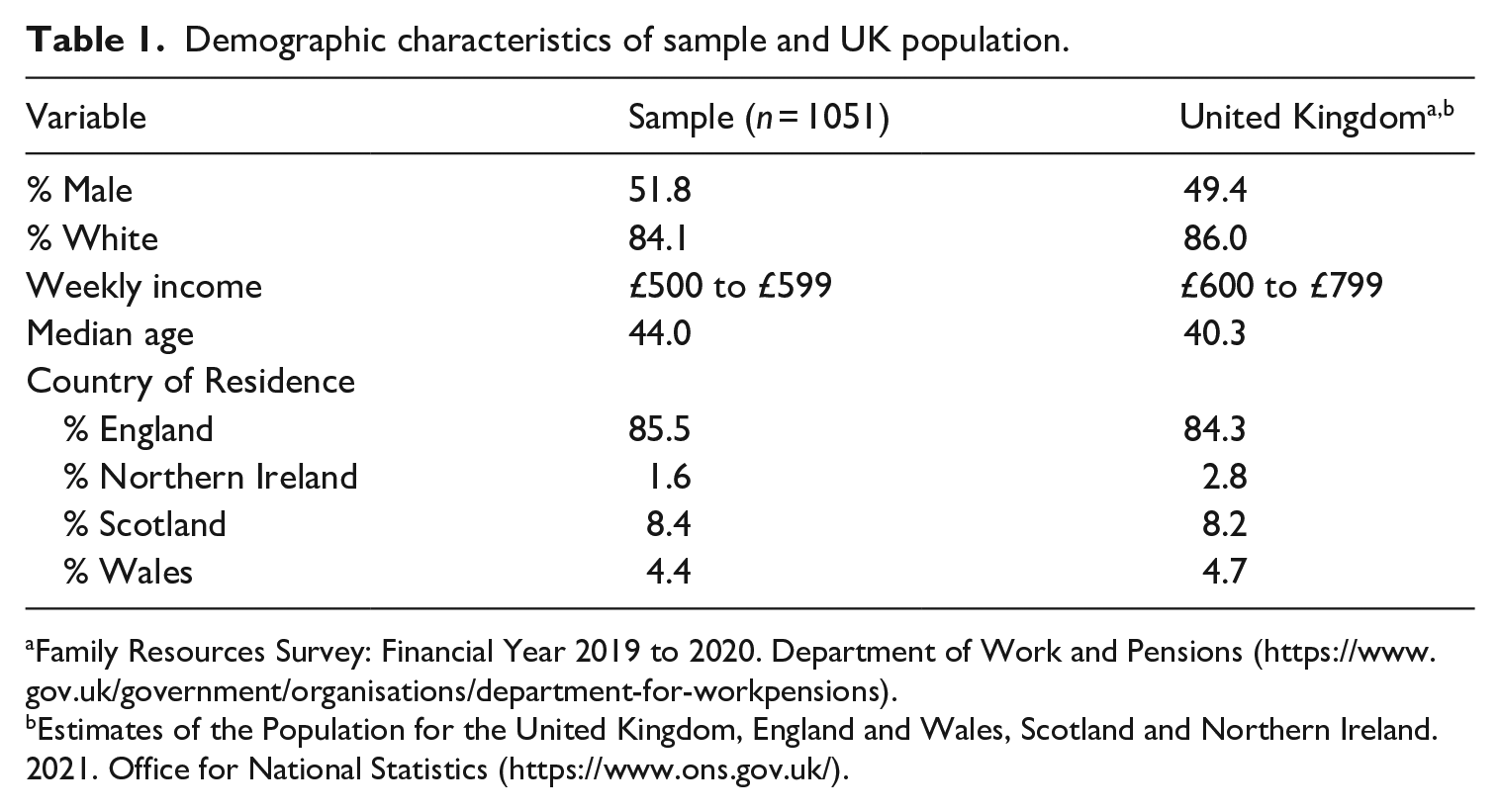
The sample used to examine perceptions about protester compliance with the police at anti-fracking protests is constructed to be nationally representative of UK residents on key demographic variables such as age, race, sex and UK country of residence. This quota sample was obtained with the help of Prolific (https://www.prolific.co). Prolific is an online survey platform that connects researchers to participants and is often used for social and economic research (Palan and Schitter, 2018). Once Prolific obtained the sample survey, questionnaires were distributed to participants (aged 18 years and older) in October 2021. 1 A total of 1051 participants responded to the questionnaires. While not all participants provided answers to all the survey questions, the number of cases used in the current analysis ranged between 973 and 1028. Table 1 compares demographic characteristics of the sample to population estimates in the United Kingdom.
Demographic characteristics of sample and UK population.
Family Resources Survey: Financial Year 2019 to 2020. Department of Work and Pensions (https://www.gov.uk/government/organisations/department-for-workpensions).
Estimates of the Population for the United Kingdom, England and Wales, Scotland and Northern Ireland. 2021. Office for National Statistics (https://www.ons.gov.uk/).
As Table 1 suggests, the sample of participants in the study sample are closely representative of the UK population on basic demographic variables.
Dependent variable
Protester compliance
To measure compliance, we used two questions that are based on research by Sunshine and Tyler (2003; see also Tyler, 1990) in their study of police legitimacy. These two items (or very similar ones) are sometimes used in the policing literature to assess the extent to which people agree that they feel obligated to ‘comply with’ (or ‘obey’) police directives (e.g. Murphy and Cherney, 2012; Pósch et al., 2021; Reisig et al., 2018). Because we are asking participants about their perceptions of anti-fracking protesters, we modified the questions to focus on participants’ perceptions about the extent to which anti-fracking protesters should comply with anti-fracking policy. Importantly, attitudes about protester compliance may be composed of legal and ethical components that participants may view as distinct. We therefore measured views about protester compliance by adding two items together: (1) ‘Anti-fracking protesters should follow police directives if those directives are right and proper’ and (2) ‘Anti-fracking protesters should follow police directives if those directives are lawful’. Respondents answered both items using a 5-point Likert-type scale (1 = strongly disagree to 5 = strongly agree) and the variable. The scores on protester compliance range from 2 to 10. The Cronbach’s reliability score for the two items that make up the protester compliance variable is α = 0.89, suggesting the variable has good internal consistency.
Independent variables
Police trust
Police trust represents the extent to which respondents believe that police motives and behaviours are honest, altruistic and effective. The variable is created by adding three survey items together. The three questions used to create police trust are (1) ‘I trust police in the UK when it comes to policing anti-fracking protesters’, (2) ‘police are generally honest when it comes to policing anti-fracking protesters’ and (3) ‘police have handled anti-fracking protesters effectively’. The responses to each variable take on scores ranging from 1 = strongly disagree to 5 = strongly agree so that the police trust variable ranges from 3 to 15. The Cronbach’s reliability score for police trust is α = 0.82, indicating that the variable has very good internal consistency.
Procedural justice
Procedural justice measures perceptions of police fairness and transparency when it comes to anti-fracking protest policing. As noted, we expect perceptions of procedural justice associated with anti-fracking protest police to be associated with trust in anti-fracking protest police. The variable procedural justice is created using five items that measure the extent to which participants agree with the following statements: (1) ‘the police treat anti-fracking protesters with dignity and respect’, (2) ‘the police take time to listen to anti-fracking protesters’, (3) ‘police use rules and procedures that are fair when policing anti-fracking protesters’, (4) ‘police clearly explain their decisions concerning the treatment of anti-fracking protesters’ and (5) ‘police make decisions about how to treat anti-fracking protesters on fact and not their personal opinions about hydraulic fracturing or protest’. When these five variables are added together the scores on procedural justice range between 5 and 25. Cronbach’s α = 0.87 for procedural justice.
New Ecological Paradigm Scale
We measured public perceptions of global environmental concern using Dunlap et al.’s (2000) New Ecological Paradigm Scale (NEPS). That scale is a universal measure that reflects general beliefs people hold about the environment. We used this scale as an indicator of the environmental attitudes by summing up scores on the 15 items that make up the scale, where scores for each variable ranged from 1 to 5 on a standardised 5-point Likert-type scale. The higher the NEPS score, the greater the concern for the environment. When the 15 items that make up the NEPS are added together (where items suggesting that humans can control nature and prevent environmental harm are reverse scored), variable NEPS may range from 15 to 75. The mean NEPS score in this sample is
Hydraulic fracturing risks
To focus on specific concerns that hydraulic fracturing is a risky technology, we create the variable fracking risks. As suggested, we propose that as perceived risks of hydraulic fracturing increase, people are more likely to believe that protesters do not need to comply with police commands. To create this variable, we asked participants if the ‘risks of hydraulic fracturing [somewhat or by far] outweigh the benefits’, if the ‘benefits of hydraulic fracturing [somewhat or by far] outweigh the risks’ or if ‘the risks and benefits of hydraulic fracturing are about the same’. This variable is scored from 1 to 5 where scores of ‘1’ represent the view that the benefits of hydraulic fracturing far outweigh the risks, while scores of ‘5’ represents the view that the risks of hydraulic fracturing far outweigh the benefits.
Protest and protester support
Support for protesters because of their higher calling to prevent harm from hydraulic fracturing may be essential in shaping perceptions about whether protesters should comply with the police. Moreover, respondents who believe in the right to protest may also be more likely to believe protesters have the right not to comply with police orders when engaging in protest activities. We measure this support for protest by asking how much people agree with the following two statements: (1) ‘I support the right to protest’ and (2) ‘I support the cause for which the UK anti-fracking protesters are advocating’. These statements are scored from 1 = strongly disagree to 5 = strongly agree and used to create two variables. The first variable measures general support for protests (i.e. support the right to protest), while the second variable measures support for a higher cause associated with anti-fracking protests specifically (support protester cause).
Control variables
To provide a robust test of our variables of interest, we also include other potentially important variables that may shape attitudes about whether protesters should comply with police comments. These measures include race, gender, economic hardship, political identity, education, age, place of residence and self-assessed knowledge of hydraulic fracturing. For example, whites, males, conservatives and older people are sometimes found to be more likely to have more positive attitudes towards the police, while those who identify as experiencing economic hardship or those who have lower levels of education may be less likely to have positive attitudes towards the police (e.g. Arthur and Case, 1994; Cullen et al., 1996; Pickett et al., 2022; Webb and Marshall, 1995). Positive views of the police have implications for police trust, views of procedural justice and perceptions of compliance with the police.
To examine the role race/ethnicity, participants were asked to self-identify the racial/ethnic group that best described them. We use these data to create a dummy coded racial/ethnic variable where White (coded as 0) is the comparison category. White (including White English/Welsh/Scottish/Northern Irish British, Irish, Gypsy or Irish Traveller) is then compared with the Black (including African and Caribbean), Asian (including Indian, Pakistani, Bangladeshi and Chinese) and Other categories (including Arab, White and Back Caribbean, White and Black African, White and Asian). Participants are asked to self-identify their gender (Gender). Those who identify as ‘male’ are scored 1, whereas those who identify as ‘females’ or other genders are scored 0. Economic hardship is created by asking participants ‘how well they are keeping up with bills and credit commitments in the last 12 months?’ Answers ranged from ‘not keeping up at all’ (scored 5) to ‘keeping up with all bills without any difficulties’ (scored 1). We use the variable economic hardship as opposed to income, since income data are missing for just over 100 participants. However, the bivariate correlation (Pearson’s r) between income and economic hardship is −0.32 (n = 901), suggesting a moderate relationship between income and hardship that may be indicative of general economic circumstances. Whether we include income or hardship in the models we estimate matters little in the overall findings, as neither are statistically significant. Thus, we made the decision to use the variable with the least amount of missing data to maximise sample size.
Political conservatives are more likely than liberals to support hydraulic fracturing in the United Kingdom (Choma et al., 2016; Williams and Sovacool, 2019). We measure political ideology by asking respondents to self-report how liberal/conservative they believe they are on a scale of very liberal (scored 1) to very conservative (scored 5). Finally, we control for age (in years) and education of participants where those possessing a university degree are scored 1 (vs 0 for those without a degree.
The final two control variables included in the analysis of beliefs that protesters should comply with police commands adjust for the urban/rural nature in which participants reside. To do this, we create a dummy variable where participants who reside in cities (scored 1), suburbs (scored 1) and towns (scored 1) are compared with those that reside in rural areas (scored 0). Finally, we control for self-assessed hydraulic fracturing knowledge as that may account for any relationship between hydraulic fracturing risks and perceptions of protester compliance. It may be knowledge of hydraulic fracturing rather than risks associated with hydraulic fracturing may account for perceptions of protester compliance. We measure knowledge of hydraulic fracturing by asking ‘How would you rate your knowledge of hydraulic fracturing?’ Responses ranged from not knowledgeable to very knowledgeable, scored 4.
Analytic strategy
This study begins by using ordinary least squares (OLS) regression to investigate perceptions about anti-fracking protester compliance with the police. OLS is used to examine the correlations between one or more independent variables and one dependent variable. Raw coefficients from OLS can be interpreted as the change in the dependent variable associated with a 1-unit change in the corresponding independent variable, while considering (i.e. holding constant) other variables in the module. Thus, this procedure lets us simultaneously examine competing explanations for protester compliance with the police. Importantly, regression assumptions for all the analyses appear to be satisfied. Model residuals are relatively normal and there is little evidence of multicollinearity between the predictors as variance inflation factor (VIF) scores for all variables fall below 2.0. There is also little evidence that any two variables interact in the model in a way that contributes to model misspecification.
We examine potential mediating effects for or major variables of interest in an additional post hoc analyses using structural equation modelling (SEM). In the SEM analyses, we examine models for both general environmental concern and concern about the risks of hydraulic fracturing specifically. We build these hypothesised models based on associations in the OLS regression and literature review on compliance and protest. Two indices used to examine the fit of the post hoc model fit are the Comparative Fit Index (CFI) and the Root Mean Squared Error of Approximation (RSMEA). In each case, the CFI is 0.99 while the RSMEA is less than 0.06, suggesting model fit is reasonable.
Findings
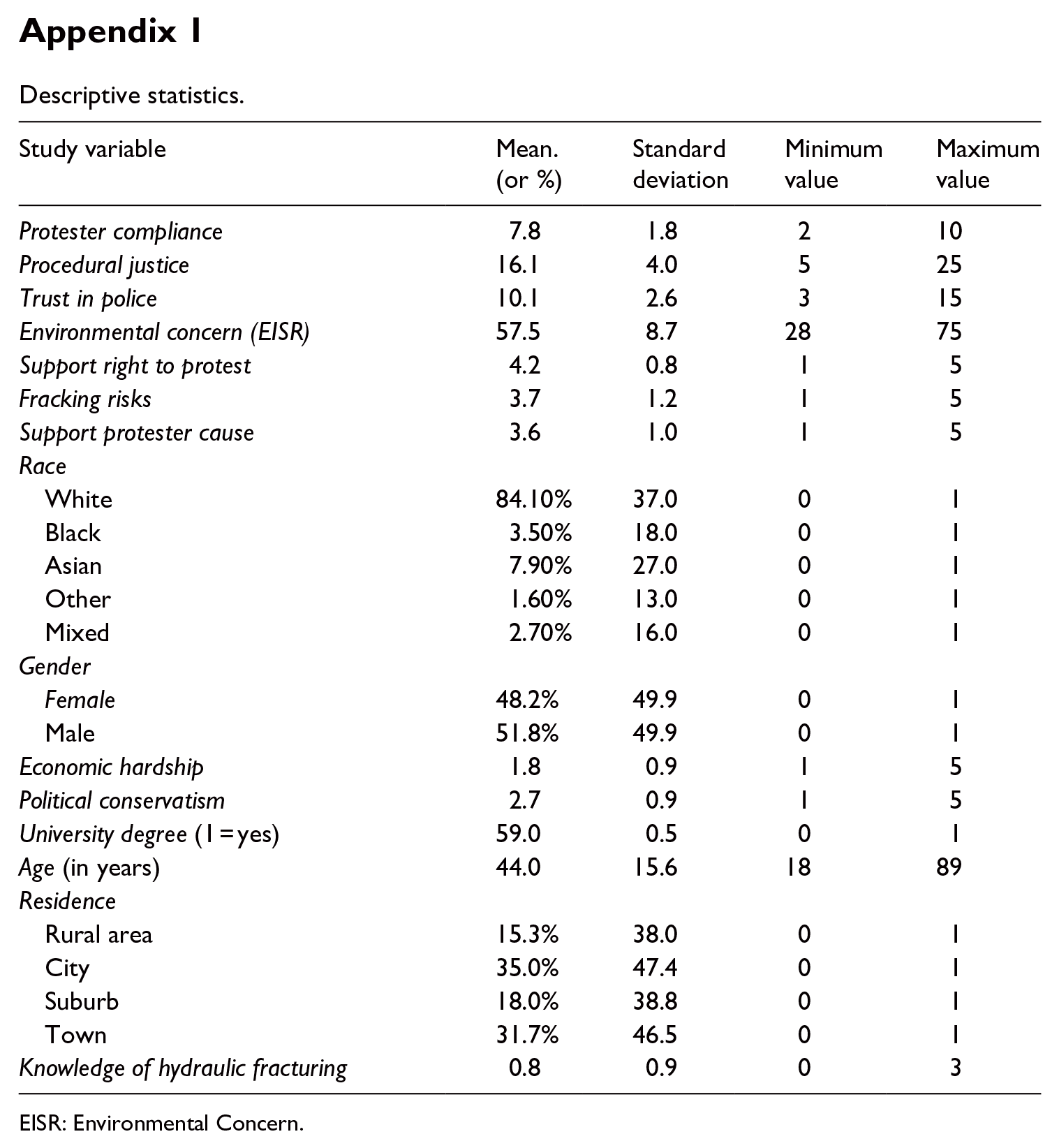
Descriptive statistics for the sample are reported in Appendix 1. Importantly, the dependent variable, protester compliance, varies considerably in that public beliefs about whether anti-fracking protesters should comply with the police at protests ranges from ‘strongly disagree’ to ‘strongly agree’. Indeed, some members of the public do not believe anti-fracking protesters should always follow police comments, even when those commands are right, proper and legal. On average, however, the mean score on compliance is 7.8 (out of a maximum of 10.0). As a result, this sample suggests that the public do not always strongly agree that anti-fracking protesters should comply with police commands and that considerable variation in perceptions of compliance exists. For instance, nearly 30% of the respondents sampled were unsure or disagreed that protesters should follow police directives if they were right and proper, while 32% said they were unsure or disagreed that anti-fracking protesters should follow police directives if those directives are lawful. These findings are reported in Figure 1(a) and (b).
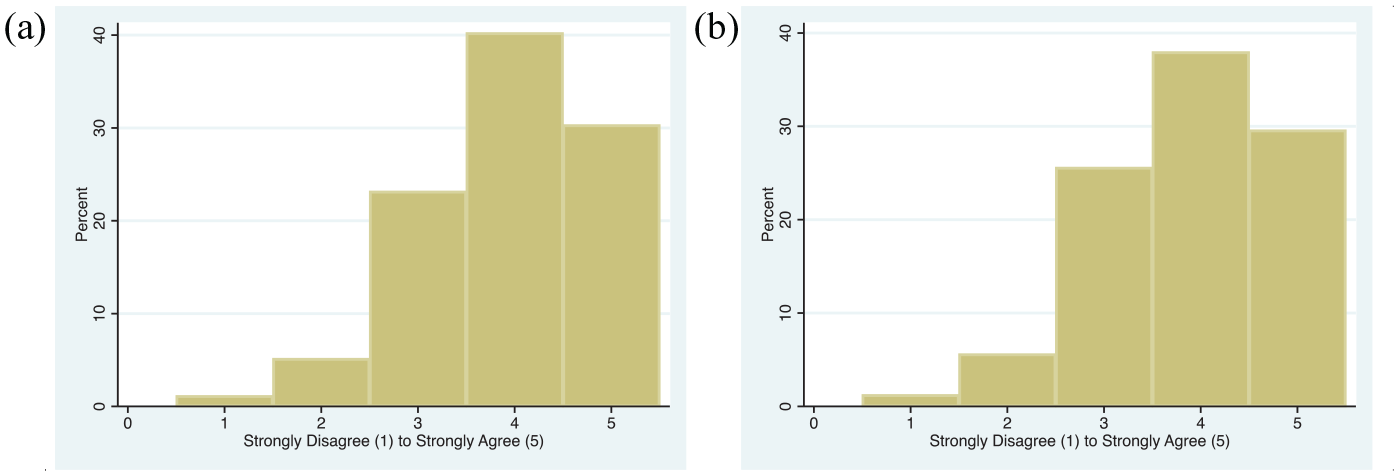
Anti-fracking protesters should follow police directives if those directives are (a) right and proper and (b) lawful.
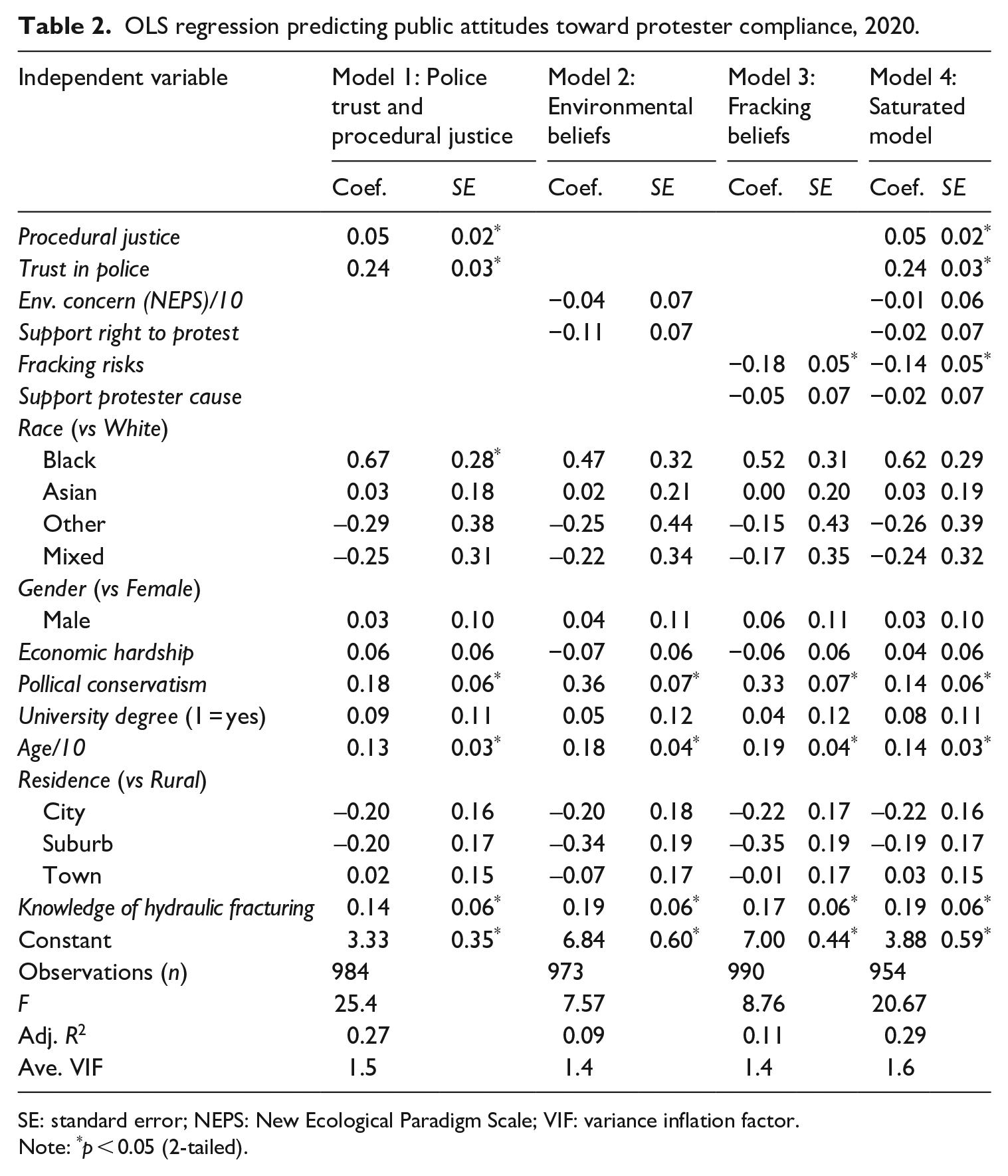
Table 2 presents findings for the regression analyses of variation in public perceptions of protester compliance. As expected, the coefficients in Model 1 (Police Trust (Hypothesis 1) and Procedural Justice (Hypothesis 2)) are statistically significant and positively correlated with beliefs about protester compliance. The correlation between police trust and compliance is substantive in that a 1-unit increase in Police Trust is associated with a 0.24 unit increase in agreement that anti-fracking protesters should obey police commands across the sample. This correlation, and its potential impact on compliance (when compared with beliefs about procedural justice) is consistent with previous criminal justice studies on protester compliance (Bolger and Walters, 2019). Findings for Procedural Justice and perceptions of compliance are also noteworthy. Across the sample, a 1-unit increase in Procedural Justice is associated with a 0.05 unit increase in Protester Compliance (Models 1 and 4, Table 2). This positive correlation between procedural justice and compliance supports Hypothesis 2, that individuals who believe anti-fracking police do not act in procedurally just ways, are more likely to believe that anti-fracking protesters do not need to comply with police directives.
OLS regression predicting public attitudes toward protester compliance, 2020.
SE: standard error; NEPS: New Ecological Paradigm Scale; VIF: variance inflation factor.
Note: *p < 0.05 (2-tailed).
Also consistent with the literature is the finding that sample respondents who identified as being Black (as opposed to being White) were also more likely to agree that anti-fracking protesters should comply with the police. However, there are more often devastating consequences for individuals who identify as Black (compared with those who identify as white) and do not comply with police directives, including serious injury and death (Anderson et al., 2021). Finally, we predictably see that among participants in this sample, those who hold more conservative views and those that are older are more likely to agree anti-fracking protesters should comply with the police. Those who report more knowledge about fracking also appear to have stronger levels of agreement that anti-fracking protesters should comply with the police.
We now turn to the findings that test whether general environmental values and the belief about the importance of protest are correlated with views about anti-fracking protester compliance. While the coefficients for environmental concern and for protest support are both negative in Model 2, those coefficients are not statistically significant. This finding is important in that it suggests that general beliefs about the environment and protest do not support Hypotheses 3 and 4 and are not likely to shape beliefs about whether anti-fracking protesters should comply with police commands. As is shown in Table 2, Black respondents are no more likely than white respondents to believe that anti-fracking protesters should comply with the police at protest events. Again, this statistically insignificant finding for race is consistent with estimates for race in Models 3 and 4 (Table 2).
Turning to Model 3, we find that specific concerns about hydraulic fracturing may shape views about protester compliance, providing support for Hypothesis 5. Across the sample, respondents who say that the risks of fracking outweigh its benefits are, on average, less likely to say that anti-fracking protesters should comply with police commands. This finding is consistent with the proposition that specific concerns about hydraulic fracturing are likely to impact support for protesters who resist police commands. Moreover, this finding is independent of protester cause (i.e. higher calling) that motivates anti-fracking protesters. Indeed, support for the protesters’ cause is not statistically significant in Model 3 (Hypothesis 6). However, in both Models 2 and 3 (Table 2), controls for political conservatism, age and knowledge of hydraulic fracturing are all correlated with protester compliance. Higher values of all three variables (i.e. more conservative, older and more confident in hydraulic fracturing knowledge) are associated with more agreement that anti-protesters should comply with police commands.
Model 4 in Table 2 includes all the variables in Models 1, 2 and 3. The coefficients for Police trust and Procedural justice remain unchanged, while the coefficient for the variable Fracking risks changes only slightly, from −0.18 to −0.14. As a result, there is evidence that respondents in this sample who believe that the risks of hydraulic fracturing far outweigh the benefits of hydraulic fracturing score roughly 0.7 points lower on views that anti-fracking protesters should comply with the police (i.e. –0.14 *5) than respondents who believe that the benefits of hydraulic fracturing strongly outweigh the risks. The coefficients for the variables Political conservatism, Age and knowledge of hydraulic fracturing are again statistically significant and the coefficients change little across the models, while the standard errors remain unchanged.
Post hoc analysis
The findings in Table 2 clearly suggest that among our independent variables of interest, views about procedural justice, trust in police and fracking risks most strongly shape views about whether anti-fracking protesters should comply with the police at protest events. The findings in Table 2 also provide a starting point for an additional post hoc analysis of beliefs about the fracking risks, support for the protesters’ cause, views of procedural justice related to policing anti-fracking protests, police trust and perceptions of protester compliance at anti-fracking protest events. We therefore draw upon SEM to see if we can better contextualise findings in Table 2 and assess a potential model for indirect effects of hydraulic fracturing risks and support for the anti-fracking protester cause through views about police procedural justice at hydraulic fracturing events on beliefs about protester compliance. The SEM focuses directly on the dependent variable (i.e. beliefs about protester compliance) and the variables procedural justice, police trust, fracking risks, environmental concern, the right to protest and support for protester cause. Protester compliance is a latent construct while the remaining variables are treated as observed variables. We produce two SEM models for comparison. The first model (Figure 2) examines general environmental concern (measured through the NEP) and beliefs about protest, while the second model (Figure 3) estimates coefficients for hydraulic fracturing risks (vs benefits) and support for anti-fracking protesters’ cause. We estimate separate models to gauge potential differences between the effects of specific and general beliefs about environmental issues (i.e. general concern vs concern for hydraulic fracturing in particular). Finally, we note that in analyses (not shown) that adding additional control variables into the models does not change the relationships presented in Figure 2 or 3, but largely replicates the relationships for those variables in Table 2. In short, the focus of these SEM post hoc models is on the theoretical variables of interest. The SEM models were estimated using Stata 15.
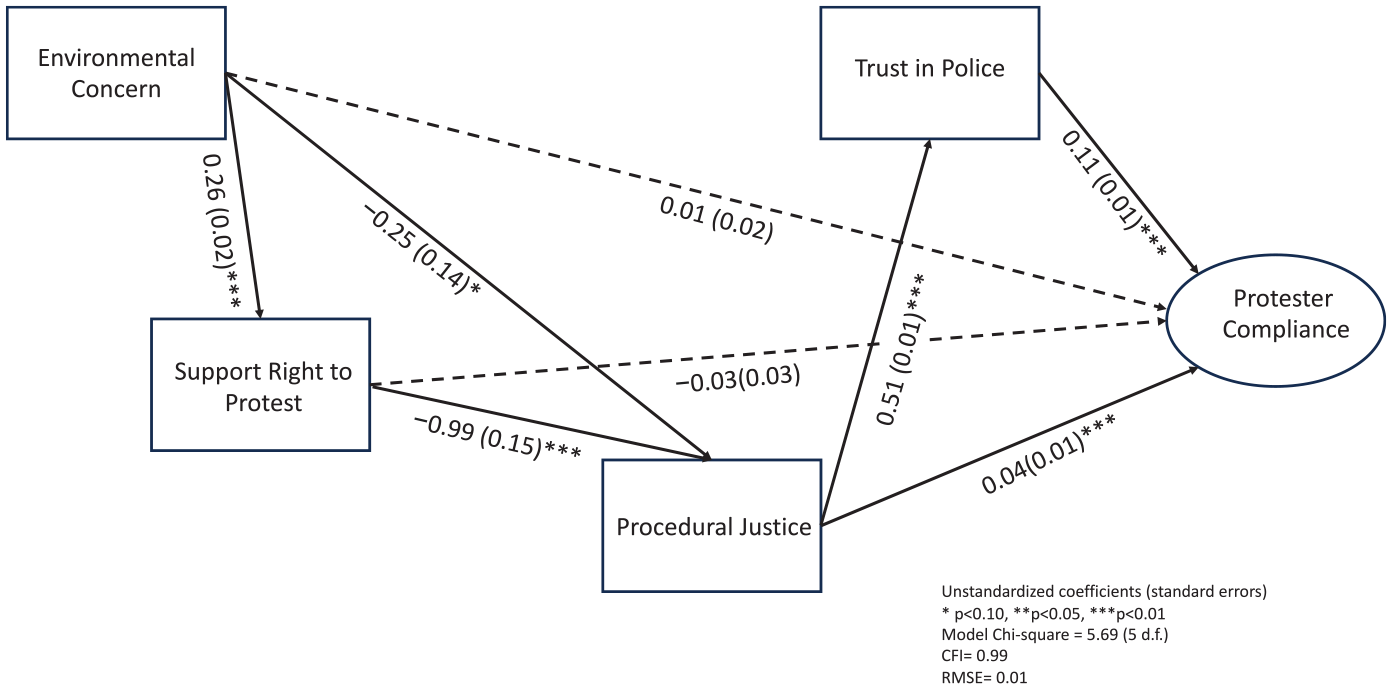
SEM of hypothesised relationship between environmental concern, support for right to protest, procedural justice, trust in police and protester compliance (n = 1028).
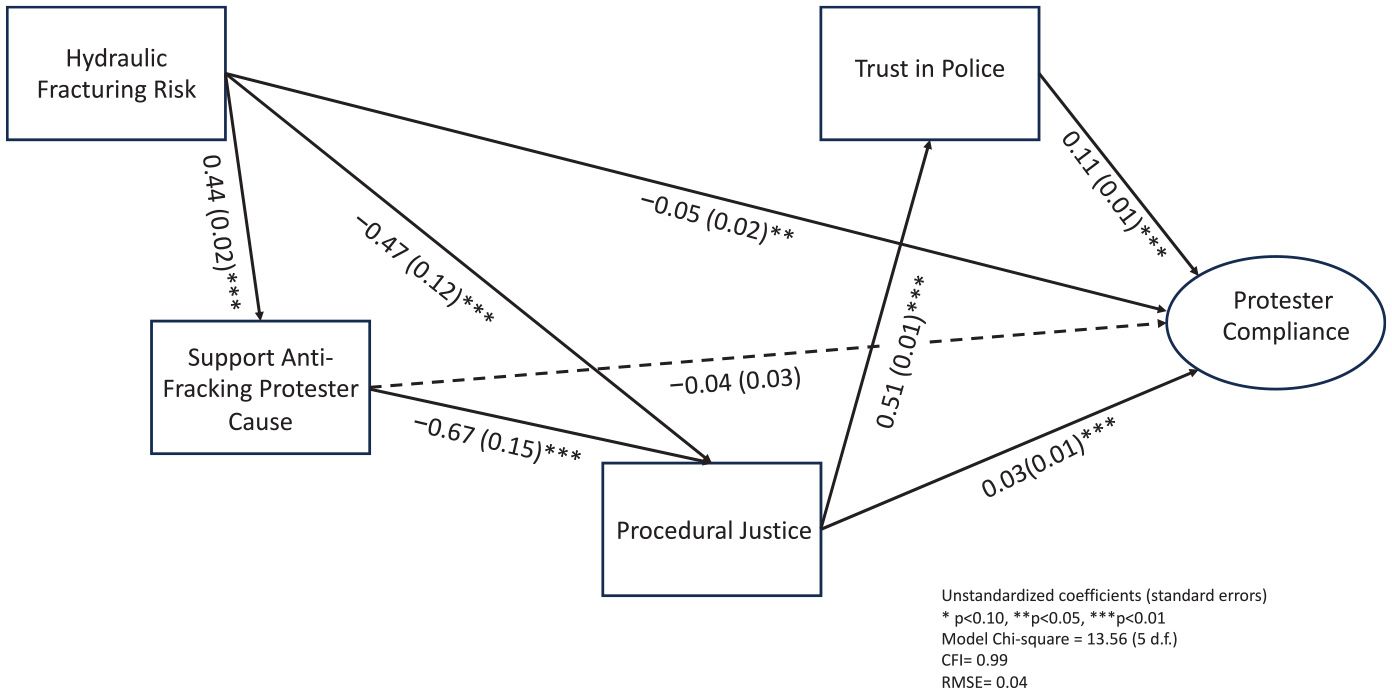
SEM of hypothesised relationship between hydraulic fracturing risk, support for anti-fracking protester cause, procedural justice, trust in police and protester compliance (n = 1028).
Figure 2 displays the unstandardised coefficients (and standard errors for those coefficients in parentheses) for environment concern, support for protest, procedural justice and police trust on protester compliance.
Consistent with Table 1, the coefficients in Figure 2 provide evidence that environmental concern and right to protest are not directly correlated with protester compliance. This post hoc analysis, then, is further evidence that general beliefs about the environment and protest are not directly related to respondents’ views about whether protesters should comply with the police. We do, however, see that the environmental concern and right to protest are negatively related to procedural justice and may therefore have an indirect effect on views about protester compliance. As concern for the environment goes up across the respondents in the sample, beliefs that anti-fracking protest police are acting in ways consistent with procedural justice decrease (Coef. = −0.25). Moreover, respondents who tend to support the general right to protest also tend to think that police at anti-fracking protests do not act in procedurally just ways (Coef. = −0.99). The right to protest is also positively correlated with environmental concern (Coef. = 0.26), suggesting that it may indirectly impact protester compliance through the variable procedural justice (which is also statistically significant in its correlation with protester compliance). Figure 2 also displays a strong correlation between perceptions that anti-fracking protester police are procedurally just and perceptions that they can be trusted (Coef. = 0.51). As procedural justice increases across the sample of respondents, so does trust. Overall, then, general views about the environment appear to impact perceptions about whether anti-fracking protesters should obey the police through beliefs that anti-fracking police are (or are not) procedurally just at anti-fracking protest events. As noted in the literature, this finding about views of anti-fracking police tends to resonate with more general observations of policing scholars who note that sympathetic segments of the public are concerned about the lack of procedural justice at UK anti-fracking protest events and that impacts trust in anti-fracking police Gilmore et al. (2019, 2020).
Figure 3 displays the unstandardised coefficients obtained from the SEM for beliefs about the risks of hydraulic fracturing and attitudes about support for the protester cause. As in Table 1, the coefficient between hydraulic fracturing risks and protester compliance is negative and statistically significant, providing evidence that across the sample as perceptions of hydraulic fracturing risks increase, levels of agreement that protesters should comply with anti-fracking protester police decrease (Coef. = −0.05). Beliefs in the protester cause, however, are not related to protester compliance directly. Still, both perceptions of hydraulic fracturing risk (Coef. = −0.47) and support for protester cause (Coef. = −0.67) are inversely related to procedural justice. Thus, across the sample as the perceived risks of hydraulic fracturing increase, so too do perceptions that the police are not acting in procedurally just ways. Moreover, the more respondents support the protesters’ cause, the more likely they are to agree that the police are procedurally unjust. Importantly, trust in anti-fracking police is strongly and positively related to views that anti-fracking protesters should show compliance (Coef. = 0.11). That is, as levels of trust in police increase, so too does the agreement that protesters should comply with police commands. Procedural justice is also positively correlated with protester compliance (Coef. = 0.03).
Taken together, the results in Figures 2 and 3 can be interpreted as providing support for previous findings in the literature that procedural justice and police trust are strongly correlated with compliance when these concepts are applied to the UK anti-fracking movement. Moreover, we find support for the hypothesis that increasing concern for the environment (using the NEPS) and the belief in the right to protest shape views about whether anti-fracking protesters should comply with the police. This appears to be happening directly in the case of perceived risks of hydraulic fracturing, but indirectly through beliefs about procedural justice in the case of (1) hydraulic fracturing risks, (2) concern for the environment, (3) support for the right to protest and (4) support for anti-fracking protester cause.
Discussion and conclusion
Environment and climate-related protests are increasingly common around the globe (Canineu, 2024; Wahlström et al., 2019). In May 2023, police in the Hague, Netherlands, arrested and detained over 1500 climate activists protesting the Dutch government’s fossil fuel subsidies by blocking a major highway (The Guardian, 2023). In September 2023, a similar event resulted in over 3000 demonstrators and activists associated with Extinction Rebellion, Greenpeace/Milieudefensie arrested, with many targeted by water cannons (Al Jazeera, 2023). In addition to mass arrests, there have been numerous laws passed to criminalise environmental protests by US state governments, including North Dakota and Oklahoma (Crockett, 2022; McClure, 2020). Such laws are part of a more recent history of cases of what some call ‘pre-emptive policing’ or ‘preventive law enforcement’ (e.g. 2009 G20 London summit protests, the 2011 Occupy Wall Street protests and more) and the inequities of policing brought forth through the Black Lives Matters movement, all of which have triggered widespread public discussion about protest policing (Smith, 2018). Despite the increased frequency of major environmental protests and the growing body of research on preventive policing of protesters, there are few investigations into public attitudes about protester and police interactions.
Our study examined public attitudes about protester non-compliance during anti-fracking protests. We found that public perceptions of environmental problems (and the risks of fracking) directly and indirectly influence whether people believe anti-fracking protesters should obey the police during protests. Importantly, members of the public who perceive that the police are acting unjustly towards anti-fracking protesters are also more likely to believe that protesters should not always comply with the police, even as they generally believe compliance is right, proper and legal.
The implications of these findings are especially interesting given the impending ecological crises documented in the literature that is creating ever increasing levels of environmental concern (Fairbrother, 2022). As public concerns about the environment continue to strengthen and as environmental and climate movement activists continue to contest state energy policies, it is likely that public perceptions of the police and, by extension, the state, as not acting in the best interests of its citizens will also grow. Such perceptions could therefore serve as a powerful force that undermines state legitimacy at times when critical decisions about future energy policies hang in the balance. Many participants in our sample simultaneously felt that the police had acted unfairly and that protesters should comply with the police at anti-fracking protests. However, our research also shows that if energy policies are perceived to be environmentally destructive, protestors’ non-compliance may help mobilise broader public opinion in favour of protester non-compliance in ways that impose significant and unintended consequences to legitimacy of the state itself.
This research provides important insights into mechanisms that influence public perceptions about anti-fracking protesters’ compliance with the police. There are, nevertheless, some noteworthy limitations in this study. First, this research draws upon public perceptions about one type of environmental movement in the United Kingdom, the anti-fracking movement. While the anti-fracking movement was well publicised across the United Kingdom, the largest direct-action protests were typically limited geographically (Gilmore et al., 2020). Moreover, hydraulic fracturing, as an energy extraction technology, was opposed by a majority of the UK public at the time data were collected for this research (BEIS, 2022). Thus, our findings regarding public perceptions of protester compliance with police may not be generalisable to other environmental protest campaigns. For example, public perceptions of protester compliance among more controversial and widespread disruptive protests, such as those associated with Just Stop Oil, Fridays for Future, and Extinction Rebellion may produce different findings, especially given the level of public disruption generated by these organisations (Young and Thomas-Walters, 2024). Thus, it is not clear how generalisable findings from this study are and it is likely that additional research on public perceptions of protester compliance is needed to draw more definitive conclusions about the potential relationship between environmental beliefs and compliance with police.
Second, research on public perceptions of civil disobedience is rare and questions measuring attitudes about protester compliance may need refinement in future research. We measure compliance using two frequently used and relatively simple statements. However, this approach comes with some conceptual limitations. For instance, policing scholars have recently developed indicators of resistance to the police (Snipes et al., 2021). Modifications of these resistance indicators may better capture the concept of civil disobedience in the case of environmental protest. Thus, the measurement of public perceptions of protesters’ obligations and/or resistance to the police is an area that requires additional study.
Third, while our sample is generally representative of the UK population (as we document in Table 1), it may still be distorted as it excludes the digitally illiterate and/or other people who are less likely to participate in online surveys. The extent and impact of any sampling bias in our research is unknown. However, research by Tang et al. (2022) finds that online surveys administered by platforms like Prolific are largely generalisable when it comes to asking questions that focus on beliefs and perceptions. Nevertheless, the online collection of perceptions of protester compliance should be given careful consideration and replicated using other data collection methods where possible.
In conclusion, this research uniquely links public views of the environment to views about policing environmental protests and perceptions about whether protesters should comply with the police. This line of inquiry is increasingly important as the effects of climate change continue to play out across the globe, attracting more attention to the human-caused ecological threats. Future research in this area can extend this line of questioning to other jurisdictions as well as investigate the opinion-mobilising effects of preventive policing tactics that target climate and environmental protestors. Moreover, we suggest that public perceptions of protest policing should be understood within the broader context of public discontent over how the state invests and supports certain energy regimes, especially fossil fuel producers over other less environmentally harmful and more socially just forms of energy. We believe supportive attitudes towards activists are indicative of deeper scepticism towards how public authorities are responding to the climate crisis. Therefore, greater attention to how diverse public(s) view policing can inform and strengthen arguments for more immediate and stringent low-carbon energy transition policies, rather than delaying such pursuits until there is some level of ‘peak’ environmental concern.
Footnotes
Appendix 1
Descriptive statistics.
| Study variable | Mean. (or %) | Standard deviation | Minimum value | Maximum value |
|---|---|---|---|---|
| Protester compliance | 7.8 | 1.8 | 2 | 10 |
| Procedural justice | 16.1 | 4.0 | 5 | 25 |
| Trust in police | 10.1 | 2.6 | 3 | 15 |
| Environmental concern (EISR) | 57.5 | 8.7 | 28 | 75 |
| Support right to protest | 4.2 | 0.8 | 1 | 5 |
| Fracking risks | 3.7 | 1.2 | 1 | 5 |
| Support protester cause | 3.6 | 1.0 | 1 | 5 |
| Race | ||||
| White | 84.10% | 37.0 | 0 | 1 |
| Black | 3.50% | 18.0 | 0 | 1 |
| Asian | 7.90% | 27.0 | 0 | 1 |
| Other | 1.60% | 13.0 | 0 | 1 |
| Mixed | 2.70% | 16.0 | 0 | 1 |
| Gender | ||||
| Female | 48.2% | 49.9 | 0 | 1 |
| Male | 51.8% | 49.9 | 0 | 1 |
| Economic hardship | 1.8 | 0.9 | 1 | 5 |
| Political conservatism | 2.7 | 0.9 | 1 | 5 |
| University degree (1 = yes) | 59.0 | 0.5 | 0 | 1 |
| Age (in years) | 44.0 | 15.6 | 18 | 89 |
| Residence | ||||
| Rural area | 15.3% | 38.0 | 0 | 1 |
| City | 35.0% | 47.4 | 0 | 1 |
| Suburb | 18.0% | 38.8 | 0 | 1 |
| Town | 31.7% | 46.5 | 0 | 1 |
| Knowledge of hydraulic fracturing | 0.8 | 0.9 | 0 | 3 |
EISR: Environmental Concern.
Declaration of Conflicting Interests
The author(s) declared no potential conflicts of interest with respect to the research, authorship and/or publication of this article.
Funding
The author(s) disclosed receipt of the following financial support for the research, authorship and/or publication of this article: This research was funded by the UK’s Economic and Social Research Council (ESRC) and the Natural Environment Research Council (NERC) as part of a collaboration between the University of Sussex Science and Policy Research Unit (SPRU) and the Social Construction of Unconventional Gas Extraction Project. The work was conducted under Challenge 5 of the Unconventional Hydrocarbons in the UK Energy System Programme (NERC/ESRC grant numbers NE/R018146/1 & NE/R017492/1).
