




Abstract
Since the 2000s, Honduras has expanded its role as a transit hub for international cocaine trafficking, with tonnes of cocaine passing through the country every year. Nevertheless, research on illicit drug flows in the country – and more generally across transit areas – remains limited. This resides in a tendency within both academic and institutional discourses to depict illicit flows as detached from societal structures, with little implications for the realities they touch. Drawing on the qualitative analysis of publicly available official US court documents on drug trafficking in Honduras and semi-structured interviews with experts on the country’s drug economy, this article addresses this gap by exploring the movement of US-bound cocaine shipments across Honduras. It explores whether, and how, transient activities such as illicit drug flows become embedded in the territories they traverse. The discussion shows the extent to which the drug trade has become embedded within Honduras’ political and territorial realities, concluding that drugs do not merely pass through transit spaces but become integrated into them. Drug traffickers rely on relationships they establish with both legal and extra-legal actors – including other drug traffickers and state officials – to receive and move drugs across the country. These relationships allow them to obtain access to ‘points of passage’ such as clandestine airstrips, security checkpoints and road networks – all of which are crucial infrastructures for facilitating the transit of drugs. Furthermore, the article reveals both legal and extra-legal actors’ role in exerting control over these logistics infrastructures and therefore in enabling the transnational flow of illicit goods. These insights contribute to broader debates on illicit flows, organised crime and the control of passage points along trade routes, while also shedding light on the often-overlooked role of transit countries like Honduras in the transnational cocaine trade.
Introduction
Since the 1970s, Honduras has been a transit hub for drug trafficking (McSweeney et al., 2018), particularly for cocaine and its precursor chemicals bound for the United States (hereafter US) (International Narcotics Control Strategy Report (INCSR), 2022). Over the past two decades, the country’s role in drug trafficking has intensified, with an estimated hundreds of tonnes of cocaine passing through every year. In 2012, US government estimates indicated that 75% of US-bound cocaine smuggling flights departing from South America first landed in Honduras (INCSR, 2014). In 2019, around 120 metric tonnes of cocaine departing from South America via air or sea made a first stop in Honduras, not counting the shipments sent via land routes (INCSR, 2020). In 2024, the former president of the country was convicted of conspiring to import cocaine into the United States (US Attorney’s Office, 2024), following his brother’s sentence of life imprisonment for the same crime in 2021 (US Attorney’s Office, 2021). Yet, the country remains significantly understudied both generally and specifically within the context of the drug trade. Why is this the case?
Illicit 1 flows move across a series of geographical and logistical spaces to reach their destination. Yet, the movement of drugs through transit areas: 2 defined as ‘midpoints on global trade routes’ (Schmidt, 2004: 98) – has received limited research attention (Berlusconi et al., 2017; Hall, 2018). This is partly due to the difficulty of pinning down geographically the movement of illicit commodities but also resides in a tendency within both academic and institutional discourses to depict flows as ‘invisible’ and ‘fluid’; as simple but obscure ‘arrows’ on a map representing objects in motion (Van Schendel, 2005), with no real implications for the realities they touch (for a discussion see Hall, 2018).
This article challenges these assumptions and brings to light the level of embeddedness of the drug trade in an often-overlooked segment of illicit supply chains: transit areas. It addresses the questions of whether – and if so, how – transient activities, such as illicit flows, can become rooted in the territory. To do so, it explores how the transit of US-bound cocaine shipments is facilitated across Honduras by drawing on a qualitative analysis of publicly available official US court documents on drug trafficking activities in Honduras, as well as expert interviews on the illicit economy in the country.
The article begins by reviewing the way in which illicit drug flows through transit areas have been addressed in the organised crime (hereafter OC) and illicit economies literature. It then draws on political science and sociology debates on ‘social embeddedness’, ‘state-crime relationships’ and the ‘control of passage points’ to explore the mechanisms drug traffickers use to facilitate the transit of drugs. This is followed by a concise overview of the history and magnitude of the drug trade in Honduras, a methods and data section and a discussion of the study’s limitations. The evidence suggests that drug traffickers rely on relationships they establish with both legal and extra-legal actors – including other drug traffickers and state officials – to receive and move drugs across the country. These relationships allow them to obtain access to ‘points of passage’ (Schouten, 2022) such as clandestine airstrips, security checkpoints and road networks – all of which are crucial infrastructures for facilitating the transit of drugs. In a nutshell, the article reveals the extent to which the drug trade has become embedded within Honduras’ political and territorial realities, concluding that drugs do not merely pass through transit spaces but become integrated into them. These insights contribute to broader debates on illicit flows, OC and the control of passage points along trade routes, while also shedding light on the often-overlooked role of transit countries like Honduras in the transnational cocaine trade.
Literature review
Despite limited research on transit areas specifically, several accounts show how the drug trade impacts on different territorial realities. In his work on Afghanistan, for example, Goodhand (2012) shows that in poppy-producing and trafficking areas of the country the opium economy has had visible effects. The proceeds from the drug economy have led to significant increases in rural wages and have become an important source of credit for rural households (Goodhand, 2012). In those spaces that are predominantly used for transit – and that are far less researched – Raineri’s (2018) account on the Sahel and the Sahara Desert shows that illegal profits from drug trafficking in the region have spurred land grabbing in an area which is otherwise unsuitable for agriculture.
For US-bound cocaine, the drug transit via Honduras remains underexplored, with research typically focusing on Mexico as the primary case study (see Calderón et al., 2013; Morris, 2013; Farfán-Mendez, 2016). The two countries have, however, different roles within the same supply chain. While Mexican drug trafficking organisations (hereafter DTOs) move cocaine at a wholesale level directly into the United States, Honduran drug traffickers manage the previous segment of the drug’s supply chain. Often referred to as transportistas (transporter groups), they specialise in the reception, storage and transportation of cocaine shipments in the country (Dudley, 2016) connecting wholesale sellers, such as Colombian DTOs, with purchasers, usually Mexican DTOs (United Nations Office on Drugs and Crime (UNODC), 2012).
Accounts of drug trafficking in Honduras have increased following the approval of a 2012 constitutional reform that allowed extradition to the United States for drug trafficking, money laundering and terrorism charges (Expediente Público, 2022). These studies have highlighted the role of DTOs in activities such as land grabbing and privatisation, cattle ranching and deforestation (Devine et al., 2021; McSweeney et al., 2017, 2018). They have also explored how and to which extent some drug traffickers govern over rural communities (Blume, 2021). Less attention has been paid, however, to the actual movement of drug shipments across the country, and, more specifically, to the mechanisms employed by DTOs to facilitate this process.
These are aspects that have been partly addressed theoretically by OC scholars within the broader context of the functioning of illicit markets. Referring to the ‘social embeddedness of organised crime’ (Kleemans and Van de Bunt, 1999) – defined as the ‘intertwinement of organised crime with the social environments’ in which it operates (Van de Bunt et al., 2014: 10) – several studies have highlighted the importance of social relations for the success of OC’s activities and for its mere existence (see Wang, 2017). Since OC operates outside the scope of the law, social relations often reduce uncertainty in transactions and help overcome cooperation challenges that are typical of extra-legal settings. Further developing the concept of social embeddedness, Van de Bunt et al. (2014) have identified two key components: ‘structural’ and ‘relational’ embeddedness. Structural embeddedness refers to the physical locations, spaces and infrastructures that criminal actors rely on for their activities. Relational embeddedness, on the other hand, involves the relationships formed between individuals within a certain network (Van de Bunt et al., 2014).
In the context of drug trafficking, these forms of embeddedness take on specific meanings. The physical infrastructures required by DTOs include means of transport like containers, trucks, planes and fast boats (Hall, 2018), often integrated into legitimate networks (Brombacher et al., 2022), as well as fixed spaces like road networks, ports and airstrips. In addition, drug traffickers depend on relational embeddedness or capital to facilitate the movement of drugs. They establish relationships with various actors to ensure their safe transit, a concept Van Schendel (2005) terms ‘the social relations of transport and distribution’ (p. 46).
These relationships encompass both legal actors – such as state officials – and extra-legal ones, including a wide array of criminal groups. Political science and international relations scholars have widely explored the interactions between criminal groups and state actors, identifying different types of state-crime arrangements, from confrontation to various forms of collusion (see Lupsha, 1996; Snyder and Durán-Martínez, 2009; Barnes, 2017). In the context of drug trafficking, collusive arrangements with state actors allow criminal groups to gain protection for their illicit activities, often in exchange for bribes (see Snyder and Durán-Martínez, 2009; Barnes, 2017). While these relationships are crucial to evade law enforcement, criminal groups also frequently interact with other criminal actors in extra-legal markets. This is especially true in those areas where multiple groups are active, some holding governance functions and wielding territorial control, while others simply operating within those territories as one criminal actor among many.
For instance, some organised crime groups (hereafter OCGs) seek to ‘establish authority over a territory and to govern interactions and exchanges within that territory’ (Breuer and Varese, 2023: 869), engaging in governance functions such as the provision of protection of legal businesses (Gambetta, 1993; Varese, 2001) and regulation of markets, or the regulation of violence and crimes and the provision of public goods within communities, among others (see Arias, 2006; Berg and Carranza, 2018; Lessing, 2021). Other OCGs, on the contrary, specialise in production or trading activities, engaging either in the production or transport and exchange of illicit goods (Shortland and Varese, 2016; Breuer and Varese, 2023). 3 In particular, ‘trade-type organised crime’, that specialises in the exchange of illicit goods, is driven largely by financial incentives and operates through flexible supply chains involving various actors (for a review, see Breuer and Varese, 2023). The commodities that are traded – such as drugs – move through a series of exchanges, with each actor typically receiving a one-time payment for their role in the process (Morselli and Roy, 2008; Breuer and Varese, 2023). This role could involve tasks such as transporting drugs or receiving them.
Recently, in Roadblock Politics (Schouten, 2022), Peer Schouten delves into an underexplored aspect of trade activities: the control that extra-legal actors establish over points of passage. Focusing on Central Africa, he reveals that rebels, local communities and state actors forge power out of exerting control over key transit points, such as roadblocks. As he points out, these ‘actors impose themselves on strategic points of passage in flows of people and goods, to derive power from the capacity to disrupt this movement’ (Schouten, 2022: 2). Similarly, geographical research on the transport of legal goods has investigated the governance of movement and the infrastructures that support it (Sheller, 2018). Shedding light on the array of actors influencing what (and who) can or cannot move (Sheller, 2018), it has addressed questions of inclusion, exclusion and access in connection to transport (Cresswell, 2006).
Yet, these aspects have received limited attention both in the literature on illicit economies and OC. While neither Schouten’s work nor geographical scholarship specifically addresses illicit trade routes or drug trafficking, their findings resonate with this article’s interrogatives on the roles of different actors in facilitating the drug trade, particularly across transit areas. Trade-type OCGs engaging in the transportation of illicit goods, for instance, need access to key transit spaces and infrastructure. Understanding how access to these spaces is acquired and controlled – and by whom – is crucial for comprehending the functioning of illicit markets and trade activities.
Drawing from this body of scholarship, this article examines how drug traffickers operating in transit areas gain access to structural capital (Van de Bunt et al., 2014). To do so, it examines the case of Honduras – a country that, while understudied, plays a critical role in the cocaine supply chain. With tonnes of cocaine passing through each year en route to destination markets (INCSR, 2020), and a tight interconnection among public, private, and criminal actors (Chayes, 2017; Ziosi, 2022), Honduras offers a wealth of empirical evidence to explore these dynamics.
Background: Cocaine trafficking in Honduras
Honduras, a small Central American republic with a total area of approximately 111,890 square kilometres (World Bank, 2021), shares borders with Guatemala to the west, El Salvador to the southwest and Nicaragua to the east. It is bordered by the Caribbean Sea to the north and has access to the Pacific Ocean via the Gulf of Fonseca to the south (see Figure 1). Its strategic location between the drug-producing nations of Colombia, Peru, and the Plurinational State of Bolivia, and North America, one of the largest destination markets for cocaine (UNODC, 2023), has positioned Honduras as a key corridor for cocaine trafficking over the past five decades.
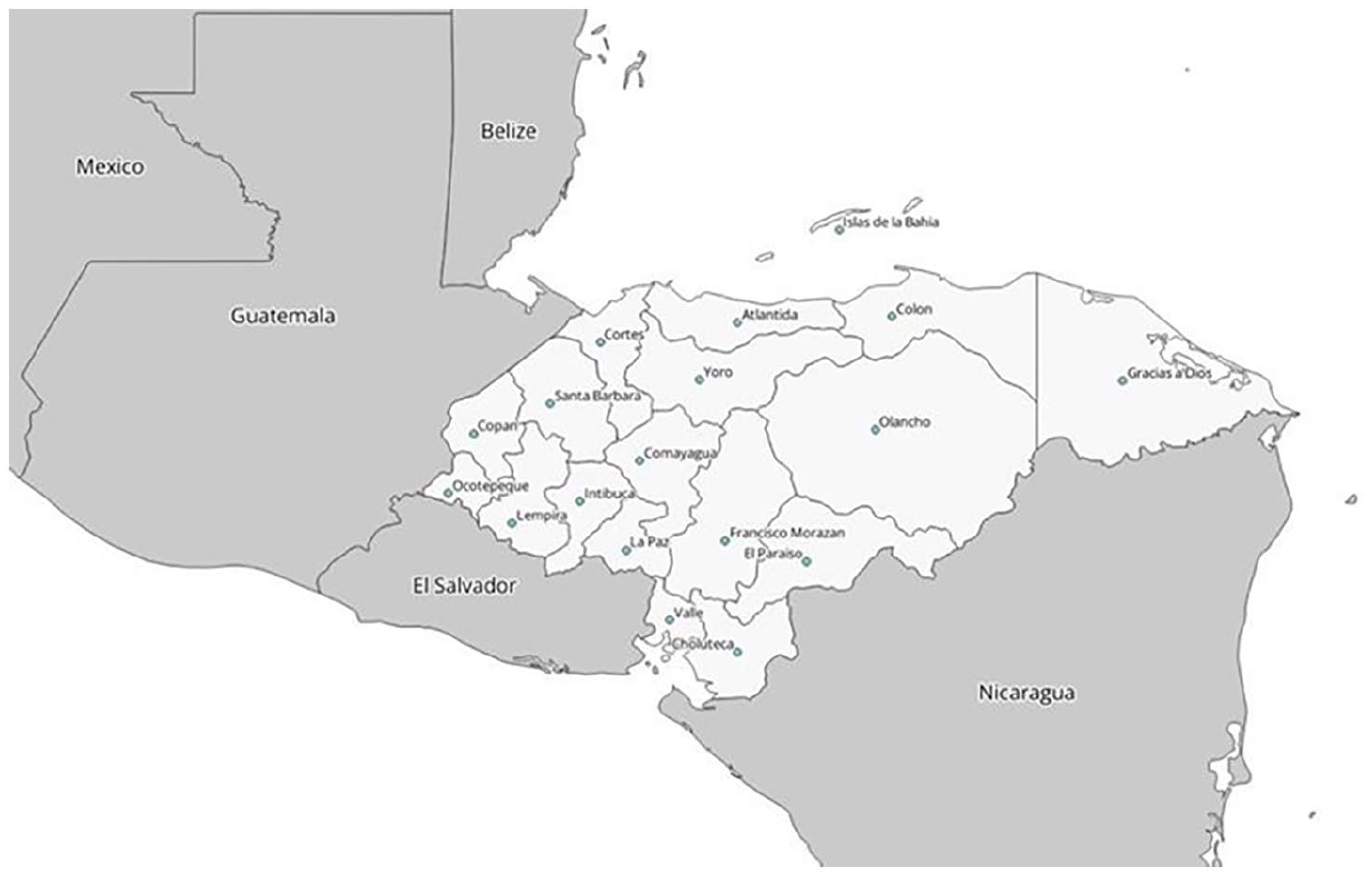
Map of Honduras and its departments.
While the country’s role as a cocaine hub has expanded in recent years, its tolerance for drug trafficking dates back to the mid-20th century (Argueta, 2013). Under the dictatorship of Tiburcio Carías Andino (1933–1949), a collaboration involving US banana boats, cargo airlines and public officials facilitated drug smuggling through the country (Argueta, 2013). This role as a transit hub then accelerated in the 1970s due to the US-led war on drugs in the region. By favouring punitive intervention against drug-producing and transit nations, especially in Colombia and Mexico, it prompted the creation of new transit routes in Central America – a phenomenon known as the ‘balloon effect’ (Wainwright, 2016: 277).
The increasing importance of Honduras as a transit point in the Americas has also been linked to the CIA’s presence in the isthmus during the 1980s (Bunck and Fowler, 2012), when the agency allegedly used the Honduran military’s participation in cocaine trafficking to fund its efforts against the Sandinista regime in Nicaragua, allowing cocaine shipments to reach the United States (Scott and Marshall, 1991). Honduras then solidified its role as a transit hub in the 2000s (McSweeney et al., 2018). In 2006, the Mexican government implemented a new national security strategy, for which it became riskier for traffickers to ship drugs directly to Mexico, pushing them to expand operations into Honduras (UNODC, 2012).
This expansion was further enabled by the political instability following the 2009 coup d’état that brought down ex-Honduran President Manuel Zelaya. As resources were redirected to maintaining order, and US counternarcotics assistance was suspended (UNODC, 2012), Honduras became an appealing base for DTOs seeking to avoid the Mexican route. This period, exacerbated by rising demand from destination countries and supply from production ones, spurred what has been referred to as a ‘cocaine gold rush’ (UNODC, 2012). Colombian and Venezuelan cocaine producers and traffickers began collaborating closely with Honduran individual drug traffickers and transportista groups to smuggle large-scale drug loads across the country and deliver it to Mexican DTOs (Dudley, 2016).
Transportista groups, drug trafficking groups described as ‘freelancers of the drug world, who move product along the supply chain and also sometimes store it for periods of time’ (Blume, 2021: 2), are responsible for receiving cocaine shipments arriving by sea, air or land and ensuring their journey across the country. Maritime routes usually involve boats leaving from the Venezuelan/Colombian border to reach the country’s Caribbean coast at ports such as Puerto Cortés, Puerto Lempira and La Ceiba (UNODC, 2012). Air routes, on the contrary, typically see private planes coming from Venezuela and Colombia landing in one of the multiple illegal airstrips of the country (UNODC, 2012). These airstrips are often found in isolated areas and across a variety of landscapes, such as forested regions, oil palm plantations, indigenous territories and communal lands (Devine et al., 2020; McSweeney et al., 2017), usually distant from law enforcement presence (Pearson et al., 2022).
To facilitate the reception and transportation of these drug shipments, transportista groups often collaborate with individual drug traffickers who are engaged in receiving, transporting and/or storing drugs. In addition, drug traffickers have often been found to collude with politicians and law enforcement officers to facilitate the traffic (Dudley, 2016), and recruit civilians from isolated and rural communities – where economic alternatives are scarce and access to infrastructure and public services is limited – to help assisting in lightning illegal airstrips and unloading drug cargoes (Bourne Jackson, 2015; Altamirano Rayo, 2021).
Despite Honduras’ significance as a transit hub for international cocaine trafficking, however, research on this topic remains limited. This is due, in part, to the inherently dangerous nature of conducting research on the subject, as discussed in the Methods and data and Limitations sections that follow.
Methods and data
This article draws on a qualitative analysis of publicly available official judicial documents of various US District Courts on drug trafficking activities in Honduras, dating from 2015 to 2024. Among the documents analysed, there are indictments, sentences, sentencing memorandums, the government’s motions in limine, 5 and trial testimonies. The documents, that are available for public consultation, were retrieved from a series of sources, including the US Department of Justice website, the InSight Crime Foundation website and Docketbird, Casetext and Scribd – large repositories of federal court cases and documents. They concern the alleged involvement of a number of Honduran nationals in drug trafficking activities.
Starting the collection in 2020, I created a database with 48 official judicial court documents, which amounted to a total of 1234 pages, concerning drug trafficking and money laundering activities in the country. As far as it is possible to assess, this is the largest dataset of publicly available court documents on drug trafficking activities in Honduras. While some of the documents have been used for research and analysis, they have never been analysed systematically in light of the questions underpinning this study.
To answer these questions, I have conducted a thematic analysis of the documents. This involved the identification of patterns of meaning within the data (Braun and Clarke, 2006) connected to the movement of drugs across the country. During the process, some documents were discarded as they concerned prominent Honduran figures who had not been convicted at the time of the case selection, 6 and others as they did not refer to the transit of the drugs across the country, but to other activities such as money laundering, or were otherwise not relevant for the article’s main aim. Although not all the documents are mentioned within the article, as some of these only provided contextual or legal information on the selected cases, the selected documents amounted to 35, with 1010 pages in total.
Information has been triangulated and cross-checked with five semi-structured interviews I held virtually between July and December 2021 with experts on drug trafficking in Honduras; three of whom have carried out extensive fieldwork in the country in the last decade. These include journalists, security analysts and scholars. The online interviews have been useful in considering how difficult access remains in Honduras to research these topics, especially at the time of conducting fieldwork. This article is also informed by secondary literature and media outlets, and by countless informal conversations held on the topic with Honduran residents and experts between 2018 and 2024. Finally, and of no less importance, the year I spent living in the country between 2013 and 2014 was crucial in the processes of collecting, analysing and disentangling the data, allowing me to better understand the country’s social and political contexts.
Limitations
This article acknowledges certain limitations. The primary concern is the reliance on publicly available court documents, which, while providing useful information, inherently present a partial and US-centric view on the Honduran drug trade, shaped by the perspectives of US judges and defence lawyers. More specifically, as the trials were held in the United States, it is also essential to acknowledge the potential influence of contextual factors on the testimonies of Honduran nationals within these documents, especially in light of the unbalanced power dynamics between the two countries.
A second aspect regards interviews, which inevitably present a subjective perspective. While undoubtedly important, individual perspectives fall beyond the scope of this study. Interviews only contributed to the analysis in terms of contextual knowledge and for triangulation purposes, as reflected in the selection of participants, which have been included based on their knowledge and expertise about the country. The same questions were posed to different interviewees in order to cross-check information whose factual nature did not depend on subjective interpretations. 7
Finally, it is important to clarify that the article does not claim to provide a comprehensive portrayal of all aspects of Honduran drug trafficking. For example, drugs are received and transported in more than one way across the country and traffickers rely on a number of different logistics infrastructures. Due to space constraints and data availability, the article only focuses on specific operational dynamics, offering depth rather than universality. The intent is to shed light on the intertwining of drug flows across transit spaces by providing empirical evidence on a much-neglected topic in a highly understudied country.
Findings: The embeddedness of illicit flows in transit areas
The evidence collected leaves little doubt: drug trafficking is deeply entangled with Honduras’ political and territorial realities, showing that drugs do not merely pass through transit spaces; rather, they become embedded in these areas. The analysis traces the movement of US-bound cocaine shipments in Honduras, from their arrival via air in the country to the moment they reach the Guatemalan border to continue their journey to the United States. Evidence shows that drug traffickers rely on relationships they establish with both other drug traffickers and state actors to receive and move drugs across the country. These relationships allow them to obtain access to ‘points of passage’ or ‘structural capital’ such as clandestine airstrips, security checkpoints and road networks.
The first section of the findings focuses on the physical infrastructures enabling the reception of air-shipped cocaine, showing how Honduran drug traffickers produce, use and aim at gaining access to – or exerting control over – these logistics infrastructures. The second section delves into the overland transit of drug shipments across the country, exploring the roles of different actors involved. These include transportista groups and individual drug traffickers, as well as state actors such as police officers and politicians. It is shown that drug traffickers establish relationships with these actors in order to negotiate safe passage for the drugs, especially across checkpoints and key transit routes.
Drug reception: Building, controlling and gaining access to logistics infrastructures
Before being moved across the country, drug shipments first require the infrastructure to be received. In the case of air shipments, this typically involves clandestine landing strips that are built and scattered across Honduras – a widespread presence documented by media outlets. While systematic data is not available, it seems that their use is nevertheless in decline. In 2012, Honduran military forces destroyed as many as 80 clandestine landing strips (Pachico, 2013), a number that decreased to 31 in 2020 (Ford, 2020), 8 reaching a low in 2024, with only 2 of them discovered in the first 4 months of the year (Woolston and Papadovassilakis, 2024).
However, it would be equally mistaken to underestimate their importance. These airstrips remain particularly relevant for understanding how drug traffickers gain access to logistics infrastructures that facilitate drug transit in the country. A recurring theme in the analysed documents, for instance, is precisely drug traffickers’ need to have access to secure landing strips to receive cocaine shipments, which is often negotiated through payments or arrangements with other traffickers exerting control over them.
This is evident in the case of a Honduran national sentenced to life in prison for his involvement in large-scale international drug trafficking in 2018 (Office of Public Affairs, 2018). During his jury trial, a fellow trafficker testified that the defendant’s primary role was to locate landing strips that could be used to receive drug shipments in exchange for payment.
What was [his] 9 role in sending shipments in these 6 planes?
To find landing strips to have water, fuel for the planes, to get the landing strips for the planes.
Is that to receive shipments of cocaine? Was that [his] role?
He was the person in charge of receiving. He would make a percentage of the cocaine that would come there. 10
The witness also revealed that, on one occasion, the defendant offered to help locate an illegal airstrip to settle a debt with another trafficker: ‘He said that he had landing strips where he could receive, where he could deal and in that way tried to pay up the debt that he had’. 11 The pattern could be identified across sources, as shown, for instance, in the trial documents from the case of another Honduran national, sentenced to life in prison in 2022 for his involvement in drug trafficking (US Attorney’s Office, 2022b), who also relied on the same airstrips to facilitate drug shipments for the transporitsta group he worked for. The documents report that on one occasion in 2011, the Honduran national, along with several of his workers, transported about 400 kilograms of cocaine by truck across the country. They moved the cocaine from the city of Tocoa, located in the northeast, to the city of La Entrada, Copán, in the west, near the Guatemalan border (see Figure 2). The cocaine had originally been sent by plane from a Colombian supplier and was going to be received at an airstrip controlled by the aforementioned defendant before continuing its journey (2021: 7). 12
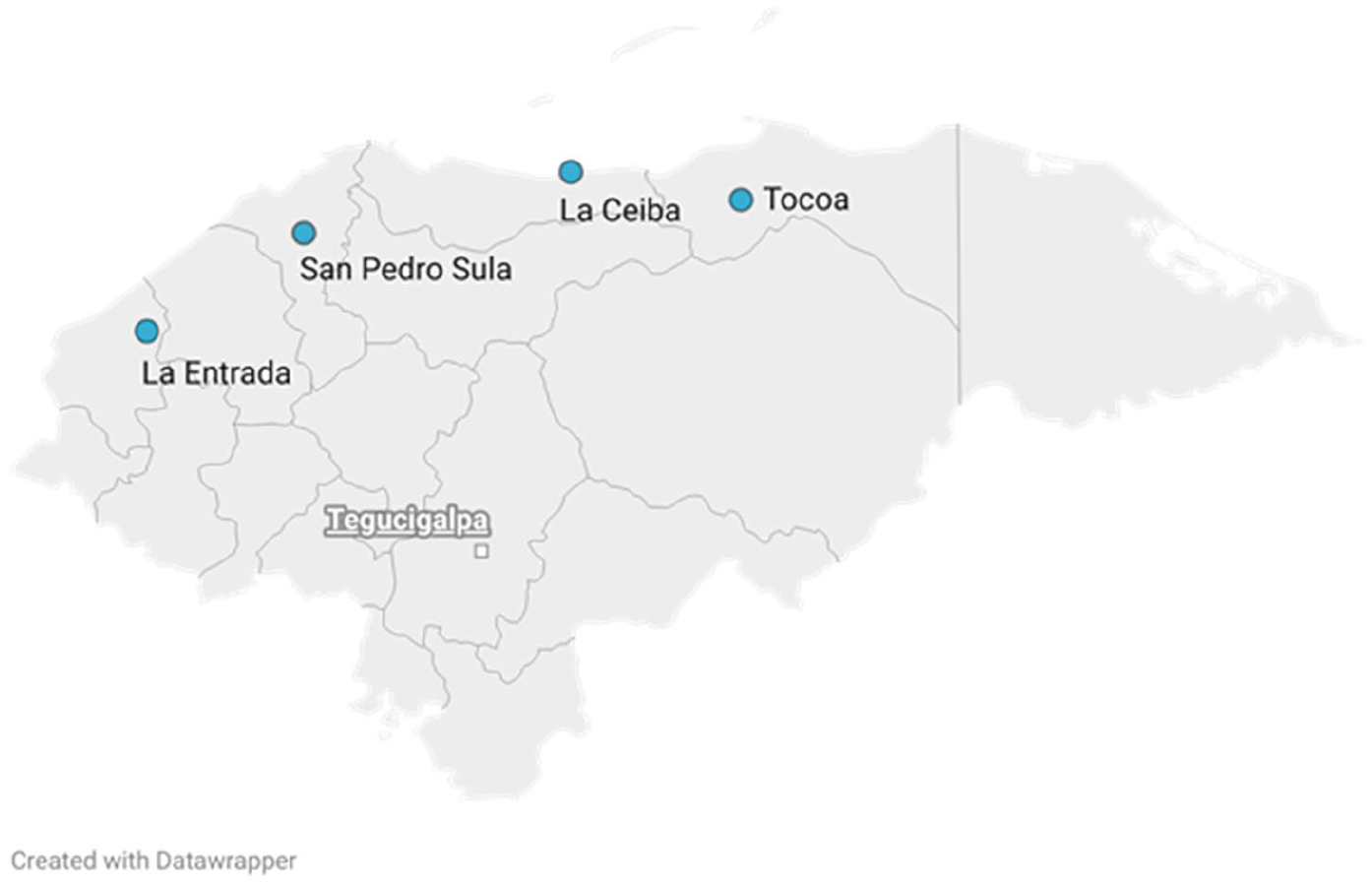
The overland transit of cocaine shipments across Honduras.
Another aspect that clearly emerged from the evidence collected is that the ability to locate and secure landing strips often relied on ties with formal authorities, at times involving the highest levels of politics. The case involving the son of a former President of the country suggests that he, 14 too, was looking for possible landing sites within Honduras. 15 His objective was to establish collaborations with the Cachiros, a prominent transportista group of the country, negotiating access to landing strips across the country through his formal connections, allegedly accepting bribes in exchange for facilitating the reception of drug shipments from South America. 16
More generally, the documents indicate a close collaboration between drug traffickers and prominent Honduran political figures, often leading to their ‘integration’ – a term defined by Barnes (2017: 973) as the highest form of collaboration between states and criminal organisations, where ‘organised crime is directly incorporated into the state apparatus’ and vice versa. This integration, as evinced by the court documents, not only provided traffickers with access to landing strips but also enabled the construction of these infrastructures, particularly in Honduras’ rural and remote areas.
For example, a former Honduran Congressman, who was sentenced to 30 years in prison in the US for conspiring to import cocaine into the country (US Attorney’s Office, 2022a), was allegedly found to be involved in the construction of an illegal airstrip near the border with Nicaragua: In or about early 2012, the defendant traveled by helicopter (. . .) to visit a piece of land on the border of Nicaragua and Honduras. (Id. at 14 ¶ 3). During the trip, the group discussed, among other things, building an airstrip to receive drug flights. Following this meeting, the defendant sent one of his workers and a member of the Sinaloa Cartel to build an airstrip at that location. The construction required approximately 75 men who helped clear and flatten the land.
17
Interestingly, some politicians seem to also be directly involved at the operational level at times, exercising some level of control over these infrastructures. According to the documents, the congressman ‘agreed to receive cocaine-laden aircrafts at his airstrips in Olancho and to be responsible for transporting the cocaine to members of the Sinaloa Cartel in San Pedro Sula’. 18 In addition, he admitted working ‘with another “drug trafficker” to receive cocaine-laden planes and helicopters at airstrips he controlled in Honduras in exchange for payment’. 19
Infrastructures were also found on private properties. For example, when in 2013 law enforcement efforts to intercept planes carrying cocaine into Honduras strengthened, the documents report that members of the Mexican drug cartel mentioned above allegedly approached the former Honduran congressman (US Attorney’s Office, 2022a) to discuss having helicopters landing at his properties, as they were believed to be more difficult for authorities to detect: During a 2013 meeting in Tegucigalpa (. . .) the defendant agreed to receive cocaine-laden helicopters at ranches he controlled in Olancho. (Id. ¶ 81). In exchange, CW-1 agreed to pay the defendant about $900 per kilogram of cocaine received by the defendant. (Id.). Between approximately 2014 and 2015, the defendant received approximately thousands of kilograms of cocaine at his ranches that were sent by the Sinaloa Cartel via helicopters.
20
Based on the evidence discussed so far, the resulting picture is as follows. In Honduras, air shipments typically land on clandestine airstrips. While some drug traffickers build and control clandestine airstrips – suggesting a high degree of territorial entrenchment – others merely negotiate access to these. Their ability to utilise infrastructures depends on the relationships they establish with both the drug traffickers who control these points of passage and state officials, including politicians, often equally involved in governing access. In other words, transient activities like drug trafficking are deeply embedded within Honduran politics. As the next section will show, these dynamics concern not only the reception of cocaine but also its transit through the country.
Drug transit: Securing safe passage for drug shipments across overland routes
Once drug shipments land and are unloaded, drug traffickers – along with their associates – are responsible for moving them across Honduras. But how is the overland transit of large drug shipments facilitated across Honduras? Again, the documents analysed highlight drug traffickers’ efforts in securing safe passage for the transit of drugs across the country through negotiations with both legal actors – such as state officials – and extra-legal ones, such as other drug trafficking groups and individuals.
As the drugs continue their journey, they often change hands among various criminal actors, sometimes requiring the participation of different transportista groups and individuals. This is exemplified by the evidence reported in ‘The Government’s Sentencing Memorandum’ for one of the trial cases (US Attorney’s Office, 2022a): The arrangement between the defendant and the Cachiros generally worked as follows: the defendant and his organization received cocaine shipments in Olancho and transported them to the Cachiros in the neighboring department of Colón. . . . The Cachiros then transported the drugs westward through Honduras to the Valle Valles and others. [. . .X]
21
then turned over the cocaine to the Sinaloa Cartel which would transport the drugs through Guatemala, Mexico, and eventually into the United States.
22
In some cases, drug traffickers would negotiate access to key points of passage with other drug traffickers holding control over specific territories and infrastructures. In the trial documents from the case of a different Honduran national sentenced to life in prison in 2022 for his involvement in drug trafficking activities (US Attorney’s Office, 2022b), it is reported that he was transporting drug shipments in exchange for payment for different transportista groups.
23
After having allegedly worked on a few shipments for the Cachiros DTO specifically, however, he also began receiving cocaine shipments directly from a Colombian supplier (CC-6 below), without the Cachiros acting as an intermediary. To do so, he sought permission from the transportista group to receive and transport his drugs across their controlled territory: Another drug trafficker who worked with [him],
24
told [him] that the defendant had received a plane containing hundreds of kilograms of cocaine from CC-6 in Cachiros-controlled territory. CC-5 also separately called [him], explained that the defendant and CC-5 were working with CC-6, and asked permission for the group to receive a cocaine-laden airplane in Cachiros controlled territory, which [he] authorized.
25
Besides negotiating access to key points of passage with other drug traffickers, drug traffickers also negotiated with legal actors, typically state officials, who in some cases provided protection for the drugs’ transit. This process is detailed in the trial of the son of a former president of the country, where a leader of the Cachiros transportista group testified about the defendant’s use of his formal connections for drug trafficking purposes in exchange for bribes (US Attorney’s Office, 2017). According to the drug trafficker’s testimony, the defendant played the role of intermediary between drug traffickers and police officers in Honduras, facilitating negotiations between these actors to enable the safe passage of drugs across the country (US Attorney’s Office, 2017). This statement, provided during the trial, is exemplificative of these dynamics.
Did you escort the truck that day?
Yes, sir.
Why did you want the defendant with you in the car while you escorted the truck with the cocaine?
If there was any problem, then I felt safe that the codefendant could talk to the police so that if there was any problems he would be able to resolve it. 26
According to the evidence contained in the trial documents, moreover, on one occasion the Cachiros needed to transport a cocaine shipment overland from Tocoa, Colón, in the northeast of the country, to La Entrada Copán, near the Guatemalan border in the west (see Figure 2). When the truck carrying the drugs arrived in Tocoa, one of the Cachiros leaders testified that he called the defendant to arrange a meeting. The defendant then allegedly arrived in Tocoa with three SUVs, whose drivers were dressed in military uniforms. The defendant and the witness then left Tocoa in an SUV, accompanied by the cocaine-filled truck and two additional SUVs escorting them. In the journey, they passed through the cities of La Ceiba and San Pedro Sula before reaching the final destination, La Entrada, using sirens when needed: 27
Were there any police check points along the path that you just described?
Yes, sir.
How many?
There was one.
What happened when you got to the police check point in the SUV with the defendant?
The defendants told the driver to turn on the siren.
What happened next?
He kind of lowered the windows a little bit and then started talking with the police officers that were at the check point, and at that time the drug truck went by. 28
In line with the evidence discussed so far, the defendant’s connections to formal powers allegedly facilitated the transportista group’s ability to move drug shipments through the country’s checkpoints without interference. In addition, trial evidence showed that in several instances, Honduran police officers supported these operations by escorting the group’s drug-laden trucks in exchange for bribes – a practice documented in the trial of the former Honduran president’s son 29 and other cases involving Honduran nationals 30 – and by providing drug traffickers with information about safe routes to follow. This is shown, for example, in the trial documents from the case of a former congressman and brother of the country’s ex-president who was sentenced to life in prison for cocaine importation (US Attorney’s Office, 2021). The documents report that, as the defendant allegedly transported cocaine from the Honduran Mosquitia and Colón Department in the east of the country to the Honduras-Guatemala border, ‘cocaine-laden vehicles would not be interdicted because of his access to the police and radar information’ (2022: 6–7). 31
These findings illustrate how drug traffickers negotiate access to key points of passage such as checkpoints and road networks with two sets of actors: on the one hand, state officials, who are typically involved through bribery, and, on the other hand, drug traffickers who exercise control over specific territories and infrastructures. This negotiation is crucial for securing safe passage for cocaine shipments across the country.
The next session will bring together the evidence discussed so far, providing a discussion of the key dynamics and showcasing the extent to which the cocaine trade has become intertwined with Honduras’ political and territorial realities.
Discussion and conclusions
This article explored an often-overlooked aspect of illicit flows: the movement of illicit drugs across transit areas and their impact on such territories. By focusing on Honduras, a key transit hub for US-bound cocaine, the aim was to address two interlinked questions: Can transient activities, such as illicit drug flows, become embedded in the territories they traverse, and if so, how?
The OC literature has shown that OC does not exist in a vacuum (Kleemans and Van de Bunt, 1999; Van de Bunt et al., 2014). It relies on structural capital (Van de Bunt et al., 2014) and networks of personal relationships (Kleemans and Van de Bunt, 1999; Van de Bunt et al., 2014) that mitigate the inherently uncertain nature of illicit transactions. Against this background, the findings of this study provide substantial empirical evidence supporting the literature, demonstrating that trade-oriented organised crime relies on both structural capital and personal relationships to facilitate drug transit.
In Honduras, the reliance on structural capital is exemplified by landing sites for air shipments, as well as road networks and security checkpoints for overland transit. While traffickers often build and control clandestine airstrips, their ability to use logistics infrastructures depends on the relationships they establish with both other extra-legal actors and state officials, including police officers and politicians. This reveals the relational embeddedness of the Honduran drug trade, showcasing its deep entrenchment with politics, including at the highest levels.
Specifically, it shows that police officers and politicians use their authority to provide what Snyder and Durán-Martínez (2009) term ‘state-sponsored protection’ to drug traffickers who, in exchange for bribes, move drugs across the country with impunity. Furthermore, the documents reveal that various state actors, including congressmen, have been directly involved in drug reception and transportation. In these instances, the distinction between legal and extra-legal actors blurs to the point where the two become undistinguishable (Barnes, 2017; Barahona, 2020).
Based on the analysis, the central argument of this article is that drugs do not merely pass through transit spaces, but rather they become intertwined with the contexts they traverse, challenging the view of illicit flows as ephemeral and detached from societal structures, and often depicted as invisible arrows moving across transit areas (for a review, see Hall, 2018). In other words, transit spaces and logistics infrastructures are not passive conduits; rather, they are active sites of negotiation where different actors regulate the flow of goods and, therefore, shape illicit supply chains. Further evidence in support of this view has been presented both within the specific context of Honduras by studies exploring drug traffickers’ involvement in land grabbing, cattle ranching, and deforestation (Devine et al., 2021; McSweeney et al., 2017, 2018), as well as beyond (see, for example, Schouten, (2022).
This research has three main implications for future scholarship. First, it confirms the importance to further explore how ‘points of passage’ (Schouten, 2022) along illicit trade routes are governed, and the broader implications of this type of control. These aspects have been underexplored in comparison to existing studies on legal trade routes and goods (Cresswell, 2006; Schouten, 2022; Sheller, 2018) and within both the OC and illicit economies literature. Second, these findings highlight the need for further exploration into the intersections between trade-type and governance-type OC (Breuer and Varese, 2023). While trade and governance activities are analytically distinct, they are at the same time often difficult to tell apart at an empirical level. This article highlights this overlap by showing how some transportista groups were not only involved in drug transportation but also controlled broader territories along key transit routes, regulating exchange and passage in these areas. Future research should thus investigate whether, and how, OCGs can engage in both trade and governance activities and how their role may evolve over time.
Third, to conclude, this article demonstrates that drug flows significantly affect and are affected by the contexts they traverse. In doing so, it highlights the need for further exploration into how the movement of illicit goods affects the transit areas they pass through (Hall, 2018; Pearson et al., 2022), shifting the focus from just the volumes and directions of these flows (Hall, 2018) to understanding the critical role that transit regions play within transnational illicit markets.
Footnotes
Acknowledgements
I am grateful to the CRIMGOV team at the University of Oxford for their constructive feedback during the development of this article. Special recognition goes to Zora Lea Hauser for her exceptional support and invaluable insights.
Declaration of Conflicting Interests
The author(s) declared no potential conflicts of interest with respect to the research, authorship and/or publication of this article.
Funding
The author(s) disclosed receipt of the following financial support for the research, authorship and/or publication of this article: This work was partly supported by the European Research Council (ERC) under the European Union’s Horizon 2020 Research and Innovation Programme (Grant agreement No. 101020598 – CRIMGOV). Additionally, this work is partly based on the author’s doctoral research, which was funded by the University of Milan.
