




Abstract
Building on recent literature on the importance of local grounded comparison and the ‘fracturing’ of the penal state, this article argues that within-case comparison of the adult and youth justice systems can shed important light on the stark differences that persist in how and why we punish. Using the case of Irish youth justice to illustrate the utility of fracturing the penal state horizontally, as well as vertically, we argue that this provides a helpful lens for making sense of the drivers of penal policy, especially the historical particularities of any penal phenomenon.
Introduction
Comparative penology has come a long way from its humble origins some decades ago. From a position where Tonry (2007) could identify only two important works in comparative penal policy (Downes, 1988; Savelsberg, 1994), to a rich, vibrant and expanding literature today (see: Cavadino and Dignan, 2006; Goldson et al., 2021; Green, 2008; Lacey, 2008; Lacey and Soskice, 2015, 2017). One of the most important advances has been the – seemingly obvious, yet for many years overlooked – point that local politics matters in shaping cross-national penal differences (Tonry, 2007). Such scholarship has in turn generated locally grounded research arguing for a more explicit and detailed engagement with the politics of penal control in order to develop more nuanced, multidimensional and complex accounts of penal change. Building on this scholarship and in sympathy with its interest in penal pluralism, this article moves from between-state comparison of penal change in either the adult or youth sector to within-case comparison of the adult and youth justice systems. Drawing on interviews with key stakeholders, we use the case study of Irish youth justice in the mid-1990s to argue that a focus on within-system continuity in the midst of penal change can provide an empirically richer account of the dimensions of the Garlandian (Garland, 2013) ‘penal state’, including their historical contingency. The article proceeds by first discussing the literature on grounded and within-case comparison, before moving in the second and third parts to examine the concept of the penal state and the methods used in the research. This is followed by a detailed analysis of the Irish case study comparing the evolution of the adult and youth justice policy during the politically tumultuous period between 1996 and 2006. The final section leverages this analysis to illustrate the unique vantage point afforded by cross-sectoral comparison.
The challenges of comparative penology
As noted, while comparative criminology has made considerable advances in recent years, stubborn questions around ‘what’ to compare and ‘how’ to undertake comparison in a way that is meaningful persist, not least the question of the differentiated nature of state ‘punitiveness’ (Nelken, 2009; Hamilton, 2014a, Newburn and Jones, 2022). Taking up these challenges, innovative work by scholars such as Barker (2009, 2013) and Brangan (2019, 2023) has sought to foreground the idea of a situated contextual reading of penal politics, together with a locally grounded, comparative political cultures methodology. Adopting sites of penal ‘exception’ or moderation as their focus, both authors have considered groups of countries that appear to be similar (viz. the Nordic states and Atlantic Isles) and have argued for the value of a culturally informed, multidimensional approach that looks within each case that is being compared. For example, Barker’s (2013) exploration of the ‘Janus-faced’ nature of the Nordic penal regimes acknowledges, on the one hand, the conventional view of these states as champions of penal parsimony and human rights, while, on the other, highlighting rights violations against those deemed unwanted or ‘undeserving’. In a similar vein, work by Muncie (2011, 2021) and Goldson and Briggs (2021) has underscored the significance of local (sub-national) differences within the youth justice system to such a degree that, ‘at the very same moments in time, variable practices within national jurisdictional borders might be as great, if not greater, than some differences between nation states’ (p. 10). The key message from such studies is that stark differences persist in how and why we punish, not just between, but also within nations in ways that continue to defy conventional tools of comparison. Indeed, as Brangan (2023) has more recently argued, this complexity ‘continues to defy our often binary comparative frameworks’ (p. 935) of harshness/leniency, continuity/change, similarity/difference and so on.
What is notable about the literature surveyed above is that it frequently involves dividing a larger phenomenon of interest (the case) into a subset of smaller meaningful units (subcases) which are then compared in order to glean insights into the larger phenomenon of interest, such as penal harshness or moderation (Mills et al., 2010). Barker’s (2013) research, for example, on the Swedish penal regime ranges far beyond the penal system, surveying police powers, the compulsory treatment of drug addicts and alcoholics, the pre-trial isolation of juvenile offenders and, most of all, its treatment of immigration violators. The advantage of such a design is that it spotlights difference thereby providing new ways of seeing and understanding. Case-within-a-case comparison also addresses a foundational principle of the comparative criminological canon, namely, the more similar the units being compared, the more possible it should be to isolate the factors responsible for differences between them (Pakes, 2019). As Nelken (2010) opines: ‘It is the apt choice of constants that set up the puzzle at the heart of any worthwhile comparison: the more the constants would seem to cover relevant factors, the more surprising and instructive the finding of difference’ (p. 35).
This applies a fortiori to within-case comparison of the adult and youth system where divergence occurs despite many of the factors usually connected with penal policy – ‘the distinctive cultural, historical, constitutional and political conditions’ (Tonry, 2007: 1) – remaining constant (Lacey, 2008; Melossi et al., 2018). An obvious rejoinder to this is the pivotal role played by diversion in youth justice and the received wisdom (at least at an international level) that children, on account of their immaturity, should be protected from the full rigours of the criminal justice system. Indeed, this was the conclusion of Zimring (2000) in his comparison of trends of incarceration for juveniles (14- to 17-year-olds) and young adults (18- to 24-year-olds) in the US between 1971 and 1995. For him, ‘one of the most dramatic demonstrations I have ever seen of how two separate courts can pursue quite different crime control policies over a sustained period of time’ (Zimring, 2000: 2493) could be explained by the diversionary objective of the youth justice system which insulated young people from experiencing a similar impact. Yet even this does not explain why diversionary measures may resonate in some jurisdictions, but not others, raising intriguing questions about the factors preserving (or not) a distinct approach to youth justice.
A cursory review of some of the countries with perhaps the most ‘child-friendly’ approaches to youth justice serves to illustrate the point. Cross-sectoral heterogeneity or ‘contrasts in tolerance’ abound in the Scottish criminal justice system, having developed a reputation internationally for both ‘penal harshness and innovation’ (Young, 1997: 116). Thus, it hosts an adult justice system that produces one of the highest imprisonment rates in western Europe (described by one Scottish criminologist as the ‘Texas of Europe’, Buchan and McNeill, 2023) alongside its unique care and justice system for children and young people (the Children’s Hearing System) which focuses on the child’s needs and welfare rather than punishment (McAlister and Carr, 2014). Similarly, if less dramatically, Australia’s declining youth detention rates since 1981 stand in sharp contrast to the consistently growing adult imprisonment rates (Goldson et al., 2021). Finally, over two decades from 1989, New Zealand hosted a punitive adult justice system alongside a progressive and tolerant youth justice system (particularly seen in its use of diversionary measures). Lynch (2013) considered the question of how and why a small jurisdiction with a population of less than five million people could host two such different systems, concluding that the adult system had experienced a politicisation of victimisation which did not find its way into the youth justice system. She found that, whereas the participation of the victim in the criminal process acted as a driver of punitiveness in the adult system, it could be viewed as a driver of tolerance in the youth justice system. Finally, in an argument with much relevance to the ‘agonistic’ criminological literature (discussed below), Lynch found that the foundation of tolerance in the youth justice system in New Zealand is not so much the design, but rather the implementation of legislation, and in particular, the use of practitioner discretion to promote tolerant practices.
Taking this penal pluralism as our starting point, we now turn to examine the conceptual tools that might best assist in interpreting it, beginning with the literature on the ‘penal state’.
Cross-sectoral comparison, the ‘penal state’ and its ‘fracturing’
Having acted as an important impetus to comparative research in the early 2000s with the Culture of Control (Garland, 2001), Garland (2013) went on to elaborate a more ‘agency-rich’ (Karstedt, 2015) approach to the comparison of penal policy, through his concept of the ‘penal state’, which offers an important bridge between macro-level structural and cultural forces and specific penal outcomes. This more fine-grained analysis of the ‘governing institutions that direct and control the penal field’ expressly aimed to ‘provide a theoretical basis for comparative and historical research’ (Garland, 2013: 502) by acknowledging the role played by social forces ‘only to the extent that they are translated into law and backed by an administrative force’ (Garland, 2013: 494). In outlining the structure and operation of the ideal-type ‘penal state’, Garland envisages the concept along five dimensions: (1) state autonomy, (2) internal autonomy, (3) control of the power to punish, (4) modes of penal power and (5) power resources and capacities. The first two aspects concern the degree to which penal officials may act against the preferences of popular opinion and those of other state institutions, respectively. With regard to the third dimension − ‘control of the power to punish’ − Garland acknowledges the significant consequences for the penal field that inhere in changes in the balance of power between various agencies over time. Prosecutors, for example, emerged the clear winners from the reforms introduced in the US from the 1980s onward as determinate sentencing policies have, in effect, transferred discretion away from the judiciary towards those making charging decisions. In the final two dimensions, Garland seeks to unpack the qualitative and quantitative aspects of penal power, asking questions such as: to what extent do states rely on negative (i.e. incapacitating) and positive (i.e. capacity-building) modes of penal power, and how does the balance between them vary? What are the legal powers, budgetary resources, professional expertise, rational organisation, system coordination, detailed statistics, trained personnel and so on at their disposal?
While Garland’s ‘penal state’ concept has been broadly welcomed, it has not escaped criticism in a field increasingly absorbed with specificity, variation and contestation in penal trends. Taking issue with the broader concept of the ‘carceral’ or ‘penal’ state, Rubin and Phelps (2017) seek to ‘fracture’ the concept, or move it away from its connotation as ‘a single homogeneous, unified or coherent entity shaping punishment’ (p. 427). Drawing on the ‘agonistic perspective’ of Goodman et al. (2015, 2017) – which sees penal development as the product of constant struggle between actors with different types and amounts of power – they point to the limitations of Garland’s view of the penal state, namely, its focus on ‘the leadership elites that direct and control the use of that apparatus and its personnel’ (Rubin and Phelps, 2017: 425). For them, by omitting reference to the agencies and front-line workers who actually implement these policies – in their case, the Michigan Department of Corrections and its radically different understanding of the crime problem – an important part of the puzzle concerning the transmission of policy is overlooked, including why ‘policy changes only sometimes follow new state mandates in a linear fashion’ (Rubin and Phelps, 2017: 434). There is little to gainsay Rubin and Phelps’s careful discussion of the penal state concept; the focus on implementation adds depth to punishment, not only as enacted but also enforced and experienced, a ‘more reality-congruent texture’ to borrow a phrase from Garland (2018: 21) himself. Moreover, a focus on analytically separating these localised, shifting and potentially conflicting preferences and concerns rather than viewing change as a mechanical process driven primarily by national sentiment is, as Goodman and colleagues (2015, 2017) have shown, essential to the study of penal development. Yet, building on and in sympathy with these arguments, perhaps the focus on the vertical fracturing of the state (from penal elites to those ‘on the ground’) may also be complemented by a horizontal fracturing of the penal field across the different sectors of the justice system? To some degree, this is acknowledged by Garland in his elaboration of the second and third dimensions of the ‘penal state’ concepts, such as his discussion of the importance of the relationship between the police, prosecutors and the penal system and the web of interconnected actors that shape the texture of punishment. It also finds a resonance in the work of Michelle Phelps (2016, 2017) on the rise of probation supervision as a criminal justice sanction and its relationship to mass incarceration. The next section introduces the case study of Irish youth justice in the 10-year period spanning 1996–2006 as a means of demonstrating the utility of this ‘horizontal’ fracturing of the penal state.
Methods: Selecting and examining the Irish case
We selected Irish youth justice as our case study because, in many ways, its steadfast commitment to its diversionary aim during this politically ‘hot’ (Loader and Sparks, 2013) period for the adult system can be characterised as the criminological equivalent of ‘swimming upstream’ or, as Rubin (2023) puts it, ‘the retention of penal policies that . . . take work to maintain’ (p. 276). The detained juvenile population in Ireland was previously divided between two institutions: a prison called St. Patrick’s Institution (run by the Prison Service) which traditionally held young male offenders aged 16–21 years and ‘special schools’ or Children Detention Centres which traditionally housed children under 16 years of age. As seen in Figure 1, which presents adult imprisonment and detention rates over a 25-year period using 1990 as an index year, the trajectories of imprisonment in the adult justice system and detention in the youth justice system have moved in opposite directions over the study period, with divergent pathways emerging in the mid-1990s. Thus, while the adult system saw an increase of 46% in the daily prison population between 1996 and 2006 (O’Donnell, 2017: 1), the population in the ‘special schools’ (detention centres for under 16s) plummeted.
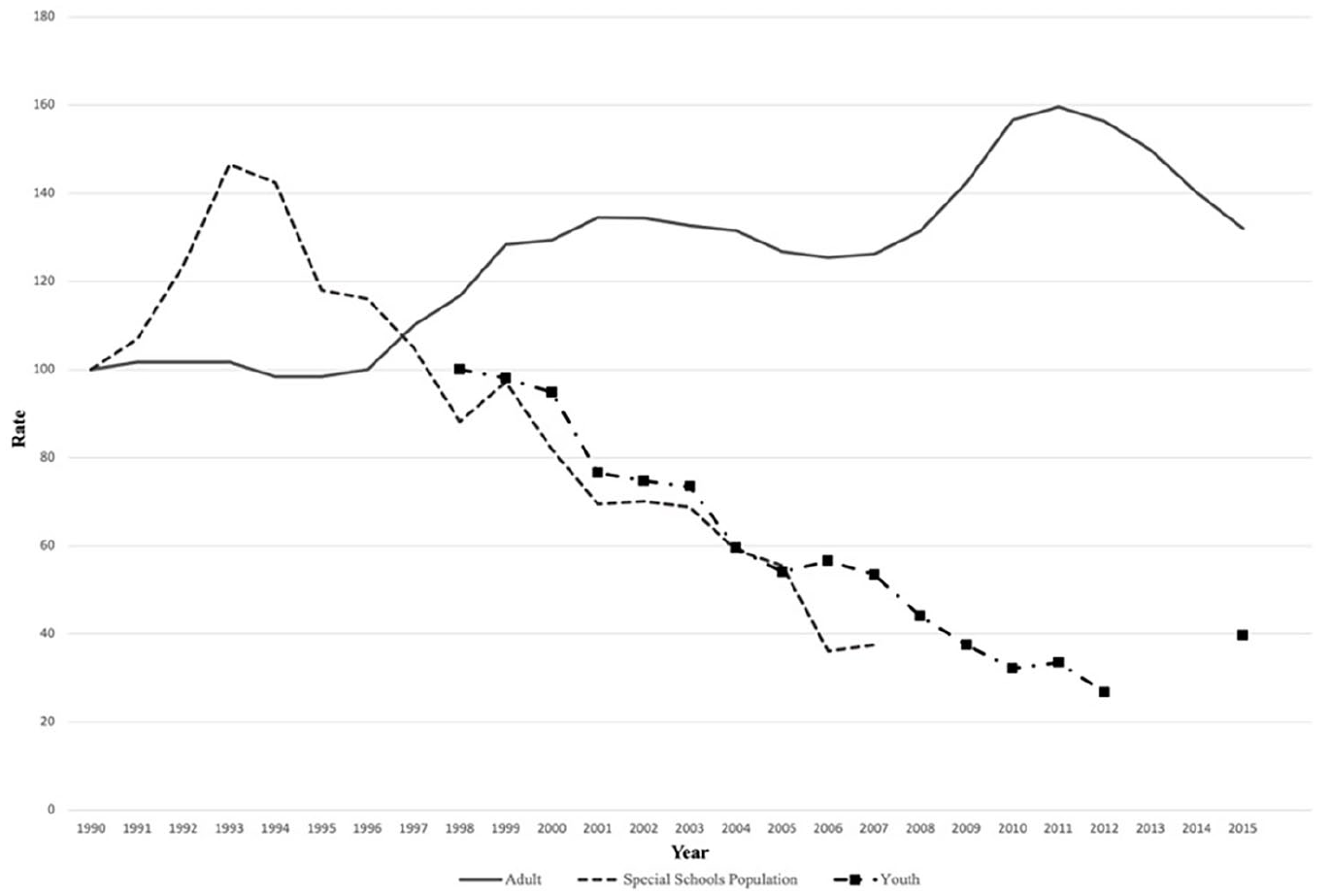
Adult imprisonment rates, special schools population in Ireland 1990–2015 using 1990 as an index year and youth detention rates 1998–2015 using 1998 as an index year.
An important part of the context for this bifurcatory trend is the 1996 murders of Veronica Guerin and Detective Jerry McCabe, which are widely regarded as an important watershed in Irish criminal justice (O’Donnell and O’Sullivan, 2003). On 26 June 1996, investigative journalist Veronica Guerin was shot in broad daylight by a group of major Dublin criminals who had been linked to illegal drugs trafficking. Her murder followed the homicide of policeman Jerry McCabe who was shot dead by the Irish Republican Army (IRA) during an armed robbery, further adding to the general sense of lawlessness (Hamilton, 2023). These killings shocked the nation and sparked a ‘moral panic’ over crime that saw law and order rise to the top of the political agenda in Ireland (Kilcommins et al., 2004). In a remarkably short space of time after the journalist’s murder, the government of the day had met public concern with a £54 million ‘anti-crime package’, described by the Irish Bar Review (1996) as ‘the most radical single package of alterations to Irish criminal law and procedure ever put together’ (p. 5). The murders also had an important impact on the resourcing of both policing and prisons. As one respondent recalls in Brangan’s (2021) study: ‘the day she (Veronica Guerin) was murdered, we got a phone call from an official in the Department of Finance. [They] rang up and said “how many jails do you want”’ (p. 91). The fallout from the murders cast a long shadow. Indeed, having fought the 1997 election on a ‘zero-tolerance’ platform, the new Minister for Justice, John O’Donoghue, delivered on his promises. Between 1996 and 2000, the Garda (Police) and Prison Votes were increased by 42% and 43% respectively and in 1999, mandatory minimum sentencing for drugs offences was introduced for the first time in Ireland, establishing ‘a new punitive dimension to Irish imprisonment’ (Brangan, 2021). This continued with the appointment of Progressive Democrat 1 Michael McDowell as Justice Minister in 2002 whose reformist zeal led to the announcement of two ‘super-prisons’ in Cork and Dublin and two flagship criminal justice acts in 2006 and 2007 (Kilcommins et al., 2004).
For the Irish youth justice system, on the other hand, the story, even during this period of law-and-order auctioneering, remained largely one of neglect (Kilkelly, 2006; Seymour, 2013). The Children Act 2001 represented the first major reform of the statutory framework addressing offences by children since the British Children Act 1908, although its provisions were not fully commenced until 2007 (Seymour, 2006). Its enactment therefore marked an important symbolic change including the abolition of the old system of reformatory and industrial schools and the establishment of detention schools and centres. 2 The 2001 Act also placed the Garda Diversion Programme (GDP) on a statutory footing, formalising a strong commitment to diversion whereby the vast majority of children in conflict with the law are diverted from prosecution. Moreover, it provided a basis for the, comparatively late, systematisation of the youth justice system, evidenced in the establishment of the Irish Youth Justice Service in 2005 and subsequent Youth Justice Strategies.
Ironically perhaps, it fell to Minister for Justice, John O’Donoghue – as we have seen a well-known ‘penal hawk’ and staunch proponent of a policy of ‘zero tolerance’ on crime in the adult criminal justice field – to introduce the 1999 Children Bill to the Dáil, as the previous Children Bill had lapsed in 1997 due to the Dáil’s dissolution. He calmly presented the 1999 Bill as representing ‘the most up-to-date and sophisticated measures for dealing with juvenile justice and associated child welfare, that took into account best international practice’ (Dáil Éireann Debates, 2000). While, admittedly, the Minister presented a key part of the 1999 bill, namely, the introduction of restorative justice conferencing, more in terms of offender accountability and victim satisfaction than in terms of advancing children’s rights (expressly stating, ‘rights and responsibilities are two sides of the same coin’), the bill’s provisions retained the central commitment to police diversion (both informal and formal) and non-custodial options contained in previous iterations of the legislation. Moreover, the period following the implementation of the 2001 Act saw several progressive moves in the area of youth justice with the opening of the National Children Detention Facility Project in June 2016 and the closure of the ‘punitive’ St Patricks Institution, a source of national and international criticism for decades (Inspector of Prisons, 2012).
Overall, therefore, it is fair to say that the political climate hardened during the 1996–2006 period, a product of two conservative Ministers for Justice, a number of ‘crime crises’ and opposition parties that now appeared more willing to play the ‘crime card’ (Hamilton, 2023). The resignation of Michael McDowell in 2007 and the subsequent financial crisis are significant in this regard, with Rogan (2013) describing the late 2000s as ‘giving way to a much more muted and cautious tone’ (p. 12). This raises important questions about the factors preserving continuity in the youth justice sector during this tumultuous period in Irish criminal justice, particularly given the reversal in neighbouring countries (England and Wales) of previous policies of diversion and decarceration (Goldson, 2020). With one important exception, it is clear that Irish youth justice ‘sidestepped some of the more punitive trends’ (Convery and Seymour, 2016: 250) that beset the adult system during this time, and thus provides a good example of cross-sectoral heterogeneity or continuity in the face of (albeit temporary) change in the adult system. The exception in question relates to a number of ‘retrograde’ (Convery and Seymour, 2016) amendments to the Children Act introduced by the Criminal Justice Act 2006 which provided for: the introduction of ‘behaviour orders’ (modelled on antisocial behaviour orders or ASBOs in England); the abolition of the presumption of doli incapax; and the lowering of the age of criminal responsibility to 10 years for children charged with murder, manslaughter and serious sexual offences. The shift to the lower age of criminal responsibility for these crimes was justified by Minister McDowell through vague references to the experience of other jurisdictions ‘where there have been murders by 11-year-olds’ and public opinion in Ireland ‘demand[ing] that criminal prosecutions should be pursued against young people accused of homicide or sexual offences’ (Dáil Éireann Debates, 2006). It is perhaps telling, however, that very few behaviour orders have been issued against children in Ireland, reflecting the widespread view that the Gardaí (Irish police) themselves do not view them as useful (O’Connell, 2012). Moreover, Ireland’s approach to serious offences is far from exceptional, and other jurisdictions have experienced significant difficulties in responding to children who commit serious crimes in accordance with international children’s rights standards (Lynch et al., 2022).
Taking this question about continuity in the face of change as our central problem, the following analysis draws on a review of relevant literature, parliamentary debates and 15 interviews with key stakeholders (practitioners, policymakers, lawyers, academics, civil society representatives, etc.) from the adult and youth justice sectors collected between March and September 2021. Interviewees were asked to reflect on key similarities and differences across the two sectors, their different trajectories over the study period and their views of the main drivers behind these similarities/differences. Interview transcripts were coded deductively using coding frames from the existing literature, with new codes inductively developed as we sifted through the data.
Irish youth justice 1996–2006: Swimming upstream?
The divergence between the two sectors referred to earlier was confirmed by several Irish interviewees whose overarching sense was that, dating from the 1990s, ‘it’s very different for children and adults’ (Irish interviewee #5: Irish judge). The sectors were described as contrasting in terms of their core characteristics. As one representative from an Irish NGO opined, ‘for the adults I would say warehousing and for under 18s, for the youth justice part, hopeful’ (Irish interviewee #8). This was similar to another interviewee (probation officer) who stated: ‘I think under 18 is more restorative and creative and family systemic’ but ‘if you come into the system after 18, I think it can be . . . not restorative, retributive’ (Irish interviewee #14).
In terms of the reasons behind this, interviewees pointed to a number of ‘protective’ factors that have served to shield youth justice from the rigours of the adult system from the early 1990s to 2006 (Tonry, 2007). Some of these were external in nature, namely, the desire to comply with the UN Convention on the Rights of the Child, which Ireland signed in 1992, and international/European human rights standards (Convery and Seymour, 2016). As interviewees stated: ‘we have been very attentive to international standards’ (Irish interviewee #3), and ‘it definitely has a huge impact . . . it can be very slow at the same time in terms of driving it but definitely in terms of the ending of kids in St Patrick’s Institution, it was pivotal’ (Irish interviewee #4). As stated by one interviewee when discussing the lead up to the 2001 reform: I think we were so far behind, we had done nothing during the 20th Century at all . . . our history . . . it was a very harsh welfare type system that we had and children being put away for years in industrial schools, very much poverty driven and all the rest, stuff that just never would happen now, so we neglected that and then I think once we signed the UNCRC, people felt they had to do it (Irish interviewee #5).
Indeed, the significance of complying with international norms is supported by the 1992 Dáil Select Committee report, which largely informed the originating legislation and is replete with references to ‘civilised standards’: It seems self-evident to this Committee that our claim to a valued place in the community of civilised nations depends heavily on our performance in this particularly sensitive area . . . Our provision must match the standards laid by these documents (Dáil Select Committee on Crime, 1992: 50).
Interestingly, in the context of this discussion, Ireland’s position as a small nation was deemed particularly important, echoing the findings of previous research that the influence of elites over policy may be easier to achieve in a smaller jurisdiction (Hamilton, 2014b; McAra, 2005). As one interviewee put it, historically, ‘Ireland fails to be the leader, we really do watch what happens internationally and then follow suit’ (Irish interviewee #4). Two other interviewees agreed that pressure for reform was borne from a sense of ‘embarrassment’ that Ireland was out of line with international standards in this area (Irish interviewee #6; Irish interviewee #8). The majority agreed that there was not the same pressure on the adult sector, for whom, ‘there is no sympathy’ (Irish interviewee #10), and therefore, when it came to public opinion, ‘it doesn’t have the same force as it might do in respect of children’ (Irish interviewee #6).
The international standards in the youth justice sector, however, had important internal implications in that they were leveraged by ‘norm entrepreneurs to highlight a discrepancy between . . . notional commitments and national practice’ (Vaughan and Kilcommins, 2008 (2007): 455). In discussing the lead up to the 2001 Act, for example, the influence of several key stakeholders or ‘champions for change’ was mentioned by some interviewees (#9, #7, #3), including the work of organisations like the Irish Penal Reform Trust, the (then) Ombudsman of Children, Emily Logan, senior civil servant, Sylda Langford and academics such as Ursula Kilkelly. As one respondent put it: [I]ndividual people with vision were really influential and whether that is TK Whitaker or whether that’s . . . Sylda Langford . . . that committed to international standards driving Irish youth justice . . . So I think the influence of very visionary and influential policy makers actually was important (Irish interviewee #3).
Other factors, however, were intrinsically bound up with criminal justice culture and the history of the Irish – and penal – state, rendering sudden change as occurred in the adult system less likely. Prime among these was the State’s history in respect of the use of industrial and reformatory schools, part of the broader phenomenon of ‘coercive confinement’ described by O’Sullivan and O’Donnell (2007), and increased public awareness of historical child abuse in this context. A watershed moment in this regard was a documentary series, States of Fear, which was aired in April/May 1999 and detailed abuse suffered by children between the 1930s and 1970s in the industrial schools and reformatories run by religious orders (RTÉ, 2010). The ensuing public outcry culminated in the Taoiseach (Prime Minister) apologising on behalf of the State to victims of institutional child abuse in May 1999 and simultaneously announcing (a) the establishment of a commission to investigate allegations of clerical child sex abuse perpetrated on children in the reformatories and industrial schools (known as ‘The Laffoy Commission’) and (b) a redress board for residential abuse victims. The States of Fear programme, the Laffoy Commission on institutional child abuse and other failures of the past were referred to by opposition deputies and senators in the parliamentary debates on the Children Bill 1999 (which became the Children Act 2001; Dáil Éireann Debates, 2001). This important historical context was also cited by interviewees in explaining the steady decline in the use of detention during the 1990s (Interviewee #6). One respondent, a civil servant, discussed the impact of the steady drip feed of reports into institutional and clerical child abuse commissioned and published in the 1990s and early 2000s (Commission to Inquire into Child Abuse, 2001a, 2001b, 2004; McGuinness, 1993; Murphy, 2005), which by the early 2000s led to ‘a growing, certainly, consciousness that hang on, we haven’t done right here as a society’ (Irish interviewee #12). The same interviewee noted that resultingly, ‘as a society, we have had to come to terms with some really uncomfortable things about how children in general were dealt with’ (Irish interviewee #12).
One interviewee discussed in depth their views on why the approach to adult and youth justice is different based on the aforementioned historical treatment of children: . . . the extent to which the state relied on . . . the religious [orders] in order to deal with children who got into trouble with the criminal law or with the authorities and it was bad enough that we were relying on the religious [orders] to do that but there was no transparency, no oversight, no scrutiny of how the religious [orders] were doing that . . . when you consider the notion that children were sent into the custody of some of these religious institutions for virtually no crime at all in [some] situations was deeply, deeply disturbing and that did not happen in the adult. The adult criminal justice system was based much more on law and to some extent transparency and the religious [orders] didn’t have the same input into that so historically there was a big difference, and most historical traditions I think haven’t entirely gone away . . . (Irish interviewee #6).
This backdrop meant that proposals to increase youth detention or impose tougher treatment of juvenile offenders, even in the febrile political atmosphere of the late 1990s and early 2000s, were probably politically unpalatable. Certainly, such provisions would have rested uneasily in a piece of legislation that also served to formally abolish reformatory and industrial schools.
Given that, as in the other countries discussed earlier, diversion forms the main point of differentiation between the adult and youth justice systems, interviewees were asked why Ireland adopted a ‘maximalist approach to police diversion’ (Forde and Swirak, 2023: 119) through the Children Act at a time when the adult system was moving in a different direction. Many interviewees commented on the organically grown nature of pre-court youth diversion in Ireland, which had been in place on an informal, administrative basis since 1963 and was placed on statutory footing by the Children Act, 2001 (Bowden, 2006; Forde and Swirak, 2023). The scheme operates through a referral system, whereby young offenders are referred to a dedicated officer (Juvenile Liaison Officer (JLO)) who then cautions the young person, visits their home and, where necessary, provides family support. In subsequent decades, it had been expanded within the wider context of the Irish community policing model (O’Sullivan, 2015), incorporating an extension of the scheme to the whole country in 1990 and an increase in the age limit for entry to the scheme from 17 to 18 years in 1991. Indeed, Walsh (2005) notes that between 1991 and 1993, the numbers referred to the programme almost doubled from 6,208 to 11,440. The effect was that the 1996 legislation (which became the 1999 bill) merely ‘wrapped around practice’ (Irish interviewee #3: an academic), and the Gardaí ‘really bought into it’ (Irish interviewee #2: a civil servant). Other interviewees supported this view, ‘I think then the Gardaí own it, at least the JLOs do, so it’s theirs, it’s not something that was imposed on them’ (Irish interviewee #3). This stood in sharp contrast to the adult cautioning scheme, which, as noted by one interviewee, ‘hasn’t got the same foundations’ (Irish interviewee #2).
Advocacy work by Gardaí was also mentioned frequently as an important factor in the commitment to diversion, something which has existed historically in Ireland and which may not be present in other areas. Reflecting on this, one senior police officer observed: I really believe the people that are doing that day job are very committed, they are well selected, they are well trained . . . there is a small very much dedicated cohort of Guards running it, and they have been consistently addressing the behaviour of children and their families from a welfare driven perspective . . . we are in the space where we believe that rehabilitation is far better than incarceration (Irish interviewee #9).
The high level of support for diversion among An Garda Síochána is important given exceptionally high levels of public confidence in the Gardaí in Ireland and its perceived status as a guardian of the community, a point to which we return below (Hamilton and Black, 2023).
Discussion: Fracturing the penal state horizontally?
Returning to the conceptual frame with which we began this article, namely, Garland’s ‘penal state’, it can be argued that the Irish case study advances the case for a ‘horizontal’ rather than ‘vertical’ fracturing of the penal state. Comparing the youth justice system with the adult system in Ireland throws up several historical factors that have operated to protect the youth justice system from departing significantly from its diversionary roots, even at a time when external events or ‘exogenous shocks’ (the double murder of Veronica Guerin and Gerry McCabe and increasing concern about ‘gangland crime’) were moving the adult system in a much more punitive direction.
Relating these factors to the penal state, the small nation’s desire to better align its youth justice system with international human rights standards undoubtedly enhanced the autonomy of those heading up reform of the youth justice sector, the relevant ‘penal state’ in this context. As one of us has written elsewhere, the penal state in Ireland − qua senior civil servants working in the context of a heavily unionised and conservative civil service − generally enjoys relatively high degrees of autonomy, outside of the ‘immediate crisis of the day’ when the Department of the Taoiseach gets involved (Beesley, 2022, cited in Hamilton, 2023). The 1996 ‘crime crisis’ was one of those moments where autonomy was significantly impacted, or as O’Donnell and O’Sullivan (2003) put it, ‘crime control became a national priority, and for a time, it was almost as if a state of national emergency had been declared’ (p. 48). At such moments, it is clear that international standards and rights instruments provided an important resource for staying the course towards diversion, in this instance, Ireland’s 1992 ratification of the UN Convention of the Rights of the Child and its desire to take its place among the ‘community of civilised nations’. In sharp contrast to his tough, zero-tolerance rhetoric in the adult sphere, where human rights norms are often met with resistance (Hamilton, 2017), in the youth justice field, Minister O’Donoghue promoted ‘enlightened’, ‘forward-thinking’ legislation that reflects ‘best practice worldwide in the area of juvenile justice’.
A second autonomy-enhancing measure in the midst of this punitive period was the wider political context in which crime policy was debated. While talk show hosts and newspaper editorials in 1990s Ireland agonised over ‘the simultaneous rise of materialistic cultural values, poverty, inequality and violent crime’ (Healy, 2020: 74), the public sphere also grappled with the legacies of institutional abuse and a plethora of reports on child abuse in industrial schools in particular. Against this context, it is arguable that decarcerative policies retaining children within their homes and communities, except in extenuating circumstances, were the only politically prudent option. As Buchan and McNeill (2023) have recently argued in the context of Scottish penal policy, the penal state is not free-floating and is significantly mediated by ‘countervailing political pressures’ (p. 336) such as, in the Scottish case, the unsettled question of Scottish independence. For them, therefore, the strong political desire not to alienate judges as a key constituency (by curtailing their independence in sentencing) meant that ‘contestation within the penal field is profoundly affected by constitutional contestation within the wider political field’ (Buchan and McNeill, 2023: 337). In like manner, youth justice policy in Ireland in the late 1990s and early 2000s operated in a ‘particularly constrained political context’ (Buchan and McNeill, 2023: 327), inflecting the detention of children, even in state-run rather than religious institutions, with a very different social meaning (Brangan, 2021; Inglis, 1998). Such considerations had little purchase in the adult sector at a time when the dramatic language employed by politicians around the problem of ‘organised crime’ evoked images of Al Capone and the prohibitionist era (Hamilton, 2005).
The final factor is less concerned with autonomy than with Garland’s third dimension of the penal state, namely, ‘control of the power to punish’ and the locus of punishment. As Garland (2013) has argued, ‘It matters where control of the power to punish is located, and it matters who controls its deployment’ (p. 500). In this context, it is a matter of no small moment that the diversionary approach to youth justice enjoyed the strong support of An Garda Síochána, an organisation which possesses significant symbolic and social capital in Ireland, and which has been described by Manning (2012) as historically ‘sacred’ in its representation of ‘authority of an indigenous sort’ (p. 354). While the continuation and strengthening of diversion under the Children Act can be construed as a kind of inertia-type argument, merely formalising practice in this area since the 1960s, the advocacy work done by gardaí in this area, as well as the resistance to behaviour orders introduced in the 2006 Act, speaks to a firmer basis for the diversionary project, one that allowed for organisational ‘buy-in’. Certainly, the status enjoyed by the organisation, as illustrated by high levels of public confidence even in the face of a string of policing scandals (Hamilton and Black, 2023), is far from unrelated to the high levels of discretion wielded by gardai under the new GDP (Smyth, 2011). As Garland (2013) has observed, the standing of penal agencies and the extent to which they are regarded as legitimate will determine the extent to which they are vested with discretionary powers, with important systemic effects. Thus, as observed earlier, numbers of children entering detention began to fall in 1993, commensurate with the expansion of the diversion programme and a doubling of the numbers entering it, long before the implementation of the Children Act in 2006 (for the links between diversion and detention, see further Bateman, 2012). In the adult system, on the other hand, the locus of control is much more dispersed, while the adult cautioning scheme, as noted by interviewees, does not enjoy the same status as the GDP.
While these historical factors combined to buffer the Irish youth justice system from the more punitive winds circulating domestically and in neighbouring jurisdictions, the Irish youth justice system has not remained impervious to more punitive measures, as illustrated by the, relatively circumscribed, irruption of the more punitive zeitgeist into the youth justice sphere in the 2006 Criminal Justice Act. Moreover, it may be argued that convergence, rather than divergence, better characterises the patterning of the two sectors in the post-2006 period, something which one of us has elsewhere attributed to inter alia the ripple effects of the post-2008 economic downturn (Hamilton, 2023). As such, it is important to view such factors not as deterministic but rather as dynamic and probabilistic, rendering an outcome more or less likely rather than inevitable (Tonry, 2007).
Conclusion
In grappling with complex questions as to why stability seems to have characterised some youth justice systems and change has characterised others, comparative researchers should not overlook within-case comparison between the adult and youth justice systems. The above analysis suggests the utility of fracturing the penal state horizontally, as well as vertically, as a helpful lens for making sense of the drivers of penal policy, most especially the historical particularities of any penal phenomenon (Rubin, 2023). To be clear, like Rubin and Phelps (2017), we do not propose abandoning the penal state concept as put forward by Garland, but rather to leverage the unique vantage point afforded by cross-sectoral or within-case comparison to put flesh on the bones of its various dimensions. This may be particularly useful in countries where differences between the adult and youth justice systems loom large, such as England and Wales (2008–present), where youth detention has dropped very significantly and adult imprisonment continues to rise, and more recently, in Canada and the US (Goldson, 2020; Webster et al., 2019). In these countries, we need to ask: how does the penal state think about youth justice differently? What actors are involved and how have they managed to sidestep the punitive impulses in the adult system? Given that, as discussed earlier, this type of comparison holds constant many of the legal, cultural and political conditions that are commonly associated with penal policy, such an approach, at a minimum, guards against the type of ahistorical accounts cautioned against by Brangan (2019). At best, we may learn more, and better, about the types of values and assumptions behind both these systems.
Footnotes
Acknowledgements
We would like to thank Ashley Rubin, Brendan Coyle and the anonymous reviewers for their comments on the earlier versions of this article.
Declaration of Conflicting Interests
The author(s) declared no potential conflicts of interest with respect to the research, authorship, and/or publication of this article.
Funding
The author(s) disclosed receipt of the following financial support for the research, authorship, and/ or publication of this article: This research was funded by the Irish Research Council Government of Ireland Postgraduate Scholarship under project grant number ircb0bf19a4b96d87c3e211079bc144967c.
