




Abstract
Statutory rape laws are designed to protect children from engaging in sexual relationships. While the enforcement of the laws on adult perpetrators is clear in its objective, its enforcement on adolescent perpetrators has been subjected to debates due to its complex nature. In Malaysia, the police and probation officers act as first responders in statutory rape cases, giving them valuable experience that can contribute to a deeper understanding in these cases. In this qualitative study, 22 police and probation officers were interviewed regarding their perspectives on the enforcement of statutory rape laws, their emotional disposition when statutory rape laws are enforced on adolescent perpetrators, and their perspective on the characteristics of statutory rape cases involving adolescent perpetrators, compared to their adult counterparts.Thematic analysis of the responses unveiled the worldview of the respondents, where some similarities in the perspectives were observed, especially in the respondents’ view on the larger purpose of the laws in protecting young girls. However, some differences were noted, such as in how the officers viewed the enforcement of statutory rape laws based on the characteristics of their profession. For instance, the police officers tended to defer to the laws and the probation officers tended to find the ‘whole story’ of the case. The findings also demonstrated the nature of sexual relationships between two adolescents, by which girls could as well be the initiators. The findings offer insights into potential avenues for improving the enforcement of statutory rape laws, particularly on adolescent perpetrators. Drawn from the responses, enforcement of statutory rape laws on male adolescents should take into account the complexity of adolescent sexual behaviour in relation to developmental and socio-religious factors.
Keywords
Introduction
Statutory rape laws exist to protect children and adolescents below a certain age from getting involved in sexual intercourse with adults (Bierie and Budd, 2016). In this regard, while statutory rape lacks the element of force, the sexual act still qualifies as a crime given the nature of the victim that results in their inability to meaningfully consent to the sexual relation (Lippert et al., 2022). Globally, statutory rape laws hinges on the legislation of the age of consent (Kanbur, 2019). In essence, the legislation stipulates that engaging in sexual intercourse with children below the age of consent is classified as rape, irrespective of whether the child consents to the sexual relationship. Malaysia, just like many other countries, sets the age of consent as 16 years old. The age of consent that points to the enforcement of statutory rape laws is stipulated in the Malaysian Penal Code, Section 375. In addition, the handling of cases involving children in conflict with the law is governed by the procedures outlined in Malaysia’s Child Act 2001.
While the objective of the application of the laws on the context of adult offenders is clear, mainly justified by the power imbalance between the partners (High, 2016; Mohammad and Nooraini, 2020), its application on similar-aged partners has received considerable contestation and debate. According to High (2016), the contestation mainly comes from the two-pronged perspectives, where one viewing sex among adolescents as ‘bad’, and another one viewing sexual behaviour among adolescents as part of a healthy development. This two-pronged perspective could also be seen in literature on the sexual development of adolescents, where the exploration of sexual behaviour among adolescents have always been associated with danger, by which the discussion gradually turns into the recognition that sexual development among children and adolescents are normal and should be expected (Jing et al., 2023; Tolman and McClelland, 2011).
While the basic foundation of the premise of statutory rape laws is that girls of certain ages cannot meaningfully provide consent to sex due to particular limitations in their development (Oberman, 1994), placing this understanding only on girls and not boys even when the latter also undergoes similar milestones in sexual development is argued to be unjust (Flynn, 2013). Furthermore, in the Malaysian Penal Code, only girls are recognized as victims of rape which indicates gender-based language in the enforcement of statutory rape laws, which is also common in other contexts. In this regard, some scholars have argued that this may be due to prevailing gender stereotypes, such as the societal perceptions of female victimhood and traditional notions of masculinity in gender roles (Bates et al., 2019; Tenzer, 2019). Recent development in modern criminal justice in some countries has, however, replaced gender-based language with a gender-neutral language that no longer sees girls automatically as the victim side of the sexual conduct and boys automatically as the perpetrators (Miller, 1994; Tenzer, 2019). This benefits adolescents in general where adolescent sexuality is seen from a positive framework rather than from a punitive lens.
Therefore, reforming the enforcement of these laws require insights that shed lights on various issues surrounding the laws, particularly on the nature of the sexual relationships between partners of similar age. Furthermore, understanding this nature necessitates exploring the socio-cultural perspectives that can influence how statutory rape laws are enforced. However, these tasks may be difficult as there is a lack of studies examining the characteristics of sexual relations involving two adolescents (Bierie and Budd, 2016), especially in Malaysia.
Sexual relations between two adolescents: Legal and Malaysian perspectives
Understanding, addressing and regulating adolescent sexual behaviour is an intricate task, and arguments have pointed to the importance of family and communities in influencing healthy sexual development among adolescents (de Graaf et al., 2010; Fortenberry, 2013; Lee et al., 2018). However, there needs to be considerations on the cultural factors that affect how parents and communities look at sexuality and talk about sex. In the Malaysian context, religious identities are a strong drive to societal behaviours, including the attitude towards reproductive and sexual health (Mohammad and Nooraini, 2020; Wong, 2012). Consequently, parents in Malaysia are shown to engage in less ‘sex talk’ with their children (Ismail and Abd Hamid, 2016). A study has shown that a lack of parental involvement in the sexual health of their children results in unregulated sexual behaviour among adolescents (Savioja et al., 2017; Zulkifli and Low, 2000). As a result, regulating sexual behaviour among adolescents mostly falls under the responsibility of the legal institutions in enforcing particular laws related to sexual behaviour.
In Malaysia, statutory rape laws are based on the age of consent as stipulated by the country’s Penal Code, Section 375. To set the context of the statutory rape cases involving peers who happen to be underage, statistics documenting the prevalence of male adolescents who were involved in statutory rape were acquired from the Contingent Police Headquarters in Penang. According to the agency, Penang, which is one of the smallest states in Malaysia, has recorded 128 cases of sexual offences involving adolescent perpetrators and underage victims between 2018 and 2022. However, one of the caveats of the current way of recording statutory rape cases is that it does not meaningfully differentiate cases involving incestuous sexual relationships (such as involving younger sibling), forcible rape with younger girls, and normative sexual relationships with underage peers. Therefore, it is difficult to ascertain the true rates of statutory rape committed by male adolescents with their underage peers based on these numbers. Furthermore, in Malaysia’s Child Act 2001, adults are legally obligated to report any knowledge of sexual conduct involving young children. This includes instances of normative sexual curiosity exhibited by children with their own peers.
In understanding adolescent sexual behaviour, it has to be noted that the legal ramifications for their behaviour are still different from their adult counterparts in Malaysia. While adults may face imprisonment, the Malaysian legal system specifies separate sets of ramifications for adolescents, acknowledging their status as children (individuals below 18 years old) as per Malaysia’s Child Act 2001; The Child Act 2001 Section 91, specifies the ramifications where the child will have to face one of eight possible outcomes, ranging from a reprimand to detention. However, given the perceived seriousness of sexual behaviour with underage girls, male adolescents who are charged with statutory rape laws almost always end up in detention or imprisonment (Teng and Mohamad, 2022), effectively exposing them to the harms of institutionalization.
Criminalizing their sexual behaviour dismisses the normative trajectories often observed in sexual development among children. A previous study in a Malaysian setting provided early insights into the mentality of juvenile offenders involved in sexual relations with underage females (Mohammad and Nooraini, 2020). The study found that, while there is no question that statutory rape laws should be maintained, implementing it on male adolescents required a more nuanced understanding on the mentality, especially considering that developing sexual interest is a normative part of sexual development. This highlights the need for more studies to further explore sexual relations involving two minors in the country, especially considering the cultural and religious norms of the Malaysian societies. However, obtaining this information in Malaysia from the perspectives of parents can be challenging as ‘sex talk’ has been viewed as taboo and inappropriate (Ismail and Abd Hamid, 2016; Makol-Abdul et al., 2009).
The perspectives of police and probations officers
Given that exploring the issues of sexual behaviour among adolescents from the perspectives of parents could be challenging in Malaysia, other parties involving the legal system whose experience dealing with statutory rape cases could provide valuable insights from a particular angle. In Malaysia, among the first responders whenever a statutory rape case is reported are the medical officers, protector officers, police officers, and probation officers. The medical and protector officers mainly deal with the victims, that is, the female partner of the sexual relation while the police and probation officers mainly deal with the perpetrators, that is, the male partners of the sexual relations.
In our knowledge, there is a dearth of studies that look into these first responders’ perspectives on statutory rape applied on adolescent offenders, despite the potentially rich account that could be obtained from their views. One comparable study explored the perspectives of law enforcement officers, examining their roles, experiences and recommendations to address statutory rape cases (Kandakai et al., 2013). The findings revealed a degree of ambiguity in the officers’ perception regarding different aspects of statutory rape cases, including whether statutory rape cases are a serious issue.
While Kandakai et al.’s (2013) study shed lights on the enforcement of statutory rape laws based on the perspectives of law enforcement agents in the United States, it is uncertain if their findings can be genenalized in the Malaysian setting, especially when considering the cultural differences and different policing styles as reported in past studies (Cheurprakobkit and Puthpongsiriporn, 2005; Mohammad and Gearhart, 2021). Recognizing the intricacies of the enforcement of the statutory rape laws on adolescent perpetrators might require particular organizational, cultural, and mentality changes by these first responders, which require local knowledge and wisdom.
Aim of the study
Based on the discussion earlier, this study aims to explore the issues of sexual relations among similar-aged partners, with consideration of those involving adult perpetrators through the insights gained from the experience and perceptions of the police and probation officers in handling statutory rape cases. In addition to understanding the issue, we are also interested in seeing how the police and probation officers viewed themselves and their profession in relation to the enforcement of statutory rape laws. Given that the police and probation officers are among the first responders of statutory rape cases involving adolescent perpetrators and heavily involved in the decision-making process for the perpetrators at different stages of adjudication, their experience and perspective could provide insights that may help in improving future practice and policymaking.
Methods
Procedure and sample
This study was part of a larger research project relating to adolescents’ sexual behaviour with underage partners from various angles. The study has been granted an ethics approval by The Ethics Committee of the University of Trás-os-Montes and Alto Douro (CE-UTAD). Before respondent recruitment took place, permission has been obtained from the Penang Contingent Police Headquarters and Social Welfare Department Malaysia to recruit police and probation officers, respectively. To recruit the police officers, a list of the police officers selected for the study was given by the agency in advance. The list included police officers with experience in handling sexual crimes (which was a criterion we requested when we were provided with the list of potential respondents), who had worked in different types of location, encompassing both rural and urban areas.
The recruitment of probation officers employed a mix of convenience and snowballing sampling. To begin recruitment, the probation officers’ details were obtained from the Department’s directory, and their offices were called to see if they were interested to be the respondents in the study. Some of the probation officers also facilitated the recruitment process by referring the study to other probation officers who might also be interested. At the end, this qualitative study recruited 13 police officers (labelled R1 to R13) and nine probation officers (labelled R14 to R22) for the interviews, resulting in a total of 22 respondents.
A majority of the police officers held the rank of inspector and were predominantly female (only one male officer). Their experience in handling sexual crimes ranged from less than 1 year to over 8 years (including still in service). However, the probation officers comprised an equal number of male and female officers (four males), with the experience of serving as a probation officer ranging between less than 1 year to more than 15 years (including still in service). All respondents were Malay.
The interview protocol and analysis
The interview protocol was inspired by Suzuki’s (2020) concept of readiness, assessing respondents’ attitudes, emotional dispositions and knowledge about the topic at hand. Suzuki’s concept of readiness was developed in the context of restorative justice; however, the elements of readiness introduced in his work align with the aim of this study which seeks to explore the enforcement of the statutory rape laws in Malaysia, with considerations of both adolescent and adult perpetrators and if reforms are needed.
The interview protocol adopts Suzuki’s (2020) concept through the three dimensions discussed in his work, comprising ‘orientation’, ‘emotional disposition’ and ‘knowledge’. In the interview protocol, we asked the respondents about their perspectives on why statutory rape laws were enforced on both adult and adolescent perpetrators (the dimension ‘orientation’), their emotional disposition when presented with a case of sexual relation involving similar-aged partners (the dimension ‘emotional disposition’), and their insights on the distinctions they perceived in sexual relationships with underage females involving adult and adolescent perpetrators (the dimension ‘knowledge’). For the second item which is the respondents’ emotional disposition, the protocol included a newspaper clipping reporting a statutory rape case involving a 17-year-old male and his romantic partner, a 15-year-old female adolescent. The clipping was meant to serve as a prompt for exploring the respondents’ emotional disposition whenever presented with similar cases.
All interviews were recorded unless the respondents requested otherwise. For the recruitment of the police officers, although the agency provided the list of potential respondents, measures were taken to ensure the privacy of the respondents. During the recorded interviews which were conducted individually, the respondents were not referred to by their name, and all recordings were discarded immediately after transcriptions. Similar privacy measures were also implemented to probation officers participating in the study.
All interviews were transcribed and translated to English using a professional translator. The translated responses, then, were analysed using a thematic analysis by Braun and Clarke (2006). Their proposed steps involve familiarization with the data, generation of initial codes from the responses, organization of the codes into themes, reviews of themes, defining of themes and reporting. In analysing qualitative data, important considerations should be placed on the potential for biases during interpretation of data (Galdas, 2017). In qualitative studies, addressing the issue of biases touches upon what past scholars call as trustworthiness, rigour and quality (Golafshani, 2003). Among the most common strategies to address biases in qualitative data interpretation are memo keeping, member checking and professional checking. In this study, memos were kept even during the interview phase itself, that provides the interviewers with the chance to reflect what has been said back to the respondents (i.e. member checking). During the analysis process, the data interpreters bounced back ideas and thoughts on the emerging themes, adopting a professional checking strategy.
Results
The interviews mainly explored the perspectives of the police and probation officers on the enforcement of statutory rape cases on both adult and adolescent perpetrators. Upon analysing the responses based on Suzuki’s (2020) three dimensions of ‘readiness’ (i.e. ‘orientation’, ‘emotional disposition’, and ‘knowledge’), distinct themes were developed that reflect the officers’ recurring patterns of experience and perspectives. Our analysis suggests that neither the years of experience nor genders of the officers appeared to influence their responses. However, the type of professions has some impacts on the insights provided by the respondents.
Perspectives on the implementation of statutory rape laws
This set of protocol item asked the respondents, based on their perspectives and experience, why statutory rape laws are enforced and implemented on both male adult and adolescent offenders. This item is meant to be beyond what is stated in law, but also the wisdom behind the implementation. Responses to this item can be divided into the following four themes: ‘as a means of protection’, ‘as a means of punishment/rehabilitation’, ‘as a means of prevention/control’, and ‘provision of laws’. These themes reflect the respondents’ acknowledgement in the roles played by the larger system in addressing cases of sexual relationships involving children.
The first theme, ‘as a means of protection’, reflects the responses highlighting the role the statutory rape laws play in protecting children, especially girls, from the lure of sexual relations with a male partner. This has been reported by 11 police officers and four probation officers, signifying a degree of agreement between the two professions. Most of the respondents mentioned that the girls are children with a limited level of maturity who can easily be manipulated. R2 said, Statutory laws are created in Malaysia, to protect and try to give justice to victims. As what you said earlier, rape of any kind is wrong when it involves an underage victim. Doesn’t matter if it is an underage suspect or an older person. When it comes to rape, when he [the perpetrator] fulfils the conditions, he is wrong . . .
R4 reflected back from her experience interviewing the persons involved in past cases that technology has played an important role in magnifying this lack of maturity: At that age, not all have a mature mentality, right? She thinks it’s not wrong, even though that it is not the right thing. That’s from me taking the statements of the victims and also the perpetrators themselves . . . In the past, it used to be just YouTube and Facebook, but now there are more and more things.
Probation officers in this study whose responses belonging to this theme also largely echoed the same sentiment on the need for protection. One probation officer, R14, made an additional comment that reflected on the Malaysian society’s view on gender norms. She said, . . . because girls are weaker and will always be under control by men. There is a gender issue here, because men usually initiate [romance] . . . because maybe it has to do with the culture that men begin first, and girls have to wait.
More probation officers have recalled that girls might also play a role as perpetrators in the sexual relations, especially when their partners were adolescents too. As reference, only one police officer has made a similar observation. For example, R17 stated, . . . now girls can also be perpetrators, but alas, [in the eyes of the law] they are still considered victims.
For the theme ‘as a means of punishment/rehabilitation’, the respondents emphasized the role of the laws in punishing the perpetrators as a consequence of their action. This theme was predominantly noted among probation officers, which was surprising considering that police officers are generally associated with a ‘punishing’ role, whereas probation officers are typically associated with a ‘nurturing’ profession in Malaysia. For example, R22 said, . . . to give lessons to the perpetrators as well. Once punished, they will feel frightened off.
R17 mentioned that the punishment was necessary for religious reasons. She stated, . . . as a punishment and a lesson. It is still necessary to implement it because he [the perpetrator] has carried out a behavior that is prohibited by religion.
For both the police and probation officers, the statutory rape laws are necessary because it serves as ‘a prevention measure’. According to these respondents, the laws exist as a strategy to deter male individuals from engaging in sexual relations with an underage female. For example, R12, a police officer stated, [We need this law] to stop rape from happening. If these laws exist, the men will be afraid because the punishment is heavy. If we have these laws, if the suspect knows [about these laws], he will be afraid [to have sex with under females].
Meanwhile, R16, a probation officer, specified her comment in the context of children and adolescents. She said, [The law exists] to control sexual misconduct among minors, to prevent it from becoming a norm.
In ‘provision of laws’, the theme developed from the responses of the police officers who stated that statutory rape laws are enforced because they simply exist. This is unsurprising given that part of professional duties of a police officer is to enforce the laws. While only two police officers mentioned this when asked about the implementation on adult offenders, a majority of the police officers responded similarly when asked about its implementation on adolescent offenders. This signifies a consistent stance among the police officers regarding law implementation, as long as it is within the legal provision. For example, R5 elaborated, For me, not only in the context of the rape cases, but the laws in general serve as guidelines [of our lives]. So, when we talk about children here, and not to mention when we talk about rape cases, of course we need transparent guidelines regarding what is happening, how to address it, and of course when it happens what actions we need to take.
R9 said reiterated that the law stays the same regardless the age of the perpetrators. She said, He’s the same whether he [the perpetrator] is a minor or not, the laws are the same. But, for a minor, he will be referred to the Social Welfare Department as well to get his probation report.
Emotional dispositions of the respondents
The second set of the protocol item explored the emotional disposition of the police and probation officers whenever they were presented with cases involving sexual relations between two partners who were similar in age. For this item, the police and probation officers were strikingly different in their responses. The themes observed among the police officers are ‘as consistent with the laws’, and ‘biased laws’. Meanwhile, a majority of the probation officers exhibited responses that can be thematized into ‘facts of the case’. However, both of the police and probation officers do share the propensity to express regular emotions, such as disappointment, anger and sadness that can be thematized into ‘polarized victim versus perpetrator views’.
The theme ‘as consistent with the laws’ demonstrates the police officers’ agreement with the legal repercussions of being involved in a sexual relationship with a minor, even if the other partner was a minor himself. According to the respondents, the expectation that the male adolescent had to be processed through laws was consistent with legal provisions in the legal system, akin to the aforementioned theme of ‘provision of laws’. This signifies a consistent alignment in the police officers’ thoughts and professional identity in their responses. R5 stated, When speaking in the context of being a police officer, I’m not surprised because I’ve handled many cases like this. It’s not one or two, it’s until giving birth near the side of the road, It’s the children, regardless of age, regardless of race and regardless of whether you’re rich or poor or smart, there are those in the universities, in high schools, too . . .
In addition, R7 simply reiterated what would happen legally whenever a case was reported, For me, it is necessary . . . the boy will be charged in court, tried, found guilty, sent to a juvenile school until the age of 21 so that we can repair his character, make him realize his mistakes.
The theme ‘biased laws’ was only observed among the police officers, who stated that the laws were biased towards viewing only the male partners as the perpetrators, especially in the case of two adolescent partners. It was surprising that the similar theme was not observed in the responses by the probation officers. However, given that the probation officers in this study did reiterate the similar point in other questions, it could not be concluded that they did not share the same sentiment. For example, R12 said, There are many feelings that I have for this kind of cases. If we look at the title of the news, we would think that there were a lot of wrong things about this boy. However, even the laws put a lot of burden on the male side [of the sexual relationships].
The theme ‘facts of the case’ is instead consistent with the professional background of probation officers, whose duties often resemble social workers who are required to make thorough assessments (i.e. exploring the facts) of a case before proposing interventions for the client. For example, R15 emphasizes, When reading about the case [of the news clipping], the duty [of the probation officer] is to know about the evidence and facts of the case. This is because it is necessary to know about the case comprehensively.
Meanwhile, R21 made a more specific commentary on what ‘facts’ that probation officers usually need to assess. She said, So, where are their parents? Why are the child’s activities not monitored? Who are in the child’s environment? There may be other members of the extended family and community. The role of people in the environment that also should contribute [in the issue].
Finally, other than the responses reflecting the officers’ professional backgrounds, the respondents also expressed some personal emotional disposition, using terms like ‘disappointed’, ‘sad’ or ‘angry’. In this theme, some responses were polarized between sympathizing with the victims and frustration towards the male partners. The polarized response is clear from R17’s, a probation officer, response who said, [I feel] sad for the girl because of her young age but already trapped [in the sexual relationship] and angry because the man/boy has had sex with an underage female partner.
R13, a police officer also echoed the sentiment: The girls are very innocent. But they have to follow friends. I feel sorry for most of the victims, [when you look at the] their family background, their lifestyle. But I am very sympathetic and there are things that influence them.
Aside from the polarized responses, there are responses that took a more neutral, albeit emotional, stance. For example, R15 commented about the situation: [I am] disappointed in the situation. Our teenagers still need to be educated a lot.
Perspectives on the differences
For this item, the respondents were asked, based on their knowledge and experience, if there are any differences between the sexual relations involving adult and adolescent perpetrators. It has to be noted that for probation officers, their service as probation officers was restricted to those below the age of 18, therefore, their responses might be limited to that age range. Upon analysing this particular item, several themes were developed, with a predominant focus on ‘legal differences’ standing out as a major theme. Other themes that have also been developed from the responses are ‘the autonomous adults’, ‘immature adolescents’ and ‘no difference – romance’.
For ‘legal differences’, both the police and probation officers agreed that the ways the existing legal procedures take place for both adult and adolescent perpetrators are already different. According to these respondents, the legal processing of statutory rape cases involving adolescent perpetrators is bound by the ethics of preserving child’s rights. Furthermore, the legal proceedings that take place for adolescent perpetrators are governed by a specific legislative framework, namely the Child Act 2001, which delineates the procedures for handling cases, dictates the type of court and prescribes the most appropriate forms of punishment.
Also observed in this theme of responses, the respondents stated that the Malaysian law has done a sufficient job in recognizing that the adolescent perpetrators are still in the stage of development characterized by a lower level of maturity. For example, R8 said, . . . but for adolescent perpetrators, I think it is good that the public prosecutor can give a punishment in the form of a lesson, for example, to send them to a school that can discipline them, which can give them a second chance. [It is not fair] if you want to give a sentence of 20 years, because the boys don’t know any better. They might be influenced by their friends, they can’t think too far, they are still children, right?
Another theme consistent among the police and probation officers is ‘the autonomous adults’. According to the respondents, the main difference between adult and adolescent perpetrators is that the adults have more autonomy in different aspects of life, providing them with more opportunities to have sexual relations with underage females. According to some respondents, this is why underage females are easier to be trapped into adults’ manipulation to engage in a sexual relation. R4 said, The adult [perpetrator] is more mature so what he says, the [female] child victim will believe him more because the person is older than her. What the person says she will more likely accept, which then is easy to persuade her.
Some of the police and probation officers also cited that the adults are usually more financially autonomous too. Financial stability provides the adults with more options for setting up the sexual relation, offering greater opportunities compared to adolescent perpetrators. For example, R5 stated, . . . adults are working people who can afford to rent a hotel room, sometimes at home but of course that home is not your parents’ home [unlike adolescent perpetrators].
For the theme ‘no difference – romance’, for a lot of these police and probation officers, they recalled based on their experience that they did not find differences in terms of other characteristics. When asked what they meant by ‘not much different’, according to these respondents, a majority of the cases involved two partners in a romantic relationship, regardless if the perpetrators were adults or adolescents.
However, despite the similarity in commentary regarding the romantic element of the sexual relationships, both the police and probation officers emphasized that, based on their experiences, many adolescent perpetrators often engaged in sexual relationships with underage partners out of curiosity or a desire to experiment, resulting in sexual relationships also occurring with non-romantic peers. For example, R1 said, What I see in terms of male adolescents who are suspects in statutory rape cases, most of them wanted to try [with different females]. And most of them, too, have no knowledge that that this thing [having sex with an underage female] is wrong.
In addition, certain respondents recalled instances in which, for some cases involving adolescent perpetrators, the victims appeared to have more sexual experience than their male partners, as evidenced by factors such as the total of sexual partners. It is important to note, however, that this sentiment was not universally shared among all respondents. For others, the Malaysian cultural norms in viewing gender trump the females’ level of sexual experience. For example, R19 said, As I said just now, adult perpetrators can manipulate. But, when it comes to children, they are not clever. They probably don’t know it’s wrong, and they are influenced by peers. But, the sexual intercourse still has ruined the girl’s future. It is wrong religiously. And even if the boy was a child, he is still a male.
Finally, while not directly responding to the question, three of the probation officers also made comments regarding the prospects of improvement in certain aspects of the implementation of the statutory rape laws. According to these respondents, while the laws have already acknowledged the differences between adult and adolescent perpetrators, especially when read altogether with Child Act 2001, some aspects of the procedures need to be refined, specifically on the tasks that involve the probation officers’ services such as writing up the probation reports. For example, R17 specifically commented about the lack of collaboration with other agencies and practitioners to prepare the reports. He said, [When preparing the probation reports] I am always not satisfied with the explanation from the perpetrator and his family. And I don’t have the authority to ask for the facts of the case from the investigating officer, if I ask then I’d have to face the bureaucracy like having to send a formal letter to the superiors, etc.
Map of themes
Figure 1 illustrates the map of themes as emerging from the thematic analysis of the responses. Based on the themes, the responses have three overarching views: the views on the larger system, the views on professional duties, and the views on characteristics. The responses from both the police and probation officers acknowledged the existing system as a necessity and as a measure to uphold the country’s commitment in protecting children from harm. The views on the larger system are translated to the views on their professional duties where the respondents reflected on how their professional duties support the enforcement of these laws. For the police officers, they tended to have deference to the law. On the other hand, although the probation officers did not exhibit an identical level of deference, their responses were consistent with their background as individuals involved in social work services. In this regard, there was an emphasis on a thorough examination of each case to ensure that the decision-making by the system could be carried out in the most appropriate manners.
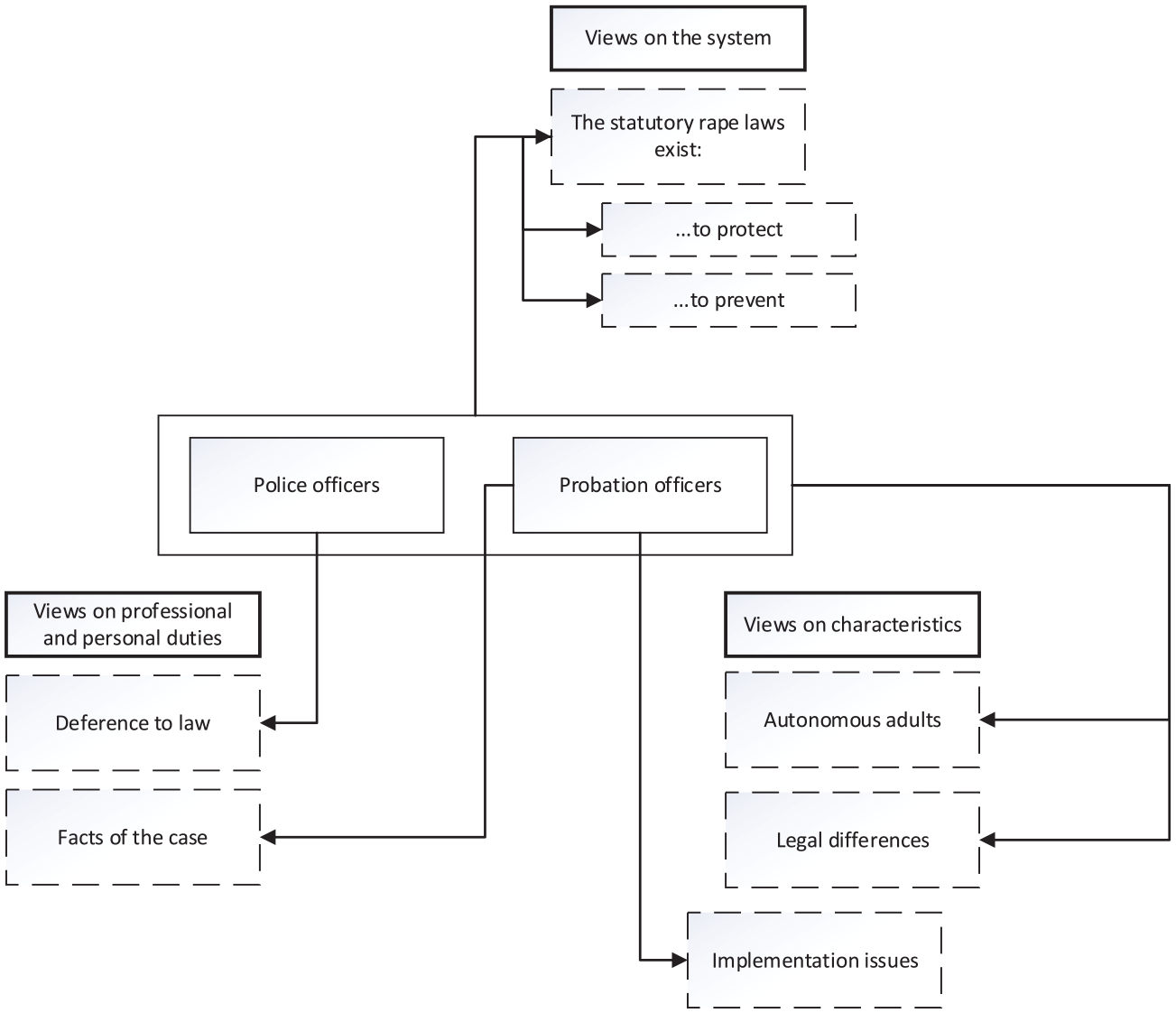
Map of themes.
Through their professional duties as police and probation officers, the respondents drew upon their experiences some insights and views on the characteristics of the statutory rape cases. These insights illuminate the different ways the enforcement of the laws could be improved at certain angle. While most agreed upon the legal differences that acknowledge the age status of adolescent perpetrators, some others have raised the possibility regarding the nature of the sexual relationship, where girls could also be the perpetrators. This is an important point to ponder as it is consistent with the perspectives of sexual development among adolescents. Finally, the views on characteristics brought the probation officers to touch upon the improvement in terms of the implementation, where the writing up of probation reports often requires the consideration in the nuanced characteristics of cases involving adolescent perpetrators.
Discussion
This qualitative study was conducted to explore the implementation of statutory rape laws on adult and adolescent perpetrators from the perspectives and experience of police and probation officers. Specifically, we asked the police and probation officers their perspectives on the reasons for the enforcement of statutory rape laws on both adult and adolescent perpetrators, their emotional disposition and thoughts when presented with a statutory rape case involving an adolescent perpetrator, and their opinions on whether there were differences in cases of statutory rape involving adult and adolescent perpetrators. The themes developed from the responses unveil patterns of the experiences and perspectives of the respondents, providing insights on their views towards the larger system, their sense of professional duties and their perspectives on the characteristics of statutory rape cases involving both adolescent and adult perpetrators. Their responses also revealed insights on possible avenues of reforms in the legal system when it comes to the enforcement of statutory rape laws on adolescent perpetrators.
In our analysis, one pattern that could be observed is that the years of experience and genders (although only one police officer was male) did not seem to influence the responses of the respondents. However, this observation should be made in tandem with the fact that all the officers recruited in this study were of the Malay ethnicity. The Malay ethnicity is enmeshed with the Muslim identity (Ow and Saparin, 2014), and the responses of the officers in this interview suggest that religious values serve as a potential influence in some these officers’ professional duties (e.g. looking at genders from a religious and cultural perspective), which is a similar observation with some past studies (Hodge, 2002; Westwood, 2022). While our study did not include respondents from other ethnicities, this observation points to the importance of considering cultural and religious values in social services. Future studies in Malaysia should particularly investigate how these cultural and religious identities attached to different ethnic backgrounds may potentially serve as a tool in improving delivery of social services in the country.
The themes emerging in our analysis are mapped in Figure 1. As illustrated by the map, the respondents, consistent with their professional background, often perceived the laws as a necessity, citing its role in providing protection for children and also as a prevention measure against sexual intercourse involving underage females. Even so, while we agree with past studies (Beck and Boys, 2012; Mohammad and Nooraini, 2020) and the respondents that statutory rape laws are necessary especially in the context of adult perpetrators, its enforcement in the context of adolescent perpetrators requires a more nuanced examination. In this regard, the responses pointed towards a noteworthy perspective relating to the perspective of normative sexual development in adolescents.
According to the interviews, some respondents expressed their concerns that the laws might prematurely consider the male adolescents to be automatically legally culpable with the sexual acts. Other responses also echoed the similar sentiment, expressing that adults had more autonomy in the relationship, different from male adolescents who had an equal status with their female partners. When statutory rape laws are enforced, even among two adolescents, one is designated as the perpetrator and the other as the victim (Flynn, 2013). This is argued to be problematic, as such application assumes that one partner should ‘know better’ than the other. This is regarded as a problematic stance, as it contradicts our current understanding on what is considered normative sexual behaviour among adolescents. Furthermore, according to Flynn (2013), ‘[w]hen the victim’s level of culpability is equal to the perpetrator’s and both individuals are within the age group the criminal statute is meant to protect, neither deserves to be arbitrarily selected for punishment’ (p. 699). Essentially, the reason why statutory rape laws exist – which is to protect underage girls from being manipulated given their lack of capability to meaningfully consent, should also be extended to boys of the similar age.
Another one of the most glaring themes that our analysis unveiled is the possibility that girls could also be the perpetrators in sexual relations involving two minors. This is a curious finding provided that in the Malaysian Penal Code, only girls are recognized as the victims of rape, directly contradicting these respondents’ experiences. Past literature examining the roles of girls in sexual relations involving two minors is limited, but it is clear that the issue should be examined from multifaceted angles. One such angle is the examination in the vulnerability of girls, particularly in sexual relationships. Some past scholars have maintained that girls are often vulnerable during sexual encounters (Janighorban et al., 2022; Oberman, 1994) and that the way the society views sex is often predicated upon the belief that girls are in subordinated positions in a sexual relation (Oberman, 1994). In this case, the respondents in this study added that there are cultural and religious reasons on why girls are always assumed to be in a subordinated position.
Furthermore, the responses reflecting the respondents’ view in gender stereotypes is indicative of gender-based language in criminal justice, which is also observed in other contexts (Bates et al., 2019; Tenzer, 2019). Gender-based language in the criminal justice system often assumes girls to be the victims of statutory rape and boys to be the perpetrators, reinforcing gender stereotypes. Therefore, the assertion that girls could be perpetrators necessitates further research, including an examination of the links between sexual risk-taking and perpetration of sexual relationships, as risk-taking is often indicative of vulnerability. This is important given the implied contradiction in the responses highlighting girls as perpetrators and the gender-based language in the Malaysian Penal Code.
Other than the issues specific to adolescent sexual behaviour resulting in the enforcement of statutory rape laws, the findings also provided insights into how the respondents viewed their profession in relation to the enforcement of laws. Based on the responses, one of the observations that can be made was the propensity for the police officers to demonstrate deference to the law. Deference to the law by the Malaysian police has also been shown in a previous study (Mohammad and Gearhart, 2021), denoting the police officers’ sense of duties in enforcing laws so long the laws exist. While this article does not specifically deal with the culture of the Malaysian police, it is a pertinent consideration in the implementation of statutory rape laws in the context of adolescent perpetrators.
One of the ways it is pertinent can be related to one of the avenues of improvements in the enforcement of statutory rape laws on adolescent perpetrators as suggested by some of the responses, which is to not automatically see sexual relations between two minors as a crime, especially on the side of the male partner. While accepting this idea has been shown to be possible among the respondents of this study, the respondents’ deference to the law may serve as a barrier in reforming the ways the laws are enforced. Accepting new ideas and initiatives within policing has been a subject of research in the past (Camlibel et al., 2021; Cheurprakobkit and Puthpongsiriporn, 2005; Kalyal, 2020). One of the main findings offered by these studies is the ability to adjust the organizational culture to allow for the receptivity of these new ideas. However, this may be made more complex with policing bureaucracy that adopts a more paramilitary style of policing (Cheurprakobkit and Puthpongsiriporn, 2005) like in Malaysia. Despite their deference to the law, drawing from the responses, it appears that the police officers did contemplate potential improvements in the enforcement of the laws, particularly concerning the automatic criminalization of the male side of sexual relationships.
While it has to be noted that the probation officers in our study did not appear to share the similar sentiment when it comes to deference to the law, their responses (such as their desire to have a thorough examination of each case to ensure a just decision-making process) seemed to agree with this proposal. Past studies have shown a higher degree of receptivity towards new ideas based on evidence among social workers, albeit varied according to countries and contexts (Gray et al., 2014; Kim, 2019). Even so, the findings of this study suggests that both professions are receptive to reforming the enforcement of the laws, by which the officers’ sense of professional duties should be considered in these efforts of reform.
Limitations and conclusion
Our qualitative study involved police and probation officers who were recruited not in tandem with the random sampling principles. Hence, it is important to acknowledge that our findings may not be readily generalizable to police and probation officers in different contexts, particularly those outside of Malaysia. Furthermore, another limitation of our study is that our probation officers were only experienced in handling juvenile cases, by which comparing their experience to the police officers who had dealt with adult perpetrators cannot be meaningfully done. Future studies should take into consideration the differences in the background and duties of these different professionals if similar research is to be undertaken.
Moreover, while the insights gleaned from practitioners with experience in dealing with statutory rape cases are valuable, it is essential to recognize that their perspectives as first responders may differ from those of adolescents themselves. The main theme of exploration in this study is the enforcement of statutory rape laws against male adolescents, by which the insights by the practitioners in this study could be used to triangulate the experience of the adolescents themselves. Future research should consider this, especially in Malaysia where the worldview of the adolescents engaging in sexual intercourse rarely becomes a subject of research.
All in all, our study provided some valuable findings on statutory rape cases involving adolescent perpetrators in Malaysia through the lens of police and probation officers. While these officers did demonstrate some deference to their professional duties, their experience has told them that some areas of the enforcement of statutory rape law did need to be relooked. Therefore, it is worth noting that the discussion on the complexity of automatically criminalizing sexual relations between two minors with these professionals should be an ongoing task in the country.
Footnotes
Acknowledgements
The authors would like to express their gratitude to the Social Welfare Department Malaysia, Royal Malaysian Police and Penang Contingent Police Headquarters for their approval and assistance.
Declaration of Conflicting Interests
The author(s) declared no potential conflicts of interest with respect to the research, authorship, and/or publication of this article.
Funding
The author(s) disclosed receipt of the following financial support for the research, authorship, and/or publication of this article: This research was funded by the European Union’s Horizon Europe Research and Innovation Programme under the Marie Skłodowska-Curie Actions (MSCA) grant no. 101059558 for their funding.
