




Abstract
With a view to contributing to an in-depth understanding of political engagement with public opinion about crime or cognate issues in the United States, this article dissects how Richard Nixon and his inner circle dealt with citizens’ views on what he collectively termed “law and order,” both during his 1968 presidential campaign and his first term in office. Based on novel data from heretofore unused or otherwise underused archival sources, the article lends concrete support to a notion which prior works have asserted without sufficient evidence, dismissed as a conspiracy theory, or, more recently, attempted to revise; namely, that Nixon’s “law and order” messaging was meant to manipulate the public so as to reap electoral dividends for him. In the process of so doing, the article investigates a series of previously understudied themes and the ways in which they intersect: Whose views exactly did Nixon try to shape to his advantage? Which strategy did he follow and what precise means did he use? And how effective were his efforts? It is shown that Nixon targeted both the white majority at large and discrete sections of it: his conservative base, disaffected Democrats, and blue-collar immigrants from Europe who lived around black urban ghettos. With each and every one of his target groups, Nixon engaged in an effort to manufacture concern over “law and order,” itself an assemblage of issues through which he hoped to improve his leadership image in a dual sense: strength of purpose and attentiveness to public will. Unlike what is commonly assumed, Nixon’s “law and order” ploys were limited in their success.
There is abundant scholarship on how political elites engage with public opinion about crime or cognate phenomena. The bulk of attention has been focused on the United States, due not least to the spectacular upsurge the country has experienced over the past half century in both the political rhetoric and state practice of severe punishment for lawbreakers (Simon, 2007; Tonry, 2022; Travis et al., 2014). According to most scholars working on the topic, America’s political elites tend to adopt a manipulative stance toward the public. That is, political elites are inclined to feign responsiveness—whether in terms of language or policy decisions—to public opinion which they themselves have largely shaped in advance, in order ultimately to serve personal electoral interests (see e.g. Beckett, 1997; Chambliss, 2001; Quinney, 2002; Wacquant, 2009). Recent years have nevertheless witnessed a growing number of accounts that view American politicians as actually prone to practising democratic responsiveness. Here, politicians are presented as aligning themselves with public opinion lest they lose votes if they speak their own mind or act on their own accord (see e.g. Enns, 2016; Miller, 2016). 1 In good part because, as Beckett (1997: 51) notes, “motives are notoriously difficult to ascertain,” neither perspective has so far received sufficient corroboration. Pertinent empirical research has typically taken a quantitative approach, gauging the level of congruence between indicators of constituents’ views, on one hand, and of political rhetoric or policy-making, on the other. Notwithstanding the merits of such research, the question of what political elites seek to achieve when engaging with public opinion may only be properly settled through systematic immersion in relevant archival or other qualitative evidence (Druckman and Jacobs, 2015).
With a view to contributing to an in-depth appreciation of political engagement with public opinion about crime or cognate issues in the United States, this article dissects how Richard Nixon and his inner circle dealt with citizens’ views on what he collectively termed “law and order.” The analysis spans Nixon’s successful campaign to win the 1968 presidential election and his first term in office. In much shorter compass, the analysis also addresses Nixon’s treatment of the Vietnam War and related public opinion over the same periods, both because the war in Vietnam was the unavoidable context to all political and policy activities at the time, and because important symbolic and practical connections obtained between the war and “law and order” as such. The selection of Nixon as the focus of this study is owing to two main reasons. First, in relevant scholarly literature and beyond, Nixon is commonly portrayed as the archetypal case of a politician who deftly succeeded in manipulating voters’ opinions about “law and order,” and also as a statesman whose electoral campaigning and tenure in the White House have left an enduring stain on crime-related rhetoric and criminal justice policy alike; most notably, Nixon is seen as the source of inspiration for Donald Trump’s own recent “law and order” politicking (see e.g. Bernstein and Woodward, 2022). Evidence has remained limited, however, whether in terms of Nixon’s manipulative intent, the specifics of his efforts to sway public opinion about “law and order,” or the success he had in this regard. Consequently, and although it has been proved that he tried to manipulate citizens in relation to the Vietnam War (Hughes, 2014, 2015), the view of Nixon as a master manipulator of “law and order” politics has been vulnerable to the charge of conspiracy theory, while some recent influential analyses claim or otherwise suggest that Nixon’s “law and order” agenda was actually developed in response to ongoing trends in public opinion (see e.g. Enns, 2016; Fortner, 2015). Nevertheless, and this is the second main reason why this study focuses on Nixon, there is a plethora of heretofore unused or otherwise little-used qualitative materials—including, among others, confidential memoranda, private reports, personal diaries, and secret recordings of conversations—that lend themselves to gaining a thorough understanding of how Nixon and his close associates approached citizens’ views on “law and order” in actual practice.
Bringing together data from research into these materials alongside select observations from existing accounts, this article lends concrete support to the notion that Nixon’s “law and order” messaging was meant to manipulate the public so as to reap electoral dividends for him. In the process of so doing, the article investigates a series of previously understudied themes and the ways in which they intersect: Whose views exactly did Nixon try to shape to his advantage? Which strategy did he follow and what precise means did he use? Last but not least, how effective were his efforts?
To prepare the ground for the ensuing analysis, the article’s first section delineates key conceptual and empirical issues in the study of political engagement with public opinion, and then elaborates on the scope adopted and the qualitative data materials used by the author to inquire how Nixon and his team treated public opinion on “law and order.” The next three sections present the article’s main empirical findings on the matter, focusing on Nixon’s 1968 presidential campaign and, in two parts, his inaugural term in the White House. Pulling the different threads together, the concluding section reflects on whether and, if so, how the nature and effectiveness of Nixon’s strategy to manipulate public opinion varied with the particular segment of “law and order” he tried to exploit, the target population, and his own political status.
Key concepts and method
Any study of how political elites engage with public opinion involves two basic challenges: conceptual clarity and empirical substantiation.
In terms of conceptual clarity, the main categories of political engagement with public opinion are not equally straightforward as such. While political responsiveness to public opinion is an easy notion to grasp—it is, after all, the essence of democracy—, political manipulation of public opinion is less so. Political manipulation is often equated with influence over public opinion, yet not all instances of the latter really qualify as cases of the former. As leading political scientists James Druckman and Lawrence Jacobs (2015) argue, the key criterion by which to ascertain political manipulation (or any other type of political engagement with public opinion, for that matter) is politicians’ intent. If, as Druckman and Jacobs explain, a politician seeks to shape public views in order to advance what they deem the broader good, as when Kennedy pushed Americans to support civil rights reforms in the 1960s, at stake is a benign effort at “education and civic learning.” But if a politician’s endeavor to influence public opinion is undertaken “for the sole or primary purpose of promoting their short-term and personal political interests,” then at stake is an attempt at manipulation (Druckman and Jacobs, 2015: 98). While Druckman and Jacobs treat the calculated prioritization of self-serving objectives as a singly sufficient condition for manipulation to be established, an even stronger case can be made with reference also to the means employed to influence public opinion; that is, if a politician knowingly engenders or reproduces falsities.
Means aside, pertinent scholarship has identified various strategies of manipulative influence over public opinion. The crudest manifestation of manipulation consists in bringing individuals to drop their own policy preferences for those favored by politicians themselves—what Herman and Chomsky (1988), following Lippmann (1922), famously term “the manufacture of consent.” Evidently, political responsiveness to such views is an exercise in simulated rather than genuine democratic representation. On a subtler level, manipulation assumes the form of “priming,” particularly in the sense of regulating the importance individuals attribute to given issues; what we may call—paraphrasing Lippmann, and Herman and Chomsky—“the manufacture of concern.” Politicians may, for example, distract public attention away from insuperable vexing issues and toward issues suitable for cultivating positive perceptions of their performance or personality. Similarly, politicians may give prominence to a narrow subset of issues on which they do actually share, or are prepared to share, policy positions with citizens, so as to nurture expedient perceptions of wider consonance with them. In this latter case, politicians seek to simulate respect toward the process of democratic representation, not by aligning rhetoric or policy to public preferences that they themselves have previously shaped, but rather by telescoping their relationship with the public into very specific issues on which they support or can easily adopt the people’s views. To this extent, politicians may cultivate false appearances of broader or generalized attentiveness to public opinion, even while really opposing the public’s preferences on the majority of issues (Druckman and Jacobs, 2015; Jacobs and Shapiro, 1995a, 2000). 2
This brings us to the second basic challenge one is bound to confront when studying political engagement with public opinion: how to determine politicians’ intent empirically. For its part, quantitative research is ill-suited for the task at hand. Generally speaking, relevant quantitative studies explore statistical connections between indicators of public opinion and either political rhetoric or policy-making, often also including exogenous variables in the analysis, so as to help reduce the risk of spuriousness. As Page (2002: 332) notes, however, quantitative studies are inherently liable to “neglecting subtleties and factors that are hard to measure”; not only actors’ private intentions in themselves, but also arguably associated real-world activities, such as secret communications and insider deals.
Qualitative research, by contrast, has the potential to break into what Druckman and Jacobs (2015: 125) term the “black box of political calculations” (see also Greenberg, 2016; Jacobs and Shapiro, 1995a, 2000). In the first instance, face-to-face interviews, direct observations, and analysis of memoranda, meeting minutes or other qualitative sources may prompt or otherwise furnish access to statements a political actor or other parties with privileged insights make about the actor’s motivations in undertaking a particular deed. True, even if such imputations are consistent with the actor’s conduct, this does not suffice to render them valid as such. It is incumbent on the researcher also to test and, as necessary, control for self-serving bias in records that an individual produces about themselves or others. This is not insurmountable an obstacle, insofar as one can triangulate different types of qualitative data—ideally including information from private sources not originally intended for public consumption, where self-serving misrepresentations are less likely to occur (e.g. personal diaries, confidential memos and letters) (Elster, 2015).
If, as is frequently the case, there exists little by way of evidence that allows for establishing motivations directly, one can proceed deductively instead; that is, by identifying the objective interests of the actor (or, better yet, their subjective understanding of their interests) and concluding that, if they align with the actor’s conduct, they coincide with the actor’s motivation. As suggested by foremost political theorist Jon Elster (2000), albeit clearly less optimal, this solution is acceptable on condition that the empirical fit is solid, other implications of the imputed intentions are properly weighed, plausible alternative explanations of the observed conduct are given due consideration, and a causal feedback loop is established from the consequences of the conduct to the conduct itself.
With these general observations in hand, the remainder of this article aims to contribute to knowledge about political engagement with public opinion particularly about crime and kindred matters in the United States. To this end, specific attention is paid to how Richard Nixon and his close associates approached citizens’ views on “law and order” during his successful campaign to win the 1968 presidential election and his first term in office. 3 Although only briefly, the analysis also looks at Nixon’s approach to the Vietnam War and relevant public opinion. This is partly because the war in Vietnam was the inevitable backdrop to any political or policy activity at the time, partly because Nixon himself drew tight symbolic linkages between the Vietnam War and “law and order,” and partly because policy decisions and other developments relating to Vietnam carried crucial practical implications for the incidence of phenomena subsumed within “law and order.”
In examining Nixon’s engagement with public opinion, particular consideration is given below to his use of opinion research, covering his treatment of data from publicly available surveys, especially those conducted by leading public pollsters Gallup and Harris, but also his use of privately commissioned polls. Political use of private polling data is itself a novel theme, insofar as prior empirical scholarship on the politics of “law and order” has commonly only concentrated on public polls, seemingly presuming that publicly available data are or mimic the actual information used by politicians. Consideration of political engagement with private polling results is ever so necessary in Nixon’s case. While Nixon generally relied on polling research as his main source of information about voter attitudes, he gradually placed increasing emphasis on private polls; indeed, as President, he invested in private polling to a substantially greater extent than his predecessors (Jacobs and Shapiro, 1995b).
In centering around a single political figure, the article prioritizes analytic depth over the generalizability of findings to other cases. At the same time, probing Nixon’s treatment of public opinion both in the build-up to the 1968 presidential election and during his first term in office allows for testing whether findings obtain across politically distinct circumstances. The inclusion of incumbency in the periods under consideration is crucial. Incumbency offers the optimal conditions for observing either policy responsiveness to public opinion, given presidents’ heightened institutional capacity to shape policy, or elite influence over citizens’ views, due to the exceptional power of the “bully pulpit.” Consideration of first-term incumbency is all the more crucial, inasmuch as the incentive of re-election inclines first-term presidents to pay increased attention to voters’ opinions, whether in the sense of adjusting their rhetoric and policy-making to public attitudes or in the sense of investing in efforts to change public opinion according to their own interests (Rottinghaus, 2006).
A broad range of hitherto unused or otherwise underexploited qualitative materials were reviewed in detail for the purposes of scrutinizing Nixon’s treatment of public opinion about “law and order.” Most notably, long-term systematic searches in the archives of the Richard Nixon Presidential Library and the Gerald Ford Presidential Library laid bare not just public opinion research that Nixon consulted to stay abreast of voter attitudes before and during his presidency—including polls he and his advisors commissioned privately—, but also a wealth of confidential memos, private reports and other papers on the basis of which it became possible to develop a unique insider perspective on how he and his team approached citizens’ views and related matters over the years.
Such insights were supplemented or otherwise triangulated with reference to information located in various other materials. First, there were the “Nixon Tapes”; namely, the raw audio recordings of Nixon’s closed-door meetings and phone calls, which were captured through microphones and wiretaps secretly installed with Nixon’s own authorization in 1971 in the White House and other government buildings. 4 Although the Nixon Tapes were intended to remain strictly private, the overwhelming majority of them have been declassified, with nearly 25,000 recorded conversations (an approximate total of 3000 hours of listening time) being accessible through the Nixon Library at the time of writing. That said, digital and, as such, much more audible and easily obtainable duplicates of the original analog tapes only became available from 2018 onward.
Another important collection consisted in the posthumously published diaries (almost 750,000 words of text as a whole) that H. R. “Bob” Haldeman kept secretly while he was Nixon’s Chief of Staff in the White House. This material covers in detail virtually every aspect of the Nixon presidency, including behind-the-scenes events and conversations with Nixon and other strategically positioned actors. Yet another valuable source were the memoirs penned and the published interviews or oral recounts given by other top aides to Nixon about their first-hand experiences of working for him. Select findings were additionally drawn on from existing scholarly and other literature on Nixon and his political conduct, including but not limited to Nixon’s treatment of public opinion about “law and order.”
“Law and order” on the Road to the White House: Nixon’s 1968 presidential campaign
Nixon had a lifelong dream to become President of the United States (Farrell, 2017). His emergence on the political scene was meteoric. At least partly, this was thanks to his investment in dirty tricks against those he deemed obstacles to his personal ambitions. Nixon’s ploys often capitalized on fear. His speechwriter William Saffire once heard him remark that “[p]eople react to fear, not love. They don’t teach that in Sunday School, but it’s true” (Saffire, 1975: 8). Already in 1950, when Nixon was a young Republican congressman and contender for a Senate seat, the “red-baiting” strategy he employed against the Democratic candidate earned him the nickname that would outlast his life: “Tricky Dicky” (Mitchell, 1998).
By the early 1960s, Nixon’s political career appeared to have been cut short. After having served as Vice President under President Dwight Eisenhower, he narrowly lost to John Kennedy in the presidential race of 1960, and then suffered a shocking defeat in the 1962 gubernatorial election in California. At that juncture, Nixon announced his decision to abandon politics and soon afterward took up employment with a Wall Street law firm. Over the next few years, however, Nixon meticulously prepared for his return to the political spotlight and the quest for the presidency in particular (Li, 2018). Thus, when Nixon formally declared his candidacy for the Republican presidential nomination in February 1968, his primary campaign bid had effectively been under way for 2 years already. In August 1968, Nixon won the nomination by a landslide (O’Donnell, 2017). By now, he stood a real chance at the presidency. Gallup’s trial heats (i.e. polls asking respondents to identify their preferred candidate “if the presidential election were held today”) showed Nixon to hold a 16-point lead over Vice President and Democratic nominee Hubert Humphrey; a complete reversal of Nixon’s 12-point deficit behind the Democratic frontrunner at the start of the year. 5
Fear was at the core of the approach Nixon followed in the build-up to the 1968 presidential election. Both his bid for the Republican nomination and his campaign for the presidency thereafter were dominated by alarmist references to what he broadly referred to as the “problem of order.” “By order,” Nixon explained on NBC Radio, “I mean peace at home, and peace in the world. I mean the containing of violence, whether by armies or by mobs or by individuals.” 6 With regard to “peace in the world,” Nixon claimed that the human and monetary costs of the then ongoing military intervention of the United States in Vietnam had proved so heavy for the American side that achievement of “honorable peace” through diplomatic means was now an urgency.
“Peace at home,” for its part, referred to the restoration and maintenance of “law and order” across the United States. “Law and order” was itself a wooly notion Nixon ceaselessly used to denote a form of social order practically based on strict law enforcement. In addition to expressing an ideal and the general approach by which to achieve it, however, “law and order” also essentially served as a condensation symbol for a diverse array of phenomena that, both singly and together, allegedly posed a direct threat to the ideal in question and had to be dealt with accordingly. Thus, in speaking of the need for “law and order,” Nixon simultaneously targeted various “law and order” issues: from street crimes such as robbery, theft, assault and rape, to rioting, to civil rights and anti-war demonstrations. 7 These were all spreading, Nixon contended, reflecting moral decadence and causing wider social malaise. His pledge was to tackle them through decisive action, including by dramatically increasing police manpower, boosting police patrols in “trouble spots,” and doing away with what he portrayed as the excessive due process constraints that kept prosecution and conviction rates low (McMahon, 2011). All in all, then, Nixon’s rhetoric brought out two constructs at once: while the language of “law and order” combined street crime and a range of other domestic issues that were dramatic, controversial and divisive as such, invocation of “the problem of order” in its broad sense merged “law and order” issues at home with war activity abroad.
Nixon and his advisors assiduously compiled and consulted both publicly available and privately commissioned opinion polls throughout the campaign period. 8 Indeed, by dint of the broader and deeper insights polls afforded, the Nixon camp placed a great deal more weight on polls than any other means of tracking public opinion (Jacobs and Shapiro, 1995b). Two trends were immediately obvious from polling research: first, the war in Vietnam was by far the issue that most concerned Americans (Loo and Grimes, 2004); and second, support for the war was declining (Mueller, 1973). The apparent correspondence between trends in public opinion and Nixon’s rhetoric about the Vietnam War should not be taken as evidence that he pandered to the American people. As Hughes (2014) has demonstrated, Nixon employed backchannel communications with the South Vietnamese to ensure the war would actually go on until election day. The underlying aim was, on one hand, to re-establish the credibility gap on Vietnam that President Lyndon Johnson and the Democrats had previously developed in the eyes of the American public; and, on the other hand, to sow frustration among the growing anti-war segment of the population, which would thus be inclined to vote for the Republicans as the only hope of bringing about a ceasefire.
Alongside seeking to sustain a catastrophic war that American citizens ranked as the foremost issue facing their nation, Nixon gave prominence to “law and order” when very few Americans thought pertinent matters to be urgent. Nixon, in fact, sought to stake out his claim on the “law and order issue” before he formally launched his campaign for the Republican nomination. In mid-1966, through a guest editorial for U.S. News & World Report, he asserted that there had been a deterioration of respect for the rule of law all across America . . . [that] can be traced directly to the spread of the corrosive doctrine that every citizen possesses an inherent right to decide for himself which laws to disobey and when to disobey them.
The piece was picked up by various mainstream outlets, and, as Nixon’s senior advisor Pat Buchanan has put it, “our trademark was on [the ‘law and order issue’] and we had made sure that no one would get around our right flank” (Buchanan, 2014: 54–56).
At the time, polling research found little concern among Americans about the host of issues Nixon subsumed under “law and order.” For instance, an average of less than 2% of Gallup poll respondents would name “crime” or “juvenile delinquency” as the most important problem facing the nation in 1966, and just over 2% would name “civil rights demonstrations,”, “[black] riots,” or “violence and lawlessness associated with them” (Marion, 1994; Loo and Grimes, 2004; see also Figure 1). Indirectly, Nixon himself recognized that his emphasis on “law and order” was incongruent with the findings from polling. “The polls,” Nixon wrote in the aforementioned editorial, “still place the war in Vietnam and the rising cost of living as the major political issues of 1966.” But, he maintained, “from my own trips across the nation, I can affirm that private conversations and public concern are increasingly focusing upon the issues of disrespect for law and race turmoil.”
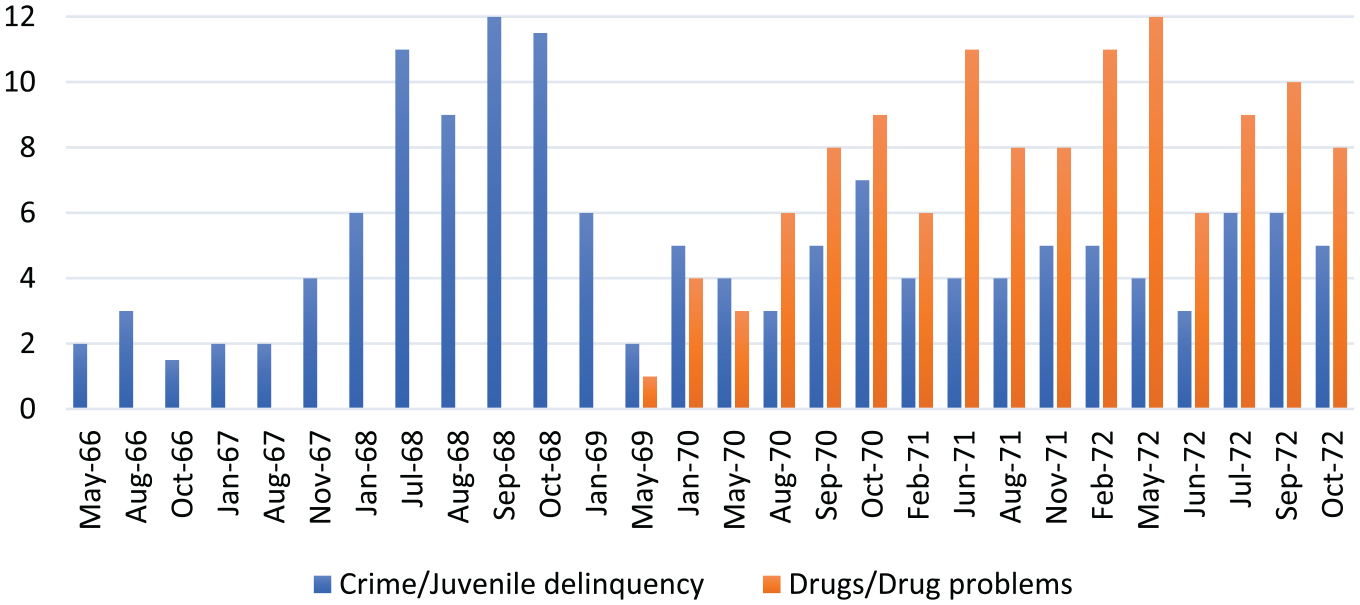
Public concern about crime and drugs as polled by Gallup, May 1966–October 1972.
Even if Nixon did glean such insights, it is unlikely he would have simply disregarded contrary evidence from polling, strongly attached as he was to polls over other sources of information about public opinion. An alternative interpretation is that Nixon’s self-professed deference to an abstract populace—what in later years he termed the “silent majority” (Perlstein, 2008)—was itself part of an effort to manufacture public concern about “law and order” according to his electoral interests. There is, as we shall see, direct proof of Nixon’s manipulative intent for his years in the White House. Considered together, several elements of the “law and order” rhetoric Nixon and his campaign team employed in the build-up to the 1968 presidential election point in the same direction.
To begin with, Nixon’s “law and order” messaging was delivered in the context of a broader campaign that was designed to “build the illusion” of a candidate attentive to the people, as put by Joe McGinniss (1970: 39), the journalist who famously posed as a graduate student writing a thesis to infiltrate Nixon’s advertising crew. Indeed, McGinniss’ insider account reveals that Nixon’s curated appearances on television were particularly important to this end. Most notably, the Nixon campaign hired a young Roger Ailes to produce a series of television broadcasts that came to be known as “The Richard Nixon Show.” 9 Aired live on local stations, the broadcasts in question were townhall-style events held in various states around the country, where, in theory, panels of citizens randomly chosen from the area could pose to Nixon any question they wanted. In practice, Ailes and his aides themselves actually chose panelists so as to control the scope of the questions asked and thereby help Nixon get through the show with a specific set of responses prepared in advance. It was also arranged that studio audiences of around 300 people recruited by local Republican operatives would “cheer Nixon’s answers and make it seem to home viewers that enthusiasm for his candidacy was all but uncontrollable” (McGinniss, 1970: 62).
With respect to the message Nixon sought to relay as such, although Americans generally treated street crime, civil disobedience and other manifestations of deviance from the established order as distinct matters (Loo and Grimes, 2004), the discourse of “law and order” arbitrarily lumped them all together, thus focusing attention on a “problem” that was bound to appear greater than the sum of its parts. Likewise, while the American public approached “law and order” issues separately from the war in Vietnam (recall that public concern was low about the former and at its highest about the latter), the rhetorical conflation of the two domains under the rubric of the “problem of order” could only work to gain further traction for “law and order.”
Indeed, not all parts of the “law and order” compound Nixon highlighted were equally grounded in empirical reality themselves. Urban riots, as well as civil rights and anti-war protests, had certainly grown to be commonplace. For instance, approximately 160 riots broke out across the country in the summer of 1967 alone (Davis and Wiener, 2020). As the Nixon campaign is very likely to have been aware, however, the prevalence of crime—whether in the streets or other settings—was at the very least more complicated than Nixon suggested in public.
In particular, although police-recorded data showed marked rising trends in criminal activity from the mid-1960s onward, this was largely due to the artificial inflation of the count of crimes at local level; namely, the combined result of a growing likelihood among victims to report crimes to the police and, even more so, a greater effort by local police agencies to record each report submitted to them and supply the Federal Bureau of Investigation with crime data for nationwide compilation and analysis (Weaver, 2007). As we shall see later, the Nixon camp eventually came publicly to acknowledge the issue with police measurements. But this was not before the presidency was won and Nixon found himself on the defensive as Chief Executive. While the 1968 election was still ahead, Nixon and his team embraced these very measurements and deployed them as an essential component of the “law and order” platform on which he campaigned (Kamisar, 1972).
This cannot have been for lack of warning. For one, stories had featured prominently in the press about the susceptibility of official crime data to variation in police-recording practices (Seidman and Couzens, 1974). Public bodies had also raised concerns in this vein. No less than the 1967 report of the President’s Commission on Law Enforcement and Administration of Justice devoted substantial passages to the pitfalls of police-recorded crime rates, emphasizing that they often showed “large paper increases in crime” as a consequence of improvements in the recording process (President’s Commission on Law Enforcement and Administration of Justice, 1967: 26). Nixon was not only aware of the Commission’s report, he also made several approving references to it in a widely publicized position paper on crime that he issued in the heat of his 1968 campaign. None of these references, however, regarded the validity of police-recorded crime rates. His position paper rather treated the rise observed in official crime rates as unequivocally true (see Nixon, 1968).
Meanwhile, doubts harbored within the Nixon campaign about the soundness of the tough approach to “law and order” issues that they advocated. John Dean, then one of the young Republican lawyers on Capitol Hill who helped draft crime-related position papers for Nixon, suggests that the “noise” the Nixon campaign made in public about the problem of crime was inversely proportional to the faith they privately put in the policies they advanced as solutions. “I was cranking out that bullshit on Nixon’s crime policy before he was elected. And it was bullshit, too. We knew it,” Dean writes (Dean, 1976: 385). Such concerns, however, took a back seat to the political utility that the Nixon campaign assigned to the policies in question. At work, in Dean’s words, was a systematic effort to “cook up legislative proposals to make political points on America’s crime problem” (Dean, 1982: 57).
What exactly were the political points at stake? Or, to phrase the question differently, why would the Nixon campaign choose to prime “law and order” and not another issue or domain? Indeed, the choice to spotlight “law and order” might appear paradoxical, given that such a campaign tactic had proved an electoral failure in the case of Republican presidential candidate Barry Goldwater as recently as 1964. Albeit to a lesser degree, even Nixon’s own abortive bid for California’s governorship in 1962 had been based on a “law and order” platform (Siff, 2018). This, however, should not be taken to imply that Nixon’s “law and order” rhetoric in 1968 was out of continuing adherence to political ideology.
Granted, Nixon’s “law and order” rhetoric gave him a conservative edge that clearly distinguished him from his Democratic rivals. Even when the latter were eventually dragged into priming “law and order” themselves, their messaging was less consistent or firm (Flamm, 2005). But Nixon was not the die-hard conservative he is commonly thought to have been. In private, he usually championed a progressive middle course between far-left and far-right viewpoints on different issues. In public, meanwhile, he often opted for liberal perspectives in order to broaden his electoral support beyond his party’s own (Small, 1999). 10 Nevertheless, because Goldwater’s “law and order” rhetoric had been successful in helping to forge a predominantly white conservative constituency of growing strategic importance, it was in Nixon’s interest to deploy similar tropes in 1968 (Perlstein, 2001).
Nixon also resorted to a less overtly racist version of Goldwater’s “Southern strategy,” using kindred if toned-down race-baiting idioms through which African Americans were identified as key perpetrators of most transgressions subsumed within “law and order.” Crucially, such invocations of race could attract broader support from the white electorate than Goldwater had previously secured himself; namely, not just from openly racist voters, but also from moderates, many of whom harbored unconscious racial prejudice (Flamm, 2005). 11 It is questionable whether Nixon’s racially charged “law and order” rhetoric was reflective of his personal beliefs or prejudices. Behind closed doors, he would express contradictory views on race, doubting black equality but still opposing bias. Once in office, moreover, his policy record vacillated between divergent positions on race in disparate policy domains, so as to influence or play to heterogeneous constituencies (Kotlowski, 2001). 12 To this extent, it is reasonable to conclude that the veiled racial appeals Nixon communicated through “law and order” were the product of strategic calculation.
Given its racial connotations, Nixon’s “law and order” discourse risked alienating black voters. The Nixon camp, however, had scant interest in trying to win blacks over, insofar as doing so seemed both futile and insufficiently worthwhile. According to a memo Buchanan sent to Nixon, for example, blacks were not only “the most committed of Democrats” and “traditionally hostile” to the Republican ticket, but also relatively small in numbers, as a corollary of which their vote was not pivotal. “[T]hey’re not our voters; and if we go after them, we’ll go down to defeat chasing a receding rainbow,” Buchanan concluded. 13 If appealing to blacks offered Nixon little by way of prospective gain, opinion research indicated that there was much he might lose were he to cease targeting blacks through “law and order.” Polling in September 1968, for instance, showed that Nixon held a wide, 17-point lead over Democratic presidential nominee Hubert Humphrey among Americans who viewed blacks negatively (Cohen, 2016: 312).
More concretely, “law and order” lent itself both as a means of accentuating negative public evaluations of Nixon’s Democratic opponents and as a tool of advancing his own image as a determined leader. In particular, problems of “law and order” could easily be framed as matters of failed Democratic leadership that Nixon was keen and able to tackle himself. When asked, for example, “What can a President do about crime in the streets?,” Nixon would reply that “[a President] can give the moral leadership that this country hasn’t had in recent years in the war against crime. He can put priority in legislation [. . .] on crime control measures that haven’t gotten the priority they deserve.” 14
If brought to the forefront of public thinking, “law and order” could be useful to Nixon also in terms of cultivating appearances of broader congruence with the electorate. The policy views Nixon expressed on “law and order” stood in rough correspondence with the policy preferences of the general public, insofar as the polls indicated a rise in public punitiveness (Mayer, 1992; Stinchcombe et al., 1980). There is evidence to suggest that Nixon was further encouraged systematically to adopt and carry on with this approach after having directly witnessed positive public responses to his tough posturing on “law and order.” According to a private letter Nixon sent to Dwight Eisenhower on 3 June 1968, for example, he was finding “great audience” to his policy proposals on “law and order” when he raised the issue on the campaign trail, even in “areas like New Hampshire where there is virtually no race problem and relatively little crime” (Ambrose, 1989: 145).
Inasmuch as Nixon’s “law and order” crusade secured him support from conservatives, it could also thereby afford him greater flexibility in seeking to attract liberal voters through calling for an end to the Vietnam War. “Law and order,” in other words, could help manage what Haldeman privately described as “right wing Republican unhappiness because [. . .] they feel we’re softening in Vietnam.” 15 Indeed, it was Nixon’s more general tactic to seek to counterbalance “non-conservative zigs” on one issue with “conservative zags” on another—and vice versa. 16 That said, Nixon could possibly solicit votes from outside the core conservative constituency—including, crucially, from disaffected Democrats—through “law and order” as such. This idea was reinforced by the relatively positive electoral outcomes that “law and order” candidates achieved in mayoral elections in various traditionally “blue” cities in 1967 (McMahon, 2011).
One way or another, “law and order” was suitable for nurturing Nixon’s leadership image in a dual sense: both as a decisive principal and as a servant of the people. In fact, a semblance of policy attentiveness to public opinion was crucial to communicating resolve effectively, given that proclamations of resolute action that did not sufficiently cohere with relevant public preferences could backfire. This goes a long way toward explaining why Nixon endorsed otherwise unreliable policies and, ultimately, why he highlighted “law and order” despite it being a mixture of low-salience issues whose actual urgency was not invariably clear.
It is hard to determine with precision the degree to which Nixon’s campaign was successful in using “law and order” to influence public opinion in line with his electoral agenda. Leaving aside measurement issues (on which see Cheliotis, 2020: 12), Gallup’s polling shows that levels of public concern about “law and order” increased severalfold during the election year, at least as compared to the low baselines recorded for 1966 (and still greatly overshadowed by concern about the Vietnam War). An average of 10% of respondents now named “crime” or “juvenile delinquency” as the most important problem facing the nation, and around 9% would name “civil rights demonstrations,” “[black] riots,” or “violence and lawlessness associated with them” (Loo and Grimes, 2004; see also Figure 1). Nixon also developed a significant lead over Humphrey in terms of his perceived ability to tackle “law and order.” A nationwide poll conducted by Harris in September 1968, for example, showed that 36% of respondents thought Nixon “could do the best job in handling law and order,” when only 23% favored his Democratic counterpart (Flamm, 2017). State-level polls produced similar results, at times putting Nixon further ahead. 17
Yet, whatever gain “law and order” may have generated for Nixon’s overall popularity appears to have been exhausted by September 1968. National-level trial heats showed that the advantage Nixon had developed over Humphrey was closing fast as election time neared. According to Gallup polling, Nixon’s lead fell from 15 points at the end of September to 8 points by late October (White, 1973). The same pattern was revealed through trial heat polls taken at state-level. 18 Although Johnson’s announcement of a temporary bombing halt in North Vietnam gave Humphrey a further boost (White, 1973), Nixon went on to win the elections in November 1968. In itself, his victory was what has been described as the “greatest comeback” in American political history (Buchanan, 2014). The margin by which it was achieved, however, was one of the smallest on record—less than a percentage point—, despite earlier indications of a comfortable win.
What is easier to establish than the electoral success of Nixon’s “law and order” campaign is that he did actually attempt to guide Americans’ views of “law and order” in ways intended to serve principally, if not exclusively, his narrow electoral interests. It is not only that Nixon’s electoral interests aligned neatly with his approach to public opinion. It is also that alternative explanations of his conduct are implausible. That is, Nixon’s dubious treatment of crime data, combined with his unwarranted conflation of street crime with various different problems, casts doubt on the possibility that he sought to alert the public to a danger he saw as objectively drastic. Moreover, the low salience of “law and order” among the electorate implies that Nixon was under no real pressure from the public to highlight related policy in his rhetoric, let alone to demonstrate agreement with the public’s own policy preferences on the matter. Similarly, neither Nixon’s personal ideological proclivities nor the campaign undertaken by his Democratic adversaries pushed him in this direction. Nixon could have, therefore, easily avoided advocating policies that his own camp viewed as ineffective in terms of their formally ascribed function. To top it all off, there are traces of a feedback loop having transpired from the impact of Nixon’s efforts to gain political advantage through “law and order” to such efforts in themselves, insofar as he continued investing in them according to their perceived success.
“Law and order” from inside the White House: Nixon’s first term as President, Part I
Nixon was already contemplating strategy for re-election before his inauguration in the White House on 20 January 1969. On 16 January, he directed Haldeman to see that each Cabinet officer produce private trimonthly reports on progress made on given issues as compared to the record of their respective predecessors. Although Nixon also thought of such oversight as a means of “better executive management,” his primary interest clearly was in the “political effect” that could be generated through public references to indicators of superior performance. “I cannot emphasize the importance of this project from a long-range political standpoint,” Nixon noted. 19
From the beginning of his presidency, moreover, Nixon sought to enhance his ability to monitor public opinion through polls. 20 Once again, the underlying intent was to mold public opinion according to Nixon’s electoral interests. Specifically, Nixon treated polls as a key source of insights into the themes, arguments, language and symbols he needed to deploy so as to shape voters’ attitudes in his favor. “That’s the reason I like to look at polls,” Nixon declared in private. “It doesn’t mean,” he explained, “that because we find out what people think, we’re going to do that. [. . .] We are supposed to lead the polls, not follow them. [. . .] [Through polls] you know what your problem is [in shaping people’s views], you know how to talk to them.” 21
To this end, Nixon developed secret contacts with public polling giants Gallup and Harris. Thanks to these contacts, Nixon’s associates were regularly granted early access to information regarding the President’s popularity and his standing in trial heats. This allowed for preparing and being ready to implement plans to bolster Nixon’s image by hyping positive results or countering negative findings as they were coming out. The relationship with Gallup and Harris also opened up the opportunity for the White House to try to shape public opinion by manipulating public polls as such. For instance, Nixon’s aides were able to plant expedient questions in Gallup’s surveys, so that positive findings could be invoked to validate the President’s stances and set the terms of public discussion about strategically significant issues (Jacobs and Shapiro, 1995a). Indeed, at least part of the Nixon camp was intent on getting public pollsters to “lie for us, which is the next step,” as Special Counsel Charles Colson told the President. 22 There is evidence to suggest that such attempts were not only undertaken but were also successful, insofar as Nixon’s team prevented unfavorable findings from being made public, affected the tone in which results were reported, and even influenced actual poll findings (Jacobs and Shapiro, 1995a). 23
Nixon also increasingly relied on privately commissioned polls, because it was easier to control their timing, frequency, location, content and confidentiality. To support this endeavor, the number and expertise of White House staff with specific responsibility for polling was vastly increased (Jacobs and Shapiro, 1995b). Several areas of public opinion were measured through private polling: what the public ranked as the most important problems; the public’s policy preferences; the public’s approval of the President’s performance both overall and in terms of handling specific issues; and the personal attributes and image of the President and his rivals (Eisinger, 2003; Jacobs and Shapiro, 1995b).
Almost as soon as Nixon began his tenure, the polls started showing a decline of his popularity as a leader. For one, an increasing proportion of Americans expressed their disapproval of the way Nixon was handling his job as President. 24 Worse still, trial heats between Nixon and Edmund Muskie, the frontrunner for the 1972 Democratic presidential candidacy, showed the former’s ratings to have dropped below 50%, and the latter’s to have been undergoing a gradual increase. 25 Against this backdrop, Nixon urgently requested from his team that a plan be developed to reverse this evolving situation (Jacobs and Jackson, 2004). A fundamental challenge was that Nixon now had to deliver on the promises he had made before the election to bring the Vietnam War to an “honorable” end and restore “law and order” in the country.
At the time, the Vietnam War kept on attracting by far the highest levels of concern among Americans. Dealing with the war was also Nixon’s main policy priority. Vietnam, as Haldeman (1992: 320) explains, “overshadowed everything else.” But while Nixon systematically sought to invoke the policy actions he undertook in relation to Vietnam as a means of enhancing his image as a competent and strong leader (Druckman and Jacobs, 2015), these actions were themselves anything but responsive to the growing popular sentiment against the war. Specifically, Nixon prolonged the United States’ military involvement in Vietnam and tried to raise public support for the war; for example, by tying its continuation to the newfound demand for the release of all American troops captured by the enemy (Hughes, 2015).
To anticipate the resurgence of anti-war activity that these moves risked causing at home—a development which could further erode public confidence in Nixon’s leadership—, the White House cast the anti-war movement and its advocates in the role of unpatriotic dissidents. Nonetheless, the ongoing presence of American forces in Vietnam caused a firestorm of protests across the United States, many of which ended in violent clashes between protestors, on one side, and the police and the National Guard, on the other (Kimball, 1998). Ultimately, Nixon was unable to build sufficient support for his war efforts and, through them, reap significant benefits in terms of his leadership image (White, 1973).
By the same token, “law and order” proved at best of limited utility in boosting Nixon’s leadership image. Leaving aside his manifest failure to put a halt to mass civil disobedience, there was little to be gained for Nixon from seeking to exploit the issue of street crime. In a sense, Nixon had no option but to carry on accenting street crime. Doing otherwise was risky for the President’s image; it could make him look like a cop-out, given the urgency his 1968 campaign had attached to the problem and the pledges he had made to tackle it. Nevertheless, convinced as he was that crime in the streets had served him well as a campaign focus in the 1968 presidential race (Harris, 1969), Nixon believed he could derive positive political gains through continuing to emphasize it.
Once the election was over, public concern about crime receded back to low levels comparable to those recorded for pre-election years. In 1969, the average proportion of Gallup poll respondents who identified “crime” or “juvenile delinquency” as the most important problem facing the nation was down to 4% (see Figure 1). Nonetheless, Nixon considered it vital to keep on prioritizing street crime in his rhetoric and make it central to his policy-making activity, treating it as a stage on which he could communicate the resolve he thought would benefit his image as a strong and dedicated leader—“a tough law and order demeanor,” as put by his Deputy Assistant Egil “Bud” Krogh (Epstein, 1977: 66). Thus, alarmist and tough-sounding utterances were coupled with policy initiatives meant demonstrably to enhance the repressive capacity and operations of federal, state and local agencies; most notably, the massive expansion of federal aid to state and local law enforcement (Feeley and Sarat, 1980), an extensive prison-building program at state and federal levels (Hinton, 2016), and Washington’s draconian new crime bill (on which more in moment). 26
Crucially, while the elevation of street crime to a prime position among policy domains was discordant with the degree of significance Americans usually attached to the problem, the strict anti-crime policies the Nixon White House promoted were broadly in line with what the citizenry said should be done when asked related questions in polls. 27 To this extent, Nixon could once more use street crime also to bolster appearances of himself as a devout follower of popular will, itself an especially important message at a time when he was growing worried about the political repercussions of his “zigzagging” on the Vietnam War and other issues. 28 Such possible benefits for Nixon’s leadership image sidelined the skepticism his inner circle sustained as to the crime control effectiveness of the harsh policies advanced by his administration. As Krogh has pointed out, harsh initiatives were chiefly meant to serve a “political purpose” (Epstein, 1977: 67). 29
In addition, framed as it still was in a suitably coded language, the accentuation of street crime and, by extension, the administration’s anti-crime policies could signal broad ideological alignment with different segments of racially prejudiced white conservatives, appealing not just to unashamed racists but also to those who held racial biases unconsciously. With the black vote continuing to be of little interest to Nixon, thinly disguised appeals to racist sentiment were by now a staple of his “law and order” campaign. 30 Nixon’s assistant for domestic affairs John Ehrlichman (1982: 222) reports that, while Nixon regarded “racists” as a “key voter bloc” to pursue, his appeal to the “antiblack voter” was typically “subliminal.” 31 Privately, Nixon explained that “[a]ttitude is very important. [. . .] People have pride; they don’t want to be thought of as racist” (Ehrlichman, 1982: 232). Therefore, as Ehrlichman concludes, although it was clear “where he stood on the race issue,” Nixon “always couched his views in such a way that a citizen could avoid admitting to himself that he was attracted by a racist appeal” (Ehrlichman, 1982: 223).
The priming of street crime assumed particular significance in Nixon’s effort to court a portion of the white population that pertinent literature has almost entirely overlooked. The cohort in question was referred to by the Nixon camp as “peripheral urban ethnics,” comprising “blue-collar, middle-income, Democratic voters of European ethnic background” who lived around black urban ghettos. The appeal to peripheral urban ethnics was part of a broader initiative to attract support from distinct groups of traditionally Democrat and independent voters by legitimizing in their minds the idea of voting for a Republican candidate, emphasizing Nixon’s assets, and raising doubts about his opponents. 32 Following analysis of polling, voting and demographic data, Nixon’s strategists concluded that one of the groups most likely to switch their vote to the President were the peripheral urban ethnics. 33
A key reason why peripheral urban ethnics were deemed amenable to Nixon was because they were “close to the President” on the issue of crime. 34 With a view, then, to drawing in peripheral urban ethnics, a gargantuan effort was undertaken to connect with them—including targeted direct mail, as well as door-to-door and telephone canvassing—, in the context of which particular attention was paid to street crime and Nixon’s popular positions on the issue. Before anything else, the hope in so doing was to promote politically advantageous perceptions of broader ideological agreement. As was put in a relevant memo, the main purpose was to induce electoral support from “favorable voters rather than persuading undecided voters.” 35 The racial dimensions Nixon retained in his discourse about crime are likely to have contributed to his favorability among blue-collar whites of European origin, given that the latter usually harbored strong anti-black attitudes, including a desire to fortify the social and spatial boundaries between themselves and the disparaged residents of adjacent black neighborhoods (Lombardo, 2018).
Still, at least partly, the long-term political utility of Nixon’s efforts to attract public support through the issue of street crime depended on him being able to point to success in tackling the problem as such. This was especially so with his attempt to project a strong leadership image. Privately, Nixon doubted much could be achieved by way of reducing street crime. 36 A key question for him was whether crime statistics could be invoked to paint his administration in a favorable light as compared to Johnson’s. 37 Police-recorded data, however, repeatedly showed marked increases in all categories of crime against which Nixon had pledged an offensive, leaving him vulnerable to censure from his Democratic opponents and the mainstream media alike (Epstein, 1977). The crime statistics Nixon valorized in his 1968 campaign were now a liability.
Various tactics were adopted in response. First was what Buchanan, conveying guidance from “one of our most experienced political advisers,” put forward as the “pitch against permissiveness.” 38 That is, the causal roots of street crime were to be identified with a type of social permissiveness that Democrats allegedly condoned. The “pitch against permissiveness” actually extended beyond crime and was meant to explain away the administration’s poor record on the broader “law and order” front. Thus, “radical liberal” statements on any aspect of “law and order” were to be singled out and fixed onto the Democrats who made them, especially Democratic frontrunner Edmund Muskie and other contenders for his party’s nomination. 39 In reality, Nixon’s Democratic rivals typically expressed moderate views on such issues. 40
For the message of “Democratic permissiveness” to be “driven into the public consciousness,” it was to be repeated “ad nauseam” and aggressively. The tone of the advice to the Nixon campaign spoke for itself: “[N]ail these people to the cross on these issues. [. . .] [Keep] stuffing those radical quotes down their throats until they choke to death. [. . .] [Y]ou should kick them in the groin—or any other place you can find where it hurts worse.”
41
It is no accident that Vice President Spiro Agnew, known as Nixon’s tart-tongued hatchet man, was chosen to lead on making the pitch across the nation. In the politically polarized environment of the time, the message Agnew was to deliver, combined with the provocative style he typically deployed on the campaign trail, was bound to inflame tensions and even violence (Perlstein, 2008). But this was not at odds with what the Nixon camp hoped to achieve. If anything, the strategic advice was that Agnew actively seek to agitate dissenters so as then to portray their reactions as an example of how “a long era of permissiveness” purportedly nurtured by Democrats undermined “law and order” as a whole: [T]he Vice President should confront them, wherever they show up; he should march right up to them and talk them down; he should not hesitate to go into a crowd; indeed, if an egg is thrown and hits the Vice President—all the better. That is just what we want. [. . .] If the Vice President were slightly roughed up by those thugs, nothing better could happen for our cause.
42
As Colson told Nixon, the “pitch against permissiveness” could prove successful in “splitting voters away from the Liberal Democrats.” But, Colson added, “to win [the alienated voters] over, we must do more. [. . .] Proving that we can do something about the evils that we and the alienated voter are against must be our highest priority political objective.” 43 A systematic effort was thus undertaken also to create the impression that street crime was dropping. Attorney General John Mitchell, the man Nixon had dubbed his “heavyweight,” was especially active in this regard. Mitchell’s public interventions occasionally included valid remarks; for example, that changes in police-recording patterns were inflating official crime rates, thereby creating a “paper crime wave.” More commonly, however, he would deploy artifices, such as citing crime drops in arbitrarily selected cities (Kamisar, 1972). Not unexpectedly, Mitchell’s treatment of official crime statistics became the subject of intense criticism from prominent commentators outside the administration and the Republican party (Cronin et al., 1981). This was already so before the New York Times revealed that Mitchell’s “public relations staff” had been re-writing FBI releases in ways which misportrayed the Bureau as concluding that police-recorded crime was tapering off (see New York Times, 8 September 1971).
Another gambit to redress the adverse political implications of trends in street crime was to use Washington D.C. as an illustration of the Nixon administration’s prowess in confronting the problem. To this end, the White House first essentially stripped Washington’s municipal government of its policy powers and federalized crime control in the area. This facilitated the introduction of exceptionally stringent initiatives in the city, including legislation that provided for no-knock warrants, prolonged “preventive detention,” and increased prison sentences for various categories of offenders. Besides displaying decisive leadership, the hope in so doing was that an appreciable reduction of street crime might be achieved in the capital, which would then be referenced as proof of the Nixon administration’s competence in the fight against the problem (Pearlman, 2019). As Washington was known to be the city with the largest majority of African Americans among its residents, its being the target of strict measures was also bound to find appeal among racially prejudiced whites.
Soon enough, Mitchell began asserting that street crime had declined in the capital, while Nixon pronounced Washington one of the safest cities. Once again, however, serious concerns were expressed from various quarters as to the accuracy of such claims (Cronin et al., 1981). In any case, questions lingered among Nixon’s own associates as to whether invocation of crime reduction in Washington could prove politically effective. This was since the District of Columbia was thought not to be easily generalizable, both because the district’s administrative structure was distinctive as such, and in that the anti-crime measures this very structure had allowed Nixon’s administration to roll out with little trouble were so harsh they actually overstepped the public’s policy preferences. “In truth,” read a memo addressed to Haldeman, “[the District] is governed by a dictatorship [. . .]. We’ve been able to do a lot of things in the management of the city government that the electorate would never have stood for if they had had any say in it.” 44 Indeed, opposition to Nixon’s anti-crime program in Washington was expressed not just by local black communities but also by liberal white residents (Pearlman, 2019). 45 All things considered, while Nixon’s crime-fighting experiment in Washington might well communicate decisive leadership in itself, it risked making the President look out of sync with far too many voters.
Two years into his first term in office, Nixon’s effort to manufacture concern about street crime and, through it, to promote his leadership image in the eyes of the general public had fallen flat. According to Gallup’s polling, public concern about crime still was at low levels. In 1970, the average proportion of poll respondents who identified “crime” or “juvenile delinquency” as the most important problem facing the nation was 4.8% (see Figure 1). 46 Ehrlichman would later on suggest that Nixon invoke such figures to claim credit for allaying people’s worries. 47 But this was too hard a case to make. Incoming polls showed that citizens were not persuaded that Nixon’s administration had been successful in its “law and order” tasks (Epstein, 1977). A poll by Harris in September 1970, for example, found that only 39% of Americans stood favorably toward Nixon’s performance (Kriesberg, 2023). In effect, Nixon had been stubbornly priming an issue that not only remained of little salience to the average person but also earned him bleak ratings.
Similarly, both publicly available and private polls revealed a continuing decline in Nixon’s broader popularity. According to Gallup polling, for instance, the proportion of Americans disapproving of Nixon’s handling of his job as President had risen to 30% in November 1970. Whereas this trend had previously been due to a dip in the share of respondents offering “no opinion,” it was now progressively because of a drop in those expressing approval, themselves a slim and precarious majority by this point. 48 Other measurements of presidential popularity painted an even gloomier picture. In late October 1970, Colson told the President that only 27% of respondents in the then latest Harris poll “say you are ‘doing the best job you can.’” This, Colson continued, reflected a perceived “leadership vacuum.” 49 To top it all off, trial heats between Nixon and Muskie showed the former to have been steadily overtaken by the latter from early 1970 onward. 50
The results of the mid-term elections in November 1970 brought the message home. Democrats not only retained their Senate majority but increased their majority in the House of Representatives as well. In his “autopsy report” to Nixon, Colson relayed that “law and order” had proved to be of limited electoral utility as a “national issue” because the “crime and violence problem” was really prevalent only in the “urban areas of the East.” In the remainder of the country—and even in the “more conservative states,” where support for “law and order” policies was otherwise especially strong—, the Nixon campaign had tried in vain to get the people to focus their attention and base their voting on “a problem that they don’t personally confront.” Insofar as Nixon had kept on hammering at an issue of little actual relevance for most Americans, his image-making endeavor through it had been at best futile and at worst counterproductive. The silver lining for the Nixon White House was that “significant inroads” had been made “with the blue-collar, white ethnic vote,” apparently “because of law and order and patriotism.” 51
“Law and order” and the “War on Drugs”: Nixon’s first term as President, Part II
Mid-way through his first term in office, Nixon naturally grew worried about the political mileage that could be drawn from street crime. The crunch came in the summer of 1971. Nixon’s popularity had not only fallen further, it also stood below the ratings recorded for his four predecessors at a comparable period. 52 Trial heats, meanwhile, showed Muskie to be holding on to his lead over Nixon. 53
Although the mid-terms had offered a stark warning against focusing a nationwide campaign on issues with limited grounding in lived reality, the Nixon camp began looking for alternative or, as it turned out, complementary scares to construct. Haldeman’s diary reveals that, during a meeting he and Ehrlichman had with Nixon on 9 June 1971, the President instructed his team to “scrape away all the crap” and focus on “how we create issues” that would lend the administration a “sharp image.” “We shouldn’t be concerned if it is something we will actually accomplish,” Nixon explained. “JFK,” he added, “was doing all of his progress building on phony issues. We need an enemy, we need controversy. We need to do something that will build those things.” 54
The issue they chose to “create” was drug abuse. In private, the administration’s own agencies were reporting that drug abuse was not a serious problem. Most notably, an interagency committee had informed the Domestic Council in December 1970 that “compared to the problems of alcoholism, mental illness, automobile injuries and fatalities, the problem of drug abuse is relatively small” (Epstein, 1977: 183). Levels of public concern about drug abuse were also low. An average of only 6% of Gallup poll respondents would name “drugs,” “drug addiction” or “drug problems” as the most important problem facing the nation during Nixon’s tenure in office up to the summer of 1971 (see Figure 1). The findings from private polls were similar (see Figure 2).
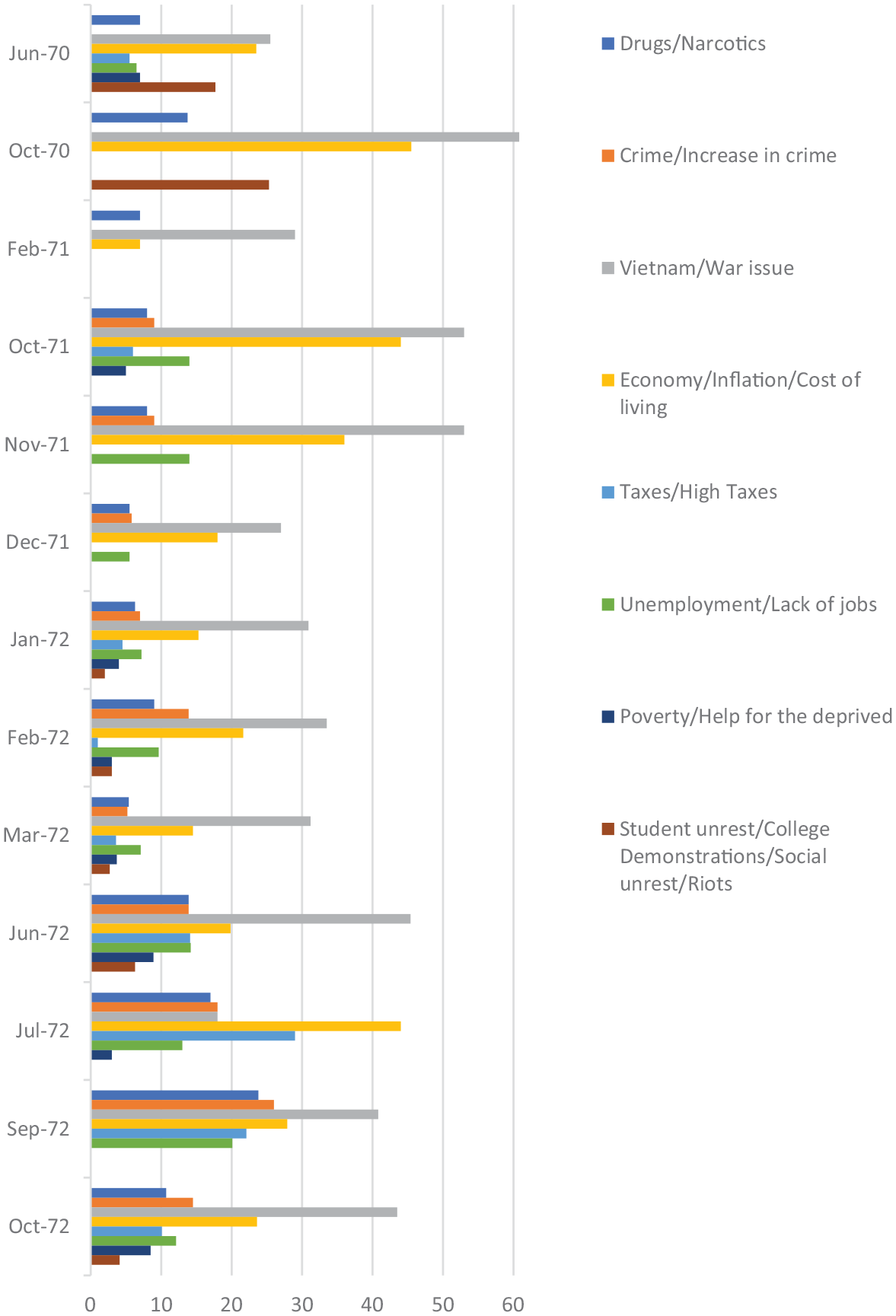
Public concern about key issues as privately polled by the Nixon White House, June 1970–October 1972.
Nevertheless, during a widely publicized press conference on 17 June 1971, Nixon announced that his administration was waging an “all-out offensive” against drugs; what he famously also termed a “war on drugs.” Drug abuse, Nixon claimed, had assumed the dimensions of a national emergency, and was now “America’s public enemy number one.” “[I]t is essential for the American people to be alerted at this danger,” he added, effectively admitting to his determination to manufacture public concern about drug abuse. Nixon’s unequivocally polemic language was meant both to elevate drug abuse to a prime concern and to convey his resolve to prioritize punitive measures against it (Musto and Korsmeyer, 2002).
That drug abuse was a domain where Nixon thought he could advocate and sanction punitive policy, thereby practically expanding the scope of “law and order,” is key to explaining why he decided to elevate it to “public enemy number one” in the first instance. By dint of having been brought under federal jurisdiction, the “drugs problem” was readily amenable to government intervention. It was therefore deemed ideal for the speedy implementation of repressive criminal justice measures and, through them, for the production of tangible results such as rising rates of arrest and conviction of drug offenders, which could then be stressed to portray Nixon both as a decisive and an effective leader. To this extent, the manufacture of concern over drug abuse was suitable for the purposes of “public relations,” as Haldeman conveyed to Krogh (Epstein, 1977: 139).
Inasmuch as repressive intervention corresponded to policy preferences the citizenry held on the issue of drug abuse, it could also be invoked to cultivate expedient appearances of presidential alignment with public opinion. Archival sources show this strategy to have been pursued once again with regard to peripheral urban ethnics. 55 It is reasonable to infer that the White House saw a crackdown on drug abuse as a means of signaling attentiveness to key elements of general public opinion as well. Polling research indicated a prevailing—albeit not unqualified—punitive mood among Americans when they were invited to express policy views on the matter. The overwhelming majority of respondents, for instance, opposed the legalization of marijuana. 56 In addition, most Americans supported the introduction of stricter laws for drug pushers, although they favored a therapeutic approach for drug users. 57
A further advantage that the “war on drugs” offered Nixon was that he could present it as a proxy effort to tackle violent and property crime in the streets. This allowed for displaying renewed commitment to the anti-crime crusade while giving it a different twist. To this end, the Nixon administration portrayed drug addiction as a key cause behind street crime, notwithstanding that such a claim was contradicted by almost all pertinent research and privately doubted by senior advisory staff who had the President’s ear. Perhaps most notably, in March 1971, a Domestic Council decision paper reached the following conclusion: “Even if all drug abuse was eradicated, there might not be a dramatic drop in crime statistics on a national level, since much crime is not related to drug abuse” (Epstein, 1977: 182; see also Benavie, 2009). Accordingly, while the “war on drugs” was unfolding, in-house forecasts of crime rates were pessimistic. 58 As Ehrlichman has remarked, “We knew we were lying about the relationship between heroin and crime. But this is what we were doing to win the election” (Baum, 1996: 13).
Less overtly, the “war on drugs” could operate as a pretext for cracking down on segments of the broader population deemed to have been jeopardizing Nixon’s overall “law and order” agenda, particularly the anti-war movement and black organizations fighting for civil rights reforms. 59 As revealed by Ehrlichman, the Nixon White House “had two enemies: the anti-war Left and black people. [. . .] We knew we couldn’t make it illegal to be either against the war or black, but by getting the public to associate the hippies with marijuana and blacks with heroin, and then criminalizing both heavily, we could disrupt those communities. [. . .] We could arrest their leaders, raid their homes, break up their meetings, and vilify them night after night on the evening news. Did we know we were lying about the drugs? Of course we did” (Baum, 2016). As regards the clampdown on African American communities in particular, it offered Nixon the additional benefit of appealing to white conservative voters concerned about the gradual erosion of the established racial order, including, thanks to the pretense of fighting drug abuse, those who had developed “color-blind” sensibilities.
Over the next year or so, Nixon intensified his effort to manufacture concern over drug abuse (Siff, 2018), alongside introducing policy to tackle the issue (on which more presently). During this timeframe, Nixon’s overall approval ratings began to rise, with clear majorities now rating his performance as President positively. Similarly, trial heats showed Nixon holding a wide and growing lead over George McGovern, the Senator who had by now won the Democratic nomination. 60 McGovern started his campaign trailing Nixon by 14 percentage points (Gallup, 1972a). By mid-October 1972, Nixon was ahead by 26 points (Gallup, 1972c).
Nonetheless, the reversal in Nixon’s fortunes since the mid-terms was despite—rather than because of—the way he was perceived to have been faring in his “war on drugs.” Before anything else, Nixon did not make much headway in terms of elevating public concern about either drugs or, even more so, crime. Between June 1971 and the end of Nixon’s first term in office, the average proportion of Gallup poll respondents who identified “drugs” or a cognate issue as the most important problem facing the nation only rose to 9%, while the proportion of respondents who named “crime” or “juvenile delinquency” was 4.7%, up by a mere 0.2% as compared to the earlier part of Nixon’s presidency (see Figure 1). Private polls revealed a similar picture overall, whether at a local or at a national level. 61
Indeed, by persistently highlighting drugs and crime, Nixon had been yet again calling attention to issues in relation to which the public was not only generally unconcerned but also gave his performance alarmingly low ratings while thinking of his Democratic opponents positively. 62 Worse even, as election day drew closer, private nationwide polling showed Nixon’s approval ratings to have increased on all other key issues but to have fallen on drugs and crime. 63 Upon the insistence of leading White House pollster Robert Teeter, campaign attention to these issues eventually declined as election time approached further. 64
Rates of police-recorded street crime had continued to increase, leaving the Nixon administration yet again vulnerable to what the President’s inner circle described as an inevitable “political onslaught.” 65 Thus, although Nixon’s Democratic rivals mostly supported moderate anti-crime policies that did not reflect the public mood, they could still derive comparative gains from pointing to the President’s continuing inability to demonstrate success in his crime-fighting efforts (see e.g. New York Times, 4 October 1972).
Drug abuse, meanwhile, proved doubly limited as a political platform on which Nixon could project a strong leadership image: not only did he find himself constrained in terms of following a clear punitive course on the matter, he was also faced with the unintended repercussions of having tried to signal a move in this direction. Nixon was aware that successfully using an issue to boost his credentials as a strong leader required clarity and stability in holding a vigorous stance on it. 66 Yet, his policy approach to drug abuse was equivocal. On one hand, his administration opposed the legalization of marijuana, introduced measures to enhance strict drug law enforcement (e.g. warrantless raids on suspects), and established harsher prison sentences for drug dealers. On the other hand, punishment was scaled back for drug users (e.g. relevant mandatory minimum prison sentences were repealed and probation was allowed for the first conviction of marijuana possession), while methadone maintenance treatment for heroin addicts was dramatically expanded (Lynch, 2016).
Nixon abhorred having developed a variegated policy record on drug abuse, regarding it as detrimental to the decisive punitive posturing he set out to establish for himself on the matter. Commenting, for instance, on a pamphlet whose cover presented him as stating that “the problem of drugs [. . .] must be dealt with in a variety of ways,” Nixon told his team: “I saw ‘a variety of ways’ and I god damned near puked. [. . .] I use the word ‘an all-out war.’ [. . .] But ‘handle it in a variety of ways’ says we don’t know how to handle it. Which may be the truth. But it sure as hell isn’t the thing to say.” 67 Paradoxically, in adopting comparatively lenient measures toward drug users, Nixon further increased the scope of compatibility between his overall policy approach toward drug abuse and the various policy preferences the general public held on the issue. Taken out of context, this might be read as an occasion of democratic responsiveness. The reality, however, is more complicated. At work was Nixon’s attempt at mitigating the political danger his own manipulation bid posed, in light of circumstances he had either underestimated or failed to foresee.
As Nixon privately recognized in September 1971, there was accumulating evidence that drug use was an increasingly “white problem.” 68 Marijuana consumption was apparently spreading beyond run-away middle-class “hippies” to the children of staunch conservatives and the white elite (Blumenthal, 2016; Peterson, 1984). Heroin dependency, meanwhile, reportedly stood at high levels among troops returning from Vietnam, the vast majority of whom were once more whites (Epstein, 1977; Massing, 2000). To this extent, Nixon’s effort to cause public alarm over drug abuse risked embroiling a growing portion of the white electorate and even some of his conservative base in controversy, while his punitive rhetoric could well be taken as a direct threat to these strategically crucial constituencies.
To prevent or contain the specter of electoral backlash that his “war on drugs” thereby raised, Nixon essentially developed an ostensibly race-neutral system that distinguished between “saving users and punishing pushers” (Peterson, 1984: 252). Whereas drug users were to receive judicial leniency and medical care, severe criminal sanctions were reserved for drug pushers, a category that the Nixon administration subtly associated in its discourse with young black men (Siff, 2018). Yet, whatever prospect there was for Nixon to control the political damage in this manner was undermined by the fact that white middle-class suburban youth were all too often the subjects of drug arrest by the police, itself an intimidating experience regardless of whether they were eventually treated preferentially (Lassiter, 2015).
The ambiguous approach Nixon was forced to enact toward drug abuse was not substantively different to that advanced by Democrats (see e.g. U.S. News & World Report, 6 November 1972). All eyes were nevertheless on Nixon. He was the one to have prioritized the issue in the first instance; it was he who had adopted a distinctively punitive rhetoric on the matter; and it was within his own purview to exercise executive control over relevant policy. His Democratic opponents, by contrast, could afford to remain above the fray, making periodic appearances to score points by identifying inconsistencies in the President’s proclamations and highlighting poor results in his ongoing “war on drugs” (see e.g. New York Times, 4 October 1972).
That Nixon won a landslide victory—by a 23-point margin—in the election held in November 1972 implies that his unsuccessful attempt at using the issues of drugs and street crime to improve the general public’s perceptions of his leadership was electorally inconsequential. 69 On the other hand, at least according to the Nixon team’s own confidential post-electoral analysis, election returns showed the strategy adopted to induce support from peripheral urban ethnics to have been effective. 70 A possible reason for this is that residential proximity to black ghettos may have rendered peripheral urban ethnics both more likely to learn of, and more prone to be moved by, the roll-out of drug law enforcement operations against underprivileged African Americans. At any rate, it was the demonstrable policy success Nixon had by now achieved on the economic front, combined with reducing the number of American soldiers in Vietnam and managing to improve relations with China and the Soviet Union, that proved key to securing him ample popular support at the ballot box (White, 1973).
Conclusion
The bulk of scholarship on political engagement with public opinion about crime or cognate issues in the United States views political elites as prone to adopting a manipulative stance toward the public, with Nixon commonly referenced as the quintessential case in point. Nevertheless, as well as simply asserting or otherwise insufficiently substantiating his manipulative intent and his success in this regard, such scholarship tends not to clarify whose views Nixon tried to influence, through what strategy, or by what precise means.
Combining previously unused or otherwise underexploited qualitative data with select observations from extant literature, this article offers a detailed “inside-the-black-box” perspective on how Nixon and his strategists engaged with public opinion about “law and order,” both during his 1968 presidential campaign and his first term in office. Proceeding deductively with reference to the former period and on the basis of direct evidence with regard to the latter, the article brings consolidated empirical support for the contention that Nixon sought to influence public opinion in ways that would principally, if not exclusively, serve his personal electoral agenda.
Had Nixon’s objective been to shape public opinion in accordance with a higher principle, such as a sense of civic duty to alert people to pressing problems and inform them of sound policy responses he was willing and able to pursue, his messaging could qualify as having been “educational” in its intent. As this article demonstrates, however, Nixon endeavored to mold public opinion in order to satisfy his own strategic needs. That his efforts to move public opinion were underpinned by a self-serving intent renders them an attempt at manipulation. To the extent that these efforts entailed the conscious production or reproduction of falsehoods (e.g. mischaracterizing the seriousness of problems, misselling plans to tackle them, conveying misleading information about the effectiveness of relevant policy), their manipulative nature is all the clearer.
Adding nuance to the view that Nixon attempted to manipulate public opinion in relation to “law and order,” the analysis suggests that he always relied on the same core strategy, regardless of the precise “law and order” issue he sought to exploit, the specific audience he tried to influence, or his political status; namely, whether he was campaigning for election into office in the first instance or seeking re-election. In particular, Nixon targeted both the white majority at large and discrete sections of it: his conservative base, disaffected Democrats, and, following his election into office, the so-called “peripheral urban ethnics” as well. With each and every one of his target groups, Nixon engaged in an effort to manufacture concern over “law and order,” itself an assemblage of issues through which he hoped to improve his leadership image in a dual sense: strength of purpose and attentiveness to public will.
In part, that is, Nixon’s endeavor to induce public concern over “law and order” was because the harsh policy positions he either took or was prepared to take on such matters were generally popular among strategically significant segments of the electorate (even while he may have exacerbated punitive public attitudes). To this extent, “law and order” was used to produce or strengthen expedient perceptions of broader ideological congruence and policy responsiveness. In other words, Nixon’s effort to direct public attention to “law and order” and, through it, to occasions of correspondence between his rhetoric or policy-making and public opinion was meant to promote his image as a leader aligned with the people. Indeed, cultivating appearances of alignment with public opinion was also key to communicating resolute leadership effectively, insofar as proclamations or manifestations of the latter could backfire in the absence of the former. More generally, success in restricting the relationship with key target groups to a subset of issues such as “law and order” could widen Nixon’s latitude on how he could seek to appeal to other sections of the electorate on different issues.
How effective were Nixon’s “law and order” ploys? The answer is partly dependent on the timeframe and the target group at issue. Whatever success he may have had before the 1968 election in terms of manufacturing concern over “law and order” and thereby influencing how his leadership was viewed by the white majority, his conservative base or disaffected Democrats, it was short-lived. Once he found himself in office, he proved largely unable to exploit “law and order,” even while expanding it to include drug abuse. Although perceptions of his leadership did improve in the build-up to the 1972 election, this was not the result of his “law and order” campaign. On the other hand, Nixon appears to have been successful in his attempt to induce support from peripheral urban ethnics during his first term in office. Taken together, this article’s findings challenge the common view of Nixon as a skilful manipulator of “law and order” politics.
It has been suggested in prior literature that the linkage Nixon rhetorically drew between drug abuse and street crime was meant to facilitate politically suppressive policies against black communities and anti-war protesters, and that the discursive focus and the clampdown specifically on blacks could also allow for courting white Americans who harbored racist attitudes. As well as supporting both claims, this article puts forward the hypothesis that Nixon’s racially redolent emphasis on street crime and drug abuse played a key role in his more targeted effort to attract support from “peripheral urban ethnics.”
The findings of this article corroborate key arguments raised in empirical literature on elite attempts to manipulate public opinion about other issues or domains. First, efforts to manipulate public opinion are not ipso facto successful, particularly when considered in the long run. Moreover, such efforts are more likely to succeed when they target specific segments of the population and tap into existing attitudes. By contrast, influence is less likely when rhetoric is not backed up with solid evidence and when other prominent actors issue competing messages. Particularly as concerns the “manufacture of concern,” while successful inducement of concern about selected issues is crucial to conveying particular leadership traits through them, it is politically risky to persist in priming issues that have not moved to the forefront of public thinking (see further Druckman and Jacobs, 2015).
Although this article finds both that Nixon had limited success in shaping public opinion and that his failed attempts did not carry electoral consequences, it would be wrong to presume that his manipulative engagement with citizens’ views lacked overall significance. As mentioned earlier, there is no shortage of accounts suggesting that Nixon’s approach to public opinion about “law and order” has inspired subsequent manipulation efforts in the United States, including Trump’s recent fear-mongering rhetoric and punitive criminal justice and immigration policies. That said, research has yet to substantiate the manipulative nature of such cases and, as applicable, specify the mechanics of the manipulation attempts at issue, ascertain the degree to which they were effective, and identify the circumstances that determined their outcomes. Equally, it would be wrong to assume that genuine democratic representation is no more than an ideal type. It is incumbent on future research to locate concrete instances of democratic representation and pinpoint the conditions that made them possible. The accumulation of qualitative case studies such as the one presented in this article will eventually allow for meaningful comparisons on the basis of which generalized conclusions can be drawn, whether about political manipulation and representational government in themselves or about the state of American politics as a whole.
Footnotes
Acknowledgements
Grateful thanks are due to Tim Newburn, Lucinda Platt, and Sappho Xenakis for their insightful comments on an earlier version of the article; to Tim Newburn, Lucinda Platt, Berkay Özcan, Hakan Seckinelgin, Kitty Stewart, Sonia Exley, Johann Koehler, and Juliet-Nil Uraz for their helpful questions and suggestions in the context of a relevant staff seminar at LSE’s Department of Social Policy; to Loraine Gelsthorpe for her patience and encouragement in her capacity as the journal’s Editor-in-Chief; to the anonymous reviewers of the journal for their constructively critical feedback on the original submission; to Chloe Kimball for excellent research assistance in an early stage of the project; and to Jamie Druckman and Larry Jacobs for generously sharing their own compilation of private White House polling data.
Declaration of Conflicting Interests
The author(s) declared no potential conflicts of interest with respect to the research, authorship, and/or publication of this article.
Funding
The author(s) received no financial support for the research, authorship, and/or publication of this article.
