




Abstract
‘Care’ in a policing context naturally focuses on supporting victim-survivors. The aim of this article is to consider care for police officers who have regular exposure to rape and serious sexual offences cases and officer gender roles. We consider the care provided to (predominantly) female victim-survivors of rape and serious sexual offences by both male and female police officers and differences by gender in how officers support their own wellbeing. The overall findings, based on a cross-sectional survey, interviews and focus groups in five police forces in England and Wales, suggest that officers’ perceptions of their ability to cope and wellbeing are affected differently by gender. The quantitative findings suggest that rape and serious sexual offences officers have high levels of emotional exhaustion, depersonalisation and burnout, but female officers are better at prioritising wellbeing than their male counterparts. This research recommends equipping officers through specialist rape and serious sexual offences training that recognises ‘care’ as a necessary component of policing.
Introduction
The high levels of attrition by victim-survivors of rape and serious sexual offences (RASSO) cases in England and Wales and a lack of trust in the wider police force have called the duty of care for victim-survivors into question (Charman and Williams, 2021). Only 1.6% of RASSO cases continue to prosecution, with lengthy waiting times creating further distress to victim-survivors, adding to evidence as to why confidence in the police is lacking (Office for National Statistics, (ONS), 2021; Rumney et al., 2018). Against this backdrop, we consider the role of police care by both male and female officers for victim-survivors of RASSO, who are predominantly female.
We offer an alternative consideration of care with a focus on the officers themselves. Investigating rape is complex; officers are not only required to provide support for the victim, but they are working against a backdrop of delays in different parts of the criminal justice system and a lack of specialist resources (HM Government, 2021a, 2021b). By its nature, policing is a traumatic job, and officers are regularly exposed to difficult and emotional scenarios (Fejes and Haake, 2013). We, therefore, look at how officers themselves deal with a constant workload of distressed and traumatised victim-survivors. Given the stereotypical view of caring regarded as a female trait (Fejes and Haake, 2013), we consider how officers care for both their victims and themselves, with a specific focus on officer gender.
In addition to the consideration of police officers who have regular exposure to RASSO cases, it is important to acknowledge other vital support services such as Independent Sexual Violence Advisors (ISVAs). ISVAs and the provision of support through Sexual Assault Referral Centres (SARCs) provide a partnership approach to statutory and voluntary agencies supporting victim-survivors. The need for support is also required for officers and other support workers in these environments (Hester and Lilley, 2018; Robinson, 2009). While in-depth discussion of this aspect of supporting victim-survivors is not within the scope of this article, it should not be overlooked in future research.
The article offers a view on gender roles within policing itself, looking at the increasing visibility of females in policing and discussing whether gender stereotypes exist, including an examination of the division of labour within specific police roles. We aim to assess whether female officers face different stress levels and wellbeing needs compared to males and whether attitudes to victim-survivors of RASSO differ by gender. We draw these findings together, supported by the findings of our research as part of Operation Soteria, a practitioner and academic research collaboration 1 to consider care for victim-survivors and care officers investigating RASSO cases. The findings of Operation Soteria have underpinned the new National Operating Model, with statutory implementation for all 43 police forces in England and Wales.
Trust and confidence in policing
Trust and confidence in the police have been affected by high-profile RASSO cases involving serving police officers in England and the recent independent review by Baroness Casey (2023) into the standards of behaviour and internal culture of the Metropolitan Police. Trust and confidence in policing are intrinsically linked, particularly in RASSO cases where the integrity of victim-survivors may be called into question and rape stereotypes and myths can prevail. In the largest ever survey of victim-survivors of RASSO offences (Hohl et al., 2023), victim-survivors report feeling ashamed and embarrassed, not believed, fear of the perpetrator, low conviction rates and having little trust in the criminal justice system. Other findings include victim-survivors feeling unsafe in the presence of officers and not taken seriously (Hohl et al., 2023). Given the ratio of female victim-survivors to male perpetrators, common assumptions infer that female police officers represent a more sympathetic face to the public than the general view of male police officers (Duxbury et al., 2021). Care has traditionally been viewed as a female attribute, yet the police force remains a predominantly male-supported organisation (Home Office, 2022a). Garcia (2003) refers to this positioning of roles as ‘doing gender’, and she argues that the human element of the differences between the genders has added a positive attribute to public facing police support. The violence against women and girls (VAWG) agenda has become a major priority for policing, and forces now accept that the safety of women has become a police responsibility.
Two significant crimes have also added to the weight of scrutiny on police behaviour. In 2021, 33-year-old Sarah Everard was kidnapped, raped and murdered by Wayne Couzens, a serving police officer. Another offender, David Carrick, was convicted of being a serial rapist of over 85 crimes during a 17-year period. Both Couzens and Carrick had served long careers as officers in the Metropolitan Police. Both of these scandals, in addition to the Casey report, have resulted in a significant loss of public trust in the police. These crimes led to a recommendation of a super-complaint against the police to consider how they will respond to police-perpetrated allegations (Centre for Women’s Justice, 2023). These cases have added to the public debate on violence against women and girls, challenging police forces to address how officers interact with the public and the cultural changes required to regain public confidence across all cases, particularly for RASSO offences (HeForShe, 2021). The landmark Casey Report (2023) into the behaviour and culture of the Metropolitan Police describes systemic issues, including institutional racism, misogyny and homophobia. Baroness Casey suggests that ‘women and children do not get the protection and support they deserve’ (2023: 21) and cases of violence against women and girls should be made a priority in London. The reports of behaviour of this type affect officers serving society to the best of their ability and seeking public trust in the police.
In beginning to consider the role of care in policing, Gilligan’s (1982) seminal feminist approach, an ethic of care, is a useful tool. The ethic of care is based on moral responsibility and care for others, beginning with the premise that people look after each other with compassion and a sense of connectedness. Police recruitment suggests that policing is ‘emotionally demanding’ and potential recruits need to consider whether they can ‘Deal with complex and sensitive cases [. . .] remain calm and patient, particularly in stressful situations [. . .] and communicate sensitively’ (Police.UK, 2023 online recruitment campaign). Gilligan argues that when faced with moral dilemmas, men display an ethic of justice and women an ethic of care, which is cognisant of the distinction between ‘caring for’ and ‘caring about’ others (Gilligan, 1982; Ribbens McCarthy and Edwards, 2011). The ethic of care begins with listening and respect, while the ethic of justice is focused on the principles of a justice-based morality of equity and fairness (Botes, 2000). Police officers, regardless of gender, are required to demonstrate both, and we seek to understand motivations for the care of officers and the self in this article. Against the backdrop of public scrutiny and specific incidents of male perpetrated crime within the organisation, we begin by considering the increased visibility of female officers in the police force.
Female representation in the police
In 2023, more female 2 officers serve in English and Welsh police forces than since records began, making up 34.9% of police strength (Home Office, 2022a). This figure demonstrates a significant increase in female police staff and those working in professional and support roles compared to previous data, where women were under-represented across the workforce (HeforShe, 2021; Prenzler and Sinclair, 2013). In 2021, female officers accounted for 45% of all new joiners between July and September 2021 (College of Policing, 2021). The increase in female recruits is due in part to the introduction of the Police Uplift Programme (House of Commons Committee of Public Accounts, 2022), which placed targets for police forces to recruit a further 20,000 officers by the end of March 2023. Government statistics illustrate the police forces in England and Wales remain comprised predominantly of male officers, with 65.1% of officers across the 43 forces (Home Office, 2022b).
Despite the uplift in female officer numbers, the occupational culture of policing, driven by operational practices including shift work, lack of uncertainty of live jobs and stressful situations, has the potential for significant repercussions on home life and, in particular, on the duality of the gendered nature of parenting practices (Agocs et al., 2015). Luhr’s (2020) findings suggest that motherhood continues to carry an employment penalty, both in terms of pay and promotion, whereas fathers signal their parental status and negotiate support for their parenting needs more persuasively in the workplace. Duxbury et al. (2021) argue that achieving a work-life balance with a family has made it difficult for women to consider a role in policing. Despite greater parity of support, childcare has remained the domain of the female partner (Cooper, 2017). However, paid parental leave for officers, available to both mothers and fathers, has encouraged women to remain employed and for partners to share child rearing, while maintaining their caring or childcare responsibilities. Silvestri (2007) suggests that policing is one of the most difficult professions to combine with raising a family. Once female officers have established work in the police, they continue to remain under-represented in certain roles in England and Wales, with only 5% working with firearms, disproportionate to 54% of women working with cases involving children, domestic or sexual abuse (Prenzler and Sinclair, 2013). Previous research by Rabe-Hemp (2009) supports a similar view that males work in serious crime roles and in higher ranks, while female officers are often tasked with social service-based cases.
Acker’s (2006) concept of the reproduction of inequality in work organisations is shared in Prenzler and Sinclair’s (2013) findings, demonstrating that policing practices and processes often replicate the traditional view of females working in caring and support roles. Fejes and Haake (2013) and Garcia (2003) argue that jobs such as care work, childcare, nursing and teaching have traditionally been deemed ‘women’s work’ due to the perceived maternalistic nature of care and the roles defined historically by the female gender. Fejes and Haake (2013) suggest that care work in policing is related to a sense of justice as part of the caring, altruistic officer role. DeJong (2004) makes the case that the focus should be on the contributions women make to policing rather than the differences between genders, given the role of the officer as the public servant and the public as consumers of policing support.
Fejes and Haake’s (2013) highlight the distinction between male and female officers, with male officers who clearly articulate their desire to engage in daring and exciting frontline policing, with little mention of caring responsibilities. According to Chan et al. (2010), the issues of gender stereotypes in policing are complex, where the physicality and risk of frontline policing reinforce the role as heteronormative, one to which females are seen to need to conform to be regarded as equals. Conversely, caring for victim-survivors requires the nurturing, emotional support that continues to be labelled as a female domain (Duxbury et al., 2021).
Care and the effect on officer wellbeing
Our article examines police officers’ perceptions of the role of gender within the internal policing organisation. Empirical work by West and Zimmerman (1987) suggests that the division of labour specified by gender is a socially constructed way to provide an organisation of social roles and a separation of work-based outcomes, both in the home and wider society. This is distinct from the biological sex of male and female, which is considered to be rooted in biological determinism (West and Zimmerman, 1987). Although greater parity between male and female officers is beginning to shift, one finding that remains constant is that internal workplace conflict does not reduce unless the organisation itself changes (Evetts, 2011).
If the conflict of managing stress in the workplace is not resolved, it can lead to a number of stress-related psychosocial factors and associated poor wellbeing. The burden on officers to deal with emotional responsibility, particularly for RASSO officers, has resulted in an increase in stress and burnout (Maguire and Sondhi, 2024). There are specific stressors associated with working continually on RASSO cases. A lack of resourcing and organisational support has resulted in a loss of RASSO specialism, affecting officers’ wellbeing and competency (Williams et al., 2022). Dalton et al. (2022) suggest that specialism in policing can enhance investigations, the care for victim-survivors and officer wellbeing. Subsequent issues arise as officers feel they are inadequately supporting their victim-survivors due to a lack of appropriate specialist training while dealing with the trauma they have witnessed themselves (Charman and Williams, 2021). Meier et al. (2006) suggest that organisational performance improves in public sector organisations as employee satisfaction rises, demonstrating a link between wellbeing and worker output.
The occupation of policing is embedded with stereotypical gender roles (Garcia, 2003), but all officers are dealing with cases involving high levels of care for the public more than ever before, compounded by a significant rise in mental health issues. The pressure on the police to support the health service has increased significantly, driven by the pandemic, government cuts and a lack of investment in local services (London Assembly, 2022). Under the Mental Health Act, Section 136 (Legislation.gov.uk, 1983), the police have exceptional powers when responding to someone with a mental health emergency who may pose a risk to themselves or others. The Justice Inspectorate (His Majesty’s Inspectorate of Constabulary and Fire & Rescue Services (HMICFRS), 2018: 3) called the situation ‘a national crisis’, and their report acknowledges the extra involvement of the police in supporting the ambulance service with mental health callouts. The report refers to the increased level of victim-survivor care, and the police demonstrate caring traits of being ‘supportive, considerate and compassionate’.
The increased volume of rape cases and victim-survivors and perpetrators with mental health needs has necessitated officers to give greater caring support to other emergency organisations, placing a further burden on officers to regulate their own emotions. In her seminal work, Hochschild (2012) coined the term ‘emotional labour’, that is, job roles that demand control of inward emotions, while demonstrating outward expressions of care and empathy. Emotional labour is required of police officers who deal with situations which are likely to be highly charged emotionally. Lennie et al. (2021) concur that police officers demonstrate emotional labour and suppress their feelings in response to facing and dealing with traumatic events. Emotional labour may come at a cost to officers who have the role of outwardly calming and caring for victim-survivors while at the same time protecting their own levels of stress and mental health. Acknowledging the need for help and the stigma and fear of reporting wellbeing issues among officers remains prevalent and is a barrier to seeking support (Maguire and Sondhi, 2024). Issues still exist concerning fears of repercussions on career prospects and concerns of appearing weak (Bell et al., 2021; Bullock and Garland, 2018).
The Conservation of Resources (COR) theory (Hobfoll, 2010) takes emotional labour to a further level of self-resilience, in that the officer will absorb distress themselves in order to minimise the discomfort for the victim-survivor. COR theory (Hobfoll et al., 2018) states that stress is driven by a build-up of events over time, for example, where high levels of work and low levels of support result in working outside of contracted hours to show a commitment to support to victim-survivors. The resultant factor could be a lack of respite from work, eventually leading to job-related stress. Burnout is a plausible outcome if the organisation does not support the needs of officers in positions of extreme emotion or stress or provide resources required within the workplace (Hobfoll, 2010). West and Zimmerman (2009) argue that differences between the genders have been socially constructed, that is, how humans understand groups of people and how we exist through interaction with each other. Gender stereotypes have been built over time by inequalities led by patriarchal, race and social class biases, which have created social expectations of how gendered responses should differ to emotional or caring work. Gender and the construction of gender differences are challenged and evolved as views and societal norms change over time.
The COR theory also considers the role that the work environment plays in creating stress in the environment. The Uplift programme (Home Office, 2022c) acknowledges the need to address the lack of officers in the police force to support the differences between the capacity to deal with cases and the experience and capability in force. Hobfoll (2001) suggests that stress factors are exacerbated in places of work with hierarchal structures, affected by high demand of cases and low resources and officer numbers. However, rather than holding the organisation to account, workers are likely to absorb the stress themselves, leading to team conflict and a blame culture. Individuals who absorb stress may also be using stress as a protective barrier by keeping distance between frightening or dangerous work scenarios and protecting their personal and family life (Hobfoll, 2001).
We therefore present our findings, where we consider gender in respect of an inward and outward perspective of care by and for police investigators working on RASSO cases. We explore how officers provide care for victim-survivors based on gendered responses and, further, if gender has an impact on how officers themselves reflect on their own wellbeing.
Methods
Study design
The data presented here are an excerpt of findings from a national programme of research known as Operation Soteria (See Note 1), a UK Home Office-funded programme designed to improve the investigation of RASSO in England and Wales, the findings of which informed the National Operating Model, now statutory across all 43 police forces. The study deployed a mixed-method approach involving the following two components: qualitative fieldwork in five English and Welsh Police Forces and a cross-sectional survey deployed in each force. The data collection was designed to understand the learning and development environment and wellbeing support of officers who work regularly on RASSO investigations.
Study 1 involved a cross-sectional survey of police officers. In total, 538 responses were returned, with an additional 214 free-text written responses.
Study 2 involved 28 interviews and 23 focus groups, with 129 participants, including first response officers, police investigators, senior leaders and police staff. Findings from the qualitative data were analysed using a thematic, interpretive approach to underpin the quantitative findings. In total, 59 male (45.7%) and 70 female (54.3%) officers, investigators and staff were interviewed, specifically chosen by purposive sampling through police force gatekeepers working on Operation Soteria.
Gatekeepers were used for two reasons: first, for forces to have a single point of contact to manage the volume of interviews and focus groups that were requested by the six academic teams across the initial 2-year research period. Second, we were focused on speaking with officers who deal regularly with RASSO offences and police management, therefore, first response officers, investigators and senior leaders who work in this capacity were recruited. While we acknowledge that purposive sampling can create a bias in the participants who are chosen, the officers were able to respond to questions that were specific to regular involvement with RASSO investigations.
Study 1: Cross-sectional survey of RASSO police officers
A cross-sectional survey was developed online using the JISC platform (www.onlinesurveys.ac.uk). The survey comprised four main sections focusing on the learning and development environment, health and wellbeing, perceptions of RASSO cases, and demographics of respondents. The survey was piloted by five current and former serving police officers and was implemented in November 2021. Respondents were provided with an online information sheet that included informed consent protocols. In total, 1457 RASSO officers were identified of which 538 responded to the survey (37%).
The aim of the analysis was to understand differences in perceptions of RASSO investigations by gender (male, female). The respondents who reported ‘other’ categories were limited in number. One key measure asked in the survey is the extent to which officers perceive that it is their role to support the victim-survivor of RASSO cases (‘Supporting a victim/survivor irrespective of the outcome of the investigation’). This question formed part of eight questions aimed at understanding what RASSO investigators thought were their operational priorities on an 8-point scale of indicating relative perceived importance, with ‘1’ reflecting their most preferred priority, to ‘8’, which was the ‘least preferred’ option. The range of measures included as prognostics included self-efficacy (the extent to which a respondent is considered experienced and confident in conducting RASSO investigations), measures of the learning environment including ‘learning climate’, ‘individual goal engagement’, ‘individual goal disengagement’, ‘work tasks’ and ‘organisational constraints’ were derived from Tones and Pillay (2008); a bespoke grouping was created ‘workload’ using three individual items within the survey: ‘having an acceptable workload’, ‘having enough time to get the job done’ and ‘being satisfied with the time spent on paid work’. This composite measure had high internal consistency with a Cronbach’s alpha (α) of 0.82. An additional composite measure incorporated five items to create a work–life balance grouping, including ‘working in own free time’, ‘worrying about job problems after work’, ‘finding it difficult to unwind after work’, ‘too tired to enjoy things at home’ and ‘thinking about work when with family or friends’ (α = 0.85). These questions were asked on a Likert-type scale (1–5), with ‘1’ being they ‘strongly disagree’ and ‘5’ ‘strongly agree’.
Further measures included binary (yes/no) measures on whether the respondent was stressed, ‘have you ever come to work in the last 3 months despite not feeling well enough to perform your duties’, and whether there was pressure from managers or colleagues to come to work despite being unwell. Also included were measures of burnout symptoms using the Maslach Burnout Inventory (MBI) encompassing chronic exhaustion (emotional exhaustion), heightened negativity and cynicism (depersonalisation), and reduced professional efficacy (lack of personal accomplishment; Maslach et al., 2001). Other measures included the age and sex of the respondent, whether the respondent was an investigator, length of time in policing, length of time in their current role, the percentage of time spent on RASSO cases and a final measure incorporating the five forces as a prognostic (see Table 1). A stepwise linear regression model was run to assess which measures were associated with the extent to which officers perceived the need to support a victim-survivor as an operational priority (see Table 2). Data analysis was undertaken using Stata v14.
Summary of stress, ill-health and burnout symptoms by sex and gender (n = 538).
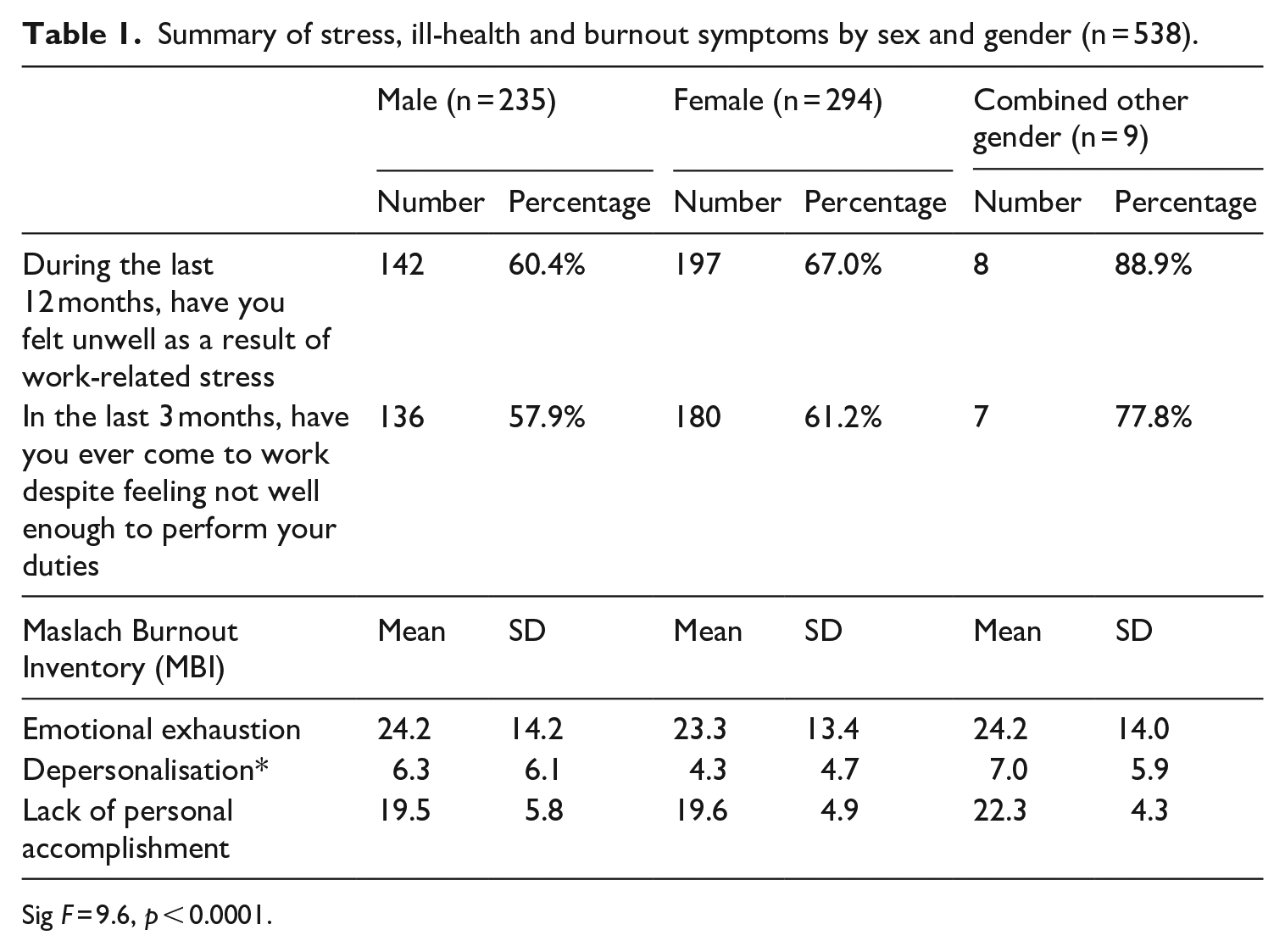
Sig F = 9.6, p < 0.0001.
Linear regression model of factors associated with officer perceptions of supporting a RASSO victim as an operational priority.
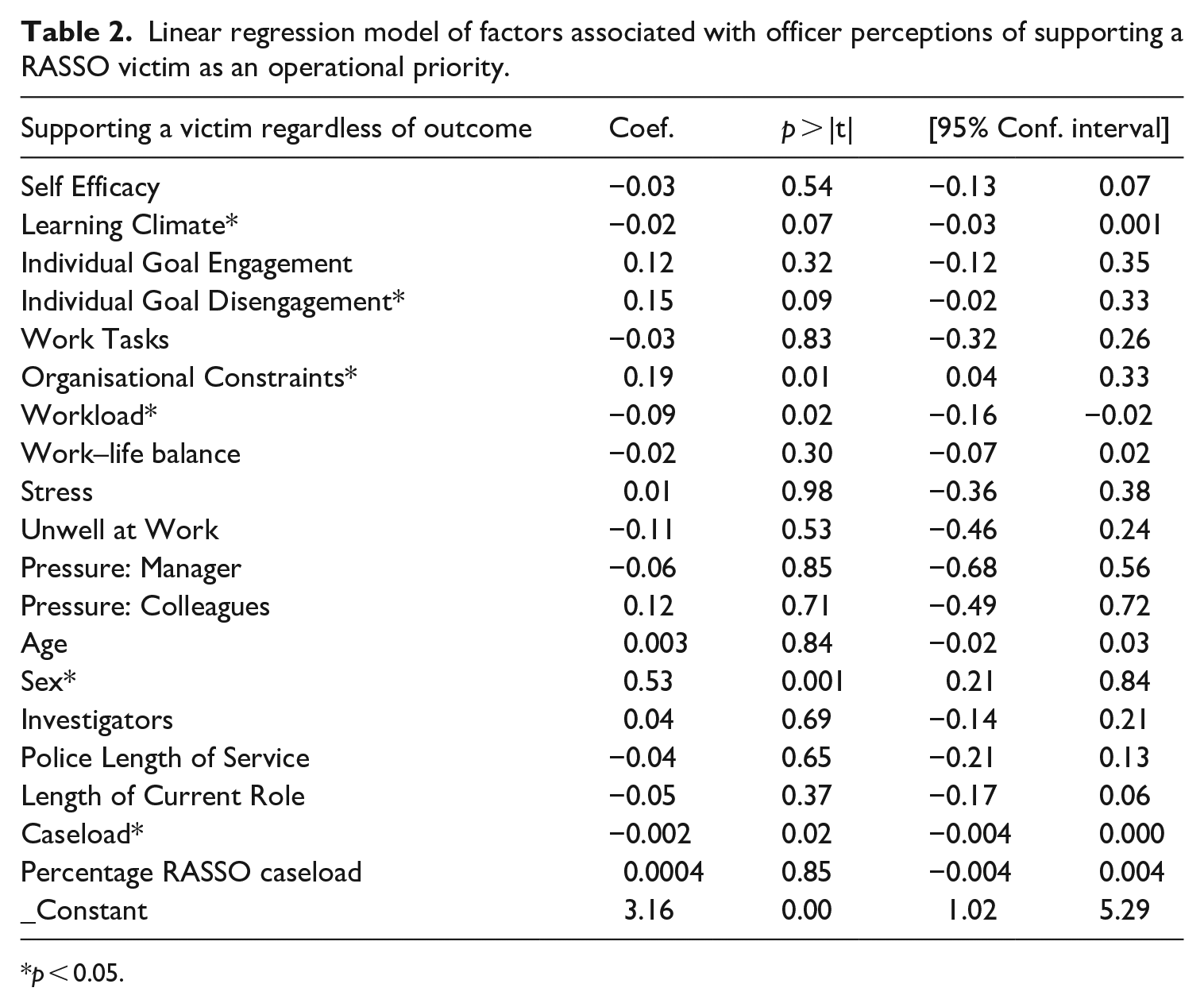
p < 0.05.
There were more female respondents to the survey (n = 294) than males (n = 235), with nine responses from investigators across gender, Cisgender, Genderfluid, Genderqueer, Intersex, Gender Non-conforming and Transgender. Caution is advised in interpreting these data due to the small number of respondents. High levels of work-related stress (67.0% of females responded that they had suffered from work-related stress compared to 60.4% of males) and ill health (61.2% of female investigators stated that they felt unwell in the last 3 months at work compared to 57.9% of male investigators) were noted among all respondents. These differences were not statistically significant. Moreover, high levels of burnout symptoms were noted across the survey. High scores of 23–24 were reported for the emotional exhaustion component, with no statistically significant difference between male and female investigators. Similarly, lack of personal accomplishment was equally consistent across male and female investigators (between 19 and 20), with no statistically significant difference noted. However, female investigators were reported to have significantly lower rates of depersonalisation relative to male investigators (F = 9.6, p < 0.0001).
In addition to the survey findings, interviews and focus groups were undertaken to explore factors of support afforded to officers and complement the survey. These interviews and focus groups allowed the participants to articulate any factors that may affect on their own sense of wellbeing. Furthermore, the interviews allowed a deeper understanding of the extent to which the role of caring for victim-survivors and the demands of their day-to-day job affects the provision of support for victim-survivors and what levels of emotional protection officers afford for themselves.
Study 2: Interview and focus group participants and recruitment
Interviews and focus groups were undertaken to collect qualitative data from 129 participants, supported by the 538 free-text responses to the survey. Ethical approval was provided by the Open University Human Research Ethics Committee HRCE/3854. The British Sociological Association (BSA) (2022) ethical guidelines formed the basis of all interviews.
As discussed, participants were recruited through in-force contacts to ensure officers and police staff working specifically with RASSO cases were invited to participate in our interviews and focus groups, all undertaken online due to ongoing COVID restrictions. All participants were provided with an information sheet and consent form before the interview. Interviews and focus groups were recorded by the research team and thereafter transcribed by a specialist transcription company. Data analysis for the qualitative findings was undertaken, supported by the use of the software package NVivo One by three researchers to ensure independent inter-rater agreement, which was further discussed across the wider research team. The findings were textually analysed by creating a coding structure to generate a wider thematic framework (Braun and Clarke, 2006).
Thematic analysis from the survey, interviews, and focus groups
In this section, we will link the findings from the quantitative component with the qualitative analysis using a broad narrative review approach (Denzin and Lincoln, 2018).
Gendered responses to victim-survivors
The analysis of the survey data shows key measures statistically significantly associated with officers prioritising supporting a victim-survivor regardless of the outcome of the investigation. From an organisational perspective, as constraints and levels to which an individual starts to disengage from their goals are perceived to increase, the less likely an officer will perceive supporting a victim-survivor as a priority: When we’re NFAing [No further action] a job, saying we’re not going to carry on, we’re cutting corners or second-guessing what CPS might say and, actually, CPS aren’t going to charge that. We’ll get rid of that. And the whole quality assurance bit around speaking to a victim if it’s NFAd, it should be a face-to-face meeting with a DI. That never happens. (Female officer, interview)
Similarly, as perceptions of a conducive learning climate increase, the more an individual prioritises supporting a victim. As the perception of the workload and actual caseload size increases, the more likely an officer will perceive supporting a victim-survivor as a priority. We suggest that as officers compensate for the lack of organisational support and a weak learning environment, they are managing concurrently their workload through self-resilience, yet with a sense of despondency in terms of the limited support they offer their victim-survivors. The survey data show that officers with high workloads and low resources are at risk of developing maladaptive strategies of disassociation and compassion fatigue with their victims, as reflected in the interviews and focus groups (Maguire and Sondhi, 2024): I desperately want them to get the best service and they’re just not, because we don’t have the time. So yes, it’s embarrassing and it’s disheartening. (Female officer, interview)
Importantly, the survey suggests that female officers are significantly more likely to state that they view supporting a victim-survivor as a priority relative to male officers. The survey data suggest that police investigators may be anticipating female victim-survivors would want to interact with a female officer rather than a male, as embodied in the victim’s code (Gov.UK, 2021). The work of Chan et al. (2010) concurs with our findings that gender stereotypes and cultural norms of male and female roles continue to exist in policing, with males less likely to prioritise victim care. Both the qualitative and quantitative data demonstrate the issues for officers having to show both strength in taking charge of a situation and providing support for victim-survivors while concurrently sharing ‘softer’ skills of empathy and care. By addressing depersonalisation among male officers, there is the possibility that this balance could change, but our findings indicate that systemic, cultural change is required to acknowledge that all officers must be equipped to deal with RASSO cases. This is further exacerbated by the issue that officers lack access to appropriate and specialist RASSO training to undertake their roles, including care as an important part of RASSO support (Williams et al., 2022): It’s still out there unfortunately that as females, we are probably better skilled to deal with sexual offence and domestic incidents rather than the males. If there’s no one trained available, then they will send other officers out, usually the female of the shift . . . I’d say typically you would think that if it’s a female complainant, that’s what they’d want and perhaps quite a lot of females will ask specifically for female officers because of the trauma that they get when it comes to being around men. (Female officer, focus group)
Schuck (2014) acknowledges the gendered labelling of emotional labour and the expectation that women perform caring duties more frequently than men. The quote above suggests that female officers are deployed more regularly to RASSO cases than their male counterparts, which may explain why the survey results demonstrated females as having higher levels of work-related stress and ill health than males. This is supported by Rabe-Hemp and Schuck (2007), who state that female officers are less likely than male officers to use physical force in their role, giving the perception of greater awareness of community care and need.
Yet emotional labour is not considered a competency in policing. The shift towards the need for victim-focused support is reflected in the revised teaching curriculum in police support for victim-survivors (Williams et al., 2022). DeJong (2004) notes the importance of recognising similarities in officer behaviours and attitudes rather than the differences based on gender. Poteyeva and Sun (2009) agree that demonstrating consistent support, regardless of gender, is the most effective approach to supporting victim-survivors. However, the survey data show higher rates of depersonalisation among male officers and must be addressed as an important issue to tackle, particularly when male officers are supporting female victim-survivors: I think in policing, because we’re predominately male, we can be accused of being a very patriarchal, ‘we know best’ organisation, we don’t want to disempower victims when they’ve made a sort of bold decision to come forward to policing. (Male officer, interview)
The notion of disempowerment of victims can be linked to officer depersonalisation and a distancing from the victim-centred approach of Operation Soteria. This is particularly pertinent in respect of the issue of failed investigations, high attrition rates and poor victim-survivor care in RASSO cases, which has affected significantly on public support (Charman and Williams, 2021). The End-to-End Rape Review (HM Government, 2021a: 30) highlights the importance of managing the police/victim-survivor relationship through care and consideration. The review recommends a future consultation for a Victims’ Bill and calls for a change in the landscape of victim-survivor support through a ‘transformative, holistic way that puts victims’ needs first’ (2021: 30). Notwithstanding the ongoing need for police officers to attend physical or violent callouts, the report highlights the need for policing attitudes to be victim-survivor focused. The shift towards an outward looking police force that is recognised by the public for all officers to show care and empathy aims to rebuild trust that has been eroded over time.
Reflections on officer wellbeing
The police force is bound by a culture where officers control their emotions through self-resilience, unlikely to show displays of emotion unless under exceptional circumstances (Maguire and Sondhi, 2024; Schaible and Gecas, 2010). Those working in public facing roles who support victim-survivors may suffer from vicarious trauma, and the survey demonstrates the high levels of burnout and emotional exhaustion of officers. Coping mechanisms such as ‘surface acting’ to absorb their stress, maintain professional boundaries and to be seen as resilient in the face of working with distressed victim-survivors (Knight et al., 2016; Lennie et al., 2021; Phillips et al., 2020): Actually, we’re being afforded that privilege to be able to help that person it has happened to. Where our mental wellbeing gets affected is exactly what [name] says, is things are not changing. (Male officer, focus group)
The officer here shares a common theme across many of our interviews, that the police see regular change and churn of staff. Instead of the problems of capacity and capability being resolved, they pass to the next investigator or team, investment remains constrained, and the cycle endures. Officers work under stress, and the difficulties are exacerbated by a lack of appetite for change at a senior leadership level. Issues relating to deficiencies in organisational support relate to Hobfoll’s (2001) argument that colleagues cover for each other in order to relieve the stress within the workplace, but such altruist actions do not solve the overarching issues of high capacity of cases, limited resources and inexperienced officers. Sembiring et al. (2020) suggest the need for emotional intelligence, that is, to ‘make sound and correct decisions despite being under pressure’ (p. 1114), particularly in situations where empathy is required. Their study and others (including Ali et al., 2012; Brunetto et al., 2012) have concluded that having emotional intelligence significantly improves work performance and satisfaction. There are lessons to be learnt on the dangers of burnout and emotional exhaustion of workers from other professions, specifically, public sector roles, including nursing and teaching, reinforcing the need to support those working in emotional and caring frontline professions (Maguire and Sondhi, 2024; Meier et al., 2006).
Duxbury et al. (2021) suggest the issues of an unwell police workforce can be explained through high demand, low resources and problematic work-life balance. Pressures of a target culture, with external measurements as a public sector provider, exacerbate a stressful work environment (Evetts, 2011). Officers with an awareness of the stressors associated with their work recognise the need to protect themselves from trauma, particularly those regularly exposed to RASSO cases. However, some perceive showing outward emotion as a weakness, with additional concerns about the consequences on both their teams or their career trajectory if they are identified as not coping with their role: Nobody ever said [name] are you okay? Can you deal with this? I was proper stressed. I was like, what am I doing? How do I deal with this? I’ve got to stay strong for my team. I don’t want to be weak. (Male officer, focus group)
Lennie et al. (2021) argue that officers need a safe space to create an environment and identify issues that otherwise go unspoken and unchallenged. Hobfoll’s (2001) COR theory demonstrates the need to develop a sense of self-efficacy to absorb the effects of difficult events. Although officers may engage their families for supportive interactions, they also protect them from distressing details (Lennie et al., 2021). Maran et al. (2015) found that female officers exhibited higher levels of organisational stress and distress than male officers, but the stress levels varied according to the role and sector of operation. Our survey and interview data had similar findings, with female officers exhibiting high levels of emotional exhaustion but, importantly, exhibiting depersonalisation at significantly lower levels than male officers.
A key component of resourcing RASSO investigations is the availability and quality of operational staff. Both the stressful nature of regular engagement with critical incidents and the potential for tension in one’s private life caused by long working hours and displays of wellbeing issues may lead to sick leave and additional pressure on already stretched resources (Maguire and Sondhi, 2024; Williams and Sondhi, 2022): I’m smiling out there all the time. I’m Mr Positive. We can do this. We’re part of a team. In here, I have my head in my hands most of the time. I stare at a sheet that’s full of vacancies or people on secondment and attachment and think, I don’t know how we can do this. (Male officer, interview)
High levels of work-related stress are prevalent within the survey, interview and focus group data, with pressure highlighted on supervisors and more experienced investigators who have to manage the responsibility for the shortfalls in staff and the lack of experience within their team. For officers who do not actively seek help, proactive coping behaviours may manifest as disassociation strategies (Keech et al., 2020). These behaviours may include compassion fatigue or depersonalisation, displaying emotional detachment from their role: We talk about how we have a good group of colleagues around us and we use that as our support network. It had got to the point that if people saw you struggling, when we first started to get busy they would all be helping. But then, just as I was breaking it was, no, we’re going to ignore you because if you break, we know we’re going to get all your work. (Male officer, focus group)
The issues of being under resourced and overworked have a detrimental effect on officers’ health and wellbeing. Findings from both the survey and responses in our focus groups indicate that female officers manage their health and wellbeing better than men, with male officers still uncertain about raising concerns regarding mental health and wellbeing in the workplace: But we still have that stigma attached. We’re joining the police, we’re police officers. We’re the tough guys. We’re the ones that save the day rather than actually putting our hands up and saying, we struggle, too, and we’re not machines. (Male officer, focus group)
Social bonding is a key factor in dealing with stress in the workplace. Hobfoll (2001) argues that workers commonly blame other colleagues for stress in the workplace rather than question their working conditions. The need to protect workforces should be organisational, for the force to provide appropriate resources, including learning, development and wellbeing support for all officers (Williams et al., 2022). Police organisations should be responsible for workplace support, heightened by the frequency of exposure to traumatic events, rather than staff themselves having the responsibility of caring for each other (Maguire and Sondhi, 2024): I refuse to go off sick because I didn’t want my colleagues to pick up my work [. . .] I don’t know if the other teams are the same, but we’re very close to each other. We will all take on those extra responsibilities and those extra burdens because we don’t want our friends and colleagues under that pressure. (Female officer, focus group)
To consider how a workplace environment can operate successfully, Hobfoll (2001) suggests we should remove obstacles that create barriers to effective workplace outcomes, rather than changing the working environment to fit the resources available. Hobfoll refers to work colleagues as a ‘tribe’, suggesting formal and informal similarities in group behaviour and certain cultures, particularly hierarchal workplaces displaying organisational professionalism. COR theory posits that individuals protect those things that are universally valued, such as health, wellbeing, family, self-esteem and a sense of purpose. For officers to deal with the continued demand of care for victim-survivors of RASSO, policing needs to concurrently support and equip its own tribe and demonstrate better care for its officers by removing the stigma of discussing mental health issues and providing greater mechanisms for wellbeing.
Conclusion
In this article, we have examined the role of the gender of police officers in England and Wales, both outwardly facing caring for the victim-survivor and with an inward focus on care for the officers themselves. The emergent theme of this article is a shift from a historical perspective of females as carers to the need for all officers, regardless of gender, to be emotionally aware of, and responsive to, victim-survivors’ needs. Furthermore, the importance of emotionally focused coping strategies and utilising emotional labour to manage work-related distress, both in caring for victim-survivors and for officers’ self-resilience.
Underpinned by the Conservation of Resource theory, we have shown that officer coping is manifested through workarounds to manage stress and pressure, which may include dissociation and compassion fatigue towards victim-survivors. We have found through our survey, interviews and focus groups that RASSO officers are initiative-taking professionals and strive to provide a caring, compassionate service to victim-survivors of rape and serious sexual assault. However, the survey demonstrates the effects of working in a traumatic environment, with high levels of ill health across the force. This study highlights the high prevalence of stress and pressures among RASSO police officers to keep working despite feeling stressed and unwell. The sources of stress can be shown to relate to high job demands and low resources, compounded by the conservation of resources that manifests itself through maladaptive strategies, such as dissociation and compassion fatigue of victim-survivors.
Pressures relate to a performance target culture at all levels of the organisation, which fosters a working climate that sets a priority of achieving work targets and comes at a precedent to physical and mental distress. Excessive workloads have a psychological cost on the ideal of a police officer supporting members of the public. Stress is manifested by high-job demand and low resources. As high workload becomes the norm and officers refuse to go sick in order to not impose their workload on their colleagues, ‘forced’ work attendance ensues. On top of workloads, meeting target-driven initiatives such as charge times and levels of thresholds to continue to charge hinders officers’ wellbeing. Regardless of a number of available services to officers, the force is not perceived as delivering effective wellbeing support to its officers. It is therefore important that the organisation takes responsibility for the support of officers, acknowledging excessive workloads and under-resourcing and the need for access to learning, development and wellbeing support services. At a national level, the recommendations from the Operation Soteria year one report highlighted the need to protect officers from burnout and to value the investment in the learning, development and wellbeing of officers on RASSO investigations. These recommendations are reflected in the National Operating Model, a statutory implementation in all police forces in England and Wales.
Our overriding recommendation is for all officers to be equipped through specialist RASSO knowledge and training and to have the skills to understand and acknowledge ‘care’ as a necessary component of policing, both to support vulnerable RASSO victim-survivors and to recognise their own wellbeing needs. This will enable the necessary transformative change of support for officers of RASSO investigations to take place. Despite concerning findings of officers presenting with psychosocial factors, there was also an overwhelming sense of officers putting their own health at risk in order to support victim-survivors as best they can. We argue that victim-survivor care is paramount, as is the support required for officers. The emphasis on care should assist in enabling transformative change at an organisational level to improve victim-survivor support and at an individual officer level to improve wellbeing, regardless of gender.
Limitations
The study is one of only a few to focus directly on the perceptions of police officers working on RASSO cases. Several limitations should be noted. First, compliance with the survey was recorded at 37% and, therefore, may be biased towards certain response types. Feedback from police officer stakeholders suggested that the main barrier to completing the survey was time. The survey was also cross-sectional and does reflect changing operational practices over time. We, therefore, are cautious as to the representativeness of the survey. Furthermore, as the qualitative interview participants were recruited by the police force voluntarily, there may be biases attached to the type of officer selected to participate.
Footnotes
Acknowledgements
All fieldwork and data collection were conducted as part of the Pillar 4 team, the Open University, Centre for Policing Research and Learning (CPRL). The corresponding author gratefully acknowledges Dr Emma Williams, Academic Director of CPRL and Pillar 4 Lead, for her support and agreement to the submission of this paper
Declaration of Conflicting Interests
The author(s) declared no potential conflicts of interest with respect to the research, authorship, and/or publication of this article.
Funding
The author(s) received no financial support for the research, authorship, and/or publication of this article.
