




Abstract
Within this article, the pains that unrepresented defendants experience when representing themselves in court will be discussed from the perspective of court professionals and the researcher. For the purpose of this article, an unrepresented defendant is someone who at some stage during court proceedings is not represented by a lawyer. Based upon data gathered from 20 semi-structured interviews with court actors and courtroom observations at two magistrates’ courts, it will be argued that while most defendants tend to struggle to effectively participate in court proceedings (e.g. follow and understand what is taking place), this is particularly the case for those who are unrepresented. It is important that defendants can participate in court proceedings for due process, human rights and liberal democratic reasons.
Introduction
The focus of this article is on defendants’ experiences at court. In art. 6(1) of the European Convention on Human rights (ECHR), it is implicitly recognised that defendants should be able to effectively participate in court proceedings, and the express rights under art. 6(3) are part of what constitutes effective participation. These explicit or implicit rights include the defendant’s right to be present at their trial (Colozza v Italy 1985), which enables defendants to hear the case against them (Owusu-Bempah, 2020); the right to adequate time and facilities to prepare a defence (art. 6(3)(b)); the right to defend oneself in person or through a lawyer (art. 6(3)(c)); the right to call and examine witnesses (art. 6(3)(d)); and the right to have an interpreter (art. 6(3)(e)). These rights seek to facilitate participation as they give defendants an opportunity to take part and follow proceedings and challenge the prosecution’s case. The right to participation is a long-recognised right (Owusu-Bempah, 2018). In R v Lee Kun (1916: 293), for instance, Lord Reading CJ stated that ‘the presence of the accused means not merely that he must be physically in attendance, but also that he must be capable of understanding the nature of the proceedings’.
To be able to effectively participate, defendants should be able to understand, follow, pay attention to, see and hear court proceedings (Mulcahy, 2013; Owusu-Bempah, 2017). Not many legal cases have discussed the meaning of ‘effective participation’. The most detailed definition was provided by the European Court of Human Rights (ECtHR) in SC v UK (2005: 29). This suggested that defendants should have a ‘broad understanding’ of the court process and ‘understand the general thrust of what is said in court’. Defendants should also be able to understand the significance of any penalty imposed, follow what prosecution witnesses say, make representations and give instructions to their lawyers.
It is important that defendants can themselves effectively participate in court proceedings (and in all hearings) for due process, human rights and liberal democratic reasons. Effective participation is needed in order to minimise the chances of miscarriages of justice happening in courts in England and Wales and to try and ensure that defendants are treated fairly and receive a fair hearing, and this is why it is guaranteed in art. 6 of the ECHR. If defendants are unable to effectively participate, then their rights and their ability to exercise them are undermined. Court proceedings need to be understandable in order for defendants to be able to exercise their rights and to call and hold the state to account – which is a key part of criminal proceedings (Ho, 2010; Owusu-Bempah, 2017). A liberal democratic society that values the freedom of the individual must seek to ensure that the state does not act oppressively or arbitrarily to prevent wrongful convictions from occurring (Duff et al., 2007; Ho, 2010). Individuals should be provided with an opportunity in court to test, comprehend and examine the case put forward by the state in order to protect their rights – particularly their right to liberty and freedom – and in order to prevent misuse of state power (Ho, 2010).
Owusu-Bempah (2020), Kirby et al. (2014) and Jacobson and Cooper (2020) have examined defendants’ ability to participate in the system and found that more needs to be done to facilitate effective participation. Discussion around effective participation has tended to focus on represented defendants though. In contrast, this article focuses largely on unrepresented defendants in the magistrates’ court and their ability to do so. This is important as although there are no official statistics for the number of those who self-represent in the magistrates’ court, it has been suggested that around 18%-26% are unrepresented for at least one hearing, so a significant minority (Kemp, 2010; Transform Justice 2016; Walker, 2021).
In Transform Justice (2016) and Walker (2021), it was found that defendants self-represented for a range of reasons, including that they did not think that they needed a lawyer (e.g. because the offence was too trivial); they did not want a lawyer (because, for example, they distrusted them, they did not want to delay proceedings by asking for a lawyer, and/or they wanted to put their own case across); or they could not afford to have a lawyer.
Regardless of the reasons why, though, past studies have found that defendants tend to experience problems at court. This was found to be the case, for example, in Dell (1971) in which 565 female prisoners were interviewed from Holloway prison about their experiences at court; in Carlen (1976) who observed proceedings in two London magistrates’ courts; in Shapland (1981) where 100 Crown Court and magistrates’ court cases in London were observed and 32 barristers, 5 solicitors and 12 sentencers were formally interviewed; and in Transform Justice (2016) where 10 prosecutors, 4 District Judges and 7 magistrates were interviewed, 2 online surveys were completed by 96 lawyers and court proceedings were observed in several magistrates’ courts in England. The architecture of the court building, for instance, the behaviour of those within court, and the complex nature of the law and proceedings resulted in defendants being marginalised and alienated during proceedings. Research has examined the experiences that unrepresented defendants have in the magistrates’ court, then, but most of the research is dated. Court proceedings, legal aid and levels of legal representation have changed since the 1970s and 1980s. Furthermore, the concept of effective participation – what this means and why it is important – was not considered in these studies.
In relation to defendants’ ability to participate and the experiences that they have, the pains of defendants self-representing will also be discussed in this article. Sykes (1958) has argued that prisoners experience specific pains, so deprivations or frustrations, of imprisonment (i.e. the deprivation of liberty, autonomy, security, goods and services, and relationships) and since then research has been done which has expanded upon these pains in relation to specific prisoners, such as female prisoners and transgender prisoners (e.g. Carlen, 1998; Maycock, 2022). Skinns and Wooff (2020) have also examined the pains of police detention. This article adds to this body of work by applying the concept of pain to a court setting. It will be argued, from the perspective of court professionals and the researcher, that unrepresented defendants experience a number of frustrations and challenges at court (i.e. pains), which undermine their ability to effectively participate in court proceedings.
Methodology
This article is based upon a small-scale study examining unrepresented defendants’ experiences at court (Walker, 2021). Ethics approval was granted by the University of Sheffield’s Research Ethics Committee. As part of this qualitative research project, 20 semi-structured interviews were undertaken with 12 defence lawyers, 3 ushers, 3 legal advisors and 3 judicial prosecutors. Attempts were made to recruit unrepresented defendants, but these were unsuccessful. Nevertheless, as stated, court staff were interviewed, and their perspectives are important given that they are involved with criminal proceedings, have experience observing and conversing with unrepresented defendants, as well as setting the culture and ambiance of the courts. Participants were recruited by being approached at court or through being sent a letter or email. The interviews were done either face-to-face or over the phone depending on what was most convenient for the participant.
As well as data being collected through the interview process, 403 hearings were observed at two magistrates’ courts based in England and Wales (the same courts where the interviewees worked). This took place over a 9-month period, between 2018 and 2019. 100 hours were spent observing at Court A (over around 19 days) and 126 hours were spent observing at Court B (over around 23 days). An observation schedule was used to collect quantitative data. Matters that were recorded included the court name, the date of the observation, the type of hearing being observed, whether defendants were represented or not, and the outcome of the hearing. Qualitative data about what was said in court and the behaviour of court actors were also recorded in the form of field notes. A range of hearings were observed, including first hearings, case management hearings, sentencing hearings and trials. In the majority of hearings observed, defendants were represented by their own private lawyer or by a duty solicitor. In the remaining cases, the defendant appeared unrepresented (see Tables 1 and 2 above for more information).
The number and types of hearings observed at Court A.
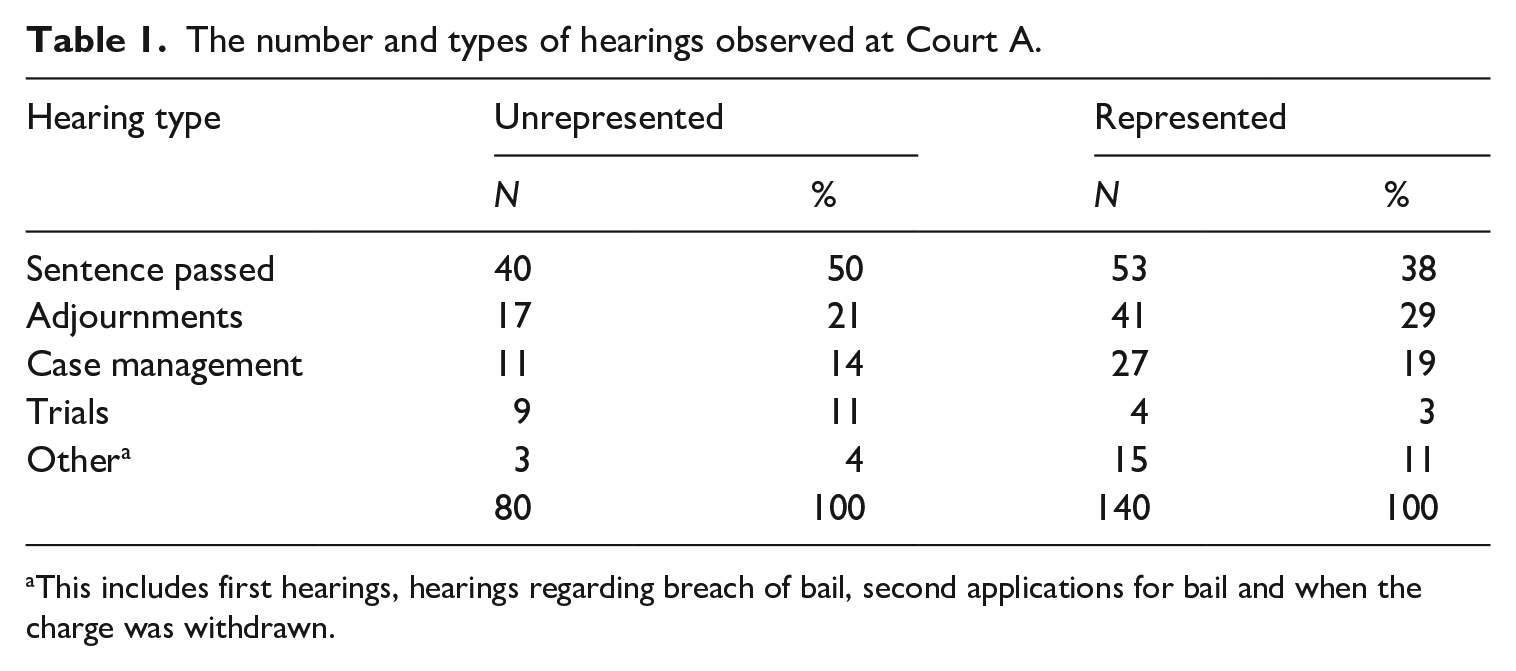
This includes first hearings, hearings regarding breach of bail, second applications for bail and when the charge was withdrawn.
The number and types of hearings observed at Court B.
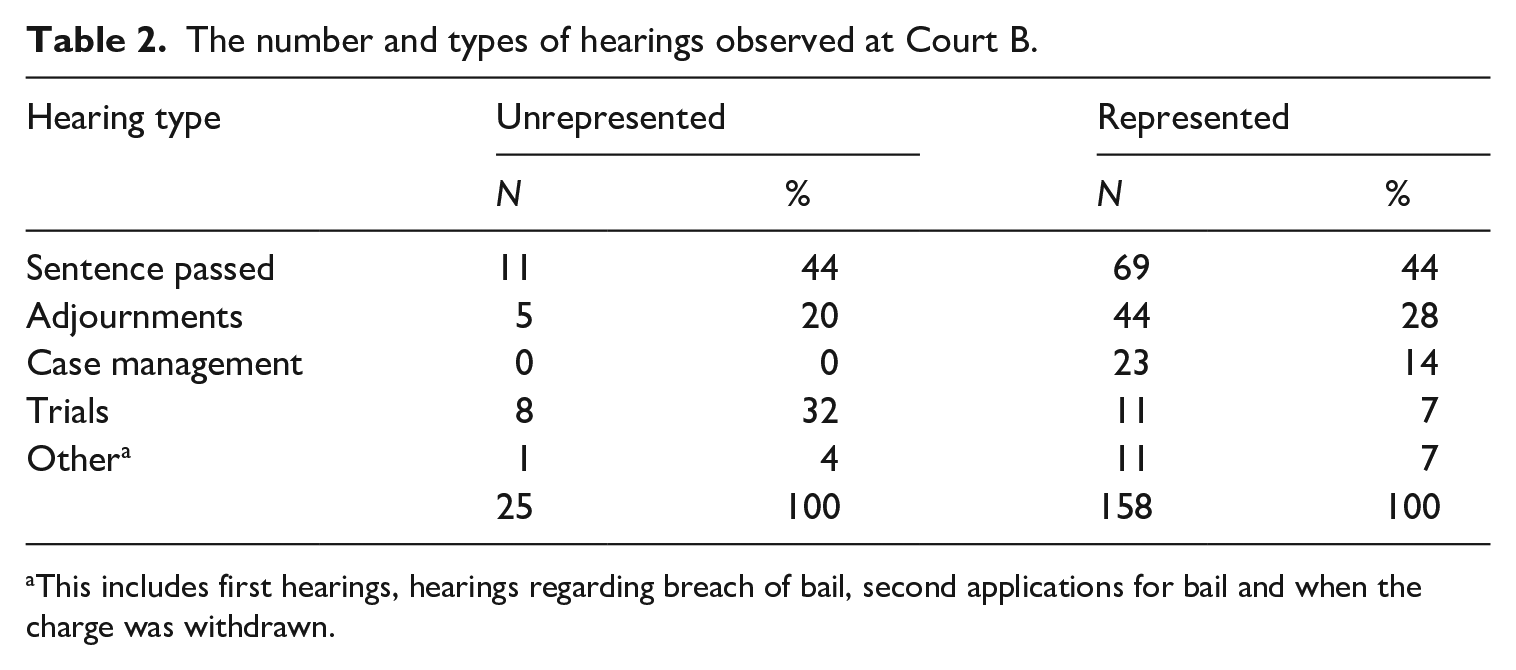
This includes first hearings, hearings regarding breach of bail, second applications for bail and when the charge was withdrawn.
Cases involving represented and unrepresented defendants were observed so that the researcher could compare their experiences at court. One of the courts was located in a city and the other one was in a town. The courts were largely chosen due to practical reasons. Due to the frequency with which the researcher needed to visit the courts, it was important that they were easy to travel to and not too far away, and that it would not be too costly to get there and back. Observing two courts allowed different court ‘cultures’ to be represented, as different courts may have dissimilar practices, approaches and procedures (Church, 1985; Hucklesby, 1997).
The fieldwork produced primarily qualitative data (apart from basic data on numbers of types of procedures observed, types of offences, types of personnel, etc.) so qualitative methods were mainly used to analyse the data. The data were analysed thematically (Bryman, 2016: 585). A deductive approach to analysing the data was taken, and so was an inductive and grounded approach due to the lack of recent research done in the area, so in some sense, the study was exploratory. When a grounded approach is taken, data should be collected until no new or relevant data emerge in relation to a category. This process is called ‘theoretical saturation’ (Strauss and Corbin, 1998: 421). In this study, the number of participants interviewed, the type of participants who were interviewed and the number of some of the hearings that were observed were limited as a consequence of time constraints, issues experienced relating to recruiting defendants to be interviewed, and the low frequency of some types of hearings. Thus, while the results are still valuable, more data could potentially have been collected to further develop some of the categories.
Given the small number of interviewees and the fact that only two courts were observed, this limits the extent to which the findings are generalisable or the sample is necessarily representative in a statistical sense. Nevertheless, the findings are still able to provide an insight into defendants’ experiences, and generalisability and representative samples are not something that qualitative researchers using an interpretivist approach necessarily desire or aim for in any case (Mason, 2002).
A potential limitation of the data is that defence lawyers could be said to have a vested financial interest in maximising representation and, therefore, be likely to favour a view that leads them to a pro-representation position. They may also adopt this position due to their own principles, inherent values, and views regarding justice. Staff at His Majesty’s Courts and Tribunals Service (HMCTS) may also have wished to promote their employer and their court in a particular light – seeking to avoid criticism (especially of their own work). This must be borne in mind when reading the results of this study.
Results
The results from the current research will now be discussed specifically focusing on the experiences that unrepresented defendants have at court and the pains that they experience.
These pains relate to the difficulties unrepresented defendants tend to experience when preparing for hearings, entering pleas, cross-examining witnesses, mitigating, and attempting to understand court processes and legal procedures. There will then be a discussion about how defendants, particularly unrepresented defendants, struggle to effectively participate in the process and, finally, some concluding thoughts will be made.
The pain of not knowing how to prepare for hearings or being unable to do so
When a defendant has been charged with a criminal offence, they may be required to attend a hearing or multiple hearings at court. The findings from the current research suggest that unrepresented defendants do not always know how to prepare for court hearings or know what evidence to bring. An usher (interview participant 13) mentioned this difficulty: ‘they [unrepresented defendants] are probably not aware of what to bring with them’.
This was also illustrated by some cases observed in court where unrepresented defendants found it difficult to know what to bring to court to support their case, and then they were reliant upon the court to adjourn proceedings for them to get the required evidence. In the cases observed, the court did tend to adjourn proceedings for them to do this. However, a defence lawyer argued that despite court staff informing unrepresented defendants that they need evidence, they still might not understand fully what that means and how to go about getting that evidence.
In addition, court proceedings were not always adjourned in such instances, which can have implications for defendants. This was apparent in Case 387. The defendant had pleaded not guilty to speeding: she said that it was not her who was speeding and that she was at work that day. She had brought a letter from her employer saying she was at work – but it had the wrong date on it and it was not signed. The legal advisor asked her if she had anything else to prove she was at work on that day, but she had not brought anything. The defendant was found guilty of the offence, but once the defendant had left, the magistrates said to the legal advisor that they believed the defendant, but she had not brought the required evidence on the day, so they had to find her guilty of the offence based upon what they had heard.
To be able to prepare for their hearings defendants will need to read their case papers, but some unrepresented defendants may lack the ability to do this. On one occasion (Case 177), for example, an unrepresented defendant – who had been charged with criminal damage – was heard saying say prior to his hearing that he had dyslexia, and he could not read, and it did not appear that his papers were read to him. This may also be an issue for other defendants too – for instance, those with poor reading skills or for whom English is a second language. As well as these issues, one defence lawyer who was interviewed expressed concern that even if they do not lack the ability to read their papers, unrepresented defendants still may not always read them before deciding on whether to plead guilty or not, and a few cases observed in this study also reinforced this claim.
Furthermore, as discussed earlier, defendants have a right to adequate time and facilities to prepare a defence (art. 6(3)(b)). When and how unrepresented defendants are given their case paperwork, though, depends upon the nature of the hearing and the type of offence. In relation to plea hearings, according to those interviewed, the court usher usually gives unrepresented defendants their case paperwork on the day of the hearing. When defendants appear in the traffic court, they should have been sent their papers to their home address. Unlike defence lawyers, unrepresented defendants are given/sent paperwork as – at the time of writing – they are excluded from receiving case files digitally.
When unrepresented defendants are given their case papers on the day of their first hearing, they will not have had a long time to consider the evidence against them, which may influence their decision as to what plea they enter. According to those interviewed, solicitors usually see their client’s paperwork on the day too, but they will be in a better position to be able to read the case papers and make an assessment in relation to what plea their client should enter given their knowledge, training and experience. When observing, it was noted how unrepresented defendants tended to be in a stressful environment when reading their case papers or when they were given the opportunity to do so (a courtroom building, which was busy with other court users). Unlike lawyers, they did not have access to secure, private rooms within the court building.
In relation to trials, defendants should have been sent their case papers prior to their trial date. However, defendants may not have a fixed address, or they may have moved, so even if documents have been sent to them, it does not necessarily mean that they will have received them, or that they will have been sent on time. Therefore, not only was the timely receipt of paperwork problematic for plea hearings but also with regard to trials. Furthermore, defendants who are unrepresented will not necessarily know what evidence to expect to be sent or how to go about rectifying any failure by the Crown Prosecution Service (CPS) to send the required evidence/papers. As one defence lawyer said: Firstly, there are Criminal Procedure Rules, whereby the CPS must serve all outstanding evidence within a set time frame. The CPS very rarely serve that paperwork within that set time frame so a person representing themselves will not know how to go about getting that paperwork. (Interview participant 2 – DL)
As was the case in Transform Justice (2016), the findings from this study suggest the ability of unrepresented defendants to participate in proceedings is undermined due to difficulties around accessing and reading case papers and understanding their importance. Thus, they are consequently disadvantaged as a result.
The pain of deciding whether to plead guilty or not guilty
Case papers are particularly important at the plea hearing (when defendants enter their plea). At the beginning of the hearings observed – where a plea was entered – both unrepresented and represented defendants tended to be identified, the charges were read out and the legal advisor asked them to enter a plea. Again, echoing the findings in Transform Justice (2016), the findings from this study suggest that some unrepresented defendants experienced problems in relation to entering the correct plea and deciding whether to plead guilty or not guilty.
According to some of the defence lawyers interviewed, some unrepresented defendants experienced problems at plea hearings as a consequence of them not understanding the law or knowing that they had got a potential defence. This could result in some pleading guilty when they should have pleaded not guilty and vice versa: You’ve got to hope that they’ve not gone and pleaded guilty in a situation where they might not actually be guilty of an offence and that may have become apparent if they had had representation. You do get situations where a person might think that they have committed the offence, but they might not be aware that there is a statutory defence available to them – that issues such as duress might be relevant to the position . . . You undoubtedly do get situations where unrepresented people through lack of knowledge of what it is that they are actually accused of will plead guilty when they are technically not guilty. That may not necessarily become apparent to the court. (Interview participant 5 – DL)
As well as the issues suggested, a few defence lawyers mentioned that unrepresented defendants might also feel pressured to enter a guilty plea or may do so, in order to speed the process up, or because they do not fully understand the implications of pleading guilty: [Unrepresented defendants’ experience] problems at plea hearings – they don’t know whether to plead guilty or not. They quite often enter what’s known as an equivocal plea, so ‘I’m not guilty but I’m going to plead guilty to just get it over and done with’ or just not understanding what the consequences of their actions or lack of actions are. (Interview participant 12 – DL)
Two legal advisors who were interviewed discussed what they do to assist unrepresented defendants at plea hearings, but they recognised that it can be problematic as they do not want to be perceived as putting pressure on defendants and there is a need for them to remain neutral. The legal advisors discussed how during plea hearings when, in their opinion, a guilty plea has been entered incorrectly, they seek to explain things to unrepresented defendants, inform them of the implications of pleading guilty or not guilty, inform them that they have got no defence and/or adjourn the hearing for them to see a duty solicitor when they are eligible to see them. However, it may be difficult for unrepresented defendants to take in information about pleas and defences and to understand it sufficiently in such a pressurised court environment.
As suggested, court personnel can ask unrepresented defendants whether they wish for the hearing to be adjourned so that they can get legal advice. Based upon the interviews and observations, whether they will receive legal advice will depend upon whether they are entitled to legal aid, or to see a duty solicitor and, if not, whether they are able or willing to pay for the legal representation themselves.
A couple of defence lawyers said that the duty solicitor can assist in relation to defendants: not knowing whether to plead guilty or not guilty; not always knowing the strength of their case; and not always knowing whether they have got a defence or not. However, this is not available to everyone and not everyone who is entitled to see the duty solicitor will choose to do so. In situations where defendants are not entitled to see the duty solicitor, proceedings can be adjourned for unrepresented defendants to get legal advice when they are experiencing difficulties at the plea hearing; but even if this does happen, a defence lawyer said that it still does not mean that the matter will be resolved when the defendant next appears in court: Even if the court adjourns for them to go and seek legal advice, they are then hit with the problem that they probably can’t afford legal advice and they may come back the next time no better able to deal with it than the first time. (Interview participant 5 – DL)
In situations where the defendant is unable to afford legal advice or wishes to obtain legal advice and is not entitled to see a duty solicitor, they are then reliant upon court staff to assist them. Based upon the interviews and observations, court actors do provide some assistance to unrepresented defendants who are struggling, in their view, to enter a correct plea. However, the frequency and nature of the assistance varied (some legal advisors observed adjourned proceedings for legal advice, others provided an explanation of the offence charged, and others went beyond providing an explanation of the offence and said whether in their view, the defendant had a defence or not). This gives rise to the issue as to how court personnel should respond to unrepresented defendants and what assistance should be offered to facilitate defendant participation.
The pain of cross-examining witnesses
If an unrepresented defendant pleads not guilty at their plea hearing, then at trial they may choose to cross-examine any prosecution witnesses. From the cases observed, unrepresented defendants were generally poor at cross-examining and tended to make statements instead of asking questions. They also usually did not know what questions to ask, asked irrelevant questions and/or did not give the witness the chance to answer the question asked. In comparison, the lawyers observed tended to ask more questions overall in an attempt to cast some doubt over the evidence presented. Unrepresented defendants usually needed assistance when cross-examining; but the assistance given varied depending on the legal advisor, magistrates or judge.
In Case 386, for example, the defendant said very little and the court personnel did little more than just ask if they had any questions to ask: Legal advisor to defendant: You’ve heard [name] give evidence. What is it that you don’t agree with? Defendant: I don’t know if it’s incorrect or not. I just know what my side of it is. Legal advisor: You will be able to give your evidence later. In relation to what Mr [name] said is there anything you disagree with? Any questions of Mr [name]? Defendant: No.
In other observed cases, the defendants asked slightly more questions and the legal advisors and magistrates provided more assistance. Nevertheless, the defendants observed still seemed to struggle with cross-examination, both in relation to its purpose and what they were required to do. They seemed to think the process was inquisitorial rather than adversarial, and they just wanted to explain to the magistrates what their case was. This was apparent in Case 153, where the defendant had been charged with a driving offence, and consequently the magistrates had to ask additional questions of the witness. The defendant also struggled in Case 366. Here again, the defendant had been charged with a driving offence, and as a result, the legal advisor took a more active role in questioning the witness. Despite the difficulties experienced by the unrepresented defendants court staff tried to assist them to be able to effectively participate in the process. The level of help they seemed to get from those in court appeared to vary, though, depending on the personalities of those in court, the circumstances, the facts of the case and the defendant themselves.
In some instances, a lawyer may be appointed to cross-examine witnesses when the witness is seen to be vulnerable. Interviewees suggested that the court-appointed lawyer scheme does provide some assistance to those who are unrepresented – even if this is not its intended or main purpose – and it helps the court out. This is because when lawyers are appointed to cross-examine all witnesses the court does not have to try and deal with an unrepresented defendant who does not know how to cross-examine. However, they also recognised that court-appointed lawyers are restricted in what they can do or are paid to do. So, for instance, once they have finished cross-examining, they leave, so they do not provide any assistance in relation to sentencing or any advice on appeals, if the defendant is convicted. Furthermore, lawyers will only be appointed to cross-examine vulnerable witnesses. The court may also decide that some individuals giving evidence are vulnerable, while others are not; so the defendant will be left to cross-examine the latter.
To summarise, defendants tend to struggle to cross-examine witnesses, which they have an explicit right to do under art. 6(3)(d) of the ECHR. As was also found to be the case in Transform Justice (2016), though, unrepresented defendants rarely have the necessary skills or knowledge to do this. The inability of most unrepresented defendants to effectively cross-examine has been noted previously, then, although the matters discussed earlier in relation to court-appointed lawyers do not seem to have been researched. When a lawyer is appointed to cross-examine a witness, this benefits the defendant in some ways, but there are limitations to the scheme. Consequently, the scheme does not mitigate all issues relating to participation.
The pain of mitigating
In the cases observed, if a defendant had pleaded guilty or had been found guilty, then some were sentenced that day. In these cases, the prosecution outlined the case to the court and listed any of the offender’s previous convictions. If an oral pre-sentence report had been prepared, then a member of staff from the Probation Service read it out. Written pre-sentence reports were read by the bench before passing sentence. If the defendant was represented then their lawyer gave their plea in mitigation. If the defendant was unrepresented, then they were usually asked if they had seen the pre-sentence report and whether they wanted to say anything before being sentenced. The bench then decided if they were willing and able to sentence the defendant in that hearing or whether it would have to be adjourned (to send the case to the Crown Court for sentence, because of time and caseload constraints, or to request a pre-sentence report).
The plea in mitigation by the defence and pre-sentence report, therefore, provided information to the bench to assist them to impose the appropriate sentence. In relation to the ability of unrepresented defendants to mitigate, the data from the observations in this study largely confirm the data gathered from the interviews: unrepresented defendants tended to say a minimal amount when they were asked if they wanted to say anything before being sentenced. They would not make a sentencing suggestion, except in hearings where a pre-sentence report had been prepared and they had been asked if they agreed with the sentencing suggestion recommended in that report (they all said that they did). Some unrepresented defendants observed did not say anything at all: Legal advisor to defendant: Did you want to explain the events that led up to the situation? Say anything? Defendant: I’ve got nothing to say. I’ve said everything at the police station. (Case 11)
In some other instances, although the defendant only spoke briefly, they did mention some factors relating to personal mitigation (they expressed remorse and/or acknowledged it was wrong and/or acknowledged guilt). Although some mitigation was offered by the defendants in these cases, they did not mention other possible likely relevant factors relating to the offender or the offence, which would have been discussed had the defendant been represented. Most participants felt that unrepresented defendants struggle for an array of different reasons. This is due to them not usually understanding what to say or what constitutes mitigation, not understanding the purpose of mitigation, not accessing or not knowing what sentencing guidelines exist and not being confident in the court environment when it comes to speaking to court staff. The court isn’t appraised of the full position [when a defendant is unrepresented]. The court when sentencing have sentencing guidelines to look at . . . so, you’ve got the offence, then you’ve got aggravating and mitigating factors, and it can bump you up or down on a scale; so, if the court doesn’t know about mitigating factors, then you know they might put the category of offence in a more serious bracket than perhaps it would be had they heard a persuasive argument from a solicitor. (Interview participant 3 – DL) I would say the biggest problem with that is the reluctance to speak to the magistrates . . . you sometimes feel that they have not said as much as they might have wanted to say either through nerves or through them not knowing what they should be saying. (Interview Participant 16 – LA)
In relation to sentencing guidelines, if unrepresented defendants do not know that they exist or if they do not understand them, the extent to which they will know what they should and should not be speaking about during their sentencing hearing will be restricted. The existence of sentencing guidelines, though, was considered helpful by some interviewees in that they promote greater consistency in sentencing for both represented and unrepresented defendants. However, although guidelines are more restrictive, they still leave quite a bit of discretion and flexibility (Roberts, 2013). In any event that discretion is bounded by aggravating and mitigating factors, which is the sort of things that the majority of participants said defendants struggle to effectively communicate.
Pre-sentence reports do help to identify those factors, though. However, a problem with pre-sentence reports is that they are now increasingly done quickly and, in less depth, to meet with court efficiency expectations (Robinson, 2017). Furthermore, they are not requested for all offence types and unrepresented defendants did not usually add to them or comment on them, as lawyers usually did, unless they were probed by court staff. When they did comment, very little was said. This suggests that pre-sentence reports do not mitigate all of the problems that unrepresented defendants face when it comes to sentencing.
Based upon the interviews and observations, it appears that although the amount said by defendants and their ability to mitigate did vary, on the whole, defendants tended to struggle when it came to providing a plea in mitigation before being sentenced. Unrepresented defendants usually did not say a lot and when they did say something, the main content of their mitigation generally revolved around their attitude to the offence. It was uncommon for defendants to speak about the offence itself or their own personal circumstances. These findings are similar to those found in Shapland (1981) and Transform Justice (2016), although the helpfulness of sentencing guidelines was not discussed in either study mentioned. Since Shapland (1981), sentencing guidelines have become more extensive, and they impose greater restraint on sentencers to promote greater consistency (Ashworth, 2015). Nevertheless, discretion has not been completely eliminated, and this would not be possible or desirable in any case, given that all cases are different and different defendants will have different circumstances. Issues remain for those who are unrepresented, and consequently, unrepresented defendants continue to struggle to effectively participate in the process which undermines the fairness of the hearing.
The pain of understanding court processes and legal procedures
When defence lawyers were asked to what extent they thought that unrepresented defendants understood proceedings and given a scale of very often, fairly often, sometimes, rarely, or never, the majority answered rarely or sometimes. Most judicial prosecutors said they thought that unrepresented defendants understood proceedings fairly often, though.
Furthermore, while the majority of defence lawyers felt that unrepresented defendants had a limited understanding in relation to what is happening during court proceedings, a few were reluctant to generalise: It’s difficult to generalise. Some will understand. Some will have been there before and, therefore, know what’s going on. Some are like rabbits caught in headlights and have never been to court and are completely utterly fazed by their appearance in court, so it’s difficult to generalise. (Interview participant 4 – DL)
A small number of defence lawyers mentioned how defendants with mental health issues, learning difficulties, or other vulnerabilities may also struggle to understand as a consequence of these issues. These findings are in line with Howard (2022) and Jacobson and Talbot (2009). One defence lawyer, however, felt that both unrepresented defendants and represented defendants struggle with understanding – regardless of whether they have been to court before. Why the process is so difficult to understand and whether it needs to be like this, though, was not something that was queried by those interviewed.
Language and terminology, understanding what to say or do, and court procedures
An usher mentioned how unrepresented defendants may struggle with terminology, and four defence lawyers said that the language and terminology used in court can cause difficulties for defendants, and this is regardless of whether English is the defendant’s first language or not. Respondents also discussed how unrepresented defendants do not always know what is relevant and appropriate to say in court and the ways in which it is appropriate to behave: Disadvantages [of being unrepresented] is that people [defendants] . . .. they don’t say all the right things. They don’t put forward everything that the magistrates need to hear. They miss things out. They only put forward things that they think is important. They very often misunderstand. (Interview participant 7 – DL)
A judicial prosecutor (interview participant 20) also said how unrepresented defendants ‘don’t know how to communicate with the court’, and another area mentioned in which unrepresented defendants seemed to struggle was court procedures. Some defence lawyers said that misconceptions arise as a consequence of defendants – who have not necessarily been to court before – getting their knowledge of court proceedings and procedures from television programmes which often do not reflect the reality of the situation: People have grown up on a diet of television programs haven’t they, which aren’t, don’t bear any resemblance often to the reality of a court experience. (Interview participant 3 – DL)
Consequently, understanding terminology and procedure is something that some unrepresented defendants experience difficulties with. It is important that proceedings and terms are explained to unrepresented defendants in a clear and accessible way to facilitate participation.
Bail applications, disclosure, evidence and relevant forms
Participants said it was rare for a defendant to have to make a bail application without legal representation. Some interviewees, though, explained some of the issues and misunderstandings that usually arise when unrepresented defendants do make such an application: If you’ve got an unrepresented defendant trying to make a bail application, they don’t understand the law . . . what can be objected to . . . what kind of clauses or bail conditions to propose that the magistrates can consider. (Interview participant 7 – DL) It’s an uphill struggle for an unrepresented person to be applying for bail. (Interview participant 18 – LA)
In relation to participation and understanding, a further area highlighted by interviewees was disclosure of evidence prior to a trial and evidence more generally: They don’t understand Criminal Procedure Rules. They don’t understand disclosure rules, so they don’t understand it at all. (Interview participant 2 – DL)
An usher also said that they struggle to fill out the case management form, which they will have to complete if the case is going to trial. They will need to identify any relevant issues and any witnesses.
To summarise, then, as was the case in Carlen (1976), Dell (1971) and Transform Justice (2016), there was concern among some participants in this study about whether unrepresented defendants have the required skills, knowledge, understanding and experience required to effectively participate in hearings.
Defendants’ ability to participate
Based upon the above findings, it is clear that unrepresented defendants experience a range of pains when representing themselves at court and these undermine their ability to effectively participate in court proceedings. This is not to say, however, that all unrepresented defendants will experience these pains, or will experience them to the same magnitude, and will all struggle to participate. For example, there were instances observed where unrepresented defendants did manage to bring all the required evidence to court, they did not appear to have an issue entering their plea, and they provided a richer account when talking about their mitigation during sentencing. This was also something that was discussed by some of those interviewed, who suggested that some unrepresented defendants can effectively participate in proceedings when assisted to do so by court staff. It is important to recognise, as has been suggested earlier in relation to understanding, defendants are not one homogeneous group. Their needs and ability to participate will differ. Nevertheless, in this study, generally there was a tendency for unrepresented defendants to experience problems in relation to the matters discussed.
From the interviews, however, and research that has been done by Kirby et al. (2014), Owusu-Bempah (2020) and Kirby and Cooper (2020), it appears that represented defendants also struggle to effectively participate in the system. A number of barriers to participation have been identified, including a lack of understanding, denial of defendants’ voices, defendants’ passive acceptance of the court process, court users’ vulnerabilities (e.g. mental health issues and language barriers), the complex nature of court processes, the language used in court, the courtroom design, and legal constraints on participation (Kirby and Cooper, 2020; Kirby et al., 2014; Owusu-Bempah, 2020). It is the role of the defence lawyer to assist represented defendants to effectively participate in the process, but not all will have the time, skills or motivation to do this (Baldwin and McConville, 1997; Newman, 2013). Thus, represented defendants can also experience issues which undermine their ability to effectively participate in court proceedings. Compared to unrepresented defendants, represented defendants are not required to take such an active role during court proceedings, so the challenges relating to cross-examining witnesses, for example, will not be apparent, but there will still be concerns around understanding.
In cases where defendants are not represented, they are reliant upon court staff to provide this assistance and as seen from the findings in this study, this is needed due to the problems that unrepresented defendants tend to experience. The findings also suggest, though, that the level of help provided can vary depending, for example, upon the staff member themselves, the seriousness of the offence, and the amount of time available. Even when help is provided, they may still experience difficulties, as seen, for example, in relation to the discussion around entering pleas and cross-examining witnesses. While it is important that all defendants can participate in court proceedings, this is particularly the case for those who are unrepresented due to the greater role that they play in court proceedings.
Conclusion
To conclude, despite the importance of defendants being able to effectively participate, based upon the findings, it does not appear unrepresented defendants always know what is happening, what they are required to do or what they will be required to do in their next hearing. Defendants appeared to struggle in relation to knowing what evidence to bring to court, receiving or reading their paperwork before entering a plea, knowing what plea to enter, understanding what to do during a cross-examination, knowing what to say during the sentencing stage and understanding the legal terminology used, court procedures and rules of evidence and disclosure.
A number of pains have been identified, within this article and, although not an exhaustive list, it has been argued that they undermine defendants’ ability to effectively participate in court proceedings. The concept of pain has, therefore, been applied to unrepresented defendants and their experiences at court. Future work could expand on this further by considering the extent to which the pains of imprisonment identified by Sykes are apparent in a courtroom setting. It would also be of value to consider defendants’ views given that they are the ones going through the experience. Despite this, minimal research has been done which has interviewed, represented and/or unrepresented, defendants themselves (Dell, 1971; Kirby et al., 2014; Kemp, 2010). Nevertheless, in this research, defendants were observed during court proceedings and the court actors interviewed were able to shed light on the area.
Significantly, the data supports the findings from previous research which has examined unrepresented defendants’ experiences in the magistrates’ courts (Carlen, 1976; Dell, 1971; Shapland, 1981; Transform Justice, 2016) – the majority from the 1970s and 1980s. This shows that despite this research taking place 50 years later and some initiatives being introduced to enhance participation (e.g. special measures and practice directions), defendants still experience issues when going to court. This suggests that defendants are still generally marginalised and confused during the court process, and although defendants have the right to effectively participate in theory, more needs to be done to enable defendants to exercise this right in practice.
Footnotes
Acknowledgements
The author would like to thank Dr Samantha Fairclough, Dr Jack Lampkin, Dr Rosie Binfield-Smith, Amy Holmes and the two anonymous reviewers who provided kind and constructive feedback on an earlier version of this article. Thank you also to Professor Joanna Shapland and Dr David Hayes for supervising the doctoral research this article draws upon.
Declaration of Conflicting Interests
The author(s) declared no potential conflicts of interest with respect to the research, authorship, and/or publication of this article.
Funding
The author(s) disclosed receipt of the following financial support for the research, authorship, and/or publication of this article: This research was funded by the Economic and Social Research Council (ESRC).
