




Abstract
Young people whose language performance does not meet socially expected standards are overrepresented in the criminal justice system. Pragmatic language skills encompass the social aspects of language, which include constructing narratives, the rules of conversations, turn-taking, topic management, and non-verbal communication. Current research on pragmatic language impairments in criminalised young people – that is, on their symptomatic difficulties with social communication and language – remains inconclusive. The purpose of this study is to uncover the perceptions and framing of pragmatic language impairments in a sample of studies involving boys and girls from Australia and the United States. Drawing on content analysis of a sample of pertinent research, we expose the deeply gendered framing of pragmatic language performance and associated behaviours of criminalised young people. We demonstrate that available studies often represent female participants’ problematised use of pragmatic language as a personal choice, thus locating the problem within the individual and responsibilising girls and young women. However, for male participants, current research often presents problematised use of pragmatic language as a consequence of institutional failures. We argue that this gendered framing has political implications for criminalised young people and future research.
Introduction
Pragmatic language skills encompass the social aspects of language, including constructing narratives, the rules of conversations, turn-taking, topic management, and non-verbal communication, whereas language impairments refer to cognitive or physical symptoms of language disorders. Pragmatic language impairments can include interrupting others, not holding eye contact, inappropriate conversation topics, monopolising conversations, a lack of appreciating others’ thoughts and feelings or difficulty telling a comprehensive story. Research shows that young people with language impairments are overrepresented in the criminal (‘youth’/‘juvenile’) justice system (Anderson et al., 2016; MacRae and Clark, 2021; see also Holland et al., 2023).
At the heart of this social problem is young people’s interaction with the world. For humans, social interaction and feedback from others are central to one’s sense of self and place in the world (Guenther, 2013). When such interactions are disrupted, in this case through impairment of language performance, there are political implications (Arendt, 1968). Whereas the criminal justice system (and an important segment of social research) views vulnerability in terms of risks – especially risks of (re)offending – we adopt Butler’s and Arendt’s position on vulnerability. That is, the relational nature of vulnerability: through our attachment and dealings with others, the danger of losing this connection or being misrecognised is ever present (Butler, 2003). Put it another way, vulnerability is not a condition inherent to individuals or the groups they belong to, but structural circumstances that limit life-chances, erect barriers and increase people’s fragility and needs. In this article, we problematise how pragmatic language performance in young people intersects with three political phenomena – gender, criminal justice system, and research.
Research shows that at least 60% of young people in contact with the criminal justice system have difficulties with speech, language and communication that are unrecognised (Bryan et al., 2015) and up to 50% of incarcerated people who have complex communication needs were previously undiagnosed as such (Holland et al., 2023). For this reason, across studies, the rate of language impairment, in all of its variations, in incarcerated young people ranges between 14% (Gregory and Bryan, 2011) and 53.7% (Games et al., 2012). The lack of screening in police custody for speech, language and communication needs renders communication impairments ‘invisible’ (Holland et al., 2023). Language impairments disadvantage those involved in the criminal justice system by diminishing their ability to accurately articulate their version of events, comprehend complex jargon and abstract concepts, seek clarification and recognise and articulate emotional states and social cues (La Vigne and Van Ryebroek, 2011; MacRae and Clark, 2021). As identification of language impairments is critical to ensuring fair outcomes in the justice system (Nolan, 2018), so is the investigation of how these impairments are represented in different genders.
Social perceptions and attitudes towards gender and gender difference influence the assessment of pragmatic language performance, and therefore have a mediating effect on young people’s criminalisation. In spite of the wide range of the rate of language impairment across studies that emanates from differences in study designs, not least the threshold for what qualifies as a language impairment, all reviewed mixed-gender studies report a higher proportion of male participants experiencing language impairments vis-à-vis female counterparts (Blanton and Dagenais, 2007; Hopkins et al., 2018; Snow et al., 2016). 1 What is the reason for this gendered disparity? Sampling research published in the United States and Australia between 1997 and 2011, we demonstrate that available studies often present symptoms of pragmatic language impairments among female participants as their personal choice to behave unacceptably. Conversely, in male participants, extant studies recognise similar symptoms as marks of impairments that they attribute to institutional failures – rather than responsibilising males as is the case with females.
To advance this argument, we first highlight the salience of language skills in social functioning of young people, with a specific focus on education and criminal justice systems. We go on to outline the methodology of this study. We then present the results of content analysis of extant research on pragmatic language impairment in criminalised young people. Our findings reveal the deeply gendered framing of pragmatic language impairments in young people who are in contact with the criminal justice system. We conclude by considering political implications of this framing for criminalised young people and future research.
Language skills: Impairments and disability
Our identities are produced, challenged and affirmed through social interactions. Central to effective interaction are language skills. Structural language skills include phonology – composition and combination of speech sounds; morphology – how words are formed; semantics – vocabulary; and syntax – sentence formation. Some of the following examples may be considered language impairments: speaking in disjointed sentences that lack detail, having difficulty getting meaning across as well as understanding others, and possessing a limited vocabulary. In infancy, symptoms include atypical birth cries or limited responses to others; by preschool these symptoms include limited comprehension and difficulty interacting with peers. In school-aged children these symptoms expand to include difficulties following directions, and comprehending and producing language (Prelock et al., 2008). Pragmatic language impairments specifically can include difficulty sharing information with others, rephrasing sentences when being misunderstood, making sense of metaphors or humour and understanding social context.
People face oppression and disadvantage if they display any ‘abnormal’ level of functioning; their position in society influences the level of this disadvantage. People develop and experience language impairments differently depending on socio-economic and socio-demographic factors (see Brown, 2011 on structural vulnerabilities). The acquisition of language skills occurs during a period of extreme brain plasticity, between birth and the age of 3, whereby environmental factors have a stronger influence than genetics (Hart and Risley, 1995). Furthermore, caregiver relationships affect the development of a child’s ability to relate to others, take turns in conversations, and express themselves effectively in social settings (Stephenson, 2017). For example, by the age of 3, children with parents with a high level of formal education display a vocabulary twice the size of that of children whose parents are on welfare (Hart and Risley, 1995). Young people who suffer from comorbid disorders may present language impairments differently depending on their condition. Children with brain injuries struggle to use language appropriately across contexts; children with cerebral palsy struggle with language comprehension, and people with foetal alcohol syndrome use shorter sentences and have a less developed vocabulary than their peers (Prelock et al., 2008).
To have a language impairment in medical terms, an individual must score 2 standard deviations below the standardised mean in language testing (Prelock et al., 2008). Language disorders are defined as a diminished ability to acquire and use language due to deficits in comprehension or production of speech across the language domain (American Speech Language Hearing Association, 1993). Language impairment studies do not abide by this terminology, using the terms ‘impairment’, ‘deficit’ and ‘disorder’ interchangeably, regardless of clinical diagnosis. For the purpose of this article we understand impairment as defined by critical disability studies: any physical or cognitive symptom of a disorder (Berghs et al., 2016). Disability and associated impairments have traditionally been understood as something located within the individual, which needs to be overcome through medical intervention (Hosking, 2008). In contrast, understanding disability as relational vulnerability, we highlight how the level of disability (and hence disadvantage) an individual faces is not based on the severity of their impairment, but on their context and position within society (Berghs et al., 2016; Holland et al., 2023; Reaume, 2014; Virokannas et al., 2020). Furthermore, we understand disability as a continuum, rather than through a binary definition (Berghs et al., 2016; Reaume, 2014; Snyder et al., 2008). Such conceptualisation allows us to compare and critique a sample of extant research publications – despite these utilising different terminologies – to pierce through clinical labels and highlight the gendered framing of problematised usage of pragmatic language.
The impact of language impairments
Young people who experience language impairments are far more likely to display ‘dysfunctional’ peer interactions and ‘behavioural problems’ (Beaver et al., 2014; Brownlie et al., 2004; Yew and O’Kearney, 2013). Young people develop behaviour deemed as ‘antisocial’ due to their limited language skills, leading to difficulty processing and negotiating social interactions (Anderson et al., 2016; Hopkins et al., 2018; Mouridsen and Hauschild, 2009; see Virokannas et al., 2020). Young people experiencing language impairments also report lower self-esteem than children with regular language patterns; these social adaptation difficulties increase with age (Schoon et al., 2010; Nance, 2016). Language impairments in children can lead to an increase in severe and frequent attention-deficit hyperactivity disorder (ADHD) symptoms, greater internalising and externalising problems, as well as emotional and behavioural challenges when these children reach adolescence, compared with ‘ordinarily’ developing children (Yew and O’Kearney, 2013). Societal reaction to and rejection of young people with language impairments further isolate and disable them. Moreover, young people with language impairments disproportionally suffer from high rates of anxiety disorders, antisocial personality disorders and social phobia disorders when compared with a non-impaired control group (Beitchman et al., 2001).
There is an over-representation of young people with language impairments in the carceral system. In the absence of ability to use speech to further their social position, young people compensate for these limited skills by using socially unacceptable (‘delinquent’) behaviours to obtain peer connectedness and acceptance. Not only can such behaviours involve more frequent contact with the justice system, but the justice system is also highly verbally mediated, demanding high communication skills (Holland et al., 2023). Once a young person comes in contact with the system, language impairments can make it difficult for them to navigate it (La Vigne and Van Ryebroek, 2011). English-language studies comparing group scores on standardised language assessments consistently demonstrate that incarcerated young people obtain substantially lower scores than comparative non-incarcerated groups (Anderson et al., 2016). Between 66% and 90% of young offenders demonstrate low language skills, with 46%–67% falling into the poor or very poor group (Bryan et al., 2007).
Language disorders and Western education systems
While current Western school systems centre on literacy, teachers often lack sufficient expertise or sensitivity to identify language impairments in students (Antoniazzi et al., 2010). Given that the reading performance of children correlates strongly with their language acquisition skills, this lack of teacher expertise can have detrimental effects (Hart and Risley, 1995; Snow and Powell, 2012). With age, a gap emerges: children who have strong language skills continue to achieve in education, while the ones with impairments lag behind without proper support. The symptoms of these impairments often take the form of behavioural issues, further masking the need for appropriate intervention (Snow and Powell, 2012). Being misrecognised as poor achievement rather than misunderstanding of classroom etiquette, symptoms of these disorders can result in a child being labelled as rude, disengaged or inattentive (Sanger et al., 2001; Games et al., 2012; Ashman and Snow, 2019). Subsequently, frustration with being punished for these symptoms can lead to disconnection with education altogether (Stephenson, 2017). The physical and social environments in which these students exist impose further limitations on learning, exacerbating the outcomes of their language impairments. Classroom barriers continue to pathologise, confine and ‘other’ these students, failing to meet their needs and instead increasing their social disadvantage. Students experiencing language impairments consistently obtain lower academic and vocational outcomes than their age-matched peers and leave school at an earlier age (Snow and Powell, 2011; Conti-Ramsden et al., 2018). In turn, school disengagement constitutes a strong risk factor for young people’s involvement in criminal offending (Sanger et al., 2003, 2010). Furthermore, the earlier a young person comes into contact with the criminal justice system, the higher their chances of recidivism (Calley, 2012). The social oppression young people who struggle with language face can be far more detrimental than the impact of their impairments alone.
Language impairments and criminalisation
Once criminalised, young people with language impairments have limited sentencing options and circumscribed progression towards release compared with their peers. First, opportunities for ‘lenient’ sentencing (including restorative justice options) reside in narrative discourse and verbal exchanges with officers, the court and victims, and clearly rely on language skills these young people may lack (Holland et al., 2023). Second, interventions directed at young people in the criminal justice system, including cognitive behaviour therapy and interpersonal therapy, are highly verbally mediated (Snow and Powell, 2012). Offending behaviour programmes normally require oral language competence commensurate with a high-school level (GCSE), whereas research shows that about a third of young people with a criminal conviction have speaking and listening skills below the tested level of 11-year-old children (Holland et al., 2023). The high level of communication skills required for these justice processes may be anxiety-provoking for young people who experience language impairments, thereby reducing their participation (Games et al., 2012; Snow, 2013; Snow and Powell, 2005). Language impairments can also affect a suspect’s ability to provide reliable evidence and comprehend the seriousness of a situation (Farrugia and Gabbert, 2020; Nolan, 2018). They may struggle to adequately understand the language used in a forensic setting, and to articulate their version of events (MacRae and Clark, 2021). With criminal justice staff often underestimating the impacts of these impairments, young people with language impairments face elevated risks of punitive outcomes during their contact with the criminal justice system. The justice system fails to provide appropriate accommodations for this cohort, thus increasing the impact of their impairments, further disabling them, and limiting their opportunities for release.
Pragmatic language impairments, incarcerated young people and gender
Multiple studies highlight a significant difference between the pragmatic language skills of boys who are and who are not in contact with the justice system (Humber and Snow, 2001; Snow and Powell, 2004, 2008, 2011). One study found participants scoring at least 5 years below their non-justice-involved counterparts across all pragmatic language skills (Myers and Mutch, 1992). In what appears to be the first English-speaking peer-reviewed research concerning incarcerated girls with language impairments, Sanger et al. (1997) report a significant difference in structural language measures between incarcerated girls and a control group. Structural measures include the following aspects of language: syntactic – understanding sentence structure; semantical – using vocabulary; and morphological – understanding how words are put together. However, they found no difference in pragmatic language skills between the two groups (Sanger et al., 1997). A later study confirmed these findings, whereby 7/9 of the participants performed within the normal range on pragmatic language testing (Sanger et al., 2001). The researchers concluded that incarcerated females could perform with strong pragmatic language skills and carry out regular conversations if they so desired (Sanger et al., 2001)
However, qualitative studies contradicted these results. For example, Sanger et al. (1999) found incarcerated girls experienced pragmatic language impairments during conversations in peer-group scenarios. This included issues with body language, eye contact, topic selection, and poor listening skills. While the participants could accurately state the pragmatic language rules that govern conversation, they could not perform these rules in social settings. Similarly, Sanger et al. (2000a) conducted a 5-month-long qualitative study on incarcerated girls and found two contradictory styles of communication in girls. Through observing participants, gathering opinions on their peers’ communication skills, and interviewing them, researchers found these girls did in fact experience pragmatic language impairments, depending on the setting. When the girls were in highly structured environments, talking with authority figures, they could navigate conversations without these deficits. However, in unstructured, peer-group settings, with multiple distractions, they struggled with following directions, negotiating, appropriately interacting in conversations or electing appropriate body posture and eye contact, among other pragmatic language skills (Sanger et al., 2000a). The environment they were in impacted the level of impairment displayed.
The discrepancies in these results may stem from different research tactics. The pragmatic language rules the girls ‘broke’ in some studies seemed highly subjective, being based on the researchers’ own opinions (Sanger et al., 1999, 2000a). For example, among the identified ‘deficits’, the researchers included girls choosing to talk about gangs, sex and violence with peers (Sanger et al., 1999). While confronting and contrary to gendered and class-based societal expectations, such choices are not a priori inappropriate. In fact, they may well be acceptable within certain peer groups. As these studies note, the context of incarceration may increase these ‘deficits’. Indeed, incarcerated girls cannot always engage in ‘polite’ conversations that include turn-taking, because their peers would not ‘shut up’ (Sanger et al., 2003). The above examples could suggest that these girls do not experience pragmatic language impairments at all, and merely utilise certain language choices and modes of speaking within the carceral setting to benefit their social position and maintain control (Sanger et al., 1999, 2000a).
Alternatively, the opposite may be true: the girls could have been experiencing pragmatic language impairments similarly to boys, but may have greater ‘masking’ skills to cope in such situations (see Holland et al., 2023 on shame and masking). Sex bias in biomedical research is well documented, with derived conclusions often being specific to the male sex. Diagnostic criteria and symptom presentation may be based on stereotypically male behaviour (Simpson, 2019; Yoon et al., 2014). Furthermore, the girls’ knowledge of language rules, and the subtlety of their impairments, could have camouflaged their underlying pragmatic language impairments (Sanger et al., 2001). This could explain why the researchers decided the participants did not experience these impairments in highly structured settings and when dealing with people with authority. One possibility is that the girls utilised ‘conversational scripts’ – conversations that are so familiar and ritualised that they enable speaking without revealing impairments (Snow and Powell, 2005). Behavioural problems could overshadow pragmatic impairments in girls, hiding their need for support and intervention (Sanger et al., 1997, 2000b).
What emerges is the presence of a clearly gendered, perhaps biased, understanding of the symptoms associated with pragmatic language impairments in extant research. Furthermore, the current research includes only two genders. While we recognise existence and lived experiences of people outside the traditional male/female binary, the dataset on which this article draws includes only male and female participants, revealing an important research gap. Understanding gender as a social construct, we use females/girls and males/boys to refer to the gender these participants have been ascribed by the researchers, and presumably, themselves – there is no mention of participants who may have been assigned a different sex at birth or who identified themselves with a gender different from their assigned sex at birth (Rioux et al., 2022).
To explore the gendered framing of pragmatic language impairments of criminalised young people in extant Anglophone research, we subjected a sample of published studies to content analysis. In what follows, we explain our methodology and report the findings, highlighting and explaining the gendered disparity in the representation of pragmatic language impairment. We argue that extant research tends to present girls as active moral agents whose choices could lead to their criminalisation, placing a high level of responsibility on them as individuals. Conversely, the studies involving male-only participants place more responsibility on social structure.
Methodology
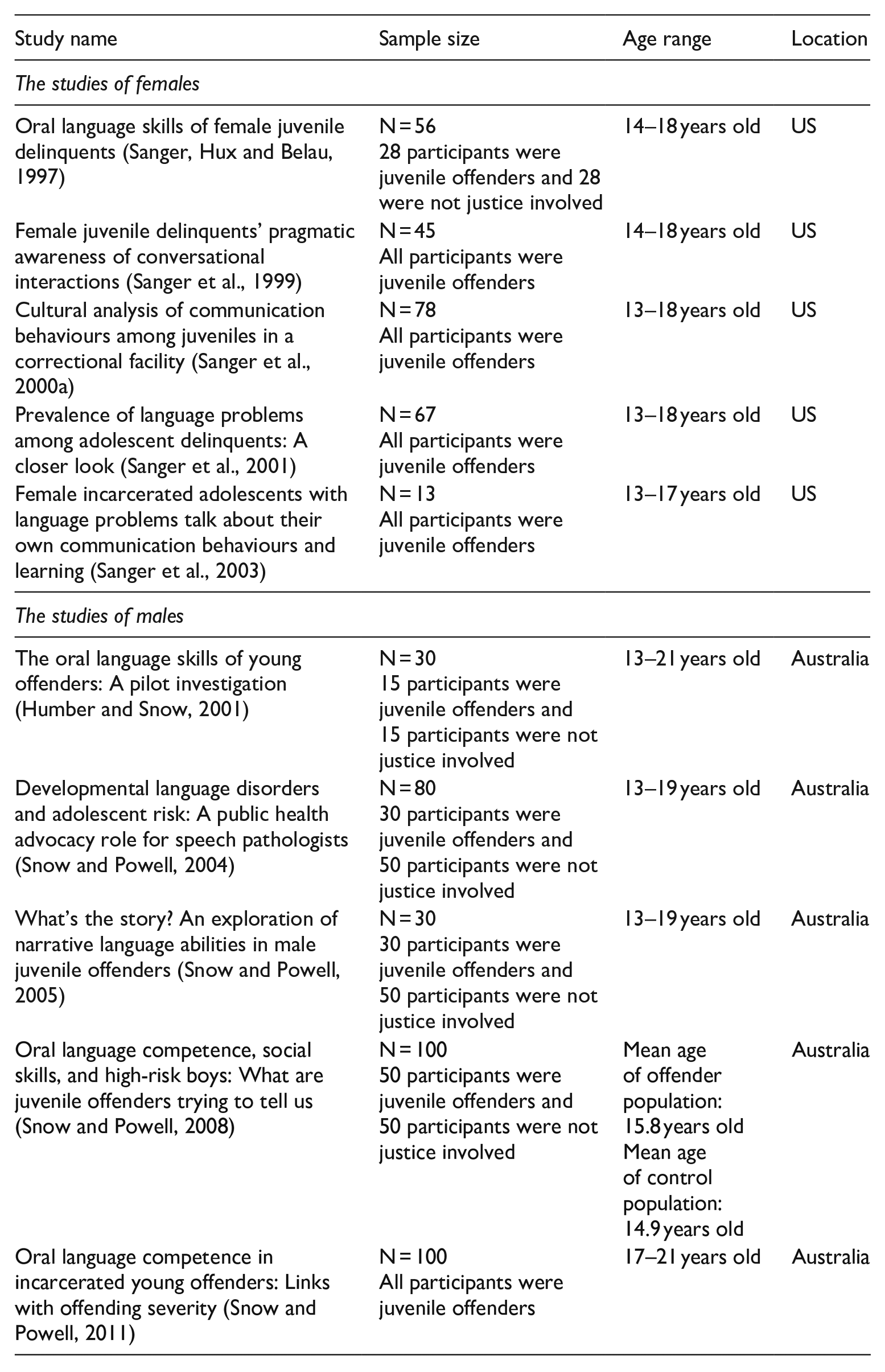
This article draws on content analysis of a sample of pertinent peer-reviewed studies from the United States and Australia – a purely pragmatic choice to make the task manageable. Although we do not make any generalisations nor claim representativeness, we suspect that the studies from these two jurisdictions are reflective of studies in other Western countries. Drawing on Anderson, Hawes, and Snow’s (2016) meta-analysis of language impairments among young offenders, our content analysis included peer-reviewed studies that: (1) were in English; (2) drew on cross-sectional or longitudinal data; (3) had an assessment sample of participants aged 10–21 years who had been in contact with the criminal justice system; (4) assessed more than one domain of language impairment; and (5) analysed the association between language skills and young people’s incarceration. Furthermore, to address the aims of the current study, we included the additional criteria: (6) the study had to have either male or female participants (no mix); 2 (7) the study analysed pragmatic language; and (8) the study appeared after 1995. This selection criteria yielded a severe over-representation of male-only studies with just two female-only studies included. To ameliorate this skewness, we limited male-only studies to only those from Australia, while including all English-language female-only studies. The only English-language female-only studies we found were all from the United States. To achieve a pool adequate for the comparison, we dropped restrictions 4 and 5 for female-only studies (i.e. we did not limit female-only studies to those that exclusively assessed more than one domain of language impairment or that analysed the association between language skills and incarceration). This selection produced a dataset of 10 studies: 5 male-only and 5 female-only (see Appendix 1). The fact that the final data set came from a small set of authors and some studies draw from the same pool of participants and data (Snow and Powell, 2004, 2005) is not consequential for our analysis. Our aim is to investigate how language impairments, and their outcomes, are represented in a sample of research literature rather than to make comprehensive claims about the entire body of research on pragmatic language. In other words, it is not the scope of studies under scrutiny, but how some of them present their findings. For example, some studies had limited sample sizes (Sanger et al., 2003 has a sample size of 13 – see Appendix 1), which is often the case with in-depth qualitative analysis. While this brings into question the generalisability of their results, for our purposes what matters is how the authors chose to analyse and interpret the data.
Content analysis of the selected studies involved coding of units of text based on their intended meaning (Gheyle and Jacobs, 2017). These codes were not predefined, but instead identified throughout the coding process, constructing categories as they appeared throughout the text, allowing coding and analysis to happen interchangeably (Symkovych, 2023). Some codes were easy to define and name (e.g. using the word ‘disorder’ resulted in a ‘disorder-based language code’), while others were more nuanced and required further analysis (e.g. the phrase ‘decisions about who will benefit from language services’ resulted in a ‘deserving’ code, as it was seen to question whether a young person is ‘disordered enough’ to deserve/benefit from intervention). The coding process resulted in eight distinguishable codes. We then calculated the percentage each code represented in a single study, thus eliminating the problem of longer studies having a larger number of codes than shorter ones. Next, we grouped studies based on gender and calculated the overall percentage each code represented in male-only studies and female-only studies. Certain codes did not have high percentages across either groups or had only slight deviation in their percentage score. However, these slight deviations represented a large difference in how important the codes were. Thus, we performed additional analysis, employing the saliency of the code criterion. We determined saliency by assessing the pertinence of a code in each study, its influence on the overall representation of the impairment, and its centrality to the argument each study advanced. This allowed codes that represented low percentages to be accurately discussed and accounted for, analysing their role beyond their numerical value. It ensured that codes that naturally had higher percentages, due to their definition alone, were not the only codes considered relevant. The next section presents the results of content analysis, drawing on both frequency and saliency of each code.
Results: The gendered themes of pragmatic language impairments
Content analysis produced the following two distinct categories of codes: first, ‘disorder-based language’ and ‘diminished language’ and second, ‘deserving’, ‘institutional responsibility’, ‘complex web’, ‘negative impact’, ‘rude’, and ‘choosing’ (see Table 1).
Definitions of the codes included in the results.
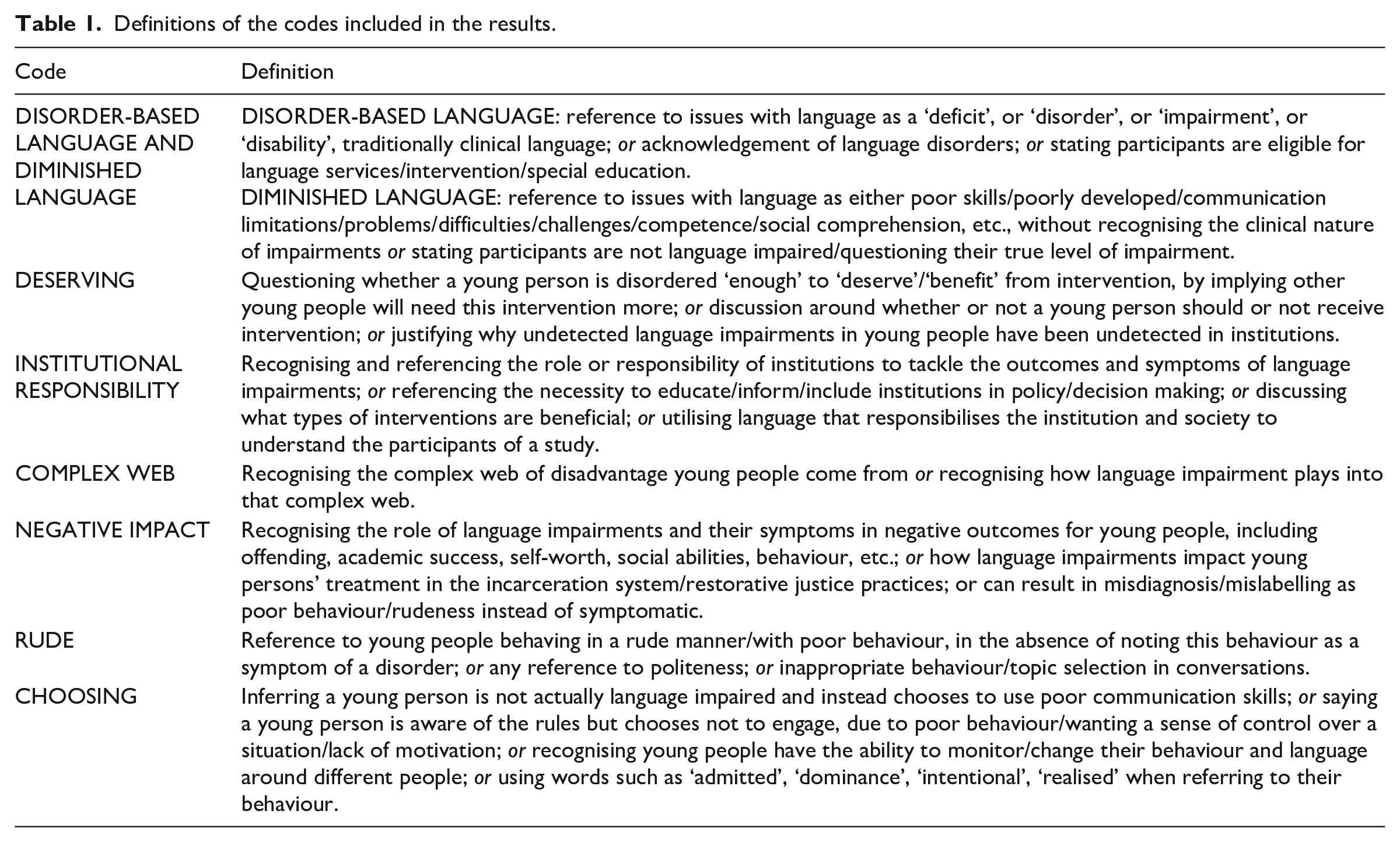
The two categories were measured separately. For codes in the first category, we measured the frequency and saliency of their use with the aim to uncover whether a study recognised the clinical nature of impairments, utilising disorder-based language, or construed deficits as communication challenges rather than disorders, utilising diminished language. Utilising disorder-based language suggests the study recognised language impairments as symptoms of a disorder; contrastingly, when the study utilised diminished language this suggested poor language skills were not impairments at all. With the second category of codes, we determined the frequency and saliency of the pertinent themes that allowed us to establish how these studies represented language impairments.
‘Disorder-based language’ and ‘diminished language’
Studies of females used diminished language 3 (61%) more than disorder-based language (39%), whereas studies of males used the disorder-based language (67%) over diminished language (33%). In studies of females, researchers regularly switched between clinical and non-clinical language regardless of diagnosis, also referencing impairments as ‘problems’ or ‘challenges’ (Sanger et al., 1997, 1999, 2000a, 2001). Utilising this language downplays relational vulnerability and the impact that language impairments have on individuals and how they interact with the world. Conversely, all but one study of males used disorder-based language at a higher rate than diminished language. The outlier only coded for diminished language at a slightly higher rate than disorder-based language (Humber and Snow, 2001). Although some studies of males referred to deficits as ‘skills’ or ‘competence’, 4 this was with far less frequency and saliency than the studies of females (Snow and Powell, 2004, 2005, 2011). This serves to construct impairments as a clinical issue that does not just sit within the individual’s personal choice. Next, we present the themes captured by the second category of codes.
‘Deserving’ (represented 7% of codes in the studies of females and 0% of codes in the studies of males)
In studies of females, the ‘deserving’ code represented the study’s stance on whether young people would benefit from, and hence deserved, the limited support available for language impaired young people (rather than advocating for support to meet the demand). The code was present in three studies (Sanger et al., 1999, 2000a, 2001). In one of them, the authors cited speech-language pathologists’ caseloads, questioning whether participants truly experienced language disorders at all (Sanger et al., 2001). One study uniquely identified a cohort of young people whom it deemed as undeservingly over-qualifying for services (Sanger et al., 2000a). Importantly, this code was not present in studies of males.
‘Institutional responsibility’ (represented 13% of codes in the studies of females and 22% of codes in the studies of males)
The ‘institutional responsibility’ code, framing multi-party responsibility and the need for multisystemic solutions, had far greater frequency and saliency in studies of males than in studies of females. Common in studies of males, it captured authors framing institutional responsibility in a broader context, calling for multisystemic solutions.
In all but one study of females, this code exhibited low frequency (Sanger et al., 1997, 1999, 2000a, 2001), with higher frequency and saliency in Sanger et al. (2003). This code referenced the responsibility of the education system, speech-language pathologists, special education services, policy makers and the implications of research for future planning and execution of programmes (Sanger et al., 1997, 1999, 2000a, 2001, 2003).
This code, covering the same themes as in the studies of females, was present in all the studies of males. Furthermore, all studies of males had codes for the responsibility of the justice system, including the police, courts and justice staff’s onus to understand the impacts of language impairments and for forensic interviewers to change their approach, overcoming speech barriers and reconceptualising restorative justice techniques (Humber and Snow, 2001; Snow and Powell, 2004, 2005, 2008, 2011). Also unique was the recognition of mental health practitioners’ role within a wider public-health framework (Snow and Powell, 2004, 2008, 2011).
‘Complex web’ (represented 5% of codes in the studies of females and 21% of codes in the studies of males)
Overall, studies of males referenced social marginalisation more than studies of females, focusing on long-term impacts and the difficulty of untangling this complex web of social factors. Studies of females mainly mentioned this code in the methodology section, without elaborating on the impact of these factors on participants.
Present in three studies of females, the code covered the themes of physical and emotional abuse, substance misuse, gang involvement, education difficulties, comorbidity with psychiatric and behavioural problems, maltreatment, peer pressure, poverty, family background, sexual abuse, troubles with authority, and low self-esteem (Sanger et al., 2000a, 2001, 2003).
This code appeared with far greater frequency and salience in studies of males. The code covered the same themes as in studies of females but focused more on the outcomes of these factors – how they directly and indirectly linked to language impairment, antisocial behaviour, educational disengagement and ‘delinquency’. The studies of males present a greater focus on the impact of social and economic impoverishment, as well as on protective factors, including prosocial models, strong literacy and numeracy skills, together with positive self-esteem (Humber and Snow, 2001; Snow and Powell, 2004, 2005, 2008, 2011).
‘Negative impact’ (represented 10% of codes in the studies of females and 54% of codes in the studies of males)
‘Negative impact’ represented the role of language impairments and their symptoms on negative outcomes for young people. These outcomes include: an inability to express thoughts and emotions, poor behaviour, disengagement, low self-esteem, offending, self-perpetuating failure cycle, violence, poor academic outcomes and the mislabelling of this behaviour as rude, lazy or naughty.
This was coded for in four of the studies of females (Sanger et al., 1997, 2000a, 2001, 2003), with one study having no negative impact codes (Sanger et al., 1999). Furthermore, while there were negative impact codes present in these studies, this was at a far lower frequency than it was in the studies of males. While it was the number one most frequent code in the studies of males, it was the fourth most frequent in the studies of females.
In contrast, studies of males recognised multiple complex factors that link together to impact participants’ experiences. These studies emphasised, with high frequency and saliency, the negative impacts of the criminal justice system, including the limitation of effectiveness of forensic interviews, counselling, and restorative justice processes. They highlighted the emotional toll of language deficits, including feelings of alienation and negative feelings derived from perceived or actual difficulties with social competency, among male cohorts. Ultimately, studies of males recognised links from language impairments to aggressive behaviours, learnt antisocial behaviours, academic failure and potential offending (Humber and Snow, 2001; Snow and Powell, 2004, 2005, 2008, 2011).
‘Rude’ (represented 25% of codes in the studies of females and 2% of codes in the studies of males)
Common themes under the ‘rude’ code included problematic behaviour, poor topic selection, difficulties with judgement, interrupting others, using profanities, having poor eye contact, not listening, intimidating others, using self-serving behaviour, bullying and using physical force.
While the studies of males generally overlooked participants’ problematic conduct (only three codes appeared across all the studies of males), they contextualised it, be it poor eye contact or ‘antisocial behaviour’, as the symptoms of language impairments. Present in the studies of males, but rarely so, were codes which recognised participants as the perpetrators of harm, committing violence and having poor social skills (Snow and Powell, 2004, 2011).
In contrast, studies of females framed such behaviour as the moral choice of the participants, not an outcome of their deficits and symptoms of language impairments. The code appeared – with high frequency and saliency – in all but one female-only study (Sanger et al., 1999, 2000a, 2001, 2003; the outlier: Sanger et al., 1997). Most of these codes came from direct observation of the participants, falling under the researchers’ discretion of what met the threshold to be considered poor behaviour. For example, the code for inappropriate topic selection – an entirely subjective criterion – was frequent and salient (Sanger et al., 1999, 2000a, 2001).
‘Choosing’ (represented 40% of codes in the studies of females and 1% of codes in the studies of males)
The ‘choosing’ code emphasised the ‘choice’ of female participants to use poor language or behavioural skills. This code appeared with the highest frequency in all but one 5 of the studies of females, representing over half of the codes in one single study (Sanger et al., 1999). In contrast, it ranked as the least frequent code in the studies of males, with only two instances across all studies of males, and exclusively when referencing results from female-only studies (Humber and Snow, 2001; Snow and Powell, 2004).
The most frequent and salient instance of the code was a scenario whereby participants could state the rules of appropriate conversational interactions, but ‘chose’ not to display behaviour in line with these rules (Sanger et al., 1999, 2000a, 2001, 2003). Most studies implied that this choice was contextual: for example, young female participants choosing to ignore the interactional rules when talking to authority figures (Sanger et al., 1999, 2000a, 2003). The researchers claimed that participants used poor behaviour to achieve control, to feel in charge, to intimidate or dominate others and to assert power and rank (Sanger et al., 1999, 2000a, 2003). Participants also described their own poor language skills and behaviour, acknowledging their choice to behave in this manner (Sanger et al., 1999, 2000a, 2003). The researchers’ insistence on young people choosing inappropriate topics, such as sex, drugs and violence, was highly salient (Sanger et al., 2000a, 2001). The salience of inappropriate topic selection was based entirely on the researcher’s judgement of what qualifies as appropriate. ‘Awareness’ was highly coded for, implying young people were aware of this ‘inappropriate’ behaviour and therefore could have chosen to act differently (Sanger et al., 1999, 2000a, 2001). The language of ‘admitted’, ‘choosing’, ‘acknowledged’, ‘intentional’, and ‘justified’ implies young people’s ‘bad’ behaviour was deliberate, emanating from personal, perhaps egoistic motivations (Sanger et al., 1999, 2000a, 2001).
Discussion
Our analysis reveals a gendered representation of pragmatic language impairments in criminalised young people. Available research frames language impairments in girls and young women as a moral choice, placing an onus on them to overcome the symptoms. Here the problem resides in the individual, with little discussion around environments and external factors that could further disable them. In contrast, current scholarship interprets pragmatic language impairments in boys and young men as a failure of institutions that requires multisystemic interventions (see Table 2). Extant literature overlooks all together young people outside the gender binary.
Final code rankings by gender across all studies. 6
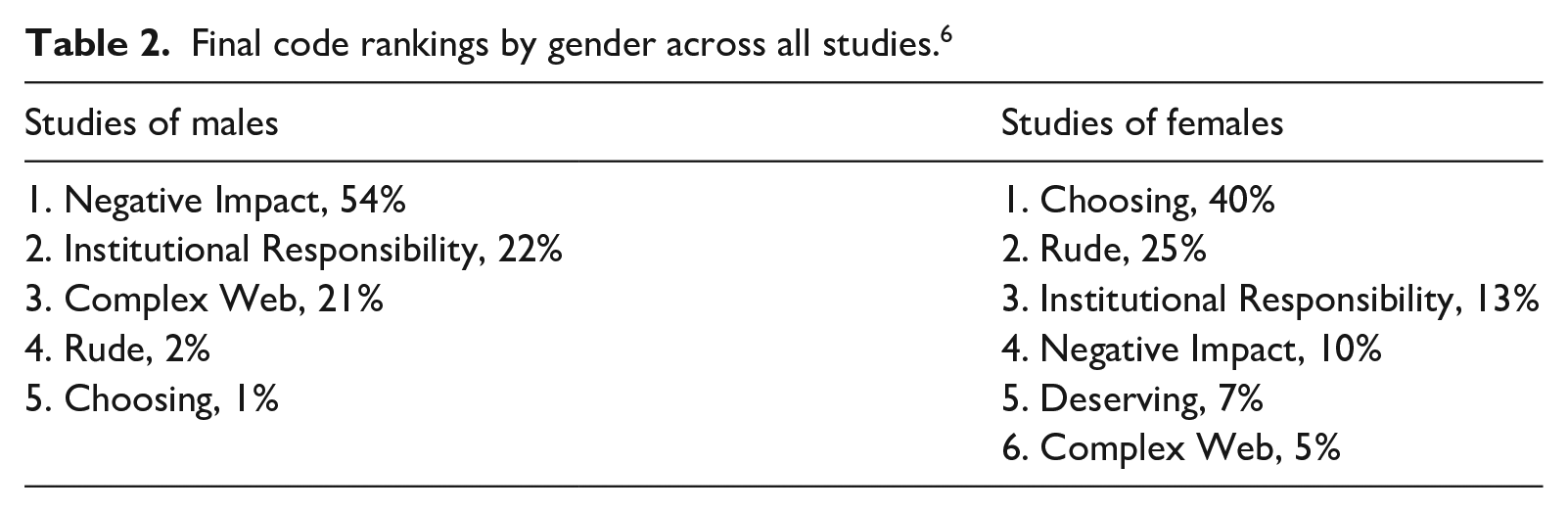
Specifically, female-only studies highlight the active agency of girls in their pragmatic language impairments, constructing them as manipulative and deceitful. Pertinent scholarship implies that girls are supposedly cognisant of their poor use of pragmatic language and communication, yet egoistically behave inappropriately. Rather than being a result of pragmatic language impairments, such behaviours supposedly stem from motivations to dominate peers and challenge authority. Responsibilising girls, current scholarship tends to put an onus on girls and young women to alter their behaviour to meet the education and correctional systems’ expectations. This reflects traditional models of disability, presuming an individual must overcome or change in order for them to successfully exist in society (Berghs et al., 2016).
Contrastingly, the literature presents pragmatic language impairments in criminalised boys as a failure of institutions. The studies connect participants’ poor behaviour with their pragmatic language impairments, further exculpating boys and young men by focusing on multiple structural factors that induce such behaviour. Unlike with criminalised girls and young women, studies of males recognise that the participants did not have the same skill set as their peers to meet the pressures, demands and expectations of various institutions. In other words, the responsibility lies with institutions that must change to ensure accessibility for criminalised boys and young men. Rather than expecting males to change, the studies list multisystemic interventions located within a public health framework that would assist boys and young men with their language impairments and social functioning more generally. Instead of focusing on individuals ‘overcoming’ their impairments, these studies recognise the role of society to make appropriate accommodations for these young people to thrive (Hosking, 2008).
What could explain such gendered framing of language impairments and resultant behaviours? We argue that this disparate representation stems from researchers’ implicit or explicit understanding of gender. Patriarchal standards tend to demand that girls be ‘inherently’ polite, and that their ‘natural state’ is to behave in socially appropriate and acceptable ways, demonstrating strong interpersonal skills (Basow and Rubenfeld, 2003; Ranjitha and Unnithan, 2018). Girls must avoid dominance in patriarchal society. Violating these patriarchal dicta causes moral outrage in observers, resulting in prejudice against those who disrupt these expectations (Koenig, 2018). When females display poor pragmatic language skills, they violate society’s fundamental assumptions of female behaviour – thus becoming ‘deviant’ and wrong. Ignoring the factors that could lead to poor pragmatic skill development, the focus is rather on girls’ personal motivations, suggesting a measure of moral censure of their behaviour. Misrecognition of impairments could also stem from the fact that girls may have become better at masking their pragmatic difficulties as they constantly must meet these society’s gendered demands. Traditional gender norms expect men to respond to conversations in ways that reduce interpersonal intimacy (Basow and Rubenfeld, 2003). The display of poor pragmatic skills by males does not cause a strong censure like it does with female participants. This allows a balanced approach to impairments when assessing male participants: researchers can perceive impairments as symptoms rather than character flaws. Thus, research constructs boys’ behaviour as an outcome of their disorder rather than a reflection of their ‘deviant personality’. Unlike with female counterparts, research presumes that boys are unaware of their negative symptoms, hence are not active agents in their non-standard behaviour.
In studies of females, high frequency and saliency of the ‘diminished language’ code undermines the significance of pragmatic language impairments. Language including ‘problems’, ‘difficulties’ and ‘limitations’ detaches impairments from their clinical significance, creating an easier dismissal of symptoms. Hence impairments are not recognised as outcomes of a disorder, and instead as a personality flaw within the individual. High frequency and saliency of ‘choosing’ and ‘rude’ codes construct individuals as active agents in their behaviour, responsibilising the participants. The ‘deserving’ code problematised the role of public health and intervention treatments, diminishing the responsibility of institutions to intervene. Instead, problematising the girls’ conversation topics reinforced their construction as ‘deviant’ people. Nonetheless, using direct quotes from the girls, the studies recognised the girls’ own personal motivations behind poor behaviour, enhancing the legitimacy of the studies’ conclusions and representations of the problem. High saliency of the code relating to personal responsibility and moral agency constructed girls as active agents in their pragmatic language impairments.
In contrast, the high frequency and saliency of ‘disorder-based language’ in studies of males enhanced the legitimacy of pragmatic language impairments. This allowed for the severity of these impairments and their outcomes to be recognised, locating the problem in a clinical space worthy of intervention. The ‘negative impact’ code recognised and explored the full effect of pragmatic language impairments. Poor behaviour was contextualised as an outcome or symptom of a language impairment. Referring to the complex backgrounds of the participants, the researchers constructed the problem as one that needed multisystemic interventions. High coding of ‘institutional responsibility’ and the absence of ‘deserving’ code moved the representation of this problem from individual males to the public health response. Studies of males uniquely acknowledged the impact of language impairments within the criminal justice system. Negative social effects experienced by people with language impairments are caused by the social environments they are navigating. In the studies of males, the focus was shifted from the physical limitations of the individual on to the way institutions can impose disadvantage on this cohort (see Berghs et al., 2016).
Studies of females failed to recognise the impact of pragmatic impairments by representing this problem as one of personal choice and responsibility. Decontextualising female participants’ poor behaviour from their impairments leaves girls’ and young women’s true experiences unproblematised. This absence results in a limited understanding of experiences in the education and criminal justice systems. Research using girls’ voices against them fails to recognise a core underlying problem: these girls are likely to be unaware of the impact of their impairments. Poor behaviour can stem from frustration with limited language abilities when navigating a world with no support. By framing it as a personal choice, the studies marginalise the importance of treatment and support for these girls and young women. Even when not reduced to personal choice, the intersectionality of factors rarely features. For example, the ‘complex web’ code that recognised the salience of individual complex backgrounds was far higher in frequency and saliency in the studies of males than in those of females. Furthermore, not only did it rarely appear in the studies of females, the link between language impairments and these factors is often missing entirely. In other words, the problem itself remained divorced from these factors. The relationship between language impairments, antisocial behaviour, educational disengagement and ‘delinquency’ is bi-directional. By leaving these complex factors unexplored, the studies of females diminished the true impact of language impairments on their participants, beyond just a limited language load, thus decontextualising it. The outcomes of impairments are not experienced equally across all demographics. There is huge diversity in experiences of disability, and these experiences are affected by social and political contexts and varying privileges. Economic and cultural barriers can further disadvantage people living with impairments (Hosking, 2008). Without approaching language impairments with an intersectional lens, much is left unsaid and unknown in the studies of females. Conversely, the studies of males, which contextualised these language impairments as part of a wider web of complex factors leading to the criminalisation of participants, called for multisystemic approaches to support male participants.
Conclusion
The representation of, and reaction to, young people with language impairments is political and significantly impacts the way young people experience and interact with the world. In this article, we have problematised the way extant scholarship represents pragmatic language impairments in criminalised young people. Literature in the field of pragmatic language impairments in justice-involved young people is scant and dated. The girls’ experiences are even further overlooked: the only English-language studies we could locate in this field that focus entirely on female participants all originated from the United States. Consequently, these studies dominate and frame the discussion due to an absence of alternative arguments.
Our content analysis has revealed a deeply gendered – and thus political – framing of language impairments and associated behaviour, most notably in the allocation of responsibility. The reviewed studies construct female participants as active agents in control of their behaviour, framing the pragmatic language impairments as their individual responsibility to ‘overcome’. The studies of males, in contrast, represent impairments as clinical, beyond boys’ personal control. The studies of females which foreground agency in girls, justify the censure girls receive, thus deeming them underserving of support. Having a pragmatic language impairment goes unrecognised in the education system, due to girls’ behavioural violations of gender norms, as well as a lack of sensitivity from teachers, and means that girls run the risk of early disengagement with the education system. This, in turn, elevates a likelihood of ensnarement in the criminal justice system. Once criminalised, this responsibilisation affects girls’ treatment. The language load of criminal justice practices is high for people with language impairments, which limits their sentencing options and subsequent progression towards freedom. Focus should be shifted from the personal constraints of these girls to the limitations of their physical and social environments in effectively supporting them.
Unlike studies of females that responsibilise girls and young women, studies of males highlight the duty of institutions to respond to pragmatic deficits in boys and young men. Recognising the debilitating impact of impairments, these studies advocate for meaningful institutional change. This includes accessibility to different sentencing options, which are uniquely and consistently mentioned in the male-only studies. This could result in better sentencing opportunities afforded to young men experiencing language impairments. Studies of males also problematise current educational responses to pragmatic language impairments, thus potentially increasing teachers’ awareness of symptomatic behaviour and influencing how students see themselves. Such change could disrupt the self-perpetuating cycle of perceived failure and low self-esteem that young people with pragmatic language impairments face. This advance could improve educational outcomes for young people, bolster their sense of self and prepare them better for adulthood.
In contrast, due to a patriarchal demand on girls and women to appear polite, symptomatic behaviour can cause moral outrage, constructing them as deviant or disrespectful. Such framing means that the impairments that impact girls’ daily functioning are considered facets of girls’ flawed personality. Consequently, girls emerge as undeserving of intervention – this framing cements gender inequality and contributes to the endurance of patriarchy. Thus, a new research agenda, with a more nuanced and sensitive approach that will build on the reviewed studies and address the identified shortcomings, is overdue. Impairments should be viewed as a communal issue, so we can understand what barriers need to be eliminated to accommodate these individuals, shifting responsibility from the individual and onto institutions to change this social environment (Hosking, 2008).
This study is not without limitations. It draws only on a sample of American and Australian pertinent literature, and for practical reasons employed different selection criteria for male-only and female-only studies. Importantly, to date, no research in the field goes beyond the male-female binary equated with biological, officially recognised sex, rather than identified gender. We acknowledge the existence and life experiences of people outside this binary. Furthermore, future research would benefit from investigating the link between neurodevelopmental disorders and language impairments. People with neurodevelopmental disorders often experience language impairments, and similarly to the current study, women often go undiagnosed in these areas (Bargiela et al., 2016). Given the findings of our study, further investigation that recognises the political nature of both research and gender is long overdue. Notwithstanding the aforementioned methodological limitations, our findings make a strong case for the seeping of gendered discourse and patriarchal assumptions into the extant research, as well as the political and practical consequences of this ‘seep’ for criminalised young people, education and criminal justice practitioners.
Footnotes
Appendix 1
| Study name | Sample size | Age range | Location |
|---|---|---|---|
| The studies of females | |||
| Oral language skills of female juvenile delinquents (Sanger, Hux and Belau, 1997) | N = 56 28 participants were juvenile offenders and 28 were not justice involved |
14–18 years old | US |
| Female juvenile delinquents’ pragmatic awareness of conversational interactions (Sanger et al., 1999) | N = 45 All participants were juvenile offenders |
14–18 years old | US |
| Cultural analysis of communication behaviours among juveniles in a correctional facility (Sanger et al., 2000a) | N = 78 All participants were juvenile offenders |
13–18 years old | US |
| Prevalence of language problems among adolescent delinquents: A closer look (Sanger et al., 2001) | N = 67 All participants were juvenile offenders |
13–18 years old | US |
| Female incarcerated adolescents with language problems talk about their own communication behaviours and learning (Sanger et al., 2003) | N = 13 All participants were juvenile offenders |
13–17 years old | US |
| The studies of males | |||
| The oral language skills of young offenders: A pilot investigation (Humber and Snow, 2001) | N = 30 15 participants were juvenile offenders and 15 participants were not justice involved |
13–21 years old | Australia |
| Developmental language disorders and adolescent risk: A public health advocacy role for speech pathologists (Snow and Powell, 2004) | N = 80 30 participants were juvenile offenders and 50 participants were not justice involved |
13–19 years old | Australia |
| What’s the story? An exploration of narrative language abilities in male juvenile offenders (Snow and Powell, 2005) | N = 30 30 participants were juvenile offenders and 50 participants were not justice involved |
13–19 years old | Australia |
| The studies of males | |||
| Oral language competence, social skills, and high-risk boys: What are juvenile offenders trying to tell us (Snow and Powell, 2008) | N = 100 50 participants were juvenile offenders and 50 participants were not justice involved |
Mean age of offender population: 15.8 years old Mean age of control population: 14.9 years old |
Australia |
| Oral language competence in incarcerated young offenders: Links with offending severity (Snow and Powell, 2011) | N = 100 All participants were juvenile offenders |
17–21 years old | Australia |
Declaration of Conflicting Interests
The author(s) declared no potential conflicts of interest with respect to the research, authorship and/or publication of this article.
Funding
The author(s) received no financial support for the research, authorship and/or publication of this article.
