



Abstract
This article seeks to transform private security discretion from a subject discussed in passing to a substantive area of research. It first draws upon the police discretion literature to construct a socio-economic model of private security discretion. It then uses this model to explore one specific articulation of discretion: the moral discretion of door supervisors as they deal with serious incidents in the night-time economy. It uncovers three distinctive rule–norm–discretion configurations: ‘enabling’ (where economic rules and moral standards line up to facilitate a straightforward mode of moral discretion); ‘constraining’ (where economic rules override countervailing moral standards to prevent a desired mode of moral discretion); and ‘complex’ (where moral standards take precedence over prohibitive economic rules to generate a circuitous mode of moral discretion). Through this analysis, the article offers an original set of categories for studying private security discretion while simultaneously deepening our socio-economic understanding of the market for security.
Introduction
Over recent decades, the ascendance of multinational corporations with sprawling and exposed supply chains (Spitzer and Scull, 1977), the proliferation of mass private property, such as shopping malls, business parks and leisure complexes (Shearing and Stenning, 1983), rising levels of risk awareness and insecurity (Zedner, 2003) and the entrenchment of neoliberal public sector outsourcing policies in the criminal justice sector (White, 2020) have together fuelled demand for protection services in the market for security. Riding these trends, private security companies such as G4S, Mitie and Securitas have expanded into multi-billion pound transnational enterprises and private security officers have come to outnumber police officers in countries across the globe, including Australia, Canada, China, India, the United Kingdom and the United States (Provost, 2017). Moreover, this sector became, if anything, even more prominent in the context of the Covid-19 pandemic, with many private security officers gaining ‘critical worker’ status as they performed services deemed essential to national infrastructure, placing them upon an occupational pedestal alongside other frontline workers such police officers, doctors, paramedics, nurses, firefighters and teachers (Leloup and Cools, 2022; White, 2022). In short, the private security industry has assumed a central role in the 21st-century policing landscape.
In response, criminologists have developed a now substantial literature on the dynamics of this market (for a recent overview, see Gill, 2022). Yet, there remain notable blind spots, especially in our knowledge of everyday private security work. It is commonly assumed, for instance, that private security officers straightforwardly perform the tasks set out in their contractual assignment instructions, no more, no less – that they are robot-like followers of economic rules (see White and Gill, 2013). While this is a logical (and convenient) assumption, it is a fiction. We argue here that private security officers are in fact autonomous calculating actors who in any given situation weigh up the importance of not only the economic rules articulated in their contractual assignment instructions but also a wide range of social norms before deciding upon the appropriate course of action, resulting in variable economic rule enforcement practices. In making this argument, we develop the first systematic theoretical and empirical analysis of private security discretion, opening the door to a potentially rich and important field of research.
Our argument unfolds in two stages. In the first stage, we construct a socio-economic model of private security discretion calibrated towards the rule/norm dilemmas faced by frontline officers. We accomplish this task by sketching out key strands of the wide-ranging literature on police discretion, before using these strands as a roadmap on which to organise and build upon what little we already know about private security discretion. Although we engage in this exercise as a means to an end, it is a significant exercise in itself since it represents the first theoretical discussion of discretion across the public and private sectors in the policing landscape. In the second stage, we use this model to study one specific articulation of private security discretion – namely, the moral discretion of door supervisors as they deal with drunkenness, emotional breakdowns, mental health crises, sexual harassment, assault, robbery and other serious incidents in the night-time economy. Our data come from a new set of interviews with and observations of 20 doors supervisors, 9 security managers and 15 police officers working in pubs, bars and nightclubs across south-east Wales. Through this analysis, we uncover three distinctive rule–norm–discretion configurations: ‘enabling’ configurations (where economic rules and moral standards line up to facilitate a straightforward mode of moral discretion); ‘constraining’ configurations (where economic rules override countervailing moral standards to prevent a desired mode of moral discretion); and ‘complex’ configurations (where moral standards take precedence over prohibitive economic rules to generate a circuitous mode of moral discretion). We conclude the article by clarifying how these configurations not only represent an important first step in the exploration of private security discretion, but also make an original contribution towards our socio-economic understanding of the market for security.
A socio-economic model of discretion
Police discretion
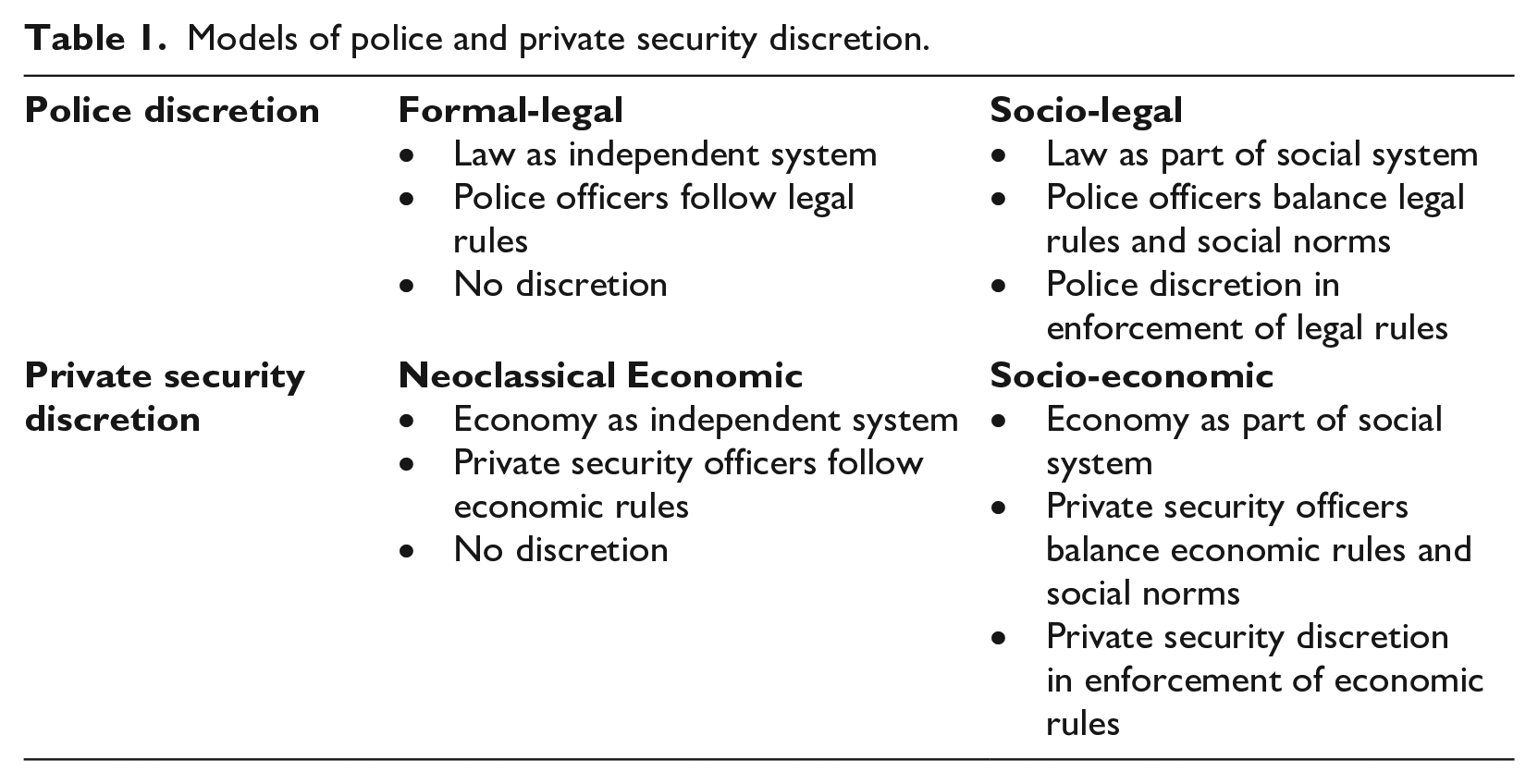
While little has been written about private security discretion, there is a sizable literature on police discretion. In what follows, we first review the well-known formal-legal and socio-legal models of police discretion and then use these models to assemble what we term the neoclassical economic and socio-economic models of private security discretion, as represented in Table 1. This is an important theoretical ground-clearing exercise because later on we employ the socio-economic model to frame our empirical analysis.
Models of police and private security discretion.
The formal-legal model of police discretion emerged in tandem with the modern police during 19th and early 20th centuries. It is underpinned by the idealistic assumption that the rule of law functions as an independent system administered by dedicated and value-neutral public servants who ‘invoke legal sanction for misbehaviour with perfect discipline’ (Pepinsky, 1984: 264). The important corollary of this assumption is that such ‘perfect discipline’ leaves no space for the exercise of discretion (Skinns, 2019). Police officers are seen to enforce the law to the word, neither wavering nor deviating. Indeed, the formal-legal model is perhaps better described as a one of non-discretion, as depicted in Figure 1. This does not mean the model is without value. It has much to offer. It sets forth a compelling vision of the police in modern society which continues to resonate today. The still ubiquitous Peelian Principles, for example, hold that the police should ‘seek and preserve public favour, not by pandering to public opinion, but by constantly demonstrating absolutely impartial service to law’ (Home Office 2012, emphasis added). Furthermore, it captures at least some aspects of what the police do on an everyday basis, as illustrated by Lipsky’s (1980) enduring observation that certain police responsibilities such as processing permit applications offer little opportunity for the exercise of discretion – they are straightforward rule-based tasks (p. 15). At the same time, however, this model misses a great deal of what is actually happening at street level.
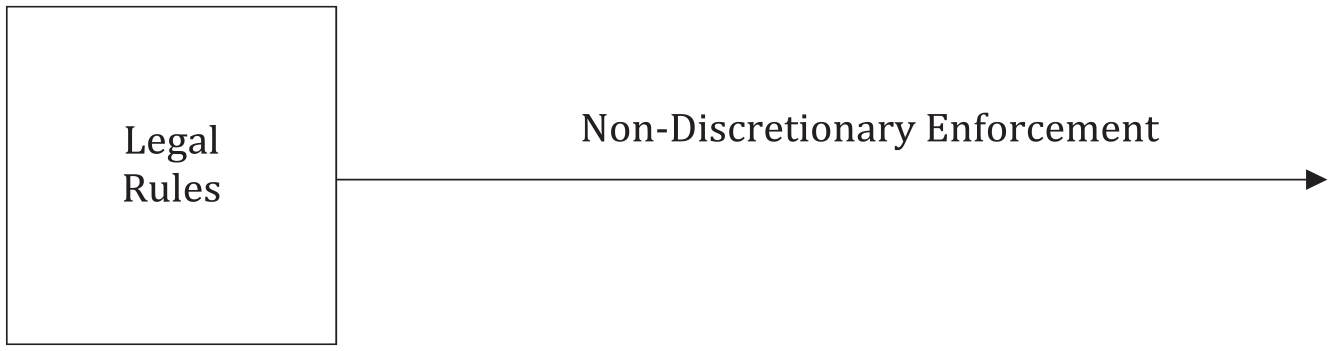
Formal-legal model of police discretion.
As frontline police work came under increasing academic scrutiny during the middle of the 20th century, it became apparent that the central assumption of the formal-legal approach lacks purchase. Far from demonstrating ‘perfect discipline’, it transpired that police officers frequently make situational judgements calls on the extent to which they enforce the law (Davis, 1969; Goldstein, 1960). This so-called ‘discovery’ of police discretion marked a turning point in police research and prompted two broad responses. The first was to double-down on the formal-legal model – and most especially the virtuous principles it is seen to embody – by simultaneously critiquing the exercise of discretion on the grounds that it ‘corrupts the proper constitutional framework’ and promoting administrative protocols designed to regulate it (Rowe, 2018: 119). In this reconstituted guise, the formal-legal model still animates policy debates on police reform to the present day (Bronitt and Stenning, 2011: 325). The second, however, was to reject the assumption of ‘perfect discipline’ and develop an alternative reading. This led to the social-legal model of police discretion.
As the name suggests, the analytical starting point for the socio-legal model is the assertion that the rule of law represents just one dimension of the wider social system rather than functioning as an independent sphere of activity (Friedman, 1986). This means that police officers take their cue not just from legal rules and administrative protocols, but from social norms too. These typically include moral standards (a sense of right and wrong), a desire for action (catching criminals), pragmatism (a practical, can-do attitude), self-interest (cutting corners to minimise workloads), solidarity (an us-versus-them sensibility), political ideology (tending towards conservativism and the status quo), machismo (heteronormativity and sexism) and prejudice (racial discrimination) – although other social norms continually enter the picture as the police role adapts to new currents of social change (Bacon, 2022). Together these social norms are usually referred to as police occupational culture and form a central thread of contemporary policing scholarship (Bowling et al., 2019). Once the influence of these social norms is recognised, police discretion takes on a different character. Police officers are regarded as autonomous calculating actors who in any given situation weigh up the various obligations, powers and preferences conferred upon them by legal rules and social norms before deciding upon the appropriate way forward, leading to variable law enforcement practices (Campbell, 1999; Ericson, 2007; Skinns, 2019), as depicted in Figure 2.
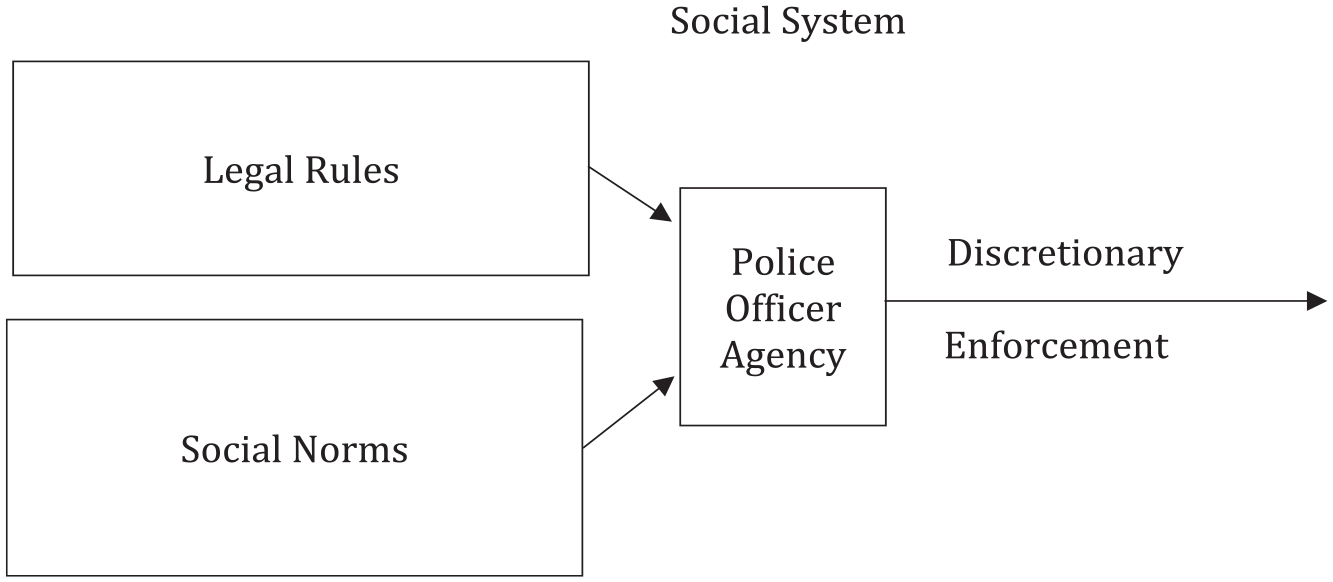
Socio-legal model of police discretion.
While policing scholars have used this model to investigate an array of rule–norm–discretion configurations, it is instructive to pause briefly on those concerning the relationship between legal rules and moral standards, since this moves us closer to the exercise of moral discretion which interests us later in this article. Maynard-Moody and Musheno (2000), for instance, write how: Street-level workers do not describe their judgements as legalistic and guided by rules, procedures and policies. Rather they describe their decisions as normative, an exercise in moral reasoning rather than rule following or even rule breaking. They first make moral judgements about the relative worthiness of the citizen client, and then they use rules, laws, and procedures to help those they consider worthy and punish those they deem unworthy. Even when they are merely carrying out a new mandate, such as automatic arrest in a domestic violence call, street-level workers infuse their actions with morality. (p. 351)
As this quote illustrates, when deciding upon the most appropriate course of action, police officers make situational judgements not only on how legal rules relate to the circumstances before them but also on how their moral standards apply – their sense of right and wrong. Sometimes there is alignment between legal rules and moral standards, other time not. It depends on the moral compass of the officer in question and their reading of the situation. Either way, when this equation is multiplied across the police landscape, there is inevitable variation in law enforcement practice. This is how we understand moral discretion. Of course, other social norms factor into the equation too, but it is instructive to bear in mind this morally infused family of rule–norm–discretion configurations because it serves as a key analytical reference point in subsequent discussion. For now, however, it simply remains to reiterate that both the formal-legal and socio-legal models of police discretion serve as valuable reference points when thinking about private security discretion.
Private security discretion
While there has been no sustained analysis of private security discretion in the extant literature (until now), there have been a handful of allusions to the phenomenon. In the ensuing pages, we attempt to organise and elaborate upon (some of) these allusions using the formal-legal and socio-legal models of police discretion as our guide. To begin with, just as the formal-legal model views the rule of law as an independent system and regards police officers as ‘perfectly disciplined’ enforcers of legal rules, there is a prominent strand of the private security literature which approaches the economy as an independent system and sees private security officers as ‘perfectly disciplined’ enforcers of economic rules. While for police officers, legal rules are set out in statute books and administrative protocols, for private security officers, economic rules are enumerated in contractual assignment instructions. 1 This does not mean that legal rules disappear from the picture. They remain present in (at least) two notable ways. First, private security officers must obey the law like anyone else and, in most countries, this includes statutory regulation targeting the activities of these officers (United Nations Office on Drugs and Crime, 2014). Second, property law in particular often serves to empower private security officers. This is because when they are stationed on private property (as they frequently are) they take on the property owner’s right to bar entry, search and/or exclude individuals seeking to enter and use the property, giving them a far-reaching though spatially limited authority, as our later empirical discussion illustrates (Button, 2016). In most instances, however, such legal rules are embedded in contractual assignment instructions, meaning officers are usually simply instructed to follow the economic rules given to them.
In much of the literature, it is then assumed that private security officers enforce these economic rules to the letter. This assumption is most evident in three well-known lines of enquiry: those studies which profile the changing ratio of private security to police officers in any given jurisdiction and the concomitant rebalancing of market and public good logics in the policing landscape (Bayley and Shearing, 1996; Jones and Newburn, 2002; Shearing and Stenning, 1983); those which promote the logic of the market in this landscape (Forst, 1999; Johnston and Shearing, 2003; Wood and Shearing, 2007); and those which critique the logic of the market in this landscape (Neocleous, 2008; Reiner, 1992; Rigakos, 2016). Each, perhaps understandably, has a tendency to reproduce a rather economistic reading of private security work to sustain a sharply drawn line between the public and private sectors (for an expansion of this observation, see Loader and White, 2018; White, 2014; White and Gill, 2013). One notable corollary of this assumption, however, is that it essentially removes private security discretion from the equation. The labour of these officers is viewed as being fully commodified or governed exclusively by economic imperatives (Radin, 1996). As such, these lines of enquiry all implicitly draw upon what we call the neoclassical economic model of private security discretion (depicted in Figure 3) – so named because, echoing the key tenets of this economic paradigm, it assumes that private security officers are utility maximisers who sell their labour to the highest paying employer and, once under contract, mechanically follow the economic rules set out in their contractual assignment instructions so as to optimise their earnings. Like its cousin the formal-legal model, the neoclassical economic model is perhaps best described as a model of non-discretion rather than discretion and, by extension, can be critiqued for being oversimplistic or unidimensional. Yet, and again paralleling its cousin, it also projects a powerful vision of the market for security which is deployed by advocates and critics alike and does capture at least some of the more automated and routinised aspects of private security work, such as running computerised identification checks or locking up vacant property (Rigakos, 2002). Either way, though, its narrow parameters blind it to the more complex frontline behaviours which concern us here. This blindspot, we argue, can be remedied by taking the lead from the socio-legal model.
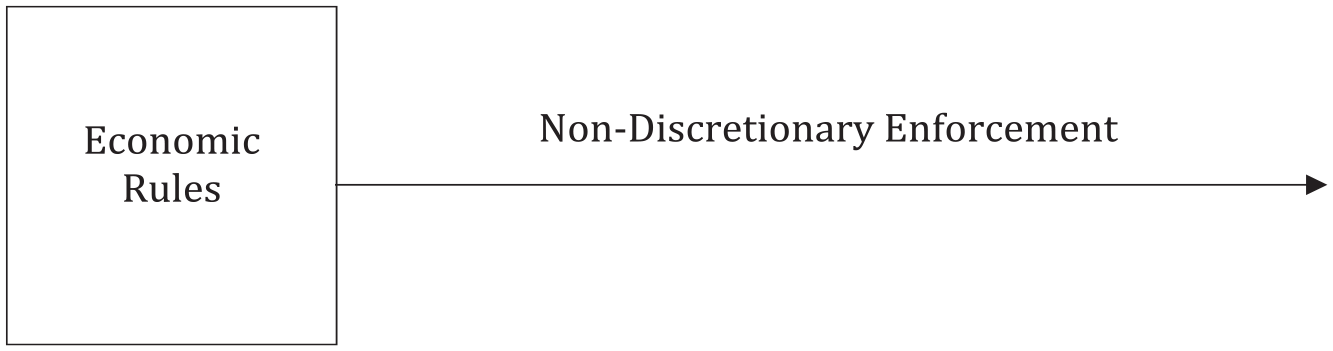
Neoclassical economic model of private security discretion.
Similar to how the socio-legal model brings police discretion into frame by approaching the rule of law as one dimension of the wider social system, there is a strand of the private security literature which rests on the analogous assumption that the economy too is one component of the wider social system (Etzioni, 2003). This strand is primarily concerned with the various social norms which run through and structure the market for security. Some of these social norms parallel those found among police officers, such as moral standards (a sense of right and wrong), self-interest (cutting corners to minimise workloads), machismo (heteronormativity and sexism) and prejudice (racial discrimination). Others are more specific to the market, including transience (high employment turnover), customer service orientation (client satisfaction and profit maximisation), an emphasis on crime prevention (deterring rather than catching criminals), taint (from working in low status industry) and a wannabe mentality (a desire to perform ‘real’ police work) (Button, 2016; Hansen Löfstrand et al., 2016; Hobbs et al., 2003; Loader and White, 2018; Rigakos, 2002; Terpstra, 2016; Wakefield, 2003; White, 2010). While these social norms are often presented as a (rather nebulous) form of private security occupational culture (Terpstra, 2016), it is rare for them to be linked with the exercise of discretion. Moreover, when this link is made, the nature of this discretion never becomes the focal point of discussion, instead serving as a background variable or being left as interesting side observation (see, for example: Hobbs et al., 2003: 163). With the socio-legal model as our guide, however, it is possible to make a much clearer connection between the influence of these social norms and the exercise of discretion. It seems a logical step, for instance, to assert that private security officers are autonomous calculating actors who in any given situation take into account the various obligations, powers and preferences bestowed upon them by economic rules and social norms before eventually deciding upon the appropriate course of action, resulting in variable economic rule enforcement practices. We term this formulation the socio-economic model of private security discretion, as represented in Figure 4.
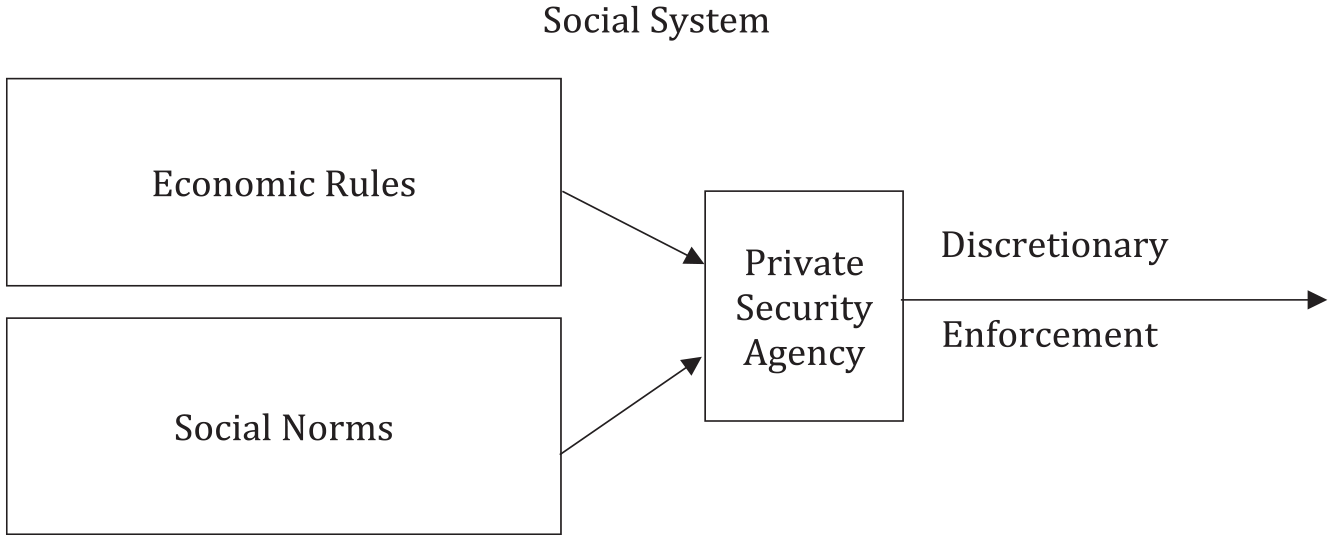
Socio-economic model of private security discretion.
While the socio-economic model can be used to explore countless rule–norm–discretion configurations in the market for security, we are here chiefly interested in those which relate to the moral discretion of private security officers – similar to how Maynard-Moody and Musheno (2000) utilise the socio-legal model to examine those configurations which concern the moral discretion of police officers. To some extent, this dynamic can again be illustrated by reframing certain contributions within the private security literature. Take, for instance, Loader and White’s (2018) study of heroic acts performed by private security officers, such as stepping into violent assaults or leading hazardous evacuations. They identify two categories of heroism: ‘contractual’ heroism in which ‘moral obligations’ are in alignment with ‘economic responsibilities’; and ‘non-contractual’ heroism in which ‘moral obligations’ come into conflict with ‘economic responsibilities’. Although Loader and White make no explicit mention of discretion – moral or otherwise – we think its presence can be detected through the lens of the socio-economic model. For these officers seem to be making situational judgements on how economic rules (‘responsibilities) and moral standards (‘obligations’) relate to the circumstances in front of them before arriving at their chosen course of action, leading to variable economic rule enforcement practices (‘contractual’ and ‘non-contractual’ heroism). They appear, in other words, to be showcasing a degree of moral discretion. This is precisely the kind of rule–norm–discretion configuration which animates the remainder of the article. In what follows, however, we use the socio-economic model not to investigate such configurations in the extant literature – an inherently limited exercise which can only take us so far – but to make sense of our own data set which charts the practices of door supervisors as they deal with a range of serious incidents in the night-time economy. This allows us to construct a more nuanced set of categories around this phenomenon and, by extension, sets in motion the project of turning private security discretion into a substantive area of research within criminology and other disciplines. Before commencing with this analysis, however, it is necessary to map out our methodology.
Methodology
To collect data on private security discretion, it makes sense to focus upon those situations where discretion is most likely to be exercised. This means bracketing to one side the more automated, routinised and non-public-facing dimensions of private security work, such as running computerised identification checks or locking up, surveilling and protecting vacant buildings and instead turning our attention towards the more multifaceted, risk-laden and public-facing dimensions, such as maintaining order in busy shopping malls, supermarkets, sports stadiums, entertainment venues, university campuses, transport hubs and licensed premises in the night-time economy (Koeppen and Hopkins, 2022; Porter et al., 2015; Talas et al., 2021). In this article, we focus on the activities of private security officers working in the UK night-time economy – specifically in Cardiff, Swansea, Newport and surrounding urban areas in south-east Wales. This is an especially fertile setting for our present line of enquiry due to the high prevalence of incidents involving risky offenders and vulnerable victims. To understand why there are so many incidents of this type, a little background is required.
The night-time economy comprises the buying and selling of alcohol-related products and services in pubs, bars and clubs between the hours of 18.00 and 06.00. It has grown significantly over recent decades as developers have turned formerly commercial and civic buildings left behind by urban deindustrialisation into themed entertainment venues (Chatterton and Hollands, 2002). While this trend has been welcomed as a valuable source of employment and revenue (Roberts, 2006), it has also filled many urban centres ‘with inebriated young people roaming around until the early hours of the morning’ (Van Steden 2014: 7). Indeed, there is now substantial evidence linking the rise of the night-time economy with increased levels of violent crime, anti-social behaviour and social harm (Bellis and Hughes, 2011; Hughes et al., 2008; Office of National Statistics 2019). While this creates an obvious problem for the police and healthcare services, it also poses a dilemma for alcohol-selling or ‘licensed’ premises, which have a strong incentive to keep their customers feeling safe and happy to maintain revenue flow. As a consequence, it is common for these premises to employ (either directly or through outsourcing arrangements) private security officers called ‘door supervisors’ to screen out potential troublemakers and act as first responders whenever violent altercations, crimes or other emergencies unfold on the property (Calvey, 2019). Indeed, as of January 2023 there were no less than 303,336 licensed door supervisors in the United Kingdom, making it by some distance the largest subsector of the licensed UK private security industry, the total population of which stood at 456,727 officers. 2
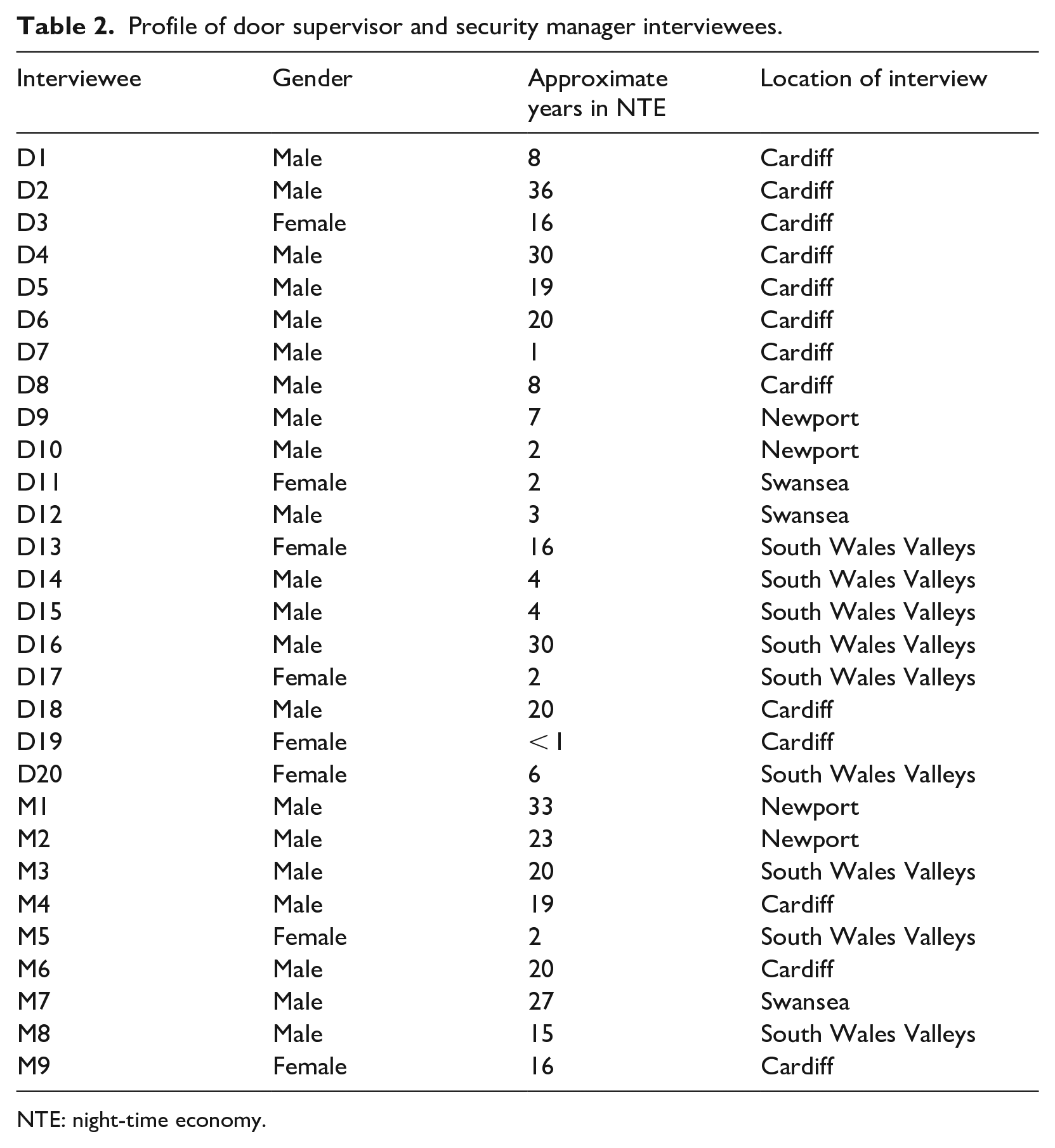
Even though door supervision in the night-time economy is likely to involve the exercise of discretion on a regular basis, collecting data on such discretion is by no means straightforward. As policing scholars were quick to recognise over 50 years ago, one of the defining features of street-level discretion is its low visibility (Goldstein, 1960). For this reason, perhaps the most widespread (and in our view effective) way of researching discretion is to invest considerable time in the field, carefully observing and interviewing frontline workers to generate a rich and nuanced qualitative data set. With this in mind, in 2018 Kostara conducted initial observations across prospective fieldwork sites in south-east Wales to develop a familiarity with the local pubs, bars and clubs. She proceeded to recruit and interview 20 doors supervisors (D1-20) and 9 security managers (M1-9) working in these premises, together with 15 police officers (P1-15) whose responsibilities fell across these sites. The recruitment of door supervisors and managers was guided by a combination of non-random purposive sampling (according to experience, gender and location) and pragmatic advice from local Security Industry Authority (SIA) investigators (the SIA is the public body charged with licensing the UK private security workforce) – see Table 2. The recruitment of police officers was accomplished through non-random purposive sampling. Interviews were audio recorded and the resulting transcripts constitute the primary data set for our study. Furthermore, 11 of the door supervisor interviews were carried out in licensed premises and during some of these Kostara made further observations and enquiries around working practices which she recorded in fieldnotes – these serve as a supplementary data set. All fieldwork was cleared in advanced by the University of Cardiff ethics committee and proceeded in line with standard research ethics principles relating to informed consent, confidentiality and anonymity.
Profile of door supervisor and security manager interviewees.
NTE: night-time economy.
The interviews played out as relatively informal conversations about working in and around the pubs, bars and clubs of south-east Wales. Importantly, while many interviewees talked about their situational judgements in different ways, none spontaneously mentioned the term ‘discretion’. This is unsurprising. As Maynard-Moody and Musheno (2000) note: ‘The word discretion rarely, if ever, enters the street-level vocabulary’ (p. 348). It is for the most part a term employed by scholars and policy-makers to describe and explain certain behaviours in the workplace. This raises an important methodological question. How do we as social researchers identify and make sense of discretion within our data sets? The answer comes down to choice of theoretical lens. In Pepinsky’s (1984) words, ‘the existence of discretion rests ultimately on how we and others look for it’ (p. 249). In our case, we ‘looked for’ moral discretion through the lens of our socio-economic model. We conducted (separately and then jointly) a thematic analysis of our data set, searching for instances where interviewees spoke about how they balance what we call economic rules and moral standards when deciding how to proceed in any given situation. In this way, we uncovered three distinctive rule–norm–discretion configurations: ‘enabling’ configurations (where economic rules and moral standards line up to facilitate a straightforward mode of moral discretion); ‘constraining’ configurations (where economic rules override countervailing moral standards to prevent a desired mode of moral discretion) and ‘complex’ configurations (where moral standards take precedence over prohibitive economic rules to generate a circuitous mode of moral discretion). We set out these findings over the following pages.
Rule–norm–discretion configurations
Enabling configurations
The enabling rule–norm–discretion configuration relates to scenarios where private security officers find their economic rules and moral standards line up to facilitate a straightforward mode of moral discretion. Beginning with the economic rules in question, whenever door supervisors take on a new position in a pub, bar or nightclub they are given a set of contractual assignment instructions by their manager which enumerate in often minute detail their roles and responsibilities within the premises. As one door supervisor elucidates, So, when we first start working in a venue, we’ve been given either a verbal instruction from the management, or written instruction, of what are the rules they expect to be followed. And it can be anything from the simplest of things, like dress code . . . you know . . . they can say ‘no shorts’. (D11)
Importantly, in some instances these instructions include a clear steer towards enhancing customer welfare. One manager, for example, tells the door supervisors under his supervision to give extra care to customers in distress, reminding them how ‘that’s somebody’s daughter and it’s just that little two minutes out of your day that could change somebody’s life completely’ (M6). This remains the case even when it entails, as an another manager puts it, ‘going above and beyond what you’re actually there to do’ (M2). This approach, remarks a further manager, leads to the satisfaction of ‘watching customers and people go home with a smile on their face’ (M7). There are different ways of interpreting such instructions. On one side, they can be taken at face value as a genuine concern for the wellbeing of fellow citizens. On the other side, they can be regarded as a way of establishing a hospitable environment in which ‘smiling’ customers are optimally disposed towards spending their money, thereby maximising profit margins. Either way, in certain situations these economic rules create favourable working conditions for door supervisors to operationalise their moral standards.
The door supervisors in our study have clearly become accustomed to instructions in this vein, as one old-hand articulates: ‘welfare’s a big thing now, it wasn’t back in the day’ (D5). Indeed, many of our interviewees talked at length about looking out for the welfare of their customers, variously comparing themselves to ‘counsellors’ (D5) and ‘agony aunts’ (D13). They also had a tendency to narrate these tasks with reference to either their own moral compass – ‘that’s someone’s child, and a lot of us are like at the age where we are parents’ (D13) – or a combination of their moral compass and contractual assignment instructions: You know, it can literally be like Jeremy Kyle! ‘Oh, I’ve lost my job’. And you’ve got to support them then, you’ve got to be there. You don’t have to, but if they want to talk to you, you listen, and you try and help them. And sometimes, them talking to you for 10 minutes, they’ll go in and have a great night. (D12)
This door supervisor, for instance, is seemingly offering a sympathetic shoulder to his vulnerable customers because he has been instructed to (‘you’ve got to be there’) and because it resonates with his own moral compass (‘you don’t have to, but . . . you try and help them’).
As such, the key dynamic running through these examples is that when determining how to manage the situation in front of them, these door supervisors are first weighing up their economic rules and moral standards. Then, finding broad alignment across these variables, they are enacting both in equal measure, giving rise to a relatively straightforward mode of moral discretion. Expressed differently, their contractual assignment instructions correlate with their sense of right and wrong. In other examples, however, the opposite scenario plays out.
Constraining configurations
The ‘constraining’ rule–norm–discretion configuration relates to scenarios where private security officers encounter a disjuncture between their economic rules and moral standards and elect to prioritise the former, thereby preventing a desired mode of moral discretion. Starting again with the economic rules in question, one of the central threads running through any set of contractual assignment instructions in the night-time economy is the spatial boundary which delimits the roles and responsibilities of the door supervisor. Almost without exception, the boundary is the perimeter of the property on which they are employed. This is for three reasons: client interests (venues usually only generate revenue from goods and services purchased on the property); insurance policies (employers’ and public liability cover only apply to door supervisors while they remain on the property); and, as mentioned earlier, power (the legal rights of door supervisors as agents of private property are restricted to the property). For many of the door supervisors in our study, this boundary served to draw a line between which individuals they are and are not allowed to help. One door supervisor, for instance, describes his job as ensuring the ‘safety of my customers, you know, the customers inside the venue’ (D2). Significantly, in certain situations this economic rule comes to grate against the moral standards of door supervisors.
Two examples in our study illustrate this dynamic. The first relates to a door supervisor witnessing sexual harassment: We protect the venue, so if for instance a girl got her bum grabbed and she went outside, that’s not our problem anymore. I know it sounds a bit tight, but we’ve got 100 other punters to look out for inside, we can’t be messing about. It’s a bit weird. (D14)
Here the door supervisor is following his contractual assignment instructions by prioritising the welfare of paying customers (‘punters’), even though this means doing nothing to address the sexual harassment he has just seen on his watch – a decision which is clearly causing him a degree of moral discomfort (‘I know it sounds a bit tight’ and ‘it’s a bit weird’). The second concerns a door supervisor who tells of how he and his colleagues are often required to ‘move on’ a threatening group of young males who ‘sit in our front garden’ and ‘get in our face’. He continues angrily, What they tend to do as well, is they look at very drunk people, and we’re getting the idea now, that they’re looking to rob them, because they’re too inebriated to even look after themselves. So, what they’re doing now is, they’re following them to wherever they’re going – be it down to the cashpoint – and they’re mugging them! There’s quite a few young women that will go past us . . . Wandering past us, no shoes on, absolutely smashed, have no real awareness of what’s going on around them, or awareness of where they are. And we’ve watched kids follow them! (D9)
Once again, this door supervisor and his colleagues are honouring their contractual assignment instructions by removing the troublesome group from the property and protecting the paying customers inside the venue, even though this means doing nothing (‘watching’) as the group then preys upon vulnerable ‘young women’ on the street outside who are ‘unable to look after themselves’ – a form passive bystanding which clearly offends their moral instincts.
The central dynamic animating these examples is that when contemplating how to address the situation before them, these door supervisors are again first weighing up their economic rules and moral standards. But on these occasions, they are running into a disjuncture between these two variables and electing to prioritise the former at the expense of the latter, thereby preventing a desired mode of moral discretion. There is still discretion on display here, of course. These door supervisors are making a decision. But, it is a reluctant kind of decision in which they are selecting what they consider to be the morally inferior option. Sometimes, though, door supervisors tread a different path.
Complex configurations
The complex rule–norm–discretion configuration relates to scenarios where private security officers again find a disjuncture between their economic rules and moral standards, but choose to prioritise the latter, giving rise to a more circuitous mode of moral discretion. To illustrate this configuration, we return to the same boundary dilemma animating the preceding section, but with a new twist. This time, the door supervisors in question elect to cross the boundary delimiting their roles and responsibilities in pursuit of their moral agendas. Again, two examples in our study illuminate this process. The first revolves around the following anecdote narrated by a door supervisor in her workplace: We had a lady that had come into the pub, quite obviously had mental health problems. She was talking to herself, she was pacing up and down the bar. She’d worried the bar staff because they didn’t know whether it was drugs or . . . whatever, and they didn’t really know how to deal with it. So they came and found me and said ‘you need to deal with this, like . . . can you get her to leave? But we don’t want you to be physical with her because . . . we don’t know if she’s going to hurt you!’ And I said ‘yeah, it’s no problem, I’ll go and have a chat with her’. So, I was sat up the smoking area with her, just talking to her and just asking her what was wrong because she was really upset about something . . . I said ‘Oh, right, ok then, what are we going to do?’ Like, she lives about 40 minutes away, she had no money to get a taxi. I said ‘Who have you come out with, tonight, then?’. She said ‘Oh, my Mum. She’s in, you know, the pub across the road’. I said ‘right, ok then, well, we’ll go find your Mum then’. Now this lady was in her late 20s, but, you know, was obviously quite unstable at that point in time. So we found Mum, reunited them, she had a cup of coffee from the Street Pastors and she was fine. (D20)
At this point in her story, the door supervisor’s manager interrupts the interview and asks her deal with a drunken young male causing a disturbance in the pub. Later that evening, Kostara located the same door supervisor and posed some follow up questions concerning this anecdote. The salient entry in Kostara’s fieldnotes reads: ‘she left her post on the doors, covered by one of her colleagues, and she went around in the other local pubs . . . and after a while through asking people she managed to find her mum’. This entry is key to understanding the complex mode of discretion under examination. While her decision to find ‘cover’ clearly represents a nod to her contractual assignment instructions, she nevertheless stepped beyond the boundary of the venue in an attempt to realise her moral objective (‘to find mum’), in the process leaving behind the customers she was paid to protect, contravening her insurance cover and losing the additional powers conferred upon her through property law. Interestingly, though, the fact that she recounts this anecdote in her workplace within earshot of her manager suggests either that she is indifferent to this contravention and willing to accept any corresponding sanctions from her manager or, more likely, that under such circumstances she is actually permitted by her manager to pursue this kind of action. Either way, moral standards are clearly taking precedence over economic rules.
The second example charts a similar sequence of events, but from the perspective of a police officer: A young girl was approached by two Eastern European males outside the premises who hadn’t been drinking in there, so that’s a warning flag straight away. Doesn’t look like they’ve gone to any pubs, doesn’t look like they’ve gone to any of the nightclubs, but they’re outside the premises looking for drunken females. The girl could hardly walk. As she got outside of the premises, they started talking to her, were leading her to a taxi. They’d already flagged a taxi down. The door staff ran across the road, asked them a couple of those telling questions . . . and were able to establish that she had no connection with these males whatsoever . . . They intervened, the two males left, and they kept the girl safe until we arrived. (P7)
These door supervisors again transgressed the boundary set out in their contractual assignment instructions (they ‘ran across the road’) so as to realise their moral goal – safeguarding a vulnerable passer-by (‘the girl could hardly walk’) who was under immediate threat. Again, though, there was an element of (retrospective) permission to this contravention, not from their manager in this instance but the police officer describing these events, who is impressed with this decision-making process: ‘So, I think that’s a good indication of how far we’ve come, you know. Previously, it would be ‘out of the premises, I’ve got no responsibility for this person now’ (P7) – similar to the scenarios in the previous section. Reinforcing this point, the police officer also comments approvingly how ‘aspects of the job of the door supervisor are starting to become more and more like those of the police’ (P7). While not all police officers in our study share this view – one, for instance, is adamant that ‘door staff are better off just dealing with the boundary of their premises’ (P15) – this nevertheless indicates a wider acceptance and indeed appreciation of such morally driven behaviour among door supervisors. Reflecting this normalisation, one door supervisor tellingly refers to herself and her colleagues as the ‘pub police’ (D19).
The notable dynamic represented in these examples is that when determining how to resolve the situation in hand, these door supervisors are once more encountering divergence between their economic rules and moral standards. In these examples, however, they are electing to prioritise the latter over the former, bringing into effect a complex mode of moral discretion. The complexity here arises not only from the observation that their actions seemingly run counter to their contractual assignment instructions – and the corresponding employment priorities, insurance protections and powers enshrined therein – but also that they are to some extent being given tacit authorisation to do so, by the manager in the first example and police officer in the second example, both of whom appear to share the same moral reading of the situation. This mode of discretion, in other words, finds articulation through a kind of permissive bending of the rules which ultimately rests on the widespread recognition that it is sometimes better to do what is morally right even if this is not the correct procedure in strict economic terms.
Conclusion
Through the lens of the socio-economic model, we have now mapped out three rule–norm–discretion configurations which shed light on the moral discretion of door supervisors working in the night-time economy. These configurations illustrate how private security officers are sometimes able to operationalise their moral standards with relative ease (enabling), sometimes with prohibitive difficulty (constraining) and sometimes only by deprioritising their primary workplace responsibilities (complex). Critics from a neoclassical economic viewpoint might counter that economic rules appear to be driving the behaviour of door supervisors in each of these configurations by facilitating, preventing and accommodating their moral standards, respectively. They might contend that there is no discretion on display here whatsoever and that door supervisors are in fact nothing more than commodified workers following the contractual assignment instructions given to them. We would disagree with this reading, however. Focusing on economic rules alone downplays the intrinsic agency of door supervisors and the extent to which they wrestle with their consciences while carrying out their contractual assignment instructions, especially when it comes to safeguarding vulnerable individuals in the risky environment of the night-time economy. This is a significant insight because it augments the emergent picture of how the market for security functions. As others have begun to observe (Loader et al., 2014; Loader and White, 2017, 2018; Thumala et al., 2015), this market is not governed by economic imperatives alone, but rather shot through with moral sentiments – with a sense of right and wrong. Through adding the dynamics of moral discretion to this picture, this article makes a notable contribution to our socio-economic understanding of the market for security.
At the same time, the article also makes a contribution to policing scholarship more broadly by offering the first substantive discussion of private security discretion of any colour, moral or otherwise. Until now, private security discretion has been either overlooked entirely or mentioned only in passing. It has never been a theoretical and/or empirical focal point. This is no longer the case. The models and categories developed over the preceding pages facilitate a far more in-depth investigation of this phenomenon – one which brings into focus the complex interplay between economic rules, social norms and situational judgement when dealing with serious incidents. Yet, it is also important to acknowledge that they also represent just a first step. We focus on one type of economic rule (set by managers of licensed premises), one kind of social norm (moral standards), one role (door supervisors), one work setting (the night-time economy) and one location (south-east Wales). There is only so far we can generalise from this combination of variables. Much therefore remains to be done. Taking each of these variables in turn, for example, we need to explore: other economic rules (set by managers in different workplaces); other social norms associated with private security occupational culture (self-interest, machismo, prejudice, transience, a customer service orientation, an emphasis on crime prevention, taint and a wannabe mentality); other roles (static guarding, mobile patrol, close protection, surveillance and investigation); other work settings (gated communities, shopping malls, business parks, sports stadiums, entertainment venues, university campuses and transport hubs); and other locations (both within the United Kingdom and beyond). Each of these alternatives is likely to yield different rule–norm–discretion configurations and thus act as a corrective to and/or further refine the categories advanced in this article. Moreover, we also need to consider associated normative questions, such as whether private security discretion constitutes a positive phenomenon which allows the market to make a wider contribution to public safety beyond its narrow economic mandate, or whether it represents a negative trend which over-empowers the market in a traditionally sovereign domain and risks fostering malpractice and discrimination – or, indeed, both at the same time. This article, in other words, opens the door to a potentially rich field of research which deserves more attention.
Footnotes
Acknowledgements
The authors would like to thank Mike Levi, Ian Loader and Layla Skinns for their valuable comments on an earlier draft. All opinions and any errors are those of the authors alone. For the purposes of open access, the authors have applied a Creative Commons Attribution (CC BY) to any Author Accepted Manuscript version arising.
Declaration of Conflicting Interests
The author(s) declared no potential conflicts of interest with respect to the research, authorship and/or publication of this article.
Funding
The author(s) disclosed receipt of the following financial support for the research, authorship and/or publication of this article: The fieldwork for this paper was undertaken by Fryni Kostara while she was pursuing her ESRC-funded (in collaboration with the Security Industry Authority) doctoral degree at Cardiff University (2016–2021). The opinions expressed are those of the authors alone. They do not purport to reflect the views of the institutions to which the authors are now affiliated.
