




Abstract
Multiagency support is considered crucial in the successful resettlement of prisoners. Various prison-based and community-based professionals should each play a part in supporting prisoners through the gate regarding employment, housing, financial problems, healthcare or valid identification issues. Yet, little is known about the actual contribution of this support to a better perceived re-entry preparedness among prisoners. To examine the association between professional support and re-entry preparedness, the current study uses self-reported data from 1442 soon-to-be-released prisoners across 26 Dutch institutions. We include general satisfaction with support, and satisfaction with the specific instrumental support received, and compare prisoners who did and did not have reintegration needs prior to imprisonment. Support was positively related to re-entry preparedness for prisoners who had needs prior to imprisonment, and instrumental support from community-based professionals showed the most robust results. The implications and future recommendations are discussed.
Keywords
Introduction
In the Netherlands, around 30,000 prisoners are released each year (Verweij et al., 2021). One major concern for policy makers, practitioners and criminologists continues to be the resettlement of prisoners in terms of employment, housing, finances, healthcare and valid identification. Worldwide, many prisoners experience multiple problems in these areas prior to imprisonment (Beerthuizen et al., 2015; McSweeney and Hough, 2006; Visher and Courtney, 2007). For others, these problems increase or emerge due to collateral damages that imprisonment itself can bring (Pinard, 2010). As a consequence, because of limited job or educational experiences, criminal records, stigmatisation, poor relational networks and addictions or mental health issues, many prisoners face re-entry difficulties upon release (Visher et al., 2017). Leaving these re-entry needs unmet upon release is problematic, as it might hamper social reintegration (Visher and Travis, 2003). Unfortunately, prisoners usually feel ill-prepared for release concerning these re-entry needs (Lloyd et al., 2015; Smith et al., 2018).
Successful re-entry is often found to be a protective factor for reoffending. First, multiple scholars showed that unstable employment and housing (Visher et al., 2011; Ward et al., 2021), financial problems (Aaltonen et al., 2016) and health problems (Wallace and Wang, 2020) are related to reoffending. Second, practical needs usually cause stress, leaving little space to work on the pro-social cognitive or behavioural changes that are believed to reduce the risks of recidivism (Andrews and Bonta, 2006). Finally, the desistance literature holds that prisoners will only desist from crime when they feel heard, seen and treated as human beings (McNeill, 2006; Maguire and Raynor, 2006). It is, thus, important to pay attention to the factors that prisoners themselves deem crucial in their successful reintegration, on top of solely focusing on ‘fixing’ their personality deficits. Prisoners themselves often mention employment, a stable place to live, financial assistance, healthcare plans and valid identification as key preconditions to reintegrate back into society (Luther et al., 2011; Visher et al., 2004).
Professional support is crucial in targeting the abovementioned needs, because prisoners often rely on professionals to gain access to community resources. Moreover, different types of professionals are trained and educated to provide proper support to prisoners. Therefore, as we describe in the following section, a multiagency team of professionals who provide re-entry support through the gate is likely to contribute to feeling better prepared for release. The aim of the current study is to examine the extent to which re-entry support from a multiagency team of professionals is in fact related to better re-entry preparedness among prisoners in terms of employment, housing, finances, healthcare and valid identification.
Professional support in prison
With the influential works of scholars such as Carter (2003) and Maguire and Raynor (2006) on how to effectively manage offenders in England and Wales, there has been increasing attention for through the gate support to prisoners, addressing their individual needs, and for interagency collaboration to achieve this. As Carter (2003) points out, different actors within the criminal justice system need to work closer together so that resources can be pooled and used more effectively. He suggests a new approach in which offenders are managed throughout their whole sentences and in which correction services and probation services cooperate more strongly. In integrated offender management (OM) models, partnerships with local agencies and health- and voluntary organisations were also promoted (Hadfield et al., 2020). Maguire and Raynor (2006) add to this that attention for the individual needs of prisoners is more important in providing support than a one-size-fits-all approach.
Since the Carter report (2003), several forms of OM policies have been adopted internationally, such as in European countries (Institute for Criminal Policy Research (ICPR), 2011), Australia (Day et al., 2012) and the United States (Hamilton and Belenko, 2016). These policies stress that prisoners should be assisted by a team of professionals, including both prison-based professionals, such as case managers and mentors, and community-based professionals, such as parole officers, municipal officers, health professionals and volunteers. In general, most OM policies consider the following five principles to be paramount in providing support: (1) having a prison-based case manager who is responsible for the coordination of reintegration support, (2) multiagency support with the help of community-based agencies, (3) sustained support throughout the whole of the sentence and after release, (4) paying attention to individual needs and (5) maintaining good prisoner–staff relationships. It is assumed that support from this range of professionals and their pooled expertise, resources and connections to services is essential in targeting the diverse and often complex needs of prisoners (Hadfield et al., 2020; McSweeney and Hough, 2006). Both prison-based and community-based professionals are thus expected to cocreate personalised plans for prisoners throughout the whole sentence and through the gate. Evidence-based practices support this idea that interagency collaboration, and continued and one-to-one care are vital in providing adequate support (ICPR, 2011; Maguire and Raynor, 2017).
Empirical research on professional support and re-entry preparedness
Unfortunately, evaluation studies have often identified problems in the actual implementation of the above-mentioned policies (e.g. Bullock and Bunce, 2020; Maguire and Raynor, 2017). These evaluations criticise that professionals collaborate poorly in pre-release planning and that in-prison involvement of community-based professionals is limited. For instance, Maguire and Raynor (2017) mention that, in the United Kingdom, the different departments of prisons still operate as ‘silos’ with no clear communication or cooperation, and that community-based professionals seem unable to implement their services from a distance. This poor interprofessional collaboration is often caused by unclear communication pathways, lack of information sharing, inaccessibility of prisons or poor work facilities inside for community-based professionals or a reluctance among prison staff to welcome the rehabilitative work of community-based professionals (e.g. Hancock et al., 2018; Watson, 2010).
Furthermore, inadequate rehabilitation is often caused by difficulties with resources and recruiting staff (Bullock and Bunce, 2020). In case of understaffing, re-entry support is often the first thing that is cancelled (Cracknell, 2021). Also, prisoners have reported that professionals do not reach out actively and that prisoners are expected to take control over their own reintegration processes (Bullock and Bunce, 2020). Yet, taking responsibility and initiative may not be a realistic option for prisoners with complex needs (McSweeney and Hough, 2006). Prisoners with complex needs often possess lower levels of human capital, which means a lack in work experiences, skills and assets to maintain a stable life (Becker, 1962). For them, it may be more difficult to navigate the prison system and to find the right professional networks to support them. This can lead to cumulative disadvantage, as prisoners who need support the most, may miss out on the support they need.
While the ineffective implementation of multiagency professional support in practice is worrisome, not much attention has been given to the outcomes in case re-entry support is offered by prison-based and community-based professionals. Moreover, studies that do focus on the professional support provided, primarily examine staff–prisoner relationships in terms of trust, openness, respect and procedural justice (e.g. Crewe et al., 2015; Haas and Spence, 2017). Although these aspects have proved important in motivating prisoners and in improving post-release outcomes, the professional support that is provided during imprisonment in relation to re-entry challenges remains an underexplored area.
By exception, a few studies have examined in-prison re-entry support from correctional staff, parole officers, volunteers, mentors, therapists, social agency staff or counsellors. Some of these studies found a positive association between professional re-entry support and re-entry preparedness, whereas others did not. For example, a survey study among 496 offenders who were within 90 days of their release date, and were held across 11 correctional institutions in one state in the United States, showed that they felt better prepared for release in terms of employment, housing and paying bills when correctional staff adhered to Core Correctional Practices (CCP) (Haas and Spence, 2017). On top of being open, caring and respectful towards prisoners, the effective use of community resources, such as advocacy and brokerage, was related to a higher preparedness in terms of employment, housing and paying debts. Yet, another survey study in Catalonia in Spain, using questionnaire data among 538 prisoners who were about 4 months before their release, found that support from professionals and volunteers was unrelated to future optimism about health and income (Cid et al., 2021). Also, among 145 prisoners in a pilot study of the Returning Home project in Baltimore state, only 3.4% and 6.9% considered support from parole officers and religious organisations, respectively, useful in their re-entry process (Visher et al., 2004).
Anecdotal reports of prisoners also show mixed opinions on the usefulness of professional re-entry support. In an interview study in Oregon state conducted among 26 recently released prisoners who were transitioned to a housing facility, most prisoners were positive about assistance from social services staff, mentors, parole officers and community volunteers (Kjellstrand et al., 2022, 2023). These professionals had helped them regarding employment, education, housing, health insurances and social benefits. Yet, a few mentioned that professional support was absent or that they had to arrange housing themselves. Furthermore, among 51 returning prisoners in the Indianapolis area, affected by substance abuse or HIV, most found it difficult to distinguish between different types of professionals that had supported them during re-entry (Luther et al., 2011). Nevertheless, aside from friends and peers, they mentioned case managers and community-based mentors as potential facilitators of successful re-entry. In addition, according to 47 successfully reintegrated ex-prisoners in Milwaukee state, support by religious voluntary organisations motivated them to aspire to conventional goals (Hlavka et al., 2015). At times, these networks were also able to connect ex-prisoners to employment opportunities. Finally, among 20 female parolees in a Southern State in the United States, most of them appreciated support from clergy, volunteers and mentors, who helped them materially and emotionally (Bui and Morash, 2010). Yet, although most reported positive relationships with their parole officer, parolees did not consider referrals from parole officers to employment or other services particularly helpful (Bui and Morash, 2010).
Limitations of prior research and current study
As mentioned, most previous literature on professional support in prison evaluated whether the implementation of support systems was in line with OM policies. Yet, thus far, it remains unclear to what degree prisoners who do report receiving (adequate) professional support actually feel better prepared than prisoners who do not receive professional support or are unsatisfied about this support. The few studies that did cover the topic of re-entry support from professionals, highlighted support from only one type of professional or placed all professionals within one category, without distinguishing between prison-based or community-based professionals. Moreover, findings from the anecdotal reports were often based on very specific groups of prisoners, such as HIV-patients or female parolees, or based on recollections of re-entry experiences in the past. Others solely focused on a single reintegration need (e.g. employment), instead of examining multiple facets of re-entry preparedness. Overall, the literature on professional re-entry support is scarce; very fragmented and findings are mixed. Thus, although these studies give us valuable insights on the potential roles of professionals in the re-entry process of prisoners, an encompassing understanding of the extent to which re-entry support by an interdisciplinary team of professionals is related to a better re-entry preparedness among prisoners is missing.
To fill this gap, the current study aims to relate professional support by prison-based and community-based professionals to the self-reported re-entry preparedness among 1442 Dutch female and male prisoners. Second, because professional support might be particularly helpful for prisoners who already had needs prior to imprisonment, we compare the results for prisoners with and without needs prior to imprisonment. Prisoners who already had needs may possess lower levels of human capital. As mentioned, this can make it more challenging for these prisoners to communicate their needs and to find appropriate support (McSweeney and Hough, 2006). However, it may be precisely these prisoners who would benefit from receiving support.
By establishing whether receiving adequate professional support in fact helps prisoners to prepare for release, we can determine the need to organise professional support in line with OM ambitions. For instance, establishing the contribution of the perceived support to the re-entry preparedness of prisoners determines the need for better implementation of both prison-based support and community-based support. Moreover, establishing differences between prisoners with and without needs prior to imprisonment determines the relevance of considering individual needs.
Concerning professional support, we established whether someone received support or not, and distinguished between general satisfaction with support and satisfaction with instrumental support. Previous research indicated that both the general satisfaction with support (e.g. contact pleasantness and general usefulness of the support) and the satisfaction with specific instrumental support received (e.g. support in employment or housing) can be relevant in relation to re-entry preparedness. For instance, prisoners were sometimes satisfied with their relationships with parole officers, while unsatisfied with the instrumental support received from them (Bui and Morash, 2010). More details on the precise measurements are found in the methods section. What follows first is a brief description of how professional support is organised in Dutch prisons.
Professional support in Dutch prisons
From 2013 onwards, the Dutch Custodial Institutions Agency (DJI) has explicitly targeted the re-entry needs of prisoners in terms of employment, housing, finances, healthcare and valid identification (Dienst Justitiële Inrichtingen (DJI), 2013, 2019). In 2019, official agreements between DJI and the Association of Netherlands Municipalities (VNG) on the roles of various professionals in targeting these needs were written down in a policy document (DJI, 2019). According to this document, case managers are expected to perform intake assessments with prisoners within 2 weeks of entry. In case re-entry needs are identified, the case manager should refer prisoners to specialised support from community-based professionals (DJI, 2019). In addition, correctional staff are appointed as mentors for prisoners, with whom they should have mentoring meetings regularly. Prison-based case managers and mentors also regularly discuss prisoners’ situations together in multidisciplinary meetings, and are responsible for guiding prisoners throughout the whole of their sentences (DJI, 2019).
At the same time, increasing attention is paid to interprofessional collaboration and to intensifying the involvement of community-based professionals in preparing prisoners for release. For example, it is stated that the case manager should cooperate with parole officers and municipal officers in setting up detention and reintegration plans for prisoners (DJI, 2019). Moreover, parole officers, who are often already involved in giving advice in court hearings and in supervision on conditional release, should also help prisoners with employment or housing in case re-entry needs is detected (DJI, 2019). In addition, the municipality of return is responsible for a smooth transition from prison to free society, and should arrange a suitable place to live and issue a valid identity document (DJI, 2019). Additional help from healthcare professionals and volunteers, and their physical presence inside the prisons, is also promoted. Community-based health professionals can provide psychological and medical care and can discuss discharge plans for after release (DJI, 2019). Finally, voluntary organisations often have housing options available for after release and offer a wide range of social services to prisoners, such as assistance in applying for jobs (DJI, 2019).
OM ideas on creating personalised reintegration plans with a team of professionals are thus clearly reflected within the Dutch rehabilitation policies. Nevertheless, a recent study in the Netherlands showed that the implementation of these policies is still under development, and that the amount of professional support provided to prisoners does not reflect these policy ambitions yet (Pasma et al., 2021). For instance, about one-third of the prisoners did not report contact with prison-based professionals. Moreover, in-prison involvement of community-based professionals was very limited, and prisoners with health, ID and complex needs most often remained invisible (Pasma et al., 2022). To follow up on these results, the current study zooms in on the received re-entry support and whether prisoners who are (better) supported also feel better prepared for release compared to prisoners who report no or inadequate support. Dutch policy not only holds that professional support should be provided, but also that this support should be helpful, and ease the re-entry process of prisoners.
Methods
Data
To examine the association between professional support and re-entry preparedness, we use survey data from the Dutch Prison Visitation Study, part of the second wave of the Life in Custody Study. Since 2017, the Life in Custody Study periodically measures the quality of life in all Dutch correctional facilities using the prison climate questionnaire (PCQ) (Van Ginneken et al., 2018). The data of the second wave were collected between February and May 2019, including multiple questionnaires handed out to prisoners and to their personal and professional visitors. In addition to completing the PCQ, prisoners in the Dutch Prison Visitation Study were surveyed on their opinions regarding visitation and in-prison support from family, friends and professionals. For the current study, we focus on the self-reported information of prisoners. Administrative data (e.g. on time served, time to release, violent index offence and regime) were also included for prisoners who gave informed consent.
Sample
In total, 5953 female and male prisoners across 26 Dutch prisons were approached, which was 76% of the total prison population excluding psychiatric units. We were unable to reach prisoners who were released, transferred, in solitary confinement, or who had language barriers, other appointments or psychiatric issues during the data collection. Of these, 5953 approached prisoners, 4546 prisoners were willing to participate (76%), of whom 4309 prisoners gave informed consent for obtaining administrative data (95%). For the current aim of examining re-entry preparedness, we selected a sample of 2125 respondents who were released in 2019. For these prisoners, re-entry preparedness was relevant as they were close to returning at the time of data collection, at least within 11 months of their release date. After deleting cases that had missing information on any of the included items of interest, a sample of 1442 prisoners was used for the current study. The average age of our sample is 35 years and the sample consists mainly of men (93%), people with a Dutch nationality (65%) and prisoners in pre-trial (33%) or prison (40%) regimes. 1
Measures
Re-entry preparedness
From 2013 onwards, the Dutch policy on tackling re-entry challenges has particularly focused on targeting five areas that are considered key in successful resettlement. These areas included employment, housing, finances, healthcare and valid identification. Therefore, the dependent variable re-entry preparedness was measured by a 5-point Likert-type scale, reflecting the mean score of answers to the following five items: ‘After my release I expect to have . . . 1) a job or find a job, 2) a stable place to live, 3) my finances in order, 4) access to healthcare, and 5) a valid identity document’ (strongly disagree to strongly agree). A higher score means that participants feel better prepared.
Professional support
As a first step, the presence or absence of support was determined by the question whether prisoners had contact with a case manager or a mentor (the prison-based professionals), and with a parole officer, municipal officer, health professional or volunteer (the community-based professionals) at least once in the past 6 months of imprisonment, or up until the point of data collection. Prisoners who reported contact within this period were asked to follow up on the support that they received from these specific types of professionals. A distinction was made between general satisfaction with the support received and satisfaction with the instrumental support received.
First, in relation to the general satisfaction with support, we created a scale that includes items on contact frequency, pleasantness and usefulness, to get a general sense of how satisfied prisoners are with the support received from a specific type of professional. OM policies emphasised frequent contact throughout the whole sentence, and positive relationships between prisoners and professionals. Moreover, interview studies on re-entry support from professionals suggested that received support was not necessarily useful (Bui and Morash, 2010). Therefore, the questions included in the 5-point Likert-type scale on general satisfaction with support are as follows: ‘[This professional] sufficiently helps me with my reintegration’, ‘I see [this professional] often enough’, ‘Contact with [this professional] is pleasant’, ‘I am satisfied with the contact with [this professional]’ and ‘Speaking with [this professional] is useful to me’. Higher mean scores on these items reflect greater general satisfaction with the support received.
Second, we zoomed in on satisfaction with the instrumental support received more specifically in relation to the five re-entry needs. Regarding instrumental support, prisoners were asked on a 5-point Likert-type scale to report the degree to which they agreed with the following statements: ‘[This professional] helps me to, after my release, have . . . 1) a job or find a job, 2) a stable place to live, 3) my finances in order, 4) access to healthcare, and 5) a valid identity document’. The mean score on these items indicated the level of satisfaction with instrumental support, for which higher scores mean higher satisfaction.
Factor analysis confirmed that the above-mentioned 10 questions on general support and instrumental support are divided over two different components. In other words, the two scales convincingly measure two separate aspects of support. Both scales appear reliable, with Cronbach’s alphas ranging from .90 to .97 for satisfaction with support from the six various types of prison-based and community-based professionals. Because the results showed similar patterns for support from the different types of prison-based professionals (i.e. the case manager and mentor) and the community-based-professionals (i.e. the parole officer, municipal officer, health professional and volunteer), we only differentiated between support from prison-based or community-based professionals, instead of displaying the results for the six types of professionals separately.
Finally, for the purpose of including prisoners who had reported no contact with a type of prison-based or community-based professional, and therefore had no score on the support scales, we converted the Likert-type scales into four categories: (1) unsatisfied, (2) neutral, (3) satisfied and (4) not applicable. The distance between every answering option on a 5-point Likert-type scale is .80 (5 − 1 = 4; 4/5 = .80). Therefore, we consider average scores between 1.00 and 2.60 (strongly disagree and disagree) as being unsatisfied, scores between 2.60 and 3.40 as neutral and scores between 3.40 and 5.00 as satisfied (agree and strongly agree).
Individual characteristics
For our second research question, we considered results separately for prisoners who reported that they did and did not have reintegration needs prior to imprisonment. This was measured by a dichotomous variable, indicating whether prisoners reported that they had any of the five above-mentioned reintegration needs prior to imprisonment. Finally, other characteristics include age, gender, nationality, time served in months, time to release in days, index offence and regime.
Analyses
For our first research question, we analyse the association between professional support and re-entry preparedness. Both general satisfaction with support and satisfaction with instrumental support are included, received from both prison-based and community-based professionals. For our second research question, we split the results for prisoners with and without reintegration needs prior to imprisonment. We display bivariate associations (one-way analysis of variance (ANOVA)) as well as multivariate linear regression analyses, including multiple models where we insert general support and instrumental support from prison-based and community-based professionals one-by-one, together and controlled for other characteristics. Finally, in additional analyses, we also checked the results for support from the six separate types of professionals (e.g. parole officers or health professionals), and for preparedness on the separate life domains (e.g. employment or housing). All analyses were performed using IBM SPSS version 27.
Results
Re-entry preparedness, professional support and reintegration needs
First, the descriptive statistics in Table 1 show that, in general, prisoners are positive about their re-entry preparedness (4.15). Second, almost one-third of the prisoners did not report contact with any prison-based professional (30%), and more than half of the prisoners did not report contact with any community-based professional (57%). Prisoners who did report contact were more often satisfied about the general support received (31% and 30% for prison-based and community professionals, respectively) than about the instrumental support received (15% and 23%). Concerning reintegration needs, many prisoners reported having at least one reintegration need prior to imprisonment (66%).
Descriptive statistics.
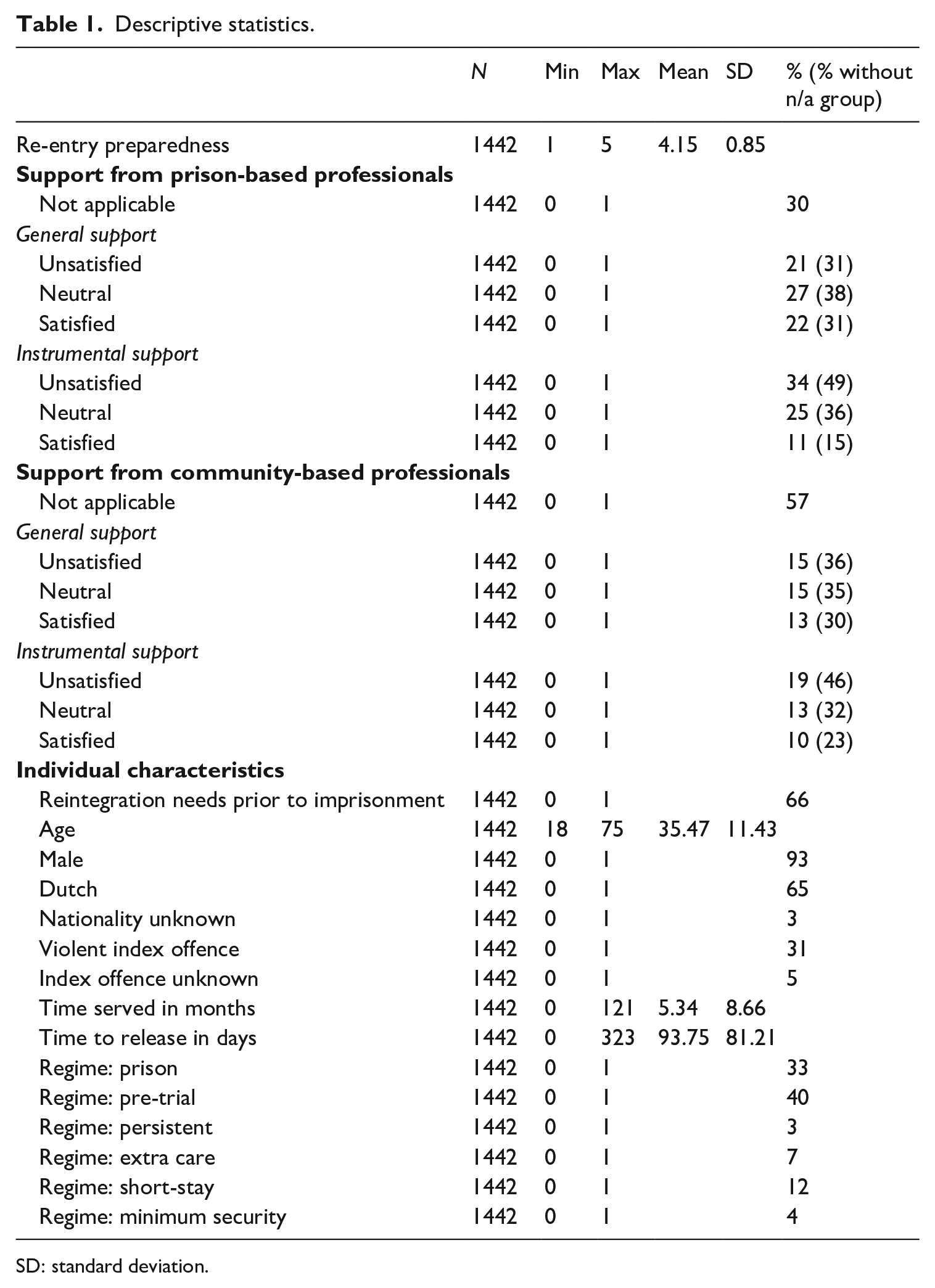
SD: standard deviation.
The bivariate association between professional support and re-entry preparedness
For our first research question, we were interested in the relationship between professional support and re-entry preparedness. The one-way ANOVA results show that both general satisfaction with support and satisfaction with instrumental support were positively related to re-entry preparedness. This holds for support from prison-based (Figure 1) and community-based professionals (Figure 2). As displayed in Figures 1 and 2 (total group), prisoners who were satisfied about general support and instrumental support scored higher on re-entry preparedness than prisoners who were neutral or unsatisfied about this support. For instance, prisoners who were satisfied about instrumental support from prison-based professionals felt better prepared (4.33) than prisoners who were neutral (4.19) or unsatisfied (4.14). These differences were statistically significant. 2
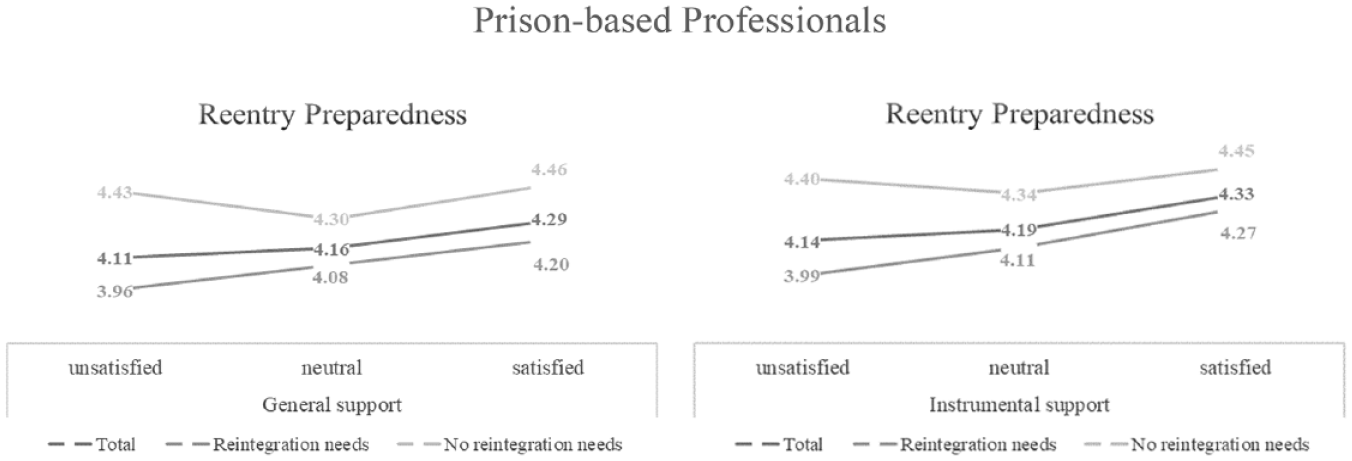
Professional support and re-entry preparedness among prisoners who reported contact with prison-based professionals (n = 1014), total and split for reintegration needs prior to imprisonment.
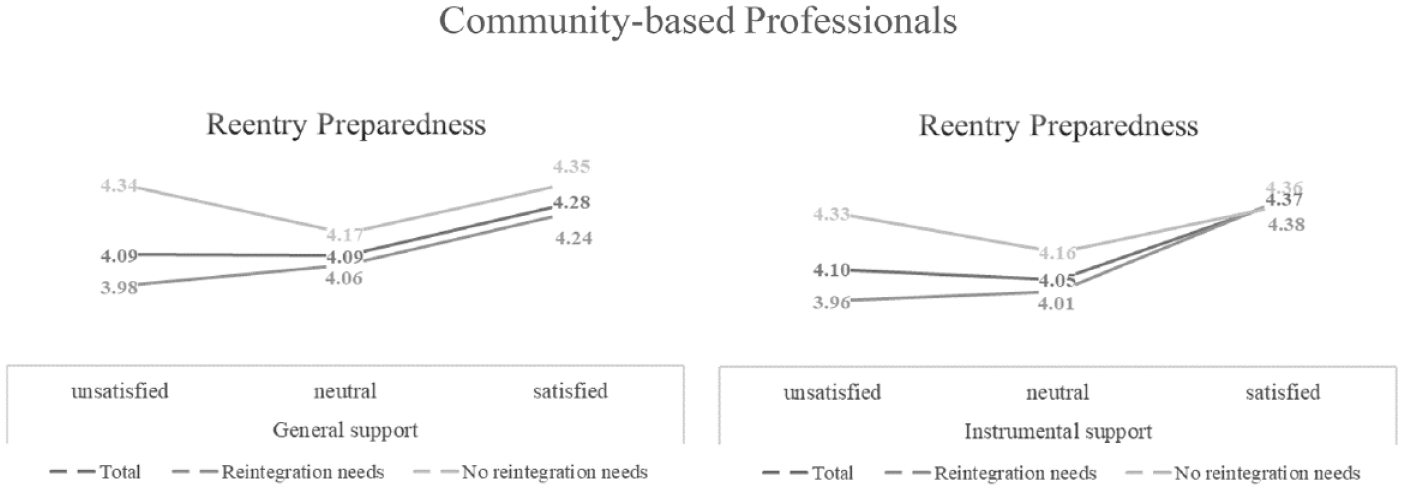
Professional support and re-entry preparedness among prisoners who reported contact with community-based professionals (n = 615), total and split for reintegration needs prior to imprisonment.
Results for individuals with or without reintegration needs prior to imprisonment
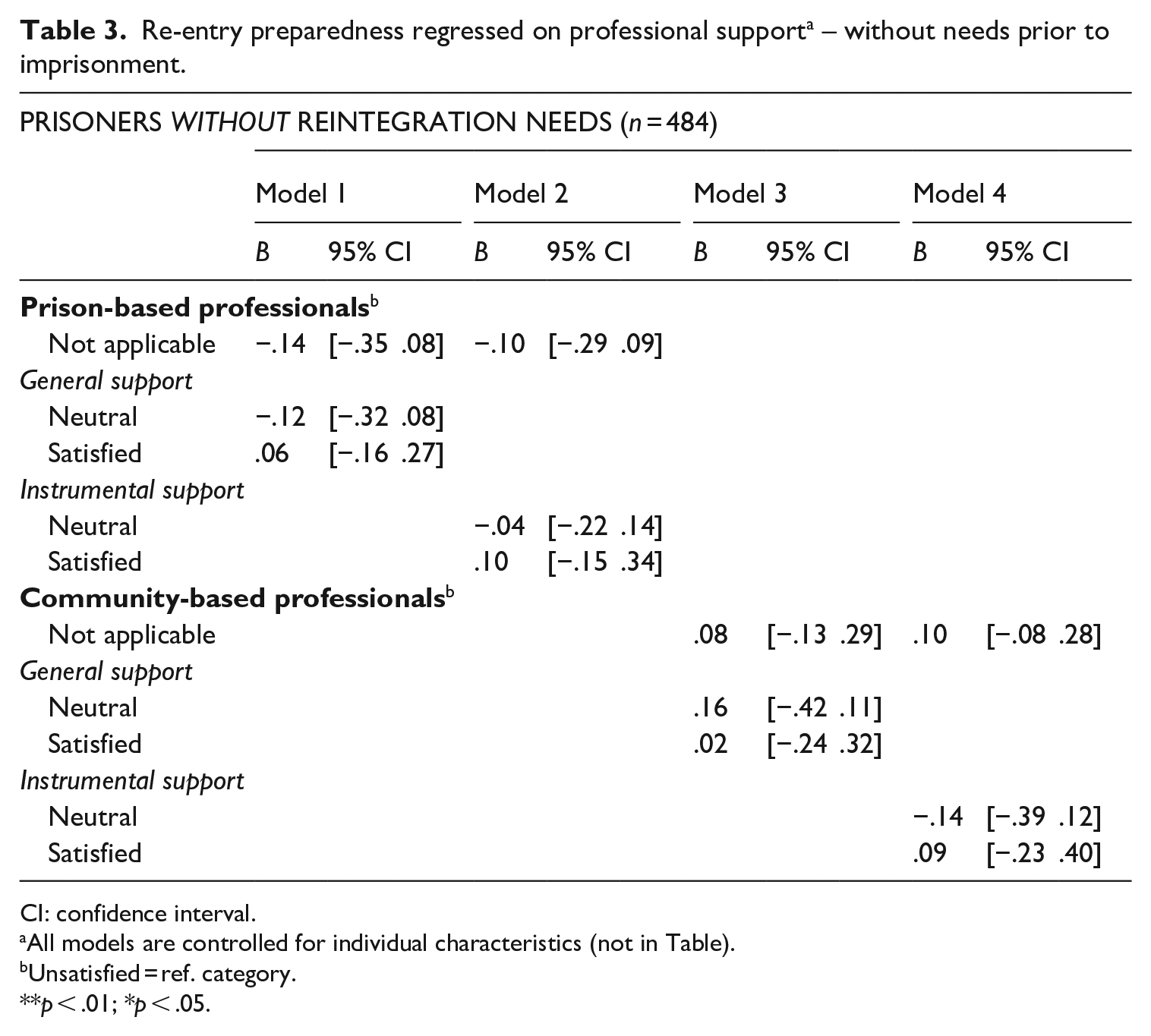
Yet, in answer to our second research question on the differences between prisoners with or without reintegration needs prior to imprisonment, the positive association between professional support and re-entry preparedness only holds for prisoners who had reintegration needs. Figures 1 and 2 show that prisoners who had no needs prior to imprisonment and were unsatisfied about general support and instrumental support from either prison-based or community-based professionals, scored about the same on re-entry preparedness as prisoners who were satisfied about this support. Differences in re-entry preparedness between prisoners who were unsatisfied, neutral or satisfied with support were statistically significant for the group who already had needs prior to imprisonment, 3 but not for the group who had no needs prior to imprisonment. 4 Moreover, in models controlled for individual characteristics, it was confirmed that better perceived support was related to better re-entry preparedness for prisoners with needs, but not for prisoners without needs. To illustrate this, prisoners with needs who were satisfied about the instrumental support from community-based professionals felt better prepared for re-entry than prisoners who were unsatisfied about this support (see Table 2: B = .45, p < .01). In contrast, for prisoners without needs, this association was absent (see Table 3: B = .09, p > .05).
Re-entry preparedness regressed on professional support a – with needs prior to imprisonment.
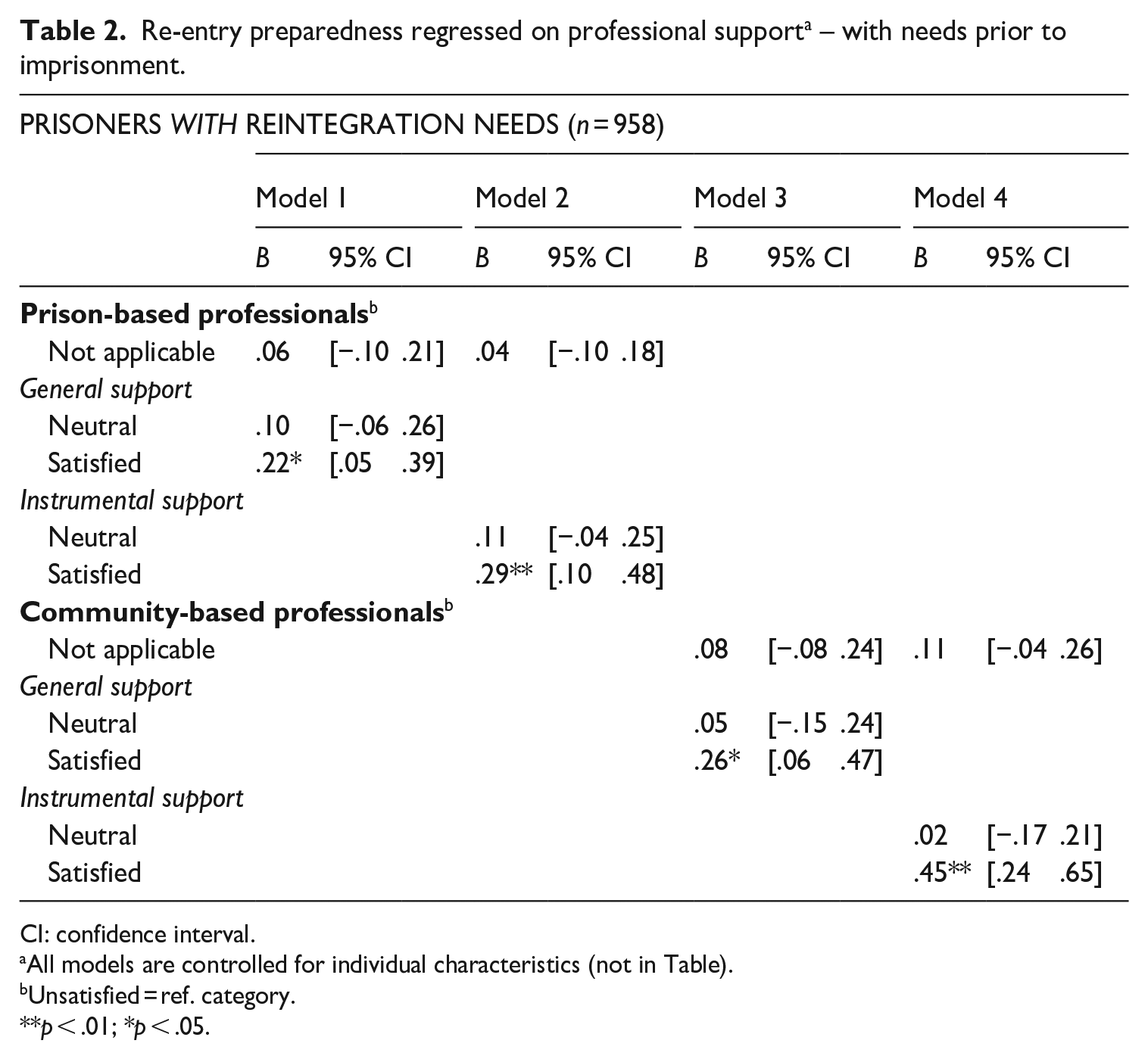
CI: confidence interval.
All models are controlled for individual characteristics (not in Table).
Unsatisfied = ref. category.
p < .01; *p < .05.
Re-entry preparedness regressed on professional support a – without needs prior to imprisonment.
CI: confidence interval.
All models are controlled for individual characteristics (not in Table).
Unsatisfied = ref. category.
p < .01; *p < .05.
Full multivariate models
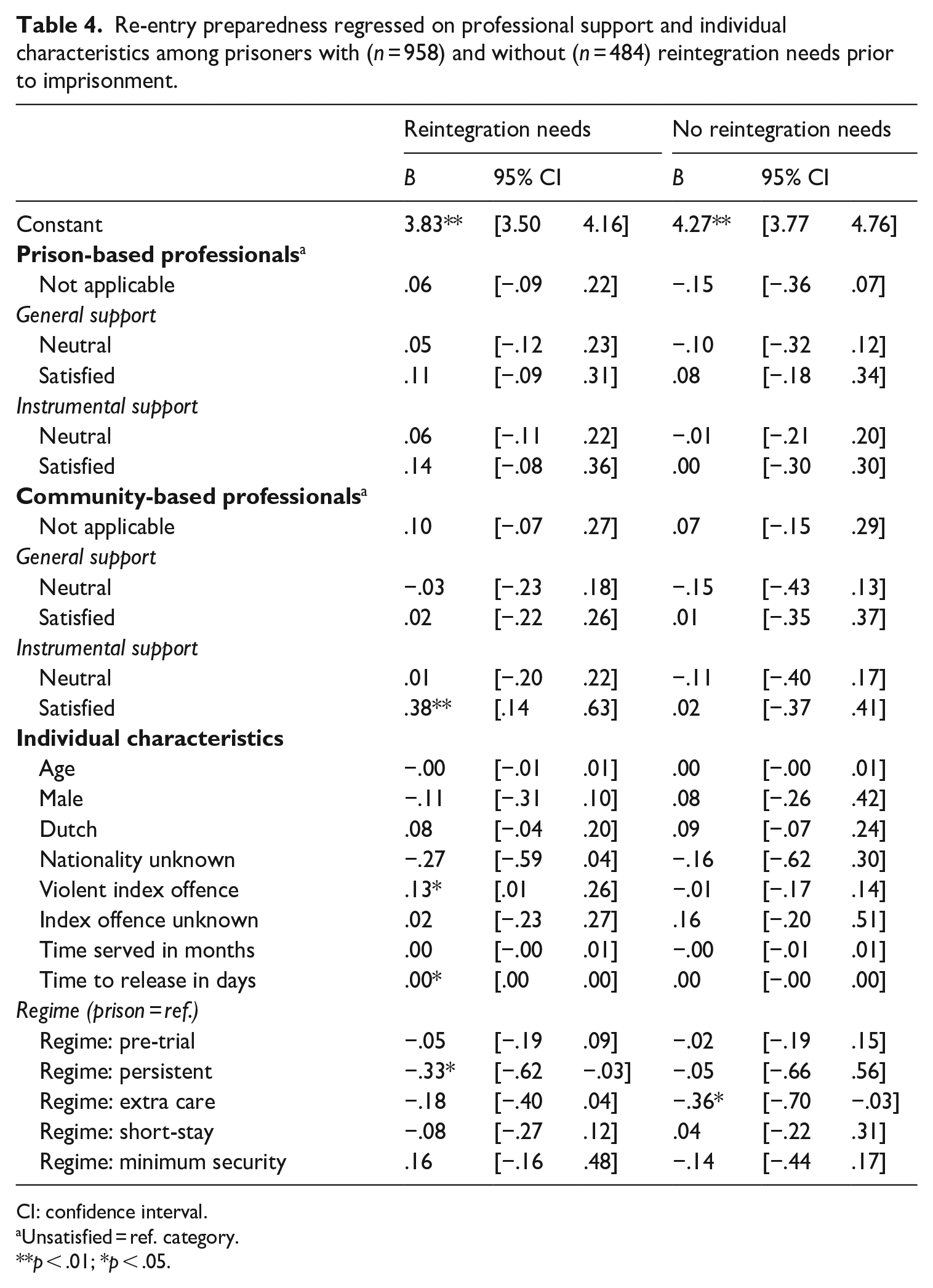
Taking general support as well as instrumental support from both prison-based and community-based professionals together, controlled for individual characteristics, the positive association between support and preparedness is most robust for instrumental support from community-based professionals. As Table 4 shows, among the group with reintegration needs, prisoners who were satisfied about instrumental support from community-based professionals felt better prepared for re-entry than prisoners who were unsatisfied about their instrumental support (B = .38, p < .01). This finding was absent for prisoners without reintegration needs (B = .02, p > .05).
Re-entry preparedness regressed on professional support and individual characteristics among prisoners with (n = 958) and without (n = 484) reintegration needs prior to imprisonment.
CI: confidence interval.
Unsatisfied = ref. category.
p < .01; *p < .05.
The other associations between support and re-entry preparedness (general and instrumental support from prison-based professionals, and general support from community-based professionals) disappeared when adding both forms of support from both types of professionals together. Likely, this is due to the finding that general and instrumental support from prison-based and community-based professionals correlates with each other (although additional analyses showed that the VIF values were below 5). 5 In any case, instrumental support from community-based professionals is the only form of support that distinctively seems to account for differences in re-entry preparedness, holding the other support forms constant. Apparently, these other forms of support do not explain any differences in re-entry preparedness on top of the instrumental support from community-based professionals. Finally, Table 4 also reveals that among prisoners with reintegration needs, those with a violent index offence felt better prepared for re-entry than prisoners with a non-violent index offence (B = .13, p < .05), while those in persistent-offender regimes felt less prepared than in regular prison regimes (B = −.33, p < .05). Among prisoners without reintegration needs, prisoners in extra-care regimes felt less prepared than in regular prison regimes (B = −.36, p < .05).
Last of all, in additional analyses, we found that the better re-entry preparedness among prisoners with reintegration needs who were satisfied about general and instrumental support from prison-based and community-based professionals holds across most separate life domains (i.e. employment, housing, financial situation, healthcare and valid ID). By exception, prisoners who were satisfied about general and instrumental support from community-based professionals, did not feel better prepared in terms of obtaining a valid identity document. Also, prisoners who were satisfied about general support from prison-based and community-based professionals did not feel better prepared regarding employment. Additional analyses also showed comparable patterns for support from the six separate types of professionals (i.e. a case manager, mentor, parole officer, municipal officer, health professional or volunteer). However, prisoners who were satisfied with general support from parole officers or health professionals, or with support from volunteers (general and instrumental), did not feel better prepared for release than prisoners who were unsatisfied. 6
Discussion
Prisoners often face hardships in terms of employment, housing, financial situation, healthcare and valid identification prior to imprisonment and upon release. In trying to tackle these problems during imprisonment, OM policies emphasise the support of both prison-based and community-based professionals in preparing prisoners for release (ICPR, 2011; Maguire and Raynor, 2017). Although previous research identified problems in the implementation of such policies (e.g. Hadfield et al., 2020), thus far, the actual contribution of professional support to the re-entry preparedness of prisoners received little attention. The current study, which found a positive relationship between professional support and re-entry preparedness, underpins the importance of proper implementation of OM policies. Moreover, our study showed the relevance of distinguishing between support from prison-based and community-based professionals, between general and instrumental support and between prisoners with or without reintegration needs prior to imprisonment.
First, our findings suggest that professional support is related to re-entry preparedness for prisoners who reported reintegration needs prior to imprisonment. These findings are in line with the idea that especially vulnerable prisoners with complex needs should receive professional support (McSweeney and Hough, 2006). It seems promising that the provided professional support is related to a better feeling of re-entry preparedness among this group. Nevertheless, previous research showed that the number of prisoners who have reintegration needs and receive relevant assistance is limited (Pasma et al., 2022). The current study stresses the urgency to provide re-entry support especially to prisoners who already enter prison with reintegration needs.
In contrast, professional support was not related to the re-entry preparedness of prisoners without reintegration needs prior to imprisonment. First, the provided re-entry support may look different for prisoners with reintegration needs than for prisoners without reintegration needs. Second, it may point to a higher possession of human capital among this group. The fact that this group reported no problems in essential life domains prior to imprisonment suggests that this group is more capable of maintaining a stable life, perhaps with the help of personal social networks. In some cases, these life skills or personal networks may be equally helpful during imprisonment in case of collateral consequences, making the support of professionals less needed. Finally, prisoners without needs prior to imprisonment were very positive about their re-entry preparedness; a ceiling effect may also partly explain why no relation was found between support and preparedness for this group, given that there was little variation in their reported preparedness.
Moreover, it turned out that instrumental support from community-based professionals was most clearly related to the re-entry preparedness of prisoners. This corresponds to the call for interagency collaboration between prison institutions and community-based professionals in the reintegration process of prisoners (Hadfield et al., 2020). According to OM policies, community-based professionals should be included early-on in the reintegration process to provide access to community resources and use their expertise and networks to refer prisoners to services. This coincides with our finding that their instrumental support seems to matter the most in re-entry preparedness. Anecdotal reports had already indicated that instrumental support from community-based professionals was considered useful according to some prisoners (Hlavka et al., 2015; Kjellstrand et al., 2022, 2023; Luther et al., 2011). Yet, similar to other previous findings (Cid et al., 2021; Visher et al., 2004), the results also show room for improvement in this aspect. Many prisoners reported no contact with community-based professionals or were unsatisfied about their provided instrumental support. The alarming reports (e.g. Bullock and Bunce, 2020; Maguire and Raynor, 2017) on inadequacies in the implementation of multiagency collaboration are thus underscored by our findings that this support may in fact contribute to the re-entry preparedness of prisoners. Therefore, we support the wish of the Dutch policy agreement (DJI, 2019) to increase the early-on involvement of community-based professionals in the reintegration process of prisoners.
While prisoners were relatively satisfied about the general support received from prison-based and community-based professionals, this played no distinctive role in the re-entry preparedness of prisoners. This is in line with previous mixed findings in the anecdotal reports of prisoners that even when (ex)-prisoners were satisfied about the contact with community-based professionals, this did not necessarily lead to meaningful job referrals (Bui and Morash, 2010). Our results did show that the perceived general support was correlated with the perceived instrumental support. In other words, frequent, pleasant and useful conversations may contribute to needs assessments, proper referrals and to the ability and willingness of community-based professionals to provide instrumental support (i.e. arrange job opportunities or housing options). Therefore, although no direct association was found on top of instrumental support from community-based professionals in the re-entry preparedness of prisoners, we still believe that it is important to pay attention to the frequency, pleasantness and usefulness of re-entry support.
Furthermore, the results held steady across the felt preparedness in most life domains (i.e. housing, healthcare, finances), except for some expectations regarding employment and valid identification. Previous research showed that prisoners without a valid ID most often had multiple needs (Pasma et al., 2022). Perhaps, for complex cases, professional support during imprisonment alone is not sufficient in increasing their re-entry preparedness. Another explanation is that in the Netherlands applying for a valid ID requires an in-person visit to a counter of the municipality of registration. However, prisoners are not granted furlough to take care of this. An alternative route is that an officer from that municipality visits the prisoner. Yet, this may be hampered by workload, poor information sharing between prison institutions and municipalities or long distances between the prison institution and the issuing municipality. Fortunately, a recent initiative was undertaken to ease this process by allowing the municipality of where the prisoner is held to issue a valid ID (Rijksdienst voor Identiteitsgegevens, 2022). Our study supports the need of such an initiative, given that without valid identification, other life domains are at stake as well.
Finally, a few limitations are worthwhile mentioning. First, we examined the subjective opinions of prisoners regarding their prior needs, received support and re-entry preparedness. Similar to what is observed in other research, prisoners often tend to be overoptimistic about their future. Their subjective feeling of being prepared for release may not accurately reflect the future of prisoners in terms of employment, housing, financial situation, healthcare and having a valid ID. Although previous research pointed out that being optimistic about the future is related to better post-release outcomes (Graffam et al., 2004), future research may want to further examine objective accounts of reintegration needs prior to, during and after imprisonment. Another limitation is that the nature of our questionnaire made it impossible to detect problems that may emerge during imprisonment. Therefore, we were unable to identify prisoners who reported no prior needs but developed such needs during imprisonment. Nevertheless, the results suggest that it was relevant to distinguish between prisoners who already enter prison with problems and those who do not. Yet, future research should map the exact timing of reintegration needs and the provided professional support, to find out whether that support helped tackling the reintegration problems. Moreover, although we controlled for several individual and detention characteristics, additional factors may also relate to re-entry preparedness, such as whether prisoners were released for the first time. Finally, the results may not be generalisable to other contexts, given the relatively short sentences in the Netherlands. While short spells of imprisonment are often associated with needs complexity, the damage of imprisonment may increase over time. Therefore, it may still be important for both short-stay and long-stay prisoners to provide re-entry support.
To conclude, our study was able to bring forth valuable insights regarding in-prison support from various professionals and its relationship with the re-entry preparedness of prisoners. Given that re-entry challenges are reported worldwide, our results may provide useful lessons for other contexts as well. Our results stress the proper implementation of OM policies, in particular, the early-on involvement of community-based professionals, who can provide instrumental support and access to resources. We also stress paying special attention to prisoners who already entered prison with reintegration needs. Future research should seek to find out whether professional support and subjective or objective re-entry preparedness are related to lower reoffending rates.
Footnotes
Acknowledgements
The authors wish to thank the DJI for their support with the administration of the survey.
Declaration of Conflicting Interests
The author(s) declared no potential conflicts of interest with respect to the research, authorship and/or publication of this article.
Funding
The author(s) disclosed receipt of the following financial support for the research, authorship and/or publication of this article: The Dutch Prison Visitation study, as part of the Life in Custody study, was funded by the Dutch Custodial Institutions Agency (DJI) and Leiden University. The opinions, findings and conclusions expressed in this article are those of the authors and do not necessarily reflect those of the DJI.
