




Abstract
In this article, we consider the moral judgements of new recruits to the police by drawing on two stages of semi-structured interviews with recruits over their first 6 months working for Lancashire Constabulary in England. The article contributes to the literature by providing insights into the moral thinking of police officers at the very early stages of their career. The discussion is supported by relevant criminological and philosophical literature as appropriate. Evidence is presented that there is more to the recruits’ moral judgements than a simple reflection of codified standards of behaviour as taught in police training. Their experiences reflect greater complexity than straightforward socialisation into existing cultures. The recruits emphasise an inclusive empathy and greater compassion for others – often irrespective of what those others have done. An empathetic policing is suggested that could challenge assumed dominant cultures and may be a way to encourage greater engagement with the moral value of police action and inaction.
Introduction
In this article, we consider the moral judgements of new recruits to the police by drawing on two stages of semi-structured interviews with recruits over their first 6 months working for Lancashire Constabulary in England. Evidence is presented that many recruits bring with them an empathetic idea of policing demonstrating compassion for others, whether those others are colleagues, victims, suspects or anyone else who comes into contact with the police. Forty-nine of an initial 60 participants were re-interviewed after 6 months to see whether greater exposure to police training and frontline working had impacted their moral judgement. After 6 months, most recruits retained an empathetic idea of policing, although some found it difficult to be compassionate in all situations. The article contributes to the literature by providing insights into the moral judgements of police officers at the very early stages of their career. The discussion is supported by relevant criminological and philosophical literature as appropriate.
Several high-profile incidents, including the May 2020 murder of George Floyd in Minneapolis by a serving officer (McClanahan, 2021; Sherman, 2020) and in March 2021, the rape and murder of Sarah Everard in London following a fake arrest and kidnapping by a Metropolitan Police officer (Casciani, 2021; His Majesty’s Inspectorate of Constabulary and Fire & Rescue Services (HMICFRS), 2022), have contributed to increased scrutiny of police officers’ attitudes, beliefs and subjective moral judgements. Much policing scholarship focuses on the cultures of policing (e.g. Cockcroft, 2020; Loftus, 2009; Manning, 1989), but perhaps less about their moral judgement. According to Fassin (2013: 3), To talk about law enforcement in moral terms may seem somewhat disconcerting. This is not the language that generally comes to mind about the police. Other associations are more common with law: force, order, security, repression, control, investigation, record.
That said, moral aspects of the job have been considered, including by Kleinig (1996), Alain and Grégoire (2008), Fassin (2013), Nathan (2017) and Maile et al. (2022). Kleinig (1996) questions a divide between ‘role morality’ and ‘ordinary morality’. Role morality may be associated with codified standards or general norms and expectations associated with a professional role – for example, as informed by policing cultures and by codes of ethics. By contract, ‘ordinary morality’ might be associated with ordinary encounters, ‘outside our professional or occupational roles’ (Kleinig, 1996: 47). Kleinig (1996) contends that any tensions between professional and personal values are no different to tensions that exist between: . . . our responsibilities to our family, friends, country, and so on versus our more general responsibilities to others. If there is a tension, it is between universal and particular obligations, not between common or ordinary morality, on the one hand, and professional role morality on the other. There are some obligations that we have by virtue of our common humanity . . . (p. 52)
People can have multiple identities and roles – such as police officer and civilian – and can behave differently towards others depending on what role they have at that time and place. Furthermore, as noted by Millie (2016: 44), ‘People are not consistent and may well contradict a moral judgement made in one context when making moral judgements elsewhere, even if this is in a similar situation’. Police officers may not always make the same moral judgement resulting in inconsistent actions or omissions.
A central aim of this article is to examine the extent to which the recruits’ moral judgements change following greater exposure to police training and frontline policing. Moral judgements place moral value on actions or omissions. These can be evaluative moral judgements of what is seen as good or bad, or perhaps deontic 1 moral judgements of ‘rightness, wrongness, obligation, requirement, reason for doing and what ought to be’ (Millie, 2016: 17). Existing literature suggests that exposure to training and frontline policing may contribute to the adoption of axioms and norms that reinforce a presumed collective need for occupational self-preservation. According to Kleinig (1996: 46), ‘first line officers are as much guided by maxims such as “cover your ass,” “don’t make waves,” and “never trust a boss,” as they are by judgements of the appropriateness of their response to the circumstances confronting them’. There may be a deontic obligation to ‘our common humanity’ (Kleinig, 1996: 52), but it is possible that this can get pushed aside once on the job. It is the kind of ‘cop culture’ code of ethics identified by Reiner (2010) reflecting cynicism, pessimism, suspicion of others, solidarity within the police and a sense of mission (see also Westmarland, 2016). Police managers may want to encourage solidarity and a sense of mission, features associated with what is colloquially known as the ‘police family’, but not if these lead to practices that protect fellow officers at the expense of others – sometimes called a blue code of silence (Skolnick, 2008; Westmarland and Conway, 2020).
Attempts have been made to counter ‘cop culture’ through the introduction of codified standards, for instance, in England and Wales with the introduction of a Code of Ethics for policing (College of Policing, 2014). 2 Within policing scholarship, codes of ethics have long been regarded as ‘a sign of a vocation’s or occupation’s true professionalization’ (Kleinig, 1996: 33). For instance, in the United States, Kleinig (1996) noted the existence of a ‘Square Deal’ Code in Wichita from 1928 and a more broadly adopted Chiefs of Police Law Enforcement Code of Ethics from 1957. England and Wales were perhaps late to adopt such a code due to internal opposition to the idea (Lawton, 1998; Neyroud and Beckley, 2001). The College of Policing Code of Ethics in England and Wales emphasises nine principles of policing: accountability, fairness, honesty, integrity, leadership, objectivity, openness, respect and selflessness. The code encourages positive attitudes and behaviour and is rooted in a virtue ethics understanding of morality (see also Manning, 2020). An ethical police officer is one who displays good character and has the moral virtues of, for example, honesty, respectfulness and selflessness. The expectation is that such virtues ought to be evident in all situations as ‘obligations that we have by virtue of our common humanity’ (Kleinig, 1996: 52).
In the next section, we provide context by considering the practical morality of police officers. This discussion is informed by consideration of more conceptual or philosophical notions of morality. This is followed by an outline of the project methodology. We then draw on the interviews with new recruits to explore their moral judgements and the possibility of an empathetic approach to policing. This is followed by a discussion of the recruits’ perceptions of ethics and integrity in policing more generally before providing a discussion of our overall findings and conclusions.
Background
There have been few studies that have focused on the experiences of new recruits to the police. Notable contributions include Van Maanen (1975), Fielding (1988), Chan (2001), Sato (2003), Alain and Grégoire (2008) and Charman (2017), who have each highlighted processes of socialisation as recruits become accustomed to operational police work and to dominant police cultures. More recently, Branch (2021: 984) has considered how US recruit training can perpetuate a notion of ‘precarious policing’, ‘through a rhetoric of job insecurity and the risk of physical and bodily harm’. Hoel and Dillern (2022) and Hoel and Christensen (2020) considered the in-the-field training recruits receive in Norway. Of relevance to this article, Hoel and Christensen (2020: 578) highlighted how ‘workplace learning can challenge proper ethical professional development and [is] thus becoming a matter of ethical concern’. The training in-the-field was quite different to that received in the classroom and contributed to their socialisation into accepted cultures and practices. Drawing on Van Maanen and Schein (1979), Chan (2001: 114) identified socialisation as ‘the process by which a person learns the values, attitudes and acceptable behaviours so that he or she can participate as a member of the organisation’. New recruits may adopt the dominant characteristics and beliefs of policing but are not necessarily subsumed by the occupational culture; as Chan (2001) has highlighted, ‘recruits [are] far more active and reflective, than previously assumed’ (p. 114). It is possible that recruits bring with them their own moral judgements and may also be able to shape police practice, as much as police practice shapes them.
In examining the moral judgements of police recruits and codified standards such as the Code of Ethics, a useful starting point is consideration of the three main approaches to moral philosophy: virtue ethics (in simple terms, focused on the character of individuals), deontology (a rule-based understanding of morality) and consequentialism (considering the consequences of actions) (see, for example, Millie, 2016). As noted, the Code of Ethics reflects a virtue ethics understanding of morality, with a good person recognised, for example, in Aristotelian terms, as someone who ‘embodied all the excellences of human character’ (Driver, 2007: 137). Within this perspective, total virtue remains an aspirational ideal. There is no entirely virtuous person and, by extension, no entirely virtuous police officer; but the aim of following the Code of Ethics might be interpreted as an attempt to more resolutely pursue this ideal. The Code of Ethics can also be regarded as deontological, as it provides a set of rules of behaviour, a code to live by. And, like the Standards for Public Life that emerged from the Nolan Committee two decades before (Committee on Standards in Public Life, 1995), 3 the Code of Ethics is also consequentialist in that the consequences of actions dictate their rightness or wrongness. The College of Policing states that ‘[i]f the public don’t have the confidence to trust the police to be fair, acting ethically and in their best interests, they are less likely to assist the police in upholding the law’ (College of Policing, 2022). Keeping to the Code is therefore interpreted as the right thing to do because of such consequences.
In criminological and social-psychological research on procedural justice (e.g. Alexander and Ruderman, 1987; Hough et al., 2010; Lind and Tyler, 1988), it is suggested that the police gain legitimacy when people are dealt with fairly, that ‘fair procedures can act to reduce generally the level of conflict and dispute’ (Lind and Tyler, 1988: 82). Yet, the Code of Ethics seemingly aims to exceed this goal of procedural justice to incorporate an expectation that each officer demonstrates the assumed virtues of honesty, respectfulness, selflessness and so on.
Drawing on the moral judgements of new recruits, an empathetic approach to policing might be a way to make this more likely and lead to a more compassionate understanding of the policing task. According to Millie (2016: 121–122), an empathetic criminology would . . . start with recognition of the inherent human dignity in all social actors, that all should be respected irrespective of whether we agree with them, or with what they do. This does not mean we approve of abhorrent behaviour; nor does it mean we do not believe in justice. What it does mean is that we recognise the human-ness in all we deal with.
This may be an avenue for pursuing a more empathetic policing strategy, with officers not only recognising others’ human-ness, but seeing a reflection of themselves and responding with compassion. As an approach, it draws some inspiration from the ‘golden rule’ as derived from several cultures and religions as well as from the philosophy of Plato and Aristotle (Hertzler, 1934; Millie, 2016, 2021; Reinikainen, 2005). For instance, the golden rule is expressed in the New Testament as, ‘So in everything, do to others what you have them do to you’ (Matthew 7: 12). 4 This might be translated in a policing context, for example, as being respectful of those often labelled as ‘police property’ (cf. Cray, 1972) if officers desire reciprocal treatment. In a previous study of police volunteers (Millie, 2018), participants often framed their values and beliefs not only in terms of the golden rule, but also as a desire to help others, exhibit honesty and integrity, and have respect for others. While there was overlap with the Code of Ethics, the volunteers were not simply repeating the Code. It is possible that the recruits in the current study similarly made moral judgements in terms broader than the Code of Ethics.
Related to the idea of respect is Kant’s conception of dignity, especially his Formula of Humanity as End in Itself, to, ‘Act in such a way that you treat humanity, whether in your own person or in the person of another, always at the same time as an end and never simply as a means’ (Kant, 1990 [1785]: 1036). Within this framework, an individual police officer may not agree with someone’s perspective or approve of their actions (or inactions), but ought to still recognise their inherent dignity, their common humanity (cf. Kleinig, 1996) and show them respect – that all people are ends in themselves and should not be regarded as means to an end (see also Kleinig, 2019).
The concept of empathy could frame such an approach to policing. We go onto discuss the views of the new recruits interviewed, but at this stage, it is worth noting that all agreed that empathy has a place within policing practice. According to the philosopher Oxley (2011), empathy is not an emotion, rather it is how we share another’s emotion. We can choose to empathise, and our emotional response to empathy is compassion. For Oxley, there are two forms of empathy: relational empathy and inclusive empathy. Relational empathy is expressed towards those perceived to be like oneself, for instance, towards family or within group associations. In this way, it is like Putnam’s (2000) bonding social capital and can be inward looking, exclusive of others. It may be relational empathy that is shown between policing colleagues as expressed positively in the notion of a ‘police family’ or negatively in a ‘cop culture’ code of ethics (Reiner, 2010) – which may be a partial explanation for historical and contemporary criticisms of policing in terms of institutionalised racism, sexism and homophobia (Rowe, 2018). Oxley (2011: 4) acknowledges that ‘empathy is not intrinsically moral and does not always lead to moral thought or action’, something that is apparent when police officers’ empathy for colleagues leads them to view others as worth less. An alternative to relational empathy is inclusive empathy, which overlaps with the notion of bridging social capital (Putnam, 2000) and reaches out to strangers. To borrow from Kant again, inclusive empathy suggests that all people are seen as ends and never as means to an end. Within a policing context, this would extend to police suspects, witnesses, victims and anyone else who has contact with the police. In relation to the Code of Ethics, a focus on inclusive empathy may be a way to encourage greater engagement with the moral value of actions – and inactions – perhaps more so than reference to a list of virtues in police training.
Methodology
The project adopted a two-stage methodology involving interviews with all new recruits to Lancashire Constabulary in November 2016 (n = 60). As many as possible were re-interviewed roughly 6 months later in May–June 2017 (n = 49) (see also Millie and Hirschler, 2018). Further interviews after a period of 12 months or longer, in the style of a conventional longitudinal study, may have revealed further insights. For instance, following their multi-phased study of new police recruits in Quebec, Alain and Grégoire (2008) noted that within 3 years, officers exhibited dissatisfaction, ambivalence and disillusionment, particularly regarding the efficacy of community policing. This was not possible for the current study. Instead, the focus is on recruits’ first 6 months working for the service to examine if this represents a transformative period during which moral judgements are challenged by police training and initial exposure to the realities of frontline operational policing. The 6-month time span also maximised the number of repeat participants before they had the opportunity to disperse elsewhere and would therefore have been more difficult to access. In deciding to interview recruits a second time, the aim was to identify the extent to which changes in perspective, if any, might be recorded within this relatively short period. The interviews were semi-structured with discussions centred on motivation for joining the police, the recruits’ moral judgement – in terms of personal beliefs and values and whether the recruits thought these would impact their approach to policing – the relevance of empathy to policing, and general views on police ethics and integrity.
The research was conducted before the Covid-19 pandemic when police roles changed in line with government guidelines (e.g. Ralph et al., 2022). It was also before major changes to police training in England and Wales with the introduction of the Police Education Qualifications Framework (PEQF) as dictated centrally by the College of Policing as part of a professionalisation agenda (College of Policing, 2016, 2020). It is acknowledged that if the study was repeated, there may be different findings, especially as, at the time of writing, recruitment across England and Wales now includes degree apprenticeship and graduate entry to the police. It is possible that newer routes into policing and university-based training could have different impacts on recruits’ moral judgement. 5 Furthermore, the research was prior to an announcement in 2019 that, after a prolonged period of cuts, there was a target to recruit a further 20,000 officers across England and Wales (Davies, 2022). However, according to HMICFRS (2022) – in a report following the Sarah Everard case – recruit vetting processes need to be improved to tackle sexualised misconduct and misogyny in the police. Simply adding to the number of officers is insufficient. The relevance of this study is therefore undiminished, as recruits’ moral judgements remain an ongoing concern.
The 60 recruits in the current study included graduates, but also a wide diversity in terms of employment and educational experience. For instance, recruits had prior experience in the Civil Nuclear Constabulary, the National Probation Service, Ambulance Service, work with vulnerable people including mental health work, work on family projects and with children with behavioural difficulties. Others were schoolteachers, had worked for their church or had other voluntary roles. Some had completed postgraduate qualifications.
Despite this range of backgrounds, three-quarters of the recruits (40/54)
6
had also previously worked for the police as Police Community Support Officers (PCSOs)
7
or volunteered as special constables. At the time of the study, experience as a PCSO or special constable was clearly regarded as a ‘way in’ to policing, which may also partly explain impacts on the retention of PCSOs (O’Neill, 2014) and special constables (Bullock and Millie, 2018). There was diversity in terms of age, ranging from early 20s through to 50s. Sixty percent of recruits were male, and 40% were female.
8
The recruits lacked meaningful ethnic diversity as most were White, meaning separate analysis by ethnicity was not possible.
9
The range in terms of age and background was recognised by one of the interviewees: Ah, it’s a little bit of an eye-opener, actually, erm, the class I’m in [in police training], is, is a broad spectrum aged from 23 to 53. Everybody – and we’ve got people from civilian walks of life, people who’ve been specials, people have been PCSOs [. . .] a lot of us are parents and have got family backgrounds, and suchlike, and worked in a variety of roles [. . .]. I can see why we’re all here, why people have been picked for this job, because everybody has great communication skills, er, great use of empathy. (#26M)
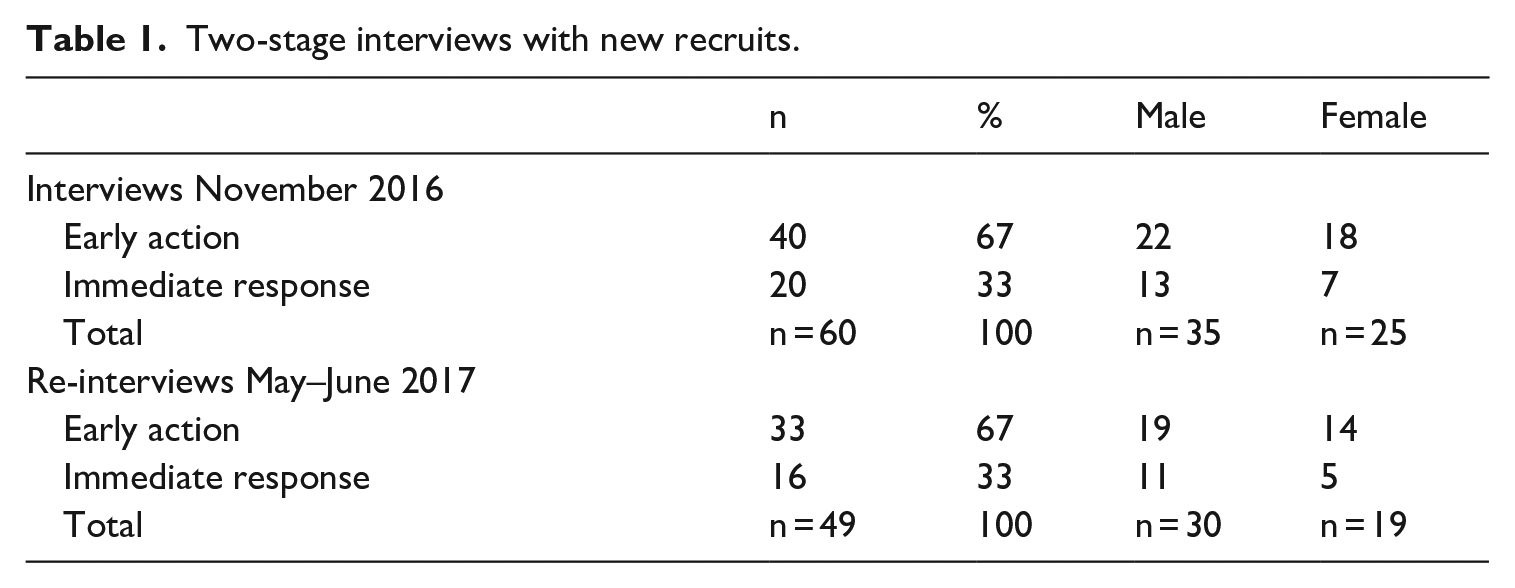
A third of the cohort of 60 that were interviewed in November 2016 were recruited as ‘immediate response’ officers whose role aligned closely with conventional reactive approaches to policing, ‘focused on control of crime through response, deterrence and apprehension, law enforcement and crisis response’ (Bullock, 2013: 142). Two-thirds were ‘early action’ recruits, as part of an ‘Early Action Public Service Lancashire’ project, which focused on . . . reducing vulnerability and crime, improving the wellbeing of our communities and improving the life chances of those involved in or at risk of engaging in organised criminality and those at risk of increasing social issues leading to crisis. (Lancashire Constabulary, 2022)
Between May and June 2017, it was possible to re-interview 49 of these recruits – again including a third that had been recruited to immediate response and two-thirds that had been recruited to early action.
Interviews lasted approximately 15–20 minutes each. All 109 interviews were transcribed verbatim and analysed using NVivo qualitative analysis software, identifying key and emerging themes. The study was conducted independently in Lancashire and was funded by Lancashire Constabulary. The research was approved by the authors’ institutional research ethics committee, and all participants were anonymised and given a unique identifier. 10 A breakdown of the interviews is shown in Table 1.
Two-stage interviews with new recruits.
At the time of the second interview, all recruits had spent 10 weeks on immediate response. Furthermore, just prior to the second interviews, on 22 May 2017, a large terrorist incident occurred at the Manchester Arena in the neighbouring police service area of Greater Manchester Police (see BBC, 2017). This had an impact on our cohort with some officers abstracted to the neighbouring service for increased visible patrol. They were also involved in visible patrol in major cities and towns within Lancashire. Due to this and other pressures – and the 10 weeks that they had been on immediate response as part of their initial training – not all the early action recruits had done any early action work at the time of their second interview.
The police recruits
The recruits were asked why they joined the police. The most common reasons concerned a desire to help people and to pursue work that offered unique experiences. Thus, motivation was both inward (seeking experiences) and outward (to help people). Some claimed to be attracted by the perceived values of policing. They acknowledged that the public image was not always favourable, but that policing’s core values were fundamentally positive. According to #14F, I’ve just always wanted to join the police. Partly because of the values, and how I like imagine a police officer should be, and that’s what I want to be like. So, like have an integrity and being brave, and protecting people, and that kind of appeals to me.
How much the reality of day-to-day policing matches this idealised conception of a police officer is another matter. During their first interview soon after joining the service, all recruits were asked about their personal values and beliefs, and whether they thought these would impact their approach to policing. They were asked the same question 6 months later. The recruits were also asked about empathy during both interviews and about police ethics and integrity more generally during their second interview at 6 months. Given that the interviews took place while the recruits were still being trained, it was anticipated that answers would be expressed using the language of the Code of Ethics – something that was emphasised throughout their training programme. There was repeated mention of a need for honesty and integrity, both featured in the Code and discussed by over 40% of those interviewed (25/60). For instance, #13F emphasised the need for honesty, that ‘I think if you’re a police officer, if you’re dishonest then you, you shouldn’t be in the job’. For #28F, ‘I think that me being honest and transparent with people, erm, is really good because it builds up like a good rapport with the community’. According to #51M, the Code of Ethics had significant overlaps with his own moral thinking: . . . there are a few things that are in the Code of Ethics that, you know, if I, when I’ve looked at it I’ve thought, yeah, I’ve, I’ve, I’m already, you know, I already think that way, or I already believe that. [. . .] there are things in there that I’d never really thought of before [. . .] simple things like, like, you know, like honesty and integrity and those sorts of things.
Similarly, for #53M, ‘some people are, are blaggers, if you like, and they will, or, you know, they try and bend the rules, [. . .] I just can’t do that, it’s not, it’s not my, not my style at all’.
While honesty and integrity were the features of the Code of Ethics mentioned most, other aspects such as fairness and selflessness were also covered. For instance, according to #16F, ‘I like things to be fair and I will fight any corner if I think something’s not fair’. For #06M, ‘I’m all for, erm, being there for people in situations, erm, and helping those who are less fortunate’. The general view was summarised by #43F: ‘I’m not expecting to be like a super, superhero or anything like that, but I do want to help make a difference in people’s lives, and I think that’s what drives me’.
Just under a fifth (11/60) talked about needing to be respectful – also a feature of the Code of Ethics – and for some, this was expressed in terms of the aforementioned ‘golden rule’, even if they did not use this precise term. For instance, for #41M, it was ‘talking to people how you’d like to be spoken to’. Similarly, for #16F, Be respectful to people [. . .] always treat people as you wish to be treated, or if you go to a job imagine that that’s your family member [. . .] at the end of the day, it’s somebody’s family member, isn’t it?
Darwall (1977) conceived of two forms of respect: recognition respect that is due to all persons in recognition of their humanity (in line with Kantian dignity) and appraisal respect which is earned on merit. The recruits’ moral judgements can be interpreted in terms of recognition respect. One participant (#36F) explained that police officers need to recognise people’s dignity, even in instances in which they are being abusive towards an officer: . . . you can’t be rude to them, you know, no matter whether they’re shouting and screaming at you in the face, whether they’re telling you to go away and not very politely, or anything else. You’re a professional and you have to remain professional, [. . .] at the end of the day, you’ve got a job to do, and you have to do it within the law and the legislation that you’ve got, but that doesn’t mean to say that you have to disregard their dignity, or, you know, disregard respect or anything else for them.
Other areas mentioned during interview that were not associated with the Code of Ethics included a need for kindness, normative family values, ‘doing the right thing’, teamwork, personal presentation, a good work ethic, relationships with others and giving others a voice. According to #15F, Erm, I think everybody deserves a chance, and I don’t think you can write somebody off. Erm, everybody deserves a chance, and a second chance [. . .] there is a limit, I suppose, and I think you’ve got to have some belief in people, and hope for people as well. Erm, it’s pointless being cynical.
At this early stage in their policing careers, most new recruits appeared to make moral judgements that would challenge an assumed ‘cop culture’ code of ethics, often grounded in normative values such as the ‘golden rule’ and a general belief that others are worthy of dignity, irrespective of what they have done or whether others’ values differ from their own. As highlighted, three-quarters of the recruits had previous policing experience as PCSOs or special constables. It seemed that this experience did not mean they were necessarily cynical, pessimistic or suspicious of others (cf. Reiner, 2010).
Seven out of 60 recruits mentioned the influence of religion on their personal values and beliefs. For instance, for #52M, ‘from day one, whether it was my [Muslim] religion taught me that, or my family, or my employment, [. . .] is how you’d want to be treated’. Similarly, for #15F, ‘I’m a Christian [. . .] I think probably [being] non-judgemental and giving everybody a chance, having hope for people as well’. The recruits’ beliefs and values overlapped with the Code of Ethics, but they were also influenced by a personal moral code, and for some, this was informed by religious belief.
During the second round of interviews at 6 months, the recruits were again asked how their personal values and beliefs influenced their approach to policing. By this stage, they had received extensive training on the Code of Ethics and exposure to frontline policing. For most, their answers were like those given during the first interview. For instance, drawing on her training and experiences on-the-job, #40F emphasised the need for (recognition) respect in all situations: . . . we’d had a training [session], and a lot of it was around, we had to imagine that it may be the person’s first experience with a police officer. And that’s always in the back of my mind, that if I’m the first, you know, if that’s the first time they’ve ever had to come in contact with the police, I want it to be as positive as it can be. You know, if somebody’s been arrested and they’re committing crime, of course, they may be spending a night in the cells, but they still deserve to be treated with respect, and as a human being, yeah.
Another theme that persisted – although only mentioned by four recruits in the second interview – was the notion of reciprocal treatment as reflected in the ‘golden rule’. For instance, according to #32M, ‘if I wasn’t working and I, and I’d ring the police, how would I expect a police officer to come along and deal with me?’ Other recruits talked about being non-judgmental, being able to listen, being fair, conscientious, selfless and not to be cynical. Their moral judgements expressed in both rounds of interviews suggested a place for empathy within policing, and it is to empathy that we now turn.
Empathy in policing
When asked about their views on the role of empathy in policing, all respondents cited its importance. During the first interview, a fifth of the new recruits (12/57) articulated a specific need to empathise with victims, ranging from those who had suffered anti-social behaviour through to victims of road traffic accidents or domestic violence. Empathy was also seen as important if having to inform the family of a deceased person. For instance, You know, you’re, you’re dealing with people at the most vulnerable time in their lives, really. If they’ve called the police, then something pretty bad has happened, er, domestics or, you know, someone’s been burgled, or you’re going and, and go into a sudden death, or giving a death message, [. . .] if you haven’t got empathy at that time, then you’re in the wrong job. (#25F) . . . something that might not seem that bad for you, for somebody else it might be completely and utterly terrifying, or upsetting, or, like when you look at anti-social behaviour [. . .] I feel you have to show empathy to that person, to truly understand that how much it is bothering them. (#16F)
For #43F, empathy represented the human side of policing, that ‘. . . you also need to show that you’re a human behind the body armour. People call the police because they want help, and that’s the only reason they call the police’. Yet, for #37M, there was risk in having an empathetic approach: ‘I know they say, yeah [. . .] leave it at work when you come home [. . .] and I think I’ve, I’ve got to erm, I empathise with some of the things I do see, and I just, and I do take it home’.
Just over a sixth (10/57) suggested an empathetic approach extended to suspects and those seeking police assistance. As #53M noted, ‘it’s really important to, to put yourselves in other people’s shoes and understand, because people are going to have issues’. For #29M, empathy was important because, ‘a lot of the people that we are dealing with are vulnerable people’. According to #27F, an empathetic approach could challenge dominant policing cultures: I think empathy is something that they could do better perhaps as a police service. My worry would be if you’ve been in the job for so long that things can grate on you, and you, you can lose that empathy, and you can just think, oh, it’s just another. [. . .] You’ve got to challenge it, but, at the same time, you’re trying to be a part of the team and you’ve got to also show empathy with your colleagues as well. But I do think it is important, and I think we need to understand that, particularly with the Early Action, the people that I think we’ll be working with, is that they’re very vulnerable people, and they’ve got a lot of problems, and they need help. And that’s what we need not to lose sight of.
When the recruits were re-interviewed after 6 months, they were again asked about empathy. At this second interview, #26M noted that ‘it’s not one of the things they ask you for at, at interview, but I think it’s, it’s one of the most valuable things you can have as a police officer’. Many respondents maintained their belief that an empathetic approach is important, and around 10% (5/46) identified empathy as a counter to cynicism. For instance, after 6 months on-the-job, #05M said he had observed senior colleagues lose the ability to empathise: . . . empathy does eventually leave your system, and that’s something I’m quite worried about myself in happening, because I don’t want to lose that empathy. But I do feel that, from experience, experience from more of the, erm, experienced policemen that they, they have lost a lot of empathy, and I, and maybe it’s toughened them up, the jobs, and that’s the way it goes maybe. But, for me, personally, I think it’s a massive role in policing.
After 6 months, a few recruits already claimed to be getting ‘battle-worn’ and did not always find it easy to empathise or claimed they could only empathise with some people. For instance, #21M could not empathise with drink drivers, who ‘basically put other people’s lives at risk’. For #17F, ‘You get the same stories so many times’. A similar point was made by #44M regarding repeat calls for service relating to domestic violence: . . . with some incidents that you go to, time and time again, erm, I think domestics being one of them, especially if they’re the same couple that ring up every single day, or every single week, it’s sometimes quite hard then to empathise with them. Because you, you keep telling them and giving them all this advice, and they’re not following it, erm, sort of thing. But then there’s some incidents where you really do feel for people, and sometimes it’s quite hard to kind of not get too involved with that.
According to Kirby (2020), repeat calls for service within Lancashire Constabulary are most often associated with mental health issues, domestic abuse and being at risk from others – including issues of substance abuse. It is not necessarily the diet of excitement that some recruits may have been hoping for, but it represents the kind of attention to vulnerabilities that the ‘Early Action Public Service Lancashire’ project was set up for and an ethos expected to extend to ordinary recruits as well (see Asquith and Bartkowiak-Théron, 2021). Whether other agencies, community groups or volunteers are better suited for working with some of these vulnerable people is another issue (Millie, 2014) due to their specific expertise or the police’s strained relationship with certain groups. The reality is that post-austerity, while the police has faced cuts to service, so too have other support services often leaving an already stretched police service attempting to fill the gaps. If expecting excitement, then repeatedly being called to the same vulnerable caller may wear the officer down; but it is the reality of policing, and in line with a Kantian conception of dignity and Darwall’s recognition respect, such callers deserve no less empathy and compassion.
Participant #18M stated that he had answered the question on empathy ‘quite strongly last time’, but after 6 months claimed, ‘I think it’s lessened since then though, because in my mind now it’s, you can almost spend too long sort of sitting talking to someone and trying to work out how things are for them’. Compared to earlier studies on the socialisation of new recruits (e.g. Chan, 2001; Charman, 2017; Fielding, 1988), it is striking that such views were expressed so early in the police officer’s career. Yet, for most of the recruits, empathy remained important at 6 months. For instance, #24M described repeat calls for service relating to domestic violence, stating, [T]hey’ve been arrested 20 times for beating you black and blue? They’ve, erm, got rape allegations against them, and [. . .] you’ve let them back in. And sometimes it can be really difficult to, to empathise with that, erm, because I’ve not been that situation. Erm, but, equally, you’ve just got to try.
In her longitudinal study of new recruits, Charman (2017) identified a ‘new breed’ of officers who held different views of what is acceptable within policing. While a few of the recruits in the current study were starting to show signs of being ‘battle-worn’, especially after exposure to repeat calls for service, most would be aligned with this ‘new breed’ and still saw an empathetic approach to policing as important; they demonstrated compassion, even if this was not always easy. For some recruits, an empathetic approach was important as it enabled them to recognise different sides to situations, which were reflected in how they listened and spoke to others. For #29M, it was preferable to going in ‘all guns blazing’. For #26M, empathy was ‘one of the most valuable things you can have as a police officer’.
Ethics and integrity in policing
During the second interview after 6 months, the recruits were asked for their views on police ethics and integrity in general and were asked to give examples. Of those who commented, the most common response given by 38% (15/40) was that they had not seen bad practice and that everyone in the police had high standards. This might be because it is ‘the right thing to say’, although exposure to bad practices might also be limited within the first 6 months. According to #40F, ‘they’re a massive part of training, erm, you know, ethics and integrity, are so much, you know, they’re so important with what we’re doing. And I think it’s exactly the same in division’. Similarly, #12M noted that ‘the team I was on had very high standards’. Nevertheless, 18% (7/40) said that practices were not consistently high. For #18M, boundaries were pushed, but he did not feel the officers were behaving unethically: I see some people get, perhaps get a bit lax with certain things that they thought of using and choose to express [but] I’ve never come across anyone that’s behaved in a, an unethical or, er, a way that’s sort of lacking integrity.
New recruit #21M recounted an instance when a colleague’s behaviour was challenged: . . . there’s been a few things that I’ve seen during my ten weeks [on immediate response] where I just thought I felt something was right, or wasn’t right, so I’ve had to question it. [. . .] Like I went to a job once where a police officer was speaking to the mother of an offender, because we were trying to find this offender, but he was speaking to the mother like she was the offender; [. . .] I said, ‘She’s not done anything wrong, she’s just concerned about her son’.
Some thought the banter and jokes of police officers sometimes crossed the line of acceptability, but, in common with Waddington (1999), they also perceived them as mechanisms for coping with difficult situations and might be more acceptable in the ‘real world’ of division than at training school. According to #14F, there’s a lot of like humour and banter, but in a good way. [. . .] It doesn’t go as far as bullying or anything like that. [. . .] I’ve not had any bad experiences and I hopefully won’t come across any as well.
Yet others’ experiences may have left them feeling uncomfortable. For instance, I’ve got quite a baby face [. . .] sometimes with colleagues who don’t know you, who make comments, and, you know, about how young you are and sometimes it’s quite, erm, undermining, [. . .] I feel like I have to work a little bit harder to prove myself. (#44M) Someone made a joke about me making the tea, and, and at training that’s, well, that’s bullying, you know, someone telling you, because you’re the new recruit making the tea. Or someone’s making a joke that I don’t think is bullying at all, but training school you can’t. [. . .] I guess there’s things that people could open into interpretation, whereas when you’re at training it’s very down the line, which is how it should be. (#50M)
For the recruits in this study, such examples were in the minority, although the difference between training school and life on division was also noted by #24M who stated that ‘people out there call it [the training centre at police headquarters] Disneyland because what you see here isn’t necessarily what you’re going to see out there’. As noted, the divide between training in class and in-the-field has been observed for recruits in Norway (Hoel and Dillern, 2022). For the recruits in the current study, this did not mean a different morality out on division with the Code of Ethics regularly breached but that the day-to-day realities of policing away from the training centre were challenging.
By the time of the second interview after 6 months, most recruits were favourable about their interactions with other officers, with the ‘police family’ a common theme; as noted by #07M, ‘you kind of have to stick together and work as a team’. A quarter of the recruits said they felt supported by colleagues who were willing to help. But like all families, the ‘police family’ is not perfect and, as one recruit noted, ‘there’s a gossip culture in the police, and everyone knows everyone’s business, which is both good and bad’ (#06M). As noted, the recruits were taken on as either immediate response officers or as part of an ‘early action’ team. This created extra hurdles for a few ‘early action’ officers to feel accepted. For instance, #04F found the response team she was assigned to in training to be ‘very sort of cliquey’ and that it was ‘hard to sort of come into and try and get into that team when you’re new and Early Action’. Community policing has long been perceived as the poor relation to being on a response team (e.g. Herrington and Millie, 2006) and it seems that, for some response officers, at least, views of Early Action may be similar. Furthermore, according to another Early Action recruit, . . . the lads were lads and they liked going to the gym together, and going out drinking beer at night. And, at first, it felt – because I was going up to Early Action – almost like they were thinking, ‘oh, [he] is a bit soft’, you know, ‘he’s going to a pink and fluffy team’. So, it almost felt like I had to earn my place on the team, which I wasn’t expecting. (#12M)
The perception that police cultures are characterised by cynicism and negativity was not widespread, although nine of the recruits suggested that they could still be a problem. One respondent was concerned that such negativity may have an impact on attitudes to certain jobs: I think probably the longer people have been in, there’s sort of a negativity around when a job comes in and, say it’s like a domestic or something, you do get the ‘oh, here we go again, it’s the same old’, you know, and sort of the perception of what they’re going to get when they get there. Which, sometimes, can be quite dangerous, because you never know what’s really going on until you get there. (#13F)
Despite some recruits having poor experiences with colleagues, most felt well-supported in their roles. And while the reality of day-to-day policing was a challenge to what was taught in the classroom – including the Code of Ethics – according to the recruits, this did not necessarily mean that most serving officers displayed the ‘wrong’ sort of moral judgement.
Discussion and conclusion
This article has considered the moral judgements of new recruits to the police during their first 6 months working for the service. Many of the new recruits were attracted to policing because of the assumed excitement of the job, but they were also motivated by a desire to help people or make a difference. Participants identified how their own moral judgements could influence the way they policed and talked in terms of the character needed for policing, a virtue ethics understanding of morality. In line with the College of Policing Code of Ethics, the recruits focused on the virtues of honesty, respect, selflessness and so on. Some claimed to already have the character required by the Code; however, they did not just repeat what they had been taught about the Code of Ethics. Instead, they situated their own morality in normative values such as the ‘golden rule’ and a general belief that others are worthy of respect. For some, this was influenced by religious faith or a general desire to treat others fairly.
Respect was often expressed in terms of an appreciation for human dignity – a recognition respect rather than an appraisal respect that must be earned. It had a lot in common with a Kantian notion of dignity, an egalitarian view that respect is due to all. As the philosopher Hill (2000: 69) has claimed, it is a view that ‘human beings are to be regarded as worthy of respect as human beings, regardless of how their values differ and whether or not we disapprove of what they do’ (see also Millie, 2009, 2016; Watson, 2020). Furthermore, all recruits agreed on the need for an empathetic approach to policing and this was the same for those with no prior experience of policing as it was for those who had previously been PCSOs or special constables. As #43F noted, empathy is important as ‘. . . you also need to show that you’re a human behind the body armour’. For #27F, an empathetic policing could challenge dominant cultures, but there was a perceived risk that greater exposure to day-to-day policing could see a decline in empathy: ‘My worry would be if you’ve been in the job for so long that things can grate on you, and you, you can lose that empathy’.
For most, their initial moral judgements, including an emphasis on empathy, survived the first 6 months on-the-job. Like recruit #48F, many saw policing as a ‘caring profession’, one where there is a place for empathy and compassion; yet some were finding such an approach difficult and could not empathise in all situations, especially for repeat callers for service, including in relation to domestic violence. While recognising the frustrations of repeatedly dealing with the same people, it is a view that is potentially problematic for those who are already vulnerable and in need of support. In line with existing literature on police recruits (e.g. Chan, 2001; Charman, 2017; Fielding, 1988), it hints at processes of socialisation already occurring at 6 months. But this was a minority picture, and the evidence from the recruits more often supported Chan’s (2001: 114) observation that the recruits can be ‘far more active and reflective, than previously assumed’. The dominant perception was that police culture was not characterised by cynicism and negativity, although nine recruits thought these could be problems, for instance, with talk of banter and jokes, the formation of cliques and acceptance into the group being difficult because ‘the lads were lads’ (#12M).
As noted, empathy can be with others with whom we already have familial or group connections, a form of relational empathy (Oxley, 2011), as reflected in the formation of cliques. Yet, relational empathy can also be expressed positively in terms of the ‘police family’, in looking out for and supporting colleagues. In any work situation, this connection with colleagues can be important and, according to the recruits, support from other recruits and from senior colleagues was clear. Yet the recruits talked more about empathy for those unlike themselves, a form of inclusive empathy including with victims, suspects and others who contact the police.
The emphasis on inclusive empathy would be the grounding for an empathetic policing – not just because it is intrinsically or subjectively ‘good’, but because it might serve a practical and constructive purpose as well. For instance, inclusive empathy may provide a useful conceptual basis for addressing practical challenges, such as combatting the image of the police as institutionally racist or systemically discriminatory. It might be employed practically to avoid instances in which the police are viewed as oppressive and domineering. Inclusive empathy is a challenge to conventional ideas of police culture and stretches the moral grounding of the Code of Ethics to a position where all are shown dignity and respect, where officers show compassion irrespective of what others have done.
In work on reassurance policing
11
(Millie and Herrington, 2005), it has been recognised that, to be effective, reassurance needs to be a golden thread running through all police activity. A similar point has been raised by the House of Commons Home Affairs Committee (2016: 7) regarding the Code of Ethics: If policing is to move on from controversies and scandals such as Hillsborough and undercover policing then reassuring the public of the integrity of those involved must be the first priority. The College and the National Police Chiefs’ Council must work harder to ensure that the Code is instilled ‘in the DNA’ of serving officers.
This is an important point as clearly the good work done by many officers can be undermined by encounters with those whose moral judgements are not so good. Public trust can be irreparably damaged by high-profile cases of poor moral judgement – such as in the cases of George Floyd and Sarah Everard noted at the start of this article.
What we can learn from the recruits in this study is that moral grounding in inclusive empathy has advantages, associated with recognition that all who encounter the police are deserving of dignity and respect. A meaningful rather than superficial adoption of empathetic policing practices may mitigate or reverse the damaging effects of poor moral judgements, whether by individual officers or more systemic failings, such as of discrimination. It could also be a useful way to conceptualise a more positive approach to policing and, as recognised by some recruits, might act as a counter to cynicism.
It is possible that these findings are limited to the cohort of recruits interviewed for this study, and it would be useful to compare these findings with those that include a more ethnically diverse sample of police officers. Furthermore, while the interviews took place in a one-to-one setting, they were within a policing environment at the force training centre at police headquarters or at a local police station. The location may have impacted responses, although recruits spoke candidly while reflecting on real difficulties and challenges. If the notion of an empathetic policing is to be considered further, it would also be useful to canvass the views of more established officers.
There is more to the recruits’ moral judgements than a simple regurgitation and reflection of codified standards of behaviour as taught in police training. Their experiences are more complex than a straightforward socialisation into existing cultures. The recruits’ emphasis on inclusive empathy and greater compassion for others could be a challenge to assumed dominant cultures and may be a way to encourage greater engagement with the moral value of police action and inaction.
Footnotes
Acknowledgements
We wish to thank all those who took part in this study and the various personnel at Lancashire Constabulary who made it possible. We are of course also grateful for the feedback we received from the anonymous reviewers of this article.
Declaration of Conflicting Interests
The author(s) declared no potential conflicts of interest with respect to the research, authorship and/or publication of this article.
Funding
The author(s) disclosed receipt of the following financial support for the research, authorship and/or publication of this article: The research was funded by Lancashire Constabulary, although it was conducted independently of the service.
