




Abstract
Accounts of police complainants and their experiences of oversight largely reflect North American data. This article examines how complainants fare in Ireland, where police crisis and reform have repeatedly occurred since 2005. Quantitative analysis of the independent police oversight agency’s complaint processing highlights patterns in allegations submitted, complaint-handling mechanism applied, and outcomes realised. In doing so, this article draws attention to the experiences of Irish Travellers, the homeless and prisoners. Findings show that socially marginal complainants submitted more serious allegations, secured higher investigation designations but were less likely to have complaints substantiated. Overall, substantiation was below international levels and police investigations were more likely to substantiate complaints than was the oversight agency. Consequently, the article then considers the frequent theoretical characterisation of police oversight in term of ‘justice’ or ‘agency’, arguing for inclusion of ‘agency self-interest’ by the oversight body in future research.
Keywords
Introduction
Police misconduct generates numerous headlines and political responses and often, in turn, new oversight measures (Walker, 2018). Yet, evidence indicates that these measures tend not to correct police misconduct over time (Farmer et al., 2020; Holmberg, 2019; Osse, 2016). Moreover, beyond the professed need for it, in recent years, police oversight has arguably competed for political and academic attention against several new developments in the policing domain. These include deployment of body worn cameras, artificial intelligence (AI) tools, officer involvement in mental health scenarios, and recently, Covid-19. Despite this, the current study contends that oversight of police misconduct displays ongoing vulnerabilities that merit continuing attention. It does this through empirical analysis of police complaint data from the Republic of Ireland, examining how different groups fare with complaints and how such patterns reflect wider conduct of the Irish police oversight model.
Ireland is a useful study site because it mirrors North American (Walker, 2018), European, Australasian and African jurisdictions in experiencing continued crises within policing that have induced ongoing responses to police misconduct, especially since 2005. Ireland also differs in important ways, such as its unitary national police agency, meaning police misconduct nationwide, its oversight and associated reforms stand to be quickly imposed, altered and evaluated by such bodies as the United Nations (UN). Furthermore, the Irish model represents a hybrid of the US civilian review and auditor bodies (Walker, 2016), having the power to look at individual complaints and systemic policy issues. Finally, appraisals of police oversight arrangements (e.g. Worden et al., 2018) have overlooked the Irish model, meriting its examination here.
Literature review
Police oversight function and form
Police misconduct oversight is the attempt to identify and manage systemic past failings, opportunities for improving procedural conduct, and misconduct of individual, groups of police officers or whole police agencies. The latter covers a wide range of lesser and more serious behaviours, including failure in duty, assault or abuse of position for sexual purposes. In addressing these matters, oversight is intended to restore police reputation (Sherman, 2020a) and public confidence in policing (DeAngelis and Wolf, 2016), be independent and impartial. Police misconduct also attracts media, academic and public commentary, most recently around police abuse of position for sexual purpose (see Her Majesty’s Inspectorate of Constabulary, Fire and Rescue Services (HMICFRS), 2019). Frustrations with police agency willingness to deal with misconduct, meanwhile, have led to various forms of external oversight emerging (Holliday and Wagstaff, 2022). These include short-term commissions/inquiries (den Hayer and Beckley, 2013), interventions by city councils (e.g. Los Angeles reviewing Los Angeles Police Department (LAPD) protest responses in March 2021), consent decrees by the US courts imposing reforms (Walker, 2018) or courts striking down the legality of laws enabling police operations, as in France (Mouhanna, 2017). A final category of external oversight, broadly termed civilian bodies, has consisted of more permanent review, investigation or auditor entities (Ali and Pirog, 2019).
Overall, oversight via parliament, inquiries and consent decrees has largely avoided assessment or achieved only temporary gains in areas like systemic corruption (Chan and Dixon, 2007; MacDonald and Braga, 2019), resulting in limited impacts on police misbehaviour. The reaction to civilian bodies, meanwhile, has been positive, even if their impact has been limited (Pryor et al., 2019; Walker, 2016), their investigation standards questioned and their independence doubted (Hawthorne and White v. Police Ombudsman for Northern Ireland, [2020] NICA 33; Independent Police Complaints Commission (IPCC), 2014; US Department of Justice, 2017; Worden et al., 2018). Overall, frustrations regarding civilian bodies’ legislative powers, throughputs and outputs have resulted in them being frequently rebranded, abolished or concerns for their future being voiced (Torrible, 2021).
Police misconduct oversight can reasonably be gauged via recommendations directed to and police responses to parliamentary committees, inspectorates and central/local political leaders (e.g. Police and Crime Commissioners). Yet, situated between the police and complainants, complaint bodies arguably encapsulate the expected attributes of oversight, and commonly constitute a visible body that the wider public can access directly in large numbers. The existence of similar such bodies across jurisdictions offers researchers and stakeholders the basis for comparison and appraisal of their own jurisdiction. Complaint bodies enable receipt of information about individual errors by police, confirmation of police misbehaviour and issuance of systemic recommendations back to police agencies. In discussing complaint handling, focusing on police officers or complainants present as options. Complainants were chosen for this article, based on a gap in literature as to who complains and who gains from police oversight. This article is also motivated by the fact that while complaints do present some anxiety for police (Shannon, 2021), they are not a primary source of anxiety (Shane, 2010). By contrast, across jurisdictions, most persons with a grievance against the police do not formalise them as a complaint (Walker, 2016). When persons do make a complaint, it is commonly not substantiated/ upheld (Worden et al., 2018), implying that most police can expect no action on allegations against them. Consequently, whether a complaint is formalised or not, the burden of any grievance remains with complainants, not the police.
Police complainants
Identifying who complains to oversight bodies reflects the conditions under which police misconduct occurs. North American studies, for instance, have found unfavourable policing largely impacts minority groupings (e.g. immigrant, gay, or non-White persons) and resource-deficient residential areas (Kirk and Matsuda, 2011). Higher complaint volumes against the police have emerged from poorer, racially segregated areas denoted by unemployment, lower-than-median income and lower education (Lersch, 1998; Liederbach et al., 2007). Non-White persons in such areas have most frequently submitted complaints about the use of force and their complaints are less likely to be upheld (Faber and Kalbfeld, 2019). Furthermore, Kwon and Wortley (2022) have emphasised differences by race and education in terms of whether a person would complain and to whom. Less research on police complainant profiles has emerged in other jurisdictions with police oversight agencies there providing the most frequent accounts. Complainants to oversight bodies in England–Wales and Northern Ireland (Independent Office for Police Conduct (IOPC) and Police Ombudsman for Northern Ireland (PONI)), for instance, have been mostly male, aged 25–49 and White (IPCC, 2015), not in employment (Police Ombudsman for Northern Ireland, 2015) and possessing lower education. The over-representation of ethnic minorities among complainants in both jurisdictions has received little commentary while data regarding which complainants remain engaged with the complaint process and how they fare (Clarke, 2009) are also missing. The current study addresses these deficits.
Oversight theory
Complaint handling by civilian oversight bodies has mostly commonly been examined in terms of ‘justice’. Here Blodgett et al. (1997) distinguish between three notions of justice, namely, procedural, distributive and interactional justice. These, respectively, relate to authority figures’ use of complaint mechanisms, the perceived fairness of the final complaint remedy offered and how parties to a complaint are treated across the complaint process. Among these three terms, procedural justice has received most attention, both in police handling of complaints (Schulenberg et al., 2019) and oversight agencies’ handling of complaints (see Clarke, 2009; DeAngelis and Wolf, 2016; Worden et al., 2018). The idea of procedural justice raises the prospect of an oversight body acting with neutrality and offering a ‘voice’ to the public (Holliday and Wagstaff, 2022), to have its concerns heard by police. Yet, evidence suggests that, for complainants, final complaint outcomes are more important than complaint procedures (Holmberg, 2019; Worden et al., 2018), meaning that examining police oversight in terms of procedural justice is not sufficient.
Oversight has also been examined in terms of its ‘agency’, adopted organisational conduct designed to achieve goals and the effects of this on others. To date, three notions of ‘agency’ have featured within police oversight literature. In each, the complainant stands to experience direct or indirect effects in the handling of their complaint. The first notion of agency is self-learning used to signify improvements in a police oversight body’s own working knowledge (Filstad and Gottschalk, 2011). This would include an oversight body’s investigatory skill and problem-solving ability. The second is agency capture, how an oversight body acts according to the influence of those it investigates, that is, the police (Prenzler, 2000; Savage, 2013b), or to political actors, for example, police unions or government. The third notion of agency concerns how those experiencing police misconduct, are (not) facilitated or (do not) have their collective concerns ‘voiced’ by police oversight bodies (Ali and Pirog, 2019). The ‘Discussion’ section argues that these three notions of justice and agency do not constitute sufficient explanations for civilian oversight in Ireland, may not do so for other jurisdictions and that a new theoretical perspective is needed.
Police misbehaviour in Ireland
As elsewhere, the Irish police service, the Garda Síochána, has faced allegations of misconduct since its creation in 1922 ranging in type, seriousness and volume (Manning, 2012). Yet, the recency, extent and unprecedented nature of the oversight structures implemented to address police deviance distinguishes the Irish case from others. These were arrangements implemented in 2005, augmented in 2015 and 2018 following further police misconduct and with further changes proposed (Department of Justice, 2021). Since 2005, the Irish model has also been beset by design flaws and questionable actions by high-level actors, including dismissal of the first Confidential Recipient to whom police whistleblowers could report concerns, the early resignation of the civilian oversight body Chairperson following questions about their handling of alleged bugging of its offices, and criticism of the justice ministry (O’Higgins, 2016). Concerns around police conduct remained underway as of June 2022, including via a Disclosures Tribunal that had already concluded the police discipline system was not fit for purpose. Consequently, the current study focuses on the public-facing and accessible part of the oversight structure, namely the Garda Síochána Ombudsman Commission (GSOC).
Opening for public complaints in 2007, GSOC is independent of the police, having police-like powers for investigating the 14,000-strong police service. By the end of 2021, GSOC had received a cumulative caseload above 29,500 complaints, all complaints in that time first subjected to a decision on their admissibility. This is a particular point of contention for police globally, who have rejected complaints generally as being unreliable, frivolous, vexatious or false (Chappell and Piquero, 2004). Yet, recent annual reports for police oversight agencies across the British Isles indicate that less than 1% of all GSOC and PONI complaints and less than 7% of IOPC complaints constituted ‘vexatious’ complaints. In Ireland, admitted complaints were initially processed via one of six statutorily provided mechanisms. These mechanisms ranged from resolving the matter informally at the lowest level through to ‘leasing’ the matter back to police to investigate, (see Landau, 1996; US Department of Justice, 2017 for similar mechanisms), up to having a GSOC officer investigate the matter as a crime for possible prosecution by the state prosecution service, the Director of Public Prosecutions (DPP). Whatever the investigative mechanism applied, every complaint to GSOC is closed with an outcome. Though never explicitly referenced, GSOC’s median substantiation rate 2007–2021 was 2%; lower than the 10% reported in other studies (Faber and Kalbfeld, 2019; Pryor et al., 2019) and that in the maligned Hong Kong system. As to the nature of outcomes, from 2013 GSOC stopped distinguishing between either ‘less serious’ or ‘serious’ sanctions, as provided for in legislation, rendering the overall nature of police misconduct opaque. Assessment of GSOC complaint handling is also hampered by gaps in its published data on police complained about. Consequently, GSOC received supportive international commentary early on (Hammarberg, 2007), only for more critical views to emerge later around its powers (Conway and Walsh, 2011), performance (Moss, 2019) and impact (Manning, 2012).
In terms of who experiences negative policing in Ireland, the case of Irish Travellers, an indigenous group, has long generated critical commentary (Joyce et al., 2022). More broadly, as of 2022, GSOC data indicated that complainants were most usually male, aged 18–30, White, living in rental accommodation, more likely to be employed and educated to third level. What has not been evident to date in Ireland, as in other jurisdictions, is how different groups fare in the complaints process and whether either justice or agency might best explain the conduct of Irish police oversight that complainants experience.
Research questions
Combining the gaps in knowledge on Irish police complainants, lack of data as to their fortunes in the complaints process and queries around how to frame complaint handling, the current study addressed one primary and one secondary research question:
How do different groups fare with their complaint (e.g. by sex, age)?
How do such patterns reflect on conduct of the Irish police oversight model?
Data and methods
To answer the first research question, analysis was undertaken of GSOC complainant and case processing data over a 3-year period prior to 2018. Complainant data were taken from a GSOC survey of all complainants, prompted by gaps in data recording by GSOC (e.g. 30% of complainant ages). Every complainant was sent a survey form at the point of GSOC formally acknowledging receipt of their complaint. This aimed to prevent any non-response bias on foot of an unsatisfactory complaint outcome later. Complainants were informed that participation was voluntary, that any data would only be used for research purposes and would not form any part of their complaint. To facilitate the current study, each survey form contained the associated case reference number of the complaint. This made it possible to cross-reference all returned surveys with case processing details from GSOC’s computerised case management system (CMS). All survey forms received were destroyed once responses had been recorded.
A total of 6635 complaints were made in the 3-year period, during which 2114 complainants replied to the survey, a 31.6% response rate. Filters were then applied to minimise data gaps and produce as complete a final sample as possible. These filters excluded: all responses that had omitted the first survey page where the case reference number was set out; those where the complaint had no outcome; and returned surveys form with no questions answered. This left 1915 responses.
The complainant and case processing variables reported here reflect those included in previous studies (Lersch, 1998; Terrill and Ingram, 2016; Waters and Brown, 2000) but with additional variables to capture the resource capacity of complainants to engage with the entire complaint process (Van Roosbroek and Van de Walle, 2008). The complainant attributes reported here are: 1
Sex. A dichotomous variable (male = 0, female = 1), reflecting male/female differences in coming to negative police attention;
Age. Reflecting reporting in the national census (0–17 = 1, 18–30 = 2, 31–40 = 3, 41–50 = 4, 51–60 = 5, 61 + = 6) approximating an ordinal arrangement, reflecting more criminal activity and likely complaints among younger persons;
Employment status. A categorical variable reflecting different states of economic activity (employed/self-employed = 1, not in employment, e.g. carer/student/retired = 2 and unemployed = 3), reflecting established connections between employment and coming to police attention;
Ethnicity. A categorical variable distinguishing Irish Travellers from other groups (MacGréil, 2011) given their history of over-representation within the criminal justice system (White = 1, non-White = 2, Traveller = 3);
Housing status. A categorical variable (owner = 1, renter/living with parents of friends = 2, homeless = 3) reflecting that housing tenure indicates willingness to hold police to account (Bullock and Sindall, 2014); and
Inmate in prison/detention facility. A dichotomous variable (no = 0, yes = 1), reflecting UN (2017) concerns about the role and conduct of police on the pathway from arrest through to imprisonment.
Four complaint processing variables extracted from the CMS for each returned survey are reported here: 2
Allegation type. While preferable to create this as an ordinal variable, previous studies have noted difficulties in doing so (Lersch, 1998; Liederbach et al., 2007; Terrill and Ingram, 2016). It was problematic here also, given the range of allegation types recorded by GSOC (18), GSOC changes in data labels for two reported years and the relatively small scale of the data set. The variable was arranged as a nominal one, reflecting the most common allegation types each year in the GSOC caseload (discourtesy = 1, neglect of duty = 2, abuse of authority = 3 and assault = 4.
Factor. The situational context in which a complained about incident with police occurred and arranged as a nominal variable in three categories (search/investigation = 1, arrest/detention/custody = 2 and road traffic = 3).
Complaint h. An ordinal variable, reflecting the increasingly serious procedural options available under the 2005 Act (inadmissible/no further action = 1, GSOC-led informal resolution = 2, Garda-led and finalised discipline matter = 3, GSOC-supervised Garda investigated and finalised discipline matter = 4, GSOC-led director of public prosecutions finalised criminal matter = 5). Its final form reflected the commitment of GSOC administration staff or, from category 3 upwards, GSOC investigation resources to examining a possible criminal act.
Outcome. An ordinal variable reflecting increasing gravity of the penalty against a police officer under the 2005 Act or Garda Síochána (Discipline) Regulations 2007 (inadmissible/no further action = 1, informally resolved = 2, less serious sanction = 3, serious sanction = 4, conviction = 5).
A category of ‘Other’ comprised large numbers and wide varieties of allegation types and factor in the initial 1915 case sample. Excluding both reduced the sample to 1030 complaints and, finally, for the purposes of regression analysis, removing cases with any missing data reduced this to 990 complaints. This final sample was still larger than the minimum needed (n = 377) to derive a sample with a 95% confidence level and +5% precision.
The analytical strategy to answer the first research question comprised three parts. First, an overview of complainant profiles was established to address findings in existing literature that minorities and resource-poor persons might be disproportionately represented among police complainants. Next, possible relationships between complainant characteristics and allegations submitted were considered. Finally, the analysis focused on influences of complainant characteristics in terms of complaint handing and complaint outcomes, using correlation analysis and regression. All analysis was conducted in STATA 17.
The second research question was addressed via a thematic analysis of GSOC reports published by itself (20) and by domestic and international institutional actors central to police oversight (6) since 2007. The analysis adopted a deductive approach (Fereday and Muir-Cochrane, 2006), using the theoretical frames of ‘justice’ and ‘agency’ as themes, looking to gauge their applicability to GSOC and, overall, the adequacy of those frames for explaining police oversight broadly.
Results
Complainants
Complainant attributes are set out in Table 1 indicating similarity to published GSOC data (i.e. male, aged 18–30, White, renting, employed and not in prison).
Complainant characteristics.
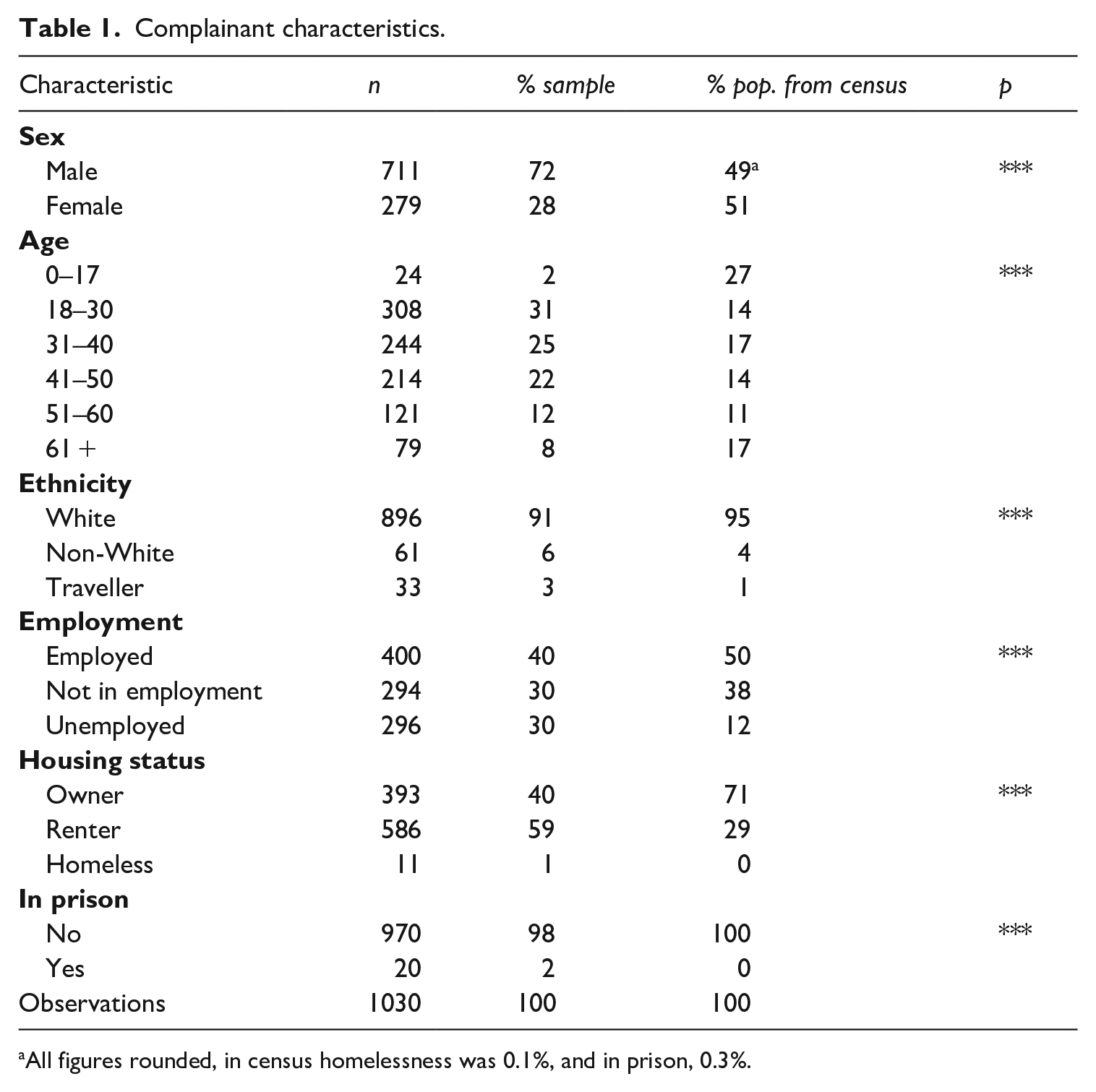
All figures rounded, in census homelessness was 0.1%, and in prison, 0.3%.
More importantly, compared to the Irish population, 3 greater proportions of complainants were male, aged 18–50, unemployed, living in rental accommodation or homeless, an Irish Traveller (3.3% vs 0.6%, Central Statistics Office (CSO), n.d.) and in prison (2% vs 0.3%, Irish Prison Service, n.d.). Chi-square goodness of fit/ binomial tests indicated that differences between the sample and wider population were statistically significant (final column, Table 1).
Case processing
Table 2 identifies the main attributes of case processing across the sample. Four allegation types were dominant, ‘Abuse of Authority’ being the most common. Most complaints were investigated by the Garda Síochána following initial receipt by GSOC, that is, they were leased back to the police. Most complaints were not substantiated. Importantly, these headline findings largely reflected patterns in the published GSOC caseload figures since 2007, meaning GSOC patterns of complainant and complaint processing attributes were reflected in the sample.
Caseload characteristics.
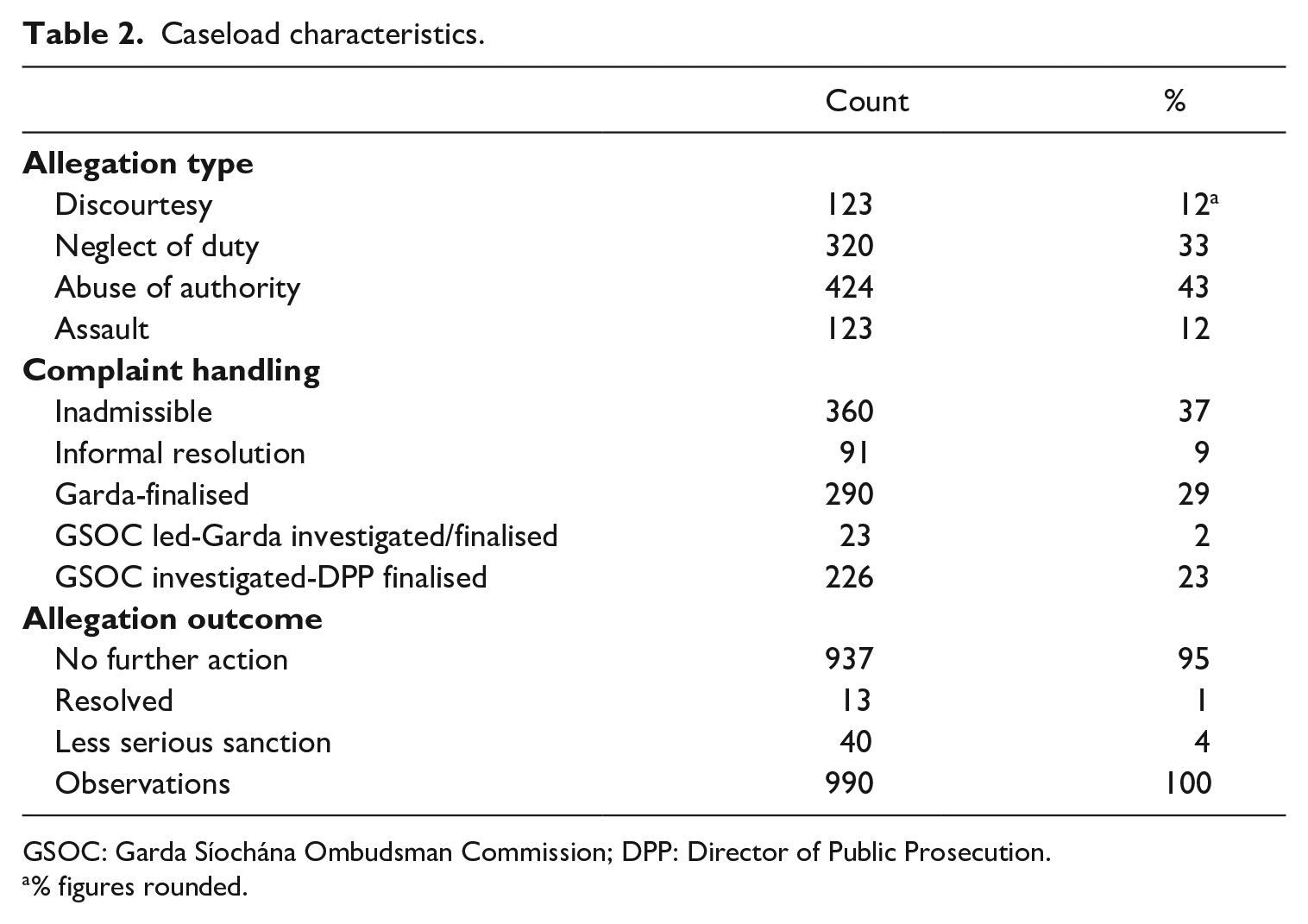
GSOC: Garda Síochána Ombudsman Commission; DPP: Director of Public Prosecution.
% figures rounded.
Next, the relationship between complainant attributes and their role in predicting complaints were examined. Tests of association (not shown) displayed weak but statistically significant relationships between allegation types submitted and four of the six complainant variables, but not ethnicity or imprisonment. Consequently, these were omitted when regressing allegation type on complainant attributes. Furthermore, cross-tabulations showed several null entries for discourtesy allegations submitted by homeless and Traveller complainants. As null entries cause issues for multinomial logistic regression models (De Irala et al., 1997), housing and ethnicity variables were temporarily re-coded; ‘renter’ and ‘homeless’ categories were collapsed into ‘Not home-owner’ and ‘Non-White’ and ‘Traveller’ categories were collapsed into ‘Non-White’. This rendered both variables dichotomous ones (Table 3, Model Note: discourtesy was set as the base allegation type). Among other aspects, the odds of submitting an assault allegation were higher among complainants who were not home-owners or working (2.2, 2.9 and 4.5 times, respectively).
Regression of allegation types on complainant predictors.
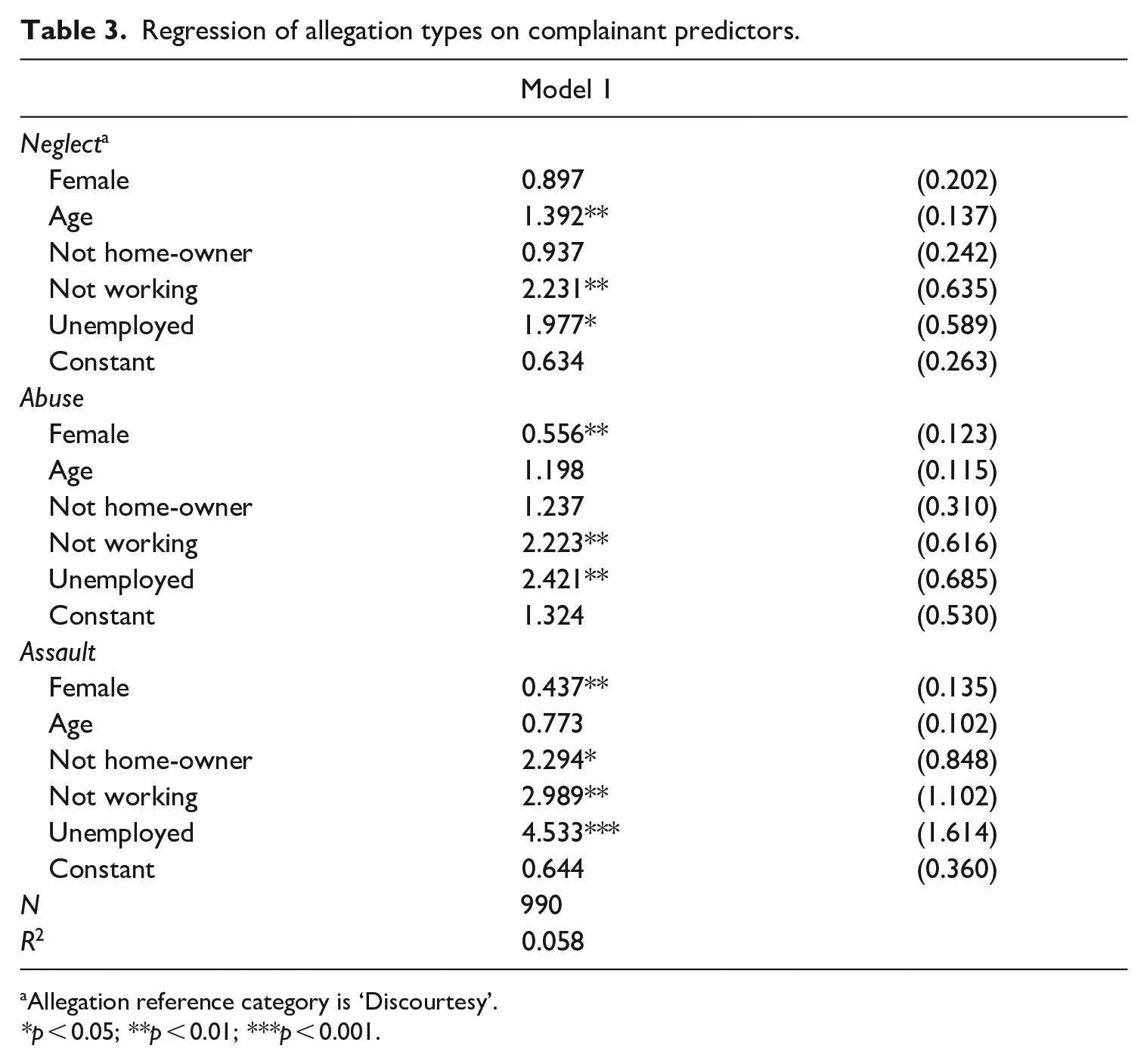
Allegation reference category is ‘Discourtesy’.
*p < 0.05; **p < 0.01; ***p < 0.001.
Complaint progress
Investigation phase was then regressed on complainant variables using ordinal regression (Table 4, Model 2). The initial model showed that those renting and unemployed were more likely to secure higher complaint-handling designations. This matched the result from Model 1, that is, were more likely to submit abuse and assault allegations, suggesting that these two allegation types were more serious in nature. Also notable was that non-Whites secured lower complaint-handling designations. As previous literature (Boivin and Lagacé, 2016) suggests that allegation type and complaint factor may be important determinants of complaint processing, they were added as variables in a further regression model (Table 4, Model 3).
Models predicting complaint handling.
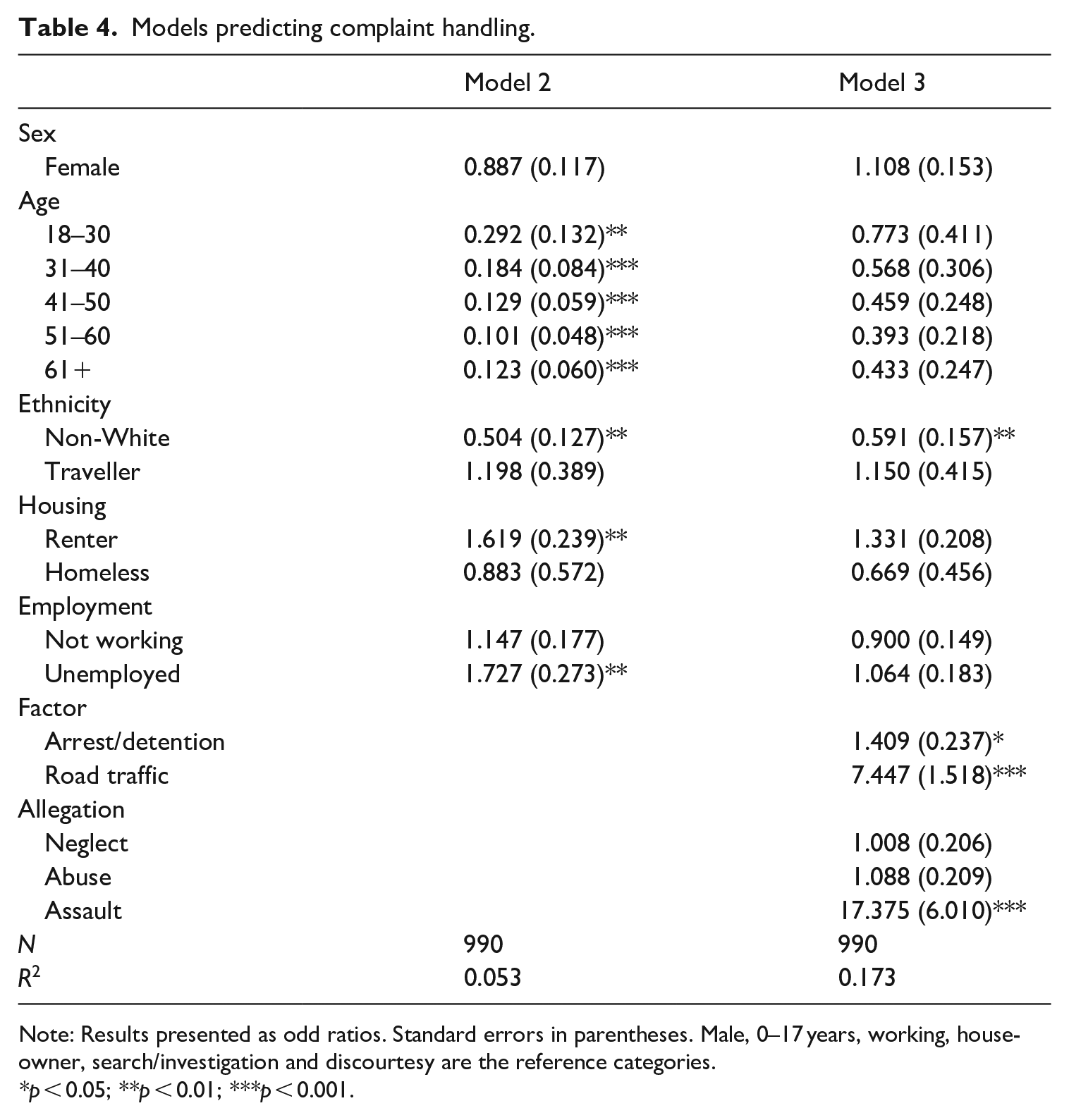
Note: Results presented as odd ratios. Standard errors in parentheses. Male, 0–17 years, working, house-owner, search/investigation and discourtesy are the reference categories.
*p < 0.05; **p < 0.01; ***p < 0.001.
Here non-Whites were less likely to gain a higher complaint-handling mechanism (0.598), while road traffic incidents and, particularly, assault allegations were more likely to secure higher ones (7 and 17 times, respectively), again suggesting assault to be the most serious allegation type.
Finally, the relationships and predictive power of complainant and complaint processing variables on complaint outcome were examined. The high proportion of ‘No further action’ in the ‘outcome’ variable (Table 2) gave rise to several null entries in cross-tabulations with the ‘complaint handling’ variable. Consequently, both variables were re-coded into fewer categories. 4 Similarly, the dichotomous version of the housing status variable (Model 1) was used given that all complaints by homeless individuals had resulted in ‘No further action’. The logistic regression results (Table 5, Model 4) highlighted that non home-owners experienced lower odds of complaint substantiation (0.485).
Models predicting outcome.
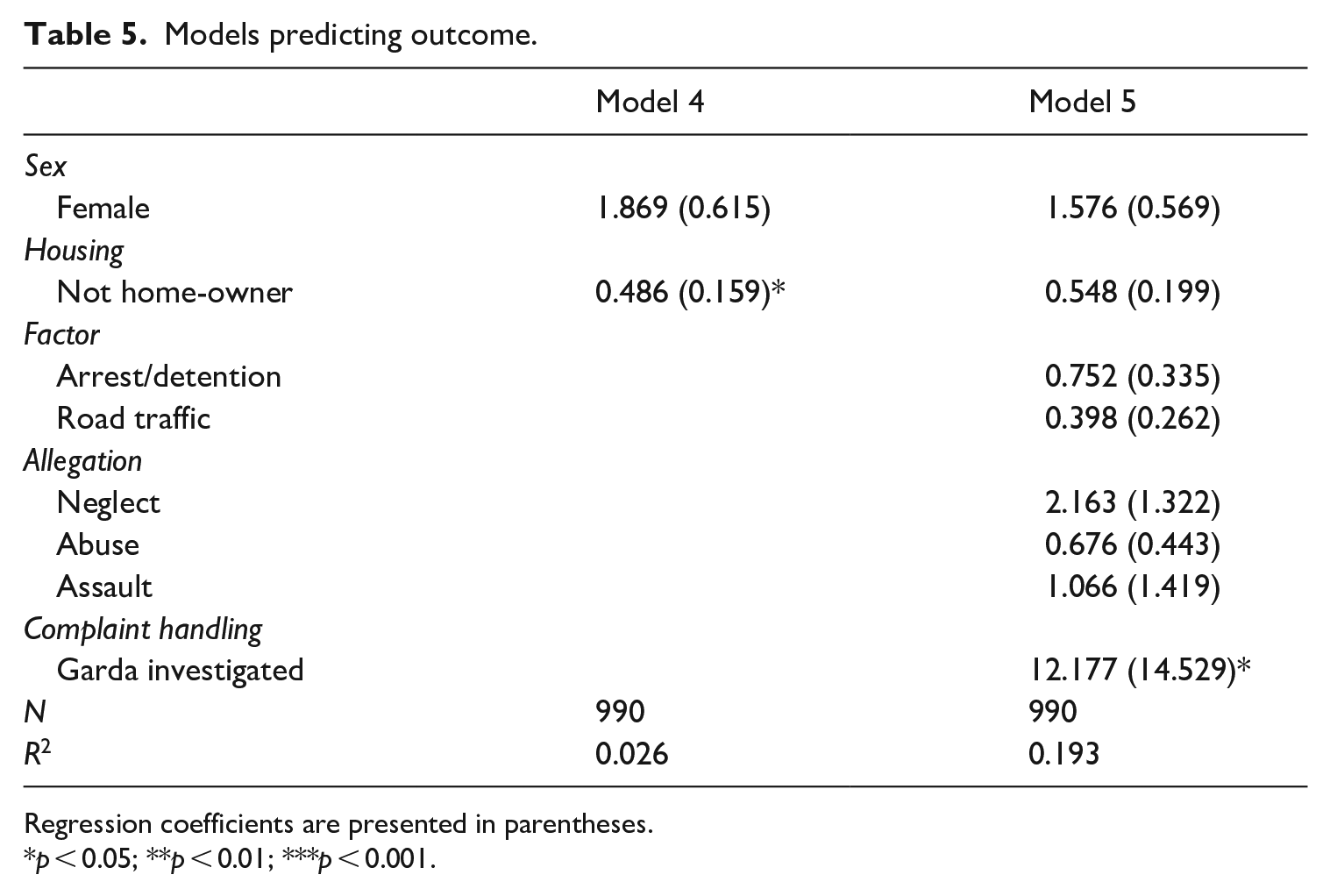
Regression coefficients are presented in parentheses.
p < 0.05; **p < 0.01; ***p < 0.001.
This result did not hold in the full model (Table 5, Model 5), where ‘Complaint handling’ was added alongside ‘factor’ and ‘allegation type’, as tests of association (not shown) suggested complaint substantiation differed markedly by complaint-handling phase. Here the only significant result was that Garda investigated complaints were much more likely to result in an outcome beyond ‘no further action’ (13 times). This higher odds ratio reflects how 1 of 225 (0.4%) complaints investigated by GSOC/the DPP resulted in a sanction, contrasted to 39 of 274 (10%) handled by Gardaí.
Overall, police complainants in Ireland were most commonly male, White and aged 18–50 with unemployed, homeless persons, prison inmates and Travellers disproportionately represented. Those in marginal housing and employment positions submitted the most serious allegation types and secured the highest complaint-handling mechanism. Inversely, non-Whites were less likely to secure a higher complaint mechanism. Finally, all complainants were more likely to have their complaint substantiated via a Garda-finalised investigation than by GSOC. The ‘Discussion’ section considers these results further.
Going beyond the caseload data
The results point up imbalances across the caseload that would be expected to have attracted some analysis or action by GSOC. In the absence of any such commentary in its publications, the article’s second research question arises – How do such patterns reflect on conduct of the Irish police oversight model? Starting with the ‘justice’ frame presented in the Literature Review, in terms of procedural justice, GSOC’s 10% non-completion rate on all complaints is double that recorded by the IOPC and four times that of PONI. So far, however, this has passed without any GSOC commentary. On the sensitive issue of ‘lease-back’ complaints, GSOC has continually altered its position. It initially supported leaseback, then became ambivalent towards it, and latterly opposed it (see GSOC, 2008, 2014, 2021) without any clear rationale and against wider evidence advocating complaint investigation independent of the police (Kwon and Wortley, 2022). In terms of interactional justice, in 2018 GSOC moved ‘service complaints’, constituting 10% of its caseload, to the police via a ‘new’ local intervention mechanism. It justified the move as reflecting complainant needs but offered no empirical evidence to support this claim. Also, in terms of interactional justice, GSOC’s most recent annual reports provided no outcome information on complainant requests for reviews of cases. This is despite reviews being a problematic aspect of complaint-handling in other jurisdictions (Faber and Kalbfeld, 2019; May et al., 2007), particularly when local resolution was used. This issue takes on greater significance when it is observed that one in three Irish complainants has rejected local intervention (GSOC, 2021). Separately, gathering and responding to complainant perceptions of the complaints process has been identified as necessary for effective oversight (Liederbach et al., 2007; Worden et al., 2018). Here again, GSOC has not produced any data. Furthermore, its submissions to the Commission on the Future of Policing (GSOC, 2018b), a mechanism intended to salvage police oversight in Ireland, lacked any evidence-based material (GSOC, 2018a, 2018b) and did not question the Commission’s lack of focus on complainant needs. Looking next at the frame of distributive justice, sanctions imposed on police officers by the Garda Commissioner following complaint processing have grown in volume and altered in nature recently. Again, GSOC has made no comment. A further measure of distributive justice, mentioned in both the ‘Literature Review’ and the ‘Results’ sections, is that GSOC’s substantiation rate is low in absolute terms, contrary to expectations of external oversight (Filstad and Gottschalk, 2011). Finally, in terms of distributive justice, it was noted earlier that concerns with police corruption have been a recurring issue. Where GSOC claimed in May 2009 that there was no evidence of corruption and only partly reversed this position a decade later with a claim that corruption could possibly emerge (GSOC, 2019), the Garda Síochána Inspectorate (2022) offered a more critical assessment, citing past scandals and systemic failures.
Turning to the frame of ‘agency’ raised in the Literature Review, in terms of agency capture, a high-ranking GSOC manager did claim political interference with the body’s independence (O’Keeffe, 2014). However, unlike in Northern Ireland (Criminal Justice Inspection Northern Ireland (CJINI), 2011), these claims were not formally examined. On the other hand, there have been several widely reported disagreements between GSOC and the police agency since 2007, some resulting in high-profile stalemate investigations. Overall, this suggests an uneven picture as to whether GSOC has experienced agency capture. As to the frame of agency self-learning, even after 9 years of organisational learning, the first inquiry into use of its powers rebuked GSOC, particularly for its investigations (Clarke, 2016). Finally, in terms of enabling complainant voice, facilitating community needs has been identified as generally necessary for effective oversight system maintenance and reform over time (Buffone et al., 2017). Yet, there is no evidence of GSOC appraising such needs since 2007.
Given the above, a third version of ‘agency’ is advanced for future consideration by police scholars. It is that of agency borne of self-interest, where the principal actor pursues goals through information asymmetry and opportunistic behaviours (Wiseman et al., 2011) with their own gain in mind. In practice, discrepancies between oversight agency behaviours and complainants’ expectations have already been documented (den Hayer and Beckley, 2013; Savage, 2013b). In Ireland, there is arguably evidence of GSOC self-interest agency across its operational history. Its last publicised attempt at stakeholder engagement (2008), for instance, contained no form of complainant input, thereby limiting possible critique. Later, limited parliamentary oversight of GSOC’s 2016 proposal to expand local intervention enabled it to drop one-tenth of its caseload without any clear legal basis, without demonstrating any evaluation of the local intervention procedure over the previous decade, and without showing any improvements for complainants/police. GSOC therefore reduced its workload in the expectation of producing better outcomes at a time when criticisms of it were emerging from the Disclosures Tribunal and Commission on the Future of Policing. Equally, despite spending public monies on training and attending international conferences on data protection, GSOC did not reveal its 29 breaches of data protection legislation in the prior 2 years (Foxe, 2021). Overall, these examples point to efforts by GSOC to consolidate its workload, problematise evaluation of it, minimise critique and preserve its standing.
Discussion
The caseload analysis noted findings similar to existing police oversight studies. These included: the basic profile of complainants (male, aged 18–50 and White) and over-representation of resource-deficient persons (Lersch, 1998); that race was not a significant factor in assault allegations submitted (e.g. Boivin and Lagacé, 2016); that force allegations were largely not substantiated; and the overriding role of complaint processing, not complainant attributes, across the complaint process. This article also offered three findings of original value. It highlighted the disproportionate presence of homeless persons, prison inmates and Travellers among police complainants, underscoring their subjectivity in everyday policing (Kyprianides et al., 2021). Second, non-Whites secured a lower complaint-handling mechanism in Ireland. Possible explanations include exaggerated complaints or a misunderstanding of the police role and culture among new Irish persons, as put by one GSOC Commissioner (Foley, 2008). Both appear implausible, given that GSOC itself decides the allegation type labels. Instead, practices within GSOC itself should be examined (see similar conclusions on the IOPC in House of Commons , 2022). Third, being homeless, not a complainant’s race (e.g. Faber and Kalbfeld, 2019), reduced the likelihood of complaint substantiation in Ireland. Complaint withdrawal by homeless persons in the sample could not account for this occurrence (n = 2 of 75 complaints). Rather, generally low credibility of homeless persons in the eyes of state services (Batty et al., 2015; Charman, 2020) of which GSOC is one, offers greater explanatory scope.
Questions about complaint processing in Ireland raise six implications about the conduct and characterisation of its police oversight and that in any jurisdiction. First, Faber and Kalbfeld (2019) note dissuasion effects and implicit biases within police oversight. The prospect of dissuasion and bias occurring during complaint-handling merit future examination of unpublished and informal policies, staff attitudes, biases 5 and culture (Savage, 2013a) within police oversight bodies. Second, as Garda-finalised investigations deliver a substantiation rate closer to international norms, the assumed benefits of police oversight independent of policing need to be re-considered. In the Irish case, GSOC’s cumulative expenditure of €145 million to the end of 2021 against its output, the many government-ordered parallel examinations into police misconduct, just one measure of failed oversight (Walker, 2016), and overall costs from civil actions against the police should be considered. Third, given the 0% substantiation rate on complaints processed by GSOC/the DPP, prosecutor reticence to act against criminal police behaviour (Clarke, 2009) should be scrutinised. Fourth, prisoners arguably constitute the spatially confined, homeless persons the spatially exposed and Irish Travellers the spatially dispossessed, and over-policed (Joyce et al., 2022). The presence of marginal, indigenous or migrant persons in any police oversight body’s caseload therefore merits greater research of their experience with police oversight. Fifth, police oversight bodies should consider developing allegation seriousness indices. These could be similar to crime harm indices already in operation (Sherman, 2020b) and could assist evaluations of the appropriateness of sanctions applied in police oversight. Sixth, future studies should consider the possibility of self-interest agency being better able to explain the conduct of police oversight than ‘justice’ or ‘agency’ can do alone. What separates the Irish model from others is its characterisation as reluctant, centrally controlled and operating at odds with best international practice (Conway and Walsh, 2011; Manning, 2012; Moss, 2019).
Limitations
Notwithstanding the above conclusions, the current study was limited in three ways. One arose from the data relied upon. This included the complainant response rate to the survey (32%), use of largely untested demographic predictors and the small sample size relative to other studies (e.g. Terrill and Ingram, 2016). Second, further research could benefit from determining the extent of GSOC caseload data gaps and the effect of local intervention on complaint outcome dynamics for different groups. Third, qualitative research designs have been less common in studies of police oversight (see Stelkia, 2020). Combining qualitative (complainant and police) with complaint processing data could further assist determine which theoretical frame best explains civilian police oversight.
Conclusion
Police oversight performance remains important as policing has been shown to have higher costs for some groups more than others. In the current study, those with less resources were over-represented in and experienced disadvantages across the Irish police oversight process. Yet, such vulnerabilities have still to be examined or commented upon by relevant stakeholders. It suggests that for all the legislation, reforms and financial costs incurred since 2005, the Irish oversight model requires additional change. Greater balancing of complainant and complained about interests, re-consideration of local intervention and leaseback, and use of its caseload data by GSOC, and scrutiny of GSOC and DPP performance by government and parliament present as starting points. Yet, legislative proposals in April 2021 look set to ensure GSOC’s continued existence, expansion and greater discretionary role, while the other police oversight bodies are to be amalgamated. This was done without any review of GSOC being compiled, suggesting more of the same problems ahead.
To avoid a similar future trajectory in other jurisdictions, future research needs to consider whether justice or agency and the original idea advanced here of agency self-interest, might better explain the conduct of civilian oversight in any jurisdiction. This would comprise future research gathering and weighing the formal role, available and expended resources of such bodies against their performance over time, measured by caseload, customer and police agency data.
Footnotes
Declaration of Conflicting Interests
The author(s) declared no potential conflicts of interest with respect to the research, authorship and/or publication of this article.
Funding
The author(s) received no financial support for the research, authorship and/or publication of this article.
