




Abstract
As digital platforms that expand opportunities to create, distribute, and access content online, social media are transforming the policing landscape. While scholars have considered social media’s contradictory effects on police services’ public image and operational capacity, less is known about how patterns of technological use are reported within the mainstream press. Employing a mixed-methods content analysis, this article assesses how Canadian newspapers framed the policing-social media relationship over a 15-year period, and how such representations can affect public opinion and policy. It finds, despite minor fluctuations over time and across outlets, news organizations prioritized police perspectives and offered overwhelmingly favourable assessments with social media being constructed as a valuable tool of crime prevention and control. The broader implications of these findings for perceptions of law enforcement and relations between the news media and institutional power are provided.
Keywords
Introduction
With information’s production and control representing a ‘decisive source of power’ (Castells, 2013: 16), the importance of social media – accessible and interactive platforms that facilitate the creation and sharing of content online – is difficult to overstate. Presently, social media’s pervasive, participatory, and networked character are transforming systems of knowledge and control, outcomes distinctly visible in the context of security governance, the modern state’s raison d’etre. With social media’s ascendance as an organizational resource and space of public communication, a growing body of research has assessed its contradictory effects for law enforcement agencies (Walsh and O’Connor, 2019). While they empower police, reducing the transaction costs of surveillance (Trottier, 2012) and offering new opportunities to strengthen and mobilize community support (Williams et al., 2018), digital platforms also unsettle law enforcement’s legitimacy and have been utilized to document, expose, and contest official misconduct (Goldsmith, 2010).
While scholars have analysed online content, as well as, the nature and consequences of social media use, whether by state agencies, offenders, or concerned citizens, no studies have interrogated how such issues are reported by journalists. Were press coverage of little significance, this neglect would be inconsequential. However, by raising awareness, activating concern, and influencing public discourse and political decision-making, the news media shape the circumstances they depict and remain a leading arena in which images of policing and social order are promulgated and contested (Marsh and Melville, 2019; Reiner, 2012 [2008]).
This study offers general insight into how newspapers have depicted the policing-social media relationship. Employing content-analytic methods, it analyses an original dataset from 2005 to 2020, a period encompassing digital platforms’ emergence and widespread adoption, and engages the following research questions: how did the news media frame the policing-social media relationship, which aspects were accentuated, whose interests and perspectives were centred, and what are the potential consequences of reporting for public sense-making, opinion and policy? It does so by focusing on Canada, a country where social media is used extensively by policing agencies and ordinary citizens (Schneider, 2016; Walsh, 2021). While research on media depictions of crime and its control is often based on analysis of a single newspaper, restricted timeframe, or high-profile event, this article adopts a synoptic view and considers nationwide press coverage over an extensive interval. Such breadth allows for greater rigour as it helps identify key trends in reporting’s frequency, substance, and tenor, and offers clues about the extent of police influence on news-making. Ultimately, by retracing the general trajectory of coverage, this study fills an important gap in the literature and illuminates policing’s construction amid patterns of significant social and technological change. More broadly, assessing the range of voices, viewpoints, and values embedded within news reports deepens understanding of contemporary relations between the press and institutional power, an issue of considerable import within criminology and beyond.
This article is organized as follows. After reviewing existing work on policing and emergent media environments, this study’s design and approach to data collection and analysis are considered. Findings concerning the volume and prominence of coverage, as well as, the thematic structure, tonality, and perspective of news reports are then presented. The article concludes by discussing its broader implications and limitations and offering suggestions for future research.
Law enforcement and new media: A contradictory relationship
A perennial feature of the policing landscape, the effects of technological innovation are distinctly salient within the contemporary information era (Kelling and Moore, 2005). More than crime fighters, the deployment of computing infrastructures concerning, inter alia, biometric registries, mobile data terminals and geographic information systems ensure officers increasingly represent knowledge workers tasked with processing, analysing and distributing information about public order (Ericson and Haggerty, 1997; Hummer and Byrne, 2017; Manning, 2008).
Social media constitute the most recent addition to policing agencies’ technological toolkit, with digital communications supplementing official techniques of surveillance, communication, and impression management. On one hand, social media’s ubiquity and penetration render previously private thoughts, communications, and events visible and trackable online, allowing police to quickly amass crime-related intelligence. Police have also leveraged social media’s pseudonymous, connective and algorithmic structure to promote regimes of monitoring that are surreptitious (they are covert and undetectable; Ferguson, 2017; Trottier, 2012), crowdsourced (they enlist multitudes of digitally connected citizens; Lally, 2017; Nhan et al., 2017), and automated (they passively mine and profile vast tranches of data to predict events; Eubanks, 2018; Mateescu et al., 2015). In permitting police to bypass mass-media filters and instantaneously connect with citizens, social media are also transforming organizational communication. Whether concerning routine law-breaking or exceptional events (e.g. riots, natural disasters), police have utilized social platforms to broadcast real-time alerts, manage public fear and quell rumours (Fowler, 2017; Lieberman et al., 2013). Reflecting responsibilization strategies or forms of indirect control where legal order is co-produced through the enrolment of private actors (Garland, 1996), police have appropriated digital communications to educate citizens about crime prevention, promote lawful behaviour, and request information about, among others, wanted offenders, missing persons, and general law-breaking (Crump, 2011; Lee and McGovern, 2013; Procter et al., 2013). Finally, demonstrating the increasingly dramaturgical character of policing social media are utilized for public relations and ‘image work’ (Mawby, 2002). Whether by responding to comments, engaging citizens online or posting content featuring humorous ‘memes’ and idealized conduct (e.g. successful enforcement, community involvement), police have employed various platforms to present themselves as expert crime fighters, humanize officers and gain public trust (Hu and Lovrich, 2019; Schneider, 2016; Wood, 2020; Wood and McGovern, 2021). Despite claims social media promote greater openness, transparency and involvement in public decision-making (Loader and Mercea, 2011), empirical studies suggest their transformative potential remains unfulfilled as digital communications are overwhelmingly appropriated for broadcasting content, controlling information and self-promotion (Bullock, 2018; Kudla and Parnaby, 2018). Accordingly, content released on social media typically constitutes bureaucratic propaganda invested in fostering positive perceptions and institutional legitimacy (Schneider, 2021).
While bolstering police efforts to govern crime and build support, social media also present considerable risks. Accompanying scandals stemming from officers’ online behaviour (Goldsmith, 2015), the ubiquity of camera-equipped smartphones permits publics to monitor law enforcement, expose misconduct and shape public discourse about policing (Bock, 2016; Brucato, 2015; Simonson, 2016; Walsh, 2019). Alongside circulating amateur videos and other footage involving police deviance, activists and concerned citizens have appropriated social platforms as ‘networked counterpublics’ (Jackson and Foucault Welles, 2016) with users circulating content and hashtags (e.g. #BlackLivesMatter) to critique official narratives, raise consciousness and mobilize around perceived injustice (Ray et al., 2017). Together, such developments contribute to policing’s ‘new visibility’ (Goldsmith, 2010), ensuring its image and legitimacy are increasingly dynamic, contested and unstable (Sandhu and Haggerty, 2017). Accordingly, social media have attenuated law enforcement’s capacity to ‘patrol the facts’ (Ericson, 1989) and control public knowledge about crime and its control, outcomes that ensure police are increasingly required to appraise, manage and reassert their legitimacy in visible digital spaces (Ralph, 2021).
Despite burgeoning interest, scholarship on the policing-social media relationship displays important omissions. Like other emergent technologies, digital platforms have attracted extensive media coverage, with news organizations featuring an array of stories regarding their functions and effects. While scholars have analysed coverage of other policing technologies including body-worn cameras (Naoroz and Cleary, 2021, Schneider, 2018), CCTV surveillance (Greenberg and Hier, 2009; McCahill, 2012), forensic science (Livingston, 2017), and Tasers (White and Ready, 2009), none have considered the content and framing of news reports about social media. Given social media use, whether by police services or lay actors, is only likely to expand, it is crucial to consider how news organizations portray the issue.
Beyond interrogating an understudied phenomenon, assessing news reports is significant as, by providing an essential context for public awareness, judgement and evaluation, media coverage affects the very issues it claims to represent (Lawrence, 2000; Walsh, 2020b). For police, with the mediatization of politics and social relations, policing is more a ‘matter of symbolism’ than ‘substance’, with citizens’ knowledge and preferences being determined, less by policing’s day-to-day realities, than news reports (Doyle, 2003; Reiner, 2012 [2008]: 314). Furthermore, given the media’s agenda-setting role (Iyengar, 1994), reporting patterns structure the salience of issues and affect popular attitudes as they have been shown to shape police procedure by mobilizing support for certain interventions over others (Hirschfield and Simon, 2010). Regarding social media use, bias towards certain representations may affect public perceptions of its impact and potential. For instance, depending on the nature of coverage, stories about official surveillance may promote public consent for greater police power and resources or activate concerns about civil liberties, while reporting on digital footage of misconduct may generate scepticism about its accuracy or increase demands for robust mechanisms of reform, oversight and accountability. In the final instance, given policing’s vital role in the administration of order and normality, assessing its mediated image not only exposes contemporary representations of law enforcement, but broadens awareness of the construction, maintenance and underlying dynamics of social reality (Barak, 1994; Sparks, 2001).
Considering coverage of policing’s transformation assumes added significance as established relations between the police, media and public are being upended. As informational gatekeepers, journalists represent ‘key mediators in ongoing struggles of various social groups to designate problems and shape how we define those problems’ (Lawrence, 2000: xi). Reflecting journalists’ tendency to privilege the perspectives of powerful actors and institutions (Schudson, 2002), commercial considerations and the routines of news-making, whether deadlines, reliance on official information, or professional norms, have ensured news reports predominately feature favourable coverage and police perspectives, dynamics that endow law enforcement agencies with considerable control over their public representation (Schlesinger and Tumber, 1994; Welch et al., 1998). Recent cultural, technological and economic changes have, however, transformed the journalistic field, igniting debates about the durability of this relationship. On one hand, scholars have argued that, together, declining trust in institutional authority, the growing availability of bystander videos, heightened competition for readership, and reduced newsroom budgets, have tipped the balance of definitional power and unleashed a sensationalist ‘press politics of outrage’ where police find themselves subject to increasingly critical assessments and are less capable of controlling traditional media coverage (Greer and McLaughlin, 2012, cf. Mason, 2012; Mawby, 2010; Reiner, 2012 [2008]). Conversely, it is believed the combination of organizational constraints, whether heightened demand for immediacy in reporting or less funding for investigative journalism, and growing investment in police corporate communications have rendered journalists more reliant on official sources, reinforcing the dominance of pro-police content and affording an increasingly publicity-conscious police further opportunities to shape media narratives (Colbran, 2018; Ellis and McGovern, 2016; Mawby, 2010). Accordingly, scrutinizing news reports not only exposes representations of policing’s evolution – an important task in itself – but builds on and contributes to research concerning the contemporary police-media relationship and the identification and construction of public issues, problems and events, topics with considerable purchase throughout the social sciences.
Research method
Data collection
To ensure a representative dataset, the ProQuest database Canadian Newsstream, an online archive featuring 350 Canadian news sources, was used to retrieve relevant stories published between 1 July 2005 and 30 June 2020. Headlines containing keywords associated with policing or the names and abbreviations of National and Provincial police services in Canada, as well as, keywords concerning social media were analysed. Accordingly, the following search string was employed: police < OR > law enforcement < OR > RCMP < OR > OPP < OR > Sûreté du Québec < OR > Royal Newfoundland Constabulary < AND > social media < OR > social network < OR > digital platform < OR > social platform < OR > MySpace < OR > Facebook < OR > YouTube < OR > Instagram < OR > Twitter < OR > tweet. 1 Duplicate entries and stories unrelated to social media use in the context of public policing were excluded, leaving a sample of 1164 ‘pure’ headlines published by 115 distinct outlets. 2
While legacy media’s dominance has been eroded, newspapers were selected for analysis as, alongside being distinctly accessible and well-archived, they remain important sites of public discourse that continue to shape understandings of policing. In addition to being perceived as distinctly credible vis-à-vis other information sources, their significance extends beyond their own readership as newspaper reports often stimulate and anchor discussion within visual and online media (Ellis and McGovern, 2016; Greer and McLaughlin, 2012). Headlines were analysed as, by condensing issues and events into succinct, meaningful statements, they are distinctly influential and more likely to be engaged with than full-text articles (Richardson, 2006).
Coding scheme
To systematically identify and quantify reporting’s salient features, this study employed a mixed-methods content analysis. Accordingly, its primary variables were the thematic content, tonality, contextualization, and perspective of news reports, as well as, article placement and outlet type. Methodologically, content analysis allows scholars to map media discourse and delimit key patterns and trends within large bodies of text. Accordingly, it exposes the meaning of media output while also producing general descriptive data (Krippendorff, 2018).
Thematic content and tonality
Qualitative analysis was conducted to identify the frames featured in headlines and infer how readers might make sense of social media use and interpret the socio-political issues brought within its orbit. As organizing ideas or interpretive schemata that – like a window frame – structure one’s perspective, media frames foreground certain themes and viewpoints, while obscuring others (Entman, 1993). Informed by existing studies of policing and social media (Lieberman et al., 2013; Walsh, 2020b) open coding was performed to identify all possible themes in the data. Axial coding was then conducted to aggregate initial themes into broader conceptual categories and convey general trends – a process involving several iterations. As elaborated in the “Results” section, this process yielded the following four main topical categories – intelligence, communication, countersurveillance, and general adoption – based on the distinct relations between police and digital platforms they referenced. While headlines can potentially contain multiple frames, for clarity’s sake, they were categorized based on their dominant or primary frame.
Beyond defining situations, media frames invite judgement, elicit emotions, and contain expressions of sentiment (Jasper, 2011). To assess whether headlines imputed positive or negative characteristics to social media use as it pertains to policing, they were coded for their emotional valence or tonality. Decisions were based on whether social media was presented as having harmful or beneficial effects. If headlines included language associating social media use with benefits including public safety, institutional accountability, greater responsiveness and improved community relations, they were coded positive. When social media was depicted as threatening or harmful, whether regarding, among others, criminal activity, discrimination, inequity, or diminished trust and support, headlines were coded negative. To assess the extent particular actors’ interests were prioritized, groups depicted as benefitting or being adversely affected by social media were recorded, generating a final list of 10 actors: police, society at large, youth, victims, ethnoracial minorities, women, suspected offenders, activists, political officials, and ‘other’ parties. 3 Rather than speculating about implied meanings, coding focused on explicitly positive or negative rhetoric. Thus, headlines containing neutral or ambiguous language were recorded as lacking tonality and designated ‘other’. To facilitate quantitative analysis and reveal central tendencies within the sample data, headlines featuring positive and negative tonality were assigned scores of +1 and –1. 4 Here, the ratio of negative to total headlines was deducted from the ratio of positive to total headlines, generating a mean sentiment score ranging from –1 (social media was framed as exclusively harmful) to +1 (social media was exclusively beneficial).
Contextualization and perspective
To further document reporting’s orientation, as well as, relations between the media and authoritative institutions, news stories’ contextualization and perspective were recorded. In the first instance, the framing of social issues, whether they are individualized or connected to institutional factors and societal conditions, shapes how audiences understand their nature, causes and effects. Accordingly, headlines were coded as episodic when they depicted events as discrete incidents and contextual when they were situated in the surrounding socio-political environment and portrayed as part of a broader trend (Iyengar, 1994). Headlines connecting social media to the investigation of a single crime, for example, would be coded episodic, while those discussing the general contours, harms or benefits of social media surveillance would be classified as contextual. In addition, by featuring the voices and perspectives of certain actors, journalists endow authority and legitimacy on particular interpretations of reality. To identify the extent police viewpoints and interests were predominant, the leading sources featured in news reports were analysed. Actors were coded as leading sources if a headline contained direct quotes from them or adopted their subject position. For example, the following headlines were coded as featuring police perspectives: ‘YouTube helped murder probe: police’; ‘As citizen-recorded videos of interactions go viral, police warn of “Trial by YouTube”’.
Placement
Accompanying the raw volume of coverage, news stories’ prominence was considered. Patterns of placement – whether headlines were part of a leading, front-page story – were recorded and employed as a measure of newsworthiness. Considering article prominence is important as front-page placement conveys a story’s perceived significance by editorial staff and influences readership (Lin and Phillips, 2014). Information regarding story placement was downloaded directly from Canadian Newsstream.
Outlet type
The 115 newspapers featured in the sample data were also categorized to contextualize this study’s results and capture potential variations in coverage, whether concerning readership or reporting style. Here, headlines were coded broadsheet, tabloid or local with the former categories referencing larger outlets associated with either reputable publications or populist outlets embracing sensationalist reporting and the latter associated with smaller community papers featuring geographically circumscribed reporting and considerable human-interest stories and ‘fluff’ (Abernathy, 2018). Codes were determined by consulting information from News Media Canada (nmc-mic.ca), the national association of the Canadian news industry. Of the sample newspapers, six were designated tabloid, 23 were designated broadsheet, and 86 were classified as local. 5 While space constraints preclude a comprehensive analysis, data concerning outlet type was employed to identify differences in headlines’ reach and visibility, as well as, internal variations in news stories’ framing and tonality.
Coding protocol
Coding was conducted by three principal coders who carefully scrutinized headlines’ text and, when featured, their abstracts. To ensure consistency, headlines were analysed by at least two coders. In the case of inconsistent codes, they were reviewed in a team meeting until consensus was reached. To assess the coding scheme’s accuracy, 116 randomly selected headlines – approximately one-tenth of the sample – were analysed. This process which required each coder to make a total of 464 decisions regarding the study’s qualitative variables (frame, tonality, contextualization, perspective) produced an intercoder agreement score of 90%.
Results
The volume, prominence, and contextualization of reporting
This study aimed to assess how the policing-social media relationship was depicted in Canadian newspapers. During the 15 years considered, 1164 stories were published, representing 6.5 stories per month. Figure 1 indicates coverage varied considerably, ranging from 0 (2005) to 12.3 (2012) monthly stories. In addition, reporting rates have stabilized with digital platforms’ widespread adoption as their standard deviation fell from 4.0 to 1.4 between 2005–2012 and 2013–2020.
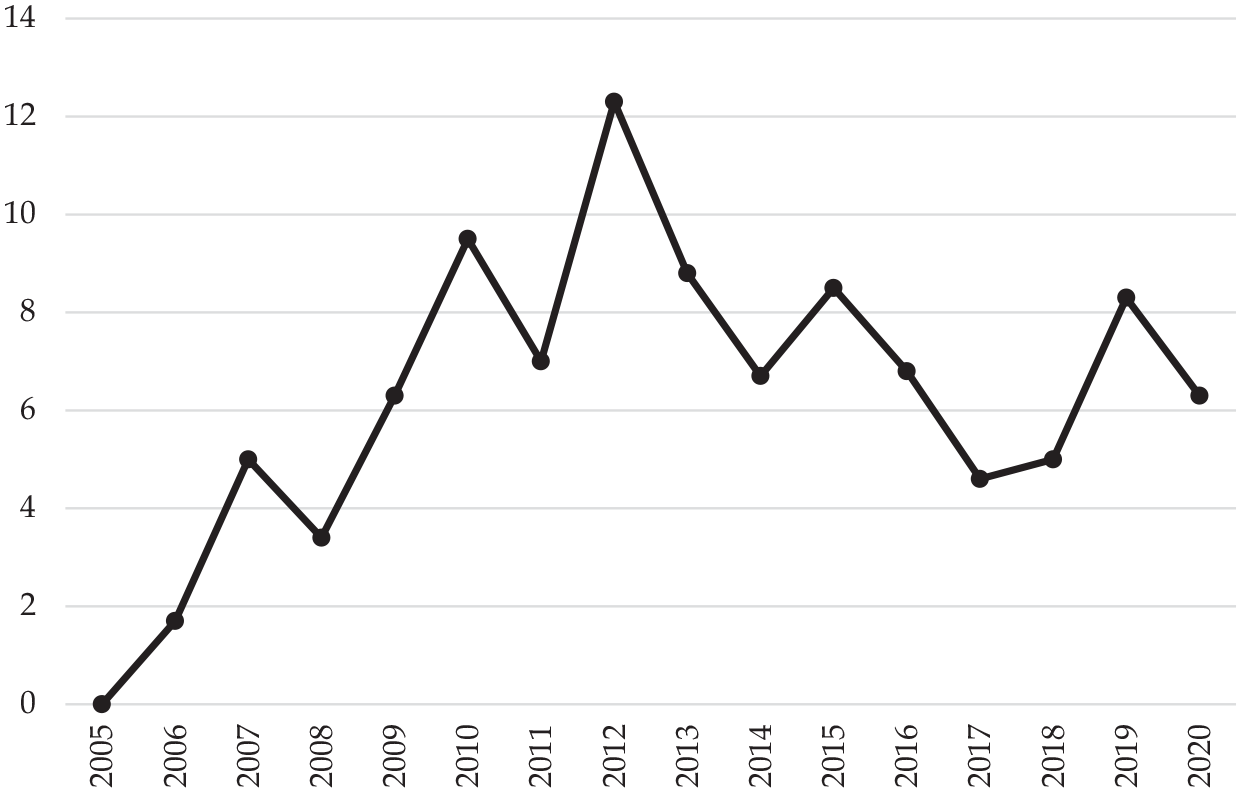
Annual rate of reporting (stories per month).
Concerning story placement, 14.3% of headlines were featured on the front-page (n = 166). Like general reporting patterns, the volume of leading stories conformed to an ‘issue attention cycle’ with media interest growing precipitously before gradually waning (Downs, 1972). Despite recent controversies involving digital footage and social media use in Canada and abroad, after reaching a peak in 2013 and 2014, with 26.4% (n = 28) and 27.5% (n = 22) of stories featured on the front-page, this proportion declined to 8.0% (n = 8) and 7.9% (n = 3) in 2019 and 2020 (Figure 2).
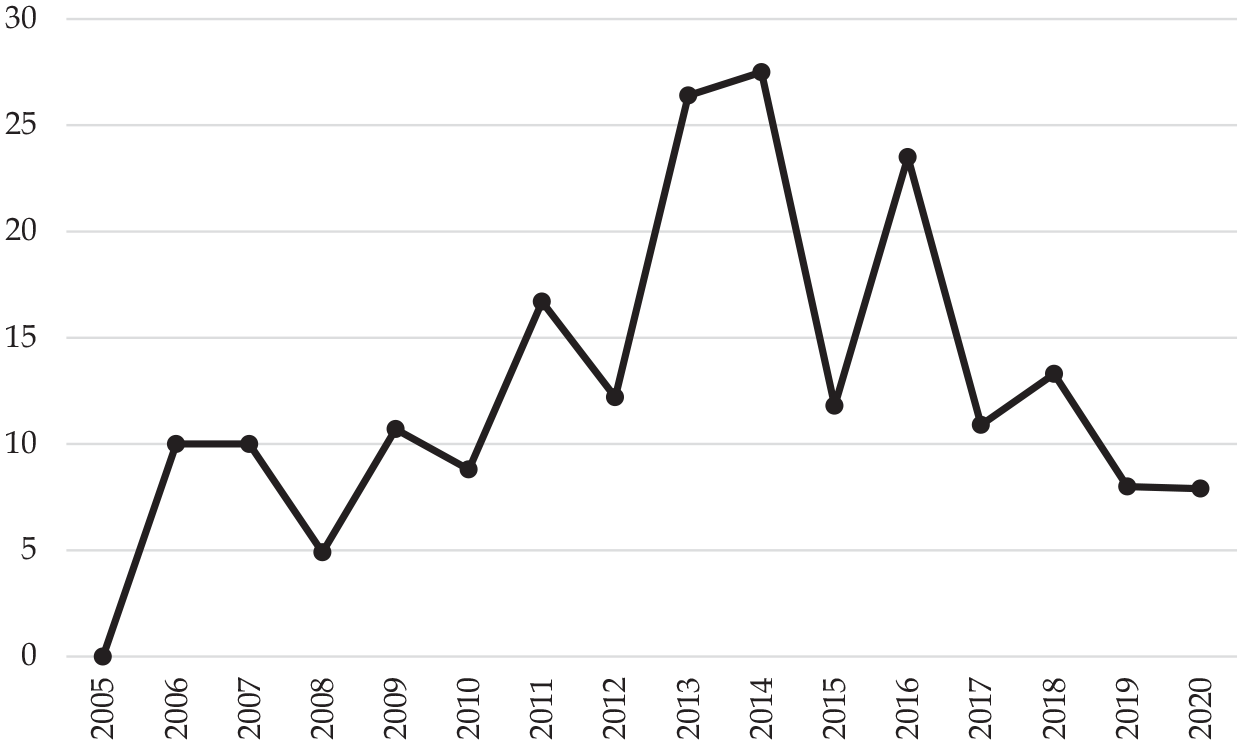
Annual percentage of news stories featured on the front-page.
News reports typically depicted events as isolated occurrences rather than connecting them to historical and structural processes or nuanced discussions and debates. Headlines were overwhelmingly coded episodic (94.5%, n = 1100) and peaks in reporting were largely tethered to coverage of local dynamics and high-profile, shocking, or unusual incidents, including investigations of a serial killer (2012), armed standoffs (2012), brawls at sporting events (2013), missing persons (2014), and scandals stemming from social media posts by police (2014), rather than considering the nature and consequences of national and global trends.
The thematic structure of news frames
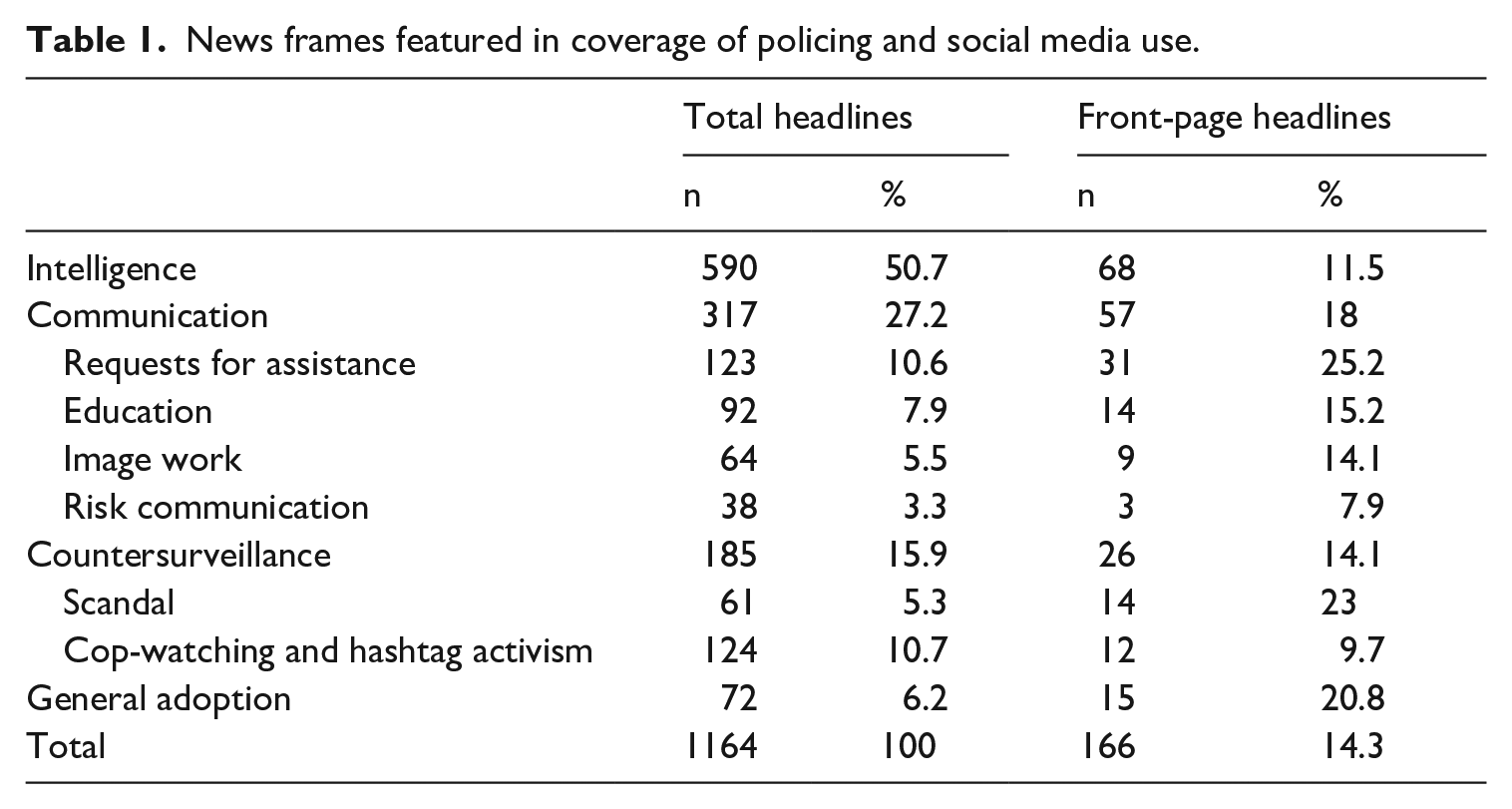
The following assesses the thematic contours of news making and presents the news frames identified within sample headlines (Table 1). Accompanying general trends in coverage, concrete and exemplary instances are presented to convey diversity and promote detailed data-reporting.
News frames featured in coverage of policing and social media use.
Intelligence
Reflecting media’s historic emphasis on how crimes are discovered and addressed by criminal justice agencies (Marsh and Melville, 2019), the leading thematic category, which contained a single frame of the same name, was intelligence (50.7%, n = 590). Headlines coded intelligence highlighted social media’s significance as an official instrument of surveillance and source of digital evidence. On one hand, coverage discussed law enforcement’s active role in monitoring digital platforms, as well as, social media’s value as ‘open-source intelligence’ (Trottier, 2012) for exposing and solving crimes, reconstructing events, and establishing the identities, whereabouts, and behaviours of victims, witnesses, and offenders (e.g. ‘Social media a valuable tool in missing persons cases: Police’, ‘Police sift Facebook for clues to teen’s slaying; Social networks act as grapevine’). Others described social media’s role in facilitating undercover work (e.g. ‘Police track gangs on social media; They’re “friending” members, whose frequent updates can be their undoing’) and featured instances where perpetrators had inexplicably posted footage of or confessions to criminal acts online (‘YouTube confession helps police find bodies’, ‘Police arrest three in assault streamed live on social media’). While less frequent, stories also discussed social media’s significance in relation to ‘big data’ and predictive analytics and referenced instances where police scrutinized digital communications and related metadata to identify trends, expose correlations and predict future threats (e.g. ‘Online profiling aims to spot would-be psychos; Law enforcement technique tracks possible suspects based on their social media posts’, ‘Big Brother or e-Detective?; New tool allows law enforcement to decrypt hidden information and anticipate threats. Even YouTube is under the microscope!’). Headlines overwhelmingly featured positive tonality and positioned social media as an efficient and cost-effective tool for acquiring crime-related information and promoting public safety (n = 470). In a few instances (n = 38), news reports referenced potential harms including racial profiling, wrongful arrests, and violations of civil liberties including privacy and freedom of speech, assembly, and association (e.g. ‘Iranian police cracking down on social media dissent’, ‘RCMP tracked protest groups online: Mounties created bogus Facebook, Twitter profiles’). Despite the frame’s prominence, headlines coded intelligence was underrepresented among front-page stories (11.5%).
Communication
The second theme was communication (27.2%, n = 317). This theme, which contained four news frames, highlighted law enforcement’s appropriation of digital platforms to circulate content and connect with citizens.
The leading frame, which referenced techniques of responsibilization and attempts to mobilize the public as a policing resource (Walsh, 2020a), was requests for assistance (n = 123). In certain instances, headlines emphasized law enforcement’s use of social media to solicit information about law-breaking (e.g. ‘Police post YouTube video to find fire vandals’; ‘Police use Facebook in Amber Alerts’; ‘Police make outstanding warrants public; Social Media Force using new technology for tips’). While headlines were overwhelmingly positive (n = 114), a handful were negative or ambivalent (n = 10) and implied enlisting the public could encourage discrimination or impede investigations by generating excessive leads and unreliable information (e.g. ‘Crowd-Sourced Cops; Use of social media presents challenges for police in manhunt’; ‘RCMP pull back on Facebook plea; RCMP are reversing course in seeking the public’s help investigating a panhandler in downtown Maple Ridge’). Headlines featuring the frame were most likely to be deemed newsworthy as 25.2% represented front-page stories.
The second most frequent frame was education (n = 92). Reflecting law enforcement’s use of media content to instruct, influence, and deter (Surette, 2014), headlines coded education featured instances where social media was harnessed to offer advice and prevent criminal activity. Specifically, by discussing how digital platforms were used to offer information about potential victimization (e.g. ‘RCMP, NB Liquor launch social media campaign aimed at young women warning about date rape’), educate citizens about public safety and personal protection (e.g. ‘Police offer tips for protecting your home on social media’, ‘Social media key to anti-bullying: Inspector Bergen of Toronto Police Service says police need to speak the “common language” of modern students’), and underscore the hazards of various activities (e.g. ‘Dangers of distracted driving focus of programme: Police share stories through social media’), headlines highlighted social media’s role in encouraging citizens to proactively manage risk and serve as co-producers of law and order. While almost exclusively positive (n = 84), two headlines expressed concerns that, by increasing fear of crime and offering information about criminal techniques, posts featuring illegal activity were potentially counterproductive (e.g. ‘Crack coke clip condemned; Police instructional YouTube video criticized’). With 15.2% featured on the front-page, headlines coded education were slightly overrepresented as leading stories.
The next frame, image work (n = 64), featured stories about law enforcement posting content to manage impressions, maintain favourable views and engage citizens. Accordingly, by showcasing various initiatives, whether virtual ride-alongs, question and answer sessions, or other attempts at online engagement (e.g. ‘Everyday tweets let citizens see slice of police life’; ‘RCMP posts viral cookie monster video to Twitter’; ‘Orangeville police offer social media ride-along’), headlines portrayed social media as conveying public-mindedness, promoting transparency, and reducing the distance between citizens and authorities, outcomes that reinforce law enforcement’s image as a ‘benign, honourable, and helpful service’ (Reiner, 2012 [2008]: 314). While generally positive (n = 51), some headlines (n = 13) were ambivalent or raised concerns digital outreach efforts were fiscally irresponsible, superficial and represented organizational propaganda (e.g. ‘Police on Twitter: Talking to the community, or just to themselves?’). The proportion of front-page headlines (14.1%) was nearly identical to the sample mean.
The final frame, risk communication (n = 38) highlighted law enforcement’s use of digital platforms to share information about law-breaking within the wider community. Here, headlines referenced social media’s use as, among others: a virtual crime blotter (e.g. ‘UK police force publishes all incidents to Twitter’); an interactive means of distributing official knowledge (e.g. ‘New RCMP online crime-mapping tool will help property crime-fighting efforts on social media’); and a real-time alert system for dispelling misinformation (e.g. ‘“It’s a hoax”; Police issue social media warning about Mississauga robberies’) and conveying imminent threats to public safety (e.g. ‘Police issue Instagram warning after luring attempt of girl’). Although headlines were generally positive and portrayed such efforts as informing and promoting the security of the general population (n = 26), over one-fifth (n = 8) referenced cases where online alerts jeopardized public safety because they were either inaccurate or not posted quickly enough (e.g. ‘Experts raise questions about RCMP response; Social media updated, but no emergency alert’). With only 7.9% featured as front-page news, stories about risk communication were least likely to be considered newsworthy.
Countersurveillance
The third thematic category, which featured two frames, was countersurveillance (15.9%, n = 185). Headlines containing the frame-referenced instances where, rather than agents of communication and surveillance, police personnel emerged as targets of public scrutiny and social monitoring. In particular, coverage highlighted how social media use, whether by police, activists or ordinary citizens, served to either disrupt enforcement efforts or expose misconduct and, as such, represented a source of conflict, outcry and reputational damage.
The first frame, which referenced controversies stemming from social media use by on- and off-duty police personnel, was scandal (n = 61). Headlines displaying the frame discussed instances where officers were responsible for posting racist (e.g. ‘London police probe photos; Social media posts show white officer’s skin painted brown’), misogynistic (e.g. ‘Police officers in Instagram videos under investigation: Shown at club posing with women in handcuffs’) and other offensive content (e.g. ‘OPP spokesperson won’t discuss “reprehensible” Facebook post’), as well as, cases of institutional ineptitude and indiscretion (e.g. ‘Peel police Twitter account hacked’, ‘Edmonton Police Service under fire after sharing photo of arrest on Instagram’, ‘Police seek safeguards after NSFW posts liked on Twitter’). While typically negative and depicting social media use as harmful for various parties, including suspected offenders, minority groups and police themselves (n = 50), in a few instances, headlines were ambivalent or positive as they implied digital platforms promoted whistleblowing and helped expose corruption (e.g. ‘Russian police officer who decried abuses on YouTube charged with fraud’). Reflecting growing coverage of police deviance, 23% of headlines represented leading stories.
The next frame, cop-watching and hashtag activism (n = 124) highlighted instances where police personnel and their activities were subjected to public observation, oversight and critique on digital platforms. Headlines referenced citizens’ use of social media to publicize enforcement efforts (e.g. ‘Roadblock locations tweeted; Police discuss ethics of revealing roadblocks via social media’, ‘Social media proving to be biggest snitch for OPP’s RIDE programme’), post footage of brutality and other misconduct (e.g. ‘Alleged beating of man by Toronto Police posted to YouTube’, ‘Police probe urinating officer complaint; Incident posted on social media’), and discuss, debate and mobilize around perceived injustice (e.g. ‘Facebook users rail against violent police tactics’, ‘White clergy offer their photos for target practice: Twitter campaign a response to Miami police snipers using black men’s mug shots’). 6 While several headlines constructed social media use in positive terms (n = 13), depicting digital platforms as promoting institutional accountability and safeguarding the rights and well-being of certain groups and the general public, the vast majority (n = 111) contained negative tonality and, by foregrounding threats to officers and public safety, weakened support, and the selective nature of footage, positioned social media activism as a source of unfair criticism and harm, outcomes that may serve to strengthen public support for the very institutions activists seek to challenge (e.g. ‘Facebook “cop trackers” could hinder safety: RCMP’; ‘People are too quick to attack the police on Facebook’; ‘Videos can be deceptive, police say; “Trial by YouTube”’). When compared with headlines containing the intelligence frame, these results resonate with prior findings that news reports typically valorize the monitoring of various ‘others’ (e.g. thieves, gangs), while criticizing scrutiny of respectable groups (e.g. police, law-abiding citizens; McCahill, 2012). Headlines containing the frame were underrepresented as front-page stories (9.7%).
General adoption
The final category, which contained a single frame of the same name, was general adoption (6.2%, n = 72). Rather than referencing the specific ways digital technologies were deployed, headlines emphasized policing agencies’ general presence on or use of social platforms (e.g. ‘RCMP now on Twitter’, ‘Canadian police forces jump into world of Twitter’). While almost exclusively positive or neutral (n = 70), two headlines implied social media generated new risks for law enforcement (e.g. ‘Social media creates new challenges for police; smartphones, instant technology can be as detrimental as it can be good’). Headlines coded general adoption was overrepresented as leading stories (20.8%).
The tonality and perspective of coverage
Before considering trends in tonality, it should be noted that 12.1% of headlines lacked a discernible affective orientation and were coded other (n = 141). For those containing an emotional valence, the majority were positive and underscored social media’s benefits (68.5%, n = 797). When favourably evaluated, digital platforms were most often portrayed as benefitting police (26.2%) and society writ large (25.7%) with youth (20.8%), victims (17.8%), ethnoracial minorities (3.2%), women (2.1%), political actors (1.6%) and suspected offenders (1.5%) also identified as beneficiaries. Roughly, one-fifth of headlines (19.4%, n = 226) characterized social media use as harmful. Underscoring the extent coverage prioritized police perspectives, Table 2 reveals law enforcement were most frequently referenced as harmed by social media (64.6%). Other groups identified as adversely affected were society (13.3%), suspected offenders (10.2%), ethnoracial minorities (4.9%) and activists (2.7%).
Parties depicted as benefitting from or being harmed by social media use.
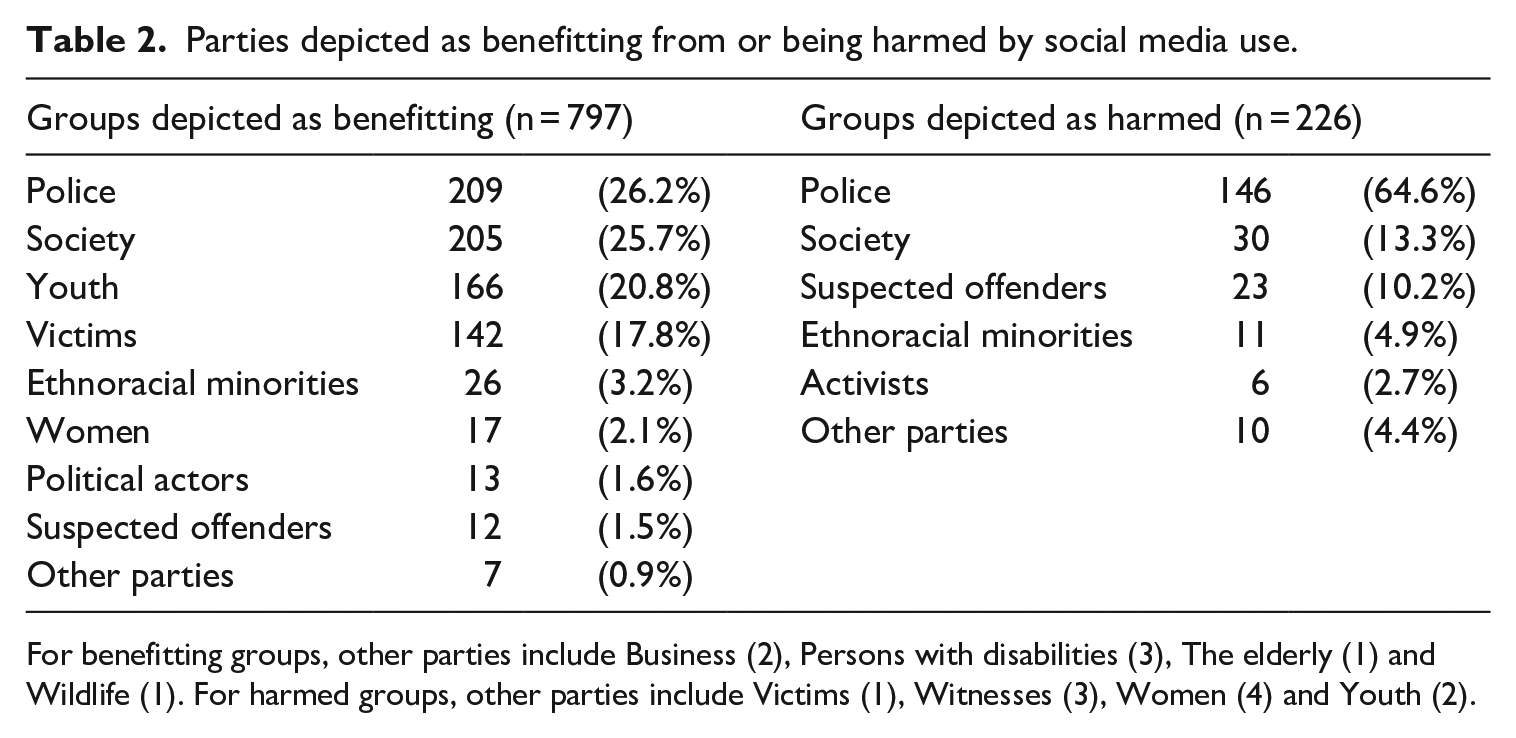
For benefitting groups, other parties include Business (2), Persons with disabilities (3), The elderly (1) and Wildlife (1). For harmed groups, other parties include Victims (1), Witnesses (3), Women (4) and Youth (2).
Calculating the ratio of positive to negative headlines produced a mean sentiment score of 0.49, revealing favourable evaluations were overrepresented. In addition, although coverage grew less positive as headlines from 2013 to 2020 displayed lower tonality (0.41) than those published between 2005 and 2012 (0.58, z = 3.67, p = .000), reporting continued to foreground social media’s benefits. While implying news-making was one-sided and lacked nuanced and critical perspectives, when read in isolation, such results potentially obscure other important trends. Accordingly, this study’s findings were scrutinized through three additional optics.
First, with the proliferation and fragmentation of media outlets (Tewksbury, 2005), it is important to consider not just the raw frequency of news frames, but how often individuals encountered them. Regarding sample newspapers, while, together, they sold 6.2 million copies, representing roughly 17% of Canada’s population, sample outlets displayed significant disparities in readership. Several local and community papers had fewer than 5000 readers, while larger outlets were often consumed by hundreds of thousands of Canadians. Thus, to account for differences in headlines’ visibility and prominence, sentiment scores were weighted according to their respective outlet’s average circulation. 7 While such adjustments lowered the mean sentiment to 0.4, suggesting larger outlets published less-favourable headlines, coverage remained substantially positive (Table 3).
Mean sentiment by news frame.
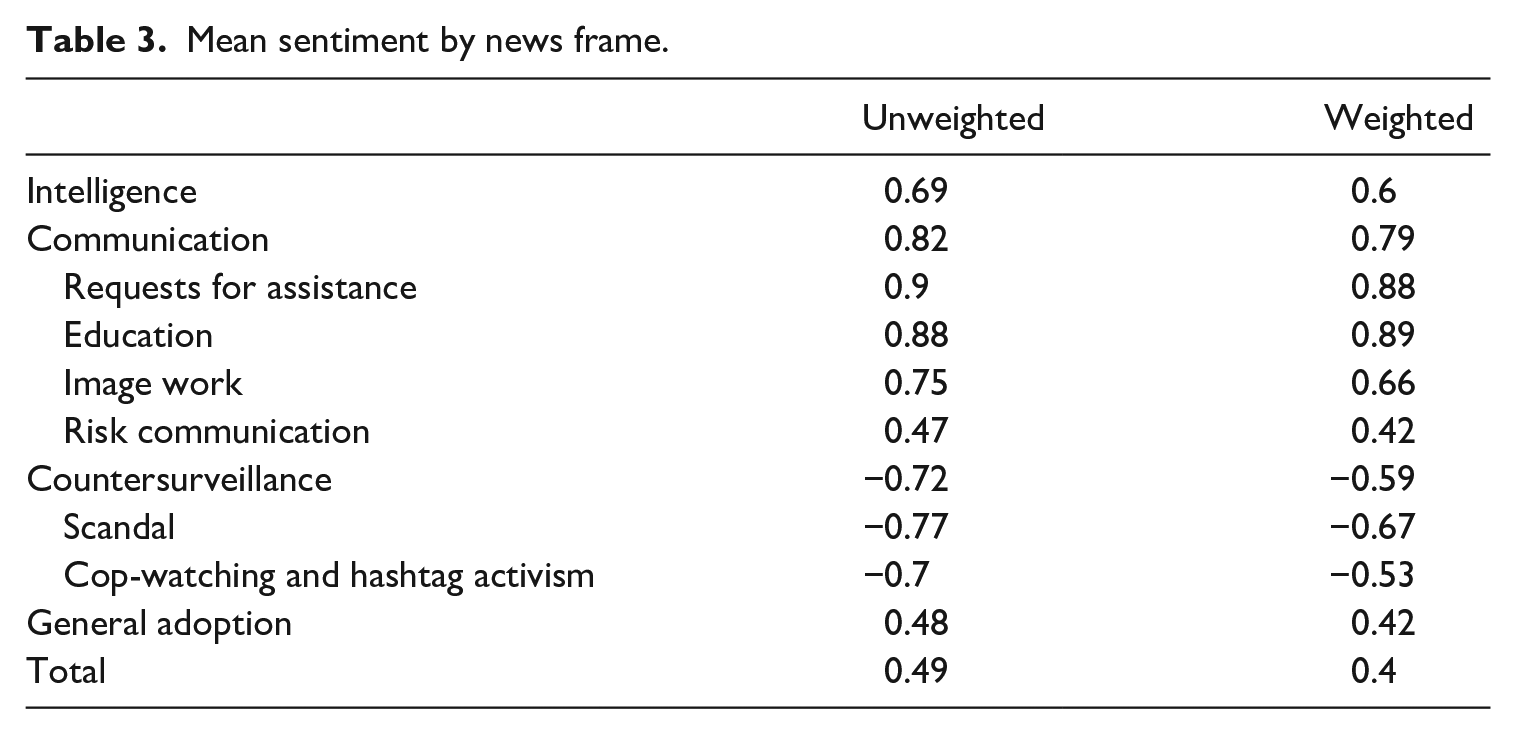
Second, tonality varied considerably across news frames. Headlines referencing official social media use, whether concerning education, image work, requests for assistance, or intelligence-gathering were disproportionately positive, while those coded scandal and cop-watching and hashtag activism were considerably negative vis-à-vis the sample mean (Table 3). Evincing media’s tendency to adopt the police point-of-view, such results suggest law enforcement’s appropriation of social platforms, whether for symbolic or operational purposes, was promoted, while attempts to challenge policing’s public image were depicted unfavourably, outcomes commensurate with previously discussed results concerning newspapers’ frequent portrayal of digital campaigns and activism as unfair, misinformed, and problematic. Alongside prioritizing social media’s consequences for police, news reporting overwhelmingly featured official discourse and accounts of events as 81.1% (n = 944) of headlines contained direct quotes from officers or adopted the standpoint of law enforcement rather than academics (2.5%, n = 29), victims and their families (1.6%, n = 19), or other societal actors. 8 Moreover, while prior research suggests reporting about official deviance creates openings for marginalized voices (Lawrence, 2000), headlines coded countersurveillance overwhelmingly favoured police as leading sources (69.9%, n = 121), dynamics that suggest coverage of misconduct reaffirms officially sanctioned realities and, thus, may serve to bolster police authority and legitimacy. As elaborated in the discussion and conclusion, while this study is unable to offer empirical insight into the lack of critical coverage and non-police perspectives, it is anticipated such omissions likely stem from a combination of insufficient knowledge on the part of journalists and concerted efforts by police to promote good news.
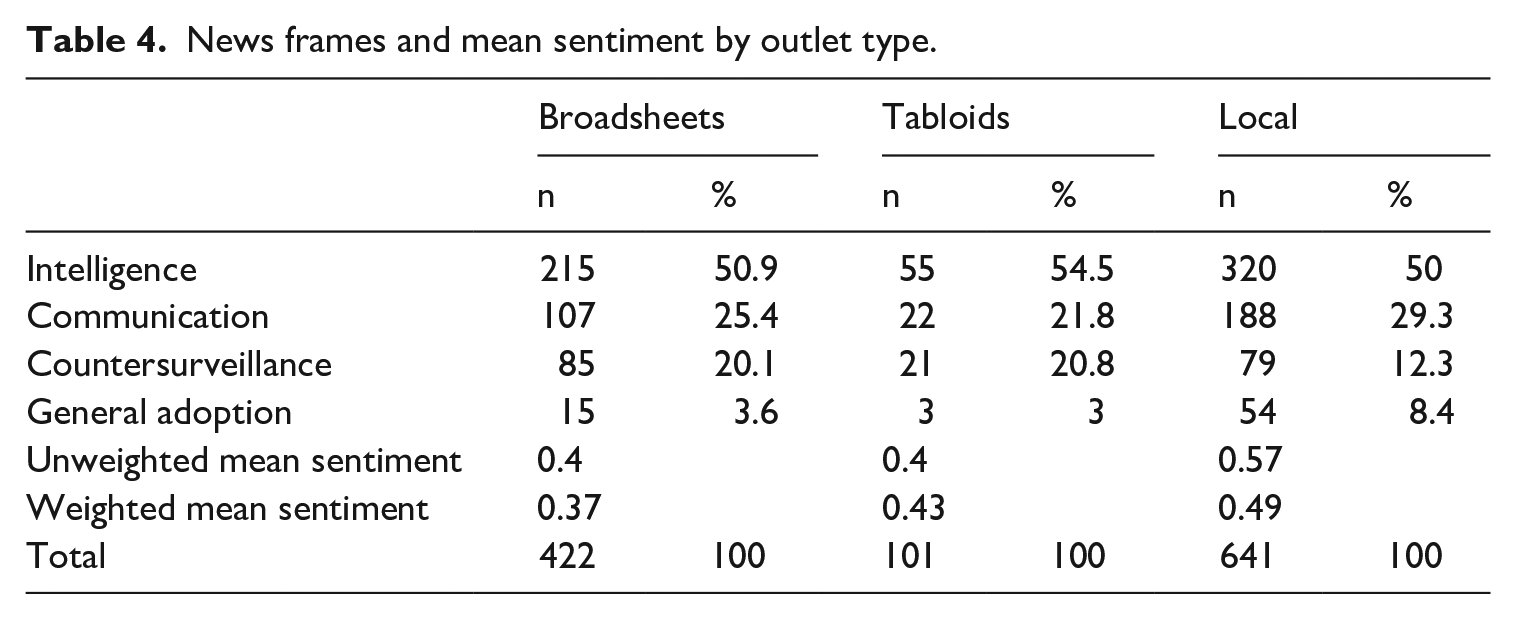
Finally, given newspapers are not monolithic and employ distinct definitions of newsworthiness, the distribution of sentiment scores may partly reflect the profile of sample outlets. While the issue requires more empirical analysis than can be provided here, data concerning outlet type was employed to contextualize and identify potential variations in news reports’ framing and tonality. Reflecting claims organizational pressures have rendered the distinction between up- and downmarket reporting less meaningful (Marr, 2004), Table 4 reveals tabloids (0.40) and broadsheets (0.40) featured equivalent affective orientations, while reflecting the lack of critical civic journalism and significance of human-interest reporting (Marwick and Lewis, 2017), local outlets featured more positive coverage (0.57, z = 3.57, p = .000), dynamics that held when weighting sentiment scores by readership (z = 3.57, p = .000). When considering the thematic distribution of coverage, local outlets featured a slightly greater share of headlines containing the communication and general adoption frames, while stories about police deviance were underrepresented (Table 4). Nonetheless, unlike prior studies which have found significant, systematic differences in reporting across distinct newspaper types (Williams and Dickinson, 1993), similarities in reporting’s thematic and affective orientation were as striking as any differences, pointing to the presence of general dynamics.
News frames and mean sentiment by outlet type.
Discussion and conclusion
Whether concerning policing or social problems generally, news reports represent cultural products that offer cues or templates for understanding emergent issues and events. Accordingly, for citizens lacking direct experience with the nexus of crime, policing and technology, journalists represent leading actors in the cultivation and entrenchment of public attitudes and beliefs. This research offers new insight into these processes and, by comprehensively mapping press coverage of the policing-social media relationship, expands existing knowledge. Informed by the Canadian context, it has systematically documented general trends, patterns and omissions in reporting over the past 15 years. In doing so, it has considered multiple issues, ranging from the volume, prominence, and thematic structure of news stories to the perspectives prioritized by journalists and the implications of reporting for practices and perceptions of policing. Based on its findings, several conclusions stand out.
Concerning the frequency and presentation of news reports, the preceding results reveal media attention featured noticeable ebbs and flows. While initially infrequent, coverage accelerated with social media’s widespread adoption, peaking in 2012. Similar dynamics were witnessed for front-page stories as media interest was distinctly conspicuous between 2013 and 2014 before abating. In addition, reflecting prior work on crime reporting (Chibnall, 2013 [2003]), coverage lacked sufficient social contextualization, with newspapers covering high-profile or sensational events as discrete affairs rather than connecting them with broader trends and developments. By precluding critical engagement with the policing-social media relationship, such dynamics raise important questions about citizens’ capacity to fully appreciate the underpinnings and consequences of technological use.
Through its approach, this study also identifies which aspects of social media use were made most salient. While stories concerning the monitoring of police and exposure of misconduct were featured, journalists tended to promote ‘law-and-order’ narratives as they devoted greater attention to police services’ deployment of social media to acquire, process and communicate information, with reporting disproportionately extolling digital platforms’ virtues in the governance of crime, risk and insecurity. Whether discussing their role in augmenting investigations, profiling population groups, predicting events, extending law enforcement’s reach and field of vision, or exhorting citizens to engage in crime-reducing activities, coverage predominately positioned social media as necessary and legitimate tools of surveillance and responsibilization.
Regarding reporting’s tonality, coverage was considerably favourable, trends that, despite minor fluctuations, held over time and across outlets. Furthermore, while a handful of stories referenced harms associated with, among others, biased enforcement, wasted resources and the attenuation of democratic rights, headlines about official social media use were significantly positive. Conversely, coverage of social media use by non-police actors, whether regarding cop-watching or digital activism, was typically negative and emphasized police interests and perspectives. Specifically, rather than a means of promoting accountability, social media content and campaigns about police deviance were disproportionately framed as inappropriate, one-sided and distortive. In addition, when reporting on outcry surrounding official misconduct, headlines foregrounded reputational damage or diminished police legitimacy rather than the experiences of marginalized groups and other societal actors. Finally, instead of featuring multiple claims makers, police sources played a dominant role in setting the news agenda. When coupled with reporting’s episodic and positive nature, journalists’ tendency to promote police viewpoints suggests news discourse represents an insufficient resource for critically assessing and fostering deeper knowledge about social media use.
Together, these results engage important questions concerning the social consequences and conceptual implications of media coverage and the relations and struggles that underpin reporting patterns. Concerning perceptions of social media use, while they do not rigidly dictate audience reactions, news reports’ content and framing restrict the range of interpretations and decodings they will likely obtain (Entman, 1993). Accordingly, by encouraging perceptions of utility and efficiency, reporting is likely to cultivate support for technological adoption, further promoting social media’s appropriation as a policing resource. Specifically, by stressing digital platforms’ value as a source of police intelligence, conclusions that, rather than systematic studies, are largely based on coverage of isolated episodes, patterns of news-making exonerate expansive police surveillance, further normalizing the monitoring of everyday life (Lyon, 2010).
Beyond conveying social media’s value as a crime-fighting tool, given news-making’s important role in the articulation of common sense (Gans, 1980), this study illuminates policing’s ongoing construction amid patterns of considerable social change and, as such, informs broader debates about relations between media, institutional authority and social order. Contra claims of increasingly adversarial patterns of news-making wherein representations of law enforcement are contradictory, uncertain and morally ambivalent, this study points to policing agencies’ resilience in exerting definitional force and advancing official interpretations of events. Specifically, the surfeit of positive coverage and official sources and perspectives, not only implies police are regarded as distinctly informed, accessible and reliable by reporters, but is highly suggestive of deliberate efforts by law enforcement to promote favourable coverage while simultaneously deflecting criticism or responding to and defusing outcry stemming from police indiscretion. Thus, rather than acting as a watchdog and check on power, news-making cultivates understandings of criminal justice that favour expansions in police funding, resources and authority. Ultimately, by presenting police as ‘authorized knowers’ (Tuchman, 1978) and competent, effective and technologically equipped crime fighters, news reports’ imagery and inferential structure reinforces their legitimacy and moral authority as the ‘seldom-failing guardians of the public’ and ‘essential bulwarks of the social order’ (Reiner, 2012 [2008]: 323; cf. Barak, 1994; Monaghan, 2022). Given the interlocking relations between public communication, truth and power, the significance of such arrangements can hardly be overestimated.
Limitations and future research
In assessing newspaper reporting on the policing-social media relationship, this study generates further questions and opportunities for subsequent research. First, while establishing the general contours of coverage, it cannot explain journalistic motivations or identify why papers framed issues the way they did. Accordingly, further examination of newsroom behaviour and organizational decision-making is required. In addition, to establish the full effects of coverage, future studies could employ methods ranging from surveys to panel and exposure studies to gauge whether reporting primes audiences and encourages particular reactions. Finally, despite their continued significance, conventional news media are but one component of today’s high-choice media ecosystem. Accordingly, to deepen understanding of citizens’ views and interpretations, other sources of social knowledge whether alternative and ethnic media or, increasingly, digital platforms themselves, should be considered. In the latter instance, assessing web-based content, including comments on news sites and user-generated social media posts, can help clarify how audiences engage with and actively shape public discourse and opinion.
Footnotes
Declaration of Conflicting Interests
The author(s) declared no potential conflicts of interest with respect to the research, authorship and/or publication of this article.
Funding
The author(s) received no financial support for the research, authorship and/or publication of this article.
