




Abstract
Although many studies of restorative justice touch on its moral dimensions, they provide a rather fragmentary view of the moral work that takes place in meetings between victims and offenders. We treat moral work as a discursive phenomenon that emerges through the evaluative rendering of character and behaviour in extended sequences of talk. Using transcripts from four victim–offender meetings, we explore how participants work within the structural constraints of the script to develop or resist particular moral conceptions of the incident, themselves and each other. We identify the significant role of the facilitator in the construction of narratives and reflections by the offender and victim, and find that ambivalence, selective attention and persuasion all appear to be necessary for achieving the moral work implied by the script.
Introduction
‘I’m not here, no-one’s here, to decide whether anybody’s a good or a bad person’. This was a standard part of Esther’s 1 introduction to the victim–offender meetings that she facilitated. She would give an overview of why the participants were there, and what would happen in the next hour or so. It would not be the first time that they had, separately, heard about the meeting’s objectives because she had spoken at least once with each participant prior to the day. But this time she needed to make sure that both of them heard the same words, and she needed to follow the script that had been given to her when training to be a facilitator and which set out the agenda for the meeting. Among the few prompts for the introduction to the session was the declaration that we have just cited.
Listening to Esther’s words, it would seem that morality had been banished from the meeting; indeed, she often followed up by emphasising that ‘It’s not about that sort of judgement being made’. In one sense her statement was true, in that the meeting would not conclude with such a crude type of judgement; and perhaps the script’s author 2 was wary of unlocking the negative emotions such as anger and hate, which can accompany attributions of badness. But if, on hearing this, we were to infer that moral work was not a part of the proceedings, we would be mistaken. Even before she got to this part of the introduction, in every meeting she applauded the participants for their courage in attending, identifying a shared virtue that would hopefully help them navigate through what might be a rather difficult conversation. And a little later, she struggled with the ‘labels’ (as she called them) of ‘victim’ and ‘offender’, which are assigned by the criminal justice system and serve as the point of departure for most restorative justice. She said that she preferred not to use them, perhaps recognising their discursive constraints on the management of identities in the meeting (Pavlich, 2005), and she was largely successful in doing so. However, her tactic of not speaking about the ‘offender’ but, instead, ‘the person who has caused the harm’ only managed to replace one moral portrait with another (albeit more nuanced) one, for the attribution of cause is central to moral thinking (Bergmann, 1998).
In short, there was unconscious irony in Esther’s explicit eschewal of morality because she was already engaging in moral work. And irony also underlay the stated objective for the meeting which, again following the script, she went on to outline: ‘we are here to explore how people have been affected by what happened and hopefully to work toward repairing the harm that was caused’. To explore the effects of what happened is to look at the nature and seriousness (or not) of the offending act, thereby attaching a moral value to it. To work towards repairing the harm that was caused similarly suggested moral action, although Esther was ambivalent about this and would note that some participants were not interested in repairing the harm but simply in talking to each other. Thus, while the meeting was explicitly framed as a nonmoral enquiry, moral work was present from start to finish. It is the nature of this moral work that we explore in this article.
Of course, much research and writing on restorative justice recognises a moral significance in its ideals and practices and most scholars would recognise the same irony that we see in Esther’s introduction to the meetings. For example, the early and influential work by Braithwaite (1989) drew its operational energy from shaming, one of the classic ‘moral emotions’, and has stimulated considerable discussion about the relative importance of shame vis-à-vis other emotions such as guilt, remorse or empathy in transforming the offender’s perspective on the offence (Doak, 2011; Scheuerman, 2018; Van Stokkom, 2002). Another line of work pays much attention to the apologies made by offenders and forgiveness extended by victims (Doak, 2011; Hayes, 2006; Szmania and Mangis, 2005), which are easily classed, but not necessarily well understood (Gill, 2000; Van Stokkom, 2008), as moral actions. That apologies and forgiveness are not always forthcoming, while not seen as a failure, can lead to suggestions that some participants lack ‘moral adequacy’ (Walker, 2006), ‘moral maturity’ (Hayes, 2006: 380) or ‘moral development’ (Wheeldon, 2009). Invaluable as these and other studies are, collectively they offer a rather fragmentary view of the moral dimensions of victim–offender meetings, and their concentration on what are often seen as moral ideals for restorative justice can miss other moral work that is going on.
We define moral work as the evaluative rendering of character and behaviour in terms of goodness/rightness or badness/wrongness (Drew, 1998; Linell and Rommetveit, 1998; Luckmann, 2002). Such work proceeds in a variety of ways – actions, gestures, thoughts, emotions and utterances – but in this article, we focus exclusively on moral work as something that is ‘talked into being’ (Heritage and Clayman, 2010; see also, Bergmann, 1998; Smithson et al., 2017; Van Stokkom, 2008). While significant moral talk (and work) occurs before and after the meetings between victims and offenders (Bolitho, 2015; Dignan et al., 2007), we examine the extended sequences of talk that take place in the meetings themselves, something which is strikingly infrequent in research on restorative justice (but see Jacobsson et al., 2012; Kenney and Clairmont, 2009; Presser and Hamilton, 2006; Rossner, 2011; Zappavigna and Martin, 2018). We contend that victim–offender meetings can be thought of as morality plays in which a cast of characters comes together to narrate and evaluate not only the prior incident but also their own identities (cf. Martin et al., 2013; Schweigert, 1999). Much of significance can be observed in these instances of informal theatre, irrespective of the thoughts and emotions of the actors which might be revealed through interviews with them before or after the fact.
The moral talk in these meetings is underpinned by a generic script with designated roles for facilitator, offender and victim and an explicit agenda of establishing the offender’s personal responsibility in causing harm (Braithwaite and Roche, 2001; Rossner and Bruce, 2018), verifying the nature and extent of the harm (McGlynn et al., 2012), and deciding what is to be done. Within the structural constraints of the script, participants work to develop or resist particular moral conceptions of the incident, themselves and each other. 3 While there are many similarities between meetings in the moral work prompted by the script, there are also some significant differences, particularly in the outcomes of the meetings.
As we will see in the meetings we recorded, much moral work focussed on the character of the offenders, the antecedents of their behaviour and how they could make amends (Radzik, 2009) for what they had done. However, the character of the victims and their behaviour during the incident that led to the meeting was also a significant consideration, revealed as much in what was not said as what was. Our analysis also reveals the significant role of the facilitator in the construction of narratives and reflections by the offenders and victims, and the significant role of the victims in assessing the offenders’ moral status. It also finds that the rhetorical tactics of ambivalence, selective attention and persuasion all appear to be necessary for achieving the moral work implied by the script. 4
The data
A focus on extended sequences of talk requires the availability of recordings, which are few and far between in restorative justice research. Through the good offices of Esther, we were able to record four of the meetings that she organised in 2016 and 2017 in the Northwest of England. All involved adult offenders and were held long after the originating incident; none were connected to decisions about sentencing, and in three cases, the sentences had already been completed by the time of the meeting. Each meeting lasted just under an hour, three being held in an educational facility and one in a prison. Esther was an experienced, police-trained, facilitator who occasionally appeared in local and national media as an advocate of RJ. In three of the meetings, she was joined by a co-facilitator who was less experienced and who focused on eliciting the victims’ tale. In the fourth meeting, a manager from the prison service was present, having expressed an interest in observing a restorative justice meeting. As we have mentioned, Esther used what was titled a ‘Restorative Conference Script’ as an aide memoire for conducting the meeting.
Prior to the arrival of the participants, the research team set up recording devices in unobtrusive locations, absented themselves during the meetings and returned to collect the recorders after they had concluded. Participants in Meetings 1 and 3 agreed to audio recordings, while participants in Meetings 2 and 4 also agreed to video recordings. The audio recording of each meeting was transcribed with line numbers and subsequently checked for accuracy and completeness by the researchers. When including segments from these in our analysis below, we indicate the corresponding meeting number (1, 2, 3 or 4) and line numbers (e.g. 1:55–58).
A brief description of each meeting follows:
lead facilitator
co-facilitator
offender
victim
Deb is a probation officer and 9 years ago Steven, an offender under her supervision, missed two supervisory meetings. When he arrived at the probation office, Deb informed him that she would have to refer him back to the court for a breach of his sentencing conditions. Steven became angry, swore at Deb and then spat at her.
Meeting 2
lead facilitator
co-facilitator
offender
victim
One year prior to the RJ meeting, Daniel was driving a car that was pursued by the police in a city centre. He collided with a bus driven by Imran, who was taken to hospital. Imran had no broken bones but was in great pain for several days after the collision and continued to suffer intermittent pain thereafter.
Meeting 3
lead facilitator
co-facilitator
offender
victim
senior colleague to Simon
About 18 months before the RJ meeting, Brian was due to be released from prison on licence. Simon, his probation officer, had not been able to find somewhere for Brian to live, meaning that he would have to seek accommodation for the homeless at the Salvation Army. When Brian was informed about this by his prison case worker, he became very angry and said ‘I’ll kill him [Simon]’.
Meeting 4
facilitator
offender
victim
observer (prison programmes manager)
More than 3 years prior to the RJ meeting, Rob stole Pete’s car while Pete was working out in a gym.
In order to provide a reasonable illustration of the relevant talk in the meetings, each section of our analysis begins with a detailed example drawn from one meeting, followed by a briefer example from a second meeting, and brief descriptions (with some illustrative quotes) from the other two meetings.
The offender’s tale
Following the opening of the meeting, with its introductions, overview and specification of ‘ground rules’ (no interrupting, no swearing, etc.), the script directed attention to the offender. Esther asked him to describe what happened on the day of the incident. Except for Meeting 2 (where Daniel gave a lengthy description of things that happened prior to the police chase and accident), the initial narratives were quite brief (cf. Martin et al., 2013). For example:
Uhm, I’d just, I’d finished work. I was going to Probation to report to Deb, and, uhm, I was there and I’d already had one breach and she said that she’d given me a second breach and I hadn’t received it and she just wanted to make sure that I’d received it. And she handed it through the thing, through the glass, and it was like I was just annoyed and I did what I did. (1:118–125)
Accounts as brief as this already had moral significance. Steven described his reaction to the breach as ‘just annoyed’, in the sense of ‘mere annoyance’, rather than the result of ongoing ill will towards Deb. 5 And he described his behaviour in the most general terms (‘I did what I did’), avoiding the detail that would remind everyone of the problem that gave rise to the meeting.
But this narrative was apparently insufficient for the purposes of the meeting because Esther followed up with numerous questions, the first of them confronting his euphemistic expression:
So what did you do?
Just spat at her, spat in her face. (1:126–127)
Of course, she knew before the meeting what Steven had done; her question was designed to bring it out into the open. Even in his reply, he attempted some minimisation: he had ‘just’ spat at Deb, in the sense of ‘only’ spitting and not doing anything else. And from there, the questions moved on to explore Steven’s feelings and thoughts at the time of the incident.
OK. OK. OK. So, how were you feeling at the time?
Uhm, I don’t know, I was just a bit, I don’t know, I was just a bit annoyed, a bit shocked . . . (1:138–140)
. . .
And I probably wouldn’t have even got breached but that’s just the way I reacted, it’s just like a spur of the moment thing and it was just like, that’s the only way. I, I mean if I was in a room, if I was in one of them side rooms I probably would have just shouted or whatever and stormed out whatever, but it was just like, do you know what I mean? That’s . . .
And so you have talked a lot about your feelings. So can you remember what your thoughts were? (1:165–175)
Reiterating that ‘It’s just like a spur of the moment thing’, Steven put his behaviour down to receiving the breach order in reception, rather than in a side room. However, Esther did not show any interest in exploring what would have been a situational cause of the incident (which might also have led to questions about Deb’s decision to hand him the breach order in reception) and she kept the focus on Steven – his feelings and thoughts.
What were your thoughts at that time?
I don’t know. I was just a bit annoyed because I thought that I was doing alright. I was working. I [was] trying to do what I was doing, I was trying to get contact with my son, going through mediation through courts. (1:182–187)
. . .
So there was a lot of sort of quick thinking about all the good work I have done, you know? Everything else I have done, you know?
Well I thought I was doing. Do you know what I mean?
OK. So a lot of sort of self-talk in a way; a lot of ‘Everything I have been doing has come to nothing. I am now going to go back to prison, so it all counts for nothing’. So a lot of negative thinking.
Yeah.
And that resulted in your anger. Just . . .
Yeah. And that’s just the action I took. (1:195–209)
Steven painted a picture of himself as ‘doing alright’, mentioning the important moral indicators of work and fatherhood. Esther incorporated this into her own analysis of what was happening: ‘a lot of quick thinking’, which negated the idea of ‘spur of the moment’ reflex behaviour, and a ‘lot of negative thinking’, which led to anger. Steven’s agreement with her analysis shows that she had successfully established that his behaviour sprang from his thoughts and feelings, the stuff of morality, rather than reflex.
Similar processes were evident in the other meetings. In Meeting 2, Daniel told how when he heard the police sirens ‘panic just kicked in’ and that it was only after the collision and starting to run away from the scene that he stopped because he realised what he had done:
But then the sirens kept on following me, and then I looked back, and when I looked back there was a police car and I said: Oh no. Just, panic just kicked in. I started thinking about what’s in the car [drugs], the fact that I haven’t got a licence and stuff like that. (2:355–360)
Shortly after this, Esther picked up on his juxtaposition of panic and thoughts:
It’s interesting what you said, a little bit about [coughs]. Excuse me. That you didn’t think, but actually all the way through you have been thinking.
Yeah. (2:417–420)
. . .
And so often we hear people say: Well, I just didn’t think. (2:427)
. . .
When I say I wasn’t thinking, I don’t mean I wasn’t, literally wasn’t thinking. I mean I wasn’t thinking the way I would normally think.
Okay. (2:431–434)
. . .
So, so your thoughts when, as soon as you got the phone call from your cousin [about the drugs], your thoughts were: You know . . .
Yeah, do the next [unclear]
Potentially I’m going to get into difficulties here because of what’s in the car. That led you to those feelings of anxiety and, and stress . . . . And again, what you said at the end there is: Your thoughts were: I’ve done wrong here. I’ve potentially harmed someone. I need to stop now. So those thoughts are what caused you to stop running.
Yeah. (2:442 . . . 461)
Esther argued that Daniel had been thinking and proceeded to suggest what his thoughts would have been immediately before and during the incident. While Daniel accepted her account (‘yeah’), he marked some distance from it by emphasising that these were not his ‘normal thoughts’.
In Meeting 3, Brian told of his fear of leaving prison and becoming homeless, his use of drugs in prison, not being ‘in the right frame of mind’ (3:187), and how he ‘snapped’ (3:138) and said ‘I’ll kill you, not meaning it’ (3:139–140). But Esther suggested that his threat was ‘deliberate’ (3:237), rather than unthinking, although she mitigated his behaviour by speculating that his motive was to avoid release from prison rather than to harm Simon. Brian partially agreed: ‘sort of, it was sort of deliberate’ (3:238). In Meeting 4, Rob said that he ‘didn’t think’ about what he was doing – ‘It’s money innit?’ (4:222–223) – but Esther insisted that he was thinking, moving Rob to the following position: ‘Yes I think for myself; but I didn’t think nothing for like anyone else’ (4:228–229), in other words, to a description of a self-centred rather than empathetic individual. 6 Having worked with the offenders to establish their thoughts and feelings as the relevant antecedents to their behaviour, Esther signalled that in her view a sufficient account had been developed by an ‘Okay’, or ‘I think that’s fine for now’.
The victim’s tale
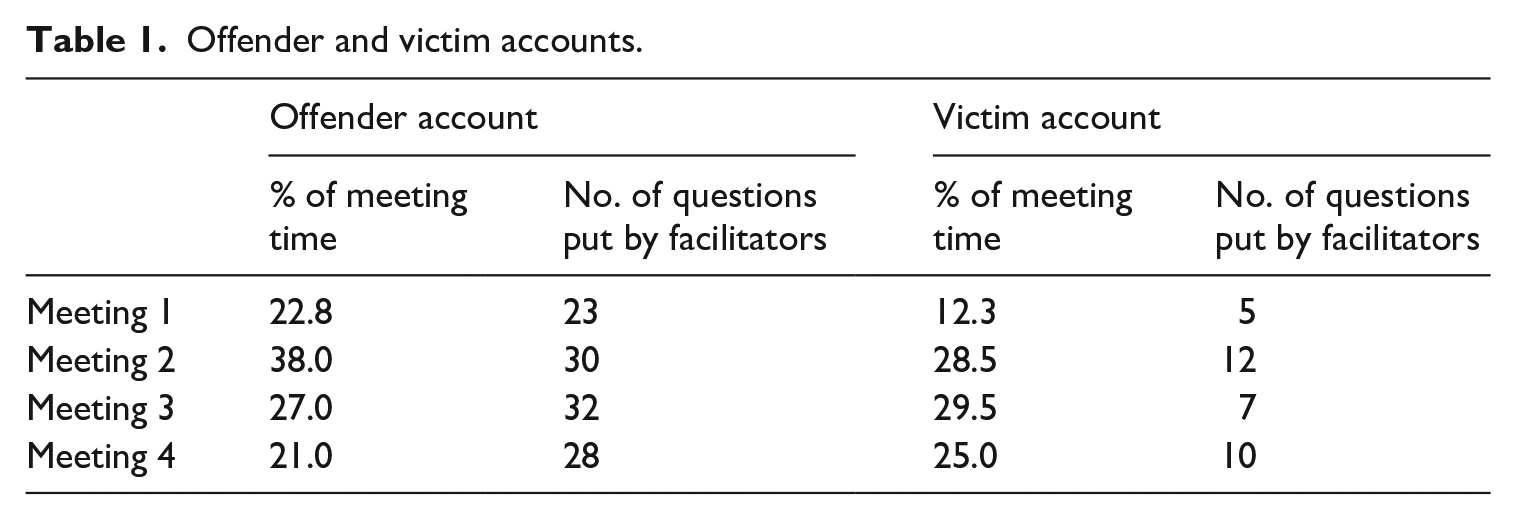
Once Esther had worked with the offender to produce a narrative that apparently fit the agenda, the victim was invited to give an account of the incident and the harm that had ensued. As Table 1 shows, the facilitators asked fewer questions of victims, who were given plenty of time to talk without interruption. The objective was to describe the harm that had been suffered, both on the day and subsequently, affecting not only the victim but also the victim’s family.
Offender and victim accounts.
Meeting 3
Simon, can I ask you, sort of, similar questions? So how did you become aware of, of what had happened in that meeting?
Well, at the time, um, I was reading some, uh, some information about another case . . . quite a horrific violent incident where somebody had broken into somebody’s house and actually with a knife had assaulted and stabbed some of the victims of the house. And . . . I got a phone call through saying there’s this guy, he’s going to be released tomorrow and he’s made threats to kill you, and I’m just letting you know that you’ve got this threat. And what I found myself doing was the information that I read . . . I, kind of, in a way that got, affected me as well, you know, um, with this telephone call. It almost . . . made it feel very real. It made me feel as if . . . this could be me, you know. So, um, . . . it was a difficult one, because I felt quite confused. I wasn’t sure what it was about. It was very limited information. (3:471 . . . 510)
. . .
And what about when you went home, Simon? So, you know, you’ve got that information, that fear is immediate. What happens at home?
Well, I went home, parked my car up and then, obviously, you know, I’d been dwelling on it all night long, I couldn’t sleep, uhm, and I found myself looking out the window a few times and just, kind of, thinking about, thinking about stuff . . . um . . . You know, it’s not . . . nice, it’s very, it was very hurtful at the time. Because I felt . . . I didn’t really need that, you know? It’s unfair. And obviously you know, my partner, my wife . . . she could pick that up that I wasn’t talking, I wasn’t eating properly . . . . So she felt that things weren’t right and then I had to, I wasn’t sure whether to let her know, because I didn’t want to worry her either. (3:626 . . . 645)
. . .
Can I ask what’s been the hardest part of all of this for you, Simon?
Um, I think the hardest part has been carrying it around in my head . . . . Um, I mean, it, it has affected my work with other people. Uh, I think I’m much more . . . it’s made me feel much more, um, cautious when I’m working with other people. Whereas before I was quite free, you know, and wouldn’t have anything on my mind . . . . I’d just work with people without the thought, without the fear that this person could be nasty towards me just for a job that I had to do, you know? It’s my work to support people, you know, to encourage people and to motivate people to, to be a better person, you know, and not, not offend, you know. That’s a good thing. It’s not negative, you know? (3:651 . . . 694)
Simon began by sharing something that Brian could not have known: he had been reading about a violent incident involving a break-in and multiple stabbings. This detail was relevant because it served to aggravate the harm caused by Brian, given that Simon imagined that he might be the victim of a similar attack. Indeed, such was the impact of Brian’s threat that Simon could not eat or sleep, could not hide his worry from his wife, and continued to ‘carry it around in his head’. He labelled the threat in various ways – ‘not nice’, ‘very hurtful’, ‘unfair’ – and classed Brian as a person who could be ‘nasty’ towards him ‘just for a job that I had to do’. He concluded by emphasising the virtues of his role, to support, encourage and motivate people: ‘That’s a good thing’. Simon’s position was that he was ‘just doing his job’; the ‘just’ implying no prejudice or ill will towards Brian. He never paused to examine whether he might have tried harder to find Brian accommodation for his release from prison, thereby avoiding what Brian had previously identified as the source of his anger and threat. Neither did Esther pursue that line of questioning: for her, the role of the victim was to narrate the harm, not to consider their potential responsibility for the incident.
Victims’ accounts in the other meetings were very similar to this one. In Meeting 1, attention focused on an important detail, that Deb was pregnant when Steven spat at her. Steven claimed that he did not know this, but Deb thought that he must have been aware:
I didn’t know that you was pregnant then did I Deb? Did I know that you was pregnant then?
I’m not sure. I was showing because I was seven months. (1:469–473)
Pregnancy not only gave Deb a special sense of vulnerability, but it also aggravated the harm she had experienced because she felt that the baby could be at risk: ‘I don’t mean any disrespect or anything, but you have been a heroin user. 7 I didn’t know if you were injecting’ (1:380–382). Deb narrated how she had felt physically sick after the incident and had worried about her baby. Moreover, she denied any personal responsibility for what happened: ‘I was just in work doing my job, and I had been instructed by our kind of policies, procedures and from advice from my line manager’ (1:340–342).
In Meeting 2, the detail that Daniel could not have known beforehand was that Imran had been in an accident more than 20 years earlier and since then had had problems with his neck. This aggravated the psychological impact of the recent collision because Imran was worried about his neck, spine and mobility. He described how pain was a daily problem. Like Simon and Deb, who were just doing their job, Imran was finishing his shift as a bus driver: he had let off the remaining passengers, was heading to the bus terminal, and ‘I was singing and suddenly everything is changed in my life at the same, you know, same second when I entered the [traffic] light’ (2:591–593). Imran did wonder if ‘I’ve done something wrong? Did I hit somebody?’ (2:624), but no-one at the scene or afterwards asked that question and neither did Sarah (the co-facilitator leading Imran through his narrative). In Meeting 4, the unknown detail was that, along with his car keys, Pete had a watch in the bag that Rob stole. It was a gift from his daughter and of great sentimental value. Its loss was what made him ‘really annoyed’ (4:492); for the rest, it was a matter of ‘inconvenience’ (4:428; 473; 495; 536; 550) – having to deal with the gym, the police, driving a small car until his own was recovered and repaired – and of adopting a more suspicious attitude towards strangers. Interestingly, although Pete gave quite a full description of the impact of the car theft, he tended to minimise the harm (‘It wasn’t a huge deal’ (4:475) ‘It’s only a car’ (4:452; 459; 466; 467)).
What is to be done?
Once the facilitators had worked separately with the offender and the victim to construct accounts of what had happened, Esther moved to the prospective phase of the meeting:
Meeting 4
So, if I can just come back to you Rob. So, you’ve heard from Pete. You’ve heard how he was affected by it. Uhm, what’s your response to that?
Just really, it’s like an eye-opener, realising, you don’t really think [unclear]. Obviously I feel a bit bad and that, you know what I mean?
About your daughter, and sorry anyway. Can I shake your hand?
[Rob and Pete shake hands 8 ]
That was a good gesture that.
I get a bit anxious talking and that. (4:561–571)
In giving his account of the aftermath of the theft, a quarter of Pete’s comments (as measured by lines of transcript) were directed to Rob rather than Esther, as shown in the following example:
One long-term effect is that either you or your mate put petrol in a diesel car, so that was a major thing to have sorted out.
Yeah, yeah, yeah; I remember that about it, we got told to put that in it.
Oh well, whoever, whoever. Uhm, and that meant they had to strip the engine so that took ages for me getting the car back. (4:390–398)
Throughout Pete’s account, whether or not he was being directly addressed, Rob added an occasional detail (‘I remember. It’s the big Mercedes innit?’ (4:454) or signalled agreement about something (e.g. ‘Hmmm’ (4:429) ‘Yeah’ (e.g. 4:366; 394; 404; 409; 464; 483; 520; 534)). Rob was, therefore, a co-constructor of the narrative of harm and it would have been extraordinary if he had, when asked by Esther, done anything but bring together the two tales (offender responsibility; harm to the victim) and acknowledge the wrong. Having had his ‘eyes opened’, he felt ‘a bit bad’ about what had happened, particularly about the watch Pete’s daughter had given him. He apologised with a ‘sorry anyway’ and asked if he could shake Pete’s hand. That it was a request signalled his deference to Pete, but what the handshake was designed to communicate – respect? closure? understanding? – remained unclear because Rob saw it as a substitute for talking (‘I get a bit anxious talking and that’). Nevertheless, Pete saw it as a virtuous act, one which signalled that Rob had at least one positive moral quality.
Apologies were also forthcoming in the other meetings. In Meeting 2, midway through his account of the incident Daniel told Imran that he had come to the meeting to apologise:
After I got told that there wasn’t anyone in the bus, apart from yourself, and they had to cut yourself out the bus. That affected me terribly and this . . . It’s one of the reasons why I had to do this because I felt like I had to, I needed to see you and . . . And apologise and . . . And just to understand, um, what impact I had on your life. (2:531–537)
And Imran later concluded his account of the incident by forgiving Daniel for what he had done:
That day, I, I’m gonna forgive you for what you have done to me, uh, or to the bus that, that day. For me, you’re forgiven. Forget about it. (2:915–917)
In Meeting 1, Esther’s question to Steven (‘Is there anything you’d like to say?’) elicited a brief response: ‘No, it’s just that I’m sorry for what I did’ (1:410–413). And in Meeting 3 Brian similarly responded, although he continued to argue that his threat arose from anger, not malice: ‘No, I want to say I’m genuinely sorry for what I said, and obviously I said it. I didn’t say it in malice, I said it as, it come out in anger’ (3:948–950). Because these apologies were part of a new dialogue between the offenders and Esther, in Meetings 1 and 3 Deb and Simon did not interrupt or attempt to say anything immediately after them. It was only much later that Deb thanked Steven for attending the meeting and ‘kind of’ apologising (1:681), while Simon did not say anything at all about Brian’s apology. As we have seen, in Meeting 4, Rob immediately followed his apology with a request to shake Pete’s hand, eliciting a very positive comment (‘That was a good gesture that’), although not necessarily an expression of forgiveness from Pete.
Alongside the apologies, as acknowledgements of the wrongs committed, offenders reaffirmed narratives of personal responsibility. In Meeting 1, Steven said to Deb:
‘Cos it’s something I’ve thought of, you know, I’m not proud of. 9 It, it’s not, you know, I can say ‘Yeah I’ve done that’, but I am not proud of that. I mean at first it was like denial and blame, but now I just accept all responsibility, do you know what I mean? ‘Cos it was like my actions that got me breached in the first place so only I’m to blame. (1:442–450)
Recall that in the early part of his conversation with Esther, Steven suggested that the circumstances in which the breach notice was given led him to spit at Deb. Here, he alluded to them by mentioning his initial thoughts of denial and blame; but he described a change of (moral) stance, to one which Esther (and the script) had been leading him. In that regard, Esther probably considered the meeting a success. 10 Similar shifts in moral stance occurred in Meetings 2 and 3 when Daniel reflected ‘it just goes back to me again . . . It’s opened my eyes’, (2:942 . . . 948) and Brian described how ‘I used to always blame other people for my own actions . . . But I do see it’s my own fault’ (3:1074 . . . 1078).
Yet, while aligning themselves with this prescribed account, the offenders advanced other moral arguments in their defence, although with limited success. As we have seen, in Meeting 1, Steven argued that he did not know that Deb was pregnant, both in his initial account and in his later exchanges with her. If he had known this, events might have been different: ‘I wouldn’t go out of here and spit in a pregnant woman’s face’ (1:223–224). This was a declaration of moral principle, but Esther challenged his thinking (‘Why does that make such a difference?’ (1:238) to which he replied with a shift of position and, paradoxically, a weakening of his own defence: ‘I wouldn’t spit in just a woman’s face anyway’ (1:239–240) (but that is what he had done). In Meeting 3, Brian tempered acknowledgement that ‘it was his own fault’ by mentioning problems with drugs:
It’s like they’re saying you know, ‘You’re getting out of jail, you be good’. And you don’t get any help, even though you’re asking for it . . . . It’s my own fault that I [got] recalled and I know I shouldn’t but I was asking, I’ve got a drug problem and I need help and they was saying ‘No’ all of the time. Gone over a few times. (3: 1061 . . . 1082) 11
However, neither here or in other parts of the meeting did Esther or the victim focus on the alleged denial of help, its possible role in generating Brian’s anger and threat, and the need to explore effective support in order to help him move forward.
Interestingly, all the offenders portrayed themselves as a changed person since the incident in question. If they had acted wrongly then, this was not who they were now. As Daniel described it in Meeting 2:
For the past year, really, it has been a very mind-blowing year for myself because it’s, it’s really been getting in touch with nature, with things around me. And not just about, not just myself. But then again, and then it just goes back to me again. Because when it goes back to me, it makes me realise that there are a lot of important things that I used to overlook in the past and that’s what the main thing is. It’s people’s lives. Not just my life, but people around you and it affects people. And that’s, it’s really . . . It’s opened my eyes. (2:937–948)
The same metaphor (an ‘eye-opener’) was used by Rob (4:565), and both there and here it conveyed the sense that they were now much more alert to the consequences of their behaviour for other people, even empathetic. And earlier in Meeting 4, in his account of what happened, Rob had already signalled his change in moral stance: ‘I don’t do that sort of stuff anymore’ (4:278). In Meeting 1, Steven identified his change as one of maturing, although he did not say how: ‘It’s like ten years on, so I am like ten years older now, so I am a bit . . . Do you know what I mean?’ (1:695–695). And in Meeting 3, Brian spoke in similar and slightly clearer terms:
I’d go about fighting with anyone and that’s, sort of, changing, I’ve started to, by the time I turned 30 I started to chill out a lot and because I’m 35 now . . . and I was, uhm, a bit of a different person at the time when that happened. Because I was a different person, I was, I was an angry . . . I’d been taking medication what I’d been taking for years, I stopped taking that. (3:898 . . . 909)
In these ways, the offenders acknowledged previous failings but described a process of development towards moral adequacy.
But while offenders argued that they had undergone positive moral development, the victims (and sometimes the facilitators) identified personal qualities that required continued attention. In Meeting 2, Imran had instructions for Daniel about thinking before acting:
I hope you have a good life in your future, and you try to change your life, uh, you know, from everything. You try to . . . To do only good things. And before to step forward, anything, you think, think ten times about everything. What’s gonna happen, what I’m gonna . . . going to do. The life is like, if you don’t think before you step forward, then you’re gonna do a . . . a lot of mistakes. You know what I mean? (2:872–880)
In Meeting 1, Esther prompted Steven to mention some commitments which she had evidently discussed with him prior to the meeting (‘drug free and attend every appointment [in Probation]’ (1:552–553)) and Deb added that he needed to get ‘back on track’ (1:600), ‘keeping out of trouble’ (1:602), and ‘work your best and try your best at just not coming back to us [Probation] (1:608–610). In Meeting 3, Simon talked to Brian about the importance of taking medication, not blaming others, and a commitment to do what he had said: ‘it’s the doing bit that takes real effort and real courage and real responsibility’ (3:1184–1186). These homilies set out goals for the future and signalled an ongoing need for moral repair work. 12 Perhaps to show that such repair work was possible, the victims identified some positive qualities in each offender. In Meeting 1, Deb thanked Steve for seeking and attending the meeting: ‘I think Esther’s right, it takes a lot to come here and do what you’ve done and, you know, be quite open and honest really’ (1:686–689). In Meeting 2, Imran said of Daniel: ‘He is a human, a good human being. He has a humility; his heart is good’ (2:990–991). And in Meeting 3, Simon said to Brian: ‘You are a good man, you can do it and I hope that you do do it, you know? I want, I want the best for you Brian’ (3:1189–1191).
Interestingly, in Meeting 4, neither Pete nor Esther had any directives for Rob. Perhaps this was partly because he had already said that he ‘didn’t do that sort of stuff [car theft] anymore’ (4:278); but it was also clear that Pete did not see any need for moral repair: [speaking to Esther] ‘Rob, I’ve no issues with, because he’s done his time and I think he’s probably suffered enough to be honest’ (4:422–424). In Pete’s eyes, Rob no longer needed to be thought of as an offender. Nevertheless, Esther asked Pete if he could think of ‘anything in terms of making reparation’:
Well there’s nothing for me, but uhm . . . I think if Rob were to do a bit of something for charity that’d be really good for Rob. I don’t know if you’re a runner Rob but I used to uhm . . . (4:585–590)
From there a lengthy conversation, spiced with humour, developed between Pete, Rob and Esther about training, running and charity events. And this was followed by another lengthy segment, again with humour intermixed, in which Pete asked Rob about how the theft had been committed. The humour not only reflected a more relaxed conversation but also a stepping away from the roles of offender, victim and facilitator. 13 Finally, Pete highlighted Rob’s courage in attending the meeting, and he put the incident behind:
I think you’ve been really brave coming, Rob. It’s a lot more difficult for you than it is for me. It’s sort of gone for me. (4:841–843)
Pete’s stances during the meeting – annoyance and problems caused by the car theft, but no great harm; no issues with Rob; the incident now in the past – suggest that he did not, at the end, see himself as a victim nor Rob as an offender. For him, their moral statuses had changed.
Discussion
The moral work taking place in these meetings showed considerable similarities. In each, Esther worked to replace the offenders’ narratives of spur-of-the-moment, panicky or unthinking behaviour with an account of thoughts and feelings that led to the incident and established the offenders’ ‘responsibility’ for what had happened. She had therefore moved them to a more negative moral position than the one from which they had started. But she only went so far. For example, in comments towards the end of Meeting 3, she recognised that a harsher description would have been to talk about ‘blame’, which she was not prepared to do: ‘And just another little word for you [Brian]: don’t talk about blame. Blame’s a hard word to use on yourself. Talk about responsibility. Because when we talk about blame that’s a hard burden; but if it’s about taking responsibility, that’s, that’s different. You are responsible for what you do’ (3:1283–1293).
While the offenders accepted this responsibility, two of them also attempted to maintain an additional line of reasoning – Steven felt that receiving his breach in reception rather than a side office was part of the cause of his reaction; Brian argued that his unheard requests for help with drug use contributed to his anger – but these were not followed up by the facilitators or the victims. To do so would have been to enquire into any responsibility on the part of the victim for the incident in question, but this was not part of the script. 14
The role of the victim was to provide an account of the harm caused by the incident. This they were able to do without much prompting, except in Meeting 4 where Pete’s minimisations required Esther to use more questions so as to construct what, for her, was a satisfactory account. In all cases, the victims described themselves as going about normal activities and Esther reflected on the significance of this at the end of Meeting 4:
. . . there’s something happens with the victim, that they blame themselves for making themselves vulnerable, uhm, but you have to work through that. You, you know, you didn’t do anything wrong. (4:812-815)
Interestingly, while blame was banished from the accounts of both offenders and victims, the ‘softer’ notion of responsibility was retained for offenders but not for victims (who were, by implication, ‘blameless’).
With apparently satisfactory accounts constructed of the offender’s responsibility and of the harm caused to the victim, in each of the meetings the offender offered an apology to the victim, confirming that they had been in the wrong. However, the script did not mention the word ‘apology’ (nor did Esther), and there was no provision for an immediate reply by the victim, unless the latter decided to intervene and say something. Thus, the presumptive sequence of apology and forgiveness that is envisioned in some models of restorative justice – mistakenly according to some scholars (e.g. Blecher, 2011; Hayes, 2006; Shapland, 2016) – was not broached in these meetings and did not occur. Rather, the offenders argued that they were now different people to the ones involved in the incidents (cf. Kenney and Clairmont, 2009), perhaps negating the need for forgiveness. While not disputing these claims, in Meetings 1, 2 and 3, both the victims and the facilitators identified aspects of character that still required work (attend meetings, think before you act, don’t blame others, etc.), such that this phase of the meeting became very much about moral repair and the offenders left the meetings with a commitment to a set of prescriptions for the future. It is interesting to note that, whereas in her introduction to the meetings Esther followed the script and talked of ‘repairing the harm’, the object of repair was in fact the offender rather than the harm. Only in Meeting 4, where Pete released Rob from the role of offender, did Esther subsequently introduce the subject of repairing the harm.
In summary, from a moral perspective these meetings established the offender as responsible for his behaviour and the victim as blameless; they explored in detail the harm that had resulted from the incident; they elicited apologies and expressions of regret from the offender; and – with the exception of Meeting 4 – they identified aspects of the offender’s character that needed repair. What is equally interesting is that these achievements had emerged from careful, if unconscious, control of contradictory moral currents. The offenders claimed that their behaviour was spur-of-the-moment or thoughtless (minimising their moral deficit), but they ultimately accepted their responsibility even though they did not abandon their original positions. The facilitators sought to establish the offenders’ responsibility but did not wish to go further in building the moral deficit by categorising it as blame. Two of the offenders attributed part of what happened directly or indirectly to the way in which the victim had acted, but the facilitators did not seek to open up this line of analysis (as might have happened in a conflict mediation session) and were emphatic that victims are ‘not to blame’. Victims described the harm they had suffered but did so in a relatively low key, matter-of-fact, manner and did not dramatise it (as they so easily could have). Both they and the facilitators also identified positive moral qualities in the offenders, indicating that the moral repair work had something to build on. One has only to think of different moral stances that could have been adopted in these meetings – including offenders’ refusals to accept responsibility; attributions of blame to the victim; victims’ and facilitators’ strong condemnations of offenders and their behaviour – to see that other kinds of moral work were possible, and with different outcomes (for examples, see Kenney and Clairmont, 2009; Strang et al., 2006; Zappavigna and Martin, 2018).
Almost all previous studies of restorative justice meetings have focussed mainly on victims and offenders (and their supporters), but some have paid attention to the role of facilitators in organising and staging the meetings (Bruce, 2013; Dignan et al., 2007; Paul and Borton, 2013). A few studies have gone beyond this to recognise the role of facilitators and family supporters in shaping the accounts given by offenders (Zappavigna and Martin, 2018) and victims (Doak, 2011; McGlynn et al., 2012). 15 Our analysis goes further than any previous study in revealing the important role that can be played by facilitators in guiding the moral work that takes place in a restorative justice meeting. Without them, and the script they use, the evaluative rendering of the character and behaviour of offenders and victims would undoubtedly exhibit different characteristics. However, while offenders and victims are partly constrained by the script and the facilitator, we also see that they develop their own stances during the meeting, with more or less success. Offenders were successfully able to claim that they were changed persons since the incident, but were unsuccessful in attributing their behaviour to panic or split-second thinking, or in broaching the possibility that the victims were partly responsible for what happened. For their part, the victims largely followed the agenda for describing the harm and, without prompting, were able to identify aspects of the offenders’ character and behaviour that required repair. And in Meeting 4, Pete was able to take a different line by minimising the harm (despite Esther’s efforts to explore it in more detail) and putting the incident behind him, effectively taking himself and Rob out of the roles of victim and offender.
Conclusion
While much previous research on restorative justice encounters has examined its moral dimensions, the portrayal of moral work, as we have defined it here, has been quite fragmentary. Our discursive approach to the topic confirms or illustrates characteristics noted in other studies, such as the moves to establish the offender’s responsibility for the harm, the emergence of apologies, and the plan for the moral repair of the offender. However, our study of extended sequences of talk also reveals a number of important characteristics that have hardly, if at all, been noted previously. Particularly important among these are the role of the facilitators in guiding the moral work during the meeting, the emergence and silencing of alternative narratives from offenders, and the careful avoidance of moving things too far along the ‘implicational scale’ towards negativity. If the meetings we recorded are considered ‘successful’, it is in large part due to these latter characteristics.
None of the meetings analysed here involved high drama. They were akin to the ‘civil’ meetings (Rossner and Bruce, 2018) and ‘procedural’ encounters (Zappavigna and Martin, 2018: 269) observed in other studies. Different patterns of interaction will likely involve different forms of moral work; thus, our findings cannot be fully generalisable to other encounters. Indeed, the discursive analysis of moral work needs to be extended to meetings organised by other facilitators, in other locations, and with different types of participant. Nevertheless, our study reveals the potential for this approach to add to our understanding of what happens when facilitators, offenders and victims come together.
Footnotes
Acknowledgements
The authors are very grateful to ‘Esther’ (pseudonym) the RJ facilitator who very willingly and successfully included the recording of the meetings in her RJ work.
Declaration of Conflicting Interests
The author(s) declared no potential conflicts of interest with respect to the research, authorship and/or publication of this article.
Funding
The author(s) disclosed receipt of the following financial support for the research, authorship and/or publication of this article: This research received funding from the British Academy.
