




Abstract
This article seeks to test the police ‘empowerment hypothesis’ to better understand public support for police powers during the COVID-19 pandemic. To do so, we draw on Australian survey data to compare the efficacy of the instrumental and normative models of police empowerment to enforce social distancing regulations. We find that instrumental concerns about risk dominate participants’ willingness to empower the police during the COVID-19 pandemic. However, when it comes to what police can do to encourage police empowerment, procedural justice appears to be more important than police effectiveness, supporting the normative model. Our article adds to the limited but growing body of research that examines the correlates of police empowerment and the conditions under which members of the public are willing to grant police expanded powers.
Introduction
During the COVID-19 pandemic, police worldwide have been responsible for enforcing new laws and regulations and, in many cases, have been granted additional powers under public health legislation. In Australia, while restrictions and penalties vary by state and territory, fines and jail-time have been issued by police to those who violate the new public health restrictions (e.g. stay-at-home orders, social distancing requirements, mask-mandates and curfews) (see Mazerolle and Ransley, 2021, for a summary). In the state of Queensland, for example, the amended Public Health Act (QLD 2005) has given police the power to require a person to remain isolated (e.g. in their home, hospital, hotel) and has enabled police to restrict movement and access to public spaces. Failing to comply with a public health directive in Queensland includes penalties ranging from AUD$1334 to AUD$13,345, with police also having the discretion to arrest violators.
Police enforcement of COVID-19 restrictions in Australia and elsewhere has sparked concerns about the overreach of police powers into the public health sphere (e.g. Boon-Kuo et al., 2020; Jones, 2020; Zornada, 2020). As the pandemic persists, these concerns have manifest in anti-mask and anti-lockdown protests, as well as reduced compliance with public health regulations (e.g. Haddad, 2021; McCarthy et al., 2021; Murphy et al., 2020; Smee, 2021). In democratic societies, expanded police powers should be questioned by citizens in order to contain abuses of power. At the same time, changes to police powers are expected if police are to be effective in achieving a new mandate, such as slowing or containing the spread of COVID-19.
Given the risk that COVID-19 poses to public safety, and the important yet controversial role of the police in enforcing public health orders worldwide (Mazerolle and Ransley, 2021), the current article seeks to better understand police empowerment during the pandemic. In Australia, police have been active and visible as enforcers of public health directives, and thus it is important to reflect on public willingness to empower police to act under these expanded powers. To do so, we draw on Australian survey data to examine the correlates of police empowerment during the COVID-19 pandemic. We particularly focus on the comparative effect of instrumental and normative factors. Understanding what factors are associated with the public’s willingness to empower the police will better enable police to acquire public support during the COVID-19 pandemic and beyond.
Normative and instrumental models of police empowerment
Empowering police is one mechanism by which the public can provide their support to the police. When the public empower the police, they ‘grant more discretion and autonomy to law enforcement and support police practices, even those that may infringe on civil liberties’ (Fox et al., 2021: 7). According to Fox et al. (2021), examples of police empowerment include ‘support for general police discretion’, ‘support for police use of reasonable and excessive use of force’, ‘support for police use of military weapons and equipment’ and ‘support for police militarisation’ (pp. 8–9).
Police empowerment was first examined by Sunshine and Tyler (2003) in their seminal study of police legitimacy, its antecedents and outcomes. In this article, Sunshine and Tyler (2003) put forward what has become known as the ‘empowerment hypothesis’ (Fox et al., 2021: 7). According to this hypothesis, as police legitimacy increases, the public will be more willing ‘to support policies that empower the police to use their discretion in enforcing the law’ (police empowerment) (Sunshine and Tyler, 2003: 514).
The relationship between legitimacy and mechanisms of support for police, including police empowerment, is explained by Tyler and his colleagues (e.g. Sunshine and Tyler, 2003; Tyler, 1990) in the normative model. According to the normative model, people are primarily motivated to support and empower the police because of a social-value orientation encompassing a ‘normative, moral, or ethical feeling of responsibility to defer’ (Sunshine and Tyler, 2003: 515). In the normative model, police legitimacy and procedural justice (i.e. fair treatment and fair decision-making by police) are the key factors that promote mechanisms of public support for police including police empowerment. 1
In contrast to the normative model, the instrumental model suggests that people will make decisions about whether they are willing to empower the police, based on self-interest concerns (Sunshine and Tyler, 2003). That is, it may be in one’s best interests to empower the police when police are effective in preventing and controlling crime; hence, public support in these contexts will likely equate to increased safety and security (Sunshine and Tyler, 2003; Tyler, 2007). When operationalised in research, the instrumental model tends to include police effectiveness (i.e. are police ‘effectively controlling crime and criminal behaviour’?), distributive justice (are police engaged in ‘fairly distributing police services across people and communities’?) and/or risk of sanction (i.e. are police ‘creating credible sanctioning threats for those who break rules’?) (Sunshine and Tyler, 2003: 514). Jackson et al. (2009) argue that worries about falling victim to crime will also influence public support for police within this perspective. If one fears crime or perceives a risk to their own safety, it will be prudent to support the police (including their use of powers), as the police play a role in mitigating this risk.
Sunshine and Tyler (2003) compared the explanatory power of normative and instrumental variables in their study of police empowerment in their general duties. Here police empowerment was operationalised as, for example, ‘The police should have the power to do whatever they think is needed to fight crime’ (Sunshine and Tyler, 2003: 542). Drawing on data collected in New York, Sunshine and Tyler (2003) examined two normative (procedural justice and police legitimacy) and three instrumental (police effectiveness, distributive justice, and risk of sanction) predictors of police empowerment. They found that police empowerment was primarily predicted by police legitimacy and procedural justice, and less so by instrumental factors 2 (see also Factor et al., 2014; McLean and Nix, 2021; Metcalfe and Hodge, 2018; Muibu, 2021; Pryce, 2019; Pryce and Grant, 2020).
Research examining support for police use of force, another example of police empowerment, found similar results. Gerber and Jackson (2017) examined attitudes towards both reasonable and excessive use of force in the United States. They included measures of fear of crime (instrumental) and police legitimacy (normative) as predictors. They found that fear of crime did not have a significant effect on attitudes towards either reasonable or excessive use of force; however, police legitimacy was significantly associated with reasonable use of force (although not excessive use of force). Similarly, Yesberg and Bradford (2019) examined support for arming more police in the United Kingdom, comparing normative (trust in police fairness) and instrumental (trust in police effectiveness, worry about terrorism) predictors. They found that trust in police fairness was associated with support for arming police, and that trust in both police fairness and police effectiveness impacted participants’ positive affective 3 responses to arming police, which in turn were positively related to support for arming police. Moreover, they found that worry about terrorism in London (an instrumental variable) had a positive and significant effect on support for arming police. These studies support the normative model of police empowerment; however, instrumental factors also appear relevant (see also Fox et al., 2018, 2021; Lockwood et al., 2018; Moule et al., 2019a, 2019b who examine support for police militarisation).
The most recent context in which support for police empowerment has been examined empirically is during the COVID-19 pandemic. As noted earlier, police have been granted extraordinary and controversial new powers to regulate public health restrictions since the commencement of the pandemic (Mazerolle and Ransley, 2021). During periods of lockdown and social distancing restrictions, behaviours that were previously considered normal such as not wearing a facemask, leaving one’s home for non-essential activities and travelling across borders suddenly became law violations subject to police enforcement. As police enforcement of these restrictions is unprecedented, the COVID-19 pandemic offers a novel context to examine the correlates of support for police empowerment; this is important because to slow virus spread, public support for police use of expanded powers is critical.
To date, two studies have examined police empowerment in the context of COVID-19. First, Nix et al. (2021) surveyed US respondents to examine support for police tactics during the COVID-19 pandemic. Policing tactics examined included those relating to ‘normal’ policing activities (e.g. ‘Cutting back on foot patrols’) and social distancing policing (e.g. ‘Having police increase their enforcement of social distancing’) (Nix et al., 2021: 10). Nix et al. (2021) identified several correlates of support for social distancing policing, including procedural justice (normative) and worry about others contracting COVID-19 (instrumental). However, contrary to prior research about support for police, they found that their instrumental variable (i.e. fear or worry about COVID-19) was the strongest correlate of police empowerment (Nix et al., 2021).
Second, in an unpublished study of Londoners, Yesberg et al. (2021) examined support for police empowerment during COVID-19. 4 They found that the key correlate of police empowerment was ‘affective response to police powers’ (operationalised as: ‘Does the Metropolitan Police Service having extra powers to deal with Coronavirus make you feel more safe, less safe or does it make no difference?’), followed by police legitimacy (normative) and confidence in the ability of police to handle COVID-19 (instrumental). However, they did not specifically set out to compare the normative and instrumental perspectives and did not examine the impact of distributive justice or perceived health risk posed by COVID-19.
Contribution of the current study
Even as a large body of research has examined the predictors of other mechanisms of support for the police (i.e. cooperation and compliance) (see Donner et al., 2015), research examining police empowerment is only recently gaining traction. Studies of this topic tend to compare the explanatory power of instrumental and normative factors and generally find that legitimacy and procedural justice (normative factors) – not instrumental factors – matter most for predicting police empowerment. However, this does not seem to be the case in the COVID-19 policing context. Notably, Nix et al. (2021) suggest that the instrumental model may hold greater explanatory power than the normative model when police are tasked with enforcing COVID-19 restrictions. In this context, fear for safety may outweigh (but perhaps not entirely eclipse) the desire for police fairness.
The current study builds on the work of Nix et al. (2021) and Yesberg et al. (2021) to more comprehensively compare the normative and instrumental models of support for police empowerment during COVID-19. We know from prior research on police empowerment that police legitimacy and procedural justice tend to be the primary antecedents of the public’s willingness to empower police (e.g. Sunshine and Tyler, 2003; Tyler and Fagan, 2008). In the context of COVID-19, however, we anticipate that fear or risk posed by COVID-19, police effectiveness and distributive justice may also be important predictors of police empowerment to enforce COVID-19 social distancing regulations. We anticipate this because COVID-19 poses a high risk to public safety. Thus, members of the public will likely be more concerned about the ability of the police to effectively curtail that risk across the population, and perhaps less concerned about fair procedures and legitimacy (for related discussion, see Rosenbaum, 1993; Sargeant and Kochel, 2018). This assertion contrasts with the extant literature that primarily finds endorsement for the normative model of support for police empowerment. Hence, we test a more elaborate model than has previously been done in the COVID-19 context that uses procedural justice (normative) and legitimacy (normative) as correlates of police empowerment while also incorporating perceived health risks posed by COVID-19 (instrumental), police effectiveness (instrumental) and distributive justice (instrumental). Our research tests the following four hypotheses:
Hypothesis 1. Participants who believe the police are procedurally just and legitimate will be more likely to empower the police to enforce new COVID-19 social distancing regulations (normative model).
Hypothesis 2. Participants who believe the police are effective and distributively just will be more likely to empower the police to enforce new COVID-19 social distancing regulations (instrumental model).
Hypothesis 3. Participants who believe COVID-19 poses a higher risk to their health (and the health of their loved ones) will be more likely to empower the police to enforce new COVID-19 social distancing regulations (instrumental model).
Hypothesis 4. In the COVID-19 context, the instrumental model will hold more explanatory power than the normative model when predicting police empowerment.
Methods
Australia and COVID-19 – Timeline to data collection
Australia reported its first confirmed case of COVID-19 in Sydney on 26 January 2020, prompting both the Australian federal and state governments to quickly close international and state borders and to introduce social distancing measures. During the first national lockdown period (15 March to 1 May 2020), shopping for ‘essential’ supplies, travelling to and from work and/or medical appointments, and exercising in one’s immediate area were the only activities allowed to take place outside the home. Australians were encouraged to work from home if possible and were not permitted to socialise with friends or family in their own homes. Australia’s rapid and strict lockdown measures, border closures, and contact-tracing and hotel quarantine programmes (for returning travellers) have been attributed with the early success of containing and, at times, almost eliminating the risk of community transmission in 2020. Australia’s initial success at curbing COVID-19 virus spread (approximately 7400 confirmed cases and 102 deaths as of June 2020) was hindered by additional waves of the virus; however, subsequent threats were met with swift and strict lockdowns. In particular, the second wave of the virus that emerged in the state of Victoria in early June 2020 accounted for approximately 90% of Australia’s total death tally at this time and saw Victorian residents enter a 112-day lockdown, with restrictions easing in October 2020. This second lockdown in Victoria was one of the longest, strictest lockdowns globally (see Murphy et al., 2021, for more information).
Data
Our study draws on data collected in the Attitudes to Authority during COVID-19 Wave 2 Survey, collected between 22 October 2020 and 12 November 2020 (Murphy et al., 2021). The aim of the survey was to examine Australians’ attitudes to authorities, including police, during the COVID-19 pandemic. The second wave of the survey sought to gauge participants’ attitudes to authorities and their handling of COVID-19 following a period of lockdown and recovery (most recently in Victoria). Relating to the above timeline, data were collected when states and territories had no known community transmission of the virus and no active lockdown measures in place, except in Victoria. 5 At this time, while restrictions had eased, the threat of COVID-19 and further lockdowns were still apparent to Australians (particularly as returning overseas travellers continued to test positive to COVID-19 while in hotel quarantine, and the virus continued to escape these settings). In addition, national border restrictions remained in place, and the COVID-19 vaccine rollout did not begin until early to mid-2021. Of note, at the time of data collection, there had been approximately 27,582 reported cases of COVID-19 in Australia (including 907 deaths) (Australian Government Department of Health, 2020).
The survey was advertised through Facebook and conducted using LimeSurvey. Facebook surveys are limited by sample representativeness and difficulties in calculating response rates; however, they offer researchers the ability to conduct time-sensitive surveys about rapidly evolving social issues such as the pandemic. A convenience sample of 779 participants was recruited to participate in the survey. Participants were incentivised with a prize draw (a chance to win an AUD$100 voucher). A response rate of 38.9% was calculated based on the number of people who completed the survey (n = 779) divided by the number of people who clicked on the Facebook link (n = 2004).
Measures
Our key variables were specifically designed to capture perceptions of police in the context of the COVID-19 pandemic. The exception was the police legitimacy measure, which captured views of police legitimacy in general. Our dependent variable was police empowerment to enforce social distancing regulations. Items employed to measure police empowerment were adapted from those employed by Sunshine and Tyler (2003); however, rather than police empowerment in their general duties, our items measured the willingness to empower police to enforce social distancing regulations during COVID-19. Survey participants were asked to indicate their level of agreement with the following statements: ‘The police should have the power to issue fines to people flouting social distancing rules’ and ‘The police should be issuing fines to those who flout social distancing rules’. Given that police powers in each state and territory of Australia are governed by state legislation, and that legislation varies across the 6 states and 10 federal territories in Australia, our survey measures of police empowerment were designed to speak to the general issue of policing social distancing regulations, rather than specific public health (e.g. mask wearing) which varied across place and time.
Two independent variables were included to capture the normative model: police legitimacy and procedural justice. Police legitimacy was operationalised as trust and confidence in police (Sunshine and Tyler, 2003) and moral alignment with police (Jackson et al., 2012). Procedural justice was operationalised as fair treatment and fair decision-making when police were ‘issuing fines to people flouting social distancing rules’ during the pandemic. Participants were asked to indicate their level of agreement with these items (see Table 1 for items).
Multi-item variables.
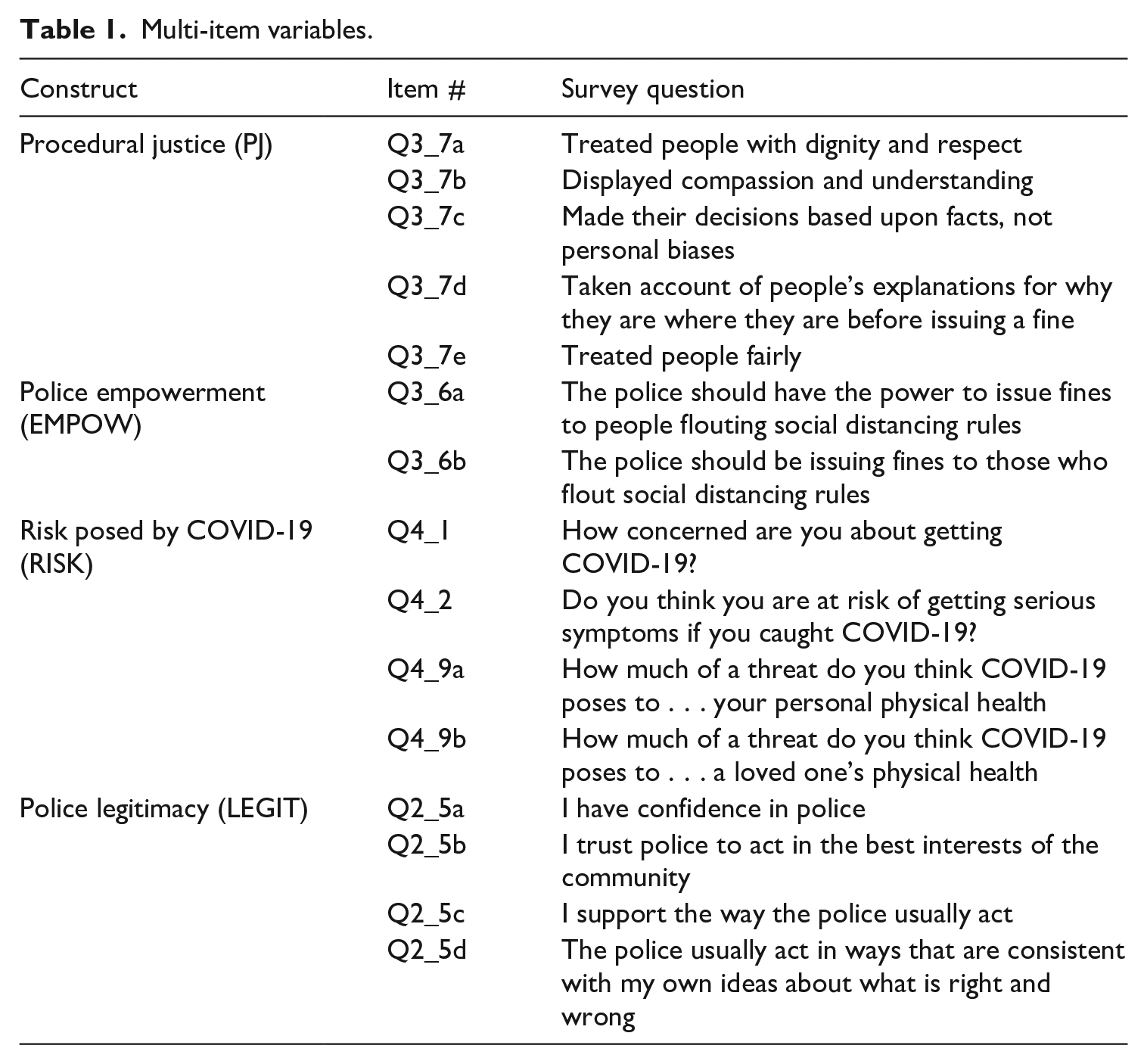
Three independent variables were included to measure the instrumental model: police effectiveness, distributive justice and perceived health risk posed by COVID-19. Police effectiveness was operationalised as one survey item where participants were asked to indicate their level of agreement with the following statement: ‘The police in my state/territory have been effective in containing the spread of COVID-19’. To measure distributive justice, participants were asked to indicate their level of agreement with the following statement: ‘When issuing fines to people flouting social distancing rules, I think police in my state/territory have generally enforced the rules consistently across different people’. Health risk posed by COVID-19 was operationalised using four items. These items captured how concerned participants were about getting COVID-19, how much of a risk of serious symptoms participants believed they would have if they caught COVID-19 and how much of threat to their own physical health and the physical health of a loved one COVID-19 posed (see Table 1 for items).
Variables measuring age (in years), gender (1 = male, 2 = female, 3 = other) and unemployment (unemployed and seeking work = 1, other = 0) were included to control for individual demographic characteristics. As our study is primarily interested in attitudes to police, we also controlled for recent contact with police ( ‘In the past 4 weeks, did the police approach you, stop you or make contact with you? Yes = 1, no = 0).
Finally, we included several control variables to capture the potential impacts of COVID-19 on participants. We asked participants if they had contracted COVID-19 (either confirmed by a test or they thought they had had COVID-19 but had not been tested) (1 = had contracted COVID-19, 0 = had not contracted COVID-19), if they had lost their job as a result of COVID-19 (1 = lost job due to COVID-19, 0 = other) and if they lived in Victoria (1 = Victorian resident, 0 = other). Victorians had recently had a different experience of COVID-19 compared to other Australians (as explained in the timeline above). These final three variables related to the perceived risk COVID-19 posed to one’s health, or the health of their loved ones, and were therefore important to control for.
Analyses
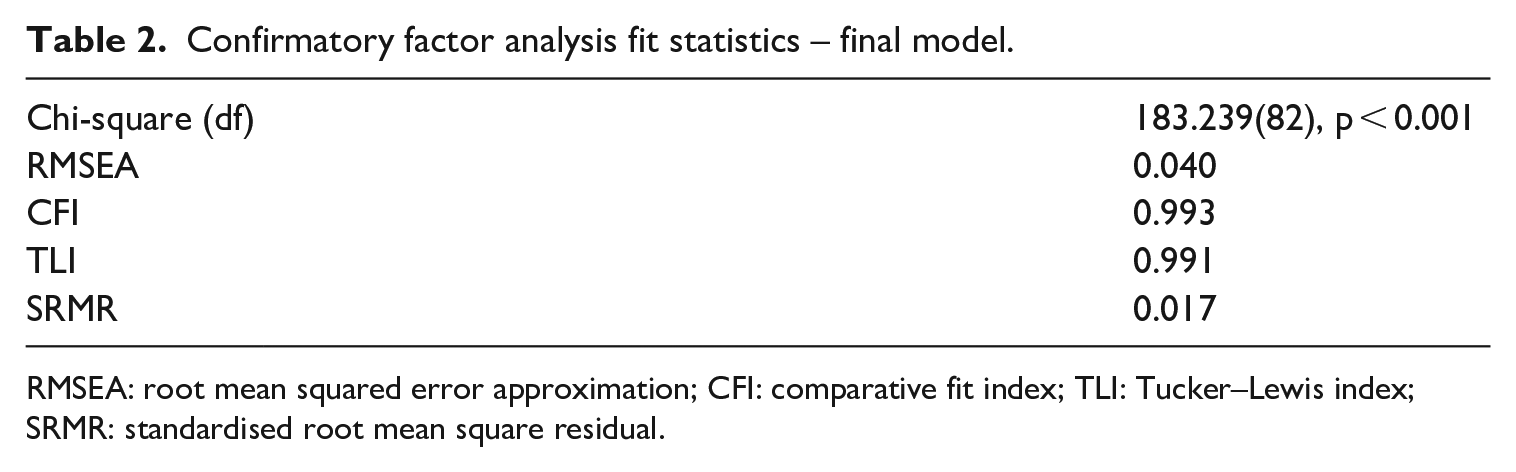
For the purposes of scale construction and to ensure discriminant validity of key variables, we analysed our multi-item scales using a confirmatory factor analysis (CFA) in STATA 13. Variable names and item numbers are provided in Table 1. Standardised coefficients and values are displayed in Diagram 1. Goodness-of-fit statistics are shown in Table 2.
Confirmatory factor analysis fit statistics – final model.
RMSEA: root mean squared error approximation; CFI: comparative fit index; TLI: Tucker–Lewis index; SRMR: standardised root mean square residual.
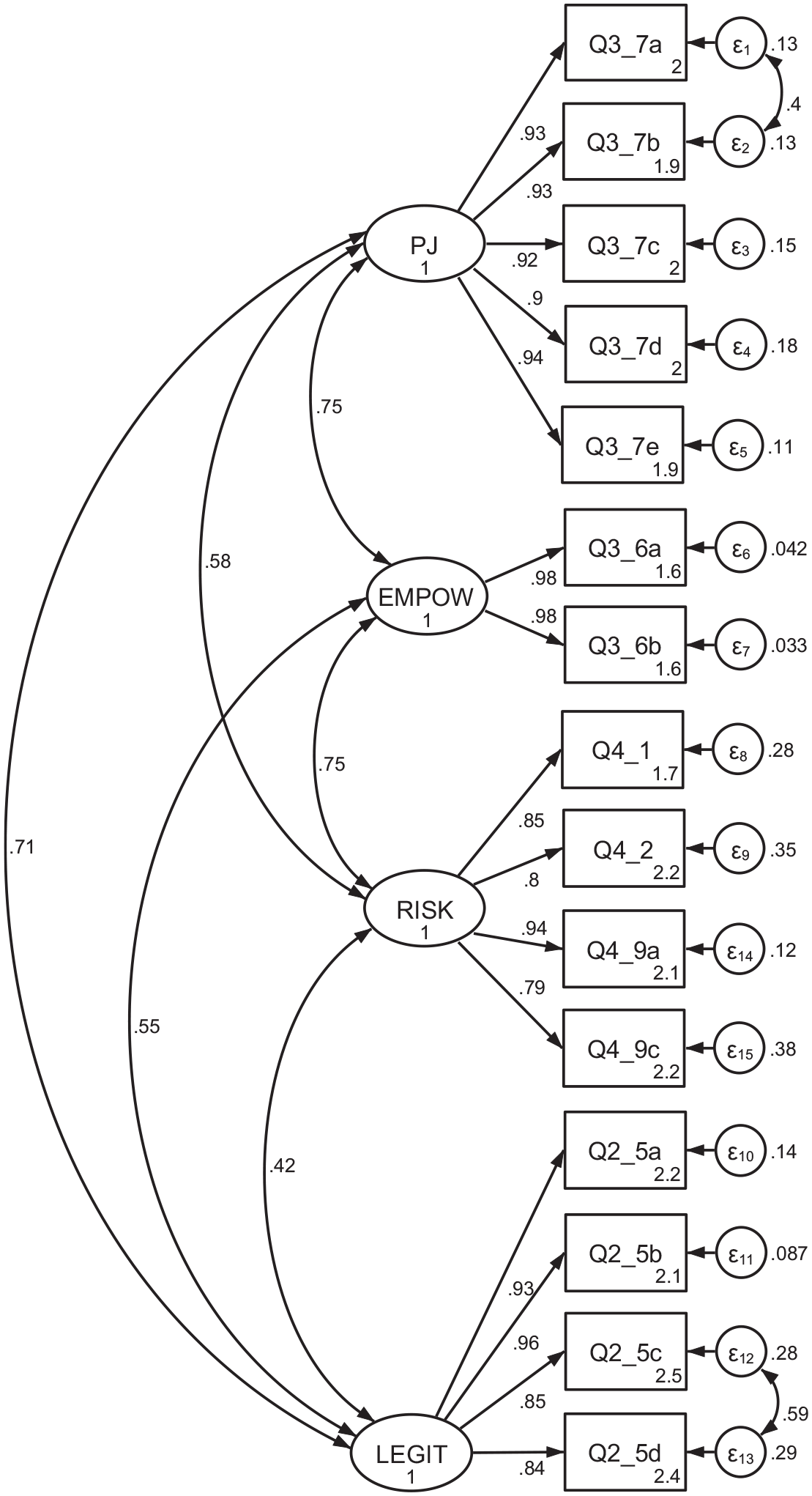
Confirmatory factor analysis.
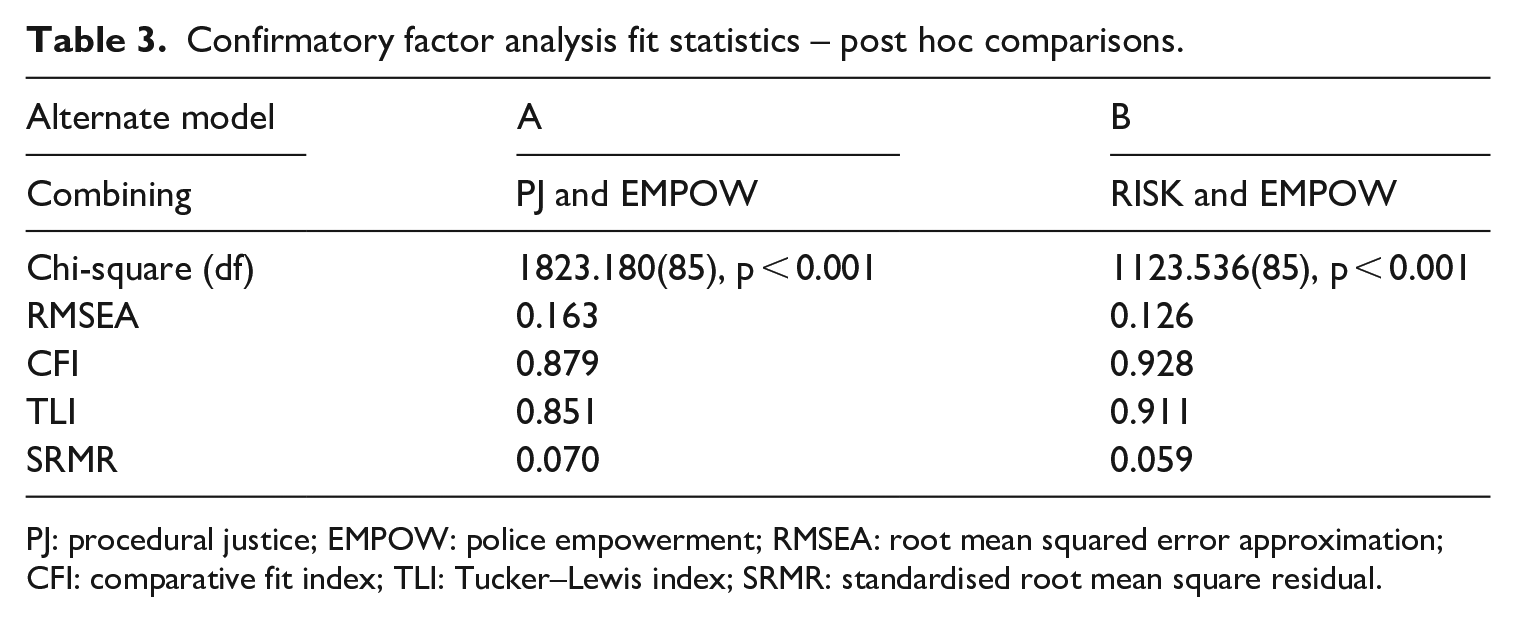
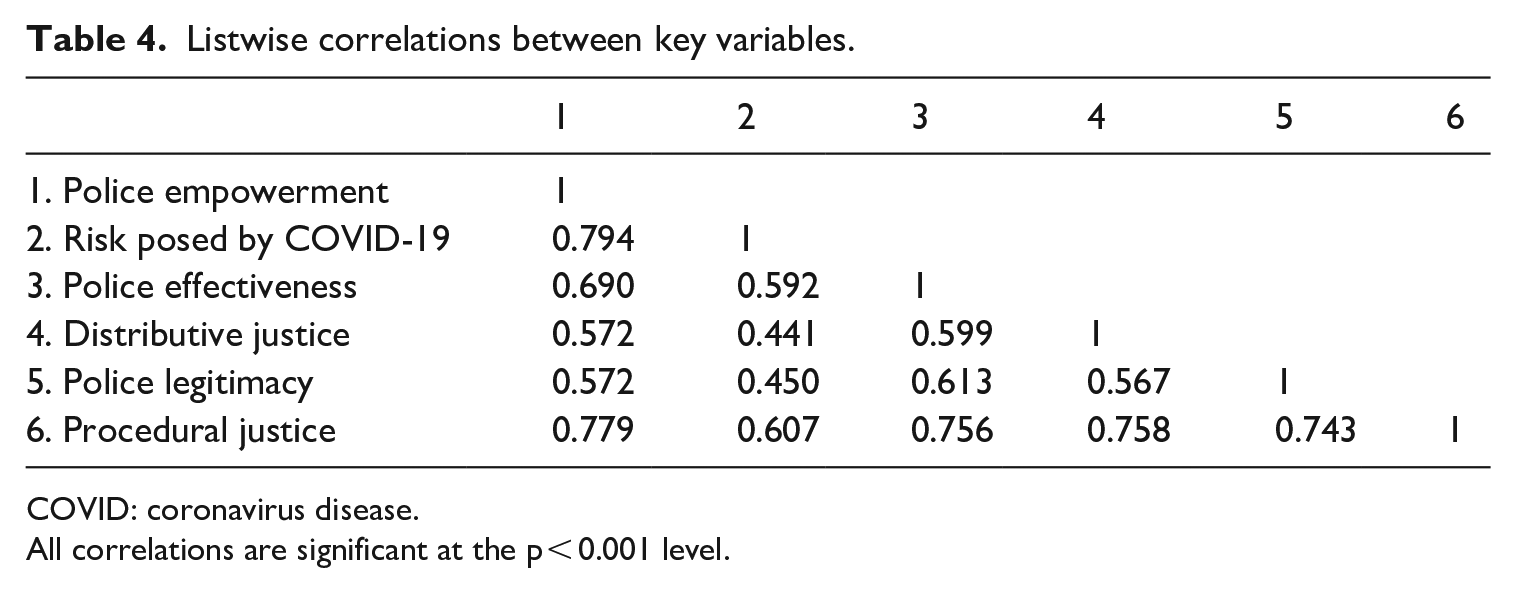
As there were strong correlations between several key variables, post hoc analyses were undertaken to examine and compare the goodness-of-fit of alternate models against the final model. These comparative statistics are reported in Table 3. Alternate Model A combined measures of procedural justice and police empowerment, and Alternate Model B combined measures of health risk posed by COVID-19 and police empowerment. Each of the Alternate Models provides ‘worse’ model-fit in comparison with the Final Model (see Table 2 and Diagram 1). Given these results and given that the measures in the Final Model are also sound on face-validity, we utilise the resultant variables in our analyses, acknowledging the strength of these correlation coefficients. To create these key variables, factor scores were computed based on the results from the CFA. A correlation table is provided to demonstrate the correlations between the key variables of interest after computation (see Table 4).
Confirmatory factor analysis fit statistics – post hoc comparisons.
PJ: procedural justice; EMPOW: police empowerment; RMSEA: root mean squared error approximation; CFI: comparative fit index; TLI: Tucker–Lewis index; SRMR: standardised root mean square residual.
Listwise correlations between key variables.
COVID: coronavirus disease.
All correlations are significant at the p < 0.001 level.
To test our hypotheses, we employed ordinary least squares (OLS) regression with robust standard errors in STATA 13. Given the strength of the correlation coefficients in Table 4, we computed variance inflation factors to test for multicollinearity. These were all within acceptable bounds (<10), indicating that multicollinearity was not a cause for concern.
Results
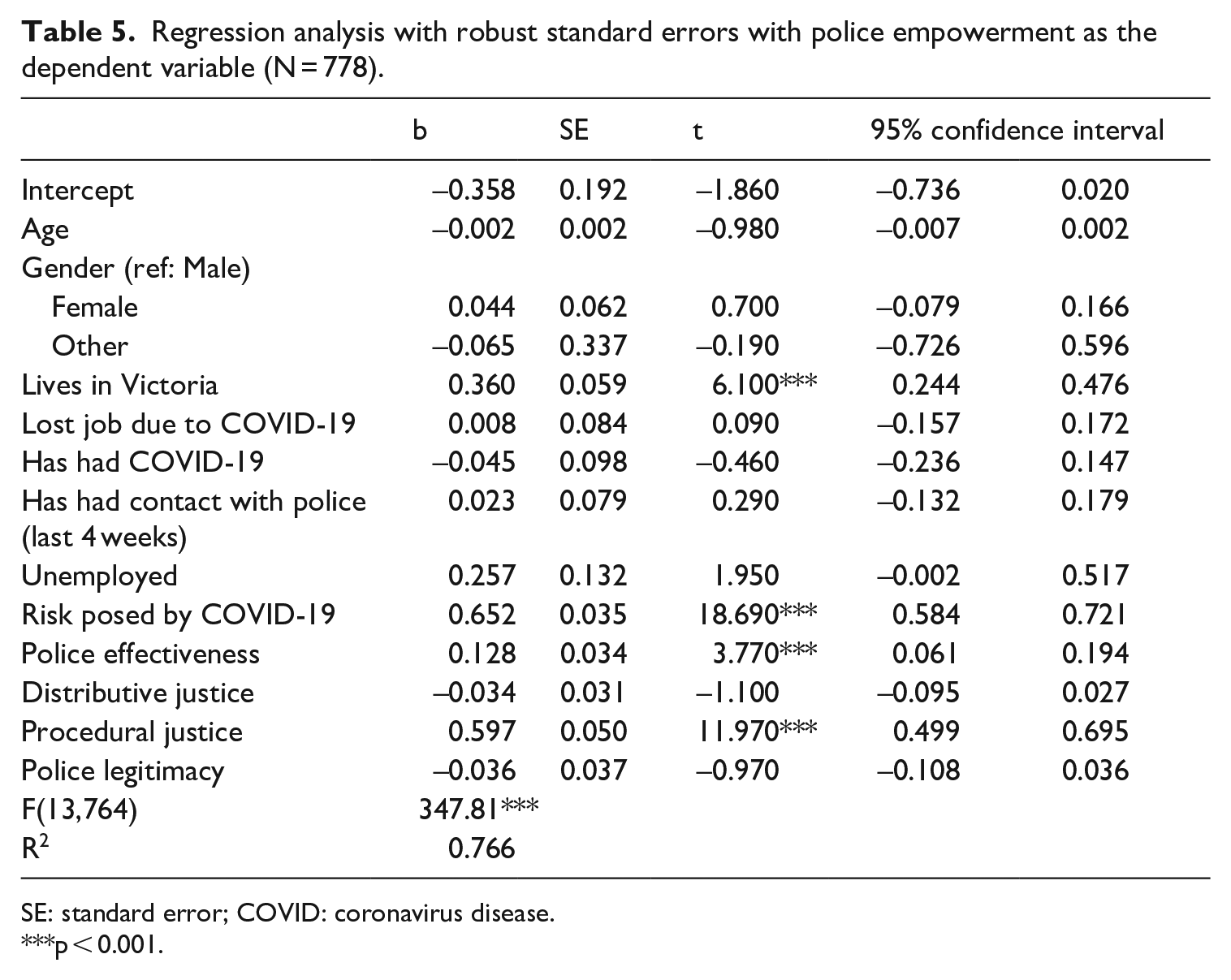
Results of the regression analysis are presented in Table 5. The model explained 77% of the variation in the dependent variable police empowerment. Beginning with the demographic variables, only living in Victoria was significantly associated with police empowerment. We found that people who were living in Victoria were more willing to empower the police (b = 0.360, p ⩽ 0.001) compared to those living elsewhere. This finding was interesting given the context; prior to the survey, and in the first week thereof, Victorians were undertaking an extensive period in ‘lockdown’ – unlike the remainder of Australians who were living under relatively limited social distancing restrictions. At this stage of the pandemic, Victoria had experienced the most widespread community transmission of COVID-19 in Australia, and as such, perceptions of the health risk of COVID-19 and instrumental concerns about ensuring compliance with containment measures may have been heightened among participants from this state. The recent experience of living under extended lockdown conditions likely led to an increased desire to empower the police to act to reduce the spread of the virus.
Regression analysis with robust standard errors with police empowerment as the dependent variable (N = 778).
SE: standard error; COVID: coronavirus disease.
p < 0.001.
Of the key independent variables, the perceived health risk posed by COVID-19 (b = 0.652, p ⩽ 0.001), perceptions of police use of procedural justice (b = 0.597, p ⩽ 0.001) and perceptions of police effectiveness during COVID-19 (b = 0.128, p ⩽ 0.001) were all positively and significantly associated with police empowerment. However, police legitimacy and distributive justice were not. Of the key independent variables that were significantly related to police empowerment, the health risk posed by COVID-19 had the strongest effect, followed by procedural justice and police effectiveness. These results suggest that both normative and instrumental factors play a role in predicting the willingness to empower the police during COVID-19.
Returning to our four hypotheses, we found partial support for Hypothesis 1. While procedural justice significantly predicted police empowerment, police legitimacy did not. Similarly, we found partial support for Hypothesis 2: police effectiveness significantly predicted police empowerment, while distributive justice did not. We found that participants who believed COVID-19 posed a higher risk to their health (and the health of their loved ones) were more likely to empower the police (Hypothesis 3 supported).
Interpreting the results for Hypothesis 4 – that the instrumental model would hold more explanatory power than the normative model – is more complicated. We found that the influence of normative and instrumental concerns on police empowerment varied across different factors. Our results show that perceptions of health risk (instrumental) had the strongest relationship to police empowerment, while perceptions of procedural justice (normative) had a slightly less strong relationship with police empowerment, followed by a much weaker association for police effectiveness (instrumental). However, legitimacy (normative) and distributive justice (instrumental) were not significantly associated with police empowerment. It therefore appears that instrumental concerns about perceived risk to health and safety dominated participants’ willingness to empower the police in the COVID-19 context.
Discussion
Police and governments in democracies draw their power and authority from the public (Locke, 1988). Consequently, for police to be effective in their role, whether that be to prevent and control crime, or to enforce social distancing regulations during a pandemic, it is important that they maintain public support. Given this, a great deal of research has focused on identifying how the police can inspire public support. This is particularly important to understand in the context of COVID-19, where police have been given unprecedented extended powers to enforce public health directives, in order to reduce virus spread.
Our study extends this body of knowledge by exploring a relatively under-researched area of public support for police: police empowerment. Police empowerment, as with other mechanisms of support for police, is theorised to be primarily driven by normative concerns (Sunshine and Tyler, 2003). While prior studies of police empowerment support this hypothesis, recent research by Nix et al. (2021) suggests that, in the context of the COVID-19 pandemic, instrumental concerns may be more influential in shaping the public’s willingness to empower the police. Our study builds on the work of Nix et al. (2021) and others to examine the relative role of both instrumental (police effectiveness, distributive justice and perceived health risk posed by COVID-19) and normative concerns (procedural justice and police legitimacy) in shaping support for police empowerment to enforce social distancing regulations during the COVID-19 pandemic. We find that when deciding whether to empower the police to enforce social distancing restrictions during COVID-19, both normative and instrumental concerns play a role. We find perceived risk to health and safety posed by the virus (an instrumental concern) is the primary driver of police empowerment, followed closely by procedural justice (a normative concern).
Before we discuss our findings in more detail, our study has some limitations, which should be noted. First, we drew on a convenience, non-probability sample, with participants recruited via Facebook advertisements. Thus, our sample is limited to Facebook users. However, this sampling method enabled the timely and efficient capture of public experiences and views on policing during the COVID-19 pandemic, and the sample was broadly demographically aligned to the Australian population (see Murphy et al., 2020). Second, this was a cross-sectional study, which limits our ability to make inferences about causality or the temporal association between variables.
Despite these limitations, our study offers a unique contribution to the extant literature on police empowerment, and in the particular context of the COVID-19 pandemic. Our findings suggest that an instrumental concern (risks to health and safety posed by COVID-19) was the primary driver of participants’ support for police empowerment. That is, if one perceives that COVID-19 posed a high risk to one’s health or the health of a loved one, that person is likely to be more willing to empower the police to enforce social distancing regulations. This is consistent with Nix et al.’s (2021) finding that altruistic fear (or worry about the impact of COVID-19 on the health of loved ones) was the strongest predictor of support for social distancing policing in the United States. Along with Nix et al.’s research, our findings suggest that, at least in the context of the COVID-19 pandemic, instrumental factors can be just as, if not more important, than normative factors in predicting support for police. As such, the ‘empowerment hypothesis’ – where normative factors are viewed as the primary antecedents of police empowerment – is not fully supported in the COVID-19 policing context.
The relationship between the health risk posed by COVID-19 and police empowerment can be viewed through the lens of a cost-benefit analysis. If the risk of COVID-19 is high, it makes sense to support policies that are designed to reduce the risk posed and to bear the costs of this through empowering police to have a broader role in regulating risky behaviours (such as breaching social distancing regulations). This cost–benefit analysis is reflective of the instrumental role of police in keeping people safe. However, public perceptions of the balance of costs and benefits may change over the course of the COVID-19 pandemic, as individuals’ perceptions of the health risks change (e.g. perhaps as vaccination rates increase; see McCarthy et al., 2021b) and as perceptions of the fairness or intrusiveness of rules and police enforcement evolve. Public perceptions of the health risks posed by COVID-19 may also fluctuate as new variants emerge, such as Delta and Omicron, with different transmission and virulency profiles, and this may also influence public tolerance for policing of health directives. In this dynamic environment, governments should focus on communicating clearly and effectively the current health risks posed by COVID-19 to the public in order to foster public support for police enforcement of health directives. Similarly, governments should also be responsive to changes in health risks and changes in public support for police empowerment as the pandemic progresses, and adjust directives and policing responses proportionately in order to retain public support for police and to foster compliance with existing restrictions (Sunshine and Tyler, 2003; Williamson et al., 2022).
Police use of procedural justice 6 was the second strongest correlate of the willingness to empower the police during COVID-19 in our analysis. Specifically, when participants believed the police were procedurally just in the way they enforced social distancing rules, participants were also more willing to empower the police to enforce these social distancing restrictions. Police effectiveness, measured as participants’ beliefs that the police in their state/territory had been effective in containing the spread of COVID-19, was also a positive and significant correlate of police empowerment; however, this association was much weaker than that of procedural justice.
In sum, it appears that instrumental concerns about health risks dominate participants’ willingness to empower the police in the context of the COVID-19 pandemic (see also Nix et al., 2021). That said, it also appears that when it comes to what police can do to encourage police empowerment, how police treat people during the COVID-19 pandemic (i.e. the perceived procedural fairness of their enforcement) appears to be more important to the public’s willingness to empower the police than perceived police effectiveness at controlling COVID-19.
So, what does this mean for police practice during the COVID-19 pandemic and beyond? Our research highlights the critical importance of police use of procedural justice during a public health crisis, such as the COVID-19 pandemic, while at the same time emphasising the risks that COVID-19 poses. While police effectiveness at reducing the risk of COVID-19 through enforcement will remain important, police should prioritise the inclusion of procedural justice principals in their interactions with the public. By demonstrating the ‘four ingredients’ of procedural justice (trustworthy motives, neutrality, offering citizens a voice and treating them with dignity and respect) (Goodman-Delahunty, 2010: 403), police may be able to increase public willingness to support their expanded role in policing social distancing measures and to subsequently encourage greater compliance with these measures (McCarthy et al., 2021). Importantly, police can incorporate messages about the risks posed by COVID-19 when demonstrating trustworthy motives. That is, police can explain that enforcement measures are important because they help to reduce the risks posed by COVID-19 and protect the vulnerable.
Prior research provides a roadmap as to how police may be able to achieve procedurally just interactions with the public. Specific to the pandemic context, Sandrin and Simpson (2021) show that police physical appearance can impact perceptions of procedural justice. They found that perceptions of procedural justice could be positively improved through observing officers’ use of Personal Protective Equipment (PPE), such as face masks/shields during the COVID-19 pandemic. By using PPE with the public during the pandemic, Sandrin and Simpson (2021) suggest that police officers might be able to demonstrate that they share citizens’ values, that they have trustworthy motives and that they respect individual citizens’ health. Beyond the pandemic context, Mazerolle et al. (2012) demonstrate that simple changes to the ‘script’ for police communications with the public can increase public perceptions of procedural justice. They found that by incorporating the elements of neutrality, trustworthy motives, voice and dignity, and respect into verbal instructions, police officers were able to increase public perceptions of procedural justice. Police can draw on this prior knowledge to inform how to approach police–citizen interactions during COVID-19 enforcement operations.
Conclusion
At the time of writing, the pace of change surrounding the COVID-19 pandemic is rapid. As of January, 2022, with high rates of vaccination and with the Omicron variant seemingly less threatening, federal and (most) state borders in Australia have reopened, and many restrictions have been lifted resulting in skyrocketing case numbers. However, at the same time as restrictions are easing in Australia, high case numbers brought about by Omicron have put pressure on public health systems globally and have led to increased restrictions in China, Hong Kong, Ontario and Peru (Beaubien, 2022).
As the risks posed by COVID-19 fluctuate, and restrictions wax and wane, approaches to policing must adjust and adapt in order for police to maintain public support (Mazerolle and Ransley, 2021). Our research suggests that the primary influence of support for police empowerment during the COVID-19 pandemic is the perceived health risk posed by COVID-19 (cf. Nix et al., 2021). As the health risk declines, public attitudes will likely change, and police will have to relinquish some of the powers they have held throughout the pandemic.
In the meantime, while the pandemic persists, our research suggests a concerted focus on the application of procedural justice principles by police, in addition to emphasising the public health risks that COVID-19 poses, could collectively enhance public support for policing powers during this challenging period. These findings may be relevant not just to the context of COVID-19, but also for future pandemics and other public emergencies such as natural disasters, where police powers may rapidly change in response to a crisis. Future research should explore the way in which normative and instrumental factors can impact support for police powers in other public emergency contexts in order to build upon this knowledge base and best inform police practice.
Footnotes
Declaration of Conflicting Interests
The author(s) declared no potential conflicts of interest with respect to the research, authorship and/or publication of this article.
Funding
The author(s) received no financial support for the research, authorship and/or publication of this article.
