




Abstract
Although there is growing interest in criminal justice policy transfer, a dearth of empirical research in this area has been acknowledged. This article addresses this gap by presenting the results of research conducted on a case of policy transfer of a criminal justice programme, focused on group/gang violence reduction, from America to Scotland. Policy transfer models were used to develop, frame and conduct the analysis of what was considered a ‘successful’ programme transfer; however, it was found that no single model could fully account conceptually for a key finding of the research, namely a policy transfer ‘backflow’. This article details the key processes, mechanisms and outcomes of the policy transfer and in doing so reflects on the usefulness of orthodox and non-orthodox/social-constructionist policy transfer approaches in understanding the outcomes of this case of criminal justice programme transfer.
Introduction
In 2008, the Scottish Violence Reduction Unit (VRU) 1 initiated a new programme, the Glasgow Community Initiative to Reduce Violence (hereinafter ‘Glasgow CIRV’), with the aim of finding a long-term solution to the problem of gang violence in the city. The development of ‘Glasgow CIRV’ drew heavily on the Cincinnati Initiative to Reduce Violence (hereinafter referred to as ‘CIRV’ to differentiate between the two initiatives), which had been established in 2007 to address Cincinnati’s gang/group violence problem. The creation of ‘CIRV’ drew heavily on the concept of the ‘focussed deterrence strategy’ (FDS) developed in the mid-1990s as part of ‘Boston Operation Ceasefire’, also referred to as ‘The Boston Gun Project’, to tackle homicides associated with gangs/groups involved in drugs supply and acquisitive crime (Braga et al., 1999, 2001; Kennedy et al., 1996; Kennedy, 1997). The concept of ‘FDS’, which involves a proactive, problem-orientated policing approach, was subsequently adopted and used in many violence reduction programmes and initiatives across the United States, including Oakland and Los Angeles, Cleveland, Detroit and Minneapolis (National Network for Safer Communities, 2014), but it was the Cincinnati example that largely informed Glasgow CIRV, hence the focus here.
The problem common to Cincinnati and Glasgow was persistent cross-generational gang or group-related violence, involving high levels of offending and victimisation among relatively low numbers of individuals, and reflecting social norms and group dynamics, which was seen to demand new social control mechanisms, or levers, both formal and informal, in order to prevent/deter cycles of offending and re-offending. It was also recognised that some gang and group members wanted to desist from offending (Kennedy, 1997). Although the gang cultures of America and Scotland were seen to differ (guns were more prevalent in America; knives, bottles and sticks in Scotland; alcohol misuse a significant factor in Scotland, unlike in the United States, where, in comparison, ethnicity was a factor); the VRU nonetheless recognised that common socio-economic factors (both are post-industrial cities, experiencing economic decline, high levels of unemployment and rising violent crime, with large urban youth populations experiencing deprivation and involved in territorial issues/turf wars) underpinned gang/group violence, meaning similar deterrence approaches to those undertaken in the United States, could potentially work in Glasgow.
The experiences of Cincinnati thus became a focus for Glasgow’s fact-finding endeavours in seeking to develop an appropriate model to capitalise on the apparent success of such strategies in America, using elements of FDS to reduce gang-related violence, initially in one part of the city (‘Glasgow CIRV’, 2009). Interviews with key stakeholders revealed that Glasgow initially decided to copy the Cincinnati model ‘in its entirety’ (‘Glasgow CIRV’ Project Manager Interview). This meant developing a similar organisational structure and a multi-agency approach, comprising members of various city agencies, including police, social work, housing, community safety and education. In operational terms, this meant approaching gang members who were involved in violence and, using the core principles underpinning FDS, offering help, support and access to various services if they chose to engage with the project and change their lifestyle by rejecting violence. However, if they elected not to engage, warnings were also given of a stronger law enforcement response targeting any ongoing violence associated with individual gang members and gangs as a whole.
During this period, one of the authors (Graham) was a senior police officer and Deputy Project Manager of ‘Glasgow CIRV’, a position held for over 2 years until retirement from the police in 2010. He then embarked on doctoral research to explore this policy transfer from Cincinnati to Glasgow from an empirical and theoretical perspective, hence the focus of this article: to understand the policy transfer process and mechanisms that underpinned it, as well as the outcomes, by applying and evaluating policy transfer models. The following sections outline previous research on policy transfer and some pertinent research issues, before summarising the significant aspects of the policy transfer, and highlighting and discussing the key finding – a backflow of policy transfer, which does not appear to be documented elsewhere.
Literature review
Policy transfer research has, until relatively recently, been more significant in the areas of political science, especially studies in comparative politics and international relations between differing states (Dolowitz and Marsh, 2000; Stone, 1999). It now encompasses a variety of policy spheres, including welfare policy (Peck and Theodore, 2010), education (Bache and Taylor, 2003), police reform (Robertson, 2005) and transport (Marsden and Stead, 2011). Although a lack of empirical research has been noted in the field of criminal justice policy transfer (Jones and Newburn, in Newburn and Sparks, 2004), key studies have been conducted on issues such as private prisons, Zero Tolerance Policing, ‘Three Strikes’ and mandatory sentencing (Jones and Newburn, 2007), electronic monitoring and the role of the ‘Drugs Czar’ (Newburn, 2002). This article contributes to the evidence base, with a focus on one case of international criminal justice policy – the transfer of a violence reduction initiative from America to Scotland.
In using policy transfer models, there are two key aspects of research that need to be considered: the so-called ‘orthodox’ view and the ‘non-orthodox’ or social-constructionist perspective.
The orthodox view is best illustrated by the work of Dolowitz and Marsh (1996, 2000) who argue that policy makers have a range of options to incorporate lessons into a system or organisation, which they categorised into four options: copying, emulation, hybridisation and synthesis and inspiration.
Copying is when a policy, programme or institution is adopted in its entirety by the borrower without any amendment to or adaptation of the originating policy.
Emulation is when a policy, programme or institution is not copied, but provides best practice to adopting actors, with changes and adaptations made to take into account the borrowing environment.
For hybridisation/synthesis, Dolowitz and Marsh (1996, 2000) combined the two separate categories discussed by Rose (1993) in ‘lesson-drawing’, whereby elements found in two or more countries are used to develop best practice to suit the adopter.
Inspiration is the study of familiar problems in unfamiliar settings that can inspire or expand ideas and fresh thinking about what is possible (see also Evans, 2009a).
The Dolowitz and Marsh model has been subject to criticism over the years, for example, by Evans and Davies (1999), who argue that the study of policy transfer has a multi-disciplinary character and that researchers do not have a unified theoretical or methodological discourse, from which they can learn lessons and develop hypotheses. Evans (2009b) developed this critique by focusing on four main deficits: First, it cannot be distinguished from normal forms of policy-making, as well as rational approaches to policy-making (see James and Lodge, 2003), and has no distinct form of enquiry. Second, policy transfer analysts fail to advance an explanatory theory of policy (James and Lodge, 2003). Third, it is claimed policy transfer analysts have failed to provide rigorous empirical tools for evaluating whether policy transfer has occurred or not. Finally, Evans (2006) maintains that policy transfer analysts fail to make research relevant to the real world of practice.
More recently, ‘orthodox’ policy transfer approaches have also been critiqued by critical human geographers and policy scholars, including Peck and Theodore (2010), Peck (2011), and McCann and Ward (2012), who examine the difference between the ‘rational-formalist tradition of work on policy transfer, rooted in orthodox political science, and the social-constructionist approaches to policy mobility and mutation’ (Peck, 2011: 774). Peck (2011) argues that the concept of ‘policy mobilities’ is better suited to explain the wandering and mobile nature of public policies across the world due to, for example, the increased globalisation of communications. Peck and Theodore (2010: 169–170) propose five key features of the ‘mobilities’ approach:
Policy formation and transformation are socially constructed processes, best seen as a ‘field of adaptive connections, deeply structured by enduring power relations and shifting ideological alignments’; policy transfer processes are rarely just about transferring policy knowledge and technology from one place to another, as there are intrinsic politics in play.
Those involved in policy transfers are not ‘lone actors’, but are heavily involved in epistemic communities (Haas, 1992), involving consultants, advocates, evaluators, gurus and critics.
Mobile policies rarely travel as ‘complete’ packages, but instead are transferred in a piecemeal fashion and often transformed in the process. They arrive at their destination, not as copies, but as ‘policies already-in-transformation’.
Policy transfer is not a linear process of replication, or simple emulation, but a complex process of non-linear reproduction and that ‘policies will mutate and morph’ during their journeys.
Given the ‘spatiality’ of policy making, policies should not be seen as travelling across an inert landscape, but rather in terms of a ‘three-dimensional mosaic of increasingly reflexive forms of governance, shaped by multi-directional forms of cross-scalar and interlocal policy mobility’ (Peck and Theodore, 2010: 170). In other words, policies do not transfer intact across boundaries, but evolve through mobility, transforming the landscape and remaking the relational connections between policy-making sites.
While conceding that orthodox policy transfer literature can illuminate policy actors, institutions and practices involved in international policy transfer, human geographers also contend that the literature is limited in three key ways: First, it does not look at the concept of ‘agency’ and is focused on a limited set of actors. Second, the conceptualisation of policy process is overly rationalistic as ‘there is a tendency for good policies to drive out bad’, in a process of optimising diffusion (Peck and Theodore, 2010: 169). Finally, there is a tendency to make assumptions that models are fully formed and ready for transfer, which does not take into account social, spatial and economic issues (Peck, 2011; Peck and Theodore, 2010).
Marsh and Evans (2012) have addressed some of the concerns raised. For example, they disagree policy transfer researchers ignore agency by focusing all their attention on a limited set of actors, argue lots of research is not just focused on nation states, suggest policy transfer does not ignore transformational issues and argue research in this field is also focussed on processes and not just on outcomes. Finally, they contend that all policy transfers are complex.
A key aspect of the social-constructionist critique of orthodox policy transfer relates to the use of the term ‘policy transfer’, which does imply a one-dimensional, linearity of approach. This was found to be a limitation of orthodox policy transfer modelling when it came to accounting for a key finding of this research – the concept of policy transfer ‘backflow’. In contrast, the terms ‘policy mobilities’ and ‘policy mutations’, discussed by Peck (2011), offer a useful way of conceptualising and understanding the transfer process investigated in this research, impacted not only by the social, spatial and economic reality of the host city, but also by Scotland’s legal and criminal justice framework. However, this also does not allow for the possibility of ‘backflow’, as discussed later.
Methodology
Graham, while undertaking doctoral studies supervised by Robertson, carried out the research that forms the basis of this article. Having recently retired from the police, following 30 years of service, Author 1 could be described as an ‘outsider-insider’, whereas Author 2 fits the ‘outsider-outsider’ category – never having worked for the police, but having an academic interest in policing and related areas (Brown, 1996). The experiences of former police officers may offer both unique advantages and disadvantages when researching the police, including pre-existing professional relationships with others, which can facilitate or hinder access (see Reiner and Newburn, 2008). As the Deputy Project Manager of ‘Glasgow CIRV’ for 2 years prior to retirement, Author 1 had significant insider knowledge of the case, as well as access to the key actors in the policy transfer process in both Glasgow and Cincinnati, which proved useful in some respects when it came to designing and conducting the research.
A case study design was used to research the process, mechanisms and outcomes of the policy transfer from Cincinnati to Glasgow, through the collection, organising and analysis of both primary and secondary data. First, a comprehensive review of secondary data was carried out (Patton, 2002), including all available documentary evidence published by ‘Glasgow CIRV’, the VRU and key academic sources. Second, 28 semi-structured interviews were conducted with key participants in the transfer process – 18 in Glasgow and 10 in Cincinnati. Using ‘insider’ knowledge, key actors were identified and invited to take part in the research, including in Glasgow, senior representatives of the VRU; the Housing, Education, and Social Work Departments; Community Safety and police officers. In Cincinnati, participants included police officers, the lead academic in ‘CIRV’, federal law enforcement officers, a city councilman and community workers. Given the high profile and status of the individuals involved in both countries, it was apparent from the outset that the usual assurances of anonymity could not be guaranteed (Noaks and Wincup, 2004), which was made clear to all participants, who nonetheless agreed to participate.
As useful as insider status may be, it is also important not to allow knowledge and personal relationships interfere with, or prejudice data collection and subsequent analysis. For example, having ‘insider’ knowledge of issues under discussion could result in temptation to ‘fill in the gaps’ by suggesting words, comments or prompts during the interviews. However, as these issues were acknowledged from the start of the research project, maintaining academic distance was prioritised so as not to, for example, pre-empt what respondents – most of whom were known to Author 1 in a professional capacity – might say. Furthermore, critical rigour was encouraged and supported by research supervisors (including Author 2) and colleagues.
Despite concerns identified in the literature about the lack of provision of rigorous empirical tools for evaluating the occurrence of policy transfer (Evans, 2006), the framework developed by Dolowitz and Marsh proved very useful in shaping the data collection phase of this research, including developing the interview schedule used, which was derived from the 9 key questions they suggest researchers use to investigate the process of policy transfer:
Why and when do actors engage in policy transfer?
Who transfers policy?
What is transferred?
From where are lessons drawn?
Are there different degrees of transfer?
When do actors engage in policy transfer and how does this affect the policy-making and policy transfer process?
What restricts policy transfer?
How can researchers begin demonstrating the occurrence of policy transfer?
How can policy transfer help our understanding of policy failure?
These 9 questions were expanded into a series of 24 sub-questions to cover fully different aspects of the main questions, which provided a detailed framework within which to analyse critically the CIRV policy transfer (Graham, 2016).
Data analysis
All interviews were conducted in person by Author 1 in Glasgow and Cincinnati and, with the permission of each participant, were recorded and thereafter transcribed by Author 1 before using Nvivo 10 to facilitate the coding of the data, collated into thematic areas that mirrored the key questions from the Dolowitz and Marsh (1996, 2000) model. This facilitated the identification and categorisation of key concepts and themes, allowing the evidence gathered from the respondents to be critically analysed. Case studies can generate huge amounts of data, and this research was no exception: 144 key themes were identified from the data, pertaining to all areas of the policy transfer process, which were collated into different subsets that allowed for the identified research areas to be addressed logically and consistently. The key findings are summarised below under the headings: processes, mechanisms and outcomes, following some contextual information underpinning the policy transfer.
Context underpinning the policy transfer process
The east end of Glasgow, where ‘Glasgow CIRV’ first operated, includes some of the most socially and economically deprived areas in the United Kingdom (Scottish Index of Multiple Deprivation [SIMD], 2020). Although housing regeneration has had some positive effects in the area, social and economic deprivation remains high, which, in parallel with American cities like Cincinnati, results in high levels of delinquency and crime (Deuchar, 2009). By the mid-2000s, violent crime was especially problematic, with Glasgow being named not just the murder capital of Britain, but of Western Europe, largely as a result of knife crime, which was attributed to both high levels of alcohol consumption and Glasgow’s long association with gang/group violence.
Glasgow’s ‘gang problem’, and associated issues with violence and territorialism, has long been the subject of academic research (Davies, 2007, 2013; Kintrea et al., 2010; Patrick, 1973). Not surprisingly this has also been the subject of police interest and action over the same time frame, with many initiatives being deployed, including knife amnesties, the development of a specialised ‘gangs task force’ and stricter law enforcement, seemingly with little long-term benefit. In 2007, police intelligence determined that there were 55 gangs in the east end of the city, known by particular names, for example, the ‘Parkhead Rebels’, the ‘Dentoi’ and the ‘Calton Tongs’, comprising mainly young males typically in their teens, but ranging from aged 12 to mid-20s.
An important aspect of gang membership in Glasgow is inter-generational ‘territorialism’ reflected in the notion of ‘defended neighbourhood’ (Suttles, 1972), which is used to explain what leads young boys and men involved in gangs to engage in violence with gang members from other areas/neighbourhoods. For example, a senior police officer involved in violence reduction commented that gang violence had always been a part of life in Glasgow, with generations of family members being part of the gang culture and structure: Gang violence in Glasgow . . . was almost a cultural norm . . . that’s what happens, that’s what we do, and that’s how it is. . . . your dad was a gang fighter, so you’ll be a gang fighter. (Senior Police Officer Interview)
Police officers were not alone in acknowledging the nature and seriousness of violence in the city. A senior figure in community safety services in Glasgow City Council commented on the longevity and entrenched nature of gang structures and violence in certain communities, which he related to as being ‘hardwired’ into their DNA: Gang violence impact on Glasgow has been going on for a long time and will continue to go on for a long time. It’s hardwired into the DNA of some communities. (Community Safety Officer Interview)
Similar to Glasgow, Cincinnati had also experienced acute social problems, associated with de-industrialisation, which had left inner city areas suffering from social deprivation and rising crime levels, including gang/group violence (Stradling, 2003). The response developed by partner organisations – the Cincinnati Initiative to Reduce Violence (which we refer to as ‘CIRV’ to avoid ambiguity) – attracted widespread academic and police interest (Engel et al., 2008, 2010, 2011), ultimately informing the creation of ‘Glasgow CIRV’, thus producing this case of policy transfer as discussed in the following sections.
Research findings
Processes
As noted above, ‘Glasgow CIRV’ was developed to try to address the city’s long-standing gang violence problem. It stemmed from a growing recognition and realisation among city agencies and the Scottish Government that small-scale, short-term strategies generally proved ineffectual in the longer term, as identified in interviews with a housing officer and senior police officer: We have been trying to deal with the issues of gang violence in Glasgow for many, many years, and . . . we recognised that the approach taken simply wasn’t working as the problem just went from generation to generation. (Glasgow Housing Officer Interview) There was a huge recognition that it hadn’t worked and that was quite simply because the gang violence and culture was still continuing . . . it didn’t seem to matter what we did. (Glasgow Police Commander Interview)
Dissatisfaction with past initiatives and consistent rises in levels of violent crime resulted in a proposal to adopt this new violence reduction initiative in Glasgow. This occurred after senior officials from the police and city council visited America on a fact-finding mission and learned about the Boston Operation Ceasefire project and its iteration in Cincinnati – ‘CIRV’. On returning to Glasgow, the VRU Director presented the idea of adopting the ‘Cincinnati approach’ to senior police management in Glasgow, and it was approved for implementation in the East End of the city, which had been identified as the worst area for gang violence and associated problems: What really appealed to us about (US) CIRV, is it was really a partnership approach to things. It was something that we had perhaps tried in different small parts but we hadn’t done it in the way that they had. (Police Executive Officer Interview)
The multi-agency approach prevalent in UK crime prevention strategies meant that consensus was sought with key agencies and actors in Glasgow to establish and develop the ‘Glasgow CIRV’ model, based on ‘CIRV’. Meetings were held with key actors and service providers previously identified, as well as members of the Crown Office and Procurator Fiscals Service (COPFS) and the Scottish Children’s Reporter Administration (SCRA). 2 The participation of the Community Planning Partnership 3 was also required as this was seen as vital to the long-term sustainability of the project.
I was completely bowled over by it. I couldn’t actually understand why we were only just finding out about it given that they had been operating it for the best part of 2 years at the time. (. . .) my first impressions were that the couple of multi-agency meetings that I went to were extremely well organised . . . and I thought that was real commitment to trying to get the barriers down and making it work. (Glasgow Social Work Manager Interview) It is not just about doing something. It is about what change has it made? So in many ways that’s where the development into CIRV in Cincinnati interested me because it appeared that it offered young people a route out of something. Whether it is into further education or whether it is into employment or real jobs, real people or real opportunities and actually changing a systemic culture. I think that’s what’s around for some of our kids in Glasgow schools, those second and third generation lack of ambition, poverty of aspirations. And I think those are things that we needed to try and break that cycle. (Glasgow Education Officer Interview)
However, not everyone involved was initially supportive of the proposal, even having observed firsthand how it worked in America: I hadn’t really seen anything that I thought was particularly innovative or that interesting . . . For me the gang culture in America was entirely different, and of a nature that beggared belief, where murder, weapons like firearms, was actually commonplace. It was also very racial with black and Mexican gangs and membership at an entirely different level from what it would be in Glasgow, Scotland. . . . I never saw much there that I thought was transferrable. (Community Safety Officer Interview)
Nonetheless, there was wide enough support across the multi-agency partners for the project to go ahead. Community focus groups were held and key actors (academic and policing) from Boston and Cincinnati were invited to Glasgow to provide insight into their experiences. Subsequently, £1.6 million of funding was secured from the Scottish Government for ‘Glasgow CIRV’ to run for a 3-year period, after which it was expected to be extended across the city, with financial responsibility and oversight being assumed by the city council.
Mechanisms
As already mentioned, the aim of ‘CIRV’ was to reduce the incidence of rising gang-related homicides (Engel, 2013, in Deuchar, 2013). To this end, Cincinnati adopted the FDS developed in Boston in 1995 (Kennedy, 1997) and created a multi-agency team to focus on rival gangs/groups engaged in the drugs market, whose feuding often resulted in shootings and homicides. In Cincinnati, police intelligence and probation records provided lists of gang members who were required to engage with ‘CIRV’ by attending a series of ‘Call-In’ sessions held in a courtroom, where they listened to various messages delivered by law enforcement, community members and service providers (see Engel et al., 2008, 2010). The key message was that the violence had to stop and there was support available for those who wanted to change their lives by engaging with the initiative. ‘CIRV’ was praised for contributing to a 34% reduction in homicides in the city over the following 2 years (see Engel et al., 2010, 2011).
Taking inspiration from the success of the Cincinnati initiative, ‘Glasgow CIRV’, in seeking to address its gang violence problems, initially sought to copy ‘CIRV’, although as previously mentioned, not all parties were initially convinced this was possible for various reasons: I was a bit concerned about how transferable some of it was into a Scottish context and whether or not they were going to try and straight lift the model or adapting it for context. (Glasgow Education Officer Interview)
Such concerns highlight the importance of contextualising the project taking into account the local environment. For example, it quickly became clear that there were legal restraints that made a direct copy impossible, and some adaptations had to be made. As a result, rather than copying ‘CIRV’, a process of emulation (Dolowitz and Marsh, 1996, 2000) occurred, with certain aspects of ‘CIRV’ fully adopted, such as the management structure, whereas other key aspects had to be adapted: It wasn’t a lift and lay. It was a ‘tartanisation’ . . . It was about . . . unpacking it line by line . . . ‘Would A transfer to here? No. What do we need to do to A to make it transfer? If we tweak this or that, what’s our hybrid version of that? That’s us sorted A, now let’s move on to B’. It was very much unpicking it like a jigsaw and then rebuild it . . . An adaptation, but guided by their experience, footprint, understanding, and their knowledge. (Glasgow CIRV Official Interview)
One key change that had to be made related to the compulsory nature of the American ‘Call-Ins’, which could not be replicated in Scotland for legal reasons. In Cincinnati, probation powers were used as a mechanism to compel targeted offenders to take part, but this was not possible in Scotland, as a result of which it was initially proposed instead to use ‘bail’ mechanisms to compel gang members to attend ‘Call-In’ sessions. However, senior law officials in Scotland argued that, as bail powers are only applicable in the pre-trial period; their use could later prejudice a fair trial. To overcome legal differences and constraints, ‘Glasgow CIRV’ embarked on a programme of inviting gang members to attend voluntarily, what became known as ‘Self-Referral Sessions’ (in contrast to the compulsory US ‘Call-Ins’): We couldn’t force people in and we had to engage far more . . . and convince people in hearts and minds. We had to do it on a much broader range of people. (Senior Police Officer Interview)
This was a significant difference from the approach used in the United States and an example of the ‘borrower’ (Dolowitz and Marsh, 1996) having to adapt their approach to suit the local (in this case legal) context.
Self-Referral/Call-In sessions
The first Self-Referral Sessions took place at Glasgow Sheriff Court on 24 October 2008, following the same structure as the US Call-Ins, but with the messages delivered to gang members in attendance taking into account the local context. The focus of the sessions was to demonstrate the expectations of the community, the availability of services for those wishing to engage and the consequences for individuals and gangs should the violence continue. The session speakers followed a similar pattern as ‘CIRV’ to ensure communication of the ‘Glasgow CIRV’ key messages to those attending:
There is a new law enforcement strategy (in place). For any subsequent act of violence, every member of the group will be pursued to the fullest extent of the law.
The community has had enough. Stop the violence. Stop the killing.
There is help available. There are ways out. (‘Glasgow CIRV’, 2010b)
When seeking to copy the model developed by ‘CIRV’, it was the intention of the ‘Glasgow CIRV’ team to invite members of different gangs to the session to attempt to ‘widen the net’ and publicise key messages to as many young people as possible. However, bringing so many ‘opposing factions’ together potentially compromised safety and security in the courtroom. This was offset at the Self-Referral Sessions by the Police presenting an ‘image of strength’ to the gang members, which resulted in the involvement of a range of officers from different services, including police court officers, Gangs Task Force, Mounted and Dog Branch officers and even the police helicopter (Donnelly and Tombs, 2008).
Similar to ‘CIRV’, the use of the courtroom was intended to provide gravitas to the occasion, especially with the Sheriff, in full judicial regalia, outlining the conduct expected of those in attendance in the courtroom. Guests were invited from a variety of statutory and voluntary agencies, representing those providing assistance to gang members to ‘change their lives’. Also in attendance were members of the community who could ‘testify to the damage caused to them and the places they lived in’ (‘Glasgow CIRV’, 2010b: 4). The impact could be emotional: When we went along to the ‘Call-In’ session . . . I was just quite staggered with that. You could see the immediate impact on young people and adults. It wasn’t something that you went away thinking that, they must have felt this, or how did they feel? You could actually visibly see the impact on them. (Glasgow Social Work Officer Interview)
There were two sessions on the first day the initiative ran in Glasgow. The first was for young people aged 16 and under from high schools in the east end of the city, who had been identified by police intelligence and local head teachers as being gang members and who could potentially benefit from attending. As gang membership in Glasgow is generational, one of the aims of ‘Glasgow CIRV’ was to engage younger people in an effort to try to prevent them from becoming involved in gangs and violence, to try to ‘break the links’ with gangs that their older brothers, fathers and uncles may have been actively involved with. A total of 95 young people attended on the day, including some aged 16–17 who were subject to a Supervision Order imposed by the Children’s Hearing System. 4
The second session, in the afternoon, was for those aged 16 and over and included some prisoners from the local Young Offenders’ Institute, who had been invited to attend and were brought to the court under guard. A stronger message was delivered to the 40 older males who attended this session, to reflect their age and gang involvement (‘Glasgow CIRV’, 2010b).
There were a total of 10 ‘Self-Referral Sessions’ held over the 3-year period that ‘Glasgow CIRV’ was in operation. Although the format and speakers originally mirrored the US Call-Ins, with speakers drawn from the local areas affected by the gang violence to reflect the Scottish context, this evolved in subsequent sessions with some speakers being replaced with others, for example, the use of a religious speaker in Glasgow was found to be ineffective and was not used again. Therefore, it can be argued that ‘Glasgow CIRV’ used a process of emulation, as discussed by Dolowitz and Marsh (1996), adapting the ‘CIRV’ model as necessary.
Case management
The case management process developed by ‘Glasgow CIRV’ (‘Glasgow CIRV’, 2010a), was distinctly different from that operated by ‘CIRV’. In Cincinnati, case management was provided by an external partner, a non-profit organisation ‘Cincinnati Works’, which only dealt with adult ‘clients’ and focussed on employability, reflecting the perceived needs of the target population (adult gang members involved in serious violence). In contrast, in Glasgow, the target audience encompassed a wider range of young people, who had not necessarily come to the attention of the criminal justice system, but nonetheless wished to engage with the initiative. The in-house ‘Case Management’ team identified their needs, allocated appropriate services and monitored their progress. By signing a pledge that they would cease their violent offending behaviour, they were able to access a range of services offered under the ‘whole systems approach’ (‘Glasgow CIRV’, 2010a), where the focus was not just on employability, but included life-skills, well-being and health, personal development and skills and anti-violence and knife awareness courses. This clearly reflected a ‘public health approach’ (Krug et al., 2002), which treats violence as a social malaise and seeks to address the key risk factors that may increase the likelihood of violent behaviour.
These different approaches were deemed successful, as evidenced by the evaluations conducted both in Cincinnati (Engel et al., 2008, 2011) and ‘Glasgow CIRV’ (Williams et al., 2014). However, this research identified a switch in these approaches in 2009 whereby, following a change in management at ‘Glasgow CIRV’, it was proposed that Cincinnati’s ‘one-stop-shop’ approach should be adopted in Glasgow, while, at more or less the same time, Cincinnati decided to restructure their service provision along the lines of Glasgow’s ‘whole systems’ approach (from interview with Professor Engel, 2012). This development appears to be the direct result of discussion and knowledge sharing between members of the epistemic network (discussed further below) that developed and grew from the planning and implementation of Glasgow ‘CIRV’, although it was not seen as significant at the time. This finding forms the basis of a seemingly original insight into the policy transfer process – a ‘backflow’ – discussed further below.
Outcomes
This section will address the outcomes of this violence reduction policy transfer, in order to assess the applicability of transfer models, and reflect on their value in relation to understanding policy transfer more generally. The Dolowitz and Marsh model of policy transfer was used as a framework for this analysis owing to its flexibility as a tool for framing both the empirical and theoretical analyses. It was also useful in analysing the results of the policy transfer, in terms of whether it could be considered a successful transfer.
According to Dolowitz and Marsh (1996, 2000), not all policy transfers are successful, the measure of which may be interpreted in different ways, for example, was it seen as a success by the key actors involved and/or did it meet its intended aims? ‘Glasgow CIRV’ was seen as a success, insofar as it appears to have met the aim of engaging young people and diverting them away from violent crime (Williams et al., 2014).
From a more technical and theoretical perspective, policy failure relates to cases that are uninformed, incomplete or inappropriate, none of which apply in the case of ‘Glasgow CIRV’. Using such terms of reference, the transfer can be considered a success, as it was informed, complete and appropriate for the city, even if the longer-term aim of sustainability was not achieved in Glasgow (‘Glasgow CIRV’ ceased to operate in 2011).
In analysing this case of policy transfer, it became clear that an important outcome, from both an empirical and theoretical perspective, warranted further consideration. As mentioned above, as a result of an exchange of ideas on mechanisms, specifically the case management structure/service, the originator of the initiative, and hence the donor in this case of policy transfer, ‘CIRV’, appears to have ‘learned lessons’ from the transfer recipient, ‘Glasgow CIRV’ and changed a key mechanism of their original project. In this way, ‘CIRV’ subsequently emulated ‘Glasgow CIRV’ and we identified a ‘backflow of policy transfer’, thus named because it demonstrates how aspects of adapted policies, mechanisms or approaches may ‘flow back’ to the originating source (the donor) from the original borrower (the recipient) of the policy, programme or approach (Figure 1).
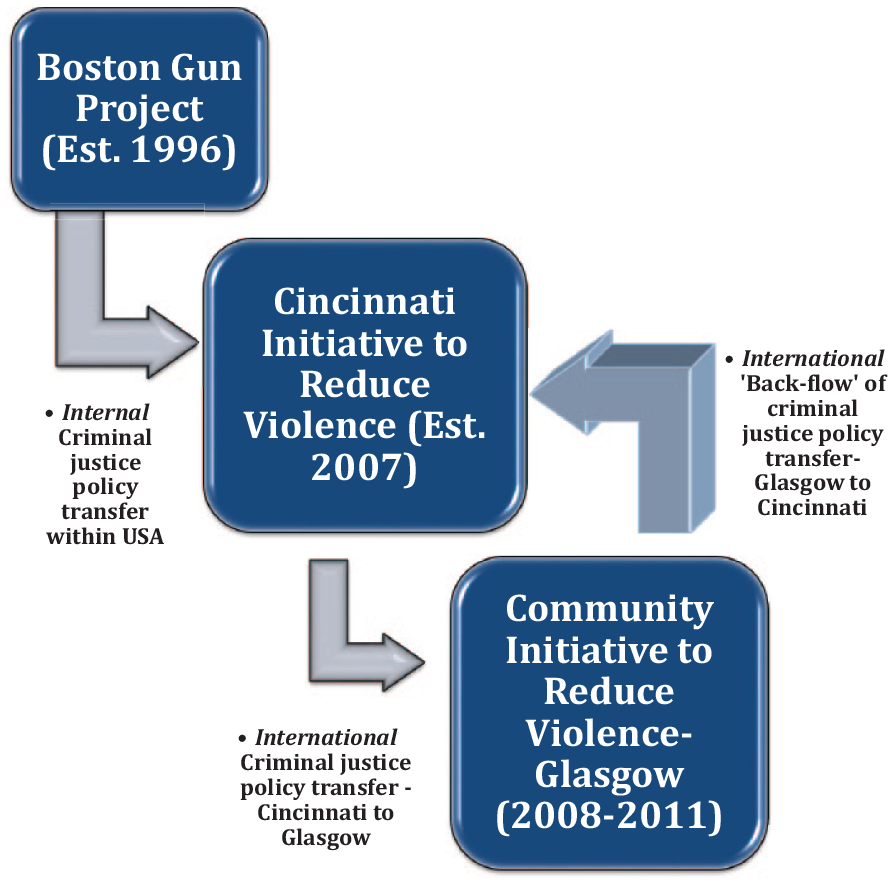
Backflow of policy transfer.
This concept does not appear to have been documented in criminal justice policy transfer studies. It suggests that in relation to the convergence of UK and US crime control policy, although much of the flow appears to be from the United States to the United Kingdom (as in this case), a focus on the initial policy transfer may obscure further developments in terms of mechanisms – which subsequently may help to understand outcomes – that extend beyond existing models. In this respect, neither the orthodox nor the social-constructionist models appear to accommodate this concept of ‘backflow’, although the latter seems more open than the former to such a development, as discussed below.
Discussion
As noted in the literature review, it has been argued (Evans, 2009b) that orthodox models of policy transfer, such as Dolowitz and Marsh (1996, 2000), have no distinct form of enquiry and that policy analysts do not propose an explanatory theory of policy (James and Lodge, 2003). Furthermore, they have also been criticised for not providing rigorous empirical evaluation tools and not being relevant in the real world (Evans, 2006). However, we found that the Dolowitz and Marsh model did provide a very practical framework for planning and conducting this case study of policy transfer and enabled the key process and mechanisms to be detailed, explained and illuminated.
However, from a theoretical perspective, the social-constructionist literature, with its focus on ‘policy mobilities’ and social, spatial and economic contexts, appears to be better suited to the examination and understanding of the policy transfer outcomes, although not all aspects of this model were found to be relevant. For example, as mentioned previously, Peck and Theodore (2010) contend that in all cases of policy transfer there is some form of politics in play and that this is not just about knowledge and technical transfer. We found in the case of ‘Glasgow CIRV’ that politics and ideology overtly played little part in the transfer process, notwithstanding the role of the police, who it could be argued were the driving force – and therefore politically behind the transfer, but perhaps in this sense the more apt term is ‘policy entrepreneur’ (Dolowitz and Marsh, 2000; Mintrom, 1997). Of greater significance were the epistemic communities (Haas, 1992) within and between both countries involved in the articulation of debates and discussions on violence as both social and criminal justice problems, and the development of context-specific solutions to address them. In this case, the relationships developed between Scottish police personnel and American law enforcement and their academic partners in the United States greatly facilitated the policy transfer. There is a long tradition of international links between police and law enforcement agencies in both countries, which, in this case, directly led to the fact-finding visit by Glasgow police to America to learn about their violence reduction initiatives. However, this relationship, and therefore the policy transfer, was consolidated and strengthened by academic researchers being closely involved in the development, implementation and evaluation of the initiatives in both countries. Such an approach was greatly enhanced by the sharing of ideas, knowledge and experiences of crime and violence reduction concepts and tools, as well as conceptual and operational policing mechanisms, and multi-agency partnership working.
In this respect, those involved in the transfer process formed an ‘epistemic community’ (Haas, 1992: 4), a network of individuals with a certain level of control over the production of knowledge and information, which allowed them to articulate cause and effect relationships and frame issues for collective debate and, therefore, transfer their policy projects onto the global stage (Haas, 1989, 1992; Dunlop, 2009). Members of this epistemic community shared their expertise and competence in the area of violence reduction based on theoretical and policy-relevant knowledge, as well as practical and operational policing experience. The contribution of epistemic networks was therefore hugely influential in the adoption of the CIRV approach both within and then between the two countries, but as noted by Peck and Theodore (2010) and Peck (2011), policies are rarely transferred as ‘complete’ packages and are often transformed in the process, arriving at their destination after already undergoing some alteration. As such, policies ‘will mutate and morph’ during transfer. In this case, having been inspired by ‘CIRV’, Glasgow initially sought to copy the violence reduction programme, however, owing to various aspects of the local context, as previously discussed, were compelled to adapt and ultimately emulate rather than copy ‘CIRV’. As mentioned, a key issue was the Scottish legal context, which necessitated some modifications to the mechanism of the compulsory ‘call-ins’ in the United States, which became voluntary ‘self-referral sessions’ in Scotland. However, although this aspect of the mechanism changed, along with aspects of content for delivery (though contextualisation), the format of this vital component of the initiatives on both sides of the Atlantic nonetheless remained consistent across the two countries.
Clearly both orthodox and social-constructionist approaches offer useful insights into the policy transfer process, mechanisms and outcomes, but neither accommodates the key finding of this research – the ‘backflow’ of policy transfer mechanisms identified above. It appears that policy transfer is not necessarily unidirectional and linear (as implied by the more orthodox approach), but can flow both ways, and in some cases perhaps become circular – hence the ‘backflow’. Although Peck and Theodore (2010) discuss the evolution of policies ‘through mobility’, they do not seem to imply this is anything but uni-linear, from the donor to the recipient (p. 170). The closest they appear to allude to something like a ‘backflow’, is with their idea of remaking ‘relational connections between policy-making sites’, from which we may infer the possibility of a two-way relationship, but this is not clearly stated. This suggests that existing models could be extended or synthesised to fully account for such additional outcomes.
Conclusion
In conclusion, this research suggests that policy transfer models, whether they be orthodox (e.g. Dolowitz and Marsh), or non-orthodox (e.g. McCann and Ward, 2012; Peck, 2011; Peck and Theodore, 2010), are useful in different ways when analysing cases of policy transfer from a theoretical perspective, with orthodox approaches also offering a useful practical framework for planning and conducting empirical research. It was found that no single model was able to accommodate the ‘backflow’ identified from the case study; however, there was more scope for this in the non-orthodox approaches, underpinned by mobility and mutation, than orthodox approaches, underpinned by ‘linearity’. Policy transfers are often complex and can have both intended and unintended outcomes – as revealed by the ‘backflow’ finding here. This raises the question of when the process of policy transfer ends, which is not easy to answer and perhaps warrants further research.
In terms of relevancy to the ‘real world’ of policing and violence reduction, this research suggests there is scope for policy transfer in similar socio-economic and crime contexts, even when the characteristics of crime patterns are different, provided the nature of the target population and their offending behaviour is understood and used to modify policies accordingly so that they are fit for purpose. Adaptability and flexibility are, therefore, key, meaning policies are likely always to evolve through mobility, as highlighted by non-orthodox transfer theorists.
This case study also highlighted the key role of the police in policy transfer, which was significant. The key responsibility of the police has been, and is primarily, as a law enforcement agency. However, their search for knowledge and sharing of ideas, approaches and experiences was the catalyst for this policy transfer, highlighting the dual role played by the police in this instance, as both law enforcers and policy entrepreneurs. In this respect, it is interesting to note that similar initiatives to gang/group-related violence have subsequently been adopted through further processes of emulation in several cities in the United Kingdom, indicating ongoing policy transfer by new epistemic networks, worthy of further research.
Footnotes
Declaration of Conflicting Interests
The author(s) declared no potential conflicts of interest with respect to the research, authorship and/or publication of this article.
Funding
The author(s) received no financial support for the research, authorship and/or publication of this article.
