



Abstract
This study examines and compares the effects on recidivism of the three most common legal responses to minor drug offences for adolescents in Norway. The essential question is whether alternative sanctions are more effective in preventing any reoffending in young people than the traditional fine. Using a longitudinal register data set, comprising all 15- to 17-year-old, first-time drug offenders in the 2000–2015 period (N = 3276), we investigate differences in duration between first legal decision and second arrest and the number of offences during follow-up. Our findings suggest that rehabilitative measures, in the form of a conditional waiver of prosecution with specified conditions, were more effective in preventing recidivism in adolescent drug offenders than a fine. Given the design of this sanction, which includes follow-up by social services and monitoring of drug use by health services, deferrals in recidivism may be caused by both positive rehabilitation experiences and negative punishment experiences.
Introduction
The potential gain from reducing recidivism in young people is substantial, making questions of which legal responses are most effective in preventing new incidences of criminal behaviour perpetually topical. Use and possession of drugs for personal use is a common offence for young people, and in the European Union (EU) about 1.2 million people were charged with this in 2019 (EMCDDA, 2021). Three quarters of the charges related to cannabis. Reflecting the higher prevalence levels of drug use among young people, national crime statistics show that the majority (>60%) charged with simple drug possession are below the age of 30 (Statistics Norway, 2021). For many young people this is likely their first and only contact with the criminal justice system, whereas for others it may be one out of many. This study examines and compares the effects on recidivism of the three most common legal responses to use and possession of drugs for first-time offenders in a policy setting where drug laws are strictly enforced.
Studies suggest that even contact with the shallow end of the criminal justice system has an impact on young people’s future criminal involvement (Fine et al., 2017), but the direction of this impact is contested. Sanction-effect studies are immersed in the opposing predictions set out by deterrence and labelling theory (Ward and Tittle, 1993). According to the former, legal interventions, however minor, could reinforce certainty of punishment and deter crime. Indeed, if punishment certainty primarily pertains to perceptions of apprehension probability, as deterrence research suggests (Nagin, 2013), arrests/policing may have crime-reducing effects regardless of legal consequences (Huizinga and Henry, 2008). Contrarily, according to labelling theory, contact with the justice system could promote future crime (Becker, 1963). Studies have shown how mere involvement with the youth justice system could have deviance-amplifying effects (McAra and McVie, 2010). Adolescents’ first arrests seem to have a particular impact on their attitudes towards the criminal justice system, making early system contact a potentially negative turning point (Fine et al., 2017; Wiley and Esbensen, 2016). Acknowledging that first arrests have an impact – negative or positive – on young peoples’ reoffending, this study analyses recidivism among young offenders being charged for the first time.
Criminal system contact, shallow or in-depth, is not one thing. As obvious as this sounds, studies of deterrent and labelling effects regularly specify sanctions in the singular (Nagin, 2013) and compare average effects of any justice system contact with no contact (Motz et al., 2019). Hence, researchers across the deterrence/labelling spectrum have stressed the need for studies of differential effects of specific sanctions (Bales and Piquero, 2012; Caudy et al., 2018; Cid, 2009). The impact of any sanction is relative to the impact of other legally available sanctions for the offence (and offenders) under study. In order to capture this heterogeneity, the discrete impact of ‘different components of the sanction regime’ (Nagin, 2013: 199) must be identified and compared. In this study, we assess the impact of the three most relevant sanction options for young drug-use offenders in Norway. Unlike much of the literature on differential sanction effects, which compare custodial with noncustodial sentences (Caudy et al., 2018), we compare three noncustodial measures on the shallow end of the criminal justice system. Moreover, our primary aim is not to map differential impacts of single sanctions across offender characteristics (Bergseth and Bouffard, 2013) or situational factors (Hayes and Daly, 2003; Yasrebi-De Kom et al., 2021), but to investigate reoffending risk following three interchangeable legal interventions.
While recidivism is a crude and often questionable measure of the performance of the youth justice system (Bateman and Wigzell, 2020; Smith, 2005), the crime reduction effects of sanctions remain the key concern for policymakers and practitioners in the criminal justice field (Petrosino et al., 2010). This approach to justice delivery has been widely criticised (Bateman and Wigzell, 2020), in particular by desistance theorists who emphasise the gradual character of changes in criminal involvement (Bushway et al., 2001). Parallel to desistance theory, studies on restrictive deterrence have shown how punishment activates a range of sanction-avoidance strategies in offenders, including temporal displacement of crime (Moeller et al., 2016). This body of research illustrates how movements in and out of crime constitute a process rather than a turning point. Given the transitory character of deterrent effects (and labelling effects for that matter), this study approaches recidivism as something temporal. Based on a longitudinal data set of adolescent first-time drug offenders, linking the police register STRASAK with population, education, and income administrative data, we investigate differences in duration between first legal decision and second arrest following three comparable sanctions and examine which of these was the most effective in preventing future crime.
Youth justice and sanction effects
In describing the qualitative aspects of penal power, Garland (2013) distinguishes between negative and positive modes. These modes, which should be regarded as archetypes, are fundamentally oriented towards different ends. While negative penal powers allude to coercive means oriented towards incapacitation, the positive modes include rehabilitative measures oriented towards capacity building. All modern penal states deploy both negative and positive power (usually in combination), but at different ratios (Garland, 2013). Incapacitating power may outweigh capacity-building power and vice versa. The distribution of negative and positive modes of penal power within states is clearly a matter of national and cultural specificities (McAra, 2005), but is also contingent on resources. Negative forms of power require less expertise and coordination than positive forms oriented towards social enhancement (Garland, 2013). Put differently, it is more demanding for the state to deploy rehabilitative power than to take something – liberty, time, money and so on – away from offenders (McNeill, 2016). Negative penal power can be exercised by the penal system without cooperation from other services, while positive power relies on collaboration with multiple services and civil society more broadly. Like adult offenders, young people, when apprehended, enter into this nexus of negative–positive power and penal capacity. However, the need for positive and interdisciplinary penal responses is generally more pronounced for young people than for adults (Haines and Case, 2015). For young offenders in particular, diversion to healthcare and social services may seem like a more helpful sanction option than, say, deprivation of money through fining.
Prosecutors commonly possess wide-ranging discretionary power in cases involving young low-level offenders. Young people may be confronted with negative penal power in the traditional justice system (e.g. fines), diverted to healthcare/social services or dismissed (Petrosino et al., 2010). This scenario, which involves a choice between three relevant sanction options, is closely related to considerations of ‘what works’. In Western jurisdictions, the choice of sanction option has increasingly been integrated in evidence-based policies (McAra and McVie, 2007). In accordance with this dominant discourse, sanctions should be chosen for their perceived ability to prevent future crime.
Referring as far back as Beccaria’s 1764 treatise On Crimes and Punishments, Sherman (1993) argues that the study of sanction effects is the historic mandate of criminology. Still, establishing causal linkages between sanctions and future crime remains a methodological challenge. Sanctions may decrease, increase or have a null effect on reoffending, depending on factors such as the type of offender, offence and level of analysis (Sherman, 1993). Regarding offender characteristics, sanction effects on recidivism seem to vary with age and degree of criminal involvement (Huizinga and Henry, 2008). Concerns with age heterogeneity are often unresolved due to small sample sizes (Morris and Piquero, 2013), yet there is a large body of research addressing sanction effects in young age groups. Overall, these studies lend more support to labelling theory than to deterrence theory (Huizinga and Henry, 2008; Pratt et al., 2006). Formal sanctions have regularly been shown to have no or amplifying effects on subsequent offending, rendering the youth justice system’s effectiveness in promoting positive behavioural change questionable (Smith, 2005). However, the ‘fact’ of deviance amplification may be contingent on the degree of criminal involvement in young people. Experimental evidence indicates differences between samples with or without previous contact with police or courts (Petrosino et al., 2010). While criminal system processing may lead to reductions in crime for first-time offenders, the opposite may be true for young people with priors. This dovetails with findings indicating that sanctions amplify offending in high-risk young people, while having a negligible effect among young people at a lower risk of offending (Morris and Piquero, 2013).
Sanction effects may also vary with the type of offence. Paternoster (1987) concluded his review of early perceptual deterrence research by stating that ‘the certainty and severity of punishment do not seem to deter the trivial and infrequent behaviors of high school and university students’ (p. 214). This finding was corroborated in a later empirical test of deterrence theory, which showed that personal experiences of apprehension and sanctioning led to increases in subsequent substance use in young people (Paternoster and Piquero, 1995). In line with Sherman (1993), the defiance was linked to perceptions of procedural unfairness. Minor drug offences are a widespread form of crime which most young people get away with, leaving those who are caught and punished with a potential sense of being unfairly targeted. In this way, sanctioning of minor drug offences may produce particular, negative effects. Research indicates that drug abuse complicates desistance processes, likely because desistance from offending is perceived as subordinate to desistance from drug use (Colman and Vander Laenen, 2012). Whereas this finding applies to entrenched drug users, the desistance process for low-level drug users may take a different form. Studies suggest that criminal involvement decreases rapidly for those only registered for drug use in adolescence, as opposed to those registered for drug offences both as young people and adults (Nilsson et al., 2014).
Longitudinal data indicate that young people’s first arrests may perpetuate both reoffending and rearrests. Importantly, the effects of first arrests have been shown to be greater on rearrests compared with reoffending, indicating a distinct ‘secondary sanctioning’ amplification process (Liberman et al., 2014). That is, first arrests seem to intensify law enforcement responses, setting the arrestees aside from other young people whose offending levels are comparable but who have escaped apprehension. The increased risk of rearrests for young people who are already ‘on the books’ could lead to forms of selection bias, potentially undermining studies on sanction effects (Smith and Paternoster, 1990).
Using experimental study designs and statistical techniques (Sherman, 1993; Wiley et al., 2013), sanction effects may be estimated by comparing self-reported crime in young people with and without justice system contact. An alternative approach is to restrict the sample to arrestees and measure differential effects of comparable sanctions. In a study where young people were randomly assigned to different societal reactions, Klein (1986) demonstrated how recidivism risk increased with the degree of contact with the justice system. Release led to fewer rearrests than referral to community agencies (diversion), which again led to lower recidivism than petitioning towards juvenile court. Hence, diversion came across as less criminogenic than formal processing in the youth justice system, but more iatrogenic than release. Apparently, crime was best reduced through ‘minimal intervention and maximum diversion’ (McAra and McVie, 2007: 315). More recent experimental evidence substantiates the crime reduction effects of diversion programmes. This body of research indicates that diversion programmes with services are more effective in preventing future crime than formal system processing, and, according to systematic review data, also release (Petrosino et al., 2010). In light of this literature, it appears sensible to offer correctional rehabilitation measures for young people (Cullen, 2005).
Alternative sanctions for young drug offenders in Norway
Compared with most European countries, illicit drug use is of low prevalence among Norwegian adolescents (ESPAD, 2020). Cannabis is by far the most reported substance, both in the general and youth population. Survey data show that cannabis use in 15- to 16-year-olds peaked around the turn of the millennium (12% lifetime prevalence in 1999), followed by a decline and stabilisation (7% lifetime prevalence in 2015) (Norwegian Institute of Public Health, 2021). In this period, an average of around 500 individuals in the 15–17 age group were charged with violations of the Act on medicinal products § 24 (drug use/possession for personal use) annually (Statistics Norway, 2021). Whereas crime statistics do not contain information on the type of substance involved in these cases, we can assume that the majority pertained to cannabis use (Sandøy, 2019).
Unlike most crimes, drug offences are largely disclosed and solved by the police on the spot. In line with this, drug offences have been dismissed less frequently than other forms of crime in Norway (Thorsen et al., 2009). The apprehended person is required to attend the police station at some later date to receive the imposed legal sanction. Two sanctions have dominated for drug offenders below the age of majority (15–17) in Norway in the 2000s. At the turn of the millennium, drug offences in this age group were almost exclusively settled with a fine. Over the last two decades, however, increasing numbers (more than 60% in 2015) have been diverted through the use of conditional waivers of prosecution (CWP). This shift has enabled prosecutors to lay down conditions that presumably have deterrent effects on future offending. First, the CWP can be enforced with a trial period stretching from 6 to 24 months. Crimes committed during the trial period will result in the resumption of the original case in addition to the new offence. Second, the CWP can be enforced with a trial period and specified conditions. For young drug offenders, this latter sanction has become particularly relevant (Lid, 2016). Specified conditions may entail diversion to external healthcare and social services, administering counselling and drug testing over 6–12 months (Sandøy, 2019). As specified by the Penal Code, conditions may include refraining from using alcohol or other intoxicants or narcotics and providing the necessary drug tests (§ 37 d) and undergoing treatment to prevent abuse of alcohol or other substances (§ 37 e).
The widespread use of alternative sanctions coupled with the continued use of the traditional fine in cases involving young drug-use offenders makes this particular part of the penal landscape suitable for studying differential sanction effects. Moreover, drug crimes are by far the most common registered offence in young people, with minor drug offences alone outnumbering all other categories of registered crime in Norway in the 15–20 age group (traffic violations excluded) (Statistics Norway, 2021). The high number of drug cases adds to the feasibility of a study of sanction effects in this area.
In this study, we compare the impact of two alternative sanctions with that of the fine. The essential question is whether minimal interventions (CWP with trial period) and rehabilitative measures (CWP with trial period and conditions) are more effective in preventing any reoffending in young people than monetary sanctions. Furthermore, we examine whether imposing alternative sanctions instead of a fine has any impact on the number of crimes. We do this by employing advanced regression techniques to analyse crime register data comprising all 15- to 17-year-old, first-time drug offenders in Norway in the 2000–2015 period (N = 3276). All participants were followed up for a maximum of 60 months. We took advantage of the possibility of individual-level register linkages offered by Norwegian administrative data and added a set of relevant controls, including a range of social background variables.
Data and methods
The sample
Register data were used to identify all 15- to 17-year-olds charged with drug offences in the period 2000–2015. Given that sanction effects may vary with the degree of criminal involvement and the seriousness of the offence (Petrosino et al., 2010), we omitted cases pursuant to the Penal Code § 231/232 (drug supply), individuals charged with other offences before the first drug offence and/or first-time drug charges compounded by several offences. Since our aim was to estimate effects of the most relevant sanction options in cases of minor drug use/possession, we excluded all court-processed cases (less than 10% in our sample), confining our analysis to offenders who received either a fine or one of the two CWPs. This process returned a sample of 3276 unique individuals with no priors charged with minor drug offences committed between the ages of 15 and 17. The register data study was approved by the Norwegian Data Protection Authority.
The models
Our analytical approach was built around two assumptions about (re)offending. First, in recognising desistance as a process (Bushway et al., 2001; Laub and Sampson, 2001), we set up data to study the timing of recidivism rather than reoffending as a single event (Allison, 2014). We employed survival regression models, relating the timing of recidivism to the sanctions under study and controls (explanatory variables). The time between first legal decision and second offence was measured in months (discrete time) (Jenkins, 1995). Sanction effects were interpreted as recidivism hazard rates (HR), that is, the proportional increase in the probability of a new offence in month t given that no new offence has happened up to that month (Table 2). Second, we assumed that differential sanction effects on recidivism could reflect unobserved individual differences in criminal propensity. Given that sanction allocation is a non-random process, simple comparisons between groups in different penal trajectories fall short (Smith and Paternoster, 1990). That is, if young people who are at a high risk of reoffending are sanctioned differently than those at lower risk, the estimation of differential sanction effects is hampered (Sherman, 1993). This methodological conundrum, known as selection bias, represents a significant challenge in sanction-effect studies. As long as the assignment of sanctions is not randomised in experiments, researchers have to turn to statistical techniques that ‘purge’ the sanction allocation for unmeasured correlates of recidivism (Morris and Piquero, 2013). We employed sample selection models in an instrumental variable (IV) framework.
To account for possible selection bias with regard to the deployment of alternative sanctions, for example, if those with a priori lower risk of recidivism were also more prone to receiving alternative sanctions, we included instruments in our regression analyses. Valid instruments should be associated with the explanatory variable (in this case type of sanction), without having an independent effect on the outcome variable (recidivism) (Smith and Paternoster, 1990). In constructing instruments, we took advantage of the diverse implementation of alternative sanctions across years and regions. Specifically, we used the proportions of young drug offenders receiving either a CWP with trial period or a CWP with trial period and conditions in a given police district and year. This instrument is clearly a strong indicator of the probability of receiving an alternative sanction over a fine (explanatory variable), without having a clear and obvious effect on recidivism risk (dependent variable). To include the instruments in the regression model, we employed the user-written ‘qvf’ command in Stata (Hardin et al., 2003).
Although the IV approach is our preferred model, we also employed regression models where unobserved heterogeneity in sanction allocation is explicitly accounted for (Table 3). One reason for carrying out this alternative analysis was the potential link between our instrument and the dependent variable. If increasing availability of alternative sanctions causes prosecutors to process more young people at low risk of reoffending (net widening), the instrument would be associated with both sanctioning (independent variable) and recidivism (dependent variable), making it less suitable. Hence, it was important to estimate sanction effects in an alternative model. Furthermore, if there is non-random selection into the different legal responses, one may assume that this could be more pronounced in police districts where alternative sanctions are less used than in districts that more frequently make use of alternatives to fines. Thus, we conducted two separate analyses of sanction effects for police districts that predominantly (>50%) deployed fines or CWPs with trial period and specified conditions in minor drug cases in a given year (Models 2 and 3 in Table 3).
The duration between first legal decision and second offence is only one measure of the possible effects of sanctioning on adolescents’ criminal trajectories (Smith and Paternoster, 1990), and by no means indicative of entrenched criminal involvement. ‘Youthfulness’ is a strong predictor of antisocial behaviours (Farrington, 1986) and most young offenders desist with increasing age (Loeber and Farrington, 2014). However, the accumulation of criminal charges during adolescence/young adulthood could indicate the early stages of prolonged criminal involvement. To examine the effects of alternative legal responses on the total number of offences during the follow-up period, we used a Poisson regression model, where the number of months of follow-up was included as an exposure variable (Table 4). Again, the model was fitted with IV analysis (Hardin et al., 2003).
The starting point for follow-up is harder to establish for noncustodial sentences than for imprisonment. Offenders are not incapacitated, yet community supervision confines their leeway for criminal involvement (Meuer and Woessner, 2020). It is likely that the CWPs regulate behaviour in a different manner than a one-off monetary sanction. Whereas the CWP without specified conditions has no immediate, practical consequences for the defendants, the trial period (6–24 months) may serve as a powerful incentive for stopping, or at least postponing, criminal involvement. Furthermore, young people who receive a CWP with conditions are usually subjected to some form of supervision (counselling and/or drug testing) lasting 6–12 months. Unfortunately, we lack information on the duration of these supervisory measures in the data. In order to examine potential incapacitation effects (Nagin, 2013), we calculated the survival function for the three sanctions separately with a stepwise specification of follow-up time (6, 12, 18 and 24 months). Based on the model estimates, we calculated the fraction of each group without a second offence at each month of follow-up. These calculations were made for hypothetical persons with average values on all independent variables (measured at the start of follow-up) so that measured differences between groups are controlled (Figure 1).
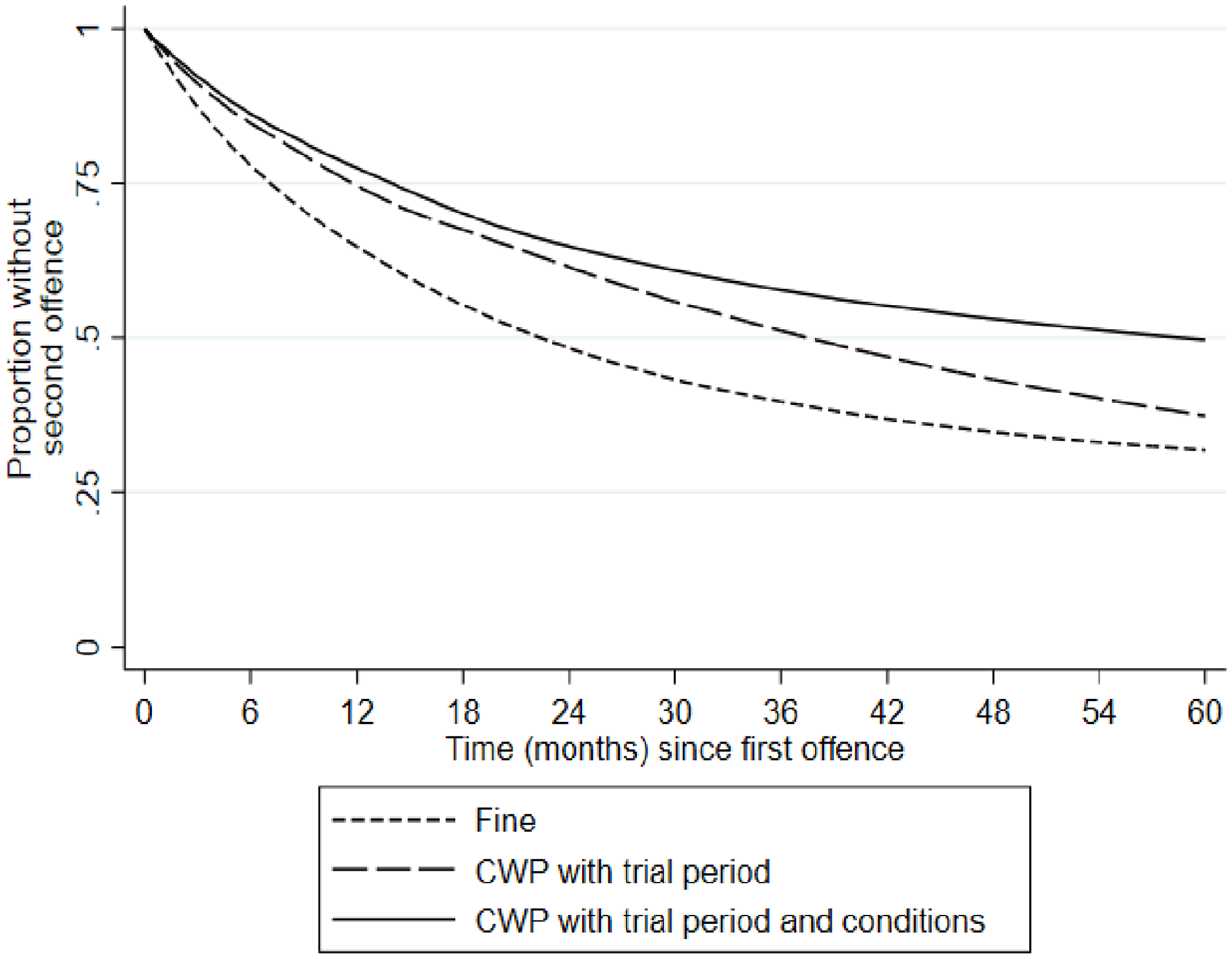
Survival functions for each sanction (sensitivity analysis).
Dependent variables
Information on criminal history was collected from the police register STRASAK, which is a register of criminal charges (not convictions). This is the preferred register for studies on reported crime in Norway, as it contains all persons who were alleged offenders at the end of police investigation (Skardhamar and Telle, 2012). Although sanctions are usually imposed in close proximity to minor drug offences, we chose decision date over offence date as the start of the follow-up. As for our main dependent variable – recidivism – we used the offence date rather than decision date, primarily to include those who reoffended during the follow-up period, but whose decision date came after (Andersen and Skardhamar, 2017). If data on offence date were not available, we used decision date as backup. Recidivism risk was then measured in months between the legal decision following the first drug offence and the second criminal offence. We started the count from the month after the initial decision and set maximum follow-up to 5 years (60 months). The number of offences used in the Poisson regression refers to all (new) offences registered in this follow-up period.
Independent variables
Information about sanctions was retrieved from a retrospectively updated decision code, showing the final legal decision after the case had passed through the criminal justice system. Sanctions were categorised as fine, CWP with trial period or CWP with trial period and specified conditions. We used information about police districts, which numbered 27 in the observation period, as our geographical unit. The age range at inclusion was narrow (15–17), but we nevertheless included age (in months since the 15th birthday) at first offence as a control. While generally short, the time (in months) between offence and legal decision may affect recidivism risk and was also included in the models.
Data from crime registries were linked with population, education and income administrative register data. This allowed us to control for confounders such as gender, immigrant status, several measures of family composition, parental education levels, household income and parental criminal history. Immigrant status was measured by indicators of whether the young person or either parent was born outside Norway. Family composition was measured by indicators of whether the adolescents lived with a married/cohabiting couple, single mother, single father or alone/in care at the age 15. The measure on parental education levels indicated whether at least one parent had completed basic, secondary, lower tertiary or higher tertiary education before the child reached age 16. Household net income was consumer price index(CPI)-adjusted and equalised by dividing it by the square root of household members (Organisation for Economic Co-operation and Development (OECD), 2020). The average of equalised income in the years when the child was 10 to 15 years old was used to measure socioeconomic status in the analysis. Parental criminal history was measured as lifetime prevalence of criminal charges, offering an approximation of criminal propensity in parents. These controls offered detailed background information on all offenders and improved our analysis of possible sanctioning effects on recidivism risk.
Results
As shown in Table 1, around half (53%) of the young people were fined for their first (drug) offence, while the rest received a CWP with trial period (16%) or trial period and conditions (31%). The sample was just over 16 years old on average when they were apprehended for their first offence. Unsurprisingly, the majority of offenders were boys, but compared with most crime samples, the gender gap was relatively small (Estrada et al., 2016). Close to 90% were born in Norway of parents also born there. Half of the sample (51%) lived with a married/cohabiting couple at age 15, while as many as 36% lived with their mothers only. Two thirds of the sample had parents with basic or secondary education as their highest educational attainment, and more than one third had at least one parent with a criminal record. Around half of the adolescents (52%) were registered with a new criminal offence within 5 years of the legal decision following first arrest. The number of offences in the 5-year follow-up period varied between 0 and 136, with an average of 4.9.
Summary statistics for young drug offenders.
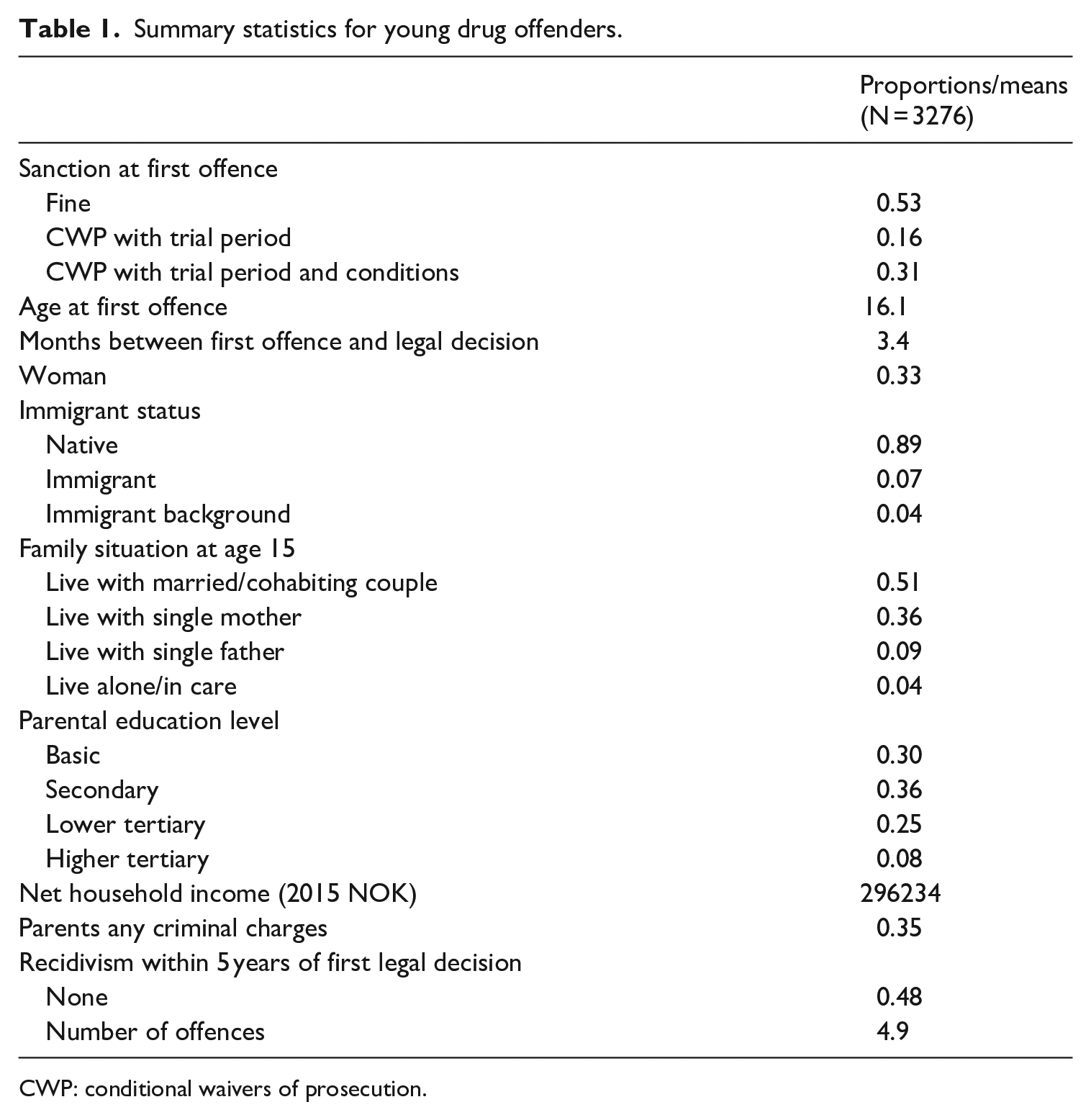
CWP: conditional waivers of prosecution.
Table 2 shows that the hazard of a second offence was significantly reduced for young people who received a CWP with trial period and conditions compared to those who were fined. The HR was 0.637 (with 95% confidence interval: 0.46–0.88), amounting to a 36% increase in time between the legal decision following first drug arrest and second offence. The effect of the CWP with trial period only was also negative on recidivism risk, but was not statistically significant. The other variables in the model were associated with the hazard of recidivism in largely expected ways. Individuals who were 15 years old (the age of criminal responsibility) at first offence were at significantly higher recidivism risk than their 16- and 17-year-old counterparts. Girls had a considerably lower risk of recidivism compared with boys (HR = 0.510). The two highest levels of parental education were significantly associated with lower recidivism risk, while parental crime was associated with a 30% shorter time span between the legal decision following first arrest and second offence (HR = 1.295).
Hazard rates (HR) of recidivism (second offence).
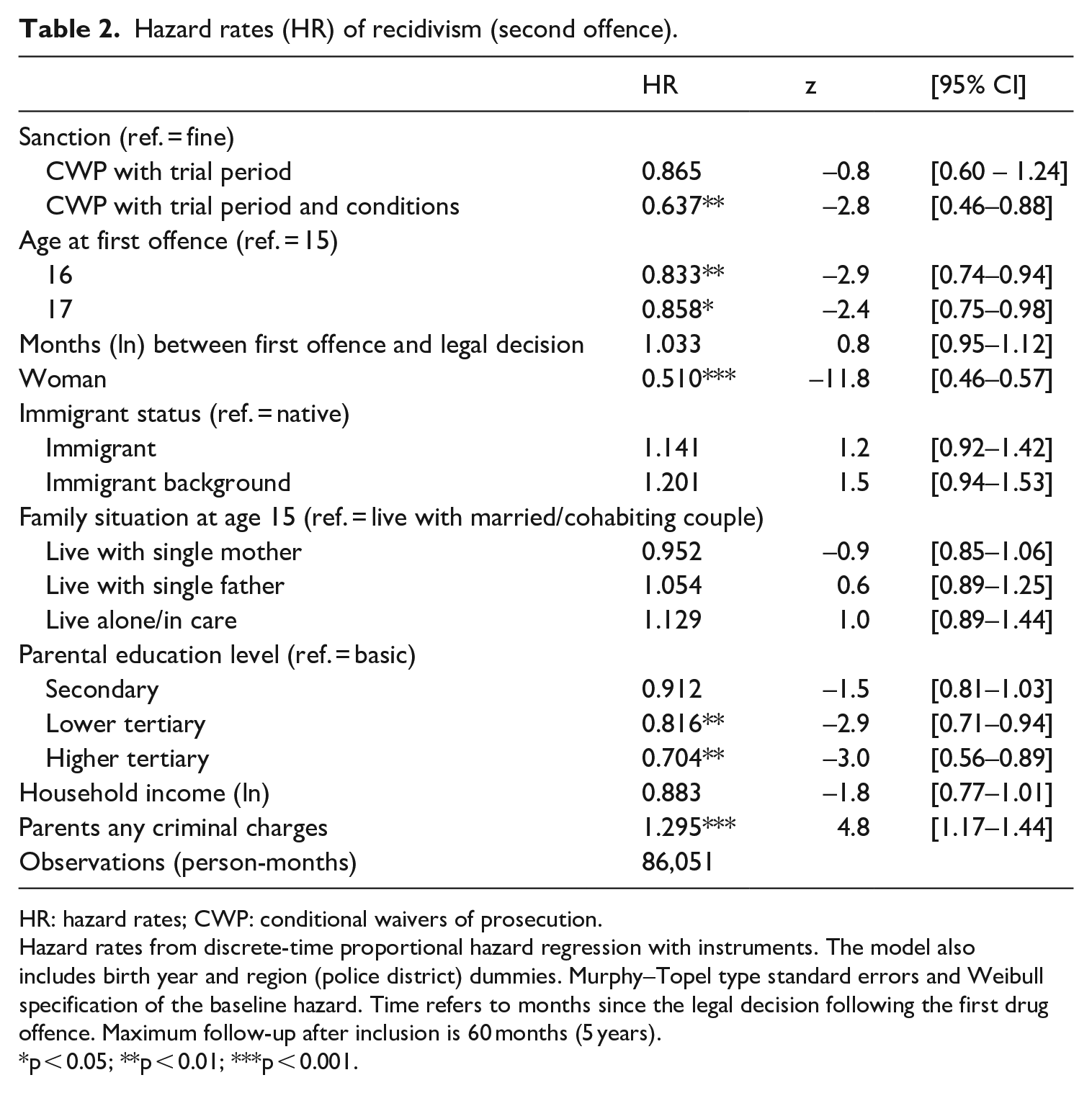
HR: hazard rates; CWP: conditional waivers of prosecution.
Hazard rates from discrete-time proportional hazard regression with instruments. The model also includes birth year and region (police district) dummies. Murphy–Topel type standard errors and Weibull specification of the baseline hazard. Time refers to months since the legal decision following the first drug offence. Maximum follow-up after inclusion is 60 months (5 years).
p < 0.05; **p < 0.01; ***p < 0.001.
In addition to the IV approach, we conducted a regression analysis where unobserved heterogeneity was explicitly accounted for (random-effects complementary log–log regression). As depicted in Table 3, the results were similar to the ones in the main model (Table 2), with the exception of the HR for young people receiving a CWP with trial period only. The hazard for second offence was lower (HR = 0.644) than the estimate in the IV analysis (HR = 0.865) and statistically significant (Model 1). The difference between results in Tables 2 and 3 reflects the greater efficiency of the latter model compared with the IV model. HRs for offenders who received a CWP with trial period only were not statistically significant in our separate analyses of police districts with either a majority of fines (Model 2) or a majority of CWPs with trial period and conditions (Model 3) in a given year. On the other hand, the hazard of a second offence was significantly reduced for young people who received a CWP with trial period and conditions compared to those who were fined across models. We found the strongest effect (HR = 0.372) in police districts that predominately deployed fines (Model 2), suggesting that the minority who received an alternative sanction in these regions constituted a more selected group of young offenders at a lower risk of reoffending. Perhaps this minority was deemed particularly suitable and/or motivated for an alternative sanction by prosecutors.
Hazard rates (HR) of recidivism (second offence).
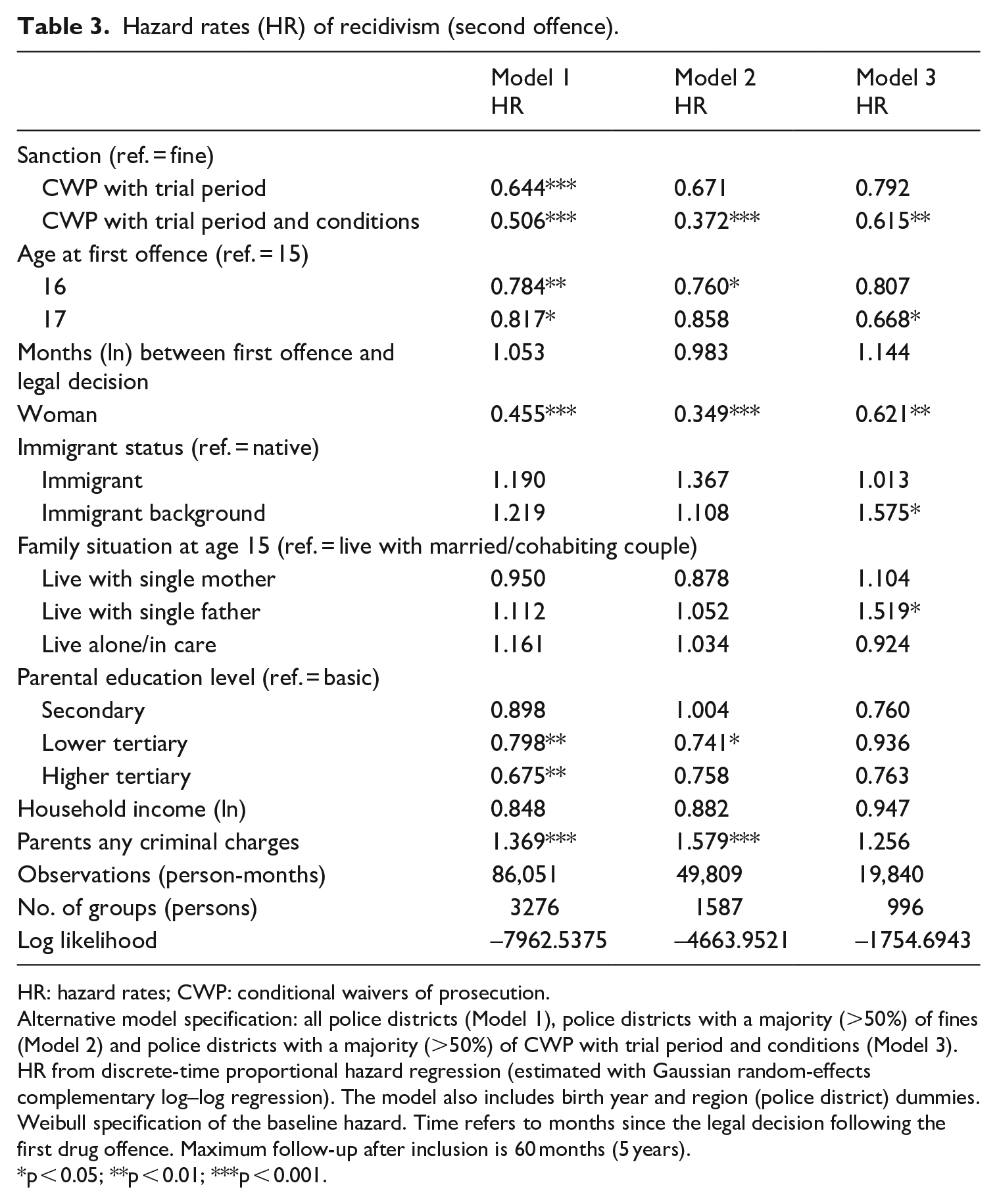
HR: hazard rates; CWP: conditional waivers of prosecution.
Alternative model specification: all police districts (Model 1), police districts with a majority (>50%) of fines (Model 2) and police districts with a majority (>50%) of CWP with trial period and conditions (Model 3).
HR from discrete-time proportional hazard regression (estimated with Gaussian random-effects complementary log–log regression). The model also includes birth year and region (police district) dummies. Weibull specification of the baseline hazard. Time refers to months since the legal decision following the first drug offence. Maximum follow-up after inclusion is 60 months (5 years).
p < 0.05; **p < 0.01; ***p < 0.001.
Table 4 shows the results from our model examining the number of offences in the observation period. Again, the imposition of CWPs at first arrest seemed to have a preventive effect compared with fines, amounting to a 20% and 52% reduction in the number of registered offences for CWP with trial period and CWP with trial period and conditions, respectively. Again, the sanction containing specified conditions had the largest impact on future offending (HR = 0.478), something that could imply prolonged effects of diversion programmes compared with monetary sanctions and minimal interventions.
Incidence risk rates (IRR) of recidivism (number of offences).
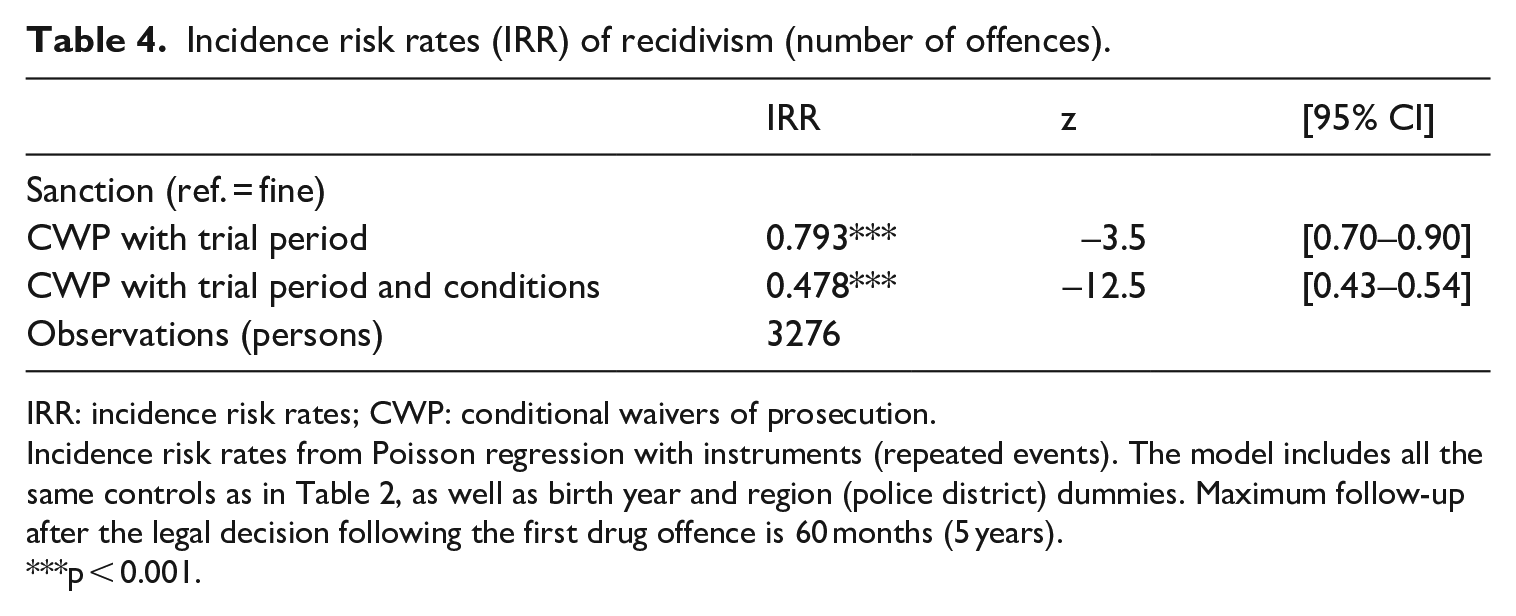
IRR: incidence risk rates; CWP: conditional waivers of prosecution.
Incidence risk rates from Poisson regression with instruments (repeated events). The model includes all the same controls as in Table 2, as well as birth year and region (police district) dummies. Maximum follow-up after the legal decision following the first drug offence is 60 months (5 years).
p < 0.001.
In order to test whether the reduced risk of recidivism following CWP with trial period and conditions (Table 2) was simply an incapacitation effect, we conducted a sensitivity analysis calculating the survival function for the three sanctions separately. As shown in Figure 1, the survival function did not change abruptly after the two first years for either of the CWPs, indicating that the sanctioning effects cannot be ascribed to incapacitation alone.
Discussion
Young drug offenders whose first encounter with the criminal justice system resulted in diversion to a desistance-oriented programme (CWP with trial period and conditions) were at lower recidivism risk compared with their fined counterparts. Our findings show a 36% reduction in the hazard of being registered with a second offence among young people in this alternative penal trajectory. Moreover, and interrelated with the lower recidivism risk following alternative sanctions, our analysis shows that both CWPs had a preventive effect on the number of registered offences in the 5 years following first legal decision. Taken together, these findings suggest that the sanction containing rehabilitative and supervisory elements did what it was intended to do, namely prevent crime better than a one-off monetary sanction.
While the impact of the minimal intervention (CWP with trial period only) varied across models, the effects of the CWP with specified conditions were consistently negative on recidivism. This accentuates the deterrent effect of the follow-up (counselling, drug testing etc.) activated by the conditions. Why are these measures seemingly more effective than a trial period or a monetary sanction? Diversion with interventions may do two things simultaneously (Petrosino et al., 2010). First, the CWP with conditions may be more effective because the legal response links the young people to more effective services (rehabilitative effect). The social work contribution to criminal justice has been strengthened through the implementation of these sanctions (McAra, 2005). This wider system of rehabilitation and reintegration, characteristic of penal welfarism, may produce desirable outcomes in young people. Second, the interventions provided may be more effective because they are perceived as more unpleasant and intrusive than their alternatives (Petrosino et al., 2010). Qualitative research on young people who received follow-up for drug offences substantiates this interpretation (Sandøy, 2020). Hence, the CWP with trial period and conditions may be more effective both because it works better than a fine and because it is experienced as worse.
Informal sanctions, in the form of damaged relationships with parents and peers, may be of greater importance for future offending than formal sanctions (Huizinga and Henry, 2008). The different sanctions under study here may activate different forms and levels of informal social control, which may serve as intervening mechanisms between the initial legal decision and the second offence (Smith and Paternoster, 1990). Given the longer duration and, in the case of the CWP with specified conditions, higher intensity of alternative sanctions compared with fines, it is likely that these interventions activate more persistent and frequent follow-up by parents or other family members than a one-off monetary sanction. Interrelated research has indicated how participation in the diversion programmes was intertwined with relationships with significant others (Sandøy, 2019). In the correctional programme context, the young people stopped (or postponed) offending primarily to restore broken social bonds (see also Wiley et al., 2013). For several, this may take the form of sanction-avoidance strategies (Moeller et al., 2016). Accordingly, the CWPs with trial period and conditions may defer rather than deter future criminal involvement. However, the differential effects on the number of offences and the analysis underpinning Figure 1 may suggest durable effects of diversion with interventions.
Through CWPs with trial period and conditions, the state deploys positive and seemingly effective penal power in lieu of monetary sanctions. As indicated above, the effectiveness of this sanction may be a result of the ‘alliance’ between rehabilitation and punishment inherent in the alternative sanctions (Robinson, 2008: 435). Viewed as a form of ‘care-driven control’, the CWP with specified conditions fit the picture of the double-sided Scandinavian welfare sanction (Barker, 2013). Despite promising crime-reducing potential, welfare sanctions should not be described as an ‘automatic good’ (Flacks, 2014: 290). Under the auspices of the positive agenda, rehabilitative efforts may easily be decoupled from the constraints of proportionality (McNeill, 2016). For the young offenders, the counselling and supervision meted out through alternative sanctions are evidently more costly than paying a fine (Sandøy, 2020). When social work contributions to criminal justice are re-legitimised (McAra, 2005), trade-offs between rehabilitative considerations grounded in a social work logic, and principles of proportionality grounded in a judicial logic, become pronounced. Young drug offenders may well be in need of major interventions, yet their offences are minor. This accentuates the problem of reducing youth justice success to measures of reoffending (Bateman and Wigzell, 2020). When the effectiveness of sanctions is assessed primarily in relation to their crime-reducing potential, other aspects of young people’s legal and social situations may be downplayed.
Strengths and limitations
Through the register data set, we were able to follow the criminal trajectories of the entire population of 15- to 17-year-old drug offenders in Norway. Moreover, by linking this information with other administrative registries, we could include a wide range of controls in our models. This allowed for estimations of recidivism risk following contact with the shallow end of the justice system on a national level. Despite the extensiveness of data, we still lack information on some factors that have been shown to predict recidivism, including neighbourhood effects, leisure activities, personality traits, the educational progress of the young people themselves and genetic inheritance (Cuervo and Villanueva, 2015; Motz et al., 2019).
By using registered and not self-reported crime as outcome, we measured the effects of sanctioning on future arrests and not offending behaviour (Huizinga and Henry, 2008). Whereas this is not a limitation in and of itself, there is a difference between studies of rearrest risk and reoffending risk (Liberman et al., 2014). However, since we estimate differential sanction effects in a sample of arrestees without priors, our results are not directly affected by differences in police exposure at inclusion.
When analysing non-experimental data, selection bias may influence the associations between sanctions and recidivism. If high-risk young people receive more severe punishments, the likelihood of recidivism will probably be proportional to punishment severity. Our main solution to this potential ‘selection artifact’ (Smith and Paternoster, 1990) was to make the sample as homogeneous as possible and compare the trajectories of comparable low-level drug offenders with no registered priors. Moreover, we used an IV approach to account for possible remaining non-random selection. We considered our instrument to be a strong indicator of the probability of receiving the sanctions under study, without having a direct impact on recidivism. For this to hold, adolescent drug offenders should not be systematically different at times/places of low and high CWP implementation. This may be a problematic assumption, if the availability of alternative penal measures widens the net of criminal justice systems (Aebi et al., 2015). If the availability of correctional programmes led to an increase in the criminal processing of low-risk young people (less prone to crime), our instrument would be associated with initial sanctioning as well as recidivism risk. Consequently, we also accounted for unobserved heterogeneity in an alternate complementary log–log regression model, capturing unmeasured correlates of recidivism. In sum, all models, including the one using the number of offences as the outcome measure, suggested that the CWP with trial period and conditions was more effective in preventing recidivism than a fine.
One limitation in this study, which applies to multiple studies of sanction effects, is the lack of contextual information about the sanctioning (Morris and Piquero, 2013). Sanction effects are contingent on the personal interpretations and emotional reactions to the sanction, as well as the relationship between the sanctioner and sanctioned (Sherman, 1993). The general problem of bridging the gap between research and real-world practice is therefore applicable to the findings in this study. We have a good deal contextual information about the content of the alternative sanctions (Sandøy, 2019), but actual content was not linked to the register data. As such, this is not a study of the effectiveness of any measures in particular (e.g. drug testing), but the effectiveness of any intervention and/or minimal intervention over fines.
Conclusion
This study adds to the research literature by comparing the effects of noncustodial sanctions on the shallow end of the justice system, as opposed to comparing custodial with noncustodial sentences. Our findings suggest that alternative sanctions, in the form of a conditional waiver of prosecution with specified conditions, are more effective in preventing recidivism in adolescent first-time drug offenders than the traditional fine. Given the design of this sanction, which often includes follow-up by social services and/or monitoring of drug use by health services, deferrals in recidivism may be caused by both positive rehabilitation experiences and negative punishment experiences. Overall, the findings are supportive of the crime-reducing potential of diversionary measures in the Norwegian justice system. As youth justice success should not be reduced to measures of reoffending only, there is a continual need for assessments of the duration and intrusiveness of evolving youth justice practices.
Footnotes
Acknowledgements
Sincere thanks to Professor Sveinung Sandberg and Professor Thomas Ugelvik for their feedback on the manuscript and to the two anonymous reviewers for invaluable comments.
Declaration of Conflicting Interests
The author(s) declared no potential conflicts of interest with respect to the research, authorship, and/or publication of this article.
Funding
The author(s) disclosed receipt of the following financial support for the research, authorship and/or publication of this article: The study was supported by the Norwegian Directorate of Health and the Ministry of Justice and Public Security. The findings, interpretations and conclusions in this article are those of the authors and do not necessarily reflect those of the funding agencies.
