



Abstract
To date, limited systematic focus has been directed to examining factors that influence the spatial behaviour of missing people. Accordingly, this study examined whether demographic and behavioural factors were related to distance between missing and found locations in 16,454 archival cases of missing reports from two UK police forces. Findings from ordinal regressions showed that children were more likely to be found at further distances if they were deemed to be at high or medium risk of coming to harm but less likely to be located further away when victims of a violent attack. Adults were more likely to be found at further distances if planning behaviours were present (e.g. had taken their passport), but less likely to if they were above the age of 65 years or suffering from abuse. Findings indicate the role of age, planning and vulnerability on travel when missing. Implications for search strategies and directions for future research are considered.
Introduction
In 2019 and 2020, police forces in England and Wales reported 325,171 missing incidents (2% increase on 2018 and 2019; National Crime Agency, 2021). Responding to missing incidents is resource intensive but police numbers have decreased by 14% over the past decade due to austerity measures, creating pressure for police to do more with less. Developing a robust evidence base that improves understanding of spatial behaviour in missing people would be beneficial for informing search strategy (Shalev et al., 2009), helping police to utilise finite resources more effectively. To date, however, only a few studies have focused on spatial behaviour in missing people, and these have used either qualitative (Stevenson et al., 2013) or descriptive methods (Eales, 2016; Gibb and Woolnough, 2007). Findings indicate that spatial behaviour may be related to demographic and behavioural factors, but this has yet to be systematically examined using inferential statistics (Taylor et al., 2019).
Spatial behaviour has received greater research focus within the criminal offending domain, with findings showing the influence of factors such as age, gender, experience and planning on distance travelled (Snook, 2004). While going missing is not a crime (Taylor et al., 2019), in the absence of missing persons research, this study draws on literature from the offending domain to begin developing an understanding of missing journeys (e.g. journey-to-crime research and models from environmental criminology), as well as the limited research on missing persons’ spatial behaviour. Examining 16,454 archival cases of missing children and adults reported to two UK police forces, we test whether demographic (e.g. age, gender) and behavioural (e.g. planning, antecedent vulnerabilities, missing history) factors influence the distance between where people go missing from and where they are found. This will allow arguments to be put forward regarding how missing people may make travel decisions while missing and how factors such as impulsivity might influence these decisions. Findings will be beneficial for informing police search strategies and broadening understanding of the processes that govern spatial behaviour.
Journey-to-crime research and theoretical underpinnings
In the absence of a well-developed body of research into spatial behaviour in missing people, we draw on the journey-to-crime literature to begin developing a model of missing spatial behaviour. Most research examining offender spatial behaviour centres around examining the relationship between the location of the offender’s base or measuring the distances between home location and crime location (also called ‘journey to crime’ research). Typically, research shows these distances to be short, even across a range of different crime types (see Townsley and Sidebottom, 2010). Similarly, when examining aggregate crime data, the frequency of crimes committed decreases or ‘decays’ as the distance from an offender’s home base increases (Turner, 1969). A similar pattern is also present within missing persons’ populations, with people tending to be found a short distance from where they went missing (Shalev et al., 2009).
Various ideas have been drawn from environmental criminology theories to understand why offenders often exhibit short journey-to-crime distances. Routine Activity Theory (Cohen and Felson, 1979), for example, proposes that offenders will come across opportunities to offend through their daily, routine activities. Crime Pattern Theory (Brantingham and Brantingham, 1981) extends this notion by positing that spatial behaviour is guided by an internal awareness space, or mental map that develops through experience. According to Rational Choice Theory (Cornish and Clarke, 1986), offenders’ decision-making also plays an important role within crimes, with offenders seeming to act in a rational, problem-solving manner, even in the most expressive, violent crimes. Thus, before action occurs, offenders will weigh up the potential costs (e.g. the risk of apprehension) and benefits (e.g. for monetary gain) of committing the crime. Taken together, these theories suggest that offending close to home (but not too close) has its benefits, including greater awareness of opportunities and how to navigate spaces, along with reduced effort (C/F the Least Effort Principle, Zipf, 1965). These theories can also explain variations in offenders’ spatial behaviour; for example, how mental maps can become more populated and far-reaching as age and experience increase, or how offenders may choose to travel further afield when they have greater access to resources (e.g. as they get older). Indeed, aspects of the offender and the offence (such as age, gender, previous convictions) seem to be related to journey to crime distances (e.g. Baldwin and Bottoms, 1976; Canter and Gregory, 1994; Davies and Dale, 1995; Gabor and Gottheil, 1984; Rengert, 1975; Rhodes and Conly, 1981). This study will explore whether such aspects play a role in distance travelled while missing and offer suggestions for why.
Age and gender
Descriptive studies with both offender (Andresen et al., 2014; Baldwin and Bottoms, 1976; Canter and Gregory, 1994; Davies and Dale, 1995; Gabor and Gottheil, 1984; Rhodes and Conly, 1981) and missing populations (Eales, 2016) show that distance travelled increases with age and then decreases in older populations. The few instances of children being found further away are the result of being abducted by a parent or mistakenly reported missing (Gibb and Woolnough, 2007). Journey-to-crime literature suggests that children travel shorter distances because they have a narrower understanding of their environment, restricted access to resources (such as transport and money) and are subject to parental control (Brantingham and Brantingham, 1981; Costello and Wiles, 2001). Spatial behaviours in missing populations may be affected by similar factors with distance travelled increasing in teenagers and adults as they are able to use public transport (Eales, 2016; Gibb and Woolnough, 2007), and develop more complex mental maps that govern their spatial behaviour (Brantingham and Brantingham, 1981). In older populations, travelling distance may decrease due to mobility issues and age-related dementia (Koester and Stooksbury, 1995; Silverstein et al., 2006). People living with severe dementia symptoms often travel on foot and in a manner indicative of random wandering (Gibb and Woolnough, 2007; Koester and Stooksbury, 1995; Silverstein et al., 2006). Those with milder symptoms are more likely to exhibit goal-driven spatial behaviour, travel to more familiar areas (e.g. previous home) and use public transport (Gibb and Woolnough, 2007).
Gender differences in spatial behaviour have also been observed within the offending literature, with men travelling further than women across a range of crime types (Gabor and Gottheil, 1984; Groff et al., 2001; Nicholls, 1980; Pettiway, 1995; Rengert, 1975). However, age has also been identified as a factor in these differences with women and younger men travelling shorter distances when drug dealing (Johnson et al., 2013; Levine and Lee, 2009). In general populations, studies also show women tending to travel shorter daily distances than men, using cars less and public transport more (see Hanson, 2010, for a review). Causes are complex, but assumptions have been made that female mobility patterns could be shaped by traditional gender and work roles, and fear of violence (Hanson, 2010). To the authors’ knowledge, no published research has considered whether there are any broad gender differences in distance travelled while missing, although some studies have examined this within specific sub-types of missing persons. For example, males living with dementia or depression are more likely to travel further than their female counterparts (Gibb and Woolnough, 2007), but missing suicidal females can travel further than males (Eales, 2016; Gibb and Woolnough, 2007; Stevens et al., 2019).
Based on these previous findings, we predict that there will be a relationship between age and the spatial behaviour of missing people, with younger children and older adult populations less likely to be found at further distance from where they went missing. We also predict a gender difference with males more likely to be found further from where they went missing than females.
Planning
Previous research has shown links between spatial behaviour and planning. Within the criminal domain, longer journey to crime distances are associated with a degree of planning (Santtila et al., 2007; van Koppen and Jansen, 1998; Warren et al., 1998), whereas shorter distances are associated with more impulsive crimes (LeBeau, 1987). Planning activities may include individuals familiarising themselves with new routes and areas that are farther afield, or other activities that could help offenders evade detection (e.g. prior knowledge of CCTV). In missing persons cases, planning may include behaviours such as booking hotels, packing and withdrawing money (Stevenson et al., 2013), which indicate the forethought of travelling longer distances. However, there is a lack of research specifically focusing on relationships between planning and spatial behaviour in missing people. It is possible that those who plan to leave travel further afield to avoid detection, taking practical steps to secure the resources needed to do so (e.g. taking passport or withdrawing funds). In contrast, those who leave spontaneously because of a ‘trigger event’ may be less likely to travel longer distances to seek immediate safety (or to have the resources to do so). However, this has yet to be tested.
Risk and vulnerability
Although most missing persons are found quickly and return voluntarily, a major challenge in police investigations is to identify cases that need a swift and urgent response and to prioritise those where the person missing is at most risk of harm. In the United Kingdom, the College of Policing’s Authorised Professional Practice (APP) for missing outlines how police and policing staff should discharge their responsibilities when investigating missing (College of Policing, 2016). According to the APP, the responding officer should make an initial risk assessment in each missing person case of either low (no danger to the missing person), medium (the missing person is likely to be subject to danger), or high (the person is in immediate danger). An example of a person being in immediate danger would include if they were thought likely to attempt suicide. Resources are allocated and deployed according to this risk level. Considering how risk level could be related to an individual’s spatial behaviour while missing poses important implications for informing search parameters. For example, distances travelled while missing could be short when risk of harm is deemed high if police or search teams are able to recover the individual quickly. Conversely, a person deemed at high risk (e.g. at risk of suicide) may be less likely to return to where they went missing from and therefore, distance between missing and found may be longer than a case deemed medium or low risk. The relationship between risk assessment and spatial behaviour is yet to be explored in empirical research.
Likewise, factors closely related to risk assessment and the part that these factors play in influencing a missing person’s spatial behaviour are also under-researched. ‘Antecedents’ are actions or events that happen to either children or adults prior to going missing (Taylor et al., 2019). Although antecedents to go missing may be experienced differently by children and adults (Biehal et al., 2003), one factor that is common among both groups is mental health issues (Biehal et al., 2003; Gibb and Woolnough, 2007; Henderson et al., 2000). Some people go missing with the intention of taking their own life or consider suicide while missing (Foy, 2006; Stevenson et al., 2013). Many go missing from mental health institutions due to concerns about family and home life, getting bad news (Beer et al., 2009), fear of staff or other patients (Gerace et al., 2015) and feelings such as boredom and frustration (Beer et al., 2009; Taylor et al., 2019). A disproportionate number of children also go missing from residential care (e.g. Abrahams and Mungall, 1992) to either escape from problems or to go somewhere or to someone (commonly family and friends; Finkelstein et al., 2004; Ofsted, 2012). Evidence indicates that mental health issues influence distance travelled; for example, males with a diagnosis of depression tend to travel further distances than those at risk of suicide (Gibb and Woolnough, 2007). This could be because they are wandering to think, looking to escape and/or avoid detection (Stevenson et al., 2013). However, some people at risk of suicide may travel further because they have a particular place in mind to consider taking their own life (Gibb and Woolnough, 2007), referred to as ‘suicide tourism’ (Hannon et al., 2009).
Other antecedents associated with going missing include sexual, physical, and domestic abuse (Tarling and Burrows, 2004), relationship difficulties, breakdowns, and family conflict (Zerger et al., 2008), social difficulties (Payne, 1995), drug and alcohol abuse (Stevenson et al., 2013), and financial difficulties and employment problems (Biehal et al., 2003). Unlike mental health issues, there is a paucity of research that examines how these risks and vulnerabilities may be related to spatial behaviour while going missing. What previous literature does indicate is that, increasingly, people with complex mental health and learning needs (British Medical Association, 2020) and children in residential care (Foster, 2019) are being placed a long way from their family and community. Consequently, if they go missing to be closer to friends and family, they are likely to travel greater distances. It is also possible that those who are ‘triggered’ to go missing spontaneously due to a particular event (such as being attacked) seek refuge somewhere close by due to lack of planning and familiarity. In contrast, those who go missing to escape an ongoing adverse situation such as domestic abuse or financial difficulties may plan to leave, and thus, travel further to evade detection.
Based on these previous findings, we predict that children and adults are more likely to travel further distances if they are experiencing ongoing adverse situations such as complex mental health, financial or employment issues, living in care, and drug, alcohol, or domestic abuse than if they go missing due to a spontaneous event such as being attacked.
Aim of the study
Although a few studies have examined the spatial behaviour of missing persons, research suggests that individuals are usually located close to where they went missing. No studies have considered whether individual demographics or behavioural aspects of the cases significantly influence the spatial behaviour of missing persons. Accordingly, the aim of this study is to consider whether demographics (age, gender) and behaviour (planning, risk and vulnerability) are associated with distance between missing and found in both children and adults. The findings of this research will be beneficial for developing our theoretical understanding of the processes that govern special behaviour, in addition to providing support for informing police missing person search strategies.
Method
Sample
The sample comprised solved missing reports recorded by two UK police forces between 1 April 2017 and 31 March 2018. Cases were examined, rather than individuals; so the dataset will have included repeat incidents. Due to the data being anonymised by police prior to being analysed, it was not possible to determine how many of these incidents involved the same person. However, the proportion of both children and adults who had previously been reported missing before was high (86.1% and 51.9%, respectively).
Of the 16,454 cases identified, 4967 (30.2%) were adults and 11,487 (69.8%) were children. In the adult sample, the mean age was 40.1 (SD = 17.5, range 18–95 years). For the children, the mean age was 14.4 (SD = 2.05; range 0–17 years). In the adult sample, 62.8% (n = 3120) were male, 37.1% (n = 1941) were female and 0.1% (n = 5) were transgender. In the child sample, 50.7% (n = 5826) were male, 49.2% (n = 5647) were female and 0.1% were transgender (n = 11). The most frequent risk categorisation for both children and adults was medium risk (children = 91.2%, adults = 68.4%). Overall, 1.7% (n = 192) of missing children cases resulted in a harmful outcome for the person going missing, while this was 6.6% (n = 328) in the adult sample.
Procedure
Variables
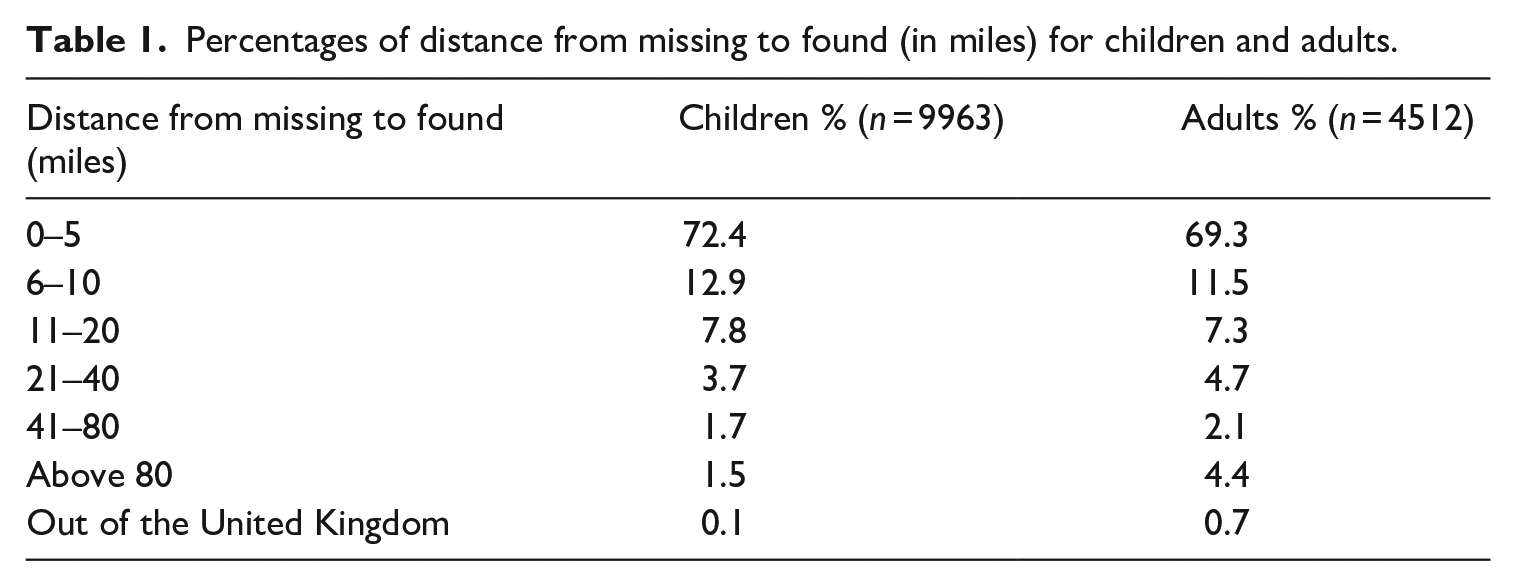
Categorical and continuous variables were derived from the forces’ missing person case management system. The outcome variable in this study was distance between the location from where the person had gone missing (missing location) and location where the person was located (found location), measured in miles. This was calculated by the respective police forces using the geocodes (grid references) for each of these addresses (x and y map co-ordinates) and calculating the Euclidian (‘crow-flies’) distances between the two given points using Pythagoras theorem. The distance data were released for this research in intervals, to protect the anonymity of the missing persons. Therefore, for each case, the distance from missing to found were recorded as being one of the following distance intervals: 0–5 miles, 6–10 miles, 11–20 miles, 21–40 miles, 41–80 miles, above 80 miles, and out of the United Kingdom.
The demographic and behavioural variables used as independent variables in the current study were derived directly from the police database. These included the continuous variables of age (in years) and categorical variables sex (male/female/transgender), and risk of coming to harm (low/medium/high). The following behavioural variables were all coded dichotomously (where 0 = absence of the variable and 1 = presence of the variable): preparation for absence, possession of a passport, mental health issue, suicide (risk of), Mental Health Act Order, schizophrenia or psychotic disorder, personality disorder, unknown mental health issue, absconder, care order, vulnerable, subject of crime, out of character, reason, family/relationship problems/conflict/abuse, child protection plan, suffered harm while missing previously, lacks ability to interact with others, essential medication, ongoing bullying/harassment, involved in violent or racists incident, education/employment/financial problems, drug, alcohol dependency, other risk factor, disability, visual disability, auditory disability, mobility disability, learning, disability and unknown disability.
Analysis
Ordinal regressions were used to examine the relationship between distance from missing to found and the demographic and behavioural variables. This allows the prediction of an ordinal outcome variable from one or more independent variables. Bivariate regressions were carried out to examine the individual impact independent variables had on the distance between missing. Odds ratios (OR) were calculated; those greater than one show that higher distance intervals are more likely for missing cases where the variable is present. When the OR is lower than one, higher distance intervals are less likely.
Before carrying out each regression, the assumption of the Test of Parallel Lines was examined. This considers whether the slope coefficients across all response categories (each level of the independent variable) are the same in each model. This study seeks to compare across categories, which means that coefficients would be expected to be different. Thus, if the Test of Parallel Lines is significant, slopes are assumed to have similar coefficients, and the regression would not be a useful way of examining the data. Several variables in each sub-sample were not included in the analysis as this assumption was violated. 1
Results
Distance from missing to found
Overall, most people were found less than 5 miles from where they went missing. There was a significant difference between children and adults (Table 1), with a higher percentage of children (72.4%) being found within this distance interval compared with adults (69.3%), χ2 = 14.98, df = 1, p < .001.
Percentages of distance from missing to found (in miles) for children and adults.
The section below outlines how each demographic and behavioural variable relates to distance from missing to found in both children and adults and should be considered in relation to Tables 2 and 3. These show the variables that yielded significant final models predicting the dependent variable (distance from missing to found) better than the intercept-only model alone.
Unstandardised beta coefficients (standard errors) and odds ratios (OR) from ordinal logistic regression predicting distance from missing to found (in miles) for children (N = 9963).
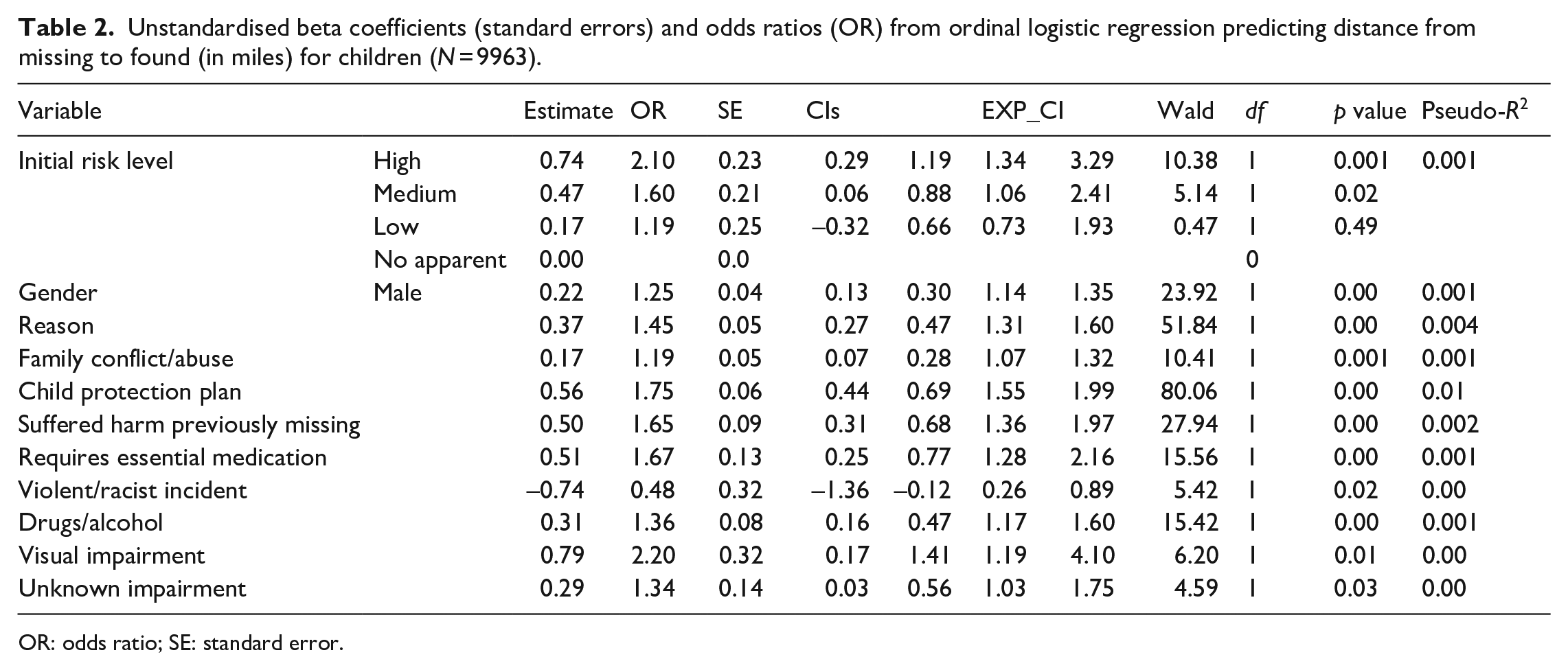
OR: odds ratio; SE: standard error.
Unstandardised beta coefficients (standard errors) and odds ratios (OR) from ordinal logistic regression predicting distance from missing to found (in miles) for adults (N = 4512).
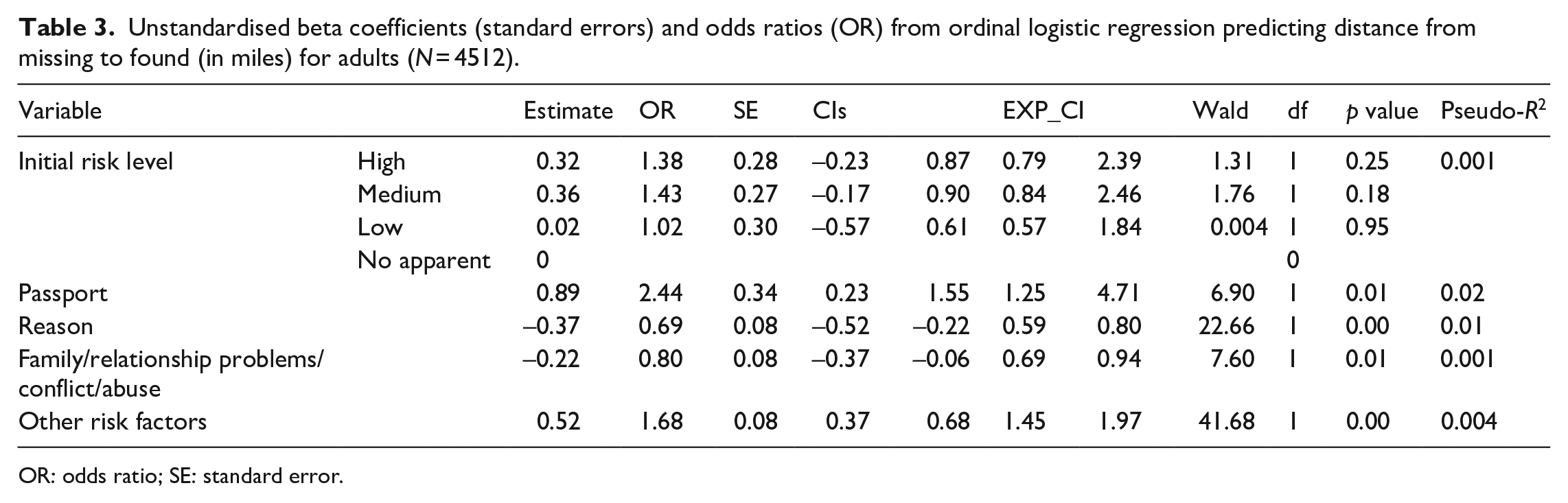
OR: odds ratio; SE: standard error.
The pseudo-R2 (McFadden, 1973) indicates how much of the variance is explained by each variable. This value was relatively low for all variables, indicating that a substantial amount of variation is not explained by the models generated. Values with the higher pseudo-R2 values were seen for the following variables; for adults, passport (0.2% of the variance) and for children, child protection plan (0.1% of the variance).
Age and age-related issues
There was no significant relationship between age in adults overall and distance between missing and found (χ2 = 3.84, df = 1, p = 0.05). However, adults aged 65 years or above were significantly less likely to be located at a greater distance from where they went missing than those who were below 65 years, B = −0.05, SE = 0.01, 95% CI = −0.08 to −0.02, p ⩽ 0.001 (0.95 times likely to be located further away).
Gender
For the child sample, the final model was a significant fit to the data: χ2 = 23.97, df = 1, p ⩽ 0.001. Compared with female children, males were 1.25 times more likely to be located at a greater distance from where they went missing, B = 0.22, SE = 0.04, 95% CI = 0.13 to 0.30, p ⩽ 0.001.
Planning
For adults, the final model was a significant fit to the data: χ 2 = 6.57, df = 1, p = 0.01. Those who were known to be in possession of their passport were 2.44 times more likely to be found at a greater distance from where they went missing than those known not to be in possession of their passport, B = 0.89, SE = 0.34, 95% CI = 0.23 to 1.55, p = 0.01.
Mental health and suicide
No significant results were found for mental health and risk of suicide in both the child and adult samples.
Risk and vulnerability
Risk. In the child sample, the final model was significant, χ2 = 17.09, df = 3, p = 0.001. Those who were deemed to be at high risk of harm were 2.10 times more likely to be found at a greater distance from where they went missing than those deemed as at no apparent risk, B = 0.74, SE = 0.23, 95% CI = 0.29 to 1.19, p = 0.001. Those who were deemed to be at medium risk of harm were 1.60 times more likely to be found at a greater distance from where they went missing than those deemed to be at no apparent risk, B = 0.47, SE = 0.21, 95% CI = 0.06 to 0.88, p = 0.02. There was no significant relationship between the distance from missing to found and those in the low-risk group when compared to the high-risk group, B = 0.17, SE = 0.25, 95% CI = −0.32 to 0.66, p > 0.05. Those at medium and high risk of harm are significantly more likely to be found at a greater distance to where they went missing.
For adults, the final model was also significant, χ2 = 8.53, df = 3, p = 0.036. However, there was no significant differences between the distances from missing to found for those who were deemed to be low, medium or high risk while missing compared with those at no apparent risk. This may mean that, together, any risk category other than no apparent risk may be useful in predicting distance (i.e. someone is more likely to be found at a greater distance if they are classified as any category above no apparent risk), individually, they do not hold predictive power.
Reason for going missing
The final model for children was significant, χ2 = 51.56, df = 1, p = 0.000. Those that had a reason for going missing were 1.45 times more likely to be found at a greater distance from where they went missing than those who did not, B = 0.37, SE = 0.05, 95% CI = 0.27 to 0.47, p = 0.000.
For adults, the final model was a significant fit to the data, χ2 = 22.57, df = 1, p = 0.000. Those without a reason for going missing were 1.45 times more likely to be found at a greater distance from where they went missing than those who had a reason, B = −0.37, SE = 0.08, 95% CI = −0.52 to −0.22, p = 0.000.
Family or relationship problems
In the children sample, the final regression model was significant for conflict or abuse, χ2 = 10.29, df = 1, p = 0.001. Those who were thought to be experiencing conflict or abuse were 1.19 times more likely to be found at a greater distance from where they went missing than those who were not, B = 0.17, SE = 0.05, 95% CI = 0.07 to 0.28, p = 0.001.
For adults, the final regression model was significant, χ2 = 7.45, df = 1, p = 0.006. Those who were thought to have experienced family or relationship problems or conflict or abuse were 1.25 times more likely to be found at a greater distance from where they went missing compared to adults who were not thought to have experienced these problems, B = −0.22, SE = 0.08, 95% CI = −0.37 to −0.06, p = 0.006.
Child protection plan
In the child sample, the final model was significant, χ2 = 76.00, df = 1, p = 0.000. Those who were subject to a child protection plan were 1.75 times more likely to be found at a greater distance from where they went missing compared with those who were not subject to a child protection plan, B = 0.56, SE = 0.06, 95% CI = 0.44 to 0.69, p = 0.000.
Suffering harm in a previous missing episode
For children, the final regression model was a significant fit to the data, χ2 = 67.81, df = 1, p = 0.000. Those who had suffered harm in a previous missing episode were 1.65 times more likely to be found at a greater distance from where they went missing than those who had not suffered harm in a previous missing episode, B = 0.50, SE = 0.09, 95% CI = 0.31 to 0.68, p = 0.000.
Requiring essential medication
Within the children’s sample the final model was significant, χ2 = 14.88, df = 1, p = 0.000. Those who required essential medication were 1.65 times more likely to be found at a greater distance from where they went missing than those who did not, B = 0.51, SE = 0.13, 95% CI = 0.26 to 0.77, p = 0.000.
Involved in a violent and/or racist incident
For children, the final regression model was a significant fit to the data, χ2 = 6.47, df = 1, p = 0.011. Those who were involved in a violent and/or racist incident were less likely to be found at a greater distance from where they went missing compared with those who were not involved in such an incident, B = −0.74, SE = 0.32, 95% CI = −1.36 to −0.12, p = 0.02. (0.48 times as likely to be found at a greater distance).
Drug or alcohol issues
In the child sample, the regression model was significant, χ2 = 14.65, df = 1, p = 0.000. Those who had a drug or alcohol dependency were 1.36 times more likely to be found at a greater distance from where they went missing than those who did not, B = 0.31, SE = 0.08, 95% CI = 0.16 to 0.47, p = 0.00.
Other risk factors
For adults, the regression model was a significant fit to the data, χ2 = 39.71, df = 1, p = 0.000. Those who had other risk factors present were 1.68 times more likely to be found at a greater distance from where they went missing than those who did not, B = 0.52, SE = 0.08, 95% CI = 0.37 to 0.68, p = 0.00.
Disability
Visual impairment
In the child sample, the final regression model was a significant fit, χ2 = 5.64, df = 1, p = 0.018. Those who had a visual impairment were 2.20 times more likely to be found at a greater distance from where they went missing than those who did not, B = 0.79, SE = 0.32, 95% CI = 0.17 to 1.41, p = 0.013.
Unknown disability
The model was significant in the sample of children, χ2 = 4.48, df = 1, p = 0.03. Those who had an unknown disability were 1.34 times more likely to be found at a greater distance from where they went missing than those who did not, B = 0.29, SE = 0.14, 95% CI = 0.03 to 0.58, p = 0.03.
For adults, the regression model was not a significant fit, χ2 = 0.09, df = 1, p = 0.76.
Discussion
Using the data from two UK police forces, this study examined whether particular features of cases and the individuals who went missing influenced their spatial behaviour. Supporting previous research into distance travelled while missing (Gibb and Woolnough, 2007) most missing persons were located less than 5 miles from where they went missing. However, several demographic and behavioural factors were found to influence this spatial behaviour.
One key finding from this study is that there seem to be many more factors that influence missing children’s spatial behaviour than adults. The higher number of significant relationships between profiles of children and their spatial behaviour gives further support for the importance of examining children and adults separately and considering missing persons as a heterogeneous group (Biehal et al., 2003).
It is also clear that indications of mental health issues and risk of suicide may need to be considered differently when examining how they may influence missing persons’ spatial behaviour. Within this study, no linear relationship was found between these factors and distance from missing to found. It may be that other types of modelling are more appropriate, or that other demographic and behavioural factors may play a role in influencing this relationship. Previous research has shown that there may be some intersectionality involved; for example, Stevens et al. (2019) found that gender influenced the spatial behaviour of missing people who had taken their own life. Considering mental health issues are often a key factor in missing person cases (NCA, 2021), the way in which mental health may or may not influence spatial behaviour needs to be investigated in more detail.
Age and gender
We were unable to examine any potential relationships between age in the child sample and distance due to data assumption violations. No significant relationship was found in adults of all ages and distance from missing to found; however, those who were 65 years or above were less likely to travel longer distances than those who were below 65 years. This is in-line with research in relation to offender samples, which show that older offenders make shorter crime trips (Andresen et al., 2014). This finding could be attributable to age-related factors such as mobility and/or issues related to dementia (Koester and Stooksbury, 1995; Silverstein et al., 2006). However, it was not possible to examine links between dementia and spatial behaviour while missing due to assumption violations.
Findings within the current study also showed that male children tended to travel further distances, although no gender differences were found in the adult sample. Reasons for this gender difference in children need to be explored further by examining the factors that might influence this finding. Suggestions may include the level of risk assigned to male compared with female children. Descriptive reports suggest that female children are more likely to be classified as high risk (NCA, 2020) and therefore may garner an increased police response in terms of recovery. While previous published research has found no differences in chance of recovery between boys and girls (van de Rijt et al., 2018), and the current study found no significant gender difference in being classified as high risk, female children were more likely to be deemed at risk of suicide than their male counterparts (although not a reported finding in the ‘Results’ section). The location where the children were found may also play a role in the differences between missing to found; descriptive research suggests that female children of different age groups are more likely to be found at friends’ houses compared to males who were likely to be found ‘hanging around’ the streets (Gibb and Woolnough, 2007). We suggest that multivariate models of spatial behaviour in both children and adults are needed to further explore potential relationships between gender and spatial behaviour.
Planning
We expected to find a significant relationship between evidence of planning and spatial behaviour, with planning associated to being found at a greater distance from the missing location. In line with this expectation, there was a significant relationship between adults taking their passports and travelling greater distances. This is unsurprising perhaps and reflects not only the idea that planning may influence distance travelled while missing but also that several missing adults are found overseas (Shalev et al., 2009). No variables related to planning were significantly associated with distance from missing to found in the child sample. Children and young people may not possess or have easy access to a passport and may not be able to travel overseas for fear of detection (if intentionally going missing). Children who had been a victim of a violent or racist attack were less likely to travel further distances. These may have been ‘trigger events’ to going missing that caused children to travel shorter distances to seek immediate safety and to hide, without enough time to plan their absence or to take appropriate resources needed for travelling longer distances. Research considering the spatial behaviour of victims suggests that, often, victim journeys are short (e.g. Chopin and Caneppele, 2019) but there is a lack of research into how far and where victims of crimes travel after the event. Therefore, further research is needed to test these potential explanations for current findings.
Risk and vulnerability
We predicted that children and adults would be more likely to travel further distances if they were experiencing ongoing adverse situations such as financial or employment issues, living in care, and drug, alcohol or domestic abuse. Indeed, children who had a history of family or relationship problems, conflict and abuse, drug or alcohol dependency, previous history of suffering harm while missing, who are high or medium risk of coming to harm, and were subject to a child protection plan were found at greater distances from where they went missing. Further research is needed to examine the co-occurrence of these variables, although some explanations could be offered. Children deemed high risk may be travelling further due to the very reason they are deemed high risk; for example, if a young person is considered to be at high risk of suicide, they may be less likely to return home or close to where they live. Although no significant relationship was found with risk of suicide as a variable on its own and distance travelled, a significant proportion of children considered high risk were deemed at risk of taking their own life compared with children who were not considered to be high risk. High-risk children were also more likely to be deemed vulnerable. Level of risk is also related to the level of resources given to a case, and it could be expected that a person deemed at high risk may be closer to where they went missing from because more resources would be deployed for a safe recovery. However, this was not the case within the current study. Future research could consider the same analysis conducted within this article for each risk assessment level to explore whether there are different patterns seen for each risk grade.
It may also be the case that young people who travel further distances may constitute particular groups of young people who go missing with complex vulnerability issues. These children may be travelling further distances to escape from adverse situations and/or may be drawn away by exploiters; issues such as living in a family environment that is difficult (e.g. high conflict) are a known risk factor to gang involvement and exploitation (Hill et al., 1999). Substance abuse issues are also linked to both going missing and child criminal exploitation (NCA, 2020). These factors can also be a consequence or warning signs of being exploited (Glover Williams and Finlay, 2019). Further research is needed to examine the relationship between these variables pertaining to risk and vulnerability and spatial behaviour while missing.
Adults with family or relationship problems, conflict or abuse were less likely to be found at longer distances than those who were not suffering from these issues. It is likely that victims of domestic abuse will be within this group of people; we can hypothesise that victims or survivors of such abuse may have escaped from these situations on impulse, without planning and hence, they may have gone to a place of safety nearby, perhaps to other family or friends. Further research is needed to explore this issue, particularly considering the difference we can see here compared with the sample of children, who travelled further when there was known to be such abuse within their background.
It is not clear why children with certain disabilities (i.e. visual and unknown disabilities) were found further away from where they went missing than those who did not have these disabilities. Further work needs to be conducted to explore this, including what could be meant by an unknown disability.
Theoretical implications
As findings are consistent with geographical studies from the criminal domain, the theoretical explanations developed from the ‘journey to crime’ literature hold relevance for this new domain. While we are reliant on distances ‘as the crow flies’, rather than knowledge of locations and activities while missing, it appears that most missing persons rely upon local mental maps, including familiar local areas and contacts that can be drawn upon to provide perceived safety and to evade detection. Staying close to a ‘home base’ helps to provide a sense of familiarity and confidence in navigating spaces. There is also reduced effort involved in staying local. When missing persons do venture further afield, this research has demonstrated a potential vulnerability framework; whereby antecedents can be seen as push factors that drive a person away from stressful events (conflict and abuse, family and relationship problems, drug and alcohol problems, previous harm episode) or pulls that missing person towards a place of perceived safety or comfort. The vulnerability framework appears to be more pronounced for children than for adults. The present research provides the first iteration of such a framework. Further research, with a range of data sources, is needed to enrich theoretical explanations and inferential assertions. For example, violent and racist attacks were associated with children travelling shorter distances. Further contextual information is required here to help understand why children experiencing abuse within a domestic context travel further than those experiencing the threat of abuse from outside the home.
Practical applications
The present research adds to the knowledge base on the spatial behaviour of missing persons and shows how it may be important to consider particular aspects of cases when searching for missing persons. In particular, the age of the person (if a child or an older adult) may be related to how far they travel while missing. Furthermore, it is important not to presume that children and adults will travel in similar ways while missing (e.g. we found differences in the spatial behaviour of children compared with adults when they are facing family conflict or abuse). Certain factors may be more useful when predicting distance travelled for each group; for example, being male was related to longer distances travelled in children but there was no such finding in the adult sample. Similarly, being in possession of a passport is related to travelling further in adults but not in children or young people.
Limitations and future research
Although the current study starts to build a picture of factors that may relate to distance travelled while missing, there are data limitations. Due to police anonymisation of data, cases, rather than individuals, were used as the unit of analysis here. As high percentages of people (especially children) within the study had been previously reported missing, it is likely that a substantial proportion of cases involved the same person going missing on different occasions. This supports recent literature highlighting that repeat missing incidents make up a large proportion of all reports (Sidebottom et al., 2020) and therefore, individuals who go missing repeatedly may be over-represented and skew findings. Research from the criminological domain also suggests that a small proportion of offenders may account for a large proportion of aggregate data used to demonstrate distance decay in journey-to-crime research (Van Koppen and De Keijser, 1997) and that, in fact, perhaps only a small proportion of prolific offenders do exhibit this spatial behaviour when examining nested data (Townsley and Sidebottom, 2010). Thus, these issues need to be further explored within the current domain to first replicate this study using data from individuals to understand the relationship between particular variables and distance travelled while missing and second, to examine the spatial behaviour of people who go missing repeatedly.
Within the current dataset, it was not possible to examine the relationship between spatial behaviour and some other key variables, including the type of transport used while missing as these data were unavailable. Previous research suggests that mode of travel influences distance travelled while missing, with people generally travelling further when using a vehicle or public transport rather than travelling on foot (Gibb and Woolnough, 2007). This needs to be examined further using inferential statistics. In addition, information on where the missing person went missing from was not available. It was, therefore, not possible to verify descriptive findings that show how far children who go missing from residential care homes tend to travel (e.g. Babuta and Sidebottom, 2020). Further research focus on this issue is needed, particularly considering our findings on risk and vulnerability outlined earlier and the risk of exploitation that some children living in such circumstances may be exposed to (Lipscombe et al., 2019). We were also not able to consider whether the number of previous missing incidents the person within the case had recorded was related to their spatial activity. Within the missing persons domain, very little published research has examined relationships between the number of times missing and spatial behaviour, although Babuta and Sidebottom (2020) did find that children who had gone missing repeatedly travelled shorter distances than those missing only once. Further research is needed here to examine relationships between repeat missing episodes and spatial behaviour, particularly in adults where there is currently an absence of research.
The distance data provided was not absolute but was provided at an interval level. This may have meant that findings stated here either over-estimate or under-estimate distance from missing to found. Future research should examine relationships using discrete distance measures. In addition, many distances from missing to found might be recorded as 0 km when the real distance travelled will have been greater as people may have returned to the place they went missing (Shalev et al., 2009). Therefore, efforts are needed to establish more accurate measures of distance travelled while missing, such as interviewing missing persons on their travel patterns. Previous work has examined the narratives of those who have gone missing, exploring where people go and their environmental decision-making (e.g. Stevenson et al., 2013) but, to date, no distance measures have been used to add to this knowledge. Finally, we must be cautious in terms of interpreting the behaviour of cases on aggregate as applying to the behaviour of an individual (the ecological fallacy).
It is important to recognise that going missing is a complex issue; people go missing for a myriad of different reasons, either intentionally, by accident, or because they are forced to by others (Biehal et al., 2003). Examining individual variables and their relationship with distance travelled while missing is important for building up a picture of the factors that might influence spatial behaviour, as the current study has done. The next steps for progressing this research would be to develop and test more nuanced multivariate models that establish how an interplay between variables influences spatial behaviours and sub-groups that display distinct characteristics and behaviours, and to consider the role risk categorisations may have in relation to these groupings. So far, such analysis has focused predominately on determining sub-groups of missing adults who share characteristics and/or circumstances (Biehal et al., 2003; Bonny et al., 2016; Henderson et al., 2000) using relatively small sample sizes and without exploring these within the context of risk. Future research should consider whether sub-groups exist within child samples, as we have proposed earlier, and whether children and adults who share characteristics also share similar spatial patterns when missing.
Finally, future research is needed to consider the extent to which relationships between demographic and behavioural factors and spatial behaviour are linear. The method of analysis used in this study assumed a linear relationship between cases with particular features and distance travelled while missing but we know from work in other areas (such as within the criminal domain), that this may not be the case (e.g. age and distance travelled; Andresen et al., 2014). For example, studies examining the spatial behaviour of aggregate samples of offenders often consider whether ‘journey to crime’ can be best fit to models such as the exponential function (e.g. Canter and Hammond, 2006). One such study has been carried out in the missing domain (Stevens et al., 2019); here, we found that a quadratic function was the most appropriate way to model the spatial behaviour of missing females who were at risk of suicide. This suggested that some females were travelling short distances from where they went missing, while a substantial number were also travelling much further while missing. Research examining how individual variables and multivariate models are related to distance travelled while missing is needed to build up a more thorough evidence base upon which search teams can draw.
Conclusion
Based on calls for more ‘scenario-based’ search strategies, this study examined whether demographic and behavioural factors were associated with distance from where someone was reported missing to where they were found. Although, in general, both children and adults were most likely to be found close to where they went missing from, some demographic and behavioural variables influenced spatial behaviour, so that the missing person was found in a way that differed from the ‘norm’. This was particularly pertinent in the sample of children. This information could be useful in informing the decision-making of those trying to locate a missing person. Future research needs to consider how multivariate models and typologies of missing people may govern spatial behaviour, and whether any relationships are non-linear. Finally, it is important to gain a greater insight into the journey from missing to found from those who go missing themselves.
Footnotes
Declaration of Conflicting Interests
The author(s) declared no potential conflicts of interest with respect to the research, authorship and/or publication of this article.
Funding
The author(s) received no financial support for the research, authorship and/or publication of this article.
