




Abstract
Putnam famously stated in his ‘hunkering down’ thesis that residents of diverse communities experiencing immigration retreat into their homes inhibiting the production of ‘social capital’. Immigration is therefore often posited to disrupt communities and positive social interaction, ultimately increasing tension and conflict between groups. Moving beyond Putnam’s simplistic account that immigration inevitably disrupts social capital, this article aims to instead show the complex features of civility and conflict that can co-exist among migrant and local communities. The research was based in a small working-class town in the North West of England that experienced the migration of Polish workers. Using a mixture of quantitative and qualitative methods, the key results show how new Polish migrants in particular demonstrate complex forms of social interaction displaying in-group hostility but out-group civility. Lenski’s notion of ‘status inconsistency’ is used to help explain why migrants with a high level of education but a low income are particularly mistrustful and intolerant of others.
Introduction
Living among ‘strangers’ is a reality of contemporary life. However, this is not a new phenomenon and sociologists have long been preoccupied with how communities adapt to newcomers, how social relationships are formed in this process and how groups manage conflict in such circumstances (Bauman, 1997; Elias and Scotson, 1965; Simmel, 1971 [1908]). In more recent years, there has been an explosion of interest on this topic in both academic and political spheres with research focusing its attention on new immigrants’ social ties, capabilities of integration and the potential for inter-group conflict to emerge. Much of this research was sparked after the 2001 riots in the Northern English towns of Oldham, Bradford and Burnley that famously saw the introduction of the community cohesion agenda to try and tackle a perceived fragmentation of communities along ethnic, racial and religious lines (Home Office, 2002). This was claimed to be a pivotal time for immigration policy that began to focus its attention on promoting such ‘cohesive communities’ (Young, 2007). There are a number of criticisms of this community cohesion agenda that have been discussed at length elsewhere (see, for example, Young, 2007) and so a repetition of this is not provided here. One of the concerns with this approach however is its preoccupation with new immigrants’, rather than with the established community’s, ability to ‘integrate’. As will also be seen, a further problem with this agenda is that it was founded on the popular theoretical concept of ‘social capital’ with subsequent research on the association between immigration and social capital providing mixed results. This literature can often paint a rather simplistic picture of migrants’ social relationships seeing the ‘right type’ of social capital as an unequivocal ‘public good’ and as an inevitable inoculation against crime and conflict. The aim of this article is to add to this theoretical discussion by demonstrating the complexities of new migrants’ and established residents’ social relationships in a North West town in England that experienced Polish migration. In doing so, the article aims to understand the nature of social exchanges in this town and whether tensions and conflict are commonplace as traditionally assumed. The article turns first to provide a brief overview of the literature on immigration, social capital and crime before moving on to present the case study and key findings.
Literature review: Immigration, social capital and crime
There is a long tradition of place-based research that seeks to understand how wider structural changes to areas, through processes such as migration, might impact the daily interactions and social exchanges that take place between different social groups, and how this ultimately might affect the social order. Famously, a wealth of writers that fall within the ‘Chicago School’ tradition have highlighted how such migration processes might disrupt social order, increasing rates of crime and delinquency due to a fracturing of positive social ties (see specifically Shaw and McKay, 1942, social disorganisation theory). During times of movement and migration, Wirth (1938) suggests that the bonds of ‘kinship’, ‘neighbourliness’ and ‘sentiments’ are likely to be disrupted or absent altogether: ‘[u]nder such circumstances competition and formal social control mechanisms furnish the substitutes for the bonds of solidarity that are relied upon to hold a folk society together’ (p. 11). The diversity of cultures and the segmentation of social relationships that are argued to result (Suttles, 1968) thus replace primary relationships and weaken dense social bonds undermining social solidarity, which ultimately disintegrates the moral order leading to competition for resources, crime and conflict (Wirth, 1938). According to these researchers, therefore, population turnover and heterogeneity that specifically resulted from immigration increase disorganisation due to an inability of neighbours to develop social networks with each other or to establish common goals and values and to work together to control crime (Newburn, 2007). Blau and Blau (1982) develop this to claim that it is the consolidation of inequality – that is, membership in certain ‘ascriptive’ groups (such as minority ethnic groups) and socio-economic position (such as low socio-economic status) – which reinforces ethnic and class differences, produces social disorganisation and discontent, and subsequently fosters conflict and violence. Blau and Blau (1982) proposed that such differences which arise from inequalities tend to obstruct the necessary legitimate resources to organise successful collective action, and this subsequently results in a situation of ‘diffuse hostility’ or ‘latent animosity’, displayed in the form of violent crime (p. 119).
There is a wealth of research in the Chicago School tradition of criminology that seeks to understand how migration might impact the social relationships that exist in neighbourhoods, and how this subsequently shapes neighbourhoods’ abilities to control crime and disorder. Traditionally, the theory of social disorganisation has been used to demonstrate how these processes might operate under times of social change. The theory of social disorganisation has received its share of criticism in the intervening years, yet it has nevertheless been updated and reformulated. To do this, the concept of ‘social capital’ has been popularised to explore the resource benefits that possession of such ‘capital’ in the form of social bonds can elicit. The theoretical and political presence and popularity of the concept of social capital can be attributed to the work of Bourdieu (1986), Coleman (1988) and Putnam (2000). Although these authors had different priorities and define social capital in different ways, the three features of ‘networks’, ‘norms’ and ‘trust’ are considered the underlying commonalities and are described as the main sources of social capital (Schuller et al., 2000). A number of authors have argued that immigration and the subsequent increased diversity in neighbourhoods disrupt and fracture both existing social capital and the potential to form any new social relations between groups. As Bursik (2006) notes, immigrants are in a ‘doubly weak position, unable to establish deep and meaningful associations with members of the host population or with the members of their own ethnicity’ (p. 23). Drawing on the work of Bursik (1999), Sampson (2006) suggests that ‘neighbourhoods bereft of social capital, indicated primarily by depleted social networks, are less able to realise common values and maintain the social controls that foster safety’ (p. 150). Putnam (2007) similarly contends that increased diversity and mass immigration can have negative effects upon trust, social cohesion and the production of social capital for all groups within communities, resulting in the propensity of all individuals to ‘hunker down’. Increased diversity through immigration is thus claimed to have detrimental consequences for quality of life and social interaction in local neighbourhoods.
The problem with such claims from Putnam though is the risk of over-generalisation and neglecting to recognise the complexities and nuances that are likely to exist in different social contexts among different social groups. More complex social interactions, and different forms of social capital, are likely to exist simultaneously. For example, Grzymala-Kazlowska (2005) demonstrated this by investigating the stock and formation of social capital within a group of undocumented Polish migrants in Brussels. According to the author, during the initial process of migration, these new arrivals had a high dependency on each other due to their commonalities of poor education, little knowledge of the new society and culture, and poor language skills. Such dependency provided the suitable conditions to forming dense collectivities where the immigrant community exhibited a high level of in-group co-operation and solidarity. Rather than fracture social ties therefore, migration here initially pushed migrants together based on their collective experience and sentiment which determined within-migrant group dense friendship ties but between-group fragmentation. Nee and Sanders (2001) similarly suggest the importance of such bonding social capital for new migrants in not only facilitating migration itself but also in helping with subsequent settlement into the new community. Nee and Sanders (2001) go on to suggest that ‘trust in ethnic ties is the default position of many immigrants when they must choose between those who are familiar and speak the same language and strangers who are not and do not’ (p. 375). A problem with this assumption of course is that it presumes a homogeneity within immigrant groups and does not recognise the nuances and complexities of social relations that are likely to exist both within and between diverse ethnic groups; something that will be explored in more detail later.
This brings us on to a crucial criticism of social capital theory, that is, its reliance on dense social networks and its assumption of being a ‘public good’ (Julien, 2014). Researchers have since warned against the assumption that social capital and cohesiveness are synonymous with social order with such density in social networks being shown to have the potential to foster both ‘internal’ crime and conflict within the dense community itself (Grzymala-Kazlowska, 2005) and ‘external’ crime and conflict across communities (Sampson, 2012). This highlights what has been termed the ‘dark side’ of social capital (Putnam, 2000), which posits that dense and ‘bonding’ social networks can produce situations of social isolation and can actually encourage criminal activity. Indeed, rather than an arguably outmoded ‘urban village’ model of social living (Sampson, 2004: 157), a growing momentum of research instead suggests that residents have adjusted to their contemporary urban environments, which are ever more based on greater diversity and an increasing presence of ‘strangers’, by developing ‘weak’ social ties (Lofland, 1973).
Morosanu (2015) agrees that bonding social ties can both ‘help and hinder’ migrants’ social mobility but is critical of the prevailing notion that weak bridging ties are viewed unequivocally in a positive light as they can themselves be differentially characterised and do not always bring the benefits assumed (p. 1). Related to this, Julien (2014) has recently proposed that there are two main models of social capital: first is the Marxist perspective that sees social capital as a resource that is dependent on class relations (of which Bourdieu is a member). The second model is the Durkheimian perspective which posits an integrative view of social relations that sees social capital as a public good rather than as a class good (this is a communitarian approach of which Putnam is a member). According to Julien (2014), a crucial problem with the communitarian approach to social capital is that it applies moralistic and normative language – such as promoting social capital as a public ‘good’ and outlining the ‘dark side’ of social capital to recognise its ‘negative’ features – both of which are moralistic judgements rather than based on sociological neutrality. Julien goes on to discuss how exclusion and conflict can exist in online interaction (and hence any kind of social interaction in virtual or physical space), something he argues that communitarians have little explanation for.
Whereas Putnam (2007) sees immigration and diversity as having a negative effect on social capital, Julien (2014) shows us that this is an overly simplistic and value-laden proposition. What is instead important is to explore the nature of such networks and to understand the complex features of inclusion and exclusion that are likely inherent in any social network. Ryan et al. (2008), for example, explored the social networks of recently arrived Polish migrants in London to show the ‘complexity, diversity and dynamism of migrants’ networks’, how they are very rarely static, and how they constantly change and adapt over time (p. 673). This complexity was also demonstrated in migrants’ trust whereby the researchers showed how different levels of trust exist within the ‘ethnic community’ and how often the wider ethnic community was viewed with ‘wariness’ and ‘suspicion’ (Ryan et al., 2008: 679). Similarly, although Grzymala-Kazlowska (2005) found that Polish migrants in Belgium initially formed dense collectivities, over time, this resulted in experiences of conflict and exploitation. Nee and Sanders (2001) also recognised that new migrants may rely heavily on each other to get by in their new environment, but equally that this dependence creates feelings of apprehension and can easily be exploited by others. According to Nee and Sanders (2001), therefore, trust and distrust are not easy to distinguish as both very often co-exist in the same relationship. Migrants may have little choice but to rely on fellow migrants and thus may worry about the consequences of doing so (p. 376).
These collections of studies therefore highlight the complexities that are likely inherent in the social relations among groups after a period of migration and how crime, exploitation and conflict can result in particular segments of communities. To contribute to this body of literature, this article reports on findings from a town in the North West of England that experienced a large number of Polish migrants settling in the area. The article adds to this existing literature by exploring both new Polish migrants and more established local residents’ social capital (in the form of social networks, trust and reciprocity) and the ways in which such groups might experience tension and conflict following this period of social change.
Methods
The methods adopted in this study have been discussed at great length in a number of other publications and so, to avoid repetition, are not presented in such detail here (for more information on the methodological approach, the challenges faced and the subsequent limitations of the study, see Griffiths, 2014a, 2014b). The wider study took place in Crewe, which is a small working-class town located in the North West of England that previously housed around 100,000 residents. In 2004, Crewe experienced a migration of Polish workers and their families following the expansion of the European Union with anecdotal reports suggesting up to 9000 new migrants moved to the area during this time. 1
To explore these changes and gather local residents as well as the new migrants’ perceptions and experiences, the researcher adopted a mixed-methods approach that incorporated a bilingual survey of new Polish migrants (the ‘migrant group’, n = 78) and local established residents (the ‘local group’, n = 172); focus groups with both communities; interviews with key institutional representatives from the police, the council, a Polish priest and private landlords; and general observations and informal conversations with residents. The bilingual survey was administered using a combination of random and non-random sampling strategies. This included a ‘random walk’ approach that involved walking along the streets in the selected neighbourhoods, following detailed and specific instructions, and selecting every fifth household to take part in the survey (Griffiths, 2017). Additional ‘non-random’ approaches to sampling were also needed though due to the challenges in gaining an adequate sample of Polish migrants. As Griffiths (2014a) outlines, a more targeted approach was used to recruit Polish migrants at important sites across the town including local Polish food shops and the local Catholic church. Due to the nature of the sampling techniques, the findings below are restricted to the descriptive analyses that were conducted, along with the qualitative accounts. No claims to generalisability are made here (see Griffiths, 2014a, 2014b, for a more detailed and critical discussion of the methodological approach). The final sample consisted of 172 local residents and 78 Polish migrants. Table 1 provides a summary of the sample demographics. As can be seen, the migrant group are slightly younger, better educated, more likely to be in paid work, to have lived in the neighbourhood for a much shorter amount of time and to rent their property, as compared to the local group. The socio-demographic characteristics of the migrant group sample in the current research do therefore appear to closely resemble those of the wider Polish migrant population throughout the United Kingdom (see Burrell, 2009; Griffiths, 2014a; Stenning et al., 2006).
The socio-demographics of the local and migrant groups.
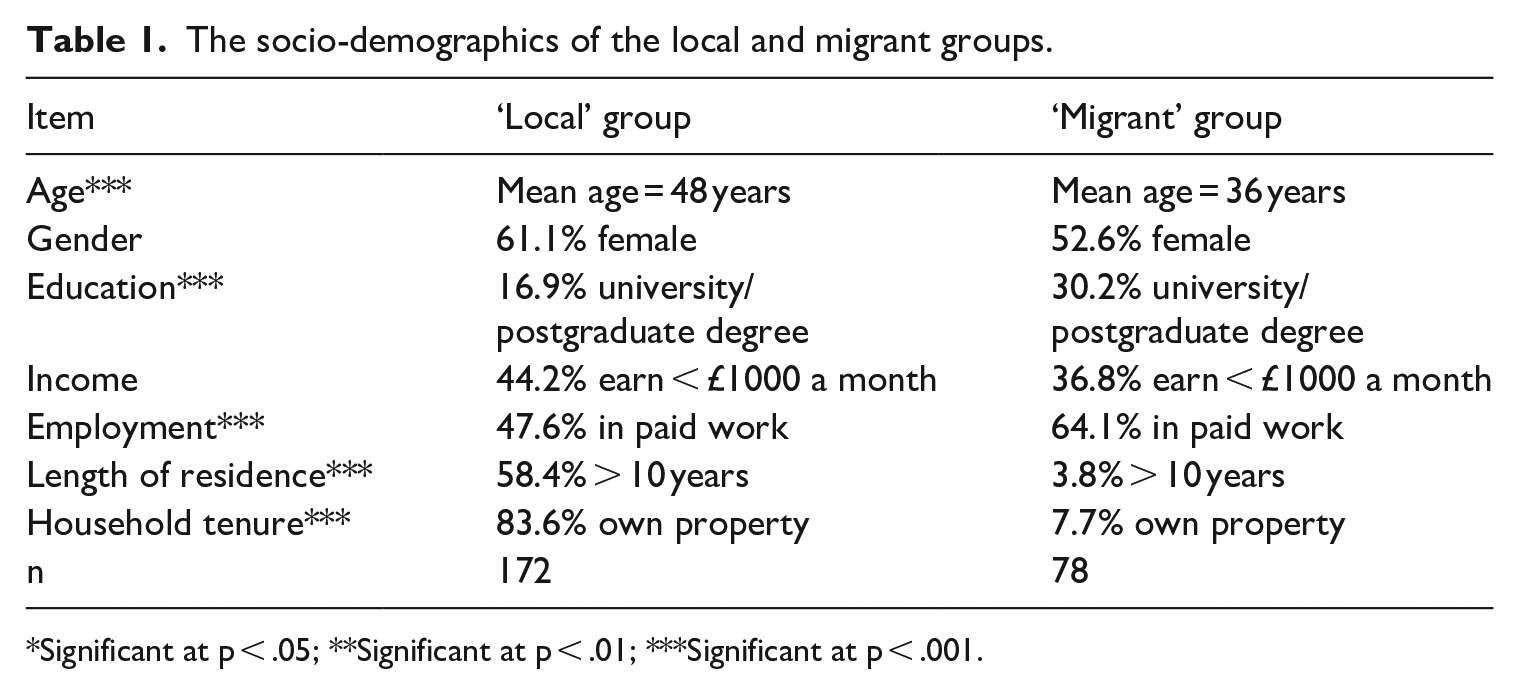
Significant at p < .05; **Significant at p < .01; ***Significant at p < .001.
Two focus groups were conducted, one with a group of local residents and one with a group of Polish migrants living in Crewe. The migrant focus group consisted of five men and four women, who were typically under the age of 40 years, and had lived in Crewe between 5 months and 4 years. One member of the group was older and had lived in Crewe for 20 years. The local focus group consisted of five residents including two women and three men. The participants of the local focus group were typically older than their migrant counterparts, and all had lived in Crewe for over 20 years (Griffiths, 2017: 5). The qualitative accounts from the focus groups and police interviews are also provided below to add further clarity to the quantitative findings.
Survey measures
The difficulties in measuring social capital are now well-cited (Portes, 1998; Schuller et al., 2000). However, as noted, the three features of networks, norms and trust are ‘the triad which dominates the conceptual discussion’ (Schuller et al., 2000: 9) and are considered the main sources of social capital. These three concepts thus frame and guide the measurement and discussion of social capital in the current article. The results section will be separated into two parts: the first part will consider migrants’ and locals’ stock of social capital (including measures on within- and between-group social networks, trust and reciprocity). The second part considers groups’ experiences of crime and conflict. The key measures used in the questionnaire to capture these concepts are outlined below.
Social networks
Adapted from Morenoff et al. (2001), to measure within- and between-group social networks in the neighbourhood, respondents were asked, of the people they consider to be friends in the neighbourhood, how many are of ‘British’ origin and how many are of ‘Polish’ origin. 2
Trust
Based on the research by Job (2005), the local and migrant groups were asked how much they felt they could trust ‘your British neighbours’ and ‘your Polish neighbours’. 3 Two measures were created from the trust in neighbours items: within-group trust in neighbours (by summating local group trust in ‘British’ neighbours and migrant group trust in ‘Polish’ neighbours) and between-group trust in neighbours (by summating local group trust in ‘Polish’ neighbours and migrant group trust in ‘British’ neighbours).
Reciprocity
In line with Sampson et al. (1999), to measure within- and between-group reciprocities, the local and migrant respondents were asked ‘how often would you say you talk to your British neighbours?’ and ‘how often do you talk to your Polish neighbours?’ Furthermore, respondents were asked ‘how often do you and your British neighbours do favours for each other?’ and ‘how often do you and your Polish neighbours do favours for each other?’ 4 Four variables were created from these items: within-group talk to neighbours (i.e. how often the local group talk to their ‘British’ neighbours summated with how often the migrant group talk to their ‘Polish’ neighbours); between-group talk to neighbours (i.e. how often the local group talk to their ‘Polish’ neighbours summed with how often the migrant group talk to their ‘British’ neighbours); within-group favours; and between-group favours, which were analogously constructed.
Experiences of crime and conflict
To measure experiences of conflict in the form of ‘targeted victimisation’ among neighbourhood inhabitants, both local and migrant respondents were asked whether they have been attacked or verbally abused, or have had their property damaged, because of their ethnic origin (i.e. because they are ‘British’ or ‘Polish’). 5
The findings below will include the quantitative data as obtained through the survey along with supplementary quotes from the focus groups and interviews where available to add depth to the quantitative findings.
Findings
This section begins with providing a descriptive account of the stock of social capital available to migrants and locals in Crewe, before moving on in the next section to understand how such social interaction might translate into experiences of crime and conflict among groups.
Social capital: Networks, trust and reciprocity
Figure 1 shows over three quarters of the local group report that ‘most’ or ‘nearly all’ of their friends in the neighbourhood are British (78.1%). Conversely, 97.6% of the local group state that either ‘none’ or ‘some’ of their friends in the neighbourhood are Polish (see Figure 1). A sign test reveals a significant difference within the local group between their number of British friends and their number of Polish friends in the neighbourhood (p < .001).
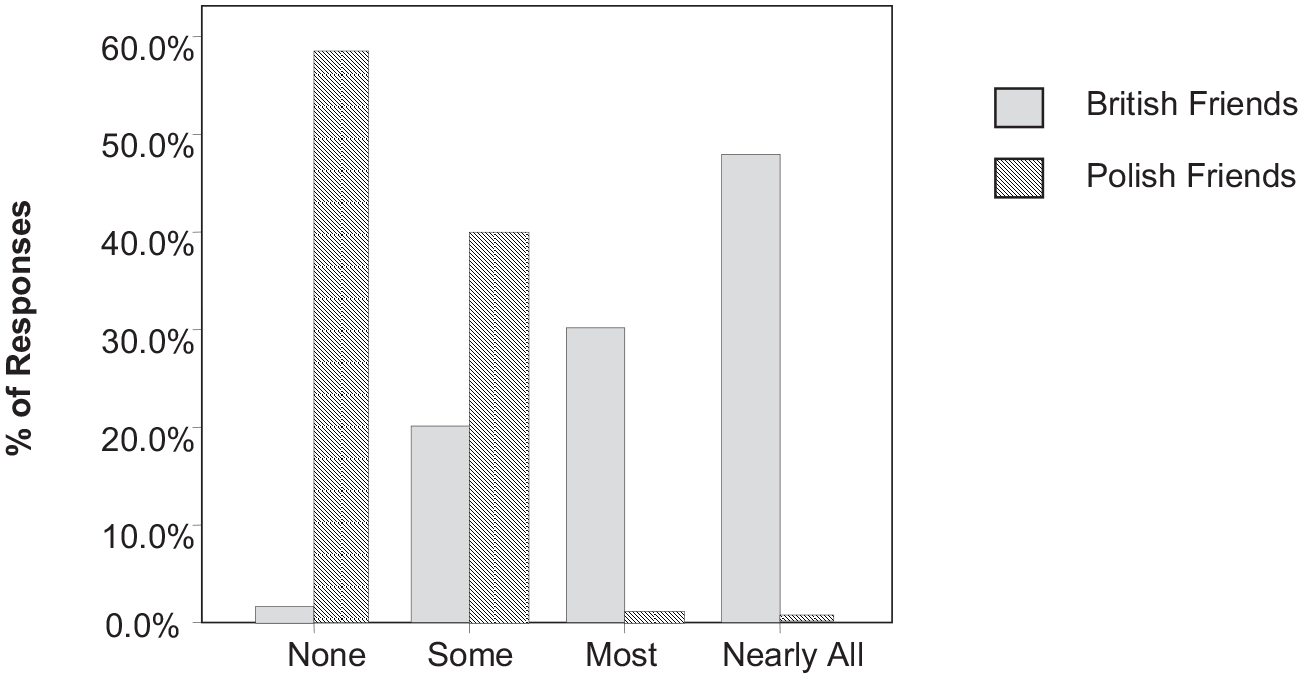
Local group: Friendship ties with British and Polish neighbours (% of responses).
The migrant group exhibit a different stock of social networks. As illustrated in Figure 2, the migrant group have a similar number of both British and Polish friends, and a sign test confirms no significant difference within the migrant group between their number of in-group and out-group social ties in their new neighbourhood. Three quarters of the migrant group report that ‘none’ or ‘some’ of their friends are British (75.4%) and over half that ‘none’ or ‘some’ of their friends are Polish (59.8%; see Figure 2).
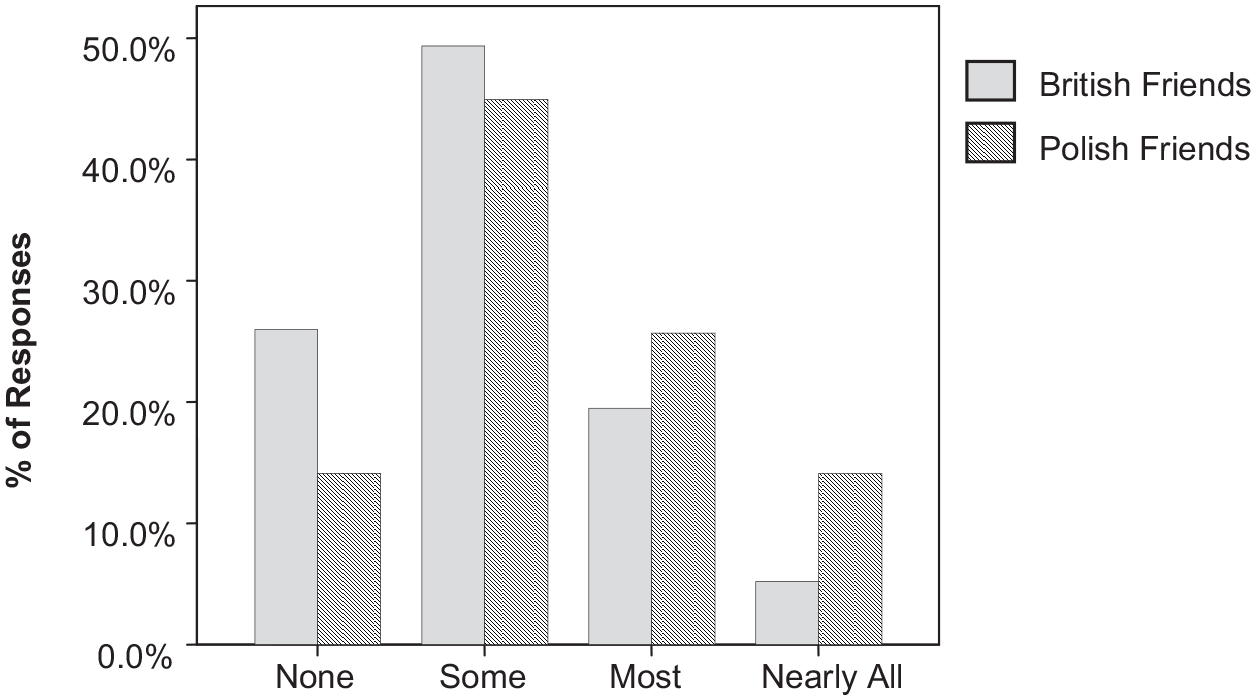
Migrant group: Friendship ties with British and Polish neighbours (% of responses).
A similar trend was found for groups’ perceptions of trust. A sign test revealed a significant difference within the local group between their within- and between-group trusts in neighbours. Over two-thirds of the local group trust their own group either ‘a lot’ or ‘a fair bit’, with less than a quarter of the group reporting the same level of between-group trust in their Polish neighbours (see Figure 3). Conversely, no significant difference within the migrant group between their within- and between-group trusts in neighbours was evident. Only a quarter of the migrant group trust both their Polish and British neighbours either ‘a lot’ or ‘a fair bit’ (see Figure 3).
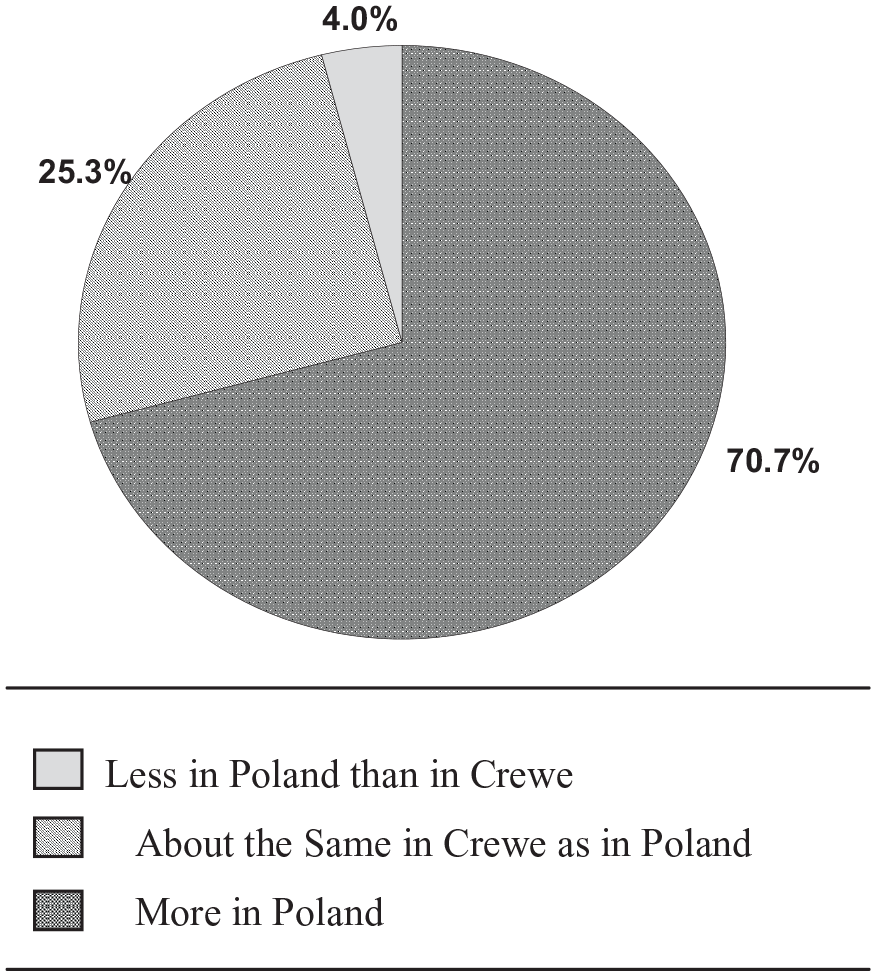
Migrant group: ‘Generally speaking, would you say you had more or less friends in Poland than you do here in Crewe?’ (% of responses).
These findings suggest that within local group, ‘bonding’ is evident across the sample, that is, strong social ties and a high level of mutual trust among the more established local residents in the area, but little or no social bonds with the out-group. The migrant group, on the contrary, appear socially disconnected to both other Polish migrants and with local residents. Furthermore, migrants’ social ties from their ‘home’ country have been severed. Figure 4 shows that the majority of the migrant group had more friendship ties in their neighbourhood in Poland than they do in Crewe, with only a quarter reporting similar social ties in their new neighbourhood as they had in their old neighbourhood.
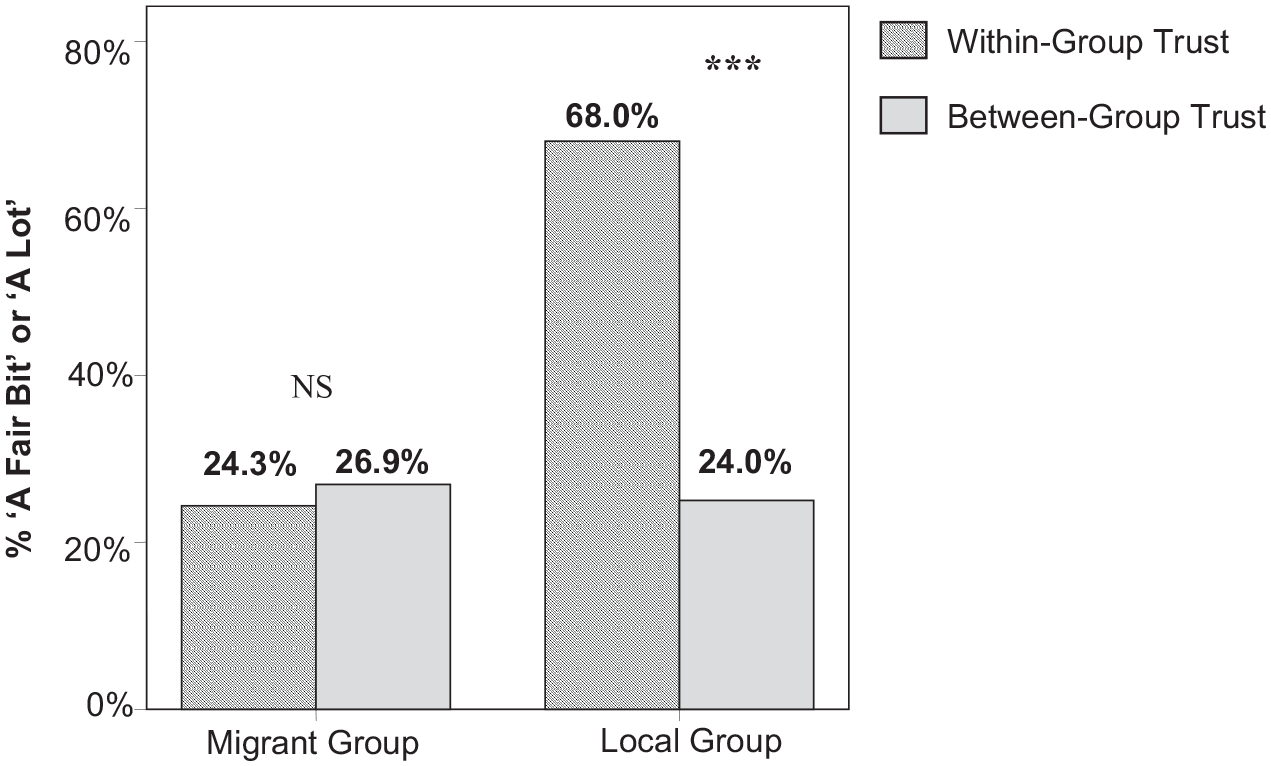
Locals and migrants: Within- and between-group trusts in neighbours (% ‘a fair bit’ or ‘a lot’).
This suggests that social networks are fractured during migration. Bursik (2006) similarly argues that immigrants’ existing ties can be weakened during migration and ‘most immigrants were not able to enter into new relationships that were as “strong and coherent” as those left behind’ (p. 23). The quote below from Szymon in the Polish focus group confirms these quantitative findings: It doesn’t matter whether you live in Crewe or in Poland everyone would say the same. I know a lot of people in Crewe but I have no friends and I do not trust anyone in Crewe. I don’t like any of the Polish people who live in Crewe, there’s a lot of bad people who like to argue, fight and drink. (Szymon, Migrant Focus Group)
Szymon captures here the feelings of displacement that can exist through migration whereby migrants can experience ‘growing ghettoization, isolation and cultural antipathies in their new settings’ (Cheong et al., 2007: 33).
So far, these findings provide mixed support for Putnam’s (2007) claims that immigration sparks social isolation among all members of a neighbourhood. Although such assertions appear to be confirmed for the migrant group – who are socially isolated from their friends back home, from other migrants, as well as from local residents in their new neighbourhood – they are not for the local group. Local residents in Crewe in fact demonstrate rather strong and cohesive friendship ties among their own group, but fragmented and weak ties with new Polish migrants, thus demonstrating in-group solidarity but out-group fragmentation. As Jane from the local focus group describes, Well I’ve been over 30 years in my house and there are two types of neighbours for me there are the older ones whom I’ve known over the years and we still have conversations with them take Christmas cards, birthday cards and speak to them more in the summer than the winter because that’s when you see them more, and the newer ones and maybe the younger ones I do not know most of their names and yes I usually say hello to them or wave to them, but there isn’t the same kind of friendship with them that there is with the older ones. It is more difficult for them to find the time to stop and speak. And I don’t think this is necessarily just a Crewe thing, I think it’s the pace of modern life and world influence. (Jane, Local Focus Group)
For the local residents in the focus group, friendships with neighbours have developed over the number of years they have lived in the neighbourhood, and they express difficulty in maintaining good friendships with ‘newcomers’ and ‘younger people’, that is, ‘there isn’t the same kind of friendship’ with these neighbours, but there is a common civility and courtesy through simple small gestures such as saying ‘hello’. The local residents within the focus group therefore suggest that friendship ties are not necessarily based on ethnicity, but rather are developed over a long period of time. This makes it difficult to form bonds with newcomers of any kind, particularly with those ‘on the move’.
Moving on to look at the final component of social capital – shared norms of reciprocity – Table 2 displays the percentage of responses and the differences between the local and migrant groups on all four reciprocity measures. As seen, the two groups demonstrate significantly different levels of both within- and between-group reciprocities with neighbours. The local group typically express greater within-group reciprocity than do the migrant group: nearly all of the local group (91.5%) talk to their British neighbours either ‘sometimes’ or ‘often’, compared to approximately three quarters of the migrant group (72.8%) who talk to their Polish neighbours. Around three quarters of the local group (75.6%) do small favours for their British neighbours either ‘sometimes’ or ‘often’, compared to approximately half of the migrant group (55.9%) who do favours for their Polish neighbours.
Locals and migrants: Within- and between-group reciprocities (% of responses).
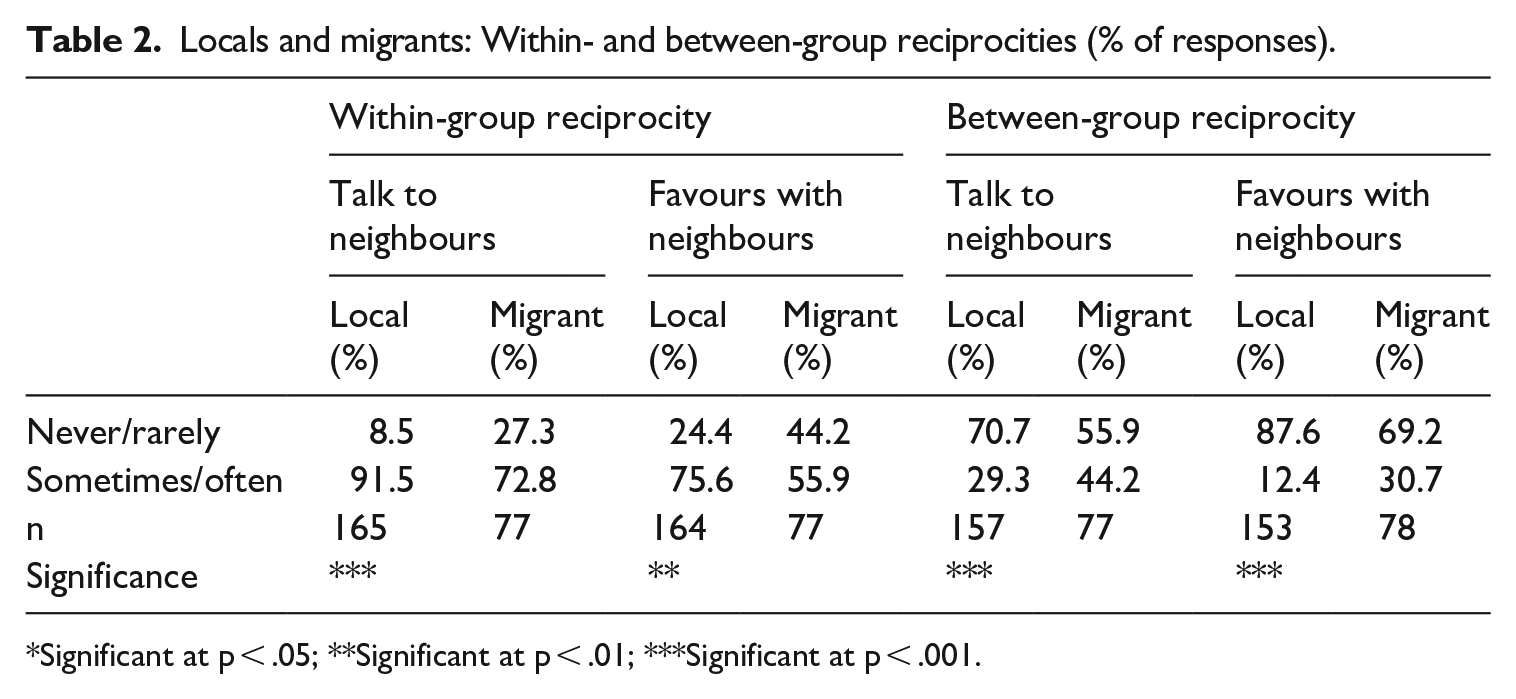
Significant at p < .05; **Significant at p < .01; ***Significant at p < .001.
On the contrary, the migrant group express significantly higher levels of between-group reciprocity than do the local group, although the percentages remain relatively small. Just under half of the migrant group (44.2%) compared to around a quarter of the local group (29.3%) either ‘sometimes’ or ‘often’ talk to their British or Polish neighbours, respectively. Finally, 30.7% of the migrant group regularly do favours for their British neighbours, compared to just 12.4% of the local group who do favours for their Polish neighbours (see Table 2).
Although the groups significantly differ in their levels of within-group reciprocity, Table 2 demonstrates that the majority of the migrant group do talk to, and do favours for, their Polish neighbours. These findings represent a different pattern than that found for migrants’ social networks and trust. Although migrants do not generally have dense in-group friendship ties, and express a high level of distrust in other migrants, the majority do exhibit within-group reciprocity. Despite this, the quote from Szymon below was a typical view among migrants in the focus group: Polish people are not nice to each other, people will not help each other or do favours for each other without expecting something in return like money. British people aren’t like this though, they’re more helpful and do favours for each other without expecting anything back, especially older people. (Szymon, Migrant Focus Group)
Although Polish migrants in Crewe may talk to and do favours for each other, the intentions and sense of obligation of these exchanges are not known. This finding corroborates those outlined earlier by Nee and Sanders (2001) who suggest that new migrants may rely heavily on each other to get by in their new environment, but equally that this dependence creates feelings of apprehension and can easily be exploited by others. As the quote from Szymon suggests, Polish migrants in Crewe are perceived to expect something in return for doing a favour. This could account for high levels of reciprocity among migrants in Crewe, but a low level of friendship ties and trust. Ryan et al. (2008) found something similar in their research on Polish migrants in London and showed that ‘despite high levels of practical and emotional support that many respondents received from their Polish friends and relatives, there was also a sense of distrust towards the wider Polish community’ (p. 679). Although these studies explore Polish migrants in a range of social settings, they do display similar findings regarding the change of social relations over time whereby trust and distrust, positive reciprocity but also exploitation, can simultaneously exist.
These comments from migrants are illuminating as they suggest that although migrants have equally weak social ties with their British and Polish neighbours – the ‘quantity’ of social relations – the nature of these weak relationships is very different – the ‘quality’ of social relations. Indeed, the migrant group express within-group hostility and conflict, which provides an explanation for the additional lack of within-group social ties. Despite this, the new migrants in Crewe express experiences of between-group civility and courtesy with local residents (see also Griffiths, 2014a). This demonstrates that the quantity of social networks cannot be considered in isolation, as the quality of social relations may have important implications for migrants’ social capital (Grzymala-Kazlowska, 2005). The article now turns to explore in more detail such social exchanges in relation to groups’ experiences of crime and conflict.
Experiences of crime and segmented conflict
To explore conflict between groups, both local and migrant survey respondents were asked whether they have been attacked or verbally abused, or have had their property damaged, because of their ethnic origin (i.e. because they are ‘British’ or ‘Polish’). 6 Figure 5 shows that the migrant group report significantly more targeted victimisation than locals do.
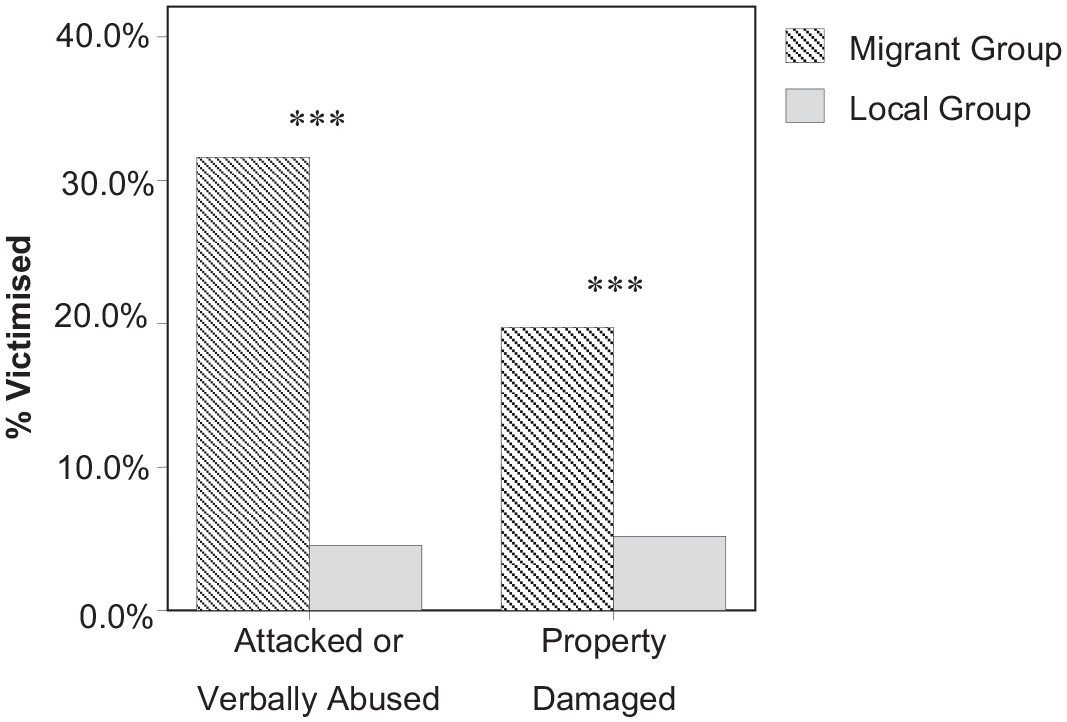
Locals and migrants: Experiences of ‘targeted’ victimisation (%).
As shown in Figure 5, around 20% of the migrant group report having had their property damaged in the last 12 months because they are Polish, compared to just 5% of the local group who report property damage because they are British. Similarly, nearly a third of the migrant group compared to around 5% of the local group report being attacked or verbally abused because they are Polish or British, respectively. Targeted victimisation is thus experienced in Crewe by a small, but certainly not a trivial, number of new migrants in the form of property crime, and nearly a third of the migrant group in Crewe report being attacked or verbally abused because they are Polish. Of those who have been attacked, 62.5% report being attacked once, 16.7% twice, and 20.8% three times or more. Therefore, a high percentage of victimised migrants suffer repeated attacks and verbal abuse because of their Polish origin.
However, the official police statistics do not reflect this, and thus the police in Crewe are generally unaware of this proportion of Polish migrants suffering targeted victimisation: I’ve never picked up a great kind of Polish English racial divide, I don’t think it exists. Even considering maybe the lack of information coming in, I don’t think it exists. I would’ve expected it to be a hot-bed of race hate crime and quite honestly it isn’t and I think the statistics prove that. (Crewe Police Sergeant 2)
It is certainly true that Crewe cannot be described as ‘a hot-bed of race hate crime’ as the majority of Polish migrants in Crewe are not targets of abuse and physical attack. However, a small proportion do suffer and in particular are victims of repeat attacks. One police sergeant did recognise the difficulties in recording hate crime against Polish migrants and the problems with obtaining a true picture of victimisation, however: getting people to report crime was the problem in the first place, hate crime didn’t compute. They didn’t perceive that being Polish was a reason that anyone would want to commit a crime against them. They kind of understood the minority aspect as being race related, but no they wouldn’t give us the evidence and if you haven’t got the evidence of hate you can’t prove the intent. So you know, you might get an instance where someone would say ‘oh my car’s been smashed up’, ‘well do you think it’s because you’re Polish?’, because we would surmise that and it would be a hate incident, they’d be ‘no no no there’s lots of criminal damage around you know it’s just one of those things, it’s not hate crime. (Crewe Police Sergeant 1)
Thus, from the police perspective, new Polish migrants in Crewe are reluctant to report such incidents as motivated by hate. The subjective component of assessing experienced victimisation as motivated by hate, although is problematic in the recording of such incidents for the police, does provide an interesting dimension for the current purposes, as it signifies whether migrants themselves feel disproportionately or unfairly targeted in Crewe. Of course, another reason for lack of reporting incidents as hate motivated could be due to language problems, that is, migrants may simply not understand an insult that is directed towards them by a local resident, or due to other reasons relating to a reluctance to report, or due to its ‘routinised’ nature as others have found (Lumsden et al., 2019).
Throughout the migrant focus group discussion, personal experiences of crime victimisation, due to ethnic origin or otherwise, did not generally arise. Migrants were conscious of crime in Crewe, from media reports in the newspapers and stories from friends or acquaintances; however, the focus group participants have generally not experienced crime themselves. The discussion below during the migrant focus group details the only example provided of experienced victimisation:
Although my car has got English number plates it gets damaged.
Do you think you’re a victim of prejudice?
No, it’s just sheer vandalism which happened to me.
Generally a lot of cars get their windows smashed. My friend’s car gets damaged nearly every month.
The statement from Pawel suggests an awareness that damage to cars can be perpetrated against Polish migrants (based on their car’s number plate), but claims such vandalism is a common occurrence and is not the result of nationality or cultural differences. These findings seemingly demonstrate a number of paradoxes. Although around a third of the migrant group report being a victim of targeted abuse and physical attack, the local police experiences and statistics do not support the idea that Crewe is ‘a hot-bed of race hate crime’ that exists between groups, and as we will see neither do the accounts from the migrant focus group.
Although this lack of reporting has been interpreted by the local police as representing reluctance to view such crimes as hate motivated, it could in fact simply represent a lack of inter-group crime and conflict altogether. Although it was assumed the ‘targeted victimisation’ question taps into between-group experiences of conflict in the neighbourhoods, this may not be the case for the migrant group as it is not known whether the crime perpetrator belongs to the local or migrant group. This could account for such differences between the two groups’ reported experiences of targeted victimisation, that is, the local group may be reporting experienced inter-group conflict, whereas the migrant group may be reporting within-group conflict. Recall earlier where local police representatives claimed crime and conflict are often committed within the migrant community in Crewe rather than between groups. The below quote from a police sergeant in Crewe further details an awareness of crime being committed within the Polish migrant group: we’ve had all the way through this anecdotal evidence or firsthand evidence of activities within the Polish community, Pole on Pole crime . . . most of that focused on a group of individuals from an area of Poland and we’ve been very active in targeting them. The community’s perception of them is that they are big gangsters, our perception is that they are just idiots really they’re not the brightest of people, and the level of criminality was fairly, you know it was burglary, theft, robbery, street robbery, intimidation, but I’m surprised that the community sort of tolerated it. (Crewe Police Sergeant 1) when they’ve come over in such large numbers as they did, it’s an inevitability there was gonna be an increase in crime in terms of they’re here and they’ve committed a crime, if they weren’t here they wouldn’t have committed. But was it disproportionate to the numbers, then no it wasn’t, it would be no more than we expected . . . [t]he vast majority [of crimes were] low level whether it be shoplifting, possibly drink driving, damage, assaults very often on other Polish as well you know, so it wasn’t on the indigenous population, it was . . . internal, Polish on Polish. (Crewe Police Inspector)
All of the police interviewees in Crewe refer to this Polish ‘organised crime group’ and use them as an example of crime committed within the Polish community.
About six to eight months in we had some issues with a night club in the town . . . we noticed that Polish nationals were getting involved in violent knife incidents, Pole on Pole, which was something that was a rarity but was starting to become a weekly event . . . other than that the crime figures stayed largely steady. (Crewe Police Sergeant 1)
Such accounts from the local police demonstrate internal conflict within the migrant group. This also corresponds with the earlier quotes provided by Polish migrants which highlighted negativity directed towards other Polish migrants rather than local residents. The below discussion between Pawel and Dorota further highlights this:
Within five years I lived in 17 places but so far I had a chance of living with English people three times. When I lived on [Name of Street] last year we had English neighbours next door, who gave us a Christmas card, which was very nice of them. They were very nice people. Now I live with the English neighbours on the one side and Polish on the other, and whenever there’re problems it is the Poles who cause them. They’re very vulgar, I can hear them through the wall.
We have never experienced any problems with our English neighbours. It was the Polish people who were the trouble makers.
Accounts from the migrant focus group and findings from the survey also showed that locals and migrants do not generally experience inter-group conflict in Crewe but rather civil social exchange (see Griffiths, 2014a) as the below examples illustrate:
Even though I don’t meet my neighbours very often, things like holding the door or patiently waiting for a parking space are common and nice to experience.
English people are generally more approachable and open than Poles. Even strangers greet each other on the streets.
Furthermore, the local group provide various examples of civility and courtesy with Polish migrants. An example comes from a local resident during a focus group discussion: I was doing something on my van and the battery had gone flat so I was gonna charge it and was taking it off and it snaps and I thought ‘oh my goodness what am I am going to do here?’ And the Polish neighbour, I mentioned it to him and he took it off, got in the car, went off, came back, had a piece for me, put it on, there you go. The Polish neighbours are quite startlingly different to what I expected, they’ve been very very helpful and friendly. (Nigel, Local Focus Group)
These minor courtesies among ‘strangers on the streets’ in Crewe have been reported and discussed in more detail elsewhere and shown to allow for positive and civilised relationships to exist between groups rather than conflict and animosity (see Griffiths, 2014a: 1122). With the vast preponderance of urban sociological literature on this topic focusing their attention on inter-group relations, and crime and conflict between established residents and new immigrants, this was an unexpected finding and demonstrates that although social ties might be weak among groups in Crewe, the character of these weak ties differ and are more complex than assumed with examples of between-group civility and courtesy but a divisive and fragmented migrant ‘community’.
Adding to this idea of a fragmented migrant group, a range of cross-tabulations were conducted as part of a wider project to see if there were individual demographic differences in attitudes and experiences depending on age, gender, current level of income and education. 7 An interesting finding to emerge from these analyses was that Polish migrants who are highly educated 8 but currently receiving a low income 9 commonly exhibited a range of negative attitudes that reflect feelings of displacement and discontent – they were more fearful, they worried more about the behaviour of those in their community and were less trusting of others. Specifically, Polish migrants who are currently receiving a low income (p < .05) but who are highly educated (p < .05) express the greatest level of worry about being a target of attack or verbal abuse because of ethnic origin when compared to their local counterparts. 10 A similar pattern emerged for other variables including generalised trust of Polish migrants living in Britain whereby again migrants receiving a low income (p < .01) but with a high level of education (p < .001) are less trusting of Polish people in Britain. 11 Similarly, Polish migrants with a low income (p < .001) and a high level of education (p < .01) more often view their Polish neighbours as sources of disorder, as compared to their local counterparts. 12
One way in which these results can be explained is through Lenski’s (1954) notion of ‘status inconsistency’. Lenski (1954) suggests that the individual with a poorly crystallized status is a particular type of marginal man [sic], and is subjected to certain pressures by the social order which are not felt (at least to the same degree) by individuals with a more highly crystallized status. (p. 412)
Lenski goes on to argue that a highly educated individual but with a low income is likely to feel frustrated with the social situation. The same can be true of any status discrepancies such as someone in a highly ranked occupation but with a low level of education, for example. Lenski (1954) suggests that in such circumstances of status inconsistency ‘the individual may react by blaming other individuals as individuals rather than as agents of the social order’ (p. 412; emphasis in original). In a recent study on Romanian migrants living in London, Morosanu (2015) similarly found that ‘despite their education and skills, many [Romanian migrants] experienced downward mobility and consequently an ambiguous class status’ (p. 8). This ambiguous status or ‘status inconsistency’ (Lenski, 1954) of Polish migrants with a high education but current low income can thus be said to result in a greater intolerance towards the social misconduct of their new neighbours in Crewe.
Conclusion
This article aims to contribute to the long-standing tradition of place-based criminological research which seeks to understand how wider structural changes to areas, through processes such as migration, might impact the daily interactions and social exchanges that take place between different social groups, and how this ultimately might affect experiences of crime and conflict. In doing so, the article reports on findings from a town in the North West of England that experienced a large number of Polish migrants settling in the area. The article has explored both new Polish migrants and more established local residents’ social capital (in the form of social networks, trust and reciprocity) and the ways in which such groups might experience tension and conflict following this period of social change. The findings demonstrate that complex features of inclusion and exclusion, of civility and conflict, co-exist among various segments of the migrant and local ‘communities’.
Although a positive picture of between-group civil social relations has been painted here and elsewhere (see Griffiths, 2014a), a more complex story emerges in segments of the communities that were not expected. The results confirmed not only a mixed distribution of within- and between-group social networks of ‘bonding’ and ‘bridging’ social capital, but also different forms of networks and norms of interaction. Countering Putnam’s (2007) ‘hunkering down’ thesis of a ubiquitous disconnected society as a result of immigration, the local group in Crewe exhibit strong bonding social relations of dense within-group social networks and high levels of trust in their own group (p. 137). Complex processes exist for the migrant group in Crewe, however. Although Polish migrants exhibit weak social ties with both their local established neighbours and their Polish neighbours, these ties are differentially characterised. New migrants reported experiences of conflict and hostile relationships within their own group, but were able to maintain small norms of courtesy and politeness with local residents (see also Griffiths, 2014a).
Furthermore, the article has demonstrated how migrants’ experiences of ‘targeted victimisation’ appear to be at the hands of other Polish migrants in Crewe and local police accounts substantiated claims of internal conflict within the Polish migrant ‘community’. The story of group relationships in Crewe has thus been one of civility between groups, but moral indignation, hostility and conflict within the migrant group. These findings run counter to expectation and demonstrate how a civil social order does not run evenly across the entire community, as segments of conflict, distrust and intolerance do persist, but typically within the migrant group boundaries. Recent in-depth research into migrants’ social networks has reported similar results however that, after time, relationships within the migrant ‘community’ become frayed as conflict, competition and fear become the norm (Nee and Sanders, 2001). Ryan et al. (2008) and Grzymala-Kazlowska (2005) in particular support the findings here regarding Polish migrants in the different social settings of London and Belgium, respectively. One explanation that Grzymala-Kazlowska gave for Polish migrants having a high dependency on each other but a lack of trust comes from Poland’s unique historical background of communism. However, it has been shown here that under conditions of migration, Polish migrants do not retreat into dense friendship networks. The current findings have instead provided more detail to show that Polish migrants cannot be considered a homogeneous group who share such distrust in others. In fact, it was particular individuals within the migrant ‘group’ who exhibited the greatest distrust and intolerance of social misconduct – most notably those with a high level of education but a current low income. These migrants demonstrate fear of being targets of crime, a lack of trust in other Polish migrants and a great intolerance of social misconduct and are in fact more likely to associate this disorderly behaviour in their neighbourhoods with other Polish migrants than are local residents. The ‘status inconsistency’ (Lenski, 1954) of these individuals has been used as an explanation of such negative attitudes and of such strong normative expectations. In policy discourse, it is often assumed that bonding social capital among immigrants is undesirable due to the assumed subsequent lack of integration into wider society, resulting in ghettoisation and fragmented communities (Cheong et al., 2007). However, what this article has shown is that it is more important to understand the nature and form that these ‘bonding’ and ‘bridging’ social relations take and thus avoiding any such value judgements as Julien (2014) similarly recommends. Instead, the findings here highlight the complexities and nuances of migrants’ social relations and demonstrate how both experiences of conflict and the construction of ‘deviance’ can take place within migrant communities themselves, that is, whereby those with a particular level of education and income engage in an ‘othering’ process, distancing themselves from other Polish migrants in the area and attributing superior moral values to themselves.
It is of course important to acknowledge that this research was conducted in one ‘place’. Claims to generalisability are therefore not made here. This should not detract from the importance of such localised studies in understanding how the complex wider historical and social context helps us to understand groups’ differential responses to migration and the impacts of this on social capital and experiences of conflict (Griffiths, 2014a). As Girling et al. (2000), on their study in the North West, note, there remain significant ways in which place continues to matter to people, even, and perhaps precisely, under the global conditions that now obtain. People continue to live somewhere, go about much of their routine daily lives somewhere and – within markedly differing contexts of freedom and constraint – persist in acquiring and developing material and emotive attachments to particular places, whether that be their home, street, neighbourhood, town or nation. (p. 162)
Furthermore, the findings presented here are comparable to others who have explored social interaction and conflict among Polish migrants in other areas of the United Kingdom, as noted above. Together with such empirical studies therefore we are able to begin building a picture of the differential ways Polish migrants might experience their new neighbourhoods and how conflict might feature in this.
Finally, it is important to note that a great deal has happened since these data were collected: social relations, processes of ‘othering’ and experiences of tensions and conflict are likely to change over time and be influenced by the social and political landscape. As Lumsden et al. (2019) suggest in their recent study on Eastern European migrants’ experiences of hate crime, temporal factors are significant for differentiating the category ‘migrants’ in relation to when they migrated, how long they have been undergoing processes of identification in a new country, and historical ‘events’ such as recession, the EU Referendum and ‘Brexit’ – events which serve to (re)activate latent hostilities which, when mobilised, disrupt integration both by and within (heterogeneous) migrant ‘communities. (p. 180)
There has been some evidence to show that hate crime and prejudice has been increasingly experienced by migrants since the European Union referendum whereby a culture of intolerance was legitimised during and after the Brexit campaign (Wilson, 2016). Such research has shown the banal and normalised nature of this prejudice (Lumsden et al., 2019). The effects of the current global Covid-19 pandemic is similarly important to explore. While there have indeed been examples of communities coming together and supporting each other, along with an outpouring of support for NHS workers (many of whom are migrants), there has additionally been evidence of latent animosities arising again around the ‘threat’ of others (Brown, 2020). It will be necessary to therefore explore the themes and findings presented in this article to explore how such recent global changes are played out in this, and other, localities.
Footnotes
Declaration of Conflicting Interests
The author(s) declared no potential conflicts of interest with respect to the research, authorship and/or publication of this article.
Funding
The author(s) disclosed receipt of the following financial support for the research, authorship, and/or publication of this article: The doctoral research on which this paper is based was supported by the Economic and Social Research Council (Award number: PTA-031-2006-00497)
