




Abstract
The article assesses three approaches to domestic violence: two that use the concept of ‘coercive control’ and one that uses ‘domestic violent crime’. These are: Stark’s concept of coercive control; Johnson’s distinction between situational couple violence and intimate terrorism, in which coercive control is confined to the latter; and that of domestic violent crime, in which all physical violence is conceptualized as coercive and controlling. The article assesses these three approaches on seven issues. It offers original analysis of data from the Crime Survey for England and Wales concerning variations in repetition and seriousness in domestic violent crime. It links escalation in domestic violent crime to variations in the economic resources of the victim. It concludes that the concept of domestic violent crime is preferable to that of coercive control when seeking to explain variations in domestic violence.
Keywords
Introduction
Domestic violence is an important form of coercion; a serious violent crime; and a cause and consequence of gender inequality. Frustrated with the limitations of the traditional approach to crime, a new field has emerged that treats domestic violence as if it has a distinctive aetiology, developing new concepts, including that of ‘coercive control’. But is domestic violence really so different from other forms of violence that it needs separate concepts? This article offers a different solution to the limitations of the traditional approach that enables the strengths of the new and the old to be synthesized to provide a better way to conceptualize and measure domestic violence, mainstreaming these new insights about domestic violence into the analysis of violent crime.
The concept of coercive control arose out of the debate about the disputed nature, extent and distribution of domestic violence: whether domestic violence is primarily rooted in men’s control of women (Dobash et al., 1992) or is gender symmetrical (Straus, 1979). Attempts to address this generated a dualistic typology, dividing domestic violence into two kinds: one, which is serious, exhibits coercive control and is gender asymmetrical; and the other, which is less serious, does not involve coercive control and is gender symmetrical (Johnson, 1995, 2008). Further distinctions arise from differences in the approach to the relationship between violence and coercion, with a developing focus on coercive control (Stark, 2007). This focuses on gendered motivation in generating the most extreme forms of domestic violence. There is a third approach: domestic violent crime (violent crimes perpetrated by intimate partners and other family members), which is gender asymmetrical and in which violence escalates over time if the resilience of the victims is compromised because of lack of access to structural, especially economic, resources (Walby et al., 2016). This third approach focuses on the relationship between violence, economy and society; rather than on ideas and motives.
In developing this third approach of domestic violent crime, first, we clarify confusions in definitions of domestic violence. In particular, the definition of violence in criminal law includes not only the act but also the harm. When harm as well as act is included, the gender asymmetry of domestic violence becomes visible (Walby and Towers, 2017; Walby et al., 2014). Second, we identify and correct the consequences of a measurement error. Domestic violence does not divide into two stable forms: gendered coercive control and ungendered non-coercion. When all violent crimes (physical acts causing harm such as injury, fear or alarm that pass the threshold of criminal law) are measured, the gender asymmetry across all levels of seriousness and repetition, including low levels of non-injurious domestic violence, becomes visible. This is preferable to a focus on victims or on a sub-set of violent crimes (Walby et al., 2014, 2016).
The theoretical implication is to challenge the thesis (Johnson, 1995, 2008) of a distinction between two discrete types of domestic violence that are internally stable over time. It is more likely that there is potential escalation from less serious to more serious over time, for any given victim; variation is more likely to indicate differences in points in the escalating trajectory. The identification of new patterns of domestic violence that flow from changes in its conceptualization has implications for the theorization of the relationship between violence and wider social changes.
There are seven issues over which the three approaches take different positions: first is the relationship between ‘violence’ and ‘coercion’; second, the place of the ‘act’ and the ‘harm’ in the definition, in particular if both are necessary; third, ‘repetition’ and how the component events in a series can be identified; fourth, ‘seriousness’, and whether a hierarchy can be identified; fifth, whether explanation of variations in domestic violence is centred in the motivation of the offender or the resilience of the victim; sixth, whether variations in seriousness and repetition are understood as indicating different ‘stable forms’ or a trajectory of ‘escalation’; and, seventh the approach to gender.
The Development of Diverse Conceptualizations of Domestic Violence
There are three main approaches to the conceptualization of domestic violence, of which coercive control is one. This section reviews the development of these, through the lens of the seven issues identified above.
The disputed gendering of domestic violence
The gendering of domestic violence is disputed: whether it is primarily men’s control over women (Dobash and Dobash, 1992; Schechter, 1982; Stark, 2007, 2010), gender symmetrical (Archer, 2000; Straus, 1979) or some mix of the two (Johnson, 1995, 2008; Myhill, 2015).
The understanding of domestic violence as patriarchal control was developed in the work of Schechter, Dobash and Dobash, and Stark among others: repeated acts of violence, along with various kinds of threats, used predominantly by men to control their partners. Schechter, who introduced the concept of ‘coercive control’ (Kuennen, 2007), considered that it was the physical violence that generated the control, which, once deployed, did not need to be repeated to gain compliance. Stark, by contrast, considered physical violence only one of four components of coercive control, alongside non-physical tactics such as isolation and belittling. In Stark’s approach, physical violence is not the initial source of the control, thus he is able to argue that physical violence is declining, while other forms of coercive control are increasing.
By contrast, Archer (2000), Straus (1979) and others argued that domestic violence was perpetrated and experienced by both women and men, and is not gendered asymmetrical power. Archer and Straus both predominately utilize survey evidence to support their conclusions. Straus devised a survey that asked about the different methods used in families to address conflict, ranging from verbal abuse to physical violence, based on a typology of actions: the Conflict Tactics Scale (CTS).
In response to Straus, Dobash et al. (1992) argued that introducing information on ‘context and control’, that is, harms and motivation as well as act, would reveal the inherently uneven gendered distribution in domestic violence.
Because the CTS concerns actions and excludes harms, it is incompatible with the concept of ‘crime’, which always embeds harms as well as actions within the definition of specific crimes. An action from a man to a woman is more likely to cause physical injury than the same action from a woman to a man. For example, the British Crime Survey found that a minor act led to physical injury in 49 per cent of instances for female victims but only 36 per cent of instances for male victims; for severe acts, the difference was 77 per cent and 56 per cent respectively (Walby and Allen, 2004: 37–38).
Are there different types of domestic violence?
Johnson (1995, 2008) attempted to reconcile the polarized positions held by Straus and the Dobashes by arguing that two different types of domestic violence exist, revealed in two different forms of data. Special samples from refuges, police and courts collected data from only the most abused and generated a picture of patriarchal (or intimate) terrorism against women. Whereas, samples from the general population tended to exclude the most abused, generating a picture of violence which was less serious and non-controlling (situated, or common, couple violence). Thus, Johnson concluded that there were at least two (indeed four) types of domestic violence made visible by different methodologies.
Johnson’s influential typology has underpinned risk assessment methodologies, such as CAADA-DASH, which is used to assess whether victims of domestic violence have standard, moderate or high risk of serious harm in the UK (Robinson and Howarth, 2012; Robinson et al., 2016). Only a high risk is considered to justify significant intervention from police and other agencies.
However, the variation in seriousness and repetition may not be the consequence of a stable type, but instead be the stage of escalation the violence has reached. Escalation is an alternative explanation of the variation found. If domestic violence has a tendency to escalate, then risk assessment instruments like CAADA-DASH are not able to differentiate between victims facing low or high danger. It inappropriately narrows the focus of activity of funded public bodies such as the police onto a very few women, thereby missing the opportunity for early intervention before escalation for many others who report domestic violence.
Johnson claims surveys cannot capture the experiences of the most abused women. However, Walby et al. (2014) found that in the Crime Survey for England and Wales (CSEW), high frequencies of violent crimes against the same victim were reported to (and recorded in) the survey. Although, official estimation methods of the CSEW ‘cap’ these at a maximum of five (currently under review), when this ‘cap’ is removed and all violent crimes reported to the survey are included in the estimates, gender asymmetry in domestic violent crime significantly increases. Thus, the empirical problem on which Johnson’s work is premised – that surveys do not find the gender asymmetry in domestic violence to the same extent that other sources do because they cannot capture high frequency victims – is rendered a non-problem. The practice of ‘capping’ has been routine in most victimization surveys. In the CSEW all series incidents have been capped at five since the survey’s inception in 1982 (Hough and Mayhew, 1983). The US National Crime Victimization Survey (NCVS) traditionally removed all series (six or more incidents) victimization reports from national estimates, thereby ‘capping’ any series at zero; it now ‘caps’ at 10 per six-month period. The national survey in Mexico (Encuestas Nacionales Sobre Iseguridad) ‘caps’ at five incidents (Planty and Langton, 2013); and the Canadian crime survey caps at three (Nazaretian and Marolla, 2013). When measurement is improved to include all reported events, gender asymmetry, not symmetry, is found.
Stark and coercive control
Stark’s (2007, 2010) position has similarities with Johnson in that there are two forms of domestic violence, patriarchal/intimate terrorism and common/situational couple violence. The issue for both Johnson and Stark is how to distinguish between the ‘really bad’ and the ‘not so bad’. They both assume these two forms have internal stability.
Stark (2007, 2010) distinguishes between ‘coercive control’ and ‘fights within couples involving physical force’. Stark’s concept of coercive control focuses on the motivation of the perpetrator. He considers coercive control to be more detrimental to women’s well-being than physical violence because, he suggests, not all acts of physical violence are coercive or controlling, ‘I exclude what I call “fights” involving physical force from the category of abuse’ (Stark, 2010: 202). Stark (2010: 207) argued ‘that the majority of violent acts identified by population surveys fell into the category of “fights” and should not be considered “abuse”’. He suggests that gendered asymmetries are found in practices of ‘coercive control’, but not in such domestic ‘fights’.
Stark (2010: 202) develops his argument while drawing on the notion that surveys find gender symmetry in domestic violence (‘the evidence of gender parity in violent acts’). However, this gender symmetry is found to be spurious when the methodology is improved by counting all reported crimes and including harm within the definition of violence (crime).
Stark does not have robust quantitative evidence over time to support his claim that coercive control is increasing while physical domestic violence is falling. Measuring ‘coercive control’ is a challenge that has not yet been satisfactorily met, although some have attempted this. For example, Myhill (2015), using data from the CSEW, frames the issues as if centred on Starks’s concept of ‘coercive control’ but actually seeks to distinguish empirically between Johnson’s two major types of domestic violence, ‘situational couple violence’ and ‘intimate terrorism’. Despite an ingenious methodology, he concludes that measuring coercive control cannot be done robustly with existing data.
Despite this lack of robust evidence, policy, practice and legislation are changing to give precedence to ‘coercive control’, including a change to the UK Home Office (2015: 3) definition of domestic violence in 2015, defining coercive behaviour as:
a range of acts designed to make a person subordinate and/or dependent by isolating them from sources of support, exploiting their resources and capacities for personal gain, depriving them of the means needed for independence, resistance and escape and regulating their everyday behaviour.
A new law that made it criminally illegal to ‘engage in controlling/coercive behaviour in an intimate/family relationship’ was passed in the UK in the Serious Crime Act 2015, s. 76. The Home Office (2016) ‘Counting Rules for recorded crime’ were updated in 2016 so that controlling/coercive behaviour is now classified as 8/67 within the category of ‘Assault without injury 105A’, as part of ‘Violence against the person’. Under the Counting Rules, multiple incidents which are part of ‘controlling and coercive behaviour’ are now to be counted as ‘one crime’ of assault without injury, even if one or more of the multiple incidents involves assault amounting to Grievous Bodily Harm.
Conceptual confusion
There is conceptual confusion around competing interpretations of the term ‘coercive control’ and disagreements about the relationship between physical violence and non-physical coercion. The concept of coercive control is now being interpreted in public debate as focused on non-physical, psychological abuse, rather than the earlier focus on physical violence. This was used to justify the extension of the criminalization to repeated forms of non-physical coercive behaviour. There is a significant difference between this and the position of Stark and Johnson, between whom there are also important differences. For Johnson, the two major forms of domestic violence, situated couple violence and intimate terrorism, both involve physical violence, but only the second involves coercive control. For Stark, coercive control is central to the identification of a particularly abusive form of power and only some forms of physical violence are included.
Domestic Violent Crime
There is a third approach, ‘domestic violent crime’, articulated by Walby et al. (2014, 2015, 2016, 2017). In this framework, all violence is already coercive and controlling by definition. If this position is adopted, the concept of coercive control adds little if anything to the analysis of violent crime; thus, domestic violent crime becomes the lead concept. There are other acts that are not physical violence and which can also be coercive and controlling (some of these will be criminal acts, such as arson, criminal damage, theft and fraud). The most important difference with Stark, is that no violent act is exempted from the category of coercive and controlling.
Since all violence, other than self-defence, is illegal under criminal law in the UK, ‘violence’ can be defined as ‘violent crime’ without limiting the range of violence included. Violent crime is defined by reference to both the act and the harm, at least one of which is usually physical. In the context of the UK, violence can be identified in the following forms: homicide; assault with injury; assault without injury; rape; sexual assault; threat to kill; threat to commit violence.
The ‘domestic’ is one gendered dimension of violent crime. There are five altogether: sex of victim; sex of perpetrator; perpetrator–victim relationship; sexual aspect; and, potentially, gender motivation. Domestic violent crime is violent crime committed by a domestic relation (intimate partner or other family member). The identification of domestic violent crime requires the identification of the relationship between perpetrator and victim to be mainstreamed into the analysis of violent crime. Domestic violent crime is a sub-set of violent crime, not a separate type of crime. This means that there is no assumption of an aetiology of domestic violence that is separate from other forms of violent crime.
The explanation of changes in domestic violent crime requires the development of a ‘theory of change’ not ‘risk factors’; this is focused on changes in the wider societal context including changes in the economy, polity, civil society and other forms of violence (Walby, 2009). Walby et al. (2016) have identified changes in the economy as important by showing that the economic crisis of 2008 correlates with an increase in domestic violent crime; this suggests the causal pathway leads through the reduced resilience of the female victim consequent on changes produced in the crisis.
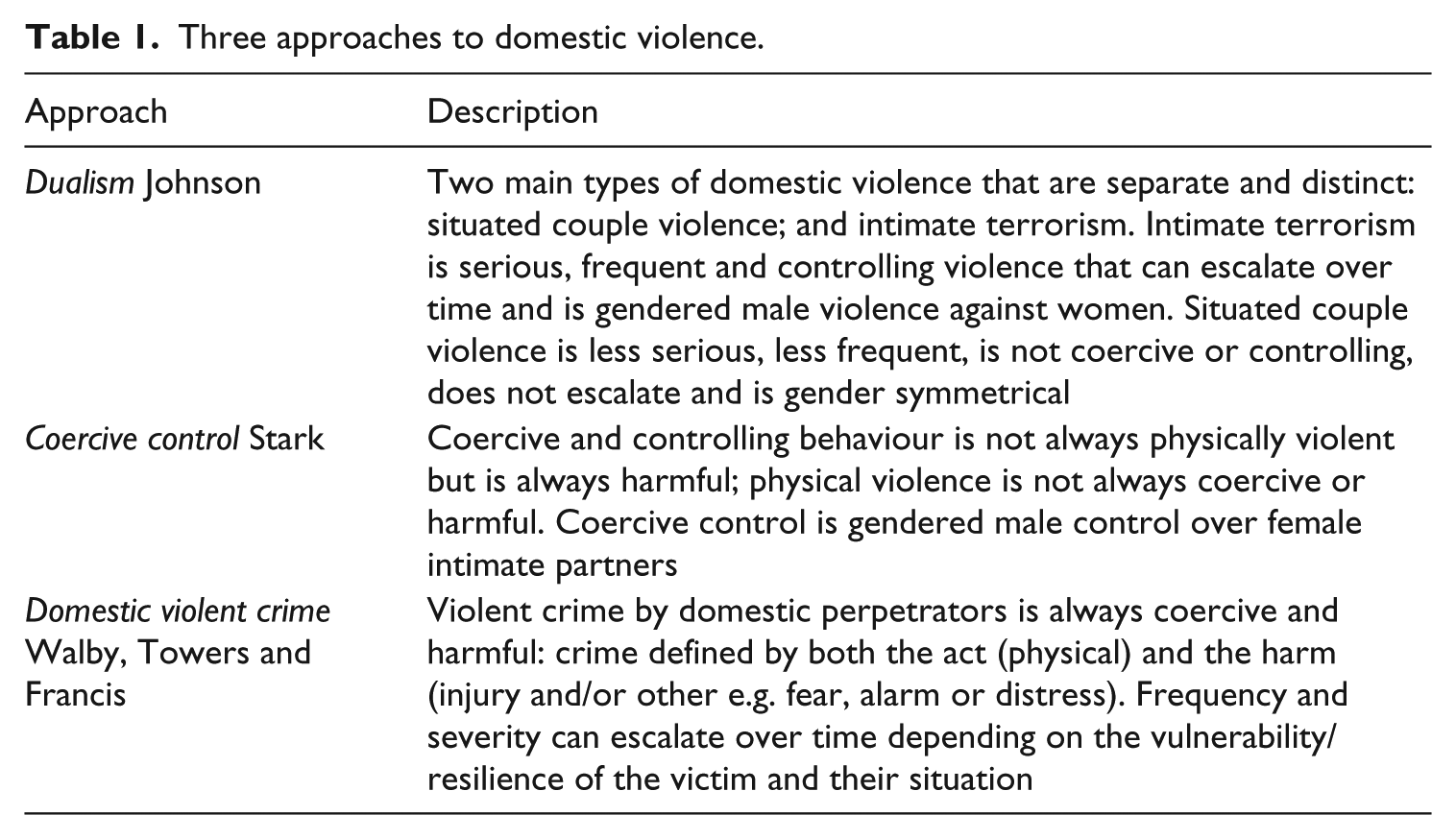
Table 1 summarizes the three approaches to domestic violence.
Three approaches to domestic violence.
Seven Issues
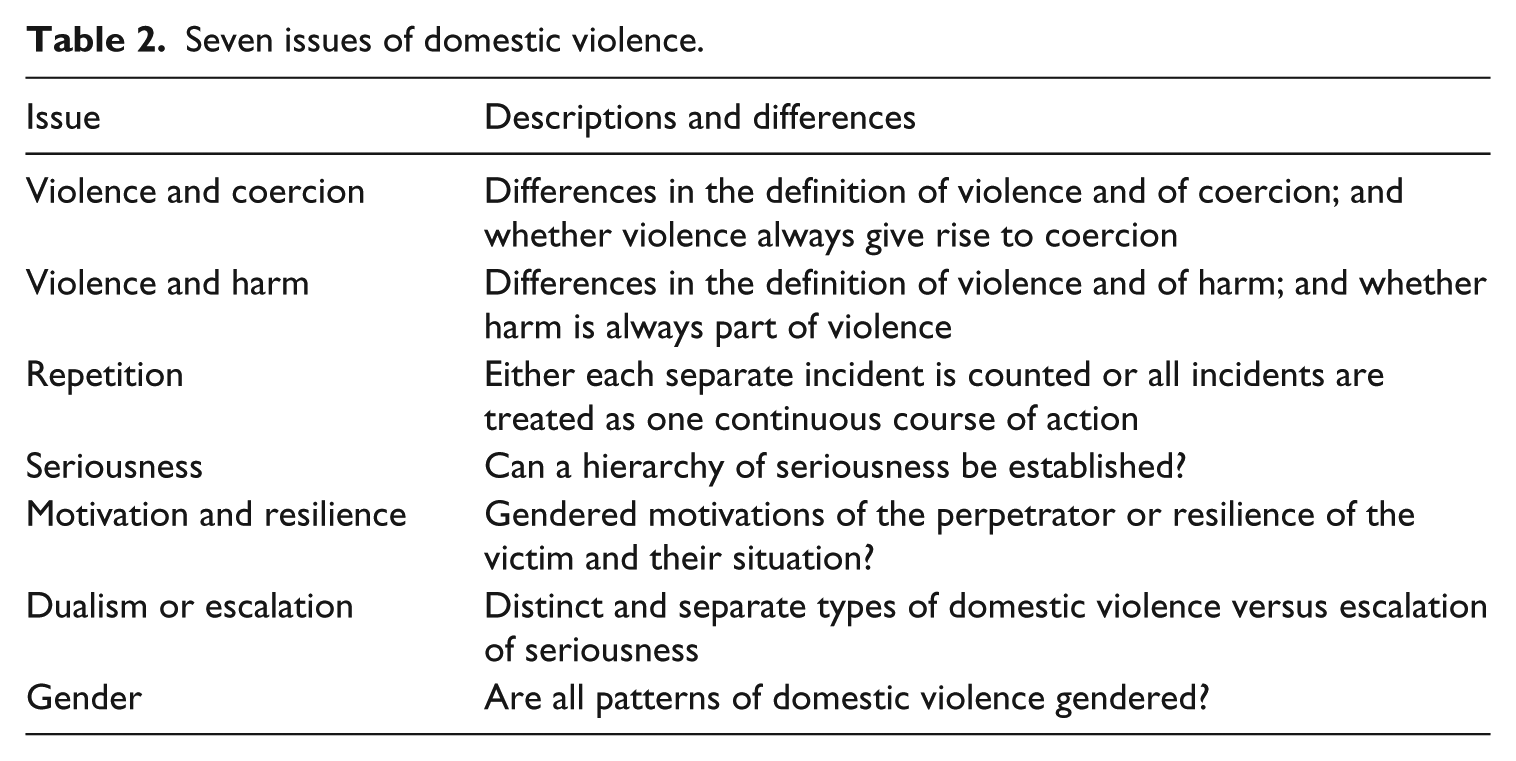
Seven issues have been identified as in need of conceptual clarification and empirical substantiation: violence and coercion; violence and harm; repetition; seriousness; motivation and resilience; different types or escalation; and gender.
First, violence and coercion: what is the relationship between violence and coercion? The position in criminal law is that violence always produces coercion since this is one of the harms that is definitional of violence (such as fear, alarm or distress). Social theory has long addressed related issues of the relationship between coercion and consent (Gramsci) and adjacent concepts such as power and authority (Weber), leading to understanding of the long-term coercive effects of violence even if only used sporadically. This understanding of violence as instrumental power is present in the concept of violent crime. For Johnson, violence is coercive, but varyingly so. By contrast, for Stark, non-physical coercion is more important than violence because of its link to gender inequality; violence is a practice that might or might not lead to coercion.
Second, violence and harm: does the definition of violence include the harm to the victim as well as the act by the perpetrator? Criminal law uses a concept of violence that includes both the act of the perpetrator (including their intentions) and the harms to the victim. Both are necessary components of the definition of an event as one of violence: if the act does not cause harm then it is not a crime. Johnson considers violence to be harmful, but varyingly so. The CTS defines violence using acts only, excluding the harm to the victim, with the consequence of gender bias in surveys that use it. Stark considers that not all violence is harmful.
Third, repetition: is domestic violence best captured by identifying separate events or by treating repeated events in the same relationship as a single course of conduct? In criminal law, violence (including a credible threat of violence) is treated as a discrete crime; so repeated violence is treated as a series of repeated crimes. By contrast, Stark argues that repeated events of coercion or violence from an intimate partner should be treated as a single course of conduct, since from the point of view of the victim the control by the perpetrator over them endures over time. But if separate events are not identified, how can a course of conduct be established?
Fourth, seriousness: can a hierarchy of seriousness be established within domestic violence? Criminal law has a hierarchy of seriousness that usually treats the more physically harmful forms of violence as the most serious followed by less physically harmful, followed by non-physical forms of coercion (stalking is an exception). This hierarchy is made visible in court sentencing guidelines and in the Counting Rules for police recorded crime (Home Office, 2016). In Johnson’s typology, intimate terrorism is more serious than situated couple violence because it causes more harm. By contrast, Stark rejects the claim that physical violence is more serious than non-physical coercion. ‘Seriousness’ is thus another component of the relationship between violence and coercion.
Fifth, motivation and resilience: are variations in the extent and seriousness of domestic violence best explained by the motivation of the offender or the resilience of the victim? Both Johnson and Stark not only distinguish but also explain the more serious forms of domestic violence through the gendered motivation of the perpetrator to coerce and control the victim. In our approach, the more serious forms of domestic violence are explained by the lesser resilience of the victim, especially their lack of economic resources.
Sixth, different types or escalation: are differences in the pattern of domestic violence to be understood as essentially different types or as a trajectory of escalation? Johnson distinguishes situational couple violence from intimate terrorism as if these were stable types. We theorize these different patterns as steps in escalation of seriousness. Many households split after a limited number of acts of violence; those that do not could experience escalation to more frequent and serious violence.
Seventh, gender: in what way is domestic violence gendered? In criminal law, gender is rarely considered relevant. Yet, the gendering of violent crime matters for public policy and the distribution of resources. For both Johnson and Stark, most couple violence is gender symmetrical – only the more extreme forms are gendered. In Stark’s framework, precedence is given to gender equality, before violence. Within this field, much data collection concerns women only, making many aspects of gender invisible. Making gender visible so that its significance can be assessed requires data to be collected on both women and men (not women only) and for official statistics to be disaggregated by gender and by gender saturated categories (such as domestic relationship).
Table 2 summarizes the seven issues.
Seven issues of domestic violence.
Gender runs through all seven issues, affecting conceptualization and operationalization. Gender can be: invisible; focused on women only; or everywhere. Criminal justice has traditionally made gender invisible leading to much criticism. There has been the development of a specialized field focused on women only, separated from the mainstream, with its own theories, concepts and measurement practices. The concept of ‘coercive control’ developed as part of this separate field.
Research Questions
While some of the seven issues that differentiate the three approaches are located at a definitional level (violence and coercion; violence and harm; repetition; and seriousness), other components can be empirically investigated (motivation of perpetrator or resilience/vulnerability of victim; separate types or escalation; gender). Some of these empirical components can be addressed using previously published data, while others require something new. The analysis is embedded in the context of the finding that an increase in domestic violent crime correlates with the economic crisis in England and Wales (Walby et al., 2016).
In this article, we investigate the gendering of all levels of domestic violent crime to test whether gender asymmetry is confined to the more severe forms, as suggested by Johnson and Stark. We investigate variations in repetition and seriousness to address the issue of whether the motivation of the perpetrator or resilience/vulnerability of the victim is better accounted for by different types or escalation. We investigate whether economic inequality (operationalized through the employment status and housing tenure of the victim) is associated with variations in domestic violent crime, to investigate whether the causal pathway is more associated with the victim’s access to economic resources or the offender’s motivation.
Methodology
The analysis of those questions susceptible to empirical testing requires an appropriate data source, the construction of an analysis dataset, the operationalization of the concepts ‘gender’ and ‘domestic violent crime’, a way to measure repetition and seriousness and the operationalization of measures of economic inequality: these are set out in this section.
Sources of data
The CSEW is currently the best source of data on crime victimization, including domestic violent crime in England and Wales. The population of England and Wales is 89 per cent of the total UK population.
The analysis uses data from the CSEW Victim Form module, which is available through the UK Data Service. The CSEW is an annual, representative victimization survey of adults aged 16 years and over who are permanent residents of households (excluding residential accommodation, homeless and those staying temporarily with friends or family) in England and Wales. The survey interviews around 30–40,000 respondents in a rolling annual programme, collecting data about experiences of crime victimization in the 12 months prior to interview, as well as demographic and socio-economic data.
The CSEW uses a complex sampling and weighting procedure in order to enable estimates at the level of the population of England and Wales to be made; full details are available in survey user guides from the UK Data Service.
The analysis dataset combines data from the CSEW Victim Form module and main questionnaire for five consecutive sweeps: 2008/2009 to 2012/2013. This enables a large enough sample size of respondents reporting domestic violent crime for disaggregation at the different levels of repetition (single; two to 10 crimes; and more than 10 crimes) and seriousness (without and with injury). In this dataset, 1678 respondents report domestic violent crime: of these, 1312 are female and 366 male.
We follow Home Office guidelines of 50 respondents per cell constituting an adequate sample size for robust analysis. Where the number of respondents is less than this, caution is needed in interpreting findings.
Violent crime
The CSEW Victim Form module collects crime data via a face-to-face interview in a respondent’s home.
A description of the incident is collected using a series of closed and open questions; which is later reviewed by an expert coder who judges whether or not the incident passes the crime threshold. Only those that do are included.
A sub-set of ‘violence against the person’ and ‘sexual’ offences is used: serious wounding; other wounding; serious wounding with a sexual motive; other wounding with a sexual motive; common assault; attempted assault; rape; attempted rape; and indecent assault. Threats of violence (physical or sexual) and non-violent coercion (e.g. stalking or harassment) are not included in this analysis.
Gender
Gender is operationalized in two ways: by the relationship between the perpetrator and victim; and by the sex of the victim.
The ‘domestic’ relationship between the perpetrator and the victim includes: current or ex-intimate partner (husband/wife/partner/girlfriend/boyfriend); or other relative including son or daughter (in-law).
Domestic violent crime is any of the crime types listed above perpetrated by a domestic relation as listed above.
The sex of the victim is female or male: data on transgender and pangender are not collected.
Units of measurement
The analysis uses two units of measurement: victims and crimes.
Victims are counted once no matter how many domestic violent crimes they report.
Two categories of crime are recorded: single and series. A single crime is a one-off; a series crime is ‘the same thing, done under the same circumstances, probably by the same person’ (ONS, 2013: 15). Between two and 96 crimes in any one series for the past year can be recorded for each respondent, or the number of crimes in the series is recorded using the code ‘97’ (more than 96/too many to count) or ‘98’ (series crime but respondent has not provided the number in the series).
All crimes reported to the survey are used in this analysis following Walby et al. (2014, 2016). Where the number of crimes in a series is recorded as ‘97’, a count of 60 is used, following Walby and Allen (2004) and Walby et al. (2016). Where the number of crimes in a series is recorded as ‘98’, a count of two is used, following the ONS (2013).
Repetition
Repetition is operationalized using three categories: single domestic violent crime; two to 10 domestic violent crimes (in a series); and more than 10 domestic violent crimes (in a series) reported in the past year. The third group represents ‘high frequency repeat victims’, with between 11 and 96 domestic violent crimes in any one series in the past year recorded.
Seriousness
Domestic violent crimes are sub-divided into two categories to form a hierarchy of seriousness: without injury (common assault; attempted assault; and indecent assault) and with injury (serious wounding; other wounding; serious wounding with a sexual motive; other wounding with a sexual motive; rape; and attempted rape).
Economic inequality
Economic inequality and poverty are important for resilience to domestic violence. Operationalizing these concepts means identifying appropriate indicators of access to economic resources: employment status (access to earned income) and housing tenure (property) of the victim.
Employment status is divided into two categories: not in employment and economically inactive (unemployed; undertaking unpaid work; looking for work; students; caring for family; short- or long-term sick; and retired); and employed (in full or part-time employment or self-employed; on a government training scheme; and waiting to take up employment).
Housing tenure is divided into two categories: renting (social and private); and owner occupiers.
Findings
The analysis findings are organized around the questions that are susceptible to empirical testing: the scale of domestic violent crime; its gendering; its repetition and seriousness; and associations with the victim’s employment status and housing tenure.
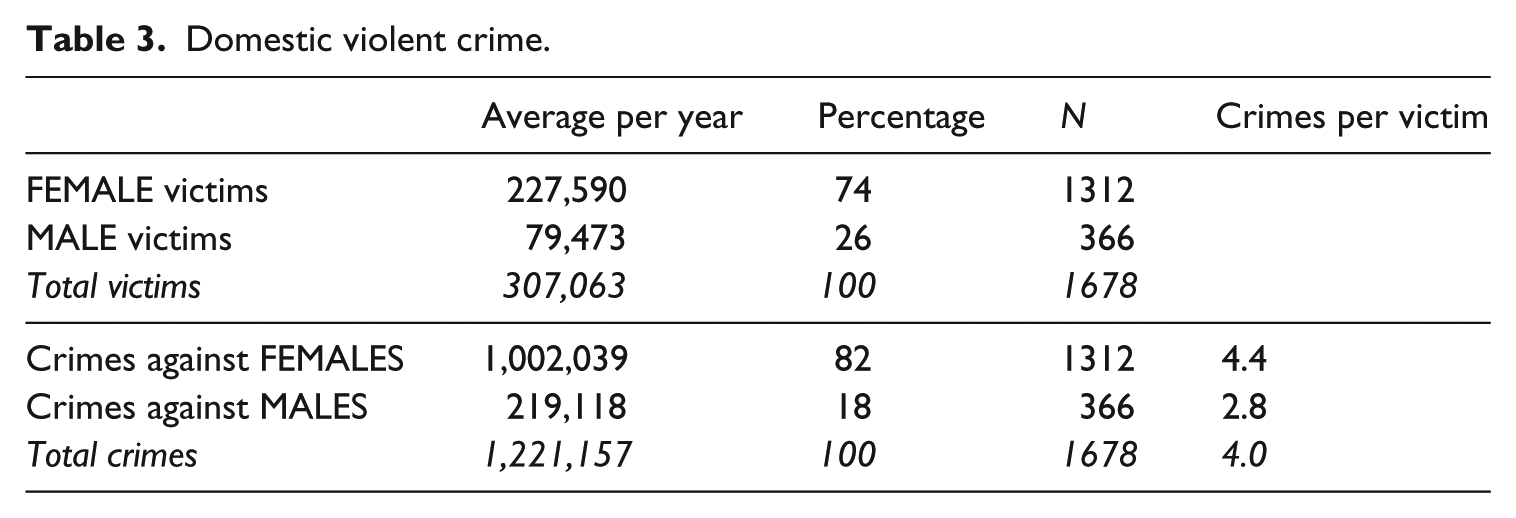
We found an estimated 300,000 domestic violent crime victims and 1.2 million domestic violent crimes per year. This is an estimated 0.7 per cent of the adult population of England and Wales (Table 3).
Domestic violent crime.
Gender is woven throughout domestic violent crime, in its scale, distribution, repetition and seriousness, as well as in its associations with access to economic resources through employment and property. Each section presents findings for all domestic violent crime victims then disaggregates them by the sex of the victim.
Almost three-quarters (74 per cent) of domestic violent crime victims are female and 82 per cent of domestic violent crimes are against women (Table 3). Over a million domestic violent crimes per year (on average) were committed against women, compared to just over 200,000 per year against men (Table 3).
Almost half (42 per cent) of victims report more than one domestic violent crime within a 12-month period and 85 per cent of domestic violent crimes are series (i.e. repeat) crimes (Table 4).
Repetition of domestic violent crime.
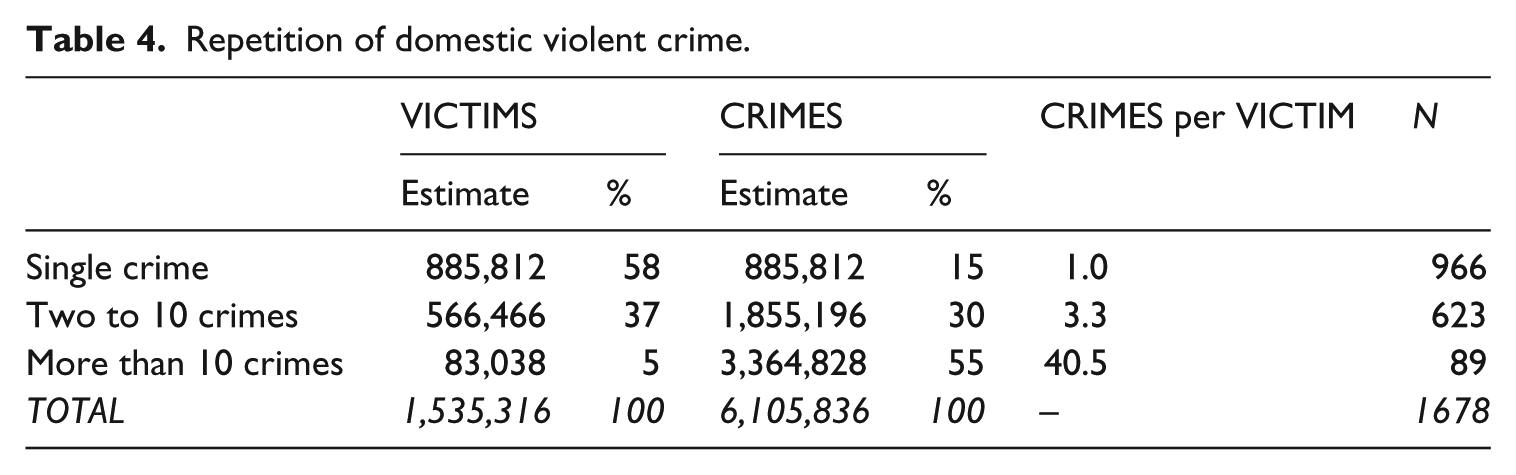
Over half (55 per cent) of all domestic violent crimes are reported by 5 per cent of victims. That is, on average, 40 domestic violent crimes per victim in the past year (Table 4).
The repetition of domestic violent crime is gendered: over 80 per cent (83 per cent) of high frequency victims (more than 10 crimes) are women. These women report nearly 90 per cent (87 per cent) of crimes in this ‘high frequency’ category (Table 5).
Gendering of domestic violent crime: Repetition.
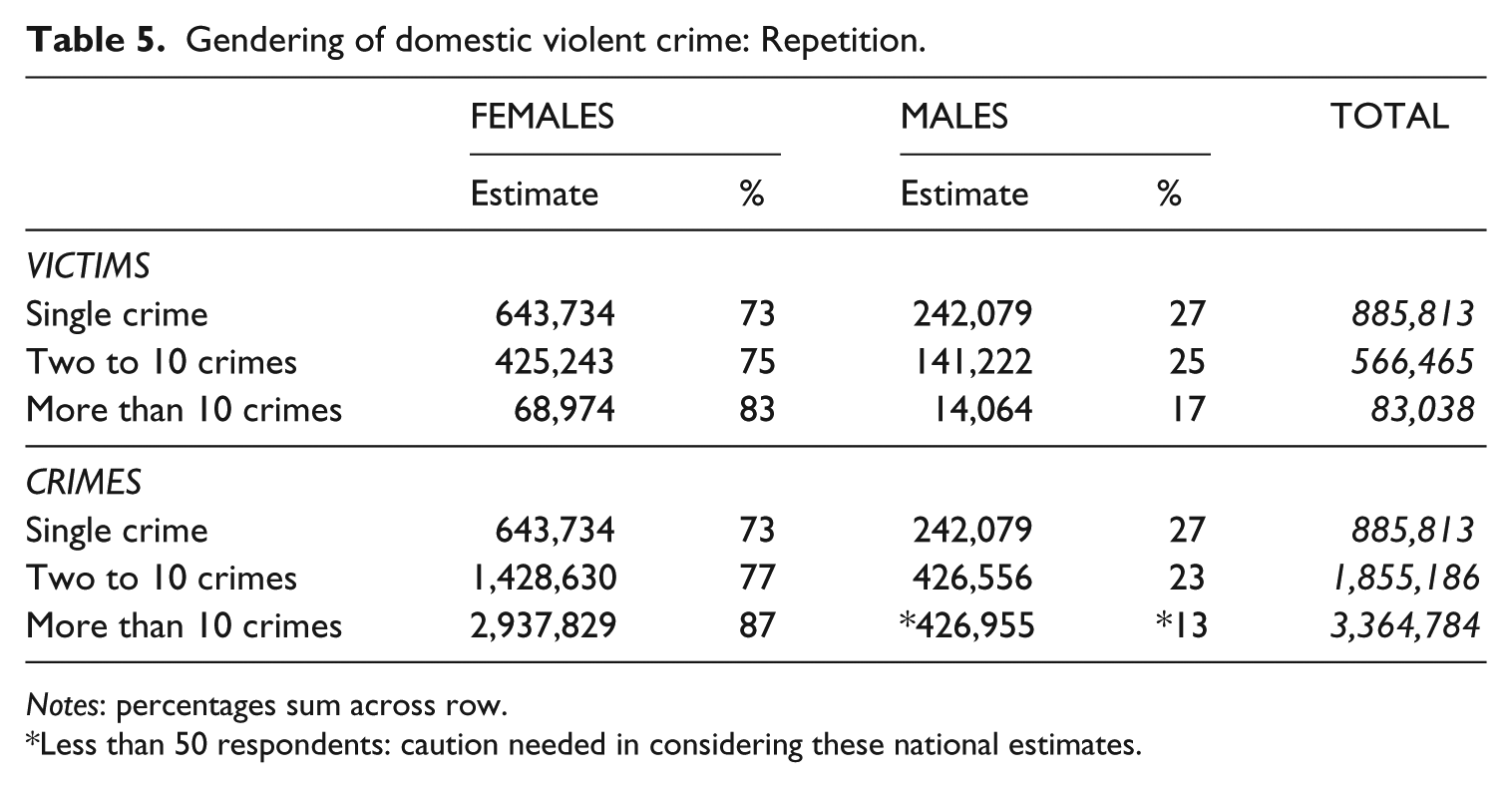
Notes: percentages sum across row.
Less than 50 respondents: caution needed in considering these national estimates.
Less than 5 per cent (4.5 per cent) of victims report almost half (48 per cent) of all domestic violent crimes; these victims are women.
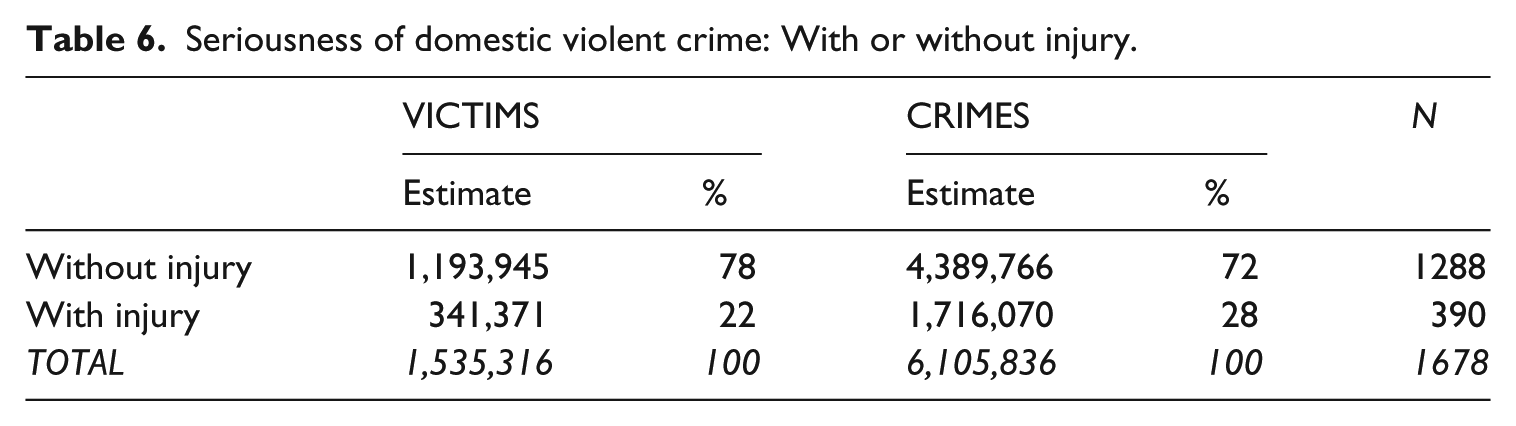
More than one-fifth (22 per cent) of victims report injurious domestic violent crime; over a quarter (28 per cent) of domestic violent crimes are injurious (Table 6).
Seriousness of domestic violent crime: With or without injury.
Seriousness is also gendered. More than two-thirds (77 per cent) of victims reporting injurious domestic violent crime are women and 91 per cent of injurious domestic violent crimes were against women (Table 7).
Gendering of domestic violent crime: Seriousness.
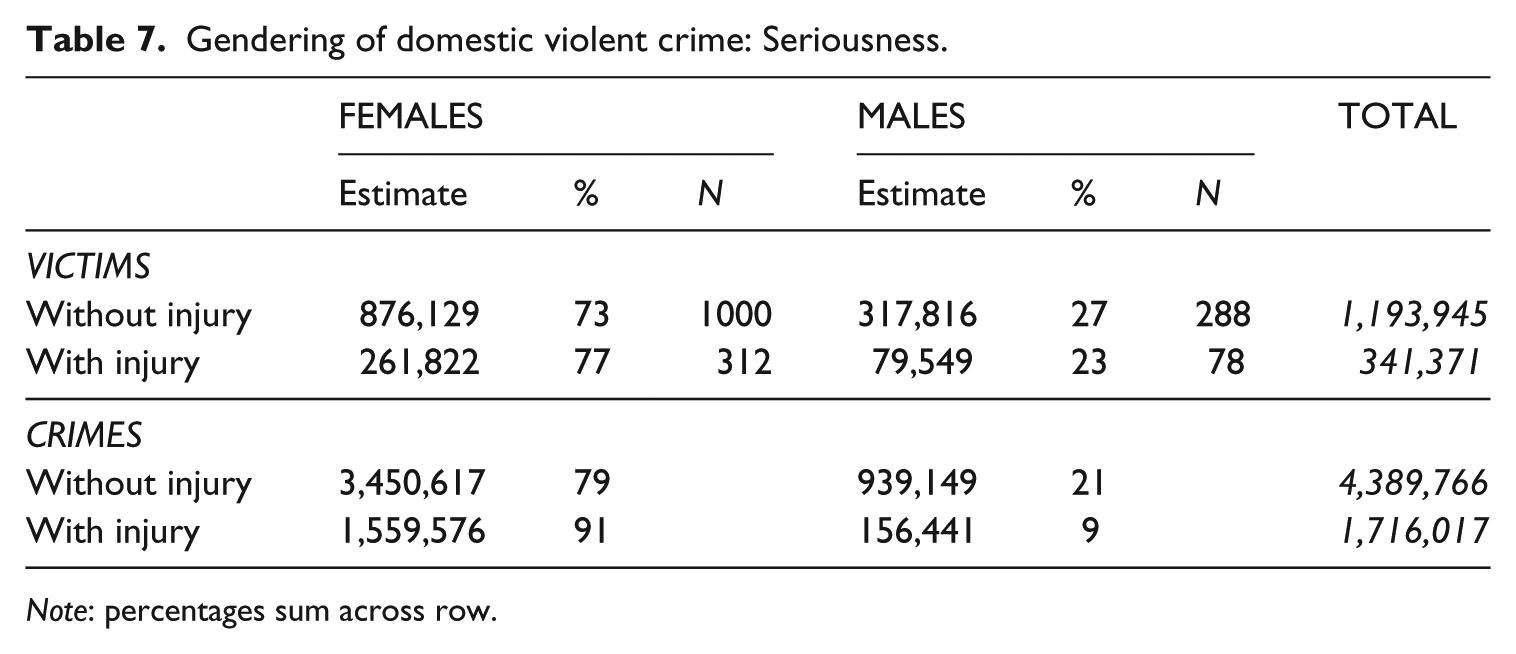
Note: percentages sum across row.
Women also report a higher proportion of injurious domestic violent crime compared to men. Women report 1.5 million injurious domestic violent crimes (1,559,576); this is one-third of all domestic violent crimes against women. Men report less than 157,000 injurious domestic violent crimes (156,441); this is less than 15 per cent of all domestic violent crimes against men (Table 7).
High frequency victims are more likely to report injurious domestic violent crime than victims reporting a lower frequency of repeat victimization (Table 8).
Seriousness and repetition of domestic violent crime.
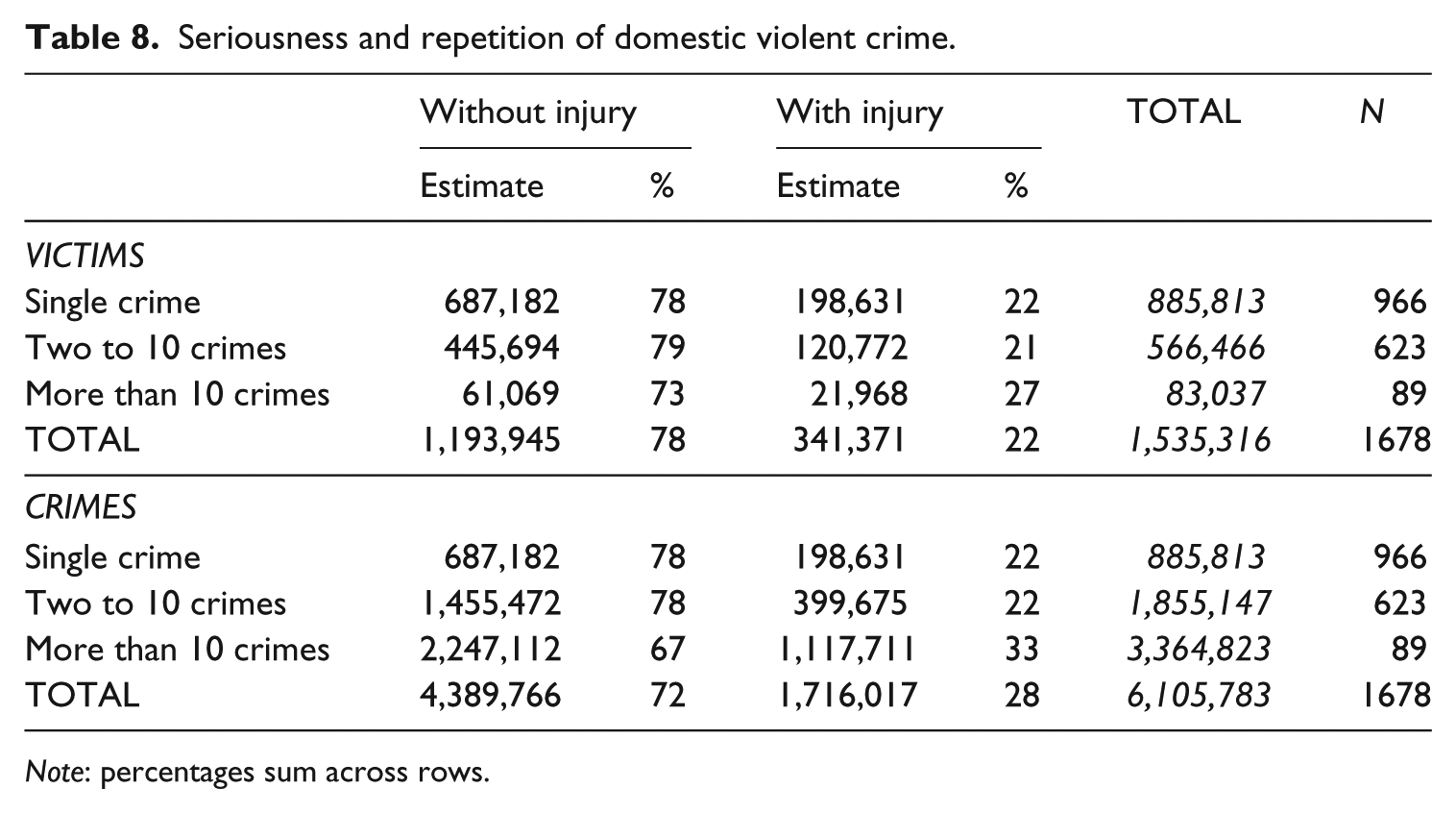
Note: percentages sum across rows.
Near all (98 per cent) high frequency victims reporting injurious domestic violent crimes are women (Table 9).
Gendering of domestic violent crime: Repetition and seriousness.
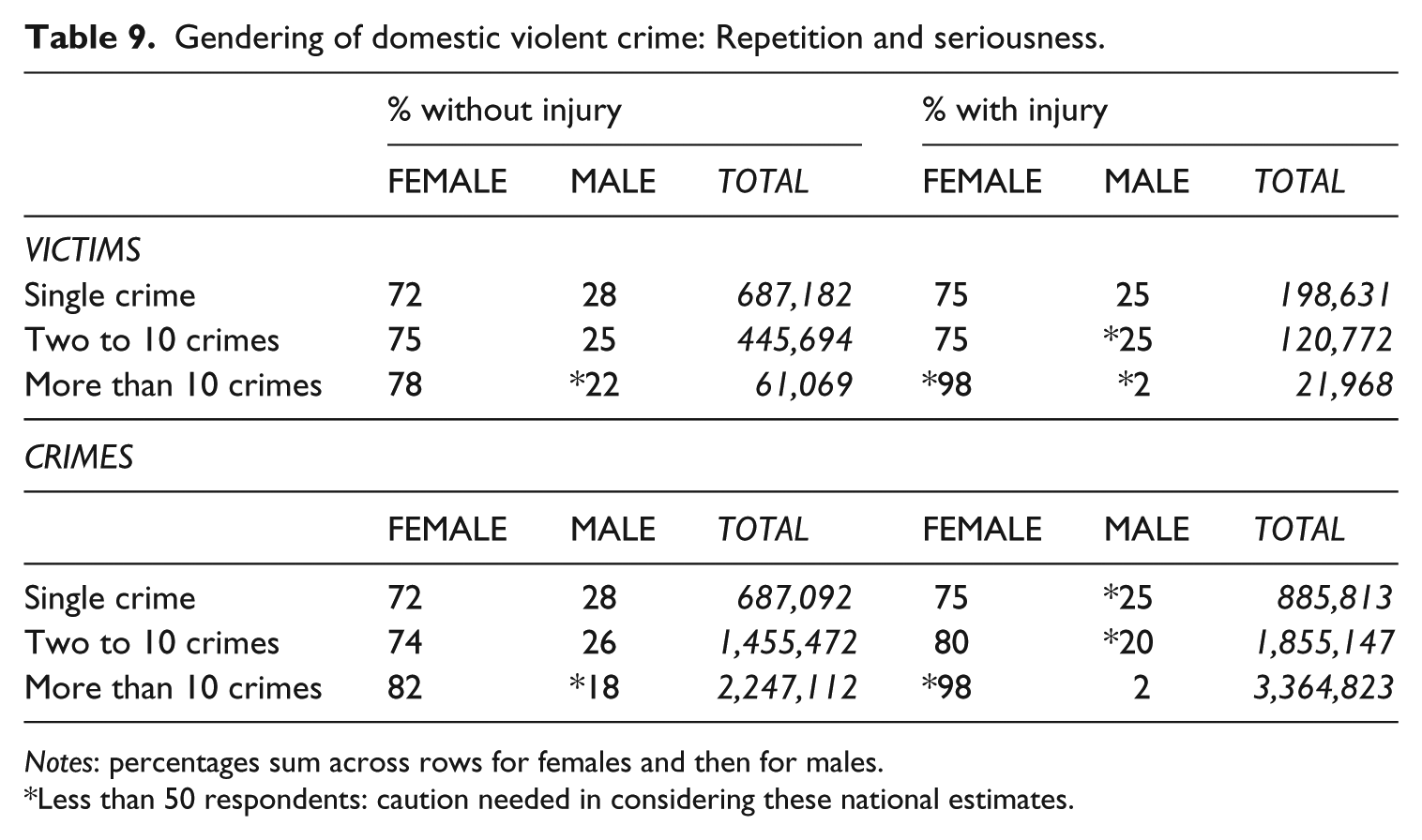
Notes: percentages sum across rows for females and then for males.
Less than 50 respondents: caution needed in considering these national estimates.
As the number of repeat crimes against women increases, the percentage of those that are injurious also increases: from 25 per cent for single crimes, to 26 per cent for two to 10 crimes, to 37 per cent for more than 10 crimes. A different pattern is found for men, although there are few respondents in some of these groups; as the number of repeat crimes increases, the percentage of those which are injurious decreases: from 20 per cent for single crimes, to 19 per cent for two to 10 crimes, to 6 per cent for more than 10 crimes.
Half of domestic violent crime victims are unemployed or economically inactive compared to just over one-quarter (27 per cent) of the population. As the number of repeat crimes increases, so too does the percentage of victims who are unemployed or economically inactive (from 45 per cent for a single crime, to 49 per cent for two to 10 crimes, to 52 per cent for more than 10 crimes) (Table 10).
Repetition of domestic violent crime and economic inequality.
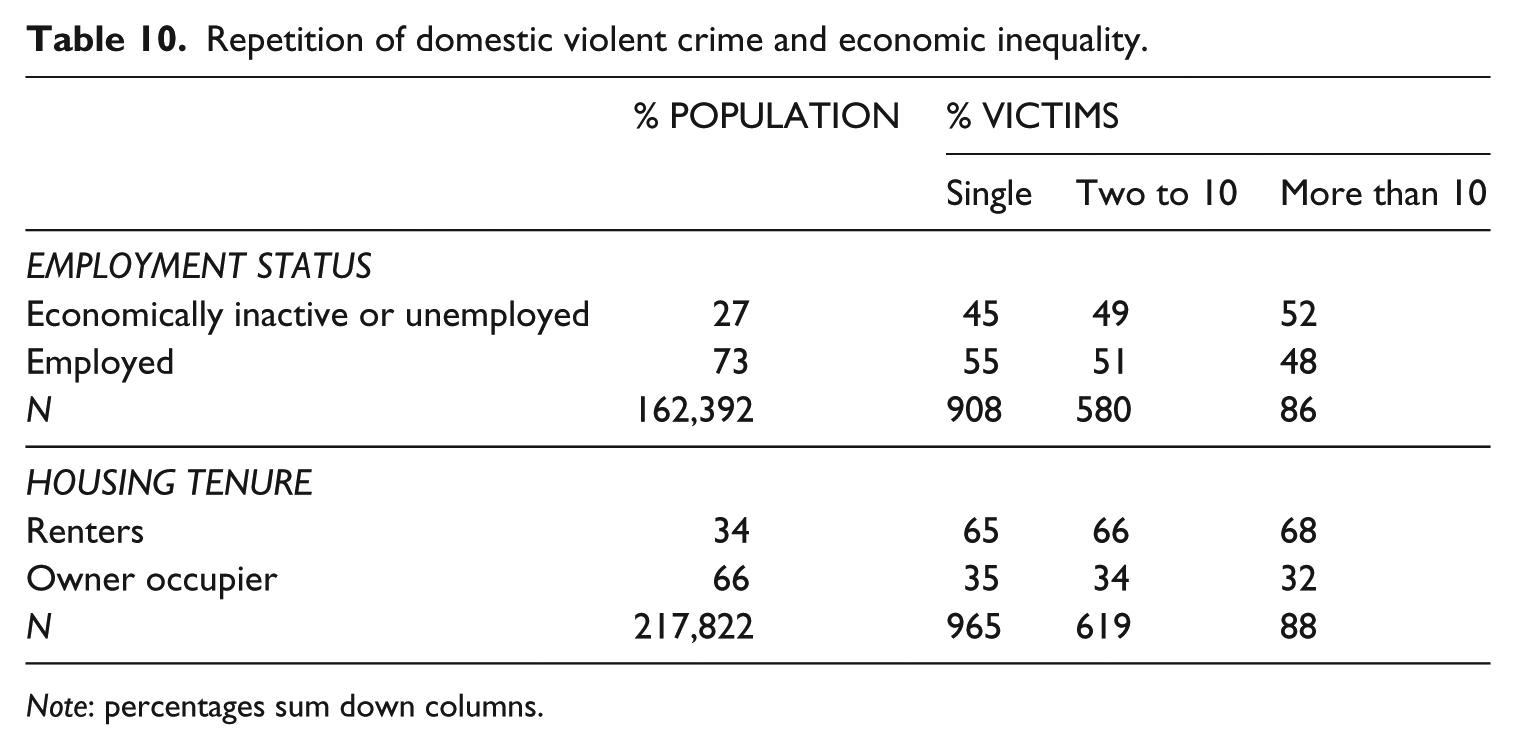
Note: percentages sum down columns.
Two-thirds of domestic violent crime victims live in rented accommodation compared to one-third (34 per cent) of the population. As the number of repeated crimes increases, so too does the percentage of victims living in rented accommodation (from 65 per cent for a single crime, to 66 per cent for two to 10 crimes, to 68 per cent for more than 10 crimes) (Table 10).
Half of female victims of domestic violent crime (53 per cent for victims reporting two to 10 crimes; and 48 per cent for victims reporting more than 10 crimes) are unemployed or economically inactive comparted to one-third (32 per cent) of the female population (Table 11).
Gendering of domestic violent crime: Repetition and economic inequality.
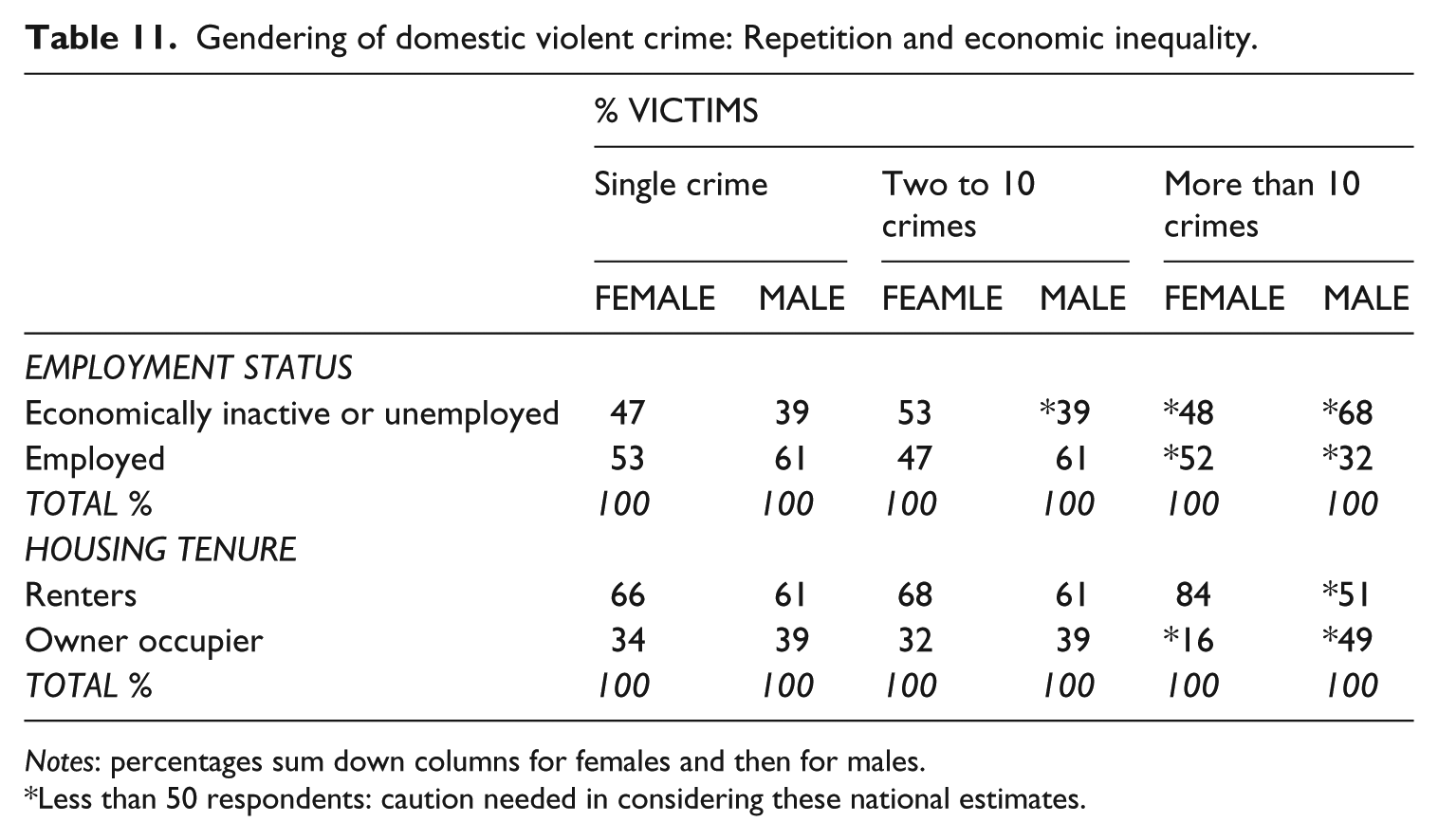
Notes: percentages sum down columns for females and then for males.
Less than 50 respondents: caution needed in considering these national estimates.
As the number of repeated domestic violent crimes increases, so does the percentage of female victims living in rented accommodation (from 66 per cent for a single crime, to 67 per cent for two to 10 crimes, to 84 per cent for more than 10 crimes) (Table 11).
For both employment status and housing tenure status, victims of domestic violent crime are more likely to have access to fewer economic resources compared to the overall population.
The percentage of victims who are unemployed or economically inactive is higher for those reporting injurious domestic violent crime compared to non-injurious domestic violent crime (55 per cent and 44 per cent respectively) (Table 12).
Seriousness of domestic violent crime and economic inequality.
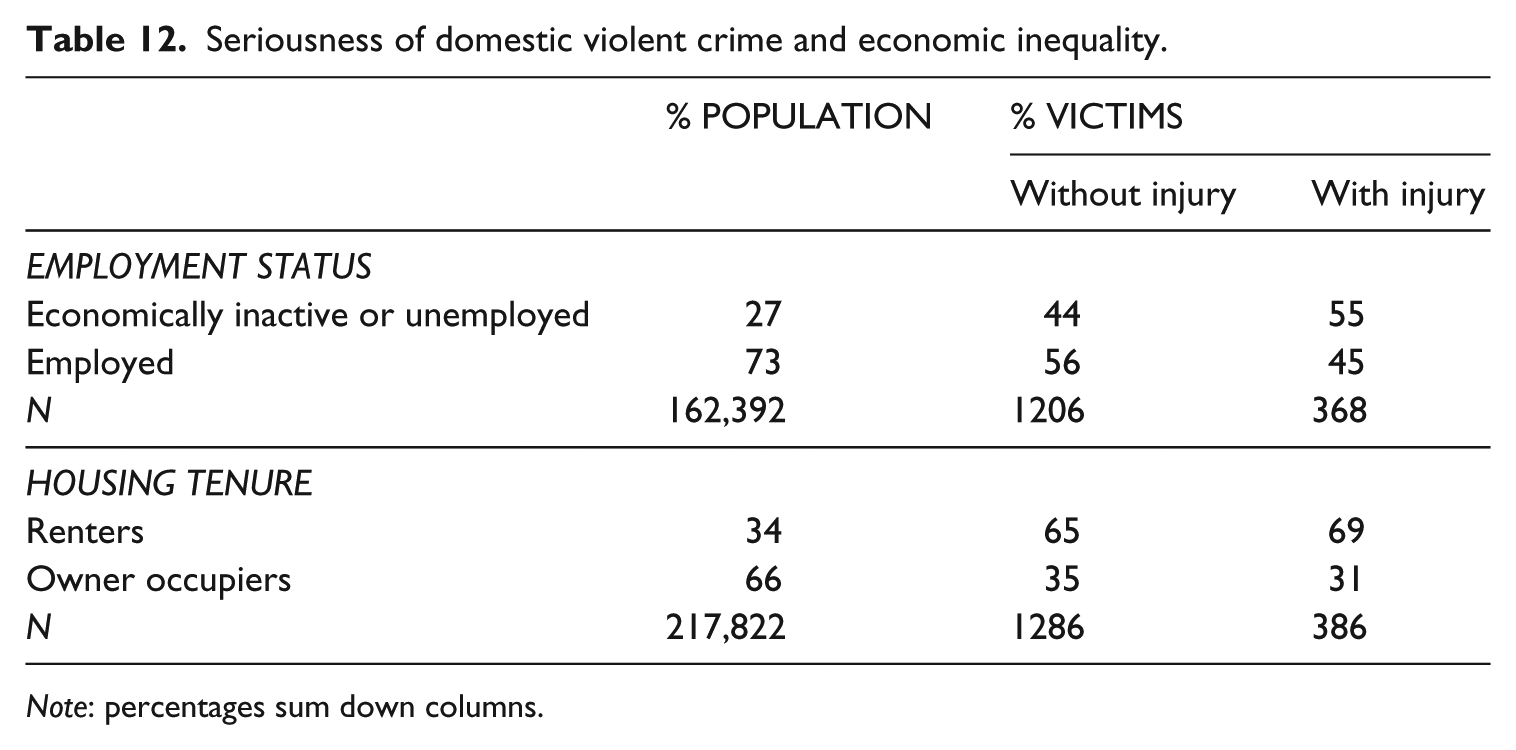
Note: percentages sum down columns.
The percentage of victims living in rented accommodation is higher for those reporting injurious (69 per cent) than non-injurious domestic violent crime (65 per cent) (Table 12).
Over half (52 per cent) of female victims are unemployed or economically inactive compared to one-third (32 per cent) of women in the population.
Two-thirds of female victims live in rented accommodation compared to one-third (34 per cent) of women in the population and a higher percentage of female victims reporting injurious domestic violent crime live in rented accommodation compared to female victims of non-injurious domestic violent crime (71 per cent and 67 per cent respectively) (Table 13).
Gendering of domestic violent crime: Seriousness and economic inequality.
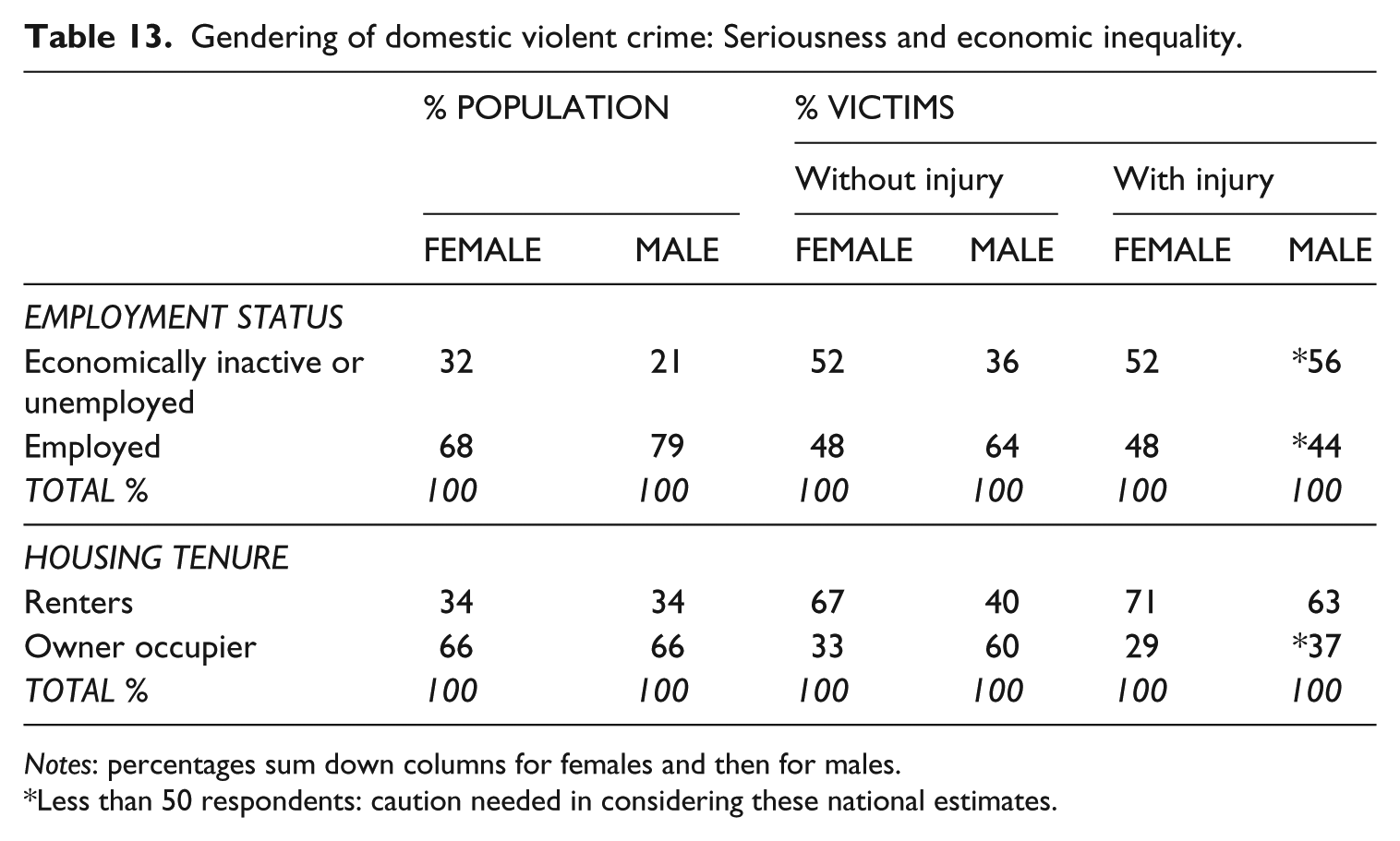
Notes: percentages sum down columns for females and then for males.
Less than 50 respondents: caution needed in considering these national estimates.
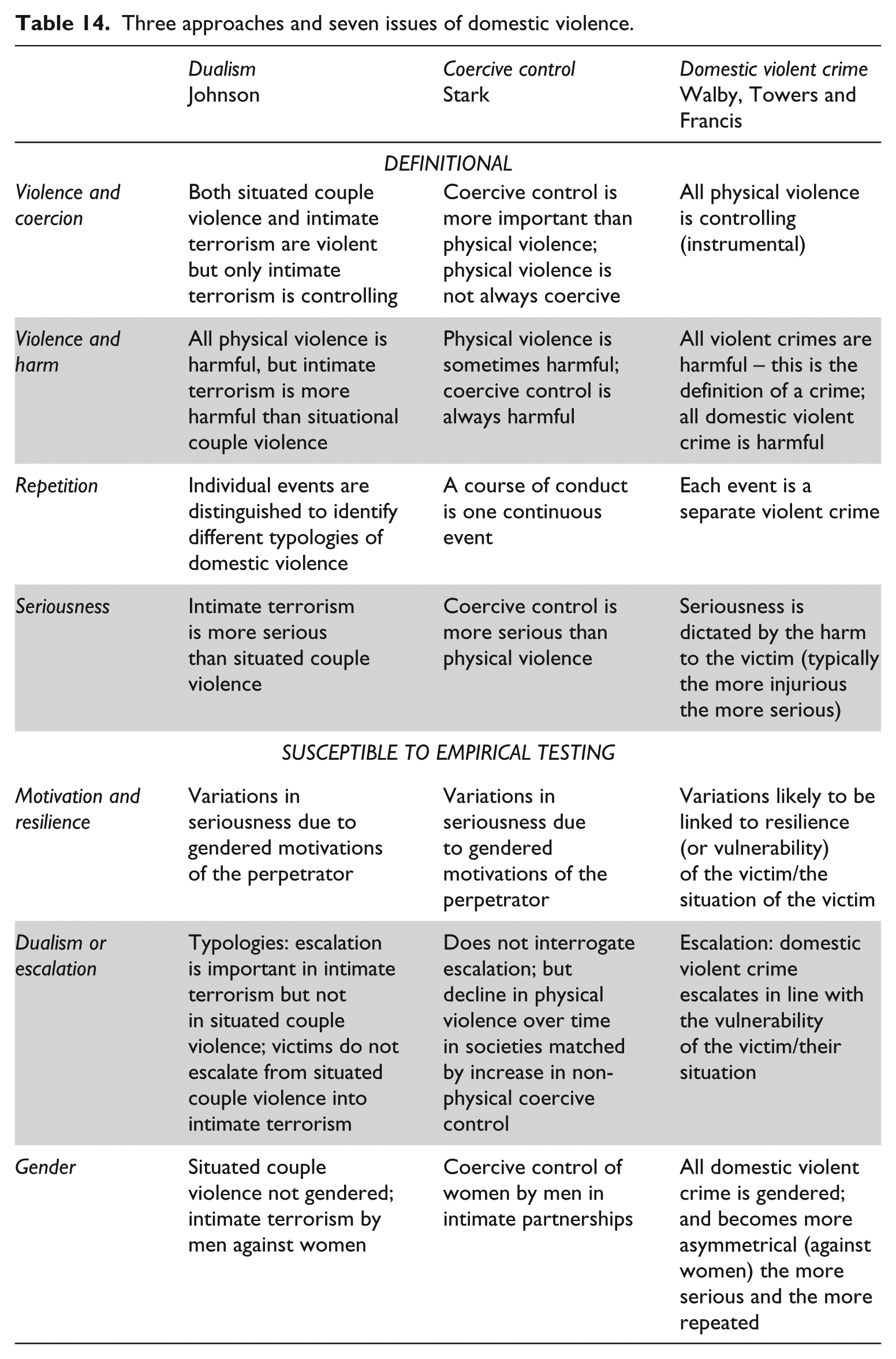
This article has compared three approaches to domestic violence (Stark, Johnson and domestic violent crime) on seven issues (violence and coercion; violence and harm; repetition; seriousness; motivation of the perpetrator or resilience of the victim; different types or escalation; and gender). For four issues, the differences are matters of definition: violence and coercion; violence and harm; repetition; and seriousness. For the other three, empirical tests potentially enable adjudication between the explanatory potential of the different approaches: motivation and resilience; dualism or escalation; and gender. Table 14 summarizes these discussions.
Three approaches and seven issues of domestic violence.
Violence and coercion
For Stark, coercive control, which does not always entail violence, is more important than violence, which is not always coercive. For Johnson, there are two forms of domestic violence (situated couple and intimate terrorism), both of which are violent but only one of which (intimate terrorism) is coercive and controlling. For domestic violent crime, all violence is coercive.
Violence and harm
For Stark, some violence is not harmful, but coercive control is always harmful. For Johnson, all violence is harmful but intimate terrorism is more harmful than situational couple violence. For criminal law, all crimes are harmful or they would not be crimes, thus all domestic violent crime is harmful.
Repetition
For Stark, there is one event – a course of coercive conduct – with many incidents. For Johnson, the separate events are counted in order to assist the allocation into one of two types. For domestic violent crime, each repetition is a separate crime.
Seriousness
For Stark, coercive control is more serious than physical violence. For Johnson, intimate terrorism is more serious than situational couple violence. For domestic violent crime, the seriousness varies with the harm to the victim.
Motivation of the perpetrator or resilience/vulnerability of the victim
For both Stark and Johnson, variations in seriousness are due to the gendered motivation of the perpetrator. For domestic violent crime, variations are likely to be associated with variations in the resilience (or vulnerability) of the victim, linked to their situation.
Different types or escalation
For Stark, there is little attempt to address escalation for individuals; however, a decline in physical violence over time in societies is matched by an increase in non-physical coercion, at the level of society. For Johnson, the differences between the two types are important, and only a minimal amount of consideration is given to potential escalation within intimate terrorism. For Walby, Towers and Francis, domestic violent crime escalates with reduced economic resources available to a victim.
There is empirical evidence on the changing rate of domestic violence that is relevant to Stark (who claims that physical domestic violence is declining) and ‘domestic violent crime’ (where the claim is that domestic violent crime increases if the economic resources needed for resilience are reduced). Walby et al. (2016) show that domestic violent crime victimization reported to the CSEW has been increasing since the economic crisis of 2008. This is consistent with the thesis that changes in domestic violence are caused by changes in the economic resources of victims. Further, analysis of data from the CSEW in this article shows people with fewer economic resources, as indicated by their access to earned income through employment and property through housing tenure, are associated with higher rates of domestic violent crime.
Gender
For both Johnson and Stark, low-level couple violence is not gendered while the more extreme forms of couple violence are gendered – overwhelmingly from men to women. For Walby, Towers and Francis, all domestic violent crime is gendered, the profile varying with frequency and seriousness.
Using data from the CSEW, we show that all domestic violence is gendered, not only the extreme forms, such as intimate terrorism. The more serious (injurious) and frequent the domestic violence, the more gender asymmetrical. But even the less serious (non-injurious) and less frequent is gender asymmetrical.
Conclusions
In the analysis of three approaches to domestic violence, two different interpretations of the concept of ‘coercive control’ were disentangled (Johnson and Stark) and an alternative approach based on the concept of ‘domestic violent crime’ proposed. These approaches varied on seven issues: violence and coercion; violence and harm; repetition; seriousness; motivation of the perpetrator or resilience of the victim; different types or escalation; and gender. While some of the differences are definitional, others were susceptible to empirical testing.
Substantive findings: domestic violence is gender asymmetrical at all levels of seriousness and frequency, not only the most severe. Gender inequality in experience of violent crime is not confined to specialized or severe forms, or to the presence of gendered motivations.
Theory: the findings are consistent with the economic resilience of the victim being a more important source of variation in the frequency and seriousness of domestic violence than the gendered motivation of the perpetrator. It is consistent with patterns in domestic violence due to escalation because of lesser economic resources rather than two stable forms of domestic violence differentiated by gendered motivation. Hence, we conclude that the focus on the motivation of the perpetrator that is central to the coercive control approach is mistaken.
Conceptual framework: the explanatory potential of mainstreaming the analysis of domestic violent crime rather than separating it as a specialist field is demonstrated. Gender and domestic relations are integral to the analysis of violent crime. This requires a common definition and scaling of the seriousness of violence, which is best achieved by including harms as well as acts in the definition.
Measurement matters: counting all crimes reported to a survey is the right thing to do. Making estimates of violent crime that include all crimes rather than capping produces better estimates of the extent and distribution of domestic violent crime. Only by taking account of the repetitive nature of domestic violence, is the full extent of the gendered asymmetry made visible. The proposed method to count coercive and controlling behaviour as non-injurious violent crime, capped at one, in the Home Office Counting Rules is likely to render violence against women significantly less visible in police recorded crime.
Policy: the probability that domestic violence escalates when the victim does not have access to economic resources rather than taking two stable forms only one of which is high risk, has implications for policy. It challenges the relevance of risk assessment methodologies predicated on the existence of multiple types, only one of which is high risk.
Thus, we conclude that the concept of ‘domestic violent crime’ is the best way forward. This is not to deny the existence of coercive control, but, since all violence is coercive and controlling, the phrase has little if anything to add other than confusion. In our approach, we identify and count each (criminal) act in order to identify the scale and distribution of domestic perpetration and to analyse the relationship/s between these different forms of coercive and controlling behaviours. The UK’s new law prevents this by combining all acts (criminal and non-criminal) into a single pattern of coercive and controlling behaviour, thus preventing the analysis of the internal relationships between these different forms.
Footnotes
Acknowledgements
We thank the ONS for the use of the CSEW and the UK Data Service for assistance in accessing these data. The original data creators, depositors or copyright holders, the funders of the Data Collections and the UK Data Service bear no responsibility for this analysis and interpretation. The data are available from the UK Data Service at  . The study analysed the CSEW main questionnaire and Victim Form module datasets for consecutive sweeps between 2008/2009 and 2012/2013, downloaded in SPSS, listed as study numbers: SN6367; SN6627; SN6937; SN7252; SN7422. We thank Brian Francis for his engagement with the ideas and statistics in this article as part of our larger programme of joint work in the Violence and Society UNESCO Centre at Lancaster University.
Declaration of Conflicting Interests
The author(s) declared no potential conflicts of interest with respect to the research, authorship, and/or publication of this article.
Funding
The author(s) disclosed receipt of the following financial support for the research, authorship, and/or publication of this article: This work was supported by the Economic and Social Research Council, grant number ES/K002899/1, as part of the Secondary Data Analysis Initiative.