




Abstract
This research examines how the media report on sentences given to those who commit serious crimes against children and how this impacts on public knowledge and attitudes. Three months of press and television coverage were analysed in order to establish the editorial lines that are taken in different sections of the media and how they are promoted by selective reporting of sentencing. Results indicate that a small number of very high profile crimes account for a significant proportion of reporting in this area and often, particularly in the tabloid press, important information regarding sentencing rationale is sidelined in favour of moral condemnation and criticism of the judiciary. Polling data indicate that public attitudes are highly critical of sentencing but also confused about the meaning of tariffs. The article concludes by discussing what can be done to promote a more informed public debate over penal policy in this area.
Introduction
The focus of this study is on variations in perceptions of sentencing policy and how these are influenced by the mass media. In this research we have specifically focused on serious crimes against children. 1 These crimes have attracted a great deal of media attention and have been highlighted as an area of major public concern. In order to address these issues, we have analysed both media reporting and public views on sentencing policy. The importance of this research is that it demonstrates how the mass media, and in particular the tabloid press, can promote specific ways of understanding sentencing policy and the appropriateness of sentences given to offenders. Politicians may then respond to these perceived climates of opinion or may attempt to harness them for electoral advantage. However, this can create a situation where criminal policy is influenced by what plays well with particular sections of the media, rather than being based on rigorous research evidence.
We will initially review the research literature on public attitudes towards sentencing and the influence of the mass media in this area. We will then examine data which suggest that since the mid-1990s, sentencing policy has moved in a punitive direction as politicians have substituted evidence-based policy for measures orientated towards media-driven climates of opinion. We will focus specifically on high profile crimes against children and will address three analytical research questions:
What are the editorial lines that are being taken in media accounts of these crimes?
How are these promoted by selective reporting of particular crimes and types of sentences?
What is the impact of this reporting on public understanding and attitudes?
The Existing Debate
A body of research conducted over decades has found that most people see the sentences handed down by judges as being too lenient (see Cullen et al., 2000; Roberts, 1992). However research also suggests that public perceptions of sentencing leniency may be a function of both widespread ignorance and misconceptions concerning the operation of the judicial system. Studies have consistently pointed to low levels of public knowledge in relation to the criminal justice system. In a MORI (2003) poll 49 per cent of respondents admitted that they knew ‘not very much’, ‘hardly anything’ or ‘nothing at all’ about the court system in Britain. Most people also have little knowledge about sentencing guidelines, maximum penalties or the range of punishments that courts can impose (Hough, 1996). Public ignorance and confusion over sentencing may be partly a consequence of the complexity of the legal system. However distortions in public perceptions are not random but instead follow a particular pattern in that respondents consistently underestimate the punitiveness of the sentencing system. Public estimates of imprisonment rates for various offences are significantly lower than actual rates (Doob and Roberts, 1983; Hough and Roberts, 1999; Mattinson and Mirrelees-Black, 2000). Furthermore the public tends to underestimate the lengths of sentences that courts hand down for specific crimes (Hough and Roberts, 1998; Paulin et al., 2003) and to assume that most of a sentence will be spent in the community without real supervision (Hough and Roberts, 1999).
Research in this area also suggests that perceptions of sentencing leniency may be an artefact of the survey method used in public opinion polls. North American studies have found that attempting to gauge public attitudes using general poll questions may be problematic for three reasons (Brillon et al., 1984; Doob and Roberts, 1988; Roberts and Stalans, 1997; Sprott, 1996). First, there is evidence people responding to general poll questions tend to answer punitively because they have the worst offenders in mind. Second, when judging sentencing policy, respondents tend to recall unusually lenient sentences that are heavily reported in the media. Third, respondents typically do not consider the full range of sentencing options available to courts. These arguments were supported in a British study where participants were asked to attach sentences to an offender in a specific burglary case (Hough and Roberts, 1999). In the study the respondents were given background information to the offence which was available to the court but which is usually absent from media accounts. The research found that ordinary members of the public were no more punitive than the courts would have been in a similar situation.
All of this research evidence points to the key role of the mass media in influencing
public knowledge and attitudes. Hough
and Roberts (1999: 23) argue that the media, and in particular the tabloid press,
exert influence through the selection and framing of stories and the strong criticism of
instances where allegedly lenient punishments have been handed down: People do not receive balanced information about sentencing practices in the news
media, but rather a steady stream of stories about sentencing malpractices, cases in
which a judge imposes what appears to be a very lenient sentence for a serious crime of
violence. Quantitative analysis of press coverage does not actually suggest that
newspapers are more likely to cover stories about court cases if the sentence is a light
one; however, when lenient sentences are passed, the attention given to them, and the
editorial comment on them, tend to be shrill. In such cases, the news media rarely make
any attempts to explain the judicial reasoning underlying the decision, or to place the
sentence imposed in some statistical context.
Others researchers point to the significance of the volume of crime reporting and how this may influence opinion. Roberts et al. (2002) argue that the way that the media feature crime, and particularly serious violent crime, makes it appear more prevalent than it is in reality and that this is mirrored in public overestimations both of the prevalence of this kind of crime and their chances of victimization. Others suggest the news media’s tendency to frame crime episodically as discrete individual actions, as opposed to arising out of wider social processes, may engender individualistic attitudes towards crime control which focus primarily on punitive sanctions against offenders (Iyengar, 1991). These effects may be reinforced by the presentation of crime in television reality shows (Roberts et al., 2002) and fictional representations such as crime dramas (Beckett and Sasson, 2000; Fabianic, 1997) both of which tend to present a robust policing solution to the problem of crime. Research evidence which directly links use of media to attitudes about crime and sentencing is relatively scarce and since much of it is correlational it suffers from the problem of trying to establish directionality. However, Indemaur and Roberts (2005: 61) note that ‘generally an association can be observed between a shallow or limited perception of crime trends, use of commercial, broadcast or tabloid media and increased punitiveness’ though ‘whether or not all these variables are in turn related to another more relevant variable such as education level, socio-economic status or even intelligence is yet to be established’.
The research evidence therefore suggests that public opinion is more complicated than the consistently punitive picture which emerges from decades of raw opinion polls. When presented with information available to judges or jurors, public opinion appears no more punitive than sentencers. Part of the reason why public opinion appears so punitive in polls is that it rests on ignorance and misunderstanding about the operation of the criminal justice system. This low and distorted level of public knowledge is closely related to the reporting of crime, particularly in the tabloid press, where little context and much negative editorial comment is attached to sentencing decisions.
However, despite the evidence that raw opinion data is an unreliable barometer of public
opinion, there is evidence that it have increasingly become influential in setting policy
debates. This trend which has been dubbed ‘penal populism’ has seen politicians substitute
evidence-based policy for measures designed to satisfy the supposed public desire for
harsher penalties (Garland, 2001;
Hough and Roberts, 1999; Pratt et al., 2005; Roberts et al., 2002). Part of the
rationale for this has been that it would restore public confidence in the judicial system
(Henham, 1997). Roberts et al. (2002) trace the
beginning of this shift in England and Wales to the appointment of Michael Howard as Home
Secretary in 1993 and his imposition of the ‘prison works’ programme. Howard ‘successfully
mined a broad seam of public opinion that supported harsher sentencing’ and increased the
prison population by 50 per cent in four years (Roberts et al., 2002: 46). Part of the reason for the
Conservative Party’s decision to move penal policy in a more authoritarian direction was
that it felt it had to compete with a Labour Party which was attempting to establish itself
as being the party toughest on crime. As Green (2006: 138) notes Labour ‘did this in part by fitting its rhetoric to
tabloid sensibilities’. Tony Blair hired Alastair Campbell, the former political editor of
the Daily Mirror. Campbell had stated that: we focus on the newspapers. They don’t like to acknowledge that the papers that really
matter are the tabloids. I think one of the reasons Tony asked me to work for him, and
why I wanted to work for Tony, was that we both acknowledge the significance to the
political debate of the tabloids. (Guardian, 17 February 1997, cited in
Green, 2006: 138)
However, a number of commentators have suggested that the shift to a more authoritarian
penal stance by both parties was also influenced by a climate of opinion fostered by the
press over a very high profile child killing (Green, 2006; Littlechild, 1997; NACRO, 2001; Newburn, 2007; Roberts et al., 2002). In early 1993 two 10-year-old
boys, John Venables and Robert Thompson, kidnapped and murdered two-year-old Jamie Bulger.
The press response to the crime was unprecedented. Across all national newspapers, a total
of 3765 inches of editorial copy were devoted to discussion of the story (Franklin and Petley, 1996). The
tabloid press, in particular were vitriolic in their condemnation of Venables and Thompson
and demanded a more punitive approach to criminal justice policy: The press corp was indeed in a vengeful mood. Editorials expressed outrage, demanded
retribution and offered a range of policy proposals designed to exact increasingly
punitive measures from the criminal justice system. The ‘demonising’ of Thompson and
Venables was so relentless in the British press that one observer was prompted to
describe it as, ‘the kind of outbreak of moral condemnation that is usually reserved for
the enemy in times of war’. (Franklin and Petley, 1996: 134)
The intense media focus coincided with significant public disorder. Angry mobs drove the families of Venables and Thompson from their homes and they had to be re-housed for their own protection. Following the decision to set a minimum tariff of eight years in custody for the two boys, sections of the tabloid press began a campaign to try and increase their sentence to a full life term. The Sun asked its readers to fill in a coupon which read ‘Dear Home Secretary I agree with Ralph and Denise Bulger that the boys who killed their son James should stay in jail for LIFE’ ( Reg. v. Secretary of State for the Home Department, 1997–1998). It ran this campaign under headlines such as ‘80,000 call T.V. to say Bulger killers must rot in jail’ ( Reg. v. Secretary of State for the Home Department, 1997–1998). These are examples of what are termed ‘informally solicited polls’ or SLOPs (‘self-selected listener opinion polls’). Despite the fact that such polls produced non-generalizable statistically invalid polls, ‘once they are broadcast’ Fiskin (1995: 140, cited in Green, 2006: 135) notes ‘their results take on a life of their own’ and ‘become representations of public opinion that are communicated to candidates, commentators and citizens alike’. This appears to have happened in the Jamie Bulger case. After receiving a petition with 278,300 signatures, 5000 letters and 21,281 Sun coupons, Home Secretary Michael Howard citing ‘public concern’ increased the minimum tariff to 15 years. 2
Similar pressures were evident in the wake of another child killing in July 2000. Following the sexual assault and murder of eight-year-old Sarah Payne, the News of World was at the forefront of a campaign to ‘name and shame’ convicted paedophiles, stiffen sentences and introduce notification legislation, dubbed ‘Sarah’s Law’. 3 This campaign mobilized support from certain senior justice professionals and members of the Conservative party. However it also appeared again to contribute to significant instances of public disorder as well as vigilante attacks on paedophiles and suspected paedophiles. Eventually the News of the World suspended its campaign of naming convicted paedophiles on the condition that the Government review the notification legislation – which it was in fact already doing. Roberts et al. (2002) argue that this tabloid campaign created a very difficult environment for policymakers. Despite the consensus among ‘informed opinion’ being that the British registration arrangements were ‘at least as effective as those introduced under Megan’s and related US initiatives’ the Government came under tremendous pressure to change policy (2002: 51). On this occasion it stood firm against a change in the legislation but ‘without doubt the [News of the World] campaign has served to compound public frustration about the criminal justice system and has simultaneously constrained politician’s ability to locate strategies that genuinely minimise the risk of predatory paedophile crime’ (2002: 51). In the years following Sarah Payne’s murder, the tabloid press has continued to press for the introduction of ‘Sarah’s law’. The response from policymakers has been to tighten the web of civil measures designed to monitor offenders (Thomas, 2005). These have involved changes to the rules governing the operation of the sex offenders’ register such as reducing the time that offenders are given to notify police stations of their presence, more power for police to fingerprint, photograph and take iris scans of offenders, and sharply increased custodial sentences for non-compliance with a range of new restriction orders issued by courts (Thomas, 2005). Eventually however, the Government bowed to media pressure and in September 2008 moved to pilot a notification system in four areas of England. In August 2010 it was announced that the scheme would be implemented across England and Wales in March 2011 (Guardian, 1 August 2010). This move drew criticism from the NSPCC who expressed concern that media attention and fear of subsequent vigilante attacks may drive released offenders underground so that they cannot be monitored and absent themselves from treatment programmes (Independent, 2 August 2010).
The research evidence in this review suggests that in the area of serious crimes against children the media, and in particular the tabloid press, can create climates of opinion which can constrain politicians’ ability to locate and implement appropriate criminal justice policy. Instead politicians may be pressured to enact policies which placate sections of the media, rather than ones which research evidence suggest are actually likely to be effective. Our own research investigates the existence of such processes by examining the editorial content of key sections of the media and the reporting of particular crimes and sentences. We also examine possible impacts on attitudes and understandings among different sections of the public.
Sample and Method
The sample consists of coverage in nine newspapers from 1 January to 31 March 2010. These were the broadsheets The Times, the Guardian and the Daily Telegraph, three tabloids, the Daily Mail, the Sun and the Daily Mirror, and three regional papers, the Belfast Telegraph, the Scotsman and the Western Mail. We also included the regional editions of all national newspapers except the Guardian. We selected the tabloids and broadsheets on the basis that they have the largest circulations in their segments of the press. The regionals were chosen on the basis that they had substantial readerships in the three devolved areas of the UK (Northern Ireland, Scotland and Wales). The three-month sample period was selected on the basis that this would provide a sufficiently large selection of newspaper articles to be representative of reporting in this area.
The sample was supplemented by the main news on BBC One, since this has a very wide national viewing audience and is the news source most trusted by the public (Barnett, 2008). For television news, we recorded all the BBC One 10 o’clock news programmes from the period of the sample and retrieved relevant items. For the newspaper sample, articles were identified using the Nexis facility which provided electronic copies through the use of key words. Since we were primarily interested in cases in which a particular sentence was mentioned we used a series of 29 search items which had to co-occur with either the keywords sentence, sentenced, jailed or prison. The search items were murder, murdered, assault, assaulting, assaulted, murdering, killed, killing, manslaughter, abused, abandoned, sexual abuse, sexually abused, sexually abusing, paedophile, pornography, pornographic, porn, grooming, groomed, groom, incest, trafficking, trafficked, raped, raping, rape, neglect and child cruelty.
Only articles which contained mention of a sentence for the crime that was reported were included in the sample. This identified a total of 4747 articles. We ran a further three-month search to check the sample we had selected had not been skewed by the presence of unusually high profile crimes. The searches for the same three-month period in 2009 returned 4725 articles thus confirming that our sample was not atypical. The sample was then refined in new searches to identify those which specifically fitted the crime categories for this analysis. These were killings, sexual offences against children, physical abuse and neglect. These categories were chosen not because they correspond exactly to legal definitions, but because they represent broadly the descriptions which are typically offered in media accounts. We excluded some other types of incident such as child-on-child injuries or killings, as well as gang or knife crime. The central focus was therefore crimes of violence, neglect or sexual abuse by adults against children. This left a total of 253 articles. Each article was then coded on according to a series of criteria. These were:
Date.
Newspaper.
Unique crime number.
Offence category (Killing/Sexual Abuse/Viewing Child Pornography/Physical Assault/Neglect).
Total sentence.
Community sentence (Yes/No).
Community sentence length specified (Yes/No).
Community sentence length.
Probation (Yes/No).
Probation length specified (Yes/No).
Probation length.
Life sentence (Yes/No).
Life sentence minimum length to be served specified (Yes/No).
Life sentence minimum length to be served.
Indeterminate sentence (Yes/No).
Indeterminate sentence minimum length to be served specified (Yes/No).
Indeterminate sentence minimum length to be served.
Suspended sentence (Yes/No).
Relationship between offender and victim (not specified/parent/step-parent or parent’s partner/other relative/people known – friends, etc.).
Comment on sentence (Yes/No).
Nature of Comment on sentence (Too short/Too long/Appropriate long/Appropriate short).
Who was comment from (Victim’s relative/expert/judge/prosecution/defence/ victim/offender’s relative/editorial/comment piece/letter writer/vox pop/offender/victim’s relatives or friends/offender’s relatives or friends)
Categories 19–22 were then repeated for any further comments by another actor relating to the same crime. Then categories 4–22 were repeated for any subsequent crime reported within the same newspaper article.
Once the coding was completed all data were entered in into SPSS for all statistical analyses. The coding scheme meant that the key unit of analysis is crime incidents reported rather than newspaper articles. There are two rationales for this. First, some newspaper articles report on different sentences for multiple perpetrators who were convicted of either the same or different offences. An example from our sample was the Kyra Ishtaq killing where both the mother and stepfather were reported as being given separate sentences for the killing of the young girl. A second reason for adopting crime incidents as the unit of analysis is that newspaper articles sometimes reference different crime incidents and the sentence attached to them within the course of a single article. So an article discussing a contemporary child killing might then move on to discuss a sentence handed down for a previous instance or instances of the same crime.
The purpose of the content analysis was to provide a broad overview of different aspects of reporting. However we supplemented the quantitative analysis with an in-depth qualitative analysis where we examined in closer detail the range of meanings, arguments and explanations offered in news accounts. To do this we employed a type of qualitative analysis termed thematic analysis which has been developed and refined over more than three decades by the Glasgow Media Group (1976, 1980) in areas such as industrial news, food scares and risk (Philo, 1999), international development (Philo, 1999), war and conflict reporting (Glasgow Media Group, 1985; Philo and Berry, 2004, 2011) and the representation of mental illness (Philo, 1996). This method is based on the assumption that in any controversial area there are competing ways of explaining events or issues. These explanations are linked to particular interests which seek to explain the world in ways that justify their own position. The media are thus conceptualized as a space where different interest groups ideologically compete to try and make sure that their explanations are dominant and accepted by audiences. For instance, in the 1970s and 1980s, the Glasgow Media Group (1976, 1980) examined the reporting of debates surrounding the problems of the British economy which was widely seen to be falling behind its international competitors. This research demonstrated that while the causes for this malaise were hotly contested, broadcast media chose to ignore some explanations (underinvestment and management failings) while prominently featuring and sometimes directly endorsing others (unions and strike action). In the current study we examined the range of debate that newspapers offered in relation to crime and criminal policy. This included commentary on the sentences handed out to offenders and prescriptions for reducing re-offending and protecting public safety. Our quantitative analysis captured all articles, whether they be hard news or comment pieces, which mentioned a crime where a specific sentence was reported. We chose not to make a clear distinction between editorials and hard news because, particularly in the tabloid press, hard news is structured in order to pursue the themes that are established by the editorial line of the newspaper. Our qualitative analysis also included 21 articles from our sample period which did not appear in our quantitative analysis. These provided commentary on the crimes we were focusing on but did not mention a particular sentence. Our aim here was to capture other reporting in our sample period which was likely to influence public attitudes.
Our audience research consisted of large scale representative polling carried out by the company Yougov in April 2010. Two questions were put to the sample:
In court cases where people are found guilty of crimes of cruelty, physical or sexual abuse or the killing of children do you think that the sentences that are given in general are: Too long/About right/Too short/Don’t know?
In court cases where people are found guilty of crimes of cruelty, physical or sexual abuse or the killing of children, people are sometimes given indeterminate sentences. Do you think that these are in general: Too long/Neither/Too short/Don’t know?
The polling was stratified by both newspaper readership and socio-economic status (National Readership Survey classification) allowing for an examination of how these variables are related to understanding and attitudes.
Results
Quantitative analysis
Our three-month sample generated a total of 253 separate articles in nine newspapers and four television reports. We were surprised by the extremely low number of television reports in this area since research has consistently shown that television is the main source of news for approximately two-thirds of the population (Ofcom, 2007). Furthermore within television, the BBC is by far the most popular and trusted news source (Ofcom, 2007). Clearly, in relation to the construction of public knowledge and attitudes concerning serious crimes against children, the press is key while BBC national news is likely to have a very marginal role. Only the most high profile crimes such as the Soham murders, the Khyra Ishaq killing and the ‘British Fritzl’ case were featured on BBC television news. In our press sample, we found that because some articles cited multiple crimes, the total number of references to crimes against children was 271. Our sample also picked up the same crime reported over many days and in different newspapers. The total number of unique crimes reported over the three-month period of our sample was 120. On average, each individual crime generated just over two articles across newspapers and television news. This measure of unique crimes also allowed for an estimation of the significance of very high profile crimes. Our research suggests that these accounted for a substantial share of all newspaper coverage of crimes against children. The eight most heavily reported crimes (6.7% of unique crimes) accounted for just over a third (34.0%) of all newspaper references to crimes against children with the three highest profile offences accounting for 18.8 per cent of all references. A list of the 10 most reported crimes in order of prominence is given below:
Soham murders – Ian Huntley, a school caretaker was convicted of two counts of murder for the killing of two 10-year-old schoolgirls, Holly Wells and Jessica Chapman.
‘British Fritzl’ – a 54-year-old businessman was given 25 concurrent life sentences for the repeated rape of his two daughters over a 25-year period. He fathered seven surviving children with his daughters.
Khyra Ishaq killing – a mother and stepfather were convicted of starving to death seven-year-old Khyra Ishaq.
Baby ‘P’ murder – Peter Connelly, a 17-month-old boy died after suffering more than 50 injuries. The boy’s mother Tracey Connelly together with her boyfriend Steven Barker and his father Jason Owen were convicted of ‘causing or allowing the death of a child or vulnerable person’. The case was particularly controversial because the boy had been repeatedly seen by child protection in the months leading up to his death.
Mother jailed for forcing son to fake serious illness in order to solicit money – a mother was jailed for three years after falsely claiming for six years that he was severely disabled and suffering from life threatening illnesses. During this period, she fraudulently claimed state benefits and awards from charities.
Teenager jailed for raping nine-year-old girl – a 17-year-old boy was given an indeterminate sentence for committing rape, sexual assault and grievous bodily harm on a nine-year-old girl while on bail for raping a 10-year-old girl.
Baby ‘P’ prisoner loses rape appeal – Steven Barker who was convicted in the Baby ‘P’ case, (see no. 4) was reported to have lost his appeal against a further conviction for child rape.
Mother and daughter murdered by convicted paedophile – a former soldier and convicted sex offender was convicted of raping a mother and her 10-year-old daughter.
Convicted paedophile given suspended jail sentence due to obesity – a church elder was given a suspended sentence for indecently assaulting a minor over an eight-year period. The judge cited his lack of mobility, ulcerated legs and need for frequent dressing as being ‘wholly exceptional circumstances’.
Girl on trial for throwing banana at home of her sex attacker – a case against a girl who threw fruit at the home of a man convicted of having underage sex with her was dropped by the prosecution. The original decision to prosecute was heavily criticized by another judge not directly involved with the case.
These results suggest that the seriousness of the crime is the key factor affecting the likelihood that an offence will be heavily reported but that other factors such as alleged judicial leniency and the unusual nature of some crimes are also significant news values. 4 What is also clear is that high profile crimes such as the Baby ‘P’ case and the Soham murders can remain prominent in news coverage long after the trials have concluded. In these cases it was subsequent events such as an attack on Ian Huntley in prison or an appeal by a prisoner convicted in the Baby ‘P’ murder which triggered further discussion of these offences. There is also considerable cross-referencing of past cases in the reporting of ‘new’ crimes.
In Table 1 we provide details of the proportion of the most serious offences of child killing and sexual abuse which are reported as attracting life or indeterminate sentences. The table also contains information on how frequently the details of minimum tariffs are reported.
Life and indeterminate sentences
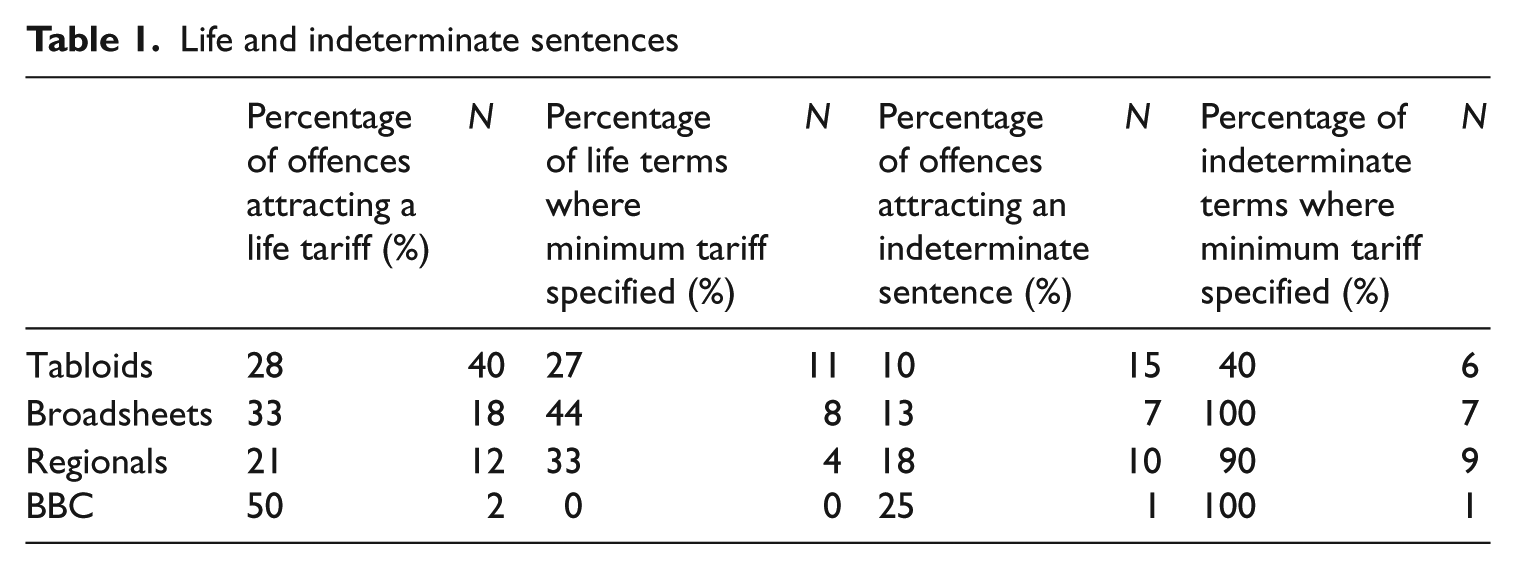
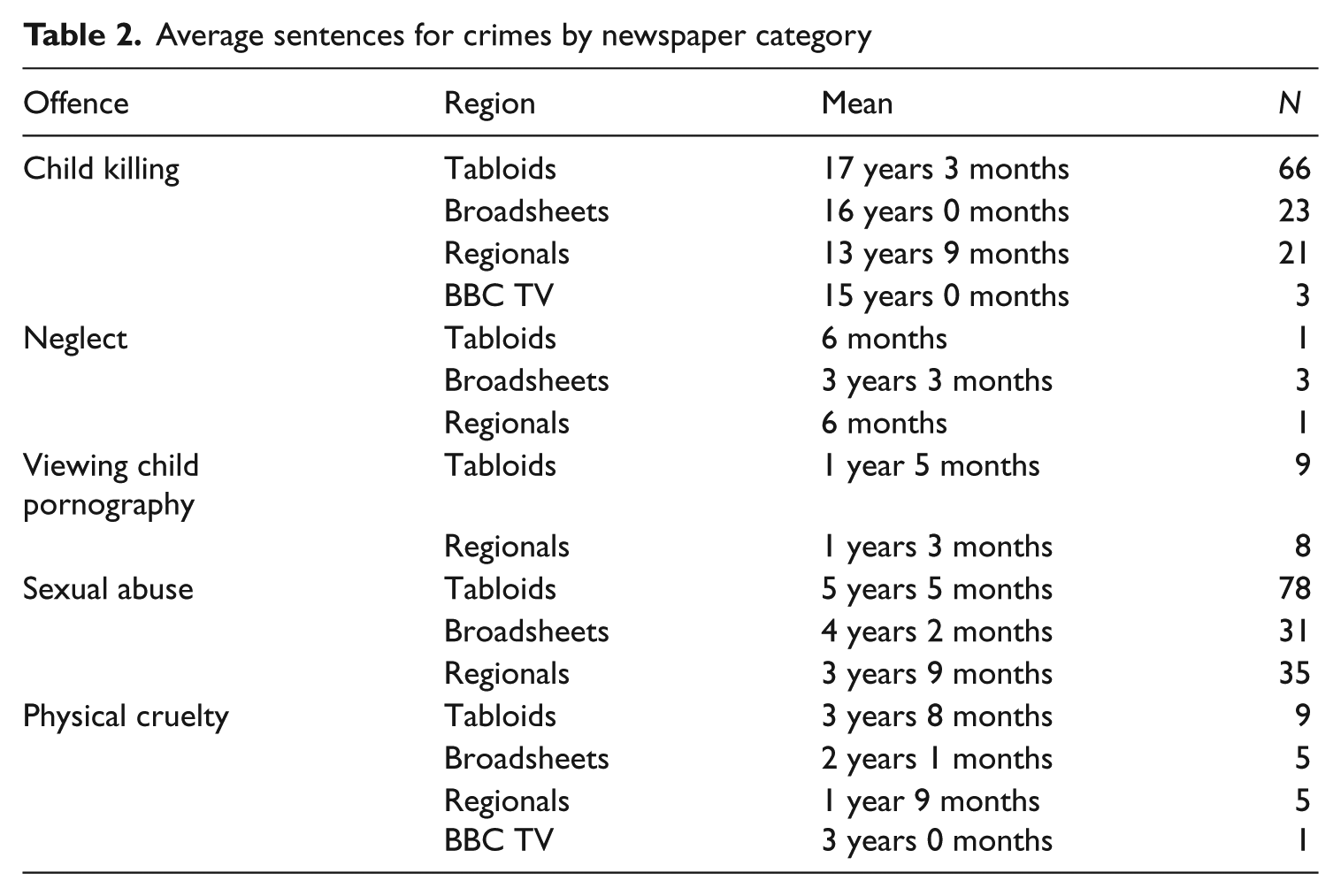
The clearest finding from this analysis is that information about minimum tariffs attached to these sentences is less frequently reported in the tabloids than it is in the broadsheet press. There is quantitatively less information about details of the most serious sentences reported in this segment of the media. Table 2 provides details of the average sentences for different crimes across the media. There are no obvious patterns and this is in line with previous research which has found that the tabloid media overall do not report disproportionately on crimes which have attracted allegedly lenient sentences (Hough and Roberts, 1999). They will however in some cases focus on ‘leniency’ when this is perceived to occur.
Average sentences for crimes by newspaper category
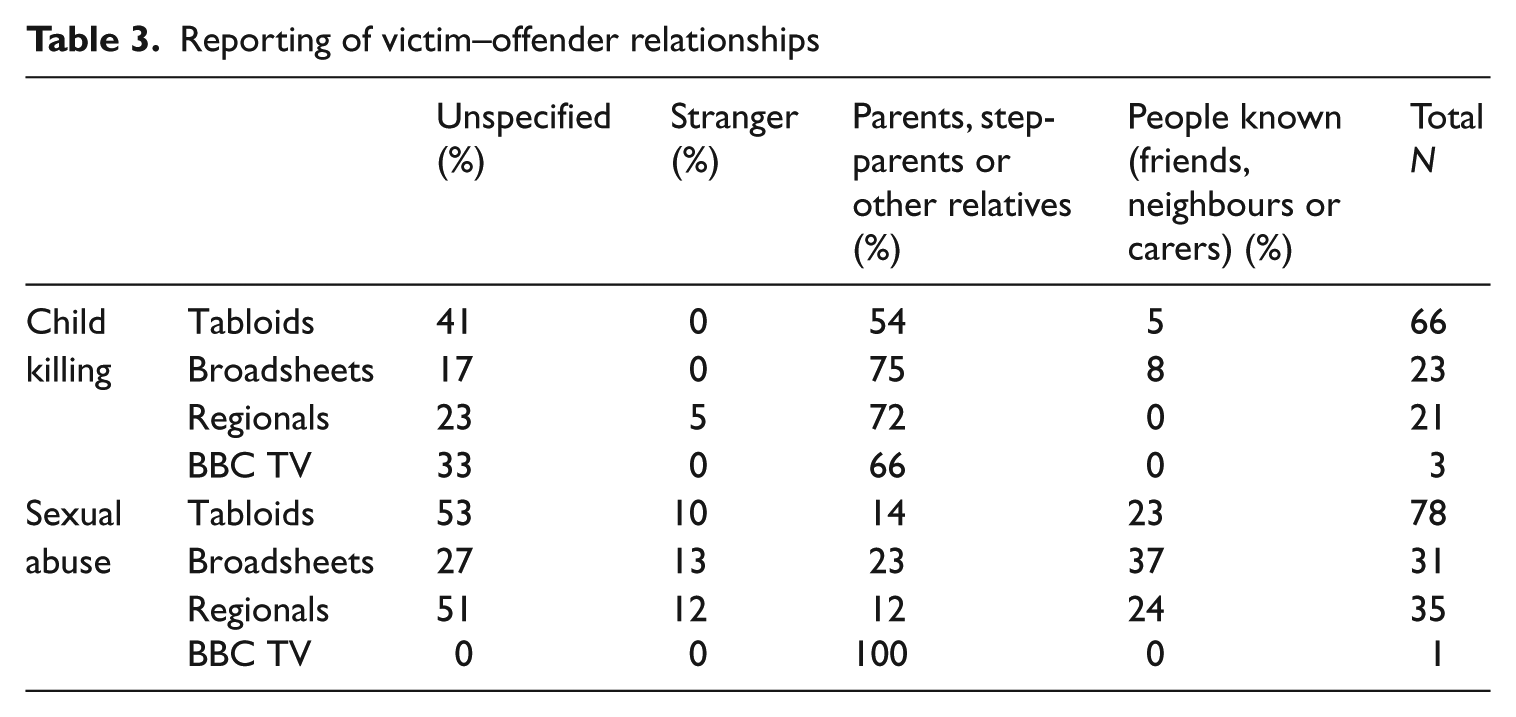
In Table 3 we provide details of the pattern of reported offender profiles across the media. Tabloids are significantly less likely than broadsheets to provide information about the relationship between victim and offender. As in reporting of minimum terms attached to life and indeterminate sentences, there is quantitatively less information provided in the tabloids than in the broadsheets. Where the offender–victim relationship is stated, clear patterns can be seen. With regard to child killings the perpetrators are overwhelmingly reported as being parents or step-parents across all newspaper categories. In cases of sexual abuse where a relationship is stated, the perpetrator is rarely identified as a stranger in any newspaper category. Broadsheets are more likely than tabloids to identify parents as being perpetrators of sexual abuse but in all types of newspaper, the most common perpetrator identified is a person known to the family such as a neighbour or a friend. Although it may appear that the most reported sexual threat to children comes not from ‘stranger danger’ but from the immediate known environment of home and neighbourhood, an important qualification should be made in the sense of what is understood to be a ‘stranger’. A neighbour might be defined as someone who is ‘known’ but some high profile cases have involved killings by neighbours who had a previous and unknown history of sexual assault. It is the unknown part of their history which defines them in some public debate as being potentially dangerous and has led to both media and public demands for access to such information.
Reporting of victim–offender relationships
In the next set of tables we examine who was reported as commenting on sentences and what they actually said about the tariffs. Table 4 gives a breakdown of who was reported as commenting across different parts of the media. Across all sections of the press criminal justice professionals were the most commonly quoted commentators on the appropriateness of sentencing. Within this category judges were by far the most frequent contributors, accounting for 59 per cent of all comments from criminal justice professionals. What is also noticeable is the substantial degree of editorializing in the tabloids, and to a lesser extent in the regional press, but which is absent from the broadsheets.
Proportion of comments by different actors across newspaper categories
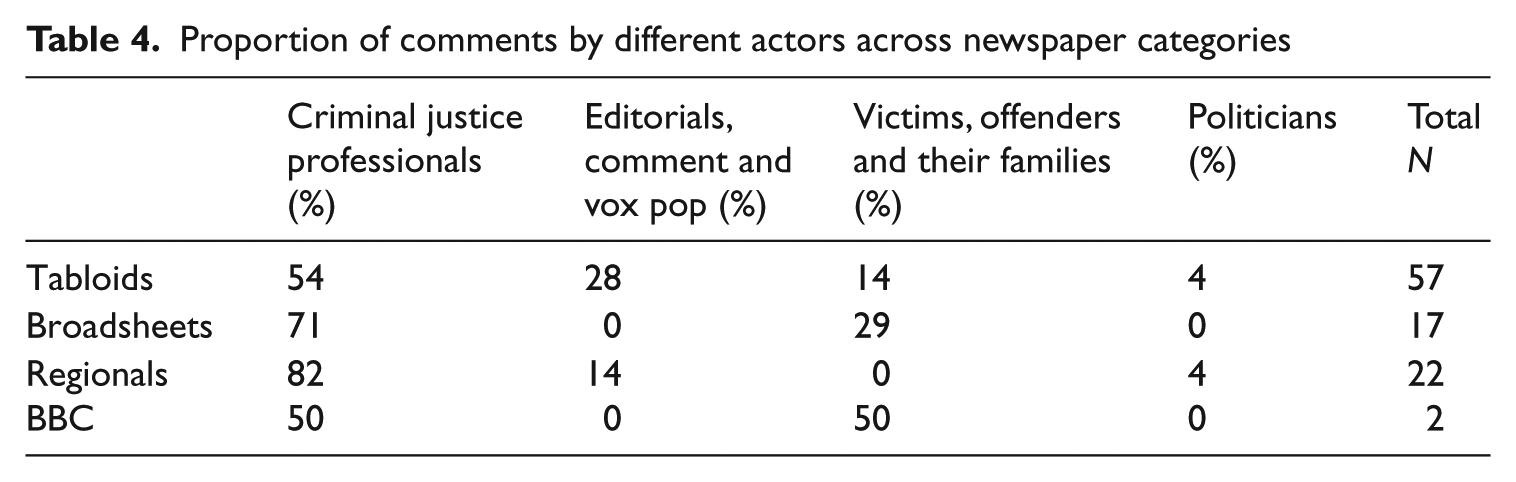
Table 5 provides details of whether the different groups who made comments on sentencing expressed approval or disapproval at the sentence handed down. We have provided categories which differentiate between comments which express the view that the sentence was severe and warranted (appropriate long) and those who argue that the sentence was short but correct (appropriate short).
Proportion of comments on the appropriateness of sentencing by actor groups
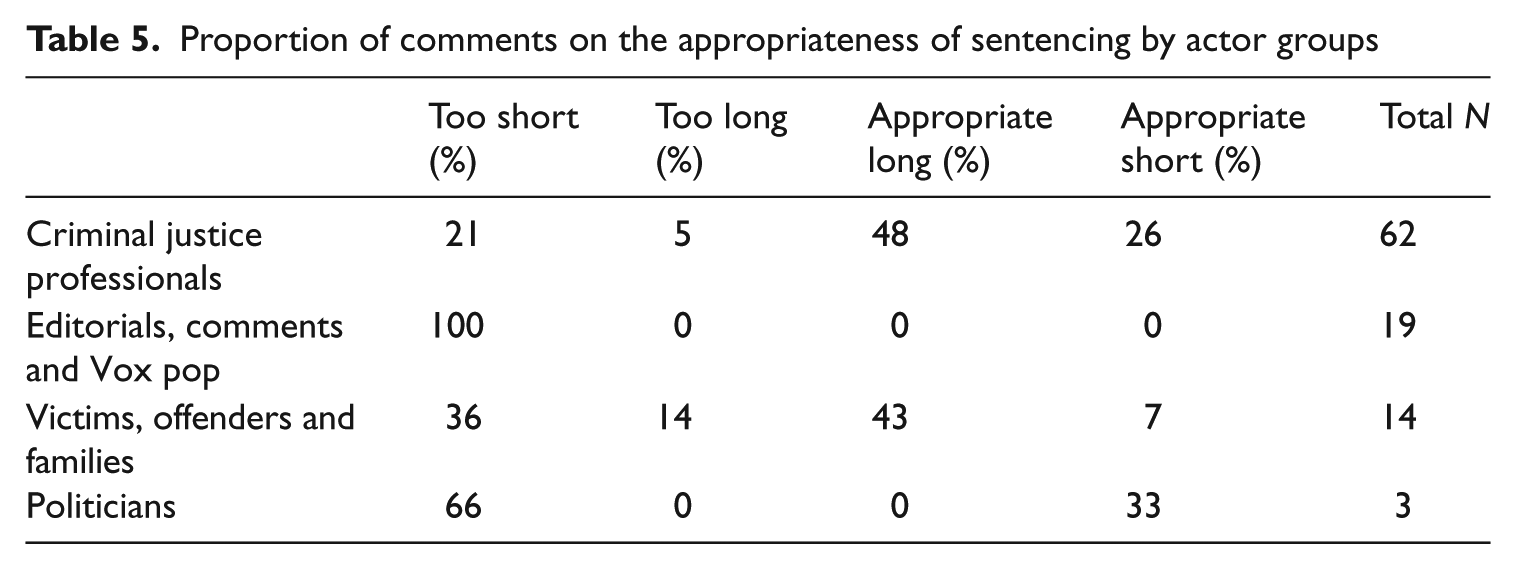
We found that criminal justice professionals, and in particular judges, were the main source of comment which expressed the view that sentences were appropriate. They justified both long- and short-term sentences. There was one exception to this which involved a case in which the Sun reported that a judge had ‘hit out’ at sentencing guidelines which prevented him from imposing an indefinite sentence on an offender who the judge described as ‘a very real risk to children’ (18 March 2010). Interventions from politicians and newspapers were always on the basis that sentencing had been too lenient. Newspapers reinforced this perception that sentencing was too lenient by using vox pops. This could be done in the form of a direct quotation from a member of the public expressing disapproval at a sentencing decision but it could also be achieved by citing public anger as in a comment from the Sun that a decision to hand down a suspended sentence to a mother who had been repeatedly convicted for child cruelty ‘sparked outrage’ (19 January 2010). Table 6 provides a breakdown of approving/ disapproving comments on sentencing by newspaper category. This demonstrates that the tabloid and regional press account for all comments critical of sentences for being too short. In contrast the broadsheets did not contain a single instance where a comment critical of a specific sentence length was made in a news report, though the Daily Telegraph did feature two editorials which made criticisms of sentencing in general.
Proportion of comments on the appropriateness of sentencing by newspaper category
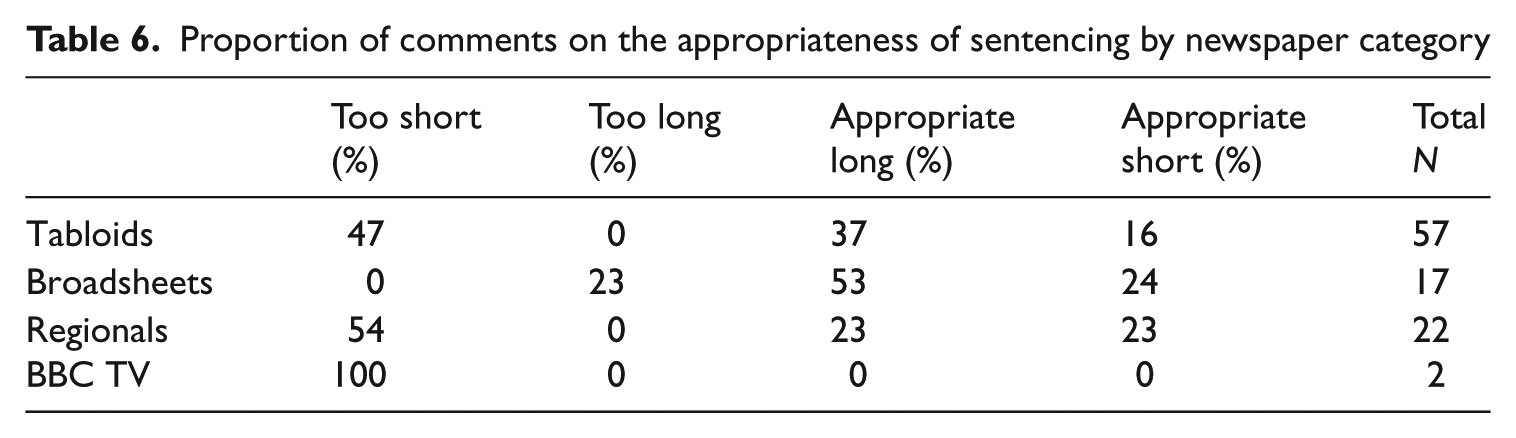
In reports of child killings, we found that almost all the negative comments on sentencing were attached to very high profile cases. In the tabloids 14 out of the 16 criticisms of sentencing were concentrated on the ‘Baby P’, Khyra Ishaq or Soham murders. For instance, the life sentence with a minimum term of 40 years given to Ian Huntley was criticized in editorials in both the Daily Mail (23 March 2010) and the Mirror (27 March 2010) both of whom argued that Huntley should have been executed. A different pattern arises in the comments tied to cases of sexual abuse. Here we did find that a great deal of critical commentary on sentencing centred around cases where allegedly short sentences were handed out. One case which involved a man who had been given a suspended sentence for repeatedly sexually abusing a young girl over several years attracted nearly half the critical comments on sentencing.
While the central focus of the study was reports where specific sentences were stated we also examined commentaries on sentencing which did not mention a specific sentence in a case. We found 21 of these of which 19 involved criticism that sentencing was too short. All but three of these appeared in the tabloid press. Most of the criticism was expressed either in the form of editorial/comment pieces or in letters to the editors, though the tabloid press also featured two critical comments from victim support groups. Overall the editorial comments which criticized sentence length tended to be much longer and more emotive than the commentary provided by judges which justified their sentencing decisions.
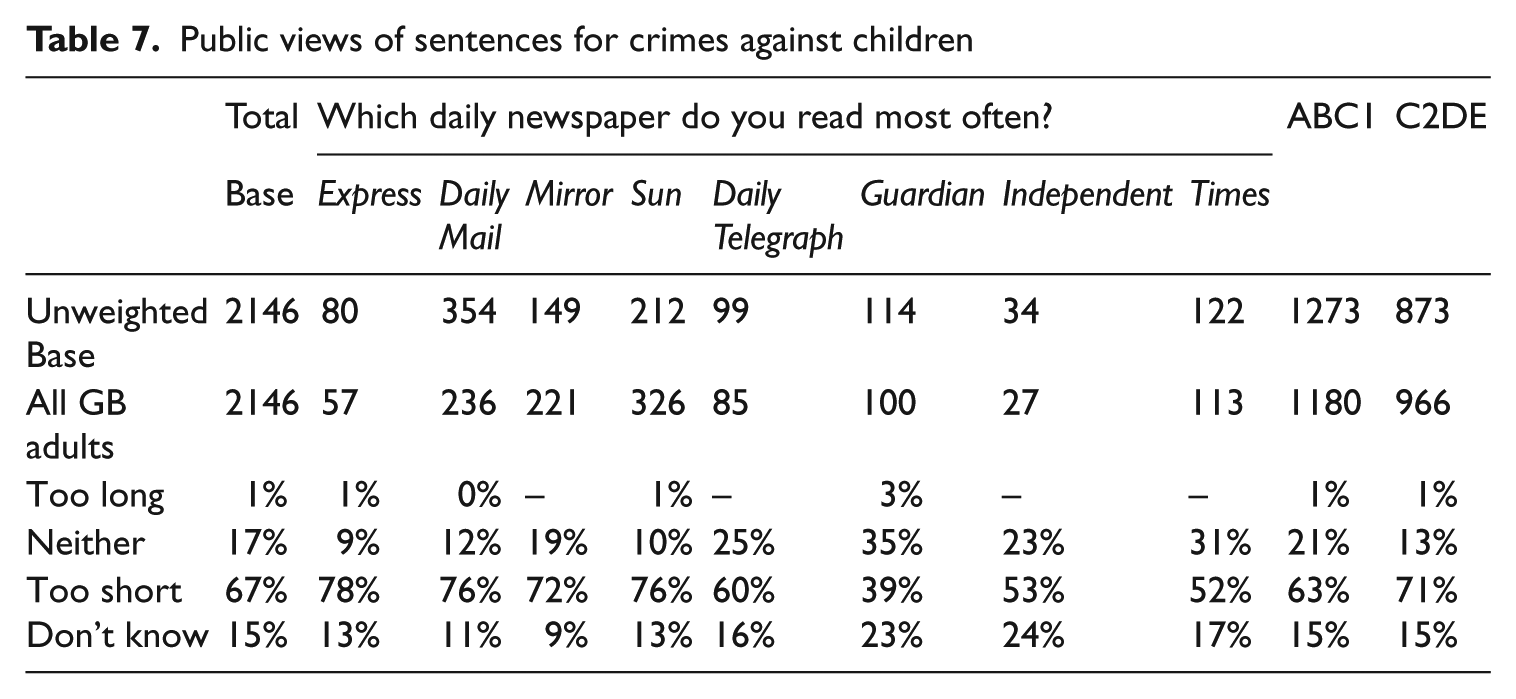
Our final set of tables list the result of the YouGov polls on public attitudes. Table 7 shows that 82 per cent of the public believe that sentences given for such crimes against children are too short. This figure is higher than poll results for perceptions of general sentencing leniency in the criminal justice system and reflects the intense public antipathy towards offences against children. For readers of the five largest tabloids the average figure is 88.6 per cent. For Sun and Daily Mail readers, the figure is 91 per cent. Broadsheet readers appear less negative about sentencing policy. For readers of the four largest broadsheets the proportion who thought sentences too short was 67.5 per cent. This average figure however masks significant variations: 85 per cent of Daily Telegraph readers saw sentences as being too lenient while for Guardian readers the figure was 46 per cent. Socio-economic status is also related to attitudes, with lower socio-economic groups exhibiting more punitive attitudes, though these differences are quite modest in comparison to the variations linked to newspaper consumption.
Public views of sentences for crimes against children
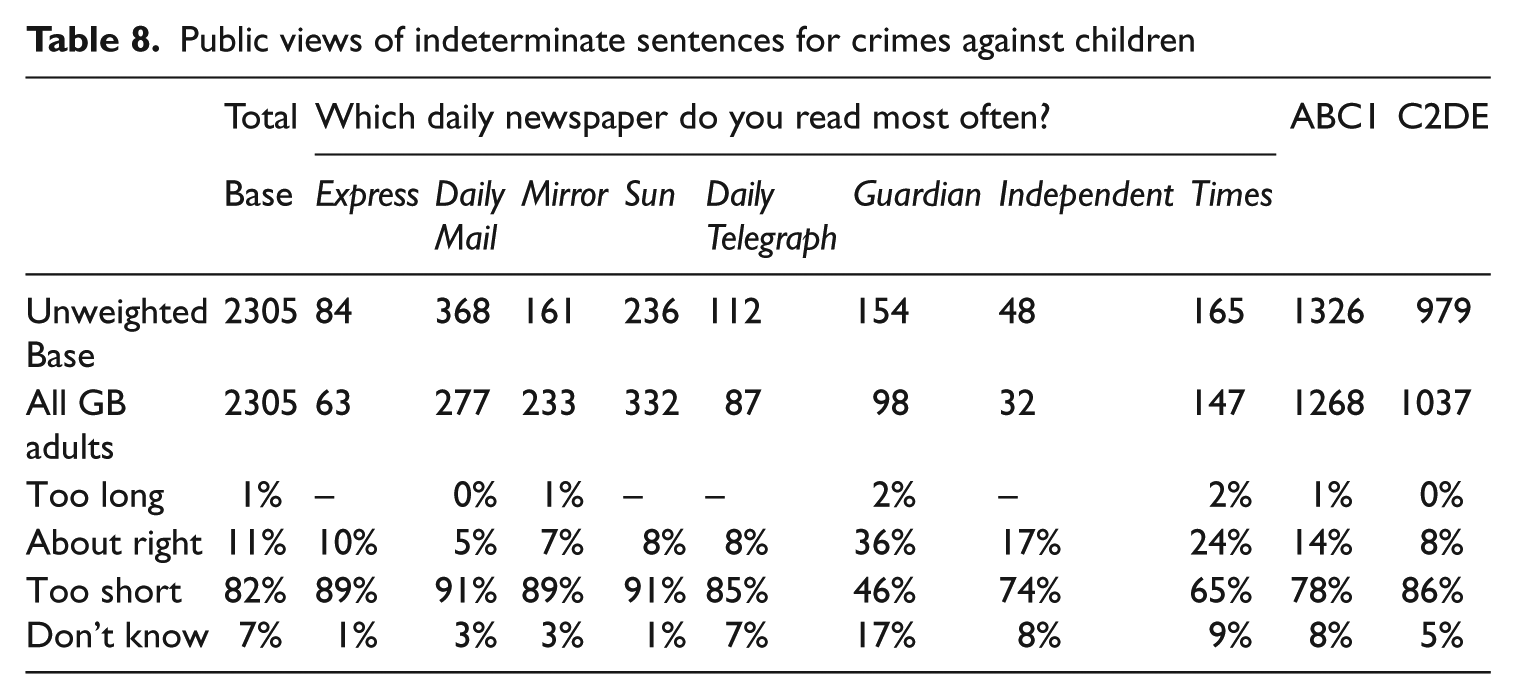
The poll results presented in Table 8 indicate that there is a great deal of public confusion about the ‘the indeterminate sentence for public protection’ 5 (IPP). This is a relatively recent tariff, which is frequently employed in cases of serious crimes against children. Overall, 67 per cent of the population believe these sentences for crimes against children are too short. There were again significant variations in responses between readers of tabloids and broadsheets: 75.5 per cent of tabloid readers thought IPP sentences were too short while the average for broadsheet readers was 51 per cent. It was also noticeable that the proportion of ‘don’t knows’ for broadsheet readers (20%) was nearly double that of tabloids (11.5%). This may be because tabloids and their readers tend to see the criminal justice system as being ‘soft’ in general and thus feel confident in putting forward an opinion. Alternatively it may be because they have been influenced by some of the tabloid criticism of indeterminate sentences which we examine in our qualitative analysis below. It is also clear that socio-economic status is related to attitudes with those in higher occupational groups being less likely to see IPP sentences as being too short, though again it is clear that this a much weaker predictor of attitudes than newspaper consumption.
Public views of indeterminate sentences for crimes against children
Thematic Analysis
In this section we examine in detail the nature of news accounts and how they may
contribute to public knowledge about sentencing policy and attitudes towards it. The first
of these is the difficulty of understanding complex dimensions of different sentences for
specific crimes. Such intrinsic difficulties are likely to be exacerbated by the manner in
which crimes are reported. Journalists sometimes pack large amounts of detail in a few
column inches, as for example in this report from The Times, which cites
multiple offences, dates and sentences relating to the same person: In cases involving very young child complainant witnesses, a delay between the alleged
offence and the making of an allegation or the hearing of the trial, did not, by itself,
automatically prevent the evidence of the child from being considered by the jury. The
Court of Appeal, Criminal Division, so held when granting applications for leave but
dismissing appeals by Steven Barker: (i) against his conviction on May 1, 2009, at the
Central Criminal Court (Judge Kramer, QC and a jury) for an offence of anal rape of a
child, under 13 years of age, contrary to section 5(1) of the Sexual Offences Act 2003,
and (ii) against his sentence of life imprisonment with a minimum term of 10 years,
imposed on May 22, 2009, by the same court. The defendant was also imprisoned at the
same time for 12 years concurrent, for causing or allowing the death of a child, known
as ‘Baby P’, contrary to section 5 of the Domestic Violence, Crime and Victims Act 2004,
of which he was convicted after trial on November 11, 2008. (The Times,
5 February 2010)
The meaning of certain types of sentence is also unclear in some newspaper reports. In the
aftermath of the Baby ‘P’ case, there were complaints that the mother was given an
indeterminate sentence but with a minimum of just five years. The Attorney General’s office
issued a statement saying that it could review minimum tariffs imposed on indeterminate
sentence prisoners, but made this clarification: It is important to understand that such prisoners are not released automatically after
the minimum term has been served – they are only released when the independent Parole
Board is satisfied that their continued detention is no longer necessary to protect the
public. (Daily Telegraph, 27 May 2009)
This confusion was also evident in the reaction to the indeterminate sentence given to
Junaid Abuhamza in the Khyra Ishaq case. This sentence was criticized by both the victim’s
relatives and a politician for being too short: Ishaq Abu Zaire raged after his ex was led away with her child-torturing lover, who
could serve just 7-and-a-half years. ‘If it was up to me they would have got much
longer’. (Sun, 13 March 2010) I think their actions were inexcusable. If it was up to me they would have got a much
longer sentence. They knew what they were doing was wrong. (Mirror, 13
March 2010) If it was up to me they would have got a much longer sentence than they were given.
(Daily Mail, 13 March 2010) Khalid Mahmood, Labour MP for Birmingham Perry Barr … added: ‘There is a sense they
have got off lightly here. I and many other feel there should have been murder
convictions.’ (Daily Mail, 13 March 2010)
This perception was also evident in some public responses to the case. Following the conclusion of the case the Sun printed a letter from a member of the public: ‘The pathetically short sentences given to Angela Gordon and her partner show why our prisons are full. There is no deterrent to make people behave within the law’ (Sun, 18 March 2010).
Other confusions may arise because of the different accounts which are sometimes given
about the same sentences. In the Khyra Ishaq case for example, the Guardian
reported for the mother and stepfather these were ‘indefinite’ and that the mother would
serve ‘at least 15 years before becoming eligible for parole’:
Headline: Indefinite jail terms for couple who starved seven-year-old
to death: ‘Harsh and cruel’ mother must serve at least 15 years … A mother and stepfather who starved a seven-year-old child to death were given
indefinite jail sentences yesterday for manslaughter. Angela Gordon, 35, was told by a
judge at Birmingham crown court that she would serve at least 15 years before becoming
eligible for parole. Her partner, Junaid Abuhamza, 31, was told he would serve a minimum
term of seven and a half years. (Guardian, 13 March 2010)
But the headlines for the Sun and the Mirror stressed
that the mother will be freed from prison in five years:
Headline: OUT IN 5½ YEARS … MUM WHO STARVED KHYRA: Fury at killer’s
sentence. (Sun, 13 March 2010)
Headline: THIS MOTHER STARVED ONE CHILD TO DEATH, DRENCHED 5 OTHERS
AND MADE THEM STAND IN FRONT OF A COLD FAN. YESTERDAY SHE WAS SENTENCED TO 15 YEARS IN
JAIL … YET SHE’LL BE OUT IN FIVE The cruel mum who killed her skeletal daughter Khyra Ishaq may be freed from prison in
just five years. Angela Gordon was sentenced yesterday to 15 years in jail for the
seven-year-old’s manslaughter and cruelty to her five other children. But the judge told
her she will only serve seven-and-a-half years – minus nearly two years that have passed
while she has been in custody awaiting trial. (Mirror, 13 March
2010)
Such variations in reporting the same sentence were not uncommon in our sample. Across all instances of child killing, where a life sentence was given out and the sentence was reported more than once we found that in 43 per cent of cases (6/14) the sentence was reported differently in different newspapers. Most commonly some reported a life sentence with a minimum and other reported it as a term sentence. The same pattern could be observed in relation to indeterminate sentencing. For instance Vanessa George was reported as receiving a seven-year jail term in the Sun for sexually abusing children in her care (10 February 2010). However in the Western Mail the sentence was reported as being an indeterminate sentence with the proviso that ‘she must serve at least seven years in prison’ (12 March 2010).
Another source of potential confusion and controversy is variations between sentences given
for different crimes and the issue of how appropriate are these tariffs. Such arguments do
not only relate to crimes against children but they tap into generalized beliefs about the
supposed leniency of sentencing and irrationality in the justice system. Here for example, a
commentary in the Daily Telegraph (15 March 2010) is introduced with the
phrase: ‘Headline: It’s simple – punishment should fit the crime; Philip
Johnston says he can’t be the only one left confused by the current trends in sentencing.’
The journalist makes the point about public confusion by comparing different cases: Peter Chapman, the vile killer of Ashleigh Hall, the teenager who met him on Facebook,
had previously spent five years in jail for raping two women at knifepoint. How is that
possible? Frances Inglis, who killed the son she loved with a dose of heroin because he
was in a coma from which she feared he would never recover, is serving at least 10 years
in jail. How could that possibly merit twice the punishment meted out to Chapman? …
Confused? You are not alone. (Daily Telegraph, 15 March 2010)
The Sun in more colourful language makes the same point about variations
in sentencing while also linking this to the argument that dangerous people should not be
released from prison:
Editorial: Legal lunacy … Ryan Yates was considered a serious danger to women when he was freed from prison.
Three days later, a court order was obtained banning him from going near females. Two
days after that he attempted to murder a grandmother in broad daylight then kidnap and
rape her grand-daughters. No order or restriction was going to make a blind bit of
difference to Yates’ behaviour. A cell, locks and prison bars were the only things which
would have made the public safe. Instead our laws meant Yates HAD to be freed despite
the knowledge he was a serious risk. On the flipside, a law-abiding businessman finds
himself out of pocket and with three penalty points on his licence because he blew his
nose while behind the wheel of his van. Not a van doing 70mph on the motorway, but one
in stationary traffic with the handbrake on … Common sense is clearly in short supply in
legal circles. (Sun, 28 January 2010)
It was also apparent in our research that there were substantial variations in sentencing for crimes that were in some respects similar. For example, on 27 January 2010, the Mirror reported that a computer expert had been sentenced to nine months in jail for possessing images of child abuse. He had fled to the USA after a first court appearance but was later extradited: ‘Headline: 9 MONTHS JAIL FOR CHILD PORN PERV’ (Mirror, 27 January 2010). Three days later, the Western Mail reported that a former police employee, found to have indecent photographs on his computer, had avoided jail. Some of these pictures were described as being in the ‘serious’ indecent category and he had been sharing photos with another sex offender. The sentence given was a three-year community order and he was reported to be ‘much loved’ by family and friends: ‘Headline: Former police employee avoids jail over child porn’ (Western Mail, 30 January 2010).
We can also compare the reporting of two cases in which men had a sexual relationship with
underage girls. In the first of these a man, said to be an alcoholic, was jailed for 18
months for having sex with a 14-year-old girl:
Headline: MAN, 38, HAD SEX WITH GIRL An alcoholic of 38 who slept with a schoolgirl was jailed for 18 months yesterday and
put on the Sex Offenders’ Register for 10 years … The guilty plea by Madden, from York
Drive, Belfast, was on the agreed basis he had sex with the youngster after they had
been drinking. A judge said there was ‘no excuse whatsoever in entering into any sexual
relationship with such a young girl’. (Mirror, 6 February 2010)
Although there is ‘no excuse’ according to the above judgment, the sentence in the second
case is quite different. Here a soldier from Sandhurst who is accused of having sex with a
13-year-old girl is reported to have been spared jail. In this case, the girl was said by a
judge ‘to have made all the running’:
Headline: SOLDIER WHO HAD SEX WITH GIRL, 13, IS SPARED JAIL BY LADY
JUDGE WHO SAYS VICTIM ‘MADE ALL THE RUNNING’ A soldier at Sandhurst who had sex with a 13-year-old girl was spared jail by a woman
judge who said the victim was ‘precocious’ and ‘made all the running.’ (Daily
Mail, 9 January 2010)
Alongside these apparent contradictions and confusions, there is a strong current of
opinion expressed in editorials and comment pages that sentences are too low. This is partly
stated as a moral argument that serious crimes require substantial punishment, but is also
linked to a debate about public safety. The first of these is clear in the following example
from the Sun, where a mother is reported to have left her children in a
‘pigsty’ home as she went on a ‘booze and drug bender’. The focus of the story is the
‘outrage’ said to have been sparked by the judge who ordered a suspended sentence and that
following a further offence she has again escaped jail. The rationale for the sentences or
what the relationship is between the suspended sentence and a curfew which is mentioned are
all sidelined by the moral judgements around which the report is based:
Headline: Booze mum left four tots in this sty This is the pigsty home where a mum left her four kids to go on a 24-hour booze and
drug bender. Selfish Rebecca …, 23, abandoned the youngsters aged three months to four
years in the house littered with empty bottles and kitchen knives … (She) admitted child
cruelty after being exposed by The Sun last year, but a judge sparked outrage by giving
her a suspended sentence. Yesterday she was back in court for breaching a curfew a month
later. (She) had left a pal’s house in Bolton three times in the early hours of New
Year’s Day. She was so drunk she couldn’t remember the third trip, Lancaster Crown Court
was told. But Judge Norman Wright refused to jail her AGAIN and ordered another curfew.
He said: ‘I am going to give you one further chance.’ (Sun, 19 January
2010)
Concerns over public safety are highlighted by the reporting of a case such as that of
Thomas Smith in February 2010. He was a convicted sex offender who had moved back to an area
where his past history was largely unknown and had then murdered a neighbour and also killed
and raped her young daughter. As The Times reported: A convicted sex offender who raped and murdered a 10-year old girl and killed her
mother has been handed down one of the longest ever sentences in Scotland … Strathclyde
Police are now reviewing how 26-year-old Smith, a known sex offender, was able to strike
again. (The Times, 6 February 2010)
The Sun’s (6 February 2010) headline expresses the point more forcefully: ‘Headline: BENCHMARK FOR ATROCITY; Paedo living with NO supervision kills mum and girl, 10.’
The debate over public safety in much of the press focuses on two issues. First the right
for public information about offenders who have been released and second the question of
whether dangerous criminals should have much longer sentences. The former is seen clearly in
demands for ‘Sarah’s Law’ as in the following report from the Mirror. The
fact that the killer has now been given an indefinite sentence is subsumed to the main
argument on the need for public warnings:
Headline: SARAH’S LAW PLEA FROM RETIRED COP An ex-senior policeman demanded the nationwide introduction of Sarah’s Law to control
paedophiles yesterday. Mick Gradwell spoke out after being sickened by the case of a
convicted sex fiend who raped a young boy … Mr Gradwell said: ‘You can have warnings on
hot drinks, yet there are certain people who admit they are a danger and we’re not
allowed to give any warnings at all.’ (Mirror, 6 January 2010)
The perceived failure to give long sentences for serious crimes is, as we have seen,
attributed to the irrationality of the judicial system. The following example from the
Sun comments on the scrapping of an early release scheme and points to
the alleged problems of ‘weak judges and feeble sentencing guidelines’:
Editorial: Crime Chaos So the scandalous early-release scheme which lets violent thugs back on to our streets
without finishing their jail sentences is to be scrapped. Anyone would think there was
an election coming up – and that Labour is vulnerable on crime. But if the Government
really wants to act tough at long last on the lawlessness that has engulfed Britain, it
had better do something fast about the liberal hand-wringers masquerading as our judges
… A brute repeatedly stabs his neighbour, an alcoholic with seven driving bans leads
police on a high-speed chase, a crooked carer fleeces a disabled woman, a pervert
amasses 3,400 child porn pictures. Not one of them given a moment behind bars. Of course
it is right to force jailed criminals to serve out their time. But it’s just
window-dressing if weak judges and feeble sentencing guidelines ensure violent,
dangerous, callous criminals are never banged up in the first place.
(Sun, 15 February 2010)
Another story based on a parliamentary answer pursues the same theme:
Headline: LESS THAN YEAR FOR PERVERTS Paedophiles and rapists are being jailed for less than a year, The Sun can reveal.
There are FIVE perverts serving less than 12 months for sex assaults against children
and 21 thugs in prison serving sentences of under a year for rape … Fury over soft
justice has been fuelled by a series of lenient sentences in recent years.
(Sun, 1 April 2010)
We will now close this article by drawing together the key features of coverage, considering their impact on public understanding and attitudes and asking what academics and those working within criminal justice can do to promote a more informed citizenry.
Conclusion
The picture of press reporting of sentencing that emerges from our qualitative and quantitative analysis is a chaotic and confusing one. There appear to be wide variations in the sentences handed down for what appear very similar crimes and there is rarely a developed rationale for these discrepancies. There is also a great deal of uncertainty over the period that offenders will be incarcerated. The same sentence is frequently reported differently in different newspapers. Against this backdrop, there is a strong and consistent editorial line in the tabloids which is highly critical of the judiciary and the criminal justice system. This manifests itself in a steady drumbeat of criticism in relation to sentencing guidelines and the behaviour of judges, together with demands for tougher sanctions and notification legislation. These are justified both for public safety and in the name of a moral concern at the abhorrence of the crimes. While criminal justice professionals are frequently cited in all sections of the press their contributions are usually quite short and rarely extend to more than a sentence or two. In the tabloid press their attempts to justify their decisions tend to be drowned out by editorials and comment which are critical.
The pattern of newspaper reporting that we encountered might be expected to generate widespread public dissatisfaction and confusion over the nature of sentencing policy. This is what we found. Public attitudes towards sentencing in this area appear very harsh. Although socio-economic status correlates negatively with punitiveness it is a very weak predictor in comparison to media consumption. Our research design does not allow us to make strong statements regarding the directionality of this relationship and part of the reason why newspaper consumption is such a strong predictor of punitive attitudes is likely to be due to those with liberal attitudes being drawn to titles like the Guardian or the Independent. 6 It is also likely that a paper such as the Guardian has a readership with experience in areas like social policy and sentencing decisions. However evaluating the results of this study in line with previous research does suggest that press coverage is a significant driver of punitive attitudes reasons (Brillon et al., 1984; Doob and Roberts, 1988; Roberts and Stalans, 1997; Sprott, 1996). As noted in the introduction, part of the reason why participants respond so punitively in opinion polls is due to the fact they answer with the worst offences in mind and that in evaluating sentencing policy, they tend to recall cases where allegedly lenient sentences are handed out. This pattern of coverage, as our analysis shows, is particularly visible in the tabloid press where there is a heavy concentration of comment on particularly notorious crimes and a steady stream of criticism in relation to sentencing decisions. What is also clear is that there is a great deal of public misunderstanding about the IPP, which is now a key element of the sentencing regime in this area. Two-thirds of the public believe these sentences are ‘too short’. Even among Guardian readers who are widely seen as comprising the liberal intelligentsia, with a wide readership among senior public sector workers including many criminal justice professionals, the proportion who saw these sentences as being too short or who answered ‘don’t know’ was 54 per cent. One factor contributing to this is likely to be the lack of explanation in most press coverage of when those on indeterminate sentences are likely to be released. Without explanation that these offenders have no automatic right of release after their minimum term has been served, it is likely that there is an assumption that they will automatically be freed. Clearly this new sanction has not succeeded in reassuring the public that those who pose a threat to society will remain incarcerated.
This research has illustrated some of the misconceptions and confusion regarding sentencing policy in relation to crimes against children and how the media may be a contributory factor. However as Roberts (2008) argues, attempts to insulate the criminal justice system from a misinformed public are now seen as ‘isolationist, elitist and even undemocratic’. One possible solution is for members of the criminal justice system to engage in more outreach and education in order to explain better and justify their sentencing decisions. This has been the approach taken by the Home Office who have published and distributed leaflets about sentencing policy and the operation of the criminal justice system (e.g. Home Office, 2001). However Green (2006) has questioned the utility of this approach. He argues that one-way expert to public communication flows may be insufficient to produce durable changes in public attitudes. One reason for this is that experts and many in the public have different frameworks of understanding for the factors underlying criminality and how it might be countered. The cool dispassionate analysis of crime favoured by experts may not resonate with the more affective frameworks held by many in the public who tend to connect better with the emotional and moralistic arguments put forward by the tabloids and populist politicians. While such educational initiatives may produce short-term changes in attitudes, they do not allow the public ‘to work through the ambivalent attitudes that crime and punishment often produce and to develop considered views’ (Green, 2006: 146). The consequence being that ‘emotive media coverage and populist rhetoric may be enough to undermine any gains these programmes produce’ (Green, 2006: 146). Green suggests that an alternative would be to employ deliberative opinion assessments such as ‘Deliberative Polls’, ‘Citizen Juries’, ‘Consensus Conferences’, ‘Study Circles’, ‘National Issue Forums’ or ‘Planning Cells’ (Ackerman and Fiskin, 2004). Deliberative polls involve recruiting stratified random samples of the population who spend extended periods hearing balanced presentations from experts and debating the issues among themselves. These sessions are televised in order to make the process more transparent and engage those not directly taking part. Green (2006) points to the success of a 1994 deliberate poll conducted in Manchester on crime and punishment issues. The ‘follow-up assessments indicated that participants tended to change their opinions markedly and durably because of the deliberation process and most often in a liberalising direction, revealing a sharp decline in enthusiasm for punitive, incarceral responses to crime’ (2006: 134). But the impacts of such exercises are likely to be felt most by those who participate directly. A single televised message is much less powerful since it is situated in a plethora of competing and often contradictory information streams. Television audiences can be reached but this requires the consistent repetition of clear alternatives and their endorsement by high status, credible sources (see Philo and Berry, 2011). For this to happen would require politicians and other ‘primary definers’ to reshape media agendas and the core content of messages on what ‘works’ in relation to crime and penal policy. At present the financial cost of punitive approaches and incarceration is forcing at least some politicians to rethink traditional approaches. It is a timely moment to renew calls for the media to adopt a more responsible and accurate reporting of crime and for specialists in this area to press for a more informed debate on criminal justice policy.
Footnotes
Notes
Biographies