



Abstract
Victorian actor Edward Saker began his career in Edinburgh before moving to Liverpool in 1865. There he established himself as a popular low comedian. In 1868, at the age of thirty, he became lessee of the Alexandra Theatre. Opened two years earlier as the New Prince of Wales, the Alexandra had struggled financially under previous managers, but it flourished under Saker. Using new evidence from the diaries of his close friend, wealthy Liverpool industrialist Andrew George Kurtz, this article describes the circumstances of Saker's transition from actor to actor-manager. Kurtz's diaries document his intimate friendship with Saker, recording how he nursed the actor through a period of serious illness and helped him financially to achieve professional success. Liverpool was an important provincial centre of Victorian theatre, and the 1860s were a turbulent time in the history of the Liverpool stage. Kurtz's diaries give fresh insights into this eventful period, as well as illuminating the private life of a notable Victorian actor.
We know very little about the majority of Victorian actors. As Michael Baker pointed out more than four decades ago, only a few celebrities live on through memoirs and biographies, while numerous players who were popular and successful in their day are now little more than names. 1 Theatre historians since Baker have fleshed out a few of these forgotten individuals, and the careers of women in particular have been brought into sharper focus. 2 Digitisation of nineteenth-century newspapers has made it easier to trace the public appearances of actors through advertisements and reviews, but their private lives and early careers remain largely obscure.
A case in point is Edward Saker (1838–83). He has long been recognised as significant for his successful management of Liverpool's Alexandra Theatre between 1868 and 1883. 3 His lavish revivals of Shakespeare were admired in their day, and later scholarship has shown how they were indebted to Charles and Ellen Kean's celebrated productions at the Princess's Theatre in London in the 1850s. 4 But how did Saker achieve such a prominent position at the relatively young age of thirty? His rise is the more remarkable because for over a year before he became lessee of the Alexandra, he had all but disappeared from the stage and from the public eye. Now, thanks to new evidence from the diaries of his friend Andrew George Kurtz (1825–90), it is possible to shed some light on this shadowy but pivotal phase of Saker's life. Against a background of upheaval in Liverpool's theatres in the 1860s, the diaries give a vivid and highly personal account of Saker's transition from actor to actor-manager, and of Kurtz's role in bringing it about.
Kurtz, Saker, and the Liverpool Stage
A. G. Kurtz was the prosperous owner of an alkali works at St Helens in Lancashire. His mother Susannah (née Shead or Shed) was born in seemingly modest circumstances in the village of Henham in Essex in 1787. She married, first, Philip Jacob Sandman (1774–1815), an industrial chemist in Battersea, and second, the German-born chemist Andreas (or Andrew) Kurtz (1781–1846). Andreas and Susannah Kurtz moved to Manchester, and from there to Liverpool, where Andreas established himself as a ‘manufacturing chemist and colour manufacturer’. 5 Around 1842, he acquired the alkali works that would be inherited four years later by his twenty-one-year-old son. There is some evidence that the young A. G. Kurtz had expected to pursue a career in the Law, but his father's sudden death made him an industrialist instead. 6
A great deal can be learned about A. G. Kurtz from the voluminous diaries that he kept intermittently between 1841 and 1861, and continuously from 1862. 7 From these, it is clear that although he was attentive to his business, his real interests were not scientific or commercial but artistic. As well as assembling a large and important collection of modern British paintings at Grove House (his home in the Liverpool suburb of Wavertree), he was an accomplished amateur pianist and an active member of the Liverpool Philharmonic Society. 8 These aspects of his cultural life have received scholarly attention, but his other great passion – the theatre – has so far been overlooked.
Kurtz was an enthusiastic theatregoer from a young age: his earliest surviving journal includes reviews of plays and operas that he saw during a stay in Paris as a youth of seventeen. 9 As an adult, he attended the theatre very frequently, both in Liverpool and London, and his diaries are a rich, untapped source for the study of the mid-Victorian stage. Not surprisingly, its ‘pictorialism’ appealed strongly to the art collector Kurtz. While he was wearied by excessive spectacle and over-elaborate scenic effects, he nevertheless wrote with feeling about the beauty of sets, costumes, and lighting. 10 He also had a strong critical interest in the work of playwrights and actors. He wanted the theatre of his day to satisfy the mind as well as the eye, but in this, he was often disappointed, either by incompetent actors or by authors who had nothing worthwhile to say. An 1866 performance of Blue Beard at Liverpool's Amphitheatre represented for him the kind of ‘old dramatic romance that thrilled our fathers & mothers, or ourselves when young’, but which was now obsolete: ‘Burlesque has killed that kind of drama’, he declared, ‘& I don’t regret it for one. Carelessly written, rendered needlessly improbable, exhibiting neither nature nor art – why should such things live?’ 11 This makes him sound progressive, but the conservatism that marked his tastes in painting and music was also evident in his attitude to the theatre. Among writers, he praised the veteran Edward Bulwer-Lytton and was sceptical of the newcomer Tom Robertson; among actors, he revered Mary Anne Stirling, whose career was already into its fourth decade. 12 Kurtz's interest in the theatre was shared by Roderick Rayner (1827–89), a Liverpool produce broker who married Kurtz's cousin Susannah Smith. It was through Rayner that Kurtz met the actors E. A. Sothern (1826–81) and J. L. Toole (1830–1906) and developed a taste for the company of theatre people. 13
Fifteen years younger than Kurtz, Edward Saker was born into a theatrical family in Bethnal Green in the East End of London.
14
After a false-start in an architect's office, he moved to Edinburgh, where his brother-in-law, R. H. Wyndham, was manager of the Queen's Theatre. There he established himself as a popular low comedian. Renamed the Theatre Royal, the former Queen's Theatre burned down at the beginning of 1865, at which point Saker moved to Liverpool, making his debut on 30 January at the Prince of Wales in The “Grin” Bushes! by Henry James Byron (1835–84).
15
Liverpool audiences quickly took to him, and his performance six months later in William Brough's burlesque Ernani earned him a glowing review in the Orchestra: Mr Saker has produced in the part of Ruy Gomez a marvellous copy of one of those dons which Vandyke knew how to paint so well: his make-up is the most striking in the whole piece, and does great credit to the actor. Put a frame round him, and the illusion would be perfect. His acting (to a certain but excusable extent an imitation of Toole's) is forcible without being exaggerated, and his dancing the funniest we ever saw.
16
The Prince of Wales was the creation of its enterprising owner, Alexander Henderson (1828–86), who had come to Liverpool after several years managing theatres in Australia. Henderson was unimpressed by the entertainment on offer in Liverpool's existing theatres – the Amphitheatre and the Theatre Royal – and determined to provide something better for ‘upper and middle-class audiences’. 17 He took a fourteen-year lease on a meeting hall in Clayton Square and converted it into a theatre, opening it in December 1861 as the Prince of Wales. 18 Henderson's venture was a shot in the arm for Liverpool's theatrical life. Stimulated by his success, a group of wealthy citizens formed a company to build a much grander theatre in Lime Street, on a site directly opposite the neoclassical civic temple of St George's Hall. 19 The new theatre was criticised as an elitist project, not least because in architect Edward Salomons’ design, the area normally given over to the pit was instead filled with stalls, while the ‘warm, impulsive pitites’ were banished to a balcony between the dress circle and the gallery. 20 Despite these unconventional seating arrangements, which immediately proved problematic, Henderson was induced to leave Clayton Square and take on the management of the new theatre. 21 It would later be called the Alexandra, but under Henderson, it was known as the New Prince of Wales. It opened on 15 October 1866, and by the following month, Saker was appearing on its stage. 22
Saker as Actor
Kurtz was a director of the company that had built the new theatre, and it was there that he attended a production of Tom Taylor's comedy A Lesson for Life on 30 November 1866. The play was meant to be a star vehicle for Sothern, but Kurtz's attention was drawn instead to the performance of Saker, whom he considered ‘the best actor in the piece’.
23
This encounter would turn out to be a watershed in both men's lives. The following month, Kurtz saw Bulwer-Lytton's The Lady of Lyons and thought it ‘weakly done’, but again he singled out Saker for praise in the role of Glavis, and in February, he endured a ‘wretchedly acted’ production of Shakespeare's Anthony and Cleopatra, but once again he praised Saker in the minor role of the Clown.
24
Over the coming weeks, he focused on the actor's work in a range of productions, including Katherine and Petruchio (‘Mr Saker's Geccino was very good in parts, but he shd. check a tendency to burlesque in Shakespere [sic]. It's very funny & vy. clever, but hardly “the thing”’), H. J. Byron's Miss Eily O’Connor (‘[he] shows his power of impersonation in Danny Mann. It was altogether good. There's no doubt of Mr Saker's ability in burlesque. It is unique’), and H. T. Craven's My Preserver (‘I think Stoyle was better in the part [of Bilberry] because more revolting & coarse. Saker at his worst is not coarse, and his rusticity has more the appearance of simplicity & naivete than brutish cunning or bucolic set purpose or calculation’).
25
After seeing him at the Theatre Royal as Dame Hatley in F. C. Burnand's burlesque of Black-Eyed Susan, Kurtz was convinced of his exceptional talent: His ‘widowed’ & half-starved appearance, his dancing & singing are things to be seen & remembered … I should say he is likely to be a very remarkable comic actor & will make his mark on the English stage. He revels in the fun & throws himself heart & soul into everything he does … he is always the character he represents, not Mr Saker.
26
As well as playing dramatic roles in the theatre, Saker performed with his friend Lionel Brough (1836–1909), brother of William, as one half of a comedy double-act called ‘The So-Amuse Twins’. The pair devised a show entitled The Photographic Studio, the ‘photographs’ being clever impersonations of everyday street characters such as racegoers and policemen. 28 This they presented to great acclaim at Hope Hall, a converted chapel in Hope Street, where it earned the young pair the impressive sum of £200 over three nights. 29 The high-minded Kurtz thought it ‘curious that an entertainment certainly inferior to a regular dramatic performance should be so much better attended than the theatre’, but he had to admit that ‘Mr Saker as an old irascible gentleman, a Scotch wife & a news boy was vy. successful’. 30 One of the most surprising things about his admiration for Saker is that someone whose tastes in art and music were so refined and serious should have been attracted to a low comedian at all, but as we shall see, the attraction went beyond Saker's acting. Kurtz also had his doubts about some of the material that Saker performed on the legitimate stage: ‘“Friend Waggles” [by John Maddison Morton] is a vy. poor farce’, he wrote at the end of April 1867, ‘& I only remained to see it on account of Mr Saker, who is as lively & impertinent as ever. I should like to see him in better things’. 31 More to his taste was Sheridan's The Rivals, in which ‘S. was Acres & almost killed me with laughing at his duel scene’. 32
On 28 April, Kurtz invited Saker to dinner at Grove House, and from then on, his friendship with the actor developed rapidly. He was regularly in the audience when Saker performed. When he took over from Samuel Phelps as Bottom in A Midsummer Night's Dream, Kurtz went to see him three times in five days, sympathising with his first-night nerves and delighting in his growing confidence from one performance to the next. 33 He also praised his work in a succession of roles during the final Liverpool season of Mr and Mrs Charles Kean: in Henry VIII (‘Mr Saker's performance of Lord Sands was a careful study of an old beau. He looked the old nobleman to the life’), in Boucicault's adaptation of Delavigne's Louis XI (‘Mr Saker said his lines as Marcel well & elicited laughter & approval, but it is a part altogether beneath him), in The Merchant of Venice (‘Lancelot Gobbo redeemed the company by the capital acting of Mr Saker. It was dry, humorous, funny & unconventional’), in Hamlet (‘S. made a first-rate grave digger, dry, racy and pointed’), in von Kotzebue's The Stranger (‘S. was Peter, it's vy. small bus[ines]s but whatever he does he does well’), and in Macbeth (‘S. made a very striking 1st witch – the others nowhere’). 34
Kurtz's pithy comments on Saker's acting are thoughtful and considered, and his praise is mixed with judicious criticism. Nevertheless, his repeated focus on Saker's performances, even in quite small parts, shows that he is writing as a friend and supporter rather than an impartial judge. As well as evaluating Saker the actor, he is responding to Saker the man. Indeed, simply being in Saker's company could be as rewarding for Kurtz as watching other actors perform: describing a benefit for Lionel Brough at the Amphitheatre, he recorded how ‘Mr Saker came into the box & sat an hour’, an experience that he, Kurtz, ‘enjoyed more than the entertainment’. 35 Watching him in T. J. Williams's farce My Turn Next, Kurtz believed that they shared a special, secret bond, evidenced by Saker's introduction of ‘all kinds of “Lazzi” wh[ich] were mostly addressed to me, though no one else knew’. 36 These evenings at the theatre often ended with Kurtz bringing Saker back to Grove House. He would help the actor go over his lines, they would talk until the early hours, and Saker would stay the night. 37 Things carried on in this way until the middle of June, when the theatre went dark and Saker was temporarily laid off, whereupon Kurtz proposed that they take a week's holiday together at Penmaenmawr in North Wales. 38 During their time away he noted fondly in his travel journal: ‘My great pleasure in this tour is to see the enjoyment S. experiences. With so few holidays & outs & those generally of the most feverish description, this little flight seems to him bright indeed & he enters into it heart & soul’. 39
Illness and Convalescence
From Penmaenmawr, Saker went directly to London, and from there to Paris to perform with Sothern's company at the Théâtre des Italiens. 40 However, on 26 July worrying news reached Kurtz that his friend was sick, and ten days later Saker telegrammed to say that he was returning to Liverpool that day. Kurtz was distraught to find him ‘wretchedly ill’, with ‘a vy. large swell[in]g in his groin and dropsical symptoms all over him’. 41 Referring to him as ‘the boy’ or ‘my boy’ (Saker was twenty-eight at the time, Kurtz forty-three), he visited him daily at his lodgings, brought him comforting food, kept watch by his bedside, and arranged for him to be attended by the surgeon Branston Nash (1841–73). 42 Nash considered Saker's case ‘vy. bad’. He lanced the abscess in his groin and diagnosed a possible case of Bright's Disease (Nephritis), the result of damage to the kidneys caused by an untreated case of Scarlatina in Paris. 43 He forbade him to return to the stage, so on 17 August, Kurtz took the invalid home with him to Grove House, and there he remained (with occasional absences) for the next fifteen months. As Saker – now referred to affectionately in the diary as Ned – gradually regained his strength, Kurtz went on walks with him, rode with him, read Jane Eyre to him, played chess with him, taught him French, and gave him piano lessons. Saker's twenty-ninth birthday fell on 30 September, and for a present Kurtz ‘changed him his opal ring into diamonds, so that now he’ll hope this spell of ill-luck will pass away’. 44
Happily, we have a visual record of both men as they appeared at exactly this time. In October 1867, Saker's brother Dick (also an actor) and his friend Henry J. Loveday (a composer, and later stage manager to Henry Irving at the Lyceum) came to visit him from Edinburgh, and the trio were photographed together (see Figure 1). Kurtz pasted a copy of the picture into his diary with the caption ‘Ned / otherwise the “boy” - / (otherwise the celebrated Saker)’. 45 Saker's beard shows that he was not currently performing. As a working actor, he would have needed to adapt his appearance to play several different parts a week, including comic female roles, requiring him to remain clean-shaven. Indeed, other photographs taken during his early years in Liverpool show a beardless Saker, as he must have appeared when Kurtz first met him. 46 As for Kurtz, a carte de visite inscribed with the date 5 June 1867 shows him nonchalantly posed and looking suave and relaxed (see Figure 2).
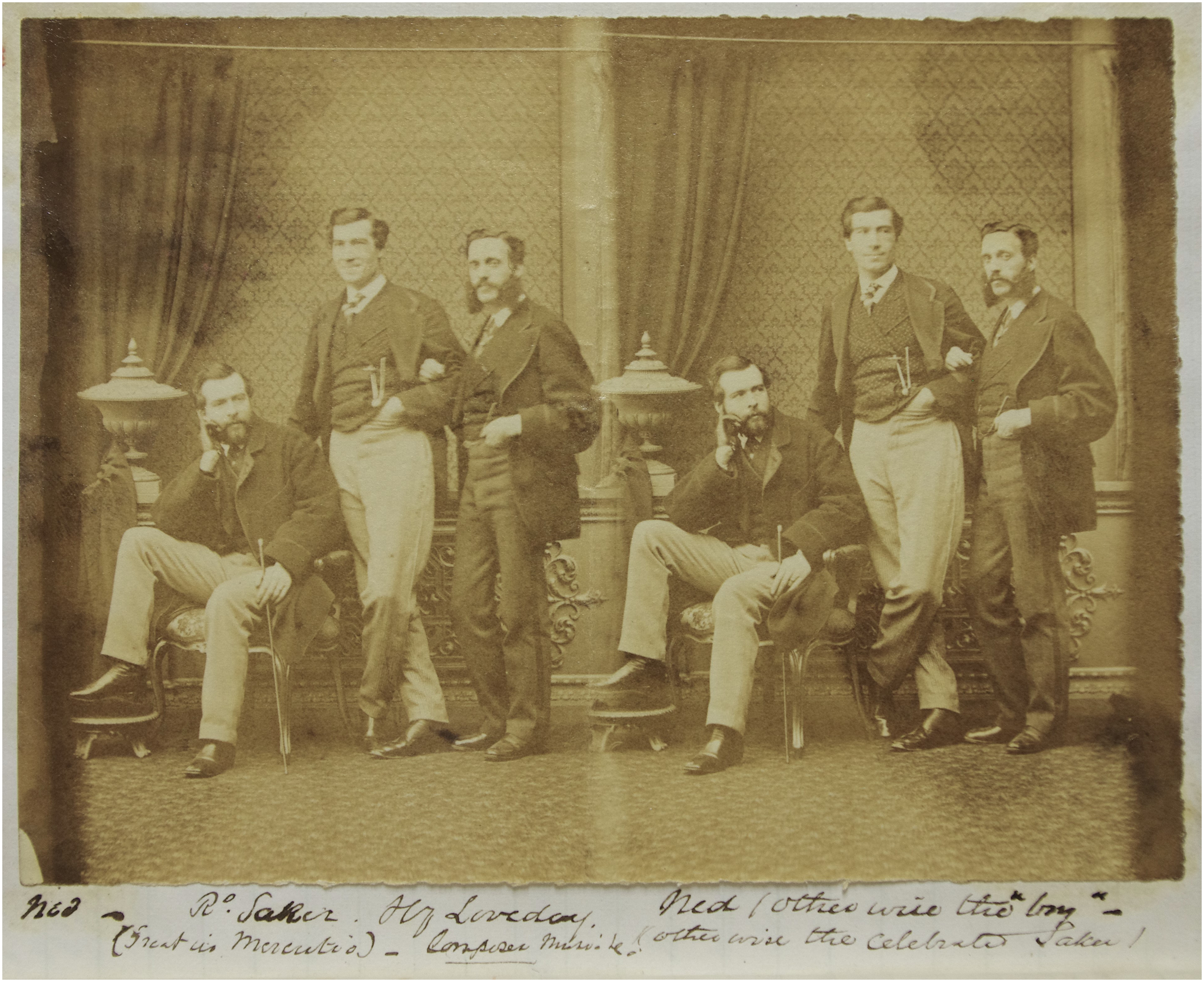
Photograph of Edward Saker (seated), Richard Saker, and Henry J. Loveday, 1867 (Courtesy of Liverpool Central Library and Archives).
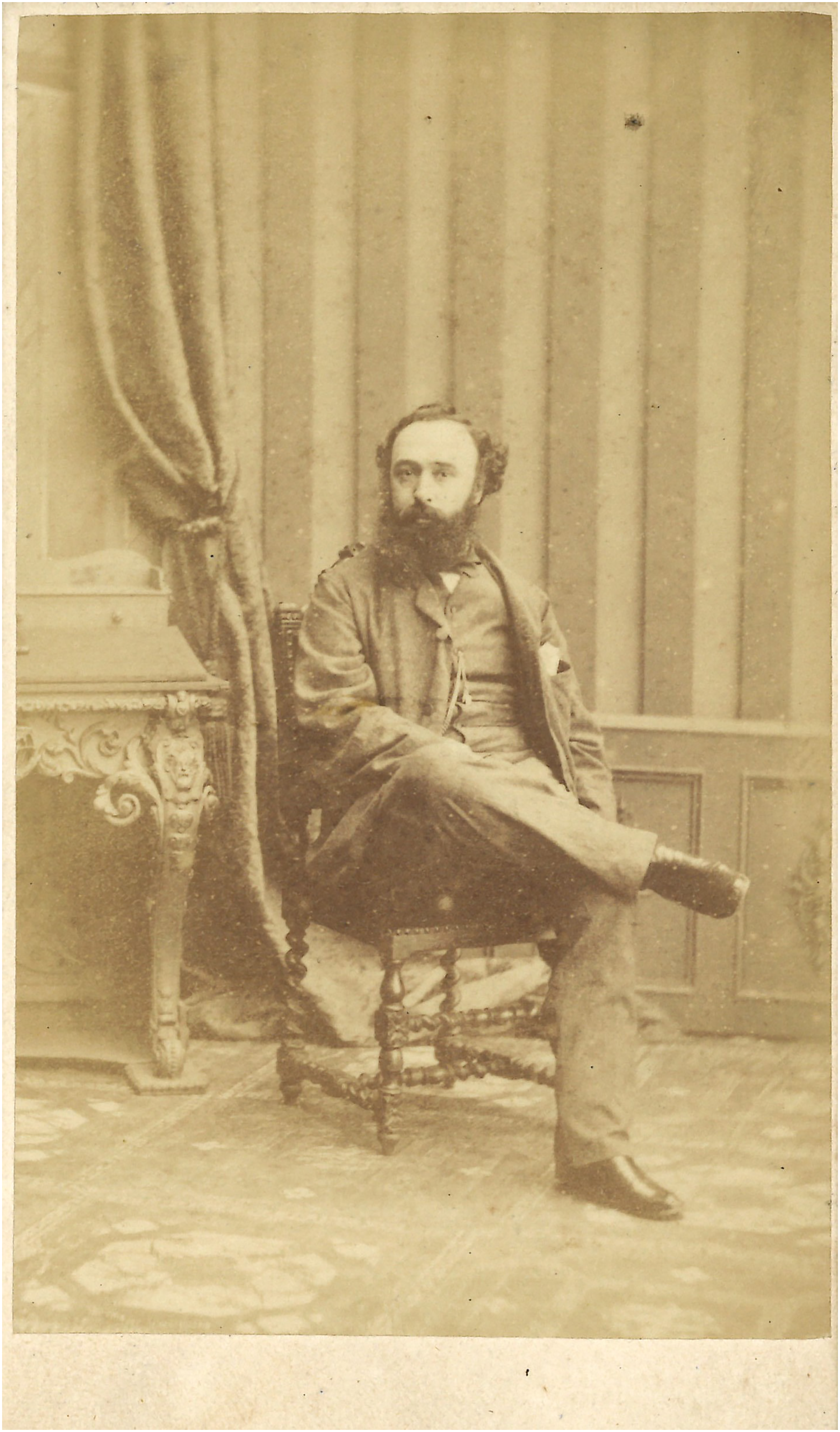
Carte de visite portrait of A. G. Kurtz, 1867 (author’s collection).
Kurtz had been a supportive friend when Saker was in good health. Now that the actor was sick and dependent, his devotion only increased. Beyond his role as Good Samaritan, he seems to have had deeper and more complex feelings towards Saker. His delight whenever they met, his dejection when they had to part, his protectiveness towards the younger man, his readiness to empathise with him in his various trials and triumphs, his pleasure in simply spending time alone with him: all these make it hard not to conclude that Kurtz was in love. This impression is conveyed cumulatively by many small incidents and remarks, which makes it difficult to illustrate by quotation. However, something of the intensity of his feelings can be seen in his reaction to an accident that occurred at Grove House one day when he and Saker were setting out for a ride: Saker was thrown by his horse and knocked unconscious, and Kurtz wrote that the shock he felt at witnessing this was equal to the impact of his father's sudden death when he was twenty-one. 47 As for Saker's feelings towards Kurtz, they are much less easy to determine. Kurtz's diaries are the only available account of their friendship, and they can hardly be considered an objective record.
As Kurtz became increasingly attached, he experienced occasional feelings of jealousy and possessiveness, for instance when Saker omitted to write or failed to keep a promised rendezvous. 48 The pair would sometimes quarrel, but they quickly made up. 49 On one occasion, a mutual friend who was staying overnight at Grove House acted as intermediary: ‘Mr H. reappeared in my room’, wrote Kurtz, ‘to say the boy cdnt. sleep because he thought I was vexed. Of course, I soon set that right’. 50 The kind of bedroom intimacy suggested here must have become routine during Saker's illness, when Kurtz took responsibility for his friend's physical care. His ministrations included putting Saker to bed and even bathing him: ‘Gave the invalid a bath’, he wrote on 20 August 1867, ‘wh[ich] produced the effect of a Turkish Bath on me’. 51 A later diary entry, written on the eve of Saker's departure for Scotland to see his relations, paints a touching picture of reconciliation as the two men said goodnight: ‘On putting “boy” to bed, he bade me farewell & asking if he had annoyed me in any way, to look it over, as he goes tomorrow to Edinburgh. Of course, I did, being very sad at the idea of his going’. 52 Despite these hints at physical intimacy – and despite the diaries’ making it clear that Kurtz responded emotionally and physically to men rather than women – there is no evidence of a sexual relationship with Saker. Indeed, the diaries suggest that Kurtz had a somewhat puritanical attitude towards anything even implicitly sexual, whether in literature, in conversation, or on the stage. 53
While his relationship with Saker was exceptionally close, it was also conspicuously unequal, and not only in terms of age. Kurtz was a man of wealth and standing whose social circle included many of Liverpool's mercantile elite. He had received some of his education abroad, he read widely, and although his tastes in music and painting were conservative, they were informed by careful study. Saker, on the other hand, was an out-of-work actor with uncertain prospects, at a time when the acting profession was only just beginning its rise to middle-class respectability. 54 His level of education is not known, but Kurtz probably hoped to further his intellectual development along with his physical recovery through exposure to art, music, conversation, and travel. The intelligent, thoughtful actor was Kurtz's ideal. When he met the twenty-three-year-old Adelaide Neilson (1848–80), it was her intelligence rather than her beauty that impressed him: ‘She seems to think out her characters for herself’, he wrote approvingly, ‘She told me some very good notions of ‘Juliet’ that showed she had studied the part carefully’. 55 At the same time, he was not immune to the social graces and social status of certain distinguished actors, for instance when dining with E. A. Sothern at his ‘well-appointed’ old house in Kensington, or lunching with ‘aristocratic looking’ H. J. Byron, or spending time in the company of J. B. Buckstone, who seemed ‘a vy. superior man’. 56 Kurtz's buying new clothes for Saker and taking him to be photographed may seem like the follies of an infatuated older man, but these actions can also be seen as practical measures to help Saker secure his place in the profession and in society. 57
In Kurtz's eyes, the social gap between himself and Saker may not have seemed so great. He was conscious that only a single generation separated him from his mother's humble origins in Henham, and despite the trappings of affluence with which he was surrounded at Grove House, he still described himself as being ‘of the “plebs”’. 58 He undoubtedly cast himself in the role of patron and protector to the ‘boy’ Saker, but at the same time, he looked up to the artist Saker with the utmost respect. It is absolutely clear that he held Saker's talent in the highest regard and wanted him to reach his full potential as an actor, and to this end, he was unstinting in his support. There was probably an element of vicarious ambition in this. Writing a few years later, he expressed the belief that he himself could have succeeded as a musician or a painter, but ‘now to be either would be to court failure’. 59 By helping a younger aspirant to scale the artistic heights, Kurtz may have hoped to fill a gap that he felt in his own life.
The only outside perspective we have on Kurtz's relationship with Saker is that of his cousin and housekeeper, Julia Williams Turner (1834–1913).
60
Two years after his death, she read his diaries. As she finished each volume, she pinned a slip of paper to the flyleaf and recorded the date and some brief comments on the contents. On reaching the end of the diary for 1867, which is dominated by Kurtz and Saker's friendship, she wrote: ‘I have finished reading this diary with painful remembrances of Finished reading this record of silly infatuation which at the time it occurred gave me agony of Mind & Body (as I was almost worn out with suffering) & which brought to poor dear A[ndrew], nothing but worry & vexation. I must never open these pages again.
62
Saker's Move into Management
Despite his illness, Saker desperately wanted to return to acting, but Kurtz persuaded him to follow medical advice and prolong his recuperation. Towards the end of September, Nash expressed the fear that ‘
By now, however, the opportunity had arisen for Saker to return to the theatre as an actor-manager. No doubt he was drawn to this possibility by professional ambition, but he may also have recognised that it would allow him to work around his illness by giving him control over how much he performed on stage. To understand how the opportunity came about, it is necessary to describe the complicated state of theatrical management in Liverpool in the 1860s. 67 As mentioned already, Alexander Henderson's success at the Prince of Wales in Clayton Square gave a general boost to Liverpool's theatrical life. It stimulated the building of the new theatre in Lime Street, to which Henderson moved in September 1866, and it also encouraged the actor and playwright H. J. Byron to try his own hand at management by leasing the Theatre Royal and the Amphitheatre the following month. Henderson's move from Clayton Square to Lime Street was not a success. He lost money from the start, and in April 1867, he combined forces with Byron and they became joint lessees of the Theatre Royal, the Amphitheatre and the Lime Street theatre. Within six months, however, Henderson decided to throw in the towel and return to his old establishment in Clayton Square (this reverted to being called the Prince of Wales, whereupon the theatre in Lime Street changed its name from the New Prince of Wales to the Alexandra). Henderson spent a large sum on improvements at the Prince of Wales, but by January 1868, as we shall see, he was rumoured to be seeking a buyer for it. Meanwhile, the Alexandra, the Theatre Royal and the Amphitheatre were all now in Byron's hands, but in March 1868, he failed with debts variously stated to be £9,000 or £15,000. 68 According to contemporary observers, these turbulent events were due partly to a general economic downturn in Liverpool, which had a negative effect on box-office returns, and partly to the elitist directors of the Alexandra, who refused to allow the reconstruction of their theatre with a conventional pit in place of stalls. 69
Before Byron and Henderson's difficulties became public knowledge, Kurtz and Saker were made aware of them by Edward English (1836–75). 70 He had briefly been acting manager in Clayton Square, and he currently held the same position in Lime Street, so he was a well-informed insider. Despite the challenging economic times, English thought he saw an opportunity. He proposed that he and Saker should become joint lessees of one or other of the two houses, his own preference being for the Alexandra. 71 The proposal was, of course, dependent on the financial support of Kurtz.
Discussions between the interested parties were under way when, as part of a one-off entertainment in aid of Byron's testimonial fund, Saker made his first appearance on the Liverpool stage in over nine months. It was in the farce Good for Nothing by J. B. Buckstone, and Kurtz was in the audience at the Alexandra to witness his friend's long-awaited return. He described the electrifying occasion in his diary. Good for Nothing was the last item on the bill, and it was a quarter to midnight before it began. Some members of the audience had already started to leave, but on Ned's voice being heard there was a sensation thro’ the whole house & when he came on it was some minutes before he could proceed for the uproar of applause with which he was greeted. It made me feel vy. queer. He seemed a good deal moved, but recovered himself immediately & went through his part uncommonly well, all his points being well taken up & appreciated.
72
English seems to have quickly abandoned the idea of working with Saker, so now it was for Saker alone to decide which theatre he wanted to run. Not surprisingly, his preference was for the smaller and more intimate Prince of Wales. Its popularity was already well established, and it had also been the scene of his first successes in Liverpool. During their initial discussions with English in January, Kurtz had suggested offering Henderson £2,250 for the ‘goodwill’ of the theatre. 73 Henderson retired from managing it on 19 February, and on 15 May Kurtz authorised his agent Heine to offer up to £4,000, presumably to include the unexpired term of Henderson's fourteen-year lease on the building. 74 ‘I suppose that will settle the boy’, he wrote confidently in his diary, but his offer was rejected. The reasons for this are not clear, but it seems that other parties besides Henderson were involved, including a Mrs Swanborough, who ‘interfered’ and stopped the sale proceeding. 75 Negotiations dragged on into the summer, and by 3 July, the reserve price was stated to be £5,500. Kurtz raised his offer to £4,800, but no agreement could be reached. 76
That left the Alexandra. It was a much more challenging proposition than the Prince of Wales. Almost twice as large, it had defeated the efforts of both Henderson and Byron to make it pay. 77 Its well-to-do audience was said to be stiff and unresponsive, and the lack of rapport across the footlights was made worse by the absence of a traditional pit. When Phelps performed there in May 1867, he described the first-night audience as ‘so infernally genteel that they seem to think it must be vulgar to laugh or applaud in the stalls (which is all the pit) and boxes’, while ‘the pit (which is above the boxes) and gallery people seem so overawed by the grandeur that they are dumb too’. 78 In September, Kurtz received confirmation that the lease was available if he wanted it, but Saker decided that he could only consider taking it on with the support of his brother Dick. 79 Dick's release from his commitments in Edinburgh was duly secured, Kurtz wrote the same day to accept the lease, and at the end of September it was finally reported that the directors had ‘found a new lessee in the person of Mr Edward Saker … “backed” by a gentleman of considerable wealth, who is notorious for the strong interest he takes in all matters connected with music and the drama’. 80
The directors finally conceded that Saker could introduce the pit for which Henderson and Byron had pleaded in vain. On 26 October, Kurtz and Saker visited the theatre together and ‘went into every hole & corner of the place & partially arranged the pit alterations’.
81
On the same day, they finally agreed the terms of the lease with the solicitors. Saker was to pay £1,200 a year for four years, guaranteed by Kurtz (this was almost fifteen per cent less than the £350 a quarter paid by Henderson).
82
On 3 November, Kurtz and Roderick Rayner agreed to stand surety for the bond of £500 that Saker was required to enter into to obtain his licence.
83
The following week, Saker moved out of Grove House and was installed by Kurtz in lodgings at 66 Mount Pleasant.
84
This put him within easy walking distance of the theatre and also gave him an appearance of independence more appropriate to the dignity of his new role. Later the same month, the pit alterations were carried out. On 16 November, Kurtz described the chaotic state of affairs at the theatre (‘Vy. busy and unsystematic. No estimate for the alterations!’) but twelve days later the work was far enough advanced for him to inspect the changes and declare them ‘vy. judiciously made’.
85
Finally, on 7 December, the remodelled theatre reopened under its new manager. In his address to the first-night audience, Saker recalled his appearance on the same stage at Byron's benefit, eight months earlier: I cannot explain fully to you to what an extent sympathy is the life and happiness of an actor; but I can and do assure you that the remembrance of the reception you gave me the last time I appeared on this stage has solaced many a comfortless day and lightened the misery of many a sleepless night. one friend – chief among many – to whom I owe my being able to appear on that night, and without whose faithful and tender nursing I believe I should not now be here to make this grateful acknowledgement of a debt which I can never hope to repay.
86
Kurtz's diaries do not spell out how Saker's management was financed before revenue started to come in through the box office. Kurtz's backing may have provided sufficient security for Saker to borrow from the bank to cover the cost of the alterations and subsequent production expenses, or Kurtz may have given or lent him money directly: there is no record. It was fortunate for Saker that he began his lesseeship at the end of September, when the great money-making opportunity of the Christmas pantomime – Ali Baba and the Forty Thieves – was only three months away. However, the imminence of the pantomime also meant that much costly preparation had to be crammed into a very short space of time. Work was certainly underway by mid-November, when Kurtz was roped in to provide musical assistance: ‘I played some of the greatest trash of the Music Halls I ever met with’, he confided to his diary, ‘Such brainless stuff I never before encountered & hope I never may again. I did it because Sam & Ted want some of the “tunes” (!!) for adaptation to the pantomime’. 87 ‘Sam’ was Samuel Morton Harrison (1841–99), a close friend of Saker's who was taken on by Kurtz to manage his St Helens works; he was also the author of Ali Baba, which he read to an approving Kurtz on 4 December. 88 The Christmas Eve rehearsal was ‘a scene of wild confusion’, according to Kurtz, but he considered the Boxing Day opening a triumph: ‘How it has all been done in so short a time is not the least of its marvels’. 89
Kurtz had an aversion to publicity, but behind the scenes, he involved himself closely in the Alexandra. He did this in a supportive rather than a meddling way, responding calmly and practically to requests for help from the variously frantic or despairing Saker. 90 In the early months of Saker's management, he called frequently at the theatre to offer business advice and moral support. When the bureaucratic directors were at loggerheads with their artistic lessee, he intervened to smooth things over. He was a shoulder to cry on, a confidant, and in some respects a collaborator. He acted as a reader for plays that Saker was thinking of staging, he translated Eugène Scribe's L’Ours et la Pacha as ‘a piece of extravagance’ for him, and he even drew set designs for his production of J. R. Planché's A Romantic Idea. 91 It is not clear if L’Ours et la Pacha ever reached the Alexandra's stage, but Kurtz's adaptation of W. T. Moncrief's The Bashful Man was performed – anonymously – in 1872, with Saker taking the lead as Ned Blushington. 92 The Alexandra flourished under Saker, so that in February 1871, the directors felt justified in seeking to raise the rent. On Kurtz's advice, Saker offered less than they were asking and got his way. 93
Endings
It became Kurtz's routine to call on Saker at the theatre on Thursdays after his weekly Philharmonic Society meeting. They would accompany each other to the Turkish Baths, and then they would dine together. They also met socially at each other's houses and took long holidays together in the summer when the theatre was dark. In 1869 they went on horseback from Liverpool to Edinburgh via Lancaster, Carlisle and the Borders, seeing plays along the way, then onwards to the Highlands by various modes of transport. 94 The following year they rode to Edinburgh again, this time via Derbyshire, Yorkshire, and Northumberland, and in 1871 they travelled via Munich to Venice in the company of Kurtz's solicitor, George Russell Rogerson (1839–96). 95 Gradually, however, they began to spend less time together. During his convalescence at Grove House, Saker had spent months of enforced leisure in Kurtz's company, but now the running of the theatre kept him fully occupied from September until June or July. As he gained in experience and confidence, he also became less dependent on Kurtz's advice and support.
The main cause of his altered relationship with Kurtz, however, must have been his engagement to the actress Marie O’Berne (1847–1912), whom he married on 16 February 1874. Marie O’Berne (or O’Beirne) was the stage name of Emily Mary Kate O’Brien. She would have met Saker when she appeared in the Alexandra pantomimes of 1870–71 and 1871–72.
96
In 1871, according to Kurtz, she also ‘made a capital Elizabeth’ in Andrew Halliday's Amy Robsart at the Alexandra, and in 1872 she appeared alongside Saker in the role of Laura in Kurtz's version of The Bashful Man.
97
The wedding took place not in Liverpool but at St Luke's church in Chelsea, where she had recently been appearing at the Royal Court Theatre. Kurtz was not present. He had proposed giving a wedding breakfast for the couple, but he dreaded the inevitable publicity and was relieved when they chose to marry in London.
98
A few days later, Sam Harrison gave him a first-hand account of the occasion: Sam … says Ted's wedding was a very quiet one, no one there but himself & [Lionel] Brough. The happy pair in travelling costume. He says that Miss O’B. faltered a good deal over the responses, as tho’ she felt she were giving up her faith. The night before the wedding Ted was very low spirited, quite out of sorts. He wonders how Miss O’B stood it.
99
Saker's subsequent management of the Alexandra is beyond the scope of this article. However, to complete the story of his association with Kurtz, we must look briefly at the end of his career and its aftermath. On 29 March 1883, at the age of only forty-four, Saker died. The cause was a severe attack of gout associated with the kidney disease that had afflicted him since 1867. Only two months earlier, he had made a joke of his condition when he attended the Lord Mayor's fancy dress ball at Liverpool Town Hall. He went in the character of ‘sole proprietor of the Gout’, wearing ‘a port-wine coloured coat, with pill-box buttons, and with a bottle of colchicum hanging at his fob, a plaster round his neck, a bandaged leg and crutches’. 101 This show of self-mockery was perhaps his last public performance. He had become a local celebrity during his fourteen years at the Alexandra, and his funeral was a major event. Mourners came in their thousands to see him buried, just as they had flocked during his lifetime to see him act. 102 According to Kurtz, St James's Cemetery was overrun, and it was ‘difficult work getting to & from the grave in consequence of the crowds that had got in, & all around the surrounding heights the people swarmed like bees’. 103
With five young children to support, Mrs Saker took on the management of the Alexandra in succession to her husband, while Kurtz, from a sense of duty to his dead friend, continued as guarantor. In 1888, however, Mrs Saker failed, and Kurtz found himself compelled by the terms of the guarantee to pay between £5,000 and £6,000 to cover her debts. 104 ‘That cursed woman!’, he raged in his diary, ‘How I could have been so foolish as to render myself responsible for such a fool I can’t account for now’. 105 Mrs Saker's debts came upon him at a time when his own business was making heavy losses, so that the following year he had to sell a substantial part of his art collection to the picture dealers Agnew's for £12,000 (£3,526 less than he had paid for the same works). 106 On top of these financial troubles, he suffered a long period of severe and debilitating illness in the second half of 1888, and two years later he died. By the time Julia Turner read his diaries in 1893, she would have been able to see the events of 1867–8 in the light of these later unhappy developments. She would have known that Kurtz's involvement with Edward Saker had led ultimately to the serious financial loss that clouded his final years. This knowledge, quite apart from any doubts she may have had regarding the propriety of their relationship, would have been enough to make her comment on his diaries as she did.
Kurtz's own assessment of their friendship was written at the time of Saker's death, when these difficulties still lay in the future, and it focuses entirely on his friend's merits: I have very little more to say about ‘poor Ted’, as my diaries will give the history of our first acquaintance & my great regard for him which was fully justified by his conduct to me. He came here quite unknown but showed abilities as an actor quite above the ordinary run. Had he had his health & had [he] continued to act I think he wd. have taken a vy. high position. But since his illness in Paris 1866–7 [sic] he has never been strong & his attacks of illness in various painful forms have been almost incessant. I think had he lived strictly, he might have overcome his malady, but he was reckless & unsparing of himself on all occasions. He was very temperate & abstemious so it was entirely owing to other causes that he was so much afflicted. With all his sufferings I don’t think I ever heard him make a complaint … [he] was generally cheerful & full of quiet drollery.
107
Although his story dominates large parts of Kurtz's diaries, Saker's character remains oddly undefined. Kurtz seldom recorded his friend's thoughts or opinions, and we get little sense of what motivated him beyond his love of the stage and his need to perform. There are unflattering hints that he could be capricious and demanding, and that he prioritised his own interests over those of friends and family. 108 It is hard to believe that he was unaware of Kurtz's infatuation, and the question inevitably arises: did he exploit it to serve his own ends? Whatever the case may be, the relationship was clearly of huge material benefit to him. It was Kurtz who cared for him through months of sickness and unemployment when he might otherwise have sunk without trace, and it was Kurtz who launched him on a career that brought him artistic fulfilment, popular acclaim, and personal prosperity.
For his part, Kurtz found it impossible to explain what had drawn him so powerfully to Saker. It was more than just his talent as an actor: he had responded to something undefinable but uniquely sympathetic in Saker's nature, and he believed – rightly or wrongly – that Saker had felt the same for him: I can give no reason for the great regard I had for him, it centred entirely in himself & I have known no-one certainly of late years to whom I could so unreservedly unbosom myself & I always felt that my regard was unstintingly reciprocated.
109
Although he had seen less of Saker since his marriage, he was profoundly affected by his death, and a month after the funeral he struggled to accept its finality: I look at his picture in the drawing room & cannot realize that I shall never see him on earth again. When I think so the idea is too painful to pursue. ‘I shall go to him but he will not come back to me’.
110
Conclusion
Kurtz's involvement with the Liverpool stage received scant acknowledgement in his lifetime, and it has been entirely forgotten since his death. This is not because he has been sidelined by history, but rather because he went out of his way to avoid being noticed in the first place. ‘If there is one thing I dislike it is publicity’, he wrote, ‘& of all things being lugged before the public in company with public characters’. 111 Without his diaries, we would know almost nothing of his close engagement with Liverpool's theatrical life. We would also have very little insight into the early professional life of Edward Saker: how he strove to make his mark as an actor in a bewildering variety of minor roles; how illness almost ended his career when it was just beginning to take off; and how he owed his resurgence as an actor-manager to Kurtz's tireless support and patronage.
Management in the Victorian theatre was often based on strong personal or familial ties, whether between spouses, lovers, or different generations of the same family. Kurtz and Saker's association can be seen as a variation on this pattern. They were not a couple in the conventional sense, but they were a great deal more than mere business associates. Kurtz was intimately attached to Saker and supported him emotionally and intellectually as well as financially. He wanted to raise theatrical standards in Liverpool, and he encouraged Saker to share this ambition. When Saker moved into management, his priority – like all managers – was to balance the books. However, this did not stop him from presenting Shakespeare and opera as well as pantomime and farce, and he succeeded in attracting leading stars such as Sothern and Toole to perform on his stage. He shed the Alexandra's elitist reputation, but at the same time he realised Kurtz's vision of it as ‘the first theatre of Liverpool’. 112
Footnotes
Acknowledgements
The author would like to thank the staff of the Liverpool Record Office and Professor Anselm Heinrich, University of Glasgow, for their help.
