



Abstract
Our essay takes up the well-known satirical print, ‘The Monster Melo-Drame’, and re-attaches it to several contexts to bring forward its richness and ambiguity as an image. We begin by considering its artist (Samuel De Wilde), printer (Samuel Tipper), and publisher (The Satirist), interpreting the print in its original publication and in dialogue with the essay that accompanied it in the January 1808 issue of the Satirist. The image, we argue, should not be read on its own but rather as the first of a trio of prints De Wilde made for that magazine. Taken together, the images show the Satirist engaging in a sustained campaign against London’s Theatres Royal, one in which melodrama is a subject but not a primary target. Part of our essay’s work is necessarily that of description: identifying figures, references, and tableaux as these prints comment on a rapidly changing theatrical scene between 1807 and 1809. Considered as a set, De Wilde’s prints constituted a fundamental part of the Satirist’s attacks on the Drury Lane Theatre management, particularly Richard Brinsley Sheridan and his son Thomas Sheridan, whom they represent as corrupt caretakers of that institution and of the national drama.
The cartoon with which we open this essay will be familiar to scholars of the early nineteenth-century stage. Appearing in fold-out quarto pages in the January 1808 issue of the Satirist; or, Monthly Meteor and known popularly as The Monster Melo-Drame (Figure 1), it presents one of the earliest satirical representations of that emerging theatrical genre. Cultural historians customarily have interpreted its content as an attack on melodrama’s perceived hybridity, which is presented as feeding the decay and degradation of the current British theatre. With Drury Lane and Covent Garden in the background, the beast appears to be a transformed British lion from which a host of playwrights and shareholders suckle. Dressed in pantomime motley, it tramples the works of Shakespeare and a scroll bearing the names of the ‘Regular’ dramatists Congreve, Beaumont and Fletcher, and George Colman the Elder. Its multiple heads include a flushed and laughing Richard Brinsley Sheridan, a fatally wounded John Philip Kemble, and an enigmatic Joseph Grimaldi repeating one of his famous though infrequent lines, ‘Nice Moon’. Harlequin, meanwhile, erupts from the back of the beast while, underneath, contemporary playwrights, presumably monstrous practitioners of the new theatrical genre, feed. The men are identifiable by their works and familiars: Frederic Reynolds astride the dog Carlo, star of The Caravan (Drury Lane, 1803); William Dimond, author of the melodramatic Hunter of the Alps (Haymarket, 1804); Lumley St. George Skeffington, author of The Sleeping Beauty in the Wood (Drury Lane, 1805), and Matthew Lewis in monk's robes and standing upon his play The Wood Daemon (Drury Lane, 1807). To the left near Covent Garden Theatre, the prolific dramatist Thomas John Dibdin stands costumed as Samuel Simmons in Harlequin and Mother Goose (Covent Garden, 1806) driving a flock of geese – a reminder of Covent Garden's more earthy function as the city's poultry market. To the right, Drury Lane stands with its rooftop statue of Apollo beheaded, presumably by the beast’s forked tail which bears the inscription ‘A Tail of Mistery’ – punning on Holcroft’s A Tale of Mystery, a Melo Drame (Covent Garden, 1802), the first British play to carry that generic tag. Holcroft, in fact, comes in for double attack in the image: marking his place under the feet of the monster is his comedy, The Road to Ruin (Covent Garden, 1792), whose title announces the allegorical end to which such monstrous practices will inevitably lead.
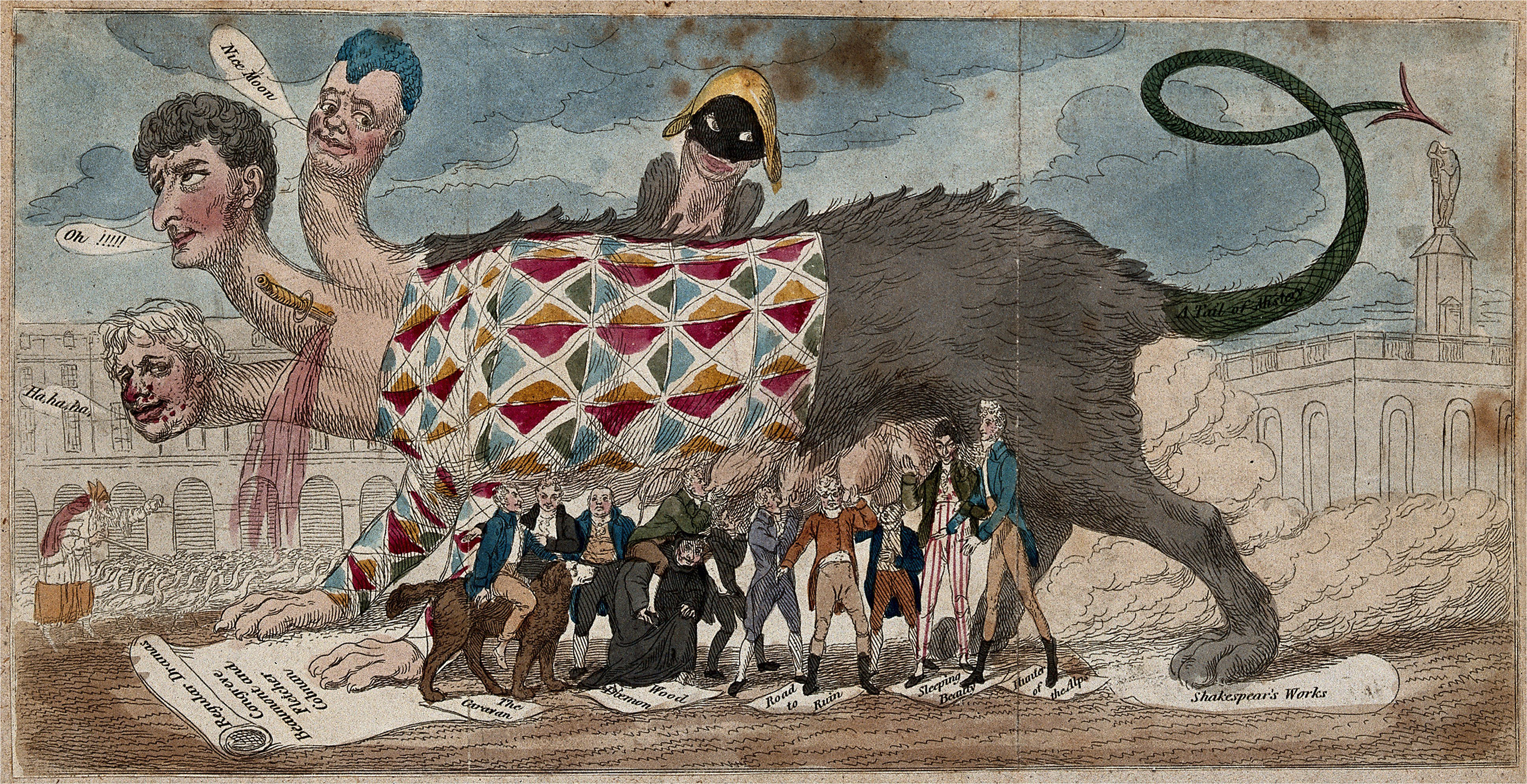
Untitled print, captioned ‘Published for the Satirist Decr 4th 1807 by S. Tipper, Leadenhall Street, Sam. De Wilde Sculp’ Property of the authors.
Like so many early nineteenth-century satiric prints, The Monster Melo-drame is at once richly allusive and visually arresting. Half human, half beast, half male, half female, its chief figure embodies the assault on the traditional drama that many felt was being launched by pantomimes and melodramas. It has proven useful to theatre historians in part because it names names, cataloguing the plays, playwrights, actors, managers, shareholders, and institutions responsible for theatrical decline. Declaring a fairly coherent symbolic logic, its many pointed contrasts (of corrupted living authors and trampled dead ones, of a laughing Sheridan and a dying Kemble) draw on the same logic of monstrosity embodied in the beast itself. Small wonder that commentators have seized on the print as faithfully documenting changes in theatrical hierarchies and the repertory. Shearing the print from its original contexts, we have accepted its representation of hybridity even as we have rightly called for a broader, more dynamic understanding of early nineteenth-century theatres and their repertories. 1
We have done so, furthermore, without fully understanding the history of the print or the rapidly changing culture into which it was born. Published by George Manners, a Tory who offered his journal to a like-minded conservative, presumably male, readership, the Satirist boasted at best a questionable reputation and modest circulation, reaching possibly 750 subscribers and likely fewer, during its brief life between 1807 and 1814. Its printer, Samuel Tipper, operated a thriving shop on Leadenhall Street, producing novels and playtexts as well as books on politics and the theatre. We know similarly little of Samuel De Wilde, the artist who crafted the image – other than that between 1806 and 1814 he drew other abrasive cartoons for the Satirist (frequently under the nom du stylo of ‘Thomaso Scrutiny’) and for other satiric journals. His personal involvement with the theatres royal and their personnel remains untraced, as do his intentions in attacking theatrical people and institutions. The continuing patronage of actors who turned to his Somerstown and Covent Garden studios for portraits was essential to his professional wellbeing, but he seems to have escaped the need to flatter them.
While we do not know their identities, we can assume that the Satirist’s subscribers, like many Britons in these years, were experiencing social confusion and, in some instances, a threatened loss of status. Their towns and cities were changing, and these changes were reflected and dismayingly perceptible in their theatres. The growth rate of Britain’s cities materially contributed to this perception of a growing merchant and middle class edging a gentry schooled in the classics into a diminishing minority, the Satirist’s readers amongst them. That minority’s declared preferences for older theatrical fare and its rejection of modern theatrical modes found a warm welcome in the pages of the Satirist, which reprinted their letters alongside articles seasoned with Latin citations from Juvenal (the Roman delineator of pessimistic invective satire) and overt sexist and anti-Semitic jibes. Melodrama's status as a convenient catch-all target for the decline of British theatrical culture likely also stems from its partially Continental origins – its mixture of French, German, and Austrian influences that had been attacked since the mid-1790s for subverting existing class hierarchies. Nor can we overlook the background of wars against which all this occurs – whether of the recent past (which had cost Britain its North American colonies) or of the interminable present (that drawn-out conflict with Napoleonic France well into in its second decade).
In once again taking up The Monster Melo-Drame, then, we hope to do more than transform and to a degree restore its contemporary meanings. Part of our project, in fact, is to begin by insisting on the expansiveness of its critique: how it does not so much represent the essence of a genre as capture a moment of radical uncertainty both on and off the stage. Assembling an array of plays and playwrights with little generic coherence, the print’s critique is at once more sweeping and more topical than previously understood. Like the many essays published in the Satirist in these months, it extends well beyond a single genre to British theatre generally. Our own essay thus takes the methodological form of a series of re-attachments: of The Monster Melo-drame to melodrama's early performance history and, more substantially, to the Satirist’s broader campaign against the current London stage. As we show, throughout 1808 and 1809 the magazine targeted the repertoire and conduct of the two patent houses, particularly the operation of the Theatre Royal Drury Lane under the nepotistic management of Richard Sheridan, his son Thomas, and his nephew by marriage, Charles Ward. Most significant and tantalising of its attacks, however, are two later Satirist prints: A New Drop Scene for D.L.T., published in May of 1808, and Feast of the Board of Management, published in February of 1809. Both were executed by De Wilde and, like The Monster Melo-Drame, both appeared in the Satirist in fold-out quarto pages, as if to call attention to their association with the earlier print. This trio, we argue, constitutes a set, each expressing a continued, despairing concern for recent developments on London stages. Taken together, they capture three moments in a sustained campaign fought not just in jousting words between critics but also in pictorial images. They also provide us with a means of understanding, however belatedly, how a small but articulate group of men perceived – occasionally with acuity, more often with doggedly conservative resistance and bloody-minded cruelty – the dramatic changes occurring before their eyes.
Dispersing Critique
Though best known as a folded insert published in the Satirist in January of 1808, The Monster Melo-drame first appeared a month earlier as a print to be sold separately. Originally bearing the inscription, ‘Published for the Satirist Decr 4th 1807 by S. Tipper, Leadenhall Street’, the image bore the signature ‘Sam. De Wilde Sculp’, but no title. Most of the versions still in existence are hand-coloured and have the tell-tale vertical folds made at thirds indicating its inclusion in the January 1808 Satirist; at least one, however, is uncoloured and folded once at the half-way mark, indicating the older provenance of the December 1807 print. 2 Some surviving versions still possess the publisher's imprint and De Wilde's signature, though most have been trimmed to ease binding or framing. This in turn has produced discrepancies across world library records as to the print's title and date of publication. 3 The confusion, we believe, is not just understandable given the print's status as semi-ephemera, but also endemic to the history of the print's publication, titling, and commentaries. As created by Samuel De Wilde and printed and sold by Samuel Tipper in early December of 1807, the unnamed print satirises several figures of the London theatre scene. Put in baldest terms, the print as originally published is not named for a specific theatrical genre, and only acquired that appellation a month later in the lead article for the January issue of the Satirist.
Entitled ‘The Monster Melo-drame’, that article takes the form of an anonymous letter to ‘Mr. Satirist’ wishing to report an extraordinary dream ‘which will, if I mistake not, very much puzzle those of your readers who are best skilled in oneirocritical knowledge to interpret’.
4
As the correspondent's use of ‘oneirocritical’ signals, the essay is deliberately old-fashioned in its performance of classical erudition, recalling the older and better established Gentleman's Magazine in its conventions and style. It also is doggedly, aggressively literary. Providing an epigraph from Romeo and Juliet, it takes its frame narrative from Chaucerian dream visions and from Dante's Inferno. This density of allusion comprises part of the Satirist‘s identity – its prevailing voice and its imagined readership – which it presents at once as learned and presumably male, and as slightly fragile, vulnerable, and capable of becoming disordered. The majority of the article, in fact, focuses not on the monstrous image of the print, but rather on the affective causes of the vision: On the 3d of the present month, about two o’clock in the morning, I was aroused from my slumbers by a very uncommon and preternatural noise; it resembled the piercing cries of a female in distress, who seemed to be suffering under the merciless lash of a hired bravo. Fully convinced of the actual existence of the parties …. I sprung from my bed in order to ascertain the cause, and, if possible, afford succour to the unfortunate object. After searching, however, most minutely every hole and corner of the house … to no purpose, I considered that I must have been the dupe of vixen fancy, and returned murmuring to my pillow. (1: 337)
The scene's comedy is driven by contrasts of genre: a middle-aged man steeped in Greek, Italian, and English classics is roused by the stuff of gothic romance. The heightened language and obtruding conventions feed the humour of the melodramatic scene, as the correspondent – presumably costumed in night-shirt, cap, and flickering candle – is transformed into an action hero ‘spr[ingi]ng’ to ‘succour’ a damsel ‘suffering under the merciless lash of a hired bravo’. The correspondent’s conclusions are of a piece with his projected, presumably bachelor persona. Finding nothing, he determines himself ‘the dupe of vixen fancy’, his casual gendering of the imagination of a piece with the monstrously female figure he will soon envision. Determined to ignore all other female cries, he sinks into the landscape of his dream: a thick wood resembling Dante’s ‘selva oscura’ at the opening of The Inferno. There, like Dante’s Pilgrim, he encounters a Virgilian guide ‘of more than human dignity’ who helps him ‘thread the almost impenetrable thicket’ to the open, more familiar, space of De Wilde’s cartoon (1: 338). And there he first sees, then describes, and finally converses with the Monster, who identifies itself as ‘a MELO-DRAME, naturally inoffensive, and much caressed of late by all ranks and conditions of the British people’ (340): How I came into the world, or to whom I am indebted for my birth, appears to be – A TALE OF MYSTERY. I partake, as you see, of the combined natures of Tragedy, Comedy, and Pantomime, without possessing the sublimity, sentiment, or humour of either. To say the truth, I cannot flatter myself that my creation has in the smallest degree contributed to the adornment, advancement, or utility of the stage. Germania's sons, perhaps, are most indebted to me; and next to them your countrymen, who, from some strange and unaccountable impulse, delight to imitate their foibles, immorality, and prejudices. (1: 340-1)
It is a narrow, strangely perfunctory interpretation, strangely out of sync with De Wilde's cartoon, which spells Holcroft's play ‘A Tail of Mistery’ and makes no reference to ‘Germania’. Ignoring the many other strangenesses of the image, the article instead revives an older line of attack first launched a decade earlier that sought to label Gothic fiction and drama as ‘German’ imports of pernicious tendency. 5 Rather than perceiving herself as a new genre, the monster associates herself with earlier works of Lewis and adaptations of Kotzebue, which had dominated London stages as the eighteenth century closed. Echoing earlier criticisms of ‘mixed’ dramas, the dream-vision concludes her account, saying that she has warned contemporary playwrights ‘to avoid such a prostitution of genuine intellect; but they have retorted upon me, that … Authors’ posthumous fame must be sacrificed for present emolument’ (1: 341). Melodrama having conveniently interpreted itself, the sleeper is awakened by a servant's tap at the door, and the vision ends.
Two separate phenomena are at work here. On the one hand, the article ‘The Monster Melo-drame’ seeks to fix the meaning of De Wilde's image by bestowing on it a title and giving to readers a key to interpreting key elements of it. The interpretation provided seeks to connect the emerging form of melodrama to ‘German’ imports of the previous decade, damning them as monstrous births resulting from a love of gain and ‘a prostitution of genuine intellect’. On the other hand, the dream vision provided in ‘The Monster Melo-drame’ complicates our overall picture of the image's creation and provenance by providing it with a fictitious narrative of origin. Our own account, provided at the beginning of this section, is spare and incomplete, consisting of the print’s creator (Samuel De Wilde), its two dates of publication (4 December 1807 and 1 January 1808), its publisher (‘for the Satirist’), and its absence of title. Taken on their own, these details point to a likely scenario in which the Satirist commissioned De Wilde to create an image attacking current trends at London's major theatres. When the editors approached De Wilde is uncertain; similarities between the image and specific articles of the December issue of the Satirist suggest that they provided De Wilde either with details or with pertinent articles in proof from the forthcoming issue of the magazine. What is certain is that De Wilde produced the image, and that it was printed and published by Samuel Tipper on 4 December 1807. From here, though, the events grow increasingly speculative. As De Wilde would produce two further images for the Satirist, it seems likely that the editors were pleased with the print and with the December sales of it in Tipper's shop – at which point a member of the Satirist editorial team then penned ‘The Monster-Melo-drame’ to open the fourth issue, thereby naming the print and providing an interpretation of it. Whether the writer of the dream vision consulted De Wilde during the composition is unclear; given the multiple disconnects between image and account, it seems unlikely.
In contrast, the Satirist’s narrative of provenance in ‘The Monster Melo-drame’ is elaborately framed and overdetermined. It is presented as a ‘puzzle’ requiring readers’ assistance, yet it is difficult to parse, given the monster's perfunctory account of itself, precisely where the mystery lies. If not with the monstrous figure at the center of the print, then where? In the cause of the dream vision itself? What has inspired the correspondent to imagine, on awakening, ‘a female in distress … under the merciless lash of a hired bravo’? Few clues exist beyond the title of the article (‘The Monster Melo-drame’), the day and time of the vision (‘the 3d of the present month, about two o’clock in the morning’), and the backdrop of the closing scene of the dream itself: ‘an extensive lawn [with] our two principal winter theatres, Drury-Lane and Covent Garden … [i]n the middle distance’ (1: 338). With these clues, readers might consult either the London dailies or the December issue of the magazine. There, they would have discovered that on 2 December 1807 both theatres produced similar bills of fare: at Drury Lane, a new Comedy in five acts, Time‘s Tell-Tale, and Ellen Rosenberg: A New Melo Drama; at Covent Garden, The Provoked Husband and another new play, The Blind Boy: A Grand Historical Melo-Drama. Readers of the Satirist willing to review the offerings of the theatre royals might thus satisfy their curiosity regarding the dream vision: imaginative indigestion caused by an overindulgence of melodrama.
What might have surprised readers more, however, is melodrama’s prominence in the Satirist at all. Previous issues had either ignored the form or noticed it only in passing.
6
Beyond the magazine’s regular column, ‘Theatre’, the October and November 1807 issues do not mention the stage at all, and are instead focused almost exclusively on political satire and invective. This said, readers might have detected the beginnings of a shift – from political to cultural war – with the December issue. Published at the same time De Wilde would have been preparing his cartoon for the press, the third number of the Satirist opens with a short foray into drama and theatre: Poet Laureate Henry James Pye defending his Comments on the Commentators on Shakespeare (also published by Tipper in 1807); a satirical poem entitled ‘Time's Answer to George Colman the Younger’; and a letter signed ‘An Admirer of the Legitimate Drama’. These are followed, after articles on political subjects, by further asides to the stage: a letter impersonating Thomas Moore as ‘Thomas Little’ facetiously praising Matthew Lewis as ‘an enemy to seduction’ (266); and a poem called ‘Goose Verses’, which first attacks William Pearce’s Hartford Bridge: An Operatic Farce in Two Acts (1793) and then other playwrights: High on the list, vain P – rse ascends the ridge, And sinks contemptible in H-rtf-rd Br-dge. D-m-nd, L-w-s, D-bd-n, Ch-rry too; A ‘weary, stale, unprofitable’ crew: All, happy bird, invoke thy goose-like power, And dim the scene, all waste the jocund hour. (1:268)
As the list of authors and topics suggests, the primary object of ridicule is the illegitimate theatre, its hybrid genres enabled by manager-playwrights like Colman and popularised by William Dimond, Lewis, Thomas John Dibdin, Andrew Cherry, and others. Within this grouping, melodrama stands as only one of many mixed forms afflicting the stage – though one enjoying a certain popularity, as the Satirist's commentary on ‘Theatre’ testifies: The next novelty at [Drury Lane] is a melo-drama, as it is termed, under the title of Ella Rosenberg, in two acts, from the pen of Mr. Kenney. This style of piece is new to the English stage, or at least it has lately been introduced: to say it is an absolute novelty, would be incorrect; for in consequence of the success Holcroft's translation, The Tale of Mystery, met with, all the would-be authors of the day have been writing melo dramas only, because they have not imagination to invent pieces with regular plots. We have had the Wood Demon, Tekeli, and many others of the same stamp, till the town is tired, and the music, with which the dialogues are interspersed, no longer amuses; it is now considered, and justly too, an impertinent interruption to the interest of the stage. Of this sort of entertainment, Ella Rosenberg is one of the best examples: replete with interest, bustle, and action. Mr. Kenny [sic] has contrived to keep up the attention to the last scene. (325-6)
The passage constitutes the Satirist’s first description of melodrama as a dramatic technique rather than as simply ‘French’ (97). This is perhaps because Kenney’s play, unlike many earlier melodramas, is not an adaptation of Pixérécourt, though the reviewer makes a point of aligning the homegrown Ella Rosenberg with earlier importations sharing a common style and defined by the absence of ‘regular plots’. Hardly a monster, it is at worst a tepid novelty overstaying its welcome, and arguably (given the reviewer’s praise for Kenney’s play) even a welcome distraction from the war with France, looming trade wars with America and other neutral countries, and the limited choices available to the new Tory ministry.
Opening the pages of the January issue, then, readers would have been at least mildly surprised by the Satirist's initiation of a culture war centred on melodrama and the London stage. Where previous issues of the magazine had bestowed between four and eight pages on theatrical topics, the Satirist No. IV for January 1808 devoted nearly thirty. Beyond De Wilde's cartoon (n.p.) and ‘The Monster Melo-drame’ (pages 337–41), the issue contained a squib on new comic forms called ‘Comedy in the Cage: An Ode’ (342–45), attacks on Thomas Sheridan (345–46) and Richard Brinsley Sheridan (362), a satiric ‘tragic-comic-melo-drame in rhyme’ (363–8), a critique of the dullness of current dramatic writing (371–72), and a final, culminating attack (432–39) on the rise of minor theatres: Certainly few of our modern dramatists take the trouble of writing; they seem to prefer … what they are pleased to term melo-drame, to common sense; but even in these pieces, amid the pageantry of pantomime, there may be from the incidents, and from the dialogue, something gained by the audience, besides the gratification of the moment; and there are plays, and many of them too, which might serve as lessons to youth, inducements to virtue, and examples to vice: surely, then, at this time of the year, when the juvenile part of an audience is the largest, such pieces, and such representations, are more proper for their amusement, than the productions which are advertised on the boards of Pavilions, Royaltys, and Sans Pareils. In the present influx then of puppet-shows, should not the legislature interfere? (435)
Here, melodrama functions less as a genre of performance than as a sort of placeholder opposed to ‘writing‘ and ‘common sense’ and synonymous with ‘the pageantry of pantomime’, ‘puppet-shows’, and other irregular forms. In the reviewer's analysis, the multiplication of hybrid forms mirrors the multiplication of London theatres. It is presented, moreover, as a problem serious enough to require attention not just from local authorities but from ‘the legislature’. Where once there were clear dramatic demarcations and boundaries – in the form of two genres (comedy and tragedy) and two venues (Drury Lane and Covent Garden) – now there is only promiscuous mixing and a proliferation of sites and forms. The result, the reviewer concludes, is confusion and prostitution, both literal and of the intellect: ‘trash which is received with bursts of applause [by] company so mixed’ (436) that it is impossible to distinguish genuine ladies in attendance from ladies of the night.
Turning back to De Wilde’s image, then, what is being represented in the print? Not a single genre but a melange, a miscellany of mixed forms. Hydra-like and dressed in pantomime motley, the monster does not represent melodrama so much as embody the death of traditional genres, represented through a knifed Kemble, a debauched Sheridan, and the trampling of the works of Shakespeare, Beaumont and Fletcher, Colman the Elder, and other ‘Regular Dramas’. This narrative is confirmed by the authors and works assembled under the beast, from The Caravan (‘a Grand Serio Comic Romance’) and Wood Daemon (‘a Grand Musical Romance’) to Sleeping Beauty (‘a Grand Legendary Melo-drama’) and The Hunter of the Alps (‘a Drama, Interspersed with Music’). As the list of subtitles indicates, ‘melodrama’ comprises one of many genres represented in De Wilde's cartoon. Put another way, the Satirist's dream vision only partially describes the image it purports to name. Far from lampooning a single genre, De Wilde projects the full range of forms that were, at that moment, powerfully transforming the traditions, authority, and repertory of the London stage. As we show in the next section, his subsequent cartoons continue this line of attack, even as they respond to topical concerns and newly arising contingencies.
Feasting on the Board of Management
The Satirist's desire to decry irregular forms as corrupt and to deport them to the Continent, especially to France and Germany, will be familiar to theatre historians. These strategies date from the later 1790s, when the double-ascendance of Gothic romance and Kotzebue’s works on the London stage created a formidable backlash among conservatively-minded reviewers and critics.
7
Even writers drawn to German culture in the 1790s felt compelled to reject it after 1800, as the career trajectories of Samuel Coleridge, William Wordsworth, and Walter Scott testify. These increasingly virulent anti-German and anti-Jacobin sentiments are rendered at once succinct and explicit in Sir Walter Scott's well-known denunciation of ‘pathetic comedy’ in the 1811 supplement to Encyclopedia Britannica: The pathetic comedy, which might be rather called domestic tragedy, became, unfortunately, very popular in Germany; and found a champion in Kotzebue, who carried its conquests over all the Continent. The most obvious fault of this species of composition is the demoralizing falsehood of the pictures it offers us. The vicious are frequently presented as objects less of censure than of sympathy; sometimes they are selected as objects of imitation and praise. There is an affectation of attributing noble and virtuous sentiments to the persons least qualified by habit or education to entertain them; and of describing the higher and better educated classes as uniformly deficient in those feelings of liberality, generosity, and honour, which may be considered as proper to their situation in life … in spite of truth and probability [:] the groundwork of a sort of moral Jacobinism.
8
But there may have been, beyond the villainising of the aristocracy, various aesthetic and critical reasons which appeared to justify resistance. Like ‘pathetic comedies’, melodramas reversed Aristotelian priorities by favouring spectacle and music over character, morals, and language. As Scott notes, they often featured untraditional mixtures of social and literary class. Neither tragic nor comic, melodramas blended both comedy and tragedy – in Aristotelian terms, forms of plot – which were then further blended with large-scale narrative ballets and dependent on scenic effects and massed performers. Colman's ‘Dramatic Romance’ of Blue Beard; or Female Curiosity, staged at Drury Lane in January 1798 and featuring a powerful score by Michael Kelly, offers a ready example of such offending heterogeneity. 9 So also does Thomas Holcroft’s A Tale of Mystery, with its powerfully expressive score by John Busby, ambiguous ending, and ambivalent depiction of relations between servants and masters.
Faced with the growing popularity of plays no longer playing by long-established aesthetic and social codes, the Satirist‘s desire to lump melodrama with earlier Gothic and ‘German’ plays becomes understandable. Perceiving a threat to theatrical tradition and the authority of the patent houses, its writers take up what weapons they have at hand, and among these are decade-old denunciations of dramas of spectacle. With fewer than a dozen examples of it available in Britain in 1807, melodrama presented an emerging genre not yet fully understood, let alone defined. Its blend of music, dance, movement, action, and suspense already had instead produced an eclectic, nearly incoherent mix of plays, from the thrilling Tale of Mystery (1802) and Rugantino; Bravo of Venice (1805) to the very different Harlequin Quicksilver (1804) and Valentine and Orson (1804) – the latter plays relying less on suspense and more on pantomimic action and comic pathos to deliver their affective payloads. It is hard to discover plays more different from one another than these first British melodramas. As a group they could hardly be said to cohere, let alone constitute a clear target for attack.
What these plays did share, however, were their elite origins. In spite of British melodrama’s reputation for illegitimacy and irregularity – insisted on by Satirist commentators – every early instantiation of a play calling itself either a ‘melo-drame’ or ‘melodramatic’ between 1802 and 1808 premiered on the boards of one of the patent houses.
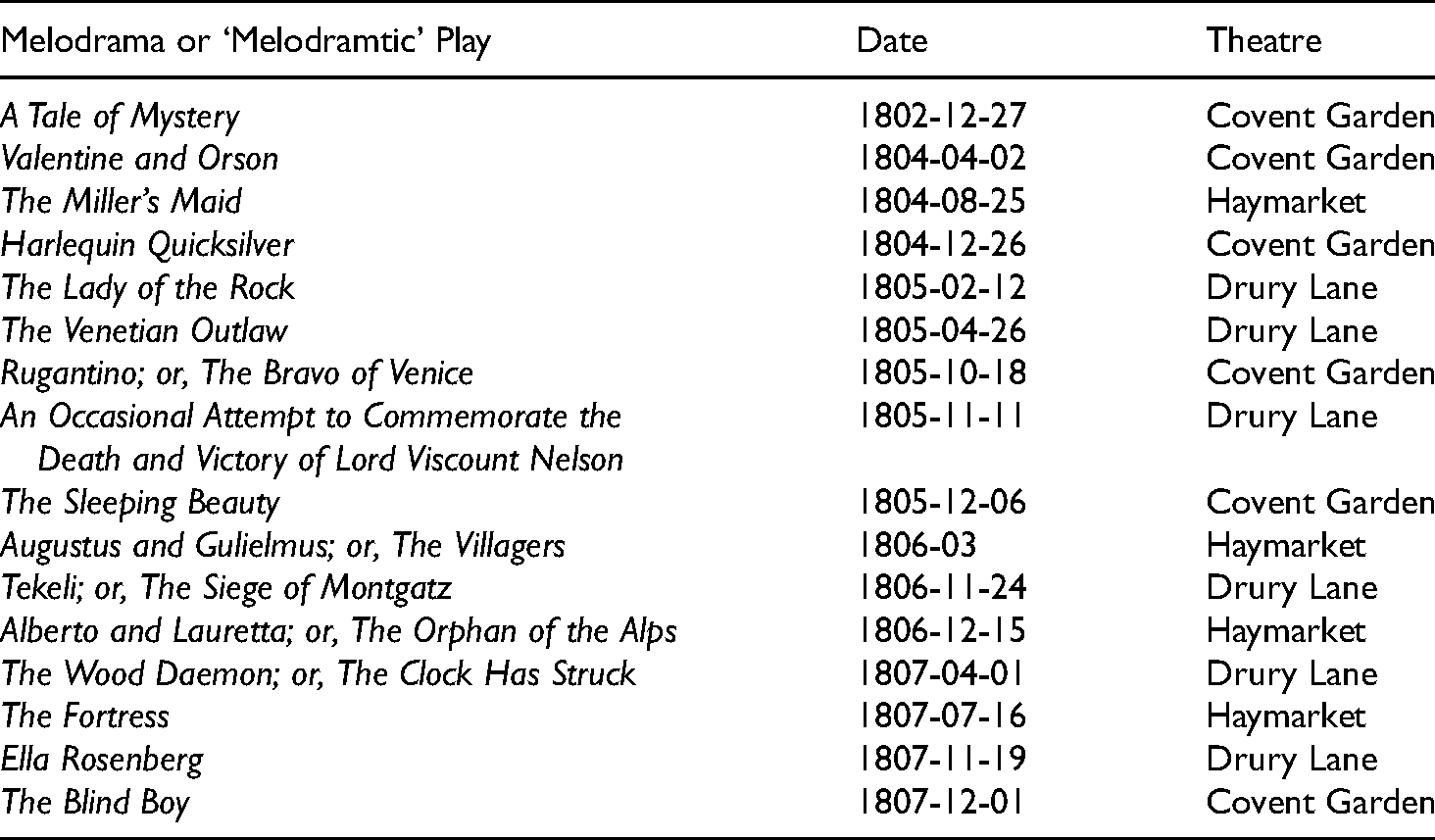
The Theatre Royals were, of course, under immense pressure. London's population growth brought with it a demand for cheaper and a wider range of entertainments appropriate to the tastes of the new residents. Add to this the fact that both theatres had recently (Covent Garden in 1792, Drury Lane in 1794) undergone significant and costly renovations. Each playhouse, reflecting London's continually enlarging population, now accommodated audiences approaching 4,000 spectators, but the spaces allotted to the various levels of patronage brought dissent and conflict. By the end of the decade, the Old Price (O.P.) riots would testify to the social, political and economic pressures imposed by the rapidly-changing theatrical scene.
For the Satirist at the opening of 1808, however, the complaint remained chiefly directed at the dramatists displacing what De Wilde's cartoon terms ‘The Regular Drama’ and the despised managers who encouraged them. Caught in a dereliction of duty, the patent houses are identified and castigated. Covent Garden is shown as host to meretricious pantomime; Drury Lane is battered by melo-drame, its patron god beheaded by the monster's ‘tail of mistery’. Indeed, the beast's heads and tail appear curiously unconnected from one another – with Harlequin and Grimaldi present but communicating little, Kemble weakened and wounded, perhaps mortally so, and Sheridan flushed and intoxicated. All are identified with the problem, but the extent of their involvement or corruption remains unclear. Such accusations were to follow, but Satirist readers would have to wait four months for the next De Wilde cartoon to drop. And when it did, it would feed primarily on a combination of hearsay and rumour.
Appearing in the Satirist for May of 1808, De Wilde's next print (Figure 2) takes us onstage at Drury Lane, extending the attacks of The Monster Melo-drame to the personnel and management policies of that patent house. This print carries a title, A New Drop Scene for D.L.T. While in no way abandoning its earlier complaints about theatrical fare, the focus nevertheless has shifted: from self-prostituting playwrights producing monstrous forms to those who commission spectacles and control would-be authors’ access to the stage. Drury Lane’s administrators are depicted by De Wilde as assailants and executioners of the embodied personifications of drama (giving the print's title of ‘Drop Scene’ a ghoulish double-entendre), while those who actually design and construct the theatre's allegedly vapid spectacles are portrayed by the cartoonist as craftsmen engaged in absurd tasks.
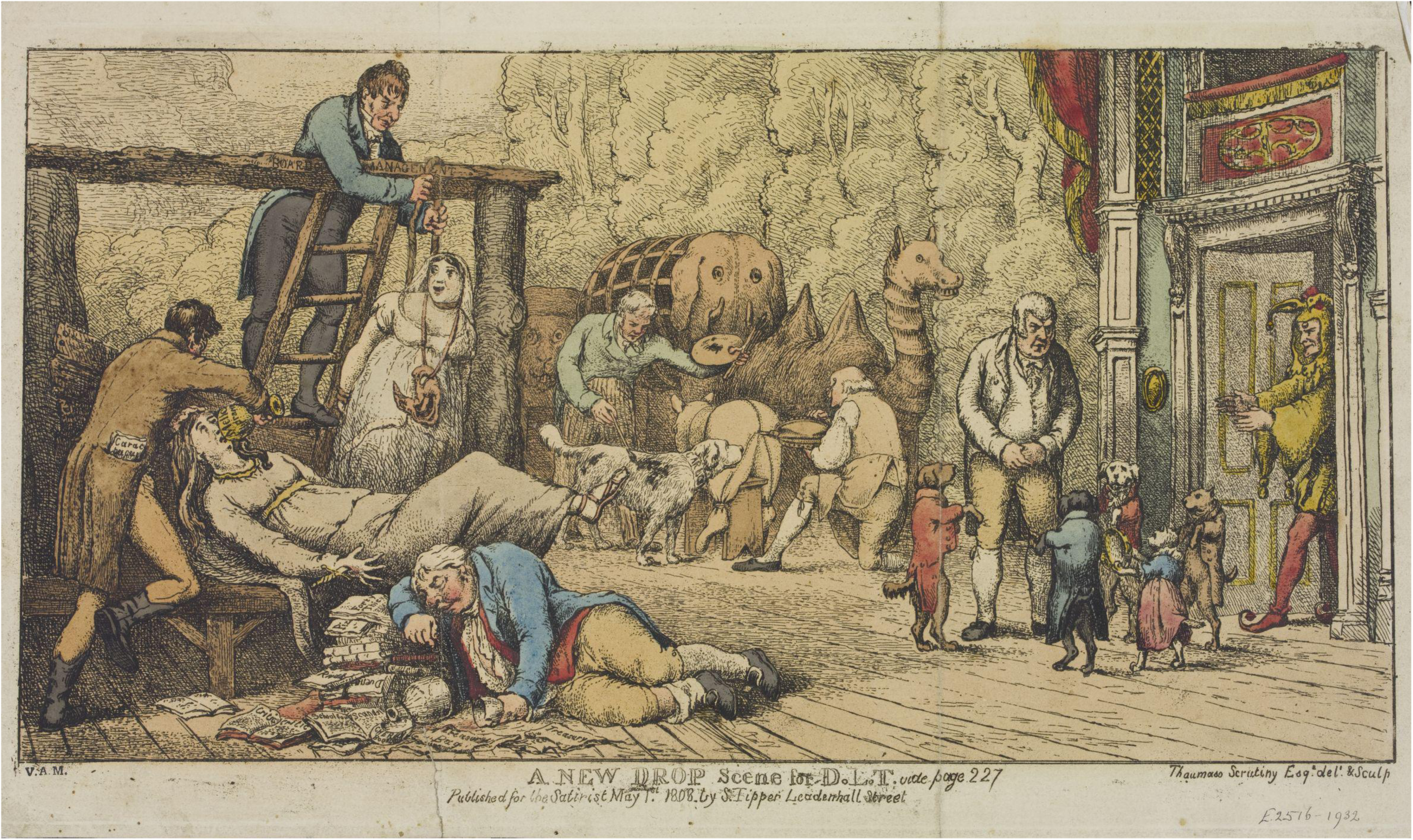
A New Drop Scene for D.L.T captioned ‘Published for the Satirist May 1, 1808 by S. Tipper, Leadenhall Street, Thomaso Scrutiny Esq. Del. & Sculp’. © Victoria and Albert Museum.
This second print departs from the practices of the first in other particulars as well, most strikingly in the replacement of De Wilde's name with that of ‘Thomaso Scrutiny, Esq.’, a pseudonym deployed frequently in The Satirist's pages. 10 The links between print and issue are now explicit: each bears the publication date of 1 May 1808, and readers following the print's directive (‘vide page 227’) will find themselves reading a description of the print entitled ‘The Board of Management’, also signed ‘Thomaso Scrutiny’. Satirical print and description are thus linked through direct reference and a common nom de plume, with little of the disconnect that had characterised De Wilde's first print and the belated description that followed in the ‘Monster Melo-drame’. If the Satirist‘s first foray with De Wilde into theatrical satire betrayed a certain ad hoc approach, this second shows more careful planning. It also betrays something more: a desire to attribute the Satirist’s view of the stage to a single authorial viewer – one who goes beyond mere spectating to more careful acts of scrutiny, exposure, and critique.
The print itself is also more richly allusive and intertextual. Upstage left, for example, is a bizarre tableau which draws on the convention of depicting David Garrick. 11 The third Drury Lane's main public salon was known for its large marble statues of Melpomene and Thalia, the muses of tragedy and comedy, placed on either side of Garrick's sculpted figure. Here, in De Wilde’s cartoon, Melpomene – half-statue, half human – lies stricken, stabbed in the hand with her own dagger. She is being tended to by Sheridan’s son Tom (identified by the scenario of James D’Egville and Henry Bishop's 1808 ballet Caractacus in his pocket), now a member of the board of management, who attempts either to revive or euthanise – it is unclear which – the injured muse of tragedy with a potion labelled ‘melo-dram’. Behind Tom Sheridan is a gallows upon which Charles Ward, the Board of Management's secretary, is stringing up the companion muse of comedy – a distressed Thalia. Ward, a would-be playwright married to Jane Linley, Sheridan’s sister-in-law, was despised by London’s dramatists because of a published demand that ‘all desirous of submitting new plays were to apply to the secretary’, 12 implying that he alone would determine whether a submitted play would be accepted and performed. The chief malefactor, though, is clearly Sheridan, sprawled on Drury Lane's forestage in a stupor and drunk on cherry bounce, a brandy mixture which also alludes to one of the dramatists lampooned in The Monster Melo-drame, Andrew Cherry. Sheridan's head rests on a stack of playscripts, which include of the Younger George Colman's romantic spectacle The Forty Thieves and Sheridan’s still-revered works Pizzaro, The Duenna, and School for Scandal. Even more conspicuous, however, are two sets of treasury accounts alluding to the principal London theatre sustained by inferior plays and vacuous spectacle.
Across, at stage left, Folly, with the face of the comic actor William Dowton, enters from a proscenium door while the stage manager Richard Wroughton auditions costumed dogs begging for future roles in Drury Lane dramas. Still farther upstage, is the theatre’s ‘ingenious machinist’ Alexander Johnston in the act of painting spots on a Newfoundland dog to resemble the famous Carlo (rumours circulating that the original Carlo had died and was replaced by a substitute). Johnston’s assistant William Underwood is seen with a bellows in the anus of an artificial bear, inflating it so that it can be used on stage, likely in Thomas Dibdin's Valentine and Orson. Johnston was known for creating full-size artificial animals out of osier and wicker and covering them with painted canvas, 13 three of which are present behind him. The first is an unidentified lion, the second the lattice and wicker-work elephant from Blue Beard, and the third a strangely ambiguous animal: either the ‘fearsome’ Welsh dragon from the theatre's 1800 pantomime Harlequin Amulet; or, The Magic of Mona or one of the basket-work camels that alternated with real camels in The Caravan. Behind the skeletal animals is an example of Thomas Greenwood's scene-painting, possibly from Lewis's The Wood Demon or Caractacus, which we discuss below.
As with The Monster Melo-drame, playtexts have the power simultaneously to identify and damn individuals. In Tom Sheridan’s pocket, for example, is a paper, presumably the top of a scenario or libretto, bearing the title ‘Caractacus’ (also featured in the next cartoon to follow in De Wilde's sequence, ‘The Feast of the Board of Management’). Alerting us to a further fiercely criticised addition to Drury Lane’s repertoire, the libretto is enough to identify Tom Sheridan but not explain him. Caractacus was one of a number of ballet spectacles that found favour with the patent house's newer clients but which, to the subscribers to the Satirist, represented a further erasing of approved dramas and their replacement by excessive display and indifferent music.
The exact steps in Caractacus becoming a ballet and Tom Sheridan's role in bringing this work to the stage are murky; we know little beyond various publication and premiere dates. The piece originally appeared in print 1759 as a largely unplayable work – ‘a dramatic poem written on the model of the Ancient Greek tragedy’ composed by the poet-cleric William Mason. Seventeen years later, it was combined with Mason's earlier dramatic poem Elfrida and scored by Thomas Arne. This fused work was offered to Covent Garden audiences as an opera, and was periodically performed through the winter of 1798. It then disappeared from view for a decade until it was revived at Drury Lane in March of 1808 as ‘a grand serious ballet of action’, featuring choreography by the King's Theatre ballet master and leading dancer James Harvey D’Egville, a new score by the then-untested composer Henry R. Bishop, and a scant libretto by Tom Sheridan. Notable scenic effects were created by Drury Lane’s machinist Alexander Johnston, and the resulting spectacle ballet was a hit, remaining in the Drury Lane company's repertoire even after fire demolished the Theatre Royal and drove players to alternate quarters.
Readers of the Satirist and viewers of De Wilde’s two cartoons needed only to see the title protruding from Tom Sheridan's pocket to recognise the inference that Drury Lane’s management, already high-handed in their rejection of worthy new plays, were corrupting the stage by substituting music-saturated spectacle for literate art. As the Satirist explained,
We complained of the indolence of genius; we had then forgotten Caractacus. The stage was drooping, Apollo on the top of the theatre hung his head, when a being, a poet, a SHERIDAN!!! looked from Parnassus into Drury-lane: he saw ‘a beggarly account of empty boxes’; Maecenas like, he patronized his Brandon; Kais came out, and Tom approved. But still the benches all were empty: quoth Sheridan the younger – ‘I will fill them. I’ll make a pantomime. I’ll take a play, leave out the dialogue, give the scenes to D’Egville, he shall group the actors, Greenwood shall brush up some old canvas: I’ll have an organ and a Welch tune, a harp and an Irish one; I’ll have music; I’ll have an altar, a fountain, a child, a rock, a boat, a man, some chains, a battle, two or three processions, and a chorus’. – No sooner said than done. The son of Richard set about it, with a good intention, to fill the benches; and on good grounds too, for let their qualifications be what they may, the family of the Sheridans have done as much toward filling the Bench as most people. (2: 326-7)
Caractacus in all its variations enacts the heroic resistance of the Welsh tribal leader Caractacus to the invading Romans. It offers the spectacles of massed Druidic rituals, battles, and strenuous physical encounters, leaps from high precipices – by D’Egville in the title role before his betrayal and capture – and a final scene set in Rome in which the imprisoned leader, persuading Caesar of his honour and valour, is freed and placed on a throne to sit alongside Caesar.
To theatre scholars, now two and a half centuries later, Caractacus obliges us to consider that an alarming gap exists in our research. 14 In our studies of the eighteenth- and early nineteenth-century stages, we have notably failed to acknowledge, let alone examine and describe, the considerable quantities of dance, mime, and musical spectacles that shared the stages of London playhouses with tragedies, comedies, farces and more recently arriving melodramas. Charles Farley, for example – who produced and starred in so many early English melodramas – established his career as a composer of spectacles with Raymond and Agnes; or, The Castle of Lindenberg (Covent Garden, 1797), ‘A New Grand Ballet Pantomime of Action’ later expanded by W. H. Grosette into Raymond and Agnes, or the Bleeding Nun of Lindenberg; an Interesting Melodrama (Norwich, 1811). If we have largely overlooked dance’s constitutive role in shaping melodrama, part of the reason lies in the fact that the evidence for ballet spectacles is sparse. The few available pictorial renderings are necessarily static and usually fail to place the dancers in any narrative context or to explain their movements. Not all is lost, however. There are other sources to seek: the scenarios of dance entertainments mixed with dialogue, song, and music and containing descriptions of choreography; and the playbills and reviews summarising narratives and describing scenic effects, the names and number of dancers and speaking actors involved. There also exist a number of surviving musical scores, which permit consideration of the dynamics and tempi, the variety of melodies, and the overall structure of the ballet. 15 Thus, while a production like Caractacus must stand only partially glossed in our analysis, we hope that it will prove a spur for future scholars of popular theatre.
Our third DeWilde cartoon is the squalid dark Feast of the Board of Management (Figure 3), which appeared in the Satirist on the first of February, 1809. Unlike the two earlier cartoons which were individually hand-coloured, DeWilde's final work for the Satirist was printed in dark sepia-toned ink. On view are men feasting on a bizarre banquet and feeding scraps to ravenous mongrels – all playwright dogs with identifiable human heads.
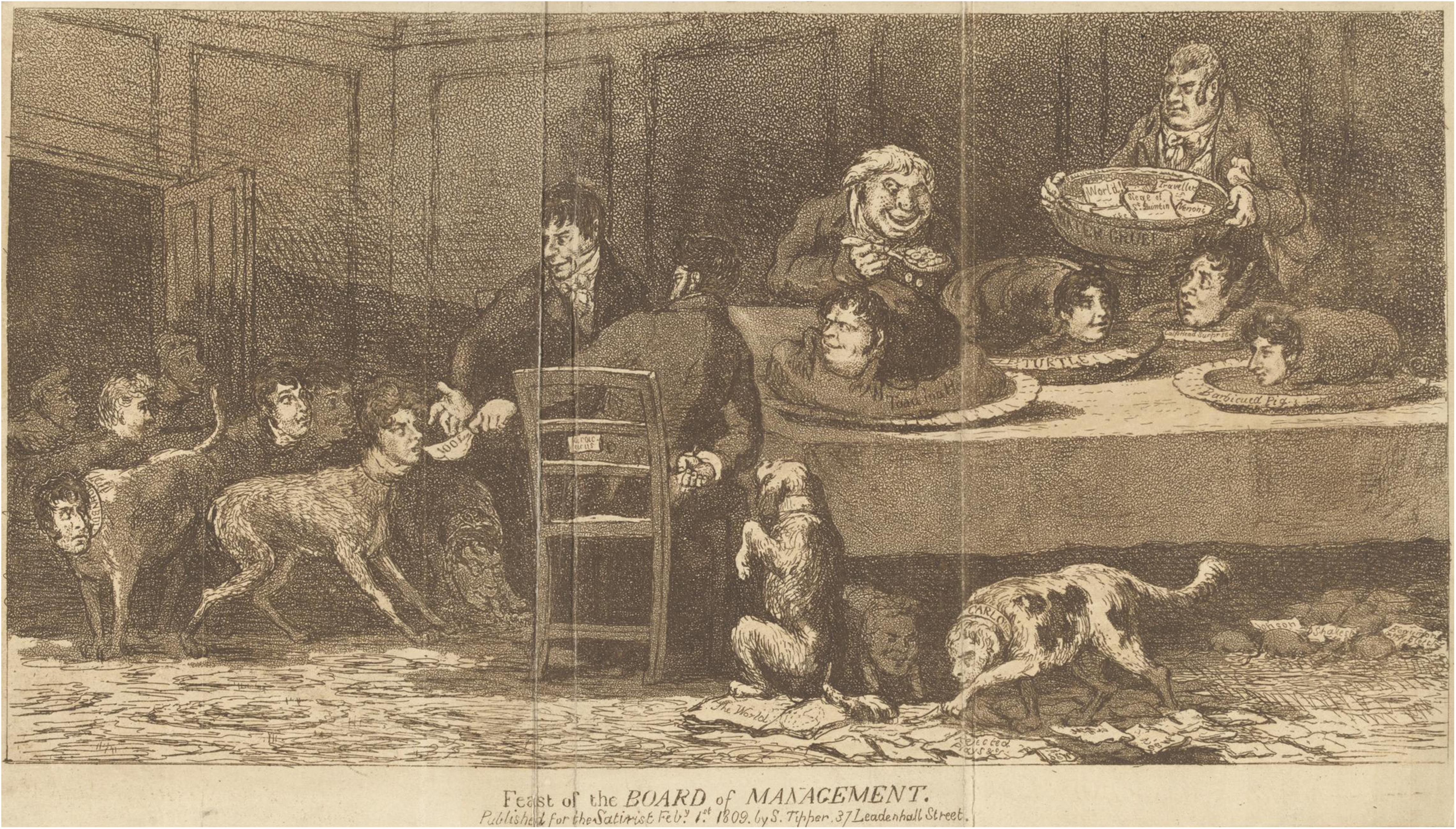
Feast of the Board of Management captioned ‘Published for the Satirist Feb. 1st, 1809 by S. Tipper, Leadenhall Street’, Property of the authors.
The cartoon wields known satirical conventions: the metaphor of a feast to express mismanagement and overindulgence was common to the era. Typically, James Gillray had previously caricatured a drunken Sheridan uttering inanity in a 1797 cartoon, The Feast of Reason and Flow of Soul. De Wilde's image of feasting presents a corrupt and heartless Drury Lane management gorging on the theatre's profits. Feeding off their leading authors, actors, and composers, they treat their lesser contributing dramatists as beggar-dogs. The logic is of a piece with preceding De Wilde cartoons: the fact that these lesser dramatists supply such allegedly inferior fare confirms that they are mere curs, entitled only to scraps.
As with The Monster Melo-drame and A New Drop Scene for D.L.T., the most recognisable figure is Sheridan, gorging himself on a ladle full of guineas. Sitting at the table are the managers Charles Ward and – again pictured with his back to us and again with the libretto of Caractacus protruding from his pocket – Tom Sheridan, who hands a 100 pound note to the dog William Dimond, a gratuity for Dimond's melodrama, The Foundling of the Forest, which had passed from the Haymarket to the patent house. Looking back over his shoulder as he skulks away from the feast is the dog George Colman the younger. His attitude, and the presence of the play title John Bull on his collar, remind the viewer that Colman had deserted Drury Lane to sell this 1803 money-spinning comedy to Covent Garden. Behind him are the dogs Thomas Morton, Colman's collaborator, and the prolific and opportunistic Thomas John Dibdin, whose melodramas, pantomimes, comic operas, operas, farces, spectacles, and ballets were performed at both patent houses and the minor theatres. Beneath the table are other dogs, foraging amongst discarded scripts where we read – recalling the works trampled by the monster in De Wilde's first cartoon – ‘Jonson’, ‘Shakespeare’, ‘Beaumont’, and ‘Rejected Plays’. One of the foraging dogs, ‘Carlo’ engraved on his collar, is Frederic Reynolds. A few further dogs have portrait faces, but we have failed to identify them.
The banquet meal is grotesque and repellent. In the upper right-hand corner of the print, the stage manager Richard Wroughton brings to the table a bowl of ‘water gruel’, containing the watery-thin scripts of Monk Lewis's Venoni (1808), Andrew Cherry’s The Travellers (1806), James Kenney’s The World (1808), and Theodore Hook’s The Siege of St. Quentin (1808) – all melodrama spectacles. Splayed on platters ready to be carved, the main dishes are wonderfully vile but difficult to identify with certainty. The head furthest to the right is John Kemble, labelled ‘Barbeque Pig’. (Kemble had quit Drury Lane in a huff and had gone to Covent Garden, only to have that theatre burn down in 1808.) Next to Kemble, labelled ‘Calf's Head Surprise’ is, we think, the composer Michael Kelly, and next to him De Wilde's only representation of a female, likely Kelly's recently deceased partner Anna Maria Crouch, an actress-singer who took the role of Fatima in Blue Beard. She is on a platter labelled ‘Turtle’. (For ‘turtle’ read, in cockney slang, ‘Dove’ or ‘turtle dove’ – i.e. ‘Love’. Whilst linked with Kelly, Mrs. Crouch, as she was usually billed, was allegedly the mistress of the Prince of Wales.) The head at the furthest left on the table, in a dish labelled ‘Toad in the hole’, resembles George Colman the younger, the creators (or perpetrators) of Blue Beard together providing the grisly but profitable feast. Taken together, the banquet recalls The Monster Melo-drame in its strategies of assemblage and montage: through a series of unworthy actors, authors, and plays, De Wilde’s final cartoon presents a British stage and theatrical establishment in a state not just of dissipation but moral debasement and artistic decline.
Epilogue
However assertive and emphatic these three cartoons may have been, they singularly failed in their attempts to drive melodrama or ballet spectacle from the stage (if that was their intent) or to any degree alter or improve that theatre’s repertoire. As we are all aware, melodrama, far from being scorned by theatre managers and the public, proliferated from metropole to province and from Theatre Royal to more minor theatres. While it was to enjoy a long and illustrious career as the dominant theatrical and literary genre of the nineteenth century, Sheridan's managerial career would come to an abrupt end. Just twenty-three days after ‘Feast of the Board of Management’ was published in the Satirist, the third Drury Lane Theatre burned to the ground on 24 February 1809. The new management, headed by the brewer-politician Samuel Whitbread, deliberately excluded Sheridan from any role in the re-building. The Satirist grudgingly noted the fire in its March 1809 issue with the briefest of comments: Drury Lane Theatre has, during the present month, afforded, as usual, plenty of the most delectable subjects for criticism; but all have perished in the dreadful conflagration of Friday night, and with them the indignation which their follies and absurdities had excited in our breasts. Peace to their ashes, we war not with the dead. We are most happy to hear that no lives were lost in the flames of this theatre. (4: 303)
There are other more incisive and more nuanced accounts than the Satirist’s of these turbulent years as melodrama came on-stream, ballets proliferated, and pantomime grew in influence. What De Wilde’s cartoons and their commentaries offer is a raucous alternate history, one that captures a conservative theatre culture at once in mourning for older times and bewildered by their own. Considered as a set, the images diagnose popular genre – and particularly melodrama – not as a cause of decline but as an effect of wider corruption and dereliction of duty. For, much as the editors of the Satirist sought to condemn new theatrical forms as monstrosities and banish them to the minor theatres, De Wilde's cartoons unrelentingly expose what they no doubt would have wished to ignore: a revolution in the repertory emanating not from below but above, and even from the hallowed boards of Drury.
