




Abstract
The origins of D. W. Griffith’s 1921/22 film Orphans of the Storm can be traced through a popular French melodrama Les Deux Orphelines (1874), its performance in translation on the British and American stage, and several earlier film versions. This article charts the ways in which the melodrama was changed and adapted over time and demonstrates Griffith’s indebtedness to nineteenth-century theatrical practices
Prologue 1
Although motion pictures are closely identified with modernity and the modern world, the ‘movies’ were, in fact, a development and the results of Victorian technology. The very apparatus which we associate with the modern cinema – cameras and projectors, panchromatic celluloid film and its nitrate-silver emulsions, lenses, and reflector – were in use by 1910. This essay will not claim that a movie is the same as a stage play nor a replacement for one. Motion pictures are a late-Victorian device for telling – dramatising – a story, but they remain distinctly different from stage plays. The subjects of these early – that is ‘silent’ – films were sometimes original and self-devised, but sometimes they were taken from popular fiction and popular – long enduring and immediately current – stage plays. It is also apparent that some makers of these early films came from a theatrical background and brought with them into the new motion picture profession staging praxis, acting techniques, stage solutions to questions of illusion, musical accompaniment, and the theatrical repertoire itself. Consequently, because of these crossovers between the theatre and the emerging film industry, it is unremarkable that surviving silent films open up a portal onto the Victorian stage. This essay passes through that portal and into the nineteenth-century theatre. There it will describe the permutations and dynamics of the d’Ennery and Corman Les Deux Orphelines, a stage melodrama which had its origins in France but soon became a world-wide phenomenon. D. W. Griffith’s 1921 silent film Orphans of the Storm 2 is perhaps the better known of the numerous twentieth-century adaptations.
In 1978, I went to New York to participate in a conference focused on preserving performance ephemera. My approach, which isolated me from the other speakers, was primitive, very low tech. In contrast, Dr Patrick Loughney from the Motion Picture Division of the Library of Congress spoke about the high-tech conservation of what the Library calls its Paper Print Collection. For those unfamiliar with the Paper Prints, this collection began in 1896 (soon after the very earliest films were commercially exhibited) because the Library promised to give instant international copyright to anyone depositing a motion picture. The problem was that in 1896 the Library of Congress did not know what a motion picture was. The Library in effect said, well, it’s not an object; it’s not literature; the closest thing to a motion picture is a photograph, but a photograph is preserved on glass or metal or cardboard and is only readable when we look at the positive image, not a negative, so what we ask of those who seek copyright is that they submit a readable positive image of this film – a positive image transferred to a paper strip.
That revelation started our quest. The Paper Prints had many theatre-related films. Helen Day-Mayer, my wife and colleague, joined me on a subsequent trip. We gathered a further number of paper films on 16 mm and brought them back to Manchester converting them into video tapes and, later, DVDs. Our initial study of these was limited until, to our great fortune, we met Dr Christine Gledhill, then with the British Film Institute, who, bringing us to Stirling in Scotland for a melodrama weekend, screened Griffith’s Way Down East. 6 Viewing Griffith’s film, we came to understand the close connection between stage melodramas and films derived from these earlier pieces. And then – later – Christine asked us, ‘Why don’t you go to Pordenone?’ the city in Northeast Italy where every October there is a week-long festival of silent film. We first went in 1997 (twenty-two years ago) just as the Griffith Project was beginning. We immediately recognised that some of Griffith’s films from 1907 and 1908, his earliest, had quite obvious theatrical connections, and we rather noisily kvetched that the notes provided by the then-Project interpreters were apparently oblivious of these inescapable links to the stage. Fortunately, and instead of tossing us out on our ears, the Griffith Project leaders invited our participation. Twelve years in which we viewed more than seven hundred of Griffith’s films. 7 What we learned about Griffith’s films and the many hundreds of others which we viewed in Pordenone and Bologna was that they frequently referred to, in many different ways, quoted the Victorian stage. That has been our work in the years since: to persuade theatre scholars that if they look carefully at early films, they may view moments of a theatre they knew only from written descriptions or still images and, similarly, to persuade film scholars of the legacies of the Victorian stage which are embedded in these films. There is a reciprocity in looking and understanding that still has to be developed, but we hope to see a time when theatre and film scholars can speak to one another without defiance or condescension.
Further, given these apparent frequent intersections between the stage and early film, we wondered whether it might be possible to devise a historiography which applied to both. Previously the single historiographic model was supplied by Nicholas Vardac in his 1949 book Stage to Screen. 8 Vardac describes an exhausted Victorian stage, unable to equal films in depicting realistic scenes, in effect surrendering that function to motion pictures. We now know, for various reasons, that this model is inaccurate. But there is not a historiographic paradigm to replace it (any more than there is a typical melodrama). Rather, we treat each intersection, each confluence between theatre and film, as a separate problem, and that’s what I am doing in this essay – looking at how we get from an extremely popular French melodrama (Figure 1), a French novel, a host of numerous translations and stage rip-offs, to about a dozen silent films. Orphans of the Storm is just one of these silent films (but by no means the last).
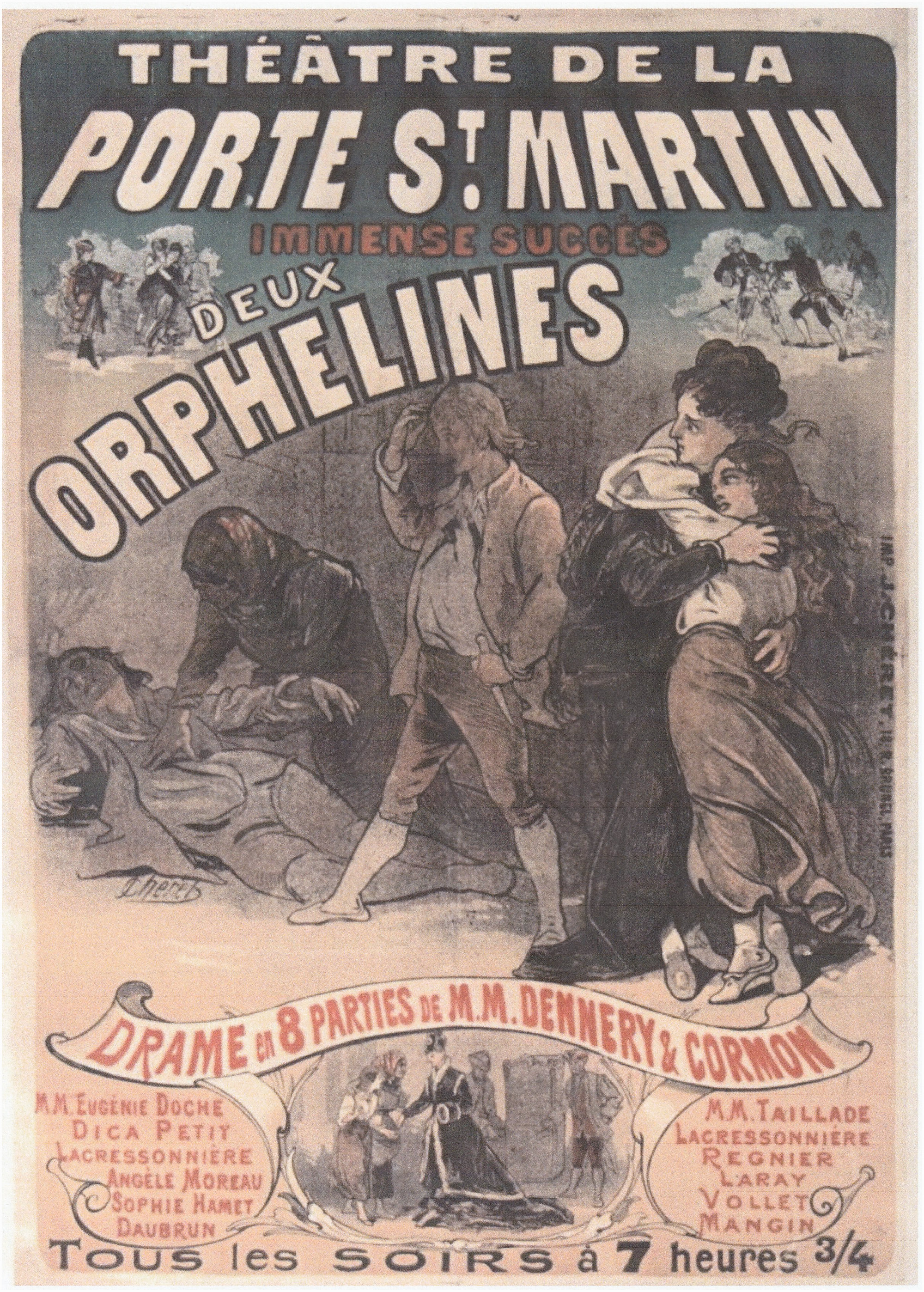
Poster for Les Deux Orphelines, Paris, 1874. Source: From the author’s collection.
Orphans of the Storm on Stage and Screen
So now, after my prologue, let us consider the stage and film melodramas which culminate in (but which are not necessarily inferior to) D. W. Griffith’s 1921–22 silent film Orphans of the Storm. My path to Griffith’s Orphans of the Storm is not straightforward. Rather, it zig-zags through a five-act French stage melodrama and a concurrent novel, two English-language stage adaptations, and, at the very least, six earlier silent films because film adaptations of The Two Orphans began appearing as early as 1902, and again in 1907, 1909, 1911, 1913, and 1915. Albert Capellani’s films referencing Les Deux Orphelines survive, as do Pathé’s 1913 and Selig’s three-reel 1911 versions, but some other films are lost. For my purpose, the casting of the sisters’ roles in the stage and film versions is one key to my examination, as both the American stage and subsequent American-made film productions became unbalanced when the American actress – Kate Claxton (Figure 2) – came to dominate how the sisters were portrayed and received. This imbalance, in time, left Griffith with some immediate problems: how to cast and characterise the roles of Henriette and Louise: how to make the two sisters equally – or differently – compelling to cinema audiences. The five-act melodrama (which lies at the core of my narrative) is, of course, Adolphe d’Ennery and Eugene Corman’s Les Deux Orphelines. Many will know the iteration of this play through Griffith’s Orphans of the Storm but may not be as familiar with the original French melodrama nor either of the two principal English stage versions.
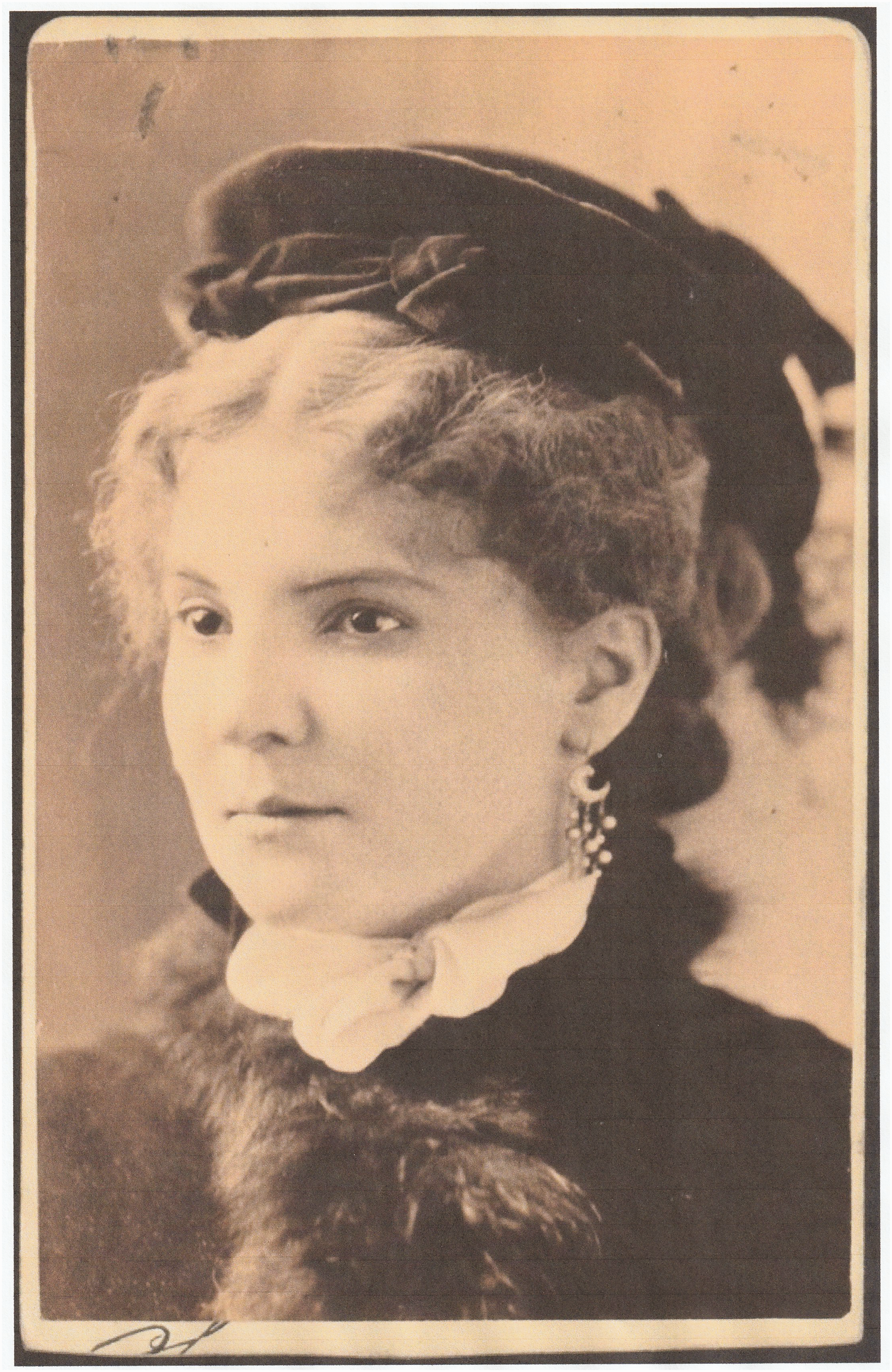
Kate Claxton. Undated cabinet photograph, c. 1880. Source: From the author’s collection.
All stage adaptations of The Two Orphans and d’Ennery’s subsequent novel chart the arrival of the two supposedly orphaned girls, Louise and Henriette, in Paris: not biological sisters, but raised as sisters. Their arrival in the city is blighted because the person supposed to meet them has been lured away. One, blind Louise (whose mother, the Countess Diane still lives and who prays for her return), is abducted to become the unwilling enslaved property of the vile and grotesque mother La Frochard and her vicious thuggish son Jacques. Simultaneously, the other sister, Henriette, is abducted as the prey of the lascivious nobleman, the Marquis de Presles, later to be rescued by the noble Chevalier de Vaudrey who then becomes her suitor, a suit that is impeded by his aunt who objects to Henriette as a commoner. An attempt will be made by the aristocratic police commissioner, Count de Linières, to have Henriette imprisoned in the penitentiary for fallen women and shipped off to the tropical colony of Cayenne, but that ploy is foiled by Marianne, the penitent former mistress of Jacques who substitutes herself for Henriette – one of the most beloved scenes in the stage versions. Henriette is then rescued by the noble de Vaudrey. D’Ennery’s melodrama is not set in the turbulence of the French Revolution but in 1784, five years before the storming of the Bastille and a full decade before the so-called ‘Terror’ of 1794 and the relentless guillotine. The audience’s only inkling of the upheaval to come is when the noble hero, the Chevalier de Vaudrey, remarks that he has just seen a new play, Pierre Beaumarchais’ The Marriage of Figaro, which – as current audiences would have known – French authorities would instantly ban as a subversive drama critical of the ruling aristocracy. De Vaudrey also senses social discontent and welcomes changes to French society which will curtail the nobility’s powers. However, there is no tumbril ride for Henriette between the Committee of Public Safety, where Henriette is charged with consorting with aristocrats, and the guillotine (although she is threatened with deportation to the penal colony of Cayenne), no Terror, no Robespierre nor Danton, no ride-to-the-rescue. This narrative enacts the privations and humiliations and profound cruelty suffered by each girl at the hands of different oppressors before they can be differently rescued and reunited.
In all versions of the drama, the Frochard brothers are almost as important to the plot as Louise and Henriette. The powerful dynamic of the brothers’ contrasting amoral and moral character, jealousy, and rivalry, and propensity to violence plays against the two girls whose sisterly affection for each other is so evident. This inverse mirroring of pseudo-sisters and real brothers means that plays and films were cast with the chief female roles falling to the leading actresses whilst the two strongest actors were cast as Pierre and Jacques Frochard. Those lost early films – quite brief films all of them – were essentially re-enactments of the knife duel (Figure 3) between the two brothers with the terrified sisters huddled in a corner and unable to intervene. These films indicate that audiences enjoyed the terrible fight – a struggle with quite different outcomes in different variations of the drama – which erupts when crippled Pierre protects blind Louise from rape by Jacques, his bullying vicious brother. At the play’s conclusion Henriette is happily partnered with her rescuer, the Chevalier de Vaudrey, and raised into the nobility; Louise will be treated by doctors (in the novel, as in Orphans of the Storm, her sight is restored) and will be cared for by her newly found aristocratic mother who will also care for Louise’s crippled saviour Pierre. It is the stuff of great melodrama.
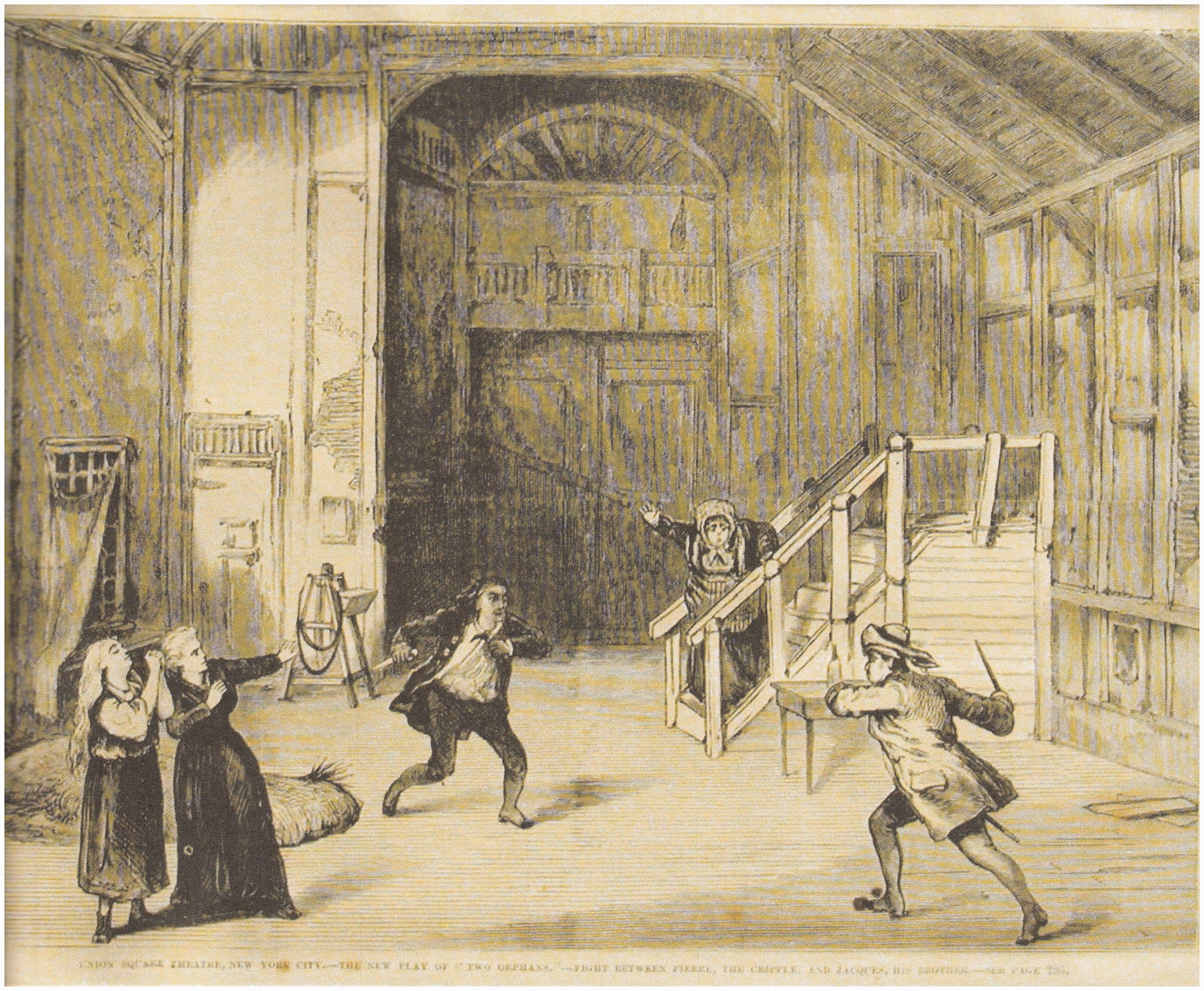
Knife fight between Jacques and Pierre as depicted in Frank Leslie’s Illustrated Newspaper, December 1874. The deadly fight between the brothers is frequently depicted on posters and other advertising materials for all iterations of this drama. Source: From the author’s collection.
Despite its being the product of a French dramatist whose work is largely unknown to us, there is something strangely familiar about The Two Orphans. Although the play is set in late eighteenth-century Paris, it chimes with numerous other French, English, and American melodramas which began appearing from the 1850s. To cite just a few: Katy, the Hot Corn Girl (1855), The Stranglers of Paris (1883), Pavements of Paris (1883), Never Say Die (1888) (Figure 4), The Ticket-of-Leave Man (1863), Lost in London (1887), Lost in New York (1888), The Streets of London (1869), The Banker’s Daughter 1878), The Still Alarm (1887) (Figure 5), When London Sleeps (1896), The Patrol (1891) (Figure 6), The Lights o’ London (1881), London Day by Day (1889), The Power of Gold (1899) (Figure 7), even The Old Homestead (1887). What these dramas have in common is that they are all city melodramas, plays which identify the city as a dangerous, unfriendly or even hostile environment potentially fatal to the countryman or woman who migrates to the burgeoning metropolis looking for work, new opportunities, and possible friendships. The medieval cities of Europe were disappearing. Europe and Britain and America were all urbanising, industrialising, expanding – becoming modern. Characters in city melodramas had to face the assumed perils of the city: treachery, robbery, fraud and embezzlement, arson and random fires, murder, gambling, vice, destitution, hunger, homelessness, disease. The city could be a place of terror or lonely indifference and anonymity. But the city is also – in dramatic terms – an exciting, sexy place. Things happen there. And, of course, that anxiety about cities carries over into the modern era. Think for a moment about the film Towering Inferno or the Bruce Willis series Die Hard where sometimes a single building stands in for an entire city.
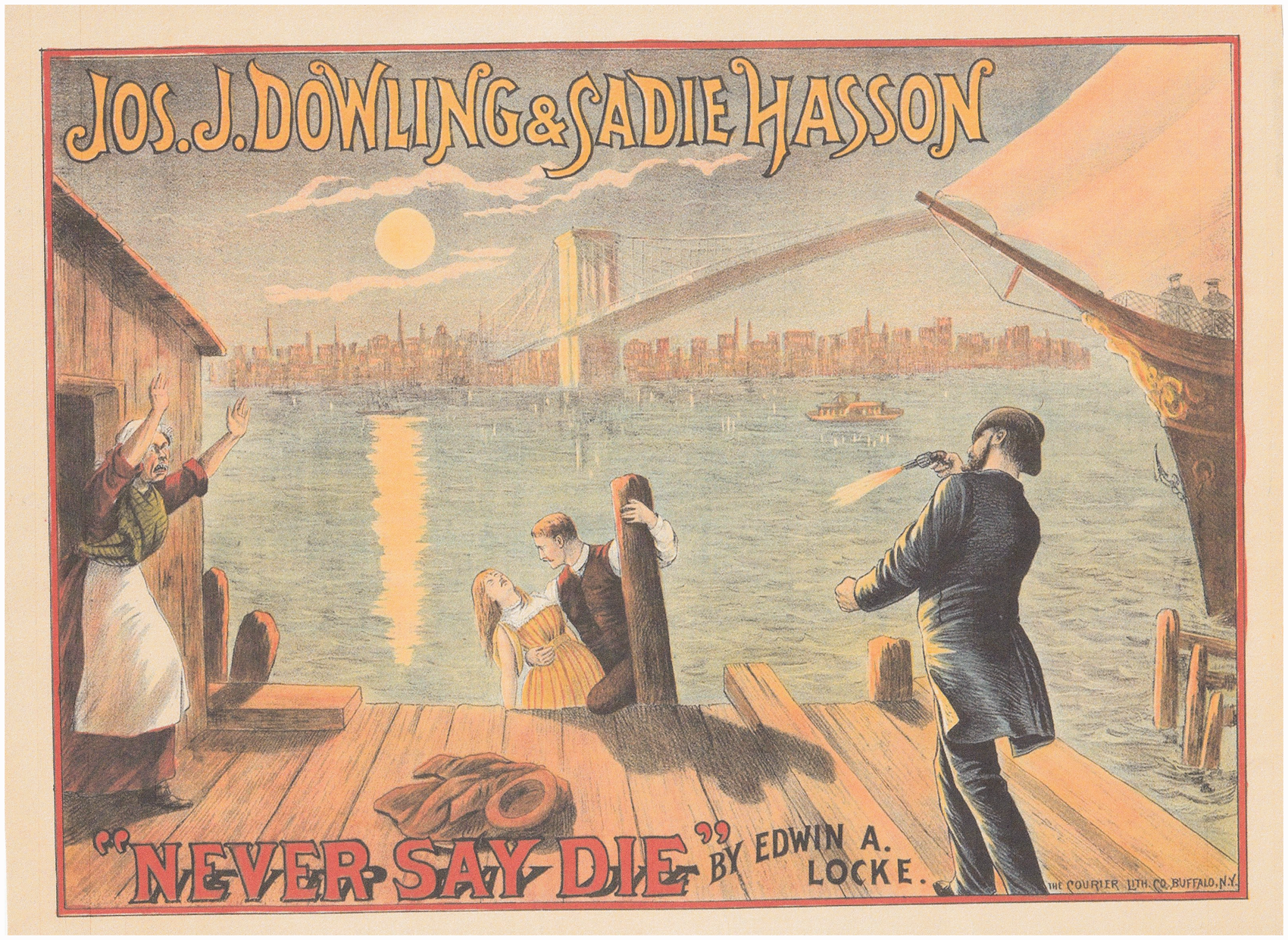
The city as a locus for poverty, degradation, and violent crime. Never Say Die (1888). The setting is the Fulton Ferryboat landing beneath the recently completed (1883) Brooklyn Bridge. Manhattan is visible in the background. Source: From the author’s collection.
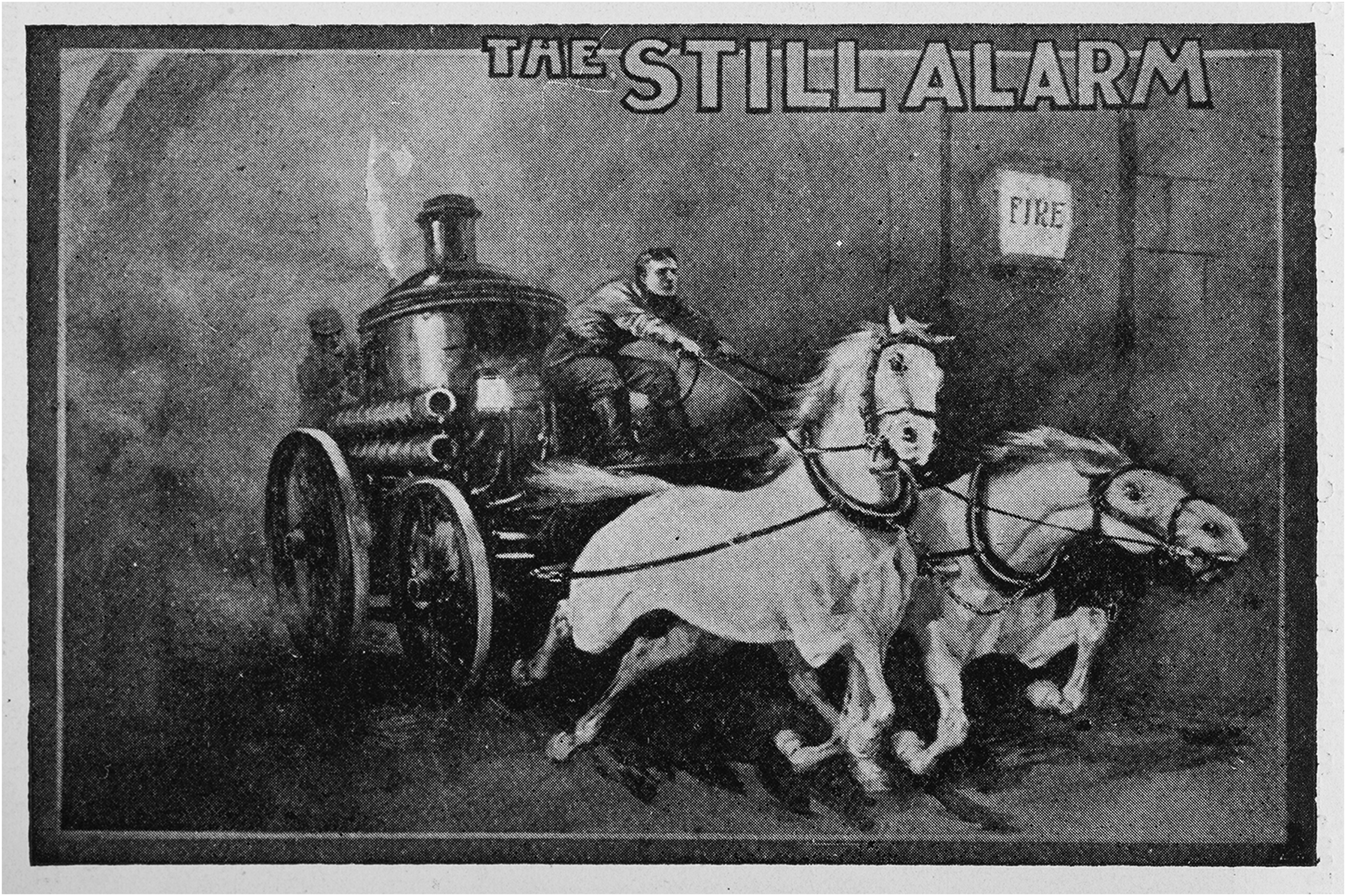
Fire as a known city hazard. A horse-drawn fire engine races to a New York fire in Joseph Arthur’s The Still Alarm (1887). Source: From the author’s collection.
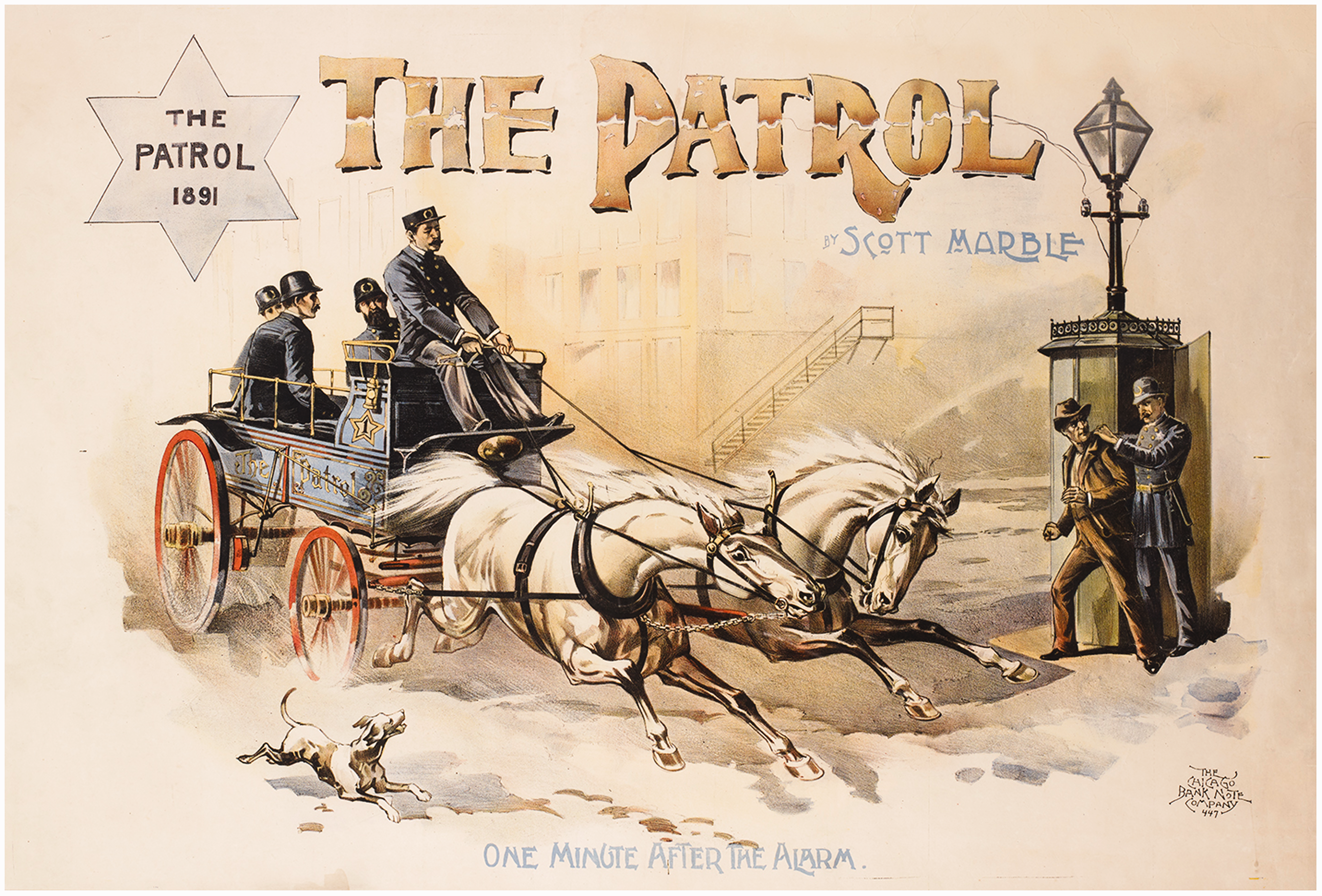
Scott Marble’s melodrama The Patrol (1891) demonstrated that metropolitan police forces were equally as equipped as fire services to respond rapidly to city emergencies and crime. Source: From the author’s collection.
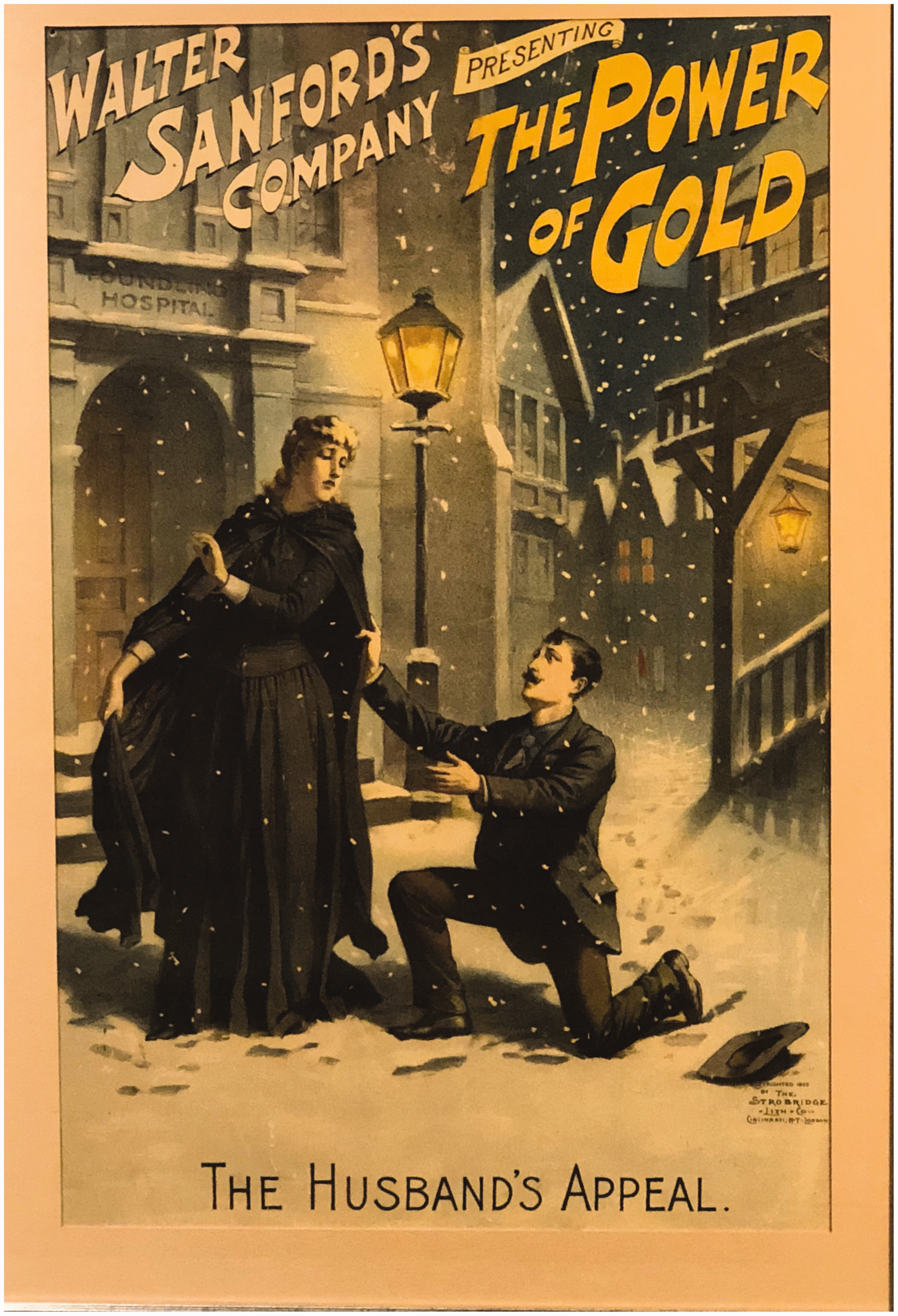
The city the site for domestic issues, as in William Sanford’s The Power of Gold (1892), a drama in which kidnapping, paternity, false imprisonment, and attempted theft figured. Source: From the author’s collection.
The city is perilous even in The Old Homestead (Figure 8), a hugely popular American play which Denman Thompson developed from an earlier vaudeville sketch, just a year after The Two Orphans succeeded in Paris, London, and New York. Thompson’s play – partly a comedy, partly a melodrama – enacts the vicissitudes of the countryman ‘Uncle’ Josh Whitcomb searching for his missing son in the dark unfriendly streets of lower Manhattan. There he encounters a series of strangers, eccentric, belligerent, only occasionally helpful, eventually meeting his own son, now lost, now an alcoholic, who can be redeemed only by being returned to dry out and convalesce in the security of the New Hampshire family home. The Old Homestead equally features city and country: two acts in New York, two in the New Hampshire refuge. Country girls Louise and Henriette encounter perils not altogether dissimilar to those in other city melodramas: abduction, separation, physical abuse and the threat of rape, many villains and few friends – only Pierre and Chevalier de Vaudrey. My guess is that we do not immediately recognise The Two Orphans or Orphans of the Storm as city melodramas because Griffith has caused us to view the latter as a drama about the French Revolution and has mashed together the quite separate events of 1789 with the storming of the Bastille into the so-called Terror of 1794 and the reign of Robespierre and the remorseless guillotine. But Griffith doubles down on the ethical lapses that occur – that are endemic to city melodramas. The Western world’s very oldest ethical law and the hideous penalties for its violation built into epics, built into the plays of fifth-century Athens, is xenia, hospitality, kindness to strangers, respect between guest and host. When xenia is violated by a quarrel between strangers, by a guest or host, when Oedipus encounters and kills Laius, when Helen is seduced and abducted by Paris, all hell lets loose. When New York sharpsters try to con, mislead, defraud Uncle Josh, xenia breaks down. Strangers become adversaries. In Paris, when de Presles attempts to rape Henriette, when, under the pretence of caring for her, La Frochard brutalises Louise, when Jacques says he will ‘marry’ Louise, that is rape the girl supposedly in his mother’s care, all hell again lets loose.
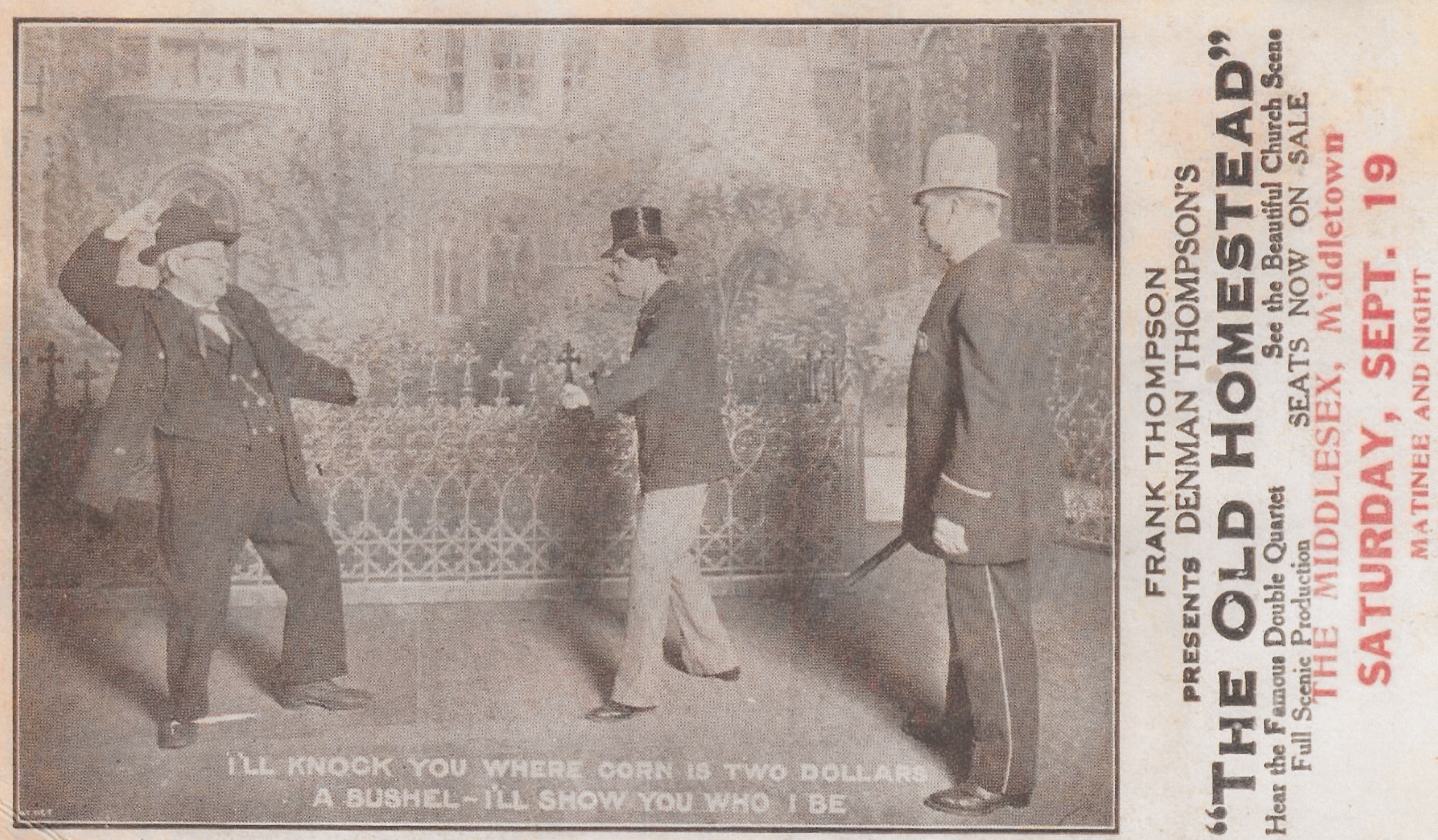
Frank Thompson (Denman Thompson’s son) as Josh Whitcomb confronts a threatening New Yorker in a touring revival of The Old Homestead (1885). Undated promotional postcard, c. 1908? Source: From the author’s collection.
Of course, city melodramas are nonetheless melodramas, which invariably derive their energy from the villain. And, as melodrama edges closer to the modern world, so melodrama’s villains adapt to the changing environment: villains become city villains – thugs, robbers, murderers, poisoners, arsonists, embezzlers, rapists, pimps and exploiters of women, blackmailers and extortionists. Financial crimes are high on the list. And, as in all melodramas, the problem and the villain are conflated so that although the immediate problem has been solved when the villain is neutralised or defeated, the city is still there. Its problems have not been solved. Other villains arise to create and justify further city melodramas, and, likewise, the answer to our anxieties about cities is more city melodrama.
Griffith’s Orphans of the Storm transfers a variant of city melodrama from the stage to the screen, but of course he creates another set of problems: those of the French Revolution and the Terror which he intentionally conflates with Bolshevism and events in post-revolutionary Russia. And both historical and current political problems are once again identified with the drama’s villains, so once Henriette and Louise are rescued, once La Frochard has disappeared and the Marquis de Presles and Jacques are wounded or dead, the heroines’ immediate problem ends and the Terror and modern political struggles recede into the background. But their rescue has not made the problems vanish. Melodrama simply and conveniently forgets the underlying anxieties, and Griffith tries to dismiss Bolshevism with a few platitudinous intertitles.
The Two Orphans and Orphans of the Storm share a different kinship with Tom Taylor’s 1863 city melodrama The Ticket-of-Leave Man (Figure 9) – itself adapted from a French source, Le Retour de Melun, by Eduoard Brisbarre and Eugene Nus – and also a much earlier French and English melodrama, Vidocq, the French Police Spy, adapted by Douglas Jerrold, which Londoners viewed at the Surrey Theatre in 1829. Vidocq is characterised as a flamboyant character – an ex-criminal turned thief-catcher – who, disguised and unobtrusive and able to insert himself into criminal surroundings, apprehends dangerous villains. And, as much to the point, Vidocq is answerable to no one. From the 1820s in Paris, and from the late 1850s in London, anxieties about modernity became focused on the figures of the secret and plainclothes detective police. Associated with covert surveillance (often in disguise), they were portrayed as occupying an ambiguous and untrustworthy role in the enforcement of laws. Taylor’s Hawkshaw, who, disguised as a navvy, eavesdrops on criminals’ conversations, is such a figure.
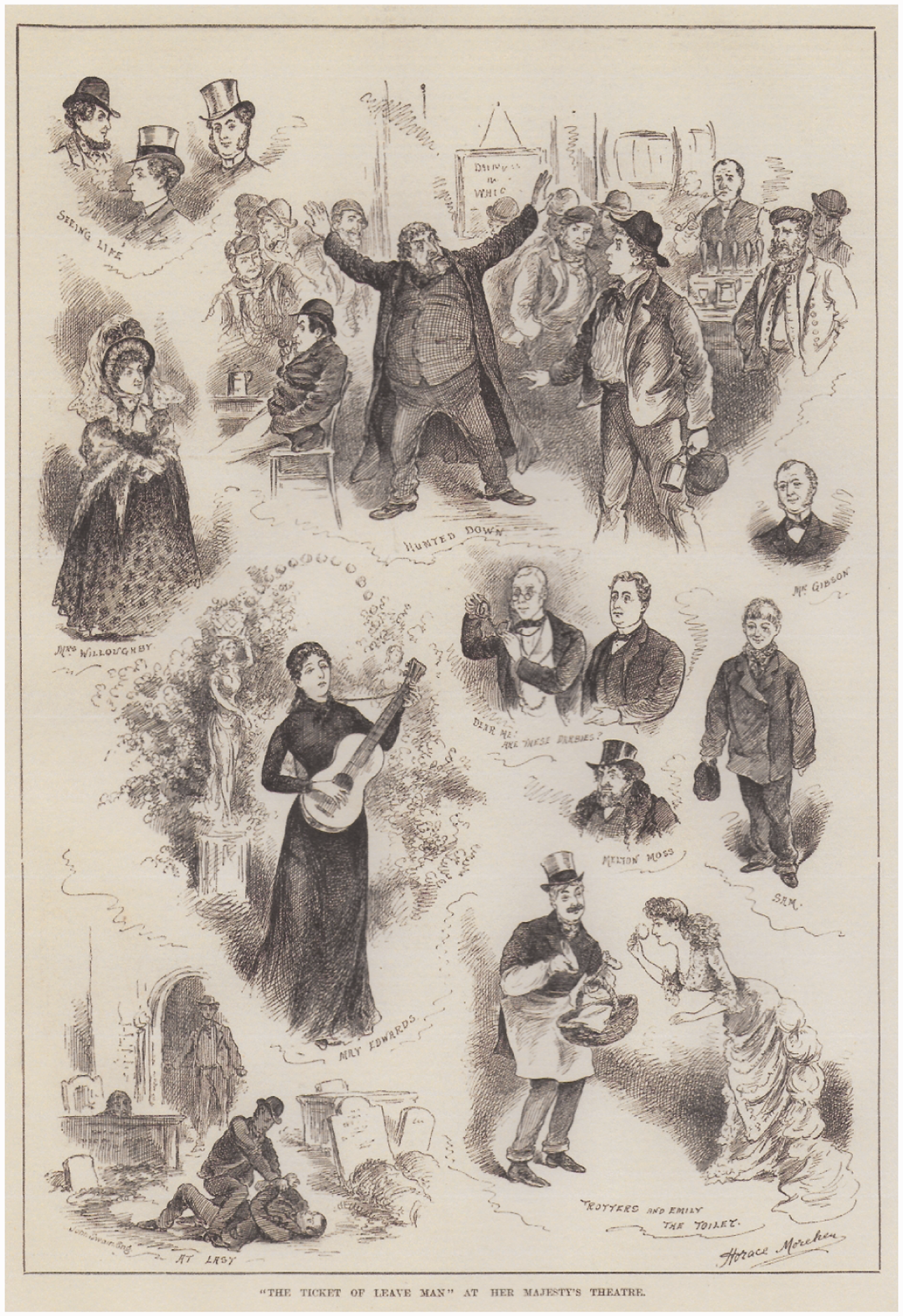
The plainclothes detective Hawkshaw, disguised as a navvy and smoking a clay pipe, eavesdrops on a criminal conversation in The Ticket-of-Leave Man. Illustrated Sporting and Dramatic News, 26 April 1884. Source: Collection of the author.
D’Ennery expresses this anxiety in his depiction of Count Linières, Minister of Police, who conducts surveillance and who arbitrarily uses his powers and membership of the ruling aristocracy to exile de Vaudrey to the provinces and to arrest and accuse Henriette, confining her in La Salpêtrière prison (in Griffith’s film ‘the prison for fallen women’). Like Eugene Vidocq, Linières is accountable to no one. In stage versions Linières goes even further, acting as both judge and jury in sentencing Henriette to deportation to the penal colony of Cayenne. Even in 1874 the Count, who appears to have retained power in spite of his aristocratic lineage and the presence of the new revolutionaries who govern, is a dodgy character, a lesser villain but a villain nonetheless, as vicious and dangerous to Henriette as Robespierre – and there is a wonderful scene (on the stage and in earlier silent films) in which Henriette is saved from cruel deportation by Jacques’ former mistress, Marianne. Marianne’s self-sacrifice emerges from French and English dramas about police surveillance and its abuses.
Les Deux Orphelines premiered to great success in January of 1874 at the Théâtre de la Porte St Martin. Audiences and critics were especially taken with three scenes: the one set in the snow outside the church of St Sulpice (Figure 10) in which the bereft Countess comes close to her daughter Louise but is thwarted before the pair can be reunited; the scene at La Salpêtrière prison when the penitent Marianne succeeds in substituting herself for Henriette; and the brutal and lethal knife fight between the two brothers. So quickly did reports of that drama spread that producers and actor-managers in Britain and America hurried to Paris to negotiate translations and performance rights.
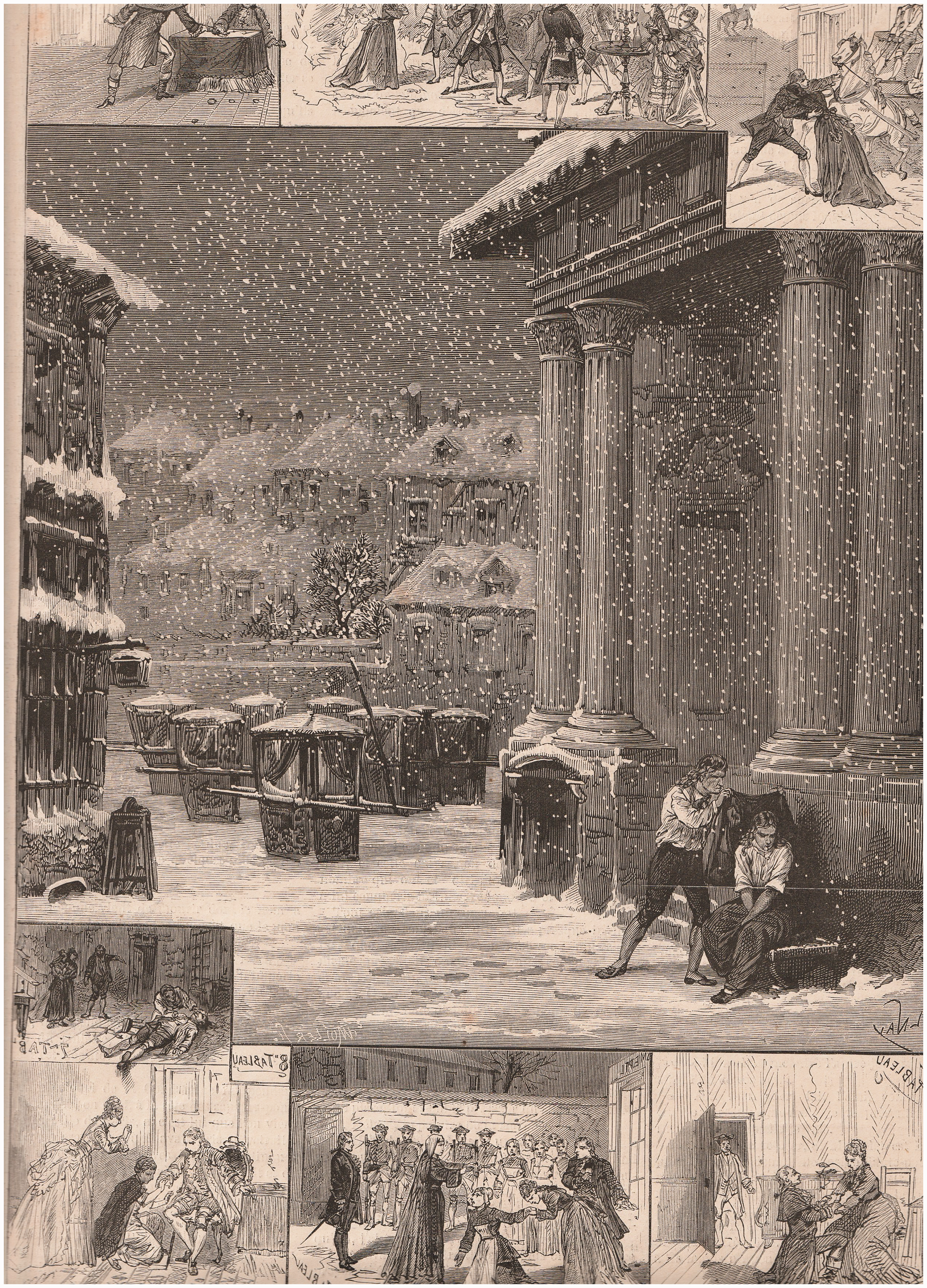
Pierre offers his coat to Louise in the snow-filled square before St Sulpice in the 1874 production of Les Deux Orphelines, illustration from Le Monde Illustre, 21 March 1874. Source: From the author’s collection.
Only two translations were approved and licensed. John Oxenford’s 9 melodrama The Two Orphans reached the London stage in the autumn of 1874 (Figure 11), and in December of that year N. Hart Jackson’s 10 translation, again as The Two Orphans, was staged at A. M. Palmer’s Union Square Theatre in New York where it ran without a break until June of the following year before transferring to Palmer’s theatre in Brooklyn. Jackson’s play was repeatedly restaged thereafter and remained in the American stage repertoire until 1936. D’Ennery’s stage melodrama was also surreptitiously copied and pirated and illegally performed throughout Europe and America – odd performances of unidentified translations popping up here and there in the repertoires of American travelling companies – but there is little known about them. This article will focus on the Jackson–Palmer adaptation and its theatrical interpretation and will – necessarily – also reference the 1911 Selig film and the 1915 William Fox (later Twentieth Century Fox) film because this text and these two films (which use what became the Jackson–Palmer–Claxton text) have directly influenced the casting and the structures in subsequent iterations in stage dramas and silent films – Griffith’s included. Griffith, starting afresh in 1921, had – as at least one of his tasks – the need to make the sisters equally compelling to cinema audiences and took a different approach to the casting and interpretations.
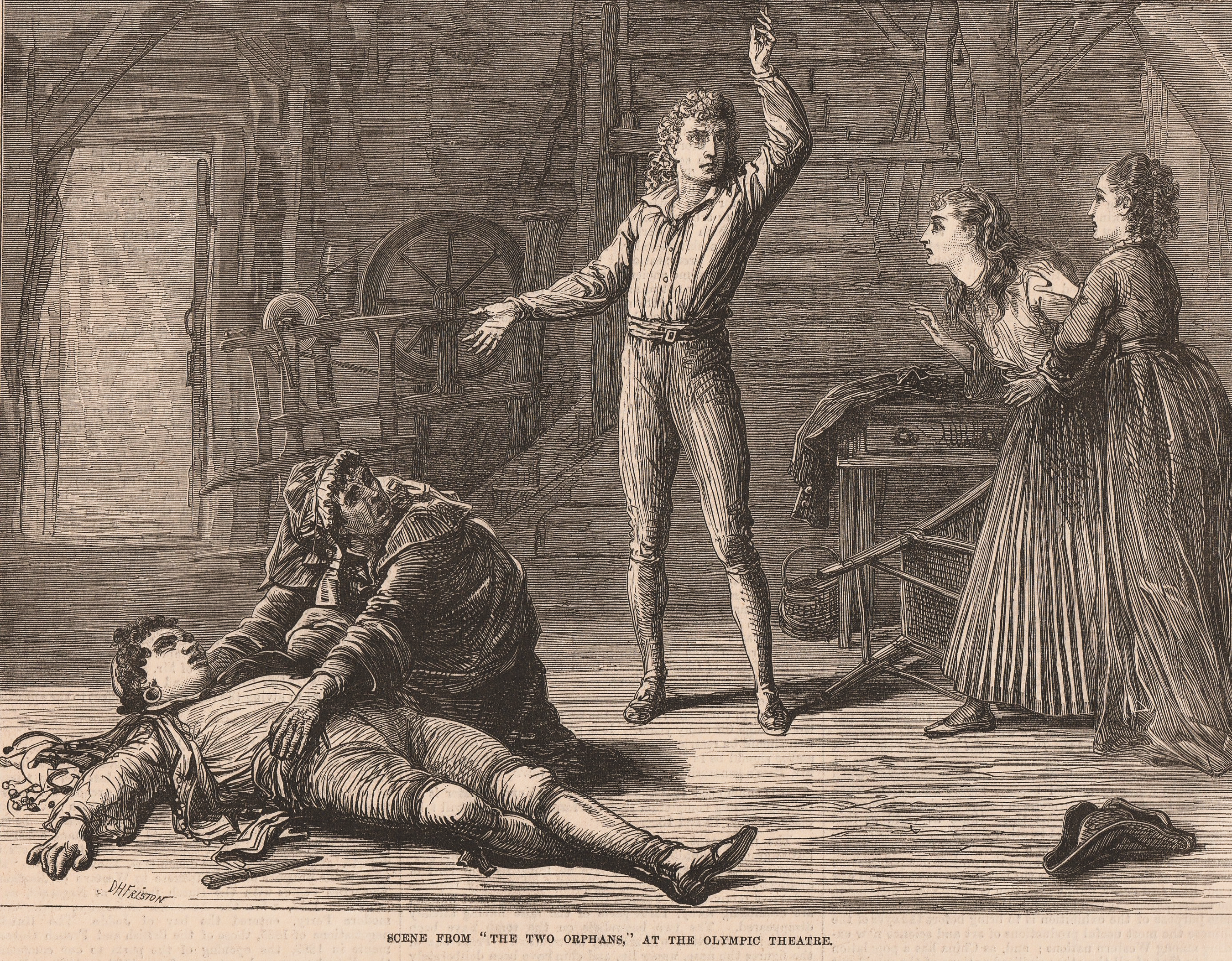
Scene immediately after the knife fight between Jacques and Pierre in the British adaptation at the Olympic Theatre, London. From l. to r. William Rignold (Jacques), Mrs Huntley (Mère Frochard), Henry Neville (Pierre), Helen Ernstone (Henriette), Emily Fowler (Louise), Illustrated London News, 3 October 1874. Source: From the author’s collection.
Returning to the stage history of The Two orphans, d’Ennery’s Théâtre de la Porte St Martin production, adapted by Jackson, reached New York audiences in December 1874, initially as a four-act drama played out in seven quite elaborate three-dimensional stage sets which, in meticulous detail, sought to re-create the elaborate surroundings of the decadent aristocracy, the great church facades and the squares before them filled with numerous sedan chairs, and the narrow streets and hovels of the poor. Excited by reports of the play and soon acquiring a translation of the script, Palmer sent his stage designers to Paris to reproduce the Théâtre de la Porte St Martin settings for the snow-covered square with the steps of the Church of St Sulpice and the shabby decaying boathouse lair inhabited by the Frochard family. These settings were again copied in Selig’s 1911 film (Figure 12), again in Fox’s 1915 film, and elaborated by Griffith in 1921. The play was two months in rehearsal. In the New York cast were Kitty Blanchard as Henriette (Figure 13), her husband McKee Rankin as the thuggish Jacques (Figure 14) and, crucially as it turned out, the actress Kate Claxton as Louise. It was Claxton’s interpretation of that role and the public reception of Claxton as Louise which visibly impacted on this production, re-shaping Jackson’s adaptation and both directly and indirectly affecting the casting and portrayal of the two sisters in all three subsequent films.
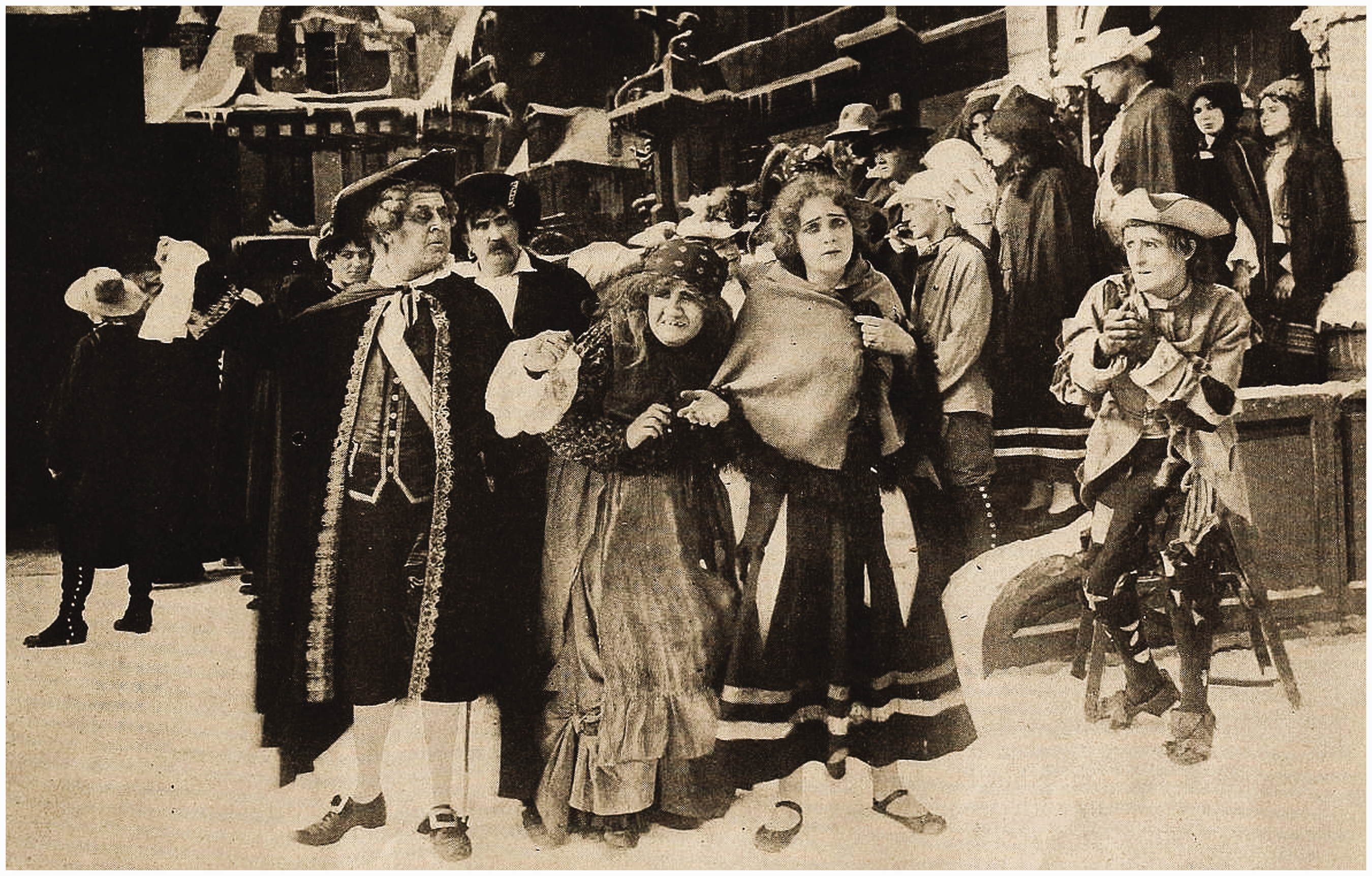
The St Sulpice scene from the 1911 William Selig film. From l. to r. the Doctor, Pierre, Mère Frochard, Louise, Pierre. Film still. Source: From the author’s collection.
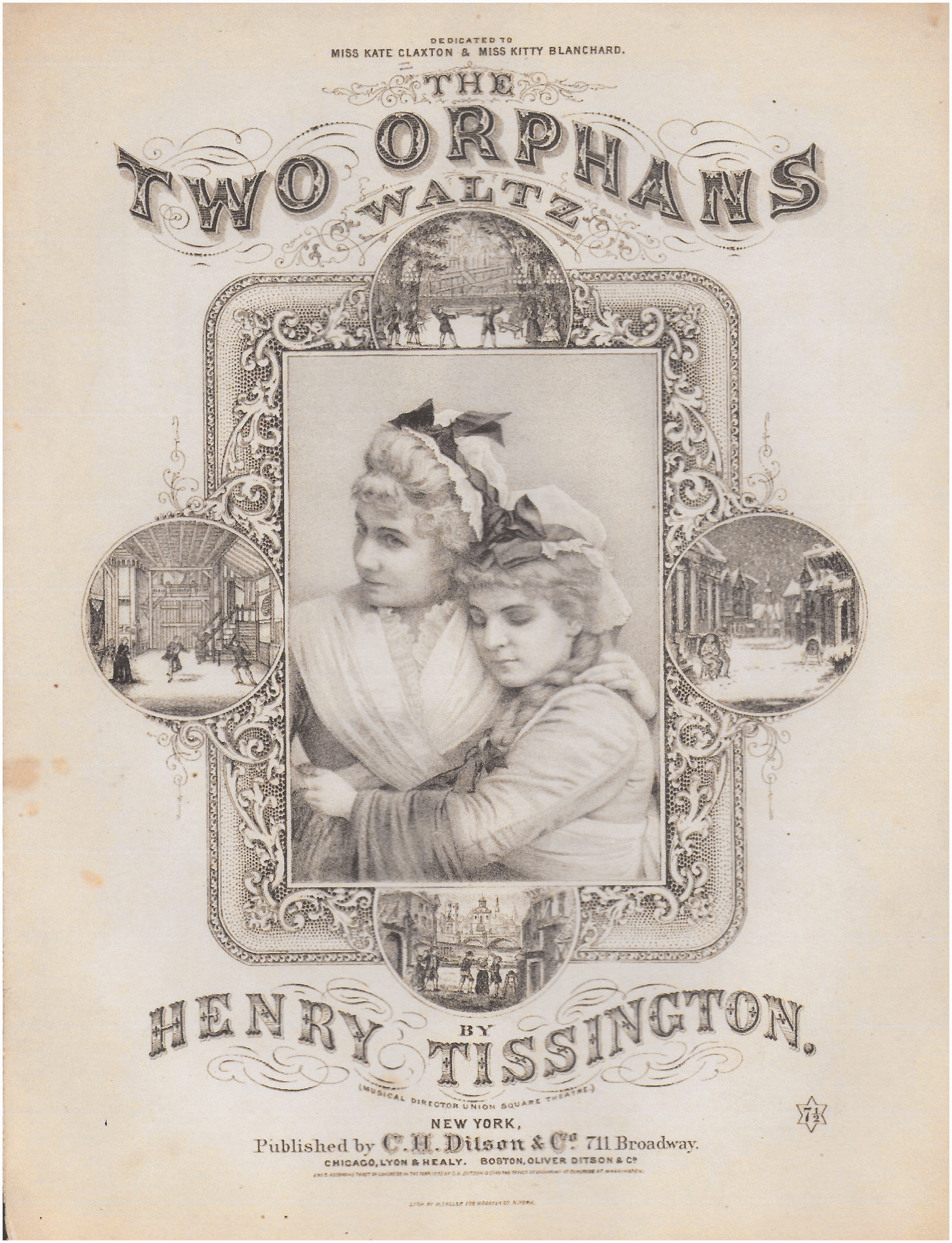
Kitty Blanchard and Kate Claxon as Henriette and Louise depicted on contemporary sheet music by Henry Tissington, the composer and conductor of the incidental music for the play. Source: From the author’s collection.
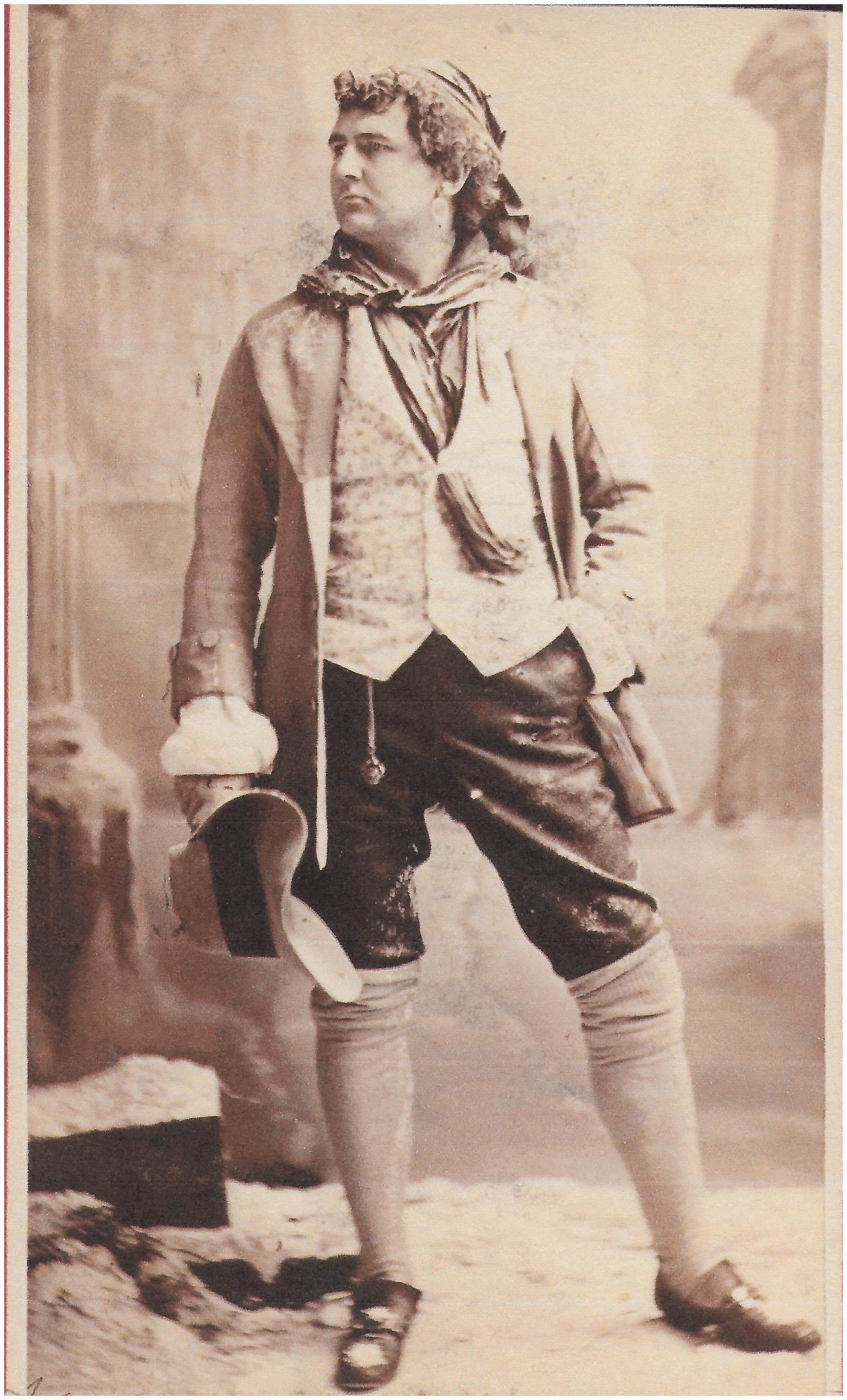
McKee Rankin as Jacques in the American adaptation. Undated cabinet photograph, c. 1874. Source: From the author’s collection.
In many respects, these problems and their solution turn on the turbulence of melodrama, and melodrama gives us something to remember and understand when we later speak of Griffith’s approach to Orphans of the Storm. Melodrama, as indicated above, is villain-driven. A melodrama’s heroine is much more the object of intense focus, of greater audience interest and empathy, when she is visibly oppressed by an identifiable villain. We are told that Kitty Blanchard did not give a strong performance as Henriette, but that was not altogether her fault. The audience’s interest was more keenly focused upon the actor Charles Thorne who played her rescuer, the Chevalier de Vaudrey, and his quarrel with her abductor, the Marquis de Presles. But more to the point, once de Presles was out of the way, there was no clear-cut villain. Henriette had no visible oppressor and was experiencing no danger. The Countess’s objection to her that she was of peasant stock and therefore unfit to marry into the aristocracy was a social issue more tied to France of the 1870s, not a source of peril. In contrast, Louise, almost immediately in the clutches of Mère Frochard and her vile son Jacques, was continually cruelly oppressed and thwarted by villains who starved, beat, and nearly raped her. The role of Henriette was recast, but the damage was done. Jackson further revised the play as a three-act drama, as concessions to his American audience softening the depiction of the Countess and altering the last-act fight between Pierre and Jacques so that the fight is interrupted before Pierre can kill Jacques, but – crucially – dismissing any previous equilibrium between the sisters and incorporating this perceived imbalance in favour of Louise.
It paid off. Kate Claxton’s performance was altogether riveting: her pathos, her suffering, her feeble attempts to sing at La Frochard’s command, her near miss in nearly being reunited with her mother on the church steps were moments of pathos and drama. It is Kate Claxton we see featured on the posters and on the more popular photographs. It was Claxton as a solo sister whom Palmer favoured in publicising his play (Figure 15) and decorating the exterior of his theatre (Figure 16). Without a doubt, Claxton’s performance was strongly abetted by Marie Wilkins as the cruelly vicious, self-pitying and brutal La Frochard (Figure 17). Claxton’s enactment of suffering and Wilkins’ wickedly unscrupulous La Frochard had unbalanced the play. Assured of her dominance in the role, Claxton, an astute businesswoman and actor-manager, subsequently purchased the performing rights to the play and mounted and toured her own production until 1904 (Figure 18), then leased those rights to other showmen, moviemakers included. And Claxton’s hold on the play and her association with The Two Orphans was strengthened when, in 1875, after Palmer had shifted the production from Manhattan to his Brooklyn theatre, a piece of cut-cloth scenery caught fire during the fourth act of Frochards’ lair scene (Figure 19). Claxton attempted to calm a frightened audience and displayed marked composure until burning scenery falling onto the stage and injuring some of the players obliged everyone to flee. Nearly three hundred spectators were killed in the fire and resulting crush, and many more were injured. Claxton escaped with minor burns and her reputation for bravery enhanced.
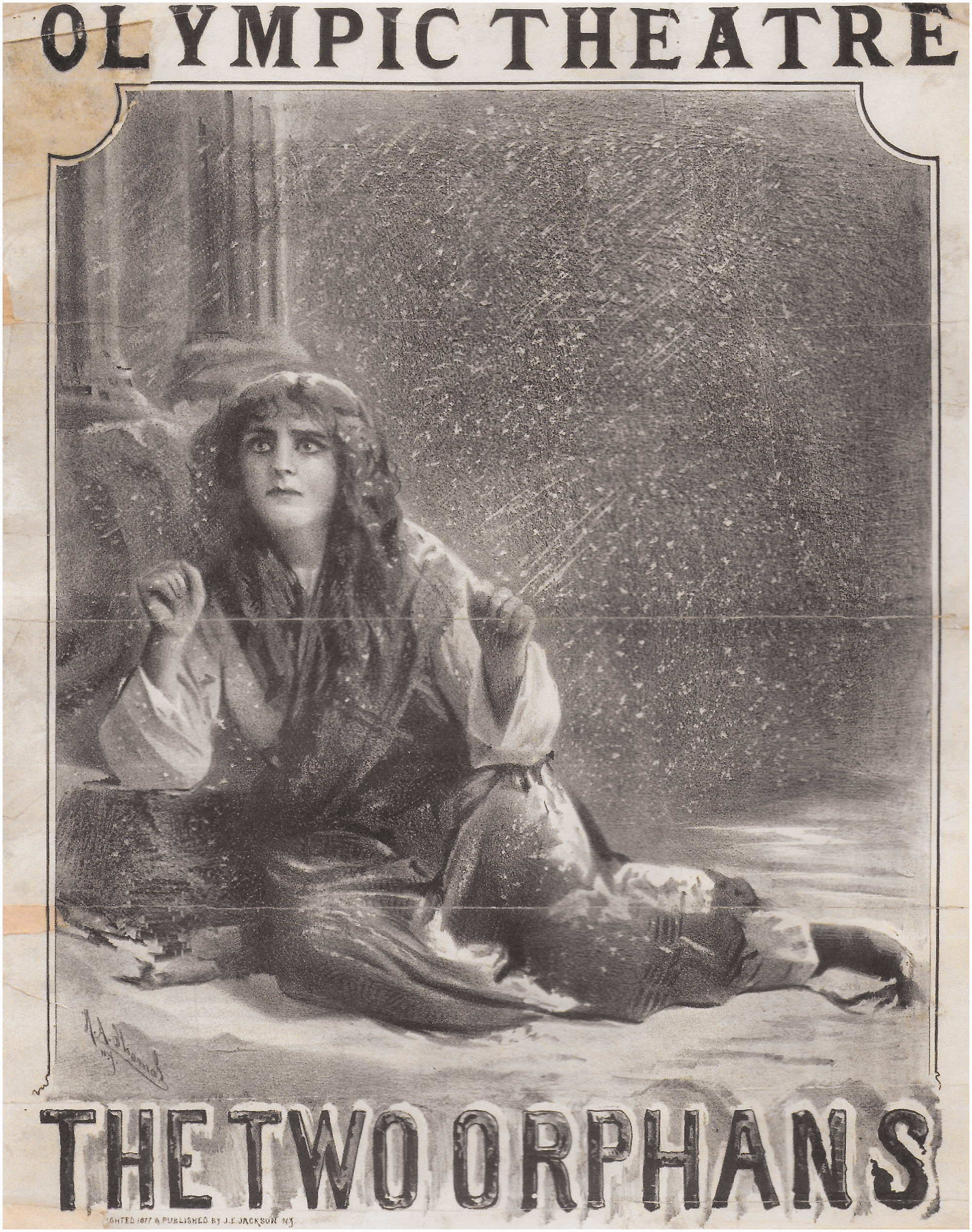
Poster for the London production of The Two Orphans. Both the British and American productions used a photograph of Kate Claxton as Louise, shivering on the steps of St Sulpice, as the source for their poster. Source: From the author’s collection.
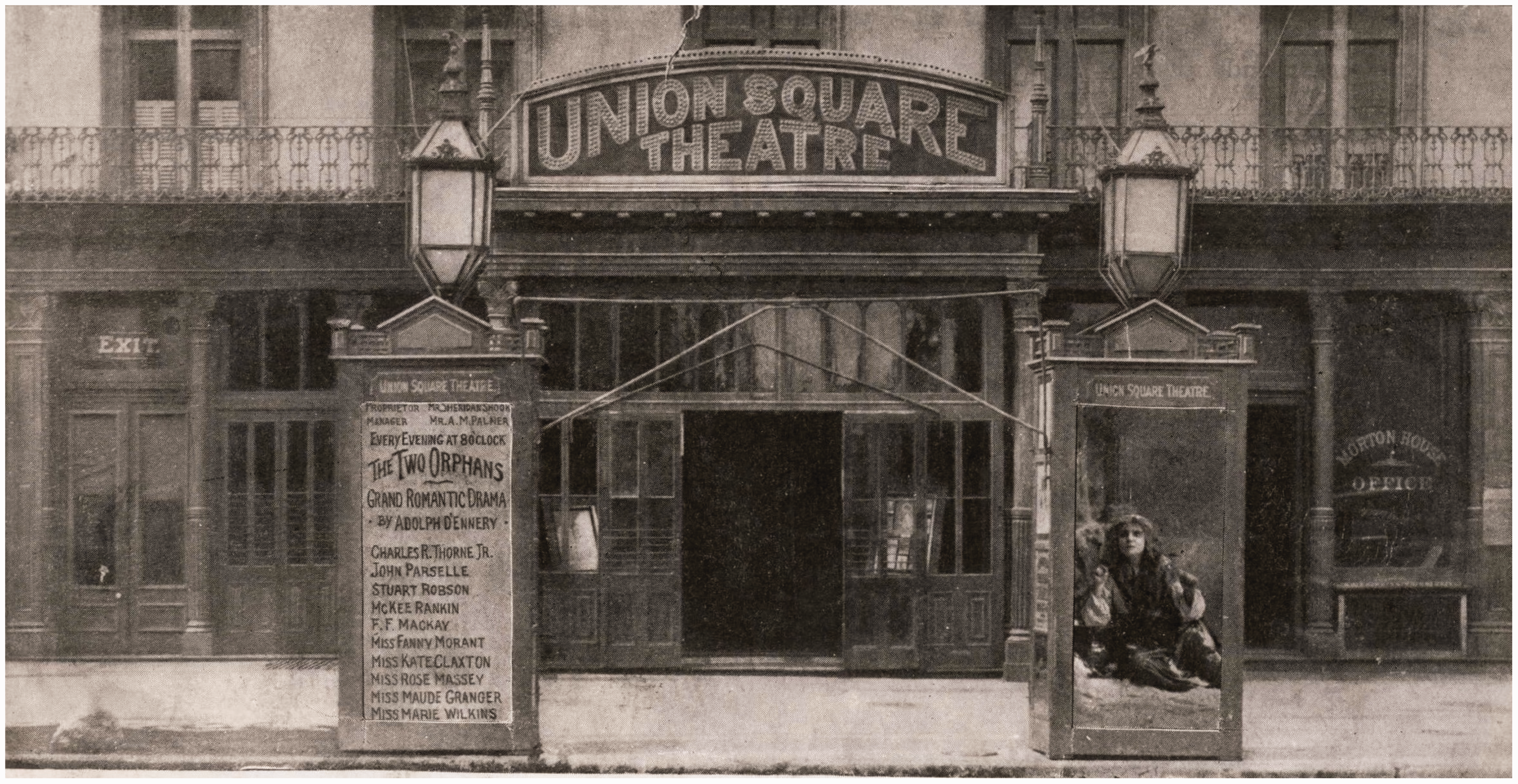
Union Square Theatre, photographed in 1875, displaying an enlarged poster for the play and a list of the principal actors in the drama. Source: From the author’s collection.
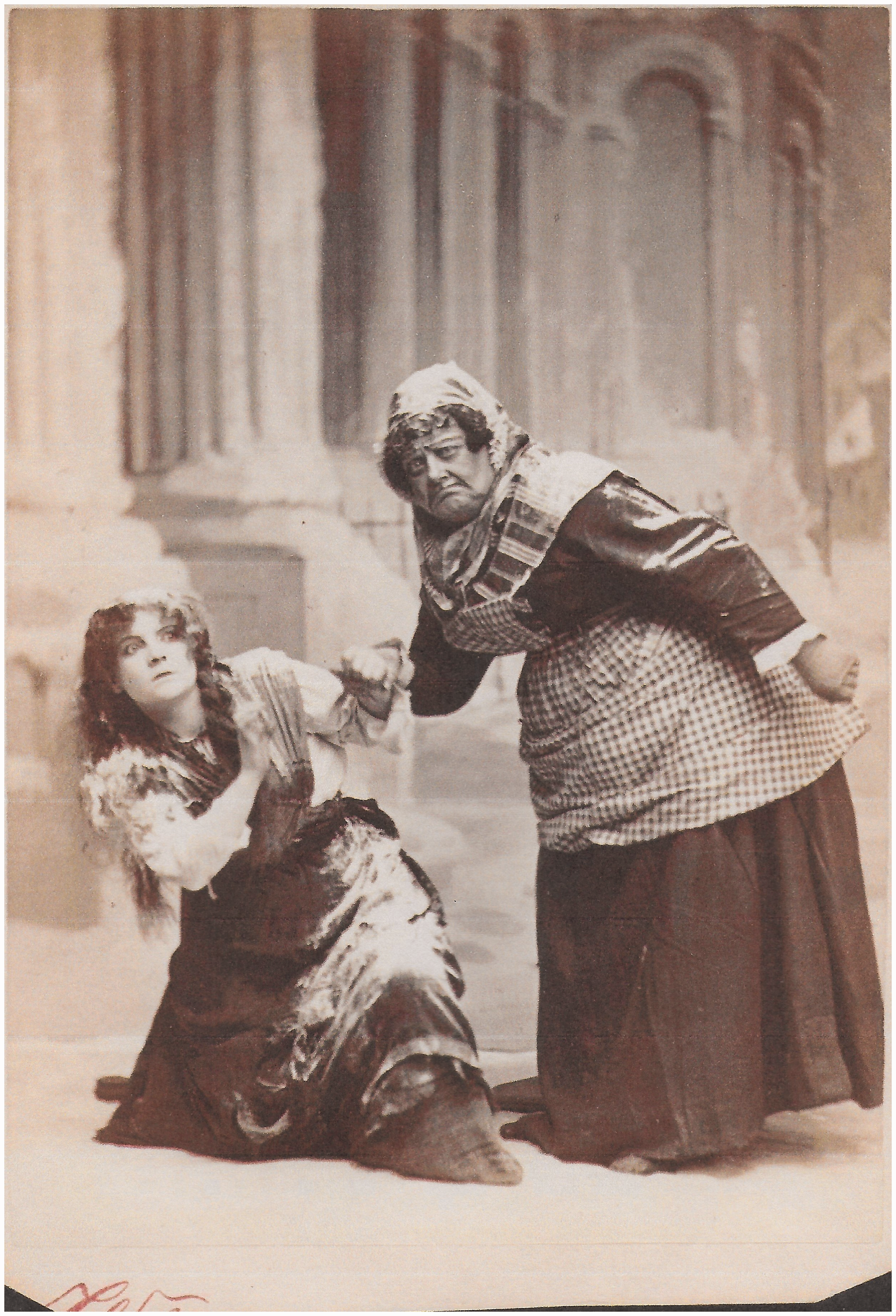
Kate Claxton as Louise and Marie Wilkins as Mère Frochard. Undated cabinet photograph, c. 1874. Source: From the author’s collection.
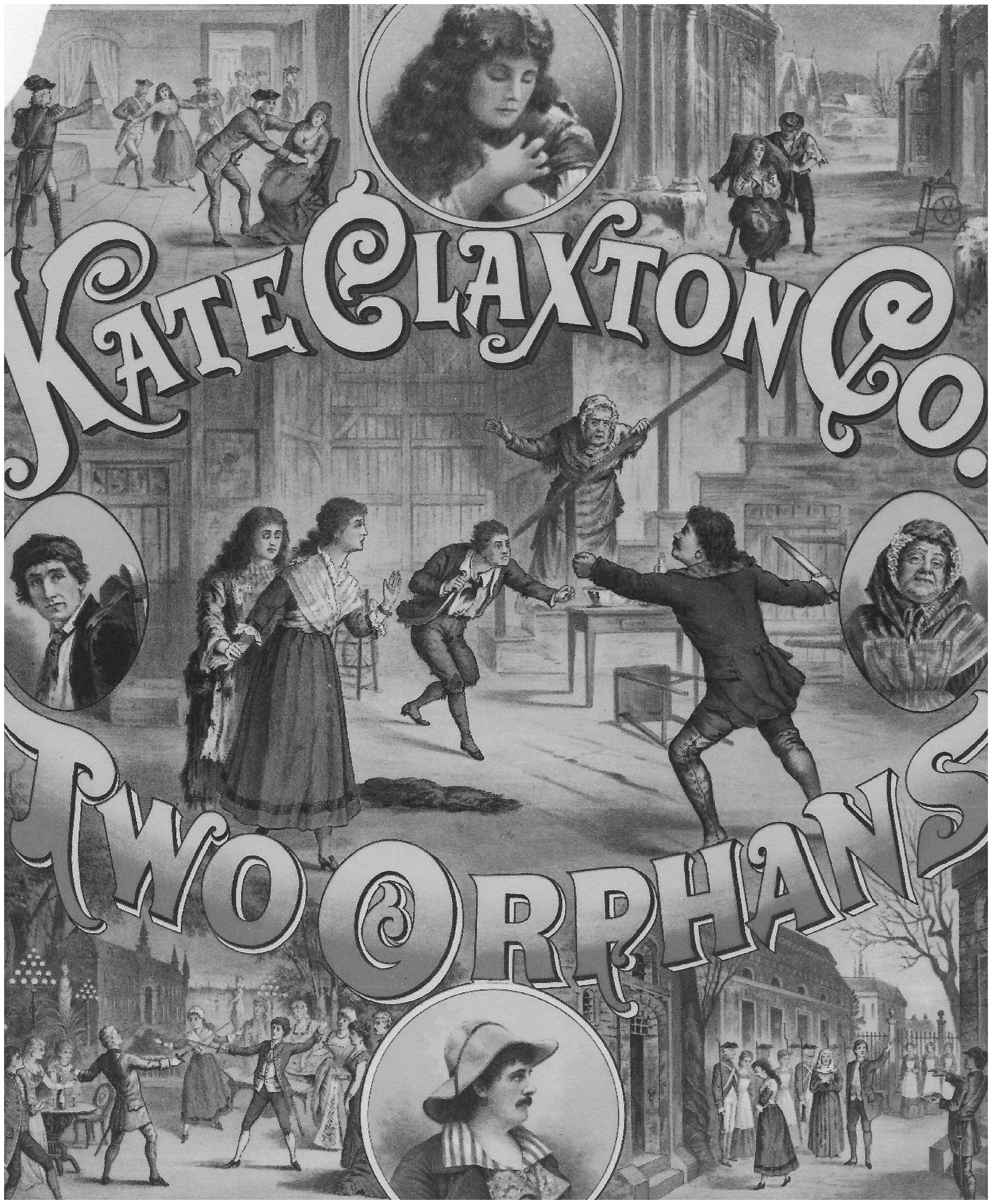
Poster for Kate Claxton’s touring company. Source: Private collection, U.S.A.
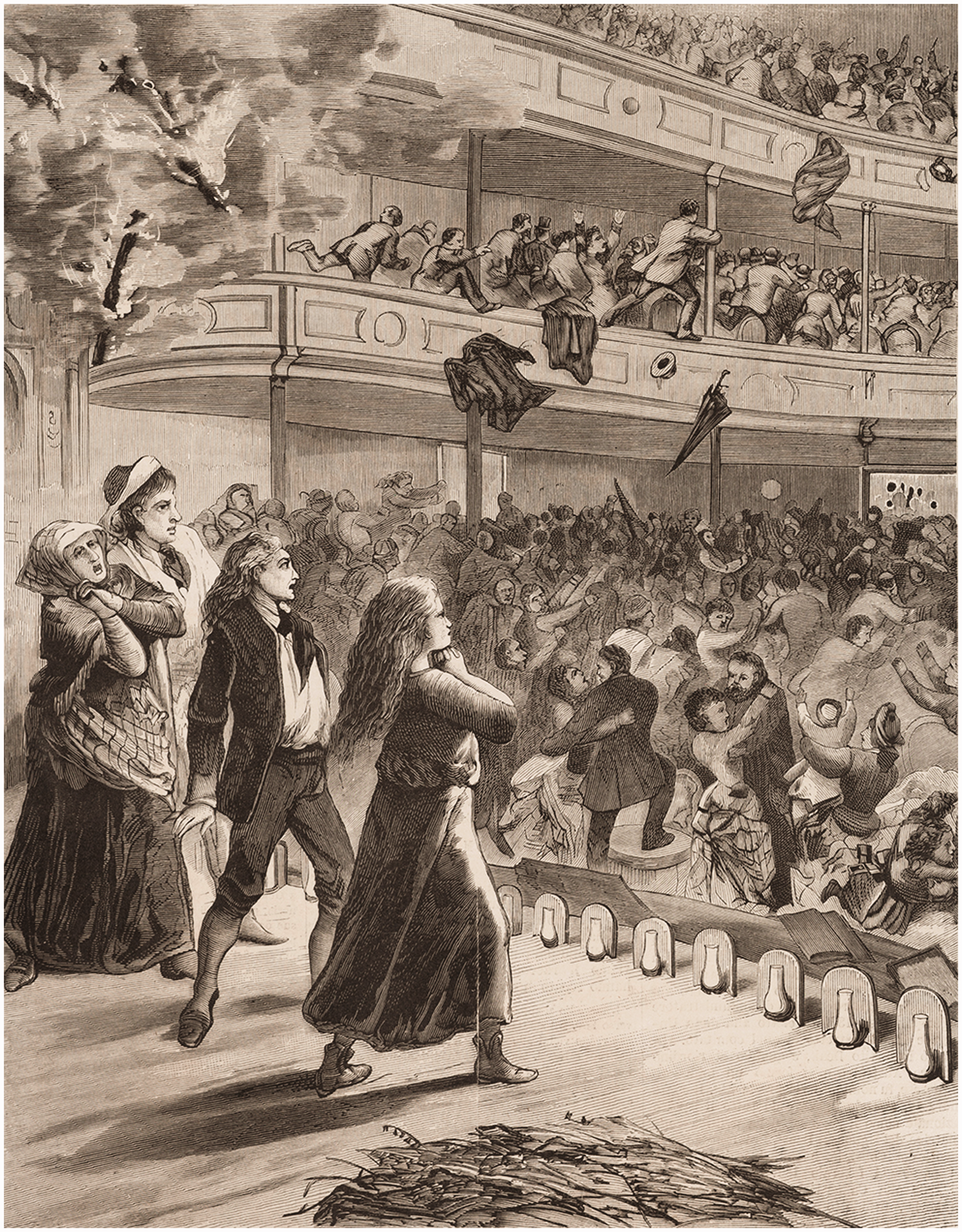
Brooklyn Theatre Fire, December 1876. Kate Claxton in the foreground. Frank Leslie’s Illustrated Newspaper, January 1878. Source: From the author’s collection.
It was thus in 1911 when Selig, paying Claxton for use of her script, made his film with Claxton as an advisory director, conspicuously credited her in the opening titles and subsequent publicity. Although the role of Henriette is well-performed by Kathlyn Williams, and the film seeks to restore the emphasis on sisterhood to the drama, inevitably the film’s emphasis is again upon the travails of blind Louise played on-screen by Winifred Greenwood. Although only a single reel – about a third – of the original film survives, we can witness Louise cruelly, physically abused by La Frochard and Jacques and altogether inadequately protected by Pierre. Louise and the Frochards dominate Selig’s film.
In 1915, William Fox, the Head of what became Twentieth Century Fox, sensed that, whilst there was still mileage and money in the Orphans’ narrative, something was amiss. His scheme to restore equilibrium to the play and to create Henriette as the star-part was to cast the famously sexy vamp actress Theda Bara in that role (Figure 20). He underwrote a lavish production which featured his star actress. But, again, he had to pay Kate Claxton some $15,000 in performing rights, and again he used the Hart Jackson–Claxton script without making substantive changes. Fox’s The Two Orphans is lost, but the reviews tell us that once again the continual oppression and dangers endured by Louise skewed the sympathy and interest in her direction. The film is remembered as a Theda Bara failure.
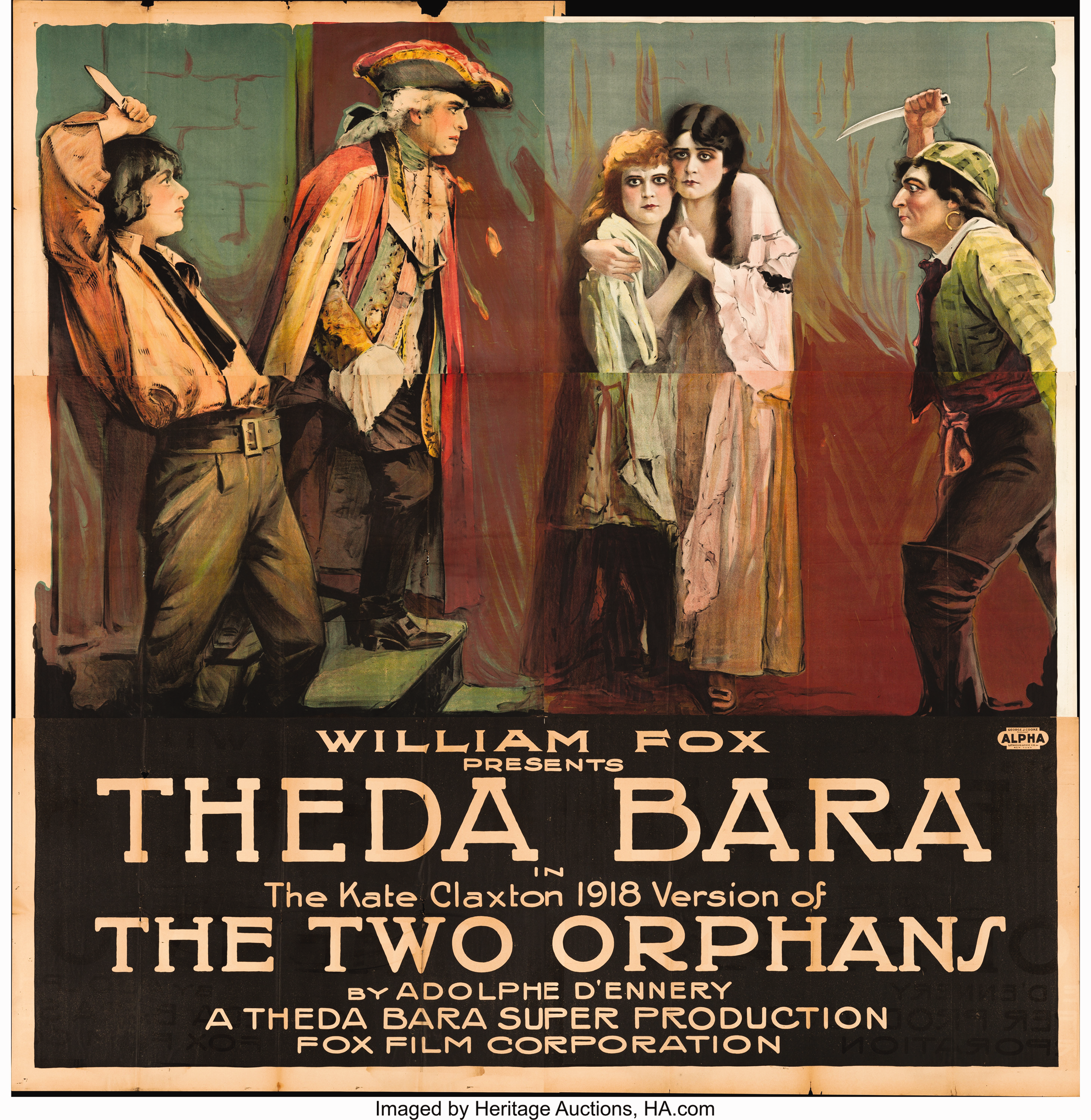
Six-sheet poster for the 1918 re-release of William Fox’s 1915 film The Two Orphans. Source: From the author’s collection.
Griffith’s 1921 Orphans of the Storm confronts us with a wholly different kind of drama, both in structure and scale. Both stage plays and film are melodramas, but all stage versions of The Two Orphans are devised for what the nineteenth century knew as a standard melodrama company with a cast of between twelve and fifteen speaking roles and perhaps a few supernumeraries who could be hired-in on the night to dress the sets and appear in non-speaking roles. In contrast, Griffith’s Orphans of the Storm was created as a spectacle, not just with elaborate and evocative sets which magnified those seen in stage productions, but with a cast which, on the one hand, reduced the number of former speaking roles by about three, but nonetheless added new characters and required a cast of supers which Griffith’s publicity claimed exceeded twelve to fourteen thousand. Compressing the events of 1789 and 1794 enabled the big set-piece scenes: the aristocrats’ fete, the storming of the Bastille, the frenzied carmagnole, the Committee of Public Safety, the mobs surrounding the guillotine in the Place de la Concorde, and Danton’s ride at the head of massed horsemen to rescue Henriette. Spectators unfamiliar with Griffith’s penchant for staging big scenes, as witnessed in his Judith of Bethulia, Birth of a Nation, Intolerance, and Hearts of the World, would be unprepared for such dexterous large-scale staging.
However, although Griffith increases the scale of his drama, he is still tied to d’Ennery’s basic narrative and must somehow work within some – if not all – of its confines. A concern of this article is to identify his strategies in adapting what he disingenuously identifies as Claxton’s text, to discern how he (or whether he) restored an equilibrium in the attention and anxiety audiences shared between Louise and Henriette, but also how he succeeded in materially re-working the portrayal of the other lead roles in the Hart Jackson–Claxton script and also in eliminating one of the episodes and key characters in the d’Ennery play and substantially re-shaping episodes in stage versions which had so appealed to theatre audiences.
Yet, although Orphans of the Storm’s main titles and publicity acknowledge Kate Claxton, it is not Claxton’s script that Griffith used. Rather, Griffith paid Claxton $10,000 for screen rights but then painfully discovered that Fox now owned these rights. He had to pay William Fox $85,000 simply to use the name Claxton, but then chose to find his own way through the narrative. So, what has he done? What do the Gish sisters – real sisters – bring to this film? And two further queries: given that Orphans of the Storm was devised and produced in the immediate aftermath of the passing of the nineteenth constitutional amendment granting American women equal suffrage, does Lillian Gish’s high-energy Henriette embody Griffith’s concept of female agency and activism? My suspicion, knowing Griffith’s other work, is that he is not remotely a feminist and that if he to any degree celebrates female agency, it is unconsciously so. He placed great trust in Lillian Gish’s instincts and judgements, but he inhabited a male world where men act and women are acted upon. Further, Orphans of the Storm is immediately political in the context of the 1920s, as Griffith warns against ‘Bolshevism’ and – conflating bolshevism with socialism, anarchism, unionisation and strikes, immigration, and the African-American civil rights protests which had followed from The Birth of a Nation – characterises the French Revolution as an analogue of what might befall America. Griffith, in his 1916 film Intolerance, had previously worried about civil and domestic disruption, anarchy, and encroaching bolshevism in his depiction of the military suppression of a workers’ strike. There is a strong element of personal involvement in these films, and it often appears that Griffith wants to talk with his audiences through his intertitles, but today these textual intertitles, making explicit his analogy with the French Revolution and the ongoing events in Russia, mar this film and merely date it to the ‘red scares’ of the 1920s.
Why and how Griffith determined to create Orphans of the Storm depends upon who tells the story. Lillian Gish, noting that The Two Orphans had been translated into forty languages, recalled that she took Griffith to an Italian language production in Manhattan. 11 However, neither The Two Orphans nor both stage and film melodrama were new to Griffith. The play was performed in his home city, Louisville, Kentucky, on nine separate occasions (on three of those occasions by Kate Claxton’s company) before he began life as a touring actor, and in 1898 he had performed multiple roles in this play as a member of the James Neil melodrama company. Further, as a film director at the Biograph studios and in projects of his own he had, by 1921, directed approximately four hundred and fifty short and full-length screen melodramas drawing on his knowledge of melodramatic stage performance and the theatrical repertoire. He knew what was demanded of actors who undertook melodramatic roles. But we are told that Griffith had been wishing to make a film on the subject of the French Revolution and retorted that Lillian had suggested this play only ‘because it has a part for Dorothy’. 12
Nevertheless, casting the sisters is certainly a factor (and here I rely entirely on Helen Day-Mayer’s analysis and insights). Dorothy and Lillian had been acting together in Griffith-directed film melodramas since their Biograph days, most memorably in An Unseen Enemy and Hearts of the World. Appearing on stage as well as in films, both had learned the gestural language of melodramatic acting: when to enlarge their gestures and when to minimise them and when close-ups allow extreme facial expression to express trauma. However, it is probable that Griffith saw the advantage in casting them, and, thinking ahead to changes in plot and structure, providing the opportunity to balance predators between the sisters and have them differently but also equally threatened. Indeed, the Gish sisters, as judged by Griffith, mirror this perceived relationship in the film, with Lillian cast as the stronger, active Henriette, who is a fiercely protective sister to Louise. Yet, Dorothy Gish was an extremely successful actress in her own right, and whilst comedy was her metier, she was also an adept performer in serious roles. But Lillian, along with Blanche Sweet and Mae Marsh, was Griffith’s go-to actress for serious emotional roles, and Griffith drew on Lillian’s known strengths in his balancing – or to be frank – substantial enlargement of Henriette’s part.
As much to the point, once Griffith had determined to link his drama to the French Revolution and thereby free himself from d’Ennery’s confining Two Orphans plot, he was able to introduce changes which shape his narrative and immediately establish the relationship between Henriette and Louise. His prologue to Orphans of the Storm, drawing on stage adaptations of Charles Dickens’ A Tale of Two Cities, instantly provides a dramatic backstory and makes exposition unnecessary. We see the Countess’s husband slain and the infant Louise snatched from her arms. The circumstances in which the infants are brought together on the church steps – one already abandoned, one about to be discarded – but then reared together from the cradle through childhood and into adolescence – enable the audience to see them happy in each other’s company – all before they begin their fateful journey to Paris. And, later, we see them confiding in each other, Henriette making the solemn promise that marriage will not come between them – and they are tightly together in the film’s final shot, significantly with Henriette’s fiancé de Vaudrey kept to one side.
Griffith’s changes are far-reaching, some diminishing interest in Louise, one of these steps materially abridging a scene that had been the favourite of Paris, London, and New York audiences and a favourite, too, of illustrators. Set in a square in front of the church of St Sulpice, the ground covered in snow and snow falling, the two brothers bicker, Pierre as usual bullied by Jacques. Louise enters led by La Frochard and is stripped of her shawl so that, in La Frochard’s words, ‘she will shiver better’. Louise sings. The Countess and Doctor then enter, La Frochard begging them to ‘Pity a poor blind child’. The Doctor examines Louise, recognises that her blindness is curable, and tells La Frochard to bring her to him for treatment. La Frochard, lying yet again, tells Louise that the Doctor had declared her hopeless. The Countess re-emerges from church having prayed that her child be restored to her. Moved by Louise’s song, the Countess approaches her and attempts to query her identity. La Frochard declares that Louise is her own child. Jacques and La Frochard leave to buy cognac, taking with them the coins that Louise has received. Louise is left with Pierre who tries to give the girl his shabby coat. Louise refuses the offer. And there is a long-standing but unverified show business tale attached to this scene: it is that Kate Claxton, always the perfectionist, would place a small cloth bag of ice into her bosom so that she might ‘shiver better’.
Griffith, retaining the setting, reduces this lengthy – and enormously popular – scene to show only La Frochard taking the shawl followed by the intertitle ‘So that you’ll shiver better’. Pierre then offers his ragged coat. The scene is brief. There is no attempt to connect the site to the church steps where, years ago, Louise was abandoned. There is no oppression, no Doctor who might cure Louise’s blindness (although – in another substitution – Griffith injects the Doctor into the women’s prison scene to explain Henriette’s innocence and to tell her where Louise can be found), no Countess praying for her lost daughter. There is pathos, but here the Frochards’ villainy is minimal. No Frochard lies, but Louise remains in the clutches of Lucille La Verne’s terrifying villainess – the amoral conniving mother from hell.
Soon thereafter, Griffith breaks with the standard Two Orphans plot to create an almost entirely new narrative. The scene which introduces the summoning drum and Jacques Forget-Not (another borrowing from Dickens) marshalling the oppressed of Paris might be cited, but I favour the moment when the wild dance, the carmagnole, is introduced and Henriette – who has ventured outside to look for Louise – is seized by the mob and carried into the midst of the orgiastic revelling. The moment that Henriette is swept away in the sans culottes’ orgiastic dance (Figure 21) is the point at which Griffith switches the narrative from the classic Two Orphans to Orphans of the Storm. From that point the two plots diverge. The sisters are once again forcibly pulled apart, and new characters – notably the historic revolutionary figures Danton and Robespierre and the fictional Jacques Forget-Not – and the mechanisms of the Terror of 1794 are subsequently introduced in ways which will change the means of reuniting Henriette and Louise.
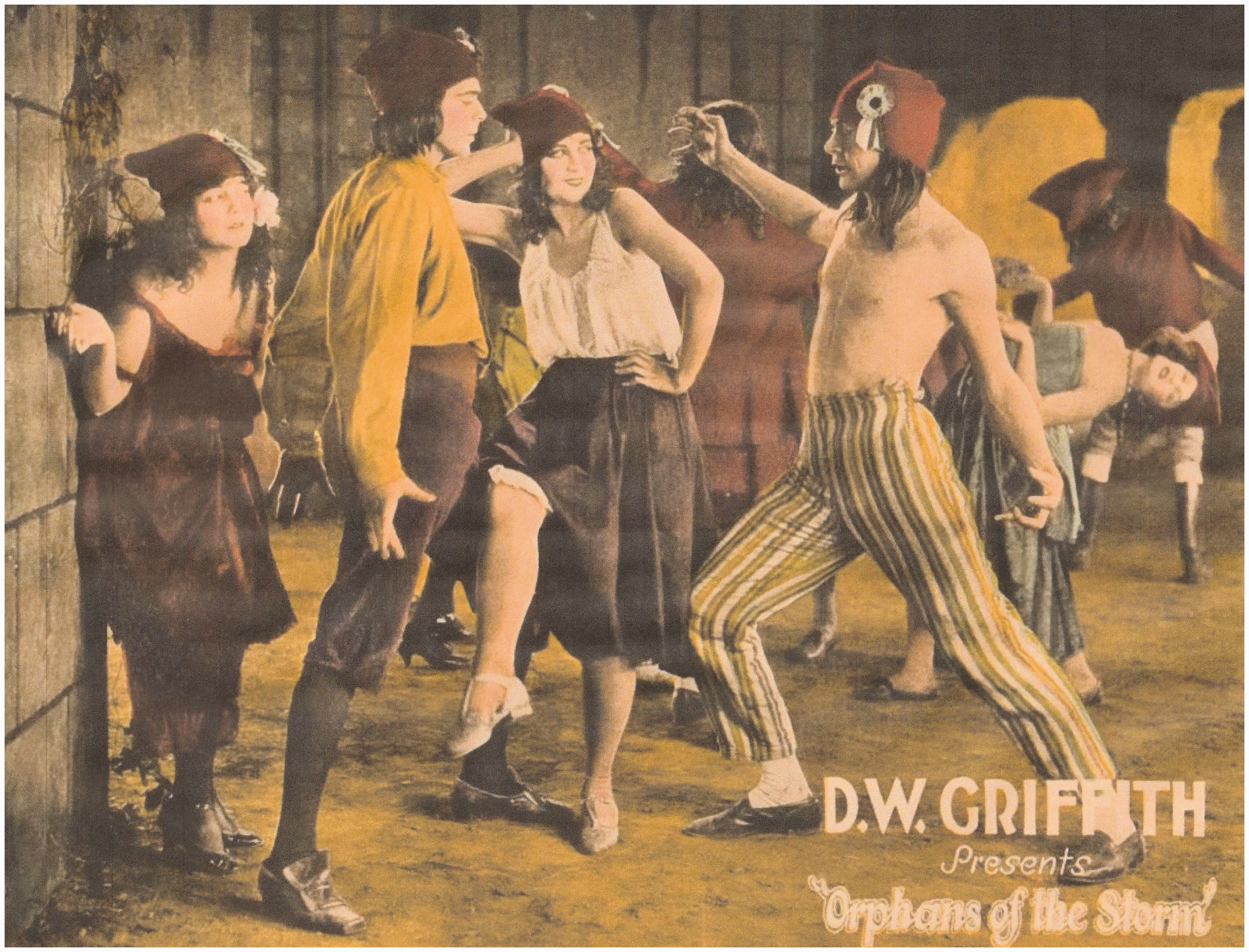
The start of the frenzied carmagnole dance in which Henriette, searching for Louise, will be pulled into the world of the revolutionaries. Lobby card. Source: From private collection, U.S.A.
Prior to that, a further cut to the Jackson–Claxton plot, eliminating a particularly popular scene, occurred. Griffith wholly excised a character from the stage version who threw further light on the dissolute and violent world of the Frochard family. This is Jacques’ cast-off mistress Marianne (alluded to above) and whom, it is implied, was also pimped by Jacques and who has been caught in a police round-up of prostitutes. Thus, when Henriette has been seized by Count Linières’ police and thrown into La Salpêtrière prison for fallen women, further officials arrive to escort a consignment of female prisoners to the ship which will carry them to the misery of the Cayenne plantations. Marianne, also imprisoned, persuades the supervising nun to lie and to identify her as Henriette, thereby postponing Henriette’s deportation until she can be rescued by de Vaudrey.
Subsequently – and crucially – Henriette summarily refuses Robespierre’s lecherous advances, slamming her door in his face followed by the intertitle: ‘Robespierre will get his revenge’. This supposedly self-denying revolutionary (not a member of the former aristocracy) is thus identified by Griffith as Henriette’s villainous oppressor. It is Henriette as well as Louise who will need rescuing. The sisters are now in parallel scenes of terror – each with her own villain.
Probably the most revealing moments of Griffith’s approach become evident in the scenes where the sisters are reunited. In the Jackson–Claxton stage version, the sisters finally come together when de Vaudrey and Henriette accompany police officers to the Frochards’ lair. She enters alone, is discovered by Jacques Frochard and is hurled to the ground. Louise has been shut in an upstairs room, but, knowing that Pierre has concealed a key for her, she feels her way into the room and stumbles over the unconscious prostrate Henriette. Here is the moment for the sisters to be reunited, but they cannot enjoy their reunion as they must first face the deadly knife fight between the brothers, finally interrupted when de Vaudrey enters, draws his sword, and disarms Jacques. Griffith, however, forestalls the sisters’ reunion, reverting to Jacques’ lecherous move on Louise and Pierre’s unlikely but successful defence of the blind girl.
In Orphans of the Storm, Henriette never enters the Frochards’ lair. Louise is there alone, about to be raped by Jacques when Pierre challenges him and in the ensuing knife fight either wounds or kills him. It is not clear which. Pierre then apparently conducts Louise to the Committee of Public Safety, where the sisters briefly meet in the terrifying scene when Henriette is brought before the revolutionary tribunal, cynically, maliciously accused of consorting with aristocrats, condemned to be guillotined, and courageously pleading for de Vaudrey’s life. Then, of course they are again forcibly pulled apart – failing to connect as they reach across the soldiers’ bayonets – and only (after a last-minute ride-to-the rescue – which is typical of many of Griffith’s films) later united again at the guillotine steps with a paternal Danton, in place of the usual romantic figure. And we see the sisters one more time, Louise’s vision restored, reunited as well with her mother. Newly sighted Louise has become a partner of equal strength. But there is also something about the final scenes which remind me that Griffith was an unreconstructed Southerner. Although the hated aristocrats have been exiled or guillotined, the girls, the Countess and de Vaudrey are not reduced to rags. Finely and expensively dressed, they are viewed in a setting that could be the old plantation.
So, what has Griffith achieved with his adaptation? Certainly Griffith rebalances the perils faced by Louise and Henriette, that rebalancing achieved, in part, by giving both Louise and Henriette identifiable villains whose crude, self-serving intentions and behaviour must be overcome, although it strikes me that this balance is now somewhat weighted in favour of Henriette despite Griffith’s efforts to underline the closeness and similarities between the two women. As Helen Day-Mayer has noted, in earlier versions of The Two Orphans, actresses performing the two women were intentionally and conspicuously different in appearance (Figure 22), and that casting made sense because they were not blood kin but merely sisters by adoption. Griffith, in contrast, not only casts true sisters but also emphasises their closeness by depicting them in identical outfits with identical personal accessories, props, and hairstyles (Figure 23). He utilises the disability of Louise to good effect by requiring Henriette to always be at her side: to be her eyes at all times. They mirror each other’s movements, and they share the screen in the symmetry: one half as the reflection of the other.
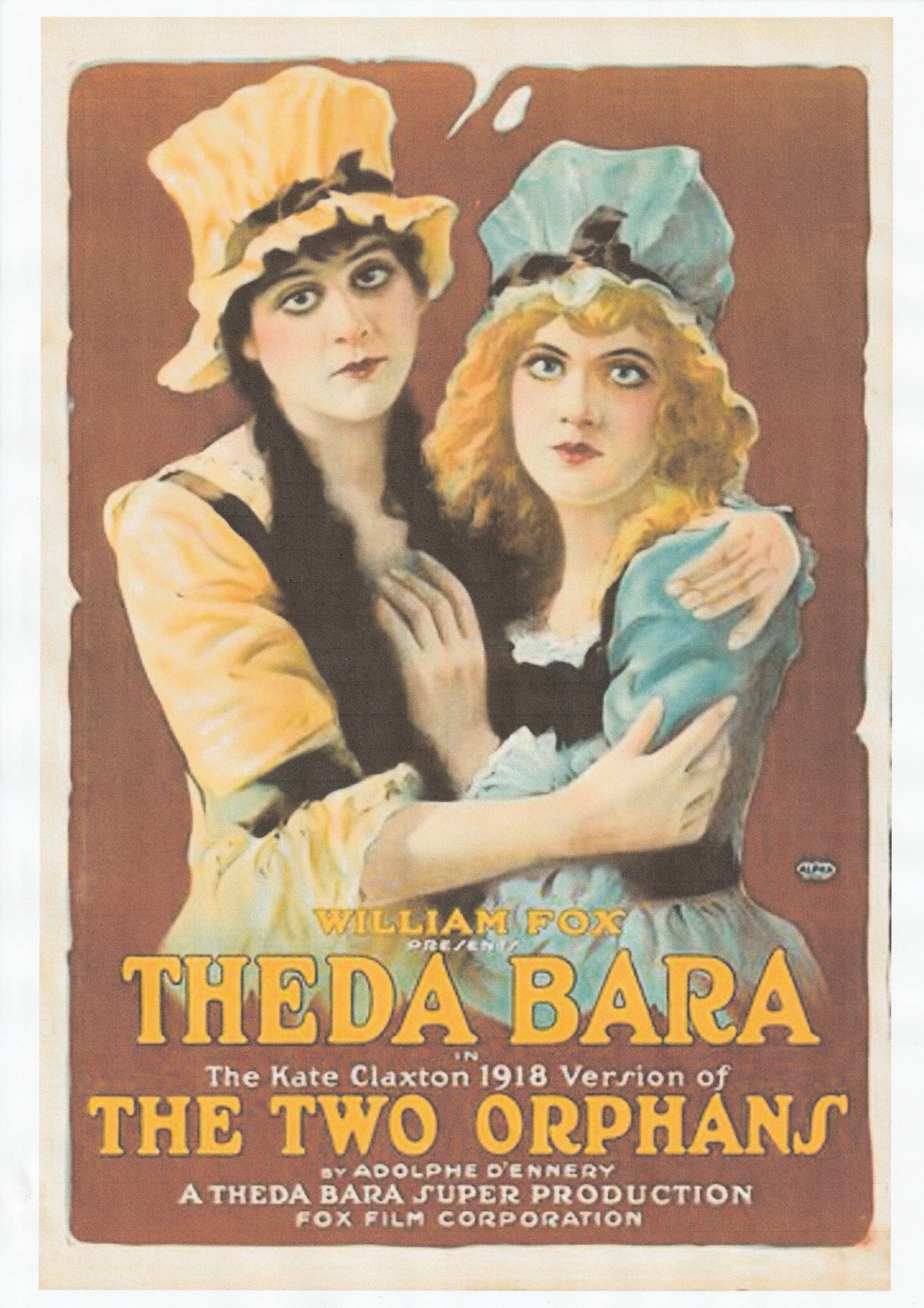
Poster for the 1918n re-release of the Fox The Two Orphans. Henriette and Louise, not sisters by birth, performed by actors who bear no resemblance to one another. Source: From the author’s collection.
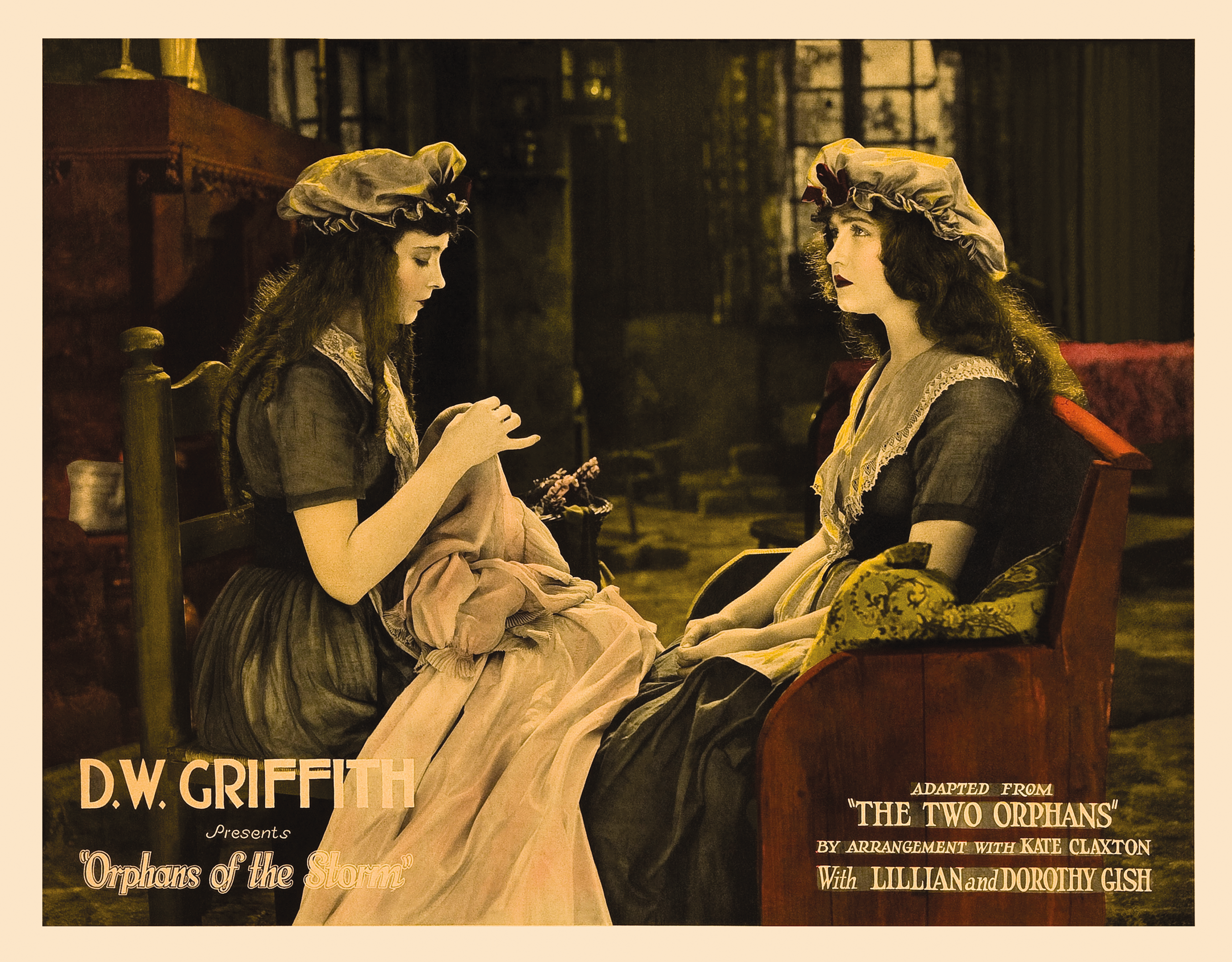
Lillian Gish as Henriette and Dorothy Gish as Louise invariably dressed alike and moving in symmetry. Lobby card. Source: From private collection, U.S.A.
Further, and to the film’s advantage, Griffith has created an original mammoth melodrama with strongly emotional scenes, a dramatic rescue, and interesting new characters as well as burnishing many of the characters he inherited from The Two Orphans. But there are limitations and drawbacks, especially the excision of characters and cutting back on scenes and episodes which were integral to The Two Orphans. He has diminished one scene, that before the church of St Sulpice, and cut from the action at that point the bereft Countess and the Doctor. And graver still, he has excised the roles of Marianne and Sister Genevieve (the complicit nun), and the scene in which Marianne sacrifices herself to save Henriette from imprisonment and transport to the colonies (Figure 24). But we do not have to choose between these two dramas. Both were exceptional melodramas in their own time. Orphans of the Storm is the more accessible of the two, but Jackson’s printed script for The Two Orphans is available for reading, study, and staging.
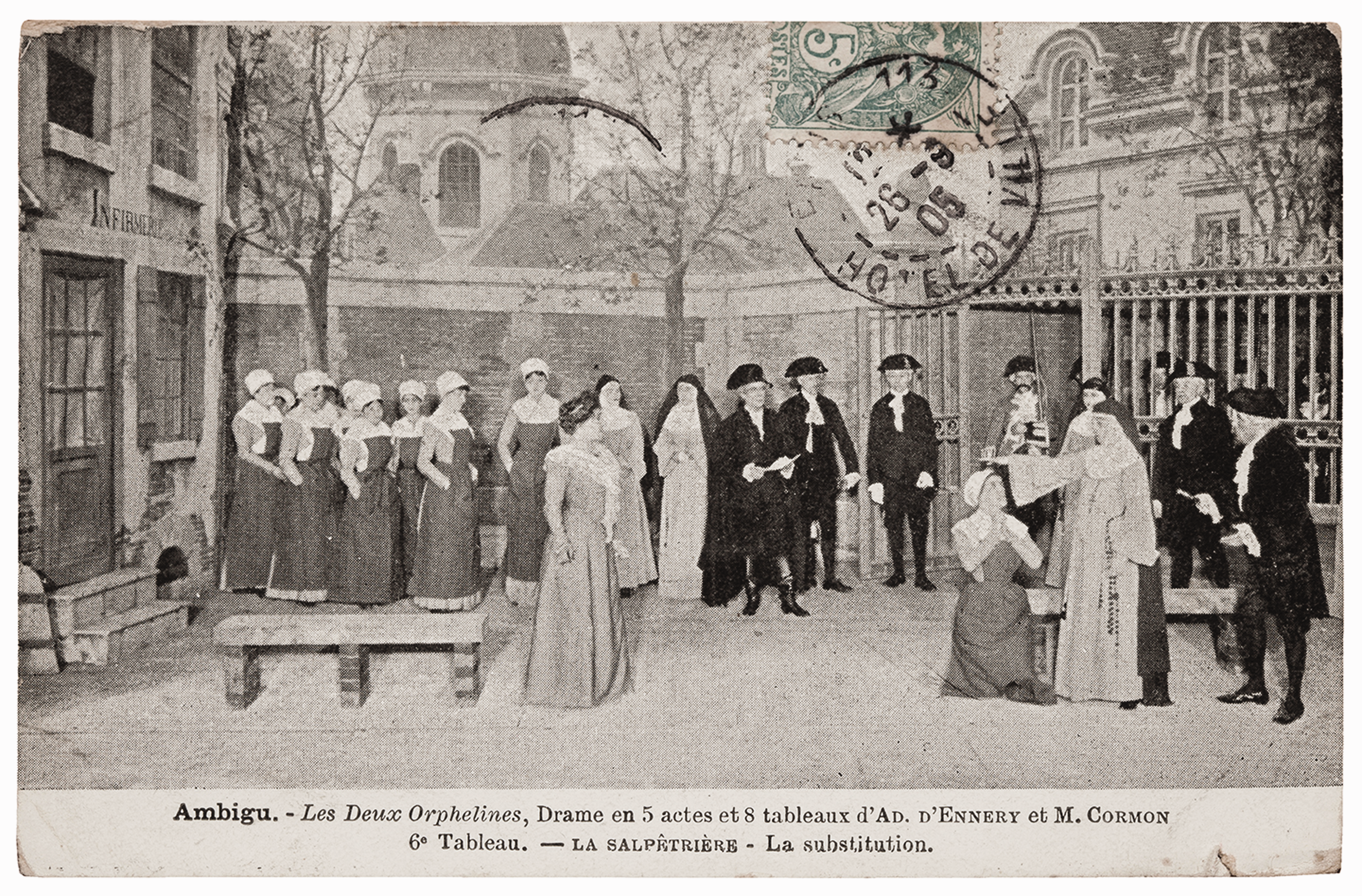
Salpêtrière Prison. Marianne’s sacrificing herself to save Henriette. From a postcard from the 1926 revival of Les Deux Orphelines. Source: From the author’s collection.
My intent has been neither to applaud nor denigrate either play or film but to demonstrate how a melodrama may play out in different adaptations – and further to suggest that in silent film we have the means to recover – but only partly recover – the Victorian stage when we find it displayed on early film. It is not invariably a rewarding experience, as a film may only offer a pale simulacrum of the original stage drama and sometimes erase, contradict, elide, and distort its theatrical source. That is the nature of adaptations. But sometimes – as with Orphans of the Storm – we get terribly lucky, and fragments of the Victorian stage – as well as a new narrative – lie before us. Then theatre scholars may view glimpses of a theatre they previously knew only from written descriptions or still images. And such discoveries are moments of joyful revelation.