



Abstract
Motivated by a sequential choice of foreign production strategies (CFPSs) in an actual decision for entering the lesser-known foreign markets, this article proposes two online models to analyze an optimal online strategy where the objective is to minimize the cost to supply the total demand of the foreign market. A basic online model for the CFPS problem with exporting (EXP) and wholly owned subsidiary (WOS) is developed to show how the transport/tariff cost and the entry/exit cost affect the switching timing and the competitive ratio of the online strategy. We investigate the online model where the firm can choose the joint ventures (JVs) besides EXP and WOS. Our results show that online strategies may not necessarily transition from EXP to JV mode. The decision-makers need to determine whether to transition from EXP to JV mode based on the cost characteristics among the three modes of EXP, JV, and WOS.
Keywords
Introduction
With the globalization of the world's economy, the competitions facing the firm in the domestic market become increasingly fierce due to the multinational corporation's (MNC’s) entry. In order to offset the MNC's competition in the domestic market, companies must enter the international market and participate in global competition. The first important problem for domestic enterprises is to choose the foreign entry mode that determines how the company organizes its production activities to serve the foreign market. This is also known as the
Meeting overseas demand by a company is a long-term process that involves many sub-cycles. The input sequence of overseas market demand appears one by one. Due to the unfamiliarity of company decision-makers with the overseas market, they only know the current sub-cycle demand of overseas markets, and do not know the future sequential demand of the entire process. In order to enter the overseas market, companies must choose an entry mode to meet the input sequence of overseas market demand in the current period. The decision-making of this problem is a typical online problem.
In the analysis of decision making under uncertainty, the traditional probabilistic analysis is developed with the goal of optimizing the expected behaviors with respect to probability distributions. In this article, we develop an online formulation for the CFPS problem in which a company has to choose a mode to meet sequential demand in order to enter overseas markets without knowing the entire process demand in the future. The objective function is to minimize costs while meeting the entire sequence of demand in overseas markets. In an online model, a sequence of events
Online algorithm is one of the important methods for solving uncertain decision-making problems. This method is mainly used to deal with decision-makers in long-term uncertain environments who lack accurate probability information of historical data and unknown events, and whose problem processing cannot wait for decision-makers to obtain sufficient information and must make decisions in the current period. Compared to traditional probability models, online optimization methods can ensure that the gap between the performance of the decision solution and the optimal solution is always within a certain range. With the increase of internal and external uncertainties, the deviation between the average optimal value obtained by applying probability models and the actual situation is becoming larger and larger. Decision makers are increasingly willing to choose online optimization solutions with robust performance to mitigate decision-making risks. This is especially true in starting point of the CFPS problem, where it is very difficult to characterize the uncertain demand, not only because the entrant has little information, but also because the total demand consists of the sequential sub-period demand.
Related work
Choice of foreign entry mode
The research on the significant impact of CFPS problems began with the study of FDI problems. The problem assumes that MNCs preparing to enter foreign markets have monopoly advantages or patents, and decision-makers choose between three modes of EXP, LG, and FDI based on the cost function of different entry modes. Buckley and Casson 6 regarded the choice of foreign entry modes as a function of transportation/tariff costs, fixed costs of FDI, and foreign market demand, and studied the optimal entry modes under different market demands. Eicher and Kang 7 considered the impact of the level of competition in overseas markets on the optimal entry mode, and analyzed the effects of different levels of competition and tariff policies on the welfare of local enterprises. Appiah-Kubi et al. 8 studied the impact of tax incentives on African countries’ absorption of FDI and found that direct investment responds to lower corporate income tax. Andreu et al. 9 analyzed the influence of family character on the choice of foreign entry mode for family businesses. Schmitzet al. 10 studied how digital enterprises choose their overseas entry modes and which specific background modes are preferred. The results show that in situations where institutions are weak, acquisitions and greenfield projects are incomplete, JVs and digital entry are more desirable.
The FDI can be divided into JVs with local partners and WOS in the foreign country. Anderson and Gatignon 11 studied the impact of bargaining behavior among shareholders and cultural and institutional differences between countries on the choice of equity structure in overseas enterprises based on transaction cost theory. Gome-Casseres 12 found that when local partners complement the company's capabilities and market transactions are more costly than equity cooperation, MNCs tend to form JVs with local enterprises.
CFPS problem under uncertainty
Uncertainty is a key factor affecting a company's choice of foreign entry mode. Dixit 13 investigated the entry and exit decisions under uncertainty and discovered that the entry and exit cost would produce “hysteresis” in response to uncertainty. Kouvelis et al. 1 developed a stochastic dynamic programming formulation for the CFPS problem with switching cost, in which the firm can adjust the ownership structure of the foreign enterprise dynamically in response to real exchange rate fluctuations. This model also discussed the impact of the switching cost on “hysteresis phenomenon.” Goldberg and Kolstad 14 studied the choice of foreign entry mode with uncertain exchange rates and demand. The results show that when there is a non-negative correlation between demand and exchange rate fluctuations, MNCs are more willing to choose the entry mode of FDI. When the fluctuation of exchange rates increases, and the correlation with demand fluctuations increases, the company will increase its equity investment in overseas enterprises. Pennings and Sleuwaegen 15 considered timing and foreign entry mode simultaneously under uncertainty about future profits. Wooster et al. 16 developed a real option model of foreign entry mode choices under environmental uncertainty. Li and Xiong 17 investigated the impact of the host country's environmental uncertainty and technological capability on the choice of entry mode simultaneously.
Online leasing problem
Another important issue related to the online CFPS problem is the well-known ski-rental problem in computer science. 18 The players design an online strategy that is to rent a sled until the rental cost accumulates to almost equal the sled price, and then make a one-time payment to purchase the sled. This online strategy can ensure that the sled usage cost does not exceed twice the optimal strategy cost. El-Yaniv et al. 19 presented a randomized online algorithm for the ski-rental problem; their work showed that the competitive ratio in the contiguous case is exactly equal to the competitive ratio in the non-contiguous case. Al-Binali 20 introduced a risk-reward framework for this problem and presented the complete set of strategies that respect the risk tolerance level. Lotker et al. 21 developed a randomized online algorithm for the multi-slope ski rental problem that all strategies cannot be rejected. Dai et al. 22 studied an online financial leasing problem in which the lessee can buy ownership of equipment after the lease agreement ends. Zhang et al. 23 considered the deterministic and randomized online strategies for depreciable equipment with opportunity cost. Xin et al. 24 introduced an online leasing problem of durable equipment and analyzed the impact of transaction costs on online strategies. Feng and Chu 25 investigated an online leasing problem in which the price of the required equipment is assumed to fluctuate over time and lie in a predetermined range.
In this article, we design an online algorithm to preserve flexibility in investing in the foreign market, which first selects EXP to supply the demand of the foreign market, then determines whether to adopt the JV mode and the timing switching to JV, and finally switches to WOS mode. Our results show that the optimal switching timings depend on the entry/exit cost, transport/tariff cost caused by market factors, and the reimbursement influenced by the firm's advantages over the local partner. The optimal online algorithm can guarantee maximal cost of implementing global objective in the worst case. Obviously, this approach is not appropriate for solving all CFPS problems under uncertain demand, but we do believe that it is appropriate for the initial stage of CFPS problems when the entrant has little information or doesn't have the experience of international expansion. Once the decision-maker has sufficient data and experience, choosing the production strategy with the goal of optimizing the expected behaviors could then be more appropriate.
Basic online model
Online CFPS problem description and assumptions
Consider a company that operates only domestically, facing increasing competition from MNCs in the domestic market. In order to offset the MNC's competitive pressure in the domestic market, companies have to enter overseas markets to participate in competition. Due to a lack of overseas market experience, company decision-makers in the early stages of entering the overseas market only know the current stage of overseas market demand, without knowing the demand in the later stages and how long the demand will last (how long the company can survive in the overseas market). Decision makers must choose a mode between EXP and WOS to meet the future demand of overseas markets without information about the demand. The decision-making process for this problem is a multi-stage dynamic online problem.
Motivated by the above description, there are main premises in the online model as following:
Due to the fact that MNCs can continuously increase competitive pressure on the domestic market by gaining profits from foreign markets, in order to offset the pressure from MNCs, companies must enter foreign markets as early as possible to participate in global competition. The total demand of the foreign market, in the long-term strategic process, is the main element to determine production strategy, which consists of sequential sub-period demand. In the initial stage of entering foreign markets, the company does not have sufficient information to predict future market demand in foreign markets, and decision-makers only know the demand of the next sub-period, has little information to know the total demand or probability distribution of the total demand. The decision-maker needs to choose between EXP and WOS at a discrete sub-period. Once the decision-maker chooses the EXP to enter foreign market, the transport/tariff cost for per unit goods must be paid, and avoids paying transport/tariff cost if choosing WOS. The decision-maker can switch from EXP to WOS, but cannot switch from WOS to EXP because the cost per unit of EXP is more than that of WOS. The time of implementing a mode switch is assumed insignificant (Kouvelis et al., 2001). The investment size of new plant in foreign country is assumed to be constant, which consists of the price of production facilities and the cost of developing a distribution network. The price of the used plant is the difference between the investment size of the new plant and the aggregated depreciations. The salvage value of the used plant is always more than the exit cost of selling it within the lifecycle, so the decision-maker can sell the used plant when he no longer needs it. The new decision starts if the lifecycle is over. The production function is uniform between EXP and WOS, which means that each production strategy has the same production cost. The total cost per unit of EXP includes the production cost and the transport/tariff cost, and the total cost per unit of the WOS equals the production cost. The entry/exit cost of EXP is assumed insignificant because the EXP mode doesn't develop new facilities in foreign country. As the firm chooses the WOS mode to enter a foreign market, there exists an entry cost resulting from the technology transfer and the market barriers of entering host country.
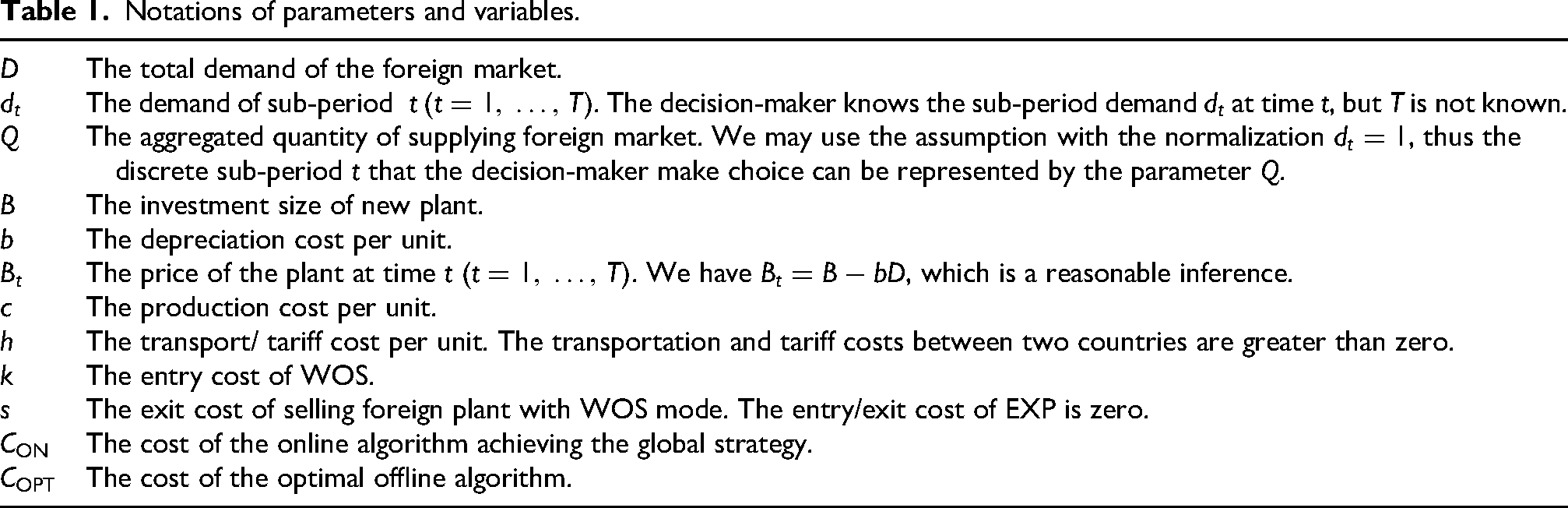
In this research, the following set of notations is used in the model. Table 1 summarizes parameters, variables, and details between parameters.
Notations of parameters and variables.
Optimal algorithm in the basic online model
Consider the following algorithm.
Algorithm-QW = (We use the switching timing QW between EXP and WOS to denote an online algorithm). The firm chooses EXP to supply foreign demand until
Compared to the traditional economic models where the decision-maker chooses an optimal entry mode in terms of a given total demand or the probabilistic distribution of total demand, the main idea of the online algorithm is to delay the tremendous investment of establishing a foreign plant by paying a small cost (transport/tariff cost) and preserve flexibility of global strategy when the decision-maker don't know the foreign markets.
We first prove that Algorithm-QW is an optimum algorithm for online CFPS problems where the decision-maker can choose EXP to serve foreign market at least one unit before employing WOS.
If
For a given total demand, the cost function of EXP is
The cost function of the WOS mode can be formulated as the following:
The first term (k) of the right-hand side above is the entry cost of WOS, the second term (B) is the investment size of setting up the foreign plant with WOS, the third term (cD) is production cost supply total demand, the fourth item (bD) is the investment depreciation recovered from the total production, the fifth item (Bt) is the residual value of the enterprise after completing the total output, 
There exist
Algorithm-QW has competitive ratio
Consider the following two cases:
Case 1. Case 2.

The first term 
By Lemma 1, the cost of the offline algorithm is 
Differentiating r with respect to D, we have
Algorithm-QW is the optimal, which obtains the best possible competitive ratio.
Consider an arbitrary online algorithm where Case 1. Differentiating r with respect to Q, we have Case 2. Differentiating with respect to Q, we have


Structural result of competitive ratio and managerial insight
An interesting finding is that in our model, the competitive ratio, which measures the performance of an online algorithm, is determined by the entry/exit cost and the transport/tariff cost. In this sub-section, we prove the structural properties of the competitive ratio function and analyze how the changes in the transport/tariff cost and the entry/exit cost affect the competitive ratio of the optimal online strategy.
Algorithm-QW has the maximal value of the competitive ratio when the transport/tariff cost is
We first prove that Algorithm-QW has the maximal value of the competitive ratio when the transport/tariff cost is 
This is a global maximum, since we have 
Therefore, we have
Next, we prove that the competitive ratio increases as the entry/exit cost increases, but is at most 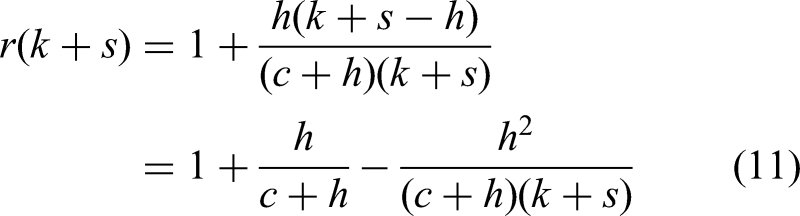
Differentiating r with respect to
Online CFPS problem with JV mode
In this section, we consider an online CFPS problem where the firms can accept or reject the eclectic modes such as JV between EXP and WOS. The cost per unit of the JV mode consists of the production cost and the reimbursement to the local partner. Without loss of generality, we assume that the firm can switch mode from JV to WOS by purchasing the share from the local partner, but the switch incurs switchover cost. We assume that the firm can choose EXP to meet foreign demand at least one-unit product before switching from EXP to JV, and employ JV to supply at least one-unit product before switching from JV to WOS. Let
There exists a
The reimbursement per unit to the local partner in JV mode is greater than zero. Otherwise, local partners are unwilling to establish JVs with the company. The reimbursement per unit to the local partner in JV mode is less than the transportation and tariff costs per unit of product. Otherwise, the company is unwilling to establish JVs with local partners.
There exists a
This is a reasonable assumption because the cost of using EXP mode to supply one-unit product must be less than that of employing JV to supply one-unit product. Otherwise, the decision-maker doesn't choose EXP but chooses JV in the first period. Therefore, we have
If
We first prove the lemma for 
Since 

Therefore, we have
The proof of the case
For
We first prove the lemma for
By Assumptions 1 and 2, there exist
The proof of the case
Consider the following two algorithms:
The decision-maker chooses EXP to supply the demand of the foreign market until
The decision-maker chooses EXP to serve foreign market until
First, we show that Algorithm-
There exists a
The cost of using EXP mode to supply one-unit product, and switching from EXP to JV and then serving the foreign market one-unit product must be less than the cost of choosing directly JV mode to supply two-unit products. Otherwise, the decision-maker doesn't choose EXP and then switches from EXP to JV, but chooses directly JV on the first product unit.
There exists a
The cost of employing EXP mode to supply one-unit product must be less than the cost of choosing EXP to enter foreign market and then switching from EXP to JV, and using JV to serve foreign market one-unit product. Otherwise, the decision-maker ignores EXP and switches immediately from EXP to JV after choosing EXP to enter the foreign market.
For the case 
The theorem follows from following four propositions. Proposition 1 shows that for case
Under Assumptions 3 and 4, Algorithm-
Consider the case
Under Assumptions 3 and 4, for case
The proof of Proposition 2 is similar to the proof of Theorems 1 and 2.
There exists a
Assumption 5 is similar to Assumption 3.
Under Assumption 5, for case
The proof of Proposition 3 is similar to the proof of Theorems 1 and 2.
There exists a
The cost of employing EXP mode to supply one unit product, and switching from EXP to JV and using JV to serve the foreign market one-unit product must be less than the cost of using EXP mode to supply one unit product, and switching from EXP to WOS and then serving the foreign market one unit product. Otherwise, the decision-maker doesn't switch from EXP to JV, but switches directly from EXP to WOS in the second period.
Under Assumption 6, for case
Consider an arbitrary algorithm switching directly from EXP to WOS when the aggregated supply is Case 1. Case 2.

The offline algorithm chooses 
By Assumptions 3 and 6, we have that there exist Case 3. For an arbitrary algorithm switching directly from EXP to WOS, the cost is:

The cost of Algorithm-

By Assumption 1, we have that there exists
For the case 
By Lemma 3, for
Numerical analysis
Effects of the transport/tariff cost and entry/exit cost on the competitive ratio
To discuss the impact of the transport/tariff cost on competitive ratio, we investigated the impact of transport/tariff cost changes on the competitive ratio for three values of the entry/exit costs:
Figure 1 shows that there exists unique
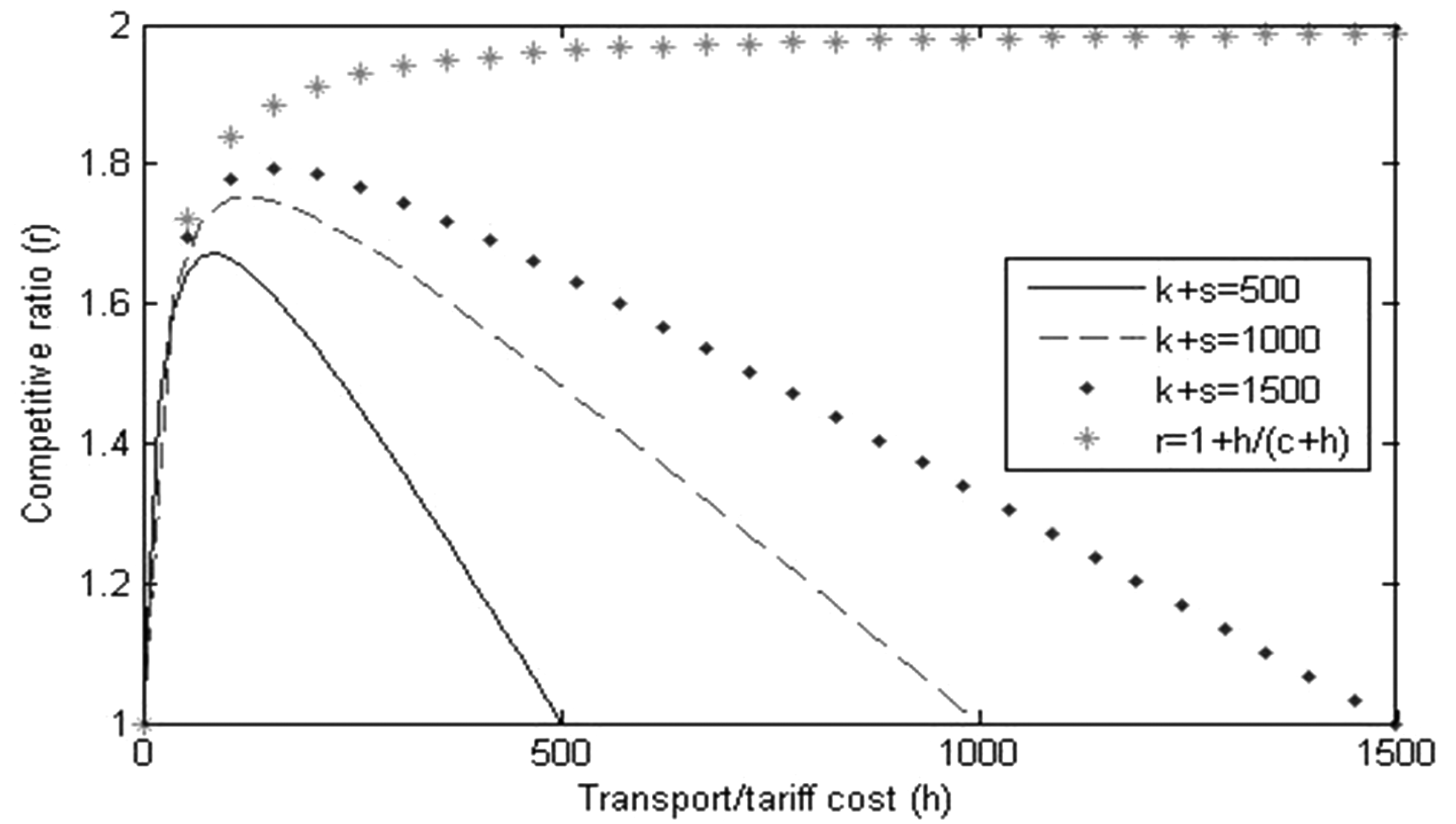
Effects of the transport/tariff cost and entry/exit cost on the competitive ratio.
As is apparent, the switching timing and competitive ratio of the online algorithm are far from insignificant. Of particular interest is the effect of the entry/exit cost and transport/tariff cost on the competitive ratio, since the decision-maker can measure the performance of the online algorithm by observing changes in the transport/tariff cost and entry/exit cost caused by government policies in host country. Moreover, it is helpful for the host countries because they can forecast the MNC's behaviors when adjusting some policies to varying these parameters.
Effects of JV mode on the competitive ratio
Assume that in the CFPS problem with JV mode,
Switch timing of the online CFPS problem with JV mode.

Competitive ratio of the online algorithm.

Table 2 shows the changes in the timing of mode transitions from EXP to JV, from JV to WOS, and from EXP to WOS when parameters change between the three modes of EXP, JV, and WOS. When the value of v increases in JV mode,
Table 3 shows that when
As shown in the above case, the impact of the JV mode on online strategies is very interesting. Adding JV mode selection in CFPS problem decision-making does not necessarily improve the competitive ratio of online strategies. Decision makers need to determine whether to choose the JV model in CFPS problems based on the conditions of the JV model, that is, the profit distribution between different equity structures and local partners in the JV model, which is influenced by negotiations between decision makers and local partners.
Conclusions
The decision-makers look for an effective strategy to reduce the MNC's threat; a common solution is entering foreign markets: the companies can counteract the competition resulting from the MNC. In this article, we investigate an online CFPS model that captures the company's behavior in the early stages of the CFPS problem under unknown demand. Based on the optimal online strategy, we analyze the impact of the transport/tariff cost and the entry/exit cost on the switching timing and competitive ratio. We also considered the CFPS problems with JV mode, in which the decision-maker has the ability to accept or reject a JV mode. This introduces additional difficulties: how to accept or reject the JV mode between EXP and WOS mode. We design a new online algorithm that is to determine whether the JV model is feasible.
The efficient online strategy that we propose increases the flexibility of entering foreign markets by first choosing EXP mode to delay the decision of FDI, and guarantees maximal cost of implementing global strategy in the worst case. A possible extension of our analysis would be to study how to find average-case performance of online algorithms as well as randomized algorithms. Another extension could include information augmentation. For example, the competence of forecasting demand increases as the length of time the firm has been serving the foreign market increases.
