



Abstract
In manufacturing, especially in oil flow filtration, combustion systems, cooling turbines, and other areas, heat transfer performance through hybrid nanofluids (HNFs) is a key factor in achieving dominance of the final product. The present study deals with the movement of the fluid containing tri-hybrid nanoparticles on an excessively large stagnation point area on a smooth plate in a permeable medium. Additionally, the leading partial differential equations of the proposed model are converted to ordinary differential equations (ODEs) by incorporating similarity variables, and the fourth-order Runge–Kutta method is then used to solve these. To find the missing initial conditions of first-order ODEs, a shooting technique is also used. Furthermore, the consequences of heat transmission rate in the form of graphs and tables are explored. It is noticed that by enhancing the strength of the solid volume fraction the skin friction along the x-axis (
Introduction
Currently, academics are mostly focused on the issue of improving heat transmission in industrial processes. In the past, fluids such as water, oil, and ethylene glycol were commonly employed as cooling agents in many processes. However, it is worth noting that their heat transfer rates (HTRs) are quite modest. The examination of the flow of hybrid nanofluid (HNF) across an expanding surface holds significant applications in many industries such as paper and plastic production, wire coating, food manufacturing processes, rubber sheet manufacturing, and polymer sheet production. The nanofluid flow across a coiled sheet was examined by Gul et al. 1 in a two-dimensional context. The study conducted by Elattar et al. 2 examined the impact of hall current and chemical reaction on HNF flow caused by slender surfaces. Ali et al. 3 investigated the flow of 3D nanoliquid over a stretched sheet characterized by varying thermal conductivity. Allehiany et al. 4 described the flow of a magneto-micropolar fluid across a heated sheet. The findings of the study indicate that the Newtonian liquid exhibits a greater velocity in comparison to the micropolar liquid. In their study, Bilal et al. 5 recognized the phenomenon of MHD viscous Jeffrey thermal transfer flow across a permeable stretched sheet. Numerous recent studies on nanofluids and HNFs for different geometries have been published.6–10 The utilization of nanofluids is observed in diverse domains, encompassing heat transfer apparatus, thermal control mechanisms for electronic gadgets, automotive radiators, refrigeration systems, and solar reservoirs. Therefore, the introduction of ternary HNF, a sophisticated kind of nanofluid, recognizes the need to achieve significant enhancements in the thermal conductivity of conventional fluids. This formulation aims to achieve a significantly high degree of heat conductivity. 11 In theory, it is postulated that ternary HNF exhibits superior thermal characteristics when compared to both single and HNF. The technique of producing ternary HNFs, along with their stability and applications in heat transfer, was reviewed by Adun et al. 12 In research done by Kashyap et al., 13 it was determined that the utilization of ternary HNF as a coolant does not provide advantageous outcomes, mostly owing to a marginal increase in the rate of heat transfer. Besides experimental studies, several numerical simulations examined the nature of the flow of HNFs of ternary systems under conditions of different geometrical and physical basis. Ahmed et al., 14 heat transfer exercise, was published through a flow conduit made up of a square. They developed a ternary nanofluid that was made of ZnO, Al2O3, and TiO2, mixed with water. The scientist confirmed the fact that the enhanced average and local heat transfer of the ternary nano-hybrid is fine to be used in an industrial context through the performed tests. The carried out by Algehyne et al. 15 revealed that various diffusion rates have either an increasing or decreasing effect on the thermal performance of a mixed nanofluid with three constituents. Sarfraz et al. 16 studied the energy conductivity for ternary HNF radiating from an asymmetric disc. In their study, Mahmood et al. 17 considered a ternary nano-hybrid fluid flow that undergoes stretching and shrinking along a curved surface. The inquiry has been conducted between the administrator dynamics and thermal characteristics. Maranna et al. 18 investigated the phenomena of ternary HNF conduction by wetting a shrinking sheet over the porous media taking into account the impact of radiation and Navier slip. The ternary nanofluid flow in a radiated channel was examined by Abbasi and Ashraf. 19 The binary/engine oil nanofluid was less productively potent pushing the ternary-hybrid/engine oil to stand out in the study. Ramana et al. 20 investigated the behavior of a nanofluid that was ternary in a stretchable converging/diverging channel with the effect of both hot reservoir/cold sink and predefined porous media through their study. The researchers found out that the efficiency of energy diffusion in the diverging channel could be significantly improved by upping the non-dimensional (heat sink or source factor) and Eckert number. But for the diverging tube, the flow becomes significantly abrupt.
Stagnation point flow is a fluid flow in a specific form when a fluid, such as gas or liquid, is forced to bypass a solid object around the perimeter, leading to the velocity of the liquid being equal to zero at a designated spot we call the stagnation point. There can be several reasons why this kind of fluid flow can be important, like aircraft and missiles aerodynamic profile, combustion, and thermal transfer. The aerodynamics which is involved in airplane designing and weapons predicting high-speed projectiles is explained by way of the static-point flow. Just like that, through proper designing of the aircraft fuselage and wing features, engineers can therefore reduce stagnation points and effectively improve lift. Certainly, this is the essence of attaining an exceptional propulsion system and enhanced maneuverability. Static point flow is used in combustion when the rapidity and accuracy of combustion through incoming air need to be established. Engineers obtain both fuel efficiency and low emissions by being skillful in this by infusing fuel and oxygen in a position near the stagnation point, giving rise to a consistent and steady flame. Static-point flow denotes a popular technique operating in the domain of heat transfer used in designing high-temperature heat sinks, air-counters, etc., (e.g., gas turbines and rocket engines). Machine engineers can dissipate the heat from the surface of the equipment effectively while also guiding a fluid to the stagnation point thus improving hydrodynamics of the flow. This prevents damage and improves performance. Static points occur when objects in the flow area experience excessive pressure and essential fluid velocity, causing the fluid to completely halt. Studying fluid flow around stagnation sites considerably enhances the design of industrial and scientific processes. In recent times, there has been a growing recognition of the ability to confine molecules or other particles inside fluid flows at locations of stagnation. The achievement of the stagnation point movement has been seen in several sectors, particularly in the domains of biology, chemistry, and medicine,21–25 after the isolation and targeting of particles or cells. The notion of a two-dimensional stagnation points motion issue approaching a solid wall was suggested by Hiemenz in 1911. 26 Ariel delivered a concise and accurate reply to a query that had elicited a momentary hesitation. The notion of two-dimensional stagnation point movement across elongating and compressing plates was established by Mahapatra and Gupta,27,28 as well as Wang. 29 The complexity of flow generation arises from the accumulation of specific stagnation point flow and the reduction of the elongating surface, both of which have an impact on the velocity of boundary layer motion, the heat transmission ratio, and the mass transmission ratio. Chamkha et al. 30 investigated a linearly stratified stagnation flow (Hiemenz flow) of coupled heat and mass transfer by mixed convection in the presence of internal heat generation or absorption effects and an externally applied magnetic field. The plate surface has a power law variation in both wall temperature and concentration and is embedded in a uniform Darcian porous medium. It is permeable to allow for potential fluid wall suction or blowing. The effects of the Lorentz force and the convective heating boundary on second-grade nanofluid flow in conjunction with a Riga pattern was examined by Gangadhar et al. 31 Gorla and Chamkha 32 explored the effect of natural convection past a horizontal plate in a porous medium saturated in a nanofluid. In their respective studies, Bhattacharyya et al., 33 Zaimi, and Ishak 34 examined the influence of expeditions on the occurrence of stagnation point motion problems. Both excursion and thermal declines were assessed by Aman et al. 35 and Fauzi et al. 36 to extend/decline wall stagnation point motion. The primary emphasis of the findings was on the distributions of velocity, temperature, skin friction, and local Nusselt number. The investigation and examination focused on the movement of fluids containing nanoparticles at stationary locations have made significant contributions to the comprehension of the thermal characteristics that influence fluid dynamics. Mustafa et al. 37 investigated the movement of nanofluids along a stagnation point in the direction of an extended surface. Controverting this, Bachok et al. 38 and Kameswaran et al. 39 looked into the fluid moving over the two-dimensional stretching and shrinking surface at a stationary point. From the study by Mansur et al., 40 the magnetohydrodynamic motion developing at a stagnation point was evaluated during the fluid flow in a channel that has either expansion or contraction under nanoparticles contained material. The research results showed that the cases of the relaxing scenario and the escalating situation were solved by the special approach, whereas the common approach was applied in the case of the diminishing scenario. The slip boundary on the stagnation point flow problem in nanofluids has been tackled because the scholars attempted to replace the older phenomenon called fluid confinement which does not work in nano and micro settings. Mohamed et al. 41 proceeded to introduce a nanofluid that was moved, at a stagnation point on a stretched surface, never ceasing to flow. It raises a contradiction with the fact that Mahatha et al. 42 explored the fluid motion of a nanofluid stagnation on a stretching surface taking into account the velocity slip and at the same time heat radiation. The nanofluid simulation described above employed Buongiorno's 43 methodology, and the findings demonstrated a strong correlation between the decrease in heat transmission rate at the surface and the influence of Brownian movement and thermophoresis components. Nanofluids, including a combination of base fluid and nanoparticles, are intelligent fluids that have garnered significant attention in several industrial domains. These applications have been extensively studied in theoretical research, encompassing their potential use in renewable energy generation within chemical processes, 44 as well as their potential in stimulating oil and gas reserves. 45
Motivation of the study
The investigators’ proficiency and ambition enabled them to successfully publish their findings on the heat transmission of stagnation point flow, which was generated through extensive research and the application of numerical methods. The motivation behind this research work can be attributed to the following factors:
In 2020, Weidman
46
successfully explored an advanced group of irregular stagnation point motions considering the shear-to-strain ratio and permeable media. An approximate method was employed to determine leading nonlinear ordinary differential equations (ODEs). Mahapatra and Sidui
47
investigated the non-Newtonian viscoelastic fluid of disproportionate Homan stagnation point motion over a rigid slice. An approximate method is utilized to derive numerical outcomes of coupled ODEs. They extended the paper of Weidman.
46
The flow over a vertical surface that is extending or contracting while experiencing second-order velocity slip and heat vault is explored by Soid et al.
48
Partial differential equations (PDEs) are converted into regular (indistinguishability) differential equations employing a modification of variables. The confine value problems solver bvp4c in Matlab software is used to numerically resolve these equations and associated confine situations. For these comparison equations, consequences from interpretative values of boundless variable, dual (first and second) outcomes are determined.
Objectives of the study
Based on the literature cited above, the leading purpose of the present investigation is as follows:
Design a mathematical model of stagnation point motion of ternary-hybrid nanofluid (THNF) in a permeable medium. To determine calculation outcomes of leading nonlinear similarity equations with the aid of a built-in MATLAB routine called bvp4c. Optimize the HTR of THNF by supervised machine learning approaches such as response surface methodology (RSM).
Mathematical formulation of the problem
The following are the flow assumptions of the problem (depicted in Figure 1):
The flow field is modeled near a non-axisymmetric stagnation point on a flat plate in a porous medium. The porous media has a permeability parameter K, and fluid flow follows Darcy's law without considering Forchheimer's inertial effects. It is assumed that the flow in the porous medium is incompressible, fully developed, and steady. The potential flow velocities are stated as The surface temperature of the flat plate is supposed to change linearly with position, as The thermophysical properties of the fluid and nanoparticles are assumed to be constant and assessed using standard property correlations.

Physical sketch of the problem.
The leading PDEs of said problem are
49
as follows:


Concern to confines conditions:

Here,
Equations (1)–(4) are higher of PDEs and it is difficult to solve numerically. Therefore, we will introduce similarity variables that transform these PDEs into ODEs. So, the appropriate similarity variables are as follows:

By inserting equation (6) into equations (1)–(4) we obtain succeeding ODEs:


Concern to confine conditions:


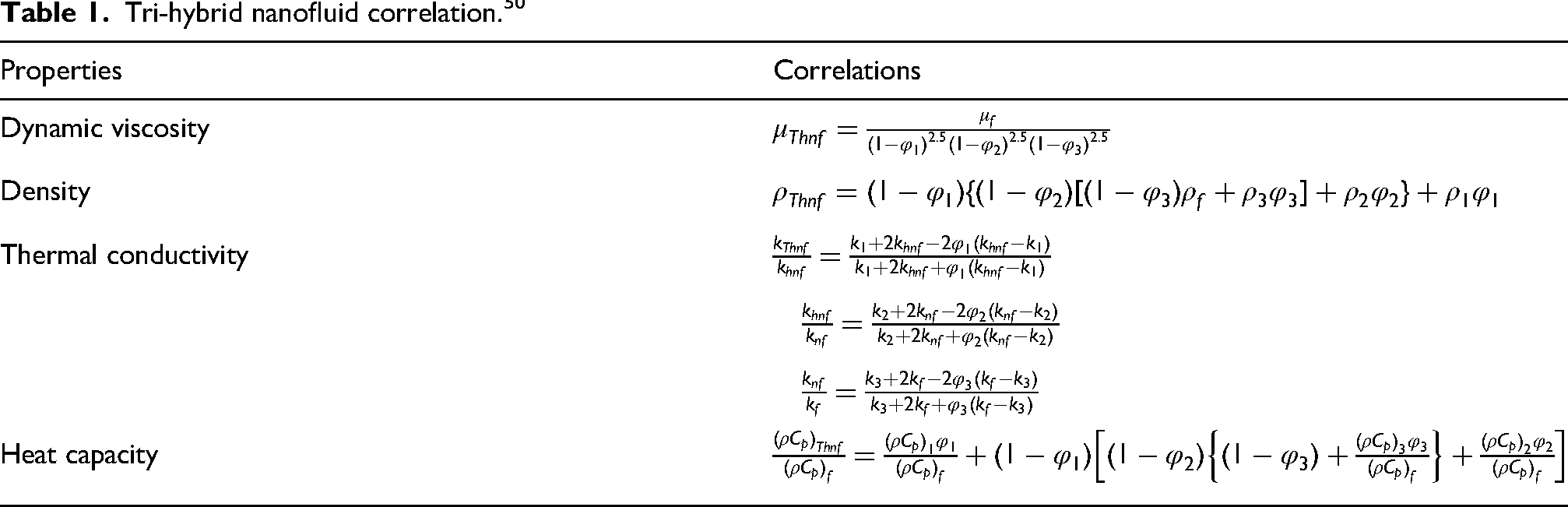
Table 1 is for correlations of tri-hybrid nanofluid and Table 2 is for thermos-physical properties of tri-hybrid nanofluids.
Tri-hybrid nanofluid correlation. 50
Thermophysical properties. 50

Physical parameters of possession
The skin friction coefficient along x and y directions is 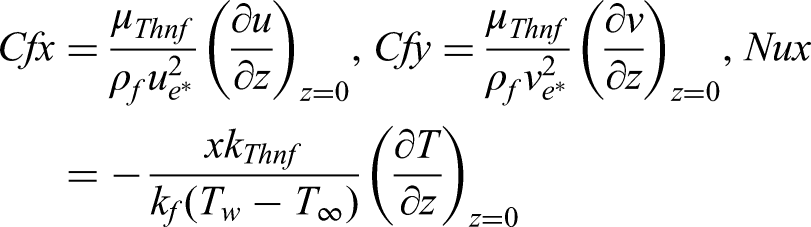
Hence,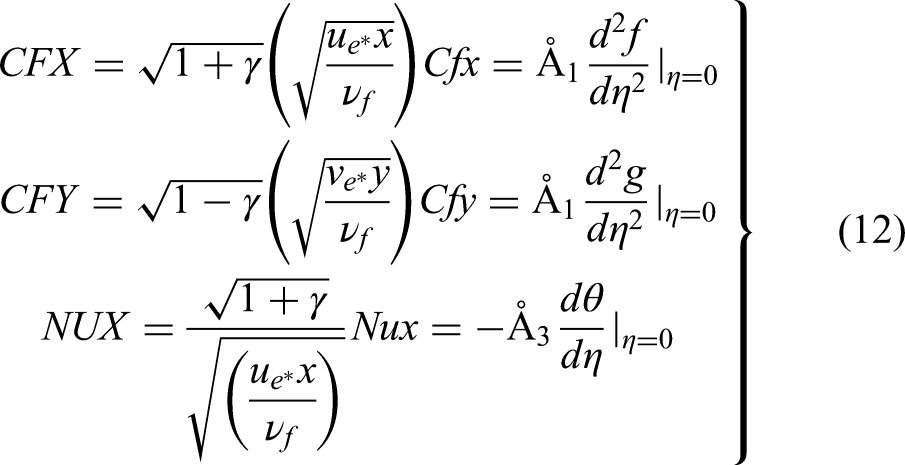
Research methodology
The numerical approach known as fourth-order Runge–Kutta is utilized to solve equations (7)–(9) under the influence of boundary conditions (11). Equations (7–9) represent higher order ODEs, therefore necessitating their conversion into a system of first-order ODEs. However, it is worth noting that three starting conditions were absent, namely 
Box and Wilson
51
establish Central Composite Designs (CCD) for appropriate second-order imitation. Moreover, CCD in m variables essential 2 m factorial runs along 2 m auxiliary amalgamations named significant points beside the reconcile axes of classified variable standards and slightly single center point. The essential points need to resolve coefficients of the second-order imitation.


After that, we processed it as the advanced interior point of the principal parameter
Results and discussions
The incorporated nonlinear ODEs were numerically resolved using the MATLAB built-in procedure bvp4c for a wide range of unknown parameters. We used

Effect of solid volume fraction on

Effect of solid volume fraction on NUX.
Validation of the numerical results for

The warm transmission rate increases with increasing immersion of NPs for

Effect of
Figure 5 compares the Nusselt numbers for three different types of fluids: nanofluids, hybrid fluids, and ternary-hybrid nanofluids. Figure 6 shows that, in the case of mono-nanofluid, the rate of warm exchange enhances as the volume ratios of Ag and Go are increased. Go-Ag and Ag-Cu for HNF, though. This is caused by Ag and Go's strong thermal conductivity; this is common knowledge. Commencing from the study, it is noted that the ternary fluid containing hybrid nanoparticles has taken the most significant effect on Nusselt number, that is, 17.12978%, 8.43809%, and 19.20192% increment for Go, Ag, and Cu type mono-nanofluid is seen. Similarly, 12.67309%, 18.13489%, and 13.65317% enhancement for HNF (Go-Ag, Go-Cu, Ag-Cu, respectively) are seen. Therefore, we concluded that the ternary nanofluid model can be more efficient in increasing the warm transmission rate related to mono and hybrid-type nanofluid imitation.

Effect of

Nusselt number NUX for various combinations of nanoparticles.
Result and discussion of response surface methodology
Examined the response of three factors of
Parameters with their levels for NUX.

Experimental design and responses.

Statistical analysis
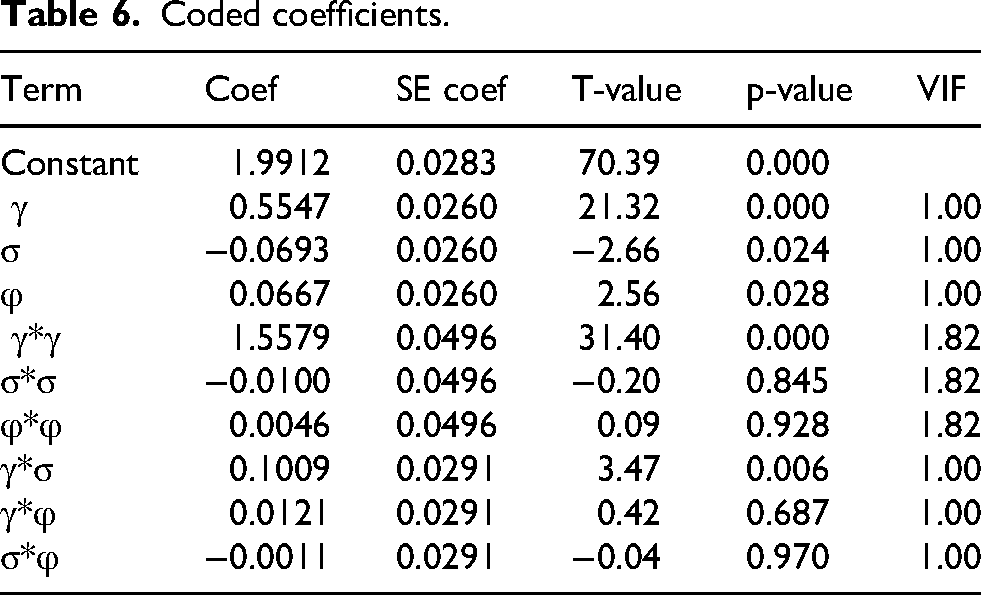
In this agreement, the statistical analysis executed 20 runs for Nux. Tables 6 and 7 shows the coded coefficient and statistical analysis influence. This model is appropriate for calculating the value of Nux because the better value of R2 for Nux i.e., 99.56% which attained by accomplishment technique and statistical analysis of the imitation. Further, the R2-Adj amount for Nux is 99.16% which is less than R2 but imitation appropriate investigational data adequately (See Table 8).
Coded coefficients.
Analysis of variance.

Model summary.

Analysis of variance and model estimation
To achieve an estimated and regression equation, the experimental model is performed under altered experimental settings. The residual plot is acquired by analysis of variance and commencing data into systematic software. The residual plot is given in Figure 7. In the residual plot, difference in the observed y-value (from the scattered plot) and predicted y-value is known as residual. According to the figure, normal probability plot is in positive correlation as all points near approximate straight lines which represents normality. In residual Histogram halves do not appear as a mirror image so is skew symmetrical distribution. Observed and fitted values display a good correlation if compared to the residual diagram and fitted value. The greatest residual was observed to be in the proximity of 0.15 for Nux. By applying RSM, we get equation1 which is a common relationship between their effective factors.

Residual plot.
From Table 7, it is observed that the p-value of 
From Table 7, it is noticed that p-value of 
Figure 8 shows the combined effect of solid volume fraction

Combined effect of solid volume fraction and porous parameter on Nusselt number.
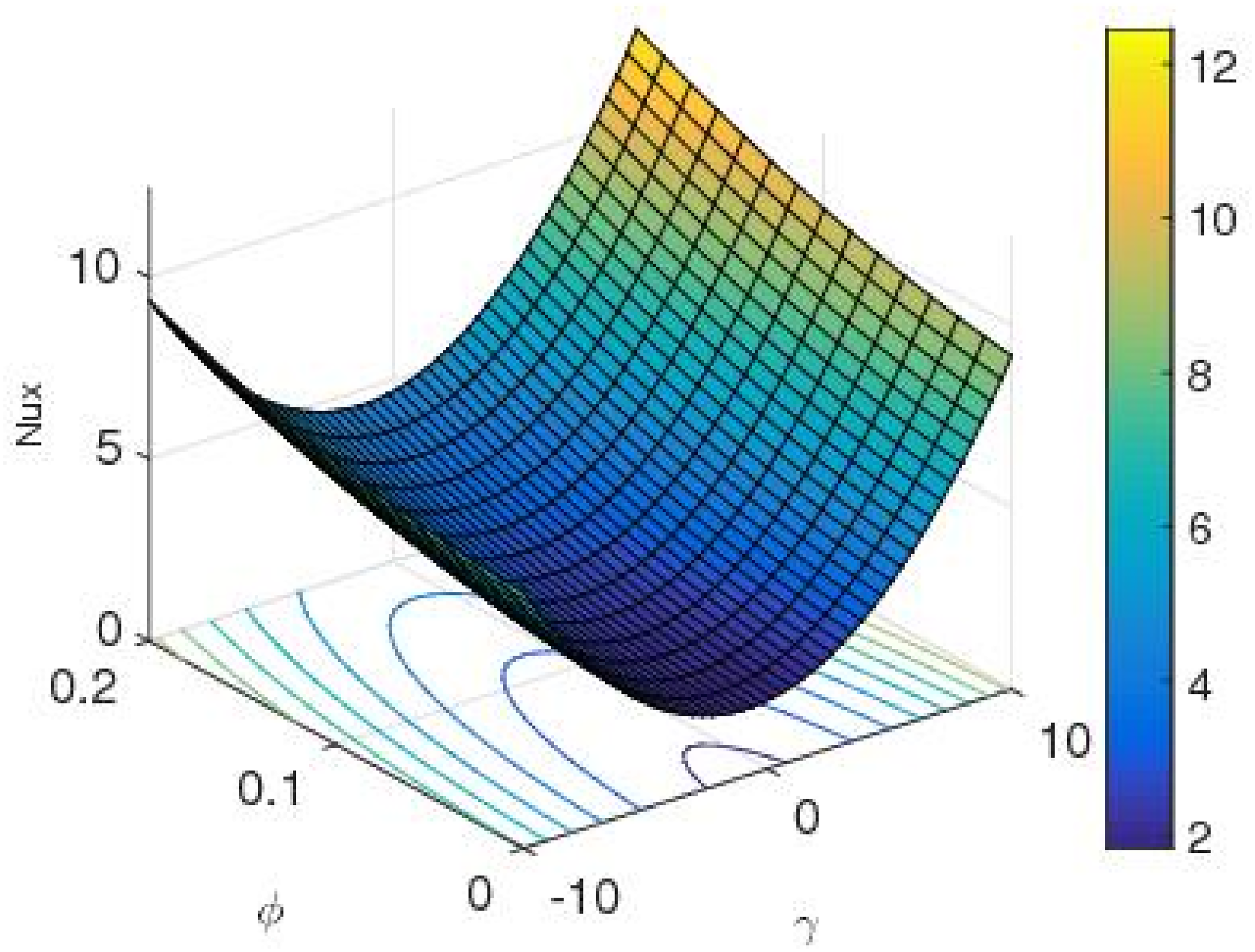
Combined effect of solid volume fraction and shear-to-strain rate on Nusselt number.

Combined effect of porous parameter and shear-to-strain rate on Nusselt number.
Sensitivity analysis
Sensitivity analysis is a principal consequential mechanism for model estimation. It is a technique for predicting the consequences of an interpretation of contingency proceed to be definite and correspond to the prevailing anticipations. Additionally, certain values of individualistic parameters (factors) regard an explicit reliant parameter (response) in a defined set of assumptions. Sensitivity analysis mentors us in ascertaining critical governing supervise points in research study and also substantiating and certifying the model. Additionally, it can be designed to examine how a diversity in the inputs of a model accomplishes the model outputs. Furthermore, we study how the change in warm transmission is attained by permeable parameters and others. Moreover, the sensitivity analysis imitation contains N self-reliant parameters
The sensitivity of the imitation prevailed by utilizing the regression equation (16). The partial derivatives of the response function (NUX) w.r.t factors (


Table 9 displays the sensitivity of the response function (NUX) for different degrees of

Sensitivity analysis of NUX with σ=0 level and all combinations of other factors.
Sensitivity analysis of NUX with

Conclusions
This work examined the area of non-axisymmetric stagnation of a flat plate in a porous medium using tri-hybrid nanoparticles. An appropriate similarity transformation was employed to convert the controlling PDEs into a set of nonlinear ODEs, which were subsequently solved numerically. The primary findings of the research are enumerated as follows:
The wall experiences zero friction in both x and y directions at HTR increases as immersion of nanoparticles increases for The rate of warm exchange increases as the volume ratios of Ag and Go are increased in the case of mono-nanofluid. However, for HNF, the rate of heat transfer enhancement is seen for Go-Ag and Ag-Cu. The ternary nanofluid containing hybrid nanoparticles has the most significant effect on Nusselt number, with a 17.12978%, 8.43809%, and 19.20192% increment for Go, Ag, and Cu type mono-nanofluid, respectively. Similarly, 12.67309%, 18.13489%, and 13.65317% enhancement for HNF (Go-Ag, Go-Cu, Ag-Cu, respectively) is seen. Nusselt number can be minimized by setting Nusselt number can be maximized by setting
Footnotes

Author contributions/CRediT
All authors participated equally in the conceptualization, investigation, analysis, original draft writing, review, and editing of the work.
Funding
The author(s) disclosed receipt of the following financial support for the research, authorship, and/or publication of this article: Project financed by Lucian Blaga University of Sibiu through research grant LBUS - IRG - 2023 - 09.
Conflicting interests
The author(s) declared no potential conflicts of interest with respect to the research, authorship, and/or publication of this article.
Data availability
The data that support the findings of the study are available from the corresponding author upon reasonable request.