In this paper, we introduce a new approximation of the cumulative distribution function of the standard normal distribution based on Tocher's approximation. Also, we assess the quality of the new approximation using two criteria namely the maximum absolute error and the mean absolute error. The approximation is expressed in closed form and it produces a maximum absolute error of , while the mean absolute error is . In addition, we propose an approximation of the inverse cumulative function of the standard normal distribution based on Polya approximation and compare the accuracy of our findings with some of the existing approximations. The results show that our approximations surpass other the existing ones based on the aforementioned accuracy measures.
The numerous applications as well as the significant statistical properties of the normal distribution make it one of the most important continuous distribution functions. Usually, researchers in various areas including but not limited to medical, engineering, and social studies use the cumulative distribution function (CDF) of normal distribution in testing and verifying various problems and conjectures in these fields.
It is well known that a random variable Z is normally distributed with mean 0 and standard deviation equals 1 if the probability density function of Z is given by,
Accordingly, the CDF of Z is,
Clearly, there is no closed-form solution for the CDF of the normal distribution, and this is one of the most important challenges to be discussed by researchers. For this reason, many approximations of have been proposed in the literature over the last six decades.1,2 Eidous and Abu Shareefa3 revised and discussed nearly 45 existing approximations of the normal CDF and suggested another nine additional approximations of , see also Hanandeh and Eidous.4 The CDF has wide applications in various fields, in particular, it plays a key role in the performance analysis of fading channels in communication systems,5 and it is important to perform an efficient assessment of wireless communication systems and have vital applications in analyzing the error rates of communication systems.6 Therefore, finding approximations of is necessity in order to enable its application over a wider range of analytical studies. Some other researches have been concerned with finding close bounds to rather than approximating it (see7,8 and the references therein).
Given that is an approximation of evaluated at a specific value of z, two well-known criteria that used by many authors to measure the accuracy of were used (see9 and the references therein). The first measure is the maximum absolute error () of , which is defined as follows:
The second measure of accuracy is the mean absolute error () of , which is given by,
where n is the number of z values selected for a given domain of interest. It is noteworthy that we compute both and for any number of selected values of . Therefore, we plan to choose the support values of z between 0 and 4 with step 0.01, which means that the above accuracy measures will be evaluated at points.
In this article, we discuss some existing approximations of that have been introduced in the literature based on Tocher's approximation of .10–13 We aim at proposing new approximations of to improve the existing Tocher's approximation. We intend to use the previously mentioned accuracy measures and to investigate and compare the performance of the new proposed approximation as well as some of the existing approximations.
Existing approximations of
A pioneer and simple idea was introduced by Tocher14 to present a closed-form approximation of as follows:
Note that if we may use the symmetry property of the normal distribution via the relation . The based on appears to be .
Several approximations have been suggested in the literature to improve the accuracy of Tocher's approximation and we list some of these approximations in the sequel:
1. The first improvement of Tocher's approximation considered in this article is proposed by Lin10 as follows:
which produces to be equal to .
2. The second improvement is proposed by Divgi11 as follows:
where . The of is .
3. The third approximation is proposed by Vedder12 as follows
where . In this case, the of equals to .
4. The fourth improvement is introduced by Waissi and Rossin15 in the following form
where (0.9 .0418198 0.0004406 . The of is .
5. Bowling et al.16 proposed another improvement following the same previously mentioned ideas as
with equals to .
6. The next approximation considered in this article was proposed by Boiroju and Rao13 given as
where
In this case, the value of corresponding to is .
7. Finally, Eidous and Ananbeh17 proposed another improvement to enhance the accuracy level of the approximation as follows:
where
The of obtained for this approximations is .
Proposed approximation of
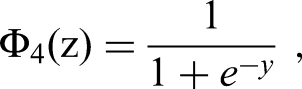
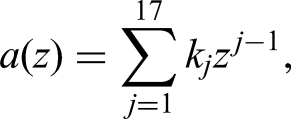
In this section, we propose a new approximation to improve the accuracy of Tocher's approximation and the accuracy of previous approximations as well. The proposed approximation of is given as
The values of the constants are obtained by using the regression method to determine the best-fitting model of the form that minimizes the absolute difference between the exact and the corresponding approximation model. Figure 1 illustrates the differences between our proposed approximation and the true value of . A thorough look allows us to see that the value of the approximation is which occurs at .
The difference between and .
Approximation of the inverse of
Let be the CDF of standard normal, where . The inverse of the CDF of the standard normal distribution is . Assuming that the value of is given, we are interested in obtaining the approximate value of z ( at which the area underneath it is p under the standard normal curve.
Schmeiser18 derived a simple approximation for z, which is given by,
Later, Shore19 derived the following approximation of z for a given value of ,
In this section, we introduce a new approximation of Based on the Polya approximation of ,20 which is given by,
We suggest the following approximation of z,
where
If we define then we can easily see the changes in with respect to the values of Figure 2 illustrates the behavior of that reflects the accuracy of our proposed approximation.
Graphical presentation of with respect to .
Comparisons and conclusions
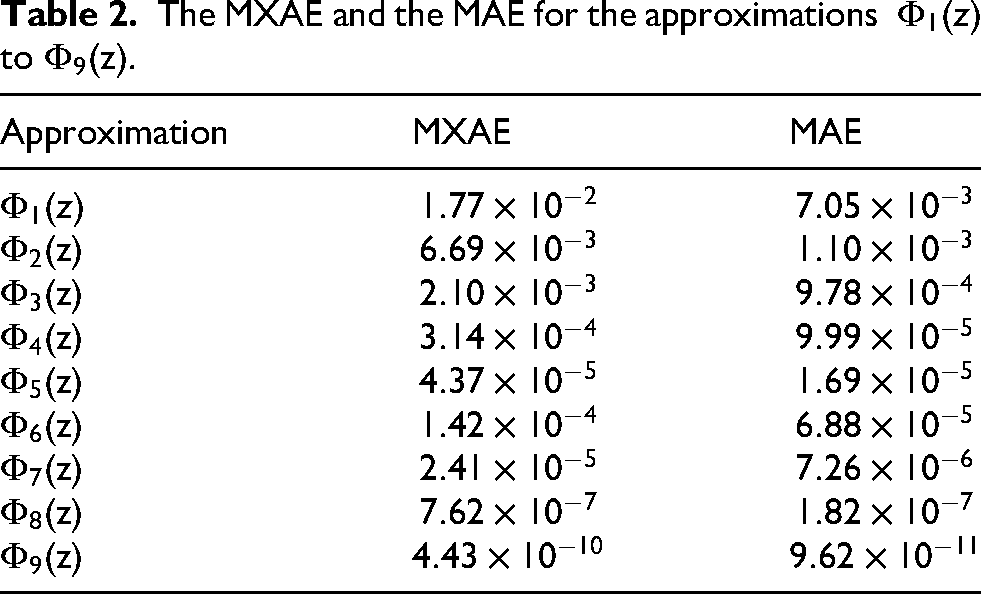
To shed more light on the accuracy of variant approximations of that discussed in this article, we obtain the values of for each approximation depending on grid values of z starting from 0 to 5 with step 0.001 and we summarize these results in Table 2. To simplify the comparison mechanism, we include, in Table 2, the values of the approximations discussed in this article.
The and the for the approximations to .
Approximation
MXAE
MAE
Table 2 clearly shows that the proposed approximation is more accurate than the other approximations based on the two criteria and .
The other part of our computational aspect focuses on investigating the accuracy of the proposed approximation A number of values for z are selected from 0 to 4.8 with step 0.4. For each value of z, we compute the corresponding value of and then we obtain the proposed estimate (. For sake of comparison, we include the results of the two approximations and in Tables 3 and 4.
The three approximations of z obtained at selected true values of z corresponding to .
0.0
0.5000
0.000
0.000
0.000
0.4
0.6554
0.3976
0.4084
0.4000
0.8
0.7881
0.7969
0.8024
0.8000
1.2
0.8849
1.1989
1.1948
1.1999
1.6
0.9452
1.6038
1.5932
1.6003
2.0
0.9773
2.0093
1.9993
1.9975
2.4
0.9918
2.4105
2.4097
2.3864
2.8
0.9974
2.7999
2.8168
2.7660
3.2
0.9993
3.1686
3.2109
3.1386
3.6
0.9998
3.5084
3.5826
3.5068
4.0
0.99997
3.8130
3.9239
3.8725
4.4
0.99999
4.0783
4.2293
4.2366
4.8
1.0000
4.3032
4.4958
4.5997
The differences , corresponding to the approximation of z evaluated at selected exact values of z.
0.0
0.5000
0.
0.
0.
0.4
0.6554
−0.00238
0.00839
−0.00002
0.8
0.7881
−0.00313
0.00237
3.28071 × 10⁻⁶
1.2
0.8849
−0.00107
−0.00521
−0.00009
1.6
0.9452
0.00380
−0.00685
0.00025
2.0
0.9773
0.00932
−0.00070
−0.00025
2.4
0.9918
0.01051
0.00972
−0.01360
2.8
0.9974
−0.00015
0.01681
−0.03403
3.2
0.9993
−0.03141
0.01094
−0.06142
3.6
0.9998
−0.09157
−0.01738
−0.09318
4.0
0.99997
−0.18706
−0.07607
−0.12752
4.4
0.99999
−0.32173
−0.17066
−0.16342
4.8
1.0000
−0.49679
−0.30416
−0.20026
This allows the reader to compare the values of the different approximations with the exact values of z (first column). To simplify the comparison process, we provided the differences for in Table 4.
Table 3 clearly shows that the proposed approximation is more accurate than and especially when the exact value of . Table 4 emphasizes on the high quality of the proposed estimator in view of the values of All results and graphs are obtained by using Mathematica, Version 12.
Discussion
In this article, we focused on developing a new approximation of the cumulative normal distribution for given values of z. In addition, we suggested an invertible approximation of z for given values of Accordingly, it is found that the performance of the proposed approximation is dominant when compared to some of the existing approximations for a wide range of true values of z.
Footnotes
Declaration of conflicting interests
The author(s) declared no potential conflicts of interest with respect to the research, authorship, and/or publication of this article.
Funding
The author(s) received no financial support for the research, authorship, and/or publication of this article.
ORCID iD
Omar M. Eidous
References
1.
EdousMEidousO. A simple approximation for normal distribution function. Math Stat2018; 6: 47–49.
2.
EidousOAbu-HawwasJ. An accurate approximation for the standard normal distribution function. J Inf Optim Sci2021; 42: 17–27.
3.
EidousOAbu-ShareefaM. New approximations for standard normal distribution function. Commun Stat Theory Methods2020; 49: 1357–1374.
4.
HanandehAEidousO. A new one-term approximation to the standard normal distribution. Pak J Stat Oper Res2021; 17: 381–385.
5.
TanashIMRiihonenT. Global minimax approximations and bounds for the Gaussian Q-function by sums of exponentials. IEEE Trans Commun2020; 68: 6514–6524.
6.
ZhangZFangJLinJ, et al.Improved upper bound on the complementary error function. Electron Lett2020; 56: 663–665.
7.
EidousO. New tightness lower and upper bounds for the standard normal distribution function and related functions. Math Methods Appl Sci2023; 46: 15011–15019.
HanandehAEidousOM. Some improvements for existing simple approximations of the normal distribution function. Pak J Stat Oper Res2022; 18: 555–559.
10.
LinJT. A simpler logistic approximation to the normal tail probability and its inverse. Appl Stat1990; 39: 255–257.
11.
DivgiDR. Approximations for three statistical functions. Arlington, Virginia, USA: Center for Naval Analyses, 1990.
12.
VedderJD. An invertible approximation to the normal distribution function. Comput Stat Data Anal1993; 16: 119–123.
13.
BoirojuNKRaoKR. Logistic approximations to standard normal distribution function. ASR2014; 28: 27–40.
14.
TocherKD. The art of simulation. London: English Universities Press, 1963.
15.
WaissiGRRossinDF. A sigmoid approximation to the standard normal integral. Appl Math Comput1996; 77: 91–95.
16.
BowlingSRKhasawnehMTKaewkuekoolS,et al.A logistic approximation to the cumulative normal distribution. J Ind Eng Manage2009; 2: 114–127.
17.
EidousOMAnanbehEA. Approximations for cumulative distribution function of standard normal. J Stat Manage Syst2022; 25: 541–547.
18.
SchmeiserBW. Approximations to the inverse cumulative function, the density function and the loss integral of the normal distribution. J R Stat Soc C1979; 31: 108–114.
19.
ShoreH. Approximations to the inverse cumulative normal function for use on hand calculator. Appl Stat1982; 28: 175–176.
20.
PolyaG. Remarks on computing the probability integral in one and two dimensions. Proceedings of the First Berkeley Symposium on Mathematical Statistics and Probability1949; 1: 63–78.