



Abstract
The Gaussian Q-function (GQF) is widely used in various scientific and engineering fields, especially in telecommunications and wireless communication. However, the lack of a closed-form expression for this function has led to considerable research efforts to achieve more accurate approximations. This study introduces a new approximate method that provides high accuracy for the boundaries of the GQF. The proposed approach utilizes parametric functions for both the lower and upper bounds of the GQF. The parameters of these functions are estimated using the Wild Horse Optimization (WHO), a meta-heuristic optimization algorithm, with the aim of minimizing the distance between the proposed functions and the actual GQF. The optimization process targets the minimization of the maximum absolute error and the mean absolute error, ensuring that the proposed bounds provide a tight and accurate approximation of the GQF. Numerical experiments and comparisons with existing bounds demonstrate the superior accuracy of the proposed method. The new lower and upper bounds achieve significantly lower maximum absolute error and mean absolute error values compared to previous approaches. Furthermore, the study evaluates the effectiveness of the proposed bounds in estimating the symbol error probability (SEP) for various digital modulation schemes, showing that the new bounds provide more accurate estimates of the SEP compared to the existing bounds. The results highlight the practical significance of the proposed method in enhancing the reliability of error probability estimation in communication systems.
Keywords
Introduction
The Gaussian Q-function (GQF), denoted as

The 20 mutual relations among the 5 functions

Nomenclature.

The article is structured as follows: the second section introduces the related work, the third section covers the basic concepts, the fourth section details the proposed method for bounding the Q-function, the fifth section presents comparisons and numerical experiments, and the sixth section provides the conclusion of the article.
Related work
The upper and lower bounds of the GQF are obtained from different mathematical methods. The diversity of these bounds is in the way and methods of obtaining them, the accuracy of the bounds, the simplicity of the bounds, etc. In the following, various types of these bounds are mentioned:
Sark and Werner
8
investigated correlation inequalities for Gaussian measures and symmetric convex sets, focusing on the center and convex bodies, and provided more precise bounds and alternative proofs compared to the existing literature. Alzer
9
introduced new methods to analyze and prove theorems related to error functions and provided insights about the behavior of these functions under different conditions. The advantages of the paper are in its detailed mathematical analysis and derivation of exact bounds. Abreu
10
introduced and proved new tight upper and lower bounds on the GQF, aiming to provide tractable and accurate bounds for large exponents. The new methods involve defining conditions for upper and lower bounds using exponential terms and rational coefficients, which are compared with existing approaches Yang and Chu
11
investigate inequalities and properties related to the Mills ratio function, with the aim of finding clear bounds using simple primitive functions. By correcting the existing inequalities and creating new boundaries, it was based on the works of previous authors. Bagul and Chesneau
12
presented a new and more accurate smooth approximation for the error function and provided a comprehensive analysis of its properties and performance in comparison with existing methods, showing a significant contribution in this field. Zoran Perić et al.
7
proposed a new hybrid interval approximation of the Q-function that provides significant improvements in accuracy compared to Q-function approximations of similar analytical forms from the literature. The proposed method is analyzed for its versatility and advantages in the design of wireless communication systems for accurate quality of service estimation, and for issues that occur in the design of scalar quantizers for Gaussian sources. Hang-Deng Zheng et al.
13
presented new and improved exponential upper bounds on the GQF for different modulation techniques over the additive white Gaussian noise (AWGN) and fading channels. The motivation behind this work is to provide tighter upper bounds on the symbol error probability (SEP) function, which plays an important role in the analysis of communication systems. The authors use Jensen's inequality and integration by parts to derive new exponential upper bounds and combine them to obtain a piecewise upper bound. Enas A. Ananbeh and Omar M. Eidous
14
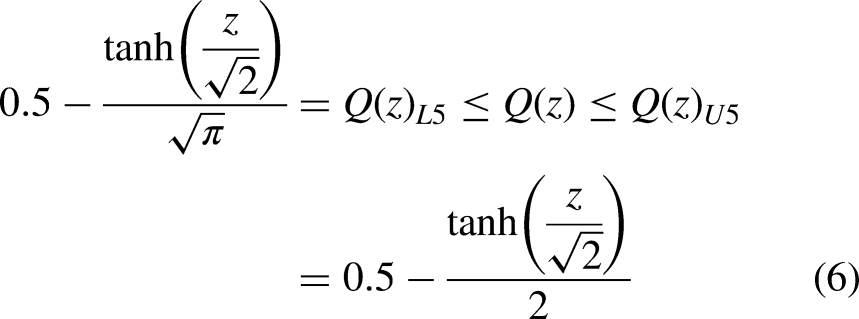
presented simple and portable bounds that are valid for a wider range of values of the standard normal distribution function. The advantages of the method used in this study are that the obtained bounds are simple and portable, and the mean absolute error (MAE) between the bounds and the exact value is generally small.




Preliminary
Maximum absolute error and mean absolute error measures
One metric that can be used to evaluate an approximation's correctness is absolute error (AE). The absolute difference between the approximation and the real value can be used to compute the absolute error (AE) if 


Metaheuristic algorithms
Optimization is the process of finding the best solution to a problem within a given set of constraints. Metaheuristic algorithms are a class of optimization algorithms that are used to find near-optimal solutions for complex problems where exact solutions are difficult or impossible to compute. 15 Metaheuristic algorithms are inspired by natural phenomena or human behavior and are designed to explore the search space efficiently and effectively. Some common metaheuristic algorithms include genetic algorithms, simulated annealing, particle swarm optimization, ant colony optimization, and tabu search. These algorithms are often used in various fields such as engineering, finance, logistics, and machine learning to solve complex optimization problems. 16
Wild Horse Optimization (WHO)
The WHO is a meta-heuristic optimization algorithm inspired by the behavior and social structure of wild horses. The algorithm aims to solve complex optimization problems by mimicking the collective intelligence and group dynamics observed in herds of wild horses. The flow of the WHO algorithm can be described in the following steps:
Initialization:
- The algorithm starts by generating an initial population of candidate solutions, representing the wild horses in the herd. - Each candidate solution is represented by a set of decision variables, which encode the problem-specific information. Herd formation:
- The initial population of wild horses is divided into smaller subgroups or herds, based on factors such as proximity, social relationships, and herd dynamics. - Each herd is led by a lead horse, which represents the best-performing solution in that herd. Herd movement and exploration:
- Within each herd, the wild horses (candidate solutions) move toward the lead horse, exploring the search space around the current best solution. - The movement of the wild horses is guided by a set of rules that mimic the natural behavior of wild horses, such as following the lead horse, maintaining herd cohesion, and avoiding collisions with other horses. - The movement of the wild horses allows them to explore the search space and potentially discover better solutions. Herd evaluation and update:
- After the movement phase, the fitness of the updated candidate solutions is evaluated based on the problem's objective function. - The lead horse of each herd is updated if a better solution is found within the herd. - If a herd's lead horse is not updated for a certain number of iterations, the herd is considered stagnant, and a restructuring process is initiated. Herd restructuring:
- In the herd restructuring phase, the algorithm identifies the stagnant herds and performs various operations to diversify the population and explore new regions of the search space. - These operations may include merging or splitting herds, replacing weaker horses with new random solutions, or introducing random perturbations to the candidate solutions. Termination condition:
- The algorithm continues to iterate through the above steps until a predefined termination condition is met, such as a maximum number of iterations, a target solution quality, or no further improvement in the best solution. Output:
- Upon termination, the algorithm returns the best-found solution as the optimal or near-optimal solution to the problem.
The WHO has been applied to a variety of optimization problems, such as function optimization, scheduling, and engineering design problems, and has shown promising performance compared to other meta-heuristic algorithms.
17
Due to its high performance and ease of implementation compared to other algorithms, as well as the availability of the algorithm's code, this optimizer was used in the present research.
Constraint handling
Meta-heuristic algorithms are well-suited for constrained optimization problems as they do not necessitate a direct representation of the constraints. One common strategy for utilizing meta-heuristic algorithms in constrained optimization problems is to integrate the constraints into the objective function. This may involve penalizing solutions that breach the constraints or employing a constraint handling technique to guarantee that only feasible solutions are examined during the optimization process. To effectively handle the constraints of the problem, the penalty method can be implemented in the following manner:
where
The proposed method for bounding the Q-function
In this section, we present a new method aimed at increasing the accuracy of GQF boundaries. To achieve this goal, we carefully select appropriate basis functions for the boundaries. After a comprehensive review of the relevant literature, we determine the functions introduced by Soranzo and Epure
19
and Lipoth et al.
1
as the optimal basis functions for the upper and lower bounds, respectively. These functions are initially defined parametrically and the WHO algorithm is used to determine the necessary parameters to achieve tighter bounds. The fundamental parametric functions for the lower and upper bounds are as follows:





The accuracy of the proposed boundaries with respect to the Q function.
Comparisons and numerical experiments
Comparisons
This section evaluates the accuracy and robustness of the proposed boundaries. Among the introduced boundaries, those that offer high accuracy and invertible approximations are considered to have more practical applications. Typically, two criteria are utilized for comparing accuracy: mean absolute error (
Comparison of the Maximum absolute error and mean absolute error of the boundaries.
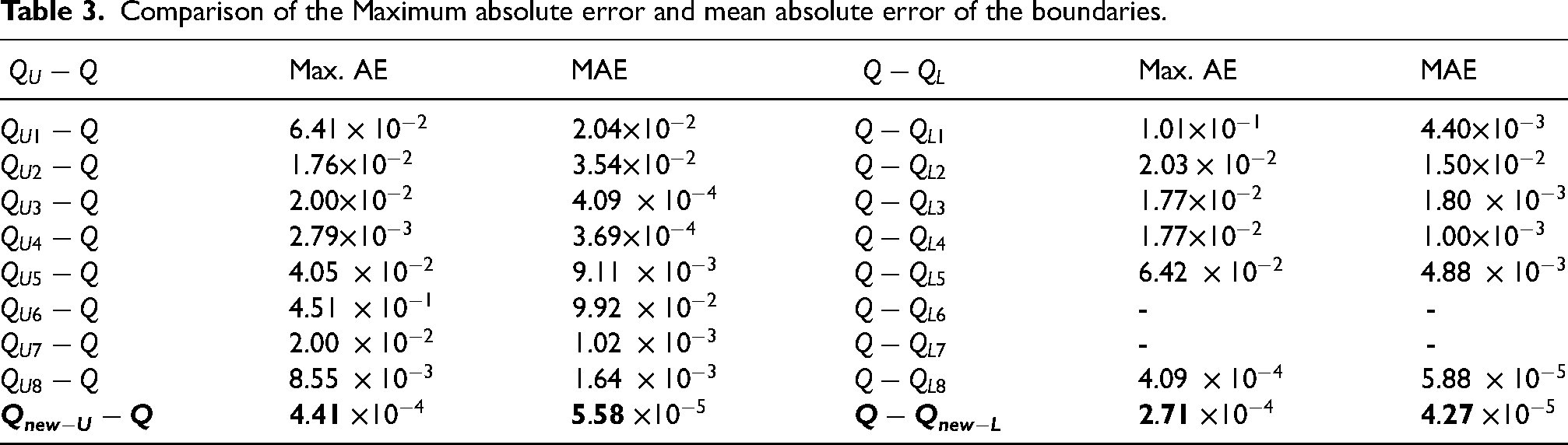
The results demonstrate that despite its simplicity and reversibility, the proposed approximation exhibits lower errors compared to other competing boundaries.
Numerical experiments
In this part, we calculate the SEP expressions for several digital modulation schemes using the present boundaries. The integrals in these formulae are the product of the fading probability density function and the GQF. The following is how the integral is represented
20
:
This section evaluates the effectiveness of the proposed bounds and those discussed in the second section for estimating upper and lower bounds on the symbol error probability. In Table 4, a comparison is made to demonstrate the accuracy of the proposed upper bound against several existing upper bounds in estimating the symbol error probability for different values of
Approximation errors between different approximation integrals (based on upper bound Q).

Approximation errors between different approximation integrals (based on lower bound Q).

Conclusion
This study introduced a new method for approximating the upper and lower bounds of the GQF. The proposed approach utilizes parametric functions and employs the WHO algorithm to estimate the parameters of these functions. The goal was to minimize both the maximum absolute error (Max. AE) and the mean absolute error (MAE) between the approximations and the true GQF. The results demonstrate that the proposed bounds outperform several existing bounds in terms of accuracy. The new lower bound,
Footnotes
Declaration of conflicting interests
The authors declared no potential conflicts of interest with respect to the research, authorship, and/or publication of this article.
Funding
The authors received no financial support for the research, authorship, and/or publication of this article.
