




Abstract
Greenhouse gas emissions have brought serious negative impacts on human beings and organisms, so energy saving and emission reduction have been recognized by more and more people. Traditional Milk-run model seldom considers the factors of energy saving and emission reduction, and its routing optimization cannot meet the current needs of low-carbon economic development. On the basis of traditional Vehicle Routing Problem research, considering the fixed cost, time penalty cost, energy consumption cost and carbon emission cost of vehicles, the Milk-run model of distribution routing considering carbon emissions under time window constraints is studied. Then the improved ant colony algorithm is used to solve the constructed model. Finally, the order and related data of a company are used to verify the validity and practicality of the model and algorithm. Compared to the scanning method, the results show that not only the total journey distance has been shortened but also the total cost and cost of carbon emissions have been reduced. The optimization of distribution routing considering carbon emissions can reduce the distribution cost of logistics enterprises, respond to the call of low-carbon development in China and help to achieve a win-win situation of social and economic benefits.
Introduction
In recent years, the competition among automobile manufacturers has been becoming more and more fierce in China. In order to reduce the cost and improve the competitiveness, an increasing number of automobile manufacturing enterprises put ‘lean production’ into practice. Simultaneously, they also benefit from an efficient logistics system as ‘third profit source’. According to statistics, the inbound logistics accounts for 70% of the total logistics costs of automotive enterprises, and reasonable vehicle path planning is the key to the operation management on inbound logistics. The transportation route optimized by Milk-run mode can effectively reduce the transportation cost. However, traditional logistics and distribution pay more attention to economic costs, ignoring the carbon emissions of vehicles, and the concept is inconsistent with low-carbon development. Therefore, the exploration of the optimization of logistics and distribution routes based on the low-carbon concept has a strong practical significance.
The Milk-run problem is a kind of vehicle routing problem (VRP). Scholars have conducted extensive research on it from different perspectives since the first proposition of this issue was put by Dantizg and Rams in 1959. 1 These scholars are Gutierrez et al., 2 Errico et al., 3 Xuping et al., 4 Yaming et al., 5 Sacramento et al., 6 Belgin et al., 7 Fink et al., 8 Li et al., 9 Xue et al., 10 Timo, 11 Wang et al., 12 Hoogeboom et al. 13 Rostami et al., 14 Uit het Broek et al., 15 Hoogeboom et al., 13 Dumez et al., 16 Zhang et al., 17 Pessoa et al., 18 and so on. However, most of these studies consider how to reduce the total cost of distribution from the view of economy. With the national attention to ecological civilization construction, energy conservation and emission reduction, some scholars consider low-carbon factors (Li et al., 19 Wang et al., 20 Liu et al., 21 Balamurugan et al., 22 Yu et al., 23 Guo et al., 24 Chen et al., 25 Wang et al., 26 Zhang et al., 27 Wu et al., 28 Abdullahi et al., 29 Qiu et al., 30 Abdi et al., 31 Alkaabneh et al., 32 Andelmin and Bartolini, 33 Norouzi et al., 34 Ashtineh and Pishvaee, 35 Basso et al., 36 Niu et al., 37 Bravo et al., 38 Bruglieri et al., 39 etc). Guo et al. 24 built the distribution route optimization model for fresh food e-commerce and verified the effectiveness of the model by using genetic algorithm (GA) and particle swarm optimization algorithm (PSO). Chen et al. 25 proposed the multi-compartment vehicle routing problem with time window arising in fresh food e-commerce by considering carbon emission. Wang et al. 26 established the model of low-carbon cold chain logistics route optimization, and the change of distribution path under different carbon taxes and its influence on total distribution cost was discussed. Wu et al. 28 constructed the green vehicle route model with the goal of minimum travel distance and carbon emissions. The multiobjective evolutionary algorithm was used to solve this problem, and a set of Pareto's optimal solutions was obtained. Qiu et al. 30 constructed the model of distribution route pollution under carbon emission, and the model was proved to be effective in reducing carbon emissions and distribution costs of logistics enterprises. Norouzi et al. 34 constructed a path optimization model with the shortest path and minimum total carbon emission cost by considering the road condition, air resistance and vehicle load, and an improved PSO algorithm was designed. For minimizing the total cost of distribution, Wang et al. 40 established an optimal model and algorithm of cold and multi-temperature co-assignment under random demand. Unlike the above study which did not consider customer delivery time factors, Niu et al. 37 established a mathematical model of the green open vehicle route problem with a time window on the basis of the integrated model emission model, and a mixed taboo search algorithm was designed to solve it. Compared with the closed vehicle path problem, the total cost of opening vehicle path problem would be reduced. Ge et al. 41 established a multi-vehicle path model with a time window considering carbon emission factors and designed a hybrid GA. There are also some scholars who have studied the Milk-run problem (Mao et al., 42 Xiong et al., 43 Wu et al., 44 Ranjbaran et al., 45 Ranjbaran et al., 46 Wang et al., 47 Baran, 48 Güner et al., 49 Bocewicz et al. 50 ). Mao et al. 42 proposed a new logistics method for VRP by embedding the progress-lane into it. Xiong et al. 43 constructed a mixed Milk-run logistics model involved second-level suppliers. Wu et al. 44 studied the multi-factory Milk-run problem under uncertain demand by taking the actual situation of China's automobile industry into account. By taking account of delivery time windows and returning empty pallets from assembly-plants backwards to suppliers, Ranjbaran et al. 45 constructed a mathematical model to minimize total transportation costs. Bocewicz et al. 50 presented a solution to a milk-run vehicle routing and scheduling problem subject to fuzzy pick-up and delivery transportation time constraints.
To sum up, though a lot of progress has been made in VRP, it is rare to be considered about the customer's time window requirements based on the low-carbon background. Some scholars have studied the problem of path optimization in a low-carbon economy, but the fuel consumption model is too simple and idealistic (Wang, 2018) or too complex (Niu, 2018; Li, 2019) to implement easily. On the basis of the above scholar's fuel consumption calculation model, this paper designs a fuel consumption function with vehicle load as an independent variable and builds a corresponding path optimization model by considering about the carbon emission cost and customer's time window requirements. Ant colony algorithm is widely used in combinatorial optimization problems such as traveling salesman and vehicle routing optimization because of its positive feedback mechanism, parallel search and distributed computing. Traditional ant colony algorithm has some problems such as easy convergence to local optimal solution and slow convergence speed. So, an improved ant colony algorithm is proposed for the improvement of the global search capability of the algorithm, which takes the total cost of distribution into account in the transfer probability. The validity of the model is also verified by testing for a case study.
Basic assumptions and symbol descriptions
Basic assumptions
Based on the background of the problem and the objective of the study, the following assumptions are made:
A distribution centre takes goods from multiple suppliers and the site of the distribution centre and the supplier is determined. The vehicle departing from the distribution centre will return to the starting point after delivery. The delivery mode is as shown in Figure 1. The delivery quantity for each supplier is fixed and will not exceed the vehicle's capacity. The operation cost of each vehicle consists of fixed cost and variable cost. The fixed cost is known, and the variable transportation cost is a linear function of driving distance. The goods for each supplier are distributed by the same vehicle and they are not split into several deliveries. If the delivery time doesn't meet the customer's requirements on time window, the carrier will be punished. The vehicle runs at a uniform speed.
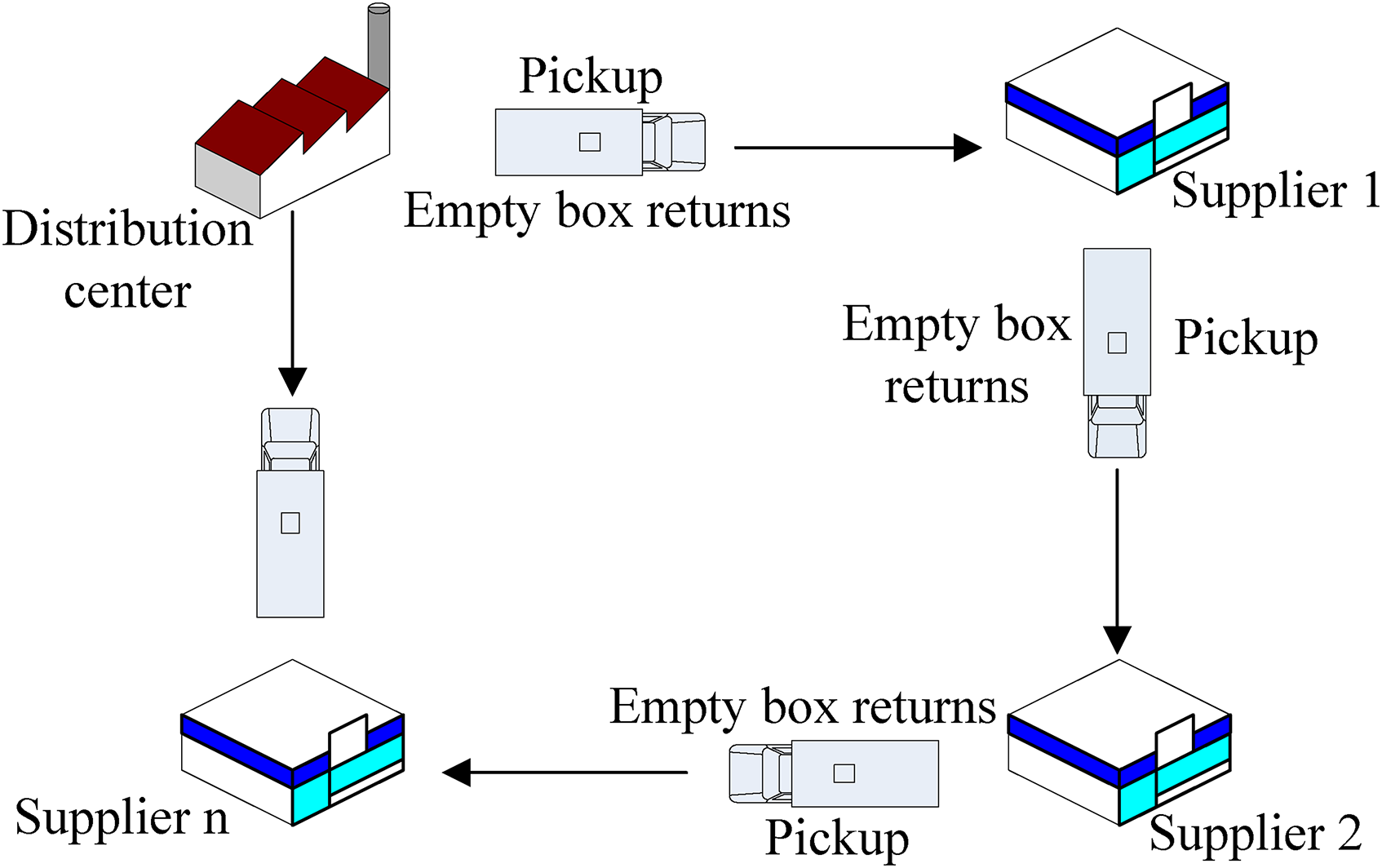
Milk-run mode.
Parameters and variables
The parameters and variables used in the model are described as follows:
Model formulation and ant colony algorithm solution
In this part, we first build a path optimization model considering carbon emissions and time window constraints and then propose an ant colony algorithm program.
Model formulation
The fixed cost of vehicle

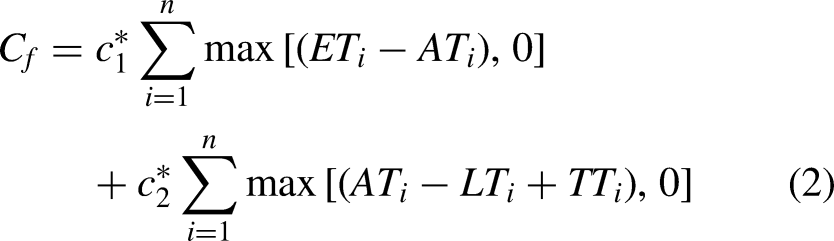
The time penalty cost
The fuel consumption cost

The carbon emissions cost

The total distribution cost




Formula (5) is the objective function, indicating that the total distribution cost is minimized; Formula (1) is the fixed cost of the vehicle, including the vehicle's abrasion and the salary for the driver. Formula (2) is the time penalty cost when the delivery vehicle does not meet the time window requirements. Formula (3) is the fuel consumption cost related to the vehicle's driving distance and the carrying load. Formula (4) is the carbon emissions cost related to fuel consumption and travel distance by the vehicle.
The meaning of each constraint is as follows:
Formula (6) indicates that all vehicles depart from the distribution centre and return to it after distribution.
Formula (7) indicates that each supplier has only one vehicle to use.
Formula (8) indicates that the total weight does not exceed the maximum load of the vehicle.
Formula (9) indicates that the vehicle must leave the supplier after finished pickup.
Formula (10) represents the running time during which the vehicle travels from the node i to the supplier j.
Formula (11) and formula (12) represent integer constraints.
Improved ant colony solution algorithm
Parameters and meaning of ant colony algorithm
The optimizing steps of improved ant colony algorithm
Path construction for ant colony
Let
It is assumed that the pheromone strength of each path is equal at the initial time, that is,

Updating of pheromones
Over time, the new pheromones add up and the old ones evaporate,



Calculation steps of ant colony algorithm
Parameter initialization. Initialize the parameters such as m,
All ants set off from the distribution centre and updated the tabu table for each ant, marking the first node as the point visited by the ant.
Determine whether the time window requirements and vehicle load limits are met when the vehicle is being distributed. If not, go to (2), otherwise, go to (4).
According to the random state transfer rule, each ant k should be transferred to the next supplier j, while j is placed in the taboo table of ant k. The cycle won't stop until all ants complete the distribution of n suppliers.
Calculate the distribution route length and cost of each ant, and record the current optimal cost, route length and distribution sequence.
Update the pheromones on each side according to formulae (14), (15) and (16).
For the sides
Judge whether
The minimum cost, the length of the path and the distribution sequence of this calculation are output.
The procedure of ant colony algorithm is shown in Figure 2.

The procedure of the ant colony algorithm.
Case analysis
Basic data
A company distributes goods for 15 suppliers around a city, the data about distribution centres and suppliers are shown in Table 1, where serial number 0 represents distribution centres and serial numbers 1 to 15 represent suppliers. Other parameters are: (1) The capacity of the vehicle is five tons; (2) The fixed cost is 300 yuan; (3) The unit fuel consumption cost is 6000 yuan per ton; (4) The unit carbon emission cost is 200 yuan per ton; (5) The penalty cost of arriving earlier than the time window is 10 yuan/h; (6) The penalty cost of arriving later than the time window is 20 yuan/h; (7) Diesel fuel density is 0.00084 tons per litre; (8) Diesel fuel CO2 emission factor is 0.00264 L/km; (9) The vehicle fuel consumption is 0.24 L/km; (10) The vehicle load is 0.15 L/km and vehicle speed is 50 km/h.
Related data of distribution centre and supplier.

Note: data from an automobile third party logistics company in Shanghai, China.
(Due to the need of confidentiality, the company name is anonymous).
The spatial distribution of suppliers is shown in Figure 3. The numbers in brackets are supplier number and it's demand, the triangle in the figure is distribution centre, and the dot is supplier node.

Spatial distribution and demand of suppliers and distribution centre.
Model solving
In this paper, MATLAB is used to solve the mathematical model of considering carbon emissions under time window constraints. The parameters of the ant system are

Relationship between iteration number and cost.
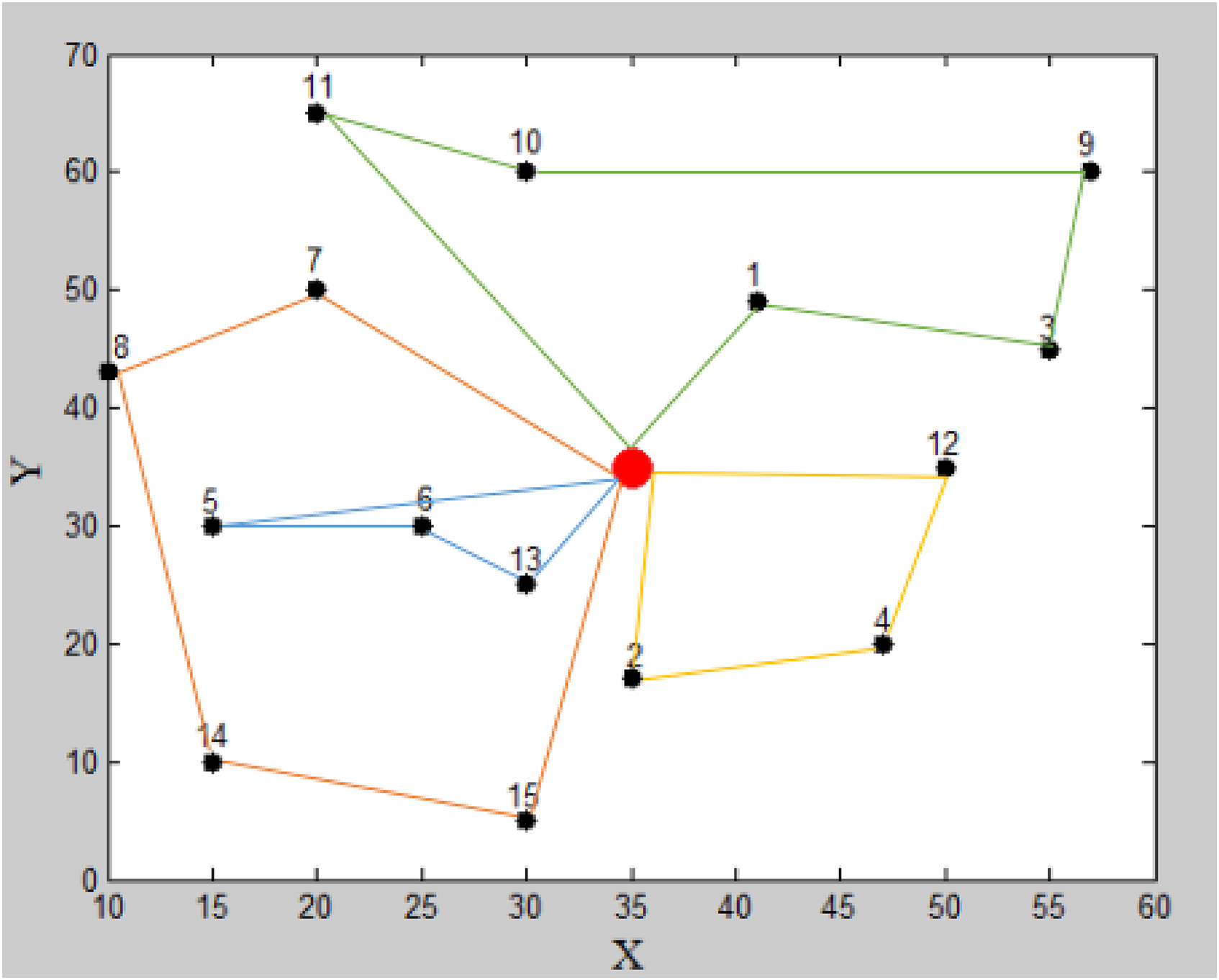
The optimal distribution paths.
Distribution routes and load rates.

In order to prove the advantages of the ant colony algorithm in considering carbon emissions under time window constraints, we compare them by scanning method, as shown in Table 3.
Comparative analysis of optimization results.

It can be seen from the table that the time cost increases by 4.8% compared to the scanning method for the reason that the ant colony algorithm comprehensively considers the total distribution cost. However, the total journey distance is shortened by 4.6%, and the total cost is reduced by 14.0%. Specifically, the fixed cost is reduced by 20.0%, the energy consumption cost reduced by 2.7% and the cost of carbon emissions was reduced by 27.0%. In addition, the average loading ratio increased by 23.7%.
Conclusion
The research of VRP in low-carbon environment has very important practical significance for today's logistics enterprises to comply with the trend of energy saving and emission reduction and also helps to promote the realization of resource-saving and environment-friendly sustainable development social goals in China. This paper constructs a path optimization model including fixed cost, time-constrained cost, fuel consumption cost, carbon emission cost of distribution vehicles and designs an improved ant colony algorithm to solve the problem. Finally, using the example of logistics company to verify the effectiveness of the model and the algorithm. Results show that the model can not only reduce the total distribution cost of logistics enterprises but also take into account the economic and social benefits. Moreover, the algorithm has a good convergence. It should be pointed out that when constructing the carbon emission path optimization model under the constraints of the time window, the factors affecting the carbon emissions such as the real-time status of the road and the speed of the vehicle can be considered in the future research to make the model more realistic.
Footnotes
Acknowledgements
We would like to express our sincere gratitude to the editor and anonymous referees for their insightful and constructive comments, which have greatly helped us to improve the manuscript.
Declaration of conflicting interests
The author(s) declared no potential conflicts of interest with respect to the research, authorship, and/or publication of this article.
Funding
The author(s) disclosed receipt of the following financial support for the research, authorship, and/or publication of this article: This paper is supported by Hunan Provincial Philosophy & Society Science Foundation (No.17YBA241); Science & Technology Program of Changsha (No.kq2014007); MOE (Ministry of Education in China) Project of Humanities and Social Sciences (No. 18YJA790026), Scientific Research Fund of Hunan Provincial Education Department (18A371).
