




Abstract
In order to improve the convergence speed and optimization accuracy of the bat algorithm, a bat optimization algorithm with moderate optimal orientation and random perturbation of trend is proposed. The algorithm introduces the nonlinear variation factor into the velocity update formula of the global search stage to maintain a high diversity of bat populations, thereby enhanced the global exploration ability of the algorithm. At the same time, in the local search stage, the position update equation is changed, and a strategy that towards optimal value modestly is used to improve the ability of the algorithm to local search for deep mining. Finally, the adaptive decreasing random perturbation is performed on each bat individual that have been updated in position at each generation, which can improve the ability of the algorithm to jump out of the local extremum, and to balance the early global search extensiveness and the later local search accuracy. The simulating results show that the improved algorithm has a faster optimization speed and higher optimization accuracy.
Introduction
In recent years, many scholars, inspired by animal habits and laws in nature, have proposed some heuristic intelligent optimization algorithms. For example, genetic algorithm for simulating the genetic mechanism of biological evolution, 1 particle swarm optimization algorithm for simulating the foraging behavior of a flock of birds,2,3 ant colony algorithm for simulating the ant colony finding the shortest path during the foraging process, 4 cuckoo search algorithm for simulating cuckoo parasitism breeding habits,5,6 gray wolf optimizer algorithm for simulating gray wolf level hierarchies and predation processes, 7 whale optimization algorithm for simulating humpback whales predation characteristics, 8 dragonfly algorithm for simulating the foraging and migration process of dragonflies 9 and so on.
In 2010, Yang, a scholar from University of Cambridge, proposed a new heuristic intelligent optimization algorithm called Bat Algorithm. 10 The bat algorithm is proposed by simulating bats sending and receiving ultrasonic waves to prey. At present, bat algorithms have been practically applied. For example, interaction testing, 11 the fuel arrangement optimization of reactor core, 12 continuous optimization problems, 13 multi-objective optimization of shell and tube heat exchangers, 14 linear antenna array failure correction, 15 the travelling salesman problem, 16 large scale cloud manufacturing service composition, 17 numerical optimization problems 18 electric load forecasting 19 and so on.
Although the bat algorithm has been applied in many fields, the bat algorithm still has the disadvantages that it is easy to fall into local extremum, the optimization accuracy is not high, and the convergence speed of the algorithm is slow in the later period. To address these deficiencies, many scholars have proposed improvements to the bat algorithm. For example, the reference 20 introduced simulated annealing and Gaussian perturbations into the basic bat algorithm to improve optimization performance of the algorithm. The reference 21 applied the mechanism of crossover mutation to the basic bat algorithm, and improved the update formula of loudness and pulse emission rate, so that the algorithm breadth exploration and depth mining ability are balanced. The reference 22 introduced the acceleration factor and individual cognition in the particle swarm optimization algorithm into the basic bat algorithm, expanded the search range of the bat population, and improved the convergence accuracy of the algorithm. The reference 23 incorporated starling flock behavior into the bat algorithm and expanded the optimization range of the algorithm. At the same time, it introduced the linear decreasing weight to balance global exploration and local search ability. The reference 24 introduced the idea of interpolation into the basic bat algorithm. According to the bat's individual historical flight trajectory, it fited the flight curve to predict the next position of the bat, thereby improved the global optimizing ability of the bat population. The reference 25 introduced a mutation switching function to maintain a high diversity of bat populations, integrated uniform mutations and Gaussian mutations at the same time, and improved local searching ability of the algorithm. The reference 26 adopted the strategy of average optimal position to improve the convergence rate of the algorithm, and introduced quantum behavior to enhance the flexibility of bats, so that the algorithm had a better ability to adapt to complex environment. The reference 27 introduced an iterative local search algorithm in the local search, which enhanced the ability of the algorithm to jump out of the local optimum, and introduced the random inertial weight to enhance the diversity and flexibility of the bat population. The reference 28 introduced the orientation strategy into bat algorithm to improve the optimization ability of the algorithm, and used the improved algorithm to optimize the constrained design of laminated composites. The reference 29 introduced the mechanism of backward learning and tangent random exploration into bat algorithm to improve the solve ability of the algorithm, and enhanced the feasibility and effectiveness for solving robot's global path planning problem. The reference 30 introduced the invasive weed optimization algorithm into bat algorithm, which made the iwba algorithm more effective and accurate in image segmentation. The reference 31 introduced an improved bat algorithm, and the improved MBA algorithm improved the exploration and development ability of bat algorithm. The reference 32 introduced the multi-objective bat algorithm, and used the algorithm to solve the new configuration design problem of single-mode fiber Raman amplifier, which expanded the application range of the algorithm. The reference 33 proposed chaotic efficient bat algorithm, based on the chaotic, niche search, and evolution mechanisms and used to optimize the parameters of the hybrid kernel-based support vector regression model. The reference 34 proposed adaptive coevolutionary bat algorithm. The adaptive evolutionary population structure is used to improve the convergence ability and optimization accuracy of the algorithm. The reference 35 introduced the principle of bat algorithm and used the algorithm to solve the problem of the planning of distribution center.
These improvements improved the convergence and accuracy of basic bat algorithm from different aspects, but bat algorithm still has room for improvement. This paper proposes a bat optimization algorithm with moderate optimal orientation and random perturbation of trend (OPBA). The improved algorithm introduces nonlinear variation factor in the velocity update equation of the global search stage to improve the bat population diversity. In the local search stage, a mechanism of modestly trend towards optimal value is used to improve the local search ability of the algorithm. Finally, a self-adaptive decreasing random perturbation strategy is added to reduce the probability of the algorithm falling into local extremum, effectively balancing global search and local mining capability of the algorithm. By selecting several classical objective functions with different optimization characteristics, the improved algorithm is compared with several other algorithms. The simulating results fully prove the effectiveness of the improved algorithm.
The basic bat algorithm
In the basic bat algorithm, each bat is viewed as a “massless, no-size” particle that represents a feasible solution in the solution space. For different fitness functions, each bat has a corresponding function value and determines the current optimal individual by comparing the function values. Then, the frequency of acoustic wave, velocity, the rate of pulse emission, and loudness of each bat in the population are updated, iterative evolution is continued, and the current optimal solution is approached and generated, and the global optimum solution is finally found. The algorithm updates the frequency, velocity, and position of each bat as follows:



Where
Once the bat finds the prey, which is close to the global optimal solution, a local search strategy is used near the current optimal individual. The generated uniform distribution random number

Where
As the number of iterations increases, the loudness of the bat


Where
The improved algorithm
Moderately optimal orientation
(1) In the global search stage, it can be seen from the equation (3) that the velocity

In the equation (7),

Where
(2) In the local search stage, bat individuals search for the optimal solution around the current optimal individual. During this process, on the one hand, the bat individual's search cannot be too far away from the current optimal individual, because if the distance is too far, it becomes a global search, losing the deepth mining ability of the local search. On the other hand, the distance cannot be too close, because if the distance is too close, it is easy to get the algorithm into a local optimum. Based on the above considerations, integrating some optimization ideas of the whale algorithm,
28
in the local search stage, the following position update equation is proposed:

In the equation (9),
Random perturbation of trend
In order to further improve the global convergence accuracy and avoid the algorithm falling into local extremum, a random perturbation mechanism was added after the bat individuals were updated. The specific way of perturbation is as follows:


Pseudo code of the improved algorithm
Objective function
Generate initial population of bat individuals,
Define each parameter
Evaluate the fitness function value for each bat;
Compare these fitness values and find the current optimal value
Use equations (1), (7) and (3) to update every bat’s rate of pulse emission, velocity and position. So as to get the new bat position
Evaluate the fitness function value for
Generate uniform random number
Use the equation (9) to perform a local search near the current optimal individual to create a new position
Use equations (10) and (11) to perturb the bat position
Evaluate the fitness function value for
Replace the value of
Generate uniform random number rand;
Accept the bat individual position
Update the loudness
Accept
Output the global optimal solution;
Experiment and result analysis
Optimization test function
In order to verify the optimization ability of the improved algorithm in this paper, the particle swarm optimization algorithm (PSO), 3 basic bat algorithm (BA), 8 a novel bat algorithm with habitat selection and Doppler effect in echoes for optimization (NBA) 36 and improved algorithm of this paper (OPBA) were used to compare simulating experiments on 10 classical test functions.37,38The specific test function is as follows:
Sphere function
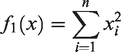
This function gets a minimum value 0 at
Schwefel’s problem 2.21function

This function gets a minimum value 0 at
Griewank function

This function gets a minimum value 0 at
Sum squares function

This function gets a minimum value 0 at
Alpine function

This function gets a minimum value 0 at
Rotated hyper-ellipsoid function
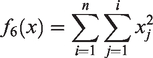
This function gets a minimum value 0 at
Branins’srcos function

This function gets a minimum value 0.3979 at.
Ackley function

This function gets a minimum value 0 at
Easom function

This function gets a minimum value −1 at
Powell function

This function gets a minimum value 0 at
Among these 10 test functions,
Experimental environment and parameted settings
In order to ensure the objectiveness and fairness of the algorithm comparison, the PSO, BA, NBA, and OPBA algorithms all use the same hardware and and software platforms. The operating environment is Windows7 and the programming environment is Matlab R2014a. In the simulating experiment, the population size, maximum number of iterations, and space dimension of the four algorithms are consistent, that is,
Optimization accuracy analysis
The four algorithms PSO, BA, NBA, and OPBA run independently 30 times in the same environment. The dimension of the high-dimensional functions
Four algorithms simulating results in function

Four algorithms simulating results in function
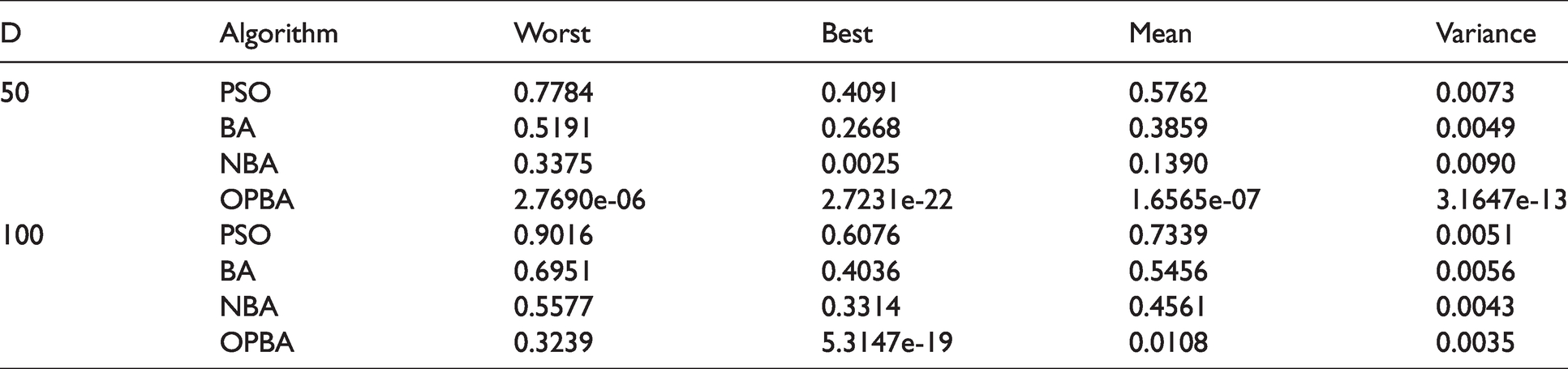
Four algorithms simulating results in function
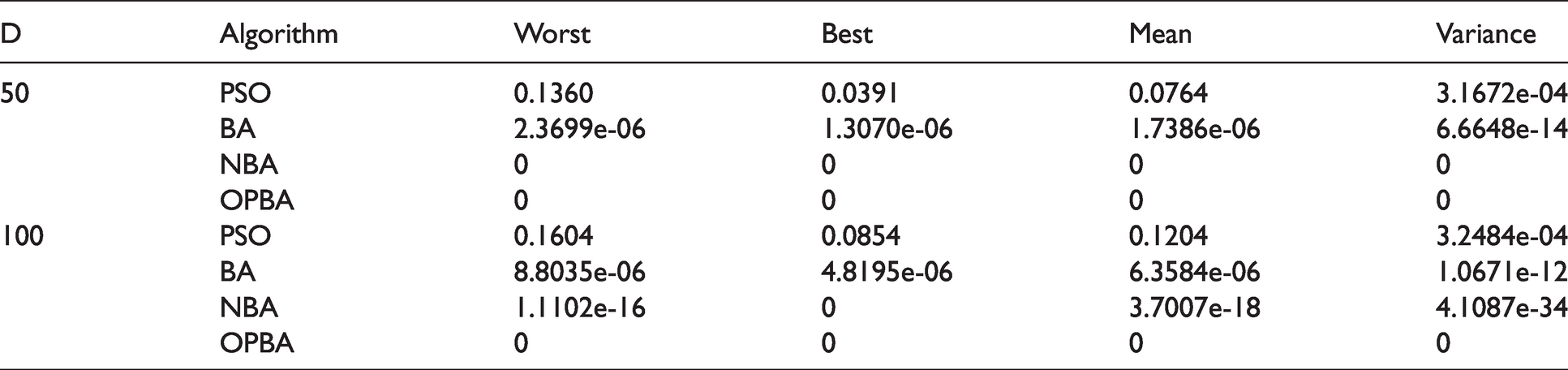
Four algorithms simulating results in function

Four algorithms simulating results in function
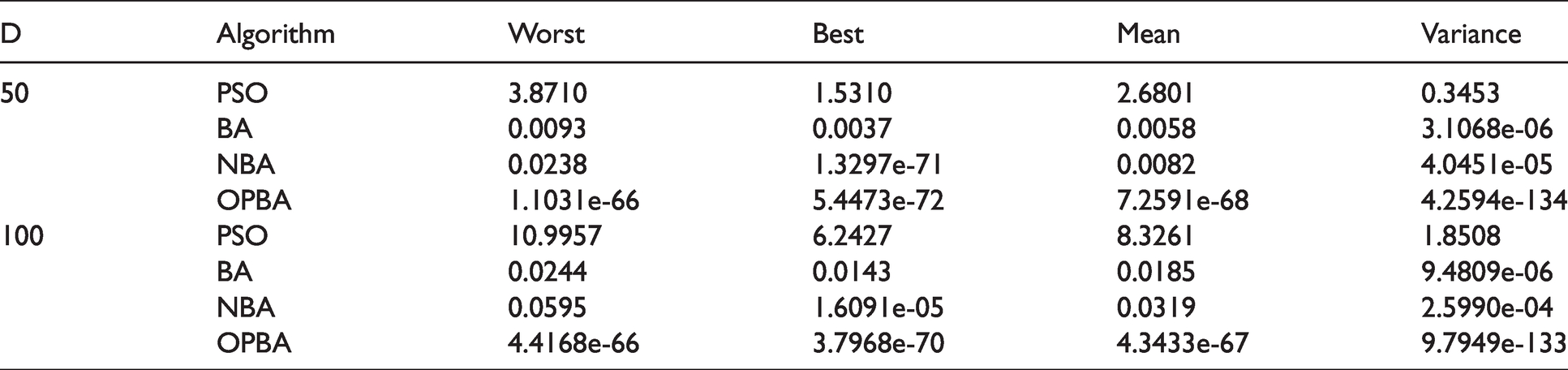
Four algorithms simulating results in function

Four algorithms simulating results in function

Four algorithms simulating results in function

Four algorithms simulating results in function

Four algorithms simulating results in function

It can be seen from the data in Tables 1 to 10 that the accuracy and stability of the OPBA algorithm proposed in this paper are better than that of the other three algorithms under the same dimension of the same function in higher dimensions. In the high-dimensional single-peak function
Analysis of convergence curve
The convergence curve can visually show the convergence speed of the algorithm and the ability of the algorithm to jump out of the local extremum. It is an important standard to measure the performance of the algorithm. Figures 1 to 10 is a comparison chart of the convergence curves of the four algorithms.
It can be seen from Figures 1, 4, 5, 6, 8, and 10, the convergence rate of OPBA is much faster than that of PSO and BA. Although the convergence curves of OPBA and NBA are almost coincident, the convergence rate of OPBA is slightly faster than NBA. It can be seen from Figures 2 and 3, although the early convergence speed of OPBA algorithm is not as fast as that of NBA, near the 10th generation, OPBA convergence speeds up. After that, the convergence speed is always higher than that of NBA, indicating that OPBA easily jumps from local optimum. From Figures 7 and 9, we can see that OPBA, NBA, and PSO algorithms achieve the final convergence in about 10 generations, and the convergence speed of these three algorithms is obviously better than BA algorithm, but the convergence speed of OPBA algorithm is slightly faster than that of NBA and PSO algorithms. The above experimental results show that the convergence rate of the improved algorithm in this paper is obviously higher than that of the other three algorithms, and oscillating phenomenon rarely occurs in the convergence process. This is because the mutation factor is introduced into the speed update formula of global search phase in OPBA algorithm, which expands the search range and diversity of bat population. And in the local search stage, a Modestly trend towards optimal value strategy is adopted, and an adaptive random perturbation mechanism is added in each generation of evolution, which reduces the probability of getting trapped in local extremes and speeds up the convergence of the algorithm.

The convergence curve of Sphere function.

The convergence curve of Schwefel’s problem 2.21 function.

The convergence curve of Griewank function.
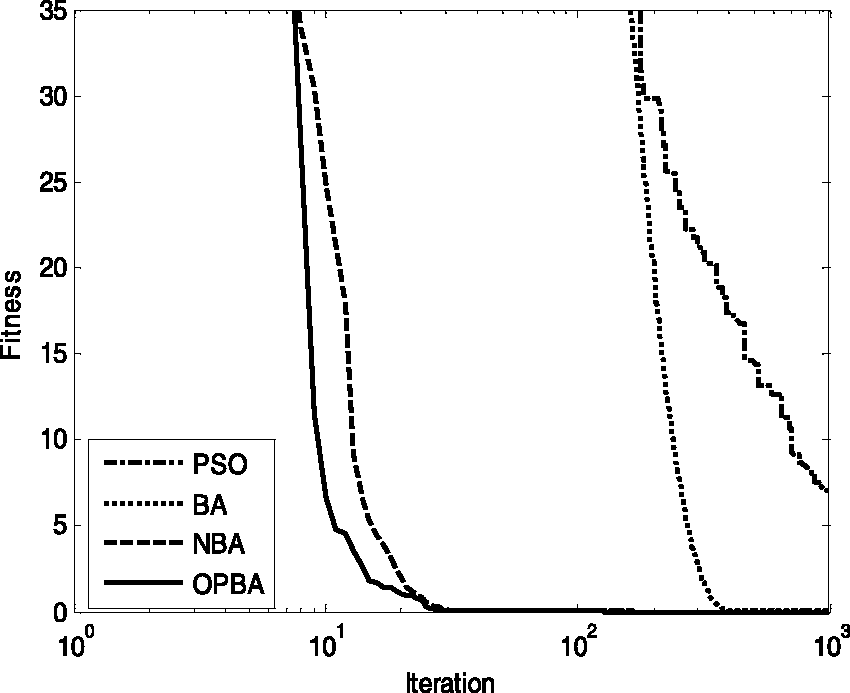
The convergence curve of Sum Squares function.

The convergence curve of Alpine function.

The convergence curve of Rotated Hyper-Ellipsoid function.

The convergence curve of Branins’srcos function.

The convergence curve of Ackley function.

The convergence curve of Easom function.
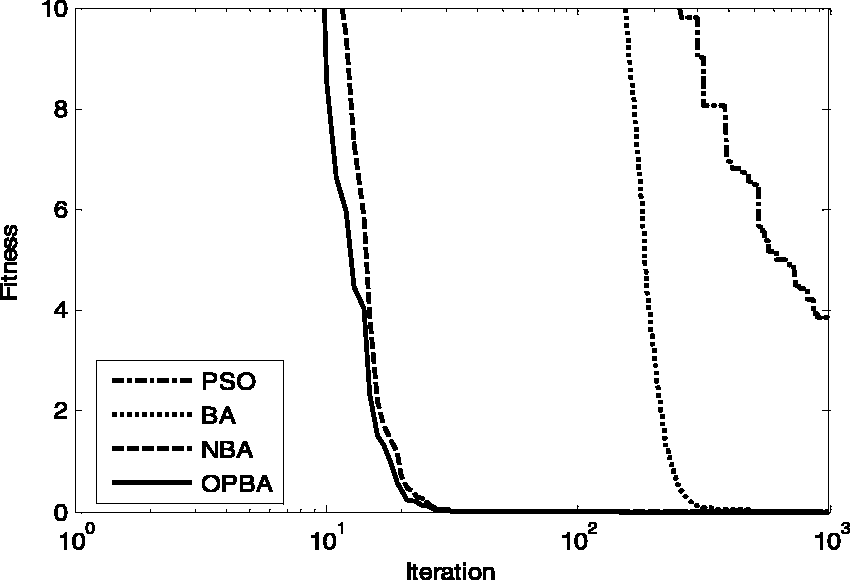
The convergence curve of Powell function.
Conclusion
Aiming at the disadvantages that bat algorithm is easy to fall into local extremum, the precision of searching is not high, and the convergence speed of the algorithm is slow in the later period and so on. This paper proposes a bat optimization algorithm with moderate orientation and perturbation of trend. The algorithm introduces a nonlinear variation factor in the global search stage, which controls the step size of bat individual and expands the bat population search range. In the local search stage, a strategy of modestly trend towards optimal value was adopted to improve the local search ability of the algorithm. At the same time, introducing a random perturbation strategy that decreases with the evolutionary trend makes it easier for the algorithm to jump out of the local extremum, which well balances the breadth of the global search in the early stage and the depth of the local mining in the later period. The simulating results show that the improved algorithm in this paper has faster convergence speed and higher search accuracy.
Footnotes
Declaration of Conflicting Interests
The author(s) declared no potential conflicts of interest with respect to the research, authorship, and/or publication of this article.
Funding
The author(s) disclosed receipt of the following financial support for the research, authorship, and/or publication of this article: This work is jointly supported by the Science & Technology Program of Henan Province, China (Grant No. 182102310886), the Postgraduate Education Innovation and Quality Improvement Project of Henan University (Grant No. SYL19050104 and SYL18020105)..
