




Abstract
In this article, we consider the numerical solution for the time fractional differential equations (TFDEs). We propose a parallel in time method, combined with a spectral collocation scheme and the finite difference scheme for the TFDEs. The parallel in time method follows the same sprit as the domain decomposition that consists in breaking the domain of computation into subdomains and solving iteratively the sub-problems over each subdomain in a parallel way. Concretely, the iterative scheme falls in the category of the predictor-corrector scheme, where the predictor is solved by finite difference method in a sequential way, while the corrector is solved by computing the difference between spectral collocation and finite difference method in a parallel way. The solution of the iterative method converges to the solution of the spectral method with high accuracy. Some numerical tests are performed to confirm the efficiency of the method in three areas: (i) convergence behaviors with respect to the discretization parameters are tested; (ii) the overall CPU time in parallel machine is compared with that for solving the original problem by spectral method in a single processor; (iii) for the fixed precision, while the parallel elements grow larger, the iteration number of the parallel method always keep constant, which plays the key role in the efficiency of the time parallel method.
Keywords
Introduction
We consider the time fractional differential equations as follows:


The presence of the integral in the equation makes the problem “global time dependence”. This means that the solution at a time tk depends on the solutions at all previous time
To resolve this important issue, we adopt the idea of the time parallel method. The parallel in time algorithm for a model ODE was initially introduced by Lions, Maday, and Turinici 9 as a numerical method to solve the evolution problems in parallel. It can be interpreted as a predictor-corrector scheme,10,11 which involves a prediction step based on a coarse approximation and a correction step computed in parallel based on a fine approximation. For the parallel in time method based on the finite difference scheme, the convergence analysis for a ODE problem was given in Gander and Vandewalle. 12 For high accuracy parallel method, Li, Tang and Xu 13 proposed a time parallel based on spectral method for Volterra integral equations and exponential convergence was proved. Xu et al. 14 proposed a time parallel method based on spectral method for TFDEs.
In this work, we propose a parallel in time method based on a spectral collocation scheme and a finite difference method for the TFDEs. The main goal of this method is to parallelize the time discretization to obtain an important speed up which makes it possible to consider the really long integration problems. The method consists in splitting the time domain into a set of subdomains, and breaking the original problem into a series of independent problems on the time subdomains. The key point of this method lies in the design of an efficient iterative process while each step containing a predictor and a corrector solvers. The predictor is solved by a coarse finite difference approximation. Corrector is solved by computing difference between the fine spectral collocation approximation and the finite difference approximation in parallel way. Here, the finite difference method we adopt in parallel method was proposed by Lin.
15
The convergence of the finite difference method was proved to be
This paper is organized as follows. In section 2, we construct the parallel in time method based on the spectral collocation scheme and the finite difference method for the underlying equation. Numerical experiments are carried out in section 3. The efficiency for the proposed method under some assumptions is given in section 4.
The parallel in time algorithm
In order to describe the parallel method for problem (1), we separate the time interval

We denote this partition by
Let
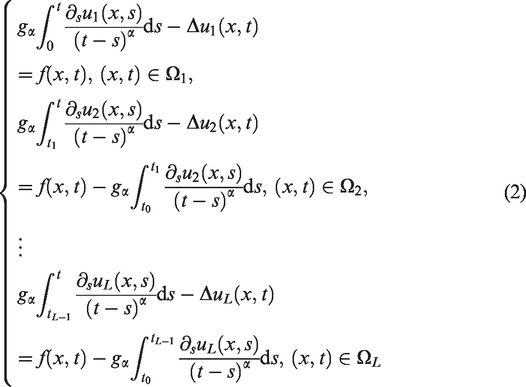
To simplify the notation, we introduce the operator
Let

Let

The discrete L2 inner product associated to the GJ quadrature is denoted by:

Furthermore, we define the Legendre-Gauss (LG) points on the element


The LG points
Now the fine approximation

In the implementation, the integral terms on the left hand sides of (4) are evaluated by using the following Jacobi Gauss quadrature:


The right hand sides of (4) are computed in a similar way:


We will use the operators
In addition to the fine approximations

Comparing this with partition (1), they coincide at the points
For

Now we define the coarse solver
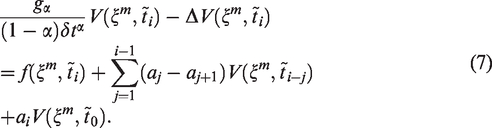
Then the parallel in time algorithm proposes an approximation to each


It is an easy matter to realize first that the method is exact after enough iterations. Indeed, by induction we obtain that
Numerical results
In this section, we present some numerical results obtained by the proposed parallel in time scheme. First, we test the convergence behavior with respect to some parameters of the approximation. Second, we test the efficiency of the parallel iterative scheme.
We consider the following example:


Top:
Next we investigate the convergence behavior with respect to the iteration number k. For a similar reason mentioned above, we now fix a large enough M = 15, N = 15, and let k vary for different values of q. In Figure 2, we plot the error decay with increasing iteration number k for several values of q. It is observed that the error curves are all straight lines in this semi-log representation, which means the convergence of order k with respect to the error associated to the coarse resolution.

In Figure 3, we test the convergence behavior with respect to q in log-log scale for three iteration number k = 2, 3, 5. The errors show an algebraic decay, since in this log-log representation one observes that the error variations are linear versus
Figure 3.

The second purpose is to test the efficiency of the scheme in a parallel machine. In the top of Figure 4, for fixed error less than

For fixed
Parallelism efficiency
Firstly, the classical sequential scheme based on the fine mesh consists of solving the problems

If we implement the scheme (8) in a parallel architecture with enough processors, then for each iteration, the time cost of the master process consists of the computational time for solving a sequential set of L coarse subproblems and the waiting time for solving a fine subproblem on a non-master process. For the coarse subproblem, we apply the finite difference scheme (6) for the time discretization and the spectral method for space discretization. The cost of solving the sequential set of L coarse subproblems is estimated to be

Comparing (11) with (12), we obtain a speed up

If the number of processors is large enough, i.e.,
Conclusions
We propose a parallel in time method, combined with the spectral collocation scheme and the finite difference scheme for the TFDEs. As the domain decomposition method, we break the domain of computation into L subdomains and thus the problem is divided into L sub-problems consequently. Then we solve these sub-problems by a predictor-corrector scheme in a parallel way. The predictor is solved by a cheap coarse approximation based on the finite difference method in sequential way, while the corrector is solved by the expensive fine approximation based on the spectral collocation method in parallel way. Numerical results are carried out to confirm the efficiency of the parallel method. The solution of the iterative scheme converges to the solution of the spectral method. The errors decay spectrally with respect to the polynomial degrees N and M, while the errors decay algebraically with respect to the parameter q of coarse approximation. The convergence of order k (iteration number) with respect to the error associated to the solution solved by the finite difference method is given in Figure 2. In Figure 4, the CPU time cost is compared between the parallel scheme and the sequential scheme based on the spectral collocation method. The efficiency analysis of the proposed method is given. If the number of processors is large enough, and the number of degrees of freedom for the coarse solver is far less than that of the fine solver which means q is small, then the speed up is close to
Footnotes
Declaration of conflicting interests
The author(s) declared no potential conflicts of interest with respect to the research, authorship, and/or publication of this article.
Funding
The author(s) disclosed receipt of the following financial support for the research, authorship, and/or publication of this article: This article is supported by NSFC, grant no. 11771083 and NSF of Fuzhou University through grant GXRC-18035.
