




Abstract
In order to select and recommend the optimal parking lot for the users, a novel intelligent selection algorithm based on the grey relational analysis considering user preferences is proposed. The parking-lot evaluation index system consisting of indicators in effectiveness, convenience, economy, environmental attribute and agreeableness is firstly established. The comprehensive weight determination method combining the expert estimation method with the user preference settings is proposed to determine the comprehensive weight of each evaluation index, and this method can meet the personalized needs of individual user to the greatest extent. The evaluation indexes considering various representative objective and subjective influential factors including the driving distance between the current location and the target parking lot, the walking distance between the target parking lot and the destination, the remaining parking spaces, the parking fee, the condition of the hardware facilities and service quality are determined, and the corresponding comprehensive weight of each evaluation index is calculated. Then the parking lots near the destination are evaluated by the grey relational analysis in order to select the optimal one to the user for parking reservation. This algorithm has been proven to be effective by the APP on Android mobile phones.
Keywords
Introduction
With the number of cars increasing year by year, it has become more and more difficult for the urban parking. Even though there is a huge growth in the number of parking lots in recent years, it is still unable to fundamentally relieve the pressure of parking difficulties, and therefore an intelligent system is in urgent need for the urban parking.1–3 Nowadays, big cities in the world such as Tokyo, Beijing, London and New York have launched the intelligent parking reservation systems, which improves the utilization rate of parking spaces, and brings great convenience to car owners.4–6 Besides, the realization of the intelligent selection and recommendation of the optimal parking lot near the destination via the parking reservation systems 7 can greatly facilitate the user choice and improve the user experience.
Recently the intelligent parking systems have been studied by some scholars. Shin et al. 8 proposed a predictive control method based on neural network. This method can dynamically find suitable weights for various factors, and realize the evaluation and selection of the optimal parking lot in the real-time environment, resulting in the improved performance of the intelligent parking guidance system. Rajabioun et al. 9 implemented a parking guidance and information system which considers various factors such as the number of available parking spaces, parking time, parking fee, type of parking lots, driving time and walking distance, and the weight of the system is obtained from the Human–Machine Interaction (HMI). Taheri et al. 10 designed a parking allocation system to allocate parking spaces in a fair way, and this system can make sure that the distance between each driver’s destination and the assigned parking lot is approximately equivalent. The beginning and the end of the driving time as well as the distance of the trip are considered to be the main factors in this system. Mukherjee et al. 11 designed an allocation system for the parking lots based on a mathematical model using integer linear programming (ILP), and proposed a heuristic algorithm to minimize the total travel time for the user to search the optimal parking lot and assign the parking space near the destination. The distance between the parking lot and the destination is considered to be the main factor in this system. Zhou and Mo 12 employed a fuzzy comprehensive evaluation method based on the analysis of the user personal preferences and the parking behaviors to sort the satisfaction degrees of parking lots in order to help user select the suitable parking lot. The influencing factors considered in the method mainly include walking distance, parking fee and personal preferences. The weight of each evaluation index is obtained from questionnaire surveys. Zhang et al. 13 proposed a parking-lot allocation model based on adaptive ant colony optimization algorithm. In addition to the factors such as the user’s current location, parking capacity, parking time and user preferences, the variable price scheme and arrival time are also considered in this model. However, the weight is unchanged, which may not be suitable for the random variations in practical parking situations. He et al. 14 proposed a real-time parking reservation service to reduce the total trip cost for all the users. Based on the current demand and supply, a mixed integer programming model is established to realize the parking space allocation and the arrangement of user’s schedule. The performance of the parking space allocation strategy is evaluated via the utilization rate of parking spaces, the satisfaction rate of user demand and the social welfare.
The objective influential factors such as the number of available parking spaces, the driving distance, the driving time and the parking fee are generally considered in the existing evaluation and selection methods for parking lots, while the personal preferences or the subjective influential factors such as the service quality and the condition of the hardware facilities (although it is a objective condition while it is subjectively evaluated by consumers) are seldom considered in existing approaches. Besides, most scholars use neural network method or fuzzy mathematics method as the evaluation method for the selection of the optimal parking lot. However, the neural network method needs a huge number of sample data for learning, 15 and the fuzzy mathematics method needs selecting the appropriate membership function for obtaining accurate results. 16 Grey relational analysis is a multi-factor statistical analysis method, which is based on the sample data of each factor and applies the grey relational degree to describe the weight and order of the relationships among various influential factors.17–19 Hence the loss risk caused by information asymmetry can be reduced to a large extent. Moreover, there is no stringent requirement on the number of data samples or typical distribution rules, and the calculated amount is relatively small, which is suitable for using by mobile phone terminals.20,21
In order to achieve the intelligent selection and recommendation of the parking lot near the destination, an evaluation index system for the target parking lot containing indicators in the effectiveness, convenience, economy, environmental attribute and agreeableness is established in this paper. Considering various representative objective and subjective influential factors including the driving distance between the current position and the target parking lot, the walking distance between the target parking lot and the destination, the number of available parking spaces, parking fee, the condition of the hardware facilities and service quality, a combined method containing expert estimation method and user preference setting is developed to determine the comprehensive weight of each evaluation index. Then the grey relational analysis is proposed to evaluate the parking lots near the destination so as to intelligently select the optimal one and recommend it to the user for parking reservation. Our paper is the first study using the grey relational analysis to relieve the pressure of parking difficulties, and it can provide valuable reference for the intelligent service of daily transportation.
Establishment of the evaluation index system for parking lots
In order to develop the intelligent parking reservation system, the parking lots near the destination should be evaluated firstly, and then the optimal parking lot can be automatically selected and recommended to the user for parking reservation according to the previous evaluation results. A scientific and reasonable evaluation index system is required for the evaluation of parking lots. Therefore a parking-lot evaluation index system containing indicators in the effectiveness, convenience, economy, environmental attribute and agreeableness is established in this paper, and each indicator contains several sub-indicators, which can comprehensively evaluate the merits and disadvantages of the target parking lot. The evaluation index system for parking lots is shown in Figure 1.

The evaluation index system for parking lots.
The comprehensive weight determination method considering user preferences
Due to the different role of each evaluation index in the evaluation of the surrounding parking lots, hence the concept of weight is introduced to distinguish the importance degree of each evaluation index in the evaluation sequence. The single use of the expert estimation method or the analytic hierarchy process method in determining the weight of each evaluation index can only reflect the common needs of all users, however, the personalized needs of individual user cannot be met. This paper proposes a comprehensive weight determination method considering user preferences, which can meet not only the common needs of all users but also the personalized needs of individual user to the greatest extent. The specific steps are shown as follows:
First, the basic weight αk′ (k = 1, 2, ….., n), which corresponds to each evaluation index, can be determined by the expert estimation method. The specific steps of the expert estimation method are as follows: firstly, a weight αi (i = 1, 2, … .l, and l is the total number of experts) is independently assigned to each evaluation index by each expert. Then, the maximum value Mi and the minimum value mi of αi can be found (namely, Mi =

Then the preference weight αk″ (see equation (2)), which corresponds to each evaluation index, can be determined according to user preference setting. Where m is the number of the index for the user preference setting. The preference weight αk″ of the checked evaluation index is set to 1/m, otherwise, it is set to 0. If none of them is checked, then m = 0, and αk″ = αk′ (k = 1, 2, ….., n) which means the user preference were not considered and the weights are determined entirely by expert estimation method. Finally, the comprehensive weight αk, which corresponds to each evaluation index, can be calculated according to the equation (3). Where δ is the percentage of the preference weight, which can be determined based on the actual situation, and is usually set to 0.7.


An intelligent selection algorithm for the target parking lot based on grey relational analysis
Many evaluation factors and indexes, including the quantitative and the qualitative data, should be taken into consideration for the evaluation of the parking lots near the destination. Besides, it is difficult to use the traditional mathematical methods to deal with some cases with the incomplete information and the unclear relationship among various factors and indexes. Grey relational analysis is a systematic analysis technique which can analyze the relational degree of various factors in a system, and it can provide a reasonable and effective method to solve the practical engineering problems. 22 Therefore, the grey relational analysis is applied to evaluate the parking lots near the destination, and is set as the important component of parking-lot intelligent selection algorithm in this paper. The steps of the intelligent selection algorithm for the target parking lot based on the grey relational analysis are as follows:
The determination of the reference sequence
The reference sequence X0′ = {x0′(1), x0′(2),…, x0′(n)} is set as the standard sequence of the evaluation system for the parking lots. The 6 representative influential factors including the 4 objective factors (the driving distance between the current position and the target parking lot , the walking distance between the target parking lot and the destination, the remaining parking spaces and the parking fee) and the 2 subjective factors (the condition of the hardware facilities and the service quality) are selected as the composition of reference sequence for the evaluation of the parking lots near the destination. These 6 representative influential factors cover all the 5 indicators (including the effectiveness, convenience, economy, environmental attribute and agreeableness) in the evaluation index system for the target parking lot, as shown in Figure 1.
The value of each evaluation index in the reference sequence is an ideal value, namely, the distance is as short as possible, the number of remaining parking spaces is as much as possible, the parking fee is as low as possible and the service quality is as good as possible and etc. According to the actual situation of our local city (Fuzhou, Fujian Province, China), the objective factors that the driving distance between the current position and the target parking lot, the walking distance between the target parking lot and the destination, the remaining parking spaces and the parking fee are set to 1000 m, 100 m, 100, and 5 ¥(RMB)/hour, respectively. As for the subjective factors, the condition of the hardware facilities and the service quality are all set to 5, which is the value of the highest level, from 1 to 5.
The determination of the evaluation sequence
The parking lots within a certain distance of the destination can be selected as the candidates, and each candidate corresponds to an evaluation sequence. The composition of the indexes in the evaluation sequence Xi′ = {xi′(1), xi′(2),…, xi′(n)} is consistent with the reference sequence. In the evaluation indexes, the driving distance between the current position and the target parking lot, and the walking distance between the target parking lot and the destination can be calculated automatically by the system according to the latitude and longitude coordinates. The remaining parking spaces and the parking fee can be collected in real time by the system from the cloud platform of the parking information. The condition of the hardware facilities and the service quality can be scored by the consumers and then obtained from the cloud platform of the parking information. This cloud platform of the parking information is the simulated cloud platform for the traffic database of Fuzhou (Fujian province, China) we developed for the parking experiments, which has been used in our previous work. 23
The initialization of the elements in the reference sequence and evaluation sequence
According to the equation (4), the elements xi(k) and x0(k) (k=1, 2, …, n) in the reference sequence and evaluation sequence can be calculated. And the new evaluation sequence Xi = {xi (1), xi (2),…., xi (n)} and the new reference sequence X0 = {x0(1), x0(2),…., x0(n)} can be obtained.

The calculation of the relational coefficient
According to the equation (5), the relational coefficient

The determination of the weight for each evaluation index, the relational degree and the grey relational order
The weight of each evaluation index
The comprehensive weight αk (k=1, 2, ….., n) of each evaluation index can be determined by the method considering the user preferences proposed in this paper.
The relational degree
The relational degree

The grey relational order
Then relational degree
Experimental comparison and result analysis
This work is based on the software development kits (SDK) of Baidu map, 24 and realize the software development of “iParking system (Versions 1.0)” on Android mobile phones. The system is primarily aimed at individual user, and the 6 representative influential factors including the 4 objective factors (the driving distance between the current position and the target parking lot , the walking distance between the target parking lot and the destination, the remaining parking spaces and the parking fee) and the 2 subjective factors (the condition of the hardware facilities and the service quality) are selected to evaluate the parking lots near the destination.
Then an experiment is conducted to verify the validity of the parking-lot intelligent selection algorithm. The address of one member in our research group is set as the origin, which is named as “The Apartment” (the longitude is 119.328045° and the latitude is 26.04085°). And the destination of the trip is set as “The Grand Theatre” (the longitude is 119.314747° and the latitude is 26.079724°).
For the limitation of article length, the 10 groups of the parking lots which are nearest to the destination are selected for analysis in this work. The initial evaluation data can be obtained by the automatic calculation and real-time collection from the cloud platform of the parking information, 23 as shown in Table 1. Where X0′ is the reference sequence, and Xi′ is the evaluation sequence of the candidate parking lots.
The table of the initial evaluation data for parking lot.

All the elements in the reference sequence and the evaluation sequence are initialized to obtain the corresponding new reference sequence X0 and new evaluation sequence Xi, respectively, as shown in Table 2.
The table of the new evaluation data for parking lot.
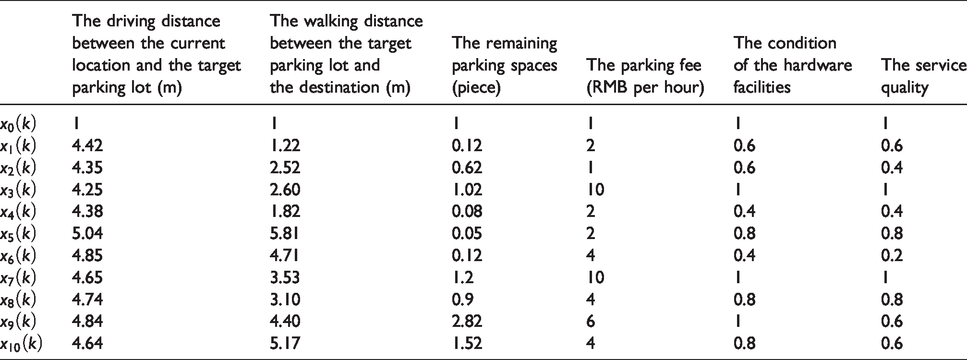
According to the data in Table 2, the relational coefficients
ξ1(k) = {0.568, 0.954, 0.836, 0.818, 0.918, 0.918}
ξ2(k) = {0.573, 0.748, 0.922, 1.0, 0.918, 0.882}
ξ3(k) = {0.580, 0.738, 0.996, 0.333, 1.0, 1.0}
ξ4(k) = {0.571, 0.846, 0.830, 0.818, 0.882, 0.882}
ξ5(k) = {0.527, 0.483, 0.826, 0.818, 0.957, 0.957}
ξ6(k) = {0.539, 0.548, 0.836, 0.6, 0.882, 0.849}
ξ7(k) = {0.552, 0.640, 0.957, 0.333, 1.0, 1.0}
ξ8(k) = {0.546, 0.682, 0.978, 0.6, 0.957, 0.957}
ξ9(k) = {0.540, 0.570, 0.712, 0.474, 1.0, 0.918}
ξ10(k) = = {0.553, 0.519, 0.896, 0.6, 0.957, 0.918}
The comprehensive weight determination method is proposed in this paper to determine the weight of each evaluation index for the cases of various user preference selections including (1) none of the user preferences is to be considered (namely, m=0 which means the weights are determined entirely by expert estimation method); (2) the only one preference (e.g., the parking fee) is to be considered; (3) two preferences (e.g., the parking fee and the walking distance) are to be considered; (4) three preferences (e.g., the parking fee, the walking distance, and the service quality) are to be considered, as shown in Table 3.
The weight of each evaluation index.

According to the above relational coefficients and weight values, the relational degree
The relational degree

The obtained relational degrees in Table 4 are sorted in descending order so that the grey relational order can be determined, as shown in Table 5. The highest relational degree calculated by the parking-lot intelligent selection algorithm is 0.8271, 0.9480, 0.8682 and 0.8749 for the case 1, the case 2, the case 3 and the case 4, respectively, as shown in the running results of the “iParking system (Versions 1.0)” in Figure 2. According to the priority principle of the highest relational degree, the candidate parking lot with the highest relational degree is the optimal one. Hence the target parking lot selected from the case 2 is the second (
The grey relational order for the cases of various user preferences.


The running results of the “iParking system (versions 1.0)” on Android mobile phones. Where (a), (b), (c) and (d) are the running results of case 1, case 2, case 3 and case 4, respectively.
From the above analysis, it can be seen that the parking-lot intelligent selection algorithm based on the grey relational analysis proposed in this paper can comprehensively consider each evaluation index and meet the common needs of all users, meanwhile, it can also reflect the user personal preferences and meet the personalized needs of individual user to the greatest extent.
Conclusion
This paper aims to meet the requirements for the evaluation and selection of the optimal parking lot near the destination, and establishes a parking-lot evaluation index system containing indicators in effectiveness, convenience, economy, environmental attribute and agreeableness. The factors and the evaluation indexes considered in the system are relatively consummate. A comprehensive weight determination method considering user preferences is proposed, and this method combines the expert estimation method with the user preference setting to determine the comprehensive weight of each evaluation index, which can reflect the personalized needs of individual user to the greatest extent. Comprehensively considering various representative objective and subjective influential factors including the driving distance between the current location and the target parking lot, the walking distance between the target parking lot and the destination, the remaining parking spaces, the parking fee, the condition of the hardware facilities, and the service quality, a parking-lot intelligent selection algorithm based on the grey relational analysis is proposed to select the optimal one near the destination and recommend it to the user for parking reservation.
In addition, the road condition information of the user’s current position to the parking lot near the destination is also one of the significant factors affecting the selection of the target parking lot, however, it is not convenient to obtain this information from Baidu map SDK at present, so this evaluation index can be added to the intelligent selection algorithm in the future study. According to the current road condition information, the system can predict the arrival time of the target parking lot more accurately to help the user select the appropriate time period for parking space reservation. In terms of the weight settings of the evaluation indexes, the intelligence level of the system will be greatly improved if the user personal preferences can be intelligently analyzed and the weight can be automatically set according to the historical data of the user’s parking habits, which needs to be deeply explored in the future for the optimization of the intelligent service for daily transportation.
Footnotes
Acknowledgments
We thank the support from the national natural science foundation of China and the Fujian Provincial Collaborative Innovation Center for High-End Equipment Manufacturing.
Declaration of Conflicting Interests
The author(s) declared no potential conflicts of interest with respect to the research, authorship, and/or publication of this article.
Funding
The author(s) disclosed receipt of the following financial support for the research, authorship, and/or publication of this article: This research was funded by “NATIONAL NATURAL SCIENCE FOUNDATION OF CHINA, grant number 51875106” and “The APC was funded by the Fujian Provincial Collaborative Innovation Center for High-End Equipment Manufacturing.”
