




Abstract
Variational methods for image registration basically involve a regularizer to ensure that the resulting well-posed problem admits a solution. Different choices of regularizers lead to different deformations. On one hand, the conventional regularizers, such as the elastic, diffusion and curvature regularizers, are able to generate globally smooth deformations and generally useful for many applications. On the other hand, these regularizers become poor in some applications where discontinuities or steep gradients in the deformations are required. As is well-known, the total (TV) variation regularizer is more appropriate to preserve discontinuities of the deformations. However, it is difficult in developing an efficient numerical method to ensure that numerical solutions satisfy this requirement because of the non-differentiability and non-linearity of the TV regularizer. In this work we focus on computational challenges arising in approximately solving TV-based image registration model. Motivated by many efficient numerical algorithms in image restoration, we propose to use augmented Lagrangian method (ALM). At each iteration, the computation of our ALM requires to solve two subproblems. On one hand for the first subproblem, it is impossible to obtain exact solution. On the other hand for the second subproblem, it has a closed-form solution. To this end, we propose an efficient nonlinear multigrid (NMG) method to obtain an approximate solution to the first subproblem. Numerical results on real medical images not only confirm that our proposed ALM is more computationally efficient than some existing methods, but also that the proposed ALM delivers the accurate registration results with the desired property of the constructed deformations in a reasonable number of iterations.
Keywords
Introduction
One of important tasks in image analysis is image registration. Generally speaking, it is the process of matching two or more images of the same or similar object obtained from different times, perspectives, and/or imaging sensors. This process can be done mathematically by computing a spatial geometric transformation of deformations (also known as displacement fields) that maps each point in one image onto a corresponding point in the other image with an optimal or meaningful manner. Image registration has played an important role in several areas of applications. Especially in medical applications, for example, it has been used routinely in medical diagnosis, treatment guidance and monitoring for providing complementary information. A good survey of the medical applications can be seen in literature1–4 and the references therein.
Variational methods for image registration have been actively and extensively studied and applied in the field of image analysis. The main idea is to find spatial correspondences between two given images, a so-called reference image
If the image intensities of the given images R and T are comparable, one may have various choices for

The registration task is then to solve the minimization problem


In this work, we focus on the regularizer of the form


In order to get a numerical solution of the variational problem (2), the standard gradient descent method can be applied. We first embed the associated Euler-Lagrange (EL) equation of (2) into a dynamic equation and drive it to a steady state. This yields the explicit scheme as given by

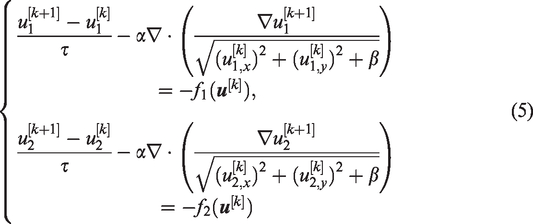
The idea of the linearized gradient descent (LGD) method in (5) is to linearize and solve the EL equation via a fixed-point (FP) iteration in a similar way to the so-called Lagged-diffusivity method
15
or Quasi-Newton scheme.16,17 For each iteration, a linear system needs to be solved. As can be seen, both gradient descent methods in (4) and (5) share two drawbacks. At first, these gradient descent methods provide only the the approximate solutions of the original problem (2), since the TV regularizer


Recently, the variable-splitting methods are the well-known techniques in the field of image restoration for solving variational models, which require the minimization of nonlinear and non-differentiable functionals. To the best of the author’s knowledge, the variable-splitting methods for TV-based image registration model in (2) are still missing in the literature. In this paper, the proposed method is based on the so-called augmented Lagrangian method (ALM). We compare the performance of the proposed ALM with the LGD method in (5) and the NMG method developed by literature. 5 Numerical results show that our proposed ALM is more computationally efficient than these existing methods
The rest of this paper is organized as follows. In the second section, we derive our ALM algorithm to solve the variational problem (2), following its numerical implementation in the third section. In the fourth section, numerical comparisons are carried out to confirm the effectiveness of the proposed ALM. Finally, some concluding remarks are made in the last section.
The proposed ALM
Before we derive the proposed ALM, we first rewrite (2) as

Next, we introduce an auxiliary variable



For the minimization of (8), this work proposes to use the ALM and rewrite the constrained minimization problem (8) into an unconstrained minimization problem. We define the augmented Lagrangian functional for the above constrained minimization as follows
1) Initialization: set m = 0, choose 2) 2.1) Compute 2.2) Update Lagrange multipliers




We propose an iterative algorithm to solve the minimization of


The two-subproblems are as follows:


According to the calculus of variation, the solution of




Numerical implementation
In this section, we present the details of how to solve the equation (20) and update the variables
Finite difference discretization
In order to discretize the EL equation (20), let



Applying the finite difference approximations with (20), the discrete EL equation at a grid point










We note that all finite difference approximations need to be adjusted at the image boundary


In the following subsections the symbols ‘h’ and ‘
Nonlinear multigrid method for solving u-subproblem
The most difficult part of the proposed ALM is the solution of the EL equation for
In this section, we propose a nonlinear multigrid (NMG) method due to literature. 22 The basic idea is to accurate the convergence of some basic iterative method on the finest grid by relying on the complementary interplay of smoothing and coarse-grid correction principles. For a more comprehensive treatment of MG methods in the area of image registration, we refer literature5,11,18,23–28 and references therein.
Let us denote the nonlinear discrete system in (24) using the following notation:


To correct


Below, we provide the technical details for our MG components.
The standard coarsening method is used in Ω
H
by doubling the grid spacing in each space direction — i.e. The restriction operator The discretization coarse grid approximation method is used to compute the coarse-grid operators. The coarsest grid solver is the LGD method. The MG cycle is The MG smoother to be discussed shortly in the next section is obtained from a coupled outer-inner iteration method using a relaxation parameter ω.
The implementation of the proposed NMG method can be summarized as follows:
Else continue with following step.
For k = 1 to ν1,
(Siter represents the maximum number of the inner iterations)
For k = 1 to ν2,
To solve
Finally, the pseudo-code implementation of the proposed NMG method can be given in Algorithm 2.
The MG smoother
Following literature5,11,18,23–27 the local Fourier analysis can be used to guarantee that there exists an efficient point-wise smoother within a MG method for solving the discrete nonlinear system (25). To obtain a high-potential point-wise smoother, this work proposes a coupled outer-inner iteration method in a FP framework.
Let ν denote the index for the outer step. We start the outer iteration by introducing the iterative scheme as follows

Since this iterative scheme is fully implicit, a linearization procedure of the nonlinear term







To obtain a simple and fast iterative scheme, we use the approximations for







These approximations leads to the following linearized system

Next, we apply the finite difference discretization as discussed in Section 3.1 with (28) and solve the associated linear system for each outer step ν by the Gauss-Seidel (GS) method as the inner iteration. The kth step of the GS method defined at a grid point


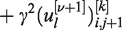

Here the superscripts k,
In order to obtain more efficiency, one introduces a relaxation parameter

Finally, the implementation of the proposed MG smoother (30) on Ω
h
is summarized in Algorithm 3.

Note that we applied the so-called local Fourier analysis (LFA) to test the smoothing performance of the proposed MG smoother with different values of ω (the relaxation parameter) and Siter (the maximum number of inner iterations) for the four representative registration problems given by Problems 1–4 (as shown respectively in Figure 1. Our results shows that the proposed FP smoother with

Four registration problems of the real medical images. (left column) Reference images; (right column) Template images; (top row) Problem 1; (2nd row) Problem 2; (3rd row) Problem 3; (bottom row) Problem 4.
The closed form expressions for
, and
Based on the formulation (23), we can get the closed form expressions for

Similarly, based on the formulations in (11) and (12), we may update all the Lagrangian multipliers by


Numerical experiments
In this section, we present a number of numerical experiments to
compare the overall performance of the proposed ALM with two related numerical solutions, which are the LGD method (5) and the NMG method by Chumchob (5) assess the accuracy and efficiency of the proposed ALM with regard to parameter changes.
We note first that four registration problems consisting of four real medical images to be denoted as Problems 1–4 were selected for the experiments, as shown respectively in Figure 1. Second, we used
Performance comparison with the other two methods
In this test, the performance of three different methods for TV-based image registration model is compared. We apply the relative SSD (a qualitative measure in the accuracy), time per iteration (in seconds), total CPU time (in seconds), and total iterations to perform our evaluation on the four registration problems shown in Figure 1.
For the LGD method, we chose
For the NMG method, we implemented with the FAS-NMG method of Chumchob (5) The details of our numerical implementation can be summarized as follows. We solved the nonlinear discrete EL system with
For the proposed ALM, we chose the penalty parameters
All numerical methods in this test used the same regularization parameter
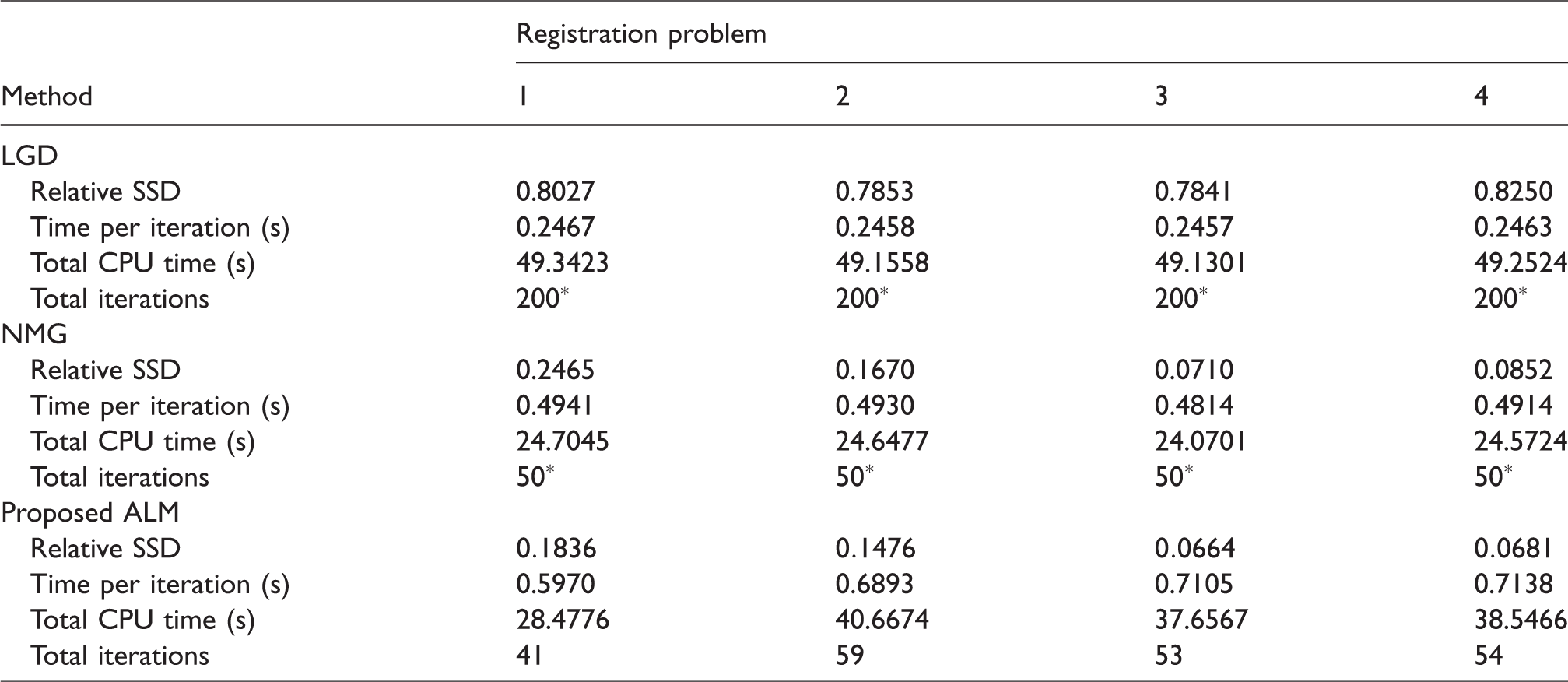
From Table 1, one can see that only the proposed ALM converges, whereas the LGD and NMG methods are unable to converge in a reasonable number of iterations. As expected, we have found in this case that the small value of β has a significant effect on the accuracy of the registered images and the convergence of the LGD and NMG method. Moreover, Figure 2 shows that for each registration problem the proposed ALM yields the best value of the relative SSD. It is important to note that the smaller the value of the relative SSD is, the accurate registered image is achieved. This evidence ensures that the registration results by the proposed ALM are more reliable than the LGD and NMG methods. Particularly, Figure 3 shows that the proposed ALM is computationally efficient than the other two methods in delivering the high quality of the registered images. The proposed ALM takes only a few iterations (say 5 iterations) to drop the relative SSD below 0.20, which means that the dissimilarities between the reference and registered images have been reduced more than 80% within the first 5 iterations. This is a remarkable result to conclude that the computational performance of the proposed ALM in solving TV-based image registration is much more efficient than those of the other two methods.
Comparison of the relative SSD, time per iteration, total CPU time (s), and total iterations by three different numerical methods on the four registration problems in Figure 1 with

Qualitative comparison of registered images by three different methods on the four registration problems in Figure 1. (left) Registered images by LGD; (middle) registered images by NMG; (right) registered images by the proposed ALM. ‘RelSSD’ means the relative SSD defined in (13) to represent the dissimilarities between R and

History of the relative SSD by three different methods in solving the four registration problems in Figure 1.
In terms of computation times per iteration, we can see that the proposed ALM requires to solve two sub-problems for
In terms of total CPU times, Table 1 illustrates the LGD method is the slowest method, while the NMG method is slightly faster than the proposed ALM. However, both LGD and NMG method are unable to converge. Thus we can conclude that the LGD and NMG methods are less computationally efficient than the proposed ALM.
In Figure 4 we present the constructed deformations by the proposed ALM for all registration problems. In Figure 5, we show the constructed surfaces of both components of the deformations in Figure 4. In Figure 6, we present the middle slices of the constructed surfaces of the components of the deformations in Figure 5. As expected from the use of TV regularizer, the visual inspection in Figure 4 shows that the proposed ALM delivers the visually appealing results in preserving the discontinuities of the constructed deformation as shown in the corresponding close-up regions. We can also see in Figure 4 that the constructed deformation yields multiple motions in the image to be registered and the motion discontinuities can be observed at the boundaries of the local regions. We see further that the corresponding deformation in each registration problem is neither smooth nor reflecting a homogeneous motion. For each local region, the motion tends to change smoothly, and the gradients of the constructed deformation in this area are small. At the boundaries of the local regions, the gradients of the constructed deformation are large, and the discontinuities of the constructed deformation can be observed. Moreover, we can see from Figures 5 and 6 that the constructed surfaces of both components of the deformations are non-smooth and their middle slices are almost piecewise constant for all registration problems.

Constructed deformations by the proposed ALM for the four registration problems in Figure 1. Note that multiple motions in the corresponding image and motion discontinuities at the boundaries of the local regions determined by the constructed deformation can be observed in the corresponding close-up regions.

Constructed surfaces of both components of the constructed deformations by the proposed ALM for the four registration problems in Figure 1. (left) the first component u1; (right) the second component u2; (top row) Problem 1; (2nd row) Problem 2; (3rd row) Problem 3; (bottom row) Problem 4.

The middle slices of the corresponding surfaces of both components of the constructed deformations shown in Figure 5 by the proposed ALM.
To summarize we have successfully developed the efficient and effective numerical method for TV-based image registration model. Our registration results on the real medical applications shown in Figure 1 demonstrate that the proposed ALM is more computationally efficient and effective than the other two methods. The most attractive features of our proposed method is that it is able to produce the high quality of the registered images in a reasonable number of iterations while it satisfies the requirement in constructing the deformations by the TV regularizer.
Performance tests with the regard to parameter changes
We now present numerical results from several test cases, to assess the accuracy and efficiency of our proposed numerical techniques with the regard to parameter changes.
h-Independence test
One of the key properties of MG techniques is that their convergence does not depend on the number of grid points. Thus, in this test we designed our numerical experiments to investigate this property with the proposed ALM in Algorithm 1, and to back up our proposed NMG method in Algorithms 2.
We implemented the proposed ALM with the same regularization parameter
Registration results for Problems 1–4 in Figure 1 by the proposed ALM in Algorithm 1 with
Registration results for Problems 1–4 in Figure 1 by the proposed ALM in Algorithm 1 with

Registration results for Problems 1–4 in Figure 1 by the proposed ALM in Algorithm 1 with

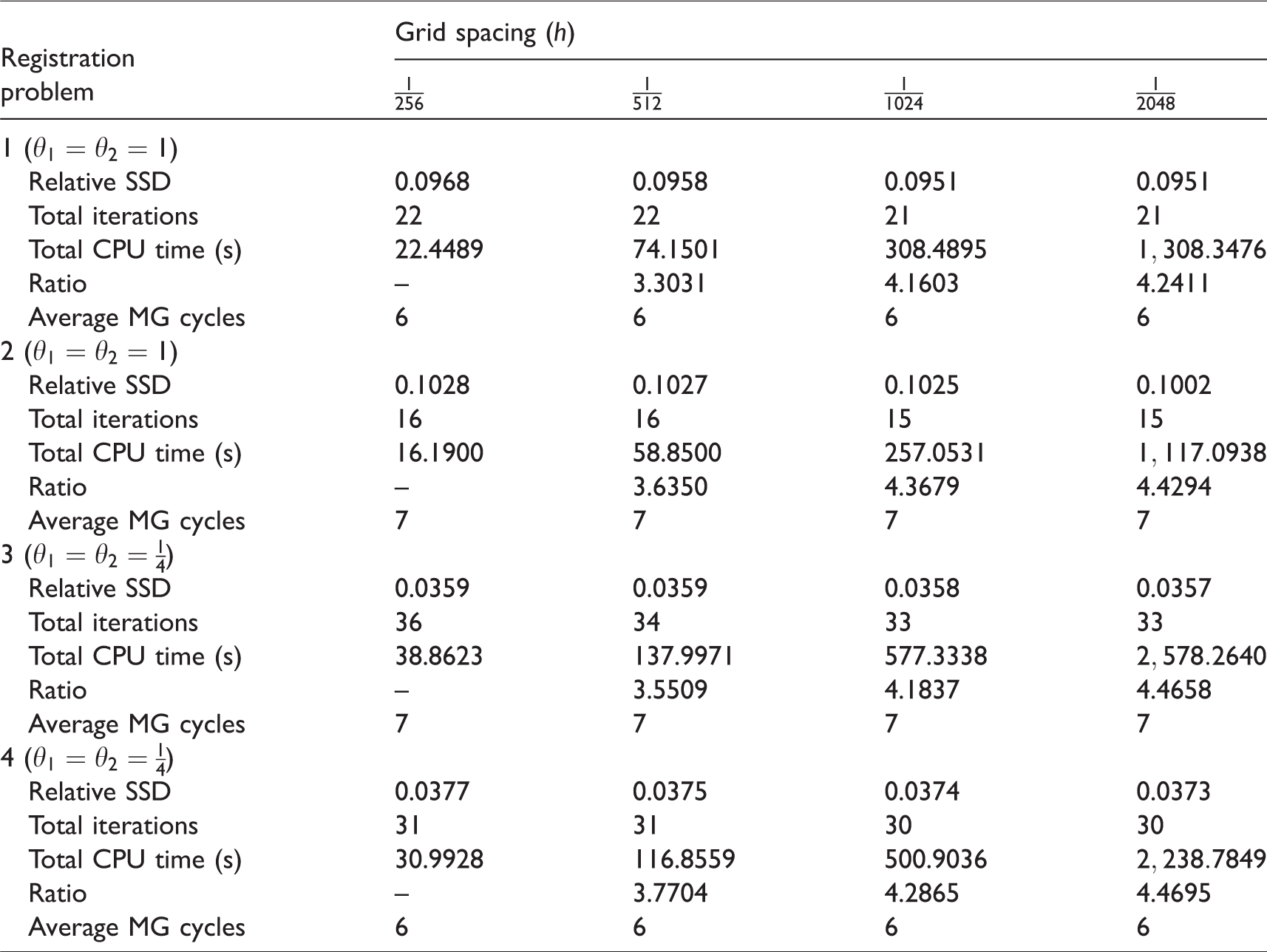
In the numerical results shown in Table 2, one can see five quantities: the relative SSD, the total iterations, the total CPU times (in seconds), the ratio of the total CPU times in increasing both image dimensions by a factor of 2, and the number of average MG steps used to solve
As expected from a numerical technique using a MG framework, Table 2 shows that Algorithm 1 not only converges within a few iterations, but it also provides the accurate registration results because the dissimilarities between the reference and registered images given have been reduced more than 90% for Problem 1, 89% for Problem 2, and 96% for Problems 3 and 4. Moreover, the NMG method in Algorithm 2 can reduce the mean of the relative residuals to
α-Dependence test
Next we evaluate to show how our proposed ALM in Algorithm 1 is affected with varying the regularization parameter α.
To this end, we performed the proposed ALM on the four registration problems in Figure 1 with the same grid spacing
Table 3 presents the numerical results by the proposed ALM in Algorithm 1 with different values of the regularization parameter α. It contains three quantities: the relative SSD, the total iterations, and the number of average MG steps used to solve
As presented in Table 3, decreasing the values of α has significant effects on the accuracy of the registered images and the convergence of the proposed ALM in Algorithm 1, whereas the value of α has only a small effect on the convergence of the proposed NMG method in Algorithm 2. We can see that large α is not needed as small ones give better registration results, typically
In order to find a suitable α automatically, the ‘cooling’ (‘continuation’) process suggested in literature11,35,37–39 is recommended for real applications. The basic idea is to start with a high initial value of α and then slowly reduce α such that the obtained solution can be used to be an excellent starting point for the next in order to decrease
-dependence test
We now present numerical results from several test cases to evaluate the registration performance of our proposed ALM with different values of θ1 and θ2.
We performed the proposed ALM in Algorithm 1 on the four registration problems shown in Figure 1 using
We note that we take
One sees from Table 4 that as θ is decreased from 10 to
Concluding remarks
In this paper, we first explained how standard methods solve the TV-based image registration model. Next, we discussed how we are needed to develop a new method. In order to efficiently solve the model, we therefore proposed to use augmented Lagrangian method. We separated the associated minimization problem into two subproblems. As a result, the first subproblem is a nonlinear problem and impossible to obtain exact solution, whereas the other one has a closed-form solution. Next, we developed an efficient NMG method to solve the associated discrete nonlinear system. In order to assess the efficiency and effectiveness of our new method, we tested, using four registration problems of real medical images, how our new method performs. We found in our first numerical test that the registered images by different methods are not identical. Therefore, it can be concluded that different numerical algorithms for TV-based image registration model have a significant effect on the accuracy of registered images. We also found that our new method outperforms the existing methods. Moreover we found by the performance comparison in this test that our new method is able to deliver the accurate registration results with the desired properties of the constructed deformations in a reasonable number of iterations. Next, we found in the second test that there are no effect on the convergence of the new method for different numbers of grid points. Moreover, we observed from the third and last tests that the choice of the regularization and penalty parameters is important for the quality of the registered images and the computational performance of the new method. The outlines in selecting these two parameters to obtain the accurate registration results were discussed. Future work will extend the proposed method to high-order variational models for image registration.
Footnotes
Acknowledgements
Declaration of conflicting interests
Funding
ORCID iD
