This research paper investigates two dimensional liquid film flow of Sisko nanofluid with variable heat transmission over an unsteady stretching sheet in the existence of uniform magnetic field. The basic governing time-dependent equations of the nanofluid flow phenomena with Sisko fluid are modeled and reduced to a system of differential equations with use of similarity transformation. The significant influence of Brownian motion and thermophoresis has been taken in the nanofluids model. An optimal approach is used to obtain the solution of the modeled problems. The convergence of the Homotopy Analysis Method (HAM) method has been shown numerically. The variation of the skin friction, Nusselt number and Sherwood number, their influence on liquid film flow with heat and mass transfer have been examined. The influence of the unsteadiness parameter over thin film is explored analytically for different values. Moreover for comprehension, the physical presentation of the embedded parameters, like , magnetic parameter , stretching parameter and Sisko fluid parameters , Prandtl number Pr, thermophoretic parameter , Brownian motion parameter , Schmidt number have been represented by graph and discussed.
The flow analysis of thin film flow has got important loyalty due to its enormous application and uses in the field of engineering and technology, industries in a several years. Thin film flow problems realized in many fields, shifting from specific situations in the flow in human lungs to lubricant problems in industrial, which is perhaps one of the largest subfield of thin liquid flow problems. Investigation of thin liquid flow of practical applications is an interesting interaction between fluid mechanics, structural mechanics and theology. Cable, fibber undercoat is one of its significant applications. Extrusion of polymer and metal, striating of foodstuff, constant forming, elastic sheets drawing and fluidization of the device, exchanges and chemical treating apparatus are several well-known uses. In observation of these applications, it becomes an important topic for researchers to develop the study of liquid film on stretching the surface. The flow of liquid film was first studied for viscous flow and further it is extended to Non-Newtonian fluid. Sandeep and and Malvandi1 have described thin film fluid flow with heat transfer of non-Newtonian nano liquids. Wang2 has described thin film liquid over stretching the unsteady surface. Usha and Sridharan3 have studied the movement of finite thin liquid over the unsteady stretching sheet. Liu and Andersson4 have discussed the motion of film flow with heat transfer through a stretching surface. Aziz et al.5 have studied for the production of inside heat during thin fluid film flow over a stretching sheet. Tawade et al.6 have described thin film fluid flow with heat transmission in the existence of thermal radiation, for the solution of nonlinear equation; they used Runge–Kutta–Fehlberg and Newton Raphson method. Anderssona et al.7 have studied liquid film flow with heat transfer on stretching sheet. Most researchers8–11 have studied fluid flow of power laws and fluid film through an unsteady stretching surface for more different cases. Megahe12 has investigated thin Casson fluid flow with heat transfer on unsteady stretching sheet with the influence of the slip velocity in the existence of heat flux and viscid dissipation. Recently, Khan et al.13 and Tahir et al.14 investigated nanofluid thin film with new modifications.
Due to eccentric features of nano liquids that makes them proficient in various applications, nano fluids are used in pharmaceutical procedures, hybrid powered engines, fuel cells, microelectronics and currently it is mostly used in the field of nanotechnologies. From earlier studies, nano fluids have been found to retain dimensions smaller than 100 nm. Nano liquids are thinned liquid holdups of nanoparticles through at least one of their principal enriched thermophysical goods such as thermal diffusivity, conductivity, viscosity and warmth transmission convective coefficients equated to base liquids like oil or water. An extensive diversity of industrial processes includes the transmission of thermal energy. The development of high enactment thermal systems for heat transfer augmentation has become widespread nowadays. After this, researchers15 have described nanofluid flow through the unsteady stretching sheet using Buongiorno’s model. Hayat et al.16 have studied Maxwell nano liquid. Malik et al.17 have studied Erying–Powell nanofluid through a stretching with the mixed convective flow of MHD. Nadeem et al.18 have investigated Maxwell liquid flow through a vertical stretching surface in occurrence of nanoparticle. Raju et al.19 have investigated MHD nano non-Newtonian liquid through a cone in the presence of free convective heat and mass transfer. Rokni et al.20 have studied nano fluid flow with heat transfer through the plates. Nadeem et al.21 have found numerical solution of nano non-Newtonian liquid flow on stretching sheet. Shehzad et al.22 have been investigated Jaffrey nano liquid MHD flow in the occurrence of convective boundary conditions. Sheikholeslami et al.23 have studied nano liquid flow with magnetic field in existence of heat transfer. Mahmoodi and Kandelousi24 have studied nanonfluid flow with heat transfer for cooling application. Recently, Shah et al.25–28 have studied nanofluid flow with impacts of thermal radiation and hall current with rotating system. The more current investigational and theoretical study of Sheikholeslami on nanofluids using dissimilar phenomena, with modern application, possessions and properties with usages of diverse approaches can be studied in Sheikholeslami,29,30 Sheikholeslami and Houman,31 Sheikholeslami32 and Nasir et al.33
Non-Newtonian fluid model has a lot of industrial applications. Many materials have great importance in the industries such as molten plastic, food products, wall paint, greases, lubricant oil, drilling mud etc, have non-Newtonian fluid behaviour. Non-Newtonian fluid, according to the researchers, is most applicable to the research. Sisko liquid is one of the important subclass which has more significance as its occurrence in many engineering operations. Practical application has produced an interest in searching the solvability of differential equation governing in flow of Non-Newtonian liquids, which have numerous uses in engineering field, applied mathematics and computer science. Munir et al.34 have discussed bidirectional flow of Sisko fluid through a stretching sheet. Olanrewaju et al.35 have studied Sisko unsteady free convective fluid flow in the existence of heat transfer passing through a flat plate. Khan et al.36 have studied Sisko fluid, steady flow with heat transfer in annular pipe. Khan and Shahzad37 have described Sisko boundary layer fluid flow through the stretching surface. Patel et al.38 have investigated laminar Sisko fluid boundary flow. Darji and Timol39 have studied Sisko fluid unsteady natural convective boundary layer flow. Siddiqui et al.40 have described Sisko fluid film on vertical belt for drainage system. Khan et al.41 have discussed Sisko fluid in annular pipe. Sar et al.42 have been described boundary layer equations of Sisko fluid. Marinca et al.43 have studied Maxwell fluid flow through a porous stretching plates. Moallemi et al.44 have found an exact solution for Sisko fluid flow in a pipe.
Most mathematical problems in the field of engineering and science are complex in its nature and the exact solution of that type of problem is very tough. To find an approximate solution, numerical and analytical technique is used. The homotopy analysis technique, which is one of the widespread and important techniques for the solution of such type of problem. Liao in (1992)45,46 has investigated it for the solution of such type of problems and it is proved that this method is fast converge to the approximated solution. The solution of this method is a series solution in the form of a single variable function, due to its fast convergence, most researchers Rashidi and Pour47 have used this technique to solve coupled and highly nonlinear equation. The recent use of HAM for nonlinear system of differential equations can be seen in Ishaq et al.,48 Nasir et al.,49 Hammed et al.50 and Muhammad et al.51
In this work, we studied two-dimensional thin film flow of Sisko nanofluid with variable heat transmission over an unsteady stretching sheet in the existence of uniform magnetic field (MHD). The basic governing time-dependent equations of the nanofluid flow phenomena with Sisko fluid are modeled and reduced to a system of differential equations with use of similarity transformation.
Problem formulation
Consider an electrically conducting and time depending nanoliquid film flow of Sisko fluids during spreading surface. The elastic surface starts as of inhibit slit, which remains fixed at succession of a accommodate arrangement, The Cartesian coordinate system oxyz be there accustomed in a well-defined way that ox is equal to the plate and oy is flat to the surface. The surface of the flow is stretched to apply two equal and opposing forces along the x-axis and keeps the origin motionless. The physical model of flow is shown in Figure 1. The x-axis is taking beside the spreading sheet through a stress velocity
where represents stretching parameters and y-axis is vertical to it. The temperature and concentration of the wall of the liquids are taken and defined as
Geometry of the demonstrated problem.
Here denotes the kinematic viscidness of the fluid and represents the slit and position temperatures correspondingly, while are the slit and a uniform volume section of thin nanoparticles. The external magnetic field is defined as
where denotes the applied magnetic field.
The theological model that illustrates the Sisko fluid39–43 as
Here is a stress of isotropic, is an extra tensor of stress, represents a power index, is the stress of a Rivlin Ericksen tensor and
For two-dimensional nanofluid, equation (7) reduced to the form of as
The momentum equation is written as
where denotes density of the fluid, denotes velocity and , denotes Cauchy stress tensor and is the body (gravitational) force. The term is called the Lorentz Force, in which current density is denoted by and the magnetic field by . is defend as where it is called Ohm law. Where ‘’ is used for electrical conductivity and represents electric field and is assumed to be . Using all above assumption, equation (9) reduced to as34–42
Here are the velocity vectors constituents alongside x and y-axis correspondingly, show the density of liquid.
Thermal energy equations
T is the local temperature, illustrate ratio of base liquid and nanoparticles thermal capacities, represent the heat capacitance of liquid, direct the Brownian diffusion constant , while the thermophoretic diffusion constant is denoted by , denotes the temperature of the liquid which is detached from the sheet. Equation (11) after using assumption is reduced to the simplified form is
Here the elastic thermal conductivity in which is used for elastic thermal conductivity restriction.
Mass Transfer equation
Equation (13) after using assumption which is reduced to the simplified form is
The appropriate boundary conditions for flow configuration are taken as
Familiarizing the succeeding similarity transformations
Here show the stream function, denotes thickness of fluid film and is the kinematics viscosity. The dimensionless film thickness is
This in term of derivative is
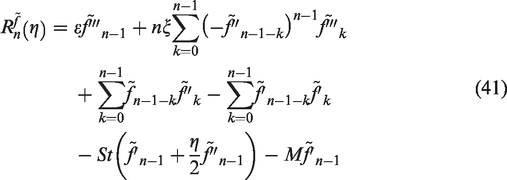
Using the similarity transformation equation (16) into equations (10)–(14), realizes the continuity equality; the leftover equations are transformed to system of non-linear differential equations as
The boundary conditions of the problem are
The physical constraints after generalization are obtained as, is the non-dimensional measure of unsteadiness, is Sisko fluid parameter, is stretching parameter and represents the magnetic, represents the variable viscosity parameter, is Prandtl number, represents thermophoresis constraint, shows Brownian motion limitation, denotes Schmidt number and all of these are well-defined individually.
The local skin–friction coefficient is defined as follows
where
where is called local Reynolds number, defined as . The Nusselt number is defined as is the heat flux and . The Sherwood number is defined as is the mass flux and . Here the dimensionless form of and is obtained as
Solution by HAM
Here we use the homotopy analysis method to solve the equations (19)–(21) consistent with the boundary restrain (equation (20)). The solutions enclosed the secondary parameters which standards and switches to the combination of the solutions.
The preliminary guesses are selected as follows
The linear operatives represented by
Which have the subsequent applicability
where the coefficients involve in general solution:
The corresponding non-linear operators are carefully chosen of the form
where is the embedding constraint, is used to regulate solution convergence. When we have
Expanding the velocity, temperature and concentration field, in Taylor’s series approximately
The dependable boundary constrains are
Here
where
Convergence of HAM solution
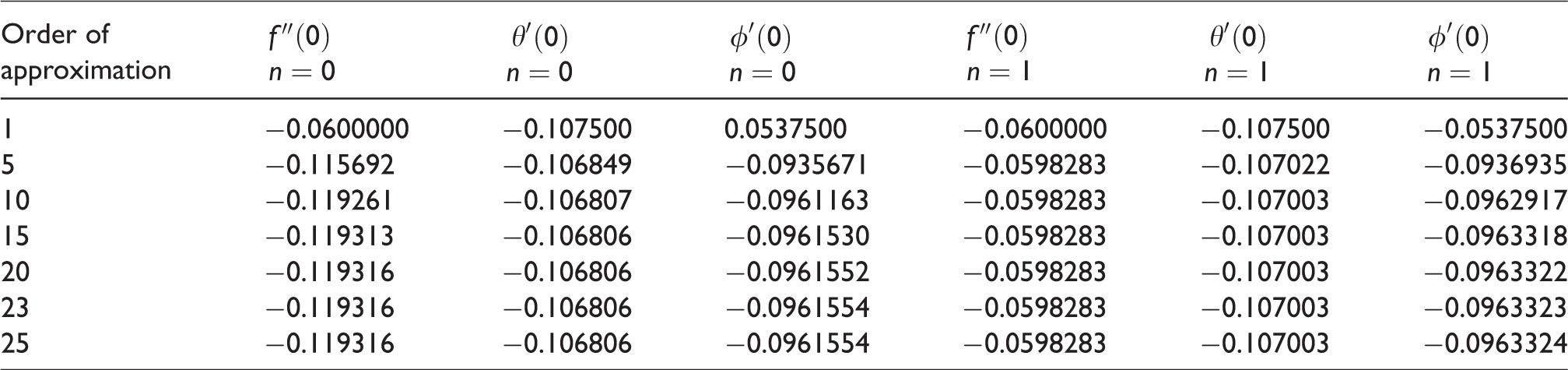
The convergence of equation (33)–(35), wholly be particulared by the secondary restrictions . It is a choice in a way to controls and merge the series answer. The probability sector of are designed curves of for order approximated HAM solution. The effective region of is The convergence of the HAM technique by -curves for velocity, temperature and concentration fields has been represented in Figures 2–4 respectively. Tables 1 and 2 display the numerical values of HAM solutions at different approximation using different values of parameters for the different power index. It is clear from the table that homotopy analysis technique is a speedily convergent techniques. The theoretical details and convergence of h curved are proved in [1.1] by a theorem as:
The - curves of for dissimilar value of power index
The combined -curve of and
Effect of on for dissimilar value of power index
The convergence table of HAM up to 25th-order approximations for n = 0 and n = 1 when
Order of approximation
1
−0.0600000
−0.107500
0.0537500
−0.0600000
−0.107500
−0.0537500
5
−0.115692
−0.106849
−0.0935671
−0.0598283
−0.107022
−0.0936935
10
−0.119261
−0.106807
−0.0961163
−0.0598283
−0.107003
−0.0962917
15
−0.119313
−0.106806
−0.0961530
−0.0598283
−0.107003
−0.0963318
20
−0.119316
−0.106806
−0.0961552
−0.0598283
−0.107003
−0.0963322
23
−0.119316
−0.106806
−0.0961554
−0.0598283
−0.107003
−0.0963323
25
−0.119316
−0.106806
−0.0961554
−0.0598283
−0.107003
−0.0963324
The convergence table of HAM up to 25th-order approximations for n = 2 and n = 3 when .
Order of approximation
1
−0.0600000
−0.107500
0.0537500
−0.0600000
−0.107500
0.0537500
5
−0.108644
−0.106860
0.0935736
−0.115370
−0.106849
0.0935672
10
−0.107774
−0.106837
0.0960198
−0.117830
−0.106811
0.0959988
15
−0.107761
−0.106836
0.0961796
−0.117699
−0.106810
0.0961558
20
−0.107760
−0.106836
0.0961819
−0.117692
−0.106810
0.0961582
23
−0.107760
−0.106836
0.0961821
−0.117692
−0.106810
0.0961583
25
−0.107760
−0.106836
0.0961821
−0.117692
−0.106810
0.0961583
Theorem 1.1: Suppose that be a continuous function on and all derivatives of exist and have a common such that for all : Furthermore, assume that be the Taylor polynomial of degree for about some , say then and there exists and interval so that
Result and discussion
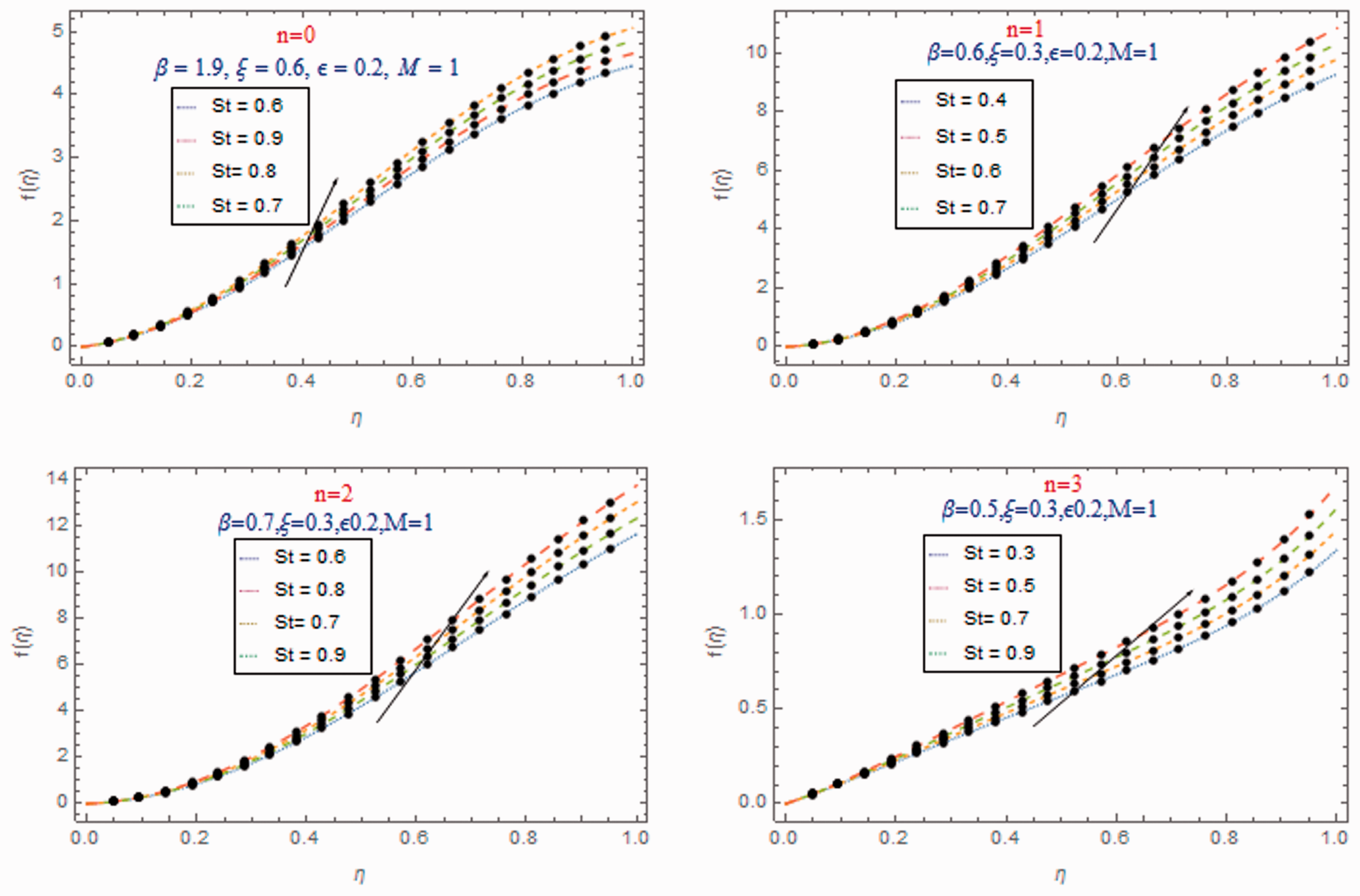
The current work focuses on the interpretation of the nano liquid film motion through modelled parameters. The graphical explanation of these parameters has been displayed in Figures 4–13. Figure 4 shows the influence of film thickness for dissimilar values of power index and 3 on velocity profile. It is seeming that the falls with higher values of Actually, liquid film produces opposition to film flow and makes to slow down the liquid velocity of nano particles with greater values of . This reduction increased when power index is increased. The effect of Sisko fluid parameter for dissimilar values of power index and 3 on velocity profile is shown in Figure 5. The large values of Sisko fluid parameter rise the liquid fluid motion of nanoparticles, but when the power index goes toward increase, then this effect is seen opposite and in case of the velocity field reduces. The characteristics of magnetic parameter on velocity field are shown in Figure 6. From the mathematical formulation, it is clear that the velocity distributions are inversely varied with magnetic parameter along the y-direction. Increasing magnetic parameter decreases the velocity field (Figure 6) when it is closed to the surface. This influence of on velocity field is because of the fact that the rise in the progresses friction force for the movement is named the Lorentz force. Lorentz force has the similarity to reduce the velocity of flow in the boundary sheet. Increasing values of the power index to 3, the reduction is increased. Figure 7 shows the influence of unsteady constraint on the for dissimilar values of power index and 3. It is observed that the velocity profile directly varies with unsteadiness parameter . Increasing rises the fluid motion. It perceived that solution depended on the unsteadiness parameter , the solution exists only when Increasing rises the nanofluid motion. It is clear that changing power index having the same reaction to the unsteady parameter, that is, the increased value of the power index rises the velocity distribution. The effect of the unsteadiness parameter on the heat profile is presented in Figure 7. It is seen that directly varies with unsteadiness parameter ‘’. Increasing unsteadiness parameter rises the temperature, which in result increase kinetic energy of the fluid, so the liquid film motion rises. It is detected that the influence of unsteadiness parameter for the different power index and 3 having the same effect on and same effect is observed for concentration profile. The effects of stretching parameter for dissimilar values of power index and 3 on velocity profile are shown in Figure 9. In case of , it is clear from Figure 9 that velocity profile increases for large values of stretching parameter . It is observed that when values of power index are varied, then the effect of stretching parameter changes and for this effect is totally opposite to that which the velocity field reduces. When the stretching parameter becomes zero, the thermophoresis parameter faces depreciation in contrast with temperature profile. This phenomenon is described by Figure 10. The thermophoresis limitation supports in growing the surface temperature. An irregular moment of nano-suspended particles in the fluid represent the Brownian motion. Due to this irregularity in motion, nano-suspended particles produce kinetic energy and the temperature increases, as a result the thermophoretic force is produced. This force causes intensity in the fluid to move away from the surface of the stretching sheet. Subsequently, the temperature inside the boundary layer rises as raises. The free surface temperature is increased. The Brownian motion constraint is illustrated in Figure 12 The reality is that arbitrary motion of particles of the fluid generates the collision of the particles. Increase in the value of Brownian motion constraint Nb results increase in heat of the fluid, consequently causing reduction in free surface nanoparticle volume friction and it is displayed in Figure 12 represents that by changing the , the dimensional intensifications. Figure 12 shows that for different measures of , dimensional reduces. It is observable that flow portion is more in the horizontal direction by increasing . It is because that the Schmidt parameter is ratio of momentum and concentration, diffusivities and increases in , creates to decline thickness of liquid and therefore decreases. The opposite effect of is found in the concentration profile (Figure 12). The impact of for numerous measures is explained in Figure 13. It is presented that increasing rate of , reduces boundary layer size, which subsequently reduces the velocity. Actually, the , a dimensionless amount, is the ratio of kinematic viscosity to thermal diffusivity. When the value of momentum diffusivity is more than thermal diffusivity, the value of Prandtl quantity is increased. Thus, the heat spread at the surface grows with growing amount of the while the mass transmission is determined as the growing. The purpose is that with the greater values of amount, the thermal boundary layer reduces. The significance is uniformly clearer for slight quantity since the thermal boundary layer thickness is comparatively more. The concentration field shows a reducing performance beside due to the thinning of the boundary layer (Figure 13).
Effect of on for dissimilar value of power index
Effect of M on for dissimilar value of power index
Effect of St on for dissimilar value of power index
Effect of St on and .
Effect of on for dissimilar values of power index
Influence of on and .
The effect of Nb on and .
Effect of Sc on and .
Effect of Pr on and
Table discussion
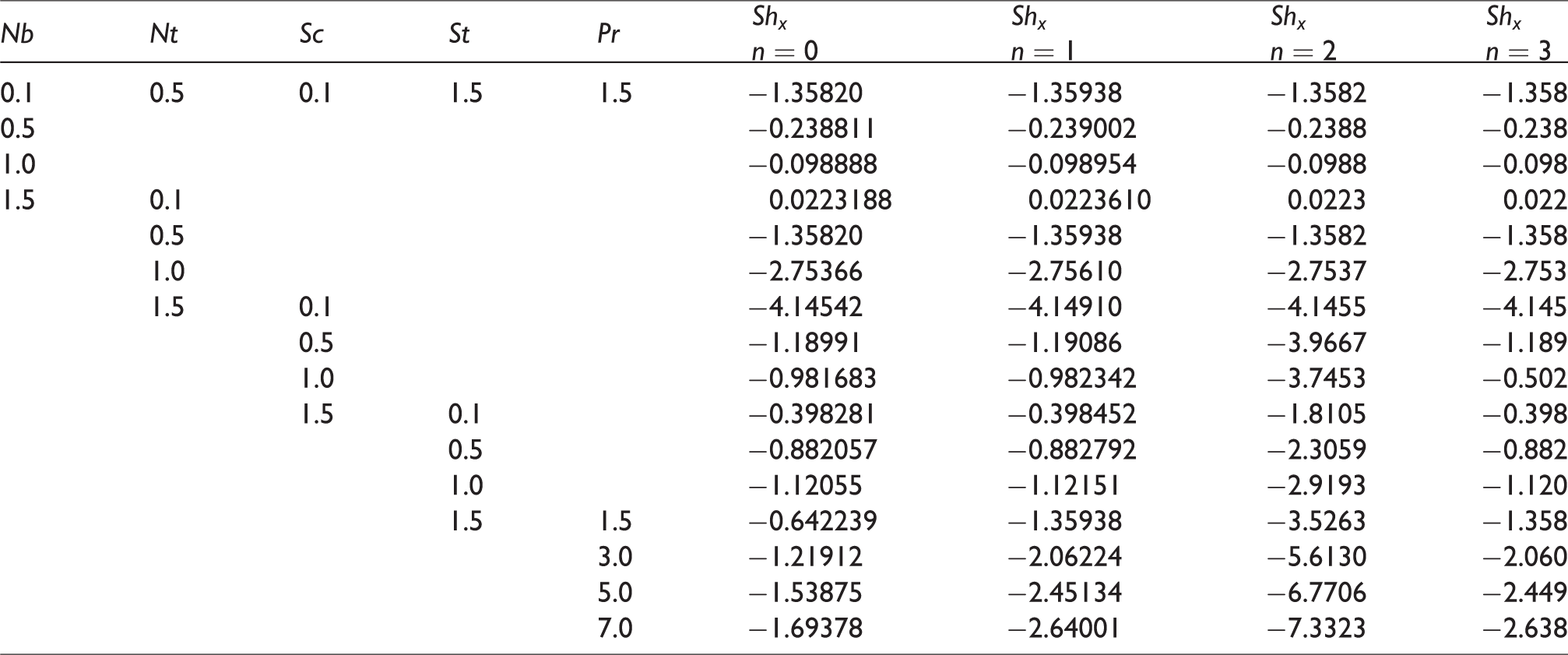
Tables 3, 4 and 5 depict the influence of skin friction, Sherwood number and Nusselt number due to altered parameters. The effects of and on skin friction for the different behavior of are shown in Table 3. It is observed that increasing rates of magnetic and unsteady parameter increases the Skin–friction coefficient, while for dissimilar values of power index , it decreases. The higher value of stretching and the thickness parameter , reduces the skin friction coefficient, while four different values of power index it is noted to increase. The effects of and on the Nusselt number for the different behavior of are shown in Table 4. It is observed that increasing rates of magnetic and unsteady parameter reduces the Nusselt number while the unsteady parameter and thickness parameter increase the Nusselt number. The effects of and on the Sherwood Number are shown in Table 5. From Table 5, it is noticed that local Sherwood number values increase due to increase in thermoporetic parameter. Increasing the value of Schmidt number decreases the Sherwood number where increasing unsteady parameter and Prandtl number causes to decrease the Sherwood number.
The Skin friction coefficient for dissimilar values of and when .
0.1
0.5
0.1
1.5
−0.124726
−0.25778
−0.1708
−0.2478
0.5
−0.143755
−0.29719
−0.2034
−0.2849
1.0
−0.167483
−0.34634
−0.2460
0.3309
1.5
0.1
−0.038228
−0.38755
−0.1776
−0.3811
0.5
−0.124726
−0.25778
−0.1708
−0.2478
1.0
−0.249452
−0.25850
−0.1708
−0.2461
1.5
0.1
−0.374178
−0.25908
−0.3434
−0.2445
0.5
−0.508809
−1.10089
−0.7463
−0.8475
1.0
−0.692997
−1.70742
−6.9860
−0.8868
1.5
0.1
−0.500106
−1.35924
−1.8672
−0.8876
0.5
−0.077021
−0.15907
−0.2217
−0.1536
1.0
−0.100915
−0.20849
−0.1320
−0.2009
Variation in Nusselt umber for different values of and when
0.1
0.1
1.5
1.5
0.626541
0.352783
0.352309
0.352250
0.5
0.626198
0.352676
0.352140
0.352063
1.0
0.625771
0.352543
0.351935
0.351830
1.5
0.1
0.626541
0.352783
0.352309
0.352250
0.5
2.38501
1.52758
1.51452
1.49232
1.0
4.78618
2.52231
2.26158
2.45957
1.5
0.1
5.10531
2.34792
1.62477
1.84831
0.5
0.407137
0.228747
0.228439
0.228416
1.0
0.517063
0.290827
0.290433
0.290394
1.5
1.5
0.626541
0.352783
0.352309
0.352250
3.0
1.08812
0.324721
0.324254
0.324196
5.0
1.40251
0.309182
0.308718
0.308659
7.0
1.56869
0.301646
0.301183
0.301125
Variation in Sherwood number for different values of and when
0.1
0.5
0.1
1.5
1.5
−1.35820
−1.35938
−1.3582
−1.358
0.5
−0.238811
−0.239002
−0.2388
−0.238
1.0
−0.098888
−0.098954
−0.0988
−0.098
1.5
0.1
0.0223188
0.0223610
0.0223
0.022
0.5
−1.35820
−1.35938
−1.3582
−1.358
1.0
−2.75366
−2.75610
−2.7537
−2.753
1.5
0.1
−4.14542
−4.14910
−4.1455
−4.145
0.5
−1.18991
−1.19086
−3.9667
−1.189
1.0
−0.981683
−0.982342
−3.7453
−0.502
1.5
0.1
−0.398281
−0.398452
−1.8105
−0.398
0.5
−0.882057
−0.882792
−2.3059
−0.882
1.0
−1.12055
−1.12151
−2.9193
−1.120
1.5
1.5
−0.642239
−1.35938
−3.5263
−1.358
3.0
−1.21912
−2.06224
−5.6130
−2.060
5.0
−1.53875
−2.45134
−6.7706
−2.449
7.0
−1.69378
−2.64001
−7.3323
−2.638
Conclusion
Concerning numerous applications in the engineering field and the study of industrial device, we present a mathematical model for describing the fluid film of non-Newtonian nano-fluids flow with flexible viscidness and thermal conductivity in the presence of uniform magnetic field. The model of the flow is supposed for Sisko nano-liquids over a stretching sheet. We strongly believe that this reconsideration efforts a worthy probability to the detectives to categorize the great thermal conductive, non-Newtonian fluid which afford good heat transfer equipment by great thermal conductive nanoparticles.
The key concluded remarks of this work are:
It is perceived that the large value of Magnetic parameter drops the velocity distribution of the nanofluid films.
The larger values of Brownian motion parameter rise the profile of temperature.
Thermal boundary layer thickness reduces with rise of Sc, where Nusselt number rises with a rise in radiation parameter.
The increasing values of Pr increase the surface temperature, where opposite effect is found for unsteady parameter St, that is, the large values of St reduce the surface temperature.
It is noticed that the temperature profile falls with the large numbers of thermophoresis parameter Nt and increases for small values.
The increasing values of Nb reduce the mass flux, where Nt increases the mass flux. The higher values of Sc reduce the mass flux, while it increases with increasing values of Sc.
The convergence of the HAM method with the variation of the physical parameters is observed numerically.
Non-dimensional velocity reduction in variable viscosity and magnetic constraints.
Footnotes
Declaration of Conflicting Interests
The author(s) declared no potential conflicts of interest with respect to the research, authorship, and/or publication of this article.
Funding
The author(s) received no financial support for the research, authorship, and/or publication of this article.
References
1.
SandeepNMalvandiA.Enhanced heat transfer in liquid thin film flow of non-Newtonian nanofluids embedded with graphene nanoparticles. Adv Powder Technol2016;
27: 2448–2456.
2.
WangCY.Liquid film on an unsteady stretching surface. Quart Appl Math1990;
84: 601–610.
3.
UshaRSridharanR.On the motion of a liquid film on an unsteady stretching surface. ASME Fluids Eng1993;
150: 43–48.
4.
LiuICAnderssonIH.Heat transfer in a liquid film on an unsteady stretching sheet. Int J Therm Sci2008;
47: 766–772.
5.
AzizRCHashimIAlomariAK.Thin film flow and heat transfer on an unsteady stretching sheet with internal heating. Meccanica2011;
46: 349–357.
6.
TawadeLAbelMMetriPGet al.
Thin film flow and heat transfer over an unsteady stretching sheet with thermal radiation internal heating in presence of external magnetic field. Int J Adv Appl Math and Mech2016;
3: 29–40.
7.
AnderssonaHIAarsethJBDandapatbBS.Heat transfer in a liquid film on an unsteady stretching. Int J Heat Mass Transf2000;
43: 69–74.
8.
ChenCH.Heat transfer in a power-law liquid film over a unsteady stretching sheet. Heat Mass Transf2003;
39: 791–796.
9.
ChenCH.Effect of viscous dissipation on heat transfer in a non-Newtonian liquid film over an unsteady stretching sheet. J Non-Newtonian Fluid Mech2006;
135: 128–135.
10.
WangCPopL.Analysis of the flow of a power-law liquid film on an unsteady stretching surface by means of homotopy analysis method. J Non-Newtonian Fluid Mech2006;
138: 161–172.
11.
MahmoudMAA.On flow and heat transfer in a thin liquid film over an unsteady stretching sheet with variable fluid properties and radiation. Open Sci J Math Appl2015;
3: 14–18.
12.
MegaheAM.Effect of slip velocity on Casson thin film flow and heat transfer due to unsteady stretching sheet in presence of variable heat flux and viscous dissipation. Appl Math Mech Engl Ed2015;
36: 1273–1284.
13.
KhanNSGulTIslamSet al.
Brownian motion and thermophoresis effects on MHD mixed convective thin film second-grade nanofluid flow with Hall effect and heat transfer past a stretching sheet. J Nanofluids2017;
6: 1–18.
14.
TahirFGulTIslamSet al.
Flow of a nano-liquid film of Maxwell fluid with thermal radiation and magneto hydrodynamic properties on an unstable stretching sheet. J Nanofluids2017;
6: 1–10.
15.
AbolbashariMHFreidoonimehrNRashidiMM.Analytical modeling of entropy generation for Casson nano-fluid flow induced by a stretching surface. Adv Powder Technol2015;
6: 542–552.
16.
HayatTMuhammadTShehzadSAet al.
Three-dimensional boundary layer flow of Maxwell nanofluid. Appl Math Mech-Engl Ed2015;
36: 747–762.
17.
MalikMYKhanIHussainAet al.
Mixed convection flow of MHD Erying-Powell nanofluid over a stretching sheet. A Numerical Study AIP Adv2015;
5: 117–118.
18.
NadeemSHaqRUKhanZH.Numerical study of MHD boundary layer flow of a Maxwell fluid past a stretching sheet in the presence of nanoparticles. J Taiwan Inst Chem Eng2014;
45: 121–126.
19.
RajuCSKSandeepNMalvandiA.Free convective heat and mass transfer of MHD non-Newtonian nanofluids over a cone in the presence of non-uniform heat source/sink. J Mol Liq2016; 221: 101–115.
20.
RokniHBAlsaadDMValipourP.Electrohydrodynamic nanofluid flow and heat transfer between two plates. J Mol Liq2016;
216: 583–589.
21.
NadeemSRizwanUHKhanZH.Numerical solution of non-Newtonian nanofluid flow over a stretching sheet. Appl Nanosci2014;
5: 625–631.
22.
ShehzadSAHayatAAlsaediA.MHD flow of Jeffrey nanofluid with convective boundary conditions. J Braz Soc Mech Sci Eng2014;
3: 873–883.
23.
SheikholeslamiMHatamiHMGanjiDD.Nanofluid flow and heat transfer in a rotating system in the presence of a magnetic field. J Mol Liq2014;
190: 112–120.
24.
MahmoodiMKandelousiSH.Kerosene−alumina nanofluid flow and heat transfer for cooling application. J Cent South Univ2016;
23: 983−990.
25.
ShahZIslamSAyazHet al. Radiative heat and mass transfer analysis of micropolar nanofluid flow of Casson fluid between two rotating parallel plates with effects of hall current. ASME J Heat Transf 2019; 141: 022401.
26.
ShahZIslamSGulTet al.
Three dimensional third grade nanofluid flow in a rotating system between parallel plates with Brownian motion and thermophoresis effects. Results Phys2018;
10: 36–45.
27.
ShahZIslamSGulTet al.
The electrical MHD and hall current impact on micropolar nanofluid flow between rotating parallel plates. Results Phys2018;
9: 1201–1214.
28.
ShahZGulTKhanAMet al.
Effects of hall current on steady three dimensional non-Newtonian nanofluid in a rotating frame with Brownian motion and thermophoresis effects. J Eng Technol2017;
6: 280–296.
29.
SheikholeslamiM.CuO-water nanofluid flow due to magnetic field inside a porous media considering Brownian motion. J Mol Liq2018;
249: 429–437.
30.
SheikholeslamiM.Numerical. Investigation of nanofluid free convection under the influence of electric field in a porous enclosure. J Mol Liq2018;
249: 1212–1221.
31.
SheikholeslamiMHoumanB,R.Numerical simulation for impact of Coulomb force on nanofluid heat transfer in a porous enclosure in presence of thermal radiation. Int J Heat Mass Transf2018;
118: 823–831.
32.
SheikholeslamiM.Fe3O4-ethylene glycol nanofluid forced convection inside a porous enclosure in existence of Coulomb force. Mol Liq2018;
249: 429–437.
33.
NasirSIslamSGulTet al. Three‑dimensional rotating flow of MHD single wall carbon nanotubes over a stretching sheet in presence of thermal radiation. Appl Nanosci 2018; 8: 1361–1378.
34.
MunirAShahzadAKhanM.Convective flow of sisko fluid over a bidirectional stretching surface. Plos One2015;
10: 13711–13713.
35.
OlanrewajuOAdigunAAFenwaODet al.
Unsteady free convective flow of sisko fluid with radiative heat transfer past a flate plate moving through a binary mixture. Therm Energy Power Eng2013;
2: 109–117.
36.
KhanMMunawarSAbbasbandyS.Steady flow and heat transfer of a sisko fluid in annular pipe. Int J Heat Mass Transf2010;
531: 290–1297.
37.
KhanMShahzadA.On boundary layer flow of sisko Fluid over stretching sheet. Quaestiones Mathematicae2013;
36: 137–151.
38.
PatelMPatelJTimolMG.Laminar boundary flow of sisko fluid. Int J Appl Appl Math2015;
10: 909–918.
39.
DarjiRMTimolMG.Similarity analysis for unsteady natural convective boundary layer flow of sisko fluid. Int J Adv Appl Math Mech2014;
1: 22–36.
40.
SiddiquiAMAshrafHHaroonTet al.
Analytical solution for the drainage of Sisko fluids film down a vertical belt. Int J (AAM)2017;
8: 465–480.
41.
KhanMAbbasQDuruK.Magnetohydrodynamic flow of fluid of a sisko fluid in a annular pipe. Numer Study Int Numer Meth Fluids2010;
62: 1169–1180.
42.
SarGPakdemirliMHayatTet al.
Boundary layer equations and Lie group analysis of sisko fluid. J Appl Math2012;
2012: 1–9.
43.
MarincaVEneRDMarincaBet al.
Different approximations to the solution of upper-convected Maxwell fluid over a porous stretching plate. J Appl Math2014;
2014: 1–12.
44.
MoallemiNShafieenejadINovinzadehAB.Exact solution for flow of a sisko fluid in pipe. Special Issue Bull Iran Math Soc2011;
37: 49–60.
45.
LiaoSJ.An explicit, totally analytic approximate solution for Blasius viscous flow problems. Int J Non-Linear Mech1999;
34: 759–778.
46.
LiaoSJ.On the analytic solution of magnetohydrodynamic flows of non-Newtonian fluids over a stretching sheet. J Fluid Mech2003;
488: 189–212.
47.
RashidiMMPourSAM.Analytic approximate solutions for unsteady boundary-layer flow and heat transfer due to a stretching sheet by homotopy analysis method. Nonlinear Anal Model Contr2010;
15: 83–95.
48.
IshaqMAliGShahZet al.
Entropy generation on nanofluid thin film flow of Eyring–Powell fluid with thermal radiation and MHD effect on an unsteady porous stretching sheet. Entropy2018;
20: 412.
49.
NasirSIslamSGulTet al.
Three‑dimensional rotating flow of MHD single wall carbon nanotubes over a stretching sheet in presence of thermal radiation. Appl Nanosci2018;
13: 204–018-0766-0.
50.
HammedHHaneefMShahZet al.
The combined magneto hydrodynamic and electric field effect on an unsteady Maxwell nanofluid flow over a stretching surface under the influence of variable heat and thermal radiation. Appl Sci2018;
8: 160.
51.
MuhammadSAliGShahZet al.
The rotating flow of magneto hydrodynamic carbon nanotubes over a stretching sheet with the impact of non-linear thermal radiation and heat generation/absorption. Appl Sci2018;
8: 482.