



Abstract
In this study, the blood flow was investigated involving nanoparticles through porous blood vessels in the presence of magnetic field by means of collocation and least squares techniques. Blood was assumed to be non-Newtonian fluid having nanoparticles in which different models were used to determine the viscosity of the nanofluids. Vogel’s, Reynolds, variable, and constant viscosity models were discussed by using the two aforementioned techniques. Hence, we compared our results with a numerical technique RK-4 and already existing results to show the credibility of our solutions. Further, some physical parameters and their effects are also stated in this research. Increase in the thermophoresis parameter and pressure gradient along with the decrease in the Brownian motion parameter provide a rapid change in the velocity profile, which has been disclosed by results. Additionally, a dramatic change in the velocity has been realized by using Vogel’s model.
Keywords
Introduction
Blood, which is made of plasma, white and red platelets, blood cells, etc., can be deliberated as a standout amongst the most vital multi-segment blends occurring in nature. Because of the wide range of applications, the study on non-Newtonian fluids is of great significance. Late advances in nanotechnology have prompted another inventive class of heat transfer called nanofluids made by the scattering of nanoparticles (10–50 nm) in usual heat transfer fluids. These fluids are broadly involved in many applications of technological, industrial, engineering, and biological sciences, such as paints, glues, biological solutions, asphalts, melts of polymers, and tars. Due to lesser attention by researchers, this area has not been studied much but, on the other hand, medical application problems regarding non-Newtonian fluids are widely involved. By using Navier–Stokes equations, the blood flow in the cardiovascular system was modeled by Ogulu and Amos 1 where it was stated that the porosity of the medium and wall shear stress were directly proportional to each other. Kumar et al. 2 experimentally examined the influence of gold nanoparticles in blood. Blood is considered as the third-grade non-Newtonian fluid, therefore, by using this assumption Hatami et al. 3 analytically investigated hollow vessel and blood conveying gold nanoparticles in a porous medium. In a tube, blood flow and modeling was studied by Moyers-Gonzalez et al. 4 and their work witnessed that the peak values of velocity and frequency of the (constant amplitude) pressure gradient oscillations were inversely proportional to each other. In the presence of magnetic field, Misra et al. 5 studied electrically conducting and viscoelastic blood in a channel in which walls are stretched and oscillatory. Mathematical model for the modified second-grade blood fluid was developed by Phuoc and Massoudi 6 in which normal stress coefficient and the viscosity were dependent upon the shear rate. They discussed fluid behavior by considering Fahraeus–Lindqvist effect where blood behaves as a non-Newtonian fluid in the core and behaves as a Newtonian fluid near the wall. By considering blood as a third-grade fluid, in Majhi and Nair, 7 mathematical model of pulsatile blood flow subject to externally imposed periodic body acceleration was given. As discussed, blood can be considered as a non-Newtonian fluid and so many researchers gave attention to second- and third-grade non-Newtonian fluids. Aziz et al. 8 investigated the unsteady flow of an incompressible third-grade fluid over a porous plate within a porous medium. Moreover, work related to nanofluids has a significant role in biosciences and many researchers paid attention to the field of nanofluids. Impact of exterior magnetic field for divergent/convergent channels and models of such type have a vital role in biosciences. Ellahi et al.9,10 investigated nanofluids of blood. Recently, in the presence of magnetic field, Rahbari et al. 11 studied heat transfer and fluid flow of blood with nanoparticles. Mohyud-Din and Usman 12 formulated the problem of nanofluids by the use of Buongiorno’s model and successfully obtained its solution. Umar et al. 13 numerically investigated the impact of heat transfer and velocity slip boundaries of nanofluids in a channel. In stretchable converging/diverging channels, heat transfer for multihydrodynamic (MHD) nanofluid flow was studied by Mohyud-Din et al. 14 Axisymmetric squeezing and two-dimensional flow of Cu–kerosene and Cu–water nanofluids and some of their effects were discussed in Khan et al. 15 Khan et al. 16 also studied the MHD nanofluids flow and effects of radiation. Later, Umar and Naveed 17 examined first of its kind Stoke’s problem for nanofluids in the presence of boundary slip condition. Usman et al. 18 used Adomian’s decomposition method to examine the solution between two parallel disks for squeezing flow and heat transfer. Further, Usman et al. 19 developed a perturbation solution for MHD incompressible viscous fluid flow. And, Mohyud-Din et al. 20 carried out an investigation on rotating channel for three-dimensional nanofluids squeezing flow, which were stretched by carbon nanotubes. In porous channels, numerical and optimal solutions for MHD flow of radiative micropolar nanofluid and later an analysis about mass and heat transfer for MHD flow of nanofluids was given by Mohyud-Din et al. 21 and Khan et al. 22 Here, we are presenting the solution through collocation method (CM) and least squares method (LSM). Least squares technique was used by Eason 23 for solving partial differential equations. LSM have been implemented for solving singularly perturbed two-point boundary value problems by Evrenosoglu and Somali. 24 Later on, Wu 25 successfully applied the LSM for solving partial differential equations by using Bézier control points. Recently, Hoshyar et al. 26 used the LSM to find the numerical solutions of porous fin in the presence of uniform magnetic field and unsteady motion of vertically falling spherical particles in non-Newtonian fluid. 27 In 1971, Newman 28 developed a technique to analyze stress for crake plates and named it as a method of collocation. Zhu and Atluri 29 carried out modification in element-free Galerkin method and titled it as modified collocation method. Without input data, solution of elliptic partial differential equations via stochastic CM has been discussed by Babuska et al. 30 Recently, Rahimi-Gorji et al. 27 used this technique to investigate the unsteady motion of vertically falling spherical particles in non-Newtonian fluid. In this research, we considered blood as a third-grade non-Newtonian fluid involving nanoparticles. Determination of viscosity has been done by using different viscosity models. A detailed evaluation of results obtained by LSM, CM, and RK-4 has been made to show the efficiency of suggested algorithms. Comparison of results for LSM, CM, and numerical technique (RK-4) has also been asserted graphically. In this work, we also emphasize on the impacts of some physical parameters for instance thermophoresis parameter, temperature, Brownian motion parameter, velocity, pressure gradient, and nanoparticles concentration profiles.
Mathematical analysis of the problem
In the presence of magnetic field, a porous artery comprising non-Newtonian, steady, and incompressible nanofluid has been assumed. Graphical representation and physics of the problem is discussed in Rahbari et al.
11
Here, we study the modeling of blood flow in one dimension since one-dimensional blood flow study is convenient for the analysis of the dynamics along with cardiovascular diseases and arterial hemodynamics. Additionally, it has been understood that the wavelengths of the pressure-flow waves created by heart have a high order of magnitude and, thus, there has been substantial speculation to accept it to be quasi-one-dimensional. Nanofluid density

Here,




In equation (5),

Following BCs, 9 have been used for this study

Stress in third-grade fluid can be expressed as

In equation (8),


Locally, at rest the specific Helmholtz energy is minimum for fluid
33

Fluid was considered to be thermodynamically compatible by Ellahi et al.,
9
and thus equation (8) can be summarized as

So, equation (12) can be restated as

Some dimensionless parameters are presented in the following equations


In equations (14) and (15),





Equations (19) and (20) are boundary conditions for the problem. Equations (16) to (18) are defined by allowing for the parameters given under


In equations (21) to (23),
Analysis of the problem for medical science
As mentioned earlier, nanofluids have a vital role in biological and medical sciences. Inhibition of growth or stimulation of blood vessels can be done using gold particles. 3 The growth of blood capillaries in certain specific diseases can be increased by consuming drugs but these treatments are effective only for a short period of time. Recently, scientists exposed that nanoparticles could solve some of the problems associated with the administration of drugs. The following models9–11 are used to determine the viscosity of nanofluids.
Analysis of the applied methods
In this section, we obtain the solution of the above discussed problem by means of two techniques i.e. CM and LSM. In addition, we emphasize on the impact of various viscosity models stated above.
Collocation method
Collocation method, which finds the numerical solutions of the above-stated problem, has the following steps as follows:


Here,



It can be seen that


Least squares method


Nonetheless, the “2” coefficient can be dropped.
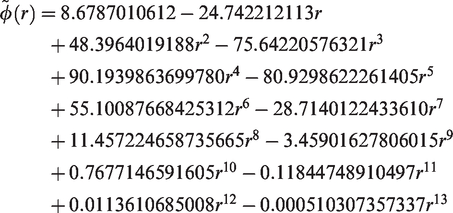
The solution obtained from CM for


Results and discussion
LSM and CM are successfully applied for the analytical solutions of the above presented problem for constant viscosity, variable viscosity, Reynold’s, and Vogel’s models.
In this section, we emphasize on the inspiration of the physical parameters i.e. third grade, pressure gradient, Brownian diffusion, magnetic, thermophoresis, Grashof,

Impact of

Impact of
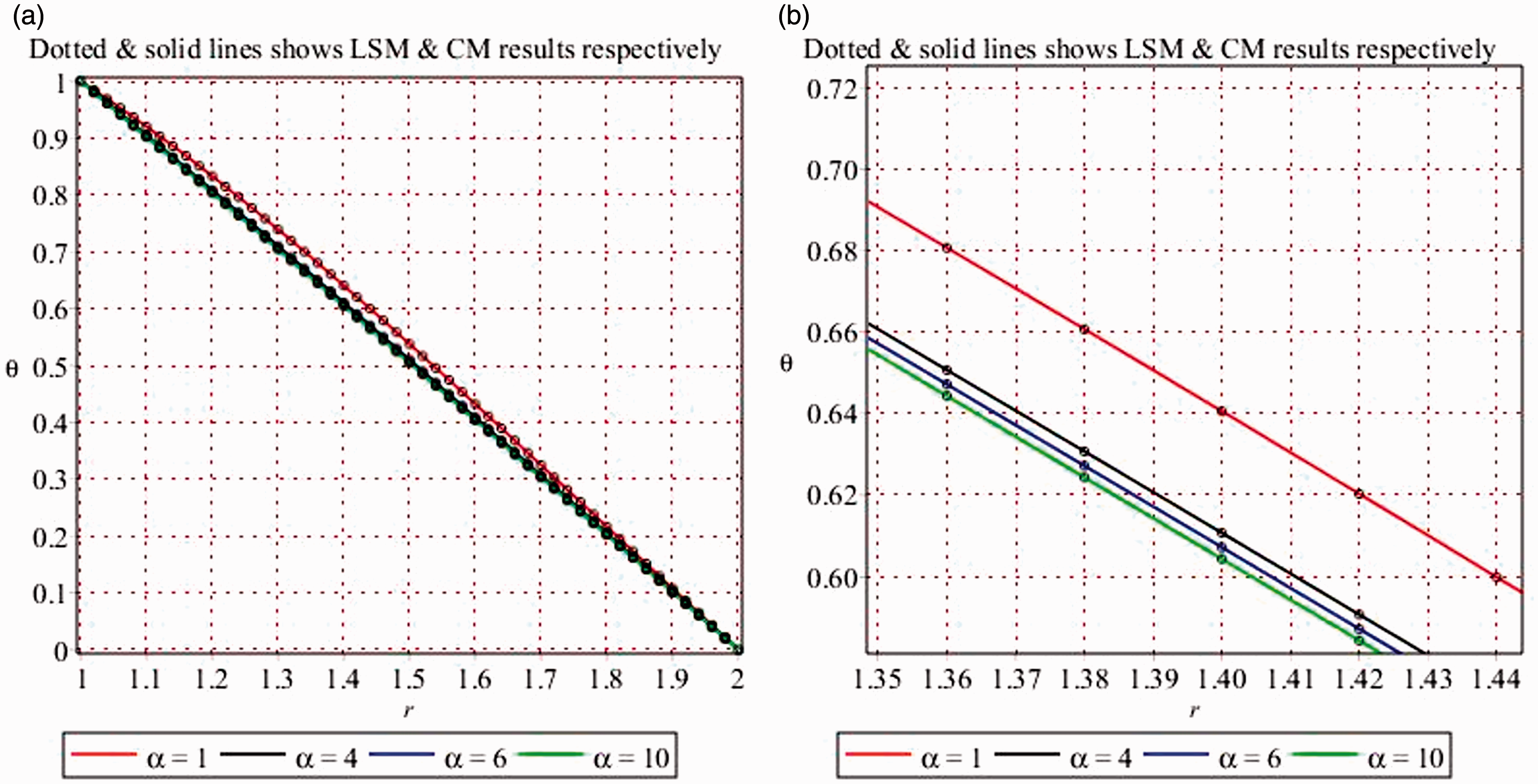
Impact of

Impact of
Figures 5 to 8 demonstrate the impact of
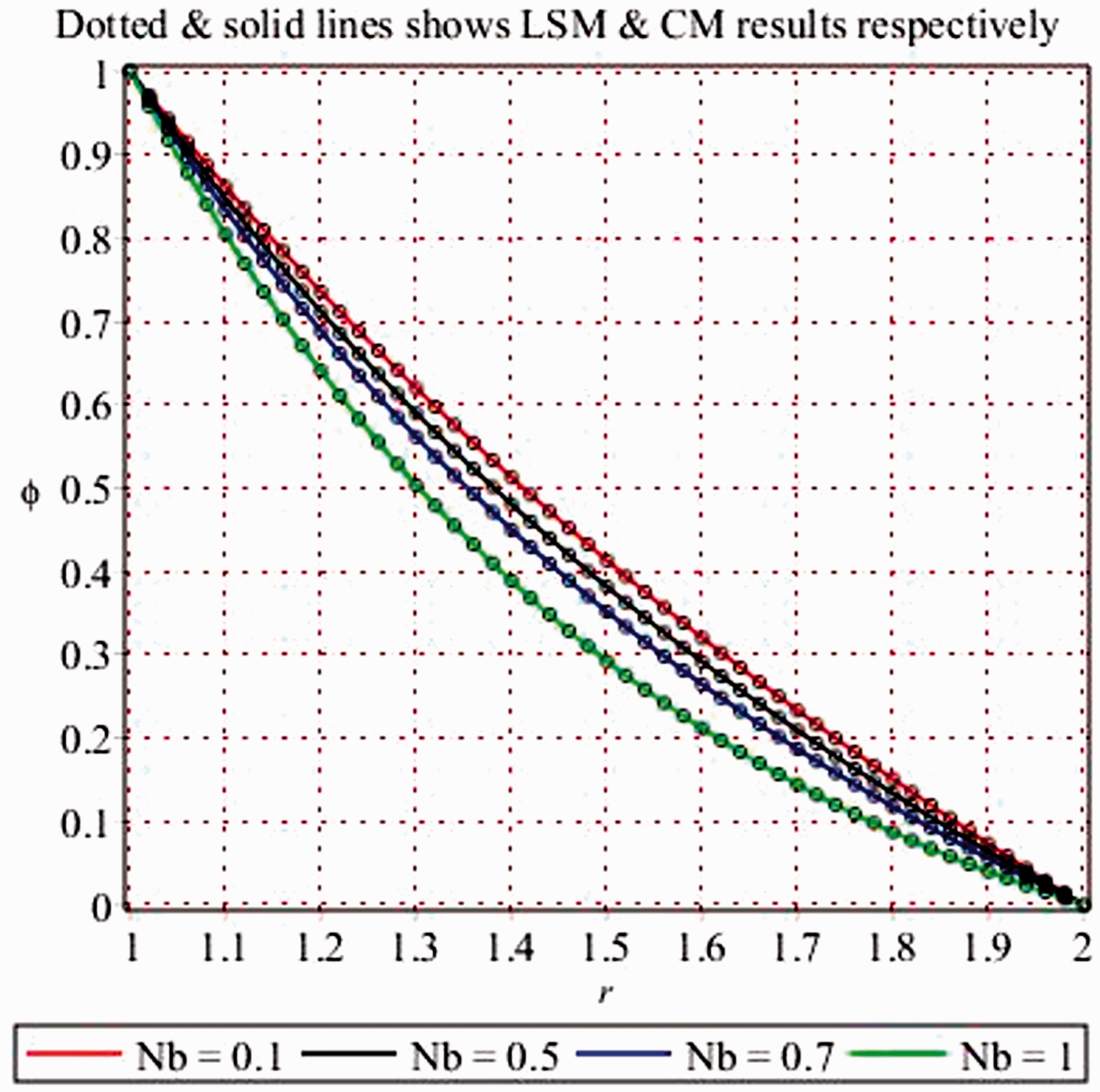
Impact of
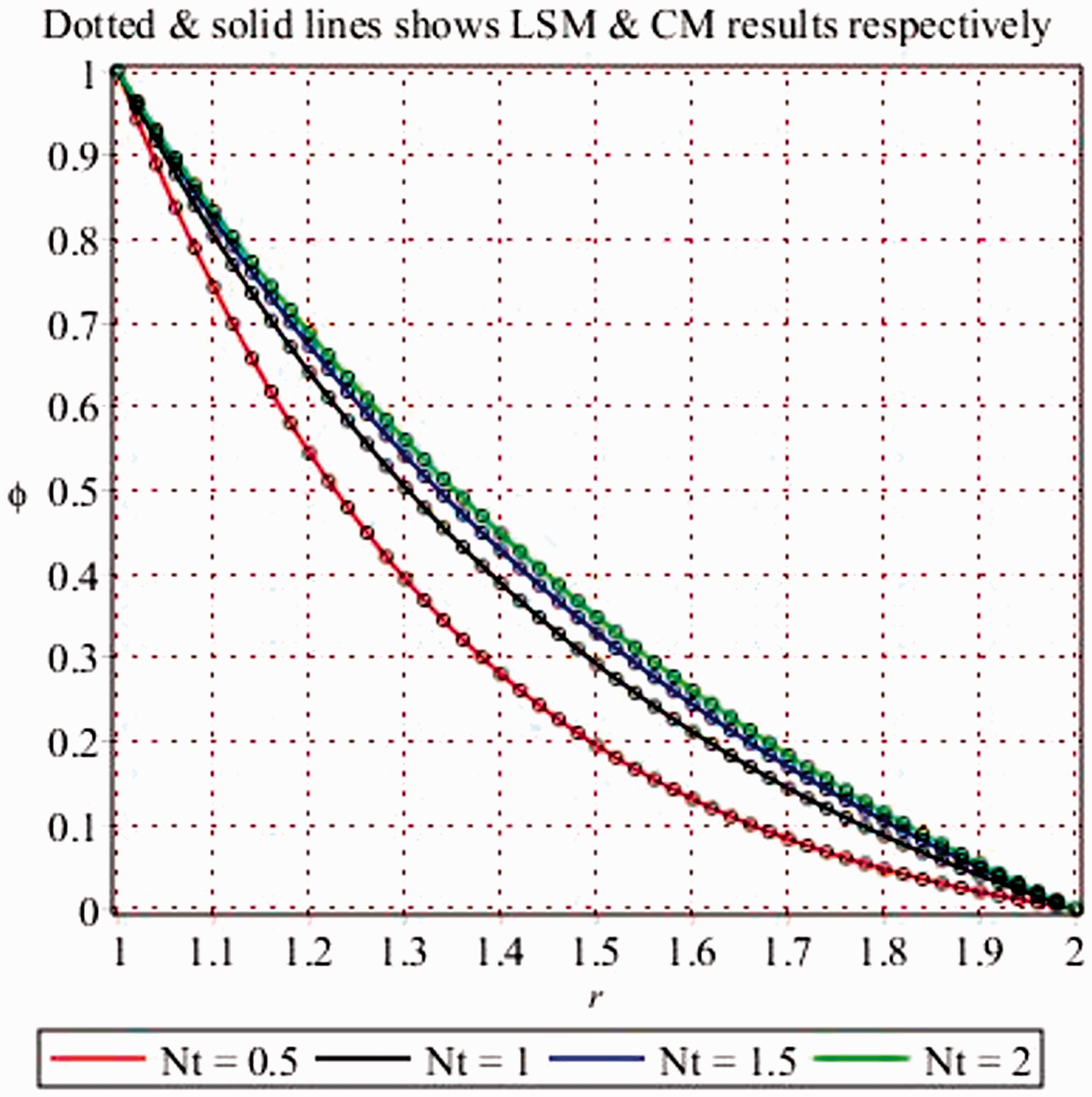
Impact of

Impact of

Impact of
The concentration of nanoparticles increases with the increase in the values of
There is a progressive decrease in the velocity profile with the increase of

Impact of

Impact of

Impact of
Variation of
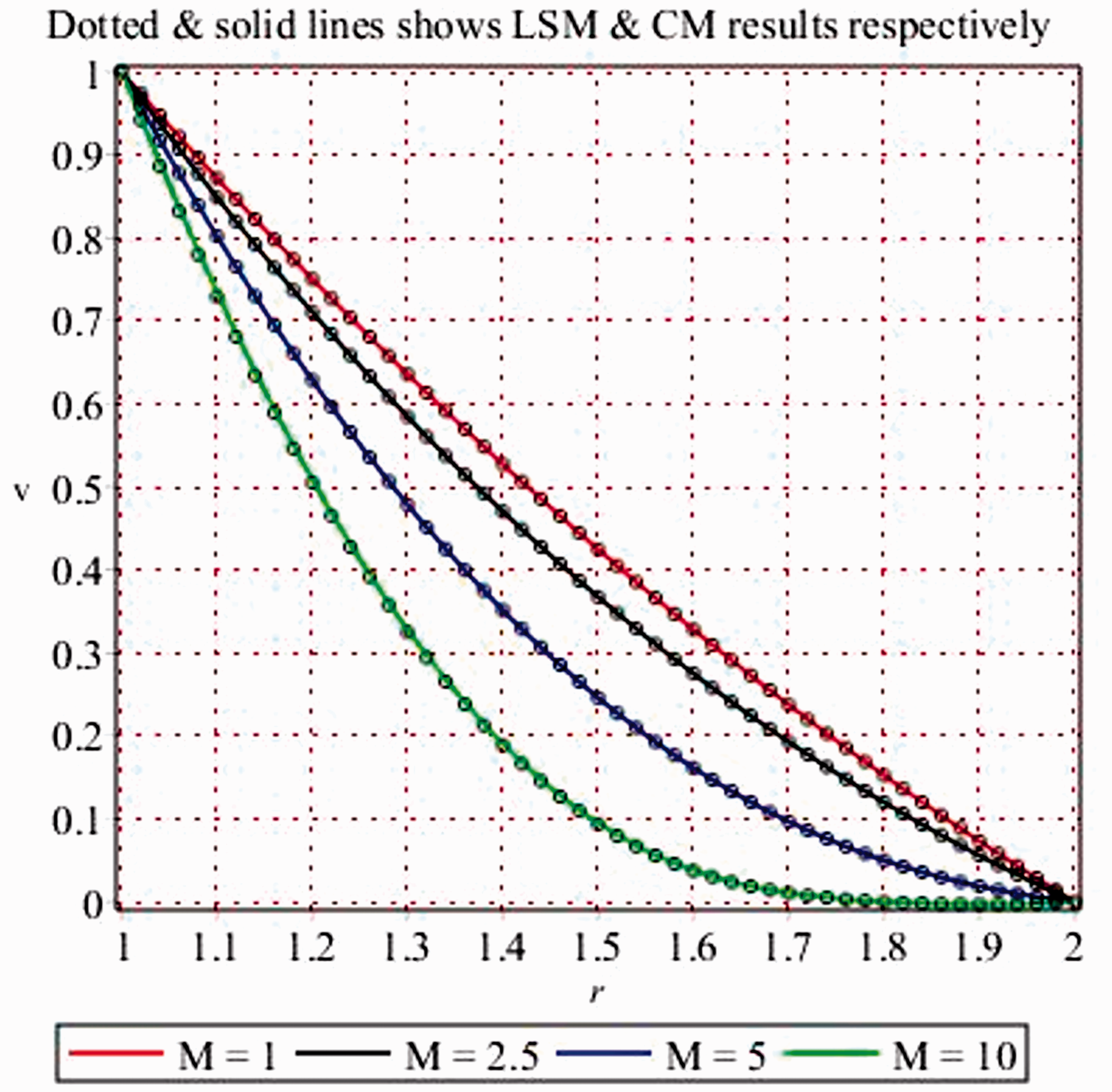
Impact of

Impact of

Impact of
The increment in the Grashof number results in the increase in the velocity profile as shown in Figure 15. Comparison between the CM and RK-4 method is emphasized in Tables 1 and 2 for the velocity, temperature, and concentration profile for constant viscosity model and variable viscosity model, respectively.

Impact of
Comparison of the collocation method (CM) with Runge–Kutta method of order four for
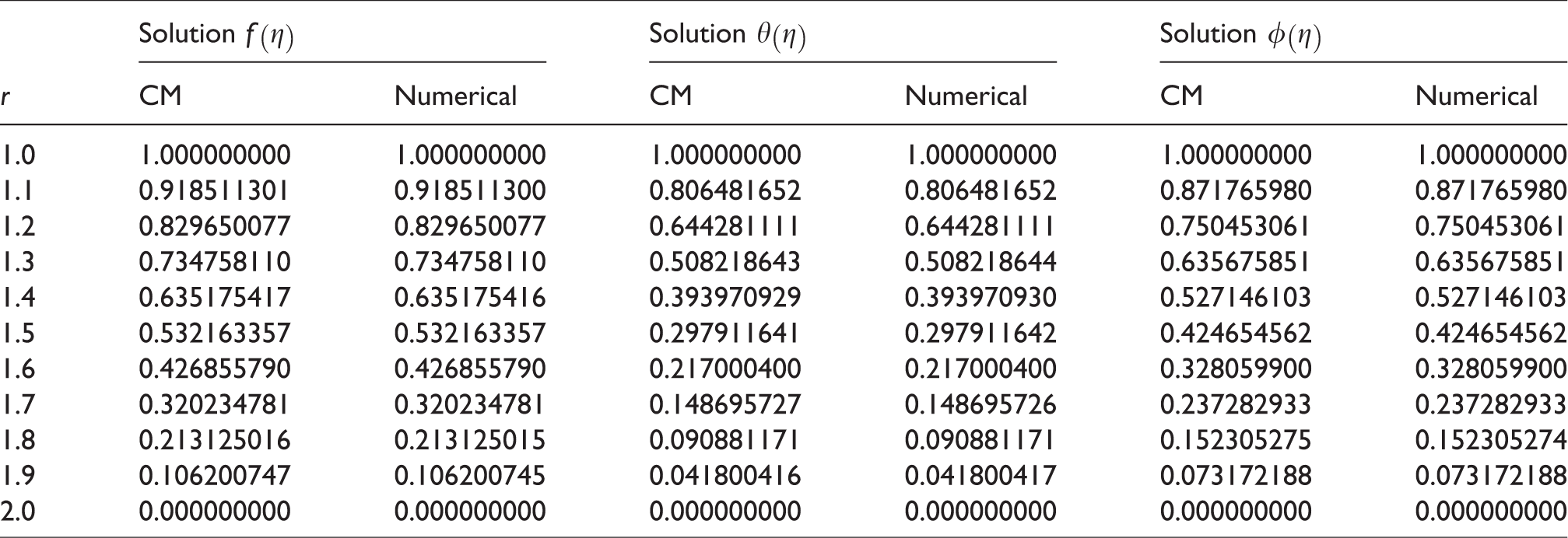
Comparison of the collocation method (CM) with Runge–Kutta method of order four for

The results obtained using the CM agree well with the RK-4 results. Moreover, the error growth in LSM and CM for
Error analysis in results obtained from least squares method (LSM) and collocation method (CM) for

Error analysis in results obtained from least squares method (LSM) and collocation method (CM) for
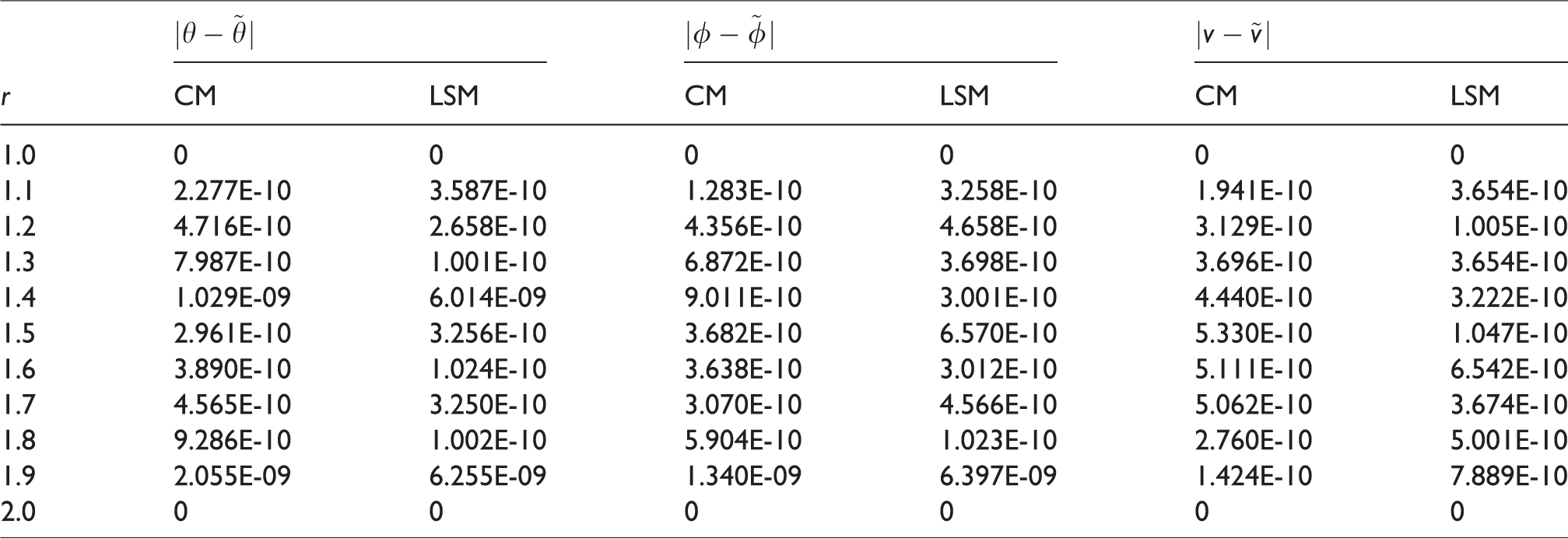
Error analysis in results obtained from least squares method (LSM) and collocation method (CM) for

Error analysis in results obtained from least squares method (LSM) and collocation method (CM) for

Comparison of the already existing results with the proposed algorithms is also shown in Table 7. This comparison table shows that the proposed techniques are well-matched to finding the analytical solutions of the presented problems. In addition, the suggested algorithms can be extended to such type of nonlinear problem arising in biosciences.
Comparison results obtained from least squares method (LSM) and collocation method (CM) with the already existing technique
11
for

Concluded facts
In this research, we assumed blood to be a non-Newtonian third-grade fluid and successfully obtained the solution of the discussed problem by means of collocation and least squares techniques. The following remarks were noted from the study:
By controlling the behavior of nanoparticles we can improve the performance of biological system. This permits the balance of resistant framework connections, cooperation with target cells, thus helping the viable conveyance of payload inside cells or tissues. Procedure depends on comprehension of the points of interest of blood moving through arteries. Results obtained via LSM and CM disclose the worth of suggested algorithms for such type of nonlinear problems. Comparison with the numerical results via RK-4 shows the credibility of the proposed techniques. Different parameters and their effects have been illustrated by graphs. The thermophoresis and Brownian movement perform an essential part on the temperature and nanoparticle focus conveyance. The projected model gives an understanding into the part of red platelets in the appropriation of nanoparticles inside the permeable vein and can be utilized to recognize the impact of attractive field of various restorative treatments on human body.
Footnotes
Syed Tauseef Mohyud Din is now affiliated with Faculty of Sciences, HITEC University Taxila Pakistan.
Tamour Zubair is now affiliated with School of Mathematical Science, Peking University, Beijing, China
Declaration of conflicting interests
The author(s) declared no potential conflicts of interest with respect to the research, authorship, and/or publication of this article.
Funding
The author(s) received no financial support for the research, authorship, and/or publication of this article.