




Abstract
This research utilizes the theoretical framework of the protest paradigm to analyze how major TV channels and newspapers in Chile and Colombia covered—on their official X (Twitter) accounts—the massive 2019 protests. The paper collected data using the software Crimson Hexagon (CH), a social media analysis software that accesses all public messages posted on Twitter, and then conducted a manual content analysis to fully explore the adherence to the paradigm in digital environments, including audience interactions with media content. Results show that chosen media outlets take mainly the riot and confrontation frames to delegitimize protesters, partially influencing the reaction of audiences who engaged with those diminishing devices. A further analysis demonstrates how deeply intertwined the media are with the status quo and elites. In addition, legacy media, particularly TV, seem to fall into a systematic delegitimization of social protest. This research is valuable as it enhances the understanding of media portrayals of protests in Latin America given the new dynamics of news engagement on social media.
Latin America has seen a surge in social protests in recent years, including the massive demonstrations in Chile and Colombia in 2019. In Chile, the 2019 protest was fueled by the weakening of political parties, the erosion of the economic model (Cuadra, 2020) and citizen discontent due to the lack of inclusive political participation (Berrío Gil, 2021). Around the same time, social protests broke out in Colombia as a reaction against the reforms promoted by the government and the private sector in various aspects such as pensions, taxes, working conditions, the environment, and resources for public education (Abitbol, 2019). Additional factors related to the government's failures in the implementation of the peace process with the FARC guerrillas and the resurgence of violence against social leaders made the protests massive (Abitbol, 2019; BBC News Mundo, 2019). According to the Center for Journalistic Research of Chile (Ciper), traditional media played a central role in the way the society understood the “social outbreak” (Luna et al., 2021). The relationship between political elites and media has led some researchers to conclude that the media coverage of the 2019 demonstrations was bias, “exalting acts of violence, criminalizing social protest, and hiding the true demands of citizens” (Cuadra, 2020: 43), and favoring the government and law enforcement (Luna et al., 2021).
Although there were several social protests around the world in 2019, in this research we chose Colombia and Chile over other countries for four main reasons: Manifestations were repressed by Police with excessive force (Castro-Riaño, 2020); they had a longer duration and intensity when compared to others in the region (Castro-Riaño, 2020); they were motivated by the exhaustion of the neoliberal economic model and the decline in trust in institutions and democracy (Semana Magazine, 2019); and young people were essential protagonists and animators of the movements. Moreover, these protests had tangible effects in the political landscape: in Chile, the leftist Gabriel Boric was elected as the new president, while in Colombia, Gustavo Petro became in 2022 the first leftist president in the history of that country.
Research on the controversial relationship between media and protesters has often found that legacy news media tend to cover protests in a negative way following the protest paradigm (Chan and Lee, 1984; McLeod and Hertog, 1999) due to the close association between news organizations and the status quo. Legacy media usually delegitimize protests and adopt frames, devices and reporting styles that undermine the reasons behind social mobilizations. However, digital technology and online social networks have shifted practices in media coverage of protest (Harlow and Johnson, 2011; Harlow et al., 2020; Brown et al., 2018). Particularly, the creation of a hybrid media system into the digital environment (Chadwick, 2013) is facilitating a mutual shaping between mass media logic, social media platform logic, and audiences in the production and distribution of news (van Dijck and Poell, 2013). Yet more research is needed to understand the role that legacy media and audiences play when framing and spreading information about protests on social media (Harlow and Brown, 2021; Harlow et al., 2017). This is particularly true and urgent in the context of Latin America where studies about protest media coverage in digital environments remain scarce, even though social media platforms are widely used to spread opinions and information in times of massive protest. 1
Attending this lack of research, the current study uses content analysis as a method and the protest paradigm as a theoretical framework (Chan and Lee, 1984; McLeod and Hertog, 1999) to understand how major TV channels and newspapers in Colombia and Chile covered on their X (Twitter) accounts the 2019 mobilizations, and how audiences engaged with those posts shared by legacy media. Therefore, the current paper expands recent research on news and social media engagement (García-Perdomo et al., 2018; Trilling et al., 2017) by examining the protest coverage of traditional media on social networks and audience's interactions with those protest-related posts (Harlow and Brown, 2021). In summary, this investigation highlights differences in adherence to the protest paradigm on social media by country, media type, organizations, and audience engagement.
Theoretical framework and conceptual approach
Framing and the protest paradigm
Over the last decade, there has been a global increase in large-scale protests worldwide, creating the need to understand the role that news media play when framing and reporting on protests (Carothers and Young, 2015; Harlow et al., 2020).
News framing is a process of selection, exclusion, elaboration, and emphasis of information that helps producers to “routinely organizes discourse,” privileging a story angle or a symbolic interpretation of events (Gitlin, 1980: 7). Frames are interpretative packages that give meaning to an issue, conveying a central organizing idea that make sense of relevant affairs (Gamson and Modigliani, 1989). In doing so, frames can “define problems,” “diagnose causes,” “make moral judgments,” and “suggest remedies” (Entman, 1993).
Media scholars have labeled frames as issue-specific, when they come out from the analysis of a particular event, or as generic, when they “transcend thematic limitations and can be identified in relation to different topics, some even over time and in different cultural contexts” (de Vreese, 2005: 54). Therefore, issue-specific frames emerge inductively during the analysis of the case while generic frames are usually studied deductively using previous categorizations and theory. Researchers have identified generic frames on political coverage or in relation to the journalistic conventions, norms, and news values (de Vreese, 2005). 2 Other authors have argued that frames such as “human interest”, “powerlessness”, “economics”, “moral values”, “attribution of responsibility” and “conflict” are common ideas used by the media and their audiences to make sense of events in different contexts (e.g., Matthes, 2009; Neumann et al., 1992; Scheufele, 1999). The protest paradigm is part of the theoretical effort in communication to find a set of generic frames that contribute to understand certain social issues across space and help researchers to generalize their findings.
The protest paradigm theorizes that mainstream media coverage tends to delegitimize protests and demonize protesters, aiming to maintain the status quo (Chan and Lee, 1984; McLeod and Hertog, 1999). According to the paradigm, mainstream media frame stories that focus on the violence and spectacle of protests rather than explaining the reasons behind social mobilizations, thereby contributing to the delegitimization of social movements (Gitlin, 1980; McLeod and Hertog, 1999). Although Hertog and McLeod (1995) originally identified five generic frames (confrontation, riot, spectacle, debate, and protest), theoretical refinements of the protest paradigm have come to four generic frames that are often consider symbolic organizing ideas used by media when covering mobilizations: First, the riot frame highlights civil disorder, the destruction of property, or other radical actions taken by demonstrators. Second, the confrontation frame highlights confrontations between police and protesters, including incidents on the streets and arrests. Third, the circus or spectacle frame focuses on odd actions and unusual behaviors of the protesters, presenting them as deviants who are part of emotional exhibitions and use sensational tactics. And finally, the debate frame highlights the reasons behind protests, the grievances that prompt people to take to the streets, and the causes and consequences of the social unrest, legitimizing the mobilizations.
The paradigm also states that media coverage can influence whether society accepts or rejects protesters’ grievances (Harlow et al., 2017; McLeod and Hertog, 1992). But activists sometimes use disruptive actions to get the media's attention—like mass demonstrations, nudity, graffiti, and confrontation with police (Boyle et al., 2004). Such acts often catch the media's attention but lead to negative news coverage, and the protesters’ message gets lost in the middle of the spectacle, riot, or confrontation (Boyle et al., 2004, Brown and Harlow, 2019). An additional factor to consider is the ideological position of the protest and the degree to which that position challenges the status quo. Boyle et al. (2004) argued that agendas that radically contest the socio-political status quo would more likely conform to the protest paradigm theory than mobilizations that support the status quo (see also, Gitlin, 1980; McLeod and Hertog, 1992).
Researchers have found prevalent depictions of protesters as unpatriotic in domestic political demonstrations, international conflict (Brasted, 2004; Di Cicco, 2010; Weaver and Scacco, 2013), or in mobilizations against social and racial inequalities (Harlow et al., 2017; Brown and Harlow, 2019). In the context of Latin America, Doran (2017) argues that there is a systemic collective response to criminalize protests due to a “limited concept of democracy, the legacy of authoritarianism, and the intensification of security discourses” (p. 200). Protest criminalization strengthens the idea of a violent society disconnected from institutions and indirectly contributes to legitimizing new modes of repression (Doran, 2017).
However, recent research has found that the protest paradigm does not work accordingly in global contexts or, at least, exhibits variations depending on the type of protest, location, and media ideology (Harlow et al., 2017; Jiménez-Martínez, 2021; Brown and Harlow, 2019; Kim and Shahin, 2019; Shahin et al., 2016). Moreover, scholars have found that online media and social media's protest coverage challenges the theory's key assumptions (Harlow and Johnson, 2011; Harlow et al., 2017, 2020).
Social media have also transformed the way traditional media and protestors relate to each other. Protesters have broader opportunities for communicating their grievances with some independence from media (Cammaerts, 2012; Poell and Borra, 2012), whereas news organizations and journalists find other forms of covering social issues apart from traditional routines. Therefore, one of the main goals of this research is to contribute to this academic discussion by analyzing whether the conventional protest paradigm persists on the social media accounts of chosen mainstream media in Chile and Colombia when reporting on recent massive protests, and whether audiences interact with those posts following the same mass media logic.
Latin American media and the paradigm
More recent studies that investigate how the protest paradigm operates in the Latin American context have found anomalies and shortcomings in the adherence to it. For instance, studying Brazilian journalists’ social media use from 2013 to 2015, Mourão and Chen (2020) noticed that social media representations reflected individual attitudes that predicted coverage. Consequently, marginalizing patterns of protest coverage can be challenged by individual journalists, and not necessarily replicated on X (Twitter). Likewise, a study comparing social unrest in Brazil, India, and China (Shahin et al., 2016) showed that in non-Western countries social movements typically exist outside nation's formal political system so protests are ways of negotiating with the system from without. Shahin et al. (2016) concluded that “historical legitimacy of informal political negotiations in a nation reduces the likelihood of its news media adopting the protest paradigm” (p. 150) and that news organizations’ ideological affiliation with the government makes it relatively more likely to conform to the protest paradigm (p. 143). In their study, Harlow et al. (2020) established that the region where the media outlets were located predicted the use of the spectacle and debate frames in protest coverages. Also, Harlow et al.'s findings may indicate a shift in alternative Latin American media coverage that focuses on the relevance of social protest and the vindication of major social movements’ demands. Jiménez-Martínez's (2021) research on the 2013 social unrest in Brazil suggests that the paradigm falls short when trying to capture the true complexity of the current news coverage of protests, particularly in the highly digitized media landscape.
The intertwined relationship between the state, elites, and the media (García-Perdomo, 2021) has shaped the historical position of Latin American news organizations toward social protests as mainstream media have often supported the status quo while underestimated protestors’ grievances. Moreover, traditional media in Colombia and Chile have frequently covered social unrest as a transgression of the law, closely related to illegal acts carried by radical leftist groups (Barrera and Hoyos, 2020; Cárdenas, 2014; Cruz, 2015; De la Maza, 2003; Lalinde, 2019). Additionally, during the last decades, protests in Chile have shown a disconnection between social movements and political institutions (Somma and Bargsted, 2015), and legacy media have portraited protesters as violent (Basulto et al., 2020). Hence, regardless of their commercial and democratic orientation, media scholars have argued that Latin American traditional media are not genuinely competitive because interests of media corporations, political groups, and elites have seized journalism in the region (Montoya-Londoño, 2014).
After providing all this context and because there is not a clear indication of how traditional media from Colombia and Chile covered the 2019 protest through their social media accounts and whether they adhered or not to the protest paradigm, we ask the following question:
RQ1 (a-e): How do the Chilean and Colombian media differ in their use of the (a) riot, (b) confrontation, (c) spectacle, and (d) debate frames in articles shared on social media and (e) how those differences could be related to the media systems in each country?
TV and newspapers’ protest coverage
The digital environment has contributed to the formation of a hybrid media system in which old and new media logics interact in flow (Chadwick, 2013). This system not only blends social networks, traditional media, politics, and publics but also provides a fertile ground to understand how different actors interact and engage in complex digital environments, creating diverse communication patterns.
Although the creation of this new hybrid ecosystem justifies the analysis of traditional media's practices on social networks as a key factor of the rapid digitalization of journalism, differences between newspapers and television have also been found significant when looking at the way these mediums cover social issues, including protest. The visual and sensational nature of television news coverage has been considered more problematic than newspapers’ reporting. Particularly, ideological cable news channels (e.g., Fox News and MSNBC in the US context) tend to utilize marginalization frames more often than other traditional news sources such as newspapers or international news agencies (Weaver and Scacco, 2013). TV news coverage of social protest has been found to produce framing effects in which higher levels of status quo support will result on higher levels of criticism of protesters and less disapproval toward the status quo and authorities (McLeod and Detenber, 1999).
While newspapers have been praised as the backbone of investigative journalism (Kovach and Rosenstiel, 2007), TV news has been criticized for undermining the foundations of social capital (Putnam, 2000) or for privileging episodic coverage of social issues over more substantial reporting (Iyengar, 1991). Scholars infer that “elite’ newspapers adopt a less sensationalized coverage of political activities in the public sphere (Beyeler and Kriesi, 2005) and, therefore, they can set the agenda for other media (Carvalho, 2007). Despite these assumptions, authors have found in their empirical analysis of main newspapers that the use of marginalizing devices to represent protests or conflict has been stable over time also in print media (Galtung and Ruge, 1965; Gil-Lopez, 2021; Shoemaker, 1984). Moreover, anti-war, anti-regime movements, and country-allies foreign protests seem to adhere more closely to the paradigm in different legacy media and formats (Gil-Lopez, 2021).
Given that legacy media play a significant role in the configuration of this hybrid media system and that there seem to be important differences between TV and newspapers, we ask (RQ2 a-d): whether there are significant associations between the media type (TV and newspapers) and the use of the (a) riot, (b) confrontation, (c) spectacle, and (d) debate frames in protest-related articles shared on social media.
Likewise, as scholars have found key differences in protest coverage between media outlets depending on organizational arrangements and political/economic interests, we ask the following question:
RQ3 (a–d): Are there differences between the social media activity of selected media organizations (@NoticiasCaracol, @ELTIEMPO, @meganoticiascl, @ElMercurio_cl,) and the use of the (a) riot, (b) confrontation, (c) spectacle, and (d) debate frames in messages shared on X (Twitter). Finally, we want to know in this section if media organizations portray protests and protesters through their Twitter handles as either violent or peaceful on social media (RQ4 a–c).
Social media engagement
Engagement through social media encourages interaction with certain content, ideas, and organizations (Moe et al., 2015). Previous studies have shown a relationship between the properties of news and engagement in aspects related to news values such as conflict and human interest (García-Perdomo et al., 2018), emotional content (Dobele et al., 2007), positive stories (Berger and Milkman, 2012), and controversial news (Kim, 2015).
Users’ interactions on social media as a response to mainstream media's posts can show whether the public legitimize or delegitimize protest (Harlow and Brown, 2021). In other words, social media engagement helps researchers to explore how online communities contest, negotiate, and respond to portrayals of the protests published by the media. Previous studies have found, for instance, a disruption in the protest paradigm on social media as posts with peaceful protest and debate frames seem to receive more interactions from users (Harlow et al., 2017, 2020). Furthermore, social media engagement slightly unveils whether online communities support or challenge mainstream media portrays of protests.
As the success of protest movements depends on public perception and the legitimacy that news media assign to demonstrations (Detenber et al., 2007), user engagement through social media has become critical to the favourable outcome and visibility of news stories and posts in the hybrid media system, supporting or undermining reasons behind a protest. For instance, Harlow and Brown (2021) concluded in their analysis of protest news and online engagement that the protest paradigm operates differently at two levels on social media: On the one hand, media and journalists decide what content is relevant to audiences and should be posted. On the other hand, users determine what stories should be amplified. Therefore, sharing, commenting, and liking stories on social media—actions and affordances that have become the engine of news engagement and distribution in the digital environment (Braun, 2015; Napoli, 2011; Tenenboim and Cohen, 2013) —provide users with gatekeeping capabilities that impact the understanding of social issues (Bruns, 2005). In addition, social media interactions create a parallel news agenda that exercises pressure on mainstream media, professional journalists, and the public sphere (Bright, 2016). And even though the impact of traditional news media messages and posts sometimes is greater than any other source or output (Jenkins et al., 2013), the audience's engagement is critical to the dissemination of protest news and stories.
In this way, the links between media framing, social media, and audience engagement reflect top-down and bottom-up processes (Walsh and Cramer, 2004) because elite/media frames can shape public opinion, but also users can engage, transform, or resonate with the meanings of those media frames (Brewer and Gross, 2010: 175). For instance, Mourão and Brown (2021) found that social media users tend to engage more with articles legitimizing protest frames on Facebook, following a different pattern than traditional media. Nevertheless, users often marginalize specific movements related to race and ethnicity. This relationship shows that mainstream media content, movements, users, and platforms replicate social hierarchy struggles, shaping social media attitudes and behaviors (Brown and Harlow, 2019).
Therefore, this research aims to contribute to the nascent literature on engagement and social networks in the context of protest coverage by analyzing the general sentiment and engagement of the conversation and asking the following hypothesis:
H1: As previous findings have confirmed the tendency of audiences to engage with conflict and odd messages, we predict a positive association between frames that reinforce the protest paradigm and engagement (likes, retweets and comments added) on articles shared on social media from traditional media outlets from Colombia and Chile.
Methodology
To answer these questions, the current study collected data using the software Crimson Hexagon (CH), a social media analysis platform with a supervised machine-learning algorithm that accesses all public messages posted on X (Twitter) (Pew, 2012) and other social media. CH allows researchers to track millions of messages and to measure sentiment (CH, 2014). The current research used the social media monitor of CH to download all tweets posted by the official accounts of the chosen media outlets (@meganoticiascl, @ElMercurio_cl, @NoticiasCaracol, and @ELTIEMPO), and then took a representative sample of those posts. CH can calculate the total number of social media interactions generated by messages shared by official media accounts (CH, 2015). We used these software affordances to describe the total engagement generated by Chilean and Colombian media when covering the 2019 protests.
However, to present results and conduct the framing analysis, we utilized human coders and manual content analysis. To grab the data, the CH software gathered randomly 1000 tweets per official media account. Then, using a tool from Excel, a second random sample of 200 tweets was obtained per media. In all, the coders analyzed 800 tweets. In the case of Chile, CH collected the X (Twitter) posts from October 18 to November 15, 2019. In the case of Colombia, the software gathered the data from November 21 to December 23, 2019. To do the framing analysis, only tweets posted by the official accounts of these media outlets were considered. CH also searches for specific languages (in this case, Spanish), narrows the regions (Colombia and Chile), and allows the inclusion of specific keywords to track the most relevant conversations. We used the keywords in Spanish: protest, protesters, and march. The framing analysis considered the texts of the tweet; the visual components, such as images or videos, were not studied.
Four traditional news media outlets were selected for the analysis: one newspaper and one TV channel for each country. Those media outlets and their respective official X (Twitter) accounts were Meganoticias TV (@meganoticiascl) and El Mercurio newspaper (@ElMercurio_cl) from Chile; and Caracol Noticias TV (@NoticiasCaracol) and El Tiempo newspaper (@ELTIEMPO) from Colombia.
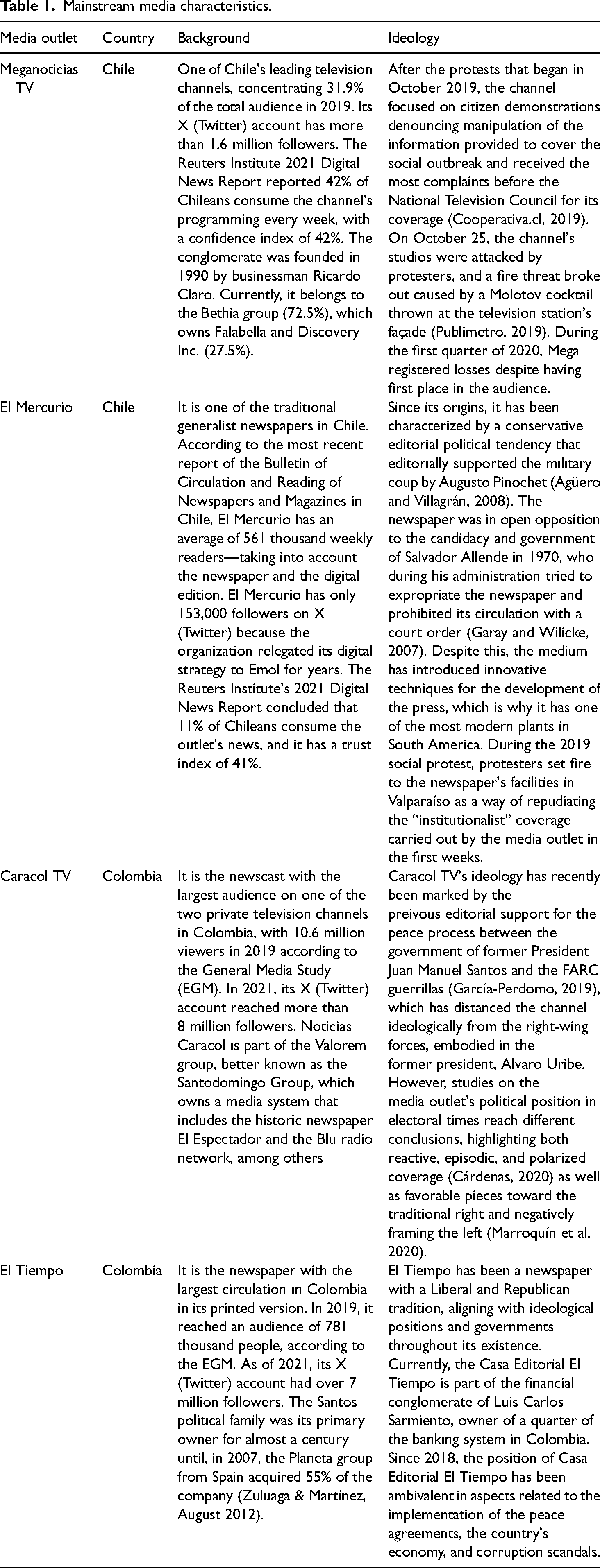
Caracol TV is one of the two private TV channels with national coverage in Colombia. According to the General Media Study (EGM), this network had the highest number of viewers in 2019 (10.6 million). El Tiempo is the national newspaper (printed version) with the highest circulation in Colombia. In 2019, it had 781,000 readers, according to EGM. Its web portal was the page that received the most monthly unique visitors with 9.25 million users (Neira, 2019). Meganoticias is the most watched news program in Chile, according to Kantar Ibope Media (2019). It was the most watched channel in 2019, annually concentrating 31.9% of the audience, according to the National Television Council of Chile. El Mercurio is one of the generalist newspapers with national coverage in Chile. According to the most recent figures from the Bulletin of Circulation and Readership of Newspapers and Magazines of Chile, El Mercurio had an average of 561 thousand weekly readers, considering its paper and digital editions (see Table 1 for more information about these media). These media outlets represent the local media system for their trajectory and impact in terms of audiences and agenda setting, but in no way this research is an exhaustive analysis of Colombia or Chile's whole legacy media system.
Mainstream media characteristics.
As a method, this research used content analysis (Berelson, 1952; Krippendorff, 2004; Riffe et al., 2005), which looks for “the objective, systematic, and quantitative description of the manifest content of communication” (Berelson, 1952: 489). Two coders, authors of the current research, with graduate education and knowledge of the Latin American context conducted the coding process. The Krippendorff Alpha's measure was used to obtain inter-coder reliability (Krippendorff, 2004; Riffe et al., 2005). A sub-set of 6% of the total sample was selected to test the agreement between coders. Three rounds of coding were necessary to obtain reliability among coders with all variables. After each one of the rounds, coders analyzed and discussed cases where they did not agree on to clarify problems related to the operationalization of the codebook.
Frames and devices
First, coders had to decide whether the tweet was related to protests in Colombia and Chile or not (No = 0, Yes = 1; α = 1). If the social media message was not related to the protest, coders stopped coding that message and removed it from the sample.
Riot frame
Coders decided whether (1) or not (0) there was a riot frame present in the text of the tweet. The riot frame focuses on the violence of protesters, rioting, looting, and protesters vs. society (α = 0.83).
Confrontational frame
Coders decided whether (1) or not (0) there was a confrontational frame present in the social media post. The confrontational frame focuses on confrontations between police and protesters or arrests of protesters (α = 0.93).
Spectacle/circus frame
Whether (1) or not (0) there was a Spectacle/Circus frame present. The spectacle frame focuses on the emotion, drama, oddity, or unusualness of protesters. It portrays them as deviants or involves celebrities in the coverage (α = 0.74).
Debate frame
Coders decided whether (1) or not (0) there was a debate frame present in the post. The debate frame focuses on dialogue and social critique and is characterized by the presence of the social movement's/protesters’ viewpoints and demands (α = 0.7).
Violent protest
Whether (1) or not (0) protests or protesters are described as violent (α = 0.83).
Peaceful protest
Whether (1) or not (0) protests or protesters are described as peaceful (α = 0.7).
Social media interactions
Number of likes, retweets and comments produced by social media users as reactions to media posts were added to create one single variable-index that grouped all interactions. This variable was normalized using the Log10 function in SPSS to avoid the abnormal distribution of interactions and to compare and find differences between media outlets.
Results
The automatic social network analysis tool of CH was used to track Chilean and Colombian legacy media's posts on X (Twitter) during the 2019 protest. The CH software automatically analyzed the general engagement of the conversation around mainstream media's activity related to protest. Considering all the conversation, TV channels—Meganoticias (286,000 reactions, meaning likes, retweets, and comments) and Noticias Caracol (294,000)—received more interactions from users than the newspapers—El Tiempo (265,000 interactions) and El Mercurio (49,000 reactions)—but had to deal with much more negative sentiment (χ2 = 80.375.38, df = 6, p < 0.001; Table 2).
Automated general engagement.
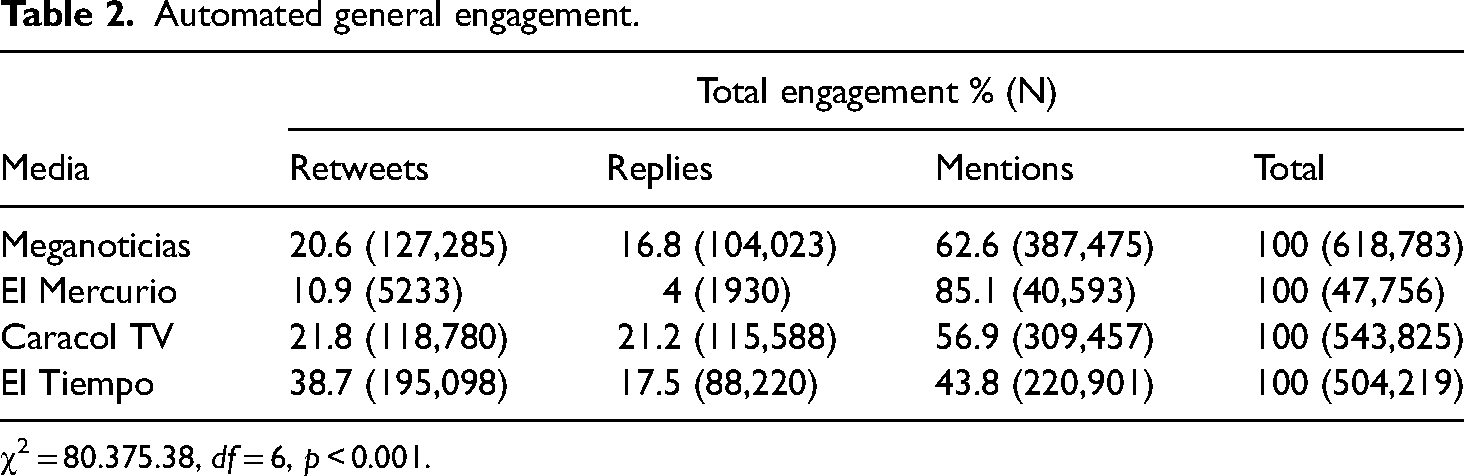
χ2 = 80.375.38, df = 6, p < 0.001.
Looking specifically at the random subsample of original posts produced by the news media outlets (N = 800; 200 posts per media), the descriptive statistics showed that 27.3% of tweets (N = 218) had the riot frame; 11.9% (N = 95) contained the confrontation frame; 8.4% (N = 67) had the spectacle frame, and 12.3% (N = 98) used the debate frame. Additionally, 24.4% (N = 195) of the sample tweets portray protests as violent, while only 12.8% (N = 102) of the posts talked about peaceful protests. Meganoticias posted 4871 messages directly from its official X (Twitter) account; |El Mercurio, 1545 tweets; Caracol TV, 5375 notifications; and El Tiempo, 4094 posts, during the timespan selected. A sample of 200 messages per media outlet and answer questions directly related to protest coverage.
The first research question asked whether there were significant differences between Colombia and Chile and the use of the riot, confrontation, spectacle, and debate frames in protest-related posts shared on Twitter. Results show that Chilean media used the riot frame (37.5%, N = 150) more frequently than the Colombian media (17%, N = 68; χ2 = 42.397, df = 1, p < 0.001, Cramer's V = 0.230). But also, Chilean outlets used the debate frame (20%, N = 80) more often than Colombia (4.5%, N = 18; χ2 = 44.700, df = 1, p < 0.001, Cramer's V = 0.236). The association between these variables proved strong according to the Phi and Cramer's V coefficient. Meanwhile, Colombian media tended to incorporate more stories containing the spectacle frame (13.5%, N = 54) than Chilean media (3.3%, N = 13; χ2 = 27.833, p < 0.001, Cramer's V = 0.185). Both countries used the confrontation frame with the same frequency (around 12%), but the results were not statistically significant, and the association was very weak (χ2 = 0.108, p > 0.05, Cramer's V = 0.012; Table 3).
National media and protest paradigm frames.
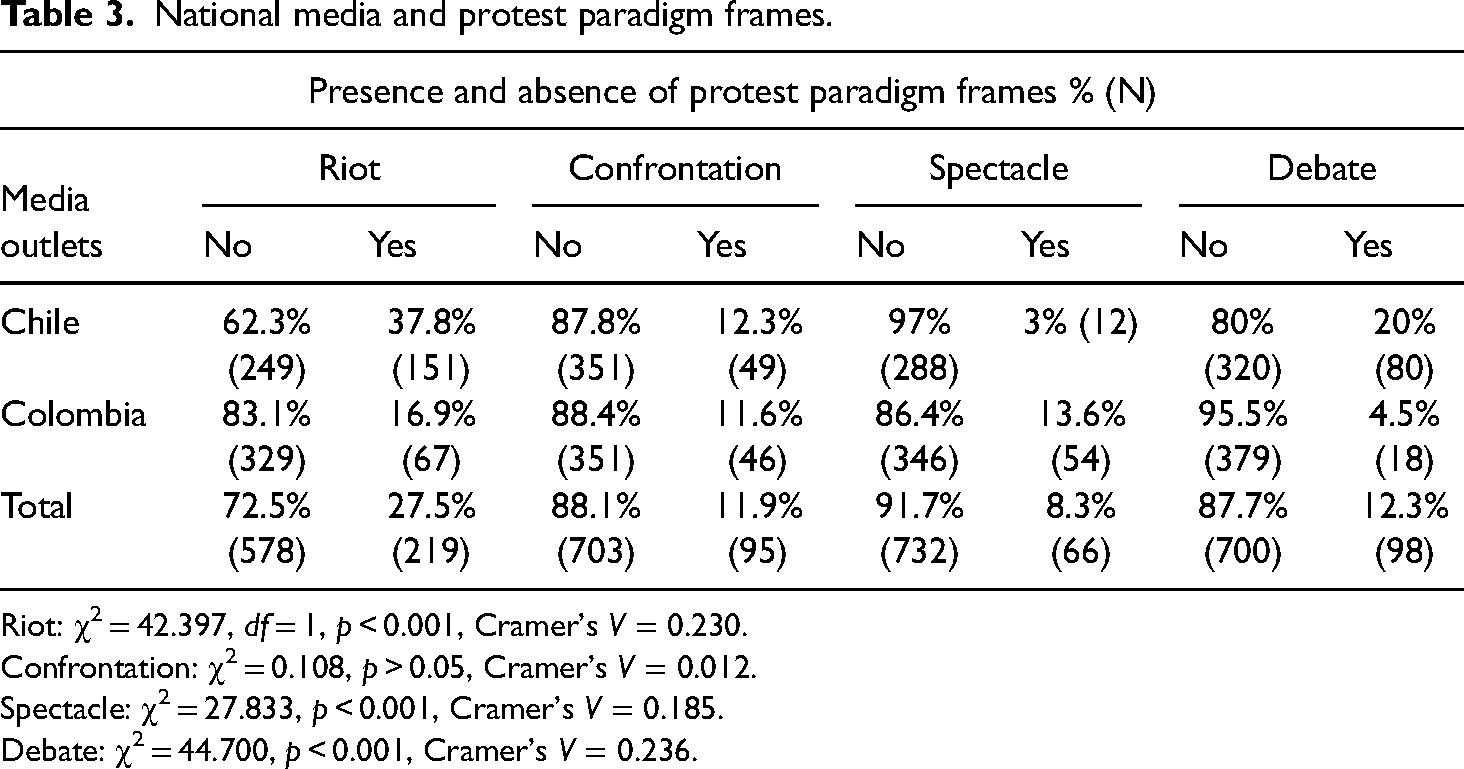
Riot: χ2 = 42.397, df = 1, p < 0.001, Cramer's V = 0.230.
Confrontation: χ2 = 0.108, p > 0.05, Cramer's V = 0.012.
Spectacle: χ2 = 27.833, p < 0.001, Cramer's V = 0.185.
Debate: χ2 = 44.700, p < 0.001, Cramer's V = 0.236.
The second research question asked whether there were significant associations between the media type (TV and Newspapers) and their adherence to the protest paradigm in protest-related articles shared on social media. Results show that TV tended to use the riot frame (36.5%, N = 146) more frequently than newspapers on their social media sharing (18%, N = 72; χ2 = 34.528, df = 1, p < 0.001, Cramer's V = 0.208) while newspapers utilized the debate frame (20.5%, N = 82) more often than TV (4%, N = 16; χ2 = 50.654, df = 1, p < 0.001, Cramer's V = 0.252). Also, TV used the confrontational frame (12.8%, N = 51) between protesters and the police more frequently than newspapers (11%, N = 44), but the results of this association were not significant and the relationship between media type and the confrontation frame was weak (χ2 = .585, df = 1, p > 0.05, Cramer's V = 0.027; Table 4).
Media type and protest paradigm frames.
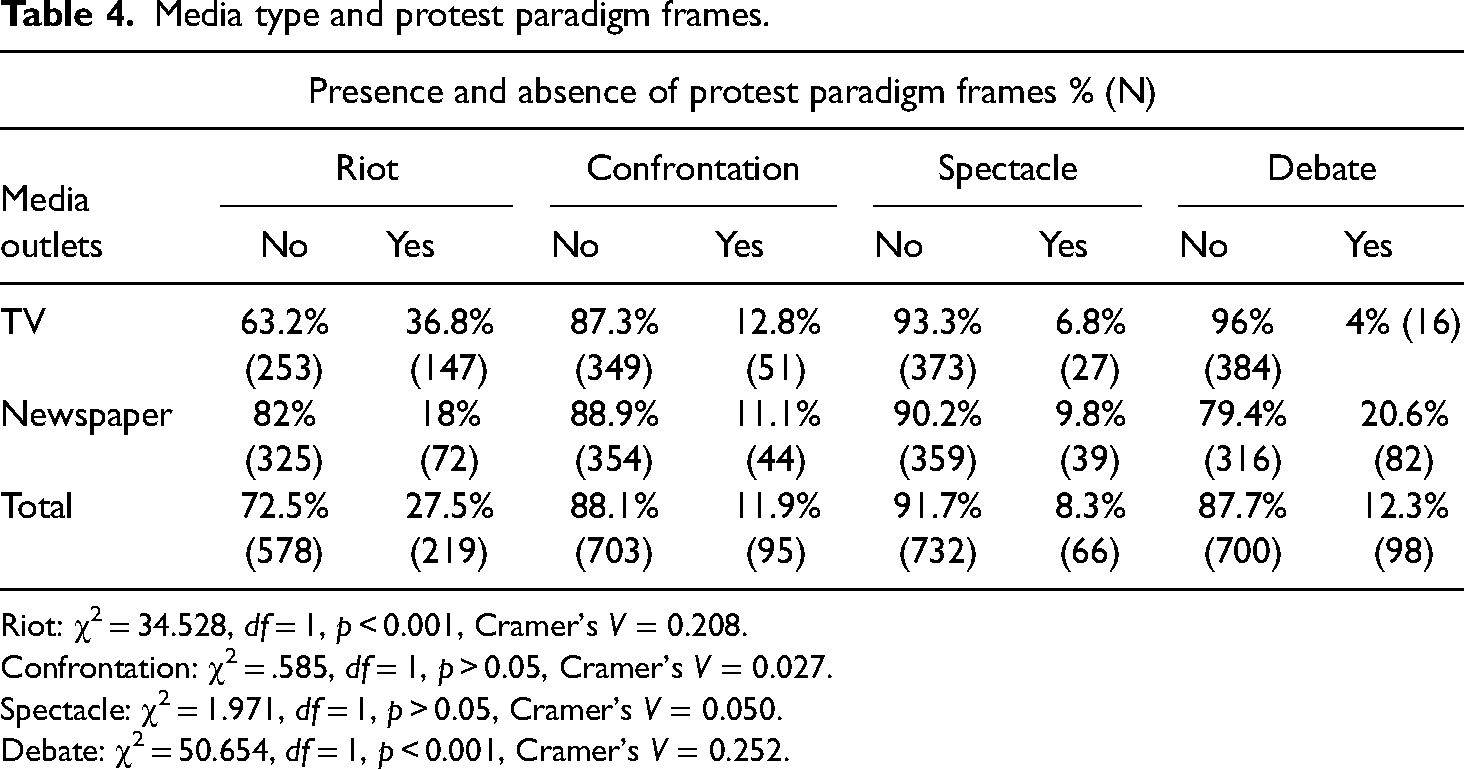
Riot: χ2 = 34.528, df = 1, p < 0.001, Cramer's V = 0.208.
Confrontation: χ2 = .585, df = 1, p > 0.05, Cramer's V = 0.027.
Spectacle: χ2 = 1.971, df = 1, p > 0.05, Cramer's V = 0.050.
Debate: χ2 = 50.654, df = 1, p < 0.001, Cramer's V = 0.252.
The third research question asked whether there was a significant association between the media organizations (Caracol TV, El Tiempo, El Mercurio, and Meganoticias) and the adherence to the protest paradigm. A crosstab table shows that Meganoticias (53%, N = 106) was the medium that used the riot frame most frequently in its social media coverage, followed by El Mercurio (22%, N = 44), Caracol TV (20%, N = 40), and El Tiempo (18%, N = 28; χ2 = 92.689, df = 3, p < 0.001, Cramer's V = 0.340). Conversely, El Tiempo (17.5%, N = 35) and Caracol TV (9.5%, N = 19), from Colombia, used the spectacle frame more profusely than Meganoticias (4.5%, N = 9) and El Mercurio (2%, N = 5), from Chile (χ2 = 36.538, df = 3, p < 0.001, Cramer's V = 0.214). Although in a small proportion, El Mercurio was the medium that used the debate frame (40%, N = 80) most frequently in its social media activity, well above Caracol TV (8%, N = 16) and El Tiempo (1%, N = 2; χ2 = 198.105, df = 3, p < 0.001, Cramer's V = .498). Finally, Meganoticias was the medium that incorporated the confrontation frame most often (14%, N = 28), but the differences with other media were not significant and the association was very weak in this case (χ2 = 1.278, df = 3, p < 1, Cramer's V = 0.040; Table 5).
Media organizations and protest paradigm frames.
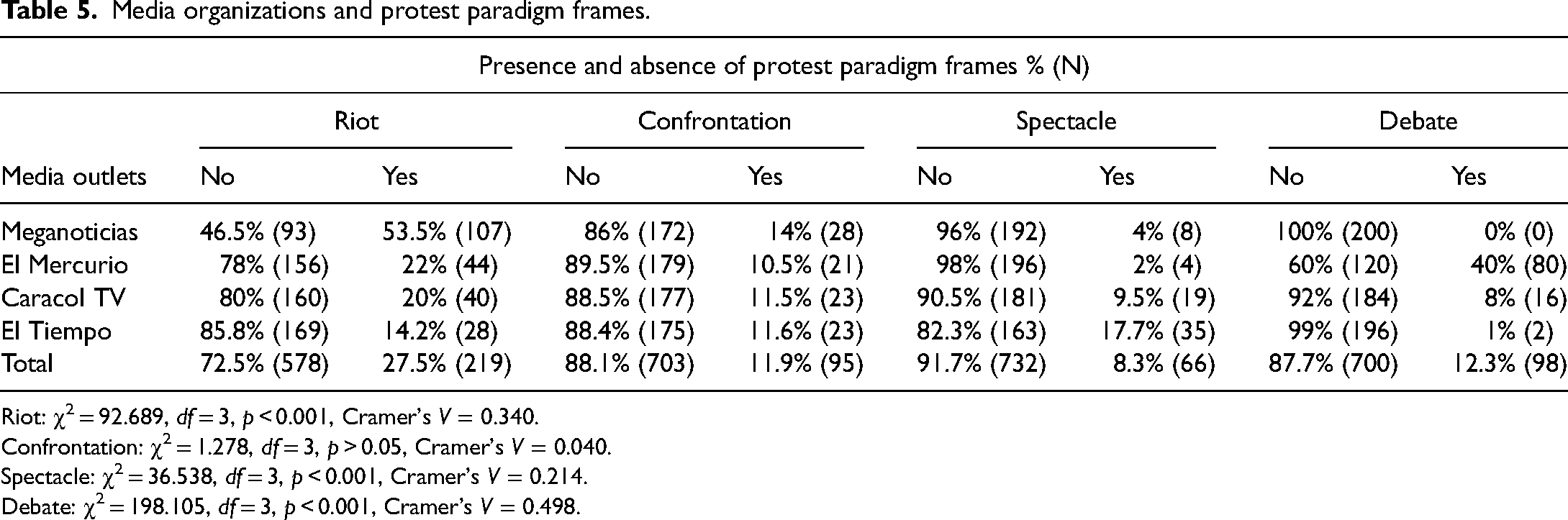
Riot: χ2 = 92.689, df = 3, p < 0.001, Cramer's V = 0.340.
Confrontation: χ2 = 1.278, df = 3, p > 0.05, Cramer's V = 0.040.
Spectacle: χ2 = 36.538, df = 3, p < 0.001, Cramer's V = 0.214.
Debate: χ2 = 198.105, df = 3, p < 0.001, Cramer's V = 0.498.
The fourth research question inquired about media organizations portraying protests and protesters as either violent or peaceful on social media. Results show that Meganoticias (36%, N = 72) portrayed protests as violent on their social media accounts more often than and El Tiempo (26%, N = 52), Caracol TV (20%, N = 40), and El Mercurio (15.5%, N = 31; χ2 = 25.572, df = 3, p < 0.001, Cramer's V = 0.179). However, with lower frequency, Caracol TV (23.5%, N = 47), and El Tiempo (21.5%, N = 43) tweeted messages referring to peaceful protests more often than Meganoticias (4.5%, N = 9) and El Mercurio (1.5%, N = 3; χ2 = 69.532, df = 3, p < 0.001, Cramer's V = 0.295). In all cases, the associations between media outlets and violent/peaceful protests proved strong (Table 6).
Media organizations and portray of violent/peaceful protest.
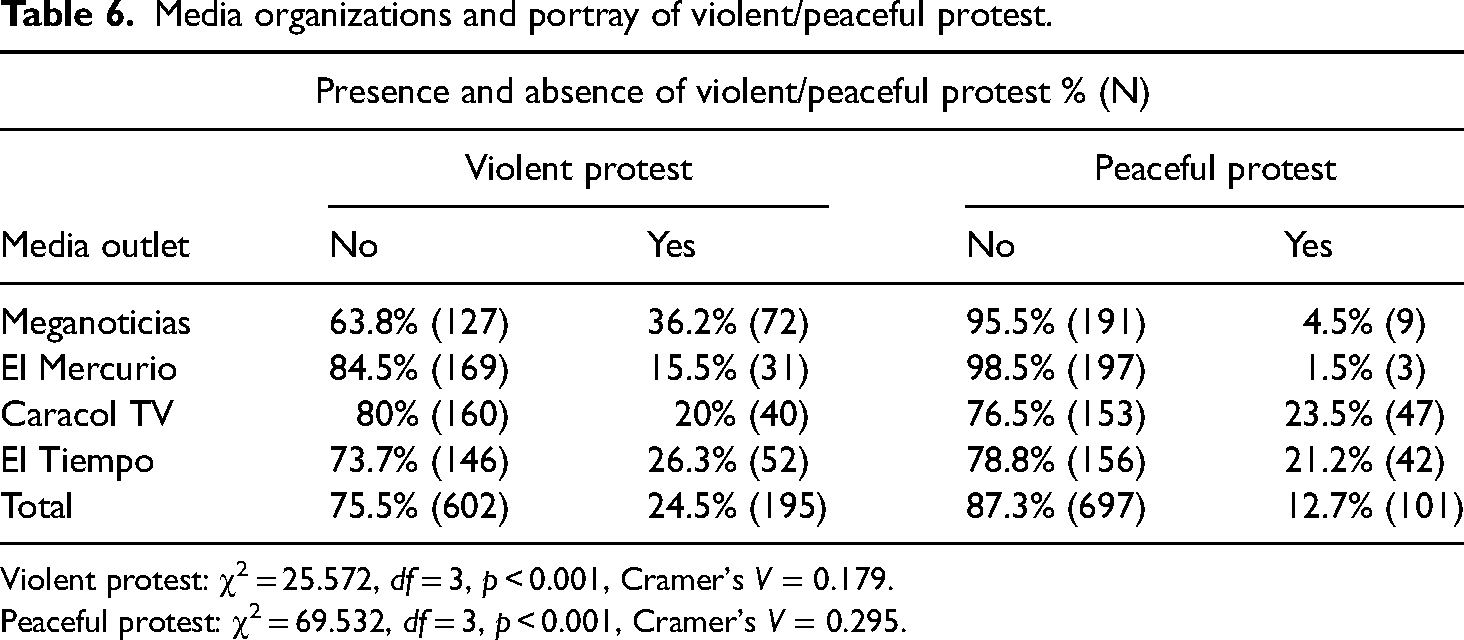
Violent protest: χ2 = 25.572, df = 3, p < 0.001, Cramer's V = 0.179.
Peaceful protest: χ2 = 69.532, df = 3, p < 0.001, Cramer's V = 0.295.
Additionally, this research conducted a series of linear regression models over the 800-message-sample to see whether there were positive associations between frames that aligned with the protest paradigm and the total engagement (likes, retweets, and comments added) on articles shared on social media from Colombian-Chilean TV channels and newspapers. To avoid the abnormal distributions of the number of likes, shares, and comments, we added all these interactions to create one single index, and then we normalized this engagement variable (log10 + 1) to improve comparison between groups. In the case of Caracol TV, results show that debate frame proved to have a positive association with the number of interactions (β = 0.152, p < 0.05) on messages related to protests. That means that social media messages that explain the reasons behind the protest predict more reactions from Caracol TV's social media users than any of the other protest paradigm frames. Regarding El Tiempo newspaper, the confrontation frame (β = 0.228, p < 0.05) and the spectacle frame (β = 0.263, p < 0.001) were positively associated with more reactions from X (Twitter) users. Likewise, Chilean TV channel Meganoticias generated in average more social media interactions when using the confrontation frame (β = 0.194, p < 0.05) while El Mercurio newspaper did not show significant associations between any of the protest paradigm frames and the number of likes, shares, and comments. These results confirm that—at least in two of the four media cases—users tend to engage more widely on social media delegitimizing frames of protesters and protests. Only in the case of Caracol TV, the debate frame seems to produce more engagement among users (Table 7).
Regression models testing prediction capability of the paradigm protest frames to generate engagement (total social Media interactions) in selected news Media.
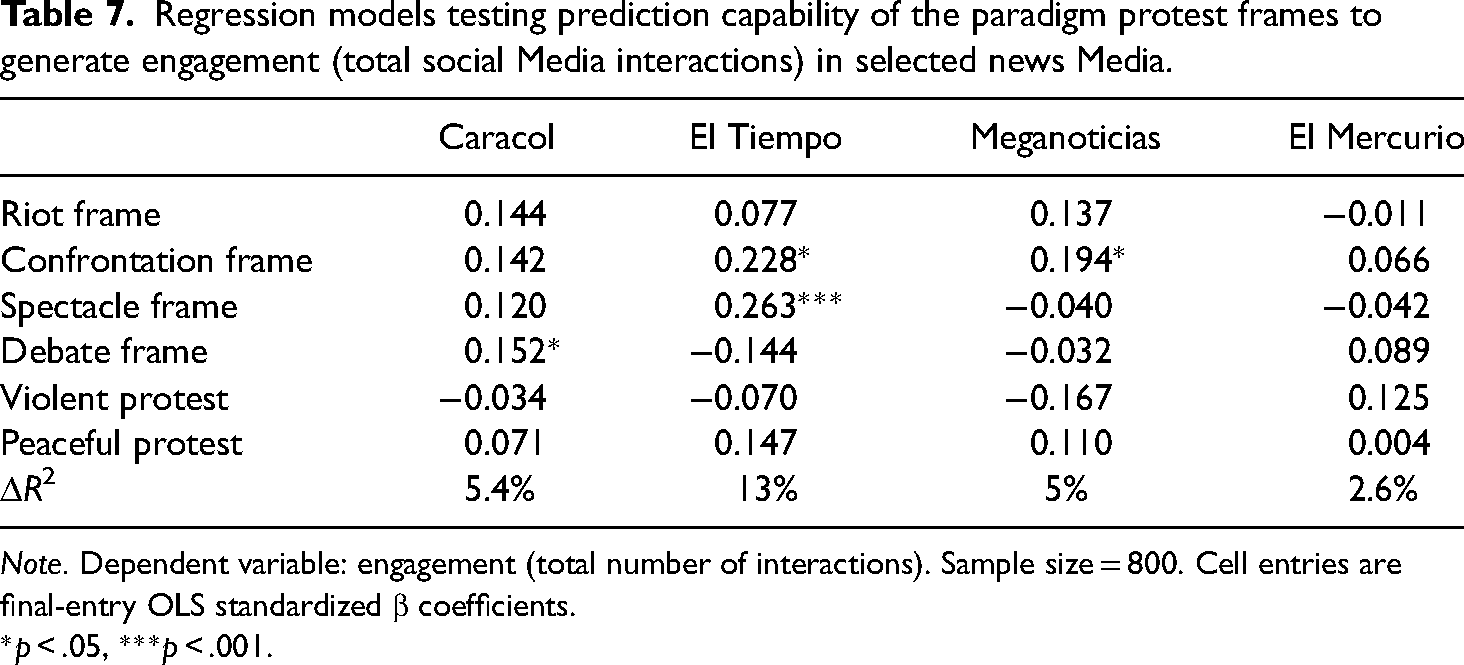
Note. Dependent variable: engagement (total number of interactions). Sample size = 800. Cell entries are final-entry OLS standardized β coefficients.
*p < .05, ***p < .001.
Discussion
This content analysis of the 2019 protest-related messages posted on X (Twitter) by two Chilean and two traditional Colombian media—as well as the reaction of their audiences—sheds light on (a) how aspects related to the national media create critical differences in the adherence to the paradigm, (b) how legacy media—with important differences depending on the media type—continue promoting the protest paradigm through social media, and (c) how audiences interact with mass media posts, engaging and amplying frames that align with the protest paradigm. These contributions are crucial to understanding how traditional media in Colombia and Chile covered the 2019 social unrest in a complex hybrid media environment, where social media plays a significant role in reconfiguring political communication, news production, and traditional media distribution. More specifically, this study contributes to a growing body of protest paradigm scholarship by comparing the national context, type of media outlets, and news organizations to understand how mainstream media replicate and operate on social media in accordance with the paradigm, during the massive 2019 protests in Colombia and Chile.
First, this research explains how aspects related to the national media systems make a difference in the adherence to the paradigm. Both Colombian and Chilean mainstream media have had historical ties with governments, and economic and political elites, making them more inclined to maintain the status quo and frame protests and protestors as violent or deviant. Although social media offer broader opportunities for journalists and media to report on social issues with independence (Cammaerts, 2012; Poell and Borra, 2012) and innovation (Harlow and Johnson, 2011), our results show that traditional media outlets still adhere to the protest paradigm on X (Twitter) in the event of massive social mobilizations. Although it is difficult to demonstrate causality only based on the results of this study, massive social protests in Colombia and Chile greatly contributed to the ascent of the left in both countries.
But despite similarities, our results also show some national differences. For instance, Chilean media tend to delegitimize protests by using the riot frame, which focuses on the violence of protesters, rioting, looting, and destruction. Meanwhile, Colombian media used the spectacle frame more frequently, focusing on the protesters’ drama, oddity, and unusualness to portray them as deviants. Though one could say media outlets in both countries fall into the protest paradigm, it would be naïve to disregard the complexity of the decisions behind news coverage believing there is not an editorial position that reflects the closeness of the media outlet's relationship with the ruling power. One of the possible explanations of the chosen Chilean media tendency to privilege vandalism in their coverage may be related not only to the systematic attacks to the metro and public transportation, but also to the editorial decision of supporting the use of force against protesters. In this sense, results from Chile align with Doran's (2017) perspective that show a growing systemic response to criminalize protests because mobilizations are perceived as acts that reflect populations’ lack of commitment to democracy and stability. In turn, Colombian media tend to delegitimize protesters using the spectacle frame more often than Chilean media. The spectacle frame is a more sophisticated device that undermines social demands portraying protesters as deviants. One possible explanation of this “soft” coverage has to do with the partial support of Colombian media to some of the protesters’ claims, particularly those related to the lack of implementation of the peace process and the systematic assassination of social leaders. Great part of Colombian legacy media was strongly compromised with the peace process between the Colombian government and the FARC guerrillas. Also, the decision of some students and social leaders of the 2019 protest to call attention from the media in more pacific ways may have some implications in the way Colombian outlets covered these demonstrations. Hence, media in both nations aligned with the status quo to protect democracy and democratic values against those whom they might see as a menace to the system, in a region historically affected by censorship, authoritarianism, and corruption.
Media could use their power to influence public opinion and portray reality as a leverage tool outside the streets (Albuquerque, 2011). In that vein, we believe the media used riot and spectacle frames, respectively, as a conscious way to induce organizations and politicians into specific actions and to motivate audiences to comply with political decisions (such as accepting curfews). Nevertheless, one of the limitations of this research is that it did not conduct a qualitative analysis of tweets and messages published by legacy media organizations, which limits the scope of our conclusions. This is still an area that requires more analysis to understand to what extent interests of media owners, political groups, and other social actors have effectively hijacked -or not- journalism in the region (Montoya-Londoño, 2014). Researchers should continue to explore if the reversed protest paradigm, proposed by Jiménez-Martínez (2021), occurs when news media (especially alternative media) focus on sensationalism and violence in their protest coverage to reinforce the claims made by protestors and leverage against official powers.
Second, this study shows that even on social media—which is supposed to contribute to dislocating the paradigm—legacy media continue to adopt frames that delegitimize protests and protesters during the massive 2019 mobilizations in Colombia and Chile. Particularly, this research indicates that chosen television channels (Meganoticias, more frequently) are the media that embrace a more negative protest coverage on social media, a conclusion that aligns with previous findings that show how TV often privileges dramatic and conflictive events as criteria for newsworthiness (González, 2020; Johnson, 1996; Wouters, 2013). TV channels tended to delegitimize protesters by presenting them systematically in the context of riots and open confrontation with authorities. Traditional TV media approach to social mobilizations seems to be transferred to social media and the hybrid system, as tweets from TV media seem to generate more engagement. Consequently, TV's coverage on social media creates a complex environment in which online users replicate and amplify their negativity toward mobilizations. In contrast, newspapers were more inclined to use the debate frame to explain the reasons behind social unrest. In this sense, newspapers seem to be more adequate for elucidating the reasons behind protests than television. The latter medium privileges dramatic images that emphasize conflict and provoke emotional reactions from users on social media during protest coverage. Media-type practices and formats may influence these differences: TV stations rely on impactful images to capture the audience's attention while newspapers in the digital age rely on in-depth reporting to create a long-lasting relationship with audiences and subscribers.
Of the few opportunities in which the peaceful nature of the protests was reported, the Colombian media (Caracol TV and El Tiempo) were more inclined to highlight it. One possible explanation is that Colombian media outlets have become particularly familiar with conflict-war journalism due to a long internal armed conflict. In addition, given the violent historical context of Colombia, private and nonprofit organizations have developed multiple guides and workshops to promote, among journalists, alternative coverage that avoids revictimizing or stigmatizing victims and protesters (Fundación Gabo, 2019; Morelo et al., 2014; Oquendo, 2019). This aligns with what was discussed by Jiménez-Martínez (2021): That is, when using the reversed protest paradigm, media can highlight the relevance of social protest and the vindication of major social movements’ demands, legitimizing some historical grievances (p. 1602). Hence, despite a high reliance on the spectacle and riot frames, Colombian media outlets are more used to recognizing social demands among the violence because of historical context and are slowly opening spaces to discuss the complexity of the Colombian reality.
Finally, El Mercurio was the medium that (albeit infrequently) at least tried to explain on X (Twitter) the reasons behind Chilean protests. A portion of El Mercurio's coverage on social media emphasizes the causes and consequences of the unrest at the social, political, and economic levels. The Chilean newspaper asked experts and columnists to explain the reasons behind these historical demonstrations and posted those comments and quotes on its Twitter account (@ElMercurio_cl). However, this result seems problematic since the social media team of @ElMercurio_cl seems to be separated from El Mercurio newsroom, and they seem to reflect the work of Emol, the online version of El Mercurio, which has its own editorial staff. The case of El Mercurio needs further and qualitative analysis, particularly given the conservative ideological perspective of this medium and its organizational structure.
User engagement and the paradigm
Furthermore, this study shows that user engagement with social media messages increased when mainstream media present protests and protesters in constant confrontation with authorities, in the case of El Tiempo and Meganoticias, or show them as odd or deviants, in the case of the main newspaper from Colombia. This conclusion is important because it shows how traditional media and audiences interact with protest news on social media contributing to reproducing frames that align with the protest paradigm (Harlow and Brown, 2021); therefore, shaping the way societies and decision makers understand those grievances and mobilizations. Engagement produced by El Tiempo and Meganoticias’ social media coverage is noteworthy because their users aligned with those media outlets and interacted significantly more with stories that contain the confrontation and spectacle frames, perspectives that Meganoticias and El Tiempo privileged online, respectively. Despite audiences having the ability to create their own agenda on social media and taking a different interpretation toward social mobilizations (Bright, 2016), the truth is that legacy media continue to exercise great power over the social network agenda, using cues to interpret certain events that challenge the status quo. As Klinger and Svensson (2015) noticed the “network media logic” sometimes overlaps with the “mass media logic” in the production and dissemination of information through the digital environment, and protest news seems to be one of the areas in which legacy media continue to exercise great influence, particularly when mobilizations are against the government and the status quo, as previous research has shown.
In this sense, media and journalists continue to decide what content is relevant to audiences while users seem to amplify negative frames following the same media logic, reinforcing previous findings like Harlow's and Brown's (2021). Users’ ability to transform the meaning of media frames (Gamson, 1992; Walsh and Cramer, 2004) seems to be restricted when analyzing reactions of audiences to the activity of legacy media on social media. The polarized context of mobilizations in Colombia and Chile facilitates the dissemination of information that delegitimize protests on social media using different devices and frames. The high consumption of news through social media in both countries (DNR, 2022) makes this kind of protest coverage relevant to understanding acts of intolerance, polarization, and state brutality toward mobilizations.
As a sign of hope, the results show that the debate frame, which tends to legitimize the protest by explaining the reasons behind mobilizations, was positively associated with an increase in the number of interactions in the case of Caracol Noticias. In line with previous research that shows certain disruptions in the way the protest paradigm operates in open-networked environments, where audiences play a key role in echoing alternative and legitimizing frames (Harlow et al., 2017, 2020), the audience of Caracol tends to amplify messages that reflect on the reasons for the mobilizations in Colombia. Blamed for exploiting images and stories in a more sensationalist way than newspapers, this result may be an opportunity for television media. In fact, social networks could give television the opportunity to better articulate social and political issues such as protest and interact with its networked audiences by privileging more thematic approaches and substantial reporting. Further analysis is necessary in the case of Caracol to see if other contextual factors such as the TV medium previous support to the peace process between the FARC guerrilla and the government (García-Perdomo, 2019) have moderated the audience of this channel to amplify different perspectives.
This research is valuable for two main reasons: First, it enhances our understanding of legacy media portrayals of protests in Latin America (a region that remains understudied) given the new dynamics of news engagement on social media. And second, this paper shows how traditional media outlets use in their social media official accounts riot and confrontation frames to delegitimize protesters, partially influencing the reaction of audiences who engage and react to those diminishing devices. Future research should analyze differences between users’ protest coverage and traditional media coverage on social media and further investigate how social media affordances condition how media produces and disseminates news in those online ecosystems.
Footnotes
Declaration of conflicting interests
The authors declared no potential conflicts of interest with respect to the research, authorship, and/or publication of this article.
Funding
The authors disclosed receipt of the following financial support for the research, authorship, and/or publication of this article: This work was supported by the Universidad de La Sabana (Research Project number COM-79-2018).
