



Abstract
Who constructs Africa's global media image? That is the main focus of this longitudinal study. It looks at both the journalists and the news sources applied in the British press coverage of Africa between 1992 and 2017. Four British national newspapers (The Guardian, Financial Times, The Times, and Daily Mail) and a mixed research approach (content analysis and semi-structured interviews) were used. A total sample of 7027 articles were utilized, while nine journalists were interviewed. This study discovered that the British newspapers’ coverage of Africa was dominated by Western journalists and the news sources used in the articles were a proportionate mixture of both African and Western sources, especially in the quality newspapers. It also uncovered that Africa's global influence, in addition to other factors impact on the UK newspapers’ coverage of Africa. This study concludes that there are some positive changes in the post-colonial British press coverage of Africa, especially in their use of news sources, but there are still some elements of neo-colonialism and racism in the British newspapers’ use of journalists in reporting on Africa.
Keywords
Introduction
In the 2000s and 2010s, there were cuts in some Western media's foreign news budgets, which resulted in the reduction of their usage of Western correspondents in covering Africa. This development paved the way for the employment of African journalists to shower up their staffing needs (Paterson, 2011). Bunce (2015) concluded that Western news agencies witnessed significant increase in their recruitment of Africans. This development has led to some scholars asserting that Africa's global media image is now jointly constructed by both Westerners and Africans (Ibid).
However, the improved use of Africans in the British media is yet to be tested on UK newspapers, especially on a longitudinal basis in the post-colonial era. Lader (2007) stated that 47% knowledge of Africa in the British media are attributed to UK newspapers, an indication of their significance in shaping the image of Africa in Britain and internationally, hence the focus of this study on UK newspapers.
Similarly, it is necessary to understand the quantity of news agencies’ African reports that are used in UK newspapers. According to Wahutu (2018), most Western newspapers barely use African news reports from wire services. He argued that the news agencies’ African articles featured more in African newspapers than the Western ones. This indicates that the increased presence of Africans in Western news agencies’ African reports may not necessarily mean that Africa's global media image is jointly constructed by both Africans and Westerners.
Therefore, who reports on Africa in UK newspapers is important to be dissected, in order to situate the position of Africans in the construction of Africa's global media image. Additionally, the news sources used in African stories by these newspapers help define Africa to their global audience. To know who these journalists and news sources are in Africa's representation in the UK media helps us to understand a bit more about the people involved in the construction of Africa's global media image.
This study is therefore, aimed at answering the following research questions (RQ):
Theoretical framework
The sociology of news theoretical framework would be central to this study. Media operations and practices are mostly concentrated within the media organisation but are also externally influenced. These influences range from individual to social systems and recently, the technologically enabled factors. According to Reese and Shoemaker (2016), knowing these influences help in our understanding of the complex factors shaping the media. Also, knowledge of these factors can help to disentangle the relationships among individual level professionals and their routines, the organisation that house them, the institutions in which they cohere and the social systems within which they operate and help maintain.
Shoemaker and Reese (1996) postulated five hierarchy of influence model - the multiple forces that simultaneously affect the media and how they interact with each other. At the individual level, which the authors described as the basic microlevel of influence, there exist individual and professional practitioners in news work. They argued that this level of influence helps in our understanding of the larger journalistic project. Also, they stated that journalists’ personal traits, the news values they adhere to, the professional roles they take on and other demographic features, such as their gender, race, and class are best uncovered at this stage. It is therefore important to check how the above stated characteristics shape UK newspapers’ coverage of Africa.
The authors further stated that the routines level is mostly concerned about the patterns of behaviour that forms the immediate structures of media work. They are the ways of working that constitute that practice, those unstated rules and ritualised enactments that are not always made explicit and they include: meeting deadlines, space requirements and full news coverage. Shoemaker and Reese believe that news routines serve the needs of journalists and the media organisations, especially in dealing with their audience. As news media adapt to digital flows and metrics, with greater user participation, journalists’ conception of their audience becomes a product of technology.
At the organisational level of influence, Shoemaker and Reese argued that media representations are organisational products that looks at the different parts of an organisation and how they interact with each other. This can be seen in studies on early analysis of social control in the newsroom.
The social institutional level, also referred to as the “extra-media,” involves factors outside of the media organisational boundary, such as – audiences, news sources, public relations, or technological forces (Shoemaker and Reese, 2014). The authors opined that media institutions can be affected by the relationships they have with outsiders, such as the state and advertisers. At this stage, the news media no longer function as a single homogenous institution. There is more complex mediatization and media interactions with other major institutions, which helps in explaining media practices.
The last hierarchy – the social systems level is the macro level of influence. Shoemaker and Reese (1996) described this stage as the traditional theories of society and power stage of the media. Media institutions function within a larger social system, which brings about sensitivity not only to the nation-state, but to more globally connected forces that affect the media. In this study, the above highlighted five levels of influences would be checked to see if they have any place in the use of journalists and news sources in UK newspapers’ coverage of Africa.
Other previous studies such as White (1950), argued in favour of political influence as a key reason behind what a particular media produces and uses, while Gieber (1964) highlighted the influence of bureaucratic routine in news work. Some sociology of news scholars have argued that while journalistic values may influence news and news work, external factors such as political censorship also affects journalism. Tuchman (1978) developed the idea that news is a social construct which is deeply rooted in organisational routines. Boczkowski (2004) showed how factors such as economic and political pressures, personal and religious attachments, changes in news gathering and production technology and the role of sources and source strategies impact on journalism. It is important to see if these conclusions are relevant to Africa's coverage in the British press.
More so, Reese and Shoemaker (2016) argued that the emergence of new media have led to more individual interaction and global connectivity, thereby invoking a more networked attributes than the mass media's agelong division into media, audience and society. Similarly, Revers (2017) stated that journalism is institutionally situated but culturally driven and that with the rise of the internet, there is a shift from a rational to a network approach to journalism but maintains that the operations of the networked media are still culturally influenced. Has new media technology impacted on the use of journalists and news sources in the UK press coverage of Africa?
In furtherance of Revers argument, there are two key cultural and historical linkages between Britain and Africa that may have some influence in media relationships between the duo – colonialism and race. These two concepts deserve to be looked at in this study to see how they play out in the journalists and news sources used in the UK press coverage of Africa. McMillin (2007: 55, 66) stated that the Western media have historically played a role in the reproduction of imperial power and their positions in contemporary global power relations often show resemblances to that earlier era of colonialism. Nothias (2017) argued that western journalists, reporting on Africa write as western ingroup members, while representing Africa as “them”
In summary, there may be multiple influences for the explanation of who constructs Africa's global media image in UK newspapers. Are these influences accountable, in any way to their usage of journalists and news sources?
The journalists reporting on Africa in the Western media
The Western media coverage of Africa was exclusively done by Western journalists (Hawk, 1992). She was of the view that Africans were not used as journalists by most Western media. Hawk also raised the issue of Western journalists’ lack of knowledge of Africa, which implies that they mostly ended up covering Africa poorly. Similarly, Fair (1992) stated that the coverages were dominated by Western journalists. In consideration of events in Africa between the 1960s and 2000s, the dominant dictatorial military rulership of that period may have been one of the key accounts for the neglect of African journalists by the Western media (Bunce, 2010). The heightened level of media censorship and the brutality of the dictators of that era in Africa may have warranted the Western media to leave out Africans in their employ to avoid their persecution by some governments in Africa, especially when such reports are about some of their bad practices.
Borden (2009) concluded differently - African journalists featured in the day-to-day reporting of Africa but required to be well trained and supported, which gives the impression of poor quality of journalism in Africa and the supremacy of Western journalism. The major Western newswires – AP, AFP and Reuters hired more African journalists in their coverage of Africa in the 2010s than decades before (Bunce, 2015).
The more use of Africans was due to the reduction of Western journalists in the coverage of Africa as a result of foreign news budget cuts by most elite Western media (Carroll, 2007). Knickmeyer (2005) attributed the cuts to the wars in Iraq and Afghanistan, which pulled resources away from Africa to the two warring nations. Reporting on Africa was deemed unprofitable by most western media, which resulted in their maintenance of a smaller number of reporting staff in the continent (Carroll, 2007). For instance, Sundaram (2017: 99) argued that only one Western reporter covers about 20 African countries at any one time.
At the management and editorial level, Bunce (2015) claimed that no African occupied such positions in the African section of the Western media. This could have partially impacted on the use of news reports by Africans, as more African stories written by Western journalists got published than the ones written by Africans. This implies that the usage of African journalists could still be under the control of Western journalists, who exclusively dominated the editorial and management aspects of the coverage. This position leads to Western-centric influence in the Western news coverage of Africa (Bunce, 2017).
However, it should be noted that most previous studies that looked at the journalists reporting on Africa were majorly event-based; they mostly applied short timeframes, with the virtual non-existence of longitudinal studies. To find out who reports Africa in the British media would require looking at the coverage over a long period of time, so as to situate the journalists involved. That is one of the objectives of this study.
News sources and sourcing practices in Western media coverage of Africa
Most news stories require information sources that generally stand behind those stories by helping to define them into reality. These news sources are important influences in media representations. Hermida et al. (2014) argue that sources shape what information the journalist obtains, how events and issues are reported and who is influencing public understanding of the world. They believe that sourcing is critical in deciding the contents of messages produced by journalists for the masses. The authors argue that sources influence news more strongly than journalists. Even though news reports are carried out within the media organisational setting, it is mostly the sources that determine them. This alone may not fully justify some media practices and this study is billed to interrogate that.
Gabore (2020) argues that news sourcing centres on the dominant use of certain people or group of people, which creates an artificial distinction between people or groups, with the more used sources as the preferred authoritative option. This form of exclusion inadvertently leads to discrimination. For instance, Hermida et al. (2014) stated that news sources are based on credentials, such as position of power, representing significant segment of society and expertise. This implies that people, who are in some ways outside of power are most likely to remain largely unused as sources in media reports.
Decades of research on Africa's coverage in the Western media have indicated that the sources used by most Western media outlets were largely Western sources. This has partly led to most of the scholars claiming that Africa's global media image is purely a Western affair. Studies such as Fair (1992) and Hawk (1992) claimed that the sources were dominated by Westerners, Western governments, and organisations. These studies stated that the use of African sources was virtually non-existent in Western media reports up to the 1990s. It was the same case in the 2000s as proven in Franks (2010), which discovered that Africa was seen through the lens of Western NGOs. The dominant use of Western sources continued in the 2010s. French (2017) concluded that Western news sources dominated Western media's coverage of Africa.
However, Gabore (2020) revealed that the Western media used both African and Western news sources significantly in African articles. Similar views were shared by a few other studies in the 2010s.
Like the journalists, news sources are hugely important in the global understanding of Africa. Looking at the 1990s and prior to that period, it was characterised by conflicts and military rulership in most African countries (Hawk, 1992). Probably because it runs contrary to Western democratic tenets, reaching out to African governments and institutions for news sourcing may have been deemed an aberration. This has the tendency of making the Western media to over-rely on Western sources.
Nonetheless, this disposition would fail to give a balanced viewpoint on African stories. Even in the 2010s, when most African countries turned to democratic governance, the Western media usage of Western sources persisted with few studies stating otherwise. To holistically address these previous research positions would require a longitudinal approach to understanding the news sources involved in African stories, which this study seeks to address.
Research method
This study applied content analysis and interview methods. Both methods were useful in unravelling the issues raised in this study. The application of content analysis was to address RQs 1, 2, 4 and 5, while the interview was to answer RQ3 and to further explore the other research questions.
Four British national newspapers – The Guardian, Financial Times (FT), The Times and Daily Mail were used. The use of the quality newspapers (The Guardian, FT and The Times) is mostly because they are global in outlook and are suitable for this study. Also, most previous studies in this field used these quality newspapers (Scott, 2017). In a longitudinal study like this, which is rare in this field, it makes sense to use same or similar newspapers as the ones mostly applied in previous research so as to determine their results’ similarities and dissimilarities. Also, due to this study's focus on Africa's global media image, the use of international prestige newspapers becomes necessary. In Britain and around the world, The Guardian, Financial Times and The Times are globally recognised and respected as international newspapers of repute (Ibid). However, the use of popular newspapers in this field is lacking (Ibid). The inclusion of Daily Mail is to address that gap and also to check if it has the same characters as the quality newspapers in their coverage of Africa. Its choice is further predicated on the fact that it is the second most circulated UK newspaper, next to The Sun (https://www.statista.com/statistics/529060/uk-newspaper-market-by-circulation/ accessed 28/02/2021). With The Sun not been included in LexisNexis databases prior to the 2000s, an important sample duration of this study, it paved the way for the use of only the Daily Mail.
The sampling duration covered from 01 January 1992 to 31 December 2017. On the basis that this study is mostly focused on some aspects of the British media practices in their coverage of Africa, during two eventful segments of the continent – the 1990s to the 2000s, a period in Africa dominated by conflicts, crisis, military dictatorship and lack of digital communication versus the late 2000s to the 2010s, a time in Africa credited to have seen democratic governance, economic progression, reduction in conflicts and a digital age (Posner and Young, 2018), the use of the highlighted sampling timeframe becomes inevitable. These two distinct timelines are important in checking if the change in events in Africa impacted on the British media usage of journalists and sources in their coverage of Africa.
The samples were selected via Lexis Nexis databases by searching in the headline using the names of Africa's 54 independent countries, and the search produced a total of 56,220 articles, which were subjected to systematic random sampling of every 8th article, starting from the 8th, thereby amounting to the use of 7027 samples for this study – 3091 (44%) from The Guardian; 1973 (28.1%) from Financial |Times; 1630 (23.2%) from The Times and 333 (4.7%) from Daily Mail. The Guardian produced the highest total number of articles - 24,730 articles, hence its production of the highest samples for this study, followed by Financial Times (15,783), The Times (13,044) and the Daily Mail (2663).
For the coding, the journalists (authors of the articles), whose names were equally listed in LexisNexis databases were represented as follows: African journalists (journalists based in Africa, whose work location is in any of the 54 African countries), Western journalists (journalists based in the West, whose work location is in any of the Western countries, such as UK, US, France etc.), joint journalists (when an article is written by both an African journalist and a Western journalist), news agencies’ report (African news reports from Western newswires) and other journalists (when an article is reported by a journalist who is neither African-based, Western-based nor from a news agency report).
The news sources (those whose opinions were prominently quoted) were categorised as follows: African sources (all news sources originating from a person, group of persons, government or an organisation based or located in any of the 54 African countries, other than international organisations and religious bodies); Western sources (news sources emanating from a person, group of persons, government, businesses and organisations based or located in any Western country, other than international organisations and religious bodies); international organisational sources (this involves news sources originating from global bodies, and their officials, such as the United Nations, World Health Organisation, UNESCO etc.); religious sources (this includes news sources from religious organisations and their officials irrespective of their locations, such as the Roman Catholic, the pope, etc.) and other sources (sources that are outside of the above stated groups).
For inter-reliability tests, the researcher and an independent coder coded the same 160 articles each, which were taken from the samples. At the end of the pilot coding, there was a high level of accuracy in the tests’ results as shown in Table 1 below, before the researcher's application of the codebook to this study. With the use of Krippendorf's Alpha statistical test of intercoder reliability, results are presented on a scale of between −1 to +1, with figures closer to 1 indicating greater correspondence (O’Connor and Joffe, 2020: 9). Landis and Koch (1977) state that agreements between 0.81 and 1 can be said to have a near perfect agreement.
Intercoder reliability results.

The interview method of this study used a total of nine journalists. This may have been different, if the over fifty journalists contacted via email to partake had accepted to take part. A number of scholars have argued that this experience is common and very peculiar with qualitative research. Brennen (2017) believes that even though having a handful of interviewees is good, the key thing is in the information itself. With the interviewed journalists’ similarity of statements, the use of a greater number of journalists in this study may not have added any extra value to this study. The interview questions revolved around the content analysis’ results and the journalists’ general experiences in their coverage of Africa for the British press.
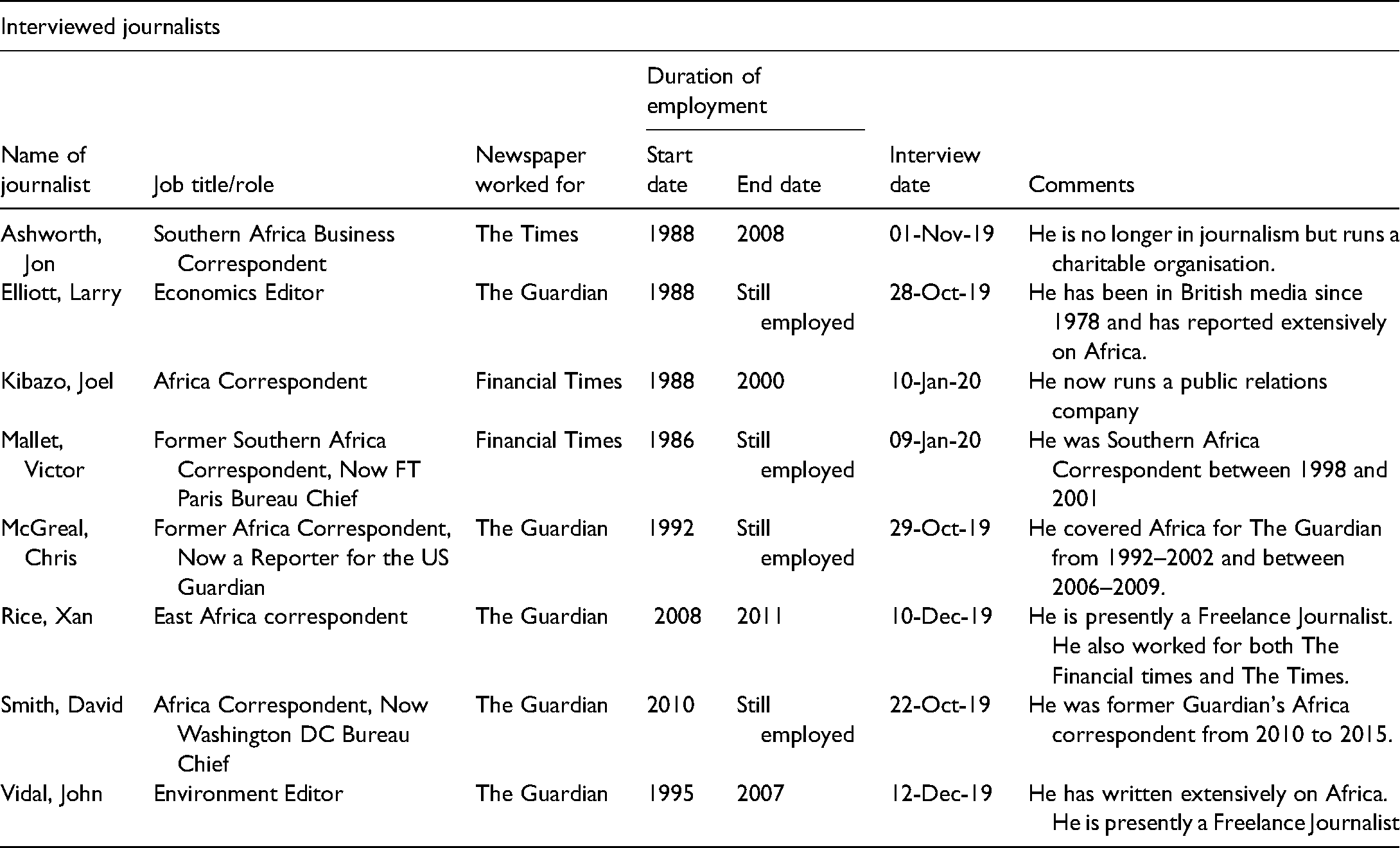
The interviewed journalists were selected based on the fact that they must have had some experience of reporting on Africa for any of the studied UK newspapers. Because they have been directly involved in writing about Africa, they would serve as a good source of qualitative information to the researcher in understanding the application of journalists and news sources in the UK media coverage of Africa.
The journalists were contacted via email by the researcher, through which the interviews were arranged. The individual interviews conducted between October 2019 and January 2020 lasted for between one and two hours and were conducted via video & audio phone calls, and WhatsApp's audio & video calls too. The non-use of face-to-face interview was because majority of the journalists live and work outside of the UK.
The interviews were all manually transcribed by the researcher and sent to all the interviewed journalists for approval and consent before their use in this study. One of the African journalists requested to be anonymous, while the rest of the journalists consented to their names and details to be used. Also, prior to the use of the themes that emerged from the interviews, two independent pilot tests were conducted. Four same transcripts were thematically coded independently by the researcher and another academic, which both parties checked for themes’ agreement, and it was noted that the themes developed by both parties were same.
The details of the interviewed journalists used in this study are presented in Table 2 below:
Details of the interviewed journalists.
Presentation and analysis of research findings
RQ1. Who are the key journalists reporting on Africa in UK newspapers between 1992 and 2017?
Table 3 shows the percentage distribution of journalists used in the four studied newspapers. 5.2% of African journalists were involved in the overall coverage of Africa across the four newspapers. Individually, The Guardian had 10.8% reported articles from this group, 8.5% in FT, The Times had 4.3%, while Daily Mail had 1.1% reports written by them. This result suggests that The Guardian is more likely to use an African journalist than the other studied newspapers.
The journalists reporting on Africa in percentages.
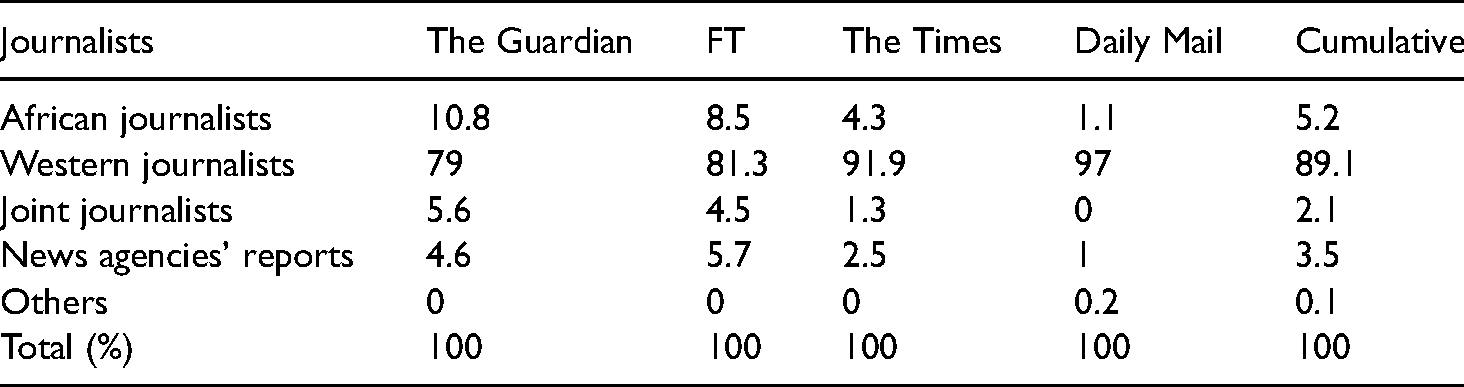
Western journalists were involved in 89.1% of the sampled articles collectively. Individually, 79% of Western journalists’ reports featured in The Guardian, 81.3% in FT, 91.9% in The Times and 97% in Daily Mail. This posits that Daily Mail has more tendency of using Western journalists in reporting on Africa than the rest of the studied newspapers.
Cumulatively, 2.1% of the articles were written by joint journalists. Separately, 5.6% of joint journalists’ reports were used in The Guardian, 4.5% in FT, 1.3% in The Times and 0% in Daily Mail. This result indicates that The Guardian is more likely to use a joint journalist in reporting an African news story.
3.5% of news agencies’ African reports featured in all the four newspapers. Singularly, 4.6% were used in The Guardian, 5.7% in FT, 2.5% in The Times and 1% in Daily Mail. This indicates that FT is more prone to using news agencies’ reports in its coverage of Africa than the other studied newspapers.
However, 0.1% of the sampled African articles could not fit into any of the above groups as they had no traceable author in Lexis Nexis databases. Independently, The Guardian, FT and The Times had zero cases, while Daily Mail had 0.2% of the articles without any attributable authors.
As explored above, Western journalists dominated the coverage, followed marginally by African journalists, while news agencies’ reports were 3rd placed. Joint journalists were the least applied. This result suggests that the reporting of Africa in the studied British press was majorly done by Western journalists.
These results are in line with most previous studies (Fair, 1992; Hawk, 1992 etc.). They concluded that Western journalists exclusively dominated the Western media coverage of Africa. It partially contradicts the findings of Bunce (2015) and Paterson (2011) in their conclusions that Africans are more involved in the coverage of their own stories in the Western media, which may be true in terms of the Western news agencies used in their various studies, but not the case with the British newspapers examined in this study.
To further attest to the dominance of the coverages by Western journalists, Joel Kibazo, a former reporter with the Financial Times, who was interviewed for this study said, “When I worked for the Financial Times, I was probably the only African in their midst. The journalists at the FT then were exclusively Westerners”.
However, the dominant usage of Western journalists in UK press coverage of Africa has the major problem of “Westernisation of African stories,” as previously raised by Nothias (2017). This can lead to inaccuracies in the reported African articles – at least from the cultural standpoint as noted in the statement made by Joel Kibazo, during this study's interview: “In 1997, there was a company called Ashanti Goldfields in Ghana. They fell into trouble and some big British companies were involved. It was reported as a gold mining story by other journalists. As an African I knew it was not just a mining story but a fight between the then President of Ghana and the Ashanti kings and rulers, where the gold mining company was situated. I wrote a feature on the story and the FT confirmed I was the only one that managed to get it right”.
RQ2. Who are the prominent new sources applied to African stories in UK newspapers for the past three decades?
From Table 4, African news sources featured in 45.2% of the sampled articles collectively. Separately, 43.4% of African sources featured in The Guardian; 49.7% in FT; 46.1% in The Times and 21.2% in Daily Mail. This indicates that FT, The Times and The Guardian are prone to use substantial African news sources in African articles. It also shows that the Daily Mail is less likely to use African sources.
The news sources used in percentages.
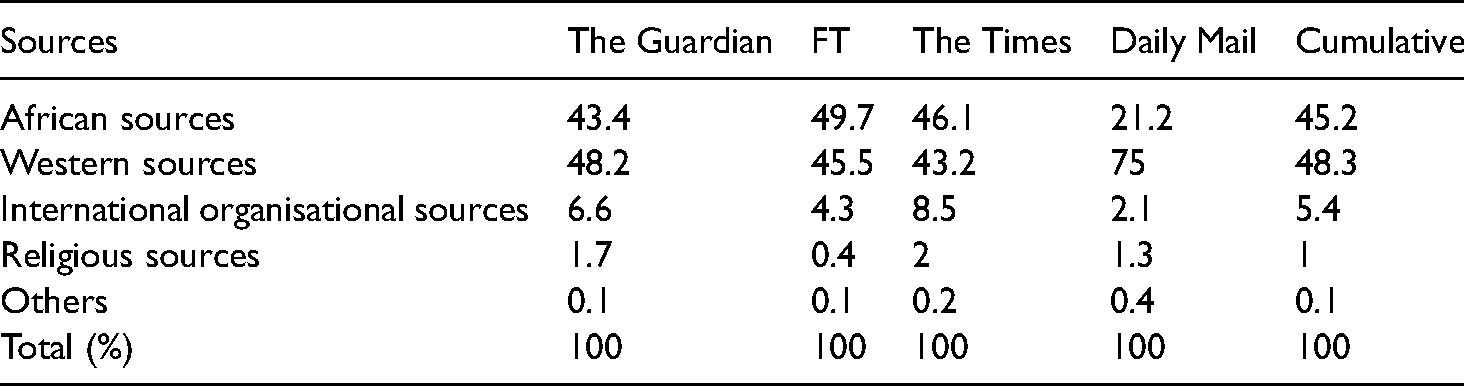
Collectively, 48.3% of Western news sources featured in the studied newspapers. Individually, 48.2% of Western sources were used in The Guardian; 45.5% in FT; 43.2% in The Times and 75% in Daily Mail. This implies that the tabloid (Daily Mail) is more likely to quote Western sources in Africa stories than the broadsheets.
Also, 5.4% of the overall news sources came from international organisational sources. Singularly, 6.6% of such sources featured in The Guardian; 4.3% in FT; 8.5% in The Times and 2.1% in Daily Mail. This shows that The Times is more likely to quote international sources than the other studied newspapers.
Cumulatively, 1% of the news sources emanated from religious sources. Individually, the use of religious sources was as follows: 1.7% in The Guardian, 0.4% in FT, 2% in The Times and 1.3% in Daily Mail. This demonstrates that The Times is more likely to use this group of news sources.
Overall, 0.1% of the sources were represented as “others” because they had no news source. Independently, The Guardian and FT had 0.1% of such articles each, while The Times and Daily Mail had 0.2% and 0.4% respectively.
Generally, these results imply that Western news sources were the topmost used – which is in line with the findings of Franks (2010), who stated that Western organisations and NGOs dominate the UK press coverage of Africa.
From the interviews conducted in this study, most of the interviewed journalists admitted to the importance and usage Western organisations/NGOs. Larry Elliott of The Guardian stated, “Western organisations, particularly Western NGOs are important sources of news for us in the British press coverage of Africa”.
However, as individual newspapers, Financial Times (FT) and The Times used more African sources than the Western ones, which indicates that some Western media use a significant number African news sources. This is in line with Gabore (2020) and it contradicts the findings of most previous studies.
RQ3. Why are certain groups of journalists and news sources dominantly used in UK newspapers’ coverage of Africa?
This study discovered through the conducted interviews that a number of reasons account for the exclusive dominance of Western journalists, as well as the more usage of Western news sources in some of the studied UK newspapers’ coverage of Africa and they are treated below:
Africa's poor global standing predisposes the continent not to be taken seriously in who reports Africa and the news sources used.
At the international level, Africa is not deemed as globally influential. No African country is among the world superpowers both politically and economically. Also, Africa is seen as one of the poorest continents in the world. These dispositions significantly impact on the coverage of Africa. Hermida et al. (2014) stated that global credentials, such as power and influence determine coverage and its components, hence the domination of international communication by the West This predisposes Africa's global coverage to be dominated by Western elements.
In support of the above, David Smith of The Guardian stated,
“Geopolitical importance has a role to play here. The US and China are the two biggest economies in the world with formidable militaries. It does make sense to devote a lot of interest to them. Again, Africa is the world's poorest continent. These forces hugely determine how Africa is reported.”
Knickmeyer (2005) affirmed to this by stating that the Western media hardly take the coverage of Africa seriously because of its lack of influence globally, except when there are African stories or events that threaten Western interests. The author argued that the stories and the people involved in African stories are most likely going to be for the interest of the West and not the interest of Africa, which paves the way for the dominant use of Western forces.
2. UK newspaper journalism is largely treated as an exclusive club, particularly for Western journalists and Western organisations/NGOs.
According to the interviewed journalists, the British press coverage of Africa is dominated by Western journalists and Western organisations/NGOs as news sources. This notion was further confirmed in this study's content analysis results, where Western journalists and sources were the topmost applied in the studied UK newspapers Africa cumulatively. Bunce (2010) supports this claim - she described the journalists used by Reuters in Nairobi Kenya as a “British Boys Club”, because of its exclusive domination by male British journalists.
As confirmed by Jon Ashworth (former Times journalist),
“UK newspapers are a bit of a club and tend to pick personnel from within the organisation. Some Western journalists hold the role of covering Africa for years, if not decades.”
In Jon's opinion, it is a high bar, which African journalists would find extremely difficult to reach. This suggests that the British press's significant involvement of Africans in their coverage of Africa may be unrealistic, at least any soon.
Similarly, Xan Rice, who worked for The Guardian added,
“The NGOs here are very powerful and useful for us. They are easy to access, cost effective and very well-known among our readers.”
Based on the fact that the studied newspapers are British, with a vast majority of their readers being British/Westerners, it becomes important for these newspaper companies to work towards sustaining their audience, as well as to maximize profit. Carroll (2007) stated that reporting on Africa is not profitable to the Western media and the use of huge non-Western journalists and sources could possibly impact on the retention of their Western customers, thereby negatively impacting on their profit margins.
3. UK newspapers lack confidence in African journalists and sources.
Majority of the interviewed Western journalists believe that Africans were somehow ill equipped to cover Africa for most of the British press. They were of the view that African journalists and news sources lack the competence to write for Western audience. Poor level of journalism in Africa, lack of confidence in African journalist, lack of knowledge of the history of some of the British newspapers, lack of knowledge of the newspaper's writing styles, poor understanding of the language and target audience were adduced for the low usage of Africans in UK newspapers.
Chris McGreal (Guardian) supported the above highlighted points by saying:
“When you work for an organisation, say a newspaper for quite a long time, they know you, you know it, you have deadlines, you know the kind of news they like you to write. So, there is a kind of confidence factor there, in a way for not using Africans.”
Also, the lack of usage of African news sources was attributed to the non-availability of competent Africans, which was corroborated by Victor Mallett of The Financial Times. He said,
“There were in some African countries, a lack of people to talk to. It is just difficult. There aren't enough skilled economists, or there weren't enough economists – it is unfair to say that.”
This lack of confidence in African journalists and sources is one of the key influences in the UK newspapers’ determination of who to use in covering Africa. In majority of the cases, the use of African journalists by the UK newspapers is mainly on temporal basis as freelance operatives or stringers and not as permanent staff members.
Jon Ashworth said,
“British newspapers are more likely to employ local African journalists as ‘stringers’ rather than staff correspondents or bureau chiefs. These are freelance journalists who write occasional stories.”
Some previous studies claim that there are huge improvements in the use of Africans in Western media coverage of Africa (Bunce, 2015; Carroll, 2007). Notably, these increased presences of African journalists were not tested in UK newspapers. Their conclusions may be correct in the newswires used, but certainly not in UK newspapers, as confirmed in this study.
4. There is the assumption from the UK media and journalists that Africa's journalism is of lower standard than British journalism.
The perception of Africa's journalism practices by some Western journalists further impacted on their usage of Africans in African reports. Most of the interviewed Western journalists see British journalistic standard as among the best globally and Africa's as one of the worst in the world. On that basis, the usage of a huge number of African journalists and sources by some of the UK newspapers became highly unlikely.
John Vidal had this to say, “I don't mean it in a bad way at all. I think, journalism in Africa have improved enormously in the past 10 to 15 years. I mean, 25 years ago, it was really difficult in finding good people, who would be prepared to write for the British newspapers”.
Borden (2009) conclusion supports the above by stating that African journalists need to be well trained and supported in order for them to be used in the Western media.
5. There are issues of power and the contestation of superiority and inferiority complex between Western and African journalists.
The interviewed African journalists believe that they are treated as a different “other”. They argued that the Western journalists feel superior to the African journalists in all areas of the British press coverage of Africa, which is in line with Borden (2009).
In support of the above, an anonymous African Journalist said, “In Kenya and South Africa, the journalists are divided racially. Also, the East African Correspondent Association is only for westerners. They do not mix at all with the African journalists. They feel very superior to African journalists.”
Also, at the editorial level of the studied UK newspapers, no African has ever been made an editor in any of them. All the interviewed journalists confirmed the above and further added that the Africa editors of their individual UK newspapers were Westerners based in the United Kingdom. They see that as a product of the superiority stance of Western journalists over their African counterparts.
The anonymous African journalist further stated, “There is not one African editor – not one – to make the important decisions. All the editors in charge of African stories for UK newspapers are Westerners, who feel they are superior to Africans.”
Jon Ashworth was of similar view by asserting thus: “The British media coverage of Africa tends to be shaped through the eyes of a London-based foreign editor.”
Additionally, the African journalists interviewed in this study believe that the few African reporters involved in the British press coverage of Africa are “pigeon-holed in covering certain stories about Africa”. They claim that Western journalists see Africans as inferior, hence Africans are not allowed to cover every African story and are equally paid far lower than their Western counterparts.
The anonymous African journalist added,
“If you are African, the only place you can cover is Africa and nowhere else. As an African too, you are only allowed to cover certain stories. Also, African journalists are paid lower wages than their Western colleagues, doing the same work.”
Consequently, this poor perception of Africa could have resulted into the UK newspapers’ use of few African journalists in their coverage of Africa. John Vidal, confirmed this in comparison with The Guardian coverage of the US:
“America has probably about 30 or 40 full-time correspondents working in America for The Guardian, while in the whole of Africa, there are maybe three. It is completely unequal and very wrong.”
The same was said of the FT by Victor Mallet, who admitted, “We have three times as many people covering China than the people covering Africa.”
6. Resource constraints in the British media coverage of Africa.
Information gotten from all the interviewed journalists indicate that resource constraints impact on the coverage of Africa, especially in their application of journalists and news sources. The four studied newspapers are businesses that have the interest of making profit, as well as sustaining and improving on their customer base. That implies the reduction of cost in who reports Africa and their use of news sources.
David Smith (Guardian) asserted,
“It can be more expensive and logistically difficult to move around Africa, as I know from personal experience. To avoid those expenses, the British press would have to make do with its available resources.”
Again, most British newspapers are more focussed on Britain than the coverage of foreign countries. On that basis, their recources would be directed mostly on British news stories, their British audience and the use of British journalists and news sources.
This was supported by Larry Elliot of The Guardian, who said,
“UK newspapers are not that interested in overseas news particularly. They are more interested in domestic news. In that respect, lots of them would likely use more British elements in their coverages.”
However, with the emergence of the internet, these newspapers’ reach may have extended beyond Britain. Recent technological innovations in mass communications have revolutionised the definition of audience (Reese and Shoemaker, 2016). When UK newspapers were only on print, they were essentially for UK readers. With the internet, these newspapers have significantly become global. To that effect, the dominant use of British journalists may have neglected the current day global disposition of news.
RQ4. What quantity of UK newspapers’ African articles were directly sourced from Western news agencies between 1992 and 2017?
In this study, 3.5% of Western news agencies’ African reports featured in the newspapers (see Table 3), unlike the increased presence of African journalists’ reports in Western newswires (Bunce, 2015). Wahutu (2018) concluded that the significant use of Western news agencies’ African reports is more noticeable in African newspapers than in the Western press. Therefore, the visibility of Africans in the global newswires of the West are more felt in Africa by Africans via African media outlets than outside of Africa.
Again, African media outlets have got no such comparable global standing as most of the studied British newspapers. This indicates that the increased use of Africans in Western news agencies might have little or no global impact on African stories, as the studied newspapers were almost exclusively reported by Westerners.
Also, the used news agencies’ African reports were mostly attributed to the news agencies and not the authors. This makes it more difficult to claim that such reports were written by Africans. More so, the nature of news agencies’ reports is such that they are more used by journalists than for the global audience (Wahutu, 2018). This suggests that global media consumers may be more attuned to The Guardian, Financial Times, and The Times than Reuters, AP and AFP. This inadvertently posits that Africa's global media image is more prone to be shaped in the UK newspapers than in the newswires.
Therefore, the significant use of African journalists’ reports in Western newswires as confirmed in Bunce (2015) and Paterson (2011) has not been reflected in UK newspapers.
RQ5. What has changed over the past three decades in terms of the journalists and news sources used in UK newspapers’ coverage of Africa?
Figure 1 shows that between 1992 and 2017, news reports by Western journalists consistently dominated the British press coverage of Africa. The four newspapers’ yearly use of other groups of journalists were insignificant. The use of news agencies’ and joint journalists’ African reports were the worst hit, with the latter being at the bottom of the list
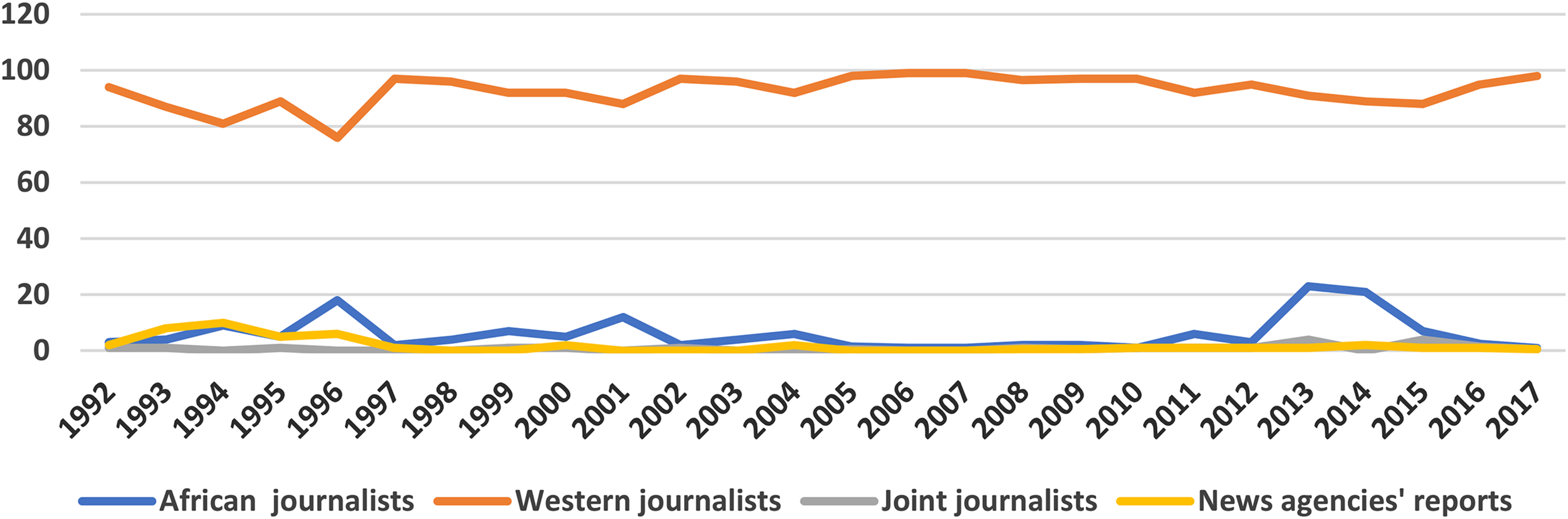
The yearly percentage usage of journalists reporting on Africa in UK newspapers.
This further suggests that Western journalists were principally used in the coverage of Africa and their definition of Africa shaped the image of the continent worldwide. Nothing has changed in this area, which is in line with most previous studies (Hawk, 1992). It equally confirms what Jon Ashworth said during this study's interviews that “the use of significant African journalists in UK newspapers coverage of Africa is simply difficult to actualise.”
Figure 2 shows that the usage of Western news sources dominated the coverages. They were the most used sources in 17 years, out of the entire 26-year coverage namely – 1997 to 2005, 2007 to 2009, 2011, 2012, 2014 to 2016.
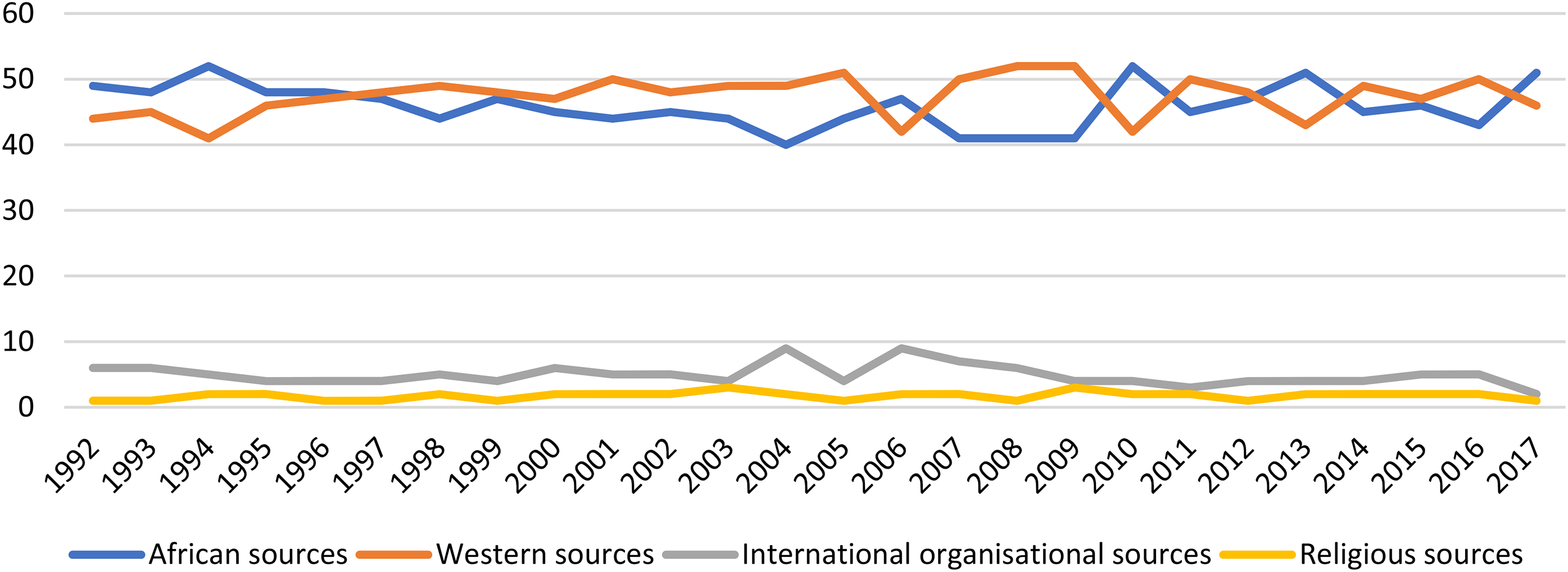
Yearly percentage of news sources’ usage in all the studied newspapers.
African sources were topmost in 9 years - 1992 to 1996, 2006, 2010, 2013 and 2017. The rest of the actors were not significantly used and had no yearly dominance.
These results posit that the sources used in the British press coverage of Africa were fairly mixed between Western and African sources, even though the former was ahead of the latter.
Therefore, there are evidence of positive changes in the news sources used by UK newspapers in their coverage of Africa in the past three decades. This is in line with Gabore (2020), who concluded that the usage of African news sources in the Western media were proportionate to their application of Western sources.
Conclusion
This study proves that some aspects of the post-colonial coverage of Africa in some UK newspapers have positively changed, while some aspects have not. There is uniformity in the four newspapers’ dominant use of Western journalists in reporting Africa, but there are positive changes in their application of news sources.
As argued by Shoemaker and Reese (1996 and 2014), one singular influence cannot account comprehensively for certain media practices, like the usage of journalists and news sources. Nonetheless, some of these influences are more pronounced in different studies than others. In this study, two influences stand out more than others – the organisational and social system influences. The position of the journalists used in UK newspapers’ coverage of Africa is more institutionally located within the media organisations, as a response to societal systems and ideologies. Even though, there are other factors that add to the dominant usage of Western journalist in reporting on Africa, the practice cuts across the four studied newspapers. That signifies an institutional preference of Western journalists to Africans.
Also, because these newspapers operate within the British society, they may have borrowed from certain social systems and ideologies that operate or operated in Britain. Britain's relationship with Africa is largely a product of past historical experiences. These experiences shape and significantly determine future relationships (Revers, 2017). Slavery and colonialism remain the two major historical linkages between Africa and Britain. In the two cases, Britain maintained the “master” position, while Africa was seen as the “subject”. As noted in the interviews conducted in this study, there is a subtle display of this in terms of who is superior to the other-the Western journalists or the African ones?. McMillin (2007: 55, 66) argued that the present day Western media reproduces imperial power of the colonial era. As evident in the content analysis results of this study (see Table 3), Western journalists dominated the scene. Therefore, colonialism and race subtly play some roles in determining who reports Africa in the British media, but not particularly so in the news sources.
However, there are some limitations to this study. Four UK national newspapers – The Guardian, Financial Times, The Times, and Daily Mail were used in this study. The findings are therefore only applicable to the four newspapers. Also, this study covered only the four newspapers’ coverages of Africa between 1992 and 2017. The coverage of Africa before and after that period are not part of this study. Therefore, caution should be applied in generalising the results of this study to the entire British press or to any period outside of the used timeframe. Again, this study focused on the journalists and news sources applied by the four newspapers in their coverage of Africa between the above highlighted period. It did not look at the themes of the coverages, the news framing nor other aspects of the representation.
The interviews applied to this study, made use of nine journalists, which may have been sufficient or insufficient in unravelling the reasons behind the certain use of journalists and sources in UK newspapers’ coverage of Africa. Caution should be applied in generalising the opinions of nine journalists as representative of the opinions of all journalists involved in the British media coverage of Africa. Also, the content analysis results of this study, which was based on headline search of individual African countries’ names may yield similar or dissimilar findings if a different search approach was applied, such as searching in the body, paragraphs or other aspects of the news articles.
Generalisations of this study's results to all UK newspapers, other timeframes and topics may not be accurate and therefore demands for caution. Perhaps, other researchers should consider undertaking longitudinal studies by using varied UK newspapers and other media avenues to help unravel this field more comprehensively.
Footnotes
Declaration of Conflicting Interests
The author(s) declared no potential conflicts of interest with respect to the research, authorship, and/or publication of this article.
Funding
The author(s) received no financial support for the research, authorship and/or publication of this article.
