




Abstract
The last decade has witnessed the development of pernicious polarization in Brazil, partly due to the emergence of right-wing organizations promoting a conservative, populist-nationalist and neoliberal agenda. Despite the attention that this process has received, the viewpoints of individuals who identify themselves as part of the right-wing have been overlooked. This article aims to address this gap, drawing on twenty-one semi-structured interviews with members of right-wing organization Movimento Brasil Livre. By analyzing the interviews through the philosophy of Paulo Freire, we show how these individuals propose a narrative of oppression that echoes in form but not substance Freire’s ideas of conscientization and liberation. We also suggest that a Freirean approach opens new ways to discuss and potentially unlock pernicious polarization, incorporating a significant distinction between sectarians and radicals, with the former unreceptive to criticism and discussion, and the latter defending their positions but open to dialogue and listening.
Introduction
Thousands of Brazilians took to the streets in cities all over the country on 15 March 2015. They protested against economic recession, the corruption scandals exposed by Operação Lava Jato – an investigation into a bribery network involving the entire political spectrum, including former presidents Fernando Collor de Mello and, notably, Luiz Inácio Lula da Silva, and demanded the impeachment of then President Dilma Rousseff. Relatively new conservative or right-wing opposition groups, such as Movimento Brasil Livre and Vem Pra Rua were behind these demonstrations, which were attended mostly by middle or upper class people (Davis and Straubhaar, 2020). The demonstrations continued throughout 2015 and 2016, with members of these and other groups promoting a conservative, populist-nationalist, neoliberal and even sometimes militarist agenda, whilst depicting the then governing Partido dos Trabalhadores (PT, Workers’ Party) as a source of corruption, authoritarianism and inefficiency, and da Silva and Rousseff as political figures to topple.
The legal but highly questionable impeachment of Rousseff in August 2016 added fuel to this situation. Right-wing organizations continued to grow during the government of Rousseff’s replacement, her controversial Vice-president Michel Temer, and the subsequent presidential campaign that ended in the victory of right-wing populist Jair Bolsonaro in late 2018. The emergence of these groups contributed to a significant social and political shift in the country. Dichotomies between the ‘left’ and the ‘right’ were replaced by a growing perception of ‘pernicious polarization’ (following McCoy and Somer, 2019), partly due to the increasing visibility of a radicalized right that did not tolerate any deviation from its own position and pledged for the symbolic, but also sometimes corporeal, neutralization of ‘the enemy’. The 2018 presidential campaign election was particularly vitriolic. Lula was forced to abandon the race after being jailed accused of corruption – but released from prison eighteen months later–, and Bolsonaro’s supporters voiced on the streets and social media anti-establishment and antipetistas (anti-PT) views (Davis and Straubhaar, 2020; Hunter and Power, 2019). Notably, one of the numerous targets of Bolsonaro’s backers was Paulo Freire and his legacy, accused of being responsible for a supposed ‘communist brainwashing’ of Brazil’s educational system (see Waisbord, this issue).
As stressed throughout this special issue, whilst Paulo Freire’s main concern was education, his philosophical project ultimately aimed to achieve a broader transformation of society, particularly in view of persistent social inequalities in Brazil and Latin America during the 1950s and 1960s (see Peruzzo, this issue). Hence, and without completely abandoning an emphasis on education, some have drawn on Freire’s philosophy – beyond the specificities of pedagogic methods – to address broader questions about democracy, the social pervasiveness of neoliberalism as well as political polarization (e.g. Bolin, 2017; Holst, 2019; O’Cadiz et al., 2018). Whilst our focus is on communication rather than education, we agree that the philosophy of Paulo Freire, particularly his ideas on dialogue, sectarianism and radicalization, can open up new paths to discuss and even unlock processes of pernicious polarization affecting societies in conflict, such as Brazil.
Drawing on twenty-one interviews with activists from right-wing organization Movimento Brasil Livre (MBL, Free Brazil Movement), this article aims to examine perceptions about the recent process of social and political pernicious polarization in Brazil through the eyes of these individuals. We start with a conceptual and contextual overview, examining what we understand pernicious polarization to be, and addressing how this process has been manifested in Brazil in the last decade. We then look at how right-wing activists proposed a narrative of oppression to explain the rise of the right in Brazil, with chronological stages of alleged ‘victimization’, ‘conscientization’ and ‘liberation.’ Although these stages seem to echo Freire’s philosophy, we are aware that these similarities are in form rather than substance. Finally, we suggest that the philosophy of Paulo Freire can open new avenues of thought to unlock the process of pernicious polarization in Brazil, enhancing the possibility of dialogue and incorporating a significant distinction between sectarians, closed within their view of the world, and radicals, who aim for social change but are open to dialogue and listening, even when disagreeing with the other.
Brazil’s growing pernicious polarization
A competitive gamut of political positions – usually articulated in terms of right and left-wing – is a normal feature of a healthy democracy. When differences are taken to the extreme, and electorates separate out into antagonistic, distrustful camps that perceive the ‘other’ as an existential threat, social and political ‘pernicious polarization’ emerges (Somer and McCoy, 2019). Hence, pernicious polarization does not simply refer to the distance between ideologies, but rather alludes to circumstances when ‘political identity becomes a social identity, and it takes on characteristics of political tribalism in which members of each camp feel loyalty and sympathy toward their own political group and distrust and antipathy toward the other’ (Somer and McCoy, 2019: 9). Whilst pernicious polarization is relational, the existence of an extreme right-wing along with an equally extreme left-wing is not a pre-requisite for this to happen. Traditionally, leaders or organizations of one specific political tendency promote it initially, simplifying the normal multiplicity of society viewpoints into a Manichean politics of ‘us’ and ‘them’ (Somer and McCoy, 2019).
Pressure to conform with the messages and beliefs of one camp may be conducive to gridlock and careening, a deepening of pre-existing crises, and post-truth politics, with facts bent to favour one’s position and erode rival ones. Furthermore, when opposition to extreme groups – even by those in the political centre – is driven by equally Manichean terms and attitudes, the process of pernicious polarization may deepen, narrowing the possibility of negotiation and agreement (McCoy and Somer, 2019). Pernicious polarization can therefore undermine democracy, opening the door to institutional collapse, authoritarianism or populism. The latter is underpinned by stressing and exploiting the perceived antagonism between a governing ‘elite’ vis-a-vis a supposedly underdog ‘people’ (Stavrakakis, 2018).
The political and economic stability enjoyed by Brazil since the late 1990s and particularly during the first decade of the 21st century, led some to argue that the country had consolidated its party system, with most electors gravitating around the policies of either the centre-left PT or the centre-right PSDB (Partido da Social Democracia Brasileira – Brazilian Social Democracy Party) (Borges and Vidigal, 2018; Braga and Pimentel, 2011). Since 2013 however, it has been argued that Brazil has fallen into a growing process of pernicious polarization, manifested by, among other things, a lack of trust of politicians, the dissatisfaction of the left due to the weakening of ties between the PT governments and social movements, and the significance of lulismo and anti-petismo as identity markers. This all facilitated the emergence of Jair Bolsonaro and the resonance of his extreme views among significant portions of the electorate (Davis and Straubhaar, 2020; Hunter and Power, 2019). Consequently, the various demonstrations that have stormed Brazil in the last decade have been interpreted as both triggers and expressions of such pernicious polarization (Davis and Straubhaar, 2020; Hunter and Power, 2019).
Brazilian commentators and academics have argued that this pernicious polarization, partly fueled by social media, not only facilitated Bolsonaro’s election, but deepened further during his government, with a clear division between government supporters scorned as ‘bolsominions’ and PT followers nicknamed ‘petralhas’ (Gomes et al., 2019; Ortellado and Ribeiro, 2018). Pundits have consequently warned about the possible implications of Bolsonaro’s extreme views for Brazilian democracy (Muggah, 2018), have complained about the apparent stupidity of voters (as observed by Welp, 2018), and have proposed means for a centrism rebirth (de Campos et al., 2019). Recent surveys seem to confirm this polarizing trend, with studies arguing that a majority of Brazilians are less willing to engage with individuals who hold different views (Gomes et al., 2019; Simonard, 2020). Evidence however suggests that pernicious polarization in Brazil is actually underpinned only by perceptions, rather than irreconcilable differences (Ortellado et al., 2016). Contemporary social and political developments have nonetheless hardened political opinions and identities across the country, with opposing perspectives dismissed in simplistic terms and political projects becoming impossible to dissociate from religious, family, social and economic viewpoints. Politics in Brazil, particularly after the election of Jair Bolsonaro, have apparently become a zero-sum game, characterized – especially among Bolsonaro’s most vocal supporters – by purism and passions leading to arguments of being ‘either with me or against me’, and leaving very limited space for compromise and negotiation.
Methodology: Talking to the right-wing
Despite the increasing attention that the process of pernicious polarization in Brazil has received, discussions have largely overlooked the viewpoints of individuals who identify themselves as part of the right-wing. There has been some work examining media content produced by these individuals, particularly through social media networks (e.g. Romancini and Castilho, 2019; Zanini and Tatagiba, 2019; Davis and Straubhaar, 2020), and on surveys conducted during protest episodes (Ortellado et al., 2016). Few studies (e.g. Barbieri, 2015; Rocha, 2019; Silva, 2016) have directly addressed the perceptions and viewpoints of these individuals.
The scarcity of interviews with right-wing individuals and organizations is partly due to the difficult of accessing them, as observed in other settings (e.g. Atkinson and Suzanne, 2012). In our own experience, individuals identifying as right-wing expressed distrust towards academics, labelling them as leftist activists. In turn, some academics also expressed sectarian positions, denigrating the value of research about the right-wing, for considering that the right-wing had nothing of value to say. Yet the growth and socio-political significance of these individuals and organizations in Brazil and elsewhere make them impossible to ignore.
The focus of this article is on Movimento Brasil Livre (MBL). This group was officially funded on November 2014, directly after the re-election of Dilma Rousseff, yet it emerged from a previous organization called Movimento Renovação Liberal (Liberal Renewal Movement), which was born after the June 2013 protests. Founders changed the name to another one more aligned with the spirit of a social movement and that also mocked the name of Movimento Passe Livre (Free Fare Movement), an activist group behind some of the early demonstrations of June 2013 (Davis and Straubhaar, 2020; Jiménez-Martínez, 2020). As mentioned earlier, the MBL was one of the main organizations behind the protests demanding the impeachment of Dilma Rousseff.
Twenty-one semi-structured interviews were carried out with activists belonging to the MBL between November 2015 and July 2017, until data saturation was reached. A sampling strategy was followed (Weiss, 1994), with people suggesting or helping us to contact other participants. Some of the interviewees were among the main leaders and founders of the MBL, and others were activists who joined the organization in 2015 and 2016. All were under thirty-years old, and three were females. The interviews were conducted in Portuguese, in São Paulo, although some were also carried out during a protest outside the National Congress in Brasília in 2015. All interviews were anonymized.
We attempted to apply Freire’s ideas on dialogue, trying to put the interviewee at ease, without apprehension or moral judgements, in order to understand why and how these individuals committed themselves to the movement. A Freirean approach meant that, in order to understand the ‘vision of the world’ of each informant, we had to be conducive to the creation of a ‘safe environment’, where beliefs and values could be cautiously listened to and considered. Hence, despite our own feelings and beliefs about their claims, we did not adopt a normative position or put their actions in jeopardy. Without this approach, informants could have simply dismissed the interview or even claimed it out as another piece of pernicious polarization.
Being non-Brazilian facilitated these exchanges, because the interviewer was seen as an outsider. Interviewees were asked about their trajectory as activists, as well as their motivations behind joining the movement. The interviews were later transcribed and analyzed. We looked for patterns of commitment, similarities in narratives as well as their relationship with social media contents. Hence, although the focus is primarily on the perceptions and beliefs of right-wing activists, we decided to incorporate contents that these groups disseminated through digital media networks and platforms.
A rebellion of the oppressed? The perceived rise of the right-wing in Brazil
The discussion below is based on a preliminary analysis of the interviews. The most striking feature was that the interviewees constructed a simplified narrative, portraying themselves as victims of a dominant ideology – the perceived left-wing agenda of the PT–, and that thanks to their cunning and continuous efforts, they were capable of liberating themselves in order to question their view of the status quo. We divided the narrative into three interrelated chronological stages: Victimization, Conscientization, Liberation. The first stage, ‘victimization’ summarizes the feeling of ‘ideological’ oppression formulated in interviews, against the backdrop of a supposed sociocultural domination of left-wing ideas in Brazil. The second one, ‘conscientization’, describes the process of becoming aware of themselves as a group, sharing this common feeling and reinforcing this narrative of victimization. The third one refers to a sectarian ‘liberation’, where the right-wing position is unleashed.
As seen throughout the interviews, whilst the narrative proposed by these individuals appears to be an ideological reversal of Freire’s (2005) philosophy on the oppressed – which Freire portrayed as intrinsically associated with the left-, it echoes only in form, albeit not in substance, the perception that groups marginalized by dominant ideologies require securing critical consciousness in order to change power structures. The view of the world of these individuals was characterized by the perception of an impossibility or at least extreme difficulty of dialogue with the left – at least according to the interviewees–, thus portraying each other as enemies rather than political adversaries. Such a perceived impossibility of dialogue has arguably played a crucial role throughout the process of pernicious polarization that has characterized Brazil over the last decade.
Victimization: The right-wing constructed as the oppressed
Most MBL activists stated that they felt stigmatized for being ‘right-wing’, which they understood as being attached to conservative values and neo-liberalism. Their perception was that during the PT governments, particularly those led by Lula da Silva (2002–2010), it was extremely difficult to voice criticisms of those in power. This was partly due to the moderately optimistic climate dominating Brazil that followed the country’s period of political and economic stability, its successful reduction of poverty, and its more significant profile on the international arena during the first decade of this century (Montero, 2014). In this context, founders of the MBL told us that ‘libertarian’ ideas contradicted what for them was the status quo, namely, the apparently unquestionable governability and popularity of Lula and the PT: People engaged with the diffusion of libertarian ideas don’t have a clue about what public opinion was like years ago. I realized that I was a libertarian between 2004 and 2005, and I remember very well how it felt back then. Lula’s approval ratings were something like ninety per cent, even after the Mensalão, that was a major corruption scandal that happened during his first term, and Lula could still manage to get re-elected (‘Rodrigo’, founder of the MBL, interviewed in 2016). I read about the [social welfare programme] Bolsa Família and I asked a friend of mine who was really talking about it all the time, ‘why is Bolsa Família so good?’. And he said to me ‘What a fascist you are!’. I didn’t know anything about it, I am asking innocently and honestly, and I get insulted. […] And then, he started to label me, like ‘If you are questioning Bolsa Família, it is because you are from the white elite’, you know what I mean? (‘Júlio’, member of the MBL since 2014, interviewed in 2017) Being a right-winger in 2004 in a college environment was a greater taboo than it is today, especially considering that we were students of a Law School actively engaged in the struggle against the military dictatorship. So we tried to act like we were independents, anarchists, and it worked, because we won the elections for the student body (‘Augusto’, founder of the MBL, interviewed in 2016). We sat together [with two other leaders, in 2014] to talk and we understood we had the same vision of the world. Then, we had this crazy idea to start an enterprise, a start-up, to promote our ideas and world vision with a more attractive packaging. Back in the days, everything connected to this vision was boring, or technically difficult to understand, connected with the economy. They were simply not appealing (‘Vinicius’, interviewed in 2016).
Conscientization: Articulating the right-wing through digital media
In addition to the perception of being victims, MBL members also stressed throughout the interviews the significance of the ‘affordances’ of digital communication technologies for the coordination and articulation of the Brazilian right-wing. This is a significant observation, particularly in view that, until very recently, scholarship used to describe the internet as a technology with the potential to help the marginalized (Singh, 2008), and social media networks as tools through which primarily progressive forces coordinated actions and disseminated information (e.g. d’Andrea and Ziller, 2016). Whilst academic attention emphasized how left-wing activists employed digital media, the interviewees revealed that right-wing groups were using them early on, not only to react against what they perceived to be the social dominant discourse, but also to develop what on the surface appears to be ‘conscientization’ (Freire, 2005), with them securing an awareness as supposed victims of a leftist status quo. As two of them told us: I remember an Orkut’s community. I was not part of it. I was not taking part in the debates just reading comments. However, I remember its name well; it appealed to me a lot, it was I am right-winger, so what? Back in the day, being a right-winger was still looked upon poorly, something to be blamed for, something odd. It was like being left-wing was the only good position to have. I followed the conversations because I was really interested in the question of ‘how come being right-wing is wrong?’ I wanted to understand, but I did not participate (‘Daniel’, MBL activist, interviewed in 2017). I was an active member since Orkut’s time. I remember the Mensalão scandal [in 2005]. Obviously, I wasn’t surprised. But at the time, I used Orkut’s communities to insult the PT and criticize Lula, saying that he was going to be put in jail, etc. […] Later on, I was also in two groups on Facebook. One was a left-winger group and the other one was a right-winger group that we had created. In these groups, we discussed politics, published stuff, and both were public, not private (‘Bruno’, MBL activist, interviewed in 2018).
When Orkut’s popularity in Brazil vanished, these communities migrated to Facebook, where other groups were created to share allegedly ‘subversive’ content, such as classic literature on libertarianism and neoliberalism. In line with previous studies (Davis and Straubhaar, 2020; Rocha, 2019), the internet sheltered these groups, permitting them to develop a common identity and conscience based on conservative and neoliberal values. As the quotes below illustrate: I became more interested in politics and I looked on the internet about capitalism and communism […] I got overwhelmed and kept looking for more and more. In Brazil, we have these discussion groups on social media, we called them patotas, and that’s what we called a closed group of intellectuals. Because the right was seen in Brazil as a military’s stuff, these groups were really closed for us. But, with social media, access was easier and was possible to discuss with them (‘Rafael’, MBL activist, interviewed in 2016). I was in a faculty where people were more inclined to be left-wingers. Then, you join a movement that they hated [the MBL], it was really complicated. The atmosphere was really hostile, I lost lots of friends. But there is a counterpart of this: I gained a lot of new friends, from all over Brazil, good people who make you feel welcome and like you, people who identify with you. I didn’t know there were so many people believing in our claim. So, it was worth it (‘Isabella’, MBL activist, interviewed in 2016).
Liberation: Battling the left-wing
The aforementioned demonstrations calling for the impeachment of Dilma Rousseff were a turning point for the right-wing in Brazil. MBL activists stated throughout the interviews that the protests showed them that they were no longer political outcasts, and should therefore stop being ashamed of opposing the PT. The right-wing, and the MBL in particular, grew stronger during 2015 and 2016, with their ideas becoming more socially visible. As one MBL activist recalled: Little by little, we succeeded in reaching the public and showing them that liberalism is not about the dictatorship period. I believe this is our objective now. We want to touch young people, supposedly already politicized, and show them that the right-wing’s position can be something good too (‘Rafael’, MBL activist, interviewed in 2016). I always say that we’ve created ‘memes of massive destruction.’ The left is like, ‘no, cultural war doesn’t exist.’ Yes! It does. We are entering a decentralized world and the right is building a counterculture on the internet.
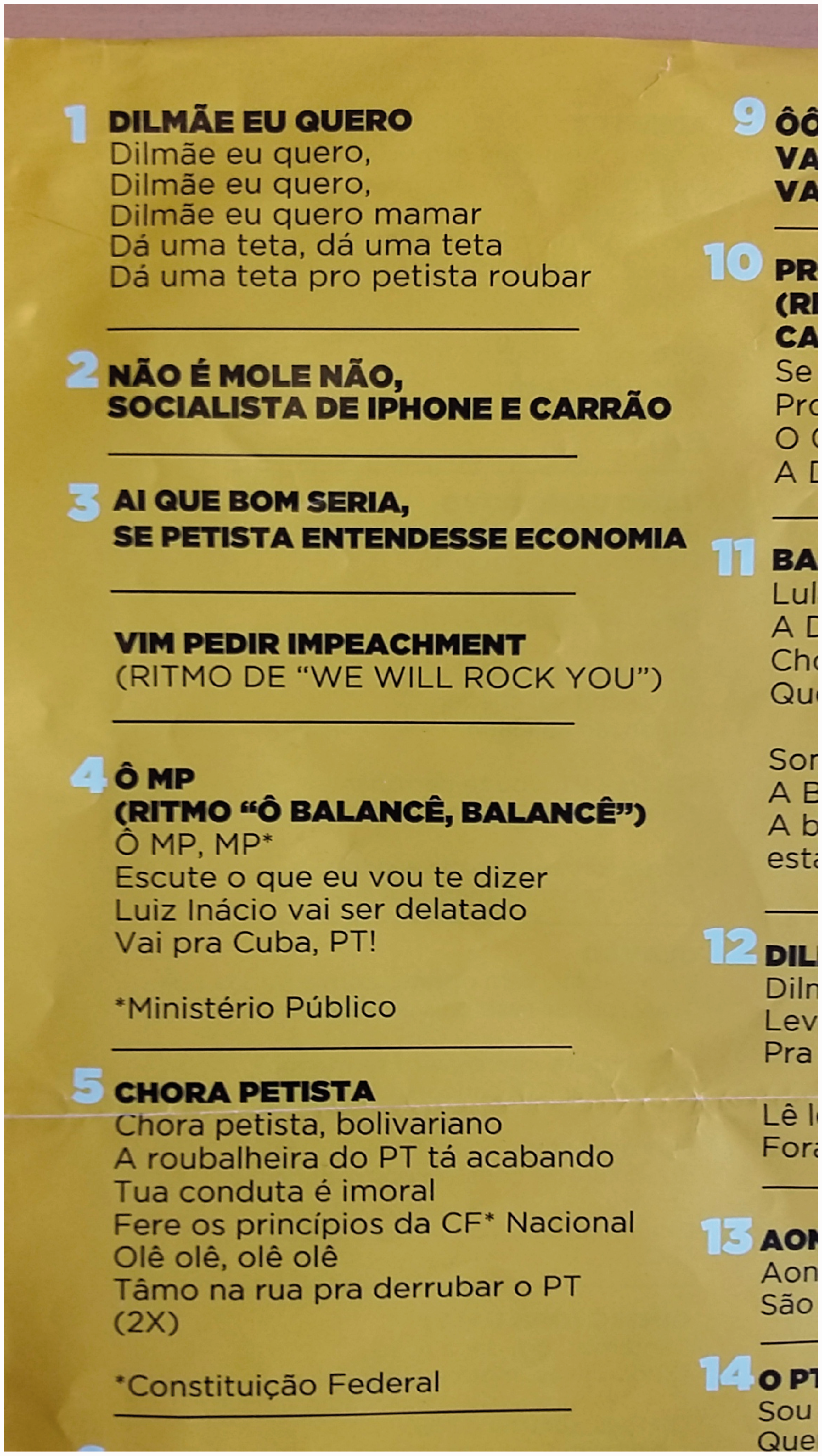
Flyer distributed by the MBL during the occupation of the National Congress in Brasília in November 2015. Photo: Fanny Vrydagh.
Other images produced and circulated by the MBL are in a similar vein. One associated the PT governments with the Maduro regime in Venezuela (Figure 2), stressing that the inefficiency of the latter would be replicated if the Workers’ Party remained in power in Brazil. Another one contrasted two popular bands in the country, with the one supporting the impeachment labelled as ‘legends’, and the other supporting Rousseff as ‘rubbish’ (Figure 3).
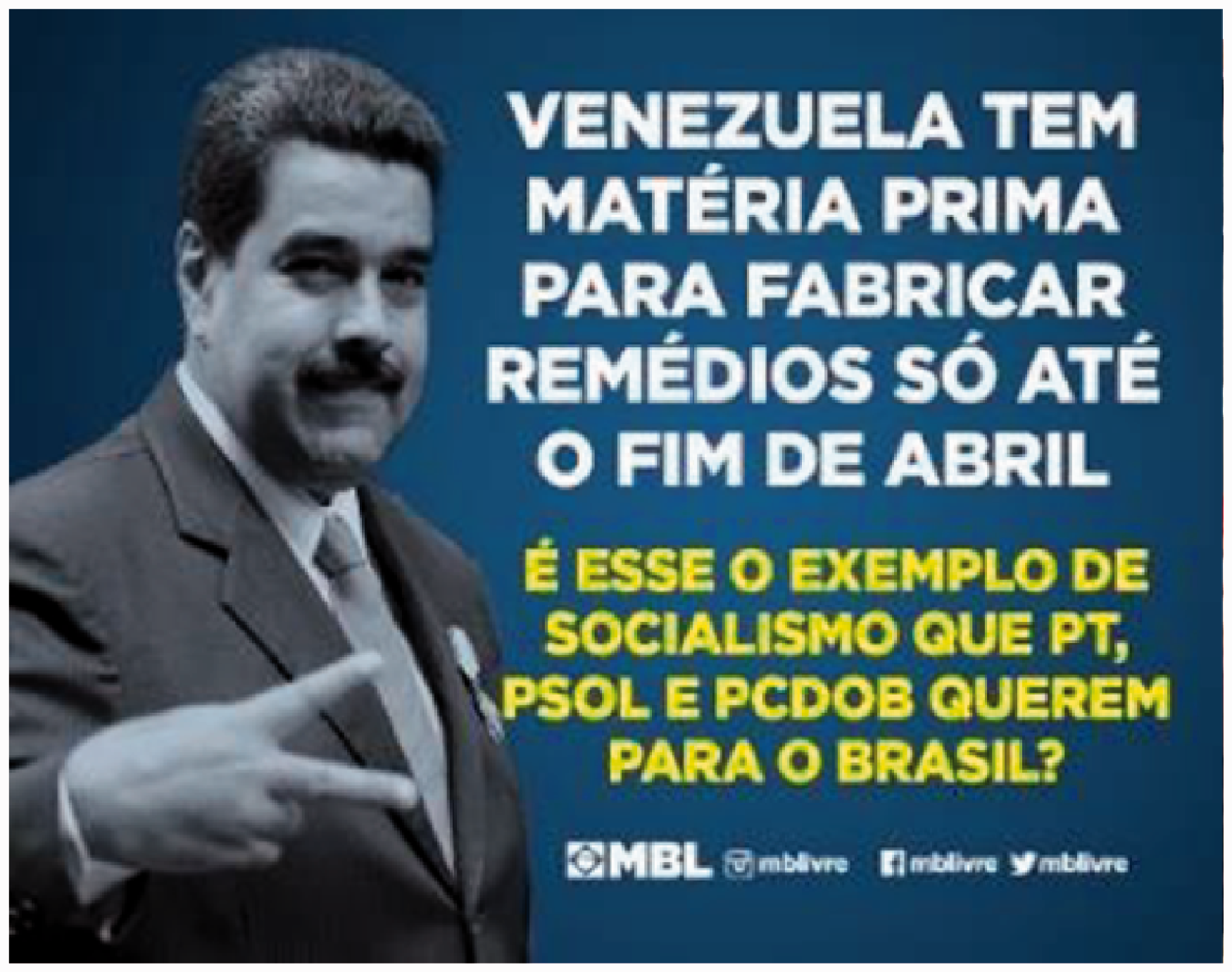
Meme associating the PT governments with the Maduro regime in Venezuela. It says, 'Venezuela has raw material to produce medicines only until the end of April. Is this the example of socialism that the PT, PSOL and PCDOB want for Brazil?'. Source: MBL Facebook page, April 2016.
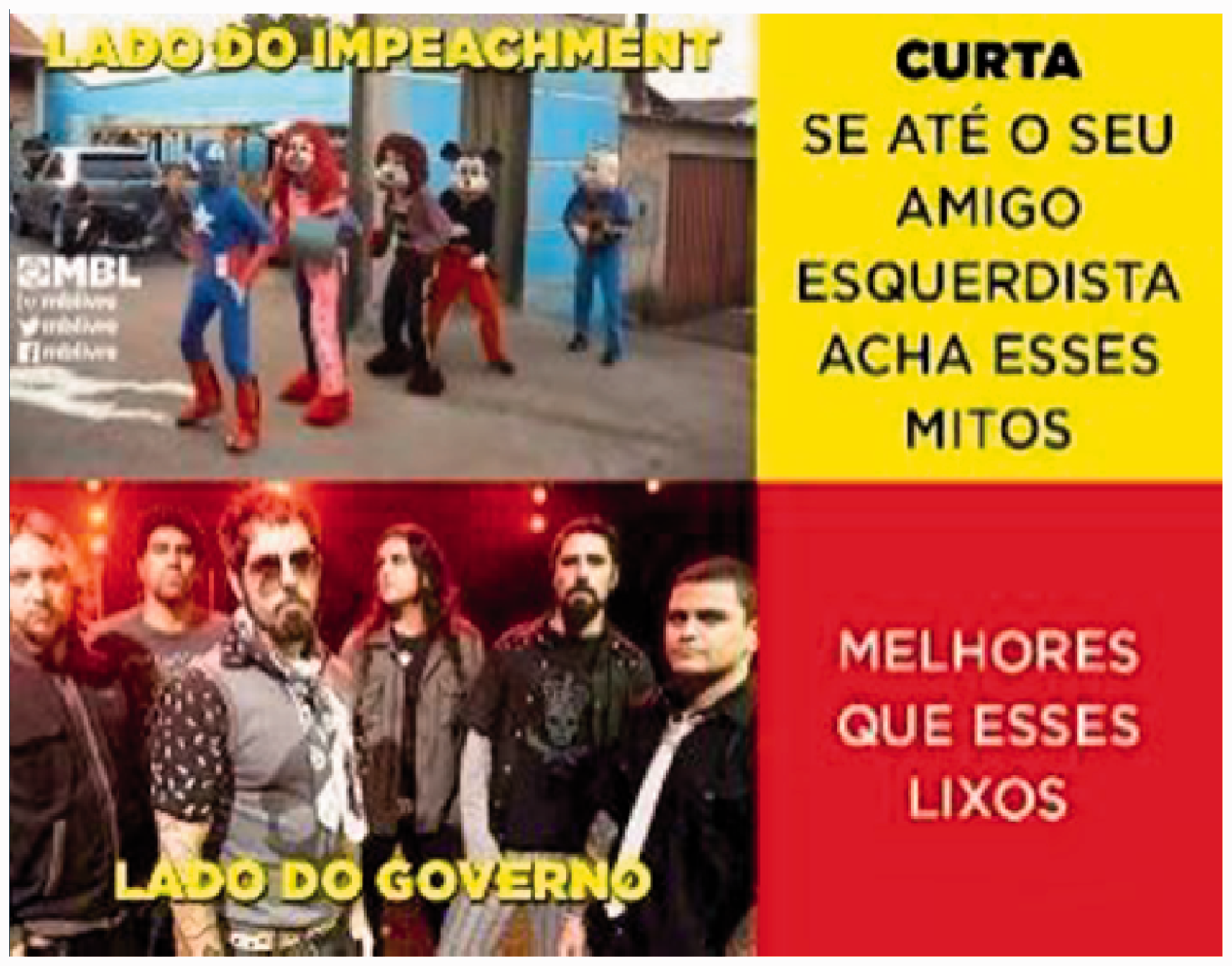
Meme comparing two popular bands in Brazil, with the one supporting Dilma Rousseff's impeachment labelled as 'legends', and the one opposing it called 'rubbish'. Source: MBL Facebook page, April 2016.
The images are thus a clear expression of pernicious polarization, with the other – in this case, the left – delegitimized in simplistic and offensive terms, portrayed not as a valid adversary, but rather a foe not worthy to be listened to. And yet, the discourse among MBL members depicted themselves simply as protectors of ‘common sense’, as representatives and even ‘liberators’ of the majority of Brazilians, whom – according to the interviewees – were oppressed by the power of a supposed left-wing status quo: The ideas we were defending at this time were ideas sharing by all the population. But, at first no one believed it was possible, and we’ve made it. We got them out of power and cut relations with the Bolivarian countries. All of this were things people wanted but at the same time, believed it would never happen (‘Gustavo’, MBL activist, interviewed in 2016).
Concluding discussion: Paulo Freire and the challenge of facing pernicious polarization
The narrative of victimization, conscientization and liberation proposed by members of the MBL is not uncommon among right-wing activists. In other settings, right-wing supporters have voiced the feeling of being oppressed by a dominant leftist status quo (e.g. Nagle, 2017). These groups therefore portray themselves as ‘subaltern counter-publics’, imbued with the awareness of being subordinated, regardless of whether or not they are actually in a subaltern condition (Warner, 2002). Echoing the previous discussion on pernicious polarization, members of these groups share identities, interests, and discourses on so much conflict with the perceived dominant cultural horizon – such as the supposed dominance of the PT across the Brazilian society – that they would face hostile reactions if they were expressed before audiences whose ways of life are assumed as correct, normal and universal.
It is tempting to see the perception of subordination among these counter-publics as a reversal of the relationship between oppressed and oppressor discussed by Freire (2005), but that would be a spurious comparison. Right-wing activists were mostly part of an elitist segment of Brazilian society that has historically belonged to the oppressors rather than the oppressed, imposing their political, economic and religious views on the majority of the population. They may not have been in government between 2003 and 2016, but still possessed plenty of material and symbolic resources, such as money, access to digital media and the support of think-tanks. Furthermore, their discourses echoed those put forward by Brazilian news conglomerates since the first Lula government, which stressed accusations of corruption, authoritarianism and populism against the PT administrations (de Albuquerque, 2019).
Conditioned by the experience of traditionally being the oppressor, these individuals interpreted the socio-political and cultural changes that, within limitations, ended up transforming their previous lifestyle as victimization and marginalization. As Freire (2005) observes, ‘the former oppressors […] genuinely feel oppressed. Conditioned by the experience of oppressing others, any situation other than their former seems to them like oppression’ (p. 57). Furthermore, dialogue and empathy for the other – that is, the left – were posed as extremely difficult or even impossible. This is a significant difference between the MBL and Freire’s philosophy. Although the victimization and conscientization described by right-wing activists seem to resemble Freire’s approach, their ‘liberation’ actually kills that association. For Freire (2005), liberation is never about killing the oppressor or exchanging positions to become an oppressor in their place. Liberation intends to free both the oppressor and the oppressed. The ‘liberation’ proposed by the MBL conversely proposed the neutralization of their perceived oppressor – Lula, Dilma, the PT–, without seeking to eliminate oppression itself.
Although the oppression described by the interviewees is a construction, it still has social and political implications. The deepening of pernicious polarization in Brazil and the subsequent election of Jair Bolsonaro in 2018 are a clear example of the appeal – at least in part – of this oppression and liberation narrative to the electorate. Yet the question of how to deal not only with this narrative of oppression, but more fundamentally with processes of pernicious polarization facilitating governments such as Bolsonaro’s – which, once in power, often try to reinforce this narrative – has puzzled scholars all around the world. Recent discussions have observed how difficult it is to find antidotes to prevent or reverse pernicious polarization. Protests seem to make little difference, and judicial attempts to establish limits and regulate social discourse have shown results only if they are applied prior to the emergence of processes of political polarization (McCoy and Somer, 2019). We argue nonetheless that the philosophy of Paulo Freire – who wrote his seminal works in a more acute polarization context – provide potential avenues of thought.
Freire’s ideas about dialogue, as discussed in works such as Pedagogy of the Oppressed (2005) and Education as the Practice of Freedom (1974), offer a key to unlock this process. Firstly, in his examination of the roles of the oppressed and oppressor, Freire (2005) proposes uniting fundamentally and dialectically separated actors through a dialogue fueled by love, humility, faith in people, hope and critical thinking, and in which parties are equal. Relatedly, as observed by some scholars (McCoy and Somer, 2019), pernicious polarization is relational, and depends not only on the rhetoric and actions of particular groups – such as right-wing organizations – but also on how those opposing them react. Unsurprisingly, calling them racists, fascists, or fools who have fallen prey to fake news deepens pernicious polarization. In consequence, the more they are attacked by the left or the centre, the more they find comfort in their position of being stigmatized (McCoy and Somer, 2019; Stavrakakis, 2018).
However, this type of approach raises the question of how those in the left, the centre and moderate right can respond to the aggressive style of the extreme right – as well as the extreme left. Freire’s distinction of sectarianism and radicalism, and this is the second point we want to make, is crucial. According to Freire (1974, 2005; see also Holst, 2019), a radical is strongly committed to their beliefs, yet is open to dialogue and disposed towards humility and critical thinking. If those principles are not followed, a radical therefore becomes a sectarian, closed to dialogue and trapped within their own fanaticism. That was true for the previously discussed online communities, where the dialogue closure contributed to the formation of digital ‘sects’ that portrayed the left-wing as an opposite and irreconcilable camp. Hence, the answer to right-wing sectarianism should not be through left-wing sectarianism (Holst, 2019). The unlocking of pernicious polarization should instead be achieved by radicals who have humility, self-critical thinking and an open mind, particularly in view of the fact that right-wing groups appear to be winning the debate by means of fallacious arguments. A radical can listen to right-wing supporters, yet that does not mean that accepts everything they say. Academics should also embrace a radical rather than sectarian position, and examine these groups not to validate their viewpoints, but to contribute to instances of dialogue that unlock rather than reinforce pre-existing polarized camps. A certain sectarian blindness within academia has for instance prevented a further examination of these groups in their genesis, partly due to romantic views on the power of digital media as well as due to a disparaging attitude towards right-wing activists. There is consequently a risk that academics may reinforce the demonization and marginalization of these groups, strengthening narratives of oppression and stopping any possibility of dialogue.
In this article, we have shown that individuals engaged in right-wing social movements actually have something to say. By looking at their viewpoints through Freire’s grammar of oppression, we could unravel the dynamic between this feeling of oppression and their sectarian position. We suggest that our experience may shed some light on how to contribute to tearing down the wall separating these different political positions. Some steps are already being taken in this regard, giving some – even if moderate – hopes to be optimistic. A few scholars have questioned the argument that Brazil is irremediably polarized, shedding light on the multiple and often interrelated social and political viewpoints that Brazilians actually have (Ortellado et al., 2016). Political actors have also engaged in this task, as illustrated by the production of videos discussing differences in values and beliefs between different groups (Fura a Bola, 2019). Furthermore, even the MBL published a mea culpa acknowledging its responsibilities in the development of online pernicious polarization (Lihnares and Zanini, 2019). This text, with all its limitations, hopes to be another.
Footnotes
Declaration of Conflicting Interests
The author(s) declared no potential conflicts of interest with respect to the research, authorship, and/or publication of this article.
Funding
The author(s) received no financial support for the research, authorship, and/or publication of this article.