




Abstract
This study uses diachronic computational analysis enhanced with a qualitative approach to examine ongoing changes in communication studies, comparing trends in two European media studies journals and three major International Communication Association journals. We analyze the titles, keywords, and abstracts of 2,585 articles published between 1994–2007 and 2008–2016. We find differences between topics in the two periods in each of the journals’ groups and between the two groups themselves. In the European group, we find centrality of topics related to media change and media logic. In the ICA journals, we find a strengthening of scholarly engagement with effects studies. At the same time, we find evidence of erosion of the place of cultural studies as a distinctive research stream.
Keywords
Since the 1980s, communication scholars have engaged in reflexive self-criticism, focusing on the achievements and the future of communication as a field of study (Herbst, 2008, Lang, 2013; Levy and Gurevitch, 1993; Pfau, 2008). This self-engagement can be seen as part of the natural intellectual maturation of this relatively young field, especially given the increasing prominence and growth in communication studies in higher education institutions worldwide (Simonson and Park, 2015). Uncertainty around the field’s boundaries seems to be an essential part of communication studies, reflected in its interdisciplinary roots (as it was anchored in both social sciences and the humanities) as well as in the fluid boundaries between professional media training and academic studies (First and Adoni, 2005). The major and rapid changes in communication technologies of the last two decades have exacerbated concerns about the field’s future and its theoretical frameworks—leading some to question the current relevance of the theoretical assumptions in communication studies that grew out of the field’s evolution and maturation throughout the 20th century (McQuail, 2013).
A recurring theme in the growing body of scholarship on trends in communication studies is to question the existence of a dominant paradigm in the field (Lang, 2013; Perloff, 2013). These doubts are driven by, on the one hand, the fragmentation and specialized trends in the field (Pfau, 2008) and, on the other, the shift toward an anti- or post-disciplinary era in communication studies (Herbst, 2008: 613). This discussion also includes an awareness and questioning of how the field has developed in different geographical regions (Waisbord, 2016). Scholars thus call for a de-Westernizing of media studies (Park and Curran, 2000) and a more nuanced perspective of field development in the West, including revisiting the relationship between disciplinary trends in the United States (often considered the center of modern media studies) and European development of the field (Averbeck-Lietz, 2012; Craig, 2008; Lang, 2009; Malmberg, 2005; Vroons, 2005).
This study uses computational analysis enhanced with a qualitative approach to examine ongoing changes in communication studies, comparing trends in two European media studies journals and three major International Communication Association (ICA) journals over the past two decades. More specifically, we analyze the text—title, keywords, and abstract—of articles published over a period of 23 years (1994–2016). The two European journals are European Journal of Communication and Communications–European Journal of Communication Research; and the three ICA journals are the well-established publications Journal of Communication, Communication Theory, and Human Communication Research.
The first two journals, as their titles indicate, stress their European perspective, seen, according the journals’ websites, in the origin of the authors or in the unique European–regional perspectives of the articles published. The latter three journals stress their publication by the ICA and, as a consequence, their international characteristics and general obligation to publish quality work with no regional preferences. The choice of these two groups of journals provides us the opportunity to examine what Karin Knorr Cetina (1999) terms as ‘epistemic cultures’—a variety of knowledge settings—in this case with the possible effect of their different identification: European or international. This calls into doubt the universality of disciplinary assumptions while adopting a more nuanced approach (Waisbord, 2016), taking into account national, regional, or international frameworks. Moreover, as Michel Meyen (2012) points out about the collective biography of the ICA fellows, the ICA is not free from national influences and is often US-centered. Thus, comparison between the two groups of journals will provide us with insight on the extent to which the topics in the ICA journal, which are allegedly global research arenas, reflect or even overlap with topics that appear in the European journals. Alternatively, we will be able to identify whether the topics in the ICA journals resemble themes that reflect the communication discipline in the US, based on the relevant theoretical review.
Our research goals are multifold. First, as explained, we see importance in a comparative study of the research topics found in European journals and those appearing in major ICA journals. In addition, an important contribution in this analysis involves a diachronic examination, which adds the implications of changes in communication technologies to changes in characteristics of the field in general and in European scholarly outlets in particular. Another contribution of the study lies in the use of computational tools. We apply not only term–frequency analysis but also topic modeling analysis—that is, latent Dirichlet allocation (LDA), which is rapidly gaining ground in communication studies (Ben-David and Soffer, 2019; Günther and Domahidi, 2017; Maier et al., 2017)—to identify latent themes in the discipline’s research agenda as reflected and shaped through these journal outlets. In order to clarify the outcome of the algorithmic analysis, we augment it with quantitative analysis: that is, we manually analyze the articles identified as best representing each topic. Considering the accumulation of scholarly research on the field’s development and history, the study offers a unique conjunction between the theoretical scholarship and the implementation of computational tools. Thus, the study will provide a cross-outlook: it will evaluate the computational results from the theoretical perspective and vice versa.
Communication as a field of study: Between the US and Europe
The 1930s saw a widening of interest—both academic and industry level—in communication studies in its modern conception. This interest strengthened as radio became established (Berelson, 1959: 2). Because industrialization of the media took place in the US before many European regions, systematic scholarship on media in the US preceded that in other countries (Dennis, 2009). With a few exceptions, then, communication research was formed as an American enterprise (Vroons, 2005). However, as Kurt Lang argues, many of the media-related ideas developed in the US in the mid-20th century had already been established in Europe much earlier with regard to the print medium. According to Lang, the diffusion of ideas from European to American scholars was disrupted by the Second World War, language barriers, and the tendency of social scientists to frame their work as revolutionary (Lang, 2009).
From its outset, American communication studies was influenced by positivist and behavioral methodologies used in other, already-established fields of studies, such as sociology, psychology, and political science (Herbst, 2008: 605). This orientation was linked to, among other things, governmental and philanthropic concerns, sponsoring studies about media effects and the sociological, political, and psychological role of propaganda (Waisbord, 2016). The founders of communication studies expressed interest in various topics and methodologies in social sciences: Lasswell’s studies focused on language and politics and other areas related to political science and social psychology; Lewin dealt with personal and intergroup relations in the direction of experimental psychology; and Hovland studied the psychological side of communications effects (Berelson, 1959: 2; Herbst, 2008: 606). The seeds of a cultural approach toward media production were also evident along this main empirical path, mainly through the scholarly work of the Frankfurt schools, which had migrated to the US as a result of the Second World War (Malmberg, 2005). Furthermore, interpersonal relations, speech rhetoric studies, and a focus on communication organizations—areas that, outside of the US, are usually affiliated with other disciplines—were instituted as part of communication studies in the US (Craig, 2008, p. 679).
US scholars’ interest in media effects included various levels of analysis: short-term and long-term effects, positive and negative effects, and intentional or unintentional effects. While scholars mainly analyzed individuals as the unit of effect, some studies also dealt with effects on groups or society as a whole. Research considered traces of media effects on various levels as well: cognitive (i.e., on information and attitudes); emotional (i.e., related to the audience’s feelings); and behavioral (McQuail, 2010). These were measured before and after exposure to the communication act in an attempt to reveal changes that could be attributed to media exposure (Vorderer and Kohring, 2013: 188).
The influences of empirical American mass communication studies percolated gradually to the West European countries. ‘By the mid-1960s or a little later, American mass communication research had established bridgeheads in most West-European countries’ (Malmberg, 2005: 9). Yet, through the decades that communication studies were institutionalized in European circles, ‘communication’ as an academic term was rarely used (Vroons, 2005: 495). This does not mean that the study of mass communication in Europe began with the flow of American influences and ideas. There were several traditions of press studies across Europe, which commonly reflected historical–humanistic approaches (Simonson et al., 2019: 523). For example, several independent departments for the study of journalism and public opinion already existed in Germany by the mid-20th century (Malmberg, 2005: 9), and in other countries, such as France, an intensive interest in journalism, public opinion, and everyday culture was evident.
Over time, France’s film studies, reflecting cultural and semiological research perspectives, flourished and gained influence in the international sphere. In Britain universities, conservatism influenced the introduction of new fields of studies, communication among them (Vroons, 2005: 505). Unlike other Western European countries, no real academic tradition of press studies was evident at British universities (Simonson et al., 2019: 532). The roots of media study in Britain were based mainly on the tradition of literary studies. Scholars such as Hoggart and Williams focused on cultural media products relating to British working-class culture. The global influence of this approach gained momentum and became dominant following the work of Stuart Hall in the mid-1980s (Malmberg, 2005: 18; Vroons, 2005). Hall, through his focus on decoding the media text, emphasized the potential for the audience to resist hegemonic cultural norms and interpret media text in line with their social perspectives (White, 2014: 5).
An accepted assumption in the historiography of the field is that the ‘dominant paradigm’ of effect studies was challenged in the early 1970s, partly as a result of intellectual trends following protest activities in 1968. Following the trend of social sciences at that time to question empiricist hegemony (Nordenstreng, 2004), communication studies borrowed from critical and cultural scholars who rejected essentialist and positivist assumptions (Simonson and Park, 2015: 4) and introduced qualitative and hermeneutic methodologies into the field (McQuail, 2010). These alternative approaches, reflecting the influences of the European cultural approach to media studies, often see media texts and products as reflecting the hegemony of the economic and ideological elites (Corner, 2013; Lang, 2013). Yet, over time, these approaches, which often reflected Marxian criticism, were influenced by other streams of thought: From the 1990s this gave way in some measure to less confident and less direct forms of critique, with the influence of postmodernist thinking about power and identity apparent and a certain re-positioning of the media as agencies whose complexity of operations and consequences, within a capitalism many of whose terms had become ‘normalized’, was seen by some if not by all to deserve a cooler, more descriptively precise, approach, partly convergent with earlier and continuing social science perspectives. (Corner, 2013: 1013)
Methodology
This study comparatively investigates how various topics and changes in them over time are reflected in several communication studies journals in the period 1994–2016. Unlike journals focused on a certain era or subfield (such as the ICA’s Journal of Computer-Mediated Communication) or a distinct methodology (such as Communication, Culture, and Critique), all the journals analyzed here are dedicated to a wide scope of communication issues. This is not to say, of course, that the ‘general’ spirit of these journals excludes any bias toward certain subfields or methodologies—indeed, we hope to reveal such biases through our computational analysis. For journals reflecting a European orientation, we have chosen two that ranked in the communication category in the Journal citation reports: European Journal of Communication and Communications–European Journal of Communication Research. Topics and changing trends in these journals will be compared with those in three long-lasting and well-established ICA publications: Journal of Communication, Communication Theory, and Human Communication Research. We split the collection of articles before and after the year 2008 and compare the topics and the changes between the two periods in each of the journal groups and between them. The year 2008 was chosen because it marks the beginning of rapid changes in communication technology along with the rise of social media and other networked platforms. Another reason for choosing 2008 as the splitting point of the article corpus is methodological: as we will see, the numbers of articles and unique terms before and after 2008 are relatively balanced.
We use two methods to analyze the text. The first is term frequency analysis, which provides insight into the usage trends of terms and concepts. The second is topic modeling, which helps to identify evolving research topics. Specifically, this study uses LDA (Blei, 2012), the most common application of the topic modeling algorithm. Topic modeling is a generative, unsupervised machine-learning algorithm that refines the semantic classification of a document beyond rudimentary analysis of its raw terms. This means that it does not require prior annotation or labeling of the documents or terms within the documents. The algorithm infers the hidden topic structure of the corpus by computing the conditional distribution of the topic structure from the words of the documents. It then identifies the thematic structure of the document by calculating the proportion of each topic within the document.
The LDA process is schematically demonstrated in Figure 1, based on Raban and Geifman (2019). The outcome of the process is dual: it produces, first, a set of topics, each identified by a distribution of the raw terms (Figure 1, table a); and second, for each document, a distribution of the topics running through them (Figure 1, table b). Researchers usually observe the semantic meaning of a topic qualitatively through its high probability ranking terms (Figure 1, table a) (Blei, 2012). In our case, we augment the automatic analysis by manually reviewing the documents (articles) that are found to be most relevant for each topic, as derived from Figure 1, Table b, in this way deepening our understanding of the meaning of each topic.
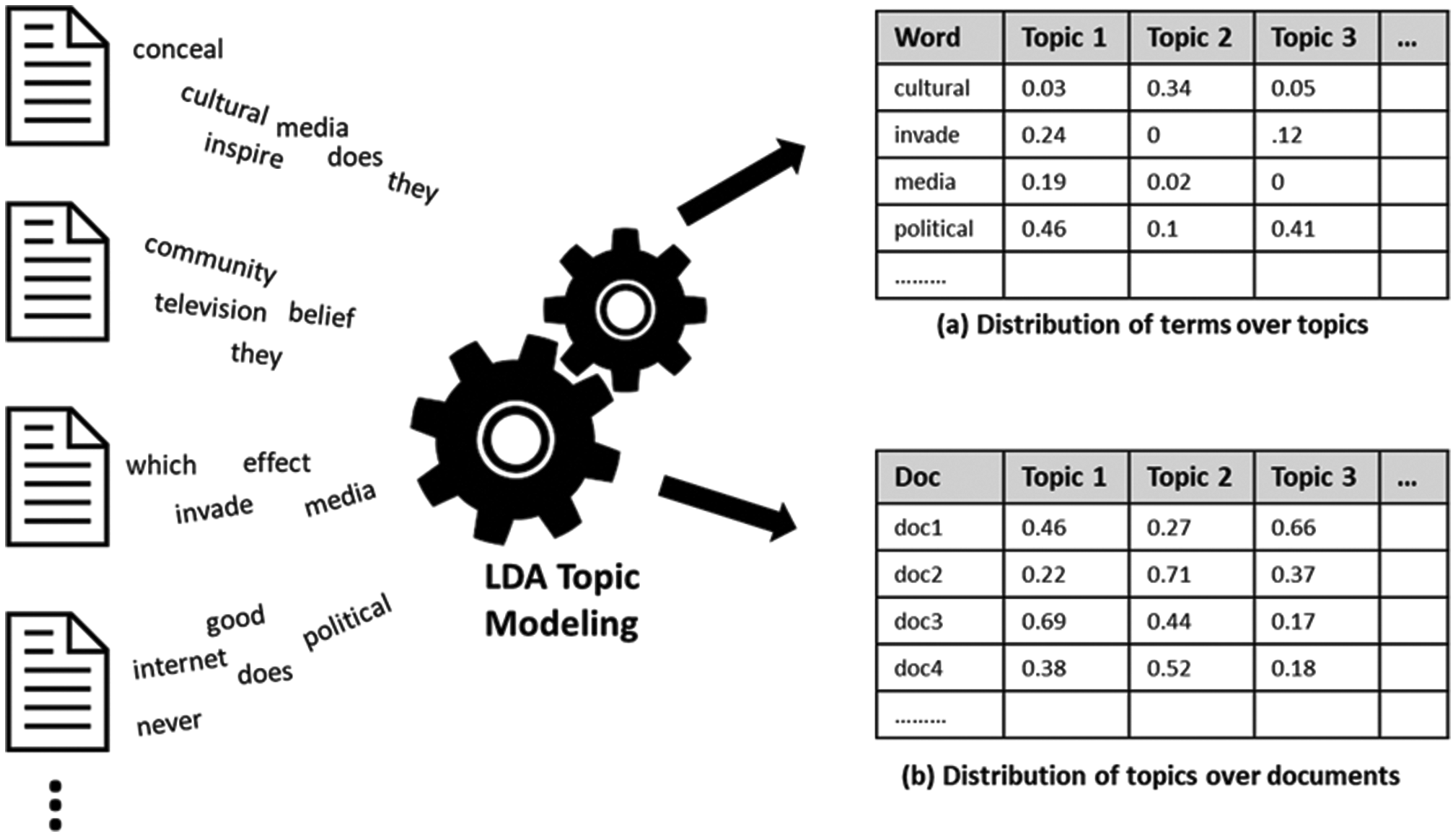
The LDA topic modeling process.
We use several R packages, which will be detailed below, to analyze the corpus of text, and we introduce manual processes to enhance the quality and performance of the automated analysis. The following sections describe our data collection, preprocessing, and topic modeling analysis.
Data collection
The meta-data of articles published between the years 1994 and 2016 in all five journals were extracted from the Web of Science repository. The collection contained the title, authors, publication year, keywords, and abstract of a total of 2,585 articles: 1,348 articles before the year 2008 and 1,237 for the years 2008–2016. Figure 2 presents the distribution of articles in the collection by year, normalizing for the different number of years per period: 14 years in the first period, 9 in the second note that Communications–European Journal of Communication Research is indexed in WoS since 2004 only and was calculated accordingly.
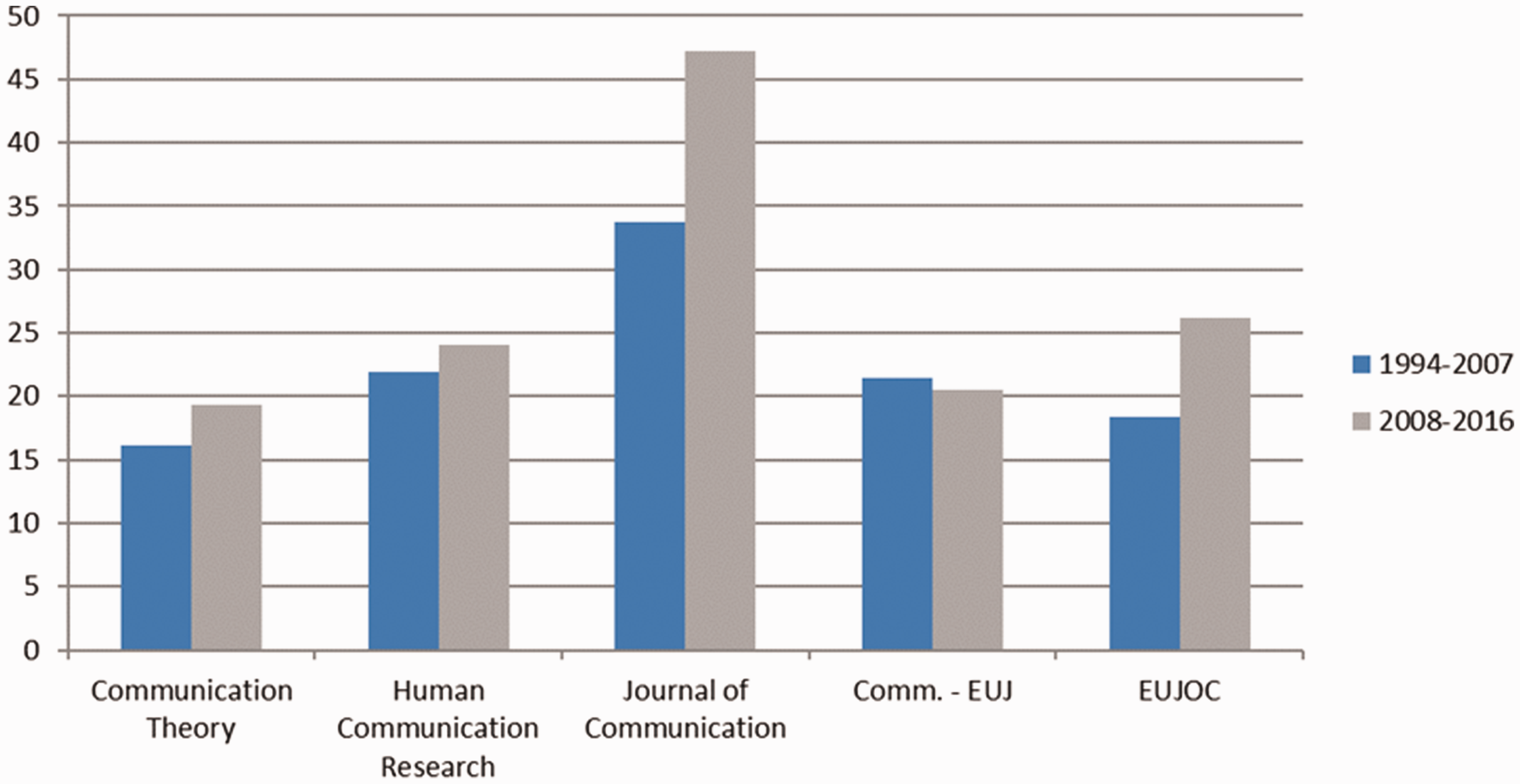
Distribution of articles in the collection by year.
Preprocessing
The preprocessing steps involved removing stop words and stemming. Stop words are neutral words—such as ‘and’, ‘the’, ‘actually’, etc.—that do not contribute to the specific context of analysis despite their high frequency. These are removed from the corpus so as not to bias the analysis. Stemming is the process of combining morphological variants of the same words by reducing them to a common root. In most cases, words with the same root have similar meaning, and stemming the corpus makes the collection of words smaller and more accurate.
While analysis of a large body of text often requires automated processing, the latter cannot fully address the text’s linguistic and semantic complexities. Manual intervention is needed when a deeper understanding of the text, specifically semantic understanding, is involved. We initially used the ‘tidytext’ R package, which includes a list of 1,147 standard stop words, in a stop words removal step, but extended the standard list with context-specific words that take into account the special characteristics of the corpus. The corpus, consisting mainly of abstracts of academic articles, included a relatively high frequency of terms specific to abstract structure and vocabulary, such as ‘research’, ‘author’, ‘results’, and ‘methods’. These terms are irrelevant when trying to understand the context of research. To correct this imbalance, we cautiously removed such terms while making sure to leave in context-related words.
For stemming the corpus, we used the Porter word-stemming algorithm as implemented in the ‘SnowballC’ R package. Stemming, however, is a process with known deficiencies (Hull, 1996), for example, words with different meaning can be combined to the same root (e.g., ‘new’ and ‘news’); words with similar meanings can stem to different roots (e.g., ‘man’, ‘men’); and after stemming, many words lose a recognizable form and cannot always be reconstructed because the stemming process is irreversible. To address these deficiencies, we created the following procedure, combining automatic and manual processing:
We first applied the stemming algorithm to the full corpus. We then reviewed the transformation of the 700 most frequent words in the corpus to identify inconsistencies in the stemming process (e.g., words such as ‘informal’ and ‘information’ were stemmed to the same root; however, words such as ‘child’ and ‘children’ were not combined). We reapplied the stemming process to the corpus while eliminating the exceptional words from the process. Finally, we transformed the outcome back to a recognizable form by selecting for each stemmed word the most frequent original word that formed it.
These preprocessing steps, crucial for effective and meaningful topic modeling analysis, resulted in a corpus of 4,558 unique terms that appeared more than twice in the corpus. In order to compare the conceptual and paradigmatic changes between the two periods, the corpus was partitioned into two: (i) before the year 2008 (1,348 articles, 3,280 unique terms) and (ii) 2008 and onward (1,237 articles, 3,197 unique terms).
Analysis
We applied three complementary analysis methods on each corpus separately. First we compared the term frequencies between the two eras, both in the European journals and in the ICAs, in order to gain insights into the differences in discourse between these two sets of journals, as well as to identify and compare the evolution of term usage in each of these journal groups in the two eras. To compare the latent topics that emerged in the two periods and in the two groups of journals, we applied the LDA topic modeling algorithm on each corpus, as implemented in the ‘topicmodels’ R package (Hornik and Grün, 2011), We used the Gibbs method, a form of Markov chain Monte Carlo that is easy to implement and provides a relatively efficient method of extracting a set of topics from a large corpus (Griffiths and Steyvers, 2004), and the default parameters.
One of the parameters required for the algorithm is the number of topics to be generated. There are no guidelines to assist in defining this number. Defining a number too large may result in topics that cannot be distinguished in a meaningful way, while a number too small may combine different aspects that should be distinct into one topic. Following best practices in the field (DiMaggio et al., 2013), we experimented with a different number of topics and decided on 10 topics as the most appropriate number for the present data.
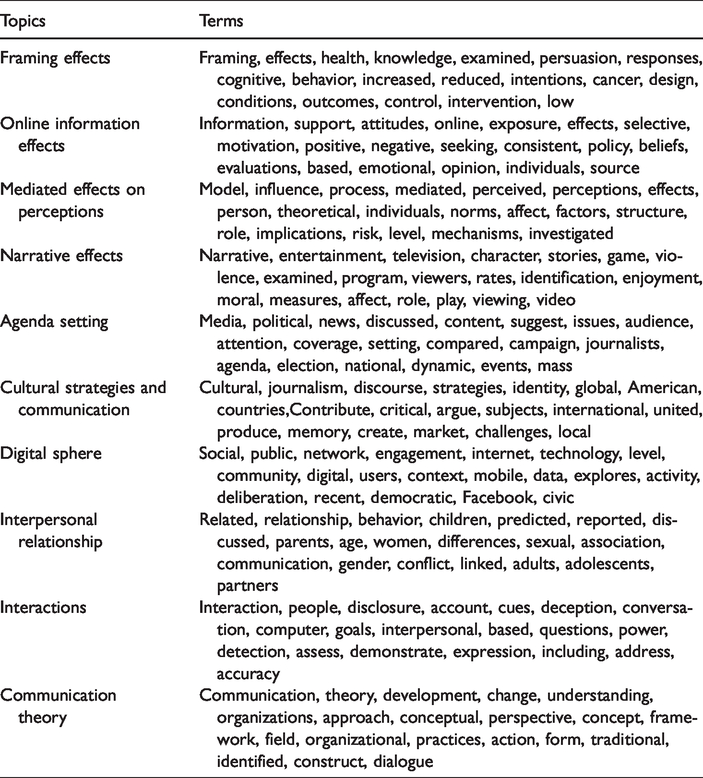
The topic modeling analysis resulted in two tables per period for each of the journal groups (Tables 1–4). We used the highest ranking terms to qualitatively define the thematic meaning of each topic.
Topic modeling results of the European journals 1994–2007.
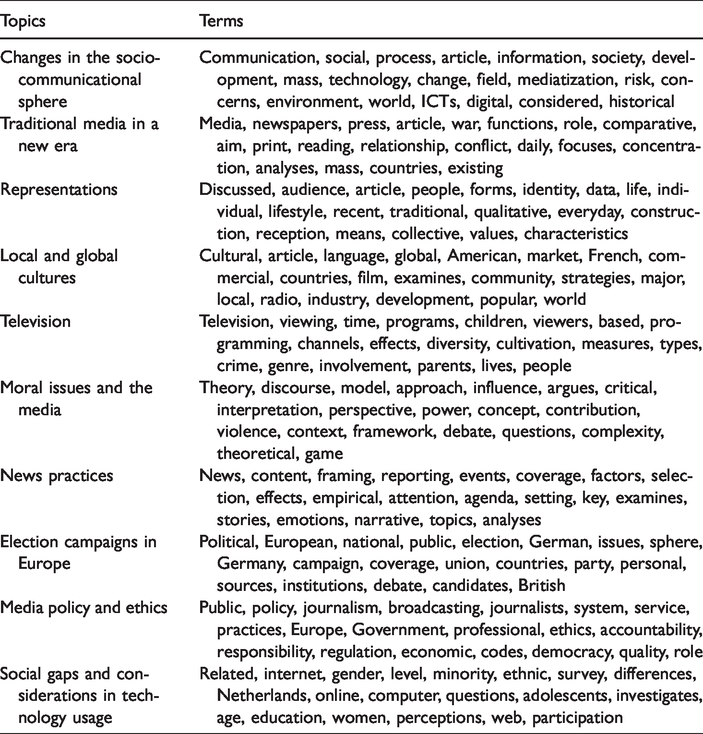
Topic modeling results of the European journals 2008–2016.
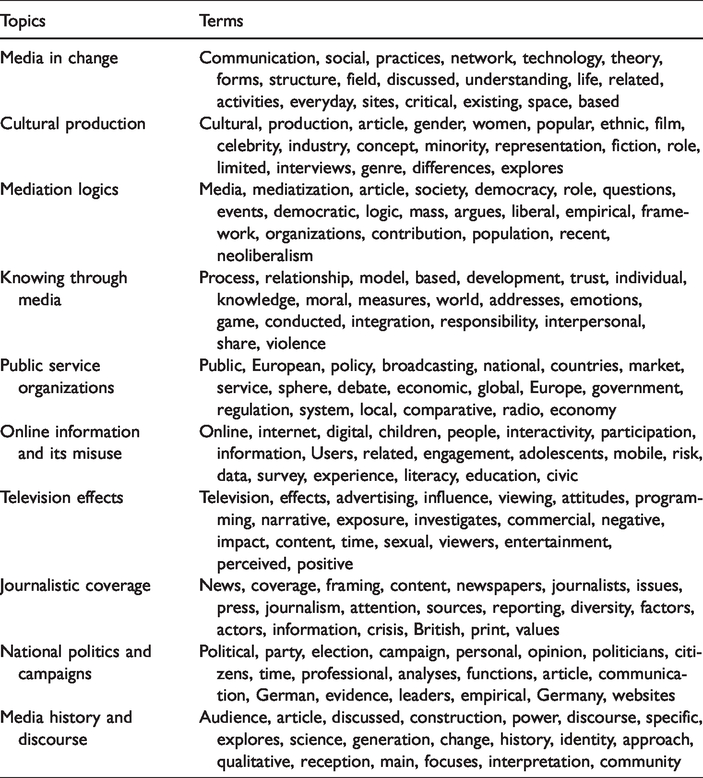
Topic modeling results of the ICA journals 1994–2007.
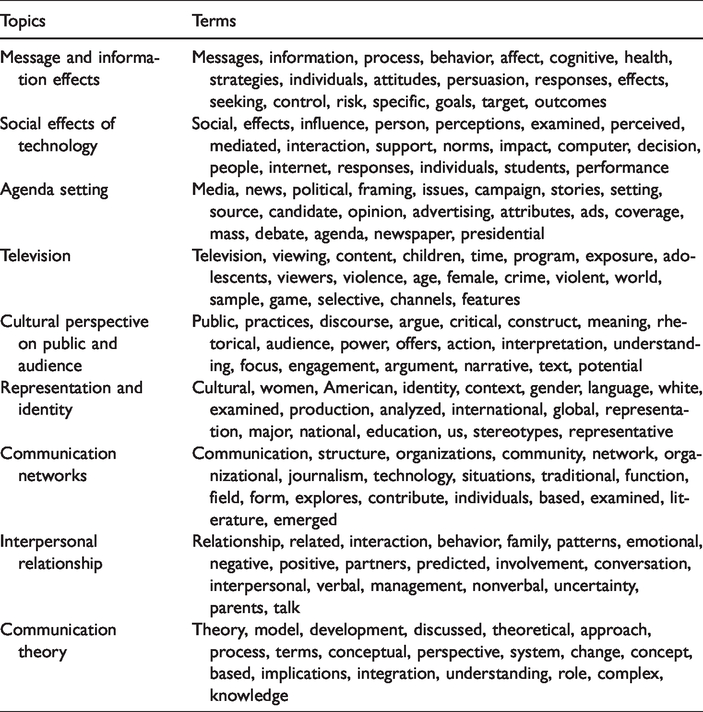
Topic modeling results of the ICA journals 2008–2016.
Results
Before delving into the results of the topic modeling analysis, it is worthwhile examining the differences and changes in term frequencies. As we will show, these differences and changes in topic are crystalized and clarified in the context of the frequency analysis.
Term frequency analysis
Figure 3(a) and 3(b) exhibits the frequencies of the 25 top-ranking terms in the two periods of analysis.
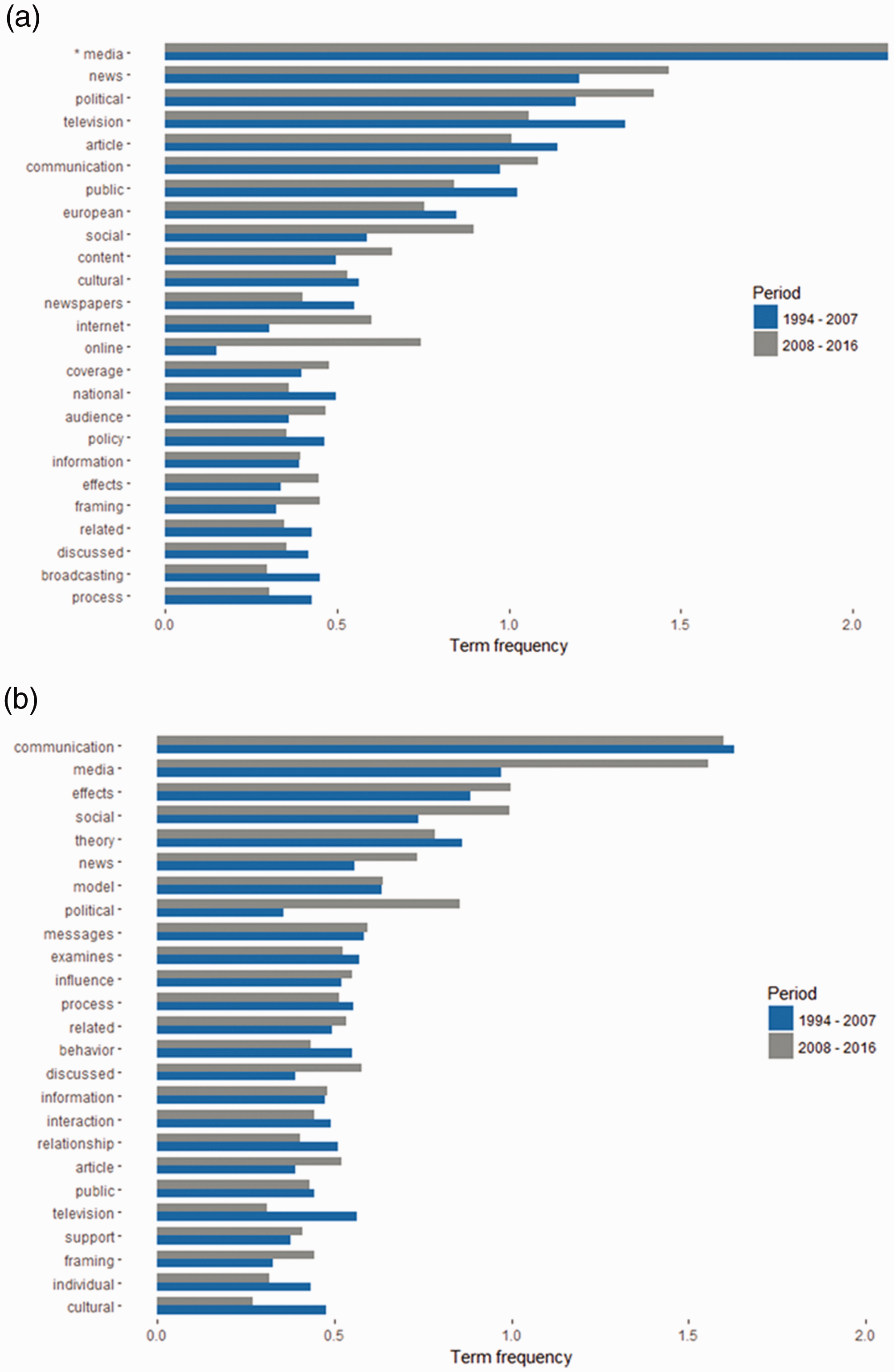
(a) Term frequencies in the European journals. (b) Term frequencies in the three ICA journals.
The differences in high-frequency terms between the European journals and the ICA ones are evident. Overall, we see a dominance in the ICA journals of terms related to the social science tradition in communication studies: such as effect, model, message, and behavior. However, in the second period examined, the differences in the frequencies of the terms in the two groups of journals are slightly blurred. Thus, while the frequency of the term media is the most prominent in the European journals in both periods (2.92% of all the terms in the first and 2.91% in the second), in the ICA journals the most frequent term is communication (1.62% of terms in the first period and 1.59% in the second). Yet, in the second period the frequency of media as a term increased in the ICA journals, although its use is still lower than the frequency in the European journals (from 0.97% to 1.55%). As Simonson et al. (2019) argue, ‘before 1945, mass communication was a term that had little, if any, circulation outside the United States. That began to change after the war, in no small part due to UNESCO, the single most important institutional locus of its global dissemination, and a site of contestation about the term’s meaning and place’ (p. 519). In Europe, the adoption of the term mass communication faced obstacles for various reasons, such as the cultural overtones related to the use of the term mass and translation gaps. This can explain the relatively modest place reserved for the term communication in the European journals compared to the dominance of this term in the ICA journals.
Because the term media is often combined with other terms, we conducted a further analysis of the frequencies of bigrams (double terms) that are associated with this term. This analysis (Figure 4) reveals that the leading bigram in the European journals is mass media, which was associated with 5.21% of the uses of media as a term in 1994–2007. Yet, in the second period the frequency of this bigram reduced to 2.16%. In the ICA journals, however, social media is associated with 0% in the first era but with 9.2% of media use in the second era (compared to 4.61% of media appearances in the European journals). It is worth mentioning that media policy, which is the fifth most frequent bigram in the European journals (2.5% of media use in the first period and 1.02% in the second), is much less frequent in the ICA journals, ranked in the 32nd place in the ICA journals (0.45% and 0.0%). The bigram media effect is much more frequent in the ICA journals (4.89% of media use in the first period and 4.2% in the second) than in the European ones (1.67% and 1.36%).
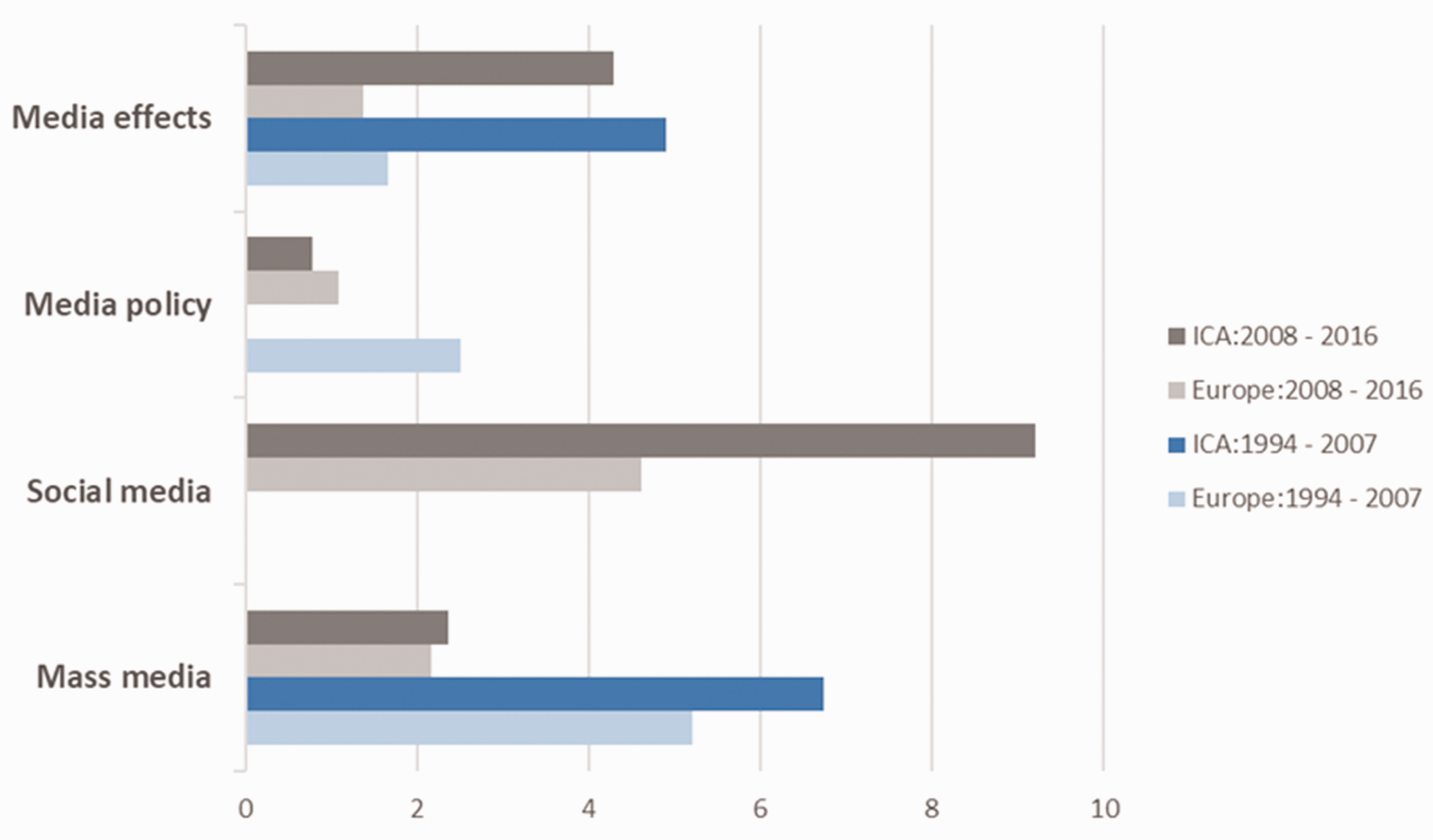
Comparing bigram frequencies in the European and ICA journals.
‘The increasing use of media as a term seems to be linked to the scholarly awareness that the communication process is not independent from the medium’. As Williams (1982: 203) explains, the use of media as a term increased dramatically following the rise of broadcasting and the popular press, used in ‘the conscious technical sense, as in the distinction between print and sound and vision as media’. Thus, the reference to media differs from that of communication as it assumes a certain logic that is an imminent part of a certain technology. This seems to be relevant to the rise of digital media as well: the prosumers are active through media and not through communication. This distinguishes them from the seemingly passive consumers of the traditional media, who were seen as exposed to communication.
The distinct intellectual engagement in the European journals with media logic and the way it shapes everyday experience is also emphasized in the use of the term mediatization. This concept is often used as an alternative to the traditional concept of mediation to signal a change in the media atmosphere and the integration of technology in people’s everyday lives (Couldry and Hepp, 2013; Hepp et al., 2015). This concept, which was developed and became routine in communication studies with the rise of digital communication (Krotz, 2014), assumes ‘that the media become an integral part of other actors or systems with the effect that the practices of these actors/systems are increasingly shaped by the media’s logic of operation’ (Sorensen and Voltmer, 2016: 5). The difference of frequency found in the two groups of journals around this term clearly reflects European scholars’ dominance in the development and discussion of this concept. In the European journal it was the 28th most frequent term, with 0.15% of all the terms in the first era and 0.50% in the second (overall, this term was used 237 times in the European journals). This term, however, was not used at all in the ICA journals.
The term-frequency list reveals a significant decrease in the frequency of terms related to ‘traditional’ means of communication in the second period compared with the first. While this trend appears in the two groups of journals, it is more prominent in the ICA journals than in the European ones. Television is the most prominent term related to traditional media in both journal groups, yet its use is much more dominant in the European journals (1.33% and 1.05%) than in the ICA journals (0.56% and 0.30%). This is, perhaps, due to the close relationship of television studies with the European-oriented influences of ‘film studies’ along with its humanities-oriented textual and esthetic methods of study (Corner, 2013: 1014). The top 25 most frequent terms in the European journals includes the term newspapers (0.55% in in the first period and 0.4% in the second). Internet, as a ‘new media’, also only appears in the European top-25 list (0.55% and 0.4%). These terms, as well as other references to communication means, are absent from the top frequent terms in the ICA journals.
Other interesting results relate to terms that are associated with the ‘dominant’ and ‘alternative’ paradigms in communication studies. One such term is effects, which is the third most popular in the terms-frequency list of the ICA journals (0.88% and 0.99%). In the European journals, however, this term is at the end of the 20-most-frequent list (0.33% and 0.44%). The frequency of affect, a verb closely correlated with the noun ‘effect’, demonstrates the same trend: it is much higher in the ICA journals (0.28% and 0.27%) than in the European ones (0.087% and 0.10%). Of course, the term effects can be related and applied to various contexts and not only to effects studies. Yet, the extreme difference in the frequency of this term between the two journal groups, as well as the results of the topic analysis, indicates at least partial correlation between the use of this term and the dominance of media effects as a study area.
The trend discussed about effects as a term differs, however, when we consider the frequency of terms related to cultural studies. While overall the frequency of these terms decreases in the two groups of journals, the drop is more dramatic in the ICA journals than in the European ones. Thus, while the frequency of term cultural is quite stable in the two periods of time in the European journals (0.56% and 0.53%), it falls sharply in the ICA journals (0.47% and 0.26%). Other terms that demonstrate sharper decline in the ICA journals are critical, gender, images, and discourse.
Topic modeling analysis
In order to extract the latent topical and thematic structures in the corpus of documents, we conducted topic modeling analysis separately to each group of journals in the two periods: articles published in the European and in the ICA journals in 1994–2007, and those published in these journals in 2008–2016. Tables 1 to 4 present the themes that emerged from the algorithm for each group in both periods. These topics led our analysis and helped us to identify and compare dominant research themes in each of the two periods.
In general, we find differences between topics in the two periods in each of the journals’ groups and between the two groups themselves. While we see—in findings similar to Günther and Domahidi’s (2017)—constituency in the general topics within each group, the balance between them changes. The European group reflects trends that continue the findings in the terms’ frequency: that is, the centrality of media and its change and discussion that is relevant to media logic and ecology within the broad social fabric. Thus, for example, the topic of ‘mediation logics’ in the European journals in the second time period not only includes terms such as mediatization but also democracy, liberalism, and neoliberalism. This hints toward the broad discussion that combines the role of the media within the larger sociopolitical spheres and philosophies.
A number of topics appear only in one group of journals and not in the other. For example, discussion of ‘media policy and the public broadcasting model’ is unique to European journals. This goes hand in hand with the above-noted relative dominance of the bigram ‘media policy’ in the European journals compared with the ICA ones. Another topic unique to the European journals is that of ‘journalistic coverage’, a finding potentially connected to the European tradition of journalism studies, which preceded the beginning of communication as a field of studies in the US (Lang, 2009; Malmberg, 2005: 9). Naturally, articles dealing with political debate in the European journals focus mainly on European national and regional issues. Yet, one topic in each of the periods is related directly to political issues: ‘election campaigns in Europe’ in the first period and ‘national politics and campaigns’ in the second.
Among the topics unique to the ICA journals are those that deal with interpersonal communication. This corresponds with the disciplinary picture in the US, where, unlike some other world regions, interpersonal relations are seen as integral part of communication academic departments (Craig, 2008: 679). In both periods, ‘interpersonal relationship’ topics deal with family relationships. In the second period, terms that refer to gender issues and sexual relationships are also evident. When considering this continuity, it is interesting to note that in the second period a new topic emphasizing ‘interaction’ evolves. While this topic includes terms such as interpersonal and conversation, which imply its belonging to the interpersonal face-to-face tradition, it also contains terms often related to computer-mediated communication, such as computer, disclosure, and cues. The emergence of this topic implies the rise of a new perception that, as Lievrouw (2009: 315) argues, ‘focuses on communicative action in context of networked relations and systems’.
In general, the ICA journals reveal a dominance of topics related to ‘effect studies’: these topics, in fact, predominated over any other theme. This trend strengthened in the second period: half of the topics in this period explicitly relate to this stream of studies. While effect as a subject of study in the ICA journals, at least in the first period, was far from a hegemonic paradigm in the field, its dominance there is striking when compared with the European journals. In the latter, only one topic in the two periods was directly associated with this theme. Yet, ‘effects’ appear as part of themes that include both empirical and qualitative studies, such as the topic ‘news practices’, which is dealt with in articles undertaking empirical examination of news selection (Kepplinger and Ehmig, 2006) and discursive analysis of news frames (Scheufele, 2006). The relatively modest place reserved for the distinct topic of effects studies in the European journals follows the trends seen in the term-frequency analysis.
While the second period revealed a significant increase in the ICA journals in the number of topics explicitly dealing with media effects, the opposite trend occurs in topics around cultural issues. In the first period, we identified two topics on the cultural–critical approach to communication: ‘representation and identity’ and ‘cultural perspectives on public and audience’. Yet, cultural-oriented terms also appear in other topics (e.g., ‘television’) combining studies with both cultural and effects orientations. On the surface, the topic ‘cultural strategies of communication’ in the second period seems to reflect engagement with issues similar to the topic ‘representation and identity’ in the first—which contains terms such as cultural, discourse, and identity. The difficulty of defining this topic as purely one of cultural studies emerges when we examine the articles identified as according most closely to this topic. One of these, for example, is a quantitative-essentialist analysis (Jiang, 2014) whose discussion of identity is not the study’s focus, but part of explaining the data related to online search bias. Thus, while cultural-oriented terms are scattered throughout the topics, the alternative that cultural studies allows in its ontology and epistemology, compared with essentialist quantitative studies, is partly lost. This supports Perloff’s (2013) arguments that critical–cultural perspectives have been integrated into and accepted as part of mainstream essentialist research in communication studies.
On the surface, the picture that emerges of cultural topics in the European journals seems similar to that of the ICA journals. In the first period, two topics are significantly related to cultural studies, ‘local and global cultures’ and ‘representations’; and in the second, we find one: ‘cultural production’. Yet, a major difference emerges between the two journal groups. The ICAs, partly as a result of the dominance of effects studies, show much more evidence of distinct cultural topics. In the European journals, the boundaries are blurred; other topics, as a result of their abstract-philosophical point of view, are close to cultural studies. Thus, McQuail (2010) identifies issues both on media, technology, and everyday experience and on the quality of media products as relating to the themes of culture–communication research. As we have seen, these issues are associated with many of the topics in the European journals.
Discussion
Recent decades saw accelerated processes of globalization and internationalization of communication and media studies. These processes are evident in increased connectivity among scholars with different national and regional backgrounds (Waisbord, 2016). Among other things, these processes are influenced by the dominance of international associations, such as the ICA, along with their affiliated journals—three of which we analyzed in this study. As Waisbord (2016: 870) argues, ‘academic globalization carries the promise of “knowledge without frontiers.”’ Yet, the results of this study reveal different ‘epistemic cultures’ (Cetina, 1999), which are seen in the topics and terminology that characterize the European journals and those that are affiliated with the ICA. The outlines of the research characteristics of the European and international journals reflect trends usually identified as typical of European media studies versus those usually attributed to US communication studies. This provides another angle to claims about the hegemonic US orientation of the ICA (Meyen, 2012). Thus, our results stand in line with Waisbord’s (2016: 878) conclusions about the limited power of internationalizing trends in the disappearance of original traditions in the field of communication: Globalization does not pull academic cultures away from local dynamics. Scholarship remains grounded in local academic cultures with particular expectations and codes. These are the ‘tribes’ that influence or ultimately make decisions about employment and tenure and provide intellectual recognition and professional belonging. Academic cultures are nested in local institutions and power dynamics that are not easily transformed by internationalization.
However, our analysis shows that the difference is not only in the terminology adopted but also in the research perception. Media as a meta-topic is seen in the European journals in discussion related to media logic, changes in media, and mediatization, as well as in engagement with traditional media. An exception in this regard is engagement with social media, which is more dominant in the ICA journals and can be related to greater interest in the international journals in new media. This can be explained by the scholarly approach of rift between mass communication and new media, ‘as if the radical new terms of mediation being explored rendered irrelevant earlier concepts and approaches’ (Corner, 1015). The ‘European approach’ to media studies, as reflected in the European journals, tends to reflect more of the humanities and press studies origins of the field than the ICA journals. This includes more topics that relate to cultural studies, media history, and moral and ethics questions.
The ICA journals that we examined reflect the general social science orientation toward communication studies. As part of this trend, and as will be discussed further below, matters related to media effects seem to dominate this discussion. Yet, specific topics that characterize the development of communication as a field in the US, such as the subfield of interpersonal communication, are well represented in the ICA journals but not in the European ones.
Another interesting issue emerges from the diachronic comparative analysis. This relates to the ongoing debate in the field on whether media effect studies dominate or have eroded. While scholars such as Lang (2013) and McQuail (2013) assume the erosion of the role of effects in communication studies and the rise of an alternative, more complex, paradigm, other scholars, such as Perloff (2013: 327), argue that ‘from the academic perspective, media effects remains the core issue that separates communication scholars from researches from other disciplines’. The question of the dominant paradigm relates to claims about the fragmentation of the field and its expansion horizontally (Beniger, 1993: 19; Peters, 1993: 133). As Waisbord (2016: 868) argues, ‘[f]ragmentation intensifies centrifugal tendencies that drive inward-looking scholarship and deepen divides in communication research’.
Based on the topics in the journals examined, the debate on the dominance of effects studies seems relevant mainly to the ICA journals. In the European journals, media effects were one among other topics in the two periods examined and no claims about its dominance hold. On the other hand, in the ICA journals, when we compare the first period with the second, computerized analysis indicates an increase in the number of topics dealing with media effects: half of the topics in the second period were classified as related to this stream of studies. This could indicate a centripetal process, with re-dominance of effect studies. In a time of great technological changes, which are reflected in a rather modest way in the topic lists, the increased place reserved in the second period to effect studies can be seen as a reaction to this scholarly uncertainty. At the same time, distinctive topics around cultural–critical issues that reflect the ‘alternative paradigm’ in communication studies disappeared from the topic list. While the topics still included terms related to cultural studies, the deep sense of ‘alternativeness’ of the ‘cultural paradigm’ was expressed in the agnosticism of essentialist ontology and empiricist epistemology. This study thus supports Perloff’s (2013) observation of the integration of critical-cultural perspectives into mainstream essentialist research in communication studies.
It is possible that the trends we identified in the topics may have been affected by the emergence of journals that attracted new types of articles and offered an alternative outlet for scholars. If this were the case, then the findings of a change in the topics would be the result of a greater number of scholarly outlets and not a shift in research topics. This, for example, could result in the decreasing dominance of research areas such as cultural studies—an occurrence that would lead to the withdrawal of such studies from these three mainstream major scholarly venues.
The results of this study point to the need for a more systematic mapping of media publications in different geographic regions around the world to provide a broader picture of communications as a field of study. Because of its focused purpose, this study may have missed out on the wider picture that could be attained by including more journals in the database. In addition, limitations of the computational power at our disposal meant that the analysis was based on abstracts, titles, and keywords rather than on the full texts of the articles. A methodological examination of the differences between the two methods of analysis—that is, analyzing full texts or abstracts—also deserves further study.
Footnotes
Declaration of Conflicting Interests
The author(s) declared no potential conflicts of interest with respect to the research, authorship, and/or publication of this article.
Funding
The author(s) received no financial support for the research, authorship, and/or publication of this article.
