




Abstract
The construction of certain country images and identities is traditionally studied in relation to public diplomacy, strategic communication and nation branding practices of state and non-state actors. However, we notice the increased instrumentalization of country images and identities in debates on issues beyond strategic promotional practices, such as those articulated around elections, referendums or migration. We analyse how Swiss media constructed Switzerland's image and identity in the debate following the 2014 referendum on ‘stop mass immigration’ initiative, in times of populism, a communication phenomenon and ideology discursively articulated by political and media actors. Thus, we: (1) bridge streams of research on country images, identities, migration and populism that have yet to be integrated; (2) propose critical discourse analysis to identify specific discursive strategies (offering insights into alternative methodologies for studying populist political communication content and style); (3) highlight the role of media in reproducing populist discourses on country images and identities.
Keywords
A turbulent context: The rise of populism
The free movement of persons within the European Union (EU) is one of the key pillars of the political-economic project of building a European supranational actor. However, as the project has developed, incorporating several postcommunist countries, differences in the level of political and, in particular, economic development between the ‘old’ and ‘new’ members have started to emerge and seriously challenge the construct. One challenge is the growth of migration from Central and Eastern Europe to Western Europe. The unprecedented wave of migration that took place after 10 – mostly Central and Eastern European – countries acceded to the EU in 2004, followed by Romania and Bulgaria in 2007 and the liberalization of the labour market in 2014, had a significant impact in both home and host countries and quickly turned into a major topic on the political agenda stirring heated debates (Beciu et al., 2018). Added to the effects of the ‘refugee crisis’ and the recurrence of terrorist attacks (repeatedly associated with increased migration and the refugee crisis), this has turned the issue of limiting migration into a key topic during campaigns for national elections or referendums: has given nationalist and right-wing parties an excellent platform from which to gain legitimacy and score points, contributing to a rise of anti-immigration, anti-Muslim prejudice and Islamophobia in both Europe and the US (Ogan et al., 2014). As Wodak et al. (2009) noted, ‘often nationalist attitudes and ethnic stereotypes articulated in discourse accompany or even determine political decision-making, and we note with concern the increase in discriminatory acts and exclusionary practices conducted in the name of nationalism in many parts of Europe’ (p. 1).
Parties such as Austria’s Freedom Party, the French Front National/National Rally, the Dutch Party for Freedom, United Kingdom Independence Party, and the Swiss People’s Party (SVP) have consistently increased their vote share in national elections, thus gaining a louder voice and (sometimes decisive) say in state affairs. Moreover, in the UK, recurrent debates around migration contributed to the surprising 2015 Brexit referendum result, while in the 2016, Austrian presidential elections, the Freedom Party’s far-right candidate, with a strong anti-immigration message, was close to being elected, and in the US, Donald Trump was unexpectedly elected president.
Switzerland’s 2014 referendum is all the more interesting as it was the first populist party initiative to limit migration that actually succeeded in passing a national vote, in this new global context dominated by debates at EU and national level on finding policies and initiatives to address this phenomenon. Our study aims to analyse how Switzerland’s image and identity were constructed by Swiss media in the debate following the referendum, identifying the main topics, arguments and discourse strategies.
Short recap: Recurrent Swiss referendums on migration
The migration issue has a long history and recurs on the public agenda in Switzerland: Sciarini and Tresch (2009) identified 25 popular votes on foreign, European and immigration/asylum policies between 1992 and 2006. This might be seen as a paradox considering that ‘due to intensifying processes of migration, more than 20 percent of the resident population are of foreign origin (…) the country is home to an indigenous minority and divided into different language regions’ (Signer et al., 2011: 419).
The origins of this process can be traced back to the time of industrialization in the second half of the 19th century, when Switzerland became attractive especially for German and Italian migrants (Busset, 1999). The issue of ‘Überfremdung’ (‘over-foreignization’) reached a peak between the 1880s and 1920s, when the number of Italian and German migrants nearly doubled (Holmes, 1998). A high number of Mediterranean migrant workers arrived to work on large railway projects like the Gotthard tunnel, and the foreign-born proportion of the population reached 15% in 1914 and even over 30% in cities such as Geneva and Basel. These waves of migrants provided fertile ground for the beginnings of right-wing populism, the politicization of and xenophobic rhetoric surrounding immigration, with another peak in the so-called Schwarzenbach Initiative in 1970 ‘Against Floods of Foreigners and Overpopulation’ (Maiolino, 2011; Manatschal, 2015).
The anti-migration discourse gained momentum once more in 2009 during debates on the Minaret ban initiative, which was eventually adopted by Swiss citizens, although it is argued Muslims and Islam were accused of transgressions against Swiss society that had not occurred (Cheng, 2015). This discourse eventually reached a new climax in 2012, triggering political action when the right-wing SVP proposed the ‘stop mass immigration’ initiative stipulating the introduction of migration quotas. Surprisingly, on 9 February 2014, this initiative was approved via a national referendum with a slim majority (50.4%), a difference of only 19,500 votes, reflecting the deeply divided attitudes within the country. This had international consequences, with immediate effects on EU–Swiss relationships (e.g., the reaction of EU leaders, suspension of Swiss access to EU funding, renegotiation of EU-Switzerland agreement on the free movement of people) (Euractiv.com with Reuters, 2014; European Commission Statement, 2014; Riegert, 2014). At the same time, it also triggered questions about the differences in, and effects of, how countries strategically project various images to outgroups (country images) and how they are perceived by ingroups (identity) (see Buhmann and Ingenhoff, 2014, 2015). While international media started questioning whether Switzerland is still a model democracy (‘Is this the start of Switzerland’s decline?’ (Gnehm-Laubscher, 2014); ‘Swiss are racist and xenophobes’ (Bleiker, 2014)), national media largely covered the unexpected vote outcome as a result of a ‘deeply divided Switzerland’ and ultimately as a matter of representation of the Swiss identity (the vote of ‘the other Switzerland’).
More recently, on 28 February 2016, Switzerland had another vote on the ‘deportation initiative’, which was rejected by voters but triggered new debates on migration. In 2019, the SVP put forward a new initiative to curb migration (‘Begrenzungs-Initiative/limitation initiative’), promoting fictitious scenarios of an imminent disaster for an overcrowded country and, therefore, a need for Switzerland to regain its sovereignty.
Populism, migration and impact on democracy
These macro and micro developments in Switzerland have brought forward a key issue: the very limit of a democratic political system, particularly of direct democracy. While giving a voice to all citizens that can be (easily) turned into actual power, as demonstrated by the 2014 referendum, (direct) democracy has facilitated the ascent of all perspectives, including the populist ones of the SVP. Consequently, a profoundly discriminatory perspective that violates the key principles of free movement of people within the European area has come to be ultimately legitimized by the Swiss government to their EU partners: its mandate to ‘put into practice the will of the people’ led to a dilemma between immigration control and bilateral agreements (Sciarini et al., 2015). In fact, this relation between populism and democracy has been widely discussed in populist political communication (Aalberg et al., 2017), with authors highlighting both the threats and the corrective impact of populism upon democracy (e.g., Mudde and Kaltwasser, 2012). Therefore, these recurrent debates in Switzerland should be considered within a wider global context characterized by increased radicalization of political discourses and the emergence of populism that challenges and questions the liberal democracy model. In general, election debates about refugees and migrants have been fertile grounds for populist discourses: Wodak (2015), for example, has traced this gradual ascent of right-wing populists from the margins of the political landscape to the centre and the articulation of a certain ‘politics of fear’, emphasizing the key element of media support.
The role of media in the rise of populism has been widely discussed and analysed (e.g., Bos et al., 2011; Esser et al., 2017; Mazzoleni, 2008), with more focus lately on social media and the ongoing structural changes in the media landscape, triggered by digitization and a shift of media usage behaviour. These developments ‘have resulted in reduced options for the media to report critically and comprehensively on political, economic and cultural events’ (Puppis et al., 2017: 33). In addition, the numbers of so-called ‘news-deprived’ (i.e., those people who read little news and are not interested in political information at all) have risen from 2009 (21%) to 2019 reaching 36% in Switzerland, for example, according to the latest study of the Forschungsinstitut Öffentlichkeit und Gesellschaft (2019), paving the way for populist rhetoric and opinions to gain ground. Compounding this, social media ‘give the populist actors the freedom to articulate their ideology and spread their messages’ (Engesser et al., 2017: 1110), as they are inextricable from a dense web of highly diverse online and offline communicative practices. Like most other forms of political communication, populism is twice hybrid, in that it entails the ceaseless interaction between old and new media as well as between online and offline sites of communication. (Postill, 2018: 762)
This complex and turbulent global context makes our study even more relevant, as it addresses a topic of great current interest and concern at both European and Swiss national level. We analyse how the Swiss media have discursively constructed the country image and identity in the debate around the passing of the 2014 referendum, investigating the topics (RQ1), the dominant discourse strategies (RQ2) and the argumentation schemes used (RQ3), with the ultimate aim of identifying the type of discourse about Switzerland that media have (re)produced (RQ4). We consider that media, as actors in populist political communication (De Vreese et al., 2018), use their powerful position to grant visibility to different political actors and (re)produce in their discourses certain conceptualizations about a country’s image and identity; consequently, they (re)produce the populist ideology of dividing society into antagonist categories, ‘ingroups’ versus ‘outgroups’, ‘the people’ versus ‘the others’. Thus, we argue that the media discourses we identify might be commonplace, and this methodology can offer insights into common narratives and discourses that circulate around debates beyond the case of Switzerland.
Linking literature on country image promotion and identity with migration and populism
Building on the school of critical theory, this study innovatively links recent critical advancements in the literature on (a) the practices of countries to promote their images (Castells, 2008; Dolea, 2015a; Kaneva, 2011; Pamment, 2014) and national identity (Buhmann and Ingenhoff, 2014, 2015) and (b) migration and critical discourse analysis (Wodak et al., 2009). We integrate country promotion literature, concepts and perspectives from discourse studies on national identities and migration that look at the production of ‘discourses of power’ and the role of media, facilitating a complex analysis of the intertwined phenomena of country image promotion, national identity articulation and migration. Furthermore, placing the analysis within the macro context of populism, the study also investigates how discourses on country images and identity are influenced by populism.
The practices of image cultivation and projection (generically referred to as country promotion in this study) can be traced back to early in the history of mankind (Kunczik, 1997), but only towards the end of the 20th century did they start to be systematically investigated in various disciplines. The main aim was to find concepts and theories to explain the increased phenomenon of states strategically managing and cultivating their images. Consistent lines of research have thus emerged in political sciences and international relations (e.g., Cull, 2019; Gilboa, 2008; Melissen, 2005; Nye, 2008), economics and business studies (e.g., Anholt, 2010; Dinnie, 2008; Olins, 2005) and communication sciences and public relations (e.g., Signitzer and Coombs, 1992). However, most studies have developed in parallel, each discipline claiming the same practices of country promotion as core to its field of study and using its own theoretical framework to conceptualize and label them. This has led to conceptual fog (Buhmann and Ingenhoff, 2014) and, in research, to a predominant positivist understanding of country promotion as an external process of communication aimed at foreign audiences and to a focus on competitive efficiency in the global neoliberal market (Dolea, 2015b).
In reaction to this strong tendency to instrumentalize country promotion, which largely ignores the broader social, political and cultural context, as well as issues of power, a critical stream of research has flourished in public relations (e.g., L’Etang, 2009), public diplomacy (e.g., Pamment, 2014), sociology (e.g., Castells, 2008), media studies (e.g., Entman, 2008) and cultural studies that critiques the implications of nation branding on national identity (e.g., Aronczyk, 2013; Kaneva, 2011; Volcic and Andrejevic, 2016). In addition, scholars have started to draw on advances from the fields of business studies, social psychology, political science and communication science to propose integrative approaches useful both for clarifying terminology and for carrying out comparative analyses. Buhmann and Ingenhoff (2014) use a communication management perspective to provide a basic terminological framework and develop the four-dimensional ‘4D Model of the Country Image’, which integrates well-established concepts from national identity theory, attitude theory and reputation management. The 4D model of the country image identifies different dimensions of this construct (functional, normative, aesthetic and emotional) and is particularly relevant for this study as it distinguishes between the country image (the perception of a country that exists among its foreign publics – ‘outgroup’) and national identity (the self-perception existing among the domestic public – ‘ingroup’).
Similarly, building on the emergent critical approaches in public relations, public diplomacy and nation branding, Dolea (2015a) proposed a different and previously absent perspective in the study of country promotion phenomena: a social constructivist and interdisciplinary approach that conceives the country promotion process as a social construction and product of society; it focuses on the previously neglected internal dimension, privileging the multiplicity of voices that are expressed by different social actors and the symbolic negotiation of competing discourses about the country image and identity which emerge in national public debates.
We use the concept of country image as conceptualized by Buhmann and Ingenhoff (2014: 116): a subjective stakeholder attitude toward a nation and its state, based on perception comprising specific beliefs and general feelings in a functional, a normative, an aesthetic, and an emotional dimension. While functional, normative, and aesthetic judgments constitute the cognitive component, the emotional dimension constitutes the affective component of the country image.
The novelty of this article is to analyse the construction of country images and identities in relation to the migration phenomenon and populist political communication, thereby bridging streams of research that have not been integrated before. Thus, studies on critical discourse analysis (CDA) and the construction of national identities have been particularly explored, as CDA is often interested in the study of ideologically biased discourses, and the ways these polarize the representation of us (ingroups) and them (outgroups). […], we thus often witness an overall strategy of ‘positive self-presentation and negative other presentation’, in which our good things and their bad things are emphasized, and our bad things and their good things are de-emphasized. (Van Dijk, 2001: 103) assumes a dialectical relationship between particular discursive events and situations, institutions and social structures in which they are embedded: on the one hand, the situational, institutional and social contexts shape and affect discourses; on the other hand, discourses influence social and political reality. In other words, discourse constitutes social practice and is at the same time constituted by it. (p. 157)
Populism,on the other hand, is a polarizing ideology that is strategically constructed through discourse and reproduced by different social actors, including media, in interaction and competition with each other to impose dominant views. Analysing the construction of populist discourses through the different approaches within the field of CDA can offer new perspectives on populist political communication, contributing to the research agenda called for by De Vreese et al. (2018). Therefore, bridging the emergent critical approaches in country promotion literature with CDA, we argue it is possible to investigate country images in the current turbulent context, emphasizing the role of media in producing ‘discourses of power’ through strategies of inclusion and exclusion.
Methods
Methodologically, the study combines content analysis and CDA of a corpus of 135 articles in Neue Zürcher Zeitung (NZZ) and Le Temps. These two media outlets were chosen because they are the leading Swiss newspapers with national coverage (Stifterverein Medienqualität Schweiz, 2018) and represent the two main languages of Switzerland (advocates of the initiative were in the German-speaking part and in Ticino, while opponents were in the French-speaking part). Thus, the corpus captures perspectives on both sides of the national debate and was built using the LexisNexis database with the following criteria: (a) only articles with the key phrases ‘stop mass immigration’ and ‘referendum’ as main topic were included; (b) articles that just mentioned them but focused on other topics were excluded; (c) articles published for 1 month after the vote, to capture the evolution of media coverage and the debates that followed.
The research instrument is designed to catch the explicit (level 1 of analysis) and the implicit (level 2 of analysis) content to investigate the following complementary dimensions of analysis: (a) topics, (b) strategies and (c) argumentation schemes.
Level 1 of analysis focuses on the explicit content of media discourse (topics) and aims to reflect the visibility of topics related to the country image of Switzerland. The concept of country image is operationalized using the 4D model (Buhmann and Ingenhoff, 2014): thus, we distinguish between a functional dimension of the country image (judgements about how the state and its institutions function at political, economic and social levels), a normative dimension of the country image (judgements about the norms, principles and values that constitute the nation at a symbolic level), an aesthetic dimension of the country image (judgements about the physical traits of the country in terms of material culture, particularities of environment, etc.) and an emotional dimension of the country image (emotional judgements towards the country and its people). Operationalizing the 4D model, we provide data on how Switzerland is described mostly in the media discourses as ‘an institution’ – the state of Switzerland (functional dimension), as ‘a nation of will’ – the Swiss nation-state (normative dimension), as ‘a country with beautiful landscape’ – the overall place, the country of Switzerland (aesthetic dimension) and ‘as a warm/welcoming nation’ – ‘the people of the nation’ (emotional dimension). Furthermore, the frequency of references to a certain dimension allows the identification of the dominant descriptor attributed to Switzerland (a country, a state or a nation) by media as well as the symbolic registers mobilized.
Level 2 of analysis builds on this foundation and illustrates how media construct, re-construct and mobilize these representations of Switzerland. This in-depth analysis aims to uncover the implicit content of media discourses, mainly (b) the discursive strategies and (c) the argumentation schemes employed by the media and the constant interplay of dominant descriptors (Switzerland as a country, as a state or as a nation). Using the macro strategies developed by Wodak et al. (2009: 33) to investigate the articulation of national identity and adapting them to the study of country images, the following 4 types of macro strategy are applied:
(a) Constructive strategies … attempt to construct and to establish a certain national image and/or identity by promoting unification, identification and solidarity, as well as differentiation. Expressions such as ‘to take on something together’, ‘to cooperate and stick together’ frequently occur in such contexts. (Wodak et al., 2009: 33)
(b) Strategies of perpetuation … attempt to maintain and to reproduce a threatened national image and/or identity, i.e. to preserve, support and protect it […] i.e. to support continuity, to discursively construct immigrants/others as a threat to national identity/status of the country. (Wodak et al., 2009: 33)
For example, Switzerland as ‘the country of Wilhelm Tell, symbol for how the country should stand in current turbulent times’; ‘our way of life needs to be protected’; and ‘migrants/EU are a threat’. Justification and legitimation strategies are specific perpetuation strategies used to defend and preserve a problematic narrative of ‘national history’ linked to past events (i.e., the 1992 referendum that rejected joining the EU; the issue of gold post World War II, etc.).
(c) Strategies of transformation ‘… aim to transform a relatively well-established national identity and its components into another identity the contours of which the speaker has already conceptualized’ (Wodak et al, 2009: 33). For example, the reinterpretation of established myths or identity traits: neutrality, will of the people, and re-think of direct democracy system.
(d) Dismantling or destructive strategies ‘… aim at dismantling or disparaging parts of an existing national identity construct, but usually cannot provide any new model to replace the old one’ (Wodak et al, 2009: 33). For instance, when Swiss multiculturalism is used to legitimize a certain historic divide instead of unity; or the argument that Swiss openness to foreigners is not an autonomous ‘national’ decision but rather is dictated/imposed from ‘outside’ (the EU).
In order to analyse in depth the articulation of these macro strategies, a set of specific discursive strategies were identified (i.e., strategy of emphasizing the difference between ‘us’ and ‘them’, or extra-national constraints and/or dependence; strategy of isolation and/or singularization, of casting doubt, etc.). These were correlated with argumentation schemes or ‘topos’ to analyse in detail through what particular argument a specific strategy is discursively constructed (i.e., topos of comparison – difference and similarity; topos of ignorance; topos of external constraints; topos of illustrative example; topos of history as teacher, etc.) (for a full list, see Wodak et al., 2009). Due to the complexity of the methodological design, a certain selection of discursive strategies and topoi was needed in order to operationalize it; we acknowledge the reductionist nature of such selection, and this can be considered a limitation of the approach proposed.
Combining the explicit and implicit levels of analysis, this study shows how specific strategies and topoi have been mobilized by media, as well as by the various political actors mediated, in the different macro strategies to construct Switzerland’s country image. Moreover, it captures and uncovers the dynamics, interactions and interplay between Switzerland’s different levels of the country image (strategic country image and national identity).
Findings and discussion
‘The hour of truth’ and its consequences for Switzerland
Media coverage of the referendum results focused mainly on topics of consequences – domestic and international – for Switzerland’s image (RQ1): the topics referred predominantly to norms, principles, values (the normative dimension of the country image – 53%) and to the overall functioning of Switzerland (the functional dimension – 42%), while the feelings and emotions associated with Switzerland (emotional dimension) or the beauty of the country (aesthetic dimension) were seldom referred to (see Figure 1). Le Temps, for example, repeatedly used a topos of redefinition – ‘moment/heure de la vérité’ (‘the moment/hour of truth’) – to highlight symbolically the importance of this referendum for Switzerland.
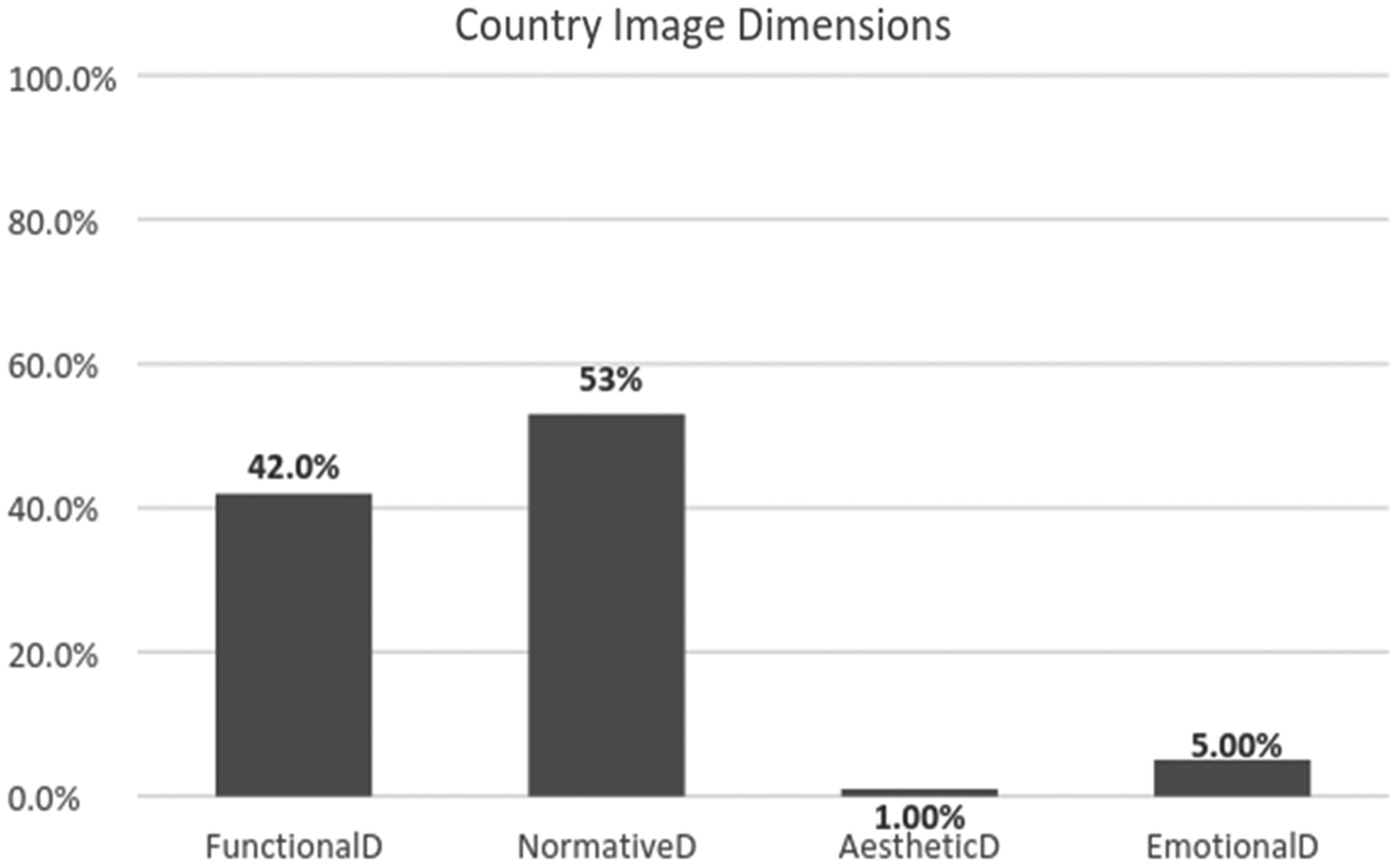
Distribution of all references on the 4D dimension of the country image.
The discourse on the normative dimension of the country image, at international level, was articulated mainly around the free movement of persons as a key principle that normalizes the relationship between Switzerland and the EU and was negatively portrayed: ultimately, the vote was in favour of limiting migration, the opposite of this principle. Consequently, a discursive strategy of difference was used to construct Switzerland’s image in relation to ‘the others’ on the international stage, as a player that does not hesitate to close its borders in order to maintain an advantageous position (‘fermer la porte derrière soi’). At national level, the principles, norms and values at the core of the Swiss nation state (the Swiss direct democracy and ‘imagined community’) were mainly referred to positively, in relation to the participation of citizens in the ‘(decision) making’ of Switzerland. However, the key descriptors of the nation (nation of will, solidarity, unity, cohesion), the integration of others (minorities, newcomers, EU migrants), as well as its multilingualism and multiculturalism were rather negatively portrayed in discourses constructing a ‘divided Switzerland’.
In discussing the international consequences of the vote and focusing on the functional dimension of the country image, media covered topics related to Swiss–EU bilateral agreements and access to the EU market. These were considered to have an immediate negative effect on Switzerland’s image following the passing of the initiative, and a similar strategy to construct the difference between ‘us’ and ‘them’ is employed: Switzerland is singularized as a clever, pragmatic actor seeking strategic advantage (‘Rosinenpicker’) or, on the contrary, is placed in an inferior position (‘der Binnenmarkt sei kein Schweizer Käse’/the internal market is not a Swiss cheese) or even worse, in a supplicant/beggar position (‘Die Schweiz als Bittstellerin’/‘Switzerland as a supplicant’). At national level, the media discourse was dominated by the consequences for the Swiss economy and for research and education, particularly since Switzerland’s participation in the Erasmus and the Horizon 2020 programs was stopped by the EU. However, the functioning of the political system in Switzerland was portrayed positively because the direct democracy model allows people to have the final say in the governing and functioning of the state.
Analysing the frequency of references to the normative and functional dimensions of the country image, we can argue that the media constructed Switzerland’s image focusing on the effects of the vote at social and identity level (for the Swiss nation of will) and at political and economic level (for the Swiss state). In the following sections, we will illustrate and discuss in depth the specific discursive strategies and topoi used by the media and the different political actors mediated to construct these two dominant dimensions of Switzerland’s image.
The ‘Sovereign’ will – ‘Les fins de la Suisse’?
Starting from the explicit content and topics of media discourses and applying a CDA approach, we identify the following typology of discourses (implicit content) on country image and identity: (1) an institutional type of discourse, (2) an expert type of discourse and (3) a political, populist type of discourse. Focusing on the specific discourse strategies and argumentation schemes (RQ3), we highlight the constant interplay between the different symbolic registers mobilized by media to construct Switzerland’s image (as a country, a nation and a state) through references to the predominant normative and functional dimensions.
(1) Constructive macro strategies were used to project unification and solidarity through appeals to common values (normative dimension), highlighting the mutual dependence between Switzerland and the EU, while trying to minimize the ‘damage’ (functional dimension). This institutional type of discourse was mainly assumed by Swiss state actors: Didier Burkhalter renewed his appeal to national cohesion and respect for minorities, because ‘success will depend on values that we will privilege’ (Petignat, 2014b) 1 ; The government will decide … in which direction it sees an opportunity to create a new stable and lasting relationship with the EU (ATS/LT, 2014) 2 ; Didier Burkhalter stated in his New Year’s speech […]: ‘Switzerland and the world are not alien’ (Zeller, 2014). 3
(2) Perpetuation strategies were largely employed to legitimize and justify the outcome of the vote, its consequences for Switzerland’s image and national identity at all levels of society, as well as a discontinuation between before and after the referendum. This expert type of discourse is constructed around the causes and effects of a vote where a divided Switzerland is reflected in the will of the people (normative dimension of the country image); yet it places Switzerland in a delicate, weak position in relation with the EU, other European countries and its neighbours (functional dimension). It was largely used by the media and the different mediated experts in political sciences, history or law: The SVP initiative gives Switzerland back a bit of sovereignty in terms of migration policy. In terms of European policy, it does the opposite: Bern is more dependent on Brussels than ever before. (Gemperli, 2014)
4
For many supporters of the initiative, it was primarily a vote of identity. The decision was much less linked to what people live directly. Otherwise how to explain that the cities with the highest concentrations of foreigners voted against the initiative?[.] But no country emphasises the myth of its independence in relation to the rest of the continent, as Switzerland does. (Büttner and Tages-Anzeiger, 2014)
5
Direct democracy has been instituted to ensure greater cohesion and security of rights in a country rather recently unified and with deep divisions. Today, the use we make of it has transformed it into an agent of institutional instability […]. But institutional stability is our first comparative advantage from an economic point of view. Let us give our society the stability it needs to face the future: reform our direct democracy. (Laufer, 2014)
7
‘Us’ versus ‘them’: At identity level, the divide is constructed through a discourse of difference between ‘us’ (the Swiss) and ‘them’ (the others, the migrants), but also a strategy of victim–perpetrator inversion as the migrants are the source of a certain ‘stress’ – they are overcrowding Switzerland producing ‘overcrowding stress’ (‘Dichtestress’): ‘the anxiety over the so-called “stress of density” due to the foreign competition on the labour market or the saturation of infrastructure dominated the debate’ (Petignat, 2014a). 8
The Swiss people were linguistically constructed as a group either directly (e.g., the Swiss/‘vox populi’, the internet users/‘les internautes’, the readers/‘les lecteurs’) or indirectly (the will of the people/‘la volonté populaire’/‘Volksbegehren’, the Swiss vote/‘le vote Suisse’). A dominant strategy of legitimization was employed by media and all mediated actors: they all used topoi of assigning authority to the Swiss people (‘la décision du souverain’, ‘le souverain suisse’, ‘Der Souverän’) to acknowledge the legitimacy of the vote and appeal for its wide acceptance.
Storytelling is another key approach used to strategically construct the ‘ordinary citizens’ who are representative and symbolic of a multicultural and diverse Switzerland: a German-turned Swiss/‘un Allemand bientôt naturalisé Suisse’; an inhabitant of Geneva with Iraqi origins/‘Genevois d’origine irakienne’; a student at the University of Lausanne/‘l’étudiante à l’Université de Lausanne’; the children of historic immigrants/‘les enfants d’immigrés’. They are all given a ‘voice’ to tell their personal stories and narrate their experiences; their points of view (pro or against) are highlighted further as they are turned into headlines: ‘Le peuple suisse a failli être exterminé’. Geneviève Descloux, d’origine camerounaise, explique pourquoi elle a voté oui à l’initiative ‘Contre l’immigration de masse’/‘The Swiss people avoided being exterminated’. Geneviève Descloux, of Cameroonian origins, explains why she voted yes for the initiative ‘Stop mass immigration’ (Do, 2014); ‘Sans la libre circulation, je n’aurais jamais été nommé à Paris’. Valaisan, Pierre Tissières est devenu chef de service d’un hôpital parisien grâce à Erasmus. Il souligne l’importance de l’ouverture dans le domaine de la santé/‘Without free movement, I would have never been appointed in Paris’ Pierre Tissières din Valais became head of a Parisian hospital thanks to Erasmus. He underlined the importance of openness in the domain of health (Buss, 2014).
In contrast, the collective actor ‘the migrants’ is constructed through strategies of singularization and emphasizing difference (‘Fremden’, ‘Nutztier’), with three different categories being introduced: historical migrants (the Mediterraneans who arrived in Switzerland after the Second World War and their descendants), new migrants (after the establishment of free movement within the EU) and trans-border migrants (the frontier workers from neighbouring countries). The historical migrants are positively portrayed as being part of the current configuration of an open and multicultural Switzerland. By comparison, the new migrants are rather negatively portrayed as a source of present threat (they are dangerous and ‘criminals’, are in prison, etc.). The trans-border migrants have a dual portrayal: as an economic development resource but also a potential threat in the future if the phenomenon is not stopped.
‘Us’ versus ‘us’: This type of populist discourse constructs a deep, internal divide between various categories of Swiss that is ultimately reflected in how the Swiss perceive themselves (national identity) and how they are perceived (country image). We can identify four different constructions of internal divide:
‘Röstigraben’ versus ‘Polentagraben’ in discourses augmenting the idea of an already existing economic, cultural and linguistic divide between the German part, the Italian part and the French part
9
: ‘Stell dir vor, es sei Röstigraben, und niemand sieht hin’/Imagine there is a boundary and nobody sees it (Büchi, 2014b). The French Swiss versus the rest of the Swiss. Christopher Blocher, the SVP leader, has used naming and ad-hominem defamation to singularize and isolate this category of Swiss: ‘les romands - suisses de seconde classe; les grecs de la Suisse’/‘Romands, second class Swiss; the Greeks of Switzerland’. Moreover, he uses a strategy of casting doubt, questioning their loyalty to the very founding descriptor of Switzerland – a nation created through the will of (all) its people: ‘Christopher Blocher: “Les Romands ont toujours eu une conscience nationale plus faible” (Zünd, 2014)/“Die Welschen hatten immer ein schwächeres Bewusstsein für die Schweiz” (Büchi, 2014a)’/The French Swiss always had a weak national conscience. The Swiss who voted YES versus the Swiss who voted NO in constructions developing on the idea of a class divide between the masses and elites in society: ‘Especially in Zurich, the elite lives in a different sphere than the normal citizens. It lives separately, it sends children to private schools’ (Mijuk and Brand, 2014).
10
A historical layer is added to the construction of internal divides through a strategy that emphasizes its historical continuity. Thus, Christopher Blocher reinterprets the very myth of unity around the establishment of Switzerland, since it is insinuated that ‘some Swiss’ have always wanted unity, while ‘the others’ fought for independence: ‘If the results vary […], it is because the population is not “united”: It has always been the case in Switzerland’s history. There are those who want to adapt and others who are fighting for independence’ (Zünd, 2014).
11
At the country image level, the strategy of victim perpetrator inversion is employed by the SVP leader to emphasize the perpetuation of Switzerland’s threatened sovereignty, a recurrent argument in SVP’s rhetoric. Portraying Switzerland as a victim of the EU and EU leaders, he implicitly constructs and legitimizes the need for salvation and, ultimately, for a saviour, but without specifically providing a solution or a new model beyond the limitation of migration: ‘Of course, the free movement of people is good for the economy, which seeks cheap labour, he repeated again and again. But it is not good for Switzerland’ (NZZ am Sonntag, 2014). 12
Summing up the analysis of the types of discourse about Switzerland’s image and identity (institutional, expert and populist), we argue that the different mediated actors and media have contributed to the projection of an overall fictitious, catastrophic scenario of Switzerland’s demise (‘Les fins de la Suisse, de la “nation de la volonté”’). Given the very close results of the vote, in covering extensively the reasons and explanations for both the YES and NO vote, the media paradoxically (re)produced the populist argument of the divided country: ‘Une victoire qui gifle l’autre Suisse’/A victory that slaps the other Switzerland (Petignat, 2014a). Ultimately, the constant interplay of these types of discourse constructed through dominant perpetuation discourse strategies reproduced a threatened national image and identity following the referendum (RQ2).
From ‘us versus them’ to ‘us versus us’ – Populist discourses by and through the media
Overall, our analysis demonstrates that media constructed a discourse focused on the consequences of the vote for Swiss national identity (‘une hystérie identitaire’/an identity hysteria), as well as for Switzerland’s status in the international arena – Switzerland’s strategic image (RQ4) (see Figure 2).
This shows that the discourse on identity tensions around the values, principles and norms of Switzerland (who we are, what defines us) overcomes the type of discourse on economic and political consequences (rethink of the system, of efficiency, of country status and image) (see Figure 3).
One explanation is that the socio-political context of the referendum in Switzerland was dominated by a discursive construction of the ‘other’ (be it migrants, the EU, EU countries) as a threat and danger, as a consequence of the SVP’s recent ascent in Swiss politics. The powerful argument of Switzerland’s sovereignty is constantly used in perpetuation strategies, emphasizing the extra-national constraints and dependence: ‘ […] the EU has been judged in many circles to be completely incompatible with our federal state and our understanding of national sovereignty’. (Gut, 2014). 13 Therefore, this type of populist political discourse increased and started gaining more traction, a process paradoxically eased by the Swiss direct democracy system.
The general negative atmosphere in the country is constructed linguistically through powerful words such as ‘confusion’, discomfort (‘angoisse’, ‘malaise’), fear (‘crainte’) and uncertainty (‘incertitude’), meant to produce discursive effects and emphasize the idea that the country faced a turning point that would result in a ‘catastrophe’, ‘tsunami’ and … an end (‘les fins de la Suisse’). These are all part of the populist repertoire of constructing fear: ‘fear of change, of globalization, of loss of welfare, of climate change, of changing gender roles’ (Wodak, 2015: X). Moreover, the strategy of emphasizing a negative analogy with a similar moment in Swiss history (the 1992 referendum) and a topos of history as teacher are thus used to draw a symbolic parallelism: The story repeats itself. When the Swiss people rejected the EEA treaty on December 6, 1992, the defeated side fell into a state of shock. The Minister of Economic Affairs Delamuraz spoke of a ‘dimanche noir’. Now the sovereign has raised a comparable exclamation point. Irrespective of the photo finish, the Yes to the popular initiative ‘against mass immigration’ shakes the divided Switzerland. Not everything will be different. But much will. (Zeller, 2014)
14
The journalistic strategy of creating a democratic representation platform for the various perspectives and positions in the debate about the consequences of the vote, through a ‘polyphony of voices’, has ultimately led to media (re)producing populist discourses of divide.
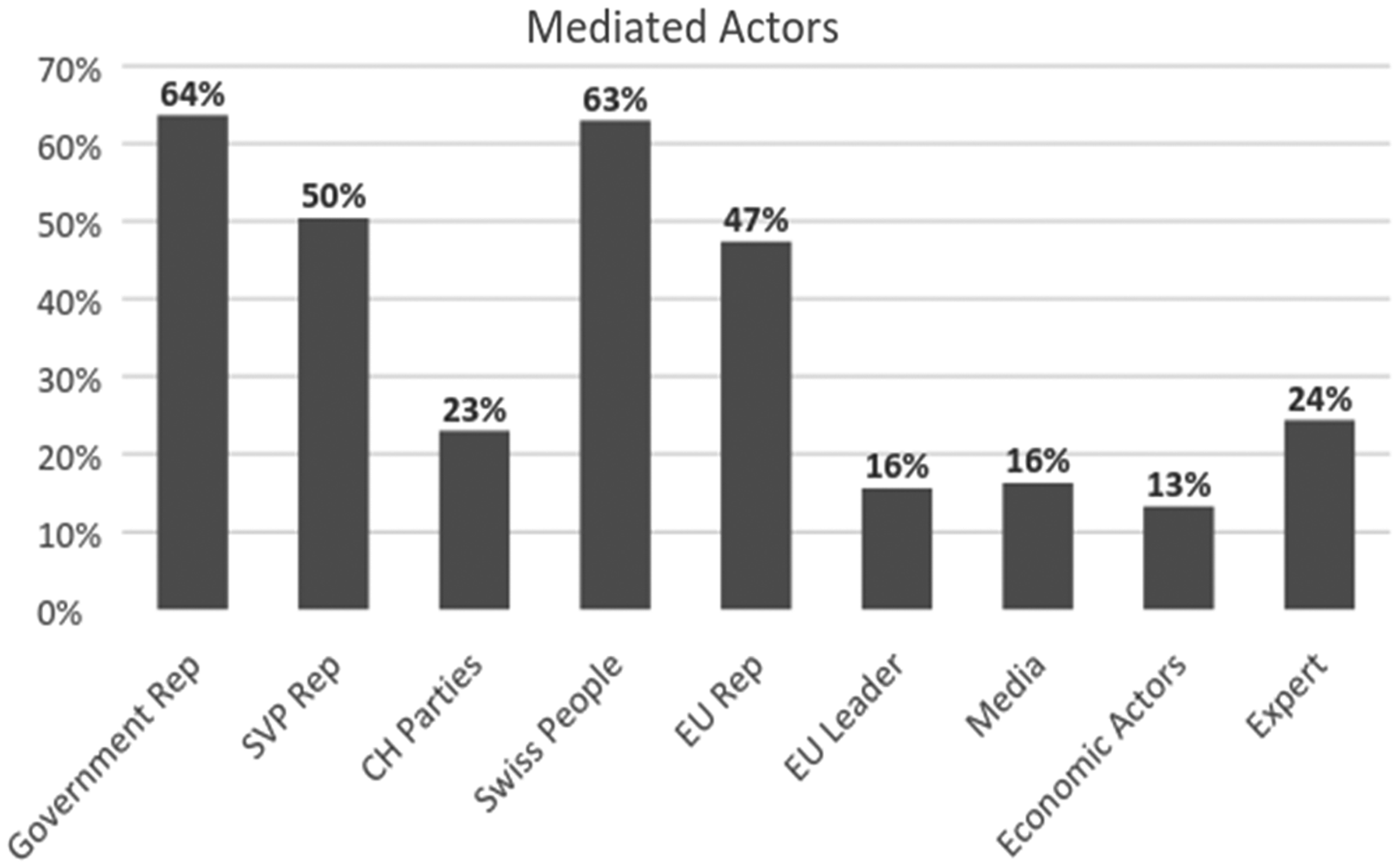
Mediated actors (percentage of references to each actor within the overall number of articles.
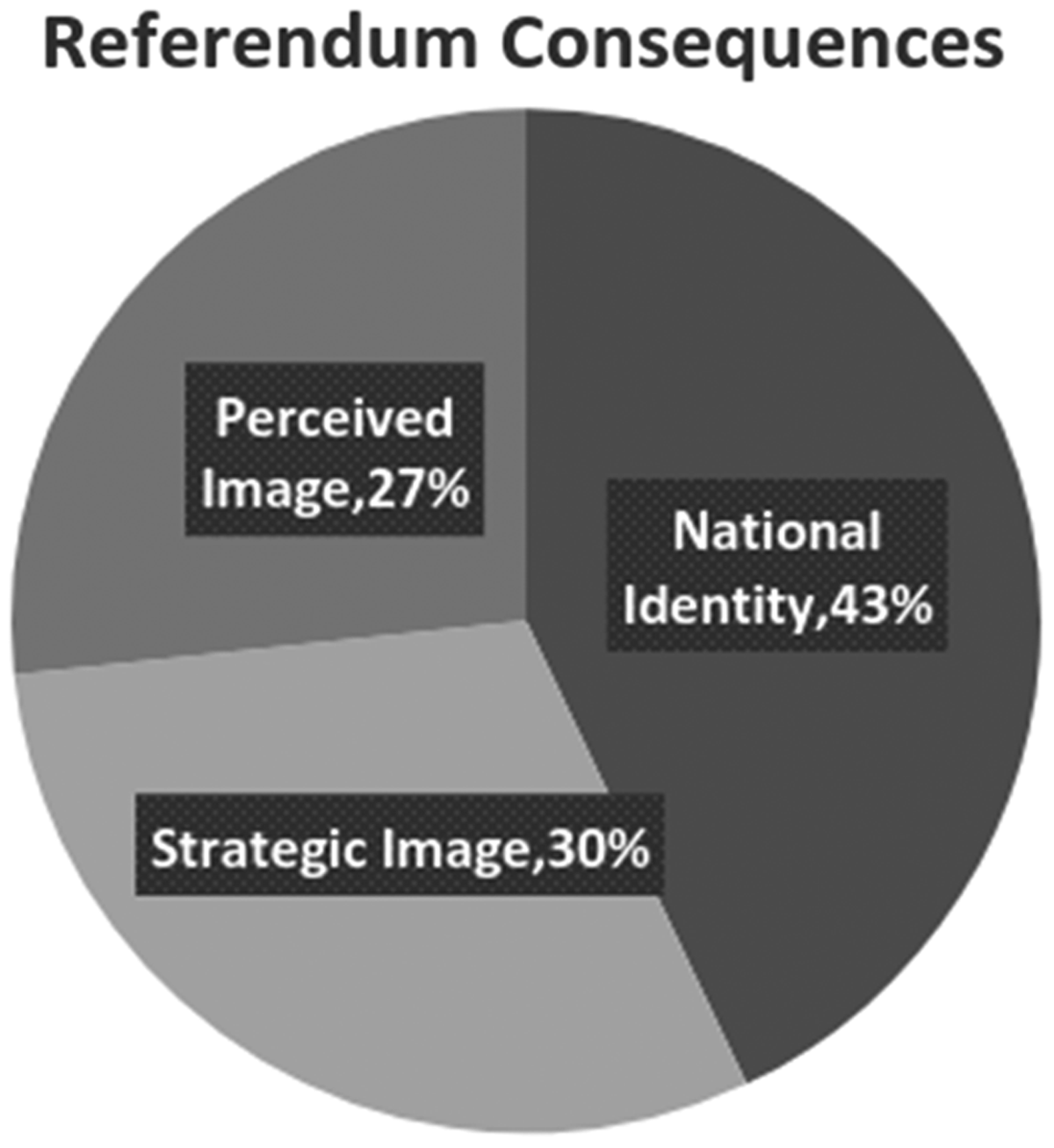
Media discourse on the consequences of the referendum and the levels of the country image.
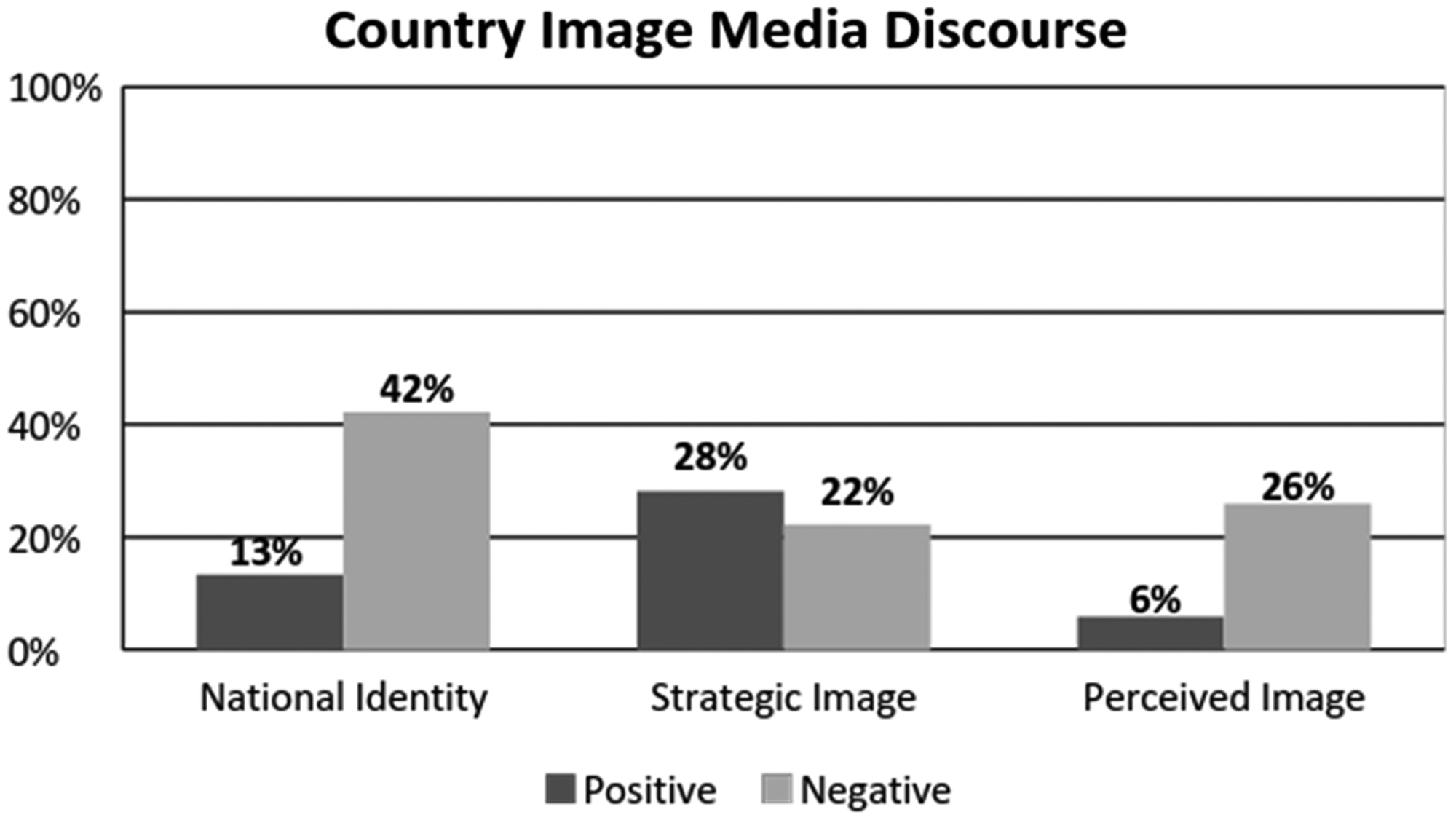
Media discourse on the levels of the country image (positive/negative).
Another explanation of these findings, which show a media focus on Swiss identity and Switzerland’s strategic country image, is that the argument of a divided Switzerland is actually not new: it is precisely around these different regions and languages that the myth of a Switzerland founded through its people’s will emerged. Moreover, this argument has recurred on the public agenda in Switzerland due to the constant initiatives to limit migration and has been repeatedly linked with Switzerland’s sovereignty in relation to the EU and others (Ernst et al., 2017). Thus, the populist logic of ‘us’ versus ‘them’ is discursively manipulated and reconstructed in an ‘us’ versus ‘us’ discourse of difference as illustrated by SVP’s categorization of different ‘types’ of Swiss; at the same time, these differences are deconstructed and reconstructed in the dynamics of discourse in new versions and visions of ‘us’ versus ‘them’: the diversity of Switzerland, including its internal divide, might actually contribute to the identity-establishment efforts (identitätsstiftend) in relation to ‘others’ and to Switzerland’s strategic country image and status in the international arena: Human behavior has always been shaped by myths of salvation. The current myth is that of Noah’s Ark. Under the leadership of SVP, Switzerland is now to be converted into an ark with which the Swiss, with their strangers, will survive the storm of globalization in order to survive forever as a sovereign, independent, small but nevertheless powerful country. The complementary myth is that of David and Goliath. But the Swiss are not a chosen people, even an Old Testament myth, but a capable, imaginative, and ever-open nation of will that does not need Noah’s Ark. The three years that remain to implement the initiative will increase this insight. The sovereign (i.e. people) is sovereign enough to change its mind. (Blattner, 2014)
15
Conclusion and limitations
Our study focused on the discursive construction of Switzerland’s country image in the debate following the passing of the ‘stop mass immigration’ initiative in February 2014. We aimed to show that country images are often instrumentalized in public debates beyond strategic communication contexts and practices of state and non-state actors, distinguishing between an identity level and a strategic country image level.
We have deconstructed the media debate and can sum up our findings in three main points:
Media covered extensively the consequences of the vote for Switzerland focusing on the normative dimension and the identity level of the country image (who we are, what defines us as Swiss, what are our Swiss values, principles and norms); this has overcome the discourse on economic and political consequences, i.e., the functional dimension and the strategic country image level (rethink of the political system, losses for the economy or for Switzerland’s position in relation with the EU). There is, however, a constant discursive interplay between the identity tensions and Switzerland’s status in the international arena constructed around the sovereignty of the vote (reflecting ‘the will of the people’) and the sovereignty of the country (how the Swiss perceive Switzerland and how others perceive Switzerland as an actor in world politics). The dominant perpetuation discourse strategies used by media have contributed to the construction of a threatened country image of Switzerland, at both national identity and strategic country image levels. In other words, media have augmented the idea of a deep internal divide and fracture in Swiss society that has consequently weakened Switzerland’s international position and status. Projecting fictitious scenarios, fear and uncertainty, media have ultimately constructed Switzerland’s image through a populist type of discourse, reproducing the populist ideology of dividing society into polarized categories through strategies of inclusion and exclusion. The very will of the people that legitimized the vote is thus very close to the ‘volonte generale’/general will (Mudde, 2004) that is central to populism: Switzerland’s direct democracy system offers populists fertile ground that has been strategically exploited by the SVP through the recurrent initiatives to limit migration. Moreover, the very historicity of such practices and discourses, as well as the gradual instrumentalization of the internal divide within Switzerland (national identity) and the external divide between Switzerland and the EU (strategic country image) have contributed to long-term processes of political socialization repeatedly exposing media and ‘the people’ to such populist messages (similar to the Brexit case, see Jackson et al., 2016).
The interdisciplinary theoretical approach proposed in this study links literature on country image promotion, migration and CDA in the context of populism, with potential to inform other disciplines and research areas, as well as policy-making processes. Thus, it can produce a significant contribution to the literature on country promotion by bringing forward aspects previously neglected due to the dominant focus on the management and efficiency of the process. The instrumentalization approach has marginalized discussion of the effects of the country promotion process, has decontextualized, projected and ultimately legitimized an almighty role of governments as ‘the ones having the power’ to impose a discourse about their country (an image), while excluding alternative voices. The conditions of production and the contexts of country promotion practices have been neglected, as well as the multitude of actors involved in this socially constructed process (Dolea, 2015b). But when it comes to the articulation of country images and identity at social level, in public debates, there is a need to widen the current reference frameworks, especially in turbulent times and contexts. At the same time, this approach can open a new line of research in critical discourse studies, which have investigated mainly aspects related to the articulation of national identities in discourse and have not been extended to analyse the construction of country images.
More broadly, this study contributes to the line of research on populist political communication, proposing CDA as a complementary methodology for the analysis of interactions and constant negotiations between political actors, media actors and citizens. We argue that CDA can provide useful perspectives for unpacking subtle discursive implications both in relation to the content (‘the public communication of core components of populist ideology – such as people-centrism and anti-elitism – with a characteristic set of key messages or frames’) and to the style of populist political communication (‘the unique contribution of communication processes to “construct” populist ideas, and at the communicative styles that systematically co-occur with it’) (De Vreese et al., 2018: 3). This study brings valuable data on (1) existing internal tensions in discursively articulating the image and identity of Switzerland as a multicultural and multilingual country, and argumentation of ‘inclusion’ and ‘exclusion’ with regards to ‘ingroups’ versus ‘outgroups’ and Switzerland versus EU; (2) perceptions of the efficiency of direct democracy as a political system; and (3) the role of media in reproducing populist discourses. It highlights, beyond the case of Switzerland, the need for media to strategically reduce the visibility of populist discourses and actors and for pro-EU, anti-nationalist, anti-populist actors to constantly join the conversation and push their more inclusive, counter-discourses in media, in order to balance debates. While it has a limit of not engaging in comparative analysis of different countries, this study has the merit of illustrating precisely the interaction element in the discursive construction of country image and identity in the case of Switzerland, focusing both on content and style of communication. Future research can explore comparatively such debates, using the variety of CDA approaches, in order to complement and develop further the body of research on populist political communication.
Footnotes
Acknowledgements
The authors would like to thank Prof. Camelia Beciu, Prof. Darren Lilleker and the anonymous reviewers for their valuable and constructive comments on the previous versions of this article.
Declaration of Conflicting Interests
The author(s) declared no potential conflicts of interest with respect to the research, authorship, and/or publication of this article.
Funding
The author(s) disclosed receipt of the following financial support for the research, authorship, and/or publication of this article: The research for this article was funded through Scientific Exchange Programme between Switzerland and the New Member States of the EU (Sciex-NMSch), project code 13307.