




Abstract
Minority integration is a highly contested topic in public debates, and assimilationist actors appear to have gained discursive ground. However, it remains difficult to accurately depict how power relations in debates change and evolve. In this study, the public debates on minority integration in Flanders and the Netherlands between 2006 and 2012 are studied to ascertain changing power relations. We use a relational method to identify clusters formed through discursive contention and study polarization in the debates as well as several aspects of discursive power between and within clusters. In the Netherlands, a pattern identified in earlier research is reproduced, whereby a unified but small cluster of assimilationists with strong discursive leaders is able to dominate the debate on integration. In Flanders, group consolidation is too low, so the clusters cannot be viewed as cohesive groups. Another difference to the Dutch debate is that the volume of opinion articles is much lower and the actors in the Flemish debate are more often foreign opinion leaders. We conclude that the assimilationists have increased their discursive power in the Dutch debate, while the anti-assimilationists have lost power. The stark contrast between the Dutch and Flemish discursive landscape highlights the need for more research on the causal mechanism behind discursive struggles.
Keywords
Introduction
Immigration and immigrant integration have become highly contested topics in public debates across Europe. Many authors have observed a trend away from multiculturalism towards assimilationism (e.g. Awad and Roth, 2011; Brubaker, 2014; Koopmans and Statham, 2000). While the literature thus suggests that assimilationist parties and opinion makers have gained ground, it remains challenging to develop concepts and methods that capture with precision how power relations in debates have changed. To respond to this challenge, this article applies and elaborates on a relational approach first developed by Uitermark et al. (2016). They studied debates in opinion articles in high-brow newspapers in the Netherlands from 1990 until 2005 and found that, in this particular setting, assimilationists were grouped together in a cluster that was small in number but had higher cohesion, stronger leadership and greater resonance compared to their anti-assimilationist opponents. Their study thus showed to what degree and in what way assimilationists acquired discursive power within the national debate.
With the present study, our aim is twofold: (1) to examine the polarization and discursive power relations in the period that followed in the Netherlands (2006–2012) and (2) to compare the polarization and discursive power relations in the public debate on minority integration in a different national context with a similar integration policy. Flanders was chosen as a comparative case because it shares a common history with the Netherlands and is relatively comparable in terms of demographic composition and integration context. Both Flanders and the Netherlands adopted a pillarization approach for accommodating ethnic minorities and have moved towards a more integrationist and assimilative strategy since the 1990s (d'Haenens et al., 2004; De Raedt, 2004).
In the following section, we first discuss the framework for this relational approach to examine discursive contention and present our research questions. Second, we detail the measures and methods used to study group formation, power, leadership and polarization from a relational perspective. Third, we discuss the findings on group formation and the internal and external power relations between the discursive clusters at hand. Finally, the main conclusions are discussed with an eye to both the limitations of our study and suggestions for further research.
Relational analysis of public debates
Changes in the prominence of certain discourses have been studied from various perspectives. Some focus on the relation between (media) discourse and public opinion and attitudes (e.g., Gamson and Modigliani, 1989), while others explore changing discourse in relation to policy developments (e.g., Vliegenthart and Boomgaarden, 2007; Lesińska, 2014). Claims analysis, developed by Koopmans and Statham (1999), has been the most influential approach to examine public debates on integration and immigration. It has been used to identify important differences between countries with respect to the participants involved in public debates and the salient topics addressed in those debates. However, one drawback of the claims analysis is that it has, so far, only examined relations between dyads of actors, specifically, the actors who make the claims and the addressees of the claim. A recent wave of studies in computational network analysis has used the increased availability of social media data to examine the overall network pattern of debates, showing marked differences in the network structure of groups of different political persuasion (Conover et al., 2012; Gruzd and Roy, 2014). Building on both claims analysis and computational network analysis, our aim is to examine discursive power relations in public debates. To facilitate historical and comparative analysis, we use the same concepts and operationalizations as Uitermark et al. (2016). Here, we further elaborate the theoretical underpinnings of our approach and articulate our research questions.
Relational analysis of public debates is based on the principle that social groups are constructed through interactions. Actors construct patterns of asymmetric interdependencies through interactions (Elias, 1978), which Elias refers to as figurations (Elias, 1994) and network analysts call network topologies (Easley and Kleinberg, 2010). Network topology reflects the distribution of power within the relationships that constitute the network. When two groups are in a competitive or conflict-laden situation, the structure of the network plays a significant role in determining the outcome of that situation. Specifically, strong leadership and solidarity among group members are determining factors for power relationships and group dominance. Solidarity in network topology is constituted by dense and supportive relationships between group members, facilitating coordinated action. Strong leadership within groups enables concentration of prestige when faced with a perceived challenge of another group (Elias and Scotson, 1965; Lind and Stepan-Norris, 2011). We distinguish three aspects of discursive power: leadership, cohesion and attention.
A telling example of the importance of strong leadership can be found in scientific revolutions when newer groups gain a dominant position over more traditional groups after a period of ‘normal’ science (Kuhn, 1962). In this process, a smaller group of scientists work together intensely to challenge putative insights of the established way of doing things in a certain scientific domain. The newer group of researchers advance their ideas and rally around a leader who receives the majority of the references in terms of publication output. The established science groups also target the leader of the newcomers within their references, although the references of the established groups are usually negative towards the leader who threatens the power of the status quo. By receiving (mostly) supportive references of the challengers and (mostly) negative references of the establishment, the leaders become ‘icons’ of their schools (Collins, 1998), thereby grounding the prestige of their group.
Critical communities in social movements (cf. Rochon, 2000) and coherent groups in science (cf. Griffin and Mullins, 1972) are enlightening examples of the importance of solidarity for the success of challenging groups over more established groups. Three mechanisms are especially relevant to our case of public debates. First, there are the aforementioned strong leaders, who represent the coherent group to the world at large, as well as to the group members themselves. Second, intense and recurrent interactions within groups can lead to a sense of collective identity and motivate members to try to change the status quo. Third, coherent groups try to create such change by drawing boundaries between themselves and other groups through antagonistic debate (Griffith and Mullins, 1972). These insights, based on situations where group members frequently interact in informal, face-to-face settings (e.g., brainstorm sessions among collaborating scientists, meeting with fellow civil rights activists), can also be applied to the mediated public debate. Even though the actors in the public debate might never meet face-to-face, they invest emotional energy in advancing their ideas, supporting their group and its members, while also disparaging the rival group(s). Certain celebrity actors in the public debate on integration (e.g., politicians, intellectuals, activists) functioned in similar roles as the strong leaders in revolutionary science groups, whereby they attract attention for their cause and thereby also inspire more peripheral actors in the public debate who support the same goals.
Another decisive factor in discursive struggles is attention, as in, the ability to attract the public eye. First, a group of actors has to be granted access to the public debate in order to articulate views and standpoints. When other actors in the public debate respond either favourably or negatively, they legitimize the ‘voice’ of the opposing group and this group gets more attention. Even if other actors do not agree with the viewpoints of the opposition, they have to at least partially reproduce these views in order to criticize them (Koopmans, 2004). The groups that end up at opposite ends of an issue do not necessarily exist before the discursive struggle takes place. One prominent thought-provoking op-ed piece could theoretically be sufficient to ignite a group formation process by inciting the opposition and thereby bringing challengers in the picture. Like-minded individuals, who might otherwise not have been aware of others sharing their views, publicly declare support for the issue and thereby contribute to the consolidation of a cohesive discursive cluster. Additionally, the polarization between the discursive groups can be enhanced, with increased positive relationships within groups and increased negative relationships between groups.
We analyse group formation, discursive power and polarization from a relational perspective between 2006 and 2012 and add a cross-cultural comparison with Flanders in our assessment over the same period of time. This brings us to the following research questions: RQ1: What characterizes the integration debate in terms of polarization and discursive power in Flanders and the Netherlands between 2006 and 2012? RQ2: How does this compare to the earlier period, as studied by Uitermark et al. (2016) in the Netherlands (1990–2006)?
Methodology
Corpus
For the present analysis, we focus on the opinion articles of the quality newspapers in the Netherlands (i.e., de Volkskrant, NRC Handelsblad and Trouw) and Flanders (i.e., De Morgen, De Standaard and De Tijd). These newspapers are not representative for the public debate on integration in its entirety. Instead, the newspapers can be viewed as an elite setting wherein authors of the opinion articles often are involved in journalism, academia, politics and similarly respected professions. The readers also tend to belong to the more affluent groups in society. The opinion sections of these newspapers are an important platform for discussion among elites involved in policy making and therefore constitute an appropriate setting to study the public debate on integration. Furthermore, quality newspapers have an ability to act as an agenda-setter for the media, political and public agenda (Brosius and Eps, 1995; Walgrave et al., 2008), so the debate in this venue can have substantial influence on the other media, politics and public opinion, which also makes them an interesting venue to study.
We retrieved articles from the LexisNexis and Gopress-databases using key terms on integration of minorities: ‘integration and Muslims’, ‘integration and minorities’ and ‘integration and foreigners’. Some articles were later excluded because they dealt with a different topic (such as EU integration) or because the content was more neutral and descriptive, rather than containing mostly opinion from the author's personal point of view. The selection procedure yielded 343 articles and 6,053 references for the Netherlands and 128 articles and 1,587 references for Flanders. Some of the articles published in de Volkskrant are adopted by De Morgen, as they have a collaboration going since 1998 1 and belong to the same media group, De Persgroep. In these op-ed pieces, the authors referred to individual actors, groups (such as political parties) and institutions. These references were coded as either positive, negative or neutral.
Intercoder reliability
Three coders worked on the corpus. During the coder training, all coders individually coded the same material, based on an extensive coder manual. Possible inconsistencies were thoroughly discussed, and in some cases, the manual was further specified, so that the coders could independently classify the material into the same categories. After the coders were adequately trained, we selected a random sample of articles for intercoder reliability testing. The variable reference to actor is viewed as nominal, and the evaluation (positive, negative or neutral) refers to the substantive meaning of the evaluation of another actor and not a numerical meaning, so we used Fleiss' Kappa to assess the intercoder reliability. We listed the actors whom authors referred to in 16 opinion articles, which led to a total of 323 references coded by all coders. The code was considered in agreement if all three coders referred to the same actor with the same evaluation. Of those references, 86% was in agreement (Fleiss' Kappa was 0.70). On several occasions, the three coders were not in agreement. This occurred most frequently in the attribution of negative, positive or neutral values to references. For instance, the authors of articles commonly use sarcasm to express a negative opinion about an actor, which can be difficult to recognize as a negative reference. Implicit references to actors (e.g., the minister, he, she) were also coded, and some inconsistencies occurred when one coder overlooked such a reference, while the other two did not. We did not assign codes to the introductions or informational sections in interviews, as they are usually written by editorial staff and do not contain the opinion of the interviewee or author. However, these sections were not always easy to recognize due to the different layout of articles retrieved from the databases compared to the originals in the newspaper, 2 and this also led to some inconsistencies whereby one coder included actors and the others did not.
Measures
Detecting clusters
We use an algorithm to detect antagonistic groups, based on positive and negative interactions between participants in the public debate on minority integration. 3 This approach is based on the social balance theory (also referred to as structural balance theory), which holds that if two people have a positive relationship (i.e., positive tie in social network terms) and they both have a relationship with a third person, that relationship will be similarly evaluated (i.e., both positive or negative). Otherwise, the triad (i.e., three connected actors) is not balanced. This also holds for ‘objects’ (i.e., issues one might have an opinion about): so, if actor A and actor B share a positive tie and actor A has a negative opinion on object C (e.g., Islam), actor B will share that sentiment (Wasserman and Faust, 1994). This principle also applies to larger groups. If a network is balanced, it can be split into factions, with positive ties within the factions and negative ties between them (Harary, 1953). We expect social balance theory to be applicable to the public debate on minority integration; however, most empirical networks are imbalanced to some degree, and there can also be large differences in tie strength in discursive networks. Some actors have a more vehement opinion about issues such as integration of minorities, which social balance theory does not take into consideration (Uitermark, 2012).
When studying opinion dynamics in networks with hostile groups, such as the public debate on minority integration, polarization is a relevant concept (Proskurnikov et al., 2016). It implies that the community can be divided into two groups, with cooperative relationships within the groups and antagonistic relationships between the groups (Easley and Kleinberg, 2010; Wasserman and Faust, 1994). The principles of group polarization are consistent with the tendency of actors in debates to refer to dualistic, contending groups, such as left and right, multicultural and assimilationist or liberal and conservative. Although the actors in the debate usually do not agree on the substantive meaning behind the labels, they do indicate that actors in a debate perceive a limited number of factions and usually only two (Uitermark et al., 2016). For that reason, the actors in this study are clustered into two groups, in such a way that the number of correct ties between and within the groups are maximized, meaning that the ties within the groups are mostly positive and between the groups mostly negative. The group clustering in that sense is not based on the opinion of actors in the public debate on the concept of integration of minorities. Instead, we take into account how the actors in that particular debate refer to each other (positively or negatively) and use that relational data to create clusters with mostly positive internal references (within the discursive cluster) and negative external references (between the discursive clusters). While our method seeks to identify whether the integration has a bi-polar structure, we stress that it does not assume such a structure exists. As illustrated below, our method shows that the Flemish debate does not feature two antagonistic clusters while such a structure can be discerned in the Dutch debate.
Using this method might lead to some unexpected results. The actors are not partitioned based on predefined characteristics such a political party membership, religion, ethnic or national descent. Instead, the actors are placed in groups based on support, or alternatively, on antagonism they show for each other in a debate. Under the premise that my enemy's enemy is my friend, actors can be placed in the same discursive groups who disagree on most things, but happen to have antagonistic relationships with the same third actor. For instance, radical left and radical right can end up in the same cluster if they both are highly critical of the political mainstream but do not attack each other on this issue. Some actors can be placed in either discursive group because this does not affect the number of incorrect ties between the clusters (i.e., negative internal cluster references and positive external references). We have excluded those actors from our analysis.
Discursive power
We distinguish three different aspects of power, based on the intensity (i.e., number of references) and tone of the references (i.e., negative, positive or neutral) between actors. The first measure is articulation power, 4 which is the capability to articulate your opinion. For this situation, it refers to the access granted to the public debate by media gatekeepers, who deem an actor's opinion worthwhile for publication. There is a limited amount of space in news media and not everyone who wants to be heard can be heard. Articulation power is important for discursive group formation, as being published allows actors to share their ideas with the public at large and thereby adds potential to draw other likeminded actors to their cause (Koopmans, 2004). Here, an individual actor's articulation power is operationalized as being published in the opinion section in a quality newspaper. While some actors are granted access to the public debate as an author, others are only talked about. So, individual actors either have or have no articulation power in a debate during a given period. The cluster's articulation power is operationalized as the number of articles published by its members, divided by the total number of articles in the debate, yielding a number between 0 and 1.
The second measure is consonance power, which refers to the capacity to express a point of view with which other actors in the debate voice agreement (Koopmans, 2004). This power becomes apparent when an actor in the public debate articulates an opinion that others agree with to such an extent that they are inspired to publicly express their support. The consonance of a specific actor is operationalized as the number of positive references minus the number of negative references, divided by the total number of positive and negative references an actor receives. As consonance is about agreement (or disagreement), we do not consider neutral references. The score for a discursive cluster is the sum of the consonance score of all cluster members, whereby ‘r is a focal cluster, s is an index for all clusters including r and Msr+ and Msr−, respectively, are the numbers of positive references from s to r. Consonance ranges between −1 (maximum dissonance) and 1 (maximum consonance)’ (Uitermark et al., 2016: 110)

The third measure is resonance power, which is the ability to get other actors to talk about you, so the capacity to attract attention or ‘buzz’, regardless of the nature of that attention (negative, positive or neutral). While consonance power is increased by allies and decreased by critics, resonance power is generated by allies, critics and neutral commentators. For specific actors, resonance power is calculated by adding up all references they receive. The cluster's resonance power is operationalized as the ratio between the total number of references a cluster is able to generate in the debate and the total number of references.
Community structure
The previously discussed literature points to the significance of community structure in discursive power relationships. Specifically, solidarity between group members and strong leadership can lead newer groups to dominate over more established configurations. Solidarity is an internal measure, in the sense that it reflects the extent to which relationships within cluster members are supportive. Solidarity within the group is cultivated by positive communication and identifications, as they indicate and fortify common objectives and obligations within the cluster and in that way bolster group solidarity. Negative communications within the cluster point towards contention therefore reduce the cluster's solidarity (Collins, 2004). Solidarity is operationalized as the number of positive references within the cluster minus the number of negative references and divided by the maximum number of possible ties (i.e., relationships) within that cluster. So, the solidarity of a cluster (s) with a certain size (Ns) will increase if there are more harmonious relationships between the cluster members, indicated by more positive references Mss+ within the cluster and decrease if there is more conflict between the cluster members, indicated by more negative referencesMss−. The impact of a single reference decreases as the total number of actors in the cluster increases

Leadership is based on the capacity to attract support from cluster members, by receiving positive references. If a discursive coalition is formed, a condition for its success is that actors invest emotional energy in shared symbols, which represent the discursive cluster as a group (Collins, 2004). In relational analysis of discursive contention, actors are examples of symbols 5 within the public debate that other actors rally around, thereby allowing them to function as a focal point for positive attention within the cluster. These actors can be active participants in the debate, but they can be religious or historical figures who are not actively participating in the debate, instead they serve as icons for the respective clusters (e.g., Voltaire or Prophet Mohammed). So, the leadership score of an actor is determined by the relational structure within the cluster. A discursive leadership score is calculated for every actor by subtracting the number of negative references from the positive references the actor receives from his or her cluster. Power is always determined in relation to others, so we calculate the degree to which clusters have leaders by taking the variance in leadership scores into account. High variance for leadership scores in a cluster indicates that there is a centralization of power with one or a few individuals attracting the support from their cluster and low variance demonstrating egalitarian relations, whereby equals refer to each other.
Both leadership and solidarity are internal measures, as they are about internal cluster relations. However, as the strength of the discord in the public debate (between two clusters) is also relevant to the community structure of the debate as a whole, a polarization measure has been added. The measure polarization is intended to indicate to what extent adversarial groups are in conflict. It is operationalized as the concurrent clustering of supporters and repulsion between adversaries. Polarization is high if there is mostly agreement within clusters and high disagreement between them. Polarization is calculated in several steps. The first step is assessing the agreement and disagreement within and between the clusters. Internal agreement (i.e., the positive references within the clusters) and external disagreement (i.e., the negative references between the clusters) increase polarization. In contrast, internal disagreement (i.e., the negative references within the clusters) and external agreement (i.e., the positive references between the clusters) decrease polarization. So, to reflect this, we subtract the sum of internal disagreement and external agreement from the sum of internal agreement and external disagreement. Second, the larger the number of actors in the debate, the smaller the impact of a singular reference in relation to the total number of actors (n). The last step is based on the idea that the amount of support actors receive determines how much polarization is generated when under attack. When an actor who does not receive a lot of support from his or her cluster is criticized by an actor from the adversarial camp, this will have a smaller polarization effect than when the criticized actor is heavily supported. In other words, if a discursive leader is attacked, this will add more to the polarization than if a peripheral actor is attacked. Hence, in the final step, each tie is weighed by multiplication with actors' leadership scores, from both the citing and cited actor

The total number of actors is provided by n, Wsr+ and Wsr− refer to the numbers of positive and negative references as weighted by leadership scores, and indices sr and ss signify the references between cluster s and r, and references within cluster s.
Results
In this section, we provide an overview of the integration debate and discuss our findings on group formation and the internal and external power relations between the discursive clusters. We start with a general overview and then situate the particularities for the Dutch and Flemish debates.
Grasping the debates
There is a big disparity in the number of articles on the integration of minorities
6
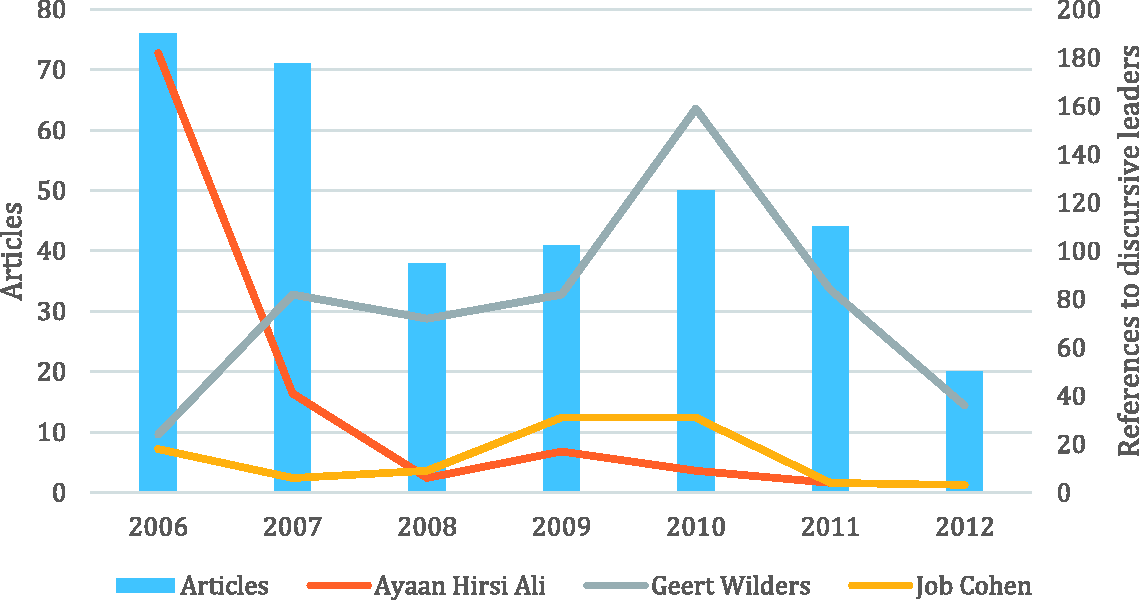
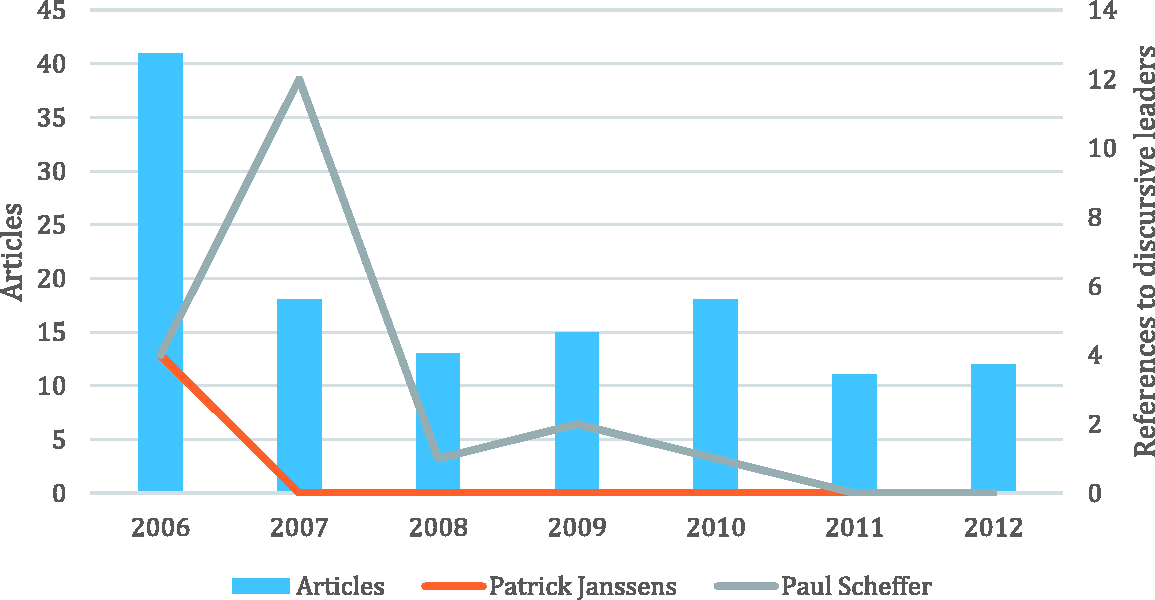
(both news and opinion) in quality newspapers in the Netherlands compared to Flanders, as shown in Figure 1. The total number of articles declined each year in the Netherlands, while the total number of yearly articles remained relatively stable in Flanders after 2006. Figure 2 displays the number of opinion-pieces and the number of references to key leaders (as calculated by the leadership scores) per year for the Netherlands and in Figure 3 for Flanders. Both collections of articles are relatively comparable in terms of overall tone, as the percentage of negative, positive and neutral references is similar (Flanders: 22.7% positive references, 44.4% negative references, 32.9% neutral references; the Netherlands: 22.3%, positive references, 45.2% negative references, 32.5% neutral references).
Articles published per year on the integration debate in quality newspapers in the Netherlands and Flanders. Articles and references to discursive leaders per year in the Netherlands. Articles and references to discursive leaders per year in Flanders.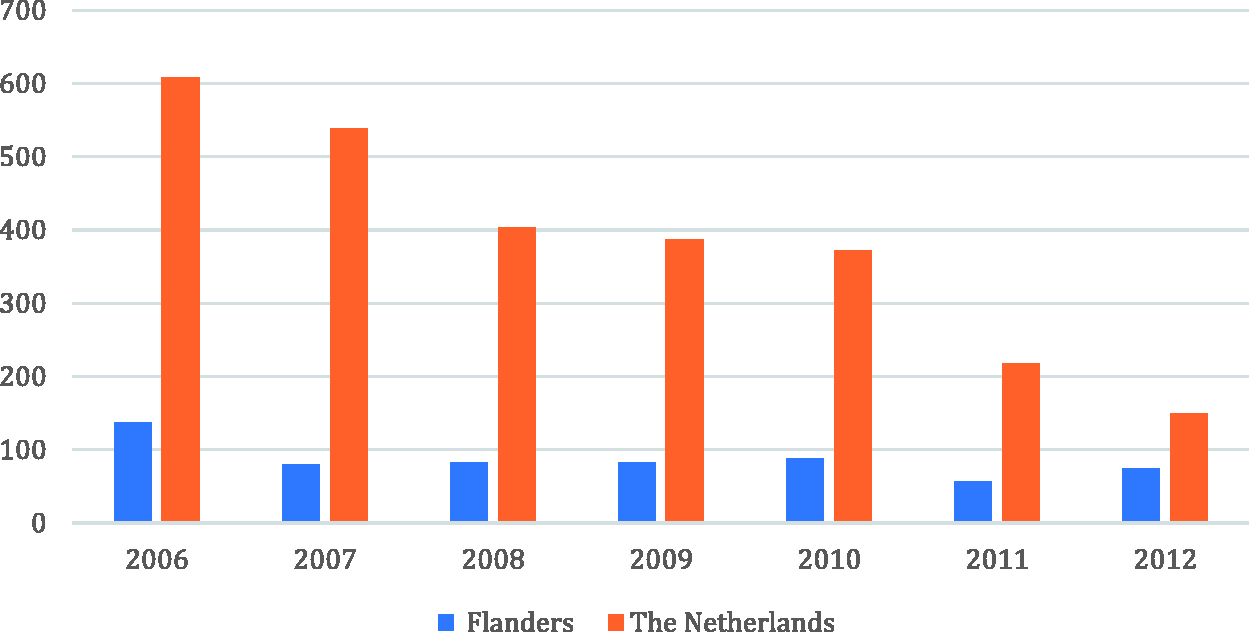
Dutch debate
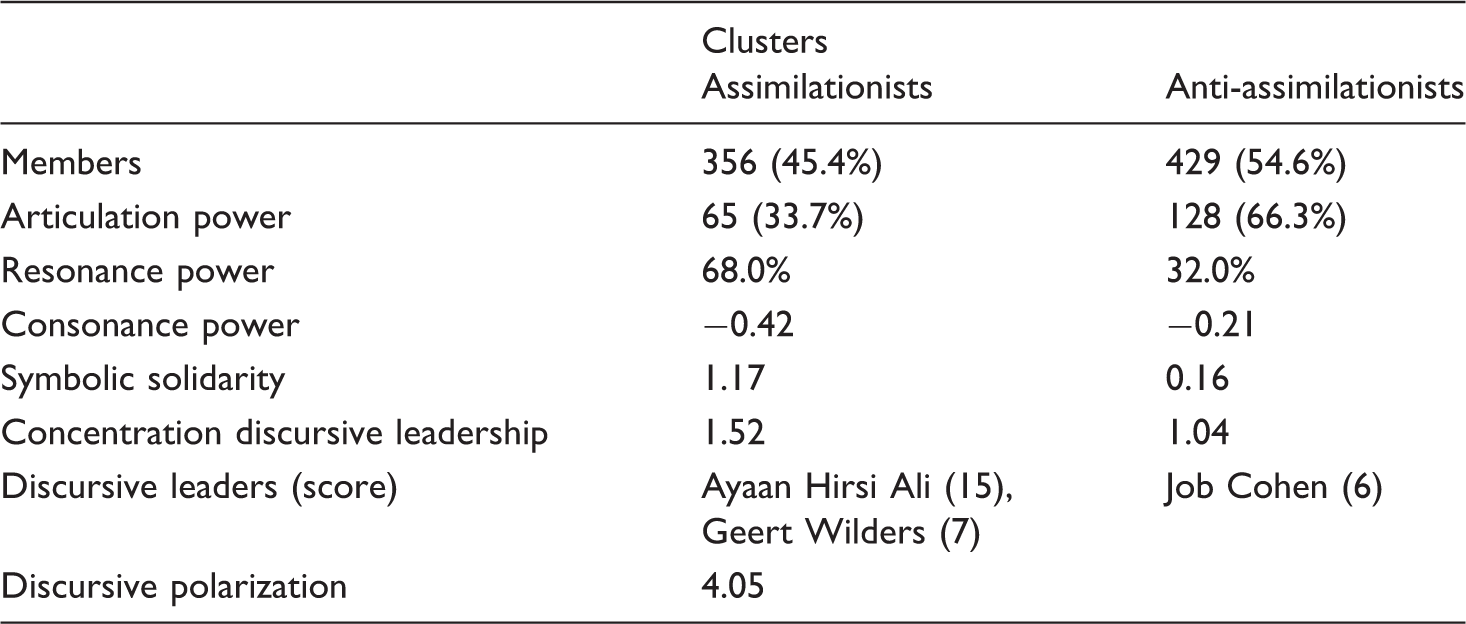
Internal and external relations of clusters in Dutch quality newspapers 2006–2012.
References to discursive leaders in Dutch quality newspapers.
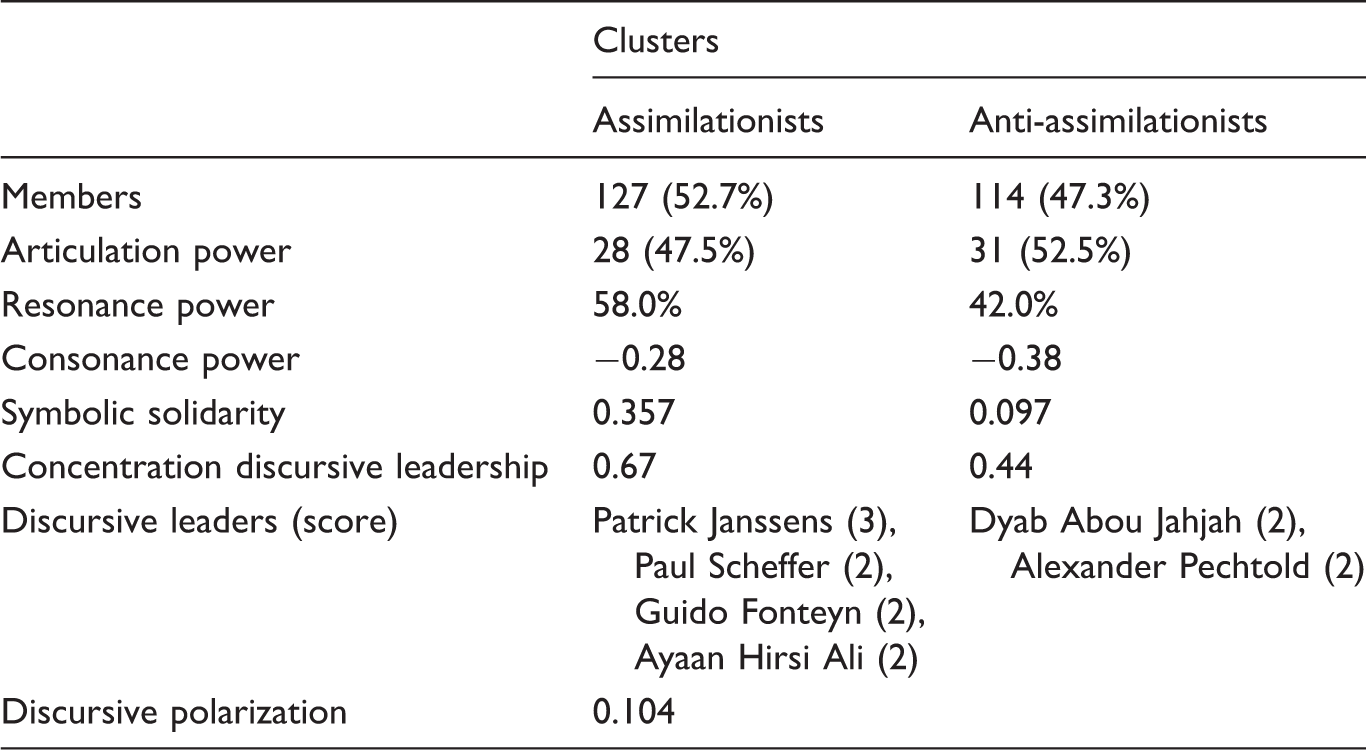
We find a pattern, as shown in Table 1, whereby the assimilationist cluster has less members, and its members have less articles published (lower articulation power) and are less able to generate agreement in the debate (lower consonance power) than the anti-assimilationists. However, the assimilationists drive the debate, as most of the articles make references to actors of their cluster (higher resonance power). So even though the assimilationists have less members and are not granted access to the debate as often, their members are more often discussed than those of the anti-assimilationists. Additionally, the community structure of the assimilationists shows more supportive relationships, as they refer more positively to each other (higher solidarity) and show a more hierarchical structure in terms of support within the cluster (higher concentration of leadership). The members of the opposing cluster do not agree with the assimilationists, but they end up discussing their viewpoints by criticizing them, and more importantly, they lack internal unity, which shows in lower solidarity and the absence of clear discursive leaders, to contest the discursive dominance of the assimilationists.
The actors in the Dutch public debate on integration and their interrelationships are visualized in Figure 4.
7
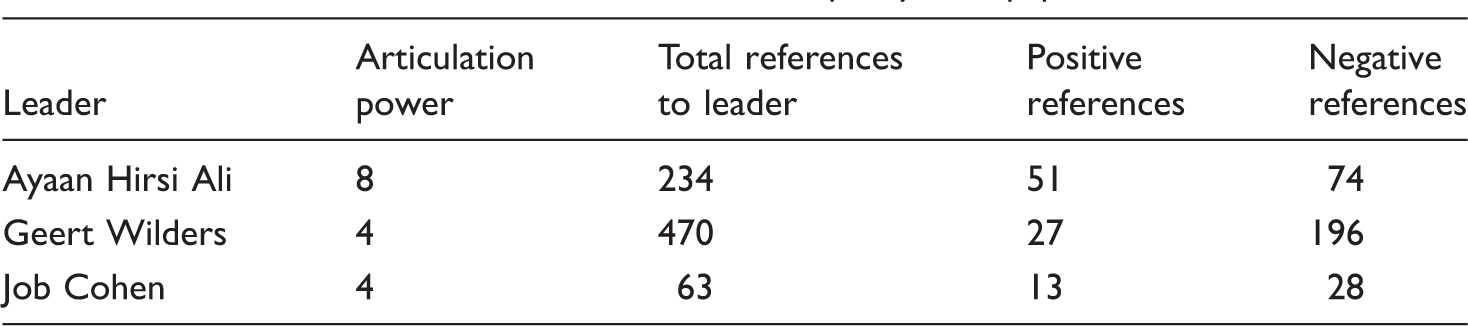
Geert Wilders (leader of the Partij voor de Vrijheid; Party for Freedom, PVV) and Ayaan Hirsi Ali have the highest scores for discursive leadership in the assimilationists cluster. Ayaan Hirsi Ali was a Somali migrant who became well known for her critical stance towards Islam and was a member of the house of representatives for the Volkspartij voor Vrijheid en Democratie (People's party for Freedom and Democracy; VVD). Although Geert Wilders received more references in total in the debate than any other actor, as shown in Table 2, Ayaan Hirsi Ali had more support from their assimilationists cluster. She is therefore the discursive leader of the assimilationists during the period 2006–2012. Her leadership score is more than twice the score of Geert Wilders.
8
The most referenced discursive leader of the anti-assimilationists is Job Cohen. He was the mayor of Amsterdam between 2001 and 2010 and later the leader of the Partij van de Arbeid (Labour party; PvdA) during the national elections in 2010. Job Cohen is referred to seven times less than Geert Wilders and almost four times less than Ayaan Hirsi Ali, again reflecting the discursive dominance of the assimilationists over the anti-assimilationists.
Visualization of clustered actors and negative and positive cross-references in the integration debate in three Dutch quality newspapers 2006–2012.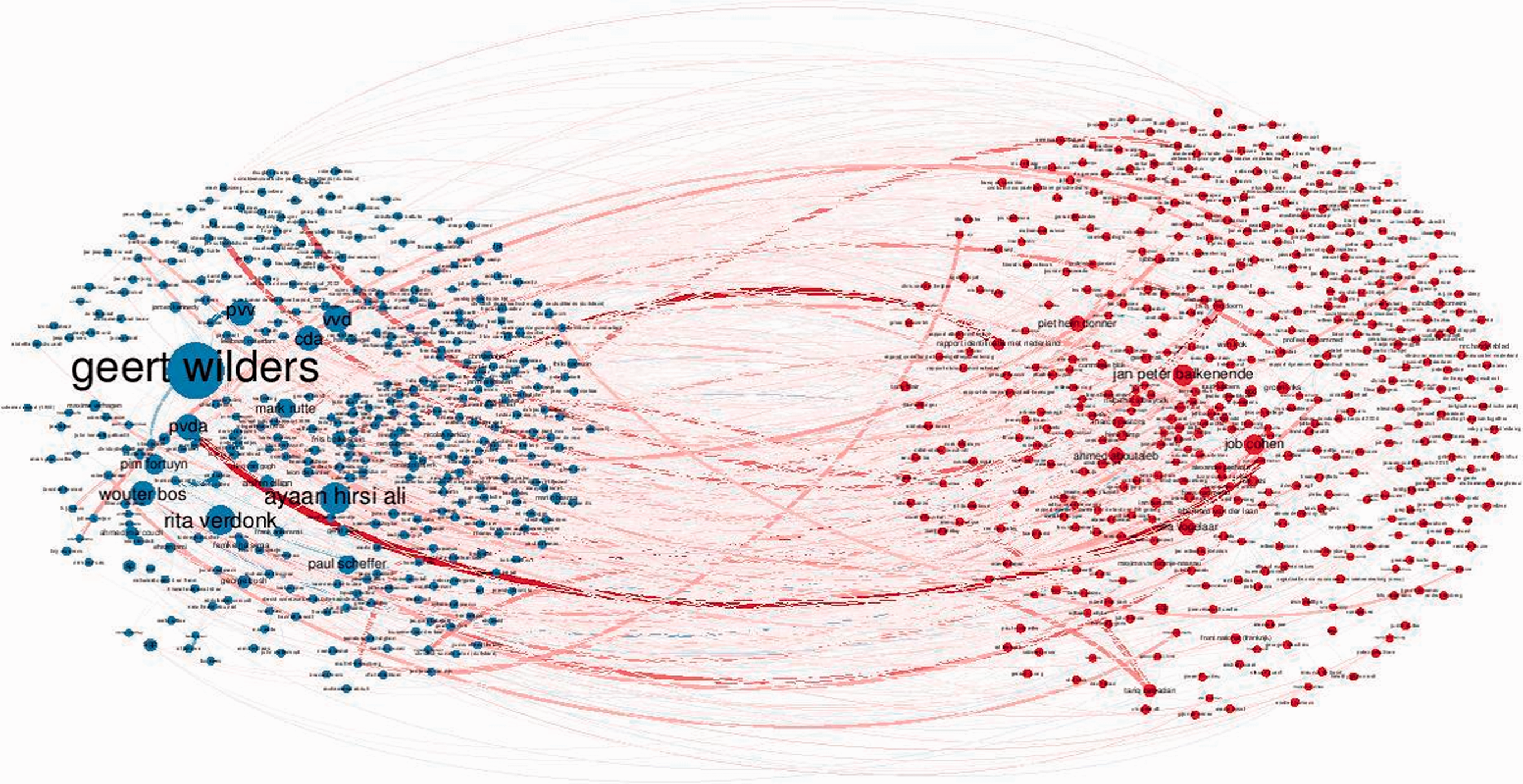
The cluster member with the second highest leadership score is Geert Wilders, as part of the political system during that period as one of the most vehement proponents of culturalism, although he was only granted four opinion pieces in that period (articulation power). The biggest difference between Geert Wilders and Ayaan Hirsi Ali is the support they each receive. Geert Wilders does generate more controversy and therefore more attention (including neutral references), albeit seldom positive. However, he does receive more support than criticism from within his own cluster and therefore still functions as a discursive leader. Ayaan Hirsi Ali has fewer detractors within the assimilationist cluster and more supporters, which makes her the cluster's undisputed discursive leader. Interestingly, she was also the most significant discursive leader of the assimilationists in the Dutch debate during 1990–2006 and appears to be a figure whom other actors in the debate like to rally around. The pattern of higher resonance, of higher solidarity, more concentration of discursive leadership for the assimilationists against higher articulation power and larger numbers of cluster members for the anti-assimilationists resemble the cluster structure during the Dutch debate 1990–2006 (Uitermark et al., 2016). However, some of the actors who were previously in the anti-assimilationists cluster have now moved to the assimilationists cluster, such as the moderate Christen Democratisch Appèl (Christian Democratic Alliance; CDA) and the left-winged Partij van de Arbeid (Labour party; PvdA). It appears that the anti-assimilationists and the assimilationists are involved in an ongoing discursive struggle, whereby the assimilationists are steadily gaining ground and the anti-assimilationists are not able to challenge their discursive dominance, as they lack the internal unity as well as discursive leaders.
Flemish debate
Internal and external relations of clusters in Flemish quality newspapers 2006–2012.
References to discursive leaders in Flemish quality newspapers.
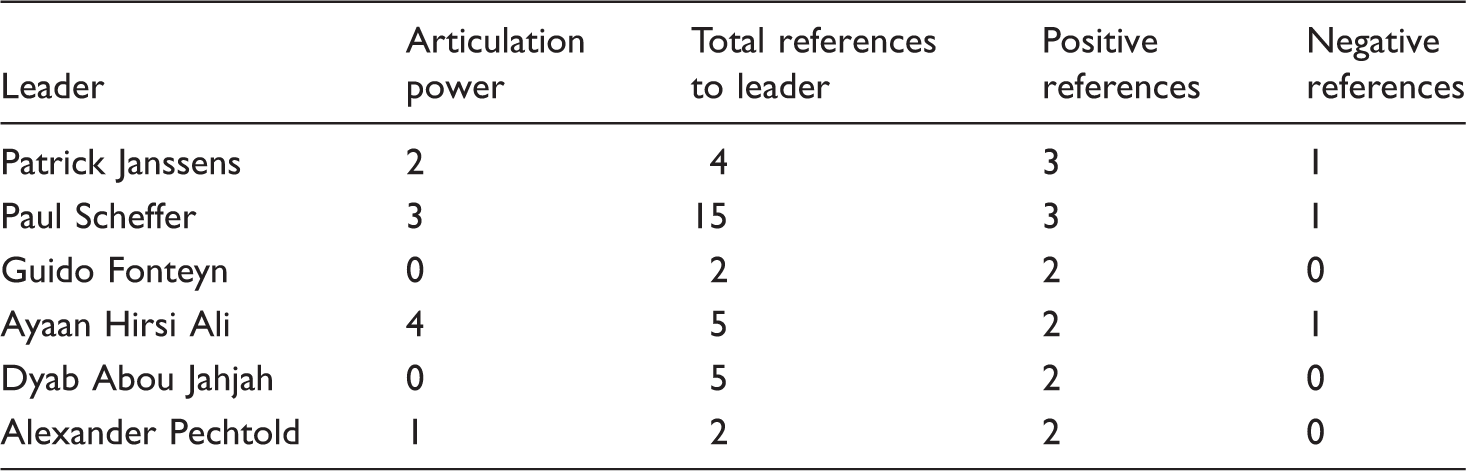
The actors in the Flemish public debate on integration and relationships between them are visualized in Figure 5. The actors with the highest score for discursive leadership in the assimilationist cluster were Patrick Janssens (3), Paul Scheffer (2), Guido Fonteyn (2) and Ayaan Hirsi Ali (2) and in the anti-assimilationist cluster Dyab Abou Jahjah (2) and Alexander Pechtold (2). Patrick Janssens was a politician for the Flemish socialist party, and he was the major of Antwerp between 2003 and 2012. Antwerp is a large city with high cultural diversity and the two articles he wrote were in defence of assimilation integration measures (e.g., ban on headscarves for civil servants). Paul Scheffer is a Dutch publicist and prominent member of the Labour Party. He published articles and a book critical of the multicultural integration model in the Netherlands and advocates the assimilation model instead. Guido Fonteyn is a Flemish journalist who mostly works in the Francophone Belgium and was referred to as a specialist on the Brussels region and Wallonia. We already described the Dutch politician Ayaan Hirsi Ali. Dyab Abou Jahjah is a discursive leader for the anti-assimilationists. He is a Belgian-Lebanese author and activist for the interests of Arab Muslim immigrants in Europe. He frequently speaks out against racism and is highly critical of what he sees as assimilationist practices in Belgium. Alexander Pechtold is the second discursive leader in the anti-assimilationists cluster. He is a Dutch politician as the party leader for a democratic liberal party and is a fervent critic of Geert Wilders.
Visualization of actors and negative and positive cross-references in the integration debate in three Flemish quality newspapers 2006–2012.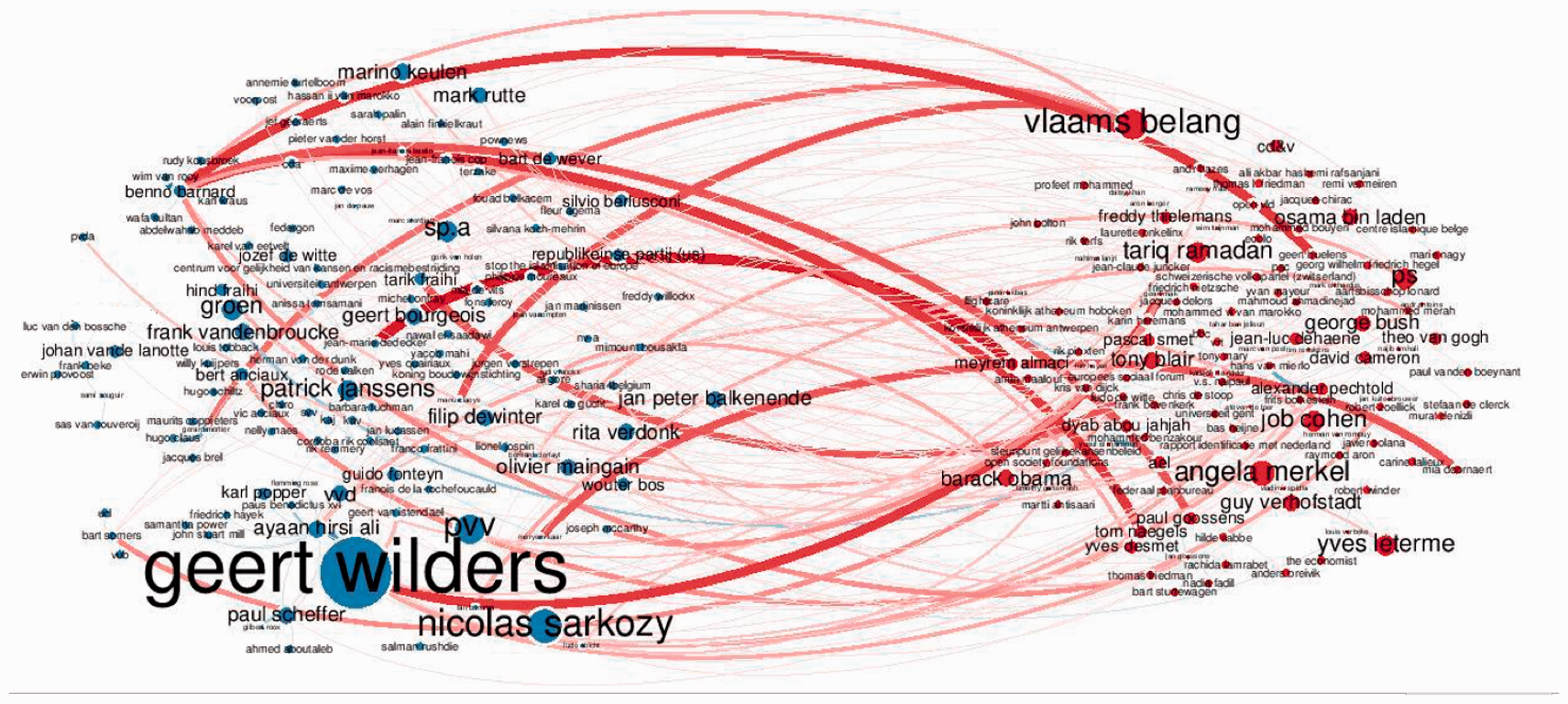
The political party Vlaams Belang (Flemish Interest; VB) appears quite prominently in Figure 5 in the same clusters that features Pechtold and Jah Jah. As this outspoken party focuses on anti-immigration rhetoric, it might seem quite curious that they are clustered with these critics of assimilation. The reason Vlaams Belang ends up in this cluster is because actors in the other cluster negatively refer to the party in an effort to distinguish their stern calls for integration from the xenophobic discourse of the Vlaams Belang. The effect is that they position themselves as opposed to both xenophobes and multiculturalists. However, this does not mean that the VB and its political leader Filip Dewinter are given a prominent role in the public debate. The VB and Dewinter are only referred to neutrally or negatively (combined neutral score: 11, negative: 22), and as they do not receive any support, the party and its leader are discursively side-lined and both score a zero on discursive leadership. The VB are not treated as a legitimate player in the discursive field and can therefore not function as a focal point for polarization, in the same way that Geert Wilders and the PVV do in the Dutch debate. The inconsistent composition of the Flemish clusters in that sense can be viewed as an outcome of the lower polarization in this debate. Not all actors in the Flemish clusters hold similar sentiments in relation to minority integration, in contrast to the Netherlands, where the clusters are composed of likeminded actors.
The difference in size of the debate is also related to the numbers in Table 4 on references to discursive leaders in Flemish quality newspapers. The most referred to discursive leader in the Flemish debate is Paul Scheffer, who is mentioned a total of 15 times, which is in stark contrast to Geert Wilders who is the most mentioned leader in the Dutch debate with 470 references. Interestingly, while all discursive leaders in the Dutch debate are Dutch, only half of the discursive leaders of the Flemish debate are Flemish and many other foreign actors appear in the Flemish debate (e.g., Angela Merkel, Tony Blair). Moreover, the majority of the articulation power of the leaders of the Flemish debate belongs to Dutch actors. A substantial portion of the other actors who are given access to the Flemish debate on integration are Dutch opinion makers and celebrities like Ian Buruma (journalist), Jörgen Raymann (comedian) and Leon de Winter (author). It seems that the Flemish actors and media look to other countries, the Netherlands in particular, when discussing integration, while the actors in the Netherlands do not share this inclination.
Conclusion
In this study, we aimed to provide an account of the relational forces shaping the discursive struggle on minority integration in the Netherlands and Flanders, as it unfolded on the opinion pages of quality newspapers. Our goals were to compare the dynamics found in the public debates in the Netherlands and Flanders (2006–2012) with an earlier study conducted in the Netherlands (1990–2006) and to assess the applicability of this dynamic to another case. By applying the conceptual framework proposed by Uitermark (2012) in a more recent period in the same country and a region in a neighbouring country, we hope to answer the question whether the dynamics found in the earlier study were typical of discursive struggles overall or just applicable to a particular country and/or period.
The integration debate in the Netherlands (2006–2012) shows remarkable continuities in terms of group consolidation and discursive power with the preceding period (1990–2005). In both periods, there was one cohesive assimilationist cluster and a fragmented anti-assimilationist antipode. The cohesive assimilationists were smaller in numbers, but higher in solidarity, discursive leadership and resonance, than the fragmented anti-assimilationists cluster. The assimilationists made controversial statements and audacious claims, thereby attacking attention from other actors in the public debate. They attracted criticism from detractors and support from likeminded actors. The anti-assimilationists reacted in an ad hoc manner to the claims of the assimilationists and lacked the internal cohesion and guidance of strong discursive leaders. Even though the criticisms discredited the assimilationists to some extent, they were placed in the centre of the attention and were therefore able to dominate the debate (Koopmans, 2004). The dynamics found in 2006–2012 in the Netherlands were more pronounced than the dynamics of 1990–2006. The assimilationists in the more recent period were given less access to the public debate by media gatekeepers (lower articulation power), although they were able to attract more attention (higher resonance power). Moreover, the solidarity was much higher in the more recent period, indicating that the assimilationists have gained in discursive power whereas the anti-assimilationists have lost power. Similar to Conover et al. (2012), who studied US Twitter debates, we find a highly polarized debate with the political right being more cohesive in community structure.
The integration debate in Flanders is painted with a very different brush. First of all, the scope and coverage of the integration debate was much more limited: there were more than two and a half times the number of articles and almost four times as many references to actors in the Dutch public debate, compared to Flanders. The actors in the public debate in Flanders tend to refer to foreign actors, and the media gatekeepers tend to give more access in the opinion pages to foreign actors (most notably Dutch). Moreover, the group cohesion, concentration of leadership and polarization in Flanders are so low that it is difficult to really speak of two distinctive discursive clusters. The public debate in Flanders deviates from the pattern discerned in the Netherlands in both time periods. More research on the causal mechanisms behind discursive struggles could be enlightening.
We end the discussion with some limitations of this study and suggestions for further research. First of all, we explicitly chose to focus on the elitist venue of the op-ed sections of the quality newspapers as we were looking for the discursive structures in the political elite. However, by not incorporating television news, current affairs programs and talk shows, we do acknowledge this limitation in scope. Additionally, our analysis only looks at actors who make it to the opinion pages. We do not know about the editorial strategies of curating opinion pages or instructing journalists. For further research, we would advise to take this into account as well as the role of journalists and public actors in the media discourse.
The case study of the two countries underscores the considerable differences in the public debate on integration in both societies. It would be interesting to include other European countries in further research to see how the national and cultural perception of minority integration in the Netherlands and Flanders could be contrasted to approaches in other European countries or to the European debate as a whole. The finding that popular (or populist) voices can court the integration debates across national borders highlights the need for continuous and cross-national media monitoring to reveal discursive shifts and keep abreast of the EU's societal and political challenges, especially in light of increasing migration due to the refugee crisis. Last, the explosive use of social media and growing availability of digital datasets open up interesting avenues for further investigation of online discursive contention and community polarization.
Footnotes
Declaration of Conflicting Interests
The author(s) declared no potential conflicts of interest with respect to the research, authorship, and/or publication of this article.
Funding
The author(s) disclosed receipt of the following financial support for the research, authorship and/or publication of this article: Justus Uitermark gratefully acknowledges the funding from the ODYCCEUS project as financed through the European Union's Horizon 2020 program (grant agreement no. 732942).