



Abstract
We model a maintenance policy with fixed periodic structure that is a hybrid of periodic inspection and opportunistic replacement. The policy is applicable to geographically remote systems such as offshore wind farms. The policy has three phases. Initially, there is an inspection phase to identify early defects. This is followed by a wear out phase during which corrective replacements are performed. Preventive replacement occurs at the end of this phase. The novelty of the model is an opportunistic phase, which overlaps with the latter part of the corrective phase, when preventive replacement is executed early if an opportunity arises. In this way, we model the reality in which remote systems with high logistics costs and restricted access may benefit from opportunistic visits for maintenance. Using a numerical example, we analyse the behaviour of the decision variables for a range of values of the parameters common to such systems. These parameters relate to: component heterogeneity; restricted access; default (failure to execute a planned action); arrival of opportunities and other standard parameters in a maintenance cost model. Specifically, our results indicate when opportunities can have a significant impact on the cost-rate of the optimum policy, but that leveraging opportunities cannot achieve a very high availability. Generally, we demonstrate that maintenance planning should be flexible when factors beyond the control of the maintainer impact maintenance effectiveness.
Introduction
Maintenance has a fundamental role in production and is a significant part of its cost. It is therefore important that maintenance is efficient and effective.1,2 Preventive maintenance (PM) is crucial for improving the efficiency and effectiveness of the maintenance of systems, and periodic PM is the predominant strategy used in industry. 3 Periodic PM schedules actions at fixed time intervals.4–6 Periodic PM actions include replacement of components or units, 7 repairs and inspections. Inspection in particular is a means to know the state or condition of a component, unit or system and then to plan actions accordingly.8–11
Between such scheduled actions, opportunities can often be exploited. 12 Opportunities can arise in various ways. In a multi-component system, corrective action (in the event of failure) or preventive action on one component may provide an opportunity to maintain others.13,14 In such cases, components may be stochastically dependent 15 (wear or failure dependence) and maintenance may be imperfect. 16 Plant may be stopped due to material shortage, harsh environmental conditions or low market prices.17,18 When a fleet of systems is geographically remote, a visit to one may provide an opportunity to visit others. 19 Indeed, other studies discuss this issue.20–22
In this context, and in this paper, we develop an inspection model with fixed periodic structure 23 that is motivated by maintenance planning for the systems where logistics costs associated with maintenance are high and potential visits to the system to do maintenance occur periodically. Such logistics costs, for example, arise when specialised equipment, such as service vessels, helicopters or cranes, are required to carry out maintenance actions.24,25 Further, costly logistics may themselves imply that maintenance actions are restricted to pre-planned times when equipment and other resources are available. Another motivation for the model we develop is the uncertainty about the possibility of access to the system, for example, due to changing weather conditions or, more recently, due to lockdowns.26,27 To model more flexible maintenance planning to take account of these relevant aspects, we consider opportunities, the possibility of default and also poor installation. A default occurs when an action is planned but not carried out, due to, for example: bad weather; service transport failure or delays; unavailability of spare parts; shortage of personnel.28,29
Opportunistic maintenance policies are relevant because opportunistic maintenance may make more efficient use of resources and therefore be more cost-effective. 30 Therefore, it is important to develop models to investigate the efficiency and effectiveness of such policies. This is our purpose in this paper. We also provide insights for managers about opportunistic maintenance strategy, particularly relating to systems that are accessible only at pre-planned times, when defaults are possible and maintenance quality is variable.31,32
The motivation for our model is an offshore wind farm, essential for the production of clean energy. The number of windfarms in production worldwide is increasing rapidly33–35 and as this renewable energy production increases, the need to find cost efficiencies related to the installation, 36 transportation, 37 operation and maintenance activities 38 of these systems also increases. Thus, the challenges to cope the logistical difficulties in doing maintenance in offshore wind turbines brings some uncertainties about the real capacity of the maintenance actions in keeping in time of a previous schedule. In other words, defaults can happen preventing maintenance actions to be accomplished. On the other hand, the high costs to visit the turbines, make prohibitive visits outside of pre-planned (scheduled) times. 39
Despite of the number of recent papers exploring the benefit of opportunistic maintenance in offshore wind farms, 22 none of them consider all the key uncertainties that we have proposed on this paper, namely: opportunities (for early cost-effective replacements); defaulting and variable quality of maintenance interventions. This then is the novelty in the model and analysis we present.
The remainder of this paper is as follows: the precise development of the model (assumptions, system and policy) is described in the next section. We then consider a long-run cost per unit time criterion to optimise the policy. This ‘cost-rate’ and the system’s availability (‘downtime-rate’) are developed there. Then we present a numerical example to describe the behaviour of the policy. And we conclude with a discussion in the final section.
Maintenance policy development
Notation
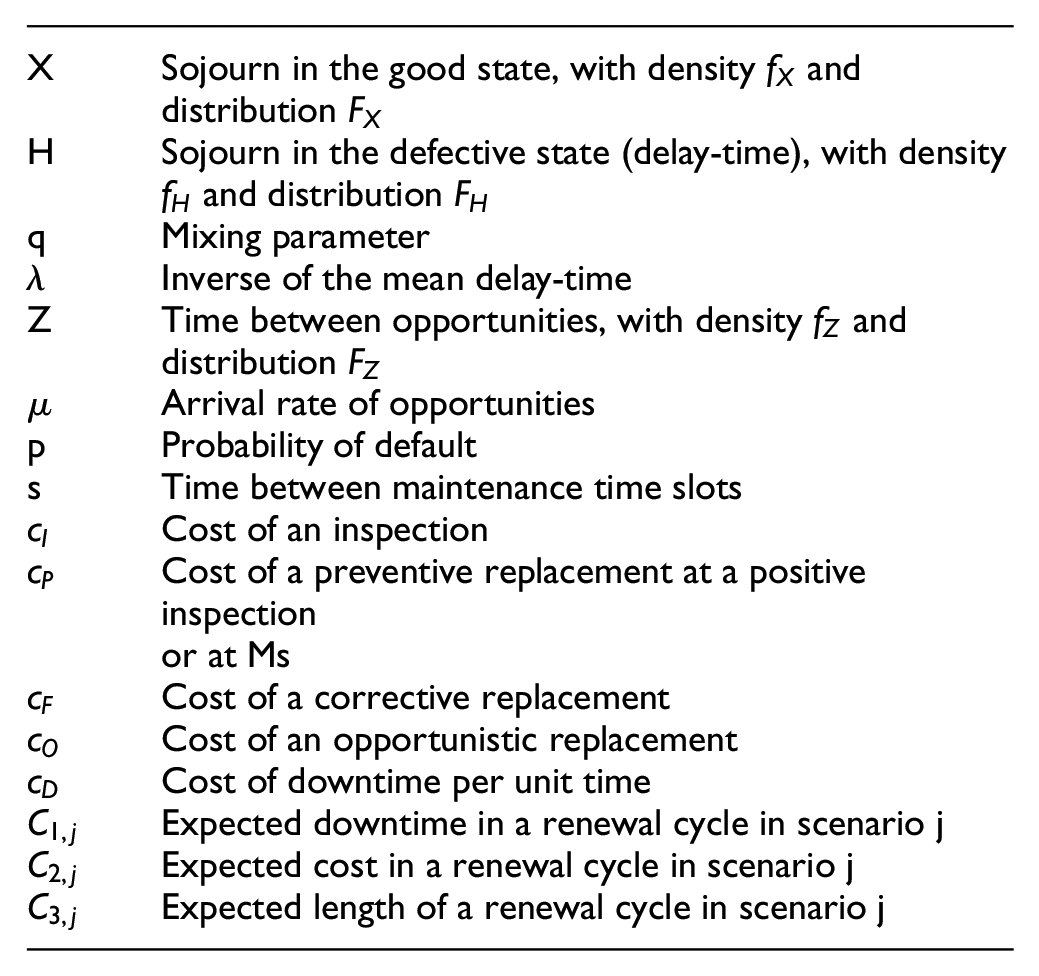
Description of the system
We consider a one-component system. That is, the system is a component that when placed in a socket performs an operational function. 40 We assume that the system is in one of its three states: good, defective or failed. The system operates when it is in the good or the defective state. Inspection is required to differentiate between these two states. This is the delay-time model. 41 Contrary to the defective state, the failed state is immediately revealed. In this way, we can consider our system as a critical system.
The sojourn in the good state, X, and the sojourn in the defective state, H, are random variables, which are statistically independent of each other. We introduce a probability q to model poor installation such that there exist two sub-populations of components, one relating to components that are properly installed and the other not.
42
We suppose that only the sojourn time in the good state is affected by this bad installation. Thus, the distribution of X is
Description of the policy
In our proposed policy, preventive and corrective maintenance actions can be performed only at times
These times are fixed, and they define the underlying periodic structure of the policy. We call them maintenance time slots, or slots, for short. The policy has three phases and three decision variables, K, W and M. Figure 1 illustrates the schedule of maintenance actions. Preventive replacement is scheduled for the M-th slot at time Ms. However, replacement other than at Ms interrupts the schedule. We assume replacement renews the system, so that the renewal cycle ends at replacement. Each phase is explained next. We start with preliminaries about defaulting, corrective replacement and downtime.
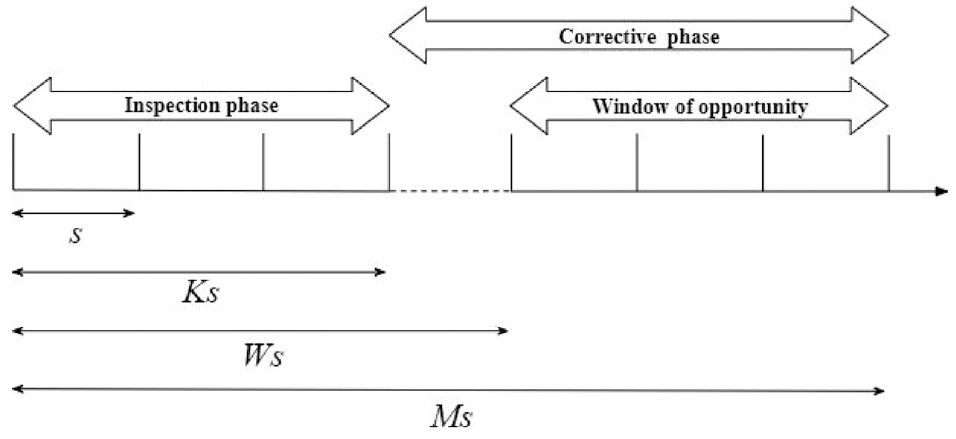
Hybrid inspection and opportunistic replacement policy.
Inspection and preventive and corrective replacement may be subject to a default. A default on a scheduled action occurs with probability p. Further, a default occurs at most once during a renewal cycle. This is a simplification that allows us to derive the cost-rate. But it also mimics the reality in which a maintainer will prioritise maintenance for a system which has been subject to default due to lack of resources. Finally, a default cannot occur at Ms. Thus, if the system survives to Ms, it is preventively replaced at Ms with probability 1.
If the system fails, then corrective replacement (renewal) is scheduled for the next slot unless there is a default, whence it is postponed to the subsequent slot. That is, if the system fails in the interval
The system is a critical system (failure is immediately revealed). Nonetheless, downtime can occur because slots are periodic and corrective replacement occurs only at a slot. Therefore, our model defines the downtime in a renewal cycle as the time from failure to subsequent replacement of the system. If there is no failure in a cycle, the downtime is zero.
We return now to the policy. Phase one is the inspection phase. Inspections are scheduled at every slot up to (and including) the K-th slot at time (age) Ks. On inspection at ts,
In phase two, between Ks and Ms, there are no inspections. Thus, in the second phase the maintainer cannot distinguish between good and defective states, but can distinguish between the operational state (good or defective) and the failed state, because failure is immediately revealed (critical system).
Phase three is the window for opportunistic replacement, which commences at the W-th slot at time Ws. Essentially, an opportunity advances the time of replacement. Opportunistic replacement is not subject to default, by definition, since if there was a default on an opportunity it would not be an opportunity. Such opportunities can be related to some maintenance action on another neighbouring system that may have been cancelled or prevented, allowing the system under study to be replaced at a lower cost. We assume that opportunities arrive according to a Poisson process and replacement (renewal) is immediate, regardless of the state of the system. That is, opportunistic replacements can occur between slots. Opportunities are independent of X and H.
Inspections are programmed for early life, and thus deal with components that may be weak, due to bad installations or equivalently variations in the quality of the components. Therefore, in systems with a higher proportion of weak components (larger q), the greater the importance of inspections. Then, in the second phase, opportunities provide a good alternative to inspection especially when they are available (frequent) and inspection is costly, due to challenges of access to systems. Limiting the window of opportunity in the second phase models the natural postponement of the use of opportunities, given that, up to a certain point, their use is likely to be economically inefficient.
The cost parameters include the expenses with transportation of the technicians, tools and spare parts, in which the logistic time and replacement time are dependent upon the action that is being promoted. For inspections at an offshore wind turbine a crew transfer vessel may be necessary, but for a corrective replacement a large maintenance vessel will be necessary. 43 The labour costs and/or the spare parts purchase are also part of the replacement and inspection cost composition. The downtime cost includes the financial loss caused by the system unavailability.
Decision criteria
We consider two criteria: the cost-rate,

We then determine the cost-optimal policy: those values of K, W and M that minimise
On the computation of the optimum policy, grid search is straightforward but slow. Probabilistic search would speed this up. If
Numerical study
Cost-minimal policy
We now study the behaviour of the policy numerically. We define a base case for the parameter values (Table 1). We select these values for two principal reasons. First, we would like to highlight some interesting aspects of the model, and second, to keep them close to the values of parameters found in the context of a wind farm.22,43 Thus, for example,
Parameter values in the base case.

The maintenance policy optimisation was performed by enumerating all possible combinations of decision variables up to a limit of
In the base case, the optimum policy is
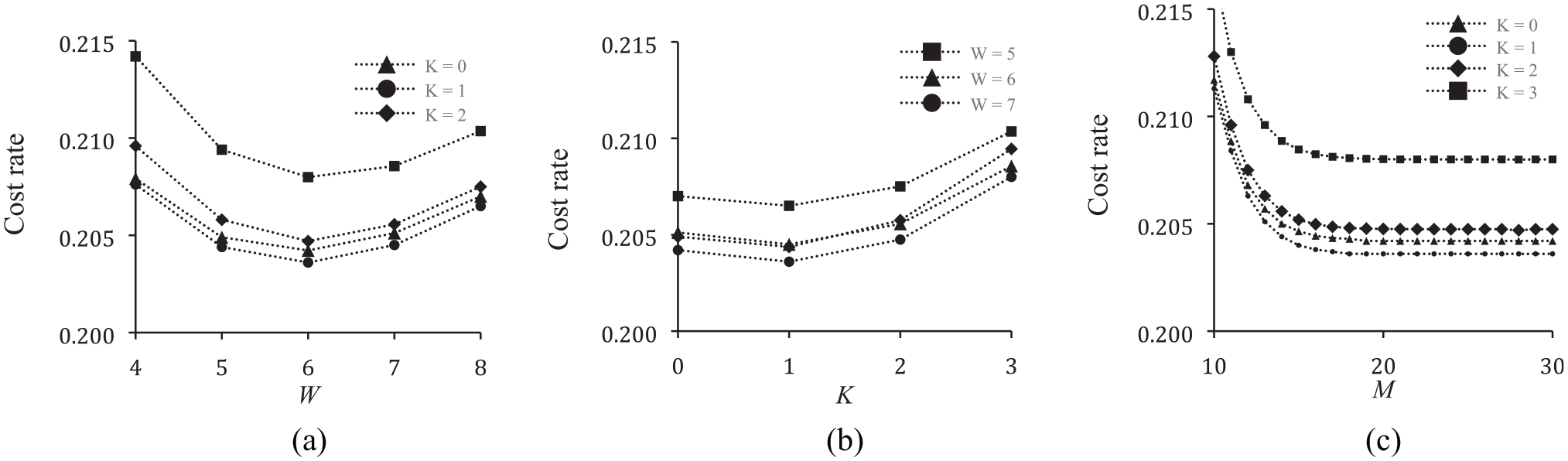
For the base case, optimal cost-rate versus: (a) W with
Optimal policy for
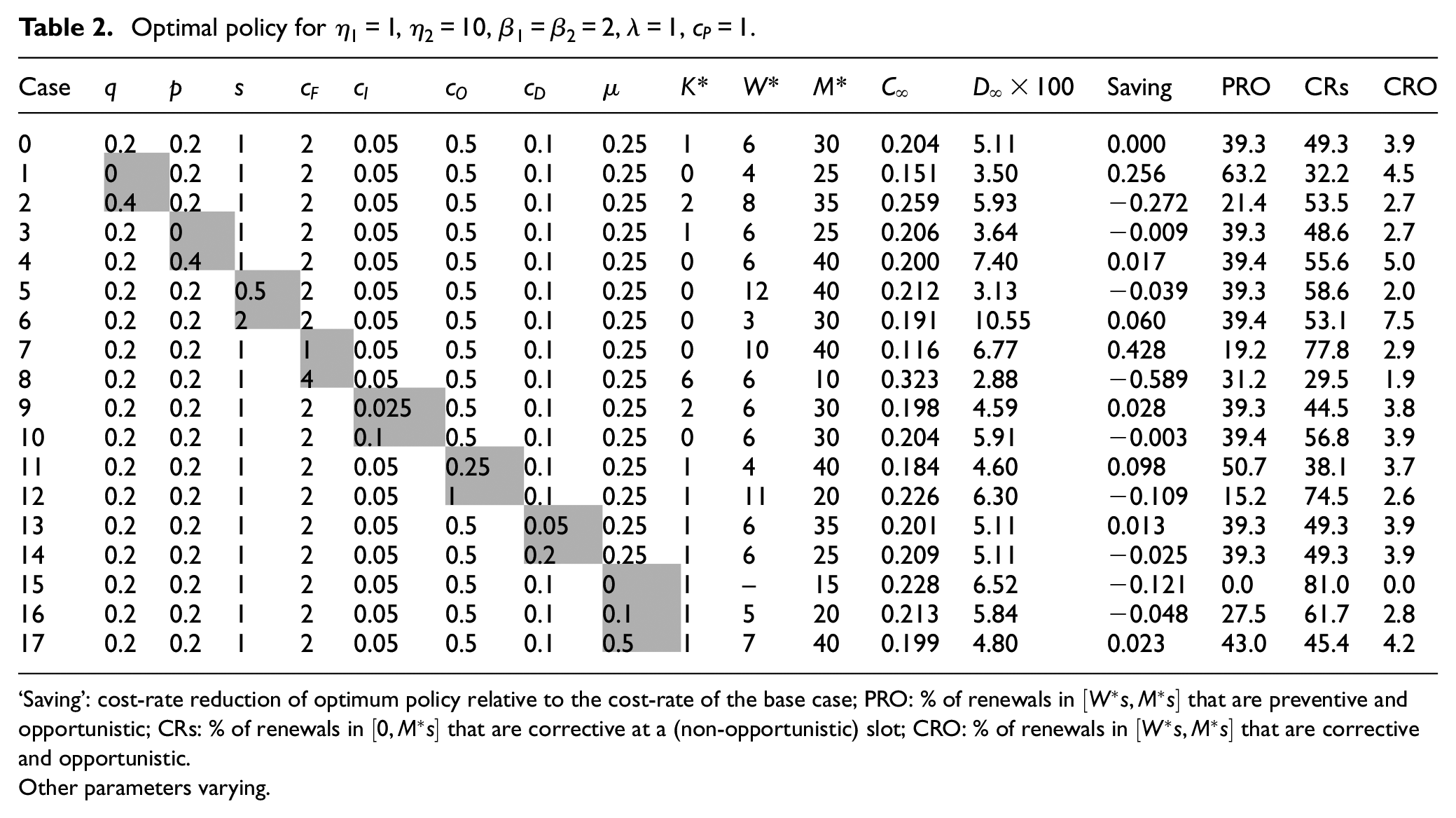
‘Saving’: cost-rate reduction of optimum policy relative to the cost-rate of the base case; PRO: % of renewals in
Other parameters varying.
As well as the cost-rate and the downtime-rate (average unavailability), we calculate the probability of each type of replacement event. There are six possible replacement events: (i) preventive replacement at inspection; (ii) corrective replacement at inspection (CRI); (iii) preventive replacement at Ms; (iv) preventive replacement at an opportunity (PRO) (this can only occur in the window of opportunity,
In most cases the policy behaves as we would expect. Thus, inspection is driven by heterogeneity (K* increases with q), and the cost-rate and downtime-rate are both sensitive to q (Figure 3). The effect of defaulting is counterintuitive, but this is perhaps because in the model there can be at most one default. Thus, a high default rate extends the cycle length without increasing the cost too much because the cost of downtime is relatively low. Nonetheless, the downtime-rate is sensitive to p as expected since defaulting will tend to increase downtime. The effect of defaulting on the optimum cost-rate (the latter decreases as the former increases) is consistent with the system preferring fewer slots (cases 5 and 6). This is because defaulting acts like having fewer slots albeit in a random way. Thus, in reality, the time between slots s may be a decision variable, and indeed we might have treated it as such. However, in the scenario with less frequent slots (case 6), it appears that inspections are redundant (K* = 0), so that the policy behaviour would be less interesting.
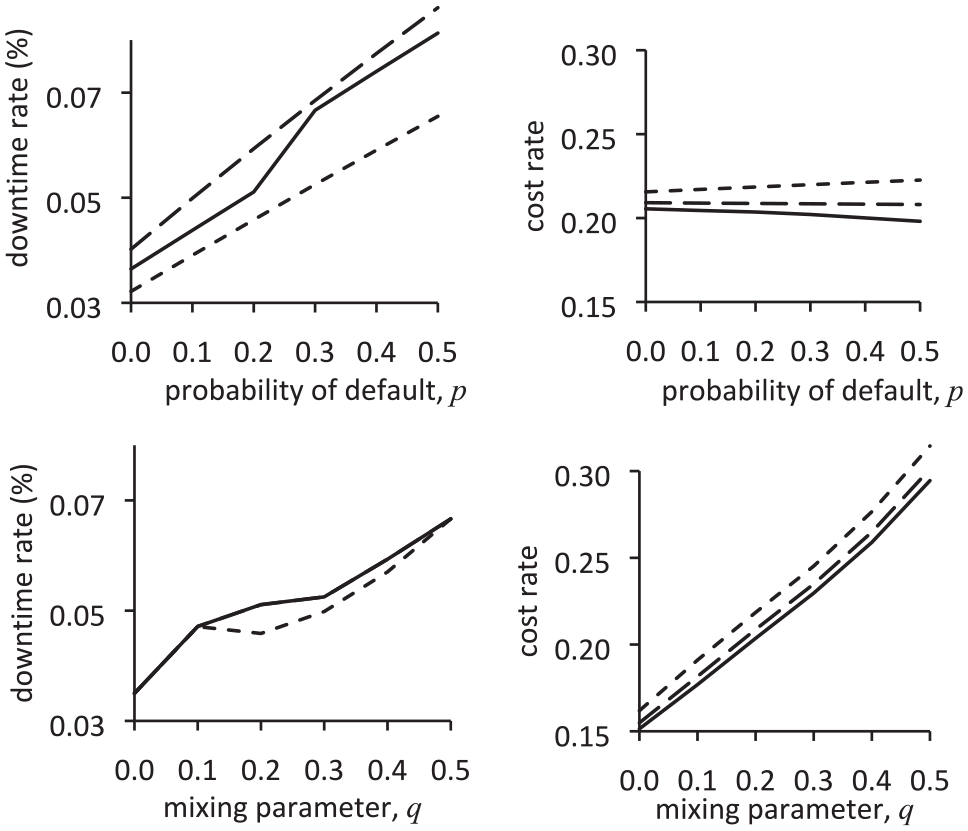
Downtime-rate and cost-rate versus probability of default and mixing parameter for
The costs of maintenance actions influence optimum policy in the way we would expect so we do not discuss these in detail. The reader is referred to cases 9–14 in Table 2. We see that the increase in the rate of opportunities reduces the cost-rate. When opportunities are more frequent (and more expensive), the tendency is to postpone the opening of the window of opportunity. Figure 4 shows that opportunities provide diminishing returns and opportunities do not need to be very frequent to be beneficial.
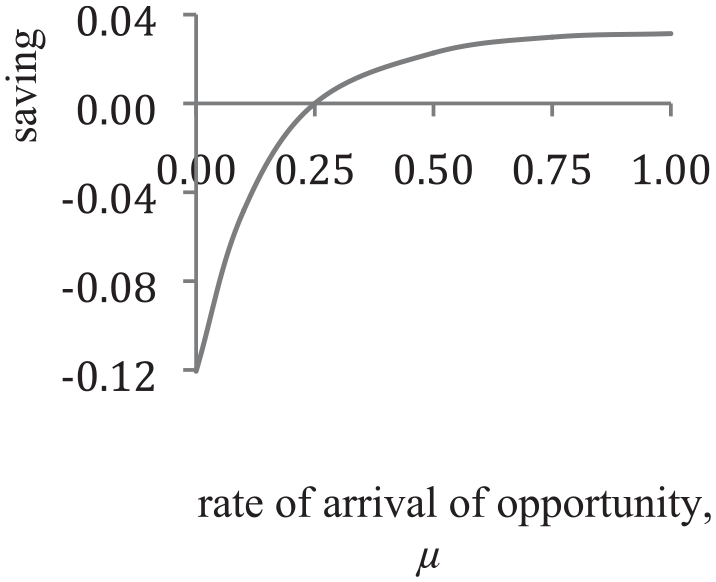
Saving (cost-rate reduction relative to cost-rate of base case) versus rate of arrival of opportunities,
Unavailability constraint
The decision-maker may want to set a minimum unavailability, for contractual reasons, say. Therefore, we also study a constrained cost-minimisation problem: find
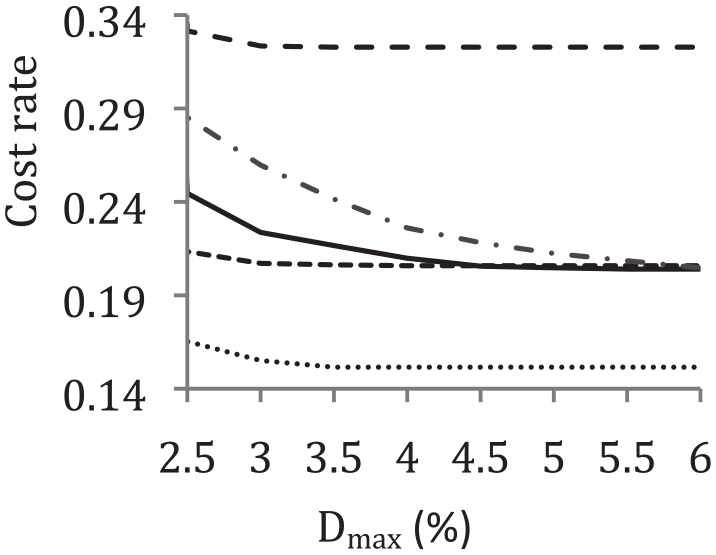
Constrained optimum cost-rate versus
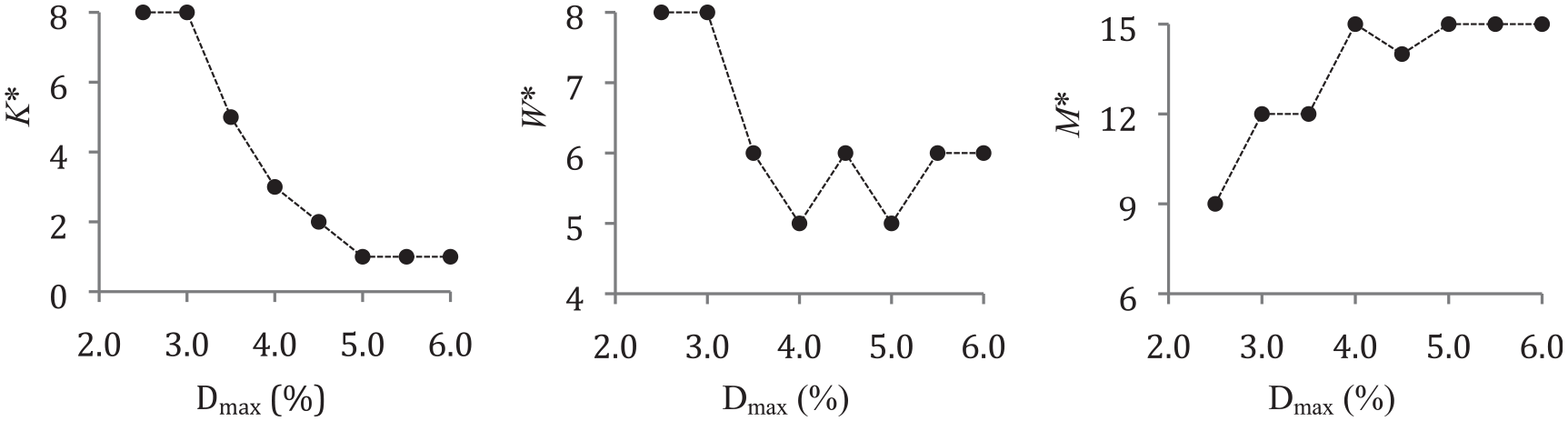
For base case, optimal values of decision variables versus
Thus, Figure 6 indicates that leveraging opportunities cannot achieve a very low downtime. That can only be achieved by inspection at every slot and a short replacement cycle (small M). This is likely due to the possibility of weak components (heterogeneity). So, a strict attitude to unavailability will tend to preclude opportunistic maintenance, particularly if the time between slots is long (case 6, s = 2). This raises an interesting question. What would a maintainer prefer: a rigid policy with infrequent slots (e.g. visit every turbine infrequently) or a flexible policy with frequent slots (e.g. visit turbines as time and resources permit)?
Conclusion
This study describes a maintenance policy that is a hybrid of inspection and preventive and opportunistic replacement. The policy is motivated by the maintenance of geographically remote systems. We suppose that maintenance activities can occur only at fixed, periodic time slots, and the time and resources available at such slots are limited. In this way, the execution of the scheduled plan is subject to uncertainty and variation in quality. This paper is, to our knowledge, the first to study an opportunistic maintenance policy that is hybridised with inspection and preventive replacement. The assumption of a fixed interval for slots permits for a tractable analysis.
We study the policy numerically. We find that scheduled inspections and preventive replacement become less necessary as one leverages opportunities. Furthermore, opportunities offer diminishing returns on maintenance costs and do not need to be very frequent to be beneficial. However, faced with an unavailability restriction, opportunistic maintenance becomes less useful, and inspection becomes more important. Our results also suggest that inspection is driven by heterogeneity, albeit when the purpose of inspection is defect identification. For the system configuration covered in here, the postponement of the preventive replacement is optimal, except in cases where opportunities are rare or the cost of failure is much higher than the cost of prevention. Defaulting is interesting because its effect is somewhat counterintuitive; we find that postponement is largely beneficial. Our analysis also suggests that flexibility implies a certain unavailability, so that safety-critical systems should be treated differently.
This policy is important to study because it models the logistical challenges that managers face in operating and maintaining geographically remote systems, such as offshore windfarms. And maintenance planning for offshore windfarms is an important issue that is receiving a great deal of attention. Large distances and difficult conditions for access to assets mean that planning must be flexible and robust to circumstances outside the control of the maintainer (e.g. weather, lockdowns). The implications of this work for the practice of maintenance engineering are that flexibility can be achieved by leveraging opportunities and that opportunities may present more frequently if maintenance time slots are more frequent and there is some slack in the scheduled works.
In reality, the frequency of slots, 1/s, may be a decision variable, and indeed we might have treated it as such. Such an analysis would extend our study. Nonetheless, this decision might be made at a higher level, on the basis of an initial provisioning policy for the resources for maintenance. Thus, for example, the maintainer of an offshore windfarm might decide first how many vessels it will use for access. Imposing a fixed periodic structure as we do allows for a tractable analysis. It would also mean that study of a multi-component extension of the model would be possible. In such a study, actions at a component level could be assigned to slots, either statically, according to a pre-planned schedule, or dynamically, as opportunities or need arises, or both.
Footnotes
Appendix 1
There are 41 renewal scenarios. We calculate the probability of each scenario, which we denote by
The quantities
Declaration of conflicting interests
The author(s) declared no potential conflicts of interest with respect to the research, authorship, and/or publication of this article.
Funding
The author(s) disclosed receipt of the following financial support for the research, authorship, and/or publication of this article: The work of Phil Scarf was carried out with funding for a research project by the Coordinator for the Coordination for the Improvement of Higher Education Personnel in Brazil (CAPES), within the scope of the Capes – PrInt Program. The work of Yan Melo, Cristiano Cavalcante and Rodrigo Lopes has been supported by CNPq (Brazilian Research Council).
Data statement
The data presented in this paper were calculated using code written by the authors. This code implements numerical calculation of the expressions for the cost-rate and the down-time rate, and their underlying elements, that are presented in the Appendix 1. A demonstrator of this code can be accessed from here:  . With this code, the reader can verify the results presented and explore new cases.