




Abstract
Background
As football becomes more competitive with age, children's experiences of the game may change, with enjoyment playing an important role in continued participation. Limited research has examined how children understand this shift or interpret associated psychological pressures. This study used a Write-Draw-Show-Tell (WDST) approach to explore children's enjoyment, perceptions of seriousness, and emotional responses across developmental stages in transition to a more competitive level.
Methods
Forty six children from grassroots football in the West Midlands, UK participated across two age groups (<U12 or >U13). Eleven focus groups were conducted, including six groups with boys (n = 24) and five with girls (n = 22). Groups completed WDST activities incorporating short written prompts, drawing tasks, and guided discussions. Data were inductively analysed using reflexive thematic analysis, supported by pen profile diagrams.
Results
Five themes captured children's experiences of increasing competitiveness in football and illustrated how enjoyment, pressure, support, and emotional responses were intertwined across developmental phases: friendship and fun (n = 43), winning and improvement (n = 37), emotional highs and lows (n = 31), support systems (n = 34), and developing within the game (n = 27). Gendered patterns were evident, with girls more frequently emphasising emotional support and social belonging, while boys described competitiveness, performance expectations, and outcome focused pressure.
Conclusion
Children's enjoyment shifted from being socially anchored and play centred to being increasingly shaped by evaluation and performance expectations, with boys and girls emphasising different aspects of this transition. Findings highlight the need for age appropriate coaching and parent practices that protect enjoyment while supporting development as competitive demands increase.
Introduction
Football at grassroots level is the most popular sport worldwide. 1 One of the key aims for younger ages is to build enjoyment, social connection, and positive developmental experiences.2,3 Enjoyment, characterised by feelings of fun, pleasure, and interest, 4 is central to children's motivation to participate in sport and longer term engagement.5,6 A consistent body of research has demonstrated that enjoyment predicts continued participation in physical activity opportunities, reduces dropout, and supports adaptive psychological outcomes such as confidence, positive affect, and long-term physical activity habits.7,8 Yet, despite the prominence of “fun” in youth sport practice, evidence consistently shows that children's enjoyment in football can diminish when the environment becomes increasingly serious, competitive, or performance-driven. 9 However, little is known about how children themselves interpret and experience this transition, particularly as they move between developmental stages and encounter increasing competitive demands.
According to Sport England's Active Lives Children and Young People Survey, 10 participation in team sports is higher among children aged 7–11 (65%) but declines during adolescence (58% among those aged 11–16). This reduction in participation coincides with a developmental period in which dropout rates begin to increase from approximately 12 years of age and is consistent with evidence indicating that disengagement from adolescent team sport is influenced by psychological and social factors. 11 Shifts in enjoyment are especially pronounced during developmental transitions, where norms, expectations, and competitive structures intensify with age. 9 In the UK, at <U12, most youth football is considered non-competitive, with the focus on development and fun, and results and tables are not published. 12 Additionally, growing competitiveness in youth football is often accompanied by rising performance expectations, 9 skill-based differentiation, 13 and increased emphasis on winning, tables and rankings. 9 These contextual demands shape children's affective and motivational responses, with some experiencing excitement and challenge, while others feel stress, pressure, or diminishing enjoyment. 9 Achievement goal theory 14 proposes that children who appraise success through personal improvement and mastery typically experience more positive affect and sustained motivation. Contrastingly, environments emphasising normative comparison, evaluation, or avoidance of mistakes can lead to anxiety, reduced confidence, and lower enjoyment. However, as performance expectations increase, children's experiences can shift from intrinsically driven fun to externally regulated pressure, altering how they perceive themselves, their competence, and regulate determination and success. 6 Accordingly, examining how children subjectively experience this shift to competitive football is critical for advancing theoretical understanding of motivation in youth sport and for identifying mechanisms that may explain declining participation during early adolescence.
A further consideration is that gender differences may also shape how children experience enjoyment, pressure, and competitive expectations in football. Evidence suggests that boys and girls navigate distinct social norms and motivational climates within sport, which influence how they perceive success, failure, and interpersonal interactions.15,16 Research suggests that across a range of sports, girls frequently report greater sensitivity to social evaluation, peer comparison, and coach expectations, whereas boys tend to experience pressure linked to performance norms, competitiveness, and physical dominance within the group.17–20 In youth football specifically, Lyons et al., 20 found that boys and girls differed in their perceived long term development focus, alignment of expectations (e.g., differences in emphasis on competitive progression versus holistic development), and holistic preparation within their talent pathways (e.g., attention to psychological, educational, and wellbeing support alongside technical development). They also reported gender differences in coach athlete relationship dimensions and motivation, with girls showing higher amotivation and boys higher externally driven forms of regulation. These gender differences may be understood through theoretical perspectives on competence threat,21,22 perceived control, and emotion motivation coupling, 23 which suggest that evaluative environments can differentially shape children's emotional responses and motivational regulation when perceptions of competence or control are challenged. Collectively, these patterns indicate that boys and girls may interpret similar football environments in different ways, resulting in divergent emotional and motivational experiences during periods of transition to more competitive environments. Consequently, there is a need for methodological approaches capable of capturing these subtle, layered, and sometimes non verbalised aspects of children's experiences.
Furthermore, recent studies have emphasised the importance of identifying where increased seriousness originates, whether from coaches, parents, peers, or the players themselves, and how these influences shape enjoyment and engagement as children progress through youth sport.9,24 Understanding the source of heightened seriousness is important because externally imposed pressures may undermine autonomy and enjoyment, whereas internally driven increases in commitment may support sustained engagement and positive developmental experiences.6,14,25 Distinguishing between these sources therefore provides critical insight into when increasing competitiveness reflects healthy motivation versus when it may signal risk for anxiety, burnout, or disengagement. However, little is known about how children perceive this shift or how they experience its emotional and motivational consequences. 24 It is also important to acknowledge that changes in engagement and dropout during this period are likely influenced by broader developmental and contextual transitions, including school transitions, increased academic demands, and family or financial changes, which may interact with sport specific pressures rather than operate in isolation. 26
Studies relying on traditional interviews or surveys often fail to capture the nuanced, embodied, and socio-emotional nature of children's experiences, as younger participants tend to provide brief and surface-level responses, limiting the depth of insight into enjoyment and developmental differences in football.9,27,28 These challenges underscore the need for child-centred approaches that enable children to communicate their feelings, pressures, and interpretations in ways that feel natural and accessible. Creative qualitative approaches, such as Write–Draw–Show–Tell (WDST),27–30 offer a developmentally appropriate and theoretically aligned means of capturing children's lived experiences of shifting competitive climates. By integrating writing, drawing, and guided discussion, WDST enables children to articulate emotions, perceived pressures, and relational dynamics that may be difficult to access through traditional interviews alone. 27 This is particularly important during developmental transitions, where experiences of competence, evaluation, belonging, and performance expectations are often felt implicitly before they are verbally articulated. 27 WDST supports children in externalising their interpretations of training, matches, peer relationships, coaching behaviours, and parental expectations, thereby highlighting how social contexts shape enjoyment and motivation in nuanced ways. In the context of increasing competitiveness, where emotional regulation, social comparison, and identity formation intersect, such participatory methods allow for a richer exploration of how children make meaning of their experiences. 28 Accordingly, employing WDST provides an opportunity to move beyond surface-level accounts and generate deeper insight into the psychological processes underpinning changes in enjoyment across developmental stages.
Given the limited number of studies qualitatively examining how children interpret and emotionally navigate increasing competitiveness within grassroots football, there remains a critical gap in understanding how developmental transitions reshape enjoyment, motivation, and perceptions of competence. In particular, little is known about how children themselves make sense of shifting evaluative climates, rising performance expectations, and evolving social dynamics as they move from non-competitive to more performance-oriented structures. Accordingly, the present study employed a WDST approach to explore how children across two developmental phases (<U12 and >U13) experience enjoyment, pressure, and competitiveness during the transition to more competitive football environments, and how these experiences are shaped by social evaluation, perceived competence, and relational influences across developmental stages and between boys and girls.
Methods
Participants
Forty-six children were recruited from community football settings in the West Midlands, UK, with data collection conducted at a university facility. Given the transition to more competitive football at 13 years, focus groups were split accordingly between <U12 (n = 26; 12 boys, 14 girls; M = 10.27 years, SD = 1.35) and U13 and above (n = 20; 12 boys, 8 girls; M = 14.43 years, SD = 0.53). Eleven focus groups were conducted, including six groups with boys (n = 24) and five with girls (n = 22). All participants had been active members of their current football teams for at least one full season prior to the study. Focus group sizes ranged from four to five children. None of the data analysts held coaching or organisational roles within the participating clubs, and no prior relationships existed with participants. Ethical approval for the study was granted by the Coventry University Ethics Committee (Ref: P188517). Parents or legal guardians provided written informed consent, and all children provided verbal assent before participation. All procedures complied with the Declaration of Helsinki and institutional guidelines for research involving human participants, with specific attention to safeguarding and the rights and welfare of children. This study is reported in accordance with the Consolidated Criteria for Reporting Qualitative Research (COREQ) guidelines. 31
Protocol
Qualitative procedures
To examine children's perceptions and enjoyment related to increasing competitiveness in football, we used a WDST approach within focus group discussions. The WDST is a child-centred creative method that supports children in expressing their experiences through short written prompts, drawings, and guided storytelling. This methodology has been previously employed in various studies in children and adolescents designed to capture the views, perceptions, and experiences of children of all ages and abilities.27,28,30,32 A semi structured interview guide was developed based on a previous study exploring enjoyment within the context of the children-to-youth sport transition. 9 WDST activities were included to support participants’ reflection on their own experiences (interview guide provided in the Appendices). These WDST activities were designed to encourage reflection on what makes football enjoyable, how children experience pressure and seriousness, and how these perceptions change as they grow older and football becomes more competitive. Each focus group lasted approximately 30–45 min. Focus groups were conducted by RM, RS, and WP, all trained and experienced in WDST methods.28,30 Interviews were conducted at university facilities in a quiet, non intrusive room and were audio recorded using a digital voice recorder (Olympus DS 2400) before being transcribed verbatim into Microsoft Word. Sampling continued until the dataset provided sufficient depth and variation to support robust theme development across gender and developmental groupings, and discussion within the analytic team indicated that additional groups were unlikely to materially extend the interpretive account. 33
Data analysis
The focus groups generated three forms of data: written, visual, and verbal. Visual and written information were not interpreted in isolation or subjected to formal visual coding but were discussed by participants during Show–and–Tell activities, ensuring that meaning was participant-led rather than researcher imposed. Data were analysed using an inductive reflexive thematic analysis.34,35 RM led familiarisation and initial inductive coding, with RS and WP contributing to iterative theme development and refinement through regular analytic discussions within the team. Participant quotations were presented with a unique identifier, self reported gender, and developmental grouping (<U12 or > U13), rather than exact age, to support anonymity and developmental comparison.
Pen profile diagrams were subsequently created to visually represent the WDST data, allowing us to summarise perceptions of increasing competitiveness in football.36–39 Developed following theme generation, pen profiles supported integration across written, drawn, and verbal data, and illustrated key patterns using exemplar quotations. The research team has backgrounds in youth sport and physical activity, which informed interpretive sensitivity to the social and emotional contexts discussed. Reflexive practices were embedded throughout analysis, including the use of field notes, documentation of analytic decisions, and regular team discussions to reflect on assumptions, challenge interpretations, and refine themes. These processes supported transparency and credibility, consistent with reflexive thematic analysis.34,35 Data were stored securely on the institutional cloud. Team meetings were used to support reflexive challenge and refinement of interpretations across analysts, consistent with reflexive thematic analysis.
Results
The inductive analysis generated five interrelated themes that captured how children experienced enjoyment, pressure, and increasing competitiveness in football (Figure 1): (1) Friendship and Fun; (2) Winning and Improvement; (3) Emotional Highs and Lows; (4) Support Systems; and (5) Developing Within the Game. Together, these themes illustrate how enjoyment is shaped by social relationships, competitive structures, and evolving self-perceptions. Although all themes were evident across age and gender groups, their emphasis differed developmentally and by gender. Younger participants (<U12) predominantly described football as playful, socially oriented, and relatively low in evaluative pressure, with enjoyment centred on friendships and shared activity. Girls more frequently emphasised belonging and emotional support, whereas boys highlighted playful interaction and team activity. In contrast, older participants (>U13) articulated a more performance-oriented understanding of football, referring more often to league tables, expectations, mistakes, and accountability. While both boys and girls described heightened competitiveness, boys tended to frame experiences around performance standards and outcomes, whereas girls more frequently described the emotional and relational impact of competitive pressure.

Pen profile diagram representing children's responses to growing competitiveness in football, including themes and example quotes. The dotted (or traced) line indicates an indirect connection or influence between themes.
Across all groups, children described football primarily as a social space centred on enjoyment, belonging, and time with friends. This theme had the highest number of mentions (n = 43). Children in the <U12 groups associated fun with playfulness and being with close teammates, whereas those in the >U13 groups highlighted a positive environment and team climate. Younger boys emphasised peer connection: “Playing with friends… having fun together.” (P1, Boy, <U12). Similarly, girls in the <U12 groups framed football as a place to build friendships and social identity: “It's fun and you make friends while doing it.” (P25, Girl, <U12) and “I like a big fat gossip… warm ups with my friends.” (P24, Girl, <U12). Participants in the >U13 groups described a consistent routine and valued social community: “It's fun, inclusive, a good environment and welcoming.” (P13, Boy, >U13) and “It's something consistent… I don’t know anything different.” (P40, Girl, >U13). Gender differences were also evident, with girls more frequently emphasising belonging, emotional closeness, and supportive social climates, whereas boys tended to highlight playful peer interactions and shared activity as central to enjoyment (Figure 2).
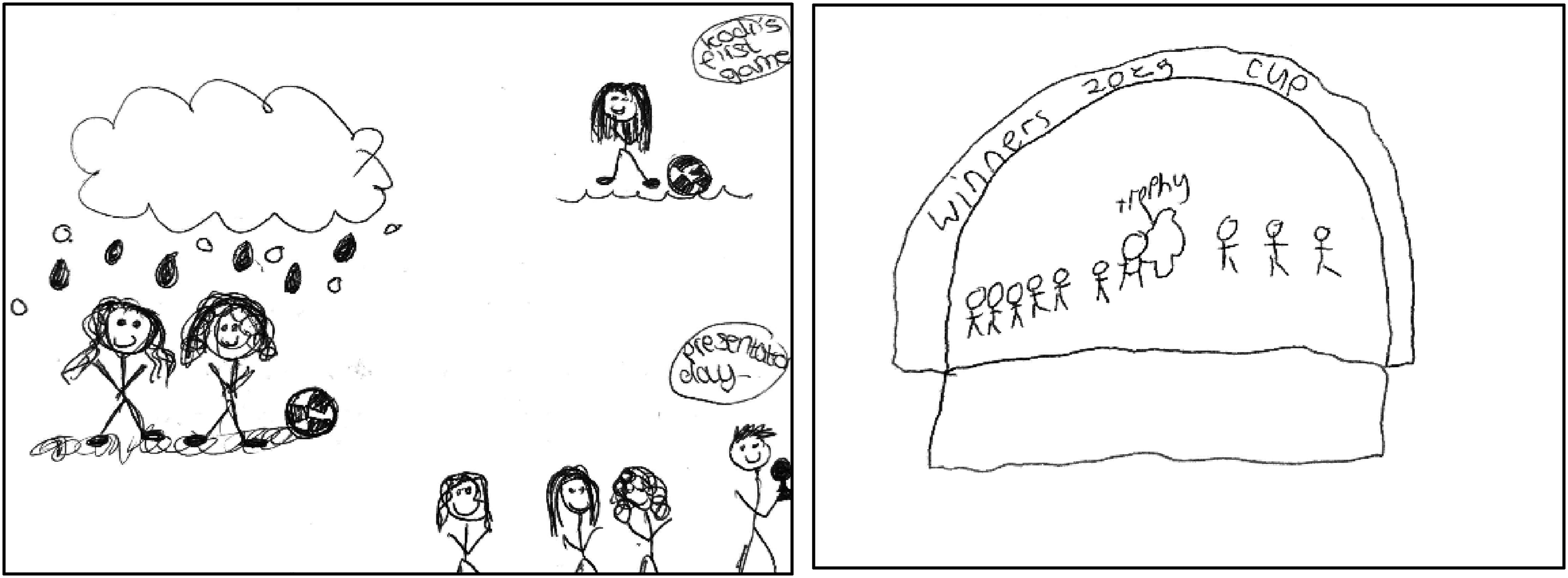
WDST drawings illustrating football as friendship and fun. Left: P25, Girl, <U12; Right: P1, Boy, <U12.
Children's drawings frequently featured trophies, scorelines, or league tables, aligning with verbal accounts that emphasised competitive outcomes (n = 37). Younger boys referred to trophies and league results: “Winning the league, we got a cup.” (P2, Boy, <U12) and older boys highlighted season outcomes and collective team performance: “I drew the league table because we went unbeaten.” (P14, Boy, >U13). Among girls, accounts reflected both performance oriented and mastery oriented emphases. These suggest that competitive meaning is not binary but layered, with children holding simultaneous mastery and performance aspirations. Some defined success in terms of elite progression and external recognition: “Success in football to me is ending up professional.” (P26, Girl, <U12). Others foregrounded development and opportunity within the sport context: “It's better if you win, but success is also opportunities like coming here.” (P41, Girl, >U13). Rather than representing opposing pathways, these perspectives suggest that aspirations for progression may coexist with an appreciation of personal development and learning (Figure 3).

WDST drawings illustrating success as winning and improvement. Left: P26, Girl, <U12; Right: P2, Boy, <U12.
Football elicited a wide emotional spectrum among boys and girls (n = 31), including pride, joy, frustration, anxiety, and sadness. Best day and worst day drawings (please see appendices for guidance) illustrated clear emotional highs and lows. Positive emotions such as excitement, pride, and happiness were commonly reported across both developmental groups: “When I scored my first goal… felt really happy.” (P3, Boy, <U12). However, among >U13 participants, negative emotions were more frequently linked to mistakes, losses, and perceived performance pressure. For example: “Felt awful after an own goal… teammates were annoyed.” (P15, Boy, >U13), “If we lose and people drop their heads it turns negative.” (P27, Girl, >U13), and “When I get annoyed I start crying on the pitch.” (P42, Girl, >U13). These accounts suggest that as players progress developmentally, emotional experiences may become more closely tied to performance expectations and social evaluation within the team context (Figure 4).

WDST drawings illustrating emotional highs and lows in youth football. Left: P3, Boy, <U12; Right: P42, Girl, >U13.
Children's enjoyment and sense of pressure were strongly influenced by coaches, parents, and peers (n = 34). Adults appeared to occupy a dual role within participants’ experiences, with supportive relationships enhancing confidence and enjoyment, whereas perceived parental or coach pressure diminished these experiences. Girls more frequently articulated the emotional significance of support, while boys tended to emphasise instructional and performance related interactions. Parental presence was described as meaningful and motivating: “My mum and grandparents were there, that was important.” (P4, Boy, <U12). Positive coach behaviours were associated with development and approachability: “Our coach is really nice and helps us improve.” (P28, Girl, <U12) and “The coaches are the GOATs… we can talk to them.” (P43, Girl, >U13). However, some accounts reflected pressure oriented climates shaped by adults: “My dad was shouting at me (for receiving a yellow card).” (P16, Boy, >U13) (Figure 5).

WDST drawing illustrating support systems. Left: P16, Boy, >U13.
Older participants, particularly boys and girls within the >U13 group, described a developmental shift towards greater self regulation, personal responsibility, and heightened awareness of expectations (n = 27). Whereas younger players emphasised fun and social aspects, >U13 participants increasingly referred to pressure, competitiveness, and the need to manage mistakes as football became more serious. The emphasis moved towards learning from errors and intentional improvement: “Got a yellow card fine, never did it again.” (P17, Boy, >U13), “Work hard and push through, improve technical ability.” (P29, Girl, <U12), and “Picked my head back up and scored a hat trick.” (P44, Girl, >U13). Older players described mistakes as more consequential as a perception of increased demand: “There's a lot of pressure on you to score or get your team back in the game.” (P17, Boy, >U13), and “If I miss a tackle, I pressure myself a lot… sometimes I crash out.” (P42, Girl, >U13). Competitiveness also intensified, with some noting that “the table gets took so flipping seriously.” (P39, Girl, >U13) or that certain matches carried heightened stakes: “If it's a game you have to win… you feel a lot of pressure from everyone.” (P17, Boy, >U13). External expectations reinforced this shift. Coaches’ reactions became more salient: “When your coach shouts at you because you’re not playing well, it's awful.” (P14, Boy, >U13), and some older children described perceived time pressure linked to progression pathways: “The older you get, the less time you have to impress people.” (P19, Boy, >U13) (Figure 6).

WDST drawings illustrating developing within the game. Left: P29, Girl, <U12; Right: P17, Boy, >U13.
Discussion
The present study offers new insight into how children experience increasing competitiveness in football, and how enjoyment, pressure, emotion, and support are experienced within this process. The findings reveal a clear developmental shift in how children make sense of football as it becomes more performance oriented with age. Football was consistently described as enjoyable and socially meaningful, irrespective of age/stage, yet older participants articulated more complex emotional responses, stronger performance expectations, and a heightened sense of seriousness. Using a robust and child centred methodology in the WDST approach, we captured developmentally sensitive and emotionally nuanced accounts of this transition that are often difficult to elicit using interview only approaches. These patterns map directly onto the themes of “Friendship and Fun” and “Winning and Improvement”, alongside greater salience of “Emotional Highs and Lows” and “Developing Within the Game” among > U13 participants.
Although shift in experiences were observed similarly across the sample, these shifts were not uniform across genders. Boys more frequently framed their experiences around performance standards, league tables, and outcome focused pressure, whereas girls more often described the relational and emotional consequences of evaluation, including sensitivity to peer reactions and coach behaviours. Such patterns align with previous research indicating that girls may be particularly attuned to social evaluation, while boys more commonly report pressure linked to performance norms and competitiveness.15,18–20,24 These findings may be understood through theoretical perspectives on competence threat and emotion–motivation coupling,21–23 as well as Achievement Goal Theory 40 and Self Determination Theory,6,25 which suggest that evaluative environments can differentially shape affect, perceived competence, and motivational regulation. Together, the findings indicate that increasing competitiveness is experienced through both structural changes in the football environment and developmental shifts in how children interpret evaluation, competence, and social feedback.
Younger children expressed task-focused meanings of success, emphasising fun, friendships, and participation, consistent with a mastery-oriented climate, aligned with Achievement Goal Theory. 40 Although formal league tables are not published at <U12 level, younger players still referred to winning or trophies, suggesting that competitive meanings are present and perceived even in the absence of formal structures. As age increased, narratives became even more ego involved, where success was defined by winning, league tables, and external evaluation. Importantly, this shift may reflect not only developmental changes in goal orientation but also exposure to a more ego involving climate shaped by league structures, selection practices, and coach and parent behaviours. Older players also mentioned the effect of their decisions, mistakes that “cost” the team, and pressure to “perform better”, illustrating a shift towards normative comparison and performance goals (e.g., targeting trophies and be the leader in their league table). These experiences suggest that competitiveness carries not only perceived value but also perceived costs, consistent with Expectancy Value Theory, which highlights the role of subjective costs alongside expectations of success in shaping engagement. 41 Whether this reflects a strengthening ego orientation within the individual or an increasingly ego involving environment, or both, remains difficult to disentangle and warrants longitudinal examination across this transition.42–44 These accounts suggest that both psychosocial maturation and contextual intensification may operate together, with maturing self awareness interacting with structural features such as league tables, must win matches, and evaluative feedback. The increasing competitiveness was perceived as either energising and linked to pride, challenge, and aspiration or it was associated with anxiety, frustration, and self-doubt. The coexistence of these responses underscores that competitive structures do not uniformly impair enjoyment but can either support or undermine it depending on how children appraise the demands they face. Consequently, sustained participation may depend less on the presence of competitiveness per se and more on how coaches and parents structure evaluative environments, emphasise effort versus outcome, and provide autonomy supportive feedback that buffers perceived costs, consistent with Self Determination Theory, which emphasises autonomy, competence, and relatedness. 6 This highlights the importance of support systems in shaping whether competitiveness is experienced as a challenge or a threat.
“Support Systems” was a theme in our results and demonstrates that these social contexts are not uniformly protective. Coaching behaviours, parental communication, and peer reactions can act as amplifiers or buffers of pressure. Supportive coaching, described as encouraging, approachable, and focused on improvement, helped children to manage mistakes and maintain enjoyment. Such behaviours reflect the fulfilment of basic psychological needs, particularly competence through mastery oriented feedback and relatedness through supportive interpersonal connections.6,25 Conversely, critical, inconsistent, or outcome focused responses (including parental shouting) were experienced as stressful and emotionally overwhelming, with potential to undermine perceived competence and autonomy. These findings align with research highlighting how parental pressure and disempowering motivational climates can elevate trait anxiety and reduce satisfaction in young athletes.14,16 The prominence of Friendship and Fun reinforces the importance of relatedness and social connection for sustaining motivation in youth sport,5,6 where children across all age groups positioned teammates, shared routines, and a positive atmosphere as core reasons for continued participation, even when results were disappointing. Gendered patterns were also noticeable, where girls more frequently described their experiences in relational and emotional terms, emphasising belonging, support, and the impact of others’ reactions on their feelings. They mentioned feeling embarrassed, or “dropping heads” after losses, and framed enjoyment around feeling accepted and valued within the team. While boys referred more often to competitive constructs such as league tables, “big games”, and performance expectations, and positioned pressure in relation to outcomes and standards of play. These views are consistent with literature suggesting that girls may be particularly sensitive to social evaluation and coach behaviours, whereas boys often experience pressure linked to performance norms and competitiveness.18–20,24 Recognising these patterns is important for understanding how similar environments may be interpreted differently by boys and girls, with implications for how coaches and clubs tailor support to ensure positive experiences in youth sports, which may be more likely to lead to longer term adherence.
By centring children's own narratives and expressions, this study advances current understanding of how social evaluation, perceived competence, and relational influences intersect to shape motivational experiences in youth football. In doing so, it provides theoretically grounded insight into the mechanisms that may underpin both sustained engagement and emerging disengagement, with attention to potential differences by gender and competitive phase. These findings aim to inform age-appropriate coaching, parental practices, and structural decisions that protect enjoyment while supporting healthy development within increasingly competitive environments. This study highlights several practically significant implications, especially given that The Football Association policy structures football at <U12 in England as non competitive, without published results or league tables. 12 The findings suggest that transitioning from this stage may mark a critical contextual transition influencing children's experiences of enjoyment and pressure. First, the developmental pattern observed suggests that clubs and coaches should not assume that enjoyment naturally persists as children progress through competitive pathways. Coaches working with older age groups may need to explicitly address emotional regulation, coping with mistakes, and managing expectations, rather than focusing solely on tactical or physical demands, which aligns with evidence highlighting variability in coaching practices and developmental priorities within grassroots football contexts. 45 Second, the findings reinforce calls for coach education that foregrounds autonomy-supportive, empowering environments and discourages overly controlling or punitive responses to errors. 14 Simple practices, such as separating feedback on effort from outcomes, involving players in setting goals, and providing constructive explanations when critiquing performance, may help to maintain enjoyment even as expectations rise. These strategies align with Social Cognitive Theory by emphasising mastery experiences and effort based efficacy rather than outcome validation. 46 Third, parents have a dual position in children's narratives, they are sources of pride and comfort when supportive yet can inadvertently become sources of pressure when highly evaluative or vocally critical. Parent-education initiatives that address sideline behaviour, realistic expectations, and emotion-focused support may therefore be important for safeguarding children's well-being as football becomes more serious. Given the gendered patterns observed in the study, parent education initiatives may also need to consider that boys and girls can interpret parental expectations and feedback in different ways, with implications for how support and encouragement are communicated.
Strengths, limitations and future directions
This study has several strengths. Methodologically, the WDST approach, combined with reflexive thematic analysis and pen profile diagrams, provides a rich, multimodal account of children's emotional, motivational, and social experiences in youth football. This approach offers a unique and original contribution to a still limited qualitative literature examining children's perspectives on increasing competitiveness in grassroots football. The inclusion of different age groups enabled exploration of developmental differences in how competitiveness is experienced, while sampling boys and girls from community football provided insight into gendered interpretations of similar environments. The rigorous analytical process further strengthens the credibility of these findings. Importantly, the findings are also practically significant, offering insights that may inform coaching practice, parental engagement, and organisational policy within grassroots football to help ensure that youth sport remains a positive experience that supports continued participation and lifelong physical activity. Reflexive team discussions, analytic triangulation, and attention to researcher positionality enhanced transparency and trustworthiness. However, there are also limitations that should be considered. Participants were drawn from community clubs in a single UK region, and were currently engaged in football, which may limit transferability to other cultural contexts, competitive levels, or to children who have already dropped out. While focus group formats can encourage rich peer dialogue, they may also shape what is shared, as some children may downplay vulnerabilities or align with dominant views in the group. In addition, although the WDST approach supports varied forms of expression, differences in drawing ability, verbal confidence, or developmental stage may have influenced how experiences were communicated. Variations in visual or narrative detail may therefore reflect expressive capacity as well as psychological meaning. Although WDST helped to elicit depth, all interpretations remain context-specific and shaped by the researchers’ theoretical and experiential lenses.
Future research should build on these findings by following players across key transition points (e.g., changes in pitch size, introduction of leagues or selection processes) to examine how enjoyment, pressure, and motivation evolve over time. Longitudinal and mixed-methods designs could help clarify how specific environmental changes (such as league restructuring or coaching practices) influence trajectories of engagement or dropout. Further work is also warranted to examine how gendered norms intersect with other social identities, and how coach and parent education programmes can best support children's emotional well-being and resilience as competition intensifies.
Conclusion
This study provides unique insight into how children understand and experience enjoyment, pressure, and growing competitiveness in football. Using a WDST approach, we identified a developmental shift from predominantly playful, socially driven engagement in younger players towards more performance-oriented, evaluative, and emotionally complex experiences in adolescence. While friendship and fun remained central across ages, increasing seriousness brought heightened expectations, stronger reactions to mistakes, and more frequent feelings of pressure, particularly among older participants. Gendered patterns suggested that boys and girls may interpret and respond to similar environments in distinct ways, with girls bringing relational and emotional aspects and boys emphasising competitiveness and outcomes. Collectively, these findings underline the importance of developmentally attuned, supportive coaching and parenting practices that preserve enjoyment, promote resilience, and help young players navigate the psychological demands present in the transition to more competitive football.
Footnotes

Ethical considerations
Ethical approval for the study was granted by the Coventry University Ethics Committee (Ref: P188517). All procedures complied with the Declaration of Helsinki and institutional guidelines for research involving human participants, with specific attention to safeguarding and the rights and welfare of children.
Consent to participate
Parents or legal guardians provided written informed consent, and all children provided verbal assent before participation.
Consent for publication
Not applicable.
Author contributions
Conceptualisation: RM, MD, WP.
Funding acquisition: N/A.
Data collection: RM, RS, WP.
Data analysis: RM, WP, RS, SG, SK, JT, KFD.
Writing – original draft: RM.
Writing – review & editing: WP, RS, SG, JT, SK, MD, KFD.
Supervision: MD, JT.
Project administration: RM, WP, MD.
Funding
The authors received no financial support for the research, authorship, and/or publication of this article.
Declaration of conflicting interests
The authors declared no potential conflicts of interest with respect to the research, authorship, and/or publication of this article.
Data availability
The data are not publicly available due to ethical and safeguarding considerations involving child participants but may be available from the corresponding author upon reasonable request and subject to institutional approval.
Appendices
Participant representation counts for each theme by developmental group (U12 and below, U13 and above).

| Theme | Total | U12 and below n = 26 | U13 and above n = 20 |
|---|---|---|---|
| Friendship and Fun | 43 | 25/26 | 18/20 |
| Winning and Improvement | 37 | 21/26 | 16/20 |
| Emotional Highs and Lows | 31 | 14/26 | 17/20 |
| Support Systems | 34 | 18/26 | 16/20 |
| Developing Within the Game | 27 | 9/26 | 18/20 |