




Abstract
While poor performance (e.g., losing streaks) seems to be necessary for a performance crisis, it is not a sufficient criterion. A team performance crisis is defined as lasting underperformance, involving threat states of team members. The team cannot cope with the situation and team functioning suffers. The overall aim of the present study was to align these theoretical considerations with the perspective of athletes experiencing poor performance. More specifically, the research questions focus on the understating of crises, predispositions and triggers of crises, as well as emotional and cognitive responses. In a case of N = 12 female youth athletes of a team that experienced a losing streak, semi-structured interviews were conducted and analysed using content analysis. First, athletes defined a crisis similar to the theoretically conceptualised team performance crisis. Second, many team factors and context variables were identified as either protective (e.g., the motivational climate in the team in question) or as a risk factor (e.g., frequent fluctuation of players) for performance crises. Third, attribution, expectations, and consequences played a role in the experience of crisis, but in a more complex way than theoretically proposed. Based on the findings, we suggest preventative measures for sport psychology consultants and coaches, as well as possible reflections for practitioners dealing with teams in crises.
Introduction
There are many examples of teams losing multiple games in a row. For example, early in the season 2025/2026, F.C. Liverpool suffered from a losing streak with four consecutive losses, a rare event for the club. While this is often referred to as a crisis from a lay perspective, from a literature-based approach, this alone does not constitute a crisis. In their review and position paper, Buenemann and colleagues 1 define a team performance crisis as lasting poor performance (i.e., losing streaks) involving threat states of team members. The team cannot cope with the situation and team functioning suffers. A losing streak may be considered when a team loses three or more games in a row. This is in line with humans’ susceptibility to streaks greater than three in the way that greater than three stands out. 2 This also becomes visible in sports e.g., in the allocation of passes to players who have scored at least three times in a row and are considered to have a “hot hand”. 3 However, while underperformance and losing streaks may contribute to a crisis, not all of them result in a crisis. In order for a crisis to arise other factors are necessary. This idea and relevant factors of which constitute a crisis is specified by Buenemann and colleagues, 1 where they propose a team performance crisis model, which forms the foundations of this study.1,4 The general aim is to explore the experience of potential team performance crises.
Team performance crisis
The team performance crisis model is conceptualised as various stages with increasing severity of a crisis as more games are lost. 1 It is characterised by lasting underperformance across games. This contrasts previous models of team underperformance, which describe collective collapse within a game. 5 The stages of team performance crises are labelled as predispositions (stage 0), crisis trigger (stage 1), crisis process (stage 2), and downward spiral (stage X). The research questions are based on these stages with a focus on predispositions and the crisis trigger. Figure 1 shows which factors are proposed to elicit higher threat states and thus, increase crisis severity. In the following, these aspects are elaborated leading up to the specific research questions of the present study.
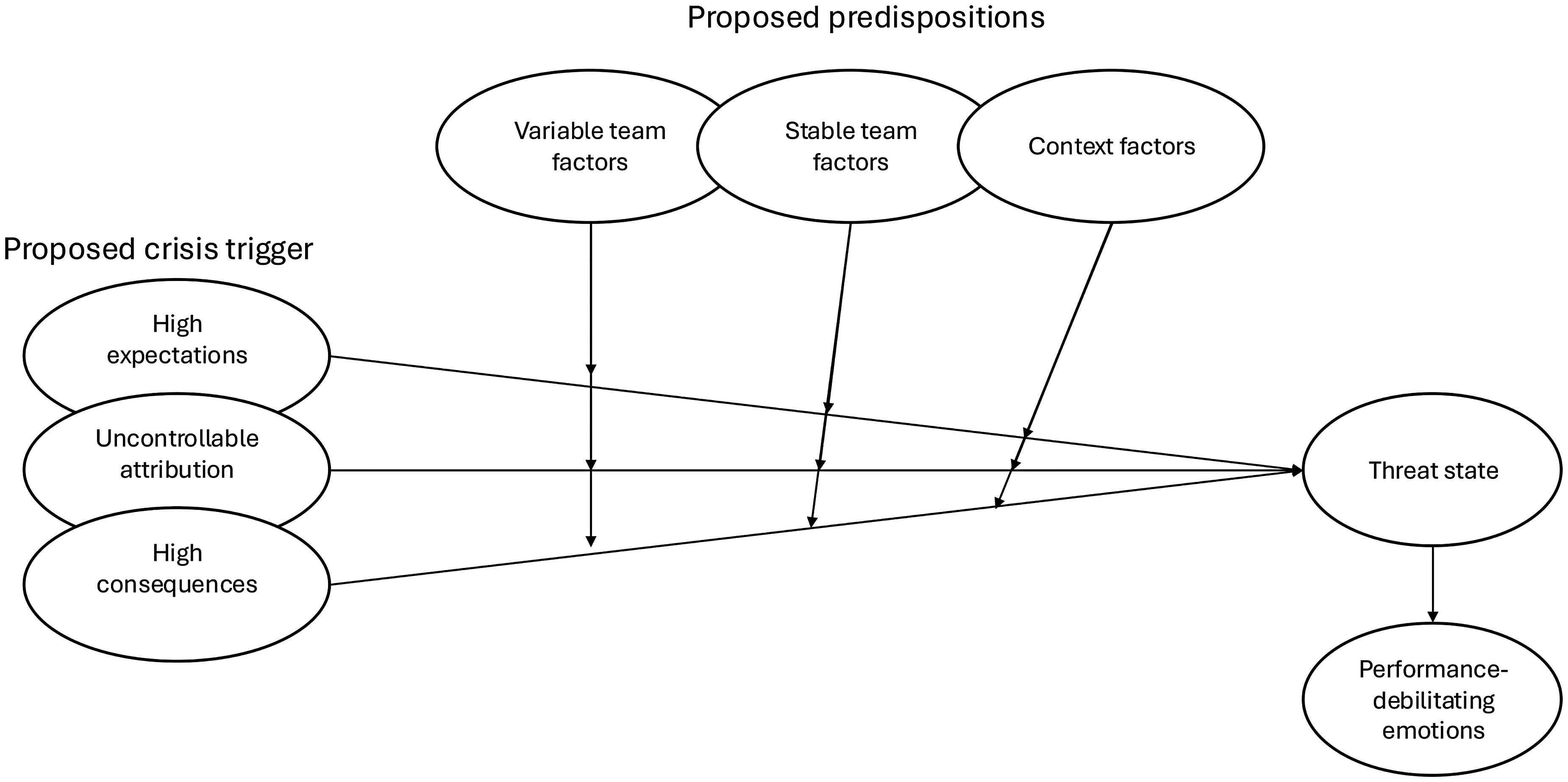
Visualisation of important aspects of a team performance crisis. This figure shows that part of the team performance crisis model that is related to the research question of the present study. This figure is adapted from the original team performance crisis model and shows the relationships of variables proposed by Buenemann et al. (2023). As a qualitative study, the present study does not test the causal relationships but rather the relevance of these aspects for a team performance crisis to be experienced by the team in question.
Predispositions
According to Buenemann et al., 1 predispositions include context variables such as characteristics of the club or association, as well as stable (e.g., age) and variable team dynamic factors (see Figure 1). Teams operate within unique contexts and possess distinct characteristics. For example, competitive adolescents, as opposed to adults, face sport-specific developmental challenges along with normative developmental challenges. 6 Contextual influences also include the club, association or even the greater context of society at large. As Behlau and colleagues 7 state, crises occur on different levels. Global crises (e.g., COVID-19) or the coaching staff influence teams. For example, the coach's ability to manage crises varies and can significantly impact dealing with crisis. 8
So far, cohesion (i. e., the tendency of a group to stick together 9 and collective efficacy i. e., the extension from individuals to groups describing the belief in the team's ability to reach a specific goal10,11) have been the primary variable factors linked to performance crises,1,4 due to their reciprocal relationship with performance.12,13 However, various group dynamic factors are of interest in sport psychological research. 14 Some examples include social identity (i. e., membership to a group as part of one's self-concept),15,16 roles, 17 or decision-making processes (i.e., the way common decisions are made or how they influence each other). 18 In this study, we explore which group variables are relevant in team performance crises rather than hypothesise relationships of specific variables with performance crises.
Cognitions and emotions
According to Buenemann et al. 1 two key components of the experience of crisis are the cognitive and emotional reactions. In a crisis, performance tasks are appraised as threatening, and emotions are performance-debilitating, usually negative. The biopsychosocial model 19 defines threats as demands outweighing available resources, while challenge is defined as available resources outweighing demands of a task. This evaluation of a stressor takes place in motivated performance situations. In other words, if it is not important, neither challenge nor threat is likely to be experienced. More recently, the concept of challenge and threat from the biopsychosocial model has been further developed in the light of situations specific to sport.20,21 Challenge and threat are suggested to elicit physiological and emotional reactions and have an impact on performance. A threat state is believed to be related to emotions harming performance, while a challenge state is believed to be related to emotions facilitating performance. 20
Proposed crisis triggers
Based largely on crisis decision theory, 22 the crisis trigger is conceptualised by a negative event (e.g., losing) that elicits a threat state and performance-debilitating emotions. It is proposed that expectations, consequences, and attribution influence threat states. More specifically, it is proposed that when expectations are high, the consequences of losing are significant, and losses are attributed to uncontrollable causes, threat states and negative emotions increase (see Figure 1).
Regarding expectations, it was found that performance slumps often occur after very good performance, suggesting that the good performance sets the performance expectation. 23 Regarding attribution, when failing, it is commonly believed that athletes look for the cause of their performance. Weiner 24 classified causal attributions to locus (internal or external), stability (stable or variable), and controllability (controllable or uncontrollable). In relation to threat states, controllable attributions seem to be most beneficial, while uncontrollable attributions seem to be detrimental.20,21 Finally, consequences of a match may be high, when it is personally important to a team or player. In other words, when a match is personally important, the consequences of losing are high. The theory of challenge and threat states in athletes underlines that challenge and threat states only occur in motivated performance situations. 20 Thus, by definition, high perceived consequences, in the sense that a lot is at stake, may influence the experience of threat.
Research questions
The general guiding research question that will be answered is how team members experience a crisis or why team members do not experience a crisis. First, we focus on the understanding of crises from athletes’ perspective given the objective criterion of a losing streak (i.e., having lost at least three games in a row) (RQ1). Specifically, the questions are what a crisis is from athletes’ perspective (RQ1a), if their definition aligns with the theoretical conceptualisation (RQ1b), and whether the team experiences a crisis or not (RQ1c). Second, what are context and stable and variable team factors that enable a performance crisis or protect the team from a performance crisis (RQ2)? Third, potential triggers and the significance of threat states are addressed (RQ3). Specifically, the relevance of expectations, consequences, and attribution for the players are analysed (RQ3a), as well as cognitive (i.e., challenge and threat states) and emotional experiences (RQ3b). Across all research questions, potential changes identified by the players across the season, may they be positive or negative, are attended to. This case study includes members of the same team so their objective results during the season are the same. However, their interpretation of the events may differ between each other.
Method
Methodological and philosophical orientation
A qualitative approach is well-suited to explore team performance phenomena, as shown in prior research.8,25,26 While Wergin and colleagues 26 use a grounded theory approach, 27 and Jekauc and colleagues 25 also developed a framework within their research, we suggest a case study approach. Teams amidst a losing streak are objectively losing, but subjectively evaluations of being in a crisis may differ. A case study approach is suitable when the focus lies on answering “how” and “why” questions. 28 In the present study, we want to answer the question of why a team in a losing streak (might not) experiences a crisis. Yin 28 also highlights the context in case studies. A case study is useful when contextual conditions are relevant to the phenomenon and the boundaries between the phenomenon and the context are not entirely identifiable.
Consistent with the nature and purpose of the study, we applied a structured qualitative content analysis informed by theoretical considerations while remaining open to participants’ subjective perspectives. The development of the interview guide and the coding procedure were guided by Mayring. 29 We asked specific questions about whether the players see themselves as being in a crisis or not. This makes the result of how many of the players suggest themselves to experience a crisis, having experienced a crisis, only partially experience a crisis, or do not experience a crisis, quantifiable. Further, we formulated clear research questions based on the team performance crisis model which informed coding. The aim of the content analysis was to systematically structure and reduce the interview material while preserving its essential meaning.
Epistemologically, the study is primarily rooted in a post-positivist stance, as we aim to approximate an understanding of what constitutes a crisis and under which conditions it is experienced. At the same time, aspects of the research, particularly the exploration of predispositions and underlying factors of crises, reflect a more constructivist orientation. These elements acknowledge that reality is co-constructed through the interaction between researcher and participants. Players’ accounts are inherently subjective, and their interpretation involves the researcher's perspective. Thus, the study integrates both structured, theory-informed analysis and an openness to individual meaning-making.
The core research team consisted of the first author (PhD student), the second author (PhD), and three undergraduate students. The remaining co-authors are senior scholars in sport psychology who provided critical feedback throughout the conceptualisation, data collection, analysis, and writing process. The first author conducted interviews and led the data analysis. Transcriptions were completed by the undergraduate students, and one student (a sport science student in teacher training) also conducted interviews. Both interviewers compete in the same sport as the players in the case study at a competitive level.
The first author's doctoral research focuses on performance crises, which shaped the formulation of the research questions, the development of the interview guide, and the coding process. She holds a defined conceptual understanding of team performance crises and their development. The coaches were aware of this research focus and approached the research team accordingly. However, no prior relationships existed between the researchers and the players.
Participants
Semi-structured interviews were conducted with players of a competitive female youth team (N = 12 interviewees) a in the age group between 15 and 18 years old (M = 16.8, SD = 1.0) (The type of sport is left out due to anonymity reasons.). The team members played in the team for an average of M = 1.8, SD = 1.2 (Min = 1, Max = 4) years. In the relevant season, they played in the 2nd highest league in Germany but outside formal competition; that is, they were neither eligible for promotion nor at risk of relegation. Nevertheless, they are listed in the ranking and receive points when they win, and the opponents receive points for their ranking. Of 24 played games during the season, they lost 21 games (see Appendix B for a more detailed overview and timeline). The sample was a convenience sample for a win-win situation with results being feedbacked to the coaches anonymously.
Interview guide
The semi-structured interview guide is based mainly on the team performance crisis model. 1 A first draft was created by one of the undergraduate students and refined between the student, as well as first and second author. Then the guide was sent to an expert on qualitative research who approved the guide and a test run with another student of the project team was carried out to adjust wording (see Appendix A for the full guide). One of the interviewers conducted the test run and the other observed. During the test run, for example, the difficulty of specifically asking about controllability became apparent, so alternatives to ask for this were generated (see Appendix A).
The first two questions are general questions about how the team was perceived at the beginning of the season and throughout the season. Question 3 specifically addressed what the athletes’ perception of a crisis is before providing them with our definition of a crisis. Questions 4 to 9 refer to the potential crisis triggers of the model, asking about both the individual perspective and how they see it from a team perspective. We also asked how expectations, controllability, and consequences changed. Then we addressed their standing in the league and how many games they had lost before asking about threat, emotions, as well as team functioning and coping (questions 10 to 14). b Question 15 addressed how the players expect the rest of the season to go, question 16 about their suggestions about how they landed in the situation, and question 17 concluded the interview with a question about whether they have anything to add on the topic.
Data collection
We received approval from the ethics committee of the University of Muenster (number: 2024-10-StB) and handed out informed consent to the parents. The players and parents received information about the goals of the study and that the interviews would be anonymised. The interviews were conducted at the university with some exceptions where the interview was held online via zoom. Prior to the interviews, a test run was conducted by one interviewer (first author) and observed by the other interviewer. The interviews were audio-recorded and transcribed. On average, the audio files were M = 43 min (SD = 13) long.
Data analysis
The transcripts were coded by the first author using MAXQDA 2022. 30 The approach to work rigorously was to discuss the coding thoroughly within the research team functioning as critical friends by discussing how statements were coded. 31 Content analysis was done both deductive and inductive.29,32 Four members of the research team coded three interviews independently c and between and after those were coded, the codes were discussed. For example, inductive codes included “incoming and outgoing of players” which was agreed to be “fluctuation”. In the end, the full coding system was agreed on between all members of the project team. Relevant statements were coded into existing categories or new categories were created. After analysing all interviews by the first author, codes were condensed (e.g., summarising codes that have to do with training), as well as structuring them into the crisis model framework including stable team factors and context, variable team factors, crisis triggers, and crisis process related to emotions and challenge and threat. Thus, examples of deductive codes are cohesion and collective efficacy as variable team factors, while other psychological latent variables were added inductively, such as leadership or motivational climate. For stable factors, deductive codes included for example, age and general stressors (e.g., school) as stable factors, and special playing permit and fluctuation are examples of inductive codes. When going through the material, we realised that some factors were not seen as completely negative or completely positive, resulting in a structuring of the factors in risk factors, protective factors, or both. The main analyst again discussed the codes with the other expert with the aim to critically reflect the analysis. For example, this resulted in disentangling individual attitudes from the team factors.
Results
All three main research questions were analysed and indicated the major themes. This includes the definition and perception of crisis (RQ1), as well as the predispositions (RQ2). Lastly, the potential triggers, threat states, and emotions were analysed (RQ3). Subthemes were categorised into the major themes: definition of crisis, perception of crisis, predispositions, consequences, expectations, attribution, threat states, and emotions. Regarding predispositions, it was further clustered whether statements were connotated with being a risk or protective factor for a crisis to emerge.
Definition of crisis (RQ1)
All athletes described their understanding of a crisis (full definitions and summarised table with crisis characteristics can be found in the Appendix C) (RQ1a), largely aligning with the theoretical concept (RQ1b). Across all athletes, all aspects of the theoretical definition were found. This includes a) negative performance for a longer period of time, accompanied by b) negative thoughts and c) negative emotions, d) not finding a solution, e) difficulties in team functioning, and e) a downward spiral. Additional views included crisis as something very bad happening rarely (Athlete 5). Another athlete viewed crises as something happening for a longer period but also stated that a crisis is hitting a low point. Others mentioned lack of motivation and poor training (Athlete 9). Looking at whether the athletes felt as if they were in a crisis (RQ1c), according to what they felt a crisis is, most state that they either were in a crisis (n = 6) at the time of the interview or that they were in a crisis (n = 4) earlier in the season or that they were only partly in a crisis (n = 2). This indicates that a crisis is perceived subjectively, even in a team. We can also infer that losing throughout the season is not enough to experience a crisis.
Predispositions (RQ2)
As a second step, predispositions in terms of context factors, stable team factors, and variable team factors were analysed. Many of the factors that are mentioned, may be interpreted as risk factors for a team performance crisis to develop. On the other hand, some aspects seemed to work well for the team, which can be interpreted as protective factors (see Figure 2). Additionally, the players differed in individual characteristics which was identified as being a risk factor within this team.
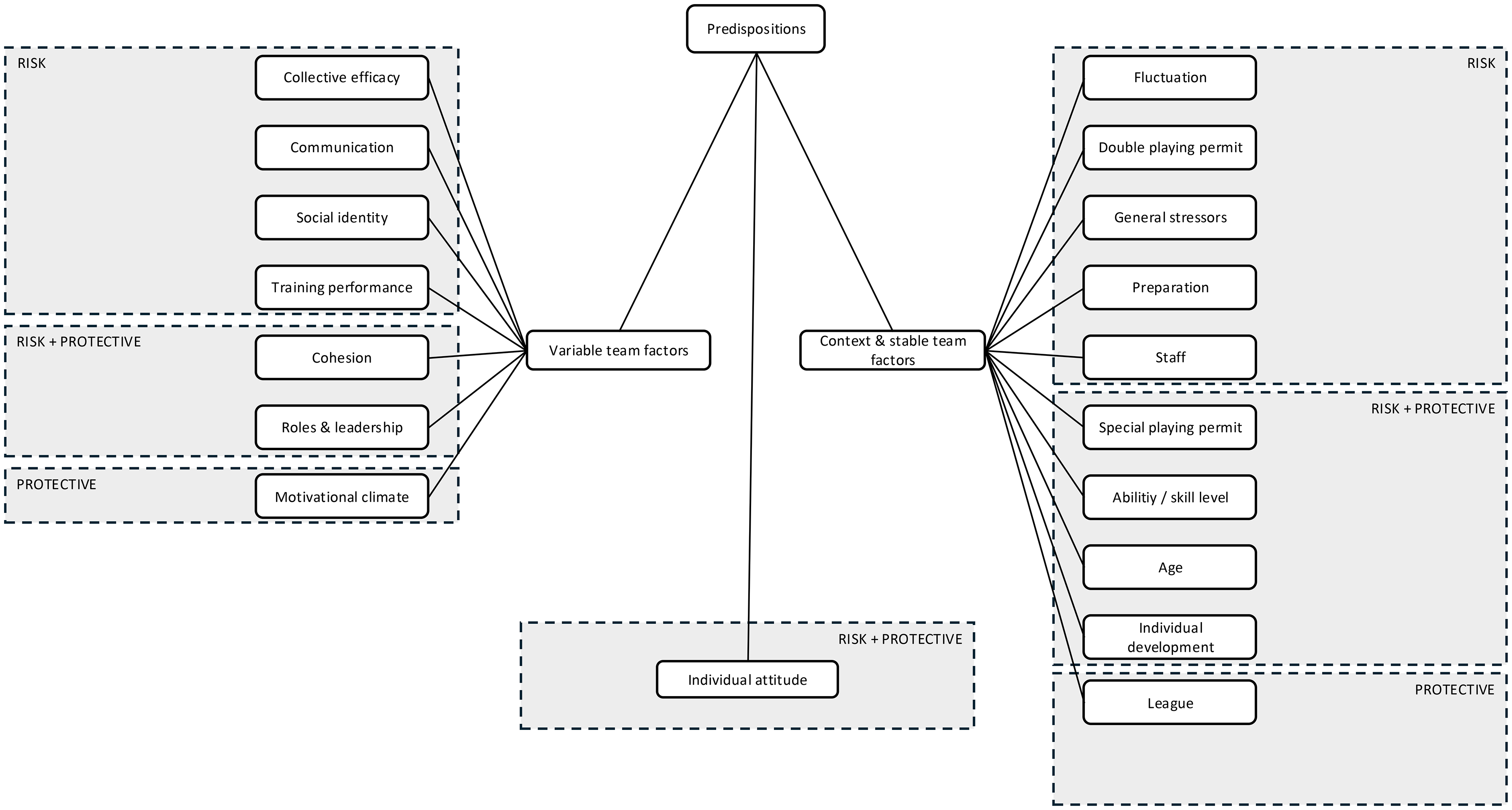
Risk and protective predisposition factors. The identified themes are clustered here with the identification of being risky or protective or both.
Stable team and context factors
First, we outline the context and stable aspects mentioned by the athletes. These include fluctuation, individual development, special playing permit, double playing permit, league, ability / skill level, preparation, staff, general stressors, and age.
Variable team factors
While the previously mentioned aspects remained constant across the season, other aspects may be more variable. Those include cohesion, collective efficacy, social identity, (leadership) roles, motivational climate, communication, and training performance (see Figure 2).
Individual attitude
Individual differences in terms of attitude became apparent. In this case study, this mostly refers to the attitude towards being a professional athlete and the individual motivation and effort put into training. One athlete said that these differences are responsible for the crisis, “[…] if we had more people who wanted to pursue competitive sports, the crisis wouldn’t be as much of a crisis. I think it maybe wouldn’t even be here in the first place” (Athlete 8). Many athletes elaborated that the team's standard and commitment to training needed to be higher.
Expectations, consequences, and attribution (RQ3a)
The triggers as proposed by the team performance crisis model were somewhat met in this case study (RQ3a). However, it seemed to be more complex than simply having high expectations, high consequences, and uncontrollable attributions for a crisis to develop. Interindividual differences, as well as changes over the course of the season, were observable (see Appendix D). Beyond performance expectations, expectations about handling defeats and team dynamics were unmet. For example, one athlete said, “I didn’t think the whole situation could escalate like that. Just… that no one was sticking together.” (Athlete 7). This shows that she expected the team to be able to stick together in times of losing. Further, over the season, expectations shifted: early losses fuelled a stronger desire to win, but later confidence declined. Regarding consequences of losing, the athletes suggested rather low consequences, because their improvement of skills is more important than winning (see individual development). However, over the course of the season, importance seemed to increase to stay motivated. Regarding attribution, when it did not go well, the players sometimes felt like being less in control, but control increased over the course of the season, presumably when most of the team felt that the crisis was over. Another dimension of attribution was internal and external causes, although the players did not always agree on the causes. Sometimes blaming each other and not taking responsibility came up (external), others acknowledged the team's responsibility (internal).
Appraisal and emotions (RQ3b)
It became obvious that threat was more present when they experienced a crisis. Over the course of the season, it seemed more of a challenge. Regarding emotions, a variety of emotions were stated for when they were experiencing a crisis.
On the other hand, negative emotions accompanied the team. These included fear, nervousness, disappointment, anger, sadness, doubt, tension, irritability, and frustration. One athlete gave a prototypical statement about what seemed to be very frustrating, “I think that's the frustrating thing, […] that we’re actually so much better than everyone else, but we just can’t bring it onto the court” (Athlete 3). Other athletes described that not living up to the potential made them angry, disappointed, or sad. Additionally, statements included feelings spreading in the team or influences of the coaches’ emotions. One of the players said “[…] sometimes the coaches are a bit tense because things didn’t go well at the weekend or something like that. And you can definitely feel it when there's that kind of tension in the air” (Athlete 6). While this demonstrates that emotional contagion processes took place, it also highlights that the phenomenon is not limited to competition but extended to practice.
Discussion
First, in this case study athletes have a similar understanding of a crisis as the theory. It seems to be an important criterion that a crisis occurs when there is no solution. Although only few athletes mentioned all or most of the theoretically relevant aspects, taken together, all aspects were mentioned in some way or another. Some athletes perceived themselves to be in a crisis at the time of the interview, others only partially, and others again suggested that they used to be in a crisis. During the interview process, the team was losing but not everyone always experienced a crisis, so a losing streak is not necessarily a crisis. The evaluation is individual. Aspects that were not specifically mentioned in or even contradict the original definition of team performance crises are rarity and hitting a low point. Rarity can also be found in other definitions of crisis, making it a plausible addition. 33 Further, hitting a low point may seem contradictory to the original definition. Jacques 34 highlights the differentiation between it being part of a process instead of an event. However, sometimes people may not realize they are in the process until they hit rock bottom, although the process may have started before. We would refrain from changing the definition to an event rather than a process, because accompanying processes (e.g., increasing threat states), as well as the perception of a downward spiral seem to be relevant aspects. The rarity of a crisis should be considered in future research. However, we cannot yet answer how often “rare” is.
Second, predispositions in terms of context variables, stable team variables, as well as variable team variables seem to play a role for the perception of crisis. In addition, the individual attitudes can contribute to whether an athlete perceives the team to be in a crisis or not. On the other hand, the athletes of this case study also recognize beneficial aspects which contribute to the perception of less of a crisis. Some aspects may vary and may at times be helpful but detrimental at other times. An important realization is the amount of different beneficial or harmful factors that came up. While these are highly specific for this team, other teams probably have their specifics which they have to deal with or positively framed, which protect them. For example, very specific to this team, is the fluctuation, special playing permit, and the double playing permit. Very frequently mentioned was the aspect of poor training and bad mood in training. This also seemed to go along with individual attitude in training and the effort athletes put into their training. The relationship between training load, mood, and performance has been investigated in several studies (for a review specific to soccer players see Selmi et al. 35 ). Patterns that emerged were for example that negative moods increase as the season progresses, and negative mood seems to be linked to full competition schedules. 36 In contrast, in the present study, mood improved as the season progressed, because team dynamics improved. In line with the literature however, mood was worse in times of stress such as schoolwork, which may relate to full schedules. In their review, Selmi et al. 35 suggest monitoring moods during the season to adjust training, as well as identify early indicators of stress and fatigue. The present study further underlines this aspect, as the players highlight how poor training quality and mood was during the times when they experienced a crisis.
Additionally, many of the variable team factors probably play a role in other teams as well, as they align with theoretical and empirical sport psychological knowledge. In this case, poor collective efficacy, poor communication, little social identity, and poor training performance were identified as risk factors. Cohesion sometimes seemed to be high and sometimes low. Low cohesion was interpreted as something negative and therefore a risk factor, while high cohesion was seen as protective. We can only speculate why results indicate both low and high cohesion. First, the perception of cohesion differs between players, which is why there is no common ground entirely. Second, it was pointed out that the team has a lot of fluctuation, which may lead to an improvement of cohesion over the course of the season, as the team gets to know each other better. Similarly, not having a leader was identified as risky. For the athletes, this became observable when there was no one to take responsibility. On the other hand, if someone was seen taking responsibility, this was identified as protective. The motivational climate seemed to be task-oriented, which was viewed to be protective. We would like to highlight social identity in this case study. Rees and colleagues 16 summarize the importance of social identity within sport psychology. It is suggested that allegiance occurs through the process of depersonalization which leads to people of the same group sticking together “no matter what”. 37 In terms of stress appraisal, it has been suggested that people are more likely to help those out whom they perceive to share the same social identity with. 38 Thus, for a team, it may be useful to highlight the shared social identity. This is further highlighted by suggested benefits of a social identity leadership. In their review, Steven et al. 39 found that leaders who create s strong group identity can improve team performance and resilience.
Third, in this case study team at times experiencing a crisis, theoretical suggestions of the relevance of expectations, consequences, attribution, threat states, and detrimental (usually negative) emotions played a role during the season. It is noteworthy that the aspects seemed to be changing over the course of the season. For example, expectations were dropping as more games were lost. With ongoing losses, expectations maybe were too low. The optimal expectations are probably realistic expectations, and both very low and very high expectations have the potential to be detrimental. Attributions and consequences also changed over time. As less players felt they are in crisis, controllability seemed to increase. The consequences of losing are more difficult to interpret. In future studies, it may be useful to consider different types of consequences e.g., poor training and bad mood. Concerning emotions, the reported experience was rather negative. This is in line with research in the realm of underperformance. For example, teams seem to use more inefficient, affect-worsening emotion regulation strategies in team collapse situations, and experience more unhelpful emotions. 40
Limitations and strengths
As a case study report, it is obvious that we are dealing with a very specific case. Especially special and double playing permit is not representative of any team in any league, and the youth sport context differs from adult settings. Nevertheless, the question arises what is representative of any team in any league. While this team has very individual characteristics, others may also have characteristics which have to be acknowledged.
A key limitation of this case study is the special playing permit of the team in question. Not being able to relegate lowers observable consequences of losing. While this raises questions about the relevance of the case, it may also indicate that other consequences play a role in the light of crises. The team performance crisis model 1 is mainly based on crisis decision theory, 22 where consequences include both direct and indirect consequences. While relegating as a consequence of losing may be considered direct, emotional and social consequences (e.g., deterioration of relationships) are more indirect, and may require attention in future studies. In this case study, the players fight for their individual careers and a place in professional sports.
Further, not only the team is specific, but the coding is also subjective. While the research team consisted of different members that discussed the coding procedure thoroughly and agreed on codes, the approach can still be criticised. The main analysis was conducted by a researcher in the field of team performance crisis, so her understanding may be biased by the theoretical perspective. Regarding coding, it can additionally be said that they do not provide evidence for causality either between the predispositions and a crisis to occur, nor between stable factors and variable factors. Some quotes were coded double e.g., individual development (stable) and motivational climate (variable), but we cannot necessarily conclude that a focus on individual development leads to a stronger task-oriented climate. While it can give us a hint, it remains speculative.
Nonetheless, we consider it valuable to be able to analyse a team that experiences such a prototypical losing streak to gain understanding in processes which may take place. While a focus group with this team may also have given valuable insights on shared group processes, we decided to conduct individual interviews in order for the team members to speak independently. For example, we wanted to address whether they felt they are in a crisis from their individual perspective and then compare this. Further research should address shared dynamics more dominantly, as well as offer more generalisability. Especially variable team factors which are latent psychological variables may also play a role in other teams and be risk or protective factors, but our research only allows for speculations for other teams. Further, we combined theoretical knowledge in addition to be open to new aspects. Although a single case study is not enough to validate the team performance crisis model, there is accumulating evidence for relevance of model propositions (e.g., inefficient coping, not finding a solution).
Practical implications
In the present study, it has become obvious that a team can identify many aspects which they find helpful or harmful in the context of team performance crises. Related to the results found on predispositions, we suggest teams to proactively think of risk and protective factors. Thus, we suggest that during the pre-season, a team may benefit from summarising characteristics that are specific to them. For example, they could collect individual factors that make them different to other teams in the respective category: context, stable team characteristics, variable team characteristics, and individual attitudes of team members. This could be done both with the staff as well as the athletes.
Another implication worth highlighting is the focus on goals for practice rather than competition, i.e., the motivational climate. For this team, it seemed as though high cohesion, task-orientation, fun, helping each other, and positive emotions were linked to the experience of better practice sessions. We suggest that sport psychological interventions address these topics. For example, there seemed to be individual attitudes toward playing elite sport and along with this, differences toward training. Especially in youth teams, this may be interesting to consider for both coaches and MPC's (Mental Performance Coaches). Further, this team seemed to deal well with focusing on individual development and thus creating a task-oriented climate. However, this focus on individual development may be responsible for them feeling like less of a team. Functioning as a team is important in addition to individual improvement. Considering this may also be a skill that athletes are able to learn, goals for practice could improve this component in addition to perfecting the individual skill set. These aspects of individual attitudes and individual development also link back to lacking social identity. Strengthening the identity as a team is another approach practitioners may take.
Lastly, the results of this case study highlight the importance of training and training atmosphere as opposed to a focus on competition. This may be different in other teams, but it is noteworthy for coaches and sport psychology practitioners to reflect on that. It should be considered how training atmosphere can stay positive and productive, even though competitions do not go well.
Supplemental Material
sj-docx-1-spo-10.1177_17479541261451852 - Supplemental material for Experiencing a team performance crisis during a losing streak: A case study
Supplemental material, sj-docx-1-spo-10.1177_17479541261451852 for Experiencing a team performance crisis during a losing streak: A case study by S. Buenemann, C. Behlau, M. Tietjens and B. Strauss in International Journal of Sports Science & Coaching
Supplemental Material
sj-docx-2-spo-10.1177_17479541261451852 - Supplemental material for Experiencing a team performance crisis during a losing streak: A case study
Supplemental material, sj-docx-2-spo-10.1177_17479541261451852 for Experiencing a team performance crisis during a losing streak: A case study by S. Buenemann, C. Behlau, M. Tietjens and B. Strauss in International Journal of Sports Science & Coaching
Supplemental Material
sj-docx-3-spo-10.1177_17479541261451852 - Supplemental material for Experiencing a team performance crisis during a losing streak: A case study
Supplemental material, sj-docx-3-spo-10.1177_17479541261451852 for Experiencing a team performance crisis during a losing streak: A case study by S. Buenemann, C. Behlau, M. Tietjens and B. Strauss in International Journal of Sports Science & Coaching
Supplemental Material
sj-docx-4-spo-10.1177_17479541261451852 - Supplemental material for Experiencing a team performance crisis during a losing streak: A case study
Supplemental material, sj-docx-4-spo-10.1177_17479541261451852 for Experiencing a team performance crisis during a losing streak: A case study by S. Buenemann, C. Behlau, M. Tietjens and B. Strauss in International Journal of Sports Science & Coaching
Footnotes
Acknowledgements
We would like to thank Jendrik Eils, Pia Kortendieck, and Julian Varnholt, undergraduate students who put a lot of effort into the project by helping with the interview guide, interviewing, transcribing, and discussions. Thank you, Chiara Reyer, for your help with the preparation of the manuscript. We would further like to thank Katherine A. Tamminen for her help and suggestions regarding qualitative work.

Ethical considerations
We received approval from the ethics committee of the University of Muenster (number: 2024-10-StB).
Consent to participate
Written informed consents was obtained by the participants’ parents.
Consent for publication
Not applicable.
Funding
The authors received no financial support for the research, authorship, and/or publication of this article.
Declaration of conflicting interests
The authors declared no potential conflicts of interest with respect to the research, authorship, and/or publication of this article.
Data availability
The data that support the findings of this study are available on request from the corresponding author, SB. The data are not publicly available due to ethical restrictions, because the information may be used to identify the participants.
Supplemental material
Supplemental material for this article is available online.
Notes
References
Supplementary Material
Please find the following supplemental material available below.
For Open Access articles published under a Creative Commons License, all supplemental material carries the same license as the article it is associated with.
For non-Open Access articles published, all supplemental material carries a non-exclusive license, and permission requests for re-use of supplemental material or any part of supplemental material shall be sent directly to the copyright owner as specified in the copyright notice associated with the article.
