



Abstract
This study explores how equestrian coaches enable or constrain meaningful participation among young equestrians within the context of Swedish riding schools. Grounded in the United Nations Convention on the Rights of the Child (UNCRC), particularly Article 12 concerning children's rights to express their views, the research adopts Cahill and Dadvand's 7P model as its analytical framework. Drawing upon approximately 170 h of ethnographic fieldwork and eight semi-structured interviews with riding instructors, the study examines how professional roles, pedagogical routines, and cultural traditions shape participation. The findings reveal tensions between performance-oriented and relational coaching approaches. While some instructors’ frame participation primarily through safety and technical mastery, others emphasise dialogue, trust, and emotional safety as integral to learning. Hierarchical power relations, safety norms, and time constraints frequently restrict young equestrians’ opportunities to influence decisions, yet relationally oriented instructors demonstrate that meaningful participation can emerge even within existing structures. The analysis highlights the dual role of coaches as both enablers and gatekeepers of children's rights, suggesting that participation in equestrian sport is not merely a pedagogical choice but a rights-based obligation. The study contributes to ongoing debates on cultural leadership and child-centred pedagogy in youth sport by illuminating how democratic coaching practices can foster safer, more inclusive, and empowering equestrian environments.
Introduction
The United Nations Convention on the Rights of the Child (UNCRC), adopted in 1989, represents a landmark framework aimed at strengthening children's rights globally. One of its fundamental principles, enshrined in Article 12, affirms every child's right to express their views freely in all matters affecting them, with due weight given according to the child's age and maturity. 1 This right is often referred to as children's participation rights, meaning, they have the right to influence and take part in decisions and contexts they are a part of. Despite the clarity of this right, operationalising meaningful participation remains a complex challenge, as participation can be interpreted and experienced in diverse ways. 2 The interpretation of participation ranges from involvement in decision-making processes to fostering a sense of belonging and inclusion within a community.3–5 Research has emphasised that adults play a pivotal role in facilitating participation by creating supportive environments where young people's voices are genuinely heard and valued.2,6
Within the context of sport, the importance of young athletes’ participation has increasingly been recognised, not least because it correlates with reduced risks of both physical and psychological harm.5,7 Studies in youth sport highlight that coaches profoundly influence athletes’ experiences, development, and wellbeing through their coaching styles, training methods, and the relationships they cultivate.8–11 Pritchard and Morgan
12
discuss how sport coaches sometimes neglect the child's right to act as an active agent in their own developmental trajectory and emphasises how coaches in football academies should cultivate authentic spaces for dialogue and by this create a meaningful participation. Kim et al.
13
demonstrated that athletes who experienced a democratic coaching style reported greater enjoyment and a stronger intention to continue participating in sport compared with those exposed to autocratic leadership. These findings resonate closely with Article 12 of the United Nations Convention on the Rights of the Child (UNCRC)
Research within equestrian sport, exemplifies how coaches enable young equestrians possibilities to have a voice and influence based on the coaches view of what young equestrians are capable of. 10 It is also illustrated how the traditional stable culture is characterised by hierarchies, entrenched gender roles 16 and unspoken social norms that often marginalise young equestrians’ voices. 14 This culture tends to silence individual voices and limit participation, resulting in exclusion and hampering the development of safe and inclusive environments essential for young equestrians. Transforming these cultural norms towards more participatory and supportive practices is thus vital for fostering inclusive equestrian settings.14,17 Young equestrians express a desire for greater involvement, particularly regarding the welfare of their horses. Nonetheless, they often encounter both explicit and implicit barriers to participation, including a coaching style focused on issuing commands rather than facilitating dialogue and reflection.10,14 This calls for a change of pedagogy in equestrian coaching which encourages a shift from directive instruction towards creating exploratory learning environments where dialogue, reflection, and meaningful engagement are central. 18 Such approaches could enable young athletes to feel empowered, take ownership of their learning, and develop holistically, which can also reduce dropout rates and enhance inclusion. 19 Creating environments where young athletes feel safe to express themselves and influence their experiences is foundational to fostering genuine participation. Thus, coaches have a responsibility not only to develop athletic skills but also to promote young people's voices, respect their rights, and build trusting relationships that support their overall wellbeing.7,20
Exploring the perspectives of coaches within sport makes it possible to identify both opportunities and barriers to the realisation of children's rights in practice. As Pavlogiannis et al. 15 emphasise, there is a clear need to move from merely descriptive research toward more explanatory and theoretically grounded studies, in which the role of adult leaders is analysed in relation to power dynamics, norms, responsibilities, and the position of the child in the sport landscape. Such an approach may contribute to developing a more rights-based and child-centred sporting culture.
Given this background, the role of riding instructors in equestrian sport is critical. By shifting from authoritarian, command-driven leadership to facilitative, dialogue-based coaching, riding instructors can encourage young equestrians to participate meaningfully in decisions impacting their training, development, and the care of the horses. This study therefore aims to explore how riding instructors constrain or enable meaningful participation among young equestrians, contributing to a safer, more inclusive, and motivating equestrian context. The study draws on Cahill and Dadvand's 21 re-conceptualisation of youth participation, using the 7P model as an analytical lens to explore riding instructors’ perspectives on young equestrians’ participation. The seven dimensions within the 7P model are Purpose, Positioning, Perspective, Power Relations, Protection, Place and Process which will be explained in the section about the theoretical framework of the study.
Creating culture for (learning) participation
Understanding participation not merely as an individual act, but as something that unfolds within and through culturally constituted practices, requires an approach that foregrounds culture as a central. Drawing on the work of Hodkinson et al., 22 one important thing in learning cultures is how cultures are created, sustained and transformed to develop young athletes. Within this lies the assumption that learning takes place through situated social practices that are both structured and structuring. A learning culture can be seen as the social practices through which learning is enacted, shaped by the actions, dispositions, and interpretations of those who participate within them. 22 Cultures are generated through institutional traditions, artefacts, pedagogical routines, and expectations. Coaches, for instance, may act with intention to shape a participatory learning culture, but their efforts are mediated by their own experiences and the social expectations of the context. 5
In equestrian sport settings such as riding schools, these dynamics are visible. The roles of instructors, staff, and even senior peers function as parts in a hierarchical setting where the young equestrians often are at the bottom, in a given culture which young equestrians adapt to and accept. 14 Kamuk et al. 23 argue, that coaches in youth sport and physical education contexts should be understood as cultural leaders. Their influence extends beyond instructional planning to include the construction and reinforcement of values, norms, and power relations that shape the participatory atmosphere. 24 However, children's possibilities to express their voices should not be conditioned. As Welty and Lundy 25 argue, respecting children's right to be heard in matters that affect them is not merely an example of good pedagogical practice, but a binding legal obligation under Article 12 of the UNCRC. The implementation of Article 12 requires more than offering a voice; it requires that children are provided with space to express views, that their views are actively listened to, and that they have a real influence. 26
Yet, as Hodkinson et al. 22 remind us, cultures are not easily transformed through intention alone. Participation is always embedded in social expectations both explicit and implicit about what roles young people are allowed or expected to perform. In equestrian contexts, these expectations are often naturalised within institutional routines, hierarchies, and norms that privilege the authority and experience of instructors over the insights or autonomy of young equestrians.10,14
Coaches influence
In youth sport and physical education, coaches occupy a position not only as instructors but as leaders who actively shape the cultures in which participation occurs. The coach influences the young athlete in many ways, not only in the development of athletic skills but also often on a personal level. 9 Rather than viewing coaching merely as a matter of organising sessions or delivering technical instruction, recent scholarship emphasises the broader cultural influence that coaches exert through their daily practices and pedagogical decisions.23–24
Coaches influence not only what is taught but how learning is experienced, through the relational climate they establish, what they reward or ignore, and how they structure power dynamics within the group. As Light and Harvey 18 argue, this makes the coach a pedagogical actor whose role is less about transmitting knowledge and more about co-constructing learning through dialogue. Within a relational pedagogy, effective coaching depends on mutual respect. Coaches must therefore not only allow space for young people to speak, but also actively listen and ensure that what is said has the potential to shape decision-making. Without this, participation risks becoming symbolic rather than substantive. 26
The work of Davies et al. 16 provides a strong conceptual foundation for exploring how young equestrians can be meaningfully involved in their own learning processes within equestrian sport. The authors highlight that skill development arises from the ongoing interaction between horse, rider, and environment rather than from unilateral control or prescriptive instruction. Extending this logic to a children's rights framework, this underscores the ethical and pedagogical importance of creating learning environments where young equestrians are encouraged to voice their perceptions, take part in decision-making, and co-create training strategies.
Theoretical framework
This study adopts the framework of the 7P model 21 to explore youth participation within the context of Swedish riding schools. Cahill and Dadvand question earlier models of youth participation for assumptions of hierarchical structures and their focus on levels of engagement or impact, which often overlook the importance of context, power relations, and cultural specificities. The 7P model seeks to offer a more flexible and context-aware framework that can guide both research and practice. The model comprises seven interrelated domains, each of the seven domains plays a role in analysing participatory practices. 21
The seven Ps are analytically distinct but dynamically interdependent. Purpose shapes why participation occurs and influences all other dimensions. Positioning determines how young people are constructed, which in turn affects their Power relations and the legitimacy accorded to their Perspectives. Place identifies the settings and conditions both positioning and power by structuring who may speak and how. Process concerns the facilitation of participation, mediating how purpose is enacted and how perspectives are translated into influence. Protection intersects with power and process, ensuring ethical safeguards while potentially constraining agency. The model stresses the interconnectedness of these domains; changes or tensions within one often reverberate across others. 21 This holistic approach encourages an understanding of participation that moves beyond simplistic metrics or universal prescriptions. Theoretically, the model serves as a valuable analytical tool to assess existing youth participation initiatives, revealing strengths, weaknesses, and tensions particularly regarding power and voice. The 7P model is for example applied when discussing youth governance, participatory studies and health contexts.27,28 However, the model could be interpreted as normative, prescribing how participation ought to function rather than how it operates in practice.
Methodology
The study is based on eight interviews with riding instructors at two riding schools in Sweden (four riding instructor at each school), also approximately 170 h of fieldwork were done to collect data. Thus, the study is ethnographic as it focuses both on what is said and what is done. 29
Equestrian sport is one of the largest youth sports in Sweden and there are approximately 430 riding schools, which are operated either as private enterprises or as associations. The Swedish Equestrian Federation reports that half of the members of the country's riding clubs are under 26 years of age and are classified as young equestrians. 30 The riding schools in the present study are association-run and considered as large riding schools in Sweden with >500 practitioners per week, >8 employees, and number of horses >35. Geographically, they are located close to a large city in Sweden.
The study has been approved by the Swedish Ethical Review Authority (Dnr 2022-07043-01) and the riding instructors who participated in the study were informed orally and in writing during a meeting at the riding school and gave their written consent. All material from the study is handled according to the principles that apply to ethically correct research in Sweden. 31
This research is a part of a larger study where young equestrians are included and their voices are heard in focus group interviews and in informal conversations in the fieldwork.10,14
Data generation and analysis
The managers at the riding schools were contacted and informed about the study, they informed their staff and decided that they wanted to participate in the study. Fieldwork lasted for eight weeks at each riding school and thereafter interviews were conducted. The fieldwork included observing when the young equestrians and riding instructors interacted in the stable before the riding lesson, during the riding lesson and after the riding lesson when taking care of the horses. In the fieldwork observations were done for approximately four hours, two to three times a week. The observations took place in all parts of the riding school such as, stables, riding arena and cafeteria. Consequently, the fieldwork contained observations, listening to conversations, and engaging in informal dialogues with both riding instructors and young equestrians.
After eight weeks the interviews with the riding instructors were conducted, four at each riding school. The interviews lasted from 50 min to 80 min followed a semi-structured interview guide developed based on levels of participation 3 and the idea that it takes more than just making one's voice heard to create participation, where space, audience and influence also become important. 26 The eight riding instructors had different educational backgrounds and experience from equestrian sport and spanned an age range of approximately 25–75 years. The youngest instructor had been working as a riding instructor for five years, and the oldest had been in the profession for around 50 years.
The analytical procedure started by transcribing field notes and interviews. In the next phase, the author read the transcriptions again reflecting about perspectives on participation that was highlighted in different ways of the riding instructors. Thereafter a matrix was constructed (see figure 1) in relation to what was seen in the fieldwork and what was said in the interviews. The analytical question that was used in this step was: What do coaches express or enact supporting meaningful participation related to 7P model?
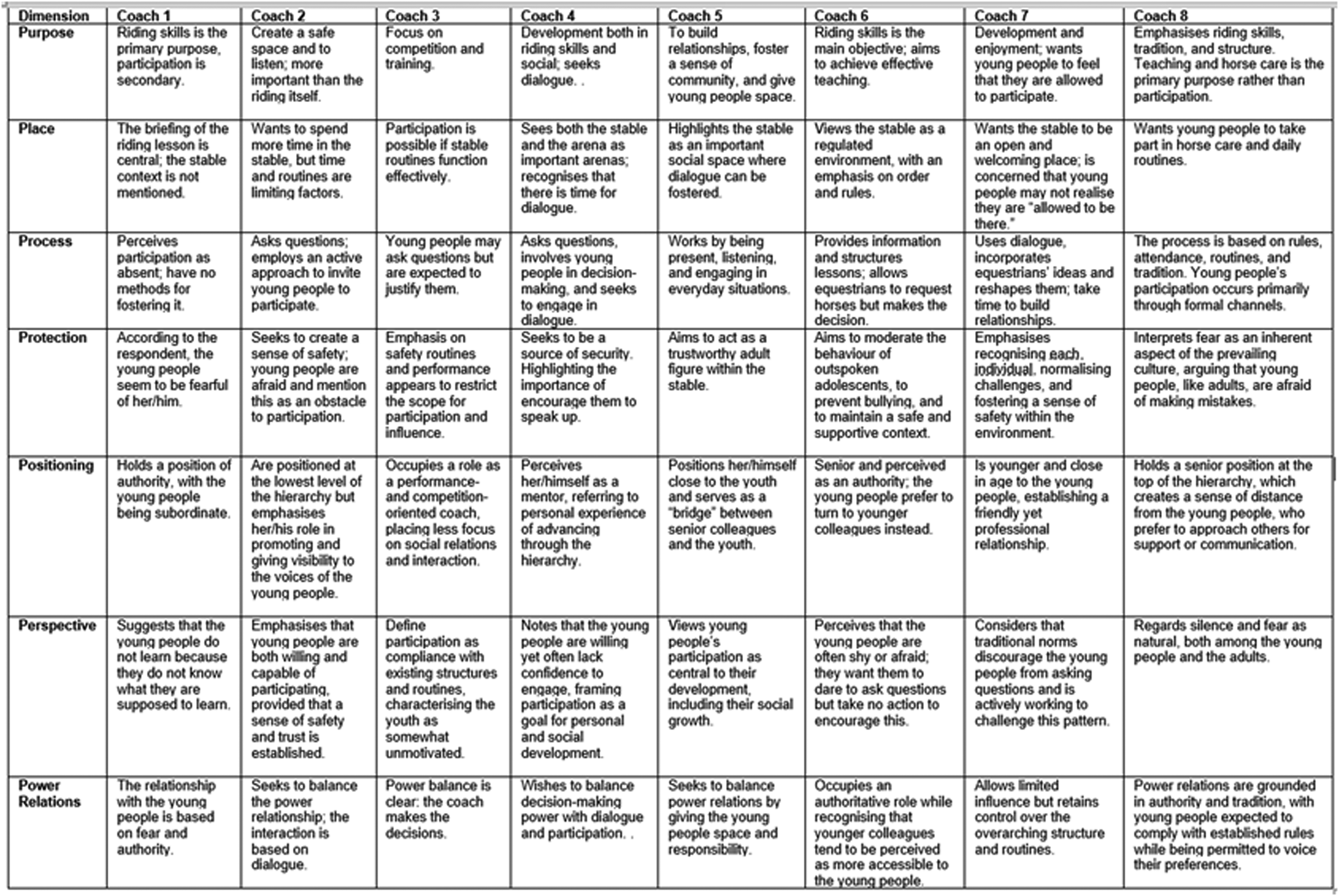
Illustration of equestrian coaches in relation to the 7P model. 562 × 376 mm (38 × 38 DP).
Pre-understanding
From a methodological perspective, the concept of pre-understanding is acknowledged as a vital element in the reflexive process. 32 My pre-understanding is that I have been active in equestrian sport as an athlete and as an instructor. When entering the field, I as a researcher inevitably bring personal experiences, expectations, and disciplinary assumptions that shape how observations are made and interpreted. Recognising and critically engaging with this pre-understanding allowed me to remain sensitive to how my own positionality influenced the interactions within the research setting and the construction of meaning. By maintaining reflexive awareness throughout the research process, it became possible to navigate the complexity of the field, thereby enhancing the credibility and depth of the ethnographic account.
Findings
Figure 1 shows an overview of the findings and illustrates that the coaches have a fundamental tension in their way of looking at meaningful participation, this often seems to be attributed to cultural norms and values.
There are some overall patterns in the analysis: some coaches emphasise the importance of riding knowledge, structure and order (coach 1, 3, 5, 8) while others emphasise the importance of dialogue, protection and relationships (coach 2, 4, 5, 7). For several of the coaches, participation thus appears to be subordinate to riding and safety, while others see young people's influence as central to their development. The culture shown in the analysis show cultures where silence and uncertainty are something that the riding instructors themselves point out in the young equestrian's context but also that they believe is part of the tradition in equestrian sports. The findings are presented below from different perspectives, with examples from interview excerpts and fieldnotes.
Purpose, what participation is
There is a clear range in how the different riding instructors view participation. Some of them see that the purpose is primarily for the young equestrians to learn to ride, and it is the coaches who hold the keys to the riding skills. This means that the young equestrians should not or cannot be involved. Participation is thus reduced to following a framework without real influence.
Interviewer: How would you say…do they have the opportunity to influence their riding lessons?
Coach 1: No, they cannot. I am not sure to what extent they should. No, not really…
Interviewer: Is it possible for them to influence anything in the stable?
Coach 1: … I do not think it even occurs to them that they could make such a suggestion.
Interviewer: And why do you think that is?
Coach 1: Well, they have never been allowed to take part in decision-making.
Some of the riding instructors see participation with a broader purpose where participation is about dialogue and personal development in addition to riding. For them, working with dialogue and interacting with the young equestrians are important. They take the time they need to see and listen to the young equestrians and thereby create space for participation.
Fieldnotes: In the riding arena, the young equestrians are informed about the two upcoming competitions. They are also asked to reflect individually on whether and how they wish to participate in the competition, including which classes are available. Participation appears to be voluntary, and the young people seem to have a relatively high degree of freedom in choosing among the levels offered. Coach 4 appears highly supportive. Questions about planning for the horses arise spontaneously while the group is walking their horses, and Coach 4 responds to them.
Here, relationships are created that reduces the hierarchies and encourages the young equestrians to have a voice. This shows that some of the riding instructors clearly create a process where participation becomes possible. However, there are also differences in what the process of participation looks like; one works actively to ask questions, another involves the young people in decisions but retains the decision-making power themselves.
Fieldnotes: Coach 7 speaks to them individually as they pass by. The young equestrians are asked to identify “one thing” in their own riding to focus on during the session. “One thing is enough: you cannot focus on everything.” As they subsequently pass, Coach 7 walks alongside each rider and asks, “What are you focusing on?” The rider responds, and they engage in a brief exchange. After having spoken to everyone, Coach 7 addresses the group: “It is very interesting to hear what you think, you are definitely on the right track.”
Other riding instructors are very controlling, and someone describes that young equestrians are not involved and have no active strategies or plan to make them involved.
Interviewer: Do they ever come forward with ideas or suggestions?
Coach 8: No, I would not say so, if you do not actively ask them. And I know that I am not very good at doing that. It is not as they come to me and say, “Today we would like to practise this.” I have to pose the question.
Thus, there seems to be a conflict in how participation is viewed and what opportunities are given to young equestrians to influence. Some of the coaches are performance-oriented and some of the coaches take a more relational and development-oriented approach which impacts their view of meaningful participation.
Place and routines
The context in which the riding instructors operate appears to significantly influence how participation is either facilitated or constrained. Several coaches describe how routines, time pressure, and safety considerations restrict the equestrians’ opportunities for influence: factors that are often perceived as being beyond their control. Safety, in particular, is frequently invoked as a justification for limiting young equestrians’ participation.
Interviewer: What do you consider participation to be?
Coach 3: Participation… for me, it means that they are engaged in what they are doing. But participation in the sense of having influence… that is difficult here. Because there are safety procedures and established routines governing how things are to be done.
Furthermore, the riding instructors’ conceptualisation of what participation entails appears to shape their understanding of whether, and in what ways, young people can influence. For instance, one riding instructor defines participation narrowly: as involvement in the debriefing of a riding lesson and argues that since young equestrians lack sufficient knowledge about riding, they cannot meaningfully participate.
Coach 1: I am sometimes struck by the fact that… they seem not to know anything, even in theory. They really do not seem to know…I find myself wondering why: are they not learning anything? Or do they simply not dare to respond? I honestly do not know. I think that they would not be able to list, for example, the leg aids and the rein aids.
Interviewer: When would you say they are most involved?
Coach 5: Oh… For me, it is most often when we are talking, particularly in the stable. I would say that it is in the stable that they show the greatest development and engagement. That is where they demonstrate: “Yes, this is what we have learned,” They might say, “Now we can see if a horse has an injury,” or whatever it may be…It is fascinating to see. Some of them are half my age, and yet they know so much.
Hierarcies and power relations
A recurring theme in the analysis is that young equestrians, according to riding instructors themselves, appear to be afraid of making mistakes or of expressing their opinions. Some of the riding instructors regard this as a natural aspect of stable culture.
Interviewer: Who would you say the young people turn to?
Coach 1: I think they would turn to Coach 5 or Coach 7.
Interviewer: So they are the closest, in a sense?
Coach 1: Yes, they are closest in… the hierarchy, in a way… Pause… Yes, I think that is why.
Coach 1: I do not think they would dare to approach me. No, they would go to Coach 2.
Interviewer: Why would they not dare to approach you?
Coach 1: I think they find me a little intimidating.
The existing cultural traditions seem to legitimise power relations, sustaining hierarchical structures with the instructor as the authority. Some coaches acknowledge that the young equestrians are afraid of them yet take no active steps to alter this dynamic. One instructor, who identifies as competition-oriented, claims that their achievements command great respect from the riders resulting in considerable control over their participation. Another instructor, by contrast, recognises their authority but actively seeks to downplay it by inviting dialogue and involving the young equestrians. Thus, there is a clear distinction between those who reproduce hierarchical relations and those who deliberately work to equalise power. There are also coaches who consciously strive to create a sense of protection, often drawing on their own memories of being fearful as young equestrians.
Coach 4: I think that young people, in general, do not dare, they are afraid. When I think back to how I was myself, if the riding instructor asked a question, I was afraid of giving the wrong answer. And I think that may be what it is about here as well: not wanting to appear foolish in relation to the riding instructor.
These riding instructors adopt a more relational and youth-oriented approach, emphasising the importance of accessibility and the creation of space for both safety and influence. Fear among young equestrians emerges frequently in the coaches’ discussions of participation, but it is managed in different ways: either through authority and or through efforts to demystify the instructor's role and encourage dialogue.
In sum, the analysis of the 7P's reveals several key tensions within the study's findings. Regarding purpose, coaches vary between prioritising riding technique and social development. Place alternates between the riding lesson and the stable as a social arena in which meaningful participation may occur. Process spans a continuum from rule-based instruction to dialogic interaction. Protection is interpreted either as safety ensured through rules or as safety cultivated through relationships. Differences in positioning and power relations are the most pronounced: tradition situates the riding instructor as the authority, while some consciously attempt to redistribute power. Finally, perspective demonstrates that young equestrians’ silence is understood either as a culturally ingrained given or as a challenge to be addressed through pedagogical work.
Concluding discussion
The 7P model provides a useful framework for analysing children's and young people's participation. From a scientific perspective, it aligns with established research in childhood studies, education, and sport pedagogy.2,7,20,22 This section will provide some concluding thoughts about how riding instructors constrain or enable meaningful participation among young equestrians.
Rationale for enabling participation
The study highlights how riding instructors’ understandings of participation are closely linked to their interpretations (purpose, perspective) of their professional roles. Some instructors adopt an authority- and performance-oriented stance, focusing primarily on athletic results and perceiving participation as something difficult to influence or manage. Others emphasise dialogue, trust, and emotional safety, aiming to create inclusive environments where young equestrians feel both heard and respected (protection). Between these positions are those who recognise the influence of contextual factors (place, positioning) such as performance demands, seniority, or time constraints that limit opportunities for genuine participatory practices.
Meaningful participation, however, entails more than allowing young people to express their views; it requires that their perspectives actively inform decision-making processes.21,26 Research also indicates that young people may prioritise social interaction and belonging over competitive outcomes, underscoring the importance of aligning participation with their everyday experiences and interests. 23 The instructors’ perceptions of their own influence, and of what young people are capable of (process, perspective, power relations), thus become crucial in shaping opportunities for authentic engagement. Moreover, the tension between performance orientation and relational, trust-based approaches reflects deeper questions about professional identity, safeguarding, and ethical coaching practice.9,11 In this sense, riding instructors play a pivotal role in enabling participation that is meaningful, inclusive, and responsive not only for the most vocal or skilled young equestrians, but for everyone involved. 10
Participation and power
The ways in which participation is understood are closely tied to the riding instructors’ personal values and their position (positioning, power relations) within the organisational hierarchy. Any meaningful discussion of participation must therefore engage with questions of power. Within sport and leisure contexts, entrenched hierarchies often delimit young people's autonomy and decision-making capacity. 14 Consequently, adults must critically examine their positional power and take active responsibility for creating genuine rather than symbolic opportunities for influence.3,6
The seven dimensions of the 7P model reveal how various aspects of riding instructors’ everyday practices require reconsideration to enable young equestrians’ participation. Participation should be conceived as an ongoing, relational process rather than as a series of discrete events. Shier's 6 framework demonstrates that sustained opportunities for dialogue and feedback strengthen children's sense of inclusion, while empirical studies indicate that when young equestrians are involved in decisions regarding, for example, training routines or horse selection, their sense of agency and ownership is enhanced. 14 The present study identifies both constraints and enablers of participation, revealing that these are largely determined by instructors’ professional self-understanding and their underlying conceptions of children and young people (purpose, process, positioning).
Children's right to meaningful participation
Article 12 of the United Nations Convention on the Rights of the Child (UNCRC) stipulates that children have the right to express their views on all matters affecting them and that such views must be given due consideration in accordance with age and maturity. When the findings of this study are interpreted through this rights-based lens, several structural and cultural tensions within riding schools become apparent. There is a general lack of systematic mechanisms ensuring that young equestrians’ voices are heard, and opportunities for expression are often contingent upon the attitudes and dispositions of individual adults. Silencing children's perspectives under the pretext of safety, or assuming their lack of competence, stands in direct contradiction to the principles enshrined in Article 12. Tradition frequently supersedes the Convention, producing a culture in which young equestrians adapt to prevailing norms rather than feel empowered to articulate their views. 14 Nonetheless, counterexamples exist. Some instructors actively challenge these entrenched patterns by initiating dialogue, inviting participation, and conceptualising the stable as a social and relational space. Such practices are more closely aligned with the intent of Article 12, as they create environments where children's voices are recognised and acted upon. However, these examples remain exceptions rather than established norms.
From a children's rights perspective, the right to participation within equestrian sport remains precarious. Participation is often framed as an optional enhancement, dependent on the instructor's personal disposition, rather than as a fundamental right. To fulfil the intentions of the Convention, riding schools must therefore strengthen instructors’ competencies in participatory and rights-based pedagogies, while simultaneously addressing the cultural and institutional structures that restrict children's influence. Although concerns regarding safety and tradition remain deeply embedded, emerging practices that prioritise dialogue, inclusion, and shared responsibility point towards the possibility of broader cultural transformation within equestrian sport.
Footnotes
Acknowledgements
I would like to thank the reviewer for encouraging and constructive suggestions for improving the manuscript. I am also grateful to my colleagues at GIH for valuable discussions and conversations in the research process.

Ethical considerations
The study was approved by the Swedish Ethical Review Authority (Dnr 2022-07043-01).
Consent to participate
Informed consent to participate was obtained from all participants.
Funding
The author disclosed receipt of the following financial support for the research, authorship, and/or publication of this article: The research has been funded by the Swedish-Norwegian Foundation for Equine Science and The Swedish Research Council for Sport Science.
Declaration of conflicting interests
The author declared no potential conflicts of interest with respect to the research, authorship, and/or publication of this article.
Data availability
The data that support the study are not publicly available due to ethical restrictions and the protection of participants’ confidentiality.