



Abstract
Javelin throwing presents some unique characteristics compared to other overarm throwing sports and imposes considerable physical demands on the throwers. As these demands have not been adequately quantified in the literature, this study investigated the associations between strength, power, and javelin throwing performance. Thirteen male (age: 24 ± 3 years, personal best: 77.0 ± 5.7 m, javelin throwing as the primary sport: 8 ± 3 years) and fourteen female (24 ± 5 years, 55.6 ± 5.7 m, 8 ± 4 years) javelin throwers were tested for javelin throwing performance, unilateral and bilateral vertical jumps, standing overhead medicine ball throw, and isometric maximal strength in various upper and lower body exercises. In males, throwing performance was associated moderately to strongly with bilateral and unilateral drop and depth jump measures, and with forearm supination strength of the throwing arm (R = .56 to .72, p < .05). In females, throwing performance was associated moderately to strongly with ankle plantarflexion and hip abduction strength in each leg, as well as with grip and shoulder internal rotation strength of the throwing arm (R = .55 to .73, p < .05). The results show clear sex-specific differences in important strength and power measures for javelin throwing. In males, better throwers possess greater lower body power whereas better female throwers display greater upper and lower body maximal strength.
Introduction
Javelin competition requires maximal release velocity and optimal release angle to maximise distance.1–3 A javelin throw unfolds through several phases: an initial approach run, followed by crossover steps and the delivery stride culminating in the release of the javelin, and finally, the recovery phase.4,5 The thrower generates more than 70% of the javelin's release velocity during the delivery phase. 5 This is achieved through precise timing patterns of angular motions in upper and lower extremity joints and segments, which enables optimal transfer of momentum through the body to the javelin.6–9
The motions occurring in a javelin throw impose considerable physical demands on the throwers, but these demands have not yet been sufficiently quantified in the scientific literature. In this paper, prior findings are summarised concisely to present essential context.
Sub-elite level male javelin throwers have shown associations between isokinetic shoulder internal and external rotation strength and both standing-throw distance and personal best performance. 10 Among elite Chinese youth male javelin throwers, standing javelin throw performance has been linked with sprinting speed, jumping ability, pull up count, and medicine ball throwing performance. 11
Evidence from other overarm throwing sports also indicates relationships between throwing performance and force production characteristics. In baseball, pitch speed has been correlated with shoulder strength in male adolescent and collegiate players,12,13 and with lower extremity power assessed by vertical jump tests in professional pitchers. 14 In handball, studies in female athletes have shown correlations between throwing speed and maximal upper-body strength in amateurs, and upper- and lower-body power at submaximal loads in elite players.15,16
Recent work indicates that leg-extensor strength and power are key determinants of performance across throwing disciplines, with javelin and shot put athletes demonstrating the highest levels of leg-extension power. 17 Furthermore, while both male and female throwers show age-related increases in maximal lower-body strength, these gains appear earlier in males, who also display more pronounced improvements in high-velocity force output with maturation—a pattern less evident in females. 17 Additionally, profiling of elite Chinese youth male throwers revealed that javelin specialists were characterised by superior sprinting ability and explosive strength in medicine ball throws, differentiating them from the more strength-oriented profiles of shot put, discus, and hammer specialists. 11
Despite parallels with other overarm sports, the javelin throw has some unique characteristics, such as a heavier and differently shaped implement, and the need to optimise both throwing velocity and release angle. Moreover, physiological differences and differences in javelin weight between males and females mean that optimal throwing characteristics may be sex-dependent. No studies to date have simultaneously quantified both upper- and lower-body strength/power measures and their sex-specific associations with throwing performance in elite javelin athletes. Therefore, the purpose of this cross-sectional study was to investigate the strength and power measures relevant to javelin throwing. Specifically, the study aimed to examine the associations between measures of strength and power and javelin throwing performance in high-level male and female athletes. It was hypothesised that, for both sexes, throwing performance would be positively associated with strength and power.
Materials and methods
Experimental approach
This cross-sectional observational study investigated associations between strength and power measures and javelin throwing performance. Participants underwent three testing sessions over two consecutive days. While the study is part of a larger project, only the test methods relevant to this study are described. The whole protocol is illustrated in Figure 1, and all examined exercises and corresponding test-retest values from a separate sample of recreational athletes are shown in Figure 2 and Supplementary Material S1, respectively.
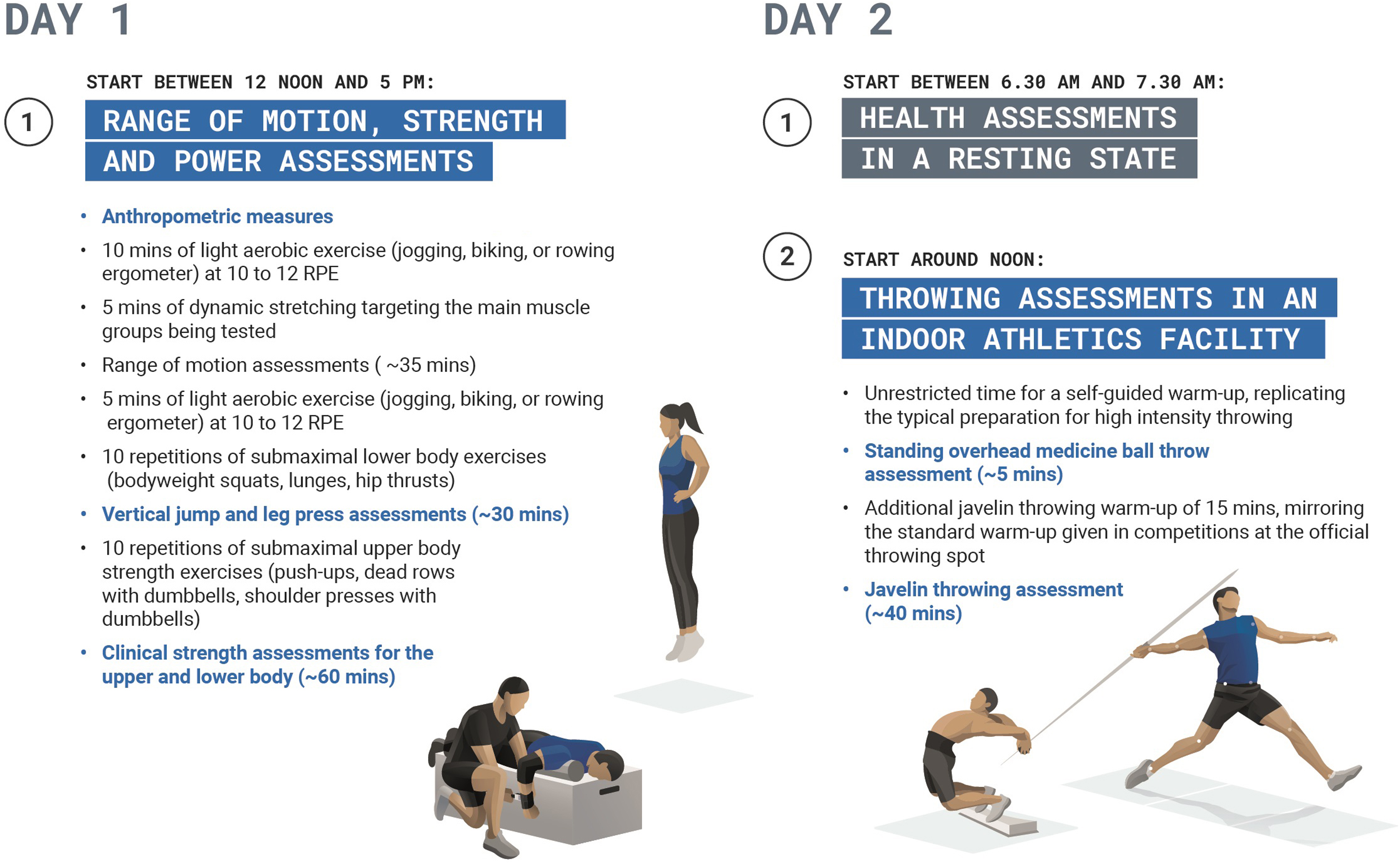
Test protocol. Phases highlighted in blue bolded text indicate the stages from which data were analysed for this study.190 × 118 mm (300 × 300 DPI).

Illustration of all examined exercises. 209 × 297 mm (300 × 300 DPI).
Participants
The required sample size was calculated a priori using G*Power software version 3.1.9.7 (Frank Faul, Universität Kiel, Kiel, Germany). Based on prior studies reporting correlations between strength characteristics and throwing performance (|R| = .61–.80),10,12,13,15,16 the analysis indicated that a sample of 9–18 participants per sex would be required to achieve 80% statistical power at an alpha level of .05.
The top 23 male and female javelin throwers, as selected by the national federation, were invited to participate in the study. Nineteen males and twenty-one females volunteered. Two males and one female missed the study due to illness, and two males due to injury. Two males and six females were excluded for not performing the javelin tests maximally. Ultimately, the study included thirteen males (mean ± SD, age: 24 ± 3 years, height: 1.85 m ± 0.07 m, body mass: 94.7 ± 11.1 kg, personal best: 77.0 ± 5.7 m, javelin throwing as the primary sport: 8 ± 3 years) and fourteen females (age: 24 ± 5 years, height: 1.72 ± 0.05 m, body mass: 79.2 ± 10.3 kg, personal best: 55.6 ± 5.7 m, javelin throwing as the primary sport: 8 ± 4 years).
Data collection and analysis
General procedures
The following strength and power tests were performed: bilateral countermovement jump (CMJ) and drop jump (BLDRJ40, 40-cm box), unilateral drop jump (ULDRJ20, 20-cm box), depth jump (ULDEJ20, 20-cm box), and isometric leg press (ULLP), clinical maximal isometric strength for the upper and lower body, and standing overhead medicine ball throw. Participants performed two submaximal practice trials at 60% and 80% of perceived maximum, followed by three maximal trials for vertical jumps and leg press, and two maximal trials for clinical maximal isometric strength tests. The best trial for analysis was determined based on jump height for CMJ and ULDEJ20, reactive strength index for BLDRJ40 and ULDRJ20, and maximal strength for clinical maximal isometric strength tests. Rest periods were 60 s between trials for clinical maximal isometric strength tests, bilateral jumps, and ULLP, and 30 s for unilateral jumps. The test leg was alternated for ULDEJ20, ULDRJ20, and ULLP trials. To minimise testing order influence, the order of jump and leg press tests and the starting limb for each unilateral test were randomised and counterbalanced within males and females. Joint moments were computed by multiplying force with the corresponding lever arm length, and unless supplemented, force, power, and strength metrics were normalised to body mass.
Jump tests
Jump tests were conducted on a force plate (AMTI Accupower, Advanced Mechanical Technology Inc, Watertown, USA) that sampled ground reaction force data at 1000 Hz using the Coachtech system. 18 Participants kept their hands on their hips during all jump tests. In the CMJ, participants stood still for the initial three seconds of the data collection, then rapidly squatted to their preferred depth and immediately jumped as fast and as high as possible. In drop jumps, participants stepped off a box, landed with both legs (BLDRJ40) or one leg (ULDRJ20) with knees and hips straight, and then jumped as fast and high as possible. In ULDEJ20, participants stepped off a box, landed on one leg in a squat with ∼60 degrees of knee flexion, and then jumped as high as possible. After landing, they stabilised in an upright posture for approximately three seconds.
The CMJ analysis was divided into unweighting, braking, and propulsion phases as per McMahon et al. 19 Phase durations, time to take-off, jump height, modified reactive strength index (RSImod), peak vertical centre of mass velocity, and mean and peak power and net impulse during the braking and propulsion phases were calculated as detailed by McMahon et al. 20 Vertical stiffness was determined as the ratio of the change in net vertical ground reaction force to the change in vertical displacement during the braking phase. 21
Drop and depth jump analyses were divided into braking and propulsion phases, and phase durations, contact time, jump height, reactive strength index (RSI), peak landing force, and mean and peak power in these phases were calculated according to McMahon et al. 22 Vertical stiffness was determined as the ratio of net vertical force at the lowest centre of mass position to vertical displacement from landing contact to the lowest centre of mass position. 23
Isometric strength tests
Isometric maximum unilateral leg press test (i.e., involving extension of the hip, knee, and ankle joint) data were collected at 2000 Hz using a custom force dynamometer, following established protocols.24–27 Participants sat against a backrest inclined at 110 degrees relative to the horizontal, with their foot on an instrumented platform. The seat distance was adjusted to achieve a 107-degree knee angle. Upon the start cue, they pushed as fast and hard as possible for three seconds until achieving a force plateau. Maximum force was determined as the difference between the zero level and the highest recorded force, and the peak rate of force development within a 100-millisecond window was computed.
In clinical maximal isometric strength assessments, participants first gradually built tension on the force transducer, then exerted maximal force for three seconds until reaching a force plateau. A portable tension dynamometer with a measurement range of 0 to 150 kg (EasyForce, Gait and Motion Technology Ltd, Suffolk, England) assessed strength in shoulder internal and external rotation, and hip abduction, adduction, and extension. For shoulder tests, participants were secured in a prone position with the testing arm at 90 degrees abduction and 10 degrees horizontal adduction, the elbow at 90 degrees flexion, and the forearm in pronation. In hip strength assessments, the ankle was secured to the dynamometer. Hip abduction and adduction involved lying on the side with the measured limb in a horizontal position, while hip extension required a prone position. Ankle plantarflexion was measured using a portable tension dynamometer (Peak Force, LLC., Mesquite, Texas, USA) with a range of 0 to 500 kg. Participants sat with their backs against a wall, with the foot fixed to the dynamometer footplate at 90 degrees of dorsiflexion. Grip strength was evaluated using a custom force transducer. Participants were seated with 90 degrees of shoulder abduction and elbow flexion, forearm in supination, and the wrist in a neutral position. Grip strength was normalised to height squared 28 in addition to body mass. Forearm pronation and supination were evaluated using a custom isometric forearm rotation strength measurement device. 29 Participants sat upright with their upper body unsupported, feet on the ground, the testing arm perpendicular to the device handle, shoulder in 0-degree flexion and 0-degree abduction (i.e., vertical), elbow in 90-degree flexion supported by a wooden block placed on the side, and wrist in neutral position. Forearm rotation strength was normalised to palm width in addition to body mass.
Throwing tests
In standing overhead medicine ball throw, participants stood with their feet shoulder-width apart, raised the medicine ball (1 kg for females, 2 kg for males) overhead, and swung it forward. Two submaximal trials followed by three maximal trials were performed with 60-s rest intervals. The highest speed, recorded using a radar gun (Stalker ATS II, Stalker, Plano, Texas, USA), was analysed. The radar was placed on a tripod behind the thrower, facing the throw direction, and adjusted individually to the ball release height.
In the javelin throwing assessments, participants performed six maximal throws against a tarp. A slightly overweight javelin (males 843 g, females 653 g) was used not only for safety—due to tip paddings required for indoor throwing—but also to facilitate accurate motion analysis. The added mass from reflective tape (placed near the front tip, rear tip, and in front of the grip) and black paint enhanced the visibility of the javelin in high-speed video recordings, ensuring precise measurement of release parameters. While this may have had a minor impact on release mechanics, it was considered necessary due to the indoor setup and the need for reliable motion tracking. Participants rested for four to five minutes between throws, being called to prepare after four minutes and given one minute to throw. Two high-speed video cameras (LUMIX DC-GH5S, Panasonic Corporation, Japan), placed 18 m behind and to the side of the thrower, captured the throws at 240 Hz with a shutter speed of 1/1000 s and a resolution of 1920 × 1080 pixels. A custom-made LED light device (Finnish Institute of High Performance Sport KIHU, Jyväskylä, Finland) with five LED lights was used for synchronisation, switching on at one-millisecond intervals for one second every two seconds, allowing sub-frame precision. Recordings were processed using SIMI Motion version 9.2.1 (Simi Reality Systems GmbH, Unterschleissheim, Germany). The reflective tapes on the javelin were manually digitised from four frames before to four frames after release. Calibration involved digitising eight points with known 3D real-world coordinates in each 2D camera view, followed by applying Direct Linear Transformation. 30 Release velocity was determined as the resultant velocity of the grip marker at release (the final frame when the javelin was gripped), with instantaneous velocities calculated from 3D position data using the adjacent frames on either side. Release angle was defined as the angle between the grip marker's travel direction and the horizontal at release, and release height as the vertical distance from the grip marker to the ground at release. The standard projectile motion equation was used to estimate throw distance considering release velocity, angle, height, and gravity. This estimated throw distance served as the primary measure to describe throwing performance.
Statistical analysis
Absolute and anthropometry-normalised values of the strength measures were used for analyses. Unilateral test results include both lower-body sides and the throwing-arm side for the upper body. In the unilateral lower-body tests, each limb was treated as an independent performance characteristic and analysed separately, reflecting the distinct actions of each leg during javelin throwing, particularly in the delivery phase. For the unilateral upper-body tests, the throwing-arm side was analysed as the functionally relevant measure in javelin throwing. These choices were applied consistently across all analyses.
Data distribution was assessed via the Shapiro-Wilk test, employing transformations when necessary. Details of the specific transformations applied are reflected in the variable names and reported in Supplementary Material S2. Pearson correlations were computed between estimated throw distance and strength and power measures. Correlation coefficients (Rp) are reported as Rp [95% confidence interval] and interpreted as very weak (|Rp| < .2), weak (.2 ≤ |Rp| < .4), moderate (.4 ≤ |Rp| < .6), strong (.6 ≤ |Rp| < .8), or very strong (|Rp| ≥ .8). 31 R (version 4.4.0, https://www.R-project.org/) was used for statistical analyses, with significance at P ≤ .05.
Results
Table 1 presents sex-specific descriptive statistics for estimated throw distance and the strength and power measures that demonstrated significant correlations with it. In males, estimated throw distance correlated moderately to strongly (|Rp| between .55 and .72, P < .05) with bilateral and unilateral vertical jump measures, and forearm supination strength of the throwing arm (Figure 3). In females, estimated throw distance correlated moderately to strongly (|Rp| between .55 and .73, P < .05) with ankle plantarflexion and hip abduction strength in each leg, as well as with grip and shoulder internal rotation strength of the throwing arm (Figure 4). Full correlation tables and descriptive statistics for all strength and power measures can be found in Supplementary Material S2.
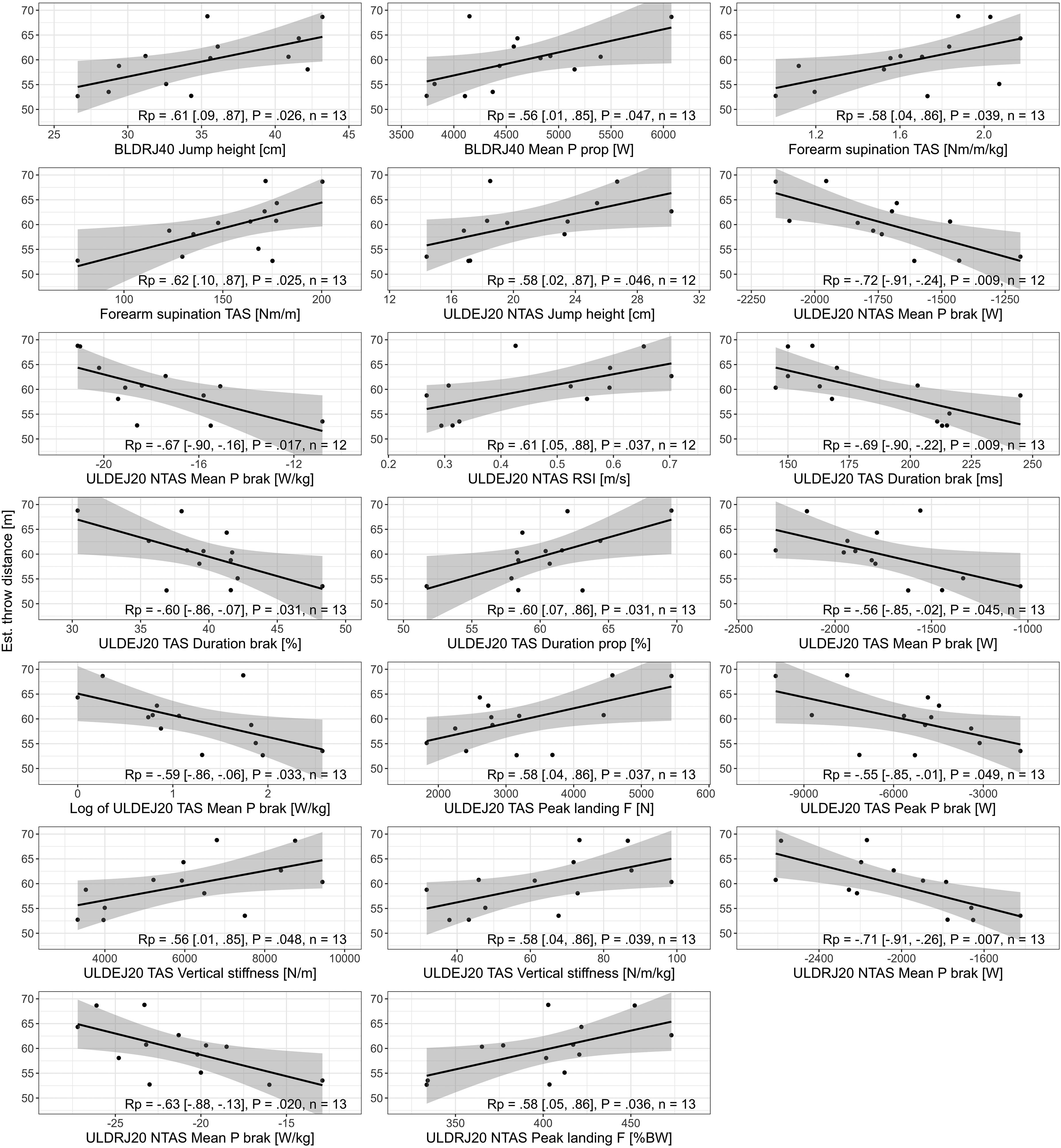
Correlation plots of all test measures that were significantly associated with estimated throw distance in males. Est. estimated, BLDRJ40 bilateral drop jump (off a 40-cm box), ULDEJ20 unilateral depth jump (off a 20-cm box), ULDRJ20 unilateral drop jump (off a 20-cm box), brak braking phase, prop propulsion phase, P power, F force, RSI reactive strength index, TAS throwing-arm side, NTAS non-throwing arm side. 250 × 272 mm (300 × 300 DPI).
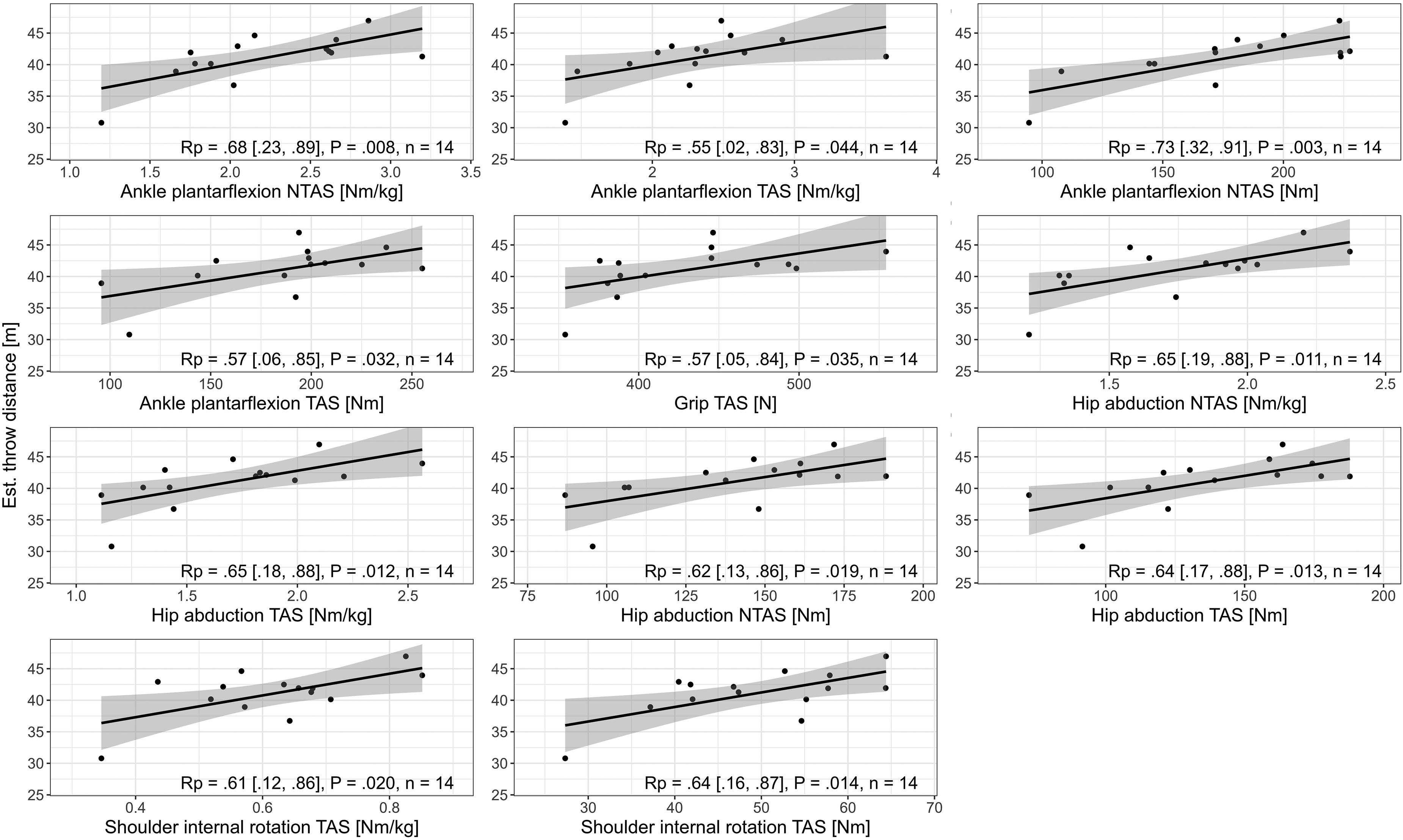
Correlation plots of all test measures that were significantly associated with estimated throw distance in females. Est. estimated, TAS throwing-arm side, NTAS non-throwing arm side. 249 × 149 mm (300 × 300 DPI).
TAS throwing-arm side, NTAS non-throwing arm side, BLDRJ40 bilateral drop jump (40 cm box), ULDEJ20 unilateral depth jump (20 cm box), ULDRJ20 unilateral drop jump (20 cm box), RSI reactive strength index.

Discussion
This study aimed to investigate the associations between the measures of strength and power and javelin throwing performance (estimated throw distance) in high-level male and female athletes. Partly in line with the hypothesis, in males, associations were demonstrated between some lower-body power measures and forearm supination strength and throwing performance, whereas in females, associations between upper- and lower-body maximal strength and throwing performance were shown.
This study has limitations. Data were collected from February to March, when some participants had completed only very few high-intensity throwing sessions and therefore may not have been optimally prepared. Given the difficulty of engaging high-level athletes during their competition season, and the novelty value of the reported data—particularly in javelin throwers—this was considered an acceptable compromise. Furthermore, throwing was conducted indoors in an athletics facility and against a tarp, rather than in an open environment as in competitions, which limits ecological validity. While this setup was necessary for safety due to the region's cold winter conditions, it may have influenced technique and motivation. Athletes may adjust their release mechanics or follow-through due to the absence of visual feedback on javelin flight and landing, and the lack of competitive environmental cues could reduce arousal and maximal effort. These factors may limit the direct transferability of our findings to outdoor competition settings. In addition, due to throwing against a tarp, the throw distance had to be estimated, and the estimation assumes the javelin as a point-like object, potentially affecting accuracy. However, we considered both release angle and height, which provides a more realistic estimate of throw distance than focusing solely on release velocity.1–3 Finally, adjustments for multiple comparisons were not applied, as the analyses were intended to be exploratory. Consequently, the findings should be interpreted as hypothesis-generating, and attention should be directed toward effect sizes and confidence intervals rather than nominal p-values.
Correlation analyses revealed that throwing performance in males was moderately to strongly (|Rp| between .55 and .72) associated with bilateral drop jump measures, unilateral drop and depth jump measures, and forearm supination strength (Figure 3). These findings are consistent with a study in high-level pitchers 14 that found correlations between lower-body power assessed by vertical jumps and baseball pitch speed. They also partly align with findings from elite Chinese youth male javelin throwers, where performance in a standing javelin throw correlated with sprinting speed and jumping ability. 11
The lack of a correlation between most upper-body maximal strength measures and throwing performance in males, previously observed in adolescent and collegiate baseball players,12,13 could be explained by the potentially higher performance level of the athletes participating in the present study in relation to world-class level athletes, or by differences in the nature of javelin and baseball throwing, including the implements used. Additionally, the previously reported associations of upper-body strength and medicine ball throwing performance with javelin throwing performance among Chinese youth athletes 11 were not found in the present study. This discrepancy may be due to the younger age of the athletes in that study and the use of a standing javelin throwing test, rather than actual javelin throws with a full run-up.
The observation regarding forearm supination strength is surprising, as previous studies in baseball pitching have indicated that the forearm flexor-pronator mass plays a critical role in actively stabilising the overarm thrower's elbow against valgus torque.32,33 However, while the forearm predominantly pronates during acceleration in baseball pitching,34,35 there is also evidence of a brief supination phase just before ball release. 35 In the same study, the peak angular velocity of shoulder internal rotation correlated with the supination range of motion, and its timing correlated with the moment of maximum supination. 35 The authors suggested that the main purpose of the short supination phase could be to meet the requirement to throw at a designated target with maximum ball release speed. Since similar research on javelin throwing is lacking, the occurrence of this motion remains a topic for future study. However, it is possible that the correlation between forearm supination strength and estimated throw distance observed in the present study was at least partly due to an attempt to control javelin release direction using the forearm and wrist. Therefore, incorporating resistance exercises targeting the forearm supinator muscles may benefit javelin throwers, and monitoring supination strength during athlete profiling could help identify individuals who may benefit from such training interventions.
Correlation analyses showed that in females, throwing performance was moderately to strongly (|Rp| between .55 and .73) associated with ankle plantarflexion and hip abduction strength, as well as with grip and shoulder internal rotation strength of the throwing arm (Figure 4). The results align with studies on amateur handball players that showed correlations between maximal upper-body strength and throwing speed.15,16 Speculatively, female throwers in the present study may not have reached the same elite performance level as males in relation to world-class level athletes, given that previous studies15,16 found associations between lower- and upper-body power and throwing performance in elite athletes.
Several factors may contribute to the observed differences between male and female throwers in the present study regarding the associations between strength and power measures and throwing performance. These differences may arise partly from the different weights of the implements used. Notably, timing patterns of body segments have been reported to vary between sexes among high-level javelin throwers.7,36 Similar observations have also been reported in handball throwing. 37 Future studies could explore how sex-specific javelin mass influences segmental timing and kinetic chain coordination, and whether this necessitates distinct optimal techniques for each sex. Combined with assessments of strength and power profiles, such investigations may also help determine whether divergent physical performance characteristics are required to maximise performance in male and female javelin throwers.
Physiological sex-differences likely also play a role. Sandbakk et al. 38 reported that upper-body-dominant sports tend to reveal larger performance gaps between sexes compared with sports engaging primarily the lower or entire body. Research has demonstrated that body size, specifically fat-free mass, significantly impacts handball throwing performance, consistent across sexes. 39 The differences observed in the present study may be explained by sex-based differences in muscle mass and limb power, which are more pronounced in the upper body. 40 These differences in muscular strength and power are primarily due to males having larger skeletal muscle mass and faster maximal contraction velocity compared to females. 41
Additionally, the strength and conditioning programs completed in the years prior to this study may have resulted in differences in the ability to utilise coordinated kinetic chain patterns. Previous research has shown that both male and female throwers exhibit age-related increases in maximal lower-body strength, but males demonstrate greater improvements in high-velocity force output with maturation than females. 17 There is also evidence that females may require different training approaches to achieve similar muscle activation levels as males.42,43 If these sex-specific adaptations to maturation and training have not been adequately considered in female athletes’ training programs, this may have influenced their timing patterns in javelin throwing—resulting in a greater reliance on maximal strength and less on coordinated timing throughout the entire kinetic chain.
While the present analyses focused on linear associations—or log-linear relationships following data transformation to meet the normality assumption—future research could benefit from incorporating quadratic modelling to explore potential non-linear trends. For example, Judge et al. 44 demonstrated in shot putters that the association between strength measures and throwing distance may follow a quadratic pattern, with performance gains plateauing at higher strength levels. Applying a similar approach to elite javelin throwers in future studies could help determine whether such plateau effects are also present in this population.
In conclusion, the current results suggest sex-specific differences in important strength and power measures for throwing. Based on our results, javelin throwing performance is generally correlated with lower-body power measures and forearm supination strength in males, and with maximal strength in females. These findings may be beneficial for athletes and practitioners as they attempt to improve javelin throwing performance. Furthermore, the study's findings can inform future research in javelin throwers, particularly in designing effective training interventions to improve javelin throwing performance and monitoring seasonal alterations in key strength and power measures. Although these findings are correlational, the male results suggest that improving lower-body power expressed in reactive jump tasks may be especially relevant for training, and that forearm supination strength could be a useful supplementary target characteristic within strength programmes. In contrast, the female results indicate that training interventions may benefit from prioritising maximal-strength development in ankle plantar flexors and hip abductors and in throwing-arm grip and shoulder internal rotators.
Supplemental Material
sj-xlsx-1-spo-10.1177_17479541261448854 - Supplemental material for Associations between strength and power and throwing performance in high-level male and female javelin throwers
Supplemental material, sj-xlsx-1-spo-10.1177_17479541261448854 for Associations between strength and power and throwing performance in high-level male and female javelin throwers by Miika Köykkä, Johanna K. Ihalainen, Anssi Saari, Benjamin Waller and Neil J. Cronin in International Journal of Sports Science & Coaching
Supplemental Material
sj-xlsx-2-spo-10.1177_17479541261448854 - Supplemental material for Associations between strength and power and throwing performance in high-level male and female javelin throwers
Supplemental material, sj-xlsx-2-spo-10.1177_17479541261448854 for Associations between strength and power and throwing performance in high-level male and female javelin throwers by Miika Köykkä, Johanna K. Ihalainen, Anssi Saari, Benjamin Waller and Neil J. Cronin in International Journal of Sports Science & Coaching
Footnotes
Acknowledgments
We thank the participants for their time and effort and the staff of the Finnish Institute of High Performance Sport KIHU and Faculty of Sport and Health Sciences of the University of Jyväskylä who assisted with data collection.

Ethical considerations
Each participant received comprehensive information about the study design and risks before providing written consent. The study adhered to the principles of the Declaration of Helsinki and was approved by the University of Jyväskylä Ethical Committee (1635/13.00.04.00/2022).
Consent to participate
Each participant provided written consent to participate.
Consent for publication
The authors have obtained written consent from all identifiable individuals featured in the photographs demonstrating the examined exercises.
Funding
The research was supported by grants from the Ministry of Education and Culture of Finland (OKM/10/626/2021, to JKI) and from Urheilututkimussäätiö (to MK). Additionally, MK's work was partially supported by The Kuortane Olympic Training Center.
Declaration of Conflicting Interests
The authors declared no potential conflicts of interest with respect to the research, authorship, and/or publication of this article.
Data availability
The datasets generated during and/or analysed during the current study are available from the corresponding author on request.
Supplemental material
Supplemental material for this article is available online.
References
Supplementary Material
Please find the following supplemental material available below.
For Open Access articles published under a Creative Commons License, all supplemental material carries the same license as the article it is associated with.
For non-Open Access articles published, all supplemental material carries a non-exclusive license, and permission requests for re-use of supplemental material or any part of supplemental material shall be sent directly to the copyright owner as specified in the copyright notice associated with the article.
