



Abstract
Emotional regulation has been identified as one of the key factors in sport performance; however, qualitative research examining this construct in real competitive contexts remains limited, particularly in emerging sports such as pickleball. The aim of this study was to analyze pickleball players’ and coaches’ perceptions of the role of emotional regulation in competitive performance, decision-making, and the occurrence of errors, with particular attention to emotionally critical moments during matches and to emotional dynamics in doubles play. A qualitative study with a phenomenological hermeneutic approach was conducted. Sixty pickleball players and eight coaches participated, completing asynchronous online interviews in two phases. Data were analyzed using thematic analysis, resulting in three main categories: (1) emotional dynamics of the match; (2) emotion, decision-making, and error; and (3) emotional regulation and interpersonal dynamics. The results indicate that both players and coaches perceive emotions as fluctuating continuously throughout the match and intensifying at critical moments, directly influencing playing behavior, technical-tactical decisions, and the likelihood of committing errors. In addition, according to participants, in doubles play, the emotional dynamics between teammates and coach intervention emerge as key elements for emotional regulation and the maintenance of collective performance under pressure. These findings underscore the need to systematically integrate emotional regulation into competitive preparation in pickleball, considering both the individual and interpersonal processes involved in performance.
Introduction
Pickleball participation has been associated with multiple psychological 1 and social benefits, 2 including improvements in perceived well-being3,4 and mood, 5 as well as reductions in perceived loneliness and strengthening of social relationships, particularly among adult and older populations. 6 These characteristics, together with their accessibility and rapid learning curve, have contributed to a marked increase in both the number of participants and the frequency of participation in recent years.4,7 Unlike other racket sports, pickleball is played on a smaller court (13.41 × 6.10 m) and uses a perforated plastic ball that reaches lower velocities, which attenuates the physical demands of play and shifts the emphasis toward social interaction, strategic decision-making, and cognitive control of rallies.8,9
From a performance perspective, competitive pickleball is characterized by a highly intermittent game dynamic, with short rallies, limited recovery periods, and a high frequency of unforced errors. 10 These features place the player in a context of substantial time pressure, requiring continuous perceptual processing, anticipation of the opponent's actions, tactical decision-making, and real-time technical execution. 11 In this context, decision-making in pickleball is shaped by a combination of situational and task-related variables, including ball speed and trajectory, opponent positioning, spatial constraints imposed by the court, and the evolving score context. 10 These factors condition players’ selection of offensive and defensive actions, requiring constant adaptation between risk-taking behaviors aimed at gaining advantage in attack and more conservative responses oriented toward maintaining rally continuity and minimizing errors in defense. 12
In this type of sport, characterized by rally continuity, generally involving eight or fewer shots per rally, 13 and by the rapid alternation between perception, decision, and action, even minor fluctuations in attention, self-confidence, or emotional state may be immediately amplified, affecting the quality of motor execution and increasing the likelihood of errors. 14 Consequently, performance in pickleball does not depend solely on technical, tactical, or physical factors, but also on the athlete's ability to effectively regulate emotional states in response to the dynamic demands of competition. 15
In the context of sport performance, emotional regulation is defined as the athlete's ability to identify, modulate, and adaptively use emotional states in accordance with the situational demands of competition.16,17 Complementarily, self-esteem and sport confidence reflect perceptions of personal competence and beliefs in one's own ability to successfully cope with high-demand situations.18,19 Across a wide range of sport modalities, including individual sports, direct opposition sports, and racket sports, effective emotional regulation and high levels of self-confidence have been associated with greater stability in decision-making, improved control of competitive stress, and a lower likelihood of committing errors during critical moments of competition.17,20 In addition, the coach plays a fundamental role in shaping the competitive emotional climate, as the quality of the coach-athlete relationship and perceived support are related to higher levels of self-confidence, psychological well-being, and emotional regulation capacity in high-pressure contexts.18,21
Nevertheless, despite the evidence linking emotional regulation, self-confidence, and the interpersonal climate to sport performance, previous research has largely relied on quantitative approaches focused on anxiety-related variables, with limited qualitative exploration of these processes. 20 Consequently, knowledge remains scarce regarding how these emotional processes manifest, intensify, and are regulated during the actual course of competition, particularly at critical moments characterized by time pressure, accelerated decision-making, and a high likelihood of error.14,22 Furthermore, limited attention has been given to athletes’ perceptions of how emotions experienced after critical events immediately influence their cognitive and behavioral processes, as well as the subsequent evolution of collective performance. Similarly, the role of interpersonal dynamics, particularly coach support and teammate interactions, in emotional regulation during competition has been insufficiently examined, especially in team sports and cooperative modalities.17,18 This lack of evidence constrains the understanding of emotion not merely as a psychological state, but as a dynamic process that emerges from the continuous interaction between the individual, the task, and the competitive context. 23
In this regard, despite the rapid growth of pickleball participation and the existing evidence on its general benefits for well-being,3,4 research specifically focused on the emotional processes operating during the actual progression of matches remains limited. In particular, there is a lack of studies examining how players and coaches experience and regulate emotions that emerge during critical moments of play, how these emotional states influence decision-making and the occurrence of unforced errors, and how interpersonal dynamics between teammates and coaches modulate these processes, especially in doubles play. This gap is particularly relevant in a sport such as pickleball, where performance is constructed through continuous interactions among emotion, cognition, and action under conditions of time pressure.
Therefore, the present study aimed to analyze pickleball players’ and coaches’ perceptions of the role of emotional management in competitive performance, decision-making, and error occurrence during competition, with particular attention to emotionally critical moments in matches and to emotional dynamics in doubles situations. In line with this objective, the study was structured around the following research questions: (1) How do pickleball players and coaches perceive the influence of emotional regulation on competitive performance and decision-making during competition?; (2) Which moments of the match are identified as emotionally critical, and how are they related to the occurrence of errors and performance under high-pressure conditions?; and (3) How do emotional dynamics between teammates and coach intervention influence the maintenance of competitive performance, particularly in doubles play?
Method
Research design
The study was conducted using a qualitative approach with an interpretative-constructivist orientation,24,25 adopting a phenomenological-hermeneutic perspective.26,27 This design was appropriate for examining in depth how participants construct meaning from their emotional experiences in real competitive contexts, as well as for exploring the relationships between these experiences and perceptions of performance, decision-making, and interaction dynamics during play. This approach allows access to the subjective and contextual processes underlying emotional experience in sport, prioritizing a situated understanding of the phenomenon from the perspective of the participants themselves through rigorous and reflexive qualitative methodological strategies. These strategies include asynchronous interview modalities that are widely recognized in the specialized literature.28,29 The study was conducted in accordance with the ethical principles set out in the Declaration of Helsinki 30 and was approved by the Ethics Committee for Research Involving Human Subjects of the University of the Basque Country (UPV/EHU), under approval code CEISH M10/2024/167.
Participants
The sample consisted of 68 participants selected through purposive sampling, based on criteria of relevance and direct experience with the phenomenon under study. The recruitment process was carried out through pickleball coaches, who disseminated the study invitation among active players and coaches in this modality, thereby ensuring access to participants embedded in real competitive contexts. Due to the asynchronous and open nature of recruitment, participation was voluntary, allowing the inclusion of a relatively large and diverse sample. This approach was intended to capture a broad range of experiences and perspectives, in line with the principle of information power. In line with this principle, the adequacy of the sample was supported by the relevance of participants’ experience and the consistency of the data. Given the emerging nature of pickleball in Spain and its still relatively limited player base, the sample can be considered broadly representative. All participants were recruited from Spain. Of the total sample, 60.3% were men and 39.7% were women. According to their role within the sport context, 11.8% (n = 8) served as coaches, while 88.2% (n = 60) were pickleball players. Players were distributed across different practice levels: 25.0% at the beginner level, 25.0% at the intermediate level, 42.3% at the advanced level, and 7.7% at the professional level. All players had active experience in pickleball and participation in competitive settings (2.6 ± 2.0 years of experience in the sport), which ensured the relevance of their accounts for analyzing emotions experienced during matches. Coaches had specific experience both in practice (3.4 ± 1.9 years) and in teaching pickleball (1.9 ± 1.5 years), allowing the inclusion of a complementary perspective grounded in systematic observation of emotional behavior in competition (Table 1).
Characteristics of the participants.
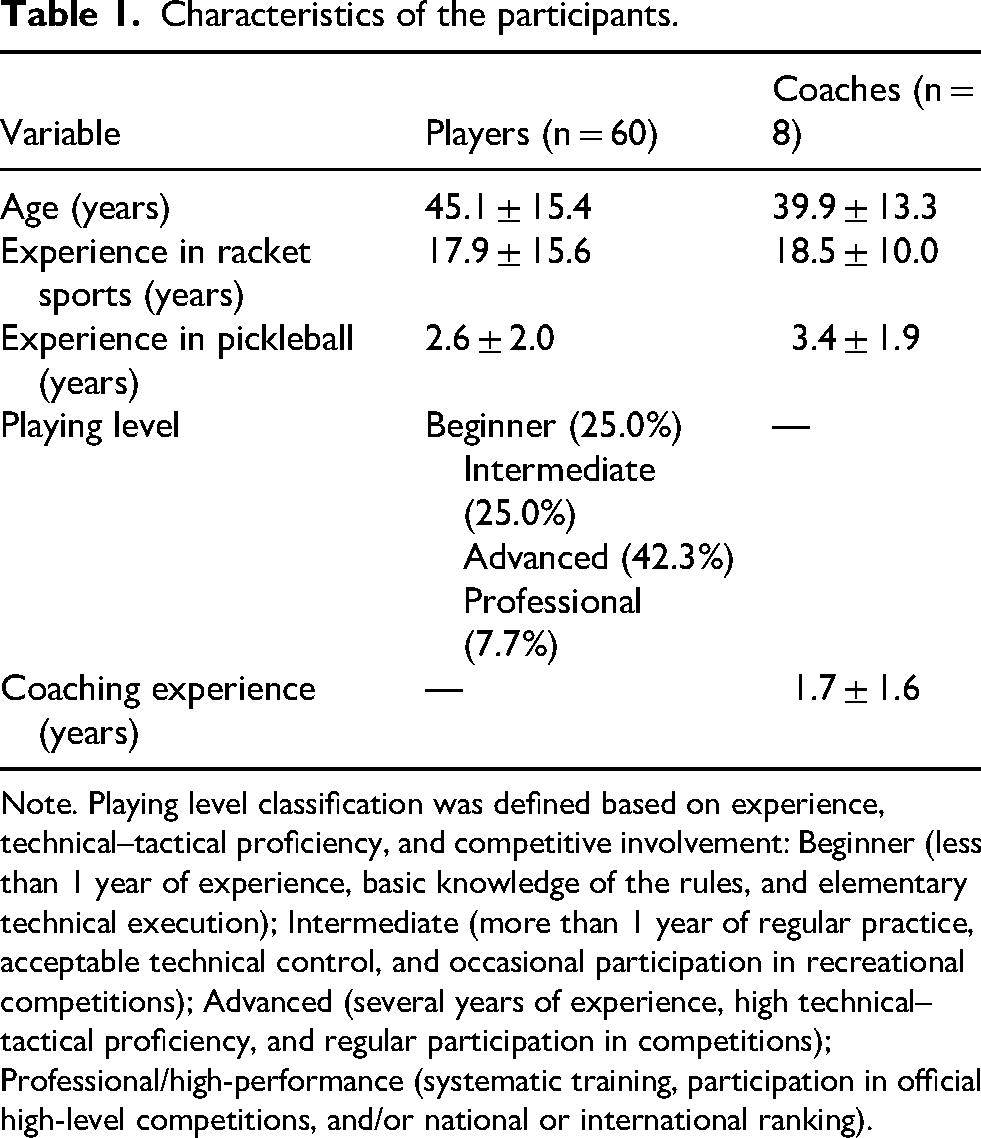
Note. Playing level classification was defined based on experience, technical–tactical proficiency, and competitive involvement: Beginner (less than 1 year of experience, basic knowledge of the rules, and elementary technical execution); Intermediate (more than 1 year of regular practice, acceptable technical control, and occasional participation in recreational competitions); Advanced (several years of experience, high technical–tactical proficiency, and regular participation in competitions); Professional/high-performance (systematic training, participation in official high-level competitions, and/or national or international ranking).
Measures
Data were collected through asynchronous online interviews, 31 designed to generate information aligned with the study objectives and oriented toward the exploration of emotional experiences associated with competitive pickleball. This procedure enabled the collection of reflective and contextually grounded narratives,32,33 facilitating access to the meanings constructed by participants in relation to their experiences during matches. Asynchronous interviews are an appropriate methodological strategy in qualitative research, as they provide participants with sufficient time for reflection and the development of detailed responses, while also allowing the research team to progressively analyze the data and formulate follow-up questions in an interactive manner. 29
The first round of interviews began in November 2025, and a preliminary analysis of the responses was conducted in early January 2026 to identify initial patterns, aspects requiring clarification, and emerging categories. Subsequently, on January 18, 2026, a second round of questions was sent to participants, consisting of complementary and in-depth prompts, while maintaining the asynchronous nature of the data collection process throughout. The questions addressed to players are presented in Table 2, whereas those formulated for coaches are reported in Table 3. In both tables, a distinction is made between the initial questions and the subsequent complementary questions, the latter being derived from the preliminary analysis of the information obtained during the first phase of data collection.
Interview questions for players.

Interview questions for coaches.

Design and procedure
The study was conducted using a qualitative design with a phenomenological hermeneutic orientation.26,27 Both players and coaches were included in order to capture complementary perspectives on the emotional processes that emerge during competitive pickleball.
The research followed an iterative asynchronous interview design, combining an initial set of open-ended questions with subsequent rounds of in-depth inquiry.28,29,31 The interviews were designed, administered, and managed by members of the research team. In a first phase, participants completed an initial round of asynchronous interviews with open-ended questions aimed at eliciting broad descriptions of emotional experiences before, during, and after matches, as well as moments of heightened emotional intensity and their perceived influence on performance and decision-making. These questions were explicitly designed to ensure alignment with the study's objectives and research questions, particularly in relation to understanding how emotional experiences influence decision-making processes and performance in competitive contexts. A common core of questions was maintained across players and coaches, while minor adaptations were introduced to account for their specific roles and perspectives within the sport
Data analysis
From a phenomenological hermeneutic perspective, the data analysis aimed to understand how pickleball players and coaches interpret and assign meaning to their emotional experiences during competition, as well as their perceived influence on performance, decision-making, error occurrence, and emotional dynamics in doubles play. This approach allowed the exploration of participants’ emotional experiences from a contextualized and situated perspective within real competitive settings. All interview data were initially analyzed independently by each member of the research team, allowing for a reflexive approach and deep immersion in the texts to identify meaning units related to emotions, performance, and interaction processes during competition. Subsequently, the analyses were compared and discussed collectively by the entire research team, reviewing the coherence, convergence, and relevance of emerging interpretations. This process of analytical comparison facilitated the integration of multiple perspectives and strengthened the interpretative robustness of the findings, contributing to the mitigation of researcher bias, in line with methodological approaches based on sequential and comparative qualitative data analysis. 34
All collected data were managed and analyzed using the qualitative data analysis software QDA Miner Lite (version 1.0.1, United Kingdom). Through a process of saturation of paragraphs, expressions, and convergent ideas across participants, several thematic axes were identified and progressively grouped into subthemes. This process followed an inductive approach, whereby meaning units were first coded, then grouped into subthemes based on conceptual similarities, and finally integrated into higher-order categories that structure the results. These categories, directly aligned with the aim of the study, capture the main processes through which emotional experiences are articulated with competitive performance in pickleball:
Emotional dynamics of the match: encompasses the emergence, fluctuation, and intensification of emotional states throughout the course of the match, as well as the identification of competitive moments in which these emotions become particularly salient and shape the emotional climate of play. Emotion, decision-making, and error: integrates players’ and coaches’ perceptions of the relationship between emotional states and the selection of technical-tactical decisions, as well as their association with the occurrence of errors, particularly in situations of high competitive pressure. Emotional regulation and relational dynamics: captures the individual and interpersonal processes involved in emotional regulation during competition, highlighting the influence of teammate interactions in doubles play and the role of the coach in emotional stability and the maintenance of performance under pressure.
To ensure traceability and clarity in the presentation of results, text excerpts were anonymized using acronyms that identified each participant's role as player (P) or coach (C), along with a consecutively assigned number for each participant.
Results
The analysis of the interviews identified three main categories that structure the study findings: (1) Emotional dynamics of the match; (2) Emotion, decision-making, and error; and (3) Emotional regulation and interpersonal dynamics.
Emotional dynamics of the match
The analysis of players’ and coaches’ narratives indicates that competitive pickleball is characterized by marked emotional variability throughout the match. Participants described frequent fluctuations in their emotional states, associated both with score development and with the execution of specific actions during play. From the players’ perspective, nervousness and anxiety emerge recurrently, particularly during the initial moments of the match and in situations in which the score is tied: “At the beginning, there is considerable nervousness and fear. As the match progresses, it largely depends on the score: if you are winning, you relax, and if you are losing, you become more tense” (P3). “At the start, I am very nervous and rushed, and this leads me to rush shots that I normally control” (P7). “I started to make several unforced errors in a row, which made me feel nervous and blocked. At that point, each mistake seemed to weigh more, and it became difficult to play with the fluidity I had at the beginning” (P12). “When these negative emotions take over, I can no longer think clearly. They dominate everything, and I cannot think about anything other than how poorly I am playing” (P40). “When I start the match well and manage to string together several positive points, I notice my confidence increases, which helps me play with greater security and make better decisions” (P19). “Confidence when shots are executed successfully on a consistent basis” (P22).
Emotion, decision-making, and error
The narratives of players and coaches indicate that the emotional states experienced during competition are associated with clear changes in decision-making and increased error rates, particularly in high-pressure situations.
From the players’ perspective, nervousness and fear of making mistakes are linked to a more conservative style of play, in which avoiding errors is prioritized over maintaining their usual game approach: “In those situations, I tend to oversimplify my decisions, focusing only on getting the ball back and not making mistakes, instead of applying the game style I really enjoy and am prepared for” (P19). “If fear or lack of confidence starts to set in, your strategy changes completely, and you start playing far too conservatively” (P5). “When I am in a positive emotional state during competition, I perceive greater confidence in my technical-tactical decisions. In those situations, I select shots more effectively, adjust the tempo of the rally more appropriately, and commit fewer unforced errors” (P2). “My hand becomes stiff, I lose feel on my shots, and I stop executing actions naturally” (P19). “When these negative emotions take over, I can no longer think clearly. They dominate everything” (P40). “In important moments, doubts can arise, for example, with the backhand from the baseline, especially if I have just made a few previous errors” (P22). “In important points, doubts increase, and decision-making worsens” (P9).
Emotional regulation and interpersonal dynamics
The narratives of players and coaches indicate that emotional regulation during competition is constructed both at the individual level and through interaction with one's partner, particularly in doubles play. From the players’ perspective, emotional regulation following errors or negative streaks relies on personal strategies aimed at regaining control and refocusing attention on the next point: “I try to take deep breaths whenever I can and focus on the next point, avoiding getting stuck on previous mistakes” (P26). Several players described the use of self-talk as a tool to reframe the situation and prevent the escalation of negative emotions: “I repeat simple internal messages to myself, such as playing calmly or securing the first shots, in order to regain positive sensations” (P19). Likewise, the idea of emotionally “resetting” after an error emerged recurrently in the narratives: “I try to think that it is just one point when I make a mistake. A match is full of points. The next point is always the most important” (P29), and “I always try to think from the moment I am in, like restarting my mind so as not to think about what happened before” (P3). From the coach's perspective, these individual strategies clearly differentiate players: “Everyone has a good level, but the mental side is a very important part” (C).
Likewise, in doubles play, participants described a marked phenomenon of emotional contagion, in which one player's affective state directly influences the partner's behavior and performance: “When I perceive that my partner is nervous, frustrated, or angry, that emotional state tends to spread. In those situations, communication decreases, doubts appear in positioning and shot selection, and team play loses fluency” (P19). This contagion can generate a carryover effect that compromises team functioning: “If my partner is complaining about my actions or making gestures about them, it makes me angry and causes me to lose focus on the match” (P22), and “When there is no mutual support and connection with your partner, the match is lost” (P16).
In contrast, players emphasized that explicit support and constructive communication following errors contribute to maintaining emotional stability and sustaining collective performance: “When I play with a partner who encourages me and offers constructive input respectfully, creating a positive atmosphere, performance increases exponentially” (P22). “I make him see that everything is fine, that we should enjoy ourselves above all… using positive phrases such as ‘we can still do it,’ ‘come on, we have got this’” (P17).
From the coaches’ perspective, these communicative dynamics are decisive for team functioning, particularly in situations where the score is tied: “When communication is negative or accusatory, performance drops immediately; by contrast, when there is mutual support, the team remains calm, makes better decisions, and is able to turn around adverse situations” (C7).
Discussion
The present study aimed to explore how pickleball players and coaches perceive the role of emotional regulation in competitive performance, decision-making, and the occurrence of errors during competition, with particular attention to emotionally critical moments and emotional dynamics in doubles play. Overall, the findings indicate that emotional regulation is perceived as a key factor that immediately shapes performance, decision-making, and error occurrence during pickleball competition, especially under high-pressure conditions and in doubles play. The main novelty of this study lies in providing a qualitative approach to these processes from the combined perspectives of players and coaches, offering original evidence on the dynamic and interpersonal nature of emotional experience in an emerging sport that has been scarcely explored from this perspective.
Influence of emotional regulation on competitive performance and decision-making
In relation to research question (1) of the present study, and from a transactional perspective, the emotions observed cannot be understood as isolated or stable states, but rather as dynamic processes that emerge from the continuous interaction between the individual, the task, and the competitive context. 23 Within this framework, the results of the present study indicate that players and coaches perceive emotional regulation as a central component of competitive performance in pickleball, closely linked to decision-making and the stability of technical-tactical behavior during competition. This perception is consistent with previous evidence identifying emotional regulation as a key determinant of performance in sport contexts characterized by high cognitive demands and time pressure.16,35 In this regard, participants in the present study described that a regulated emotional state facilitates cognitive clarity, self-confidence, and consistency in execution, whereas emotional dysregulation compromises decision quality and increases the likelihood of errors, particularly in situations of high competitive demand. Beyond this general association, the narratives of players and coaches suggest that emotional regulation primarily influences the way decisions are made and actions are executed during competition. Participants reported that emotional stability allows them to maintain their usual playing patterns and to select decisions that are aligned with the demands of the rally, whereas emotional dysregulation is associated with changes in playing style, either toward increased caution or toward more impulsive responses. This pattern is consistent with previous literature in other sports, which has linked maladaptive emotional states to reduced decisional flexibility and the adoption of less efficient behaviors under competitive pressure. 22 In line with earlier studies, participants indicated that anxiety and fear of making mistakes tend to simplify decision-making, prioritizing error avoidance over maintaining habitual play, whereas frustration promotes more rushed decisions and increased risk-taking during execution. Research conducted in sport contexts characterized by high temporal demands has shown that such emotional alterations interfere with attentional processes and decision-making quality, even among athletes with high levels of technical skill.36,37 These dynamics appear particularly relevant in pickleball, a sport characterized by short rallies and a high frequency of unforced errors, which reduce the opportunity for emotional recovery between actions.10,13 In this context, emotional regulation emerges as a key factor in sustaining decisional stability and performance throughout the match, especially under conditions of competitive pressure.
Emotionally critical moments, errors, and performance under pressure
In response to research question (2) of the present study, the results reveal that players and coaches consistently identify a set of match moments as emotionally critical, characterized by intensified cognitive and emotional demands and by greater vulnerability to error. These moments include the start of the match, negative streaks associated with consecutive unforced errors, and situations of score parity or decisive points, in which perceived pressure increases substantially. In particular, the beginning of the match can be understood as an especially sensitive phase from an emotional standpoint, as it concentrates high levels of activation and the absence of prior performance feedback. This combination increases vulnerability to error when adequate emotional and attentional adjustment is lacking, as described in the literature on pre-performance routines and performance under pressure. 38 These findings are also consistent with previous research indicating that moments characterized by high uncertainty and competitive relevance act as triggers for intense emotional processes that, through attentional and cognitive disruptions, may compromise sport performance. 39
From participants’ experiences, these critical moments are associated with increased nervousness, anxiety, and fear of making mistakes, emotions that directly interfere with decision-making and technical execution. In line with previous studies in racket sports and direct opposition sports, players reported that under pressure situations, excessive arousal is associated with reduced efficiency in cognitive processing and perceptual anticipation, which diminishes decisional clarity and increases the likelihood of committing unforced errors.11,35 This relationship between emotional pressure and error is particularly relevant at the beginning of the match, a moment in which players have not yet fully adjusted their level of arousal and in which small initial mistakes can amplify subsequent emotional responses.
Emotional dynamics between teammates, coach intervention, and performance in doubles
In relation to research question (3), the findings indicate that in doubles play, competitive performance in pickleball is strongly influenced by the emotional dynamics established between teammates and by the coach's intervention at key moments of the match. Both players and coaches consistently reported that emotional states tend to be shared within the pair, directly affecting communication, decision-making, and the stability of collective performance. Consistent with previous studies in team sports, participants’ narratives reflect a clear phenomenon of emotional contagion, whereby frustration, nervousness, or loss of confidence in one player is transmitted to the partner, compromising game fluidity and increasing the likelihood of errors under pressure. 17 By contrast, constructive communication and emotional support following errors emerge as protective factors that promote calmness, the recovery of confidence, and the maintenance of collective performance, in line with the literature on social support and emotional regulation in competitive sport contexts. 25 In this regard, previous evidence indicates that in team sports, emotional regulation is not limited to an individual process, but rather constitutes an interpersonal phenomenon in which emotions are co-regulated and externally regulated through interactions between teammates, directly influencing emotional stability and collective performance during competition. 40
In this sense, coach intervention is identified as a key element in modulating the emotional climate and sustaining performance under pressure. Participants in the present study reported that the most effective interventions are characterized by brief, clear, and task-oriented messages that help players regain attentional focus and normalize errors. This regulatory role of the coach aligns with models of the coach–athlete relationship, in which perceived support and communication quality are central mechanisms influencing athletes’ self-confidence and emotional regulation under pressure. 18 This is consistent with integrative models of coaching effectiveness that highlight the central role of interpersonal knowledge and coach–athlete interactions in shaping athletes’ psychological and performance-related outcomes. 21 Overall, these findings suggest that performance in doubles depends not only on individual factors but also on interpersonal and contextual emotional processes. Emotional regulation thus emerges as a shared process in which the quality of interactions between teammates and the coach's intervention acts as a key resource to buffer the impact of competitive pressure and sustain collective performance.
Limitations and practical implications
Among the main limitations of the study are the size and nature of the sample, which are inherent to a qualitative design and limit the generalizability of the findings. In addition, data collection was based on retrospective perceptions reported by players and coaches. Future research could therefore complement these findings by collecting real-time data during match play in order to capture emotional dynamics at critical moments with greater precision.
From an applied perspective, the results highlight the importance of considering emotional management as a central component in the planning and training of pickleball performance, particularly in high-pressure contexts and in doubles play. Understanding how players and coaches perceive the influence of emotions on decision-making, the occurrence of errors, and performance stability is essential for designing training and intervention strategies that are better aligned with the real demands of the game, systematically integrating emotional regulation work at both the individual and interpersonal levels. In this regard, training tasks may include the simulation of pressure scenarios, the use of reflective practices, and the development of routines aimed at improving emotional awareness and regulation during competition. Coaches should also deliberately foster effective communication and emotional support strategies within training, as key elements for maintaining performance and emotional stability in competitive contexts. As a future line of research, it would be valuable to examine how decision-making and emotional regulation vary according to players’ and coaches’ level of expertise and experience.
Conclusion
The present study demonstrates that both pickleball players and coaches perceive emotional regulation as a relevant component of competitive performance, as it is considered to be associated with decision-making, the occurrence of errors, and performance stability under pressure. From the participants’ perspective, emotions operate as dynamic and contextual processes that can modify playing behavior, altering playing style and technical-tactical choices, particularly at critical moments of the match and in doubles play, where interpersonal dynamics and coach intervention play a central role. Overall, these findings highlight the importance of systematically integrating emotional regulation into competitive preparation in pickleball, taking into account both the individual and relational demands of the game.
Footnotes
Acknowledgements
The authors would like to thank DROP Pickleball, a pickleball club, for their collaboration and for facilitating contact with players and coaches, which was essential for the conduct of the study.

Ethical considerations
The study was conducted in accordance with the Declaration of Helsinki and was approved by the Ethics Committee for Research Involving Human Subjects of the University of the Basque Country (UPV/EHU), approval code CEISH M10/2024/167.
Consent to participate
Participants were provided with detailed information about the study, and those who agreed to take part provided informed consent prior to completing the questionnaire.
Consent for publication
Participants were informed that the data collected would be used for research and publication purposes in anonymized form, and consent for publication was implied through their voluntary participation.
Funding
The authors received no financial support for the research, authorship, and/or publication of this article.
Declaration of conflicting interests
The authors declared no potential conflicts of interest with respect to the research, authorship, and/or publication of this article.
Data availability
The data are not publicly available due to ethical and confidentiality restrictions related to participant privacy, but are available from the corresponding author upon reasonable request.