



Abstract
This study aimed to explore elite male rugby union players’ perceptions and lived experiences of physique development and management in relation to low energy availability risk. Semi-structured interviews (29 ± 8 min) were conducted with 18 players (senior: n = 9; academy: n = 9; mean age: 23 ± 3) across four professional rugby union clubs in Ireland. Through reflexive thematic analysis, the following themes were constructed. Players had limited awareness of low energy availability, yet described experiences consistent with symptoms, including fatigue, low mood and reduced libido. A pervasive physique culture, characterised by body composition ‘ideals’ and weight or skinfold ‘norms’, strongly influenced behaviours and athlete identity. Adolescence was identified as a critical period of vulnerability, where pressures to achieve body composition targets were internalised as discipline but often fostered disordered eating behaviours and negative relationships with food. While some players acknowledged the benefits of professional nutrition support in reshaping harmful beliefs, many expressed frustration towards staff practices and language that reinforced physique expectations without clear performance justification. Elite male rugby union players appear to be an at risk population for low energy availability, with risks shaped less by individual choice than by entrenched cultural norms and staff influence. Early pathway interventions should prioritise one to one nutrition and psychological support, while organisations must ensure alignment in staff beliefs, language, and practices around body composition. Developing evidence informed policies and educational initiatives is essential to foster healthier physique cultures, reduce disordered eating behaviours, and mitigate low energy availability risk in elite rugby union.
Introduction
Rugby union, a field collision sport for ‘all shapes and sizes’ continues to have a strong cultural identity with masculinity and physique. 1 Distinct positional demands reinforce variation in “idealised” anthropometric profiles across two positional groups. Forwards (front row, second row, back row) are typically taller, heavier and possess more muscle and fat mass; while backs (half backs, centres, wings / fullbacks) are lighter, faster and cover more ground at higher speeds. 2 Body mass ranges widely from 70 kg to 140 kg, yet the overall trend has been towards heavier physiques, with the average body mass of professional forwards increasing from 103 kg in 1991 to 113 kg in 2019. 3 While such profiles are linked to performance demands, they also establish “ideal” physique expectations which, as seen across sport, can act as mediators of body image dissatisfaction and maladaptive eating behaviours.4–7 Such behaviours may disrupt energy availability, a key determinant of an athletes’ nutritional status. 8 Low energy availability (LEA) status, defined as any mismatch between dietary energy intake and energy expended in exercise, may occur knowingly or unknowingly, and leaves the body's total energy needs unmet. Symptoms include fatigue, anxiety, low motivation, low sex drive and disrupted sleep, and therefore can have significant health (e.g., impaired bone health, haematological function, glucose and lipid metabolism) and performance (e.g., decreased power and endurance performance, motivation and cognitive skill) implications.8,9
The drivers and consequences of LEA are complex, spanning unintentional undereating to severe eating disorders8,10,11 and can be driven by psychological risk factors (perfectionism traits, body dissatisfaction, body image distortion), socio-cultural risk factors (peer pressure, weight stigma, physique ideals) or sport specific requirements (body compositional testing, pressure to change body composition, coaching behaviours, performance optimisation pressure). 12 Limited nutrition knowledge or inadequate access to professional nutrition support may further exacerbate these risk.13,14 These multiple known risk factors for LEA among athletes highlights the critical, but often under supported proxy role of coaches in training environments to identify and manage LEA risk.15,16
Despite rugby unions’ status as a non-weight category sport, beliefs around size, leanness, and muscularity are viewed as prerequisites for selection and success,2,17,18 contributing to the sports cultural identity and potential doxa practices. Doxa refers to the embedded beliefs, values and assumptions that are rarely questioned. 19 Lewis 20 demonstrated that rugby coaches, driven by a performance, win focused culture, often favour older more physically developed players perceived as ‘bigger, faster, stronger’, over younger peers. This bias at age grade levels reinforces early selection based on size, potentially marginalising late developers, embedding physique based ideals in youth development pathways. In Ireland, four professional clubs run elite pathways where boys as young as 15 years of age train in pursuit of a professional rugby contract. Successful players most commonly at 19–22 years of age, progress from this pathway to a professional (paid to play) provincial academy and senior training squad environment with some research indicating that attaining ‘ideal’ physical profiles is associated with players’ progression from amateur to professional level. 21 Players on this elite pathway encounter diverse cultural norms and stakeholder beliefs and values that shape their athlete identity, eating habits, wellbeing, and views on body composition. The construct of athlete identity is defined as the degree to which an individual identifies with the athlete role.22–24 A player's experience with body composition in elite sport can often be informed by doxic practices underpinned by a drive for success that are rarely challenged by both players and staff 19 as seen in professional soccer and cycling.25,26 Body compositional measuring, daily weighing and physique commentary, may be norms often intended to support and optimise player performance, yet may unintentionally risk exposure to harmful disordered eating behaviours mediating symptoms of LEA. 27 Reports suggest prevalence of disordered eating behaviour28–31 ranging from 9% - 30% and LEA risk 32 of up to 52% exist in elite male rugby union. While qualitative studies have highlighted body size concerns among retired and varsity players,17,18 little is known about how current elite players experience and navigate these risks within the contemporary high-performance rugby union environment.
Accordingly, this study aimed to explore elite male rugby union players’ perceptions and lived experiences of physique development and management in relation to low energy availability risk. Our intention is that our data may prompt critical reflection of cultural dynamics among practitioners, collective staff groups and governing bodies within elite rugby union environments on how to improve body composition practices to ultimately support the health, wellbeing and sustainable performance of professional rugby union players.
Methodology
Study design
A qualitative research design was employed using semi-structured interview methodology, whereby, a pre-determined set of questions allowed the interviewer a degree of flexibility in the sequence of questioning and probing the interviewee. 33 The study was approved by the Human Ethics Research Committee at Technological University Dublin (REC-23-120).
Research philosophy and positionality
This study was grounded in a relativist ontology and constructivist epistemology methodological approach. This perspective asserts that reality is shaped by how each individual experiences it. 34 Accordingly, the researchers positioned themselves as facilitator, aiming to support participants in articulating their personal realities, and then interpret and convey these. The first author's dual role as both a researcher and applied sports nutritionist within the national elite player pathway is recognized and it is acknowledged that his embeddedness in the rugby context inevitably shaped interaction, interpretations and the co-construction of knowledge with participants. 35 The positionality of the lead author has unique advantages that facilitated a deeper co-construction of knowledge: an insider's cultural competence, access, and trust, which fostered authentic dialogue and nuanced engagement with participants. Through reflexive practice, the first author remained critically aware of how his professional background informed meaning-making, ensuring that interpretations were situated, transparent, and grounded in the context of elite sport.
Sample
To capture a breadth of perspectives from elite professional players, purposive sampling was employed across four professional rugby union clubs in Ireland. Eighteen male participants (23 ± 3 years) were recruited, comprising forwards (n = 11), and backs (n = 7), representing both academy (n = 9) and senior (n = 9) professionals currently under contract. This approach is comparable to previous explorations in elite sport.36–38 Academy players were integrated in the same training environment as the senior players within their respective club, enabling insight into shared and contrasting experiences across developmental stages. Participants were recruited through a gatekeeper at the club (e.g., head of athletic performance), who distributed an invitation email containing a participant information sheet. All participants provided voluntary verbal and written informed consent before completing the interview. Consistent with qualitative research 34 the sample size was not predetermined, but decided by the analysis. Recruitment ceased once additional data no longer contributed to the emergence of new themes.
Procedures
Semi-structured, open-ended interviews (29 ± 8 min) were conducted, enabling participants to freely, and extensively elaborate their experiences. 39 The first author (GS) conducted all interviews remotely via online software (Microsoft Teams) scheduled at times convenient to the participants. Interviews were video and audio recorded, transcribed automatically, and anonymized with participants assigned numerical identifiers throughout this study to protect participant identification. Importantly, the interviewer (GS) had extensive understanding of academy and senior subculture having worked as a performance nutritionist in the industry for the previous seven years. While his professional background could introduce an element of bias in the interview process, it was deemed advantageous due to his fluency in their jargon and informal terminology.38,40 The interview guide (Supplementary material 1) was developed by the first (GS) and second author, a clinical psychologist (SM) acknowledging the need for adapting questions based on the directionality of the discussion with participants. The interviewer presented questions in a conversational and informal manner to allow maximal voluntary contribution. 41 Similar to previous investigations,37,38 questions began with phrases such as ‘tell me about’…, ‘What are your thoughts on…?’ ‘Have you ever felt..?’. Naturally occurring probing followed to gather more detail. 42 This format allowed participants to express their experiences freely and navigate topics they found meaningful. 43 The guide was informed by prior soccer-based qualitative research,38,44,45 and grounded in the practical experiences of the lead author (GS) within elite rugby union environments. It covered 5 domains: (1) Participant background and demographics; (2) Perceived role and experience of nutrition; (3) Nutrition service expectations and experiences; (4) Experience of body composition, practices and its role in rugby; and (5) Experiences and understanding of LEA. Pilot interviews were conducted with three elite male rugby union players (19-22 years) to evaluate feasibility, clarity, and appropriateness of the guide. Pilot interviews were excluded from the final analysis, and no substantive modifications were deemed necessary.
Data analysis and generation
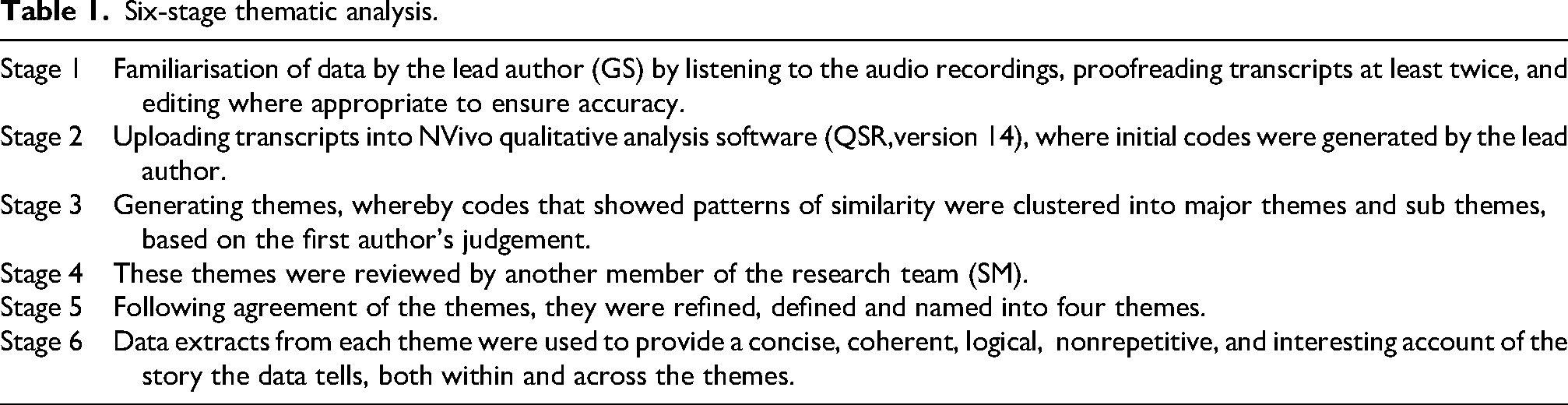
A reflexive thematic approach 46 adopting the six-stage thematic analysis by Braun and Clarke 47 was used to generate themes (Table 1). An inductive approach was taken. Reporting practice was guided by the Reflexive Thematic Analysis Reporting Guidelines (RTARG). 48
Six-stage thematic analysis.
Methodological trustworthiness and rigor
To ensure scientific rigour, several procedures were undertaken. A varied sample and the piloting of the interview questions ensured viability. The interviewer (GS) was trained in qualitative methods by an experienced qualitative researcher (SM). The reflexivity of the lead researcher was deemed important, 33 with steps taken to avoid their potential biases. Members of the research group (SM) independent of the primary author acted as critical friends, detached from nutrition practices in elite rugby union, examined interview guides to avoid leading questions, and critique data analysis and thematic interpretations. Two authors (NC,KC), uninvolved in the interview process, challenged data interpretation, refining coding and themes over time to provide a credible representation of participants’ experiences. The critical friends acted not to ‘agree’, but rather encourage reflexivity by challenging each other's construction of knowledge. 49 As all authors engaged in open critical discussion throughout the data analysis process, a strong methodological rigor was achieved while maintain a collaborative and reflexive approach. 50 We do acknowledge, similar to previous investigations, 38 the lead authors role and experiences working within rugby union. However, this ultimately was considered beneficial due to their deep familiarity of the topics and social contextual considerations.
Findings and discussion
A reflexive thematic analysis of the interviews generated four themes, presenting a narrative around how elite male rugby union players experience, navigate and manage physique expectation in relation to the risk of LEA. Themes within highlight the complex interplay between performance demands, cultural norms, and individual strategies for coping with the pressures surrounding body composition expectation. The study extends current understanding of elite rugby union environments and provided critical insights into the contextual factors underpinning LEA risk and it's intersection with mental health.
Theme 1: becoming the body: athletic identity and the pursuit of positional ideals
For many, the construction of athletic identity in rugby union began in adolescence and was strongly influenced by perceived physique ideals. Player 9 stated ‘I knew I had to be a certain weight to make national u20s’ while Player 3 reflected on behaviour ‘I was so obsessed with putting on weight and becoming this heavy player’. Although rugby is not formally a weight categorised sport, players described weight hierarchy across positions. Player 18 sharing ‘You've so many different shapes and sizes. I feel there's a weight category now for centres, back rows, front row and locks’. The physical demands of the game shape the players’ perceived expectations of an ideal physique, with Player 8 stating ‘It seems to be good for the sport to be bigger, to be stronger, to be more effective in collisions’. Achieving an ideal physique is believed to support success in professional rugby union:
Player 1
I knew that if you want to go on to the next level, you need to have obviously size which is the big thing, it's a collision-based sport, so there's a need to get bigger.
Contrastingly for backs, Player 4 noted ‘The impetus on our physique is definitely to have less body fat’ and due to positional roles, expectations change as player 11 stated ‘I don’t really need to be in collisions every single phase of the game, where I need to be really big, maybe in certain positions, but not mine’ . Despite positional difference, players recognise the body mass emphasis in the game has intensified over time from starting their career:
Player 14
Players are getting bigger. When I first came out of school, in my position players were 100 kg/106 kg. Now, three years down the line, players are 110 kg or more. Next, it will be 120 kg plus. I think weight's becoming a bigger thing nowadays than it used to. I know the head coach here loves big, heavy guys and he will get them game time.
Theme one illustrates that body mass and positional physique ‘ideals” are perceived to be a vital component shaping athletic identity early for players. Similar to early specialisation weight sensitive sports like gymnastics,51,52 players highlight adolescence as a critical period for achieving an “ideal” physique, driven often by performance expectations across positions and coach preferences. Despite rugby's label as a non-categorised weight sport, participants perceive weight hierarchy across positions. Similar to sports like cycling reporting the same expectations 25 there is a clear pressure to conform in rugby union. This may increase vulnerability to disordered eating, eating disorders, as well as doping either accidently or purposely as previously reported, 21 due to these perceived body composition ideals and external influences within rugby culture and from key stakeholders. 28
Theme 2: social capital influences “doxic” practices that risk mental health concerns
Elite athletes’ beliefs and practices surrounding body composition appear to be influenced by those with the most extensive social capital. 26 In this study, rugby coaches and strength and conditioning (S&C) coaches appear to assume this role, which subsequently influences player's dietary practices. Player 17 reflects on this influence during his first 8 weeks in an elite training environment, stating ‘I was told by my S&C - right, you're x kilos right now, you're not going to play rugby until you hit x target - so I did some awful training’. This subsequently influenced his eating behaviour, explaining ‘my nutrition knowledge wasn’t there, I knew myself I couldn't lose 12 kg as quickly as I wanted, so I skipped a few rules in the weight loss department just to get back as soon as possible’. Others reported, due to coach expectations and pressure, experiencing physique anxiety, defined here as an unpleasant psychological state in reaction to perceived stress concerning the achievement of an ideal physique under pressure. 53 For example, player 10 reflected ‘I always felt I was a bit skinny, and coaches (rugby) got on to me to gain weight, but also, if you're not under like 60 mm skin folds, coaches (rugby) are going to look at you as fat’, while others shared:
Player 8
When I was growing up, from age 14 to 17, I was full time conscious of putting on weight the whole time. Even last year in pre academy, I would be retesting skin folds, weight, every six weeks and coach (S&C) would say you have to see improvement, you have to get to that next number.
Results of body compositional measurement tests are often used to justify performance by rugby coaches:
Player 8
Rugby coaches keep it (body compositional test results) to themselves when you’re playing good. But start performing badly, then they'll maybe use it as an excuse to tell you why you're not performing.
Player 6
The head coach at the time. He said, “don't get smaller because that'll be harder to put on”. I kind of was like, well, I'll get fucking bigger and stronger. And then I got a DEXA scan. I put on 5 kg muscle, 2 kg fat, and all that was mentioned to me was the 2 kg fat, it was from fucking every department. Like fucking 2 Physios said it to me and a couple of S&Cs. I'm not sure if the head coach said anything, it's that they didn't.
Player 14
I do worry, at the minute I've lost a bit of weight and I'm a bit like fuck. Like, this is hard to put back on, I need to keep eating a lot more now so I don't lose too much.
Player 17
I definitely have had negative thoughts and feelings towards my body and still do.
Theme 2 highlights how social capital within rugby union environments shapes toxic practices around body composition measurement. Rugby union players from this study navigate athletic development systems in schools, clubs, professional academies and senior environments, where figures with high social capital, particular rugby coaches and S&C coaches, influenced body composition norms among players. These expectations were often internalised through toxic practice with embedded and unquestioned beliefs about leanness, muscularity and weight contributing to rugby unions’ physique culture. Our data, building on theme 1, reveal that such ideals are rarely challenged by younger players, instead absorbed as ‘just the way things are’, 54 despite limited performance justification. To illustrate, despite a wealth of physical performance metrics examined through robust research methods on how to optimise elite performance, 22 no study has established correlations between superior rugby performance and weight thresholds outside of subjective selection bias. 20 These cultural norms today still foster body composition anxiety for players, even with access to nutritionist and psychologists. These shared experiences echo some broad concerns of the physique culture across rugby union in relation to mental health and the interconnection with LEA risk, where coach driven emphasis on physique may predispose players to psychological and physiological concerns.11,15
Theme 3: misrecognised discipline: A lack of awareness masks disordered eating behaviour and low energy availability symptoms
Players demonstrated limited familiarity with LEA. Player 10 admitted ‘I haven’t come across it”, whilst most players had a surface level understanding of under-fuelling, for example Player 15 explaining ‘yeah I’ve heard, not eating enough, for the given task’. Building on themes 1 and 2, and consistent with arguments that elite sports performers are strongly affected by a ‘discourse of excellence’, 55 players describe practices which they perceive as dedication to meeting body composition expectations, rather than dysfunctional behaviours, with attitudes largely structured around the relentless pursuit of performance enhancement, often coming at the expense of wellbeing:
Player 2
Yeah, I definitely have experienced under fuelling and disordered eating. I would just eat based on my body composition. If my skinnies were too high and I was too heavy, then I'd eat less. I guess being naive and not having the nutritional knowledge and being told I needed them down by the S&C coach. I was feared up, I didn’t have the knowledge to do it appropriately, so I just stopped eating.
Player 17
A person over your shoulder when weighing in each morning. The reason I'm losing weight is purely to play rugby, not to look good. It's the one thing I want to do as a career and I'm not able to do it because I'm not losing weight quick enough, so I just said right, fuck that, I'm just doing an aggressive calorie deficit and skipping meals.
Player 2
I was eating really good, had really good body composition, but I'd get burned out after sessions, I’d nap straight after training consistently. I wasn't fueling appropriately.
Player 17
I didn't get endorphins from gym sessions, I'd just be fucked.
Player 7
I remember I just had no sex drive and then being wrecked going to games. I felt tired a lot, I could wake up, I'd still be absolutely wrecked. That's kinda when I started looking into the nutrition stuff more. And like, I felt I started turning around then after a few months, but I did suffer with low sex drive for a while, to be honest.
Theme 4: nutrition service support: suboptimal in the pathway, but critical for players, staff, and organisations
The final theme illustrated how professional nutrition support can act to mitigate symptoms of LEA, with some players highlighting the importance of how positive staff relationships shifted their mindset around physique and eating behaviors. As player 5 explained ‘There is a lot of reward to come from working with nutritionist, but trust needs to be built over a number of years, changing habits is quite difficult, it takes time’. For others, nutritionists were instrumental in reshaping misconceptions. Player 1 reflected ‘I would probably thank particularly nutritionists for changing my mindset on nutrition and weight. I had negative preconceptions of food, now I see it as a way to enhance performance’, while player 3 noted ‘I would have worried about that stuff before seeing the nutritionist, in terms of carbs make me fatter, affect body composition. Now I see that I need to be fueled every day’. Individual consultations were particularly valuable, helping players understand and connect their symptoms to nutrition practices, adjusting behaviours accordingly. Player 2 recalled ‘I would have completely cut out everything. I went from being like 98 kgs to 94 kgs with good skin folds, I felt like I wasn't as explosive and wasn't as good as in collision. I learned that's not right. That one-to-one time with the nutritionist is really important’. Many players described similar turning points:
Player 7
I'd be absolutely wrecked, even though I could have slept for 9 hours. When the nutritionist said I could be leaving myself in an energy deficit all week due to my eating habits I started getting more conscious of my nutrition and saw improvements.
Player 6
I think for most of my career I was under fuelling, Last year having a long sit down with the nutritionist, I felt like until that chat, I was probably on the field for most sessions I thought I was just working so hard, I was that fucked, it was like dizzy a few times at training.
Reinforcing the above, Player 18 emphasised the value of personal interaction, sharing ‘More one-on-ones are needed because I think it's very easy to just go into the classroom but not really be there when you're younger but when it's one-on-one you engage way more, it's more personal’. Players also stress the importance of how education is delivered to support behaviour change. Player 11 observed ‘When nutrition is related to performance on the pitch, that's when I feel like I'd listen or lads would listen more’. Conversely, in environments without nutritionists, misinformation often filled the gap. Player 8 reflected, ‘In school you don't have a nutritionist, a lot of them just have coaches. I definitely think if I had extra support when I was entering age systems from 17 to 19, it would've benefited me’.
Theme 4 therefore highlights both the value and the limitations of existing nutrition provision in elite rugby pathways. Although nutrition support can help positively reframe harmful beliefs and mitigate LEA risk through individualised support, access remains inconsistent, particularly during adolescence, when there is intensified pressure to pursue idealised physiques. As earlier themes demonstrated, misaligned staff beliefs and body composition practices exacerbated physique anxiety and disordered eating for players. A lack of nutrition expertise embedded across the pathway, risks players being vulnerable to misleading advice, that may compromise health and wellbeing that could be easily prevented.
Summary of findings
This study advances our understanding of physique culture and the risk of LEA in elite male rugby union by exploring the lived experiences of players. While existing quantitative research documents the prevalence of LEA and disordered eating risk among elite players,28–32 our findings highlight the cultural and organisational mechanism though which risk is embedded. This included the perception of weight hierarchy across positions and the influence of social capital on player disordered eating behaviours often misrecognised as disciplined performance practices. Adolescence is a critical period of vulnerability for aspiring elite rugby union players. Similar to reports,57,58 during this period, heightened concerns about muscularity and a culturally embedded emphasis on physical size influence mental health concerns and disordered dietary behaviours, often transferring to senior environments. The extent to which these risks intensify or mitigated depended on the physique cultural norms of each training environment which appeared to be often shaped by non-nutrition support staff. Interestingly, although player engagement with nutrition support services echoed improvements physically and mentally during players careers, for some, a fear around weighing and body compositional targets remained, perpetuated by staff commentary. Critically, the persistence of conflicting messages from staff suggests that access to nutritionist alone is insufficient to offset entrenched cultural norms. Our findings demonstrate similar to other reports15,16 and consensus statements 6 that support staff in elite rugby union play a proactive role in mitigating mental health concerns, disordered eating behaviours and LEA.
Practical applications
The findings highlight the need for action across individual practitioners, collective staff and organisational levels to address risks associated with disordered eating, LEA, and physique and mental health concerns among elite male rugby union players. 59 At the individual level, early provision of one to one nutrition and psychological support should be prioritised during vulnerable periods of adolescence where players are forming an athletic identity. Where resourcing or time allocation with players is limited within rugby union settings, resources in the form of information videos and graphics may be provided to both players and staff to increase the collective knowledge of the symptoms and consequences of LEA. Across a collective staff level, workshops may foster greater collaboration and alignment among staff as education alone to players is unlikely to change all nutrition behaviours. 60 It's important to note, cultural and behavioural change takes time, and requires targeted strategies that do not just change knowledge or awareness, but action and behaviour. Thus framing these workshops across a sporting calendar with purpose and clear objectives built around frameworks such as the capability, opportunity and motivation behavioural (COM-B) model of fixsen's implementation drivers 61 supports progressive measurement which is important to avoid a sense of the workshops becoming a “tick the box” exercise. This is essential to ensure consistent, supportive messaging from staff, reinforcing messaging from sports nutritionists, to allow body composition to be discussed in ways that are timely, development or performance-relevant, supportive and safe. 15 Importantly, just because individuals in the environment may have been educated, this does not immediately infer that the athlete is ready to complete body compositional measures, which may not be appropriate depending on the individuals history of DE/ED or body image concerns. Thus organisationally, we are calling on rugby unions to implement clear informed policy and guidelines 62 around body composition practices across all elite sporting levels and environments to promote a positive psychological environment, thereby limiting harmful practices. 11 Finally, sports nutritionists, as well as support staff, should firstly reframe their discussions away from body mass and composition ideals, and towards fuelling, recovery and long term health. This reframing, supported by policy and continued education, should clearly outline when, how and whom should engage in body composition conversations, measures and decisions, to offer the most promising route to both supporting players and reducing their risks of disordered eating patterns, LEA and mental health concerns.
Strengths, limitations and future research
A key strength in this study is the lead researchers positionality within elite male rugby, which enabled culturally attuned engagement and nuanced interpretation. Reflexive thematic analysis, supported by critical friends, further enhanced depth and credibility to the generated themes. However, limitations remain. Although players provided rich reflection, their accounts may be influenced by recall bias or selective disclosure. The dual role of the lead author could also be seen as a limitation, shaping participant interactions and data interpretation. Future research should explore player and stakeholder perspectives globally to inform practical approaches for supporting team environments. Mixed method designs that integrate lived experiences with physiological monitoring could deepen understanding of how cultural pressures translate into tangible health and performance outcome. Importantly, intervention based research co designed with players and staff will be crucial in testing strategies that are both contextually sensitive and practical feasible.
Conclusion
This study offers a novel insight into how cultural practices surrounding body composition shape elite male rugby union players’ experiences, positioning them to be an ‘at risk’ population for LEA. Through reflexive thematic analysis we identified how staff voices and a culture of embedded beliefs about physique ideals shape player behaviours from adolescence pathways into professional senior environments, often overriding the impact of professional nutrition support. Despite nutrition support, entrenched norms around size, leanness and performance within sporting environments perpetuate disordered eating behaviours that compromise health and wellbeing. Addressing LEA risk and mental health concerns therefore requires coordinated action across players, staff and governing bodies. Early pathway interventions from nutrition and psychological support, consistent messaging across staff, and evidence based policy is essential to improve the physique culture and reframe nutrition as a foundation to support fuelling, recovery and sustainable performance in elite rugby union.
Supplemental Material
sj-docx-1-spo-10.1177_17479541261439191 - Supplemental material for Physique development and management shape experiences of low energy availability risk in elite professional male rugby union players
Supplemental material, sj-docx-1-spo-10.1177_17479541261439191 for Physique development and management shape experiences of low energy availability risk in elite professional male rugby union players by Gary Sweeney, Siobhain McArdle, Nessan Costello and Kieran Collins in International Journal of Sports Science & Coaching
Footnotes
Acknowledgements
The authors would like to thank the Irish Rugby Football Union for their support in the study. We are grateful to all the rugby union staff who participated in the study.

Ethical declaration
Ethical approval for this study was granted by the Human Ethics Research Committee at Technological University Dublin (reference number REC-23-120).
Consent for participation and publish
Written (electronic) informed consent to participate and for aggregated, deidentified results to be published was obtained from all individual participants included in the study.
Contributions
GS lead the conceptualisation, data analysis, generation of themes, project administration and writing the article. GS and SM designed the interview guide. GS performed the interviews and conducted the data analysis. SM contributed to thematic interpretations. SM, NC and KC, challenged data interpretation, refining themes over time to provide a credible representation of participants’ experiences. NC and SM contributed to reviewing drafts and supporting writing.
Funding
The authors received no financial support for the research, authorship, and/or publication of this article.
Declaration of conflicting interests
The authors declared the following potential conflicts of interest with respect to the research, authorship, and/or publication of this article: The lead author (GS) was employed by the Irish Rugby Football Union as a performance nutritionist at the time of data collection. No other potential conflict of interest was reported by the author(s).
Supplemental material
Supplemental material for this article is available online.