




Abstract
Introduction
The Union of European Football Associations (UEFA) youth league (UYL) is an annual club competition contested by the U-19's teams of clubs competing in the UEFA Champions League (UCL) and the highest-ranked youth teams from other national associations. Consequently, it is considered the highest level of competitive academy club football in Europe.
Thirty-six teams enter the UYL by the UCL pathway, competing in a league format that mirrors UCL senior team fixtures. Fifty-two teams enter through the Domestic Champions pathway, comprised of UEFA-affiliated domestic youth league champions and runners-up. These compete in a two-legged, three round knockout competition. Thirty-two teams progress to the UYL knockout phase, which is comprised of fixtures for the round of 32, round of 16, quarterfinals, semifinals and final. Therefore, in total, the UYL schedules 6 to 11 additional fixtures that are completed alongside domestic academy competition commitments, involving international travel and disrupted recovery patterns.
Despite the importance of the UYL to European academy football, only limited published data are available to describe the typical match running demands of the competition. A 2019 investigation reported that outfield players completed average total (TD), high-speed running (HSR) (i.e., > 19.8 km/h) and sprinting (i.e., > 25.2 km/h) distances of 9330 m (± 366 m), 505 m (± 28.6 m) and 95 m (± 8.5 m) during UYL match play, which were comparable to domestic league-match demands in the same cohort. 1 Similar TD (∼ 9950 ± 432 m), and HSR (∼ 422 ± 170 m) distances were reported for UYL match play in 2017. 2 However, to the authors knowledge there are no published data available to describe the typical positional demands of U-19 (UYL) match play or how UYL match running demands compare to other domestic English Premier League (EPL) academy age groups (i.e., U-18 and U-21).
Existing data indicate that match running demands typically increase linearly with age across the foundation (i.e., U-9 to U-11), youth development (i.e., U-12 to U-16) and professional development (PDP; i.e., U-17 to U-23) phases of EPL academy football. 3 This is primarily explained by changes to match format (i.e., increased pitch size and match duration) with age, which reach full professional standards at U-18. 3 Within the PDP, research from 2021 indicates similar TD (i.e., ∼ 10,260 ± 880 m and ∼10,050 ± 715 m) and sprinting (i.e., 110 ± 80 m and 140 ± 80 m) demands during U-18 s and U-23 s EPL academy games, but slightly greater HSR demands in U-23- (704 ± 217 m) compared to U-18- (626 ± 228 m) games. 4 Interestingly, this investigation also reported that match running demands were similar for U-23 and senior professional ‘first team’ players (i.e., ∼10,140 ± 835 m TD, 670 ± 250 m HSR and 145 ± 90 m sprinting), inferring that match play physical demands plateau across the U-23 and senior professional first team levels. 4
From a positional perspective, U-18 and U-21 EPL academy studies typically report that central midfielders (CM) complete greater TD and moderate-intensity acceleration distances, and that wide defenders (WD) and forwards (F) complete greater HSR, sprinting and high-intensity acceleration distances during match play. This disparity in positional demand has been widely discussed in the football science literature and is principally attributed to the unique technical and tactical roles of each position, possession context, quality of opposition, match state and tactical approach.5–7 For example, the lower TD, HSR and sprinting distances reported in central defenders (CD) are likely explained by the tactical constraint of principally operating in confined central areas of the pitch, largely during defensive situations. Conversely, the higher TD achieved by CM players is likely explained by the dual role that midfielders play in connecting defensive and attacking situations, requiring frequent involvement in both phases, with a specific requirement to perform more high-intensity actions (i.e., pressing and counter-pressing) when out of possession. Similarly, the greater HSR, sprinting and acceleration demands observed in WD and wide midfielders (WM) likely relate to their involvement in less congested wide areas of the pitch, which provide greater opportunities to run unopposed at high speed. Indeed, these positions have a particular requirement to perform high volumes of acceleration, sprinting and HSR actions to support counterattacks and create goal-scoring opportunities, whilst also being required to respond rapidly to defensive transitions.5,6,8 Finally, the greater HSR and sprinting demands observed in forwards (F) is thought to relate to their frequent requirement to make runs ‘behind’ opposing defenders whilst covering less overall TD owing to their (often) more limited defensive responsibilities. 8 Therefore, positional match running demands are shaped by the distinct tactical and technical requirements of each role, with current evidence indicating that demands for wide players and forwards are characterised by greater high-speed outputs, and central roles by higher total volumes and transitional responsibilities. While positional running demands within domestic academy competition have been described previously, these data are almost exclusively derived from domestic league structures and do not account for the unique competitive, tactical, and logistical context of UEFA Youth League (UYL) match play.
Unlike many European leagues, EPL academies now adopt a U-18 and U-21 team structure, with U-19 squads assembled only for UYL fixtures. As such, EPL U-19 teams are formed only intermittently during the season and typically comprise a mixed group of eligible players selected from younger (i.e., U-16 and U-18) cohorts. Given that the UYL is regarded as the highest standard of European academy club football, it is plausible that both team average and positional match demands differ from those observed in domestic fixtures.5–7 At present, however, there is limited understanding of how U-19 (UYL) match demands compare with EPL U-18 and U-21 games. Developing this understanding will enable academy coaches and practitioners to make more informed decisions regarding a) individual player ability to fulfil positional requirements, and b) the physical preparation methods utilised when preparing teams and individuals for UYL fixtures. Accordingly, this exploratory investigation aimed to examine U-19 (UYL) match running demands in the context of adjacent domestic age group demands (i.e., EPL U-18 and U-21) at team-average and positional levels over two consecutive seasons to determine if UYL demands exceed, align with, or fall between U-18 and U-21 domestic competition. We hypothesised that total match distance would be similar across all groups (H1) and that that high-speed (HSR and sprinting), and high-intensity (acceleration, deceleration, high metabolic load- and explosive- distance) activity would increase with chronological age (H2). At the positional level we hypothesised that CM players would complete the highest TD (H3), CD would complete the lowest TD (H4) and that wide players (WD and WM) would complete the greatest high-speed and high-intensity match running demands (H5).
Methods
Study design
Player match running demands were recorded across two consecutive seasons (2023–2024 and 2024–2025) for U-18, U-19 (UYL) and U-21 fixtures. All player-match observations were drawn from single-game weeks on a player-by-player basis and only observations from outfield players who played whole games (i.e., ≥ 90 min) were included in the analysis. Accordingly, all analyses reflect full-match positional and team running demands, rather than all match appearances, and were designed to avoid the need for time-normalisation of high-intensity and acceleration-based variables. Eighteen games were recorded each season: six U-18, six U-19 and six U-21. The final data set included 305 player-match observations from 36 games (i.e., 36 games x 10 eligible outfield players per match with 55 player-match observations removed from the data set after applying exclusion criteria). To minimise the potential effect of temporal variation in match running performance (e.g., within- and cross- season changes), U-18 and U-21 match observations were paired as closely as possible to UYL (U-19) fixture dates, without breaching the player-by-player single-game week exclusion criteria. Typically, this meant that each U-18 and U-21 game observation was within 7 to 14 days of each U-19 fixture.
To facilitate positional analysis, players were assigned to a playing position group post-match, confirmed by the UEFA Pro-License qualified head coach of each age group. Positional classification was based on commonly used definitions from both practice and previous research. 8 In contrast to recent well cited multi-centre work employing eight positional roles across multiple teams, 5 the present single-team design used five broader groups based on the game model deployed by the sample team: central defenders (CD), wide defenders (WD), central midfielders (CM), wide midfielders (WM) and forwards (F), helping to preserve positional sample sizes. Player data were excluded from the analysis if tactical changes during a match resulted in a change of player position.
Match running variables
Match running demands were recorded for all games using a sports global positioning system (GPS) and micro electrical mechanical sensor (MEMS) devices (Statsports APEX, Belfast, Northern Ireland, UK), sampling at 18 Hz (GPS) and 952 Hz (tri-axial accelerometer). These have been used in similar research 4 and are valid and reliable for the measurement of distance and peak-speed during linear and multidirectional running activities that replicate the demands of football.9,10 Typical error for distance and peak-speed during these activities are reported to be between 1 and 2%.9,10 The mean number of satellites and horizontal dilution of precision for GPS data across the sample period were 9.0 ± 0.46 and 1.67 ± 0.03%, respectively. Players wore the same GPS device for all games, positioned between the scapulae in a bespoke neoprene vest, as per manufacturer guidelines.
Match running variable selection was based on use in similar research11–14 and popularity of use in practice in football. 15 Therefore, selected variables were: match duration (min), player total distance (TD) – (total distance completed (m)); high-speed running distance (HSR) – (total distance completed between 5.5 m/s and 7 m/s (m)); high metabolic load distance (HMLd) – (distance covered when energy consumption per kilogram per second is > 25 W/kg-1 (m)); explosive distance (ED; distance covered when energy consumption is > 25 W/kg-1 and running velocity is below 5.5 m/s (m)), sprint distance (total distance > 7 m/s; i.e., ‘Zone 6’ (m)); and high intensity variables: total number of high-level acceleration, and decelerations. Acceleration and deceleration efforts were identified according to the manufacturer's guidelines, as a change in player velocity of > 0.5 m/s2 maintained for > 0.5 s. Efforts were zone-banded based on the peak magnitude of acceleration or deceleration, with thresholds set at > 3 m/s2 and > −3 m/s2 respectively. These thresholds are consistent with those used in similar research literature.16–18 Match load data were extracted from GPS devices using manufacturer software (Statsports Sonra 4.0, Belfast, Northern Ireland, UK). All data collection and analysis were completed by the same investigator across the sample period.
Participants
In total, 45 players (pooled average age = 18.3 ± 1.5 years; height = 1.82 ± 0.07 m; body mass = 74.7 ± 7.8 kg) from a single EPL Category 1 academy participated in this investigation. Players spanned the U-18 (n = 26, age = 17.0 ± 0.7 years ; height = 1.82 ± 0.07 m; body mass = 73.5 ± 7.6 kg), U-19 (n = 23, age = 18.3 ± 0.9 years; height = 1.83 ± 0.06 m; body mass = 74.7 ± 7.9 kg) and U-21 (n = 28, age = 19.6 ± 1.2 years; height = 1.81 ± 0.06 m; body mass = 75.8 ± 8.1 kg) age groups. Owing to the longitudinal nature of the study design, players were able to progress between squads during the study period and contribute to observations across more than one age group, accounted for in the statistical design. Ethical approval was provided by the St Marys University, Twickenham, UK, Human Research Ethics Committee (application number 2021-21_230). Written informed consent was obtained from all players and a parent / legal guardian for those under the age of 18.
Statistical analysis
All analysis was conducted in R (v4.5.0, R Foundation for Statistical Computing, Vienna, Austria). Linear mixed-effects models were fitted for each match-play physical performance variable, using fixed effects for age group (‘Team’; U-18, U-19, U-21), playing position (‘Position’), and their interaction (i.e., Team x Position). Player identity was included as a random intercept to account for repeated measures of the same players (i.e., variable ∼ Team x Position + (1|Player)). Models were estimated using the lmer function in the lme4 package, with p-values and Satterthwaite degrees of freedom obtained using the lmerTest function. Tukey-adjusted pairwise comparisons were performed using emmeans for all interactions. For all models, U-18's were used as the reference team and CD's were used as the refence position. Model assumptions were evaluated by inspecting residual Q–Q plots. Fixed-effect coefficient estimates were visualised using the plot_model function in the sjPlot package. Alpha was set at p = 0.05. Effect sizes (ES) for pairwise contrasts were expressed as Cohen's d (Hedges’ g correction applied when appropriate) and interpreted as: 0.0–0.2 = trivial, 0.2–0.6 = small, 0.6–1.2 = moderate, 1.2–2.0 = large, >2.0 = very large. 19
Results
Descriptive statistics
Descriptive statistics for all match running variables (estimated marginal means, 95% CI, SD, SE, df, and n) at Team, Position and Team X Position levels are presented in the supplementary file, tab 1. Distribution plots for match running variables at team and position levels are presented in Figures 1 and 2. All linear mixed-effects models are presented in the supplementary file, tab 2, with pairwise comparisons in tab 3.
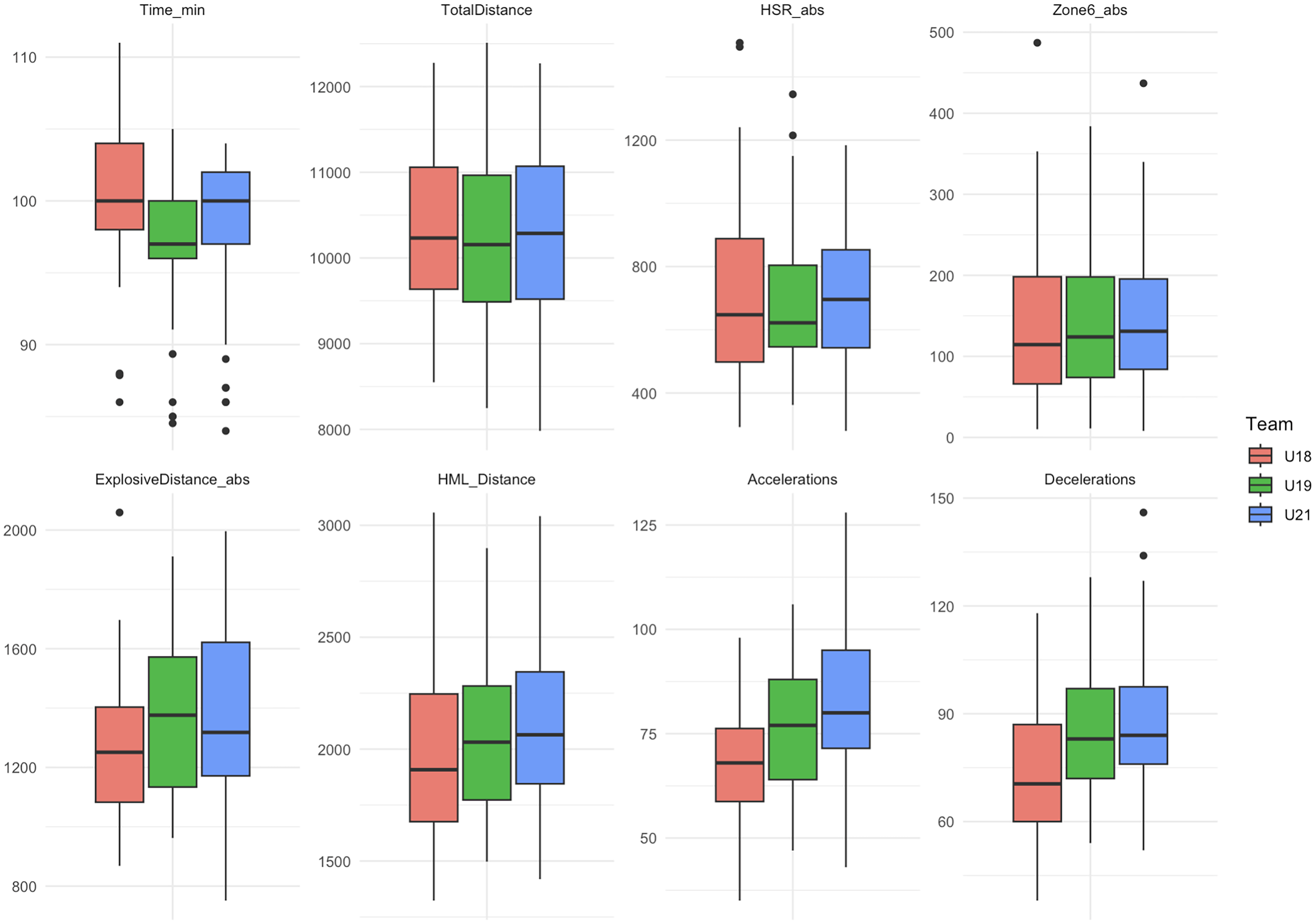
Distribution of average match play physical demands for U-18, U-19 and U-21 outfield players. Boxes show the median and interquartile range (IQR; 25th and 75th percentiles), whiskers extend to the most extreme values within 1.5 x IQR, with outliers shown as individual data points. Note: Time_min, match duration (minutes); TotalDistance, total match distance (m); HSR_abs; high-speed running distance (m); Zone6_abs, sprint distance (m); ExplosiveDistance_abs, explosive distance (m); HML_Distance, high metabolic load distance (m); Accelerations, number of accelerations > 3 m/s2; Decelerations, number of decelerations > −3 m/s2.
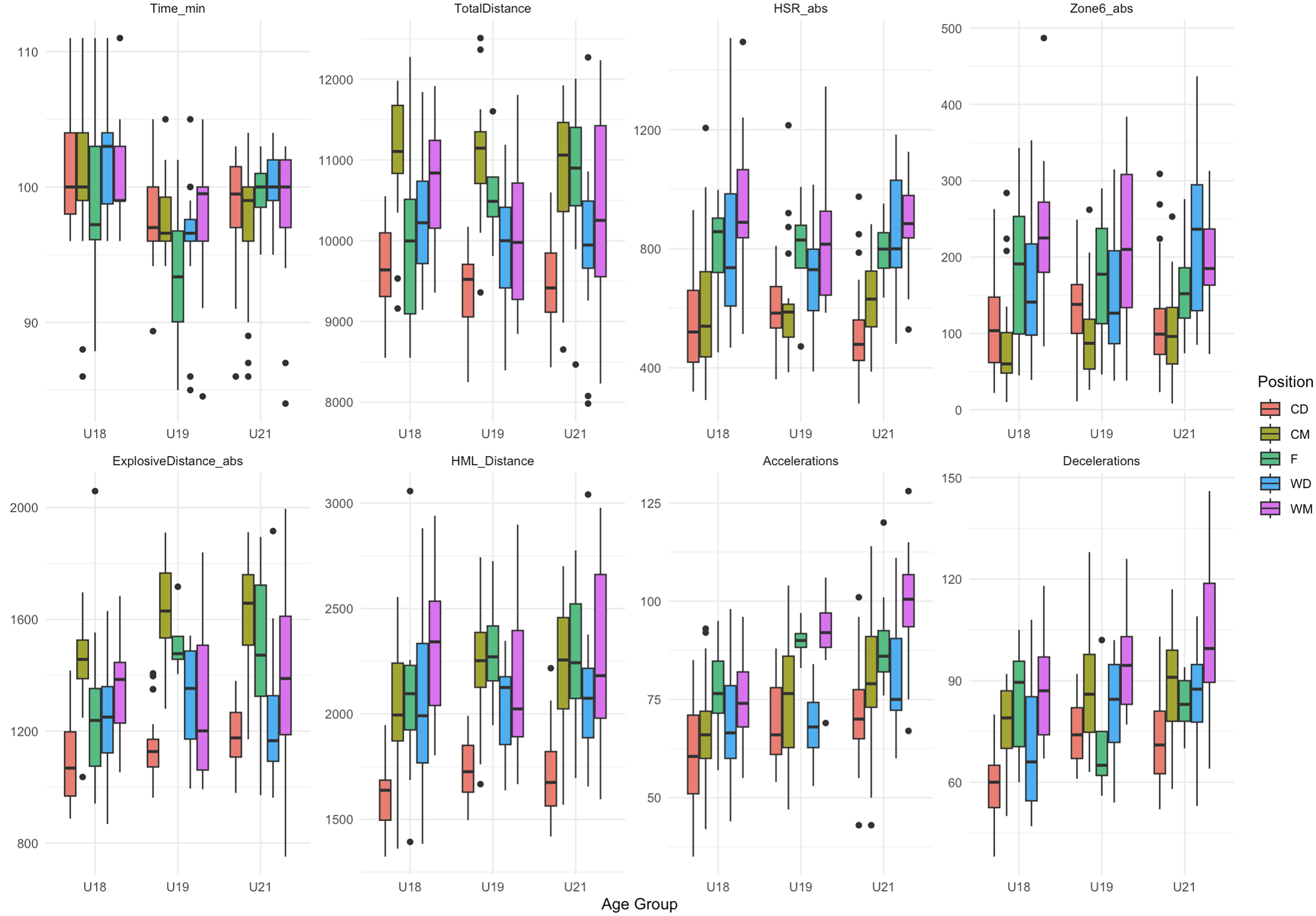
Distribution of match play physical demands for U-18, U-19 and U-21 games by playing position. Box and whisker plot conventions are as described in Figure 1. Note: CD, central defenders; WD, wide defenders; CM, central midfielders; WM, wide midfielders; and F, forwards. Other abbreviations are as per Figure 1.
At the team level, average match duration was longer for the U-18 s than for both the U-19 and U-21 teams (p = <0.001; ES = small) (Figure 3, supplementary file tab 2). Under 18 s completed greater TD than the U-19 (p = <0.01; ES = small), but not the U21 s (p = >0.05, ES = trivial) (Figure 3, supplementary file tab 2). Total decelerations were higher for both the U-19 (p = <0.01; ES = small) and U-21 (p = <0.01; ES = small) teams than the U-18 s, and the total number of accelerations were higher for the U-21 s than the U-18 s (p = <0.05; ES = small) (Figure 3, supplementary file tab 2).

Fixed effects coefficient estimates relative to the model reference team (U-18) and playing position (CD). Abbreviations are as per Figure 2. Note: *, p < 0.05; **, p < 0.01; ***, p < 0.001.
Positionally, WM players completed the greatest HSR and sprint distances (p = <0.001; ES = small), and the greatest HMLd and number of accelerations and decelerations (p = <0.01; ES = small) (Figure 3, supplementary file tab 2). Central midfield players completed the greatest TD (p = <0.001; ES = small) and had greater ED, HMLd and deceleration demands (p = <0.05; ES = small) than the model reference group (Figure 3, supplementary file tab 2). Wide defenders completed more total distance (p = <0.05; ES = small), HSR (p = <0.001; ES = small), sprint and HMLd (p = <0.01; ES = small) distance and performed more decelerations (p = <0.01; ES = small) than the model reference group (Figure 3, supplementary file tab 2). Finally, forwards completed more accelerations (p = <0.05; ES = small) and decelerations (p = <0.01; ES = small) than the model reference group (Figure 3, supplementary file tab 2).
Within-positions across-teams, U-19 (p = >0.05; ES = small) and U-21 (p = <0.05; ES = small) CM players completed greater ED than U-18 CM players. Similarly, there was a trend for U19 forwards to complete more ED than U-18 forwards (p = >0.05; ES = small) (Figure 2, supplementary file tab 3). U-19 and U-21 CM (U-19: p = >0.05; ES = small and U-21: p = <0.05; ES = small) and WM (U-19: p = >0.05; ES = small and U-21: p = <0.05; ES = small) players completed more accelerations than U-18 CM and WM players (Figure 2, supplementary file tab 3). Finally, U-19 WD (p = <0.05; ES = small) and CD (p = >0.05; ES = small) completed more decelerations than U-18 WD and CD (Figure 2, supplementary file tab 3).
At the interactive (Team x Position) level, U-21 CM players completed the greatest HMLd (p = <0.05; ES = small) distance and more ED (p = <0.05; ES = trivial) than the model reference groups. While performing more ED (p = <0.05; ES = trivial), U-21 WM players completed less sprint distance (p = < 0.05; ES = trivial) than the model reference group (Figure 3, supplementary file tab 2).
Discussion
This investigation aimed to examine U-19 (UYL) match running demands in the context of adjacent domestic age group demands (i.e., EPL U-18 and U-21) at team-average and positional levels over two consecutive seasons and determine if UYL demands exceed, align with, or fall between U-18 and U-21 domestic competition. Our main finding is that though TD was marginally greater in the U-18 s, high-speed (i.e., HSR and sprint distance) and high-intensity (i.e., ED, HMLd, ACC and DEC) demands typically increased linearly with chronological age (i.e., U-18 < U-19 < U-21). Overall, CM players completed the greatest TD, wide players (i.e., WD, WM) had notably large high-speed and high-intensity demands and F had particularly high ACC and DEC demands. Within positions across age groups, U-19 and U-21 WD, CM, WM and forwards typically completed more high-intensity activity than their U-18 counterparts, and interactive analysis revealed that U-21 CM and WM players experienced the greatest high-intensity match running demands. Based on these findings, H1 is rejected and H2, H3, H4 and H5 are accepted.
The most important findings from this investigation relate to the greater high-intensity and high-speed running demands observed during U-19 s and U-21 s games, compared to U-18 s games. This effect was observed at Team, Team x Position and within-position across-team levels. For example, at the Team level, though TD was marginally greater in the U-18 s than the U-19 s (rejecting H1), deceleration activity was greater in the U-19 s than the U-18 s. Similarly, despite equivocal TD, acceleration activity was greater in the U-21 s than in the U-18 s. Overall, these findings suggest that total match volume (TD) is broadly consistent across the PDP phase, whereas high-intensity and high-speed running increase more linearly with advancing age group. This finding might reflect the influence of situational and contextual factors, whereby TD is influenced not only by physical capacity but also by tactical structure, pacing strategies, and game context. Indeed, greater tactical efficiency and positional discipline expected in older age groups might offset increases in physical capacity, resulting in broadly similar TD across age groups. Reynolds and colleagues 4 previously reported equivocal TD and sprint distances during U-18 and U-23 EPL academy games but greater HSR demands in U-23 games. Our finding that high intensity match actions increased linearly across age groups is novel and might be explained by a combination of training induced advancements to physical, technical and tactical abilities that occur across the PDP. For example, previous scientific literature has proposed that training age is associated with increases in bioenergetic, biomechanical and movement skill qualities supporting the ability to perform a higher volume of intense match actions. 20 Indeed, similar findings have been reported previously 21 and might go some way to explain the stepwise increase in high intensity match output observed across age groups both herein and previously.4,21–25 Of note, this notion is supported somewhat by our recent in-house post-preseason 30-15 test 26 performance (VIFT) data for the U-18 and U-21 cohorts (20.4 ± 0.97 km/hr vs 21.5 ± 1.1 km/hr); anecdotally connecting high-intensity running capacity to high-intensity match output. 27
Our findings relating to average positional demands are largely consistent with previous scientific research literature.5–7 For example, across positions we found that WD and WM players had particularly high TD, HSR, HMLd, sprint, acceleration and deceleration demands, that CM players completed the greatest TD and had high ED, HMLd and deceleration demands and that forwards had high ACC and DEC demands compared with CD, WD and CM (figure 3). However, interestingly, at the Team x Position level, we found that both U-19 and U-21 CM players completed greater ED than U-18 CM players, and U-19 forwards completed more ED than U-18 forwards. Likewise, U-19 CM and WM players completed more high-intensity accelerations than their U-18 s counterparts, and U-19 WD and CD completed more high-intensity decelerations than U-18 WDs and CDs. Though we were unable to report match play technical outcomes in the current research design, previous research has attributed the greater high intensity match demands imposed on WD, WM and CM players to the dual role that these positions adopt in connecting attacking and defending situations, and their specific requirement to complete more high-intensity actions to support pressing and counter-pressing actions when out of possession.5,6 Moreover, the greater HSR, sprinting, and acceleration demands commonly observed in wide players are also proposed to relate to their primary involvement in wide areas of the pitch, which are characterised by having a lower player density. This is thought to provide a greater opportunity to perform high-intensity and high-speed actions that facilitate counterattacks and goal-scoring opportunities, while necessitating rapid recovery and defensive transition efforts.5–7 Interestingly, Bradley and colleagues 6 reported that high-intensity match actions are most strongly associated with defensive recovery and transition-oriented behaviours when out of possession, and with final third entries when in possession. Accordingly, we speculate that our findings may also, in part, reflect the higher quality of opposition and the resultant increased defensive transition speeds typically encountered during U-19 and U-21 games compared to U-18 games. Collectively, these situational and contextual demands might contribute to the elevated acceleration, sprinting, and HSR requirements observed in these players.5,6,8
The notable increase in match play physical demands observed from U-18 to U-19 and U-21 cohorts has important practical implications. Of note, the PDP phase in EPL academies is principally structured around U-18 and U-21 teams, with U-19 teams only assembled for UYL games for qualifying teams. Consequently, in comparison to many European leagues that have U-19 teams as part of their normal academy structure, U-19 teams in EPL academies are principally comprised of younger players derived from the U-18 and U-16 teams. Importantly, our findings indicate practically meaningful increases in game speed and intensity from U-18 to U-19 and U-21 levels across all outfield playing positions. Consequently, we recommend that coaches and practitioners alike consider the physical capacities and training status of players when making decisions regarding team selection and the readiness of players to execute their tactical responsibilities within roles. Indeed, the step-wise increase in high-intensity match demands highlighted here infers that transitioning ‘up’, through these age groups presents a meaningful step-wise physical challenge to players; and existing evidence indicates that this transition might be better tolerated by players with more advanced physical capacities. For example, we recently reported that speed, strength and endurance capacities positively moderated match-induced neuromuscular fatigue in EPL U-18 academy players, reinforcing the role that these physical capacities play in supporting match-play physical demands. 28
Though we acknowledge that high-volume, high-intensity and high-speed, intermittent demands transcend all playing positions in elite-level football match play, our findings highlight several unique positional characteristics that might warrant specific consideration for physical preparation methods used across the PDP. For example, it is very apparent from our findings, and an extensive body of previous research4–7 that CM and wide players (in particular) necessitate highly developed bioenergetic (i.e., aerobic and anaerobic), biomechanical and movement skill (i.e., acceleration, maximal speed, deceleration) profiles to satisfy the running demands of match play, with speed qualities being particularly important for wide players. However, our findings that forwards and CD experience specific, meaningful increases to acceleration, deceleration and ED demands when playing at U-19 and U-21 levels are novel and should be considered in their long-term physical preparation strategy. For example, by virtue of these findings, practitioners and coaches alike might consider affording more attention to developing the underpinning qualities that support repeated acceleration, deceleration and change of direction capacity in younger players transitioning to U-19 and U-21 competitions. Though such training methods are discussed in good detail elsewhere,29,30 we crudely propose that this might include developing technical competency in acceleration, deceleration and change of direction movement skills, and designing sessions characterised by high densities of repeated acceleration, deceleration and change of direction efforts, aligned with positional match demands. Overall, these results provide a useful benchmarking framework for players, coaches, and support staff. Indeed, the positional reference values reported here allow individual match performances to be contextualised relative to typical PDP standards and provide developmental targets across age groups. Practitioners may use these benchmarks to evaluate whether players ‘playing up’ are physically coping with the demands of older age groups, to identify areas requiring further physical development, and to inform training design aimed at preparing players for the demands of subsequent PDP stages and UYL competition.
Notwithstanding our practically important findings, there are several limitations that readers should consider in relation to this investigation. The interactions discussed here mostly achieved small effect sizes and therefore should be addressed with some conservatism. Moreover, despite limiting our analysis to retain statistical power, some interactions were characterised by having a low number of observations (supplementary file, tab 1) and should also be considered with some caution. This limitation pertains mostly to the forwards sub-group and likely relates to these being the most substituted players in games and the most common position to broach our ‘full match’ exclusion criteria. As such, the present findings should be interpreted specifically as reflecting full-match running demands. Future work incorporating time-normalised metrics or substitution-specific analyses may provide a valuable complementary perspective on positional running demands across all match exposures. Additionally, we acknowledge that the use of broad positional groupings assumes a degree of homogeneity within each position and may mask role-specific or individual variability in match demands; therefore, the present findings should be interpreted as representing average positional profiles rather than the full range of within-position behaviours. Also, we were unable to include several potentially important situational and contextual variables in our analysis, which likely relate to the physical performance data reported. Of note, these include measures of possession context, quality of opposition, match state and tactical approach,5–7 which might have otherwise helped to support our conclusions. Consistent with other well cited scientific research,4–6 we used absolute as opposed to relative HSR and sprint thresholds and acknowledge that this could be considered as a limitation. Additionally, we acknowledge that High metabolic load distance (HMLd) and explosive distance (ED) are model-derived, composite indicators intended to characterise the combined energetic and mechanical demands of high-intensity match actions, particularly those occurring at sub-maximal running speeds but involving frequent accelerations and decelerations. Owing to their conceptual nature, these metrics are more challenging to validate using traditional field-based criterion methods and should therefore be interpreted descriptively and in conjunction with established external load measures. Accordingly, HMLd and ED were included to complement, rather than replace, well-validated speed- and acceleration-based variables. Finally, we examined U-18, U-19 and U-21 male players and acknowledge that our results pertaining to match play physical demands might not be generalisable across female cohorts or younger (i.e., < U-18) and older (i.e., senior professional) male cohorts who participate in international club competitions. As such, we encourage similar research to be conducted in these groups. Nonetheless, we consider that our research design provides a novel and interesting overview of the physical demands of EPL PDP and UYL match play physical demands at team average and positional levels.
Conclusion
Though total match running volume was similar across PDP chronological age groups, high-speed and high-intensity match running demands typically increased linearly across the U-18, U-19 and U21 cohorts. Central midfield players completed the greatest TD, wide players (WD, WM) had the greatest high-speed and high-intensity demands, and forwards had notable high-intensity acceleration and deceleration demands. Within-positions across-teams, particularly high demands were observed for ED (CM, WM and forwards), accelerations (CM and WM) and decelerations (WD and CD) in U-19 and U21 players compared to their U-18 counterparts. Transitioning ‘up’ to the U-19 and U-21 cohorts from the U-18 s presents players across all positions with meaningful increases to high-speed and / or high-intensity match running demands. Consequently, practitioners and coaches alike should consider the physical capacity and training status of players when making team selection decisions and adopt specific physical preparation strategies aligned with these match demands to better prepare players for their positional demands, particularly when transitioning into UEFA Youth League and U-21 competition.
Supplemental Material
sj-xlsx-1-spo-10.1177_17479541261438438 - Supplemental material for A contextual comparison of UEFA Youth League and English Premier League academy match running demands across the professional development phase
Supplemental material, sj-xlsx-1-spo-10.1177_17479541261438438 for A contextual comparison of UEFA Youth League and English Premier League academy match running demands across the professional development phase by M Springham, N Singh, L Stafford, J Salter, A. Clarke, T Griffiths, I Jones, D May and P Stewart in International Journal of Sports Science & Coaching
Footnotes

Ethical considerations
This study was approved by the Ethics Committee of St. Mary’s University (Ethics Application Number: 2021-21_230) on March 23, 2022.
Consent to participate
All participants provided written informed consent prior to enrolment in the study. This research was conducted ethically in accordance with the World Medical Association Declaration of Helsinki.
Consent for publication
Not applicable.
Author contributions
Conceptualisation (MS); Data Curation (NS, MS, LS, AC, TG, DM); Formal Analysis (MS); Funding Acquisition (n/a); Investigation (MS, NS, LS, AC, TG, DM); Methodology (MS, NS); Project Administration (MS, NS, PS); Resources (n/a); Software (MS); Supervision (MS, JS, PS); Validation (MS, JS, PS); Visualization (MS); Writing – original draft (MS); Writing- review & editing (MS, NS, LS, JS, AC, TG, IJ, DM, PS).
Funding
The authors received no financial support for the research, authorship, and/or publication of this article.
Declaration of conflicting interests
The authors declared no potential conflicts of interest with respect to the research, authorship, and/or publication of this article.
Data availability
We are unable to make raw data publicly available.
Supplemental material
Supplemental material for this article is available online.
References
Supplementary Material
Please find the following supplemental material available below.
For Open Access articles published under a Creative Commons License, all supplemental material carries the same license as the article it is associated with.
For non-Open Access articles published, all supplemental material carries a non-exclusive license, and permission requests for re-use of supplemental material or any part of supplemental material shall be sent directly to the copyright owner as specified in the copyright notice associated with the article.
