



Abstract
This study tested whether momentary enjoyment moderates within-session effects of Differential (DL) and Repetitive Learning (RL) on basketball shooting performance and perceived exertion (RPE) in youth athletes. Thirty-seven players were randomly assigned to DL (n = 19) or RL (n = 18) and completed 16 training sessions across eight weeks. Enjoyment was assessed after each session using the Physical Activity Enjoyment Scale (PACES) and decomposed into within-person and between-person components. Performance outcomes included Stationary Shooting Accuracy Test (SSAT) scores before and after a 30-shot training task (30-STT), as well as accuracy during the 30-STT itself. RPE was recorded immediately following each session. Linear mixed models (LMMs) were used to analyze group effects and enjoyment-related moderators. Results showed that DL yielded superior performance in the 30-STT (β = 2.23, p = .011, d = 0.66) and substantially lower RPE compared with RL (β = −1.18, p < .001, d = −1.40), reflecting performance differences within the practiced task constraints rather than generalized shooting proficiency. We did not detect moderation of DL versus RL effects by enjoyment; however, confidence intervals for interaction terms and the limited variability in PACES indicate that small-to-moderate moderation effects cannot be ruled out. SSAT scores were similar between groups pre- and post-task, with explained variance driven primarily by individual differences rather than enjoyment changes. Training structure accounted for immediate performance and RPE differences independently of post-session enjoyment, though this does not preclude the importance of affective states, which require more comprehensive assessment and ecologically valid performance measures.
Introduction
Shooting proficiency is widely recognized as a decisive component of basketball performance, shaping outcomes across all competitive levels, from youth participation to elite professional play. 1 The ability to execute accurate shots in varied and dynamic situations is essential to a player's overall contribution to team success. 2
Performance in basketball shooting arises from the interaction of multiple physical, psychological, and technical factors. Research has examined how physical demands, 3 biomechanical parameters, 4 and mental conditions 5 influence shooting accuracy. Training interventions such as shooting drills, 1 coordination and plyometric exercises, 6 and core-stability work 7 have also been proposed to refine technique. However, despite extensive research, these determinants are typically examined in isolation, leaving their combined influence insufficiently understood.
More recently, affective processes have been highlighted as relevant determinants of training responses. However, it is important to distinguish between the well-established role of enjoyment in long-term motivation and adherence to physical activity, as articulated within Self-Determination Theory (SDT), and its potential influence on immediate, session-level outcomes. Within SDT, enjoyment reflects autonomous motivation and is consistently associated with sustained engagement and persistence in sport and exercise behaviors over time. 8 This body of evidence primarily concerns longitudinal behavioral regulation rather than acute performance modulation. By contrast, short-term associations between affective states and perceived exertion may be theoretically grounded in psychophysiological models of effort perception, which posit that RPE reflects a centrally mediated appraisal integrating afferent signals with cognitive–affective factors. 9 Positive affective valence during or immediately after exercise may, therefore, plausibly relate to lower perceived exertion at the session level via attentional allocation and appraisal processes. In relation to shooting accuracy under tightly constrained task conditions, any putative acute influence of enjoyment is expected to be modest, given the limited scope for affect-driven modulation of motor output in repetitive, low-variability tasks. Accordingly, in the present study, enjoyment was hypothesized to be more proximally related to RPE than to immediate shooting accuracy, and any affect–performance association was anticipated to be small in magnitude.
Changes in training methodology provide an additional layer of complexity. Traditional approaches emphasizing repetition and stable movement patterns are increasingly complemented by learner-centered, variable-based models. DL is one such approach, characterized by purposeful movement variability and the reduction of repetitive practice to foster motor exploration and adaptability. 10 By exposing athletes to a wide range of movement variations, DL is theorized to support the development of individualized, flexible solutions; however, in the present study, outcomes reflect immediate performance under the practiced constraints, and no inferences about retention or adaptability can be made. Although DL has been shown to benefit retention and adaptability in other sport contexts, the present study does not include retention or transfer assessments and therefore cannot make claims about learning effects. 11
Fatigue, both physical and mental, represents another factor that may influence the learning process. Physical fatigue reduces force production and neural activation, 12 while mental fatigue increases perceived exertion and impairs technical performance. 9 In basketball small-sided games, higher technical and cognitive demands elevate perceived effort. 13 Because shooting tasks provide immediate feedback, understanding how perceived exertion interacts with psychological states such as enjoyment is essential for interpreting performance fluctuations.
Despite the relevance of these domains, research examining enjoyment within basketball-specific training remains limited. The only available study suggests that offensive tasks demand greater mental effort than defensive tasks and that relationships among enjoyment, mental load, and perceived exertion are weak. 13 This scarcity of evidence highlights a need to investigate how enjoyment interacts with different motor learning approaches during shooting performance.
Therefore, the present study aimed to examine whether post-session enjoyment moderates the effects of DL versus RL on basketball shooting performance and RPE. Given DL has been theorized to support learning, we hypothesized that enjoyment would exert a stronger positive influence on performance in the DL condition compared to the RL condition.
Methods
Research design
A between-subjects, two-group experimental design with repeated measures was implemented. To examine the within-session effects of the two learning approaches, all participants completed the SSAT immediately before and after the 30-STT and reported their RPE. Enjoyment was conceptualized through the PACES, administered after each training session to quantify participants’ affective responses to the intervention. The distinction between within-person and between-person enjoyment was maintained to allow a nuanced understanding of affective variability and its relationship with learning conditions. 14 Participants completed 16 training sessions over eight weeks (two sessions per week) during the competitive season. Because the team trained three times weekly, the experimental sessions were scheduled during the first and third weekly practices. All sessions began with a standardized warm-up followed by the assigned learning intervention (DL or RL). Although the intervention extended over eight weeks with repeated exposure to the training conditions, the present analyses focus on session-level, immediate responses (i.e., within-session or post-session performance and perceived exertion), and therefore do not constitute evidence of motor learning or longer-term adaptation, which would require dedicated retention and/or transfer tests beyond the practice context.
Participants
This study is part of a previously described experimental protocol, 15 from which distinct outcome variables are analyzed here. This approach aligns with international ethical guidelines, which permit the reuse of methodological descriptions across related publications provided that transparent cross-referencing is ensured. 16
A priori sample size estimation was conducted using G*Power (Version 3.1.9.6, Institut für Experimentelle Psychologie, Düsseldorf, Germany). Assuming an expected effect size of 0.7, an alpha level of 0.05, and a statistical power of 0.80, the minimum required sample size was determined to be 21 participants. Random allocation to DLG or RLG groups followed a computer-generated sequence with a 1:1 ratio.
Eligibility criteria required a minimum of two years of formal basketball training and competitive experience, as well as full attendance at all 16 training sessions and scheduled assessments over the eight-week intervention. Participants were recruited from a structured youth basketball development program coordinated by the National Basketball Academy in Kaunas. Athletes who missed training or assessment sessions, or who sustained injury or illness, were excluded from the final analysis.
The DLG comprised 19 athletes (13.2 ± 0.29 years; 169.7 ± 9.1 cm; 57.1 ± 10.5 kg; 7.4 ± 2.1 years of experience), whereas the RLG included 18 athletes (13.8 ± 1.1 years; 171.3 ± 8.6 cm; 59.4 ± 15.4 kg; 7.1 ± 1.5 years of experience). Baseline comparisons revealed no significant between-group differences (p > .05). All athletes trained three times per week as part of their regular team schedule.
Participants and their guardians were informed of the objectives and procedures of the study and notified of their right to withdraw at any time. Ethical approval was granted by the Institutional Ethics Committee of Vytautas Magnus University (Approval No. SA-EK-23-29), and the study adhered to the Declaration of Helsinki.
Training interventions
Differential learning sessions
The DL sessions required participants to perform shooting tasks incorporating systematically varied constraints related to the performer, equipment, or environment. In accordance with the theoretical foundations of DL, 17 no corrective feedback was provided during task execution. Each athlete completed 30 shots across five predetermined court locations, with scoring based on the number of successful attempts (Figure 1). Two assisting players retrieved rebounds to maintain continuous task execution. The DL intervention incorporated variations delivered in blocks, including changes in equipment (e.g., mini handball, street football, size-7 basketball), body-related constraints (e.g., unilateral shooting, one-legged shooting), target manipulations (e.g., elevated platform, lowered basket, presence of a defensive mannequin), and perceptual constraints (e.g., goggles, occluded vision). These variations produced systematic fluctuations designed to induce exploratory behavior and enhance motor adaptability, consistent with DL principles. 18 Post-test assessments were administered immediately after each DL sequence.
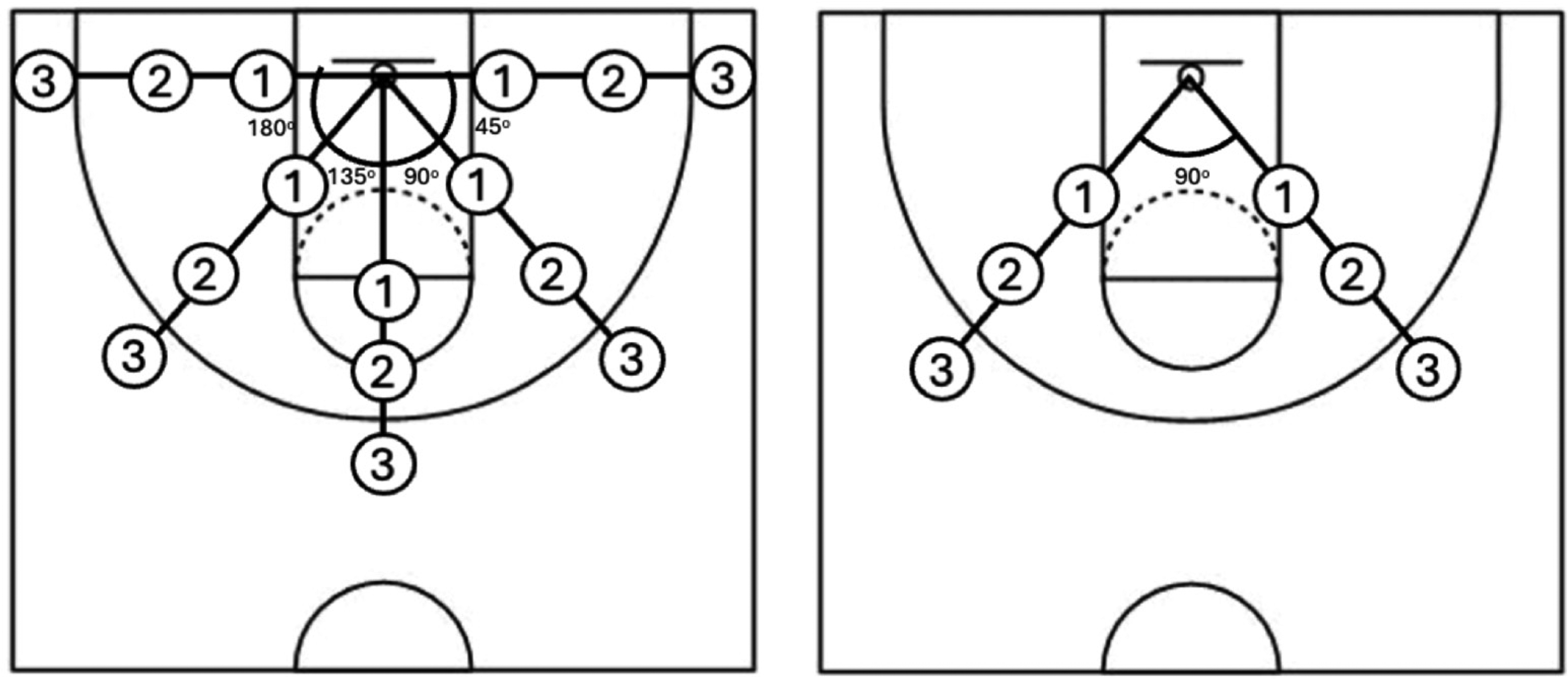
Combined representation of the 30-shot training task and the shooting performance evaluation protocol.
Repetitive learning sessions
The RL sessions replicated the DL structure in total volume, spatial configuration, and temporal duration but excluded any variability in constraints. Participants performed conventional basketball shots using a standard size-6 ball and maintained consistent execution across all sessions. As in the DL condition, no corrective feedback was provided. This matched design ensured that the sole experimental manipulation was the degree of practice variability, allowing a precise comparison between the two learning paradigms.19,20
Data collection
SSAT
The modified version of the SSAT followed the protocol described by Pojskic et al., 21 involving two sets of jump shots from six standardized court positions at distances of 3.90 m, 5.30 m, and 6.75 m 22 (Figure 1). Two players assisted with ball retrieval. Performance was recorded as the total number of successful shots using standardized scoring sheets.
30-Shot training task and performance measurement
In the DLG, the 30-STT consisted of six attempts at each of five court angles (0°, 45°, 90°, 135°, 180°), with two shots per distance (3.90 m, 5.30 m, 6.75 m) (Figure 1). Each shot was executed under a specific constraint consistent with DL principles. 17 The RLG performed a parallel task structure without variability. The SSAT was administered 5 min before and after the task, and RPE was collected immediately using Borg's CR-10 scale. 23
PACES
After each session, participants completed the adapted PACES questionnaire. 14 Items were scored on a 5-point Likert scale, converted into numerical codes, and reverse-scored where appropriate. The total score, obtained by summing all 16 items, reflected overall enjoyment, with higher values indicating more positive affective responses. While PACES demonstrates robust psychometric properties for capturing global session enjoyment, post-session assessment may not adequately capture in-task affective dynamics experienced during shot execution. Consequently, PACES scores in the present study likely reflect a retrospective, global appraisal of the session rather than moment-to-moment affective states most proximally related to immediate performance or perceived exertion. Because PACES is completed post-session, scores likely represent a global evaluative judgement that may integrate enjoyment of the practice process and satisfaction with perceived performance (e.g., shot success). Accordingly, PACES in this design cannot disentangle process enjoyment from outcome-related affect.
RPE
RPE was assessed immediately after each session using the Borg CR-10 scale (Borg, 1982). This method provides a valid and widely used indicator of internal training load in youth sport contexts.24,25
Statistical analysis
Descriptive statistics (mean ± SD) were computed for all performance and perceptual variables, including SSAT before the task, SSAT after the task, 30-STT performance, RPE, and PACES. We prioritized pre-specified session-level outcomes (SSAT pre, SSAT post, 30-STT, RPE) modelled via mixed effects with within- and between-person enjoyment components; change-score modelling was not pursued to avoid redundancy and inflation of analytical degrees of freedom given the constrained variability in SSAT. LMMs were then fitted to examine the effects of training methodology (DLG vs. RLG) and enjoyment components on shooting performance and perceived exertion across repeated sessions. For each outcome—SSAT before the task, SSAT after the task, 30-STT performance, and RPE—an LMM was fitted with Group (DLG, RLG) as a fixed effect. Enjoyment was partitioned into within-person enjoyment (PACES_w), representing session-to-session deviations from the individual's mean score, and between-person enjoyment (PACES_b), representing each participant's mean enjoyment across all sessions. Both components, along with the Group × PACES_w interaction, were entered as fixed effects. This approach allowed assessment of whether within-session fluctuations or stable differences in enjoyment predicted performance or effort responses, and whether such effects differed between training conditions. For all DLG–RLG contrasts, Cohen's d was computed by standardizing the model-estimated contrasts with the residual SD (σ) of the respective mixed model and corresponding 95% confidence intervals were derived by standardizing contrast CI limits. Given the sample size and repeated-measures structure, the present models were primarily sensitive to moderate-to-large Group × PACES_w interaction effects (approximately d ≥ 0.40), and smaller moderation effects cannot be excluded. All analyses were conducted in Jamovi (version 2.7.9; analogous procedures reported in previous manuscript version: v1.2.27)
Results
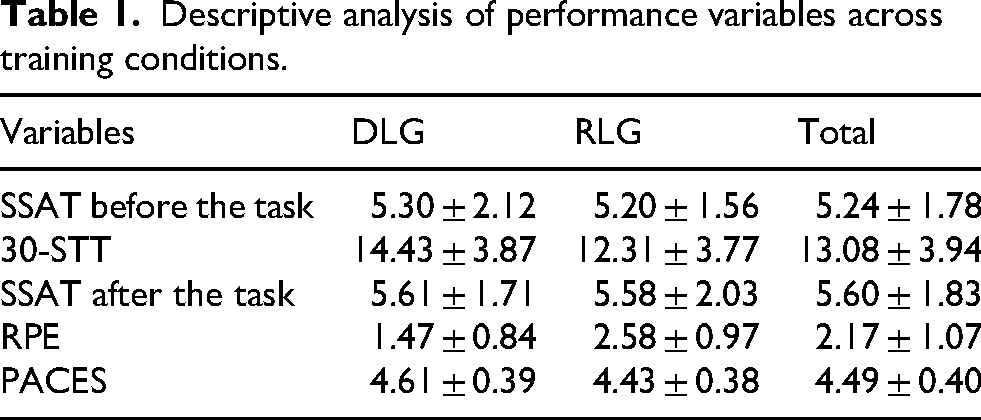
Descriptive statistics for performance and perceptual variables are presented in Tables 1 and 2. LMMs examined the effects of training group (DLG vs. RLG), within-person enjoyment (PACES_w), and between-person enjoyment (PACES_b) on the SSAT before and after the task, on 30-STT, and on RPE. Interaction estimates (Group × PACES_w) were imprecise with wide confidence intervals for SSAT-before and 30-STT, and no statistically significant moderation was detected (Tables 3 and 4). Given the width of the confidence intervals and restricted dispersion in PACES, the data remain compatible with small-to-moderate moderation effects. Model-fit indices indicated modest explanatory power (AIC = 981.28; BIC = 1013.42; R2_marginal = 0.0195; R2_conditional = 0.2530). A significant main effect of training group emerged (β = 2.23, p = .011), with DLG participants outperforming RLG participants (DLG = 14.43 ± 3.87; RLG = 12.31 ± 3.77). Neither within-person nor between-person enjoyment, nor their interaction, significantly predicted shooting performance (all p > .35). The model accounted for a modest proportion of variance (R2_marginal = 0.093; R2_conditional = 0.307). To examine whether post-session enjoyment reflected outcome satisfaction, an additional mixed-effects model was fitted with PACES as the dependent variable and same-session 30-STT performance as a predictor (random intercept for participant). The association was trivial and non-significant (β = 0.001, 95% CI −0.012 to 0.014), indicating minimal overlap between shooting success and post-session enjoyment ratings. No significant fixed effects were observed for group or enjoyment variables (all p > .28), and the Group × PACES_w interaction was also non-significant (β = 0.12, p = .867). Descriptive means were comparable between groups (RLG = 5.58 ± 2.03; DLG = 5.61 ± 1.71). Model-fit indices showed limited explanatory capacity (AIC = 983.41; BIC = 1014.46; R2_marginal = 0.0197; R2_conditional = 0.3527). A strong group effect was identified (β = −1.18, p < .001), indicating that RLG participants reported higher exertion (2.58 ± 0.97) compared with DLG participants (1.47 ± 0.84). No significant main or interaction effects of enjoyment were detected (all p > .55) (Table 5). The model revealed moderate inter-individual variability (AIC = 665.16; BIC = 704.34; R2_marginal = 0.257; R2_conditional = 0.397). Across all models, R2_marginal values ranged from 0.02 to 0.26, and R2_conditional values from 0.25 to 0.40, indicating that a substantial portion of total variance was attributable to individual-level differences rather than fixed predictors. Overall, training methodology significantly influenced shooting performance and perceived effort, whereas momentary enjoyment did not emerge as a significant predictor of either shooting accuracy or exertional responses.
Descriptive analysis of performance variables across training conditions.
Summary of linear mixed model predicting from enjoyment variables and SSAT before the 30-STT.
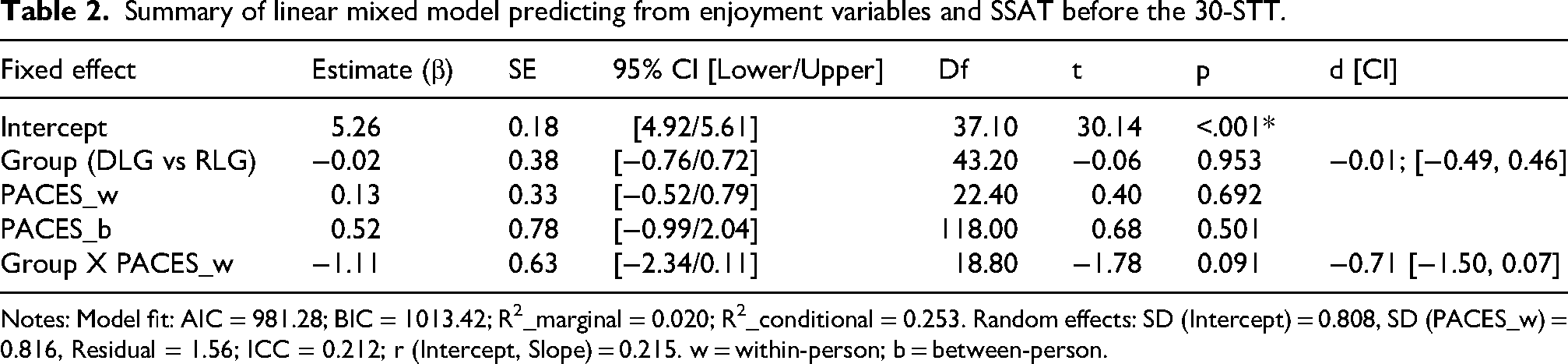
Notes: Model fit: AIC = 981.28; BIC = 1013.42; R2_marginal = 0.020; R2_conditional = 0.253. Random effects: SD (Intercept) = 0.808, SD (PACES_w) = 0.816, Residual = 1.56; ICC = 0.212; r (Intercept, Slope) = 0.215. w = within-person; b = between-person.
Summary of linear mixed model predicting from enjoyment variables and 30-STT.
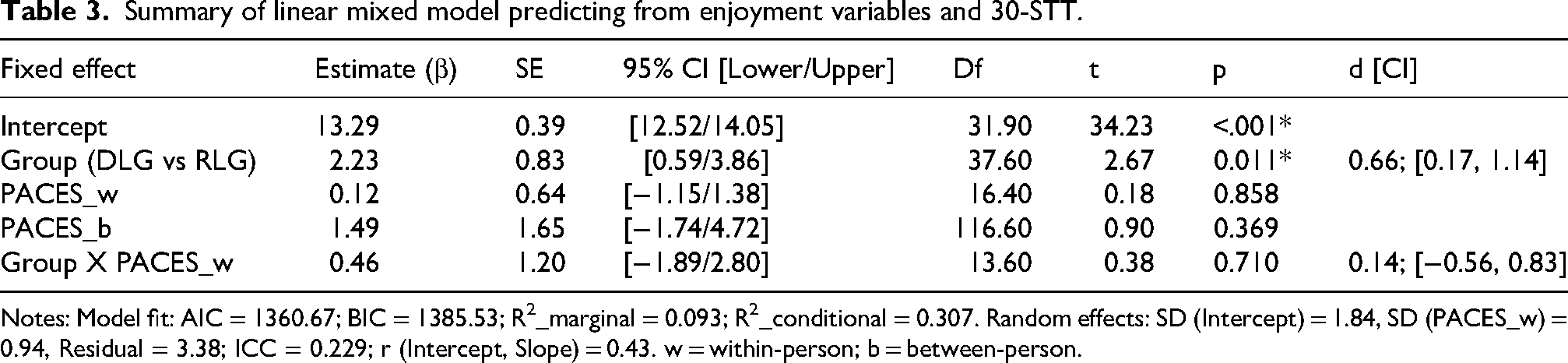
Notes: Model fit: AIC = 1360.67; BIC = 1385.53; R2_marginal = 0.093; R2_conditional = 0.307. Random effects: SD (Intercept) = 1.84, SD (PACES_w) = 0.94, Residual = 3.38; ICC = 0.229; r (Intercept, Slope) = 0.43. w = within-person; b = between-person.
Summary of linear mixed model predicting from enjoyment variables and SSAT after the 30-STT.
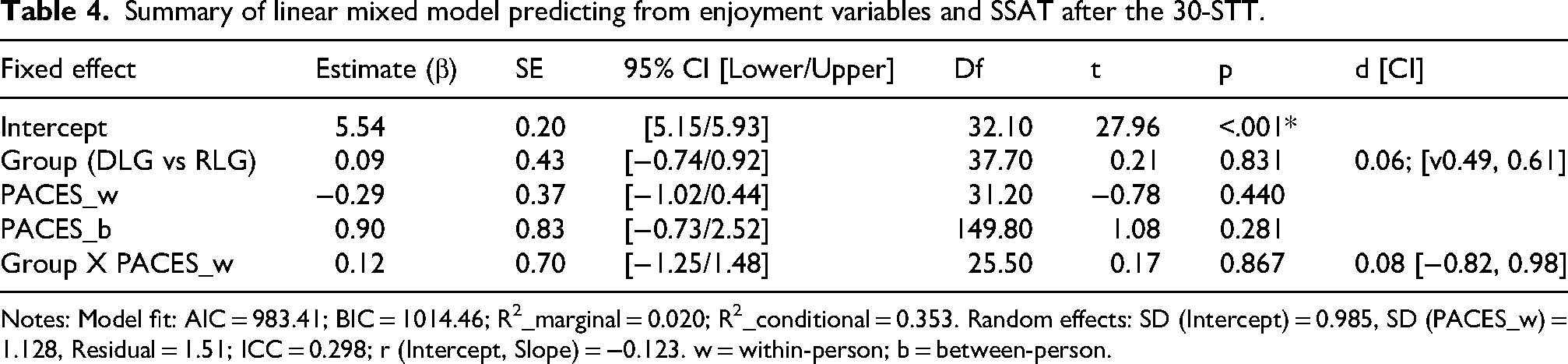
Notes: Model fit: AIC = 983.41; BIC = 1014.46; R2_marginal = 0.020; R2_conditional = 0.353. Random effects: SD (Intercept) = 0.985, SD (PACES_w) = 1.128, Residual = 1.51; ICC = 0.298; r (Intercept, Slope) = −0.123. w = within-person; b = between-person.
Summary of linear mixed model predicting from enjoyment variables and RPE.
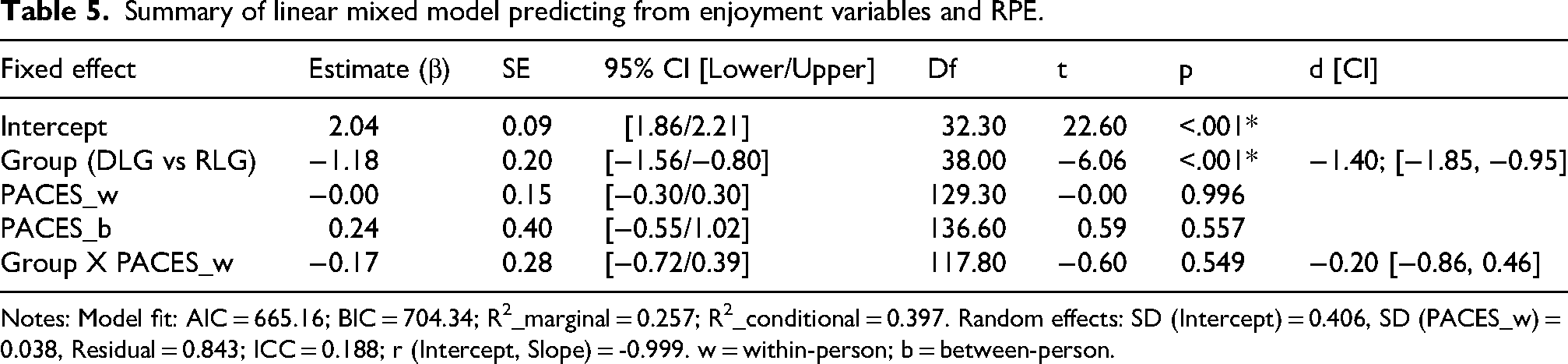
Notes: Model fit: AIC = 665.16; BIC = 704.34; R2_marginal = 0.257; R2_conditional = 0.397. Random effects: SD (Intercept) = 0.406, SD (PACES_w) = 0.038, Residual = 0.843; ICC = 0.188; r (Intercept, Slope) = -0.999. w = within-person; b = between-person.
Discussion
The present study examined whether momentary enjoyment moderated the effects of DL versus RL on basketball shooting performance and RPE. We did not detect moderation of training-method effects by enjoyment in the present sample. Importantly, the wide confidence intervals around interaction estimates and the restricted variability of PACES indicate that small-to-moderate moderation effects cannot be excluded, and the null findings should be interpreted as inconclusive rather than definitive evidence of no moderation. When interpreted against the design sensitivity of the present study (i.e., detectability primarily for moderate-to-large interaction effects), the observed small, standardized interaction effects with wide confidence intervals reinforce that the data are underpowered to exclude small enjoyment-related moderation effects. Importantly, the present outcomes provide a conservative test of affect–performance relations under low-variance, constrained task conditions; thus, the study primarily informs whether any detectable affect-related signal emerges in tightly controlled practice contexts, rather than adjudicating broader affect–performance mechanisms that require higher-variance, ecologically valid, and transfer-sensitive outcomes. Although DL is designed to promote adaptability through increased practice variability, this did not translate into higher shooting accuracy relative to RL. However, DL was associated with significantly lower RPE, suggesting that variable practice may ease athletes perceived exertion despite producing similar short-term performance outcomes.
The absence of moderation by enjoyment contrasts with theoretical perspectives that view positive affect as a facilitator of motor learning and performance. Previous research highlights that structured instruction can enhance athletes’ enjoyment, but such effects are often attenuated in competitive or evaluative contexts. 26 Because both training approaches in this study were implemented in group settings with clear evaluative components, momentary enjoyment may have been constrained by contextual pressure rather than by the training method itself. This interpretation aligns with evidence suggesting that intrinsic motivation, although strongly linked to long-term enjoyment, may not protect athletes from stress-related cognitive interference during performance. 27 Achievement goal theory further suggests that performance-oriented environments increase pressure and reduce enjoyment, whereas task-oriented climates tend to promote more adaptive affective responses. 28 These dynamics may help explain the small, non-significant Group × PACES_w interaction observed in this study, indicating that any enjoyment-related differences between DL and RL were subtle and likely obscured by contextual factors. Rather than concluding the absence of enjoyment effects, we emphasize estimation: interaction effect sizes were small and imprecise, and the data are compatible with a range of plausible effects, including small-to-moderate moderation.
Although enjoyment varied across sessions, as reflected in post-session PACES scores obtained after completion of the 30-STT, these fluctuations were not associated with performance outcomes. This aligns with findings from Calábria-Lopes et al., 29 who note that 41even highly preferred skills such as shooting do not always produce performance-enhancing emotional states in the moment. Additionally, studies by Dewar et al. 30 and Tauer and Harackiewicz 31 show that enjoyment is shaped by both situational demands and athletes’ goal orientations, suggesting that momentary affect may operate more strongly in team-based or social competitive contexts than in isolated skill-execution tasks. A further possibility is that post-session enjoyment was partially outcome-contaminated, reflecting perceived competence or satisfaction with shooting outcomes rather than enjoyment of the training process per se. This conflation may attenuate detectability of distinct enjoyment–performance pathways. Future work should separate process enjoyment (task engagement) from outcome-related satisfaction (perceived success/competence) using in-task affect sampling and/or additional constructs such as perceived competence or need satisfaction. Although post-session enjoyment could theoretically be influenced by perceived competence or outcome satisfaction, our exploratory mixed-effects analysis indicated a trivial, non-significant association between same-session shooting performance and PACES. This suggests that, within the present constrained task context, post-session enjoyment was not strongly driven by immediate performance outcomes. Nonetheless, PACES reflects a retrospective global appraisal, and future studies should incorporate in-task affect sampling and distinct measures of perceived competence to better disentangle process-related enjoyment from outcome-related satisfaction.
Within this framework, the self-organizing nature of DL warrants further investigation. DL encourages exploration rather than explicit instruction, and coaching behaviors that support autonomy, competence, and relatedness may be particularly important for maximizing its affective and motivational benefits. Evidence from Fransen et al. 32 and Cooke et al. 33 underscores the relevance of coaching climate and competitive structure in shaping enjoyment and performance. The present study suggests that under stable competitive conditions, enjoyment alone may not exert an immediate influence on shooting accuracy; instead, performance differences appear attributable to the training method itself.
DL produced a significant main effect on 30-STT accuracy, indicating differences in immediate task performance under the practiced constraints rather than evidence of accelerated motor learning. Because the 30-STT constituted the training task itself, the observed group difference should be interpreted as performance within the practiced context and not as transfer or learning beyond the task. In the absence of retention or transfer assessments, claims regarding learning-related benefits of DL remain speculative.
The results concerning perceived exertion further reinforce the importance of training context. DL participants reported significantly lower RPE than those in RL, despite similar performance levels. This supports claims that RPE reflects not only physical demands but also cognitive and affective appraisals of the task. 34 Prior work shows that motivational stimuli such as music or task novelty can reduce perceived effort and support sustained performance. 34 DL's emphasis on exploration and reduced repetition may similarly lower perceived cognitive monotony, thereby decreasing perceived exertion.
Finally, theories of mental fatigue and emotional load suggest that optimizing psychological states can improve learning outcomes. 9 Although this study cannot directly confirm such interactions, the observed differences in RPE highlight the importance of considering psychological factors when designing training protocols. Collectively, the findings indicate that training structure (DL vs RL) influenced session-level task performance and perceived exertion during repeated exposures across eight weeks. Given the absence of retention or transfer testing, these effects should be interpreted as performance effects within the practiced context, not as evidence of motor learning or longer-term adaptation. Training structure explained immediate task performance and RPE differences independent of post-session enjoyment variability measured here. This should not be generalized to conclude that affective states are unimportant; richer affect measurement (e.g., in-task or experience-sampling approaches) and representative performance outcomes are required to more definitively evaluate affect–performance relations across contexts.
Conclusion
DL was associated with higher in-task shooting accuracy during the 30-STT and lower perceived exertion relative to RL, reflecting short-term performance differences under the practiced constraints rather than demonstrated learning or transfer effects.
In contrast, enjoyment—whether assessed within persons across the session or between individuals—did not significantly predict shooting accuracy on the SSAT or during the 30-STT, nor did it influence perceived exertion. The interaction between training group and within-person enjoyment for pre-task SSAT performance did not achieve statistical significance, and overall variance was primarily driven by individual differences rather than enjoyment levels. These results suggest that training structure exerts a more immediate effect on performance and perceived effort than athletes’ momentary affective states.
Future research should employ larger and more diverse samples to clarify whether enjoyment may moderate performance under different conditions or across longer time scales. Particular attention should be given to the role of coach behavior, as instructional style, feedback, and interpersonal support may meaningfully shape athletes’ enjoyment, motivation, and engagement during training. Longitudinal and experimental designs are recommended to examine how fluctuations in enjoyment, coaching strategies, and practice variability interact to influence sustained performance development and perceived exertion. Integrating physiological, cognitive, and motivational indicators may further elucidate the mechanisms through which affective and contextual factors contribute to athletes’ learning and performance outcomes.
Limitations
Several limitations should be considered when interpreting these findings. Enjoyment was assessed post-session using PACES, which provides a global retrospective appraisal and may not capture within-task affective fluctuations during shot execution; future studies should incorporate in-task or experience-sampling measures to better index affect proximal to performance and RPE. PACES was analyzed as a total score in line with standard practice; however, item-level responses may capture qualitatively different facets (e.g., interest, fun, satisfaction) that could relate differentially to perceived effort or performance. Future studies should pre-specify facet-level analyses or test measurement models (e.g., confirmatory factor analysis) to determine whether subdimensions provide added explanatory value beyond the total score. The absence of retention and transfer tests precludes conclusions about motor learning or adaptability, restricting inference to immediate, session-level performance and perceived exertion. Outcome sensitivity and ecological validity were also limited: SSAT showed restricted variability, and the 30-STT reflected in-task accuracy under practiced constraints rather than transfer to game-representative contexts; future work should use game shooting assessments and include delayed retention/far-transfer tests to enable stronger tests of affect–performance mechanisms. Finally, the study was not powered primarily for moderation, and restricted PACES variability and within/between decomposition reduce sensitivity to detect interactions; thus, small-to-moderate moderation effects cannot be ruled out.
Footnotes
Acknowledgments
The authors would like to thank participants for their contributions to the study.

Ethical considerations
Ethical approval was granted by the Institutional Ethics Committee of Vytautas Magnus University (Approval No. SA-EK-23-29), and the study adhered to the Declaration of Helsinki.
Consent to participate
Participants provided written informed consent to be part of this study.
Consent for publication
Participants provided written informed consent for their anonymised data to be published in this study.
Funding
This research did not receive any specific grant from funding agencies in the public, commercial, or not-for-profit sectors.
Declaration of conflicting interests
The authors declared no potential conflicts of interest with respect to the research, authorship, and/or publication of this article.
Data availability
The datasets analyzed for the current study are not publicly available due to sensitivity of the data and the restrictions from the informed consent but are available from the corresponding author on reasonable request.